Festive Chicken Roulades

Special occasion food doesn’t have to be complicated. Sometimes, it’s the simplest flavors that have the most impact, and this is one of many lessons I learned during the few years that I pitched in at a catering kitchen back in the ’90s. But when an occasion calls for something “fancy,” there are a few tricks you can use to elevate your presentation of simple ingredients. Roulades are a great example of this concept, and it’s only a little bit of extra effort, but the impact is always great!

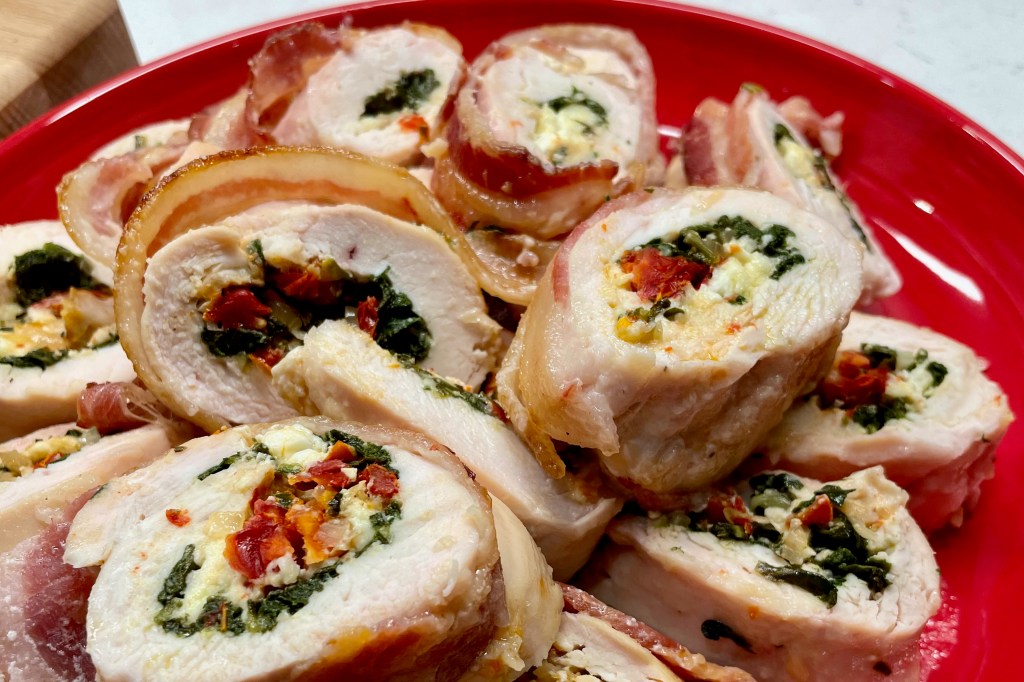
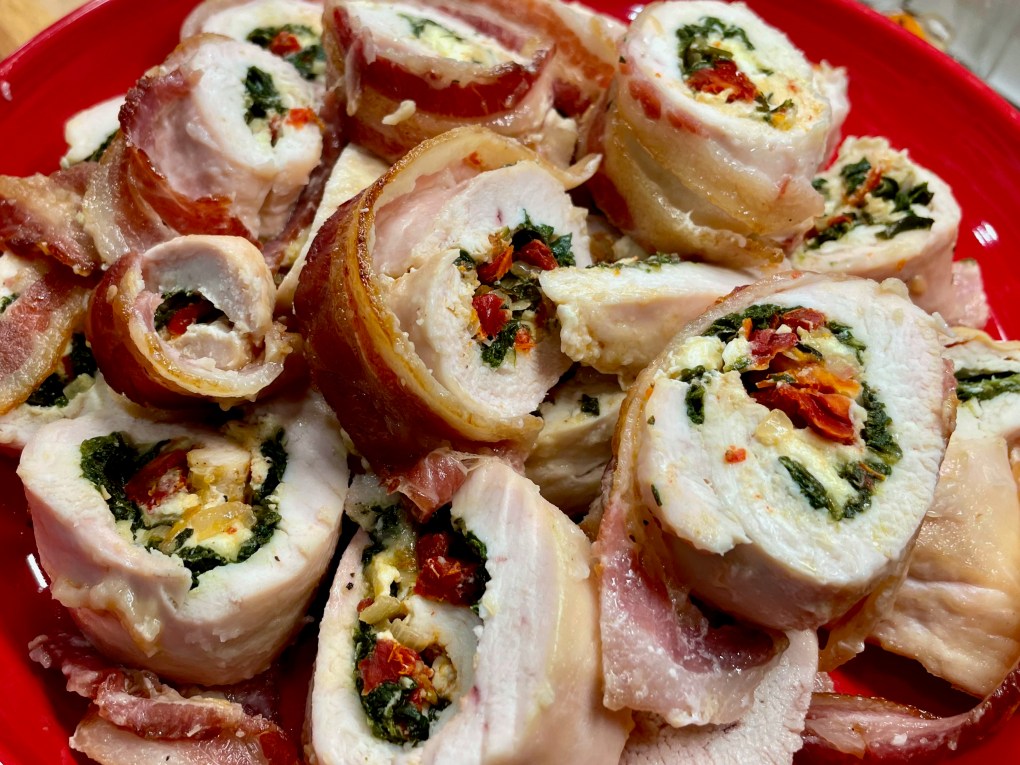
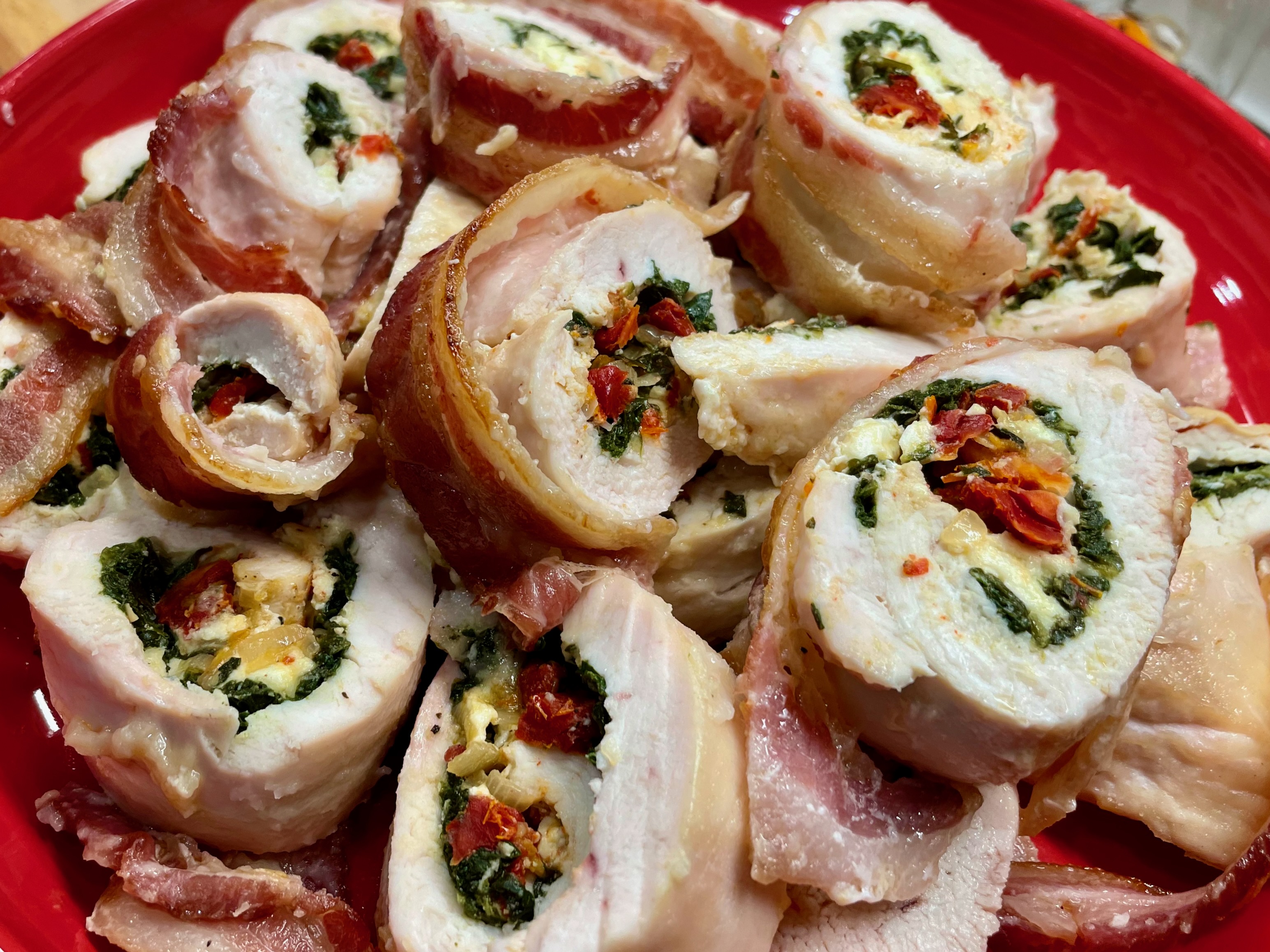
Despite the special appearance of roulades, they’re actually quite easy to make, using whatever fillings sound good to you. This time, mine are bearing festive hues of green and red (just like Christmas), with crowd-pleasing flavors of spinach, feta and sun-dried tomato. The filling is accented with sautéed shallots, garlic and Italian herb blend, and these pretty pinwheels are delicious alongside some roasted garlic mashed potatoes

Are you ready to get cookin’?

My flavors are Mediterranean, but there are so many possibilities!

Special tools

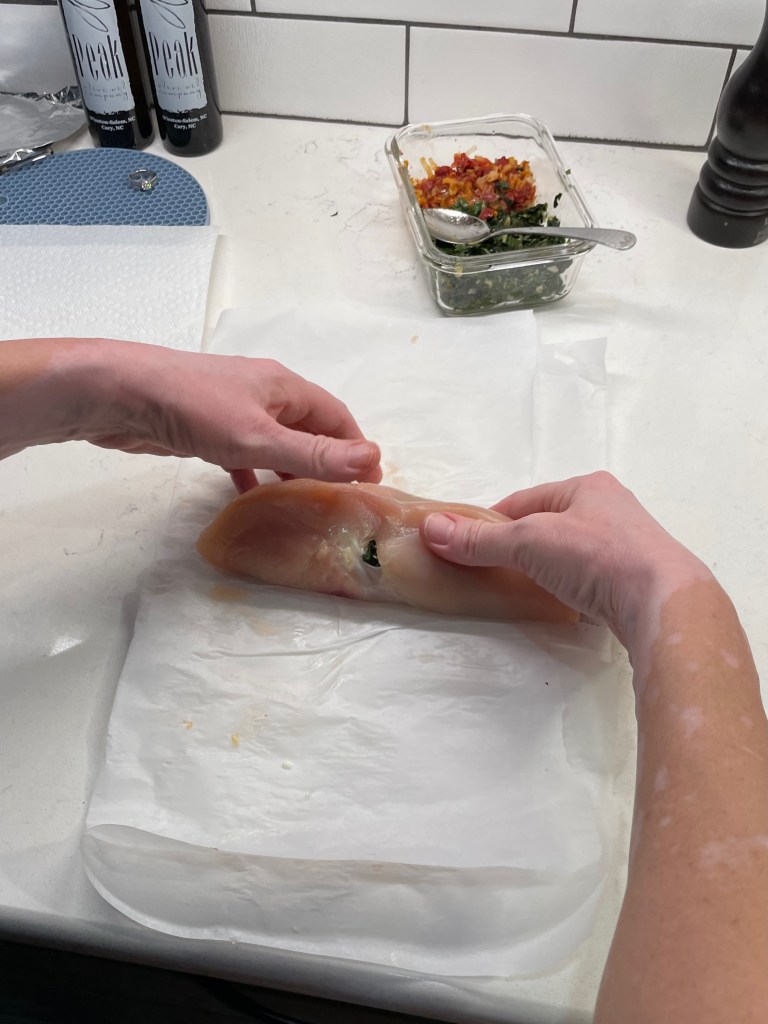
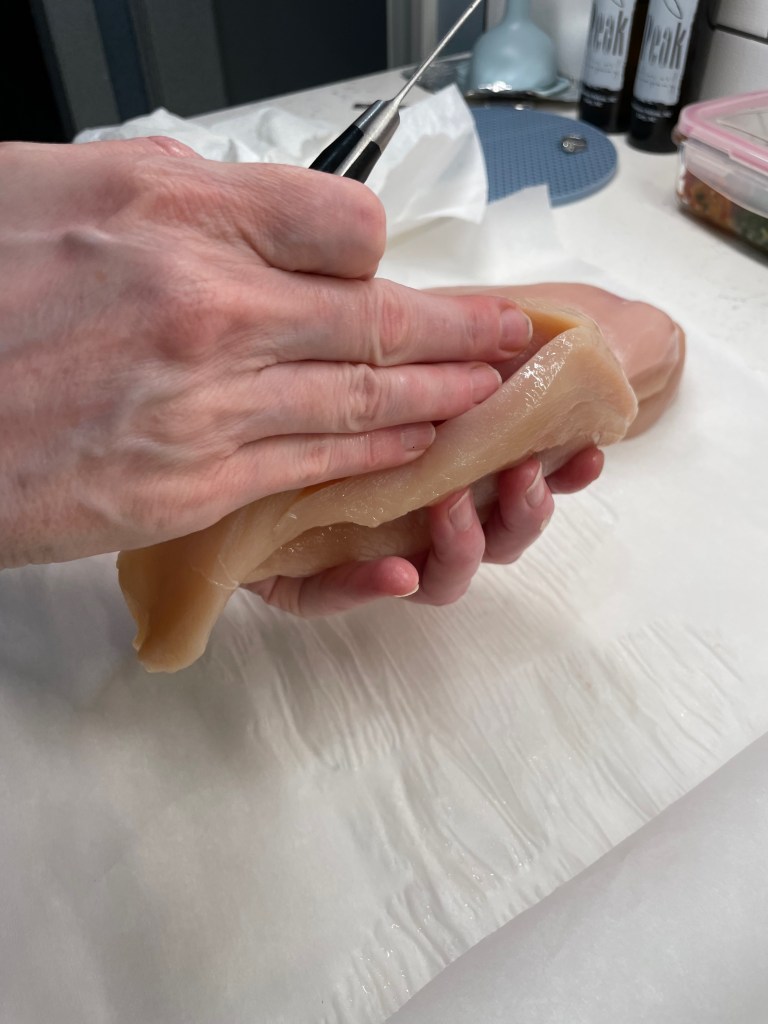
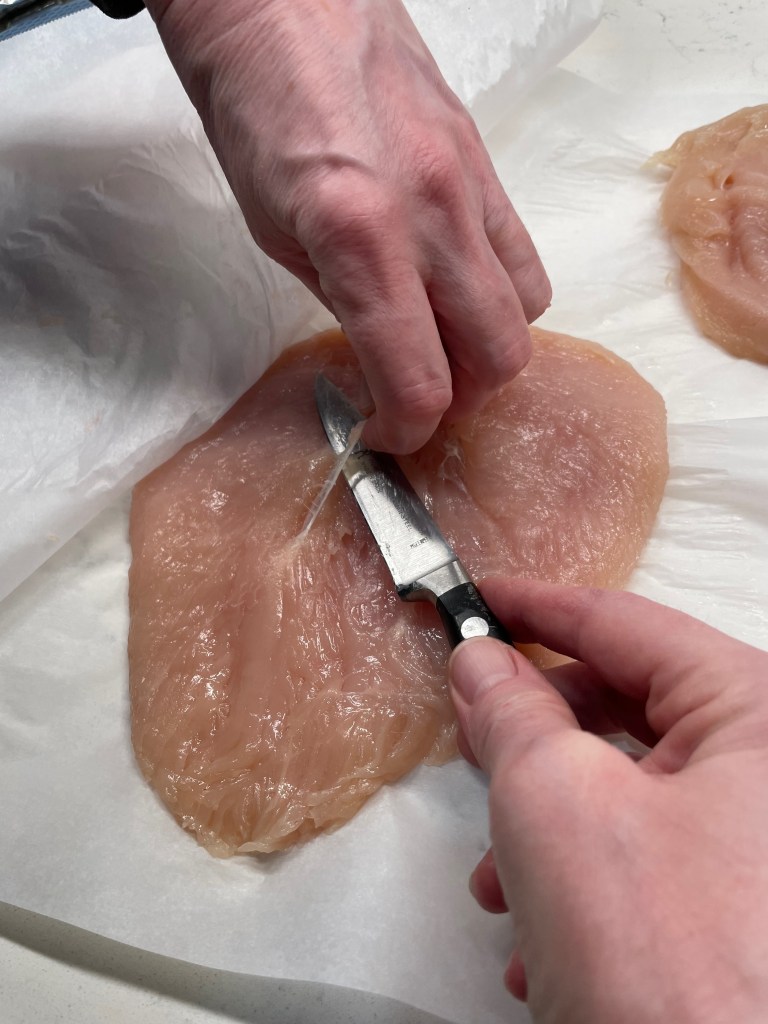
You’ll want to have a few items handy to successfully prep the chicken breasts, and the most important is a sharp, sturdy paring knife that you can use to open up a plump breast into a wider piece that can be pounded flat. A large chef’s knife is not recommended for safety reasons; using a smaller knife allows you to cut with more precision. Begin by holding the thick side of the breast toward you, and make several shallow slits lengthwise, opening the breast as you go, until it lays flat on the parchment. Take your time, and don’t use heavy pressure on the knife. Nobody wants to be at urgent care the week before Christmas.

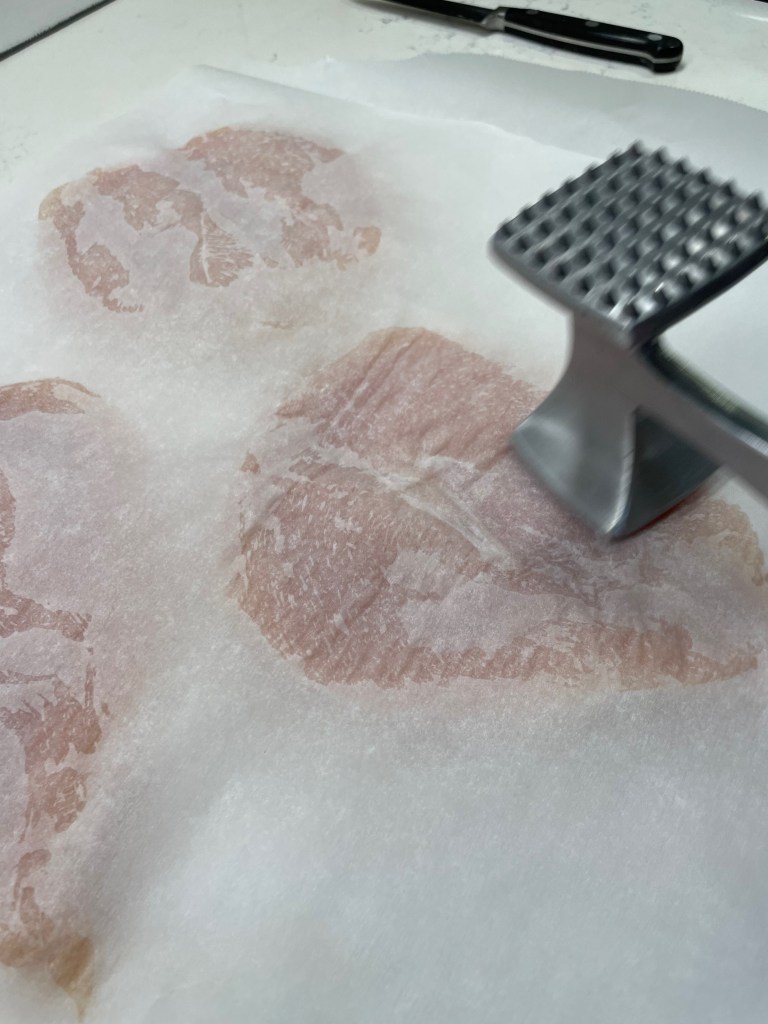
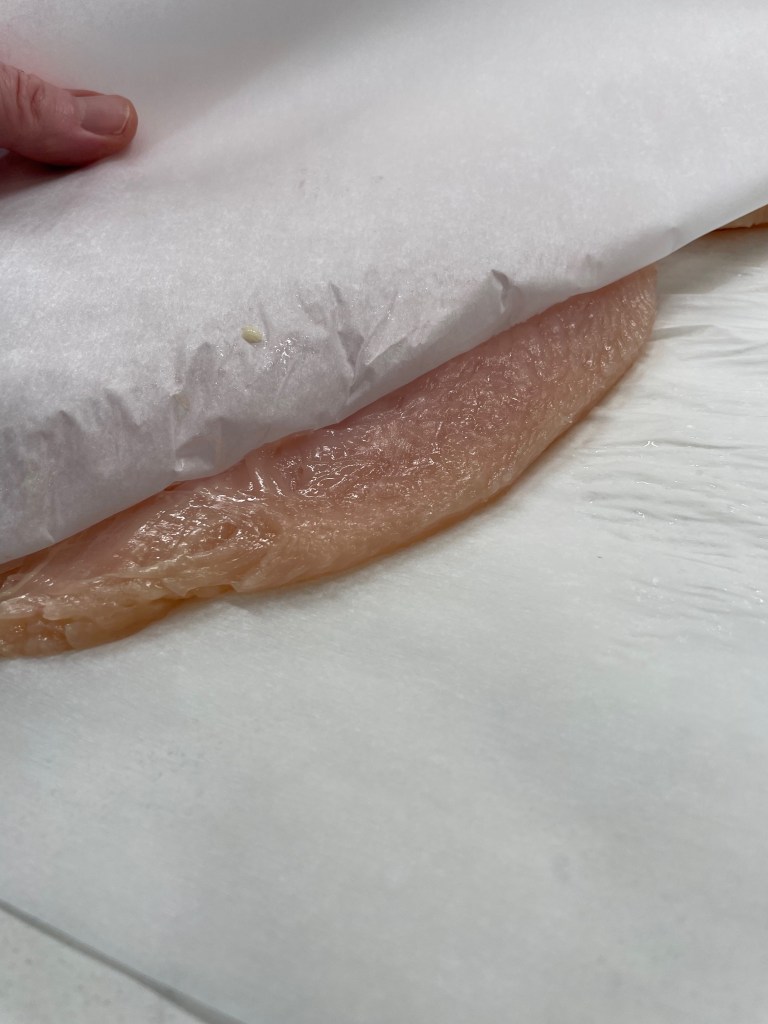
Next, you’ll need parchment or waxed paper and a smooth meat mallet for pounding the chicken. Don’t rush this, and don’t use the textured side of the mallet or you may accidentally split the fibers of the meat. The goal is to gently pound out the breast between layers of paper until it is an even 1/4-inch thickness (or as close to it as you can get). This makes the chicken more flexible for rolling up around your chosen filling ingredients, but don’t go thinner than 1/4-inch, or your chicken will tear apart.
Filling for the roulades

Just about any ingredients you like can be layered into chicken roulades, though I don’t recommend “melty” cheeses because they will always ooze out and make a mess in the oven. If you want a cheesy accent, stick with small amounts of firm cheeses, such as feta, bleu or Parmesan. Whatever vegetables you choose, chop everything small so that the filling rolls up easily and doesn’t fall out of the roulades when you bake them.

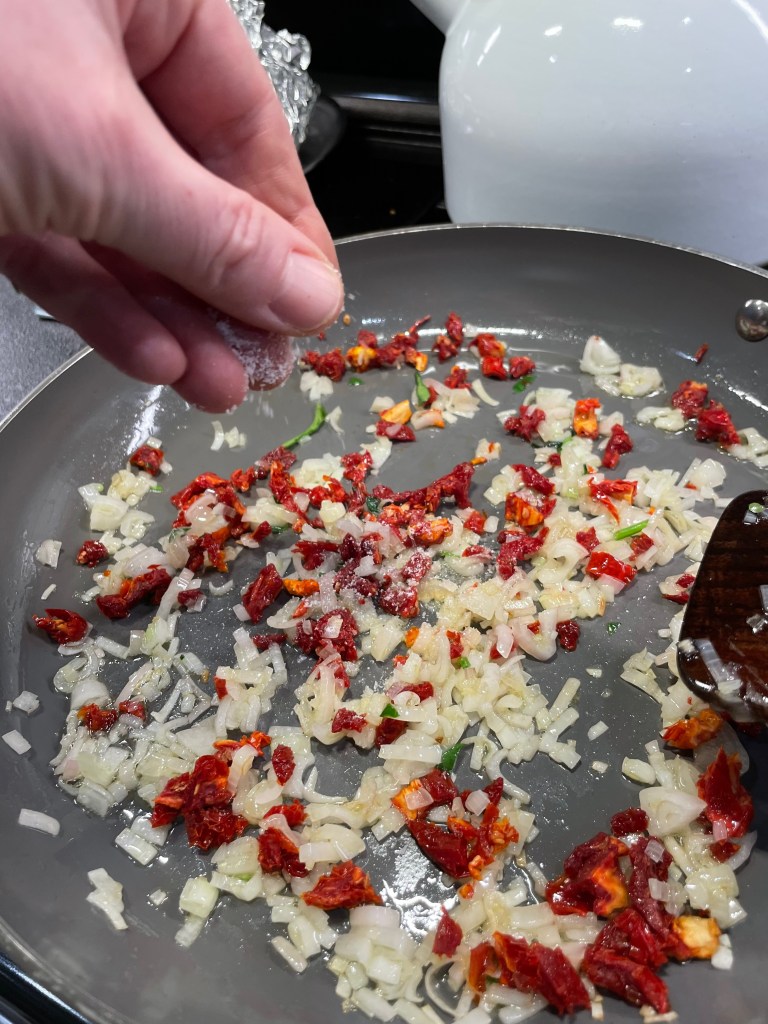
Second, cook any vegetable fillings until they are soft and tender. Raw ingredients rolled up inside the chicken will give off extra moisture and throw off the cooking time, and you’re also likely to have some unpleasant textures. To make the colors of my filling stand out, so I cooked the sun-dried tomatoes and spinach separately, but there would be no harm in cooking it all together to save a little time.

Don’t miss a chance to add flavor!

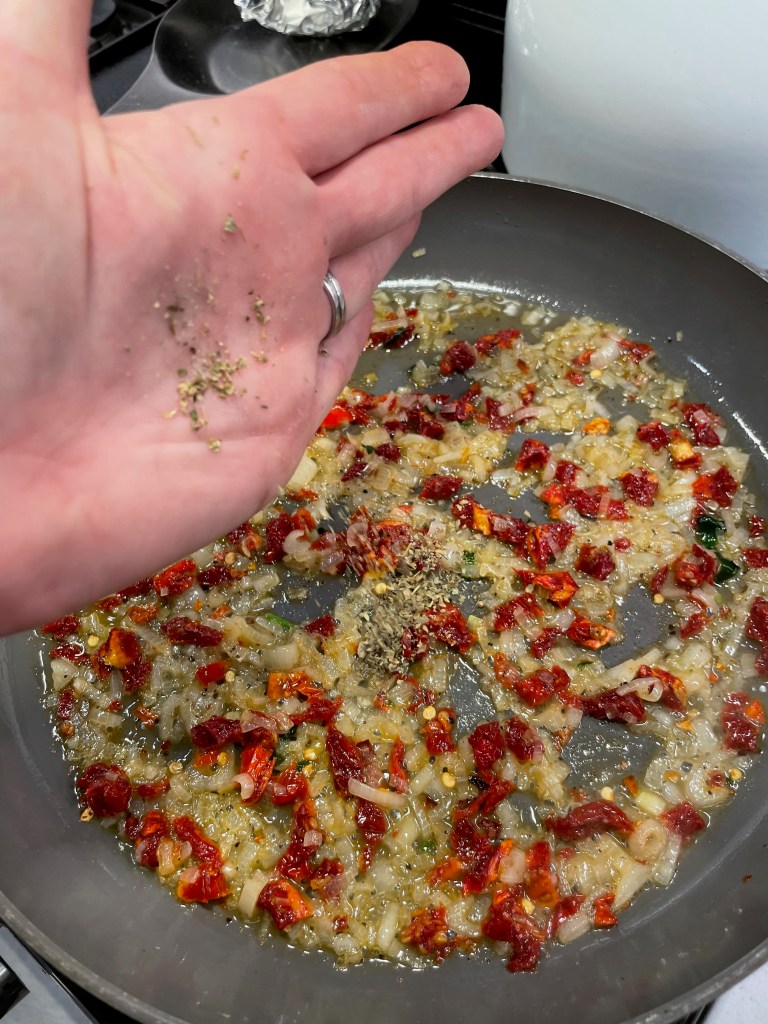
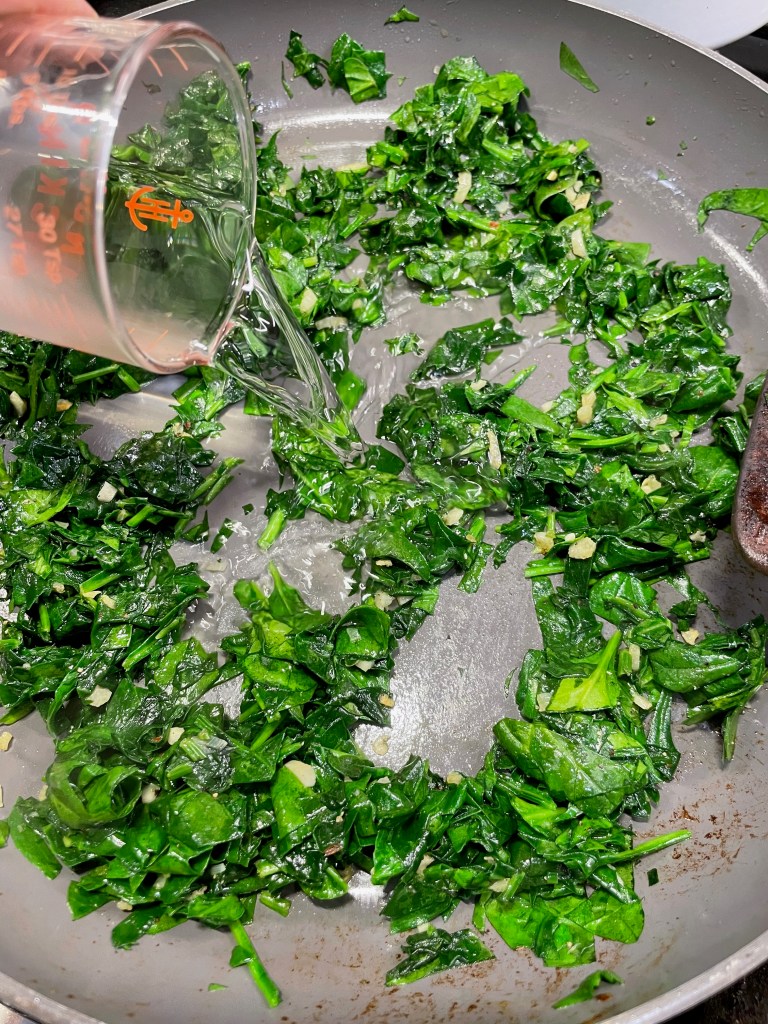
A little Italian herb seasoning and a pinch of Calabrian chile flakes gave my sun-dried tomato mixture some pizazz, and then I simmered with a splash of chicken stock until all the liquid was cooked off. To add depth to the spinach and garlic filling, I braised it in a shot of dry vermouth, again cooking until the excess moisture was evaporated. Dry white wine would be fine here; I just never have one open anymore and the vermouth is more interesting.

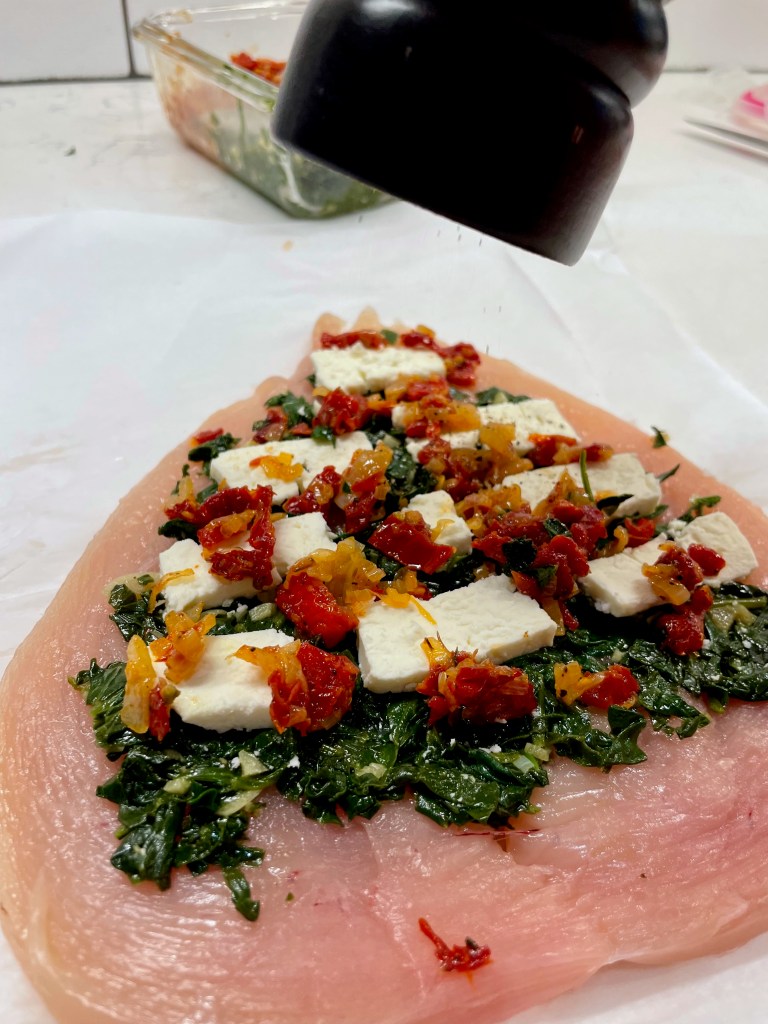
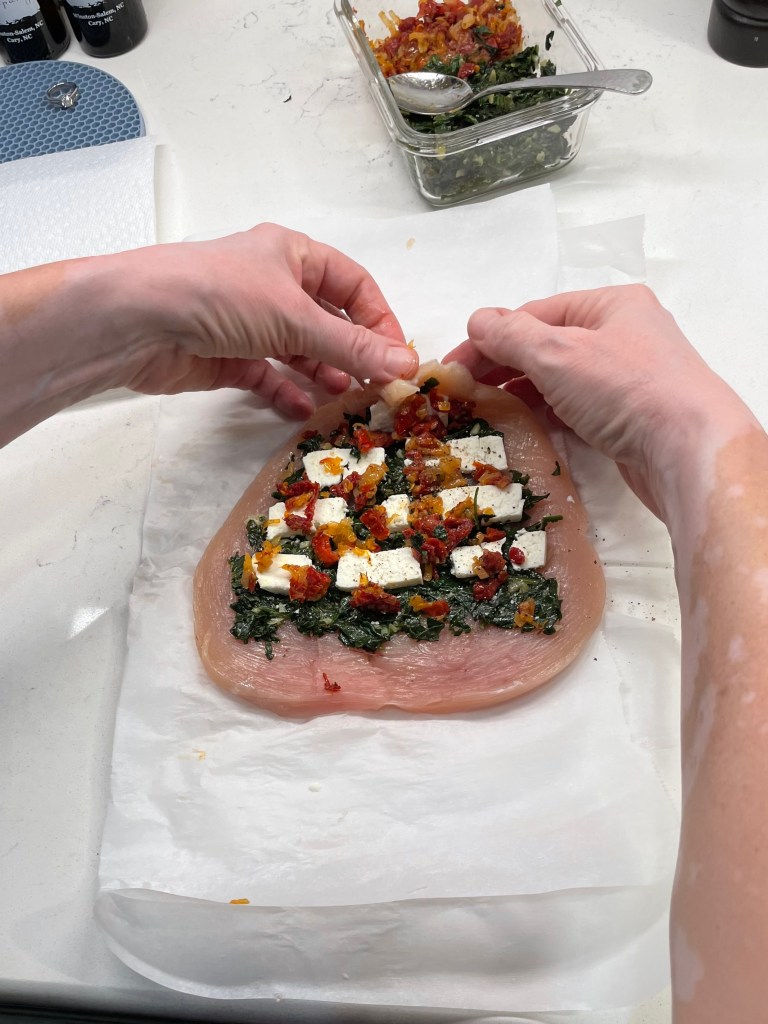
My chicken was layered with the spinach mixture, then thin slices of salty feta, and finally the sun-dried tomato mixture. Begin rolling from the pointed end of each butterflied breast, so that the fillings stay secure inside. The great thing about roulades is that any part of this could be done in advance to save precious time when you’re ready to entertain. You could even roll and refrigerate them in advance and just pull the whole baking sheet out of the fridge an hour before you bake.
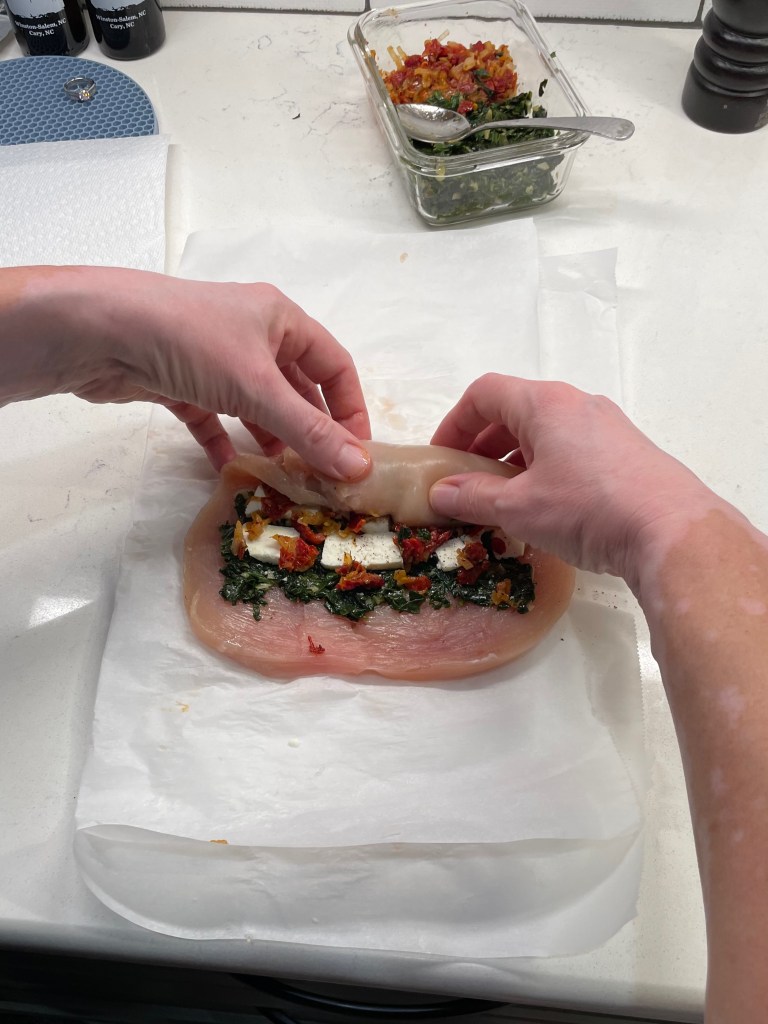
Secure the roulades with toothpicks, or stretch and wrap thin bacon slices all around before placing them (seams or bacon ends down) on a parchment-lined baking sheet. These go straight into the oven— no browning or searing is needed— and they’ll need about 40 minutes at 350° F. Let them cool a few minutes before slicing into one-inch thick rounds. Serve immediately.

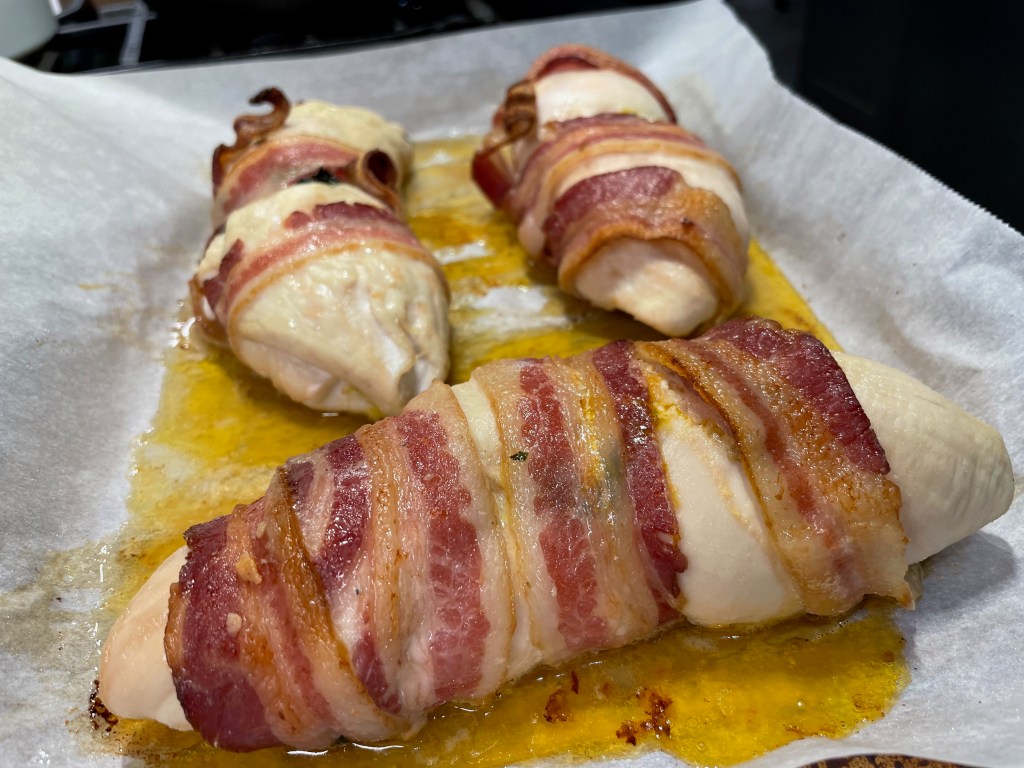
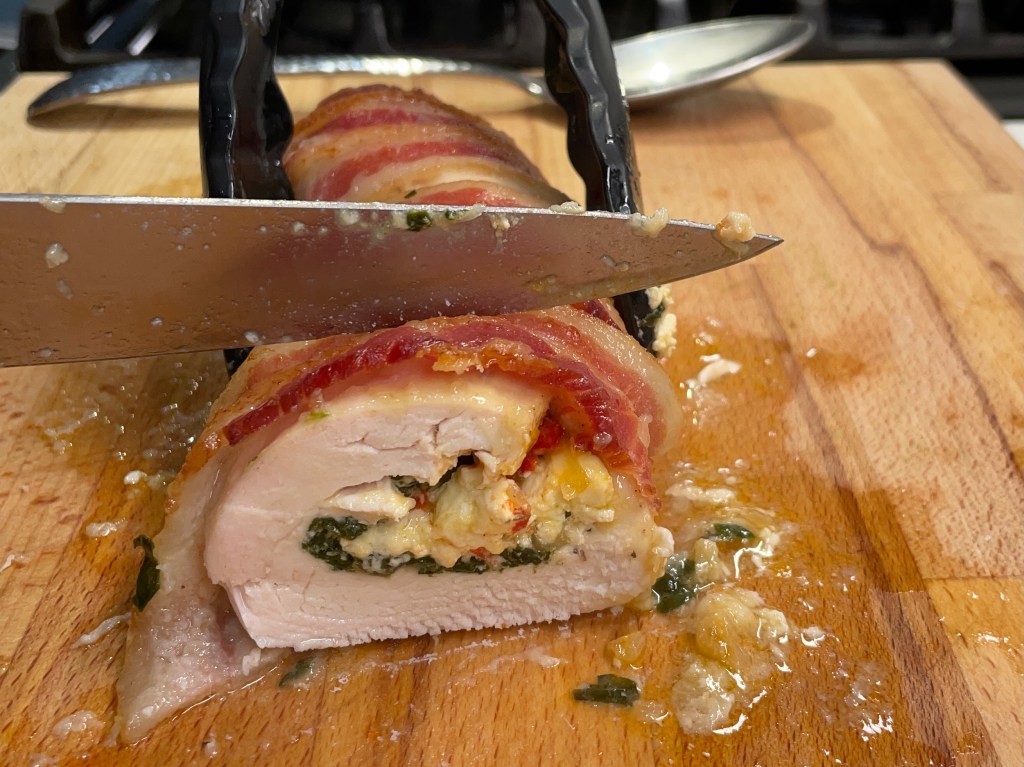
These festive chicken roulades were moist, tender and so flavorful. It made a delicious entree with Les’s amazing roasted garlic mashed potatoes, but I could also imagine them with polenta or risotto with these Italian-themed ingredients. But there are lots of other flavorful possibilities. Now that you know how to make roulades, drop a note in the comments to let me know what filling flavors you would like to try!


Festive Chicken Roulades
  • Servings: 4 generous portions
  • Difficulty: Average
  • Print

With favorite flavors and a few easy techniques, you can transform simple ingredients into something special for holiday entertaining. These roulades are filled with spinach and sun-dried tomato, but as long as your filling ingredients are chopped small and pre-cooked, the possibilities are endless!


Ingredients

  • 1 1/2 pound package skinless, boneless chicken breasts (see notes)
  • 2 Tbsp. extra virgin olive oil, divided (you’ll use half each for sautéing the spinach and tomato mixtures)
  • 2 fat handfuls baby spinach leaves, chopped
  • 2 cloves garlic, finely minced
  • 2 Tbsp. dry white wine (or vermouth, which is my go-to)
  • 1/4 cup chopped sun-dried tomatoes (see notes)
  • 1 medium shallot, finely diced
  • 1/2 tsp. dried Italian herb blend
  • A pinch of red pepper flakes
  • 1/4 cup chicken broth or stock
  • Kosher salt and freshly ground black pepper
  • 4 oz. dry feta, cut into thin slices or crumbled
  • 2 slices thin-cut bacon for each chicken breast used

Notes: The chicken breasts can be any size, and you don’t need to have one breast for each person you’re serving. They will be sliced into rounds, so as long as you have the appropriate weight package, you’ll have enough.

The sun-dried tomatoes I use are soft and pliable, ready straight from the package. If using very dry ones, rehydrate them briefly in hot water or chicken broth and then pat them dry. If using sun-dried tomatoes packed in oil, there’s no need for additional oil for sautéing them with the shallots.

Directions

  1. Preheat oven to 350° F, with rack in center position. Line a baking sheet with parchment paper.
  2. Butterfly the chicken breasts; use a sharp paring knife to cut shallow slits along the fat edge of the breasts, opening as you go until the breasts lay flat on the counter. Place between layers of parchment or waxed paper and pound gently with the smooth side of a meat mallet until they are a uniform, 1/4-inch thickness. Season with salt and pepper and set aside.
  3. Heat one tablespoon of the oil over medium heat. Add the sun-dried tomatoes and shallots and sauté until tender. Season to taste with salt and pepper, plus Italian herb blend and red pepper flakes. Add chicken stock or broth, simmering until the liquid evaporates. Cool completely.
  4. Heat remaining olive oil over medium heat. Add the chopped spinach and garlic and sauté until spinach is fully wilted. Season with salt and pepper, and stir in dry white wine; continue cooking just until the liquid evaporates. Cool completely.
  5. Place the butterflied chicken breasts in front of you, with the pointed ends at the top. Divide spinach mixture evenly over the breasts, then arrange the feta and sun-dried tomato mixture. Roll each chicken breast tightly, starting at the narrow top so that you finish with a long edge. Use toothpicks to secure the edges of the chicken to the roulades, or gently stretch two slices of bacon to wrap around each breast, covering as much as possible.
  6. Bake the roulades (uncovered) 35 to 45 minutes, or until bacon is fully cooked and chicken is opaque but not dry. Internal temp should be ~165° F. Let roulades rest at least five minutes, then slice into one-inch thick rounds and serve immediately.
Crispy Five Spice Duck with Cherry-Pinot Noir Sauce

While out shopping yesterday, I bumped into some friends who asked whether my husband and I would be staying close to home for Christmas. I jokingly told them that yes, our holiday would be easy and simple again this year for one good reason: Les is Jewish. 😂

Our friends know this of course, and they also know that we do celebrate Christmas, just as we celebrate and observe Hanukkah, Rosh Hashanah, Easter and Passover. Even when it is just the two of us, we enjoy making a special dinner for Christmas night— one that usually begins with a fancy appetizer and ends with a nice dessert.

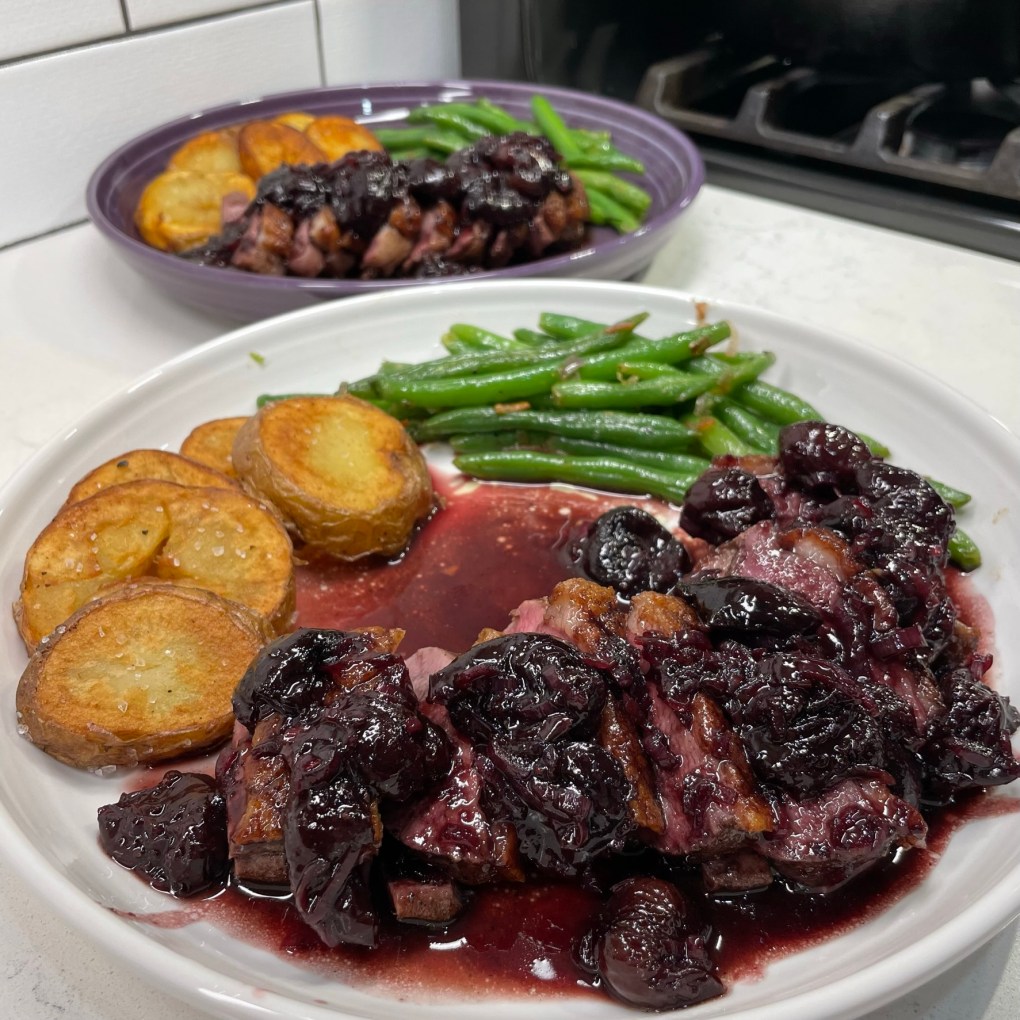
The holidays are a great time to pull out all the stops and splurge a little— calorie- and money-wise—and we relish this little bit of indulgence regardless of whether we are serving guests or just ourselves. Les informed me recently that his favorite “special” dish that I make is duck (funny that I didn’t know that!), and so I’ve decided to share my tips for making a perfectly crispy seared duck breast and a cherry-pinot noir sauce that sounds complicated but is actually so easy.

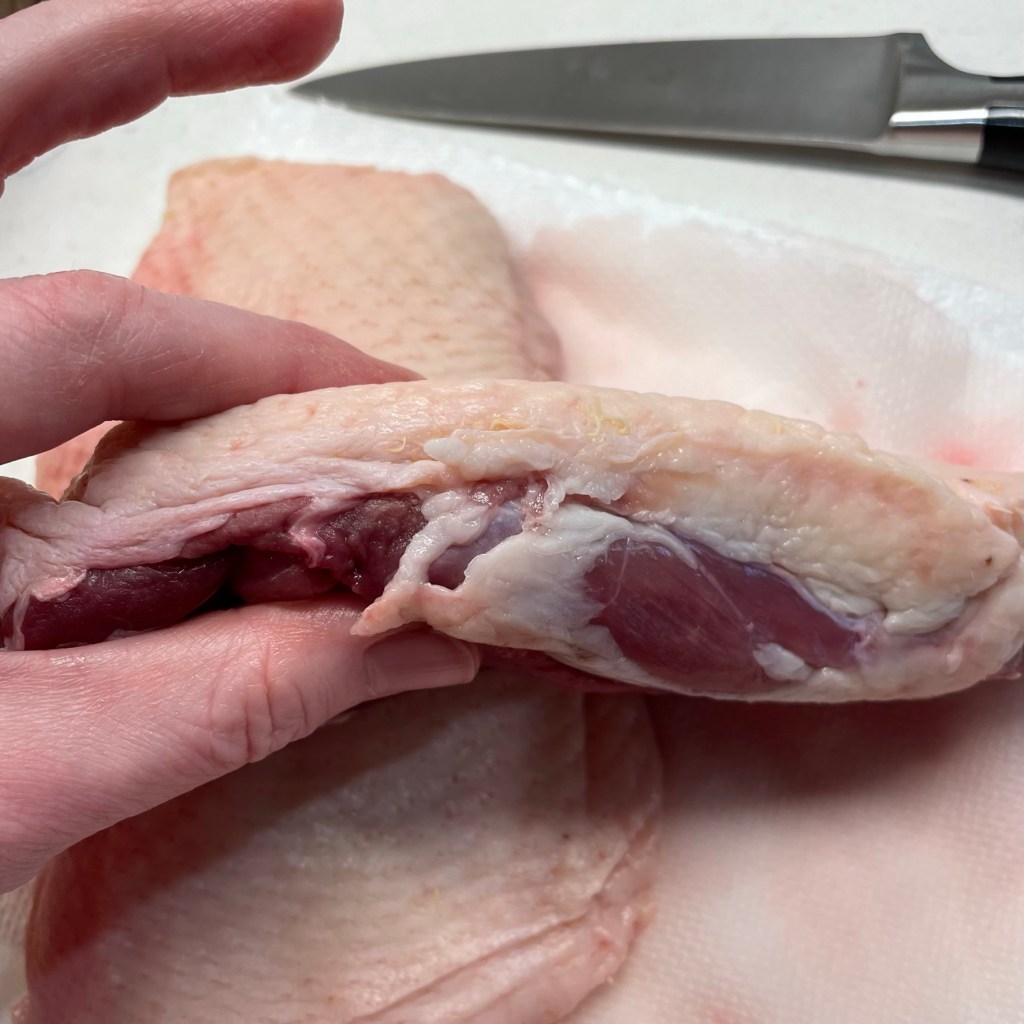
Let’s start at the beginning. At first impression, you might think that duck is similar to chicken, but in flavor and preparation, it is actually closer to red meat. There is a generous layer of fatty skin on duck, and it takes extra care to crisp it without overcooking or drying out the meat. This is the technique that works best for me, and I’m sharing it with a recipe I made for my sweetheart on Valentine’s Day this year. If you already have your Christmas meal planned, save this for February (and make something with chocolate and cherries for dessert).

Tip #1: Score the meat for better rendering


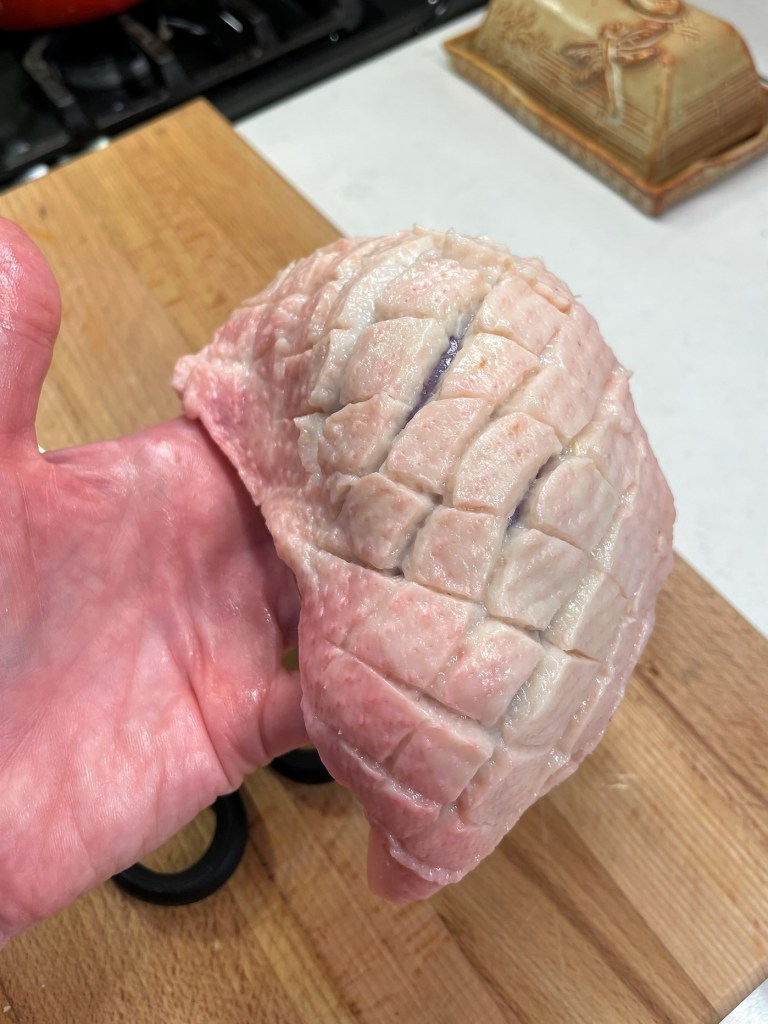
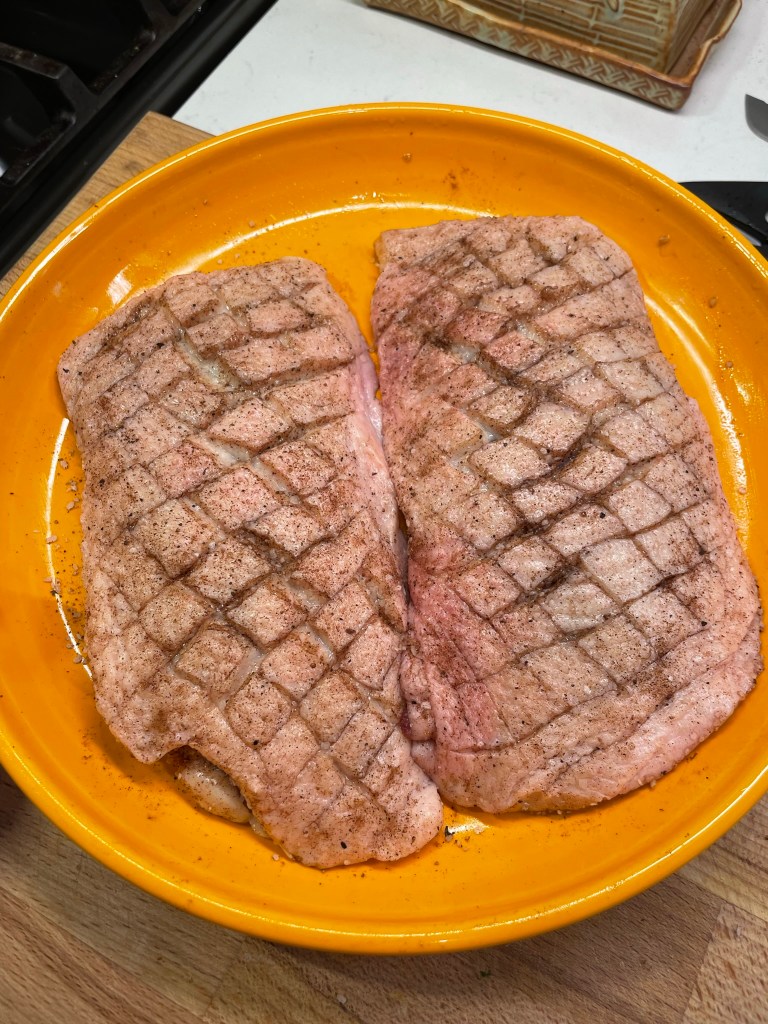
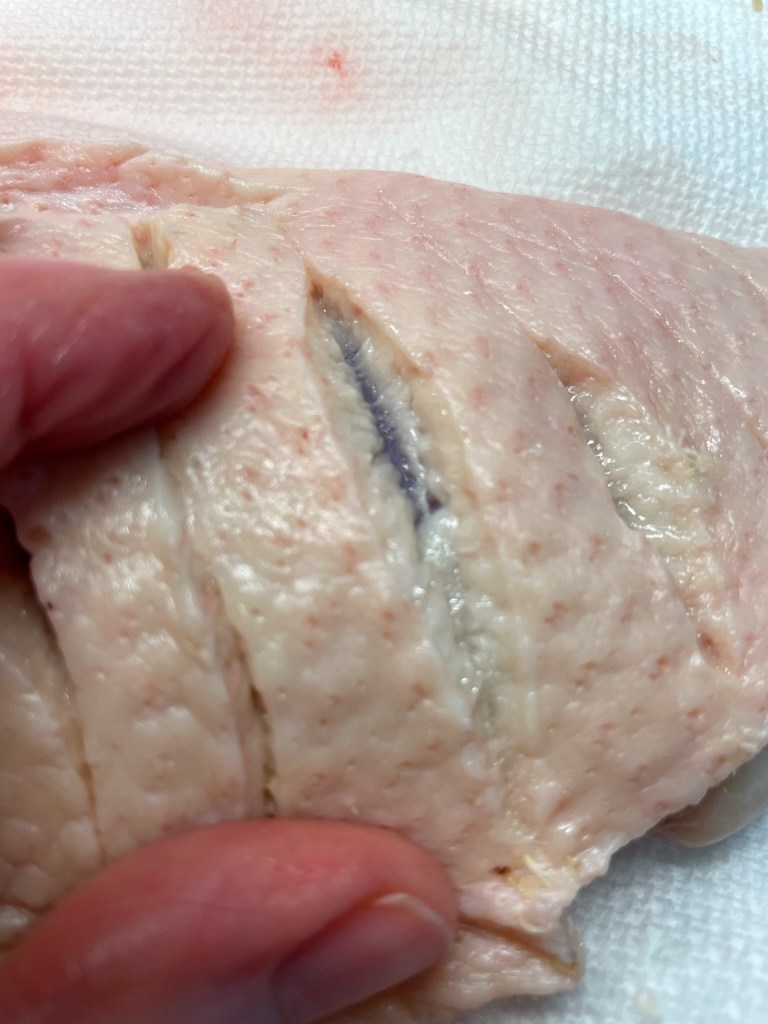
To efficiently render the thick, fatty skin on duck breast, use a very sharp knife to score it with a crosshatch design, with cuts that spread about 1/2-inch apart and only through the skin, not into the meat. This scoring allows more of the fat to render when you fry it in a skillet.

Tip #2: Dry brine the duck breast


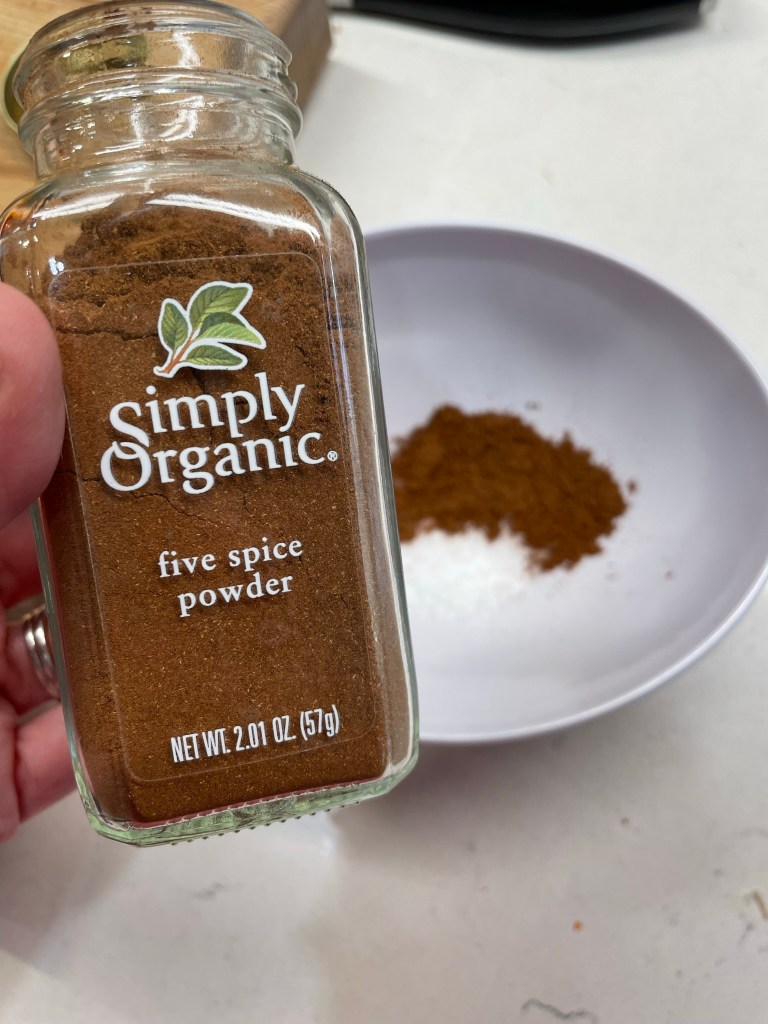
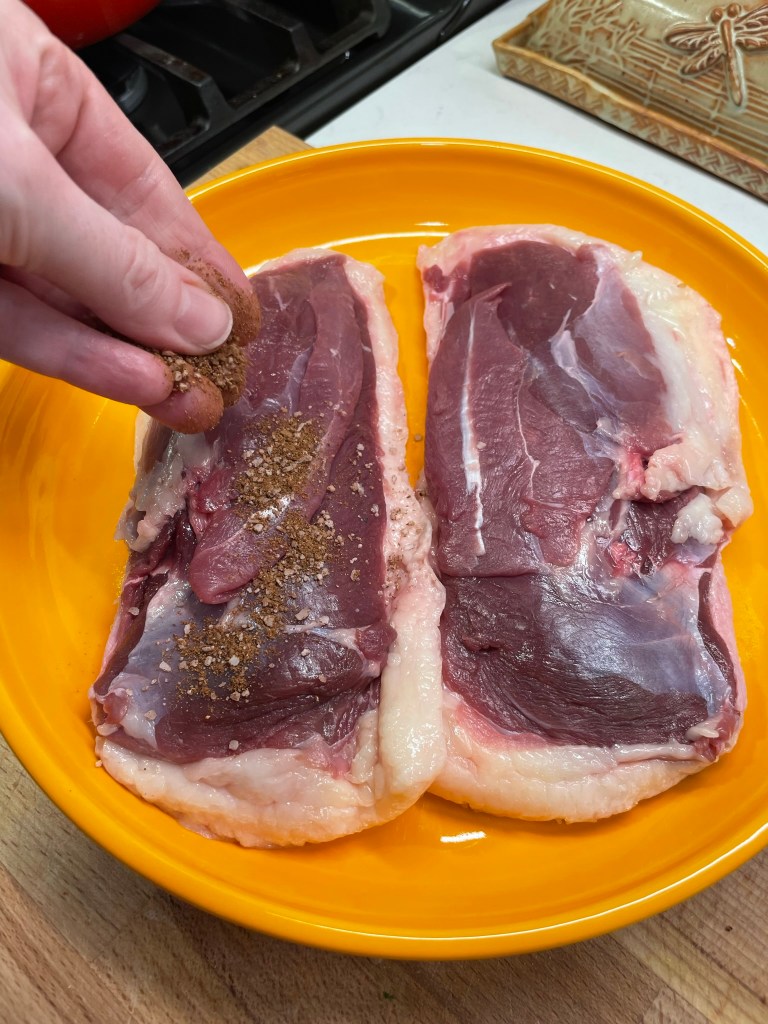
I’ve become a big fan of the dry brine, though I had to wrestle with my own sensibilities the first few times I tried it because at first glance, a dry-brined meat looks like it has dried out. Not so! There’s a whole science behind how this works— reverse osmosis of some sort, I guess— but the upshot is that salting and resting meat uncovered in the fridge allows better infusion of the seasoning into the meat and juicier results in the end. Here, I added five spice powder to the kosher salt. It was excellent with the flavors in my sauce. Another advantage of doing this step is that it does dry out the fatty skin a bit, and that greatly reduces spattering in the next step.

Tip #3: Begin with a stone-cold skillet


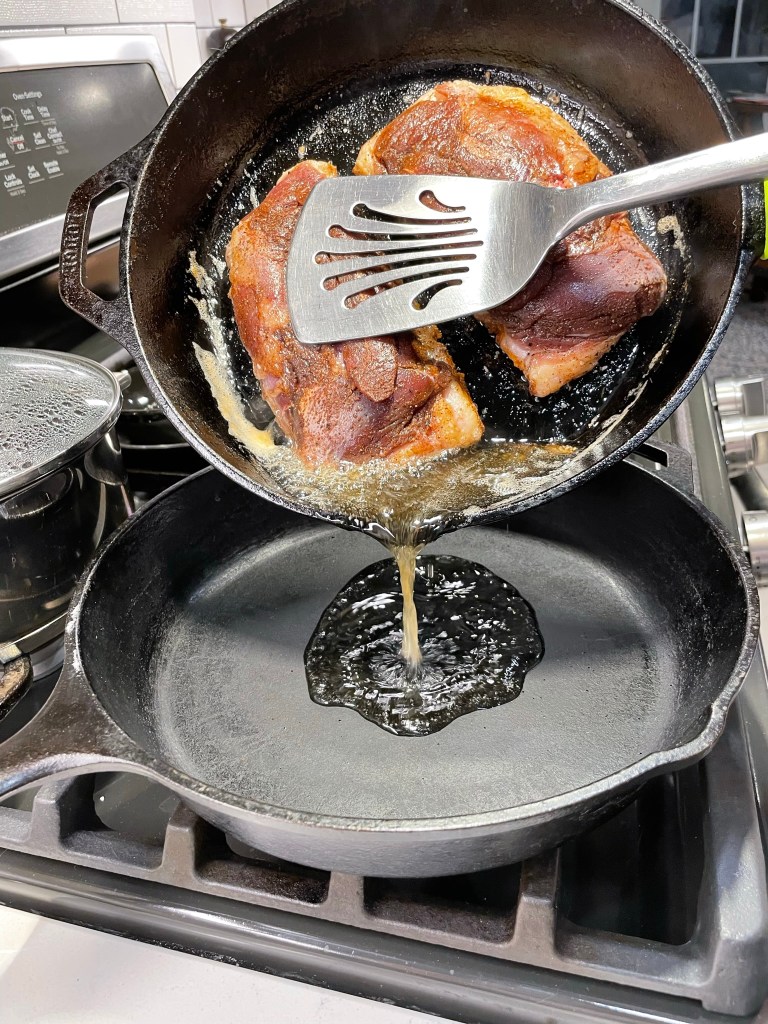
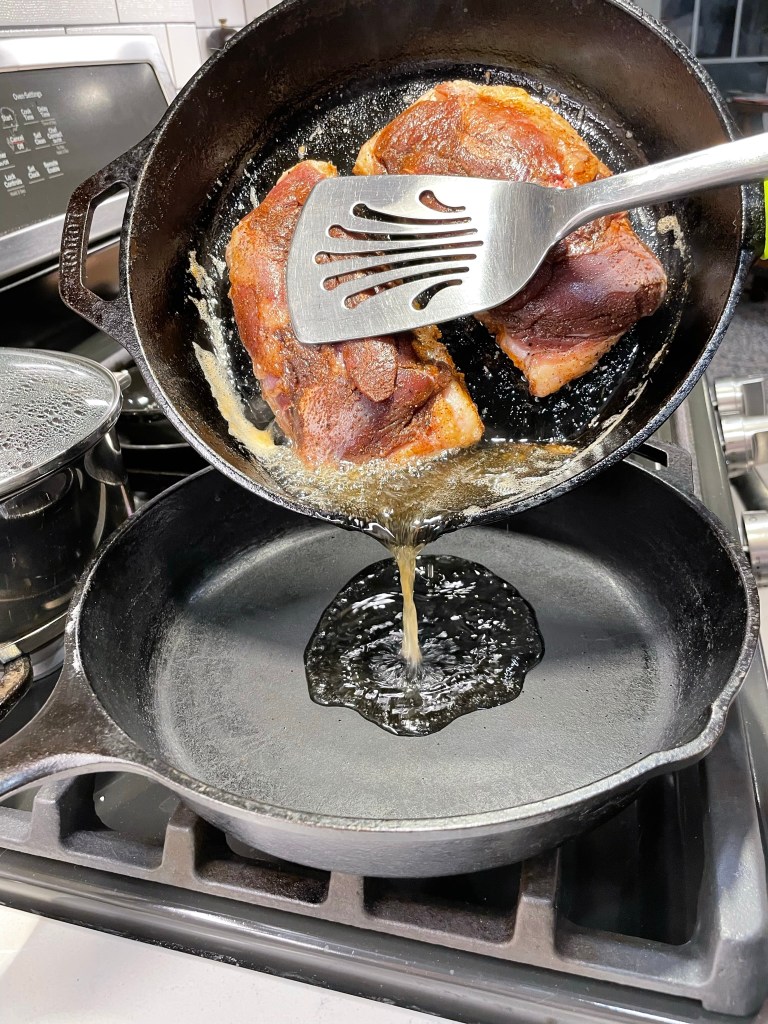
And preferably cast iron! If you were to place a duck breast in a hot skillet, the skin would sear, but the fat would not render very neatly. You’d likely be left with an oily mess, as I did the first couple of times I made duck. A non-stick skillet is not ideal either because the coating is a barrier to getting crispy skin. Invest in a quality cast-iron skillet and it will reward you with exceptional results for any meat you sear. Mine is a 10-inch Lodge skillet, made in the USA and built to last a lifetime. As the fat renders, carefully drain it off.

Tip #4: Do most of the cooking on the skin side


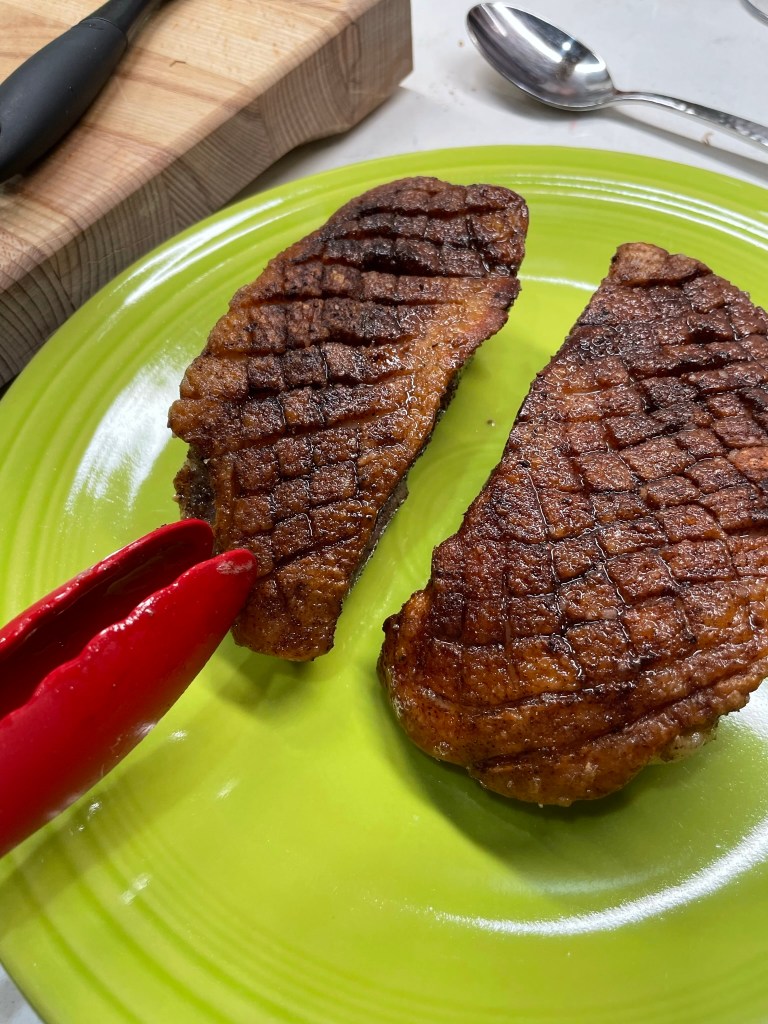
Duck is best served medium rare (like red meat), and the best way to achieve this together with crispy skin is to leave the breast skin-side down for most of the cooking time. Residual heat from the pan will bring it to temperature, and you only need to turn it to the flesh side for a minute or two to seal in the juices.

Tip #5: Don’t waste the extra duck fat!

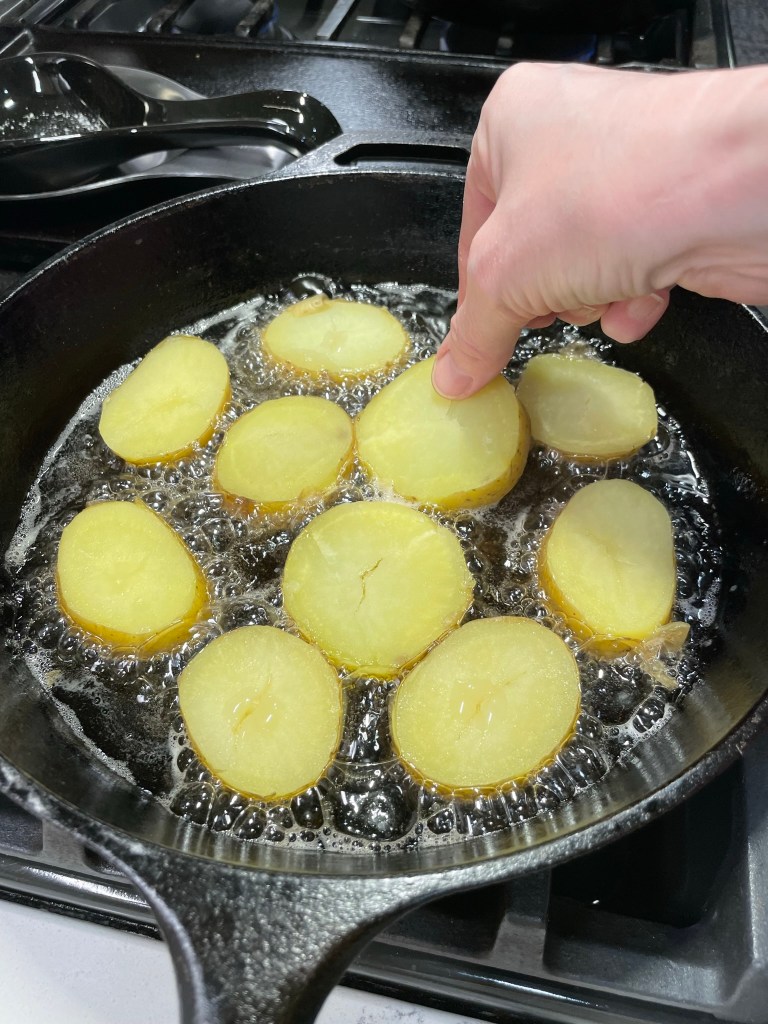
A great deal of fat will be released as you render the duck breasts, but this is decidedly not a bad thing! If you plan to make potatoes to accompany your duck, do yourself a favor and fry them in the duck fat! The flavor is incomparable and I am always thrilled to find the crispiest, non-greasy texture on the potatoes. If you don’t need the fat for this meal, drain it off into a jar, let it cool and store it in the fridge until you do make potatoes. 


Yes, it’s saturated fat, and of course, you shouldn’t eat like this very often. But these are the holidays, and this meal is a worthwhile occasional indulgence. Especially with cherry-pinot noir sauce!

Let’s talk about that sauce!


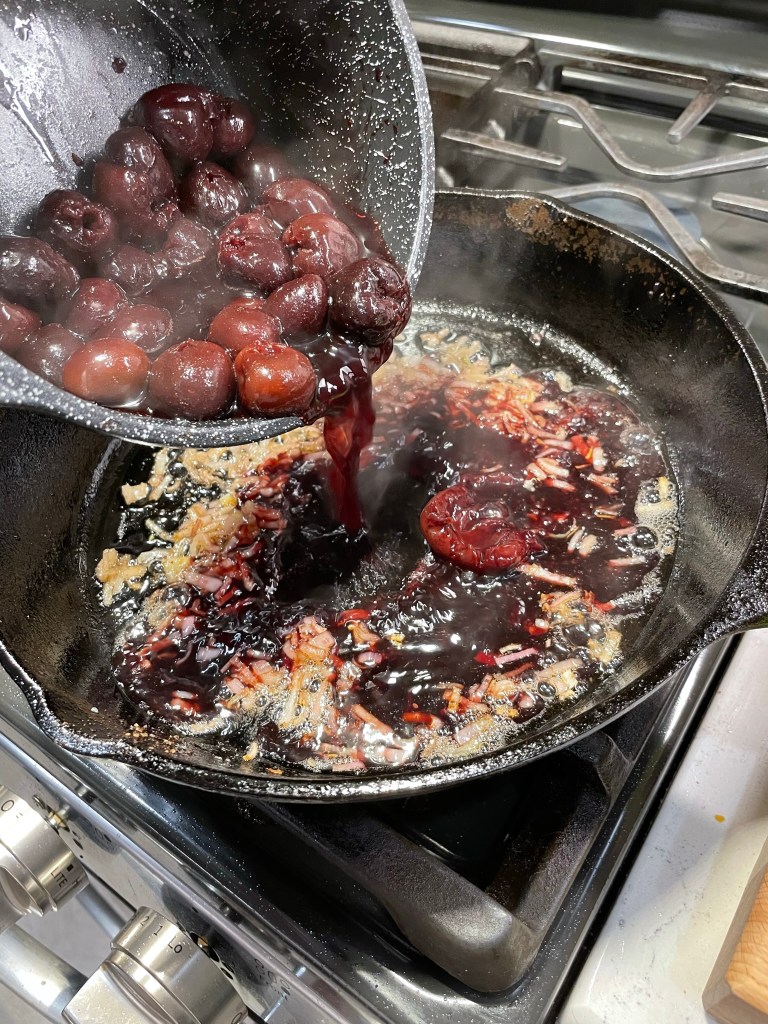
Now that you’re feeling confident about achieving the perfectly crispy duck breast skin, take a look at this flavorful, sweet and savory sauce, made from dark cherries, shallots, chicken stock and Pinot noir. Though we are definitely not in cherry season, this recipe is great because it uses frozen dark cherries. Pinot noir is the perfect complement to this, and the shallot, chicken stock and red wine vinegar provide a savory backdrop to keep this from feeling too sweet. 


As you will see, this recipe makes quite a bit of sauce and each duck breast is about half a pound, so the whole thing is really suited to serving four people. Les and I got a little carried away because the flavors were so mouthwatering and we knew it would lose that perfect, crispy texture as leftovers. Get the base of the sauce started while the duck is cooking and just keep it warm on the back burner until serving time.

Time to plate this gorgeous meal!


The sauce finishes quickly in the same skillet used to cook the duck, and you’ll get to enjoy all the little fond bits of flavor that were left behind in the pan.


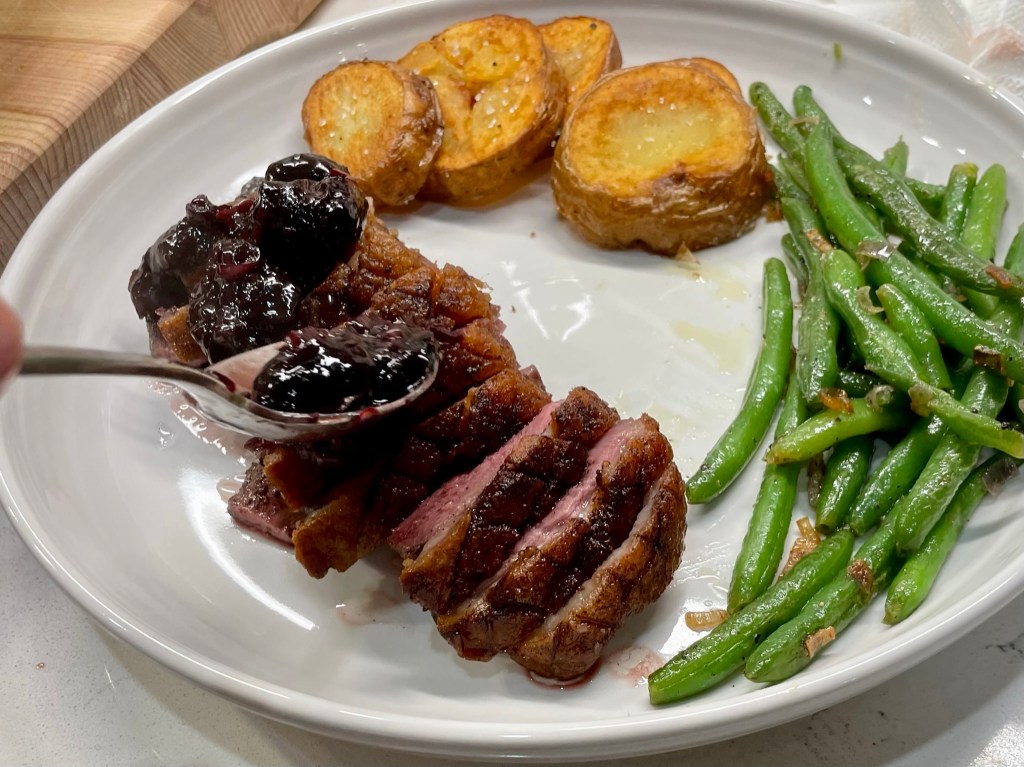
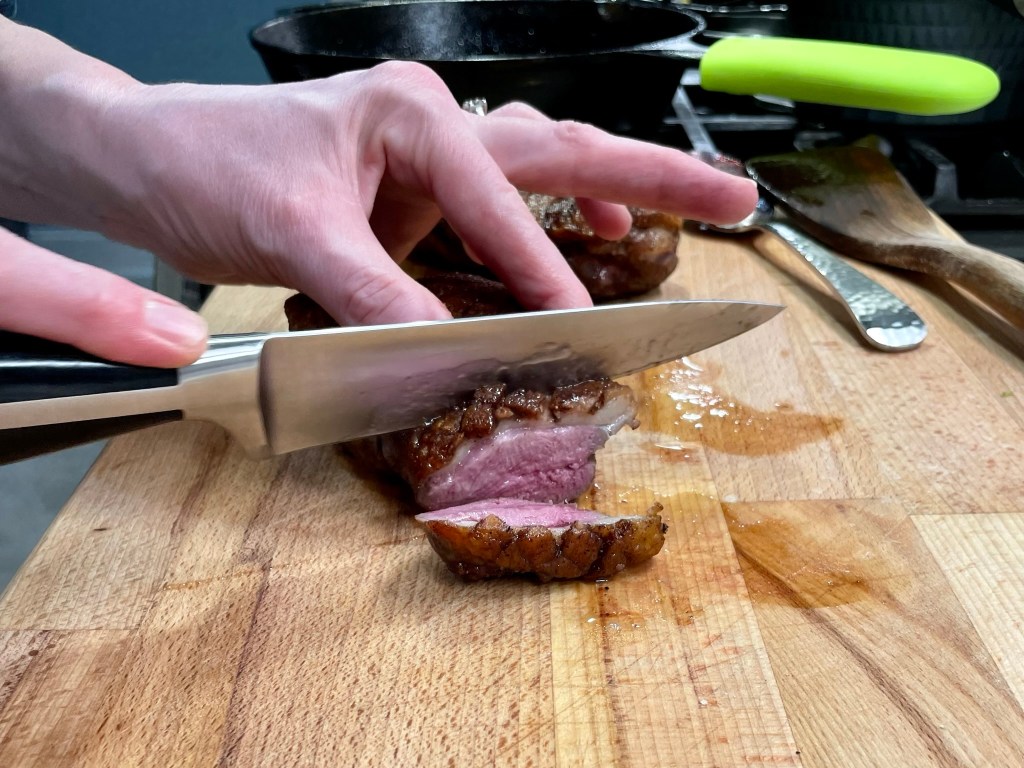
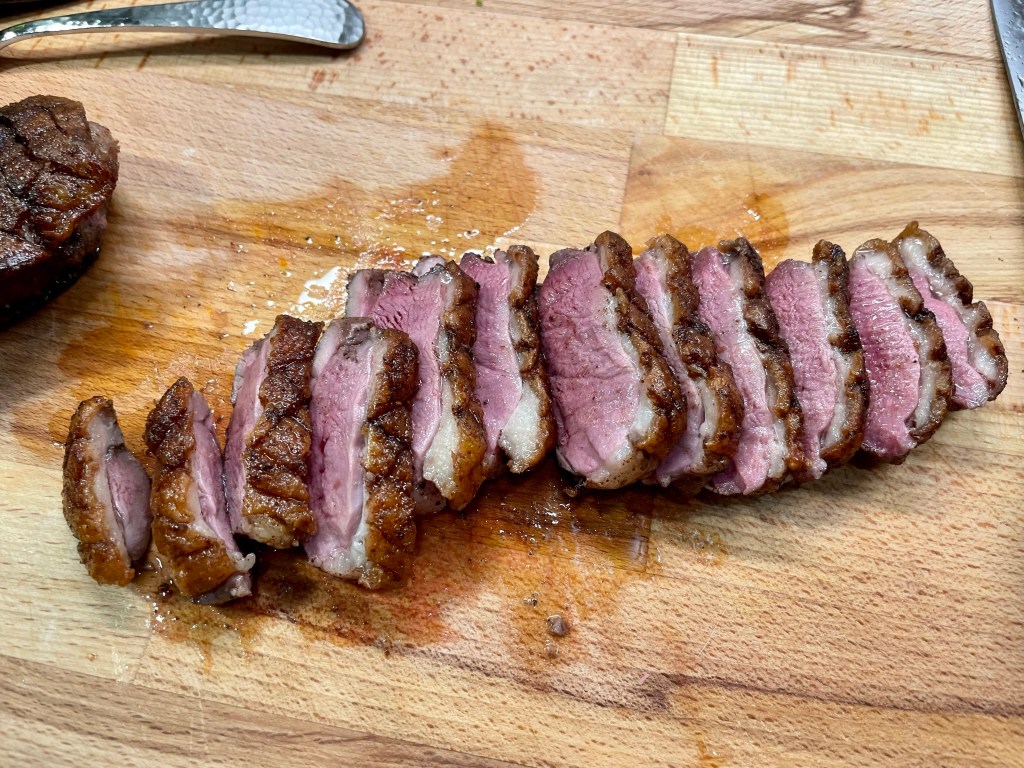
Place each breast on a cutting board and use a sharp knife to cut 1/2-inch slices. The meat should be bright pink and juicy with a thin layer of succulent fat under the crispy skin.


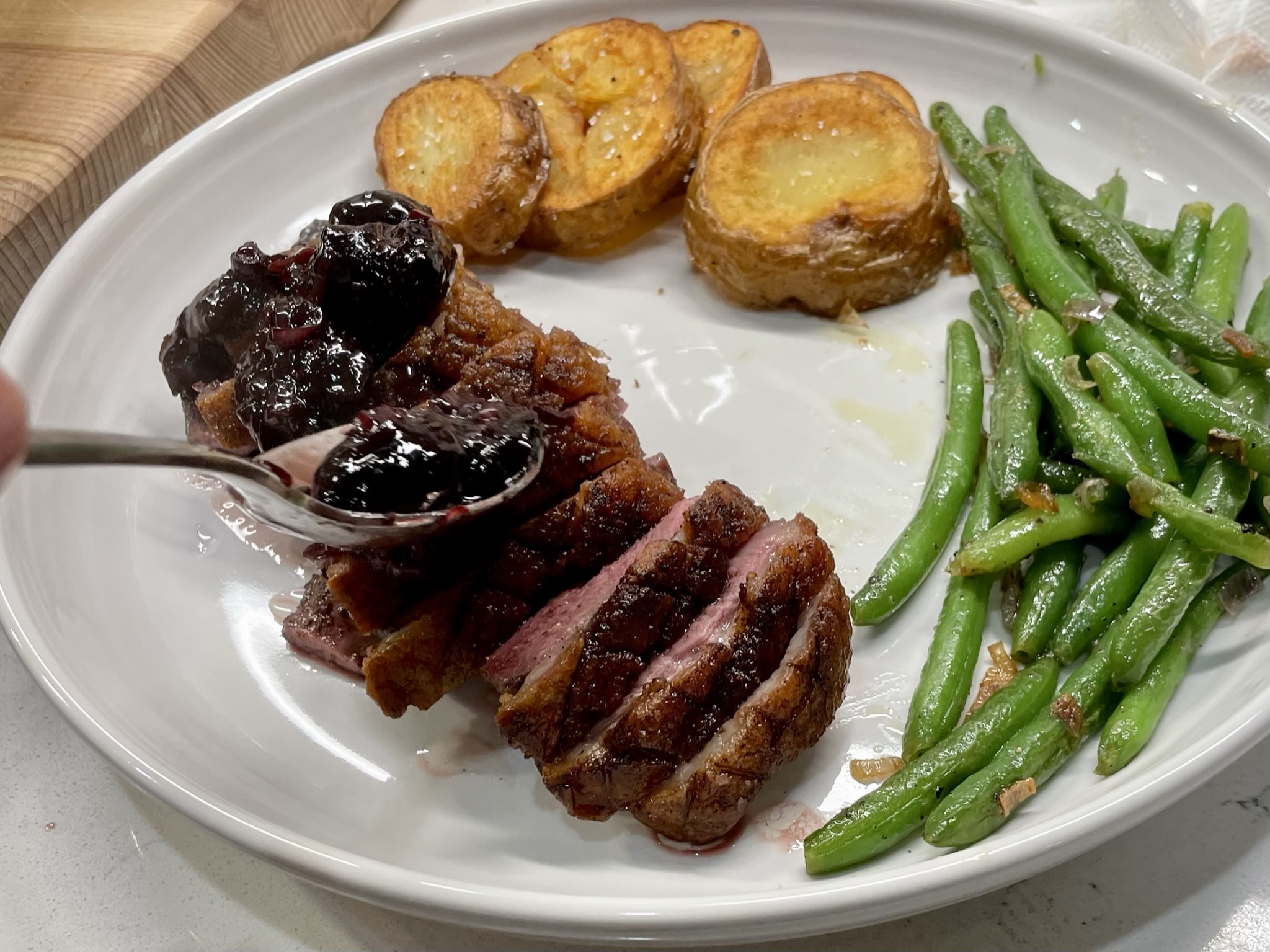
If I could go back in time to one step of this recipe, I’d plate the sauce before the duck breast, just to show off that incredible crispy skin. I do recommend sauce underneath the duck breast if you’re serving company, as we all know people eat with their eyes first. But we can confirm that it was just as delicious with the sauce on top, and if nothing else, it helped keep the duck warm as we savored every last delicious, cherry-kissed bite.

Crispy Five Spice Duck with Cherry-Pinot Noir Sauce

  • Servings: 4
  • Difficulty: Intermediate
  • Print

There's a lot to love about this dish, from the crispy skin to the flavorful sauce. It is definitely special occasion-worthy!


Ingredients

  • 2 individual duck breasts, about 8 oz. each
  • 1 tsp. kosher salt
  • 1 tsp. five spice powder
  • 2 Tbsp. turbinado sugar
  • 1/4 cup good quality Pinot Noir (save the rest for dinner)
  • 2 Tbsp. red wine vinegar
  • 1/2 cup good chicken stock
  • Kosher salt and freshly ground black pepper to taste
  • 1 heaping cup frozen dark sweet cherries
  • 1 medium shallot, minced

The trick to getting the crispiest skin begins with a dry brine on the duck breasts and a stone-cold skillet at the start of cooking. Render the fat slowly and drain off the excess as it accumulates, saving the fat to fry up the most delicious potatoes your taste buds will ever enjoy.

If you wish to make this dish without alcohol, substitute tart cherry juice for the Pinot Noir and reduce or omit the red wine vinegar.

Directions

  1. Pat the duck breasts dry with paper towels. Use a sharp knife to score the fatty skin only of the duck breast pieces. Make your cuts about 1/2-inch apart, in a crosshatch pattern. Take care not to cut the meat.
  2. Combine the salt and five spice powder and sprinkle all over both sides of the duck breasts, rubbing it into the scored fat side. Place the breasts on a plate and rest, uncovered, in the fridge for about six hours.
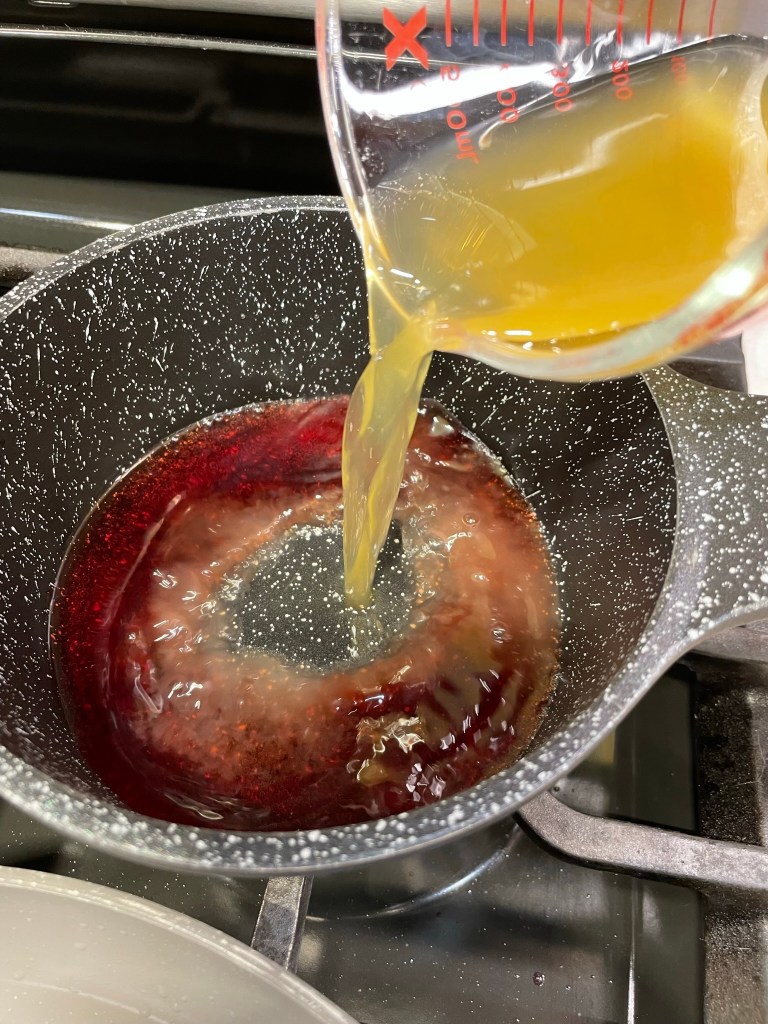
  3. Begin the flavor base for the sauce by combining sugar, wine, vinegar and chicken stock in a small saucepan. Bring to a slight boil then add the frozen cherries and simmer until cherries are softened. Keep warm.
  4. Place a COLD cast iron skillet onto a burner over medium heat. Immediately place the duck breasts, skin side-down, into the skillet. Don’t disturb the breasts until the fat begins to render. Carefully drain off excess fat by holding the breasts in place with a spatula or tongs and pouring off the fat into a bowl, jar or a second skillet. This helps reduce the amount of spattering. You’ll likely need to do this twice during the rendering process.
  5. Cook the skin side of the duck breasts for about 11 minutes, or until the bottom is deep golden in color and very crispy. Gently turn the breasts to cook the second side for only about two minutes. Transfer the breasts to a warm plate while you finish the sauce.
  6. Drain off all but a tablespoon of the duck fat and add the minced shallots to the skillet, tossing until slightly tender. Pour in the reserved Pinot Noir-cherry mixture and bring to a boil, scraping up any bits that are stuck to the pan. Allow this to simmer for a few minutes until some of the liquid evaporates and the sauce is slightly thickened.
  7. Slice the crispy duck breasts into 1/2-inch thick slices and serve immediately with the sauce.

If you’ll be frying up the potatoes, boil Yukon golds in advance (skin-on) until they are about half-cooked. Cool them to room temperature and slice into 1/2-inch rounds. Fry in hot duck fat until both sides are crispy, and season with salt immediately.
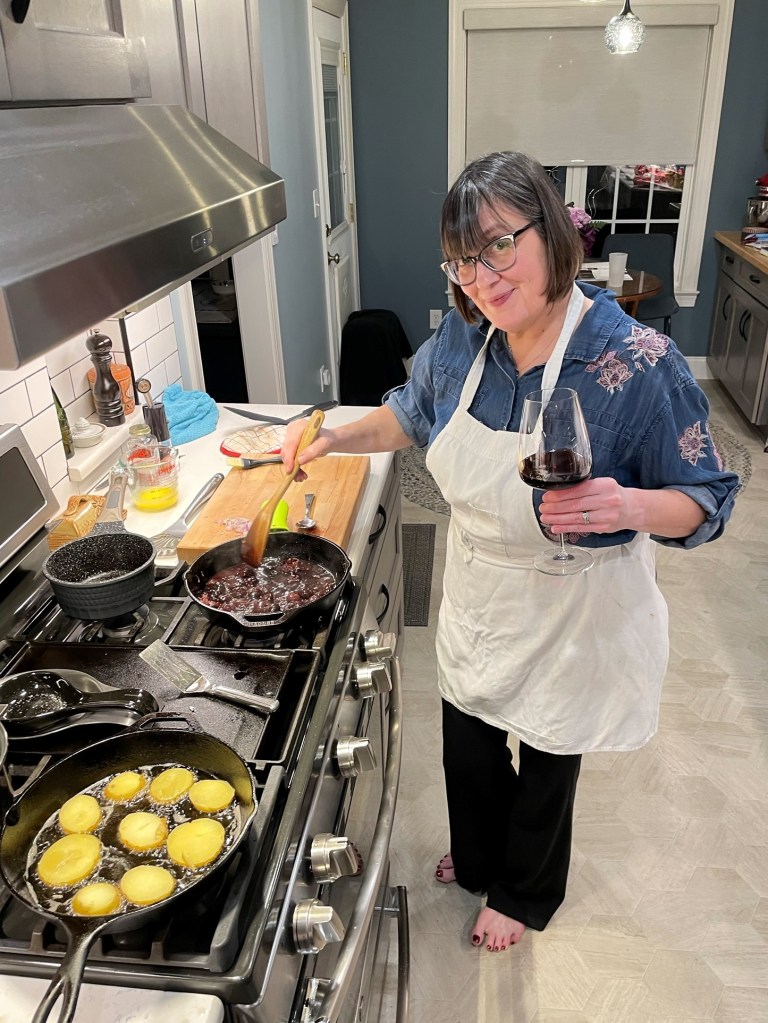

Just for fun…

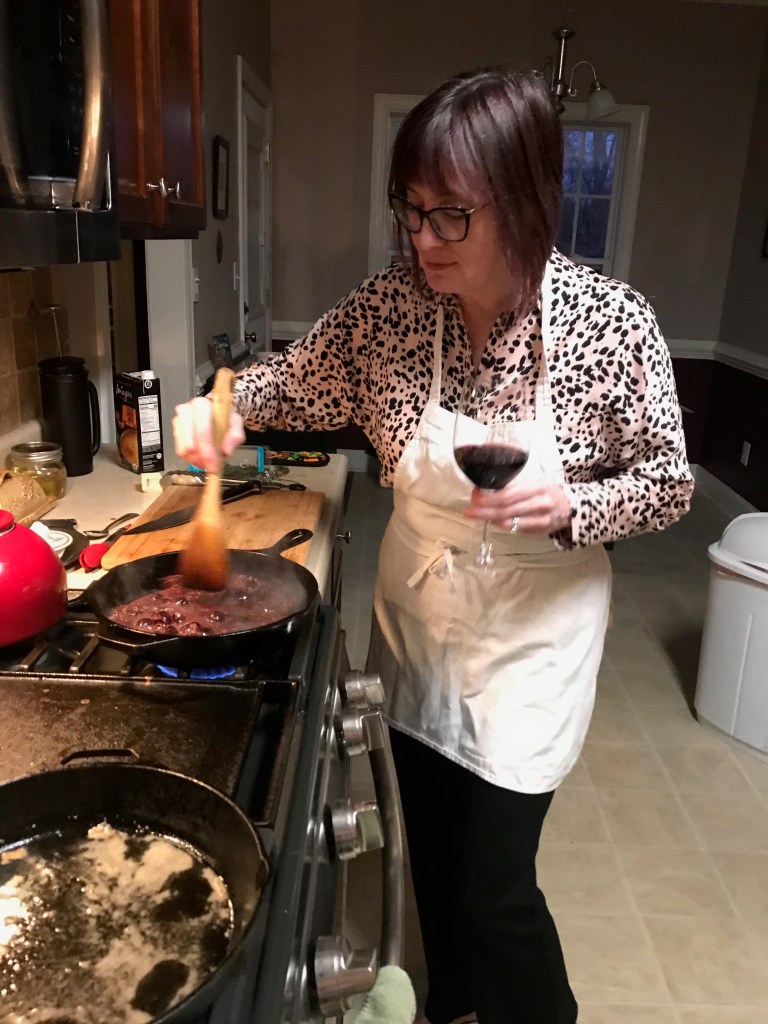
Les and I had some flashbacks during the making of this recipe, because I had first prepared it on Valentine’s Day three years earlier, just one month before Covid disrupted everything known to mankind. He had snapped a picture of me at the stove, wine glass in-hand, stirring the sauce. I was oblivious to what he was doing at the time, but he recognized my passion for cooking and has been my biggest supporter since I started my food blog two months later. When I made the dish again this year, we tried to replicate that photo, but with our beautiful new kitchen and a perfected crispy duck technique. Cheers!


Reverse-Seared Steak

The first time I heard the term “reverse sear” was about five years ago, on Food Network, but that was already more than a decade after a young, rock-star chef and culinary consultant named J. Kenji López-Alt started talking about his discovery of a new method for cooking thick steak to perfection. 

Rather than searing the meat first— you know, “to lock in the juices,” as we’ve all been advised since forever— Kenji tested this method of bringing the steak to ideal temperature in the oven first, and then throwing it onto the hot grill or skillet to sear it. The food world took notice of this brilliant discovery, but I’d been reluctant to try it, for reasons I can only explain as sentiment and tradition.

We’ve all seen the drawings on cave walls, with a man cooking animal parts over fire. This is the way we’ve always done it, and here I was, questioning what was already working. Still, I had to ask myself, are some of my mindsets about cooking set in stone because they date back to the actual Stone Age?

But Kenji hasn’t steered me wrong yet, as evidenced when I tried his brilliant baking soda technique that I like to call the miraculous mayo marinade. I use that one all the time now. Or last summer when he posted a recipe in NY Times Cooking, describing how to use salt to draw out the flavors of ingredients in this Mexican street corn guacamole, which Kenji says is his favorite and understandably so. And of course, the tremendous a-ha moment I had when I realized how positively simple it is to make my own sausage, following his salt-wait-grind-mix instructions.

So this summer, I finally decided to try the much-lauded reverse sear, and I’m here to report my experience. First things first, I had to pick up some steaks.

And not just any steaks. According to this article on Serious Eats, I needed to have steak that was close to 2 inches thick, and that usually means a custom order. When I explained to my local butcher what I had in mind, he pulled a huge slab of bone-in meat from the cooler in the back and went to work— slicing it nice and thick and trimming off the excess fat and bone. I’ll pause right here and acknowledge how much I appreciate having an actual butcher in town, one that sells locally produced meats with sustainability in mind, rather than a forced selection of meats from God-knows-where, shrink-wrapped over styrofoam trays. If you have a community butcher shop, please support it. 


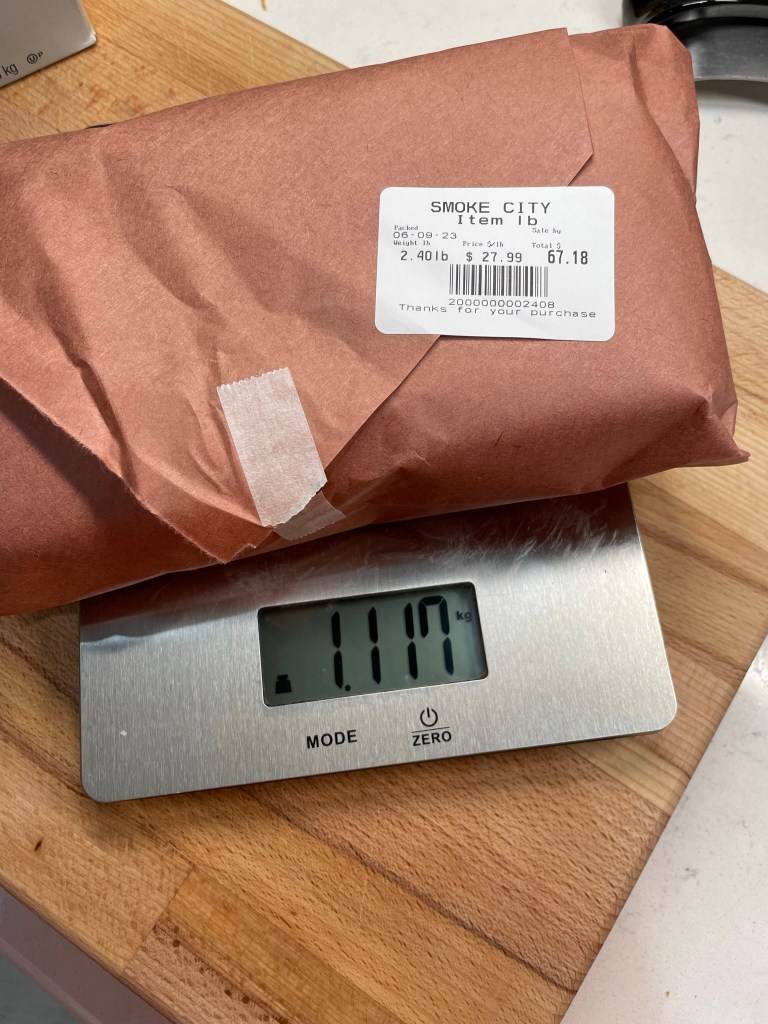
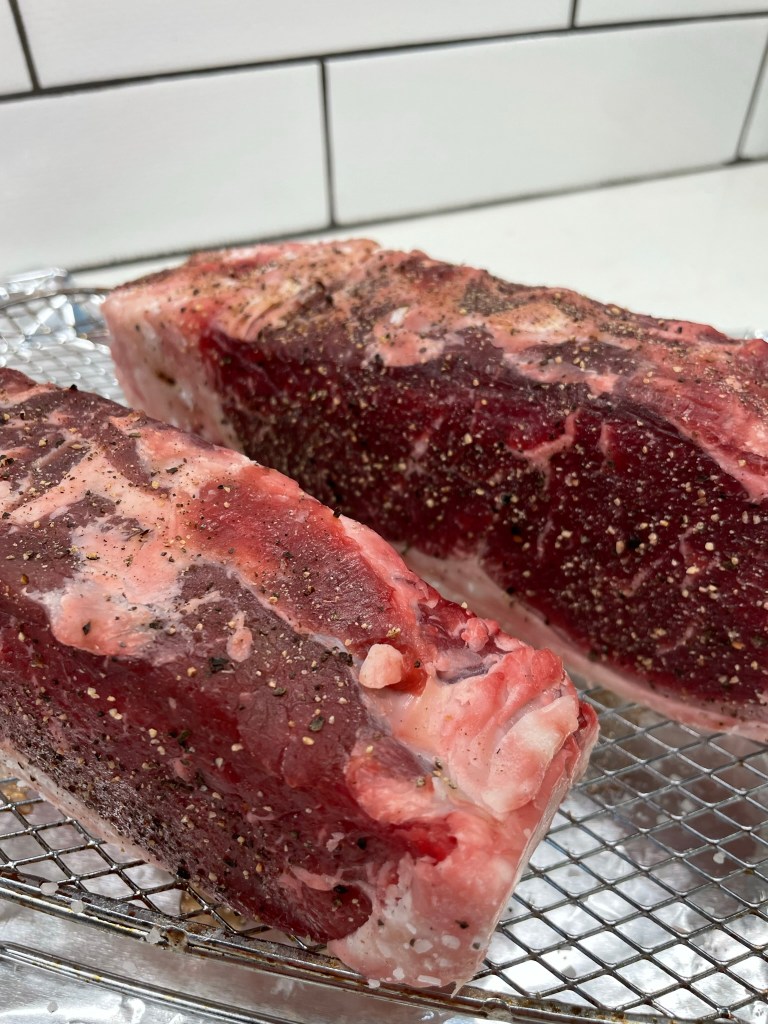
We ended up with two locally raised, grass-fed N.Y. strips that weighed roughly 2 and 1/2 pounds total— whew, that’s a lotta meat. At nearly 28 bucks a pound, this was not going to be a cheap experiment. My husband (and resident grill master), Les, was a great sport about the whole thing, even though the method defied his sensibilities, too, and even though it meant a longer wait for dinner.


Here’s how it was supposed to go.

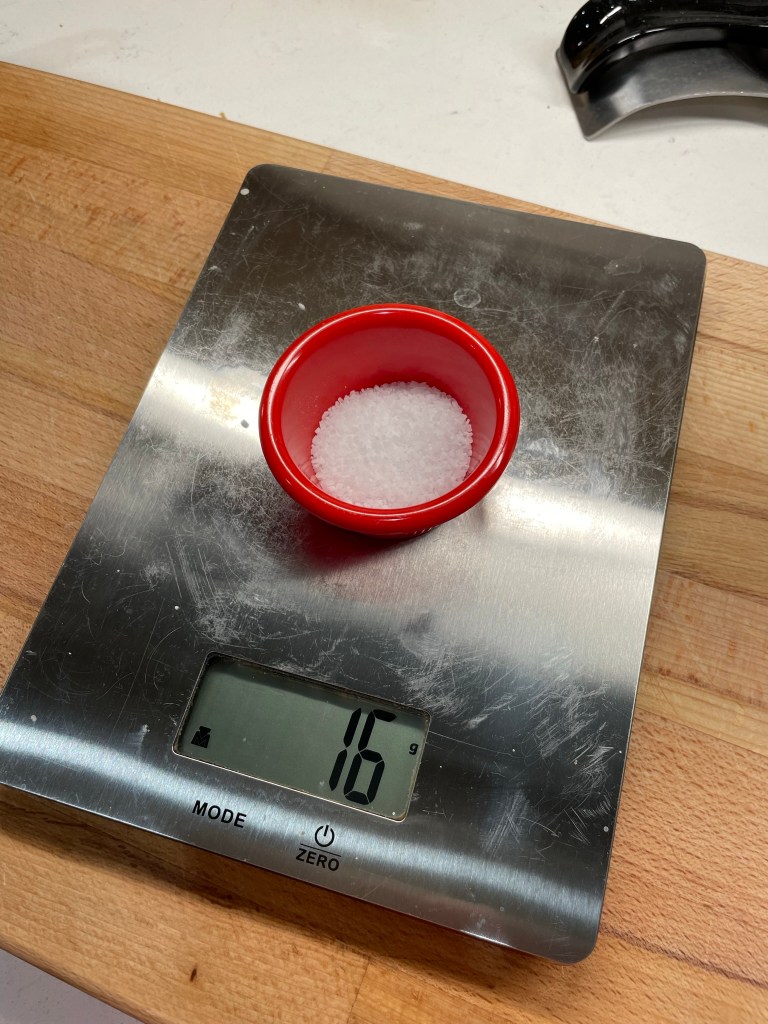
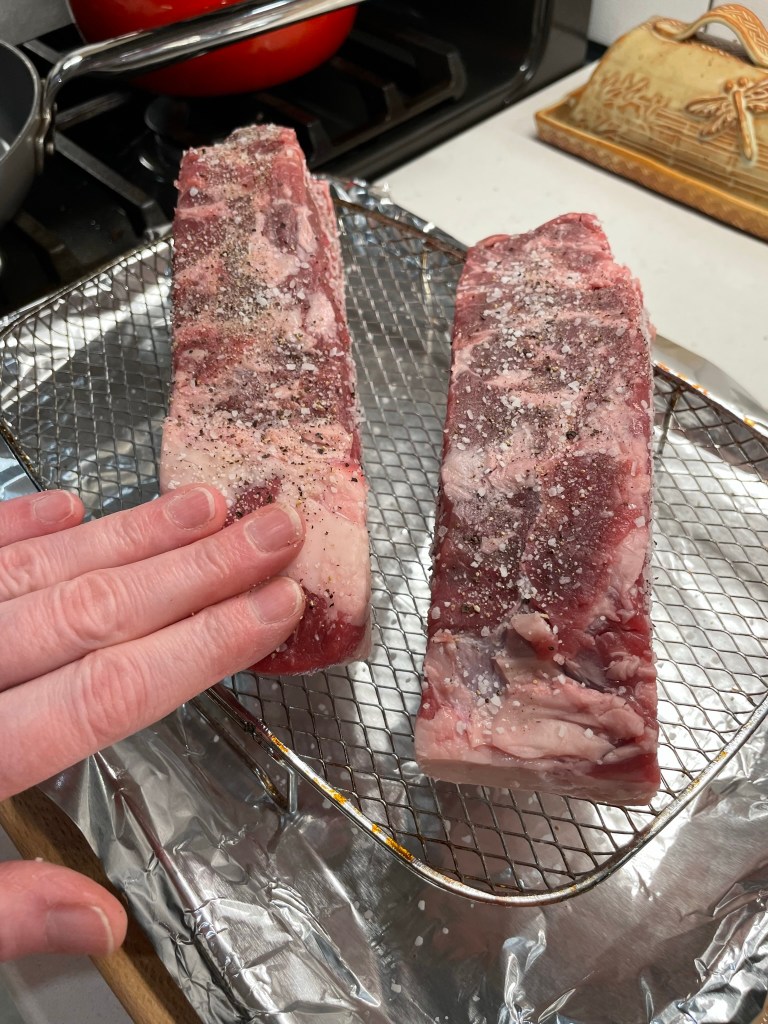
  1. Dry rub the steaks the night before — I used just kosher salt and black pepper, and they rested uncovered in the fridge.
  2. Slow bake the steaks at low temperature (250° F) to just-shy of done — 25 to 30 minutes (we’ll just see about that).
  3. Sear the steaks to perfection — we had the grill fired up and ready to go!


Are we there yet??

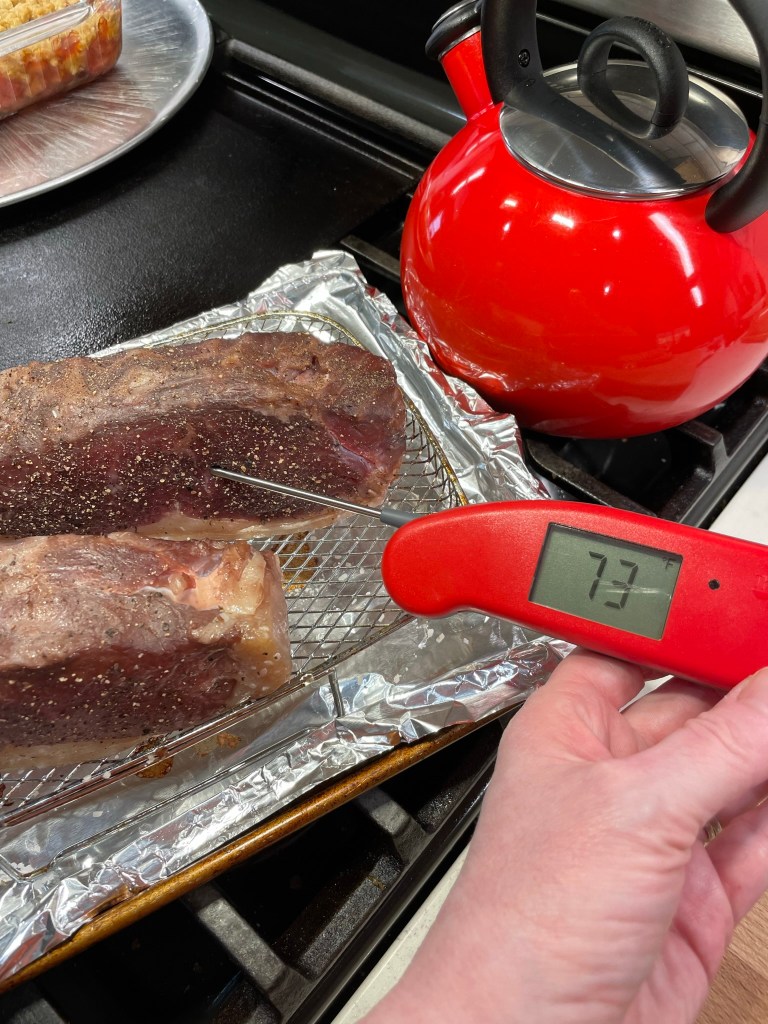
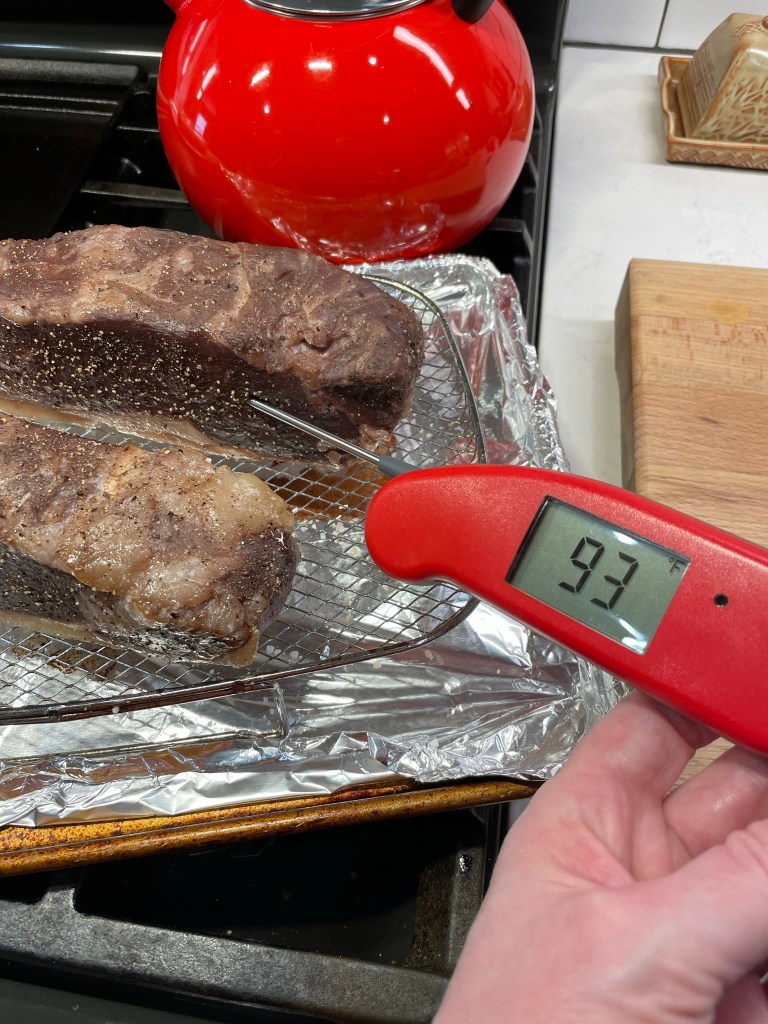
First, the process that was supposed to take 25 to 30 minutes ended up taking much longer. Were my steaks too thick? Was 40 minutes out of the fridge long enough to knock the chill off? Whatever the case, the steaks looked awful during this slow oven time. It’s a little upsetting to see expensive cuts of meat looking so— what’s the word? Grayish. 🫤

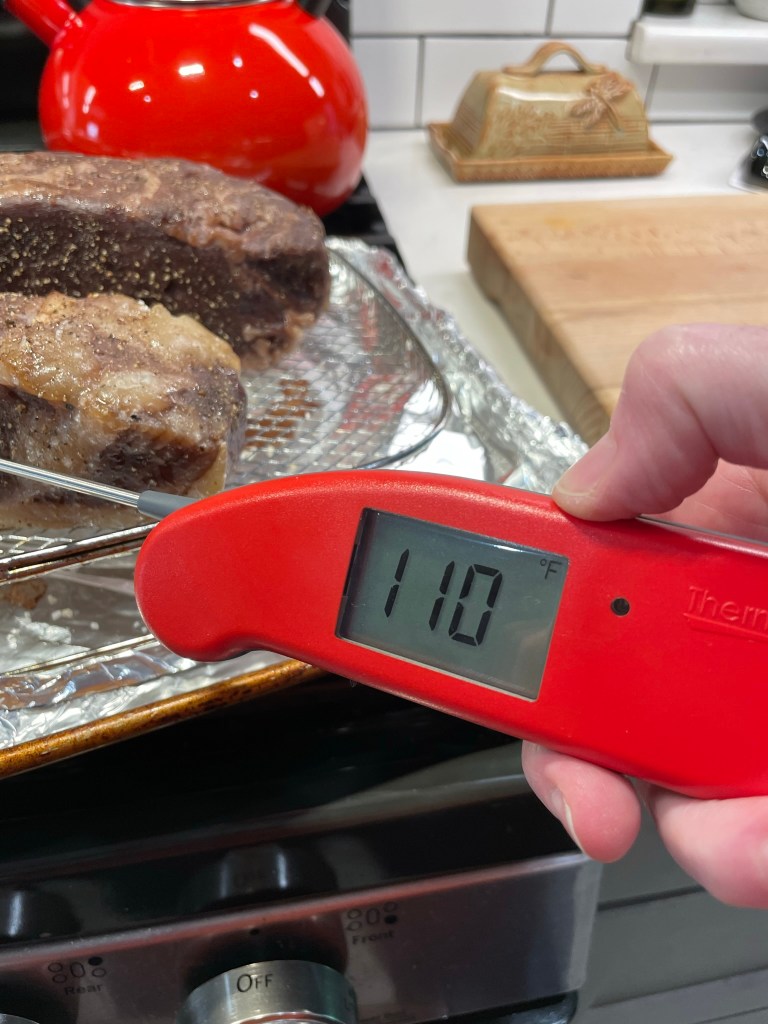
I started checking at the 30-minute mark, and we weren’t even close to the 115° F internal temperature we needed for a medium rare finish. This project was running slower than molasses in January. We resisted the urge to turn up the oven temp, but the clock was ticking, and we were getting damn hungry by this point.
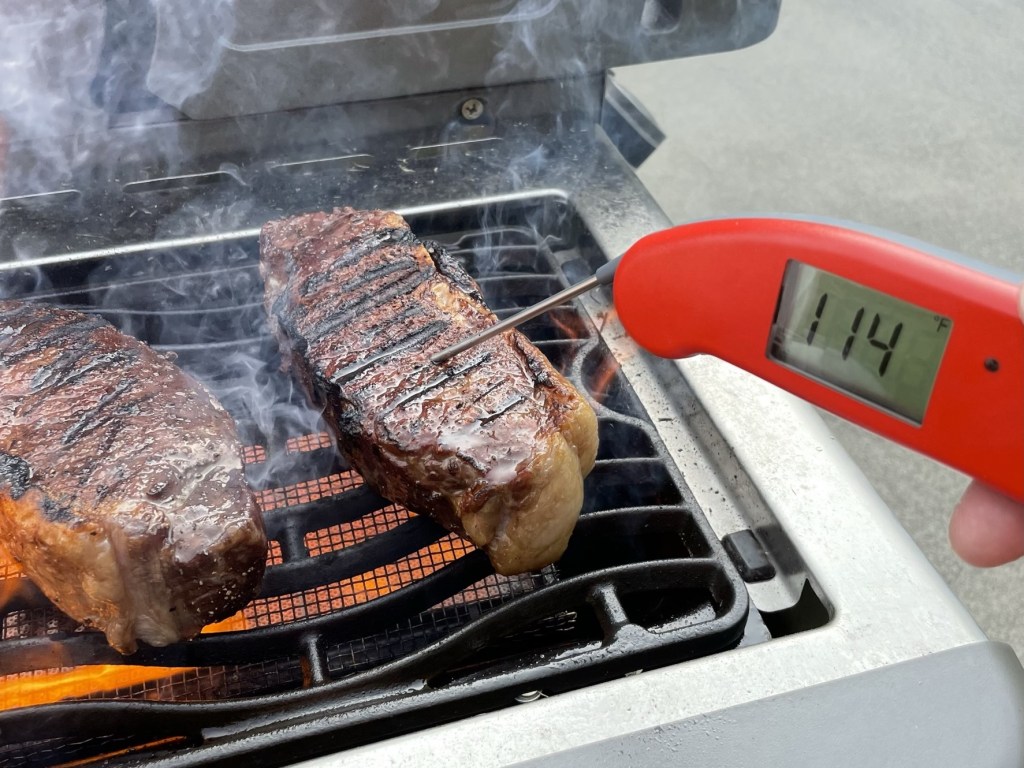
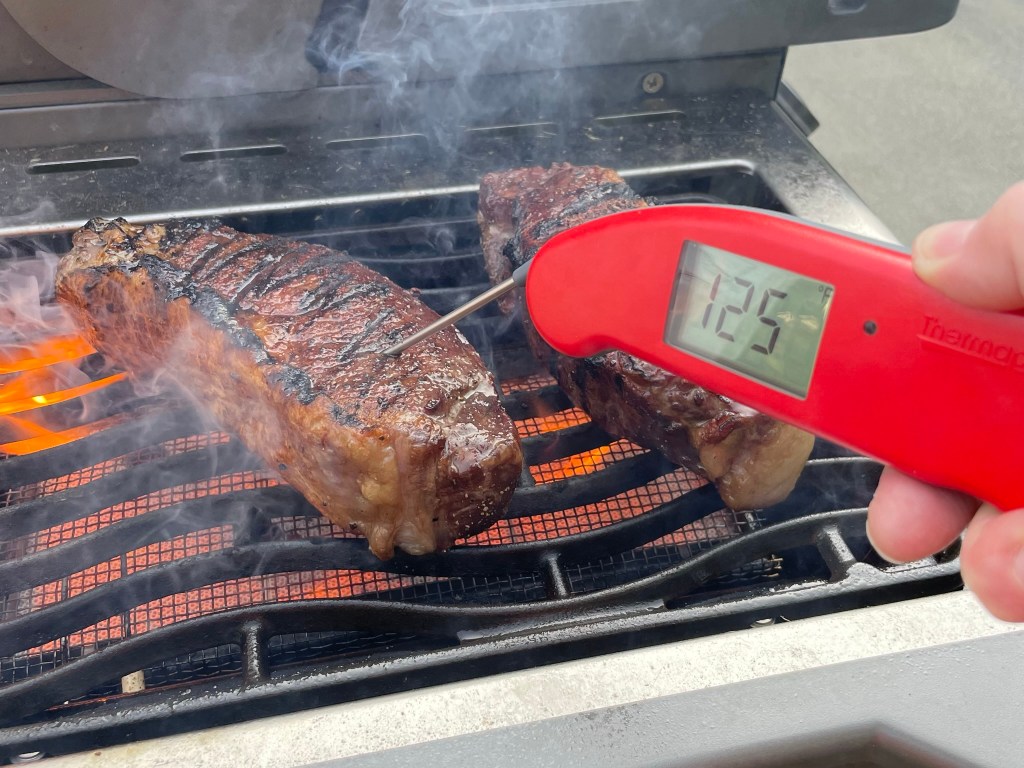

C’mon, I’m starving!

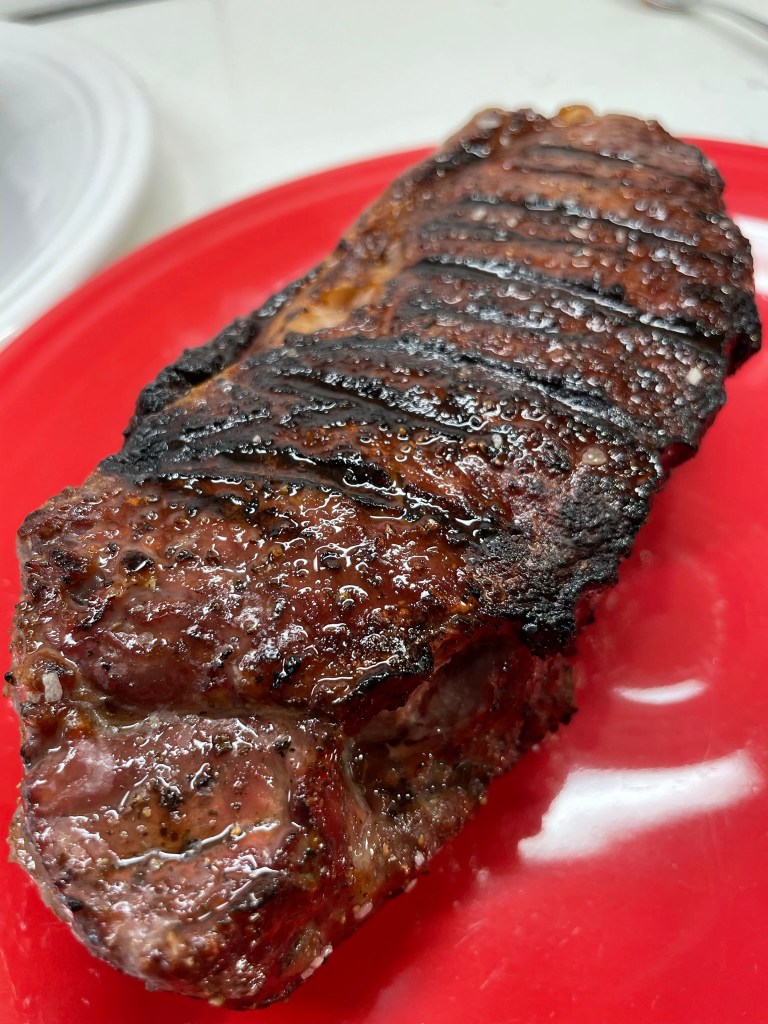
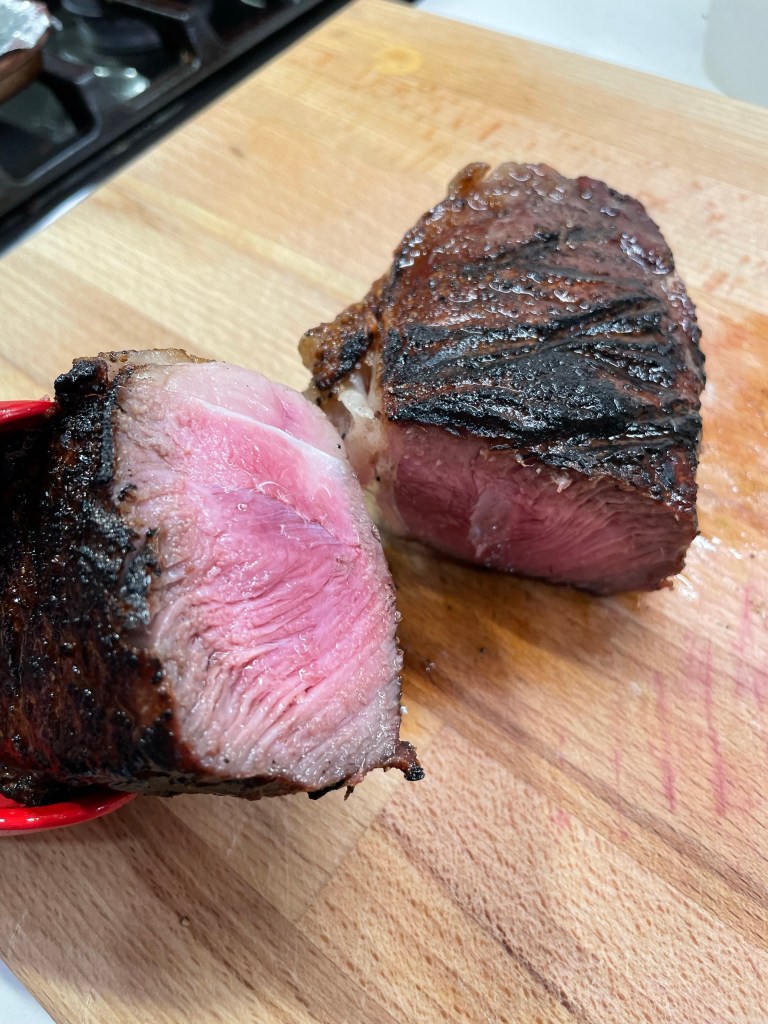
Finally, we decided that 110° was close enough, and when those steaks hit the infrared side burner of our Napoleon grill, it was quite dramatic! The sear was spectacular, and from that point, it took a mere four minutes to plating. We were grateful that Kenji’s instructions said there was no need to rest the steaks before serving. All that business of letting the juices redistribute was covered during the slow roast. Just slice and enjoy! I barely slowed down to take pictures.


Finally, the taste test!


The texture of the reverse-seared steak really was perfect— crusted and flavorful on the outside, juicy and tender inside— and it was delicious. But was it superior to a seared-first steak— the kind we usually grill? I can’t say for sure, and I also can’t confirm that it was the cooking method alone that caused this perfection, as I also followed Kenji’s instruction for salting and seasoning the steak the night before. The overnight “dry-brining” technique used to make me uncomfortable, too, but I’ve done it with turkey, chicken, pork and duck, and had fabulous results. Maybe the dry brine on its own would have given us the same end result.

Would I do the reverse sear again? Possibly, but only on rare occasion and under the right circumstances. Les already does a terrific steak on the grill, following the old cave man method, and I do a darn good job with them in a cast-iron skillet. It is unlikely that we would ever choose such large steaks to begin with; nutritional guidelines say that 4 to 5 ounces is appropriate for a serving, and we usually push that into the 8-ounce range, but these were over a pound apiece! We should have shared one, I think, but I wanted leftovers.

The reverse sear technique could be useful if we had a large gathering for a grilled meal (probably why top-notch restaurants are doing it). Things can get a little dicey when you’re trying to get a bunch of steaks grilled at once, and the low-and-slow process would allow extra flexibility for accurate temperature and quick finish, and more time for cocktails and chit chat while we wait—nothing wrong with that.

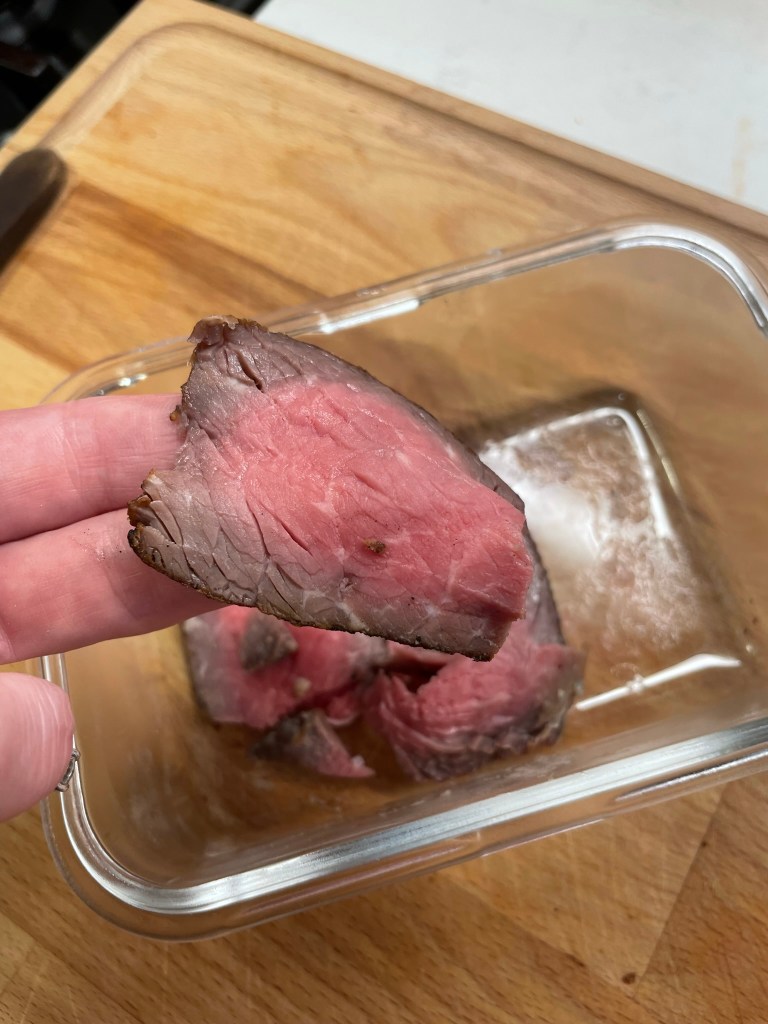
One final observation about reverse searing, and this one didn’t hit me until the next day when I sliced up some of the leftovers of our enormous steaks to top a salad. I can truly say that never-have-I-ever had leftover steak with such flavor and texture. The meat was still juicy and tender, much more so than I expected for round two, so there’s that.

I’m curious to know others’ experiences with reverse searing; if you have tried it, please let me know in the comments section below how things went for you. If you haven’t tried it, will you be firing up the grill (and oven) to give it a go this weekend?