It’s that time of year again, and I don’t mean Christmas in July. I’m completing another trip around the sun this weekend, and what better way to celebrate than with a signature cocktail for the birthday girl?
My husband, Les, is throwing me a party, and though many of the party details are a secret (including most of the guest list), I do at least know what will be on the drink menu because the venue gave us the option to request a special cocktail—yay! I love a theme for a party, and I’ve decided that my signature birthday drink should be reminiscent of the one that was in my hand back in the days when I was first “of age” to imbibe. Oops, did I just give away my age?!
How is it possible that it was soooo long ago??
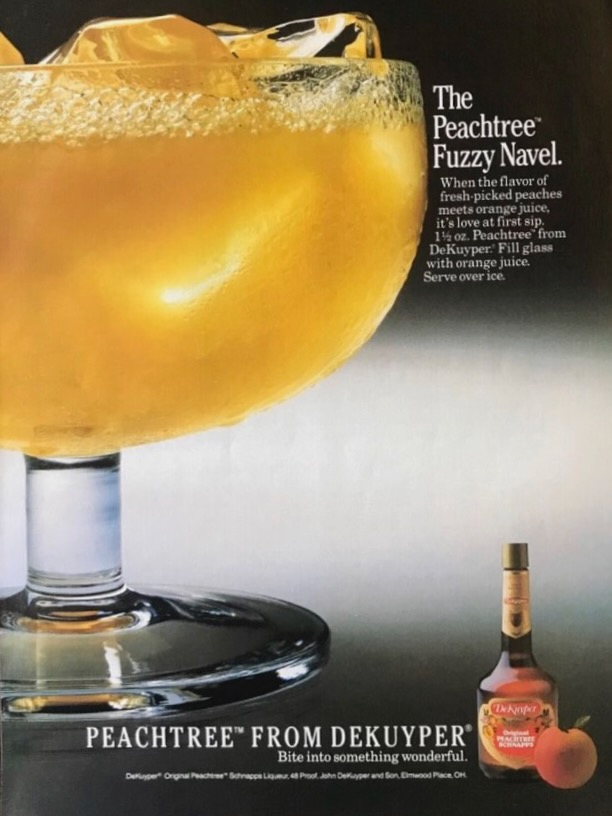
DeKuyper had just released its Peachtree™️ schnapps, and everyone who was anyone— at least among the girls— was sipping on fuzzy navels, a blend of this syrupy sweet schnapps and equally sweet orange juice. The drink gave us a fun little buzz, and it was perfectly simple for all the bridal showers that my girlfriends were having.
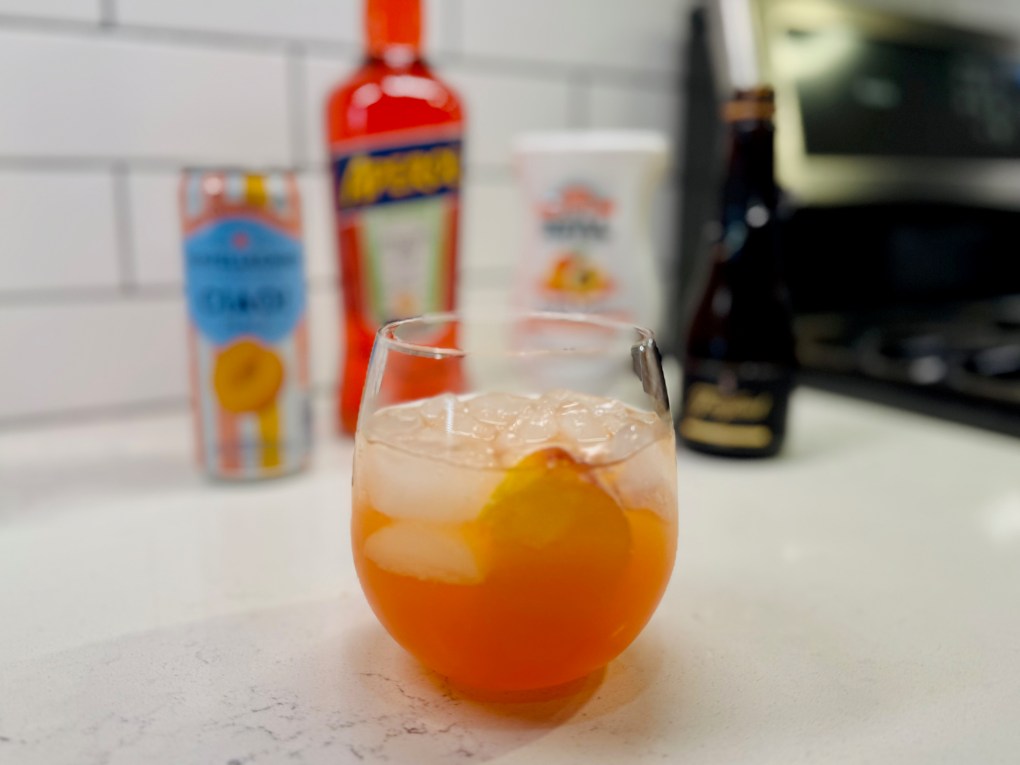
Fast forward, ahem, a few decades and I’m still fond of the “idea” of the fuzzy navel, though I could never stomach the sweetness of it today. So I did what I always do— a modern makeover of an old favorite into a cocktail that is familiar but fresh— this one is easy to make, easy to drink, easy on the alcohol and yes, easy on the eyes.
Hello, Gorgeous!
What’s fun about a fuzzy navel spritz?
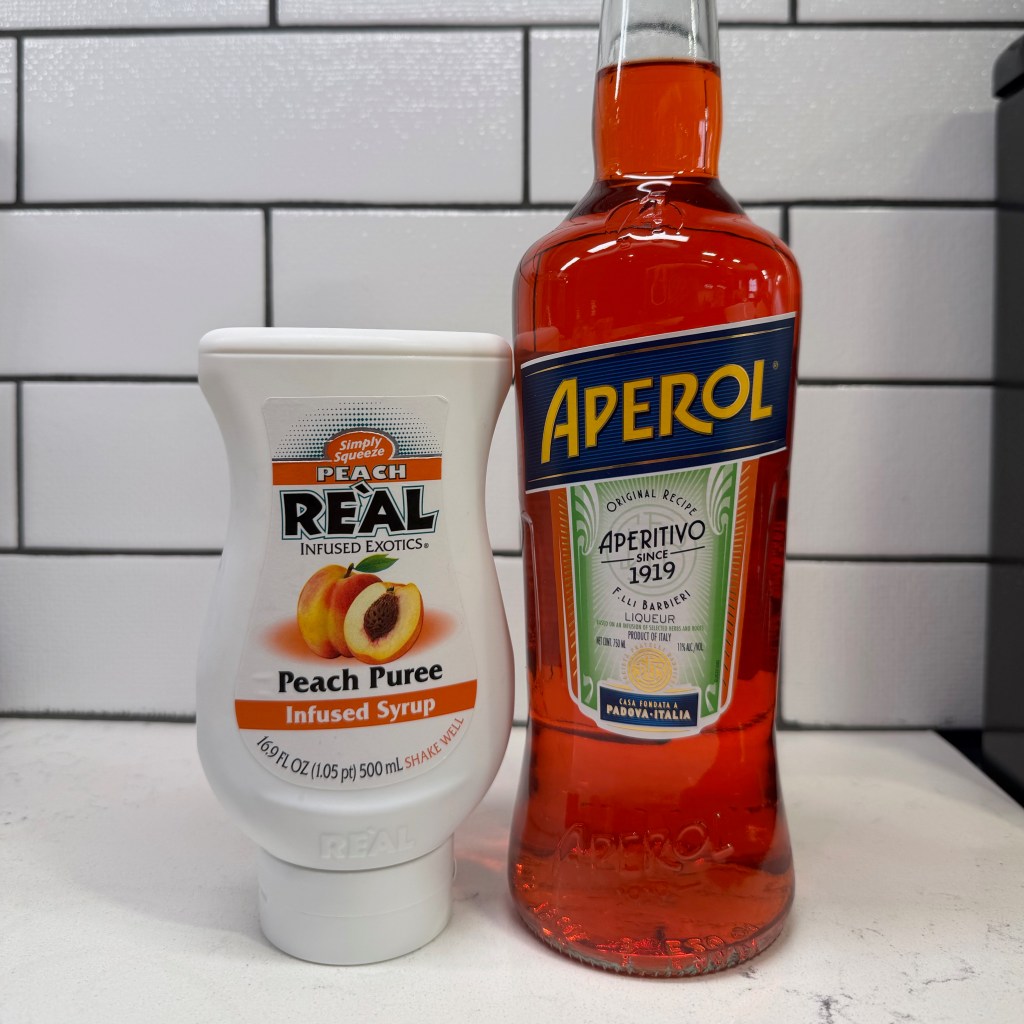
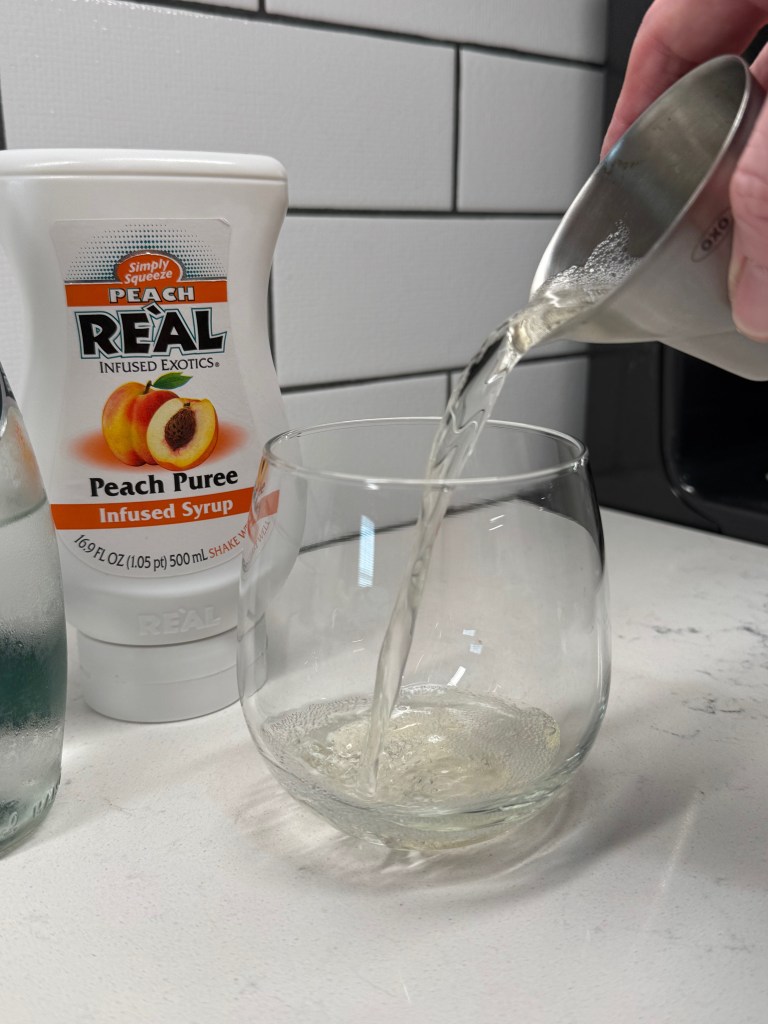
First of all, there’s no peach schnapps! The last time I tasted that stuff, I cringed at the artificial aftertaste. No, this glow-up gets its “fuzzy” flavor from a peach puree that concentrates real peaches into a thick syrup that plays nice with a number of alcoholic spirits— vodka, bourbon, blanco tequila, need I go on? It’s sweet (but naturally so), and a little goes a long way. You can find this product in the mixers section of a larger supermarket, or in the same aisle of a wine or spirits store.
The “navel” aspect of my upscale drink comes from Aperol. This slightly bitter, orange-meets-herbal aperitivo from Italy brings an instant citrusy balance to the sweetness of the peach puree. Aperol is having more than a fleeting moment of popularity, and I decided to ride that wave for my birthday.
The peach and orange flavors are covered here!
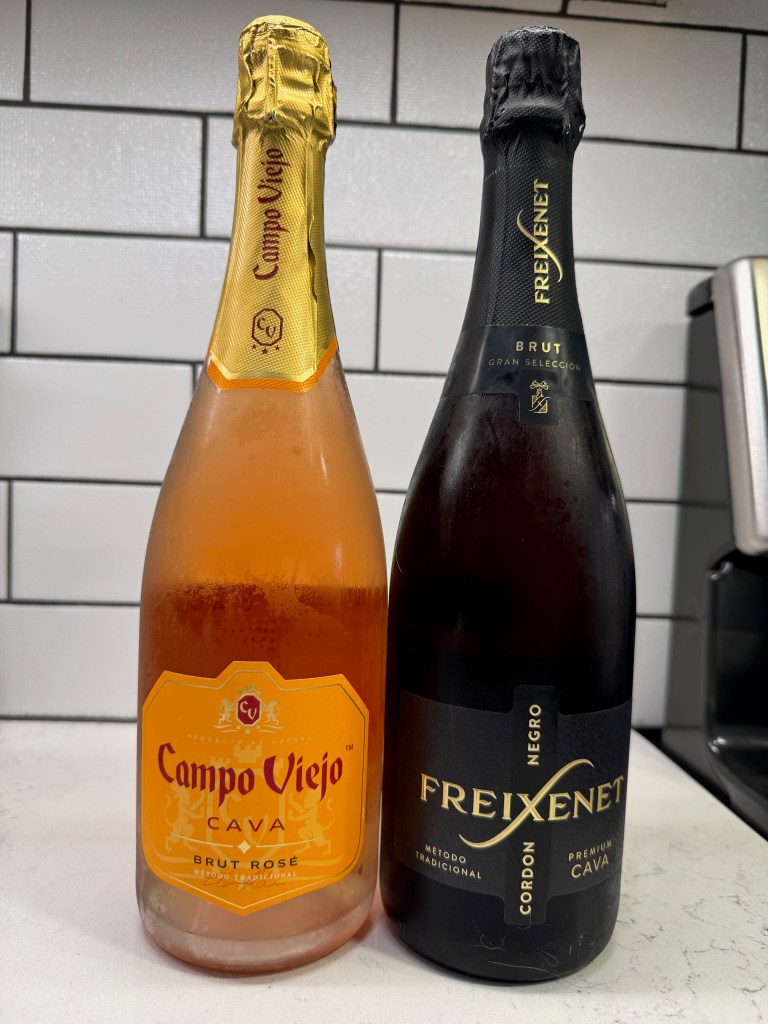
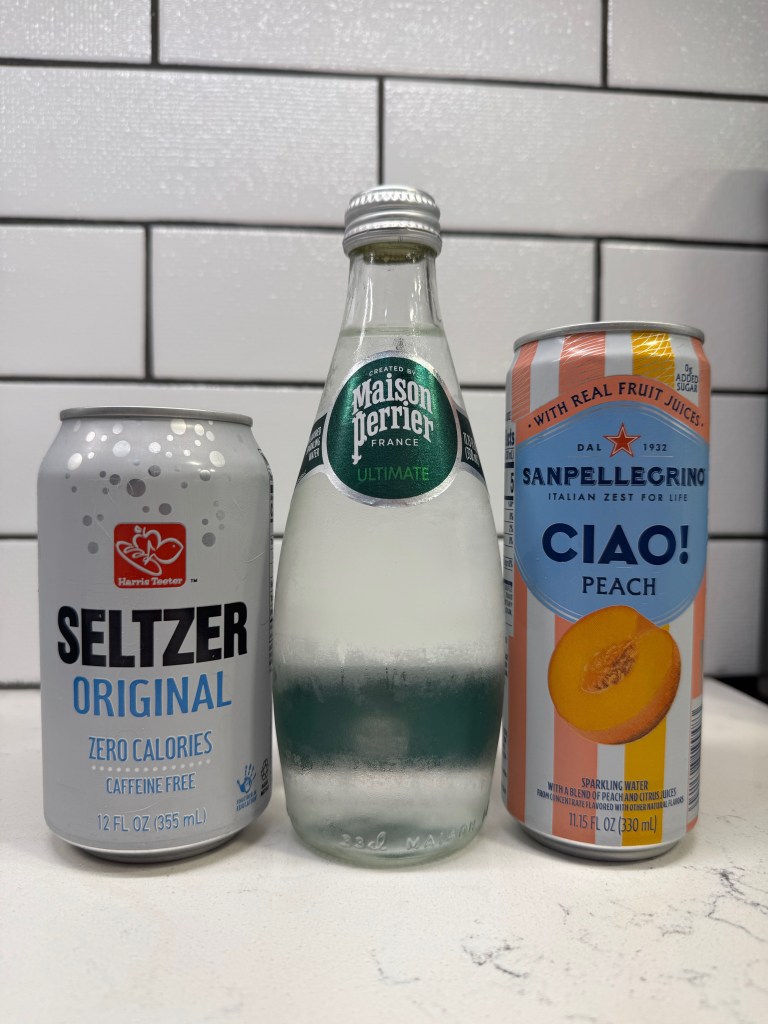
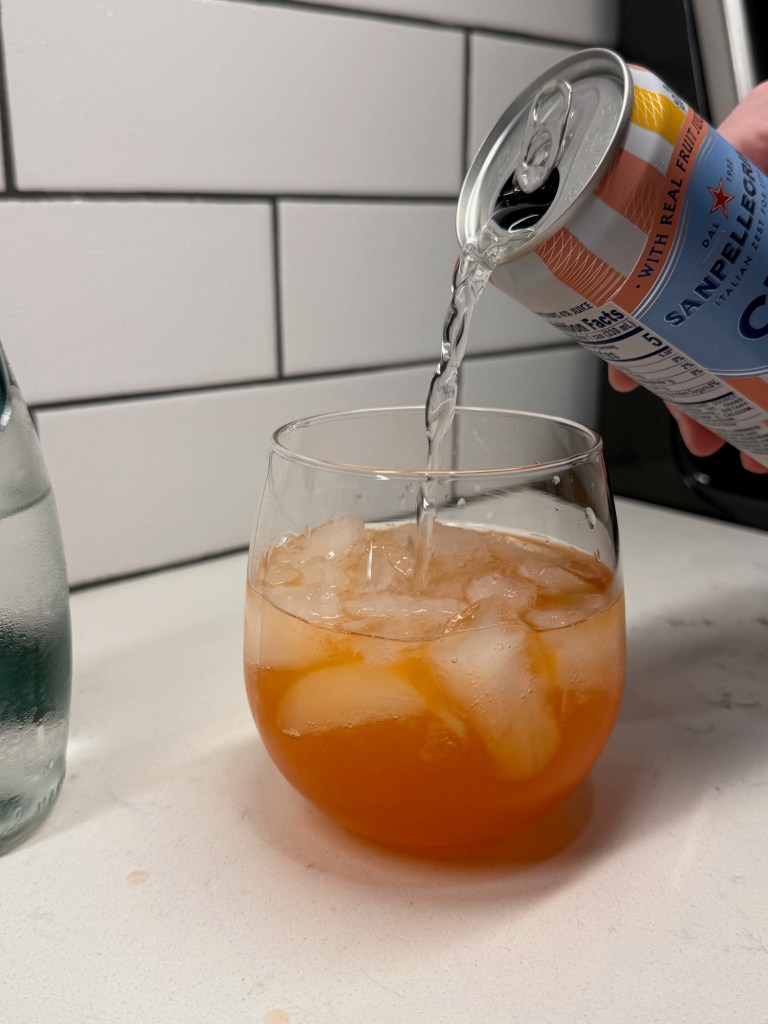
Finally, the base of the drink is Cava, Spain’s counterpart to champagne, bringing a little “fizzy” to my “fuzzy,” and a splash of sparkling water on top softens the drink for superb sipability. Any sparkling will do, whether club soda, seltzer or one of the fancy European options. If you happen to find one scented with orange or peach, even better!
Pick your poison! Any sparkling wine will work, but choose something dry.Please try to find the Ciao! peach. It’s awesome, even on its own.
If at first I don’t succeed, and I didn’t
This cocktail idea has been floating in my mind since at least my last birthday, but it was only in the past few weeks that I got serious about making it work. My first effort looked nothing like what you see here. It included vodka, peach nectar (which is not as peach-forward as it sounds), orange juice, Aperol and prosecco. It was too boozy, too sweet, not very peachy, not pretty and not refreshing at all. In other words, it needed a lot of work!
The peach flavor needed to be concentrated. I considered cooking peaches down into a puree to replace that so-called nectar, but would my birthday venue be willing to do that when I handed them the recipe? Relying on a pre-made mixer felt like cheating, but I am so glad that I checked out this peach puree. It’s just sugar, peaches, citric acid and a preservative—not so bad after all! Did I mention that it is great with bourbon, too? I’ll save that for another post. 😉
The vodka got 86’d because I wanted this to be a lower proof drink for easy summer sipping. Prosecco wasn’t right because the peach puree makes this drink sweet enough. Cava feels like the perfect choice, but a California brut would be great as well.
In the name of research and development, I’ve made quite a few iterations of this drink, fiddling with the ratios to balance the flavor. A traditional Aperol spritz follows a 3-2-1 ratio of bubbly, Aperol and sparkling water. But two ounces of Aperol was overwhelming to the peach, so I’ve cut it almost in half. The ratios you see in the click-to-print recipe below are my final decision, and I think it’s perfect.
Just one more thing…
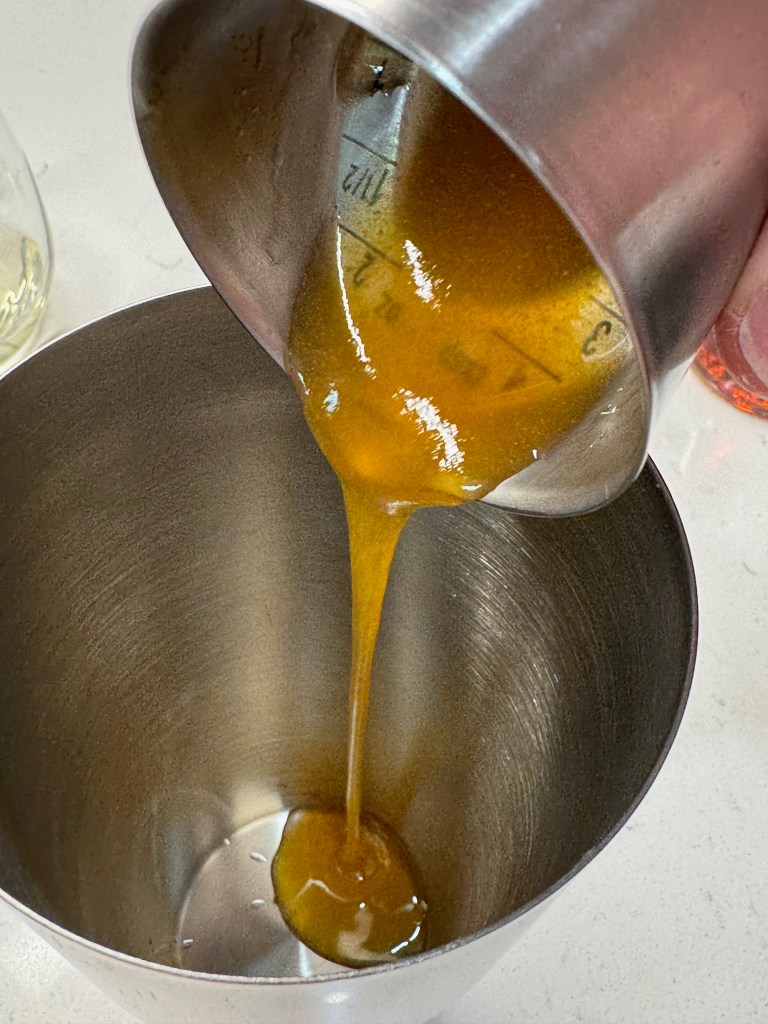
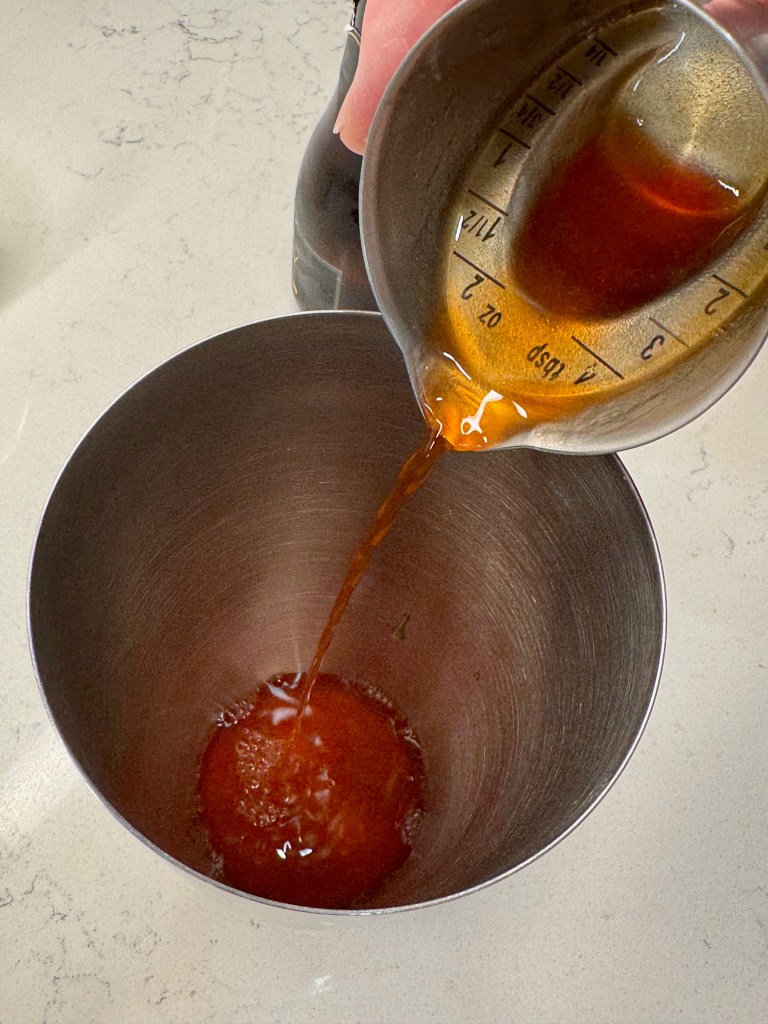
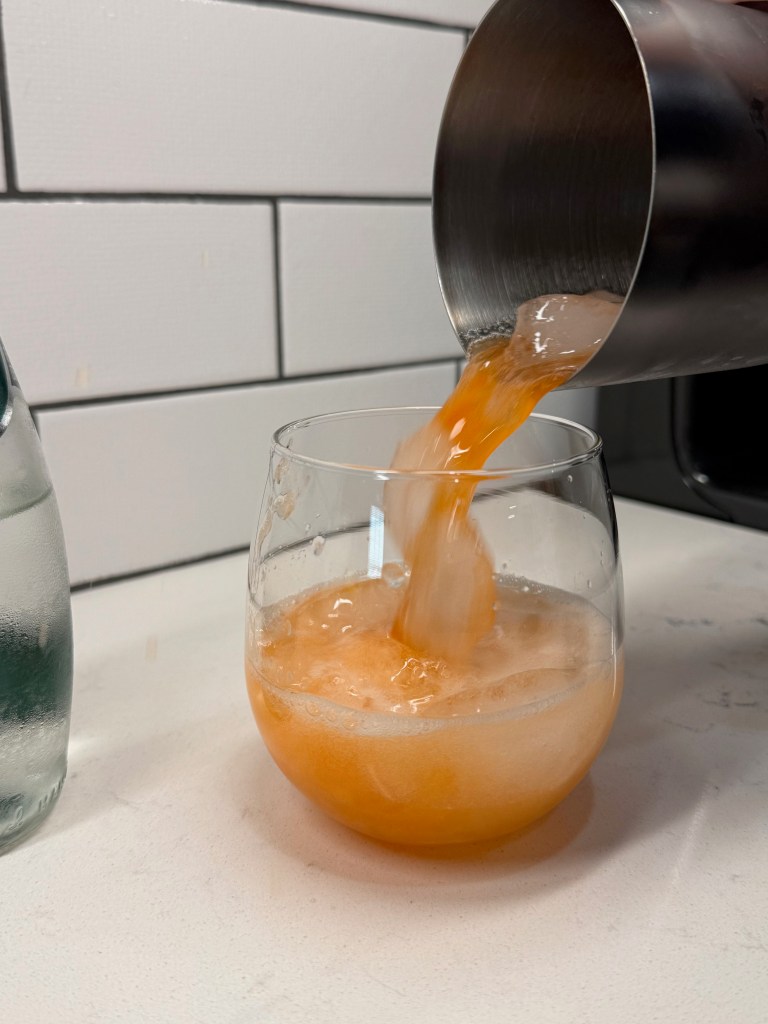
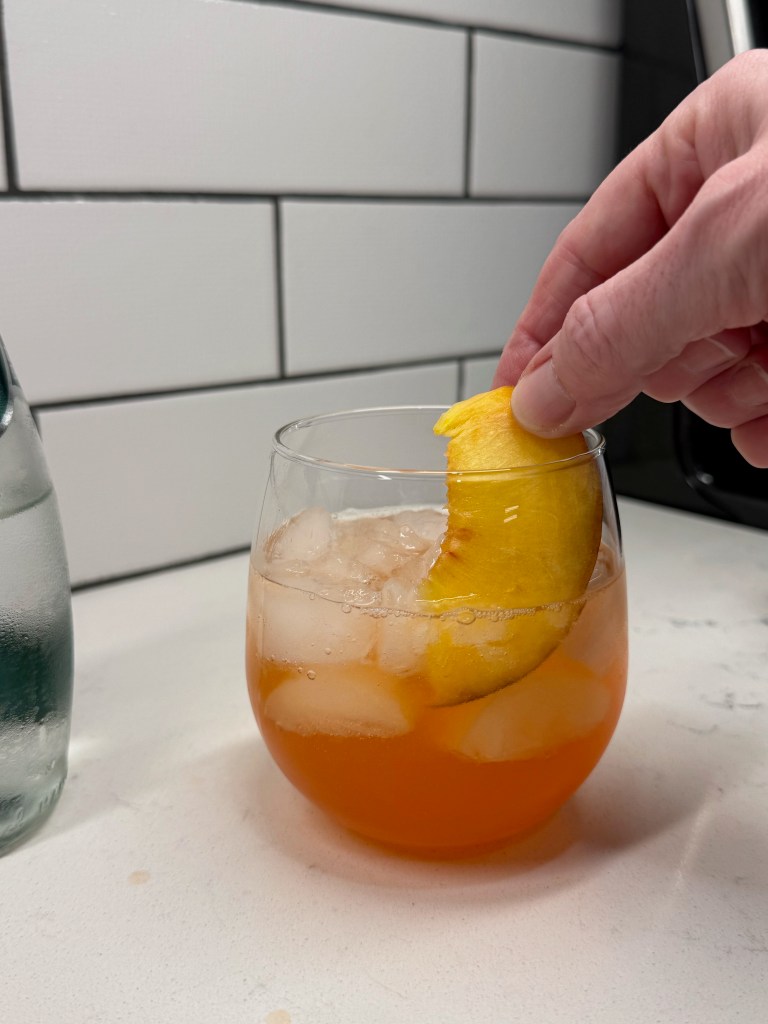
Though a spritz is typically mixed directly in the glass, this one does require a shaker to mix the Aperol and the peach puree, which is very thick. The bubbly ingredients should not go into the shaker, unless you want to clean the whole kitchen when it bubbles over! My method is to measure the chilled Cava into the glass first, shake up the Aperol and peach puree with a decent amount of ice, and then do what pro bartenders call a “dirty pour,” ice and all, into the glass with the Cava. A final splash of sparkling water at the end, and a wedge of fresh, juicy peach finishes this drink.
This is my modernized interpretation of a drink I loved back in the 1980s. It's less sweet than the fuzzy navels of my youth, but still light and very refreshing!
Ingredients
3 oz. Cava or other dry, sparkling wine
3/4 oz. peach puree syrup (Reàl brand)
1 1/4 oz. Aperol
1 or 2 oz. sparkling water, seltzer or club soda
Slice of fresh peach or orange, to garnish
Note: Most spritz cocktails are built directly in the glass, but this one requires a shaker for mixing the thick peach puree. Use a balloon glass, such as a red wine glass, that will hold all of the ice you use for mixing the drink.
Directions
Pour Cava into the serving glass.
Add peach puree and Aperol to a cocktail shaker. Add about one cup ice cubes and shake for several seconds until the shaker is frosty and very cold.
Pour the entire contents of the shaker (ice and all) into the glass with the Cava. Top with sparkling water. Garnish with a fresh fruit slice.
The inspiration for this scrumptious chicken highlighting the flavors of peach and bourbon came from Instagram, but it was salmon rather than chicken. And it was baked rather than grilled (I think). I don’t remember the details, and anyone who is on Instagram knows that’s the nature of the social media beast— either follow it or lose it. And I don’t want to follow every single thing that interests me because I’m scatterbrained enough, and I don’t always think to “save” a recipe post to my favorites collection. I need that sacred space for videos of hero dogs making their final flight home, hungry raccoons snatching a donut at the Dunkin’ drive-thru, and onesie-wearing dachshunds munching on carrots by a cozy fireplace. Yep, I use social media for mindless entertainment. When it comes to food posts, I’m only looking for inspiration.
That mention of a peaches and bourbon combo was enough to get me going, though, and it stuck with me for days after I saw it, so when Les and I were asking each other what we’d do for dinner last weekend, I remembered the package of chicken thighs I had just bought that day and I blurted without even thinking, “peach-bourbon glazed chicken.” And there was no arm-twisting involved, because anytime we are pairing anything and bourbon, we’re good. All I needed was a recipe, right?
Not so fast.
If I had time only to share one message for people who think they don’t know how to cook, it would be this: trust yourself! Recipes only get you so far; you still have to understand some things about cooking, and that boils down to pairing flavors and mastering a few techniques. You already know what flavors you like together, so learn the methods that will help you be successful and the rest will fall into place. I didn’t write down anything about the recipe from that fleeting Instagram post— but I am going to connect the dots from what struck me about it: peaches, bourbon, meat and the grill.
The Flavor Pairings
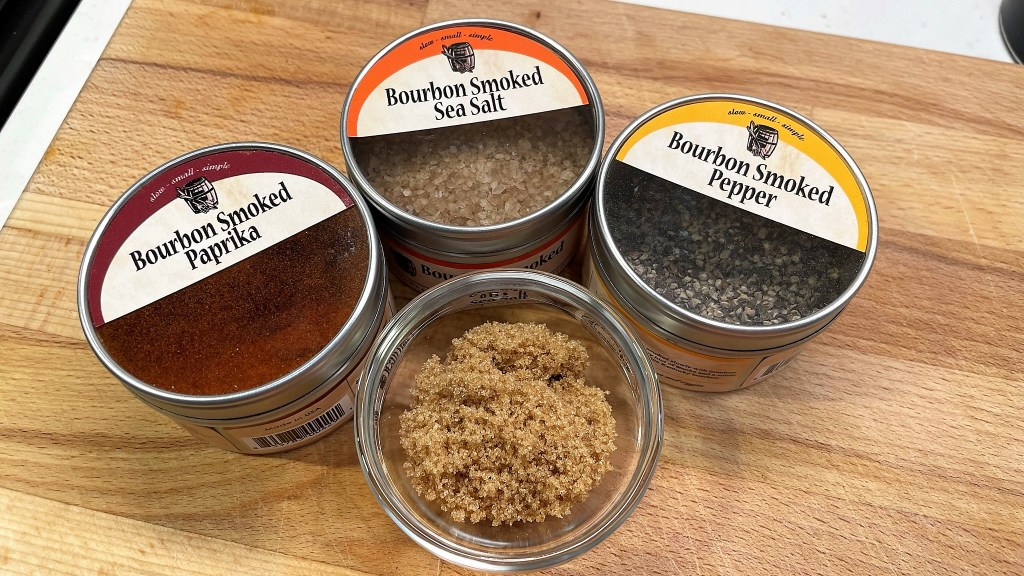
Peaches are sweet, juicy and summery. What complements sweet? Tart, spice or smoke. That helps narrow down my next move toward pairing flavors. Bourbon is strong, with a boozy bite and a light smokiness from oak barrel aging, so I already have a complementary flavor profile (smoke) taking shape. I can inch it further toward smoke with introduction of a spice, but which ones are smoky? Off the top of my head, I know I have cumin, but that starts heading off into more specific ethnic cuisines (Mexican or Indian), which is not where I’m going. I wanted this to taste like an all-American summer. Paprika is also smoky and brings the benefit of adding vibrant brick-red color. That’s my choice for this dish, and I happen to have a bourbon-smoked paprika, which is a no-brainer here. Finally, I want to take the edge off the bourbon without losing its flavor, and a bit of brown sugar will do that while also supporting the sweetness of the peach. See how easy that was?
Lest you think that I analyze every recipe I make this way, I can assure that most of this mental processing happens unconsciously, much the same as getting dressed in the morning and instantly knowing which colors, styles and patterns will work or clash. The more time you spend in the kitchen, the more natural these decisions become.
Salt and pepper: the simplest seasonings are usually enough when you’re grilling, and it’s the way to go when you want the flavor of the meat to take center stage.
Smoked paprika: this lends a light smoky flavor, which is always a winner for the grill. This spice might not have been right for berries or citrus, but it worked great with peaches.
Brown sugar: this will underscore the sweetness of the peaches, soften the bourbon and also encourage even caramelization of the meat during grilling and glazing.
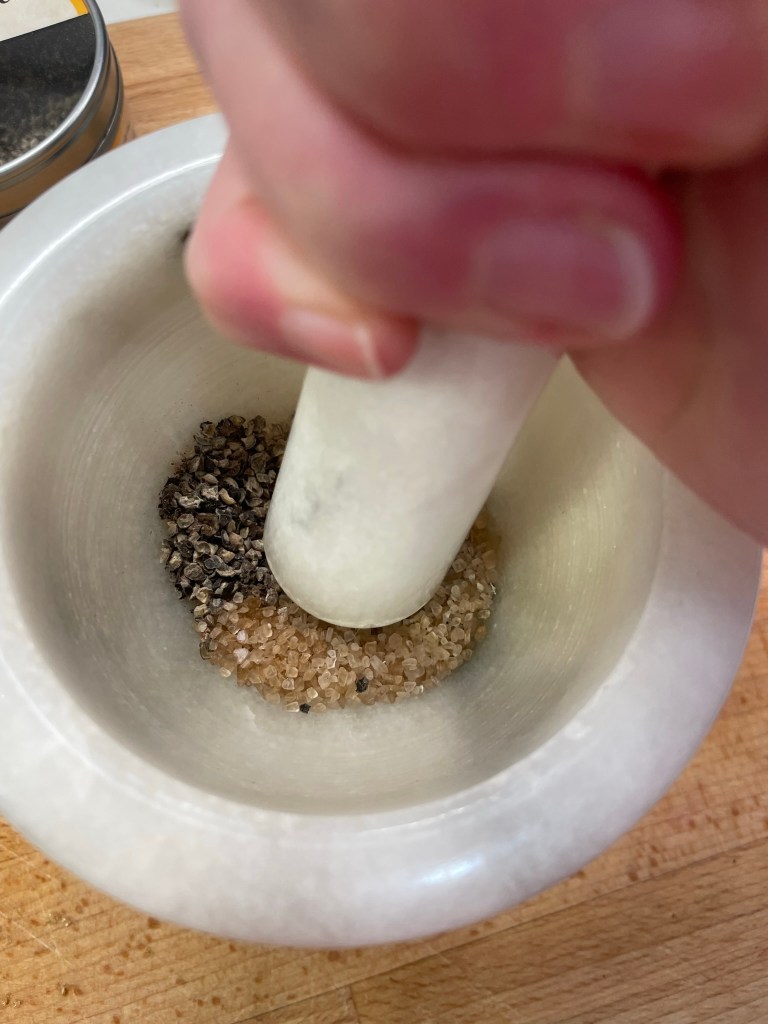
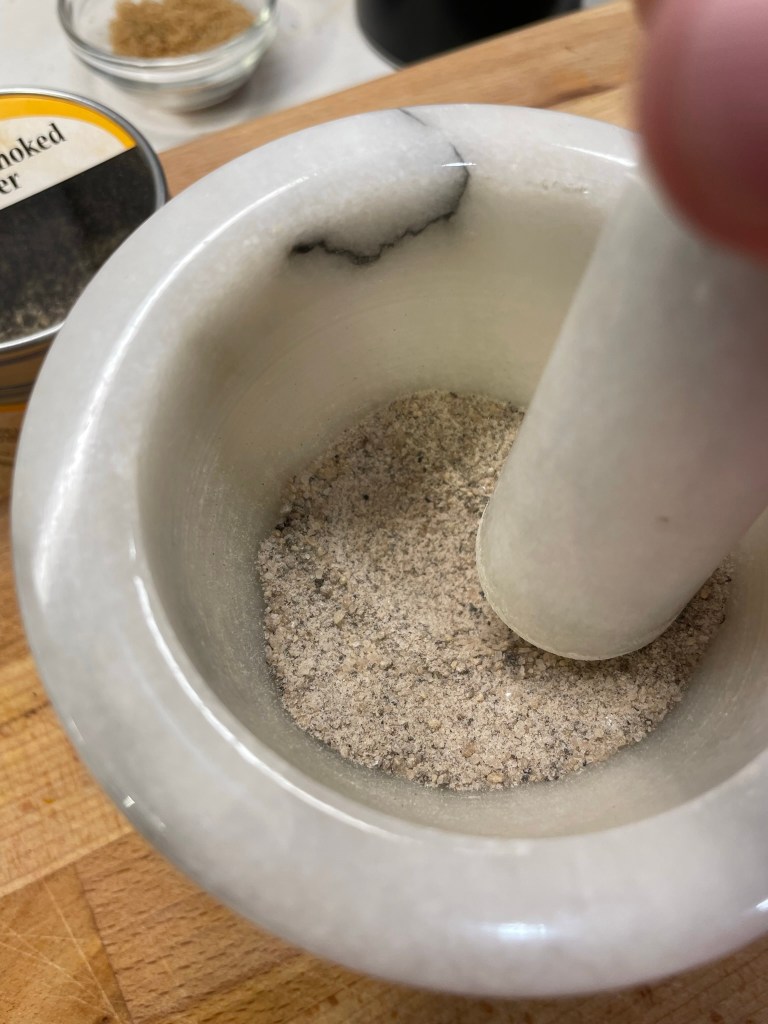
My bourbon smoked salt and pepper were very chunky, so I crushed them fine, then added the mixture to the paprika and brown sugar.
The Technique
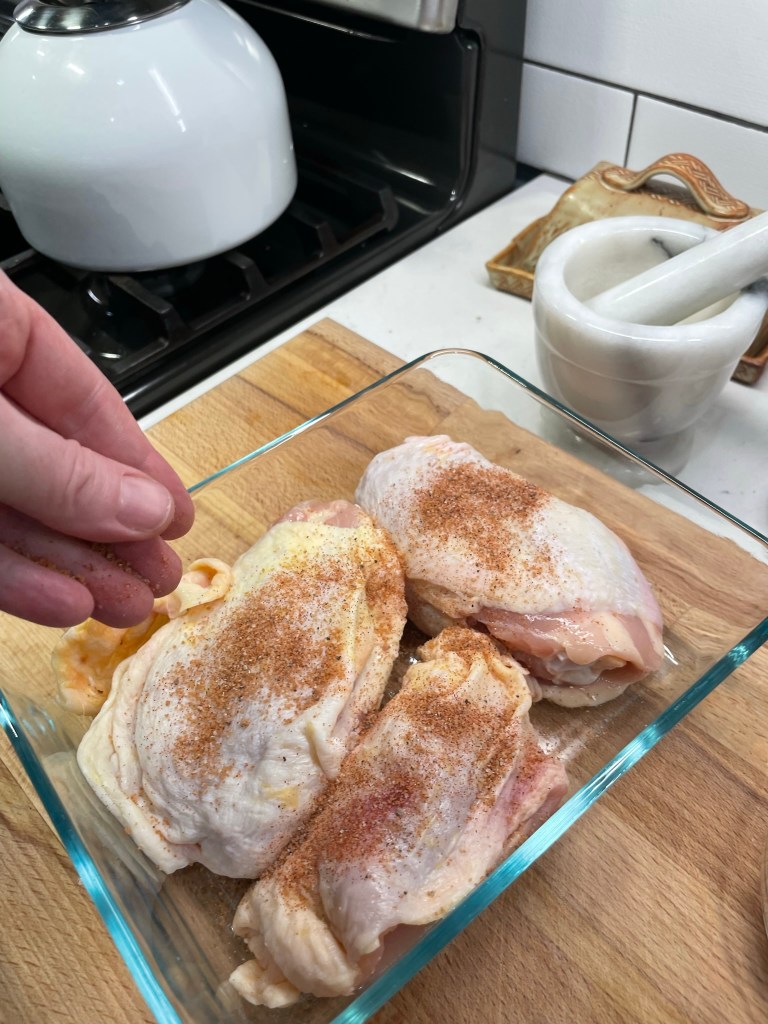
Les and I have both grilled food for years, but we always have something new to learn. I’ve been leaning heavily lately on the teachings of Kenji López-Alt, whose book The Food Lab describes in detail the benefits of dry-brining meat before roasting or grilling. It’s a whole science-y thing that involves reverse osmosis or something, and it works every time, producing both a great crispy skin and a juicy, tender interior. So for these chicken thighs, I did a quick dry brine with the seasoning blend above, and I held back a spoonful to use in the peach-bourbon glaze (more on that in a moment).
Pat the chicken fully dry before seasoning both sides with the spice rub, then send it to the fridge WITHOUT a cover.
With better planning, I would have done this seasoning step the night before we cooked, to give the chicken skin more than five hours of dry brining time. But sometimes these ideas hit me on the same day I want to cook, and five hours turned out to be plenty to give the chicken a locked-in delicious flavor. An extra few hours would likely have dried out the skin more for an even crispier exterior, so maybe next time. 😉
The Peach-Bourbon Glaze
The peach-bourbon flavor combination that started it all was the last thing I prepared, but you can see by now that it was the basis for everything else I did. This is usually how I develop a recipe, whether it’s for a cocktail, a dessert or a main dish. The same spice blend I rubbed on the chicken also seasoned the peaches I cooked down for the glaze. An extra spoonful of brown sugar made the glaze syrupy, but too much would have made it cloyingly sweet. For the bourbon, I scanned my bar for ideas. Would regular bourbon have worked? Of course. Black-cherry infused bourbon? Not so much. The smoked maple was next-level, the winner!
Notice that I added the smoked maple bourbon twice? Half a shot at the beginning of cooking, and half a shot at the very end.
More Technique
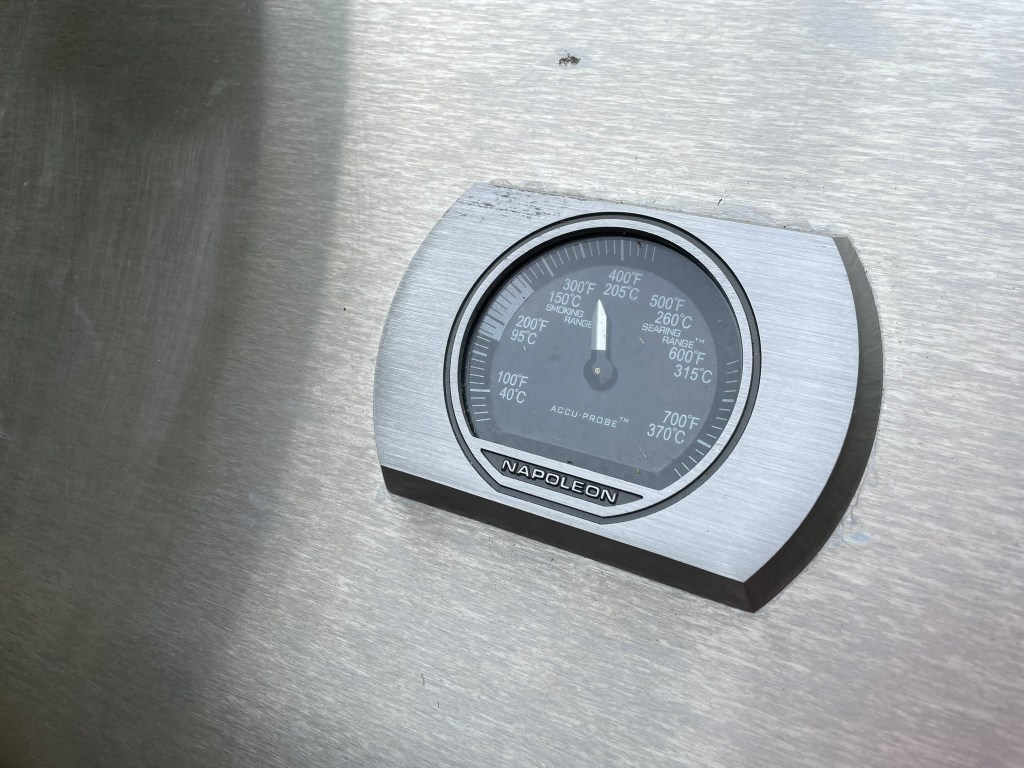
The rest of the process belonged to my husband, also known here as “Master of the Grill.” He has been relentless in learning the nuances of our new Napoleon gas grill with its numerous bells and whistles, including infrared searing zones, and some of those features come with a steep learning curve. For chicken thighs, Napoleon recommends a “reverse-sear” technique—Kenji would approve— and so Les preheated the grill to 350° F, with indirect heat on one side. The goal with this kind of cooking is to slow-cook the meat to achieve proper temperature before sealing the deal with crispy skin and glaze.
This reverse sear technique seemed backward from our usual way of grilling, but it paid off.
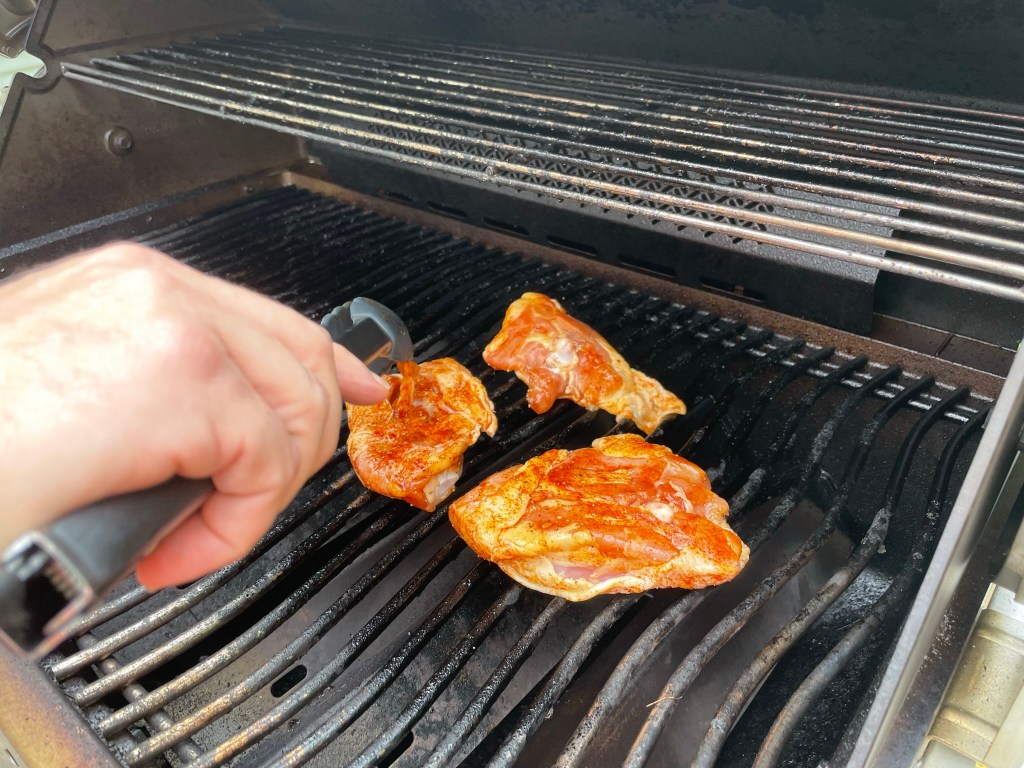
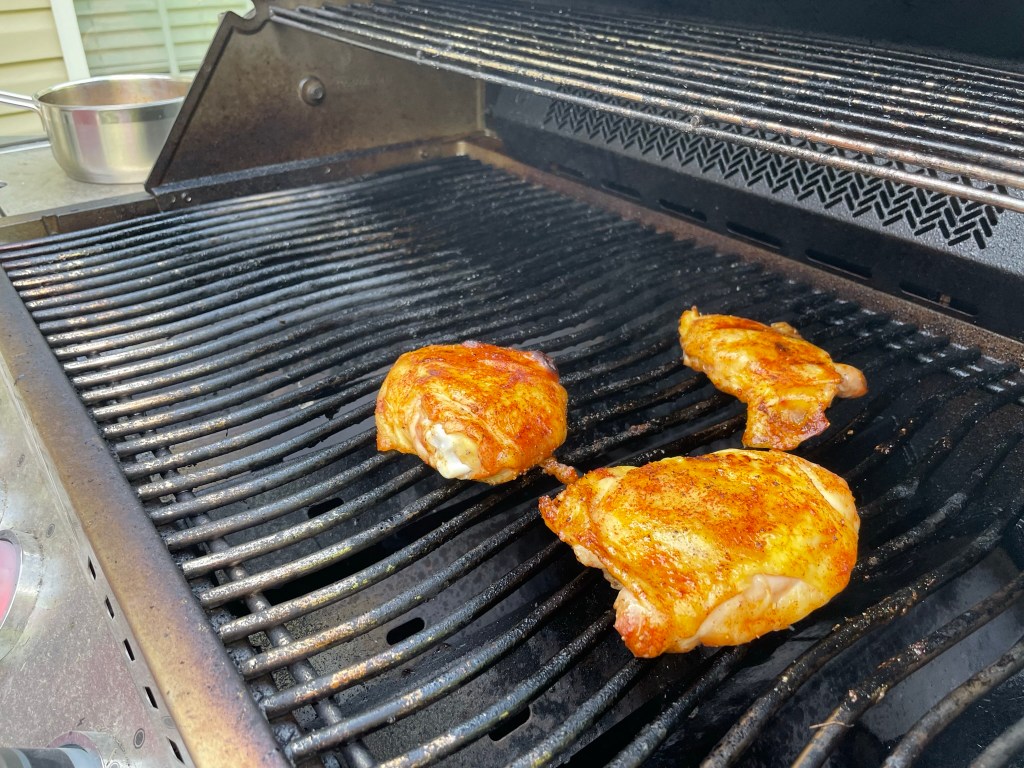
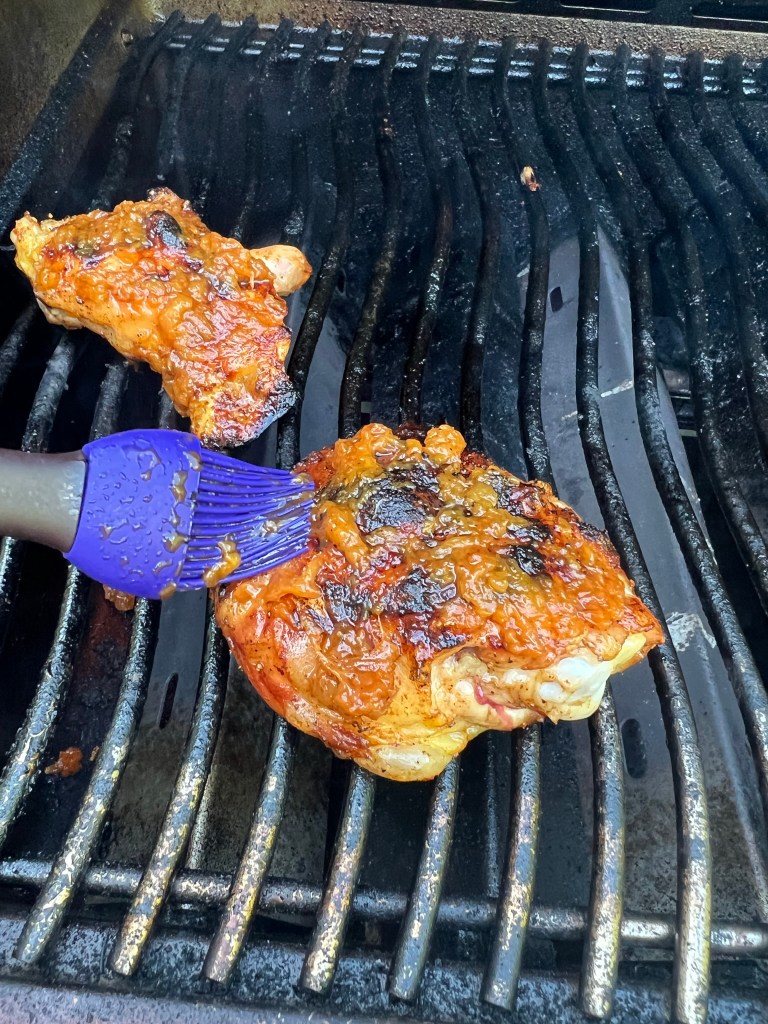
Les placed the thighs skin side-down on that indirect side and closed the grill cover, turning them only once during a whole 25 minutes, and checking the internal temperature periodically until it reached the recommended 145° F. Finally, the chicken was ready to move to the direct heat side of the grill, where it was licked by the flames for about four minutes, until the skin was crispy and the final meat temperature was 165° F. Only then did Les brush the peach-bourbon glaze onto the thighs for a final grilling, and gave them another quick sear to lock in the glaze.
If he had done the glazing too early, two things could have gone wrong— the glaze (with all its sugars) would probably have burned, and the wetness of it would have kept the skin from reaching and keeping its ideal, crispy texture. Patience, Grasshopper.
The Result
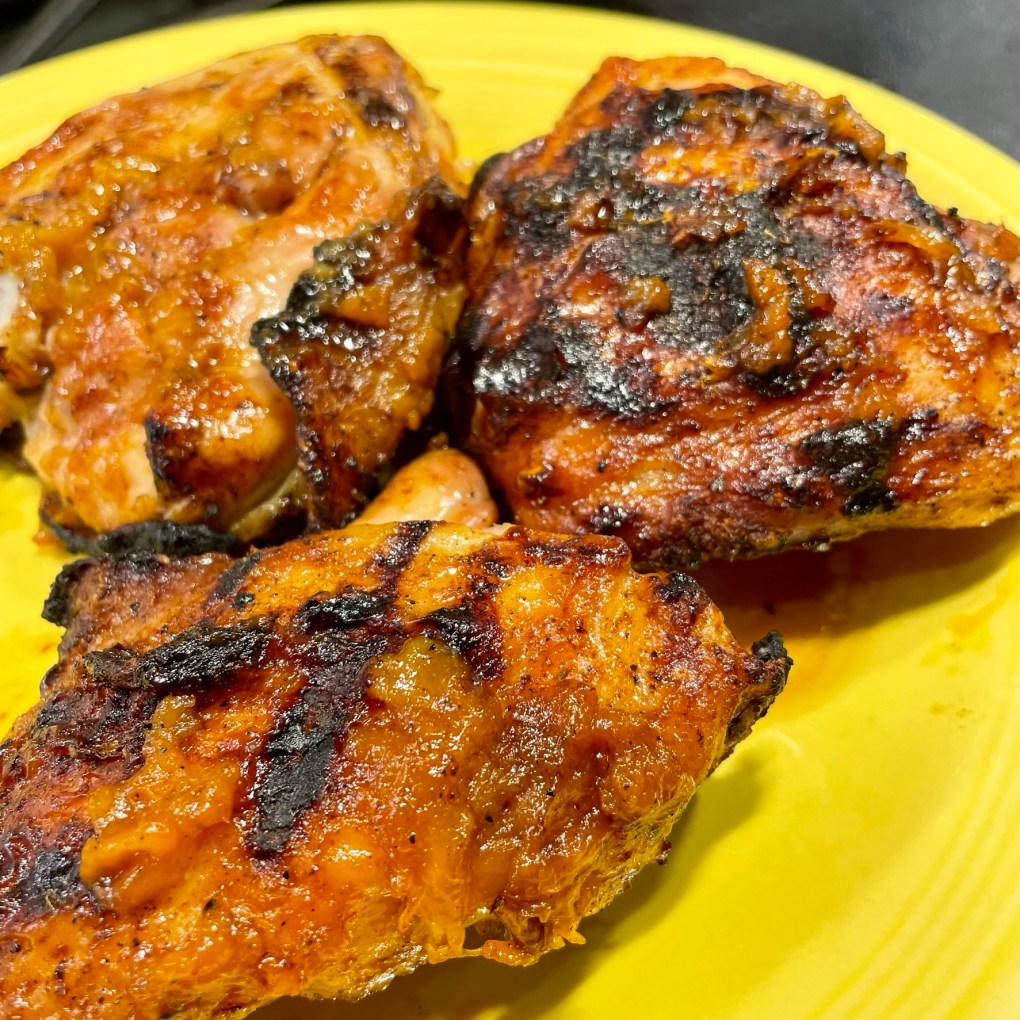
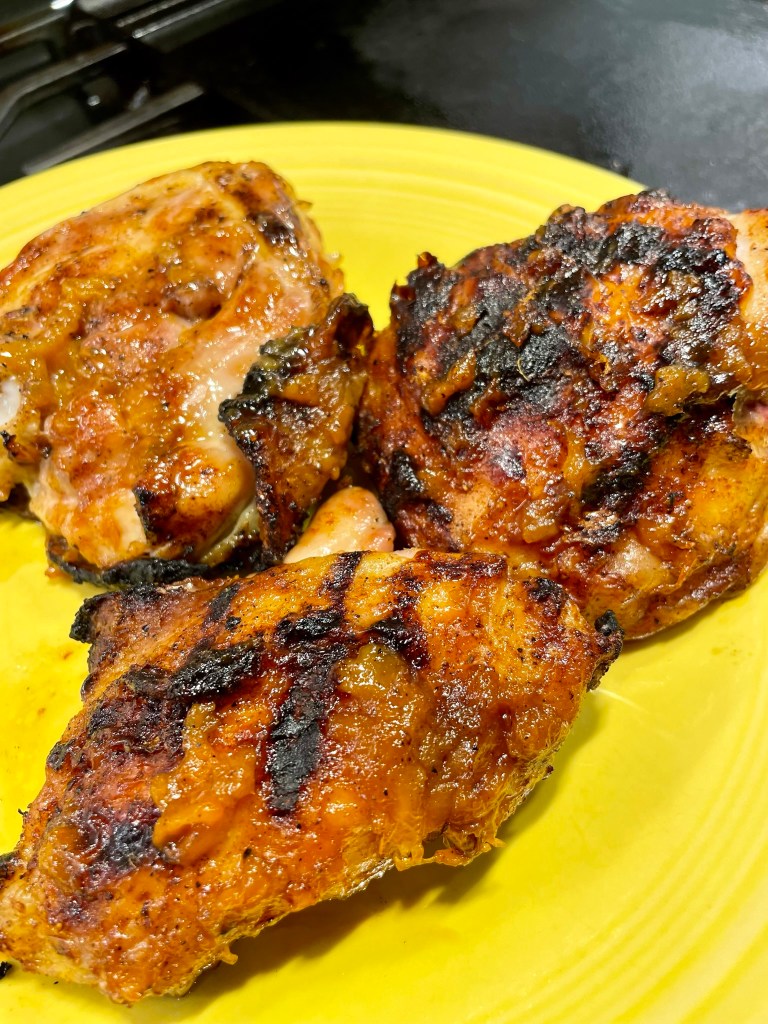
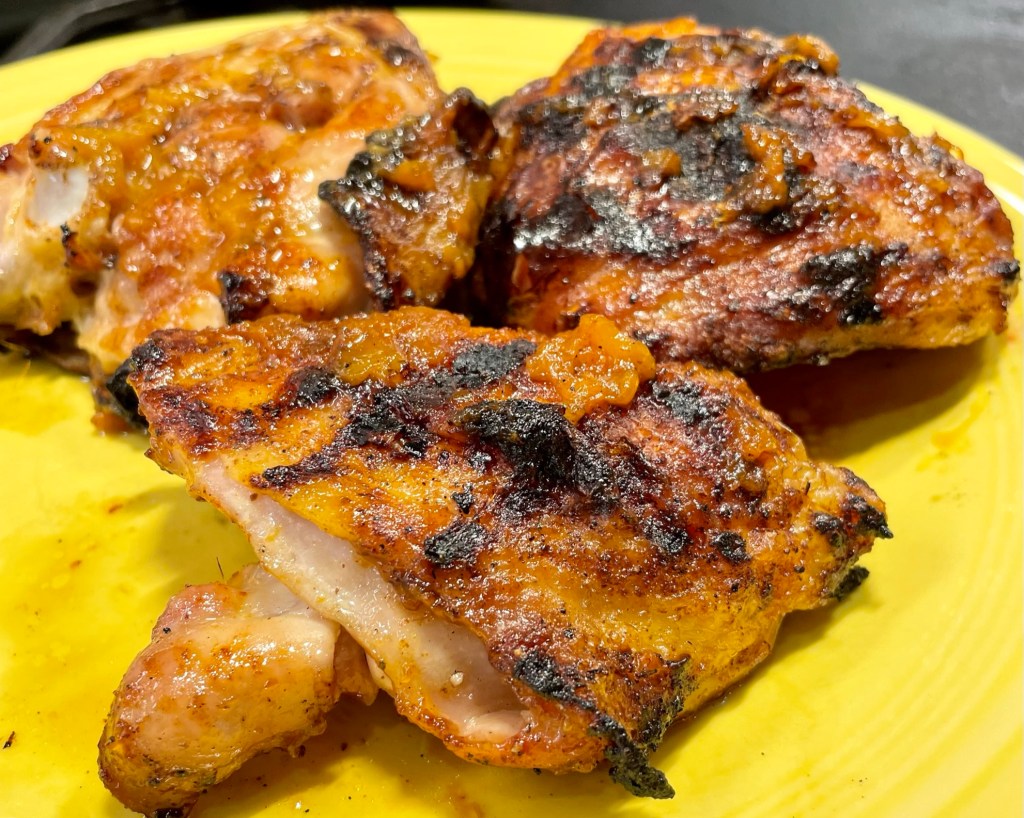
So there we have it: peach-bourbon inspiration + simple, complementary seasonings + unconventional technique + teamwork = one winner of a dish! The chicken thighs were juicy and tender inside, with a nice, crispy skin and a flavorful coating that combined one of summer’s greatest gifts and one of our favorite spirits.
A smoky spice is a wonderful complement to the sweetness of fresh, summer peaches in this flavorful grilled chicken recipe.
Ingredients
1 pound chicken thighs
1 tsp. smoked paprika (Spanish-style, not “hot” or Hungarian)
1 tsp. kosher salt
1/2 tsp. black pepper
3 tsp. brown sugar (use 2 for the rub and 1 in the glaze)
1 large peach, peeled and diced
1 1/2 oz. bourbon (I used smoked maple, and it was great!)
A splash of water, as needed, to cook down the peaches
This recipe relies on two specific techniques: dry-brining and indirect grilling. Both are outlined below, and they take longer than a conventional recipe, so plan ahead. I promise, the extra wait time is well worth it in the end! You’ll need to check the internal temperature of the chicken, so it’s beneficial to have a meat thermometer handy when you begin.
Directions
Do not rinse the chicken. Pat the pieces dry on all sides with paper towels. Arrange on a plate or in a glass dish.
Combine paprika, salt and pepper in a small bowl. Add two teaspoons of the brown sugar and mix until evenly blended. Sprinkle all over both sides of the chicken, reserving about one teaspoon of the spice mix for the glaze. Place the chicken, uncovered and skin side exposed, into the fridge and let it rest for several hours.
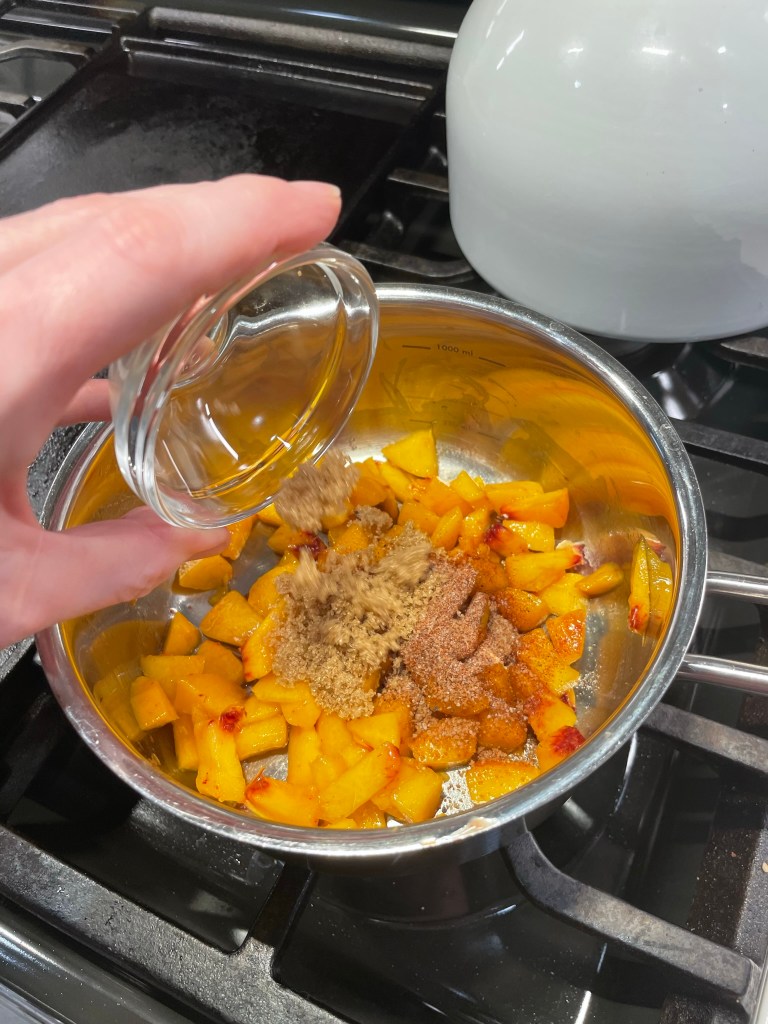
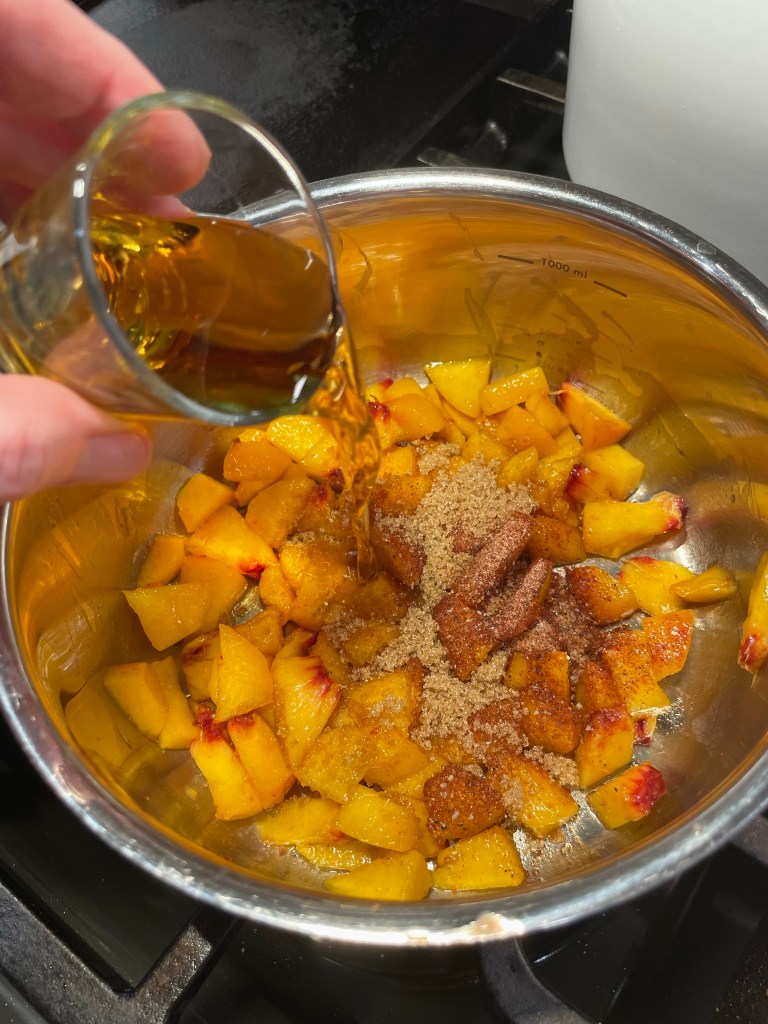
Add diced peaches to a small saucepan with remaining spice blend and another teaspoon of brown sugar. Pour in half of the bourbon and cook over medium low heat until peaches break down and mixture is slightly syrupy. If needed, add a splash or two of water to achieve this consistency.
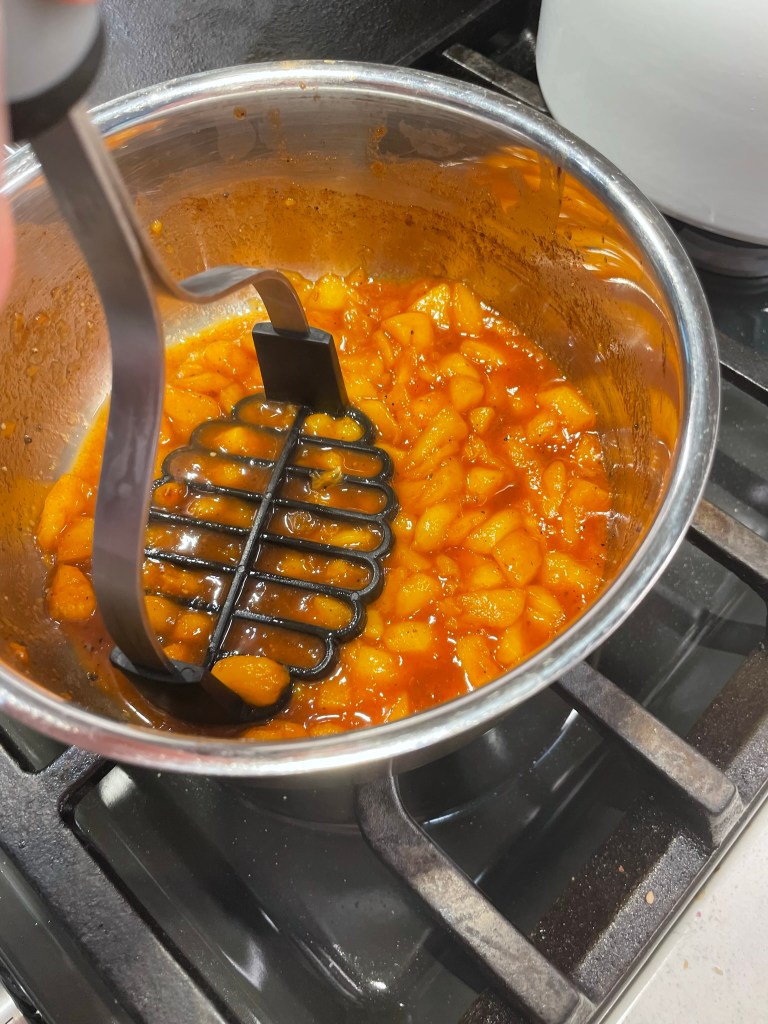
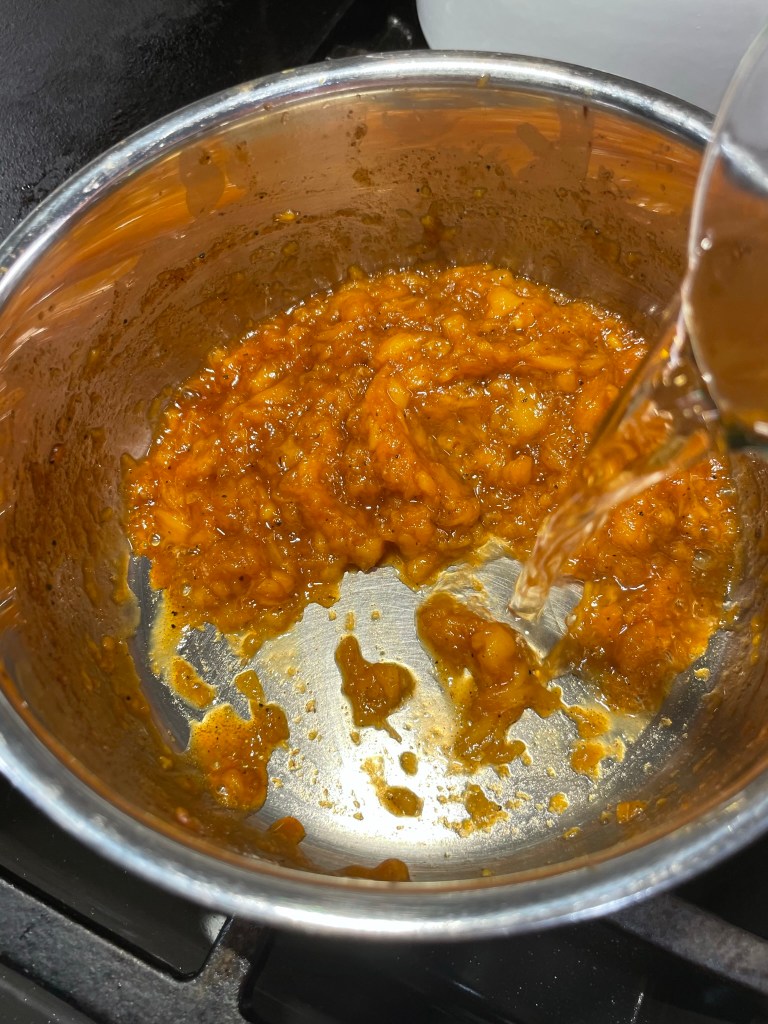
After about 15 minutes, mash the peaches slightly into a chunky puree. When all the moisture has evaporated, stir in the remaining half shot of bourbon and remove from heat. If you make and chill this ahead, bring it to room temp before grilling.
Remove chicken from fridge about 30 minutes before grilling. Heat grill to 350° F, with burners or coals only one one side of the grill for indirect cooking.
Arrange chicken pieces, skin side-down, on indirect side of the grill. Cook for about 25 minutes, turning once or twice, until internal temperature is 145° F. Move chicken to direct heat side to finish cooking and crisp the skin.
When chicken internal temp reaches 165° F, brush on peach-bourbon glaze, and continue to cook on direct heat side briefly, until glaze has a “baked-on” appearance. Watch it closely so the sugars don’t burn.
Serve chicken immediately. When cooking by reverse-sear, post-cooking rest is not necessary.
It’s interesting to me that some foods have their own variations in different parts of the country. Take barbecue, for example. Depending on where you go— Texas, Kansas City or the Carolinas— you might be presented with dry-rubbed beef brisket, saucy ribs or burnt ends, or slow-braised, pork shoulder with vinegar sauce. And for sure, natives of each area will proclaim theirs to be the “true” barbecue, the best or most authentic. It is, of course, a matter of opinion and upbringing.
The same can be said for peach cobbler. Here in the South, most cobblers I’ve had at church potlucks, diners or restaurants resemble another popular dessert here, the dump cake. Everything gets slopped into a pan, usually with the batter on the bottom and the fruit on top, and somehow during the baking process, the dough finds its way to rise up through the peaches. It’s tasty, but a bit soupy and mostly a mushy texture— definitely not the peach cobbler of my childhood, and we all know that comfort food is what you remember from those early days. So I’m about to say something that irritates Southerners more than anything else, ever:
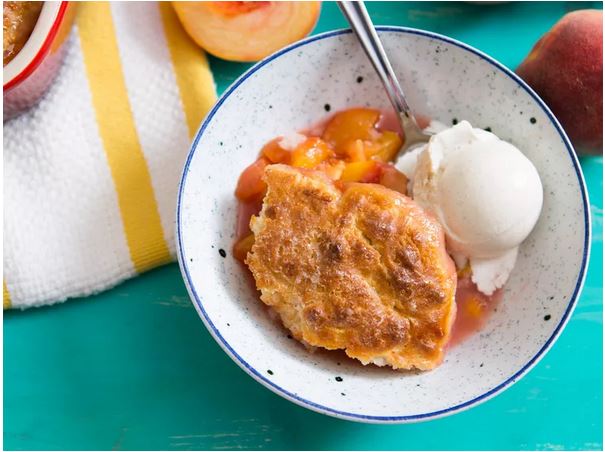
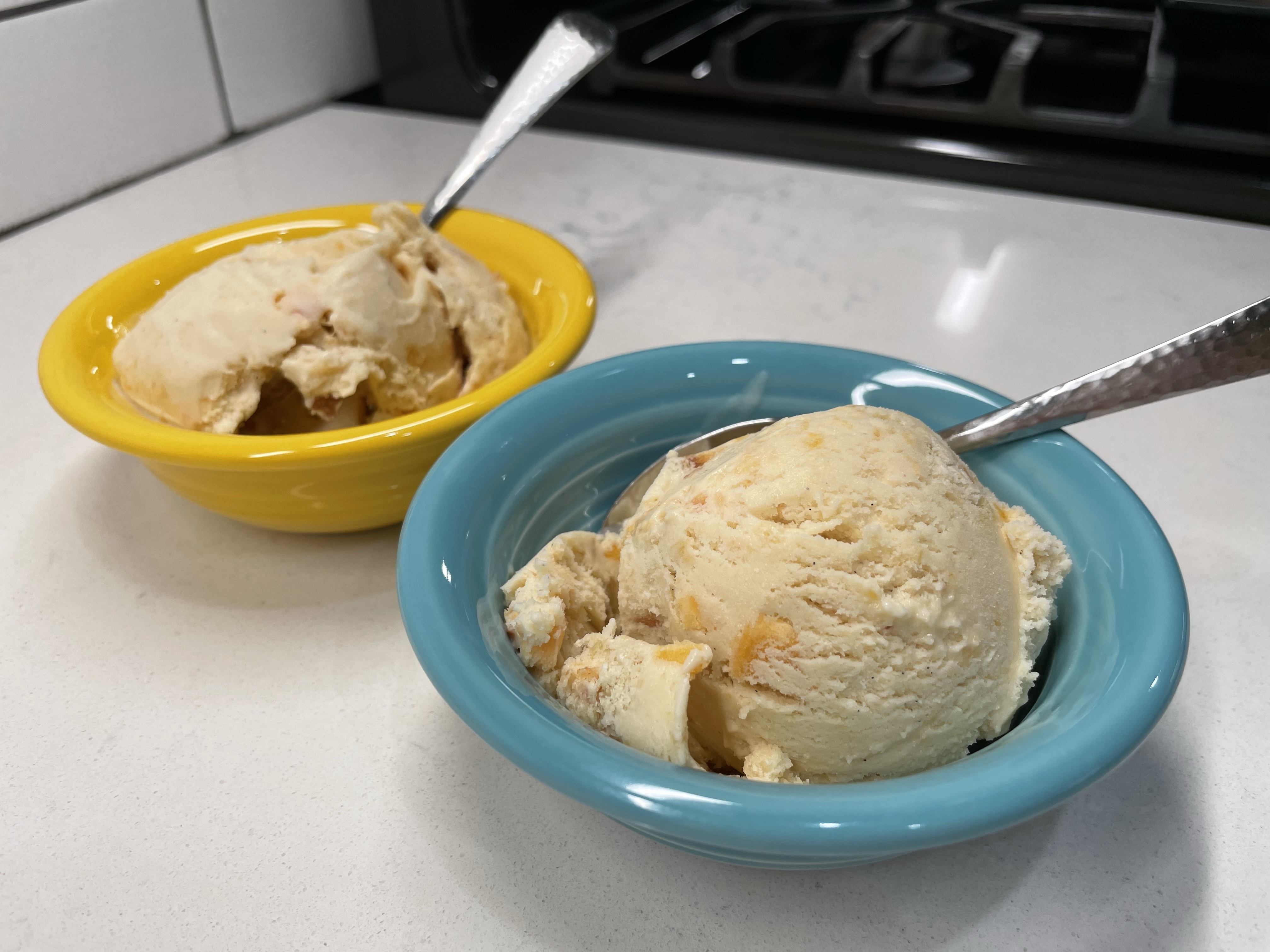
Sweet juicy peaches, tossed with sugar, corn starch and a touch of cinnamon, cooked until tender and saucy under a crown of tender biscuits that have just a touch of crunch on the edges. Crystals of sugar on top that add a little extra something with each bite. Served warm with a scoop of vanilla ice cream. That, to me, is a real deal peach cobbler. As the sun sets on National Ice Cream month this year, I’ve transformed that favorite summer dessert into a single, glorious scoop of peach cobbler ice cream.
This recipe is my own, developed out of my experience with several other past recipes, with and without peaches. To explain how I got here, it makes sense to share what I’ve learned from past efforts and mistakes.
What’s the best way to make ice cream with fruit?
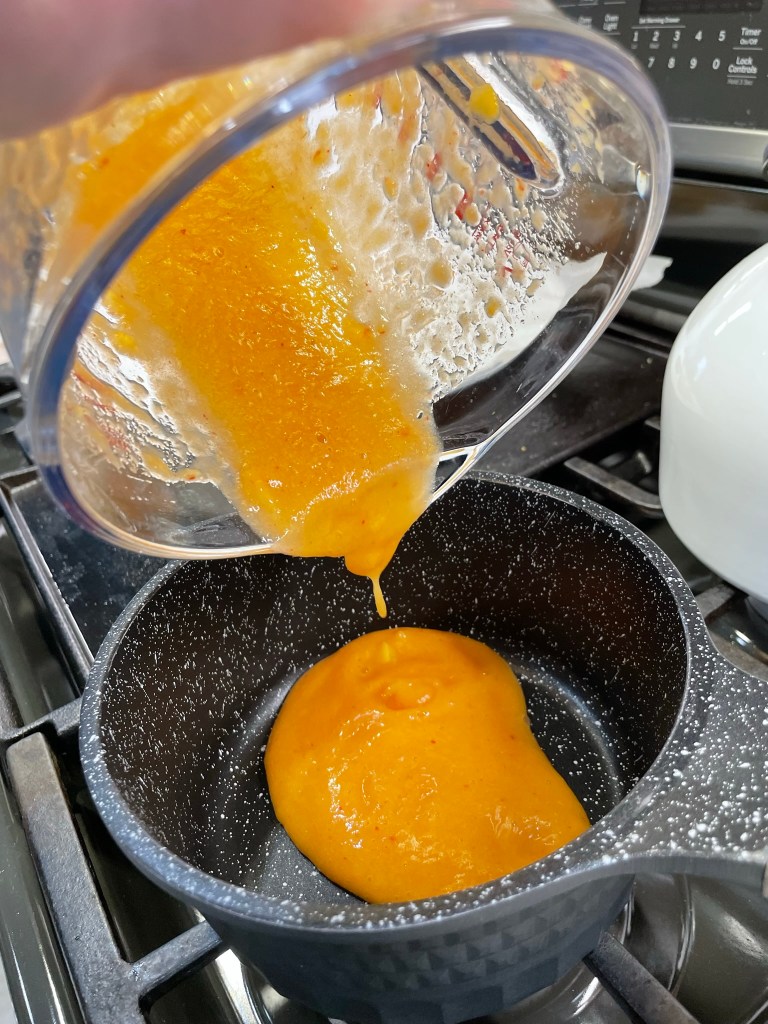
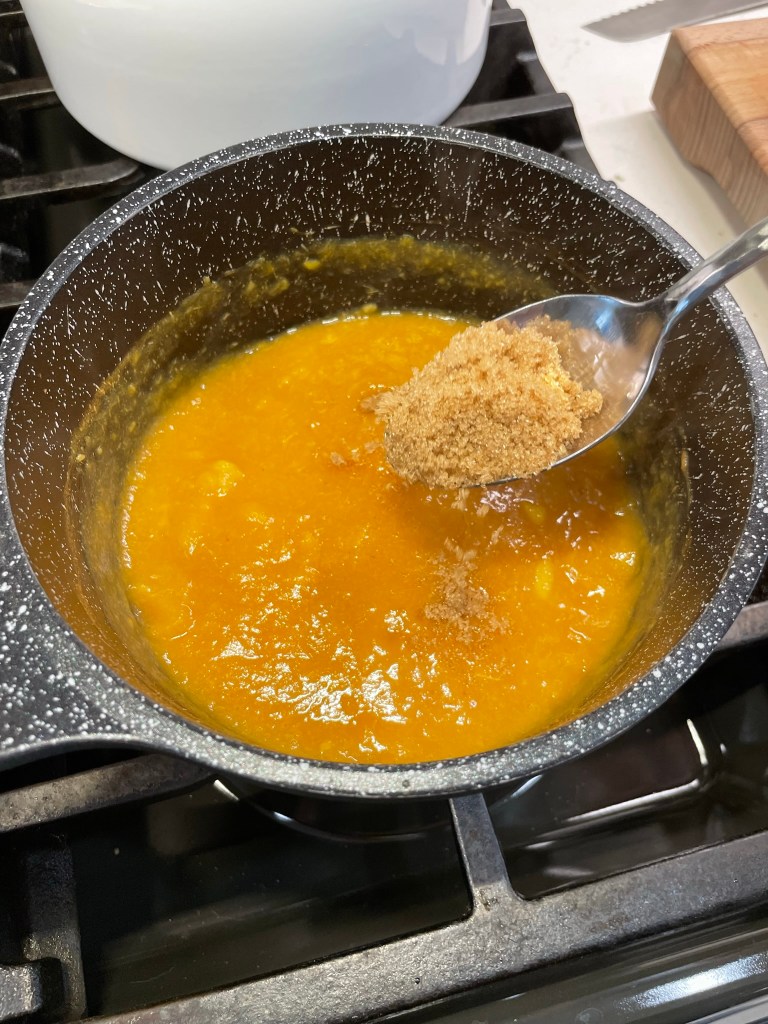
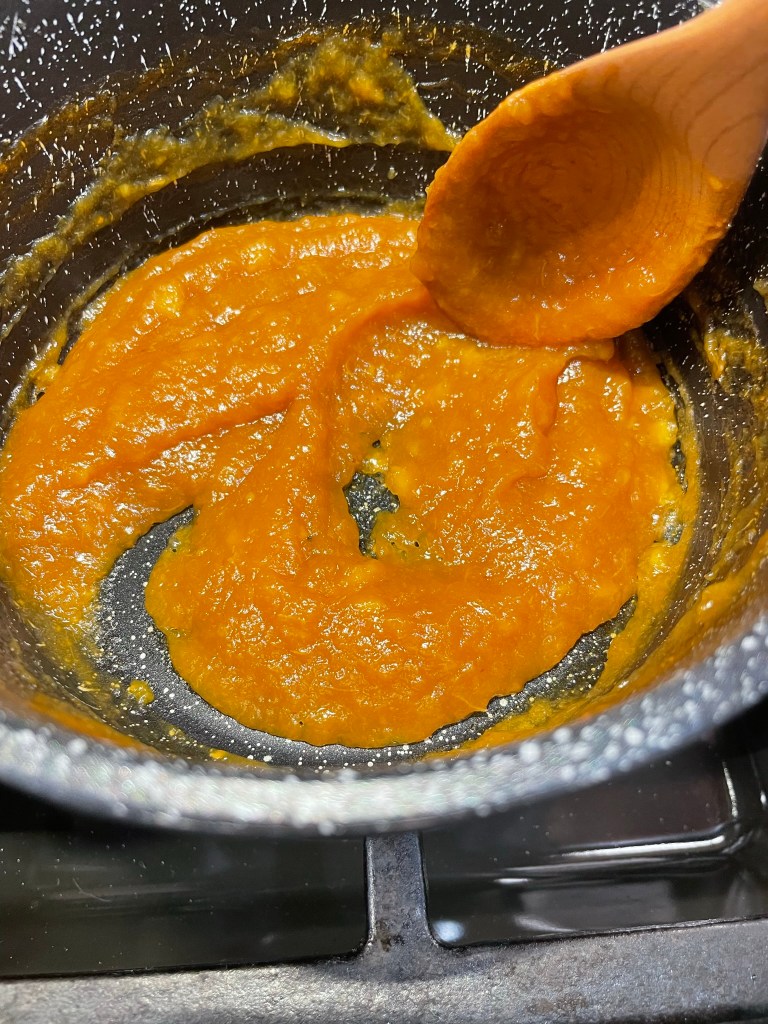
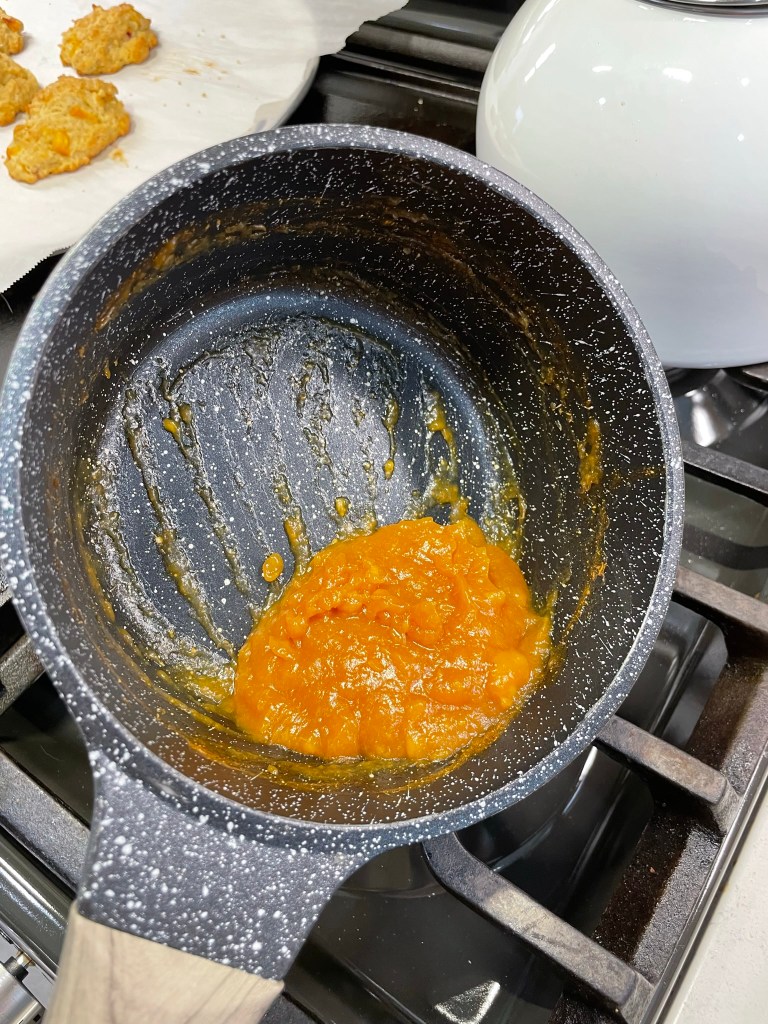
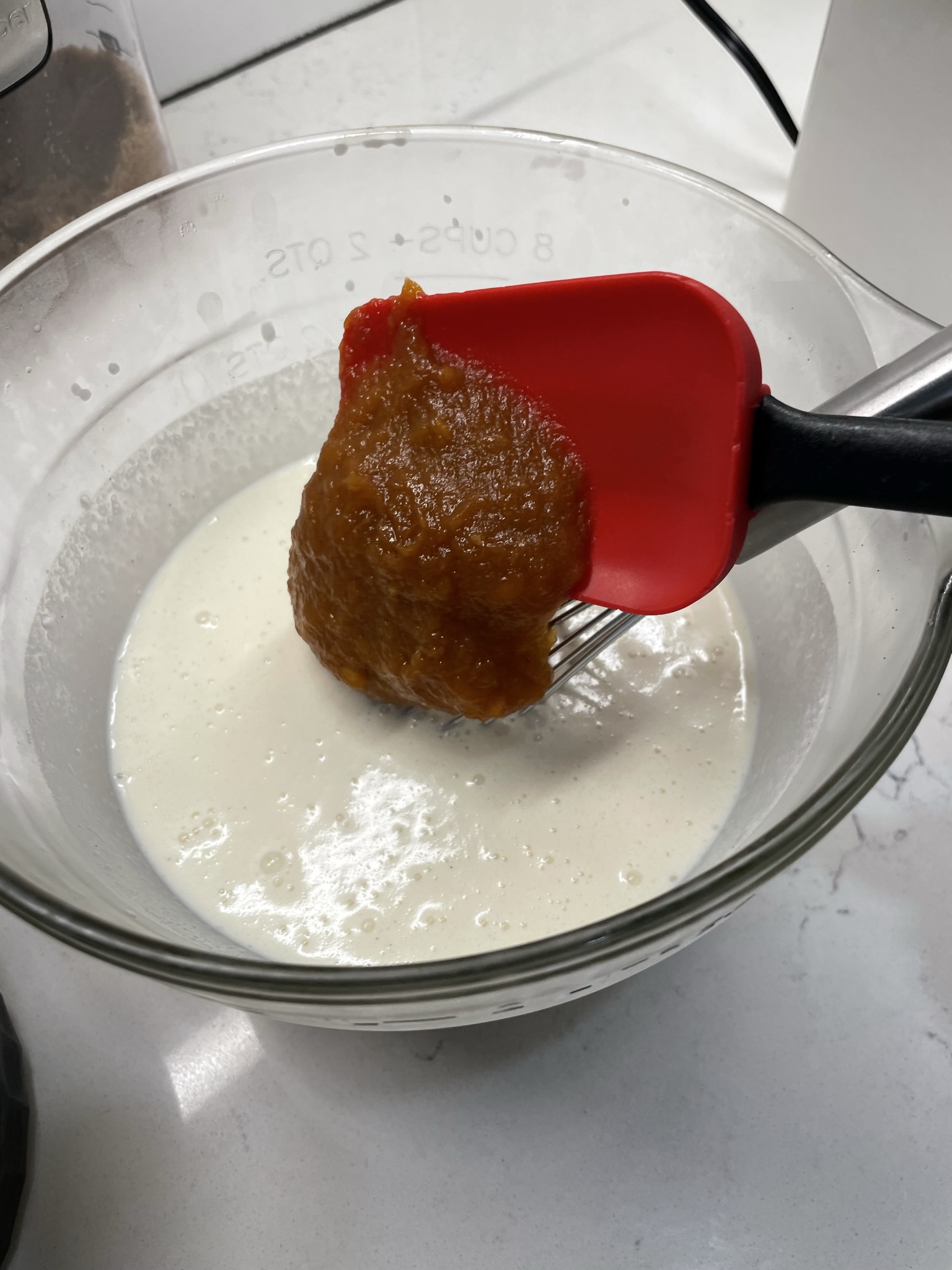
Too many fresh fruit bits can make the finished ice cream feel too icy. I learned this especially when I made a strawberry-mascarpone ice cream a few years ago. Fruit, especially fresh fruit, contains a great deal of moisture, and when you freeze it, ice crystals form inside, making for an unpleasant bite that hurts my teeth. One day, I will re-work that recipe to improve the texture. But to counter the icy effect in this peach cobbler ice cream, I cooked the peaches, borrowing a technique I learned recently when I made that heavenly, boozy strawberry daiquiri cake. Cooked fruit loses volume as the moisture evaporates, but all the flavor remains, so I peeled and pureed a couple of peaches, then cooked them down into a sticky, concentrated peach paste. I still embellished the ice cream with a few bits of fresh peach for pops of color and flavor, but the ice cream gets most of its peachy keen flavor from the puree.
A touch of brown sugar in the puree made this extra delicious!
How do you incorporate other foods into an ice cream?
I’ve had to get a little creative with some ingredients, because adding the ingredient directly would have resulted in a weird texture. For my s’mores ice cream, I wanted every element of a s’more— the melty chocolate, toasty marshmallow, the sweet graham cracker— but can you imagine what would happen if I tried to swirl actual melted chocolate into an ice cream base? Yep, a big mess. Same with toasted marshmallows, which just get hard and sticky in the refrigerator, let alone the freezer. My solution for that ice cream was to use a dark chocolate syrup to play the role of the Hershey square, and a marshmallow fluff-cream cheese mixture to stand in for the toasted marshmallow element. It was delicious, but I’ve been hankering for a re-do on that one as well, so stay tuned! For this peach cobbler ice cream, I wanted the “biscuit” texture that I loved in my up-north cobblers, but a plain old biscuit would have been dry and crumbly. That’s when I remembered one of my baking class experiences at King Arthur earlier this month— we made scones!
Thanks to Michelle, my baking partner, for taking this picture! It was such a hectic day, I forgot! 🙂
What’s the difference between a biscuit and a scone?
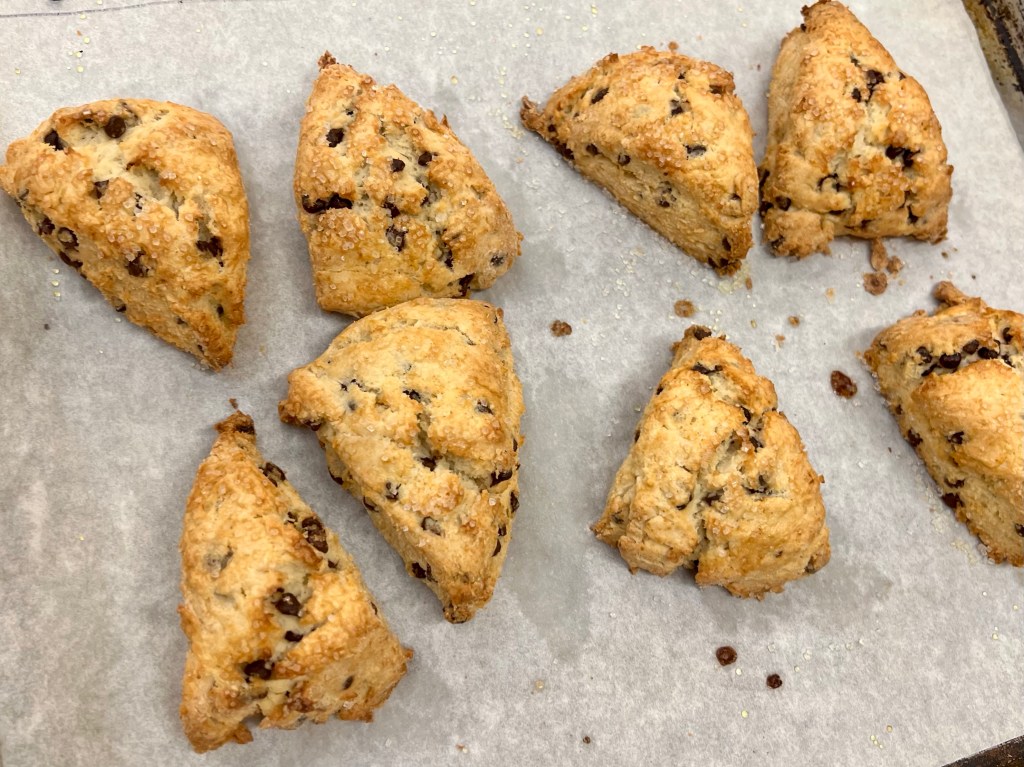
Scones are similar to biscuits in that they use a chemical leavening— baking powder, in this instance— but different because the dough usually incorporates more sweetness and an egg for richness and texture. At the tail end of my Bread: Principles & Practice class, we whipped up a batch of scones as we waited for another bread recipe to do its thing. The scones were delightfully tender, like a biscuit, but sweeter, softer and almost cookie-like. That, I decided, would be a perfect solution for the “cobbler” element of my ice cream, and would you believe it? King Arthur Baking has a recipe for tender peach scones! I whipped up half a batch (exactly as written, if you can imagine), and crumbled two of them to layer in my ice cream.
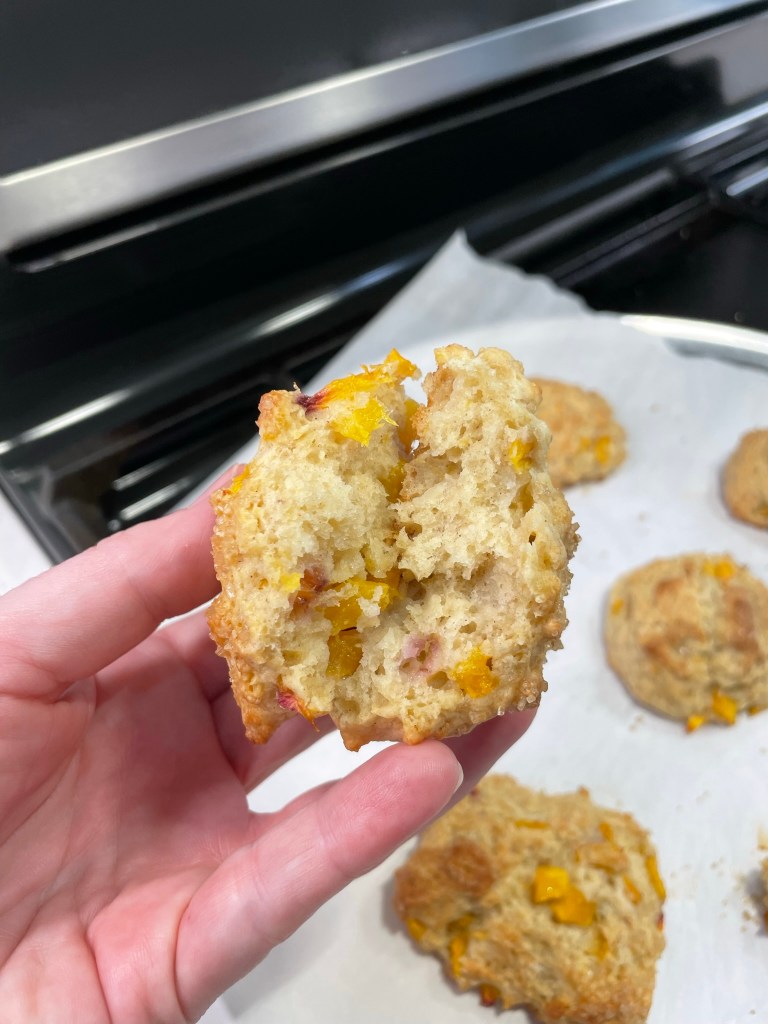
These drop scones were deliciously peachy, with a tender, almost spongy texture.
I hope I always find something new to learn in the kitchen. This is my blue ribbon-hopeful peach cobbler ice cream, my final bow for this year’s National Ice Cream Month. Enjoy!
A cooked puree of peaches adds a concentrated fruit flavor to the base of this ice cream, and tender peach scones provide the 'cobbler' element.
Ingredients
3 fresh, ripe peaches (you’ll puree two and dice the third)
2 teaspoons fresh lemon juice (divided between peaches above)
1 Tbsp. light brown sugar
14 oz. sweetened condensed milk (regular or fat free)
1 cup whole milk
1 cup heavy cream
1 Tablespoon vanilla bean paste
1 Tablespoon vodka (optional, added at end for improved scooping texture)
1 cup crumbled peach scones (recipe linked in story), or substitute as noted below.
To mimic the texture and sweetness of cobbler batter, I baked a half batch of tender peach scones, found on King Arthur Baking website, and crumbled two of them to layer in this ice cream. Other great options would be buttery sweet drop biscuits, a yellow cupcake or even a few snickerdoodle cookies! If you want to skip the cobbler portion, the peach ice cream on its own will still be sweet and summery.
Directions
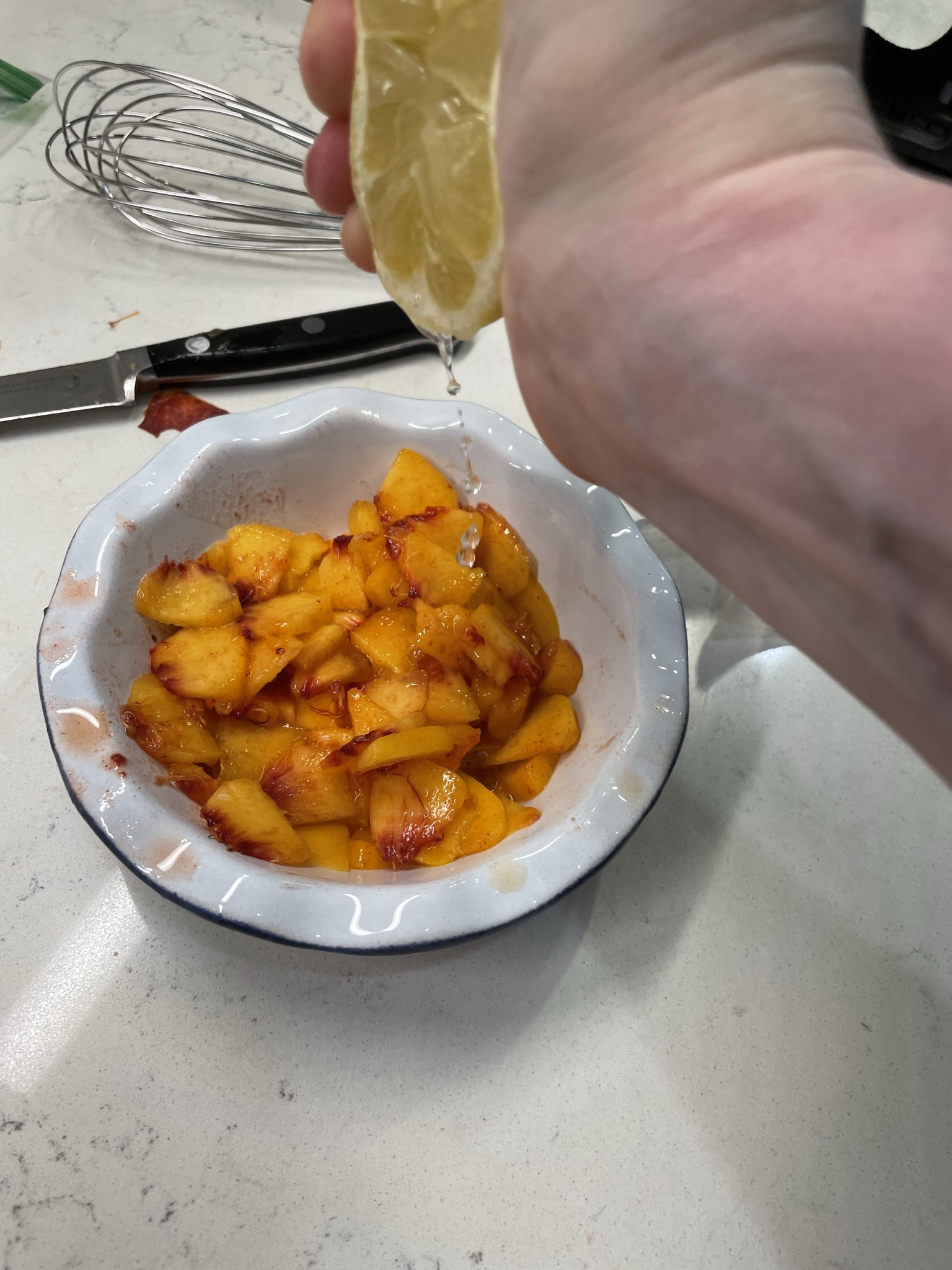
Peel two of the peaches and add to a blender or food processor bowl. Add one teaspoon of lemon juice. Puree for 20 seconds, keeping a few bits if you wish. Cook the puree and brown sugar over medium heat, stirring constantly, until reduced to about 1/2 cup volume (about 20 minutes). Cool to room temperature, then press a piece of plastic wrap directly onto puree. Refrigerate until thoroughly chilled. Peel and dice the third peach and toss bits with lemon juice to prevent browning. Cover with plastic wrap and keep chilled until ready to freeze.
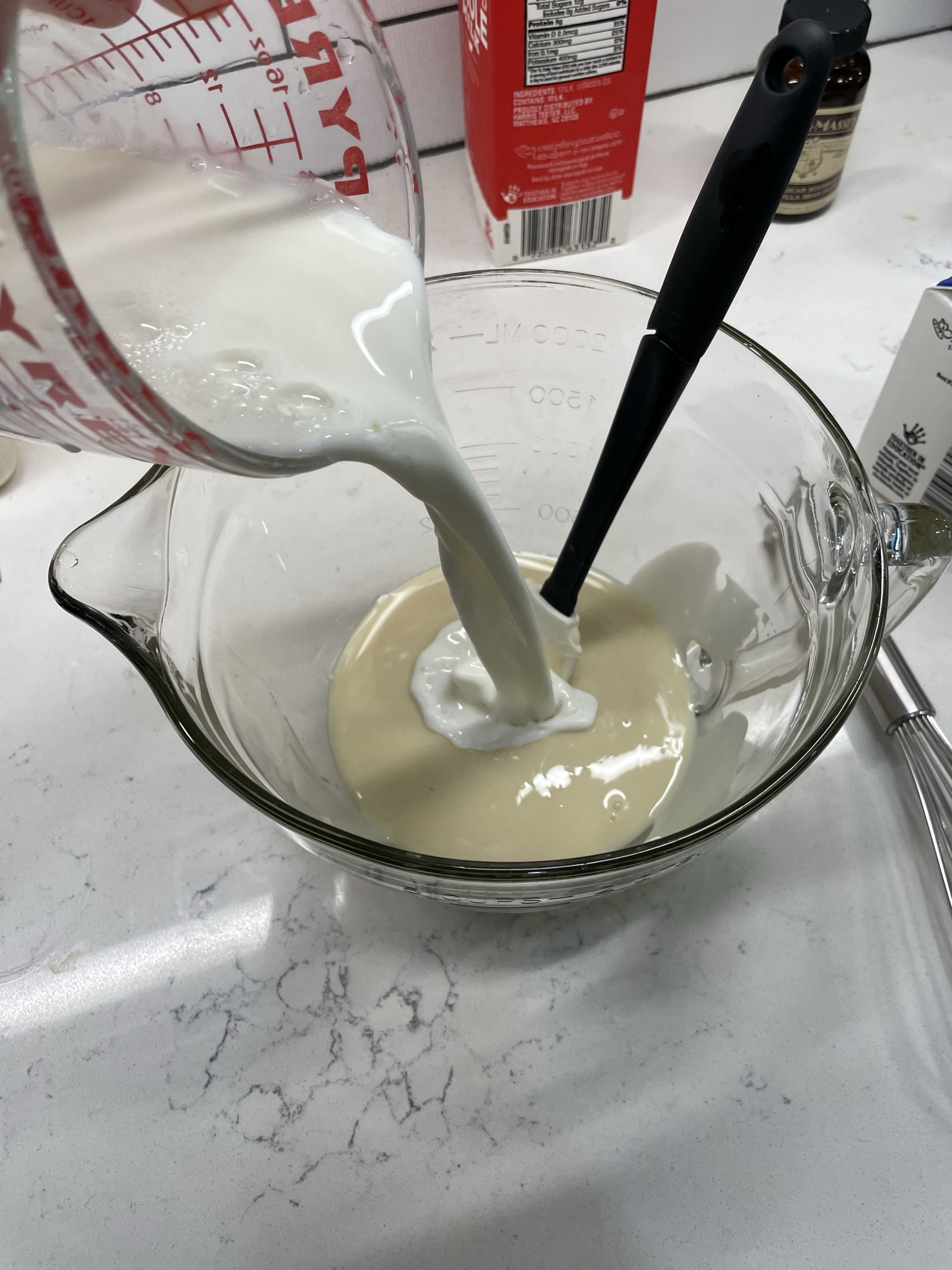
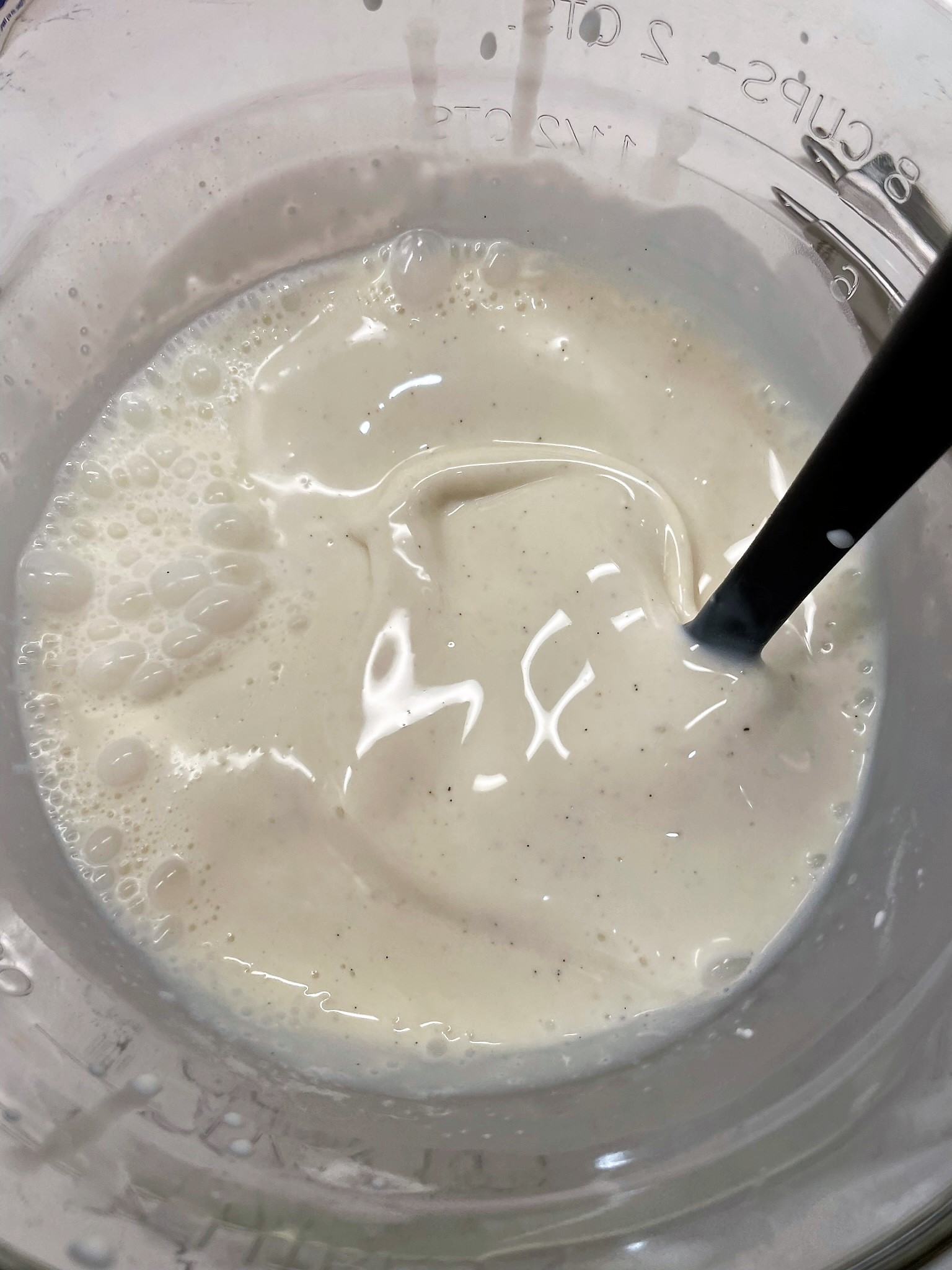
In a large bowl or pitcher, combine condensed milk, milk and heavy cream until evenly blended. Stir in vanilla bean paste. Refrigerate at least 3 hours until thoroughly chilled.
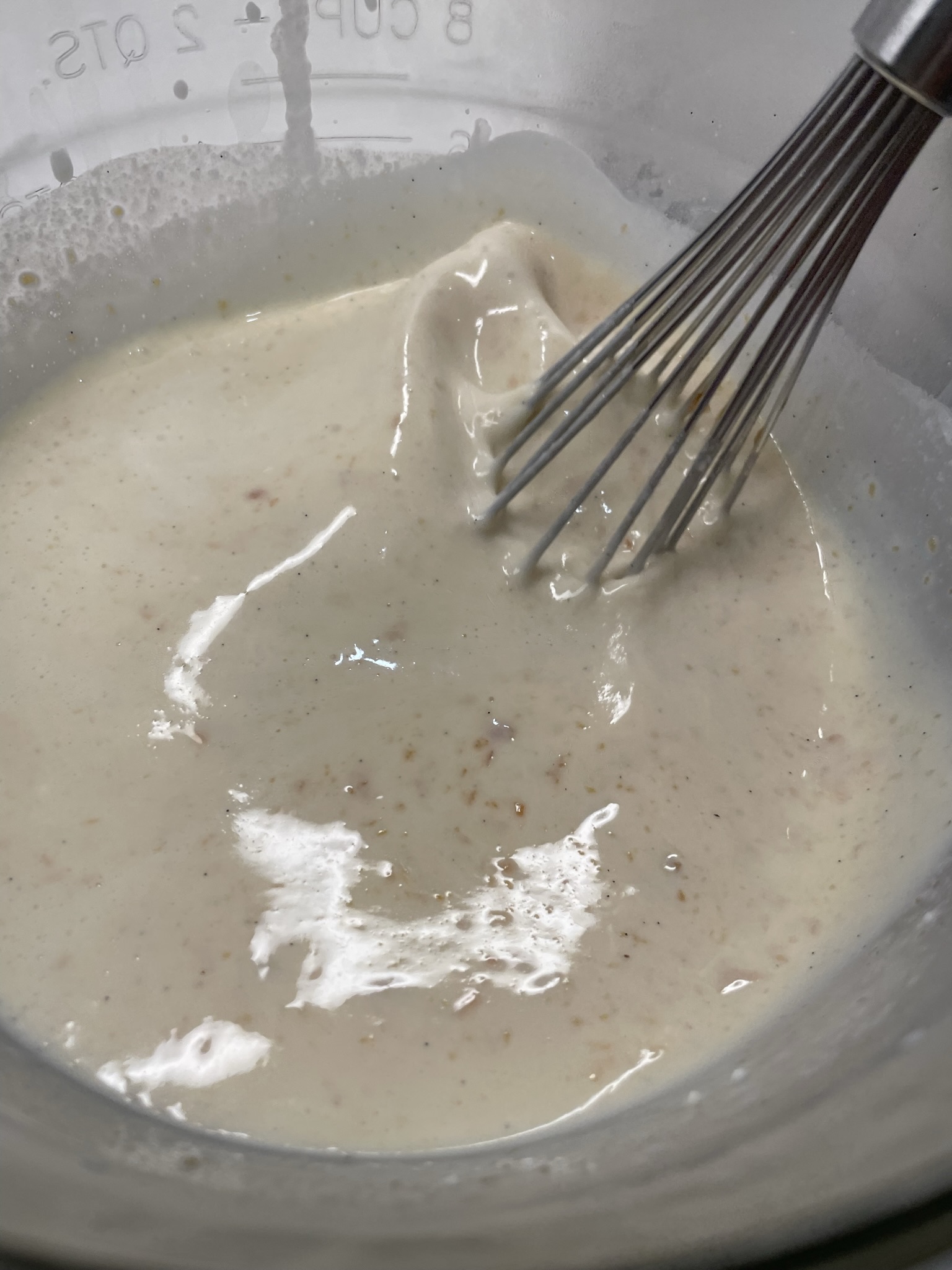
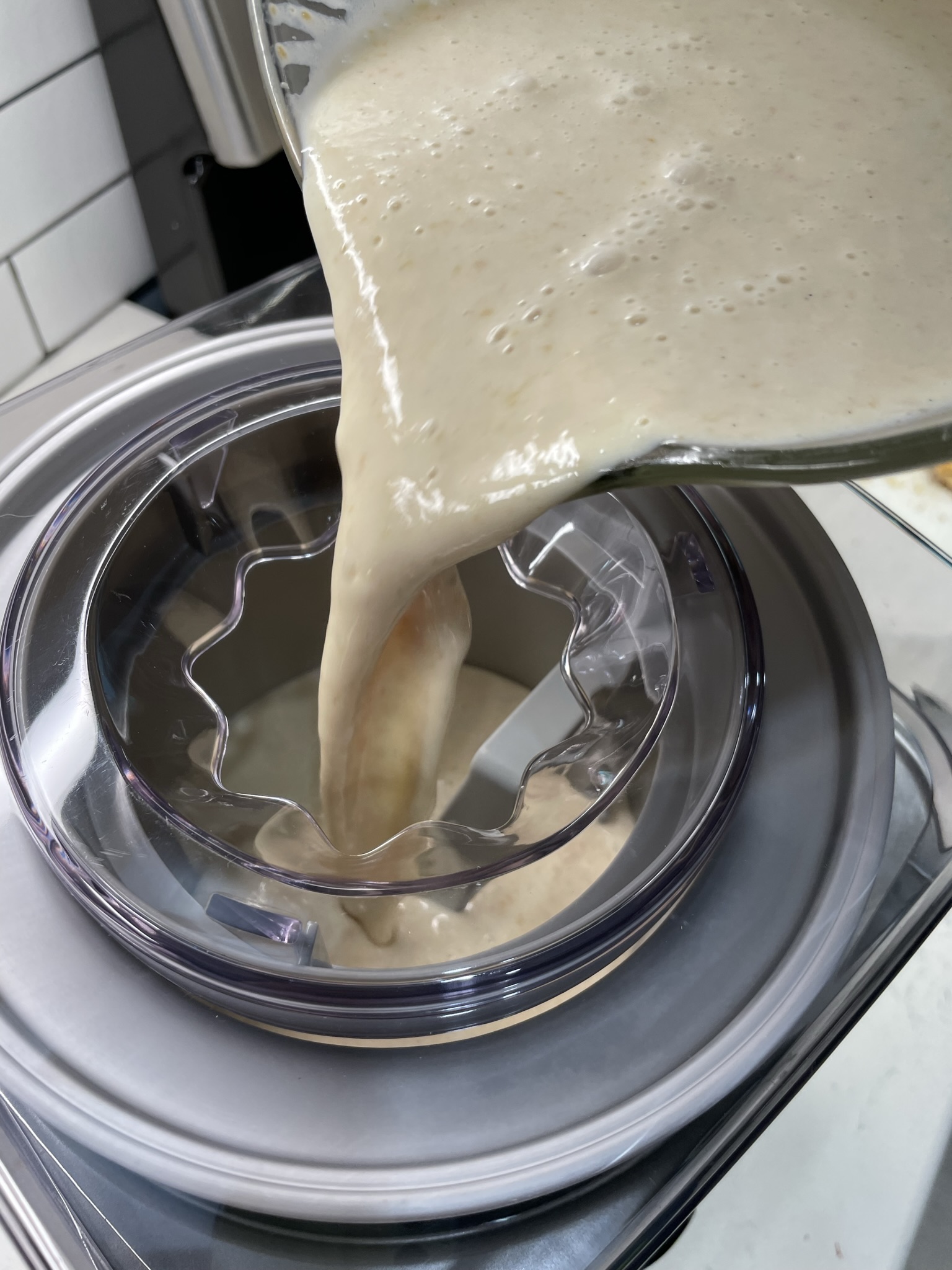
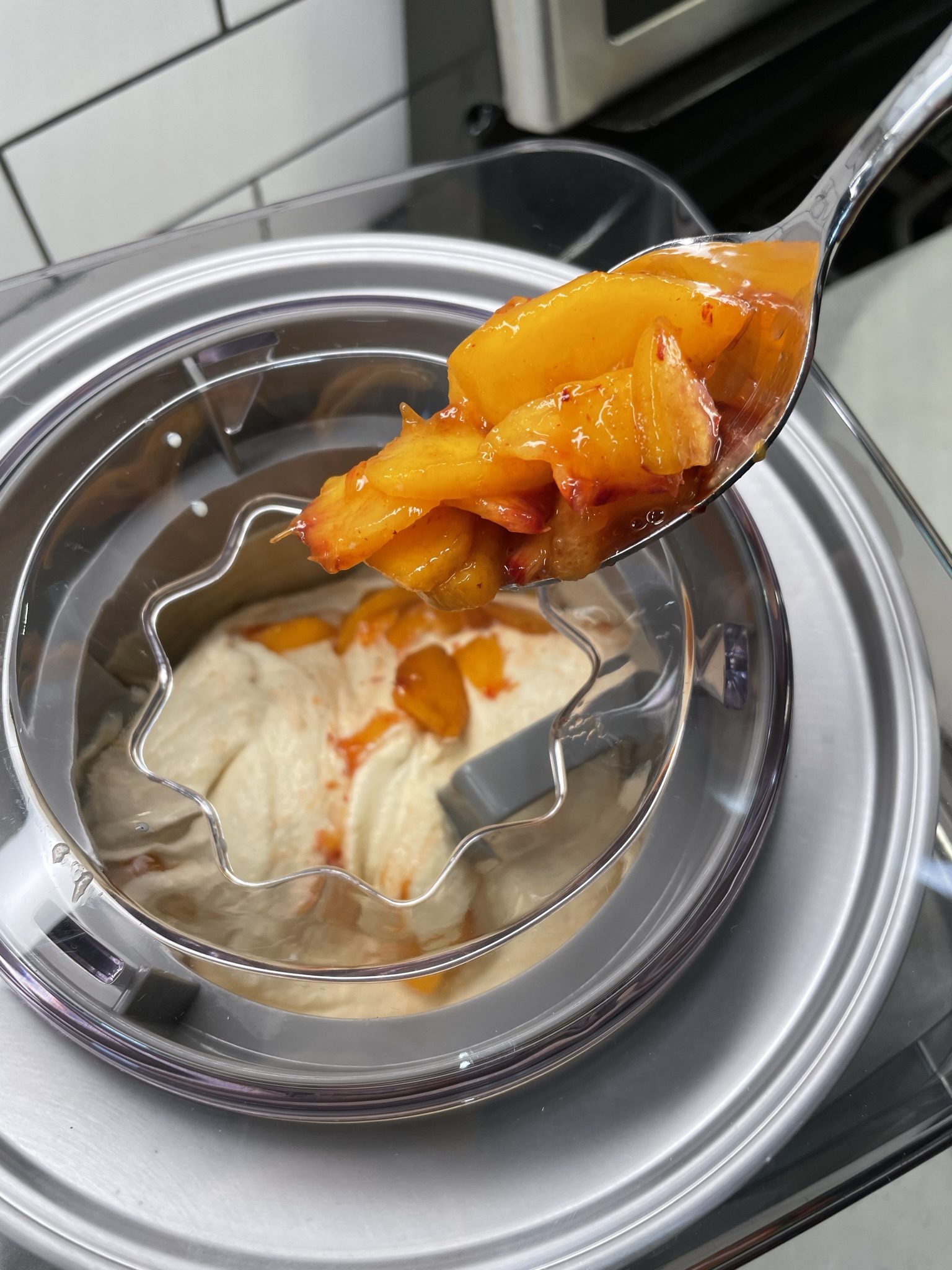
Gently whisk cold peach puree into ice cream base. Freeze in ice cream machine according to manufacturer’s instructions. In the final two minutes of churning, spoon the reserved diced peaches into the machine and pour in vodka (if using). Churn until fully blended.
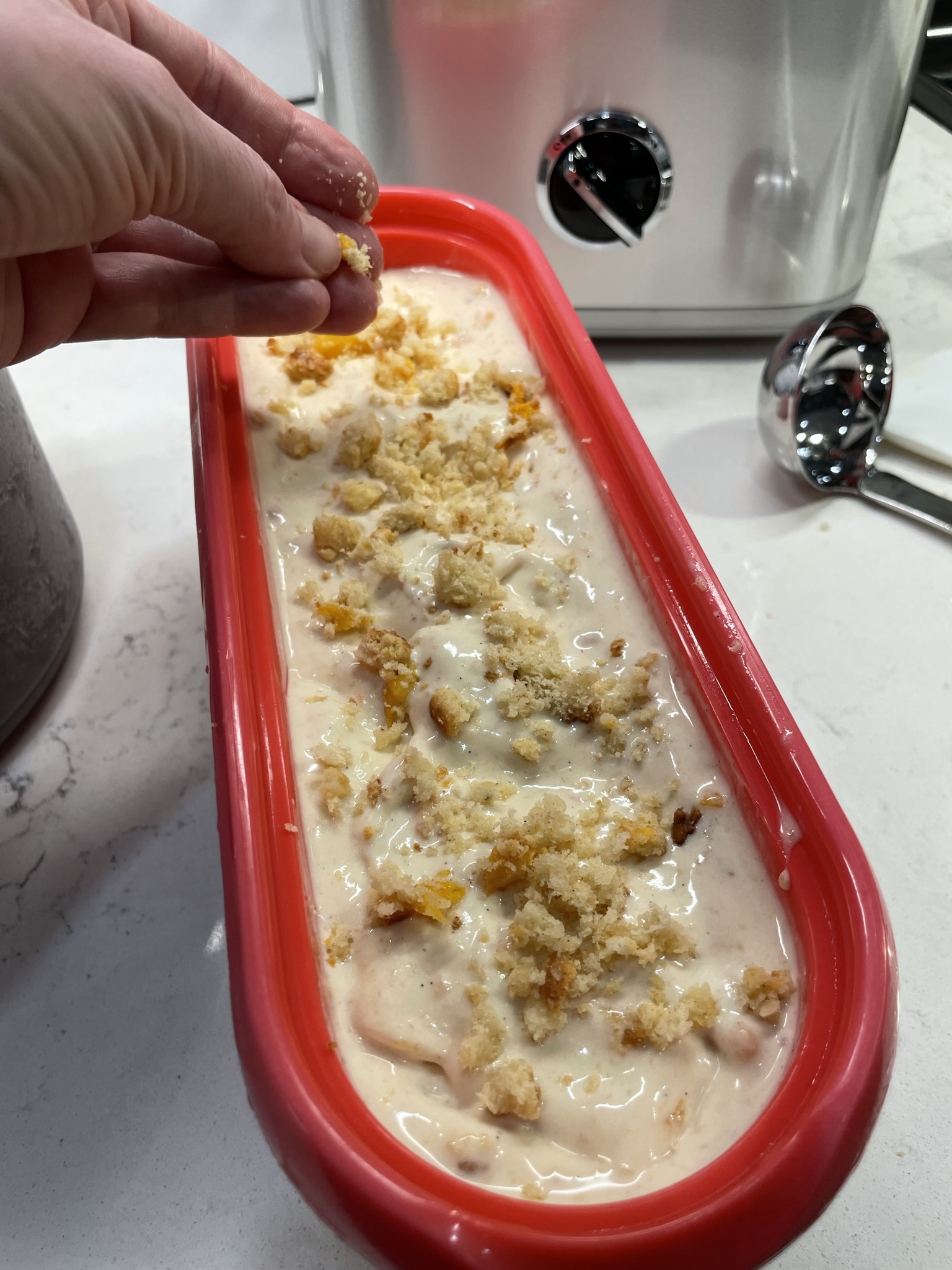
Transfer ice cream to an insulated freezer container, layered with scone crumbles. Cover and place container in freezer several hours or overnight for best texture.
The heat is getting to me, I think. Since I returned from my solo trip through New England, I have barely wanted to cook. It’s just too hot to think about standing at the stove in the late part of the day. Usually in summer, we at least enjoy firing up the grill for a backyard barbecue, but with it being 97° F in the shade at dinner time, the idea of the grill feels even more oppressive than turning on the stove. I only want cool foods, and it better not take long to prepare. Thank goodness for ripe summer tomatoes and sweet southern peaches!
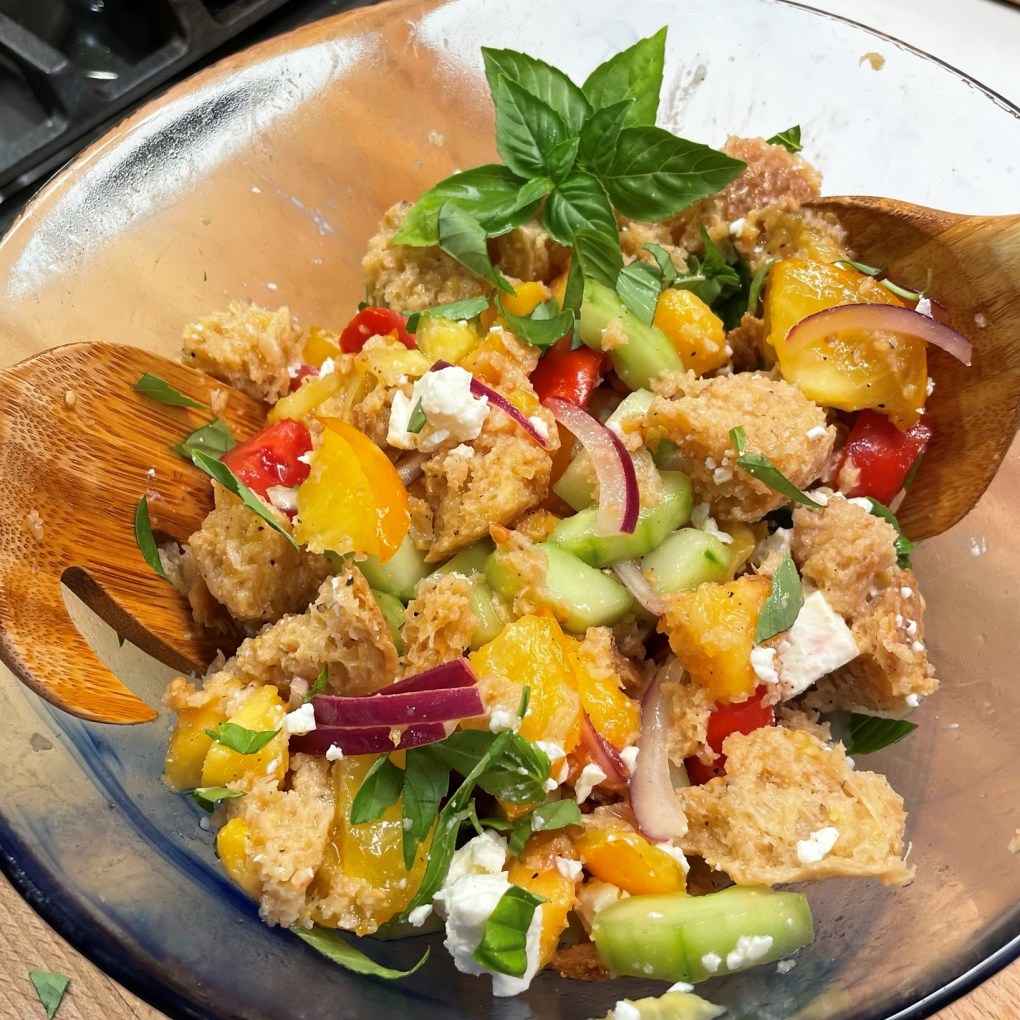
There’s a saying out there in foodie land that “if it grows together, it goes together,” and I’m not claiming that peaches and tomatoes are good companions in the garden— how could they be, with peaches growing on trees and all— but I do know that they’re both coming ripe right about now, and I may be onto something with this fresh, light (and did I mention easy?) summer salad.
This is one more thing to love about summer!
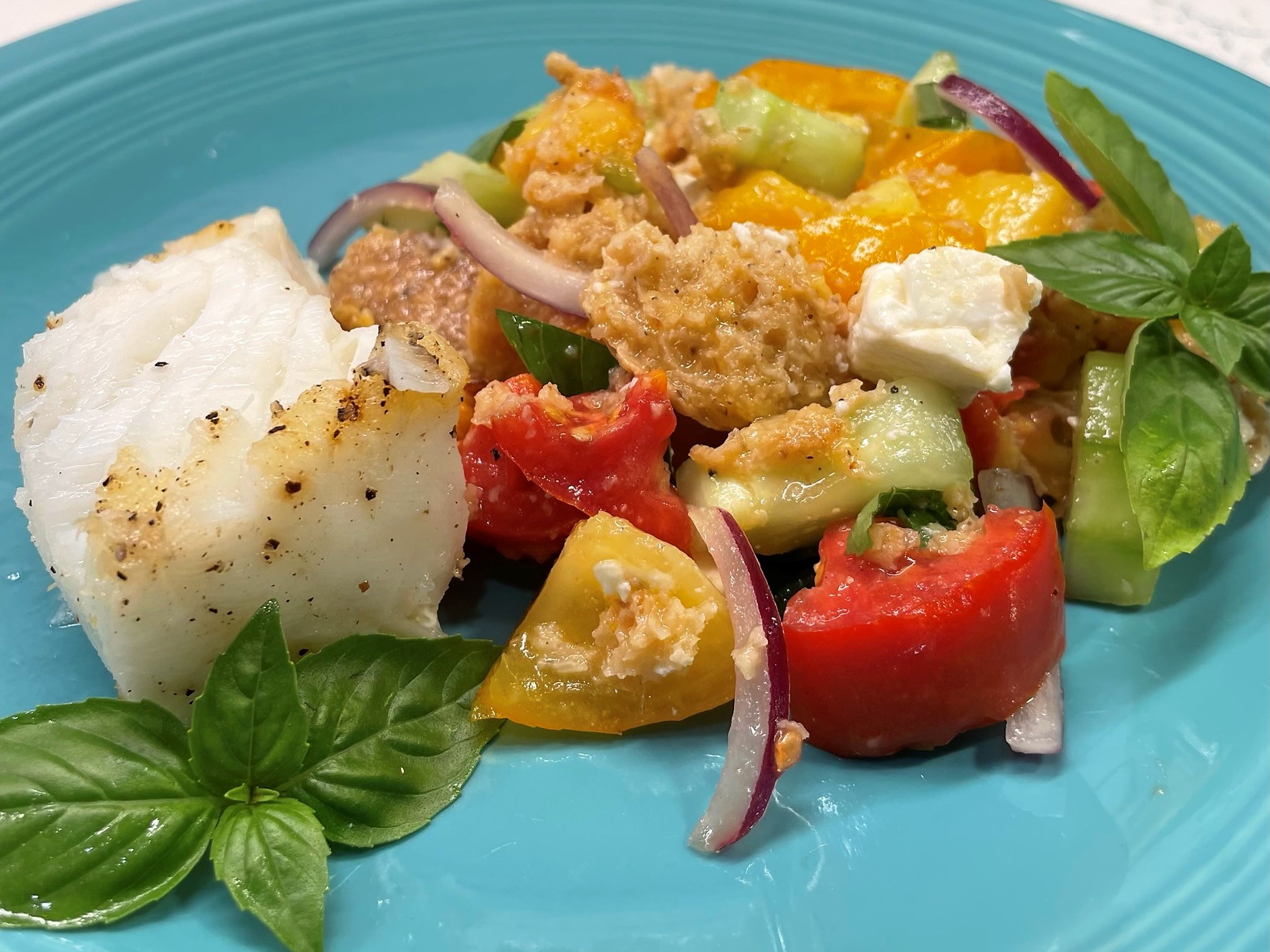
Panzanella, in case you have never had the pleasure, is a rustic dish of Tuscan origin, usually made with ripe, juicy tomatoes, cucumber and other fresh ingredients, along with chunks of day-old bread that soak up the juices. The bread gives the salad body and bulk, and the rest of the ingredients are cool and refreshing when the summer weather is everything but.
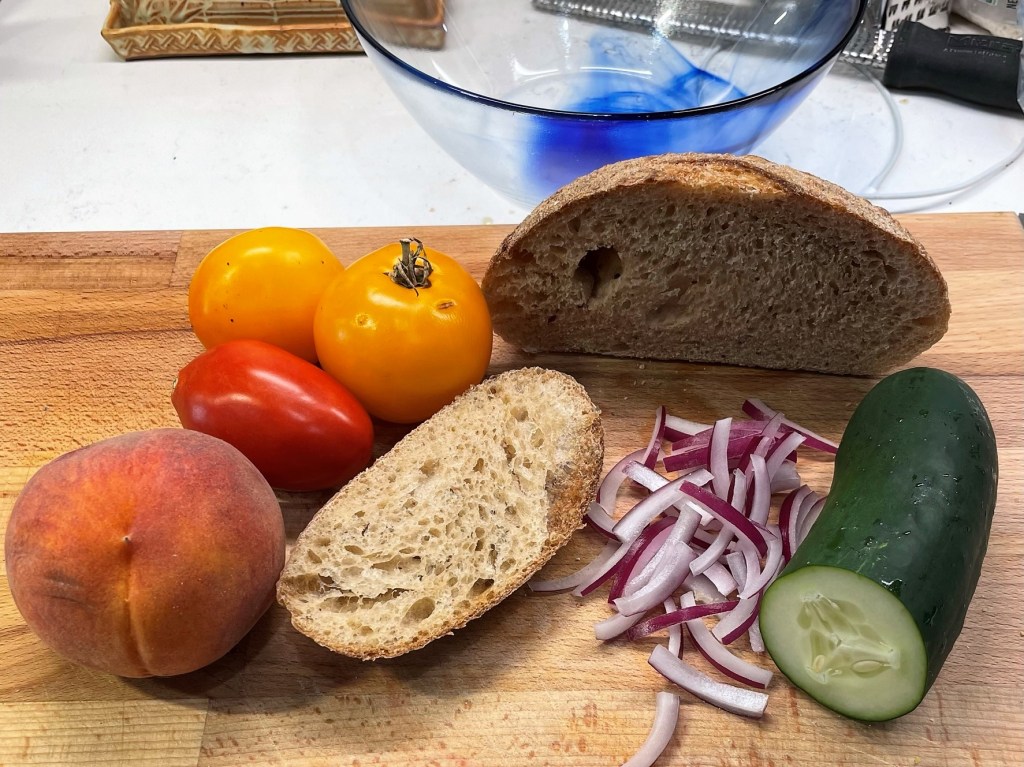
I was about to make a classic panzanella, but then I spotted that peach!
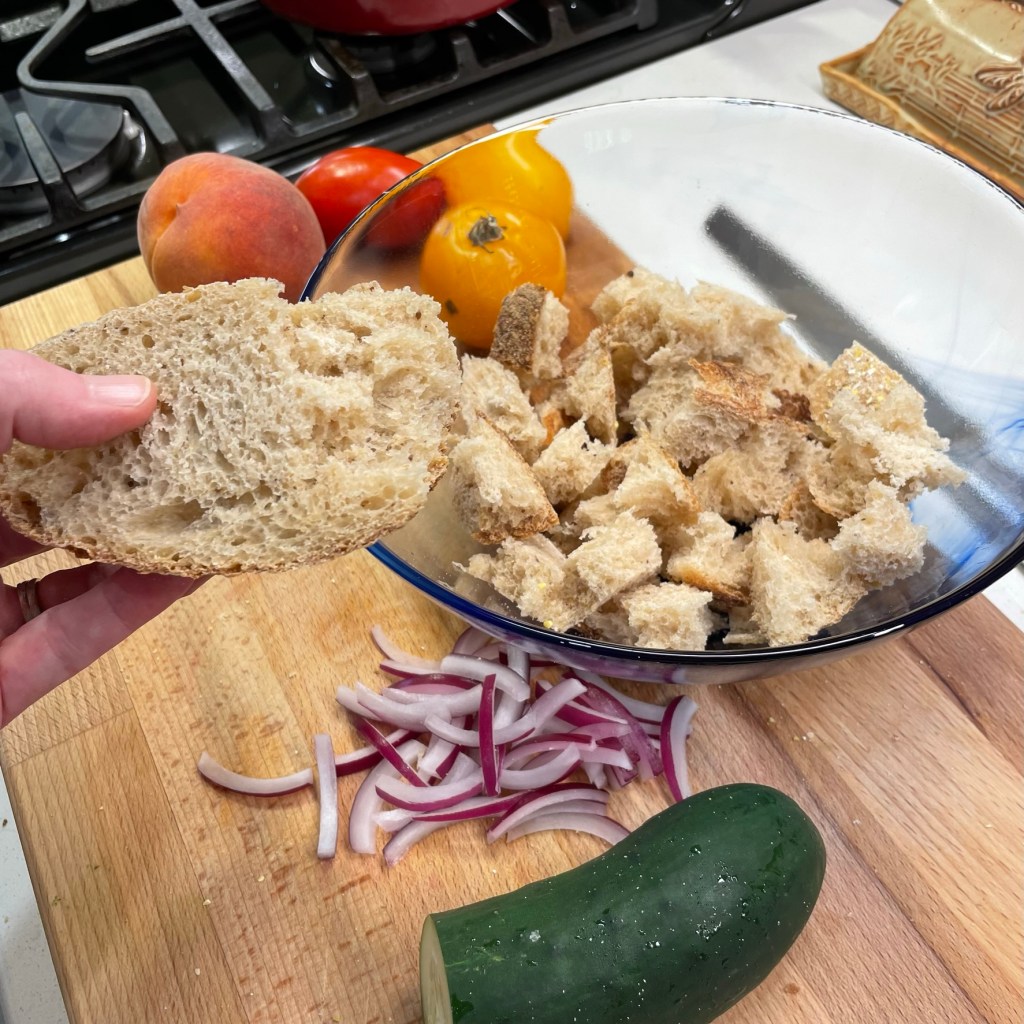
It seems I always have a stale end of bread hanging around the kitchen, and for panzanella, you want the bread to be a “lean” one— that is, not enriched with fats, dairy or sugars. If the bread is soft and pliable, it will quickly turn to mush and you’ll be disappointed in your panzanella. Something like a French baguette or crusty homemade sourdough loaf is perfect because it will generally holds its shape. Whole grain works well, and even seeds on top will work! Tear or cut the bread into small, bite-size chunks, and remove the crust if it seems extra thick or chewy.
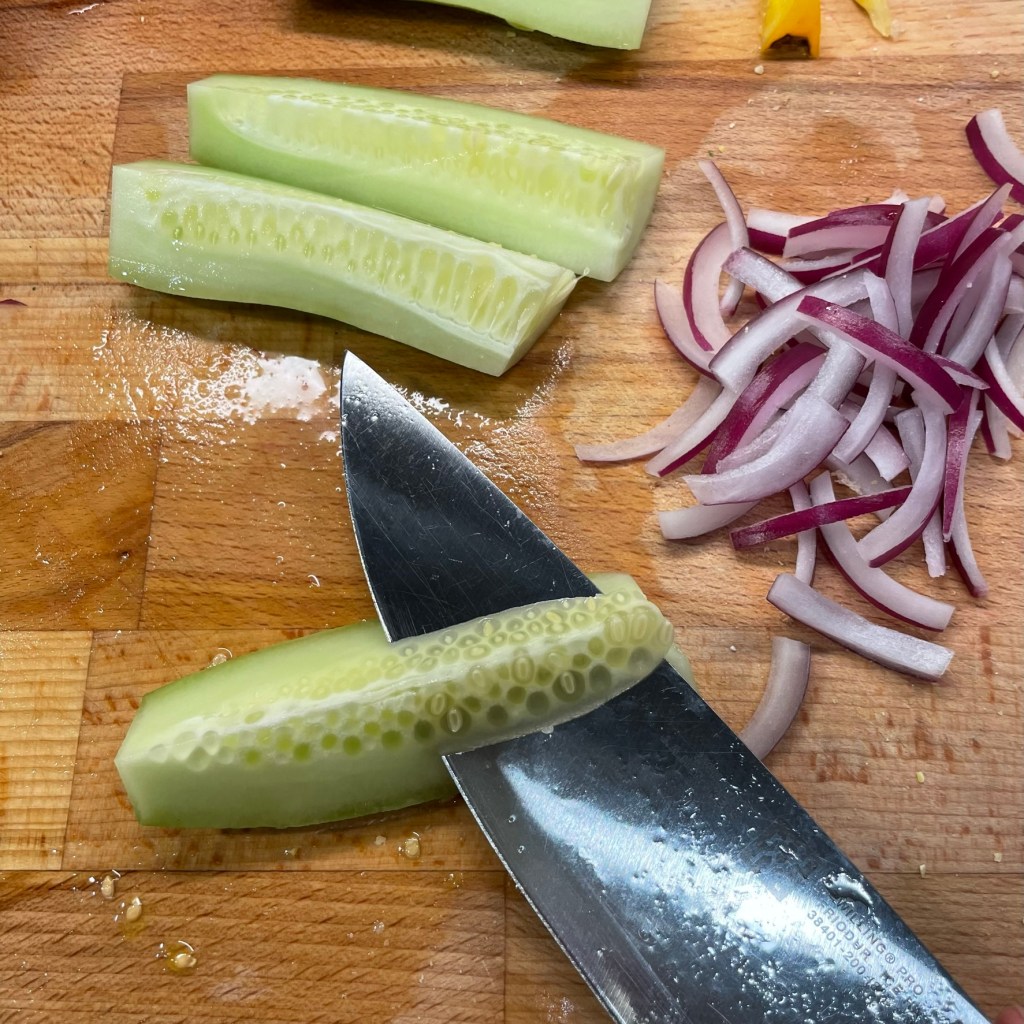
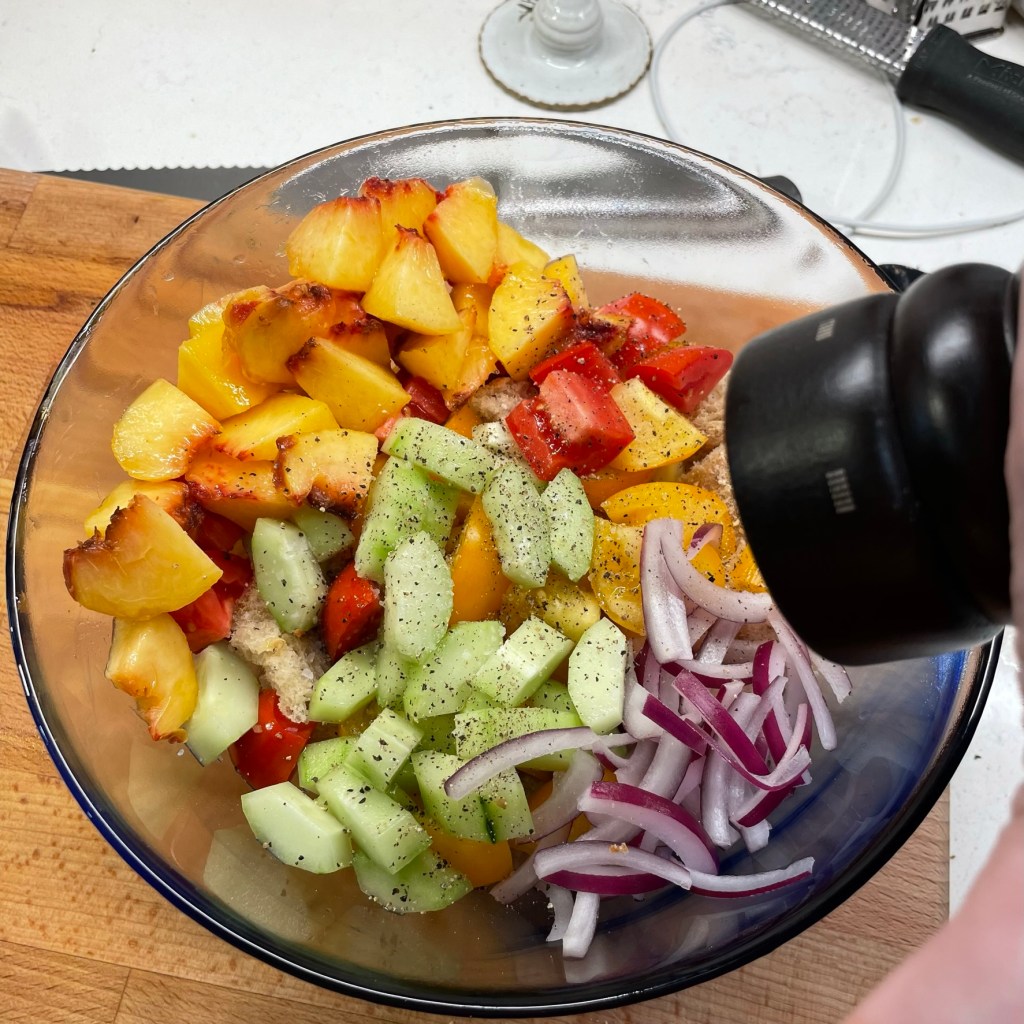
Next, prep all the fresh ingredients, cutting each into smallish bites. My personal rule of thumb for salads to break down the ingredients into small enough pieces that I will be able to get a little bit of everything in a single bite, but not so small that it’s hard to spear them with a fork. I only had a slicing cucumber, so I did remove the tough peel and most of the seeds, but with a Persian or English cuke, there’d be no harm in just washing and cutting it up. A quick seasoning with salt and pepper on all of that, and then I’m on to the dressing.
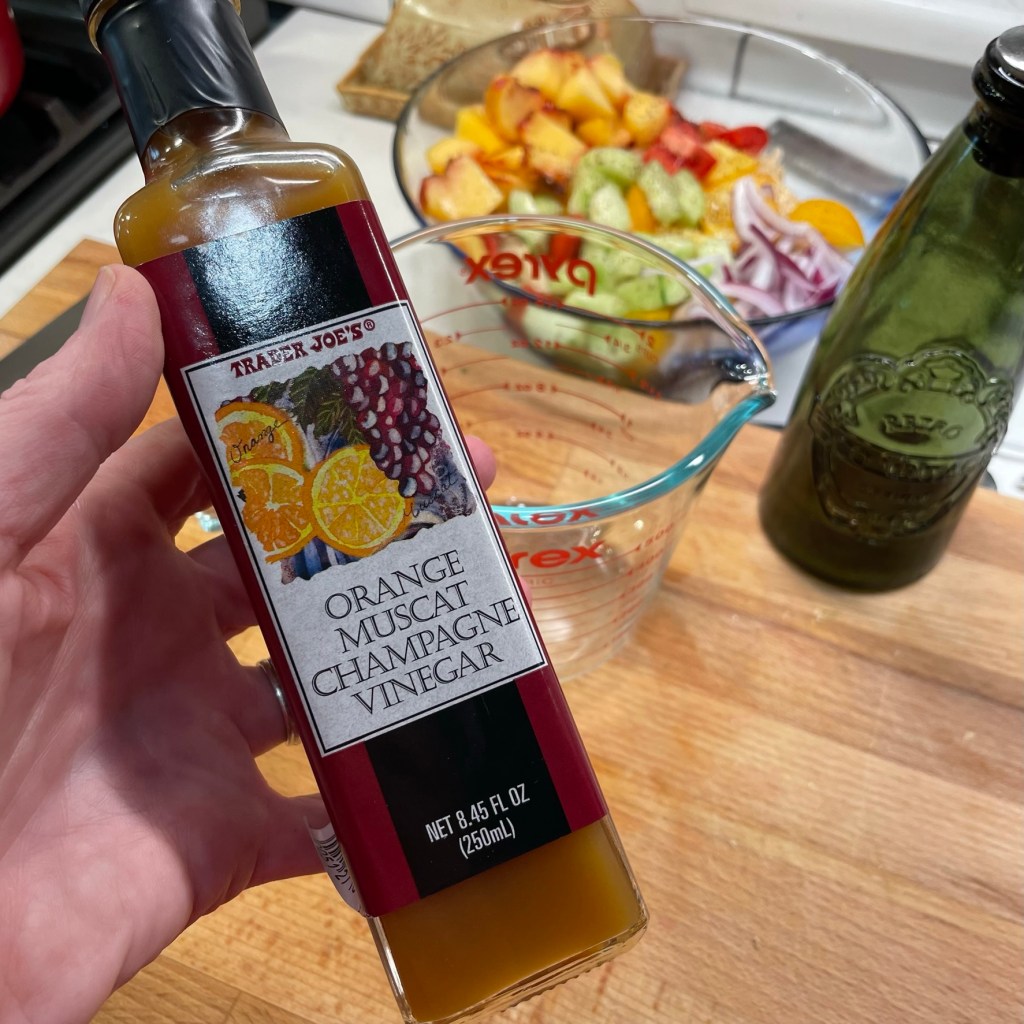
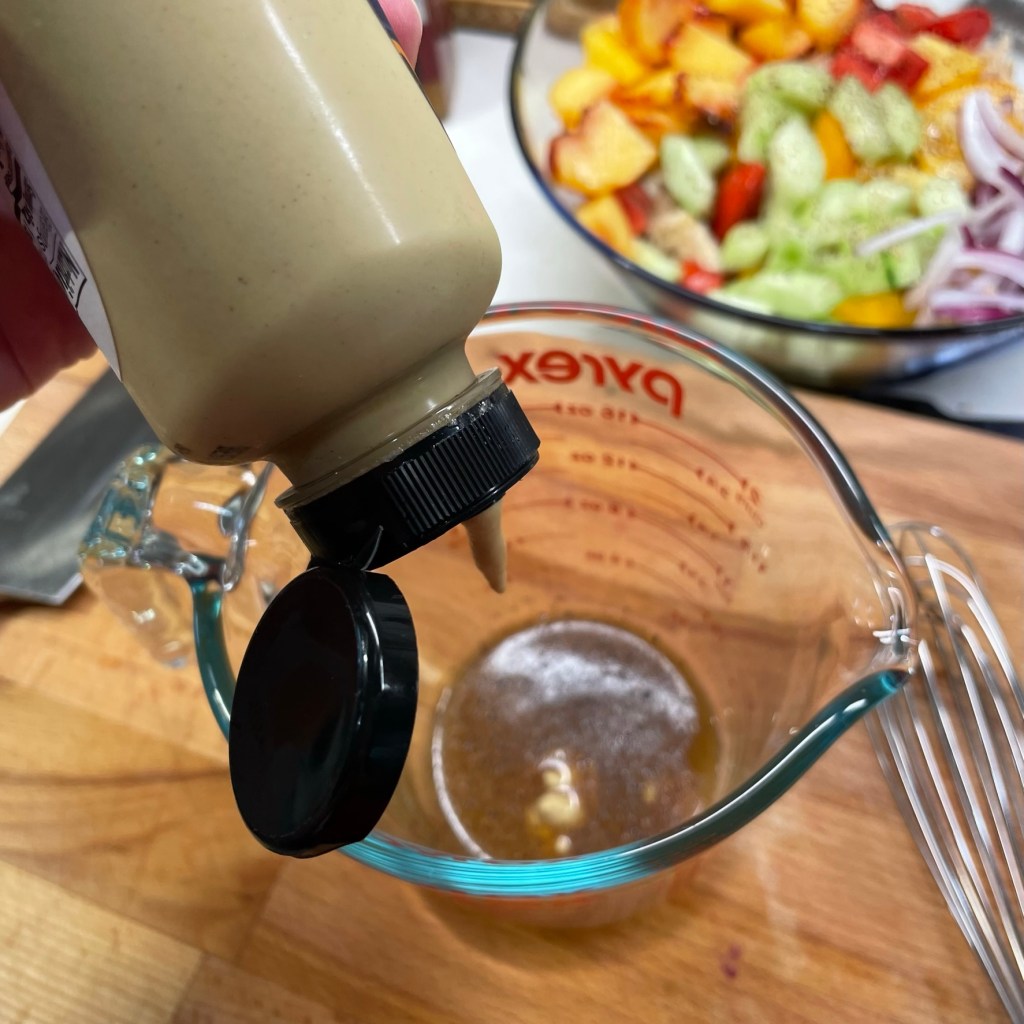
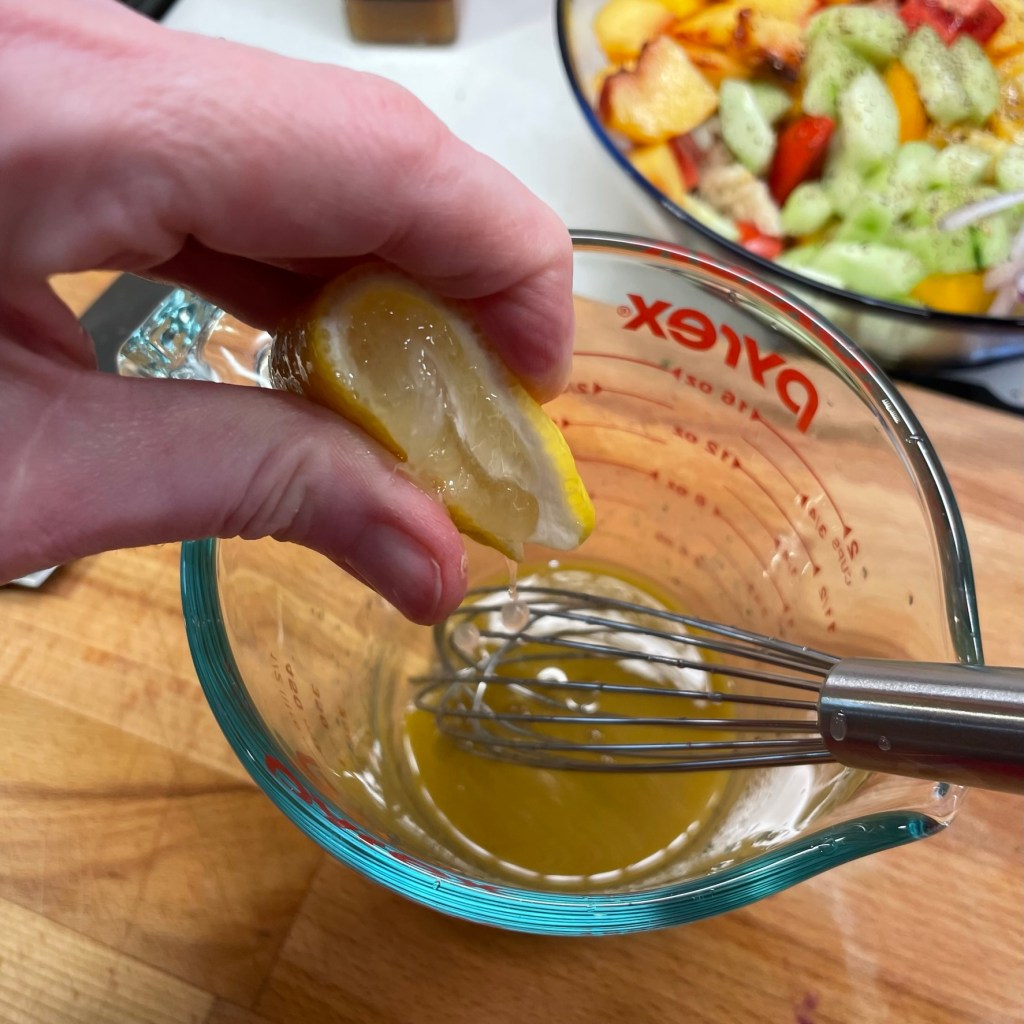
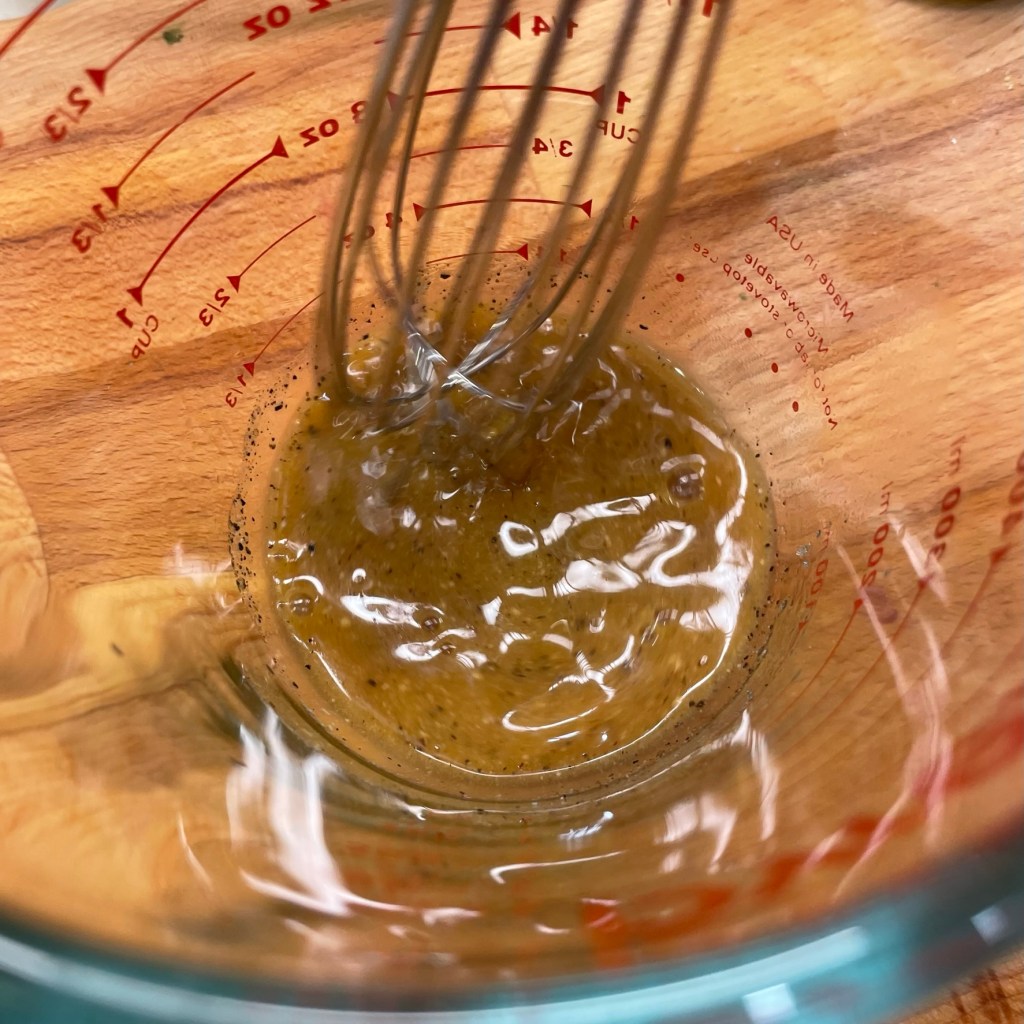
A classic panzanella would be strictly savory, so a vinaigrette with Italian herbs and garlic would be appropriate. But I wanted a lighter, fruitier touch for this one because of the sweet summer peach, so I started with a citrus-y vinegar from Trader Joe’s and jazzed it up with Dijon, a squeeze of fresh lemon and a generous drizzle of fruity, extra virgin olive oil. Any light, fruity vinegar would work well here, or even a white wine or champagne vinegar. If yours is tart and sharp, give the dressing a little balance with a bit of honey or a few pinches of cane sugar. And don’t forget salt and pepper.
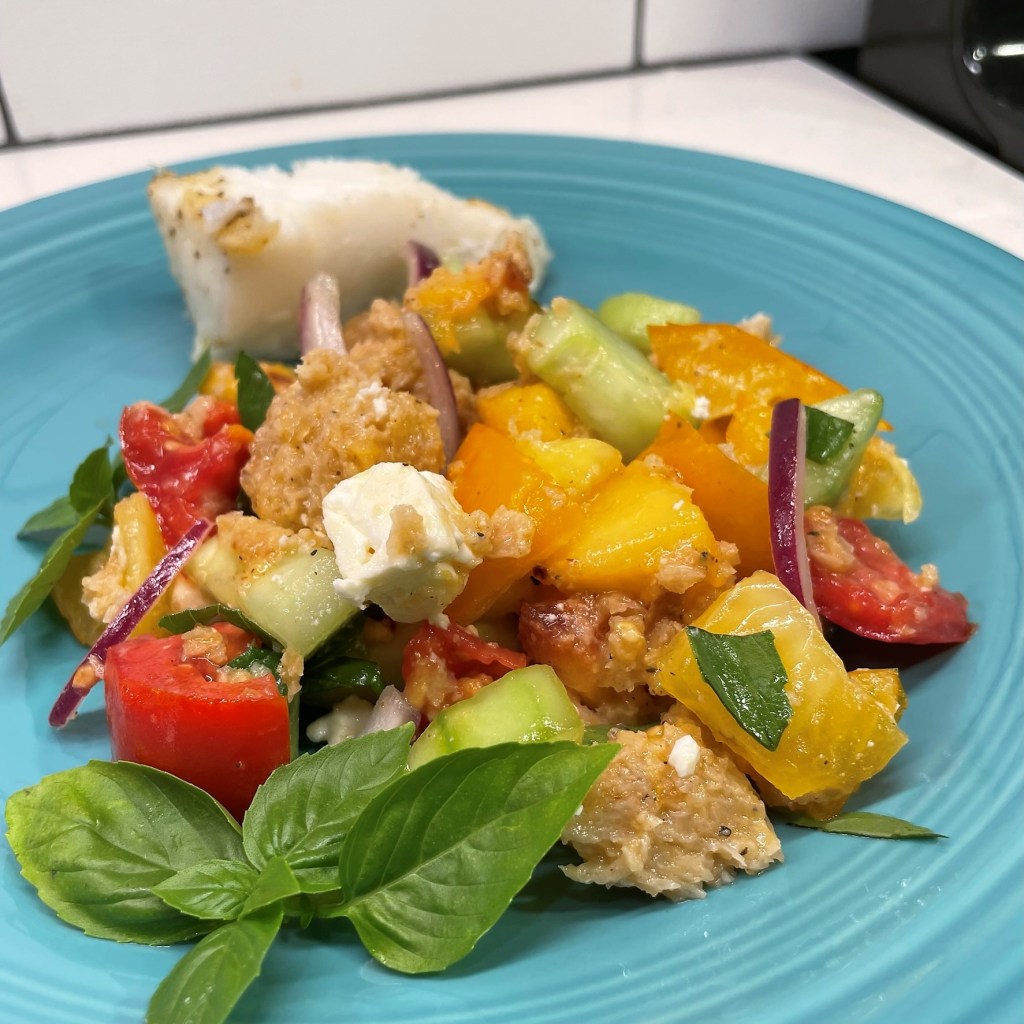
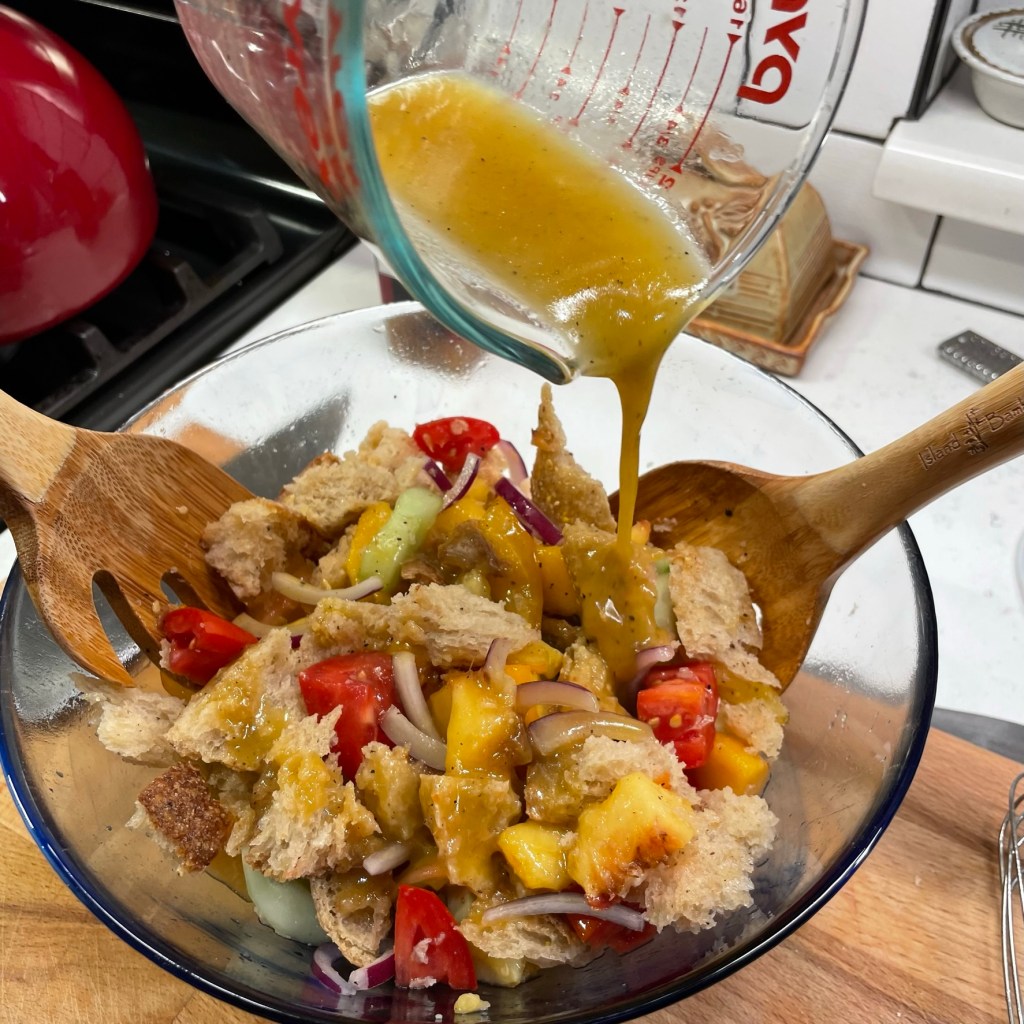
Here comes the best part! Drizzle that dressing all over the salad, and don’t worry if it seems like a lot— the stale bread will slurp it up so it won’t go to waste. Toss gently a few times to fully incorporate the dressing, and allow the panzanella to rest while you set the table. Just for fun, I sprinkled on some feta chunks and fresh, summery basil. Italian parsley would have been just as delicious, or even fresh mint to add another cooling layer.
I served my peach panzanella with petite fillets of halibut. They were super easy to make, seasoned with only salt and pepper and baked in the oven for a mere 15 minutes. Easy, quick and done!
A ripe and juicy summer peach puts a delicious and unexpected twist on a classic panzanella. It's a cool and tasty way to beat the summer heat!
Ingredients
3 cups torn sourdough bread (dry or stale)
1/2 slicing cucumber, peeled and seeded
2 small yellow tomatoes, halved and cut into wedges
1 Roma tomato, quartered lengthwise and cut into wedges
1 large ripe peach, peeled and pitted then cut into chunks
1/4 cup thinly sliced red onion
2 oz. real feta, crumbled or cut into cubes
Small handful of fresh basil, torn or rough-chopped for garnish
Vinaigrette dressing (see below)
The dressing for the panzanella can be made ahead if desired. Choose a vinegar that is light and summery, such as white wine vinegar or something infused with citrus.
Ingredients
3 Tbsp. Muscat orange-champagne vinegar (or something fruity and tart)
1 tsp. Dijon
Salt and pepper
1/4 cup extra virgin olive oil
1 tsp. honey or sugar if vinegar is very tart
Directions
Add all salad ingredients except feta and basil to a large bowl, in order, so that bread pieces are on the bottom. Season with salt and pepper and set aside while you make the vinaigrette.
Whisk together dressing ingredients. Adjust salt and pepper to taste.
Pour dressing all over salad. Toss gently to incorporate, and allow the bread a few minutes to soak up the dressing and juices.
Sprinkle with feta and fresh basil. Serve at once.
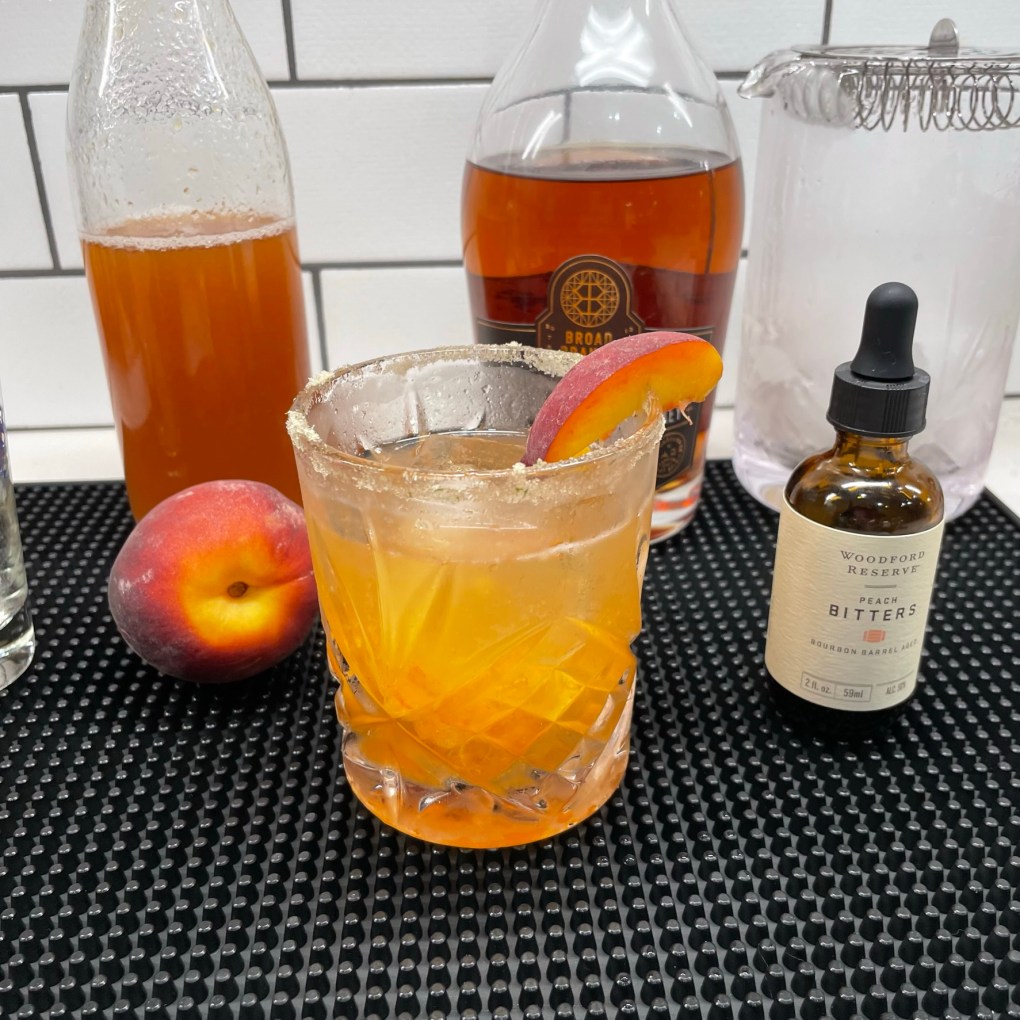
We have enjoyed this peachy bourbon cocktail at our house all summer, ever since I first made the peach shrub. What’s that—you say peaches don’t grow on shrubs? True. The peach “shrub” that I speak of is an old-school concoction, otherwise known as a “drinking vinegar,” and though it was a popular way of preserving seasonal fruits back in Colonial times (or as far back as the Roman Empire, depending on whom you ask), the shrub is having a new moment, especially in the world of craft cocktails.
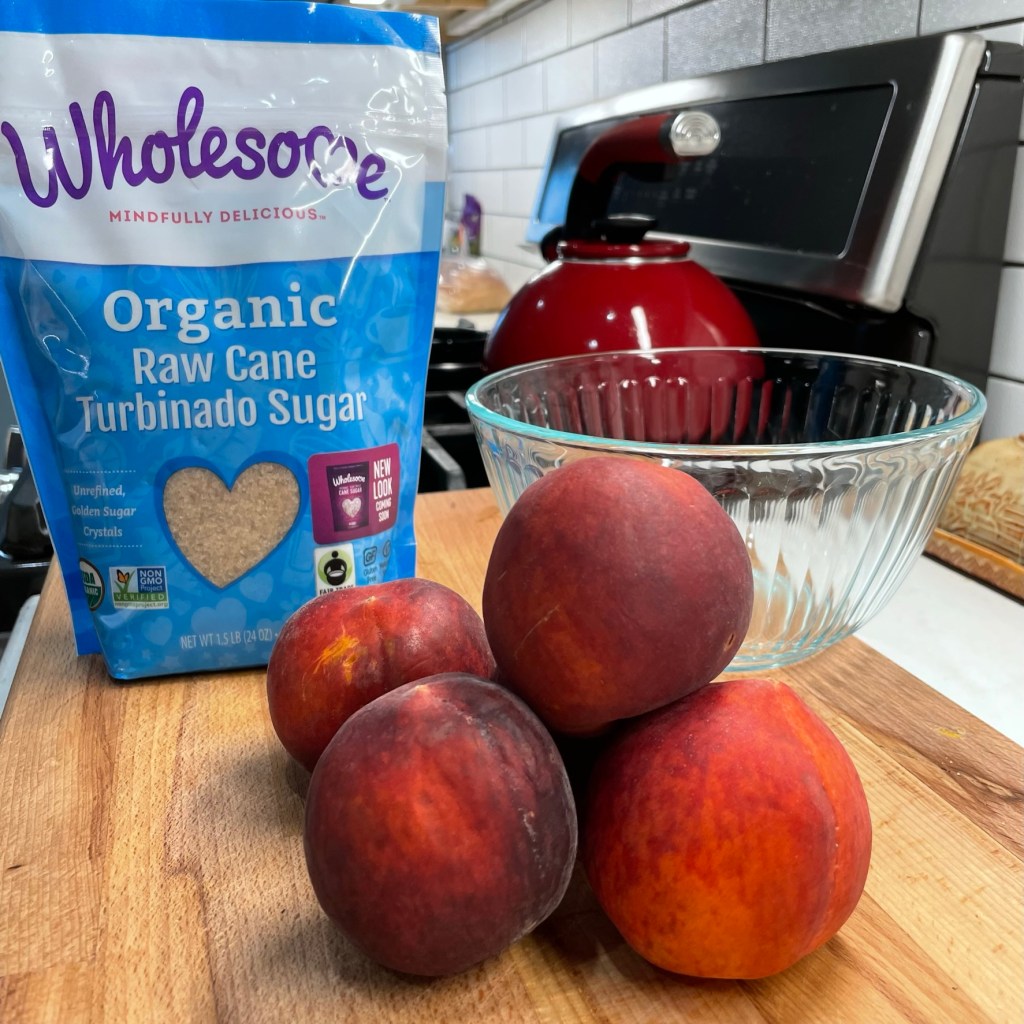
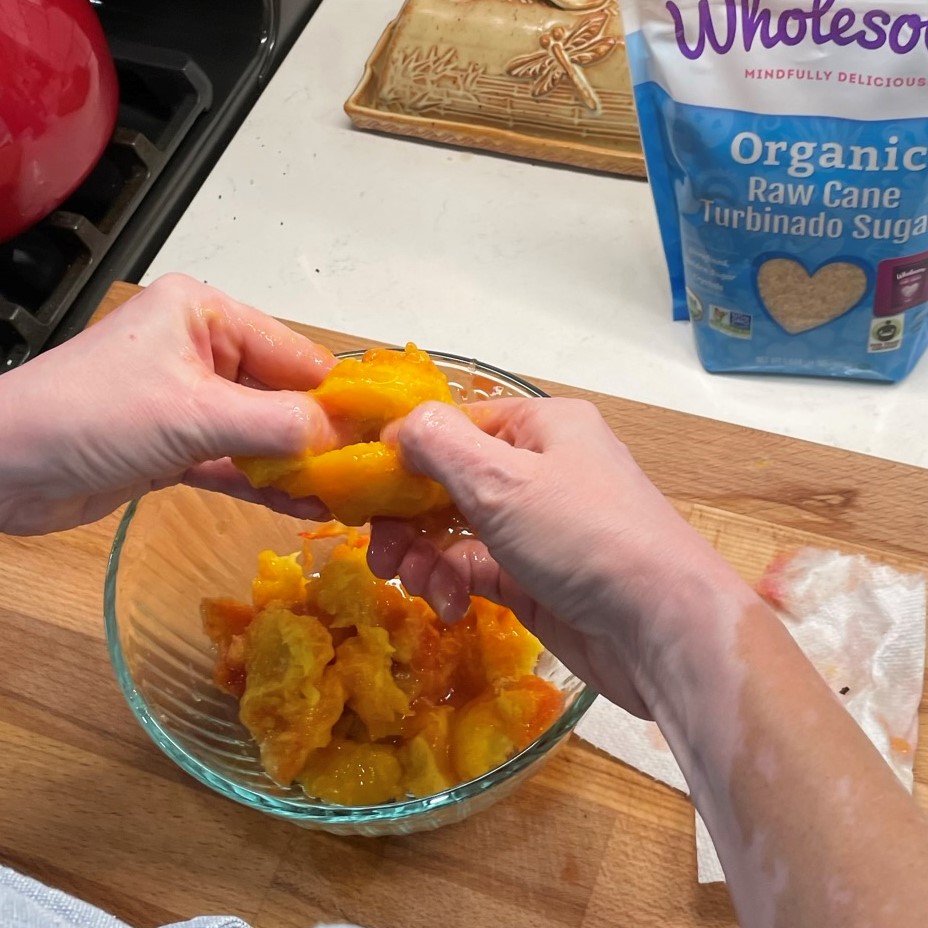
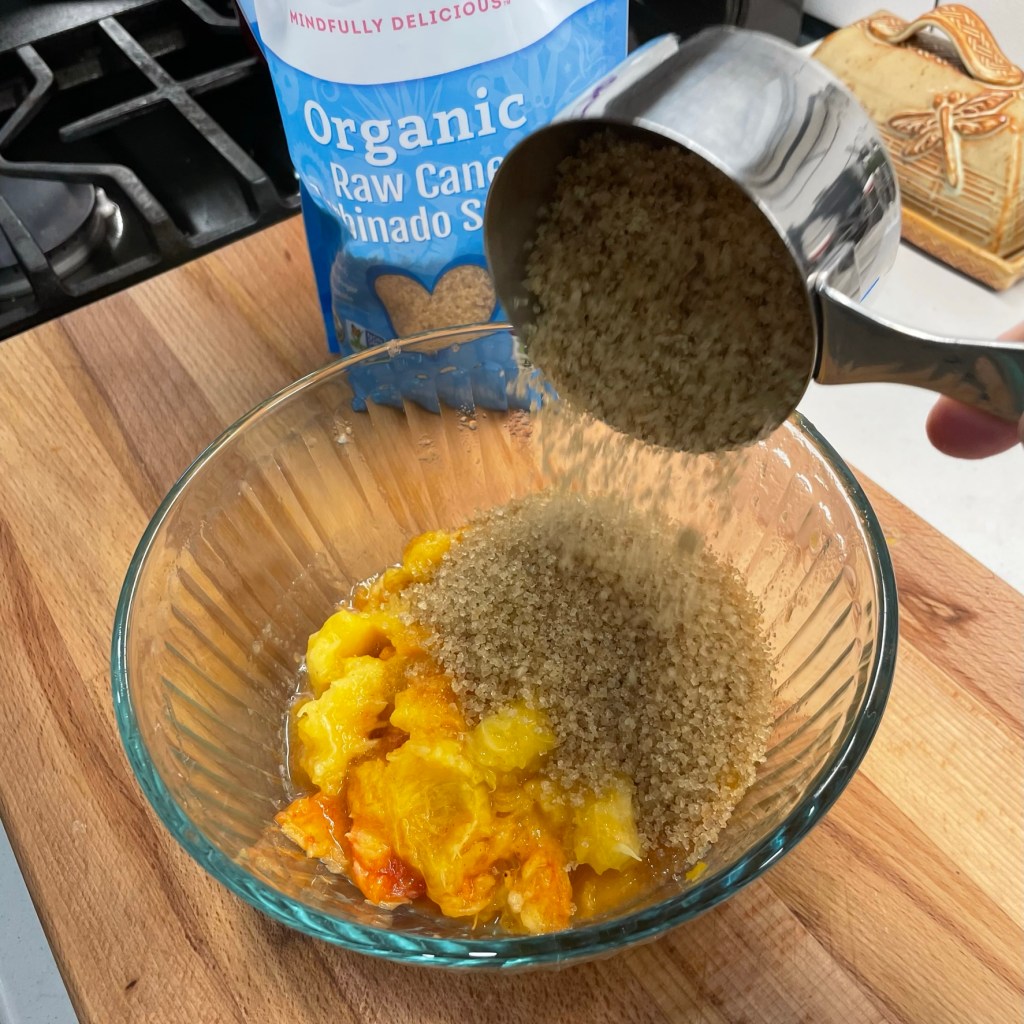
A shrub is a mixture of fruit, sugar and vinegar, usually in equal parts. You can either cook the fruit together with the sugar before adding the vinegar, which results in a jammy, compote-type flavor, or go the fresh route with raw fruit, which takes longer to develop but presents a more vibrant flavor in the shrub. I chose the latter, with enough cut-up peaches to measure a heaping cup. I stirred in a cup of raw turbinado sugar and left it in the fridge about 24 hours.
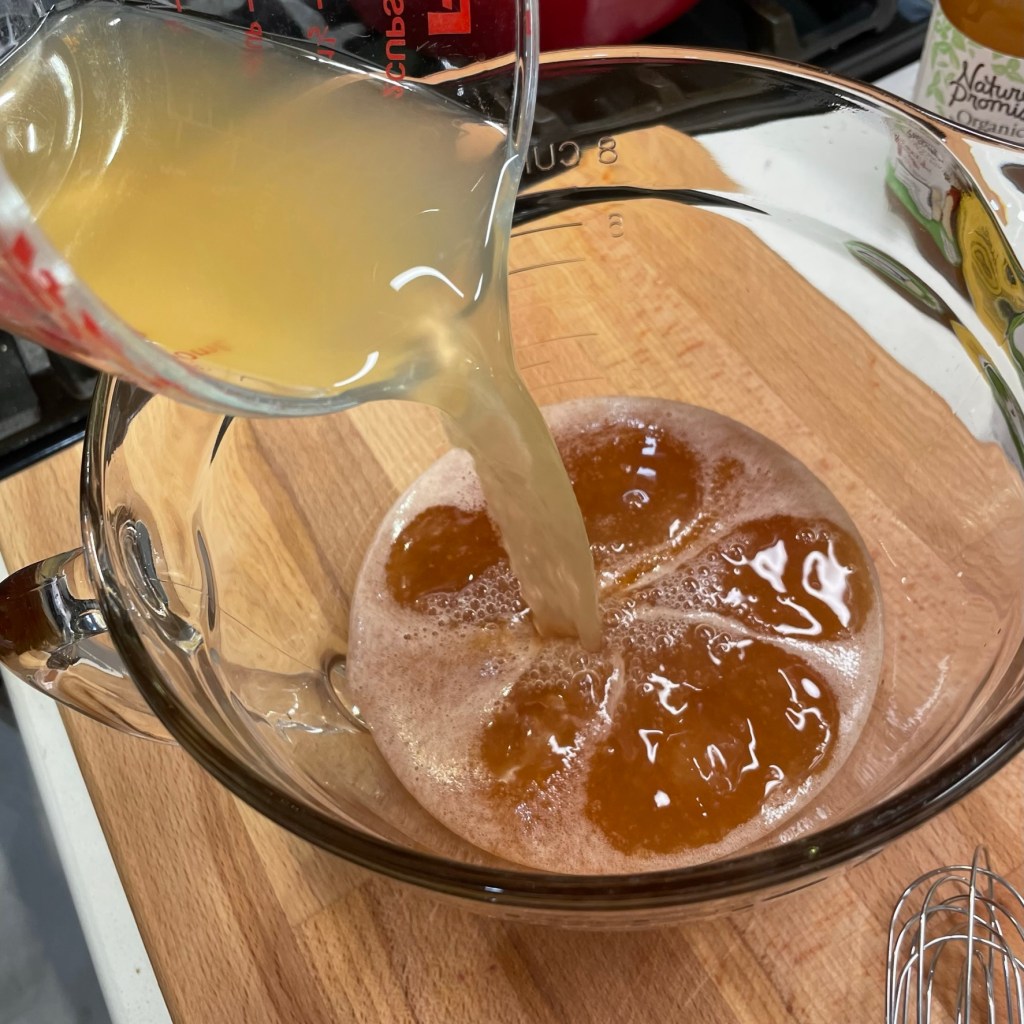
The second day, I strained the syrupy, macerated fruit (we put the chunky remains on top of vanilla ice cream) and mixed the liquid with a cup of vinegar—half apple cider (raw, with the “mother”) and half white wine.
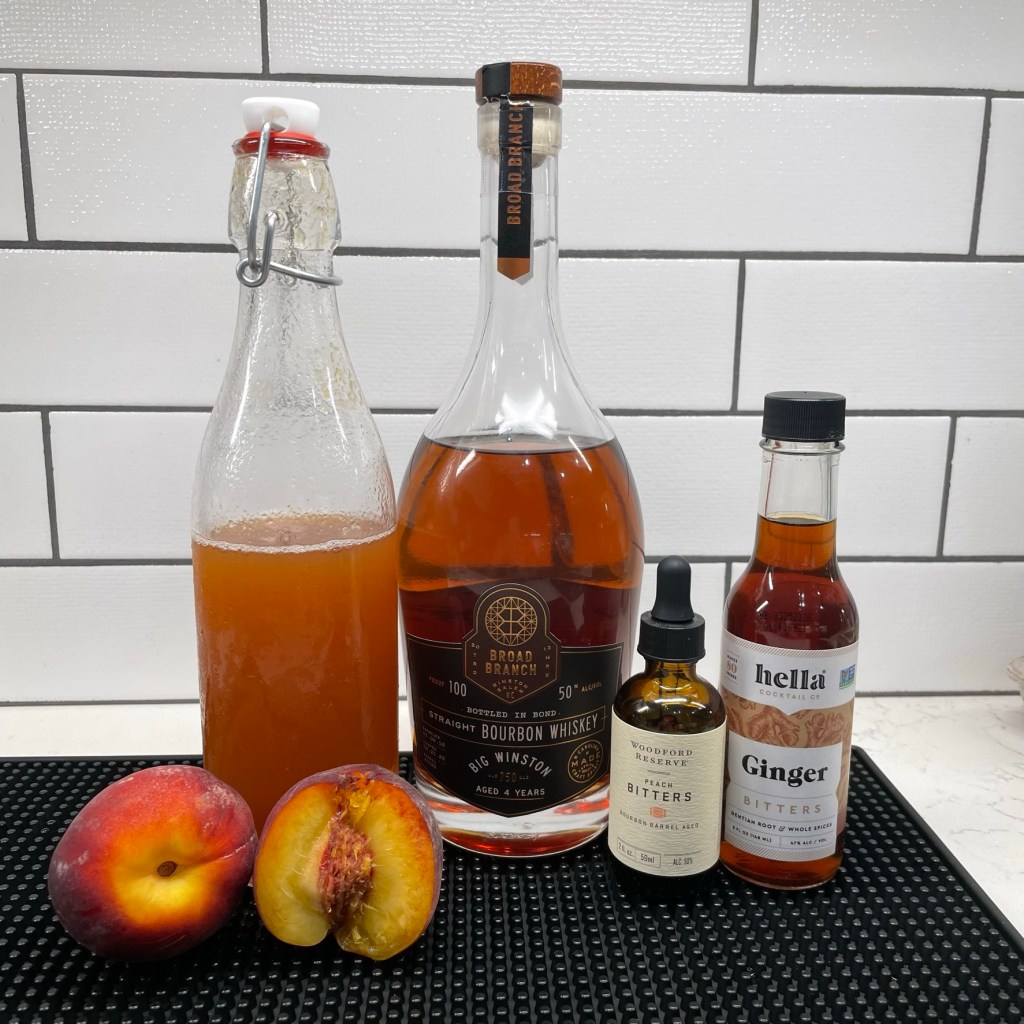
My peach shrub was strong, tart and a little too “in your face” for the first couple of days, but after a week in the fridge, it had mellowed to become quite enjoyable in this cocktail, and even more so as the weeks have passed. The other ingredients in this drink are bottled-in-bond bourbon (this one has a very low percentage of rye in the mash bill, so definitely choose one on the sweet side), a fresh chunk of muddled peach and a couple of shakes of bitters. I like the ginger bitters, but if you can find peach bitters, they’re nice, too.
This is a bottled-in-bond bourbon from one of our local distilleries. It’s mostly corn, and only a slight amount of rye, so it’s nice and sweet.
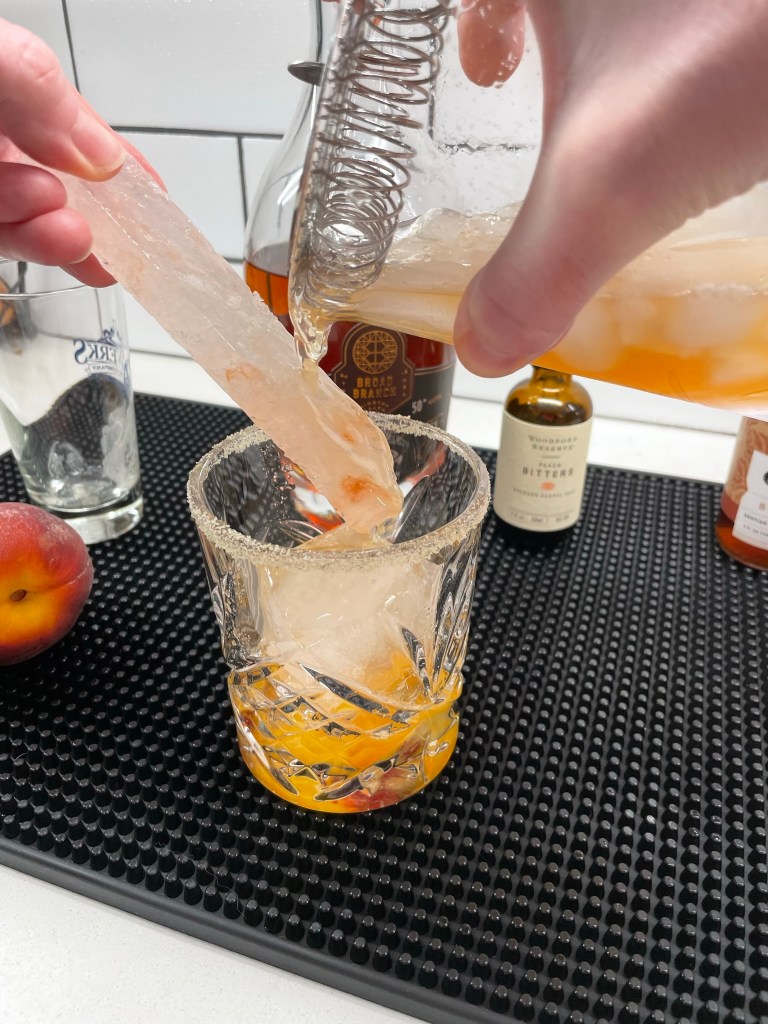
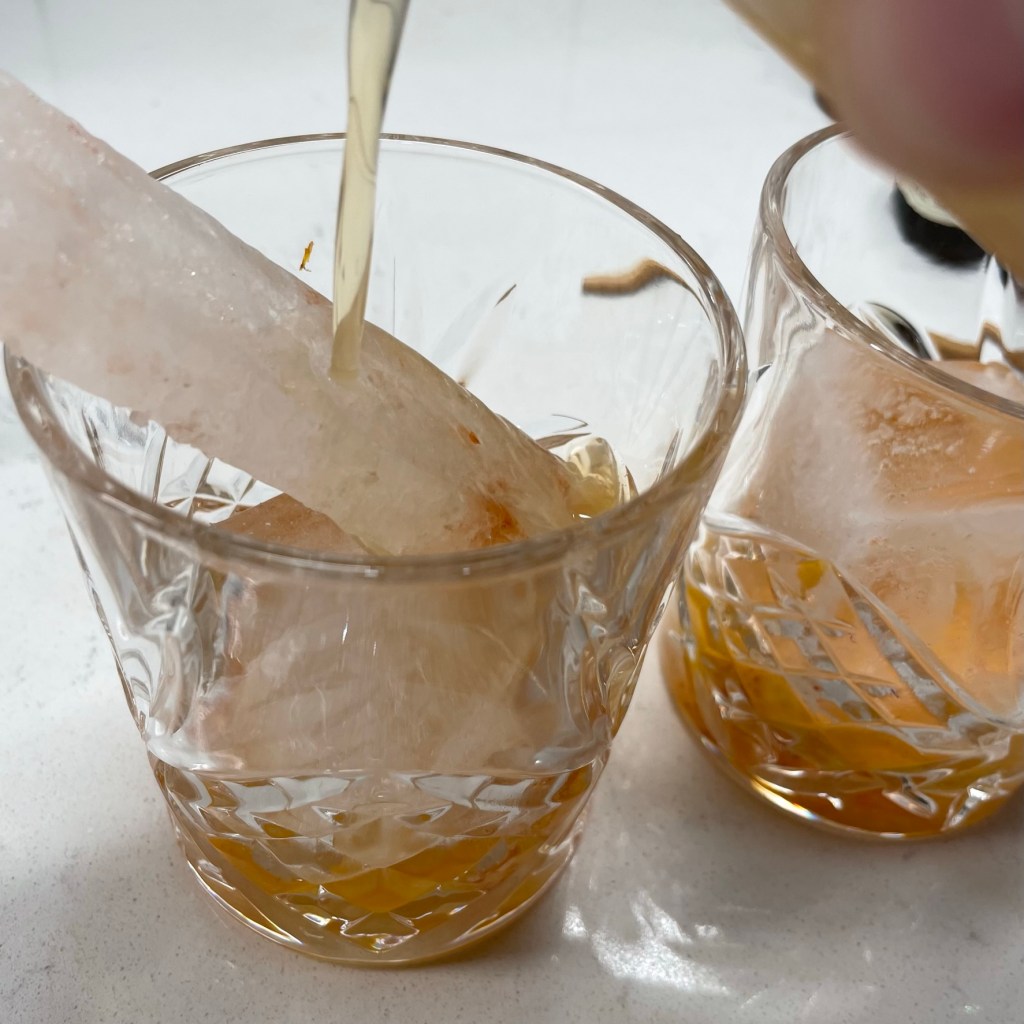
There’s one more thing that makes this cocktail special, and you’d probably never guess—it’s salt. You heard me. I’ve been experimenting with the concept to further balance a cocktail, and it is a pretty amazing thing. We bought this Himalayan pink salt swizzle stick back in February when we visited Asheville Salt cave, and as it turns out, a slight touch of this special salt brings this drink together, the same way a pinch of salt makes a dessert taste better. The things we learn!
By pouring the strained drink over the edge of the salt bar, you only get a hint of the salt. So good!
We have tried several iterations of this libation over the summer, including an infusion of thyme in the peach shrub, minted sugar on the rim of the glass, on the rocks, and up in a Nick and Nora glass, etc. My favorite is simple and straightforward—bourbon and muddled peach, shrub, ginger bitters, no sugar rim, poured over the salt swizzle stick on a giant ice cube, and keep ‘em coming.
I decided to call this cocktail “Pompatus of Love.”
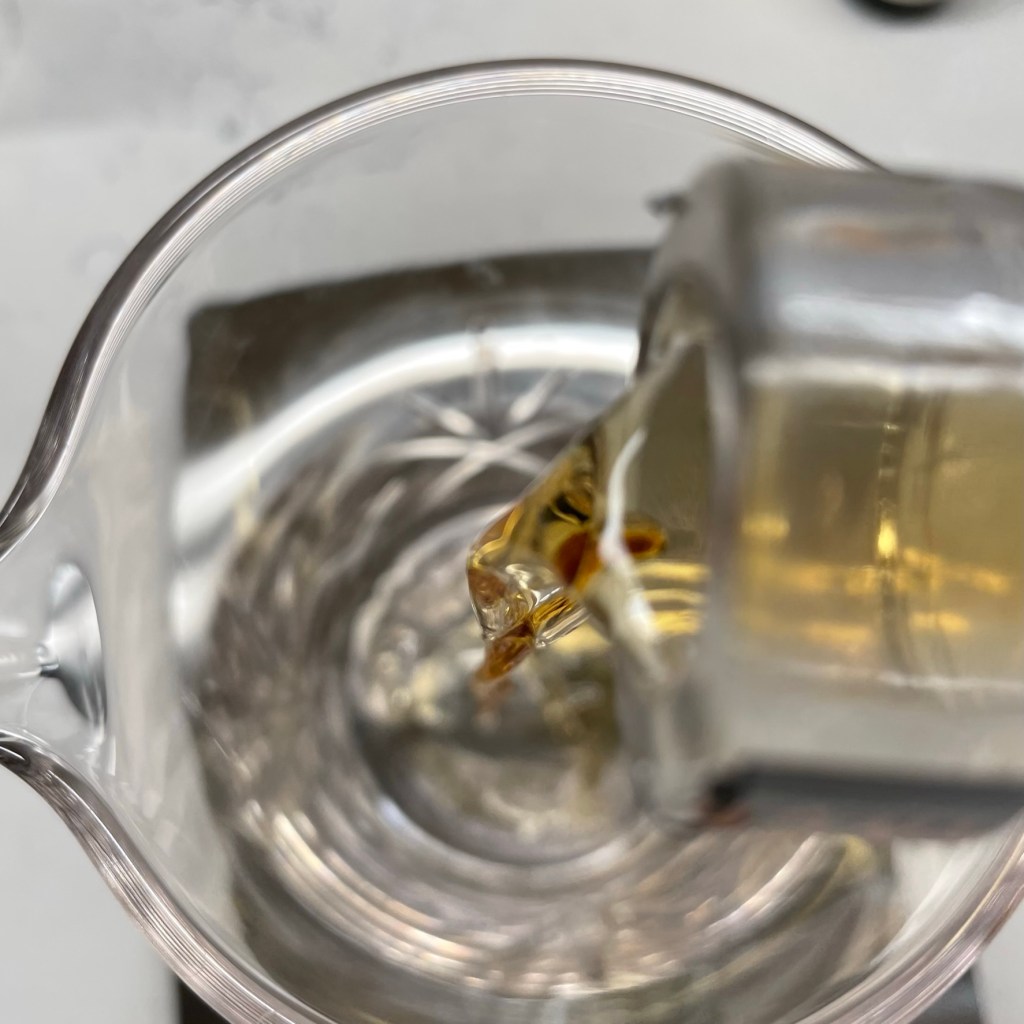
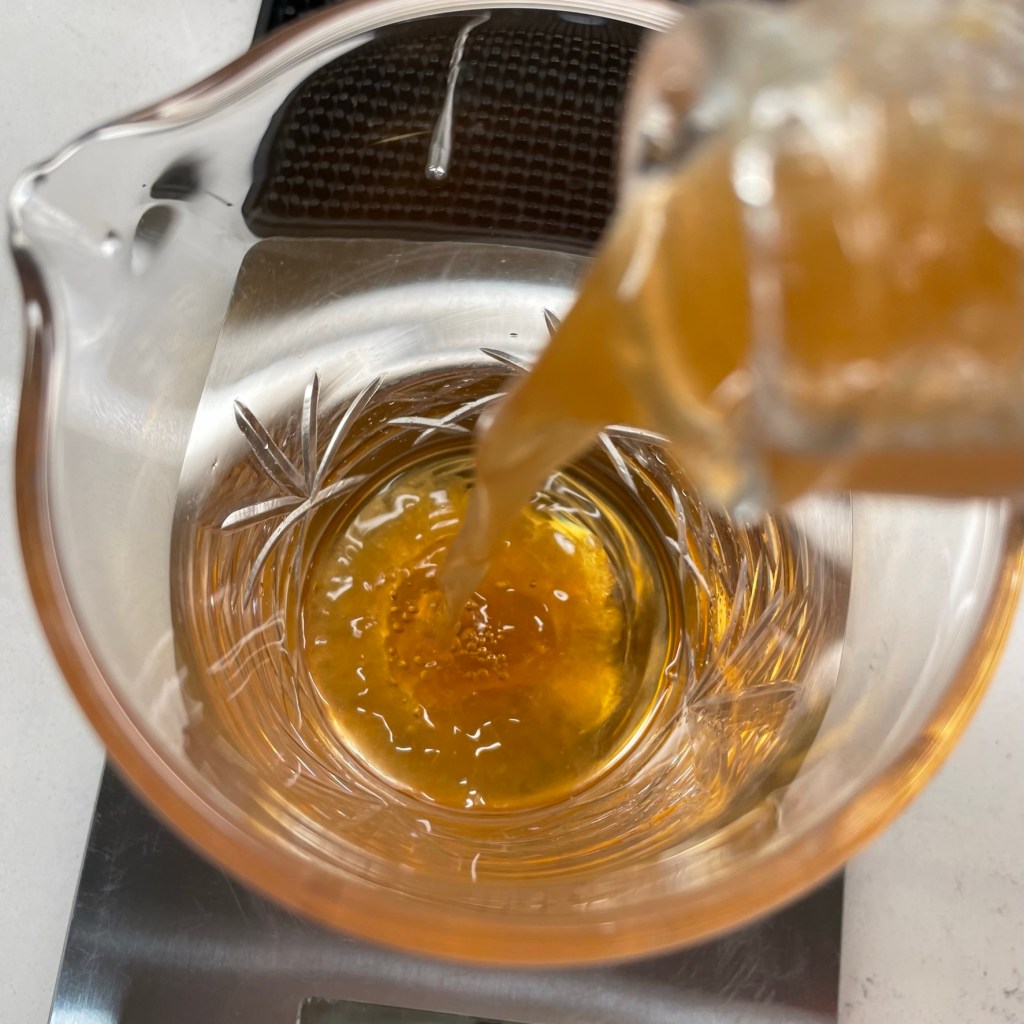
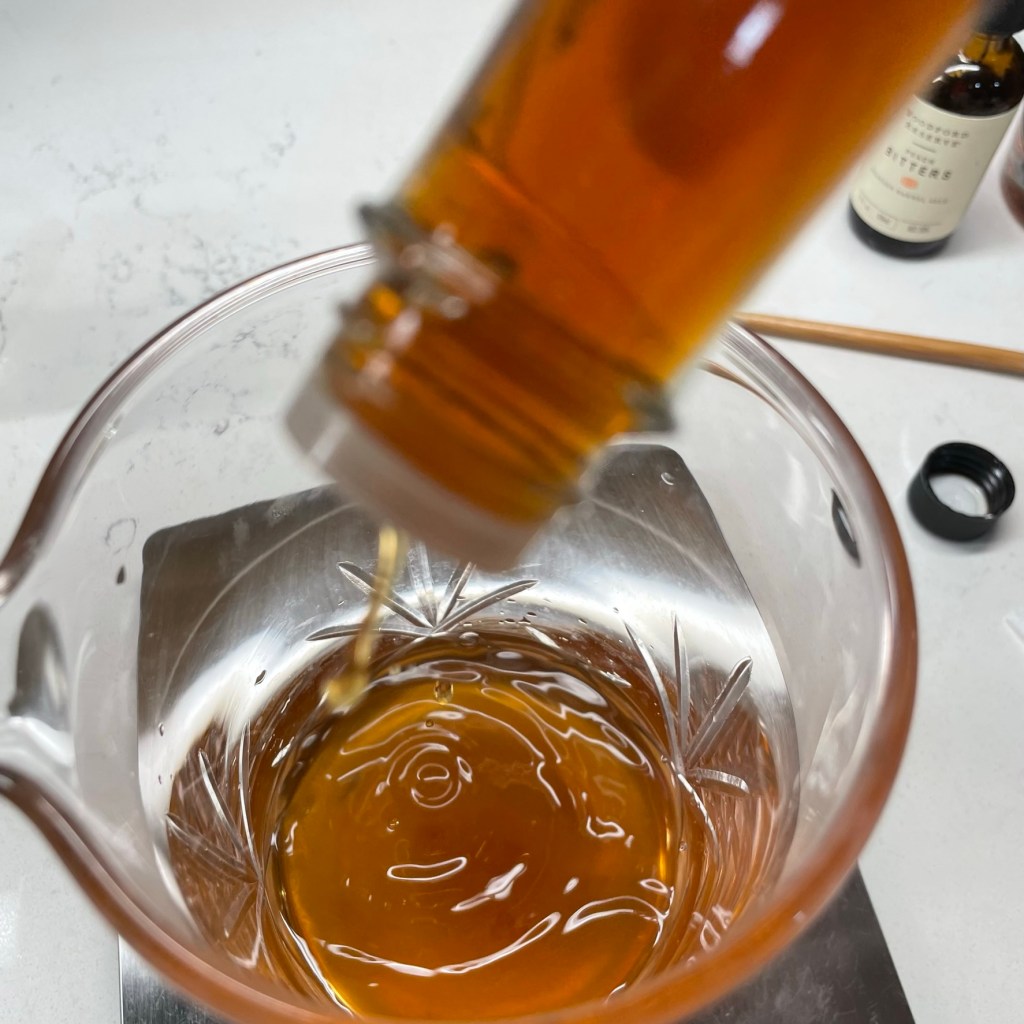
Muddle a chunk of fresh peach, cover with huge ice cubeMeasure 2 oz. bourbon in a mixing glass or shakerAdd 1/2 oz. shaken peach shrubTwo shakes of bitters, then add ice and stirStrain over Himalayan swizzle stick onto big ice cube.
Pompatus of Love.
Now, I won’t make you wrack your brain to figure out why the name sounds familiar to you—it comes from the 1970s classic rock song, “The Joker,” by the Steve Miller Band. You know, right after he sings, “some people call me Maurice.” What you might not know is that the word pompatus is not really a word at all, but something that Miller misheard from a doo-wop song released two decades earlier. I’ll let you explore that on your own time with the help of Google and Wikipedia, because it is a story in itself.
And since you’ve already heard the Steve Miller version of the song at least as many times as I have, I’d like to introduce you to one of our favorite local artists who performs a terrific rendition of this song. Please click to play, while I tell you a little bit more about this peachy bourbon drink, and about our friendship with Colin Allured, the artist featured here.
If you love this, subscribe to Colin’s YouTube channel. He has plenty more where this came from.
I first met Colin almost 8 years ago, when he debuted his one-man act at a wine bar that I frequented. He mesmerized the entire room on that December night, even drawing the kitchen staff out to the front of house to see who was this guy, covering the vocals of everyone from Steve Miller to The Beatles to Justin Timberlake to Katy Perry—as well as plenty of his own (awesome) original music. From that night, I hardly missed an appearance by Colin at the wine bar or anywhere else, and Les quickly caught on as well when we began dating. Fast forward a few years, when Les conspired with Colin to play a very special song for us on an evening we had planned to celebrate my birthday—I say they “conspired” because the night took on a whole new meaning after Colin dedicated the song to us. That’s when Les popped the question and put a ring on my finger. Since then, we have followed our friend around to many venues, including the show where he recorded that version of “The Joker,” and I have no doubt that he will always be a part of our love story, in some way or another.
So what does all of this romance nonsense have to do with this bourbon cocktail, based on a peach shrub?
I named this drink Pompatus of Love because, to me, it embodies a little bit of everything that makes a romantic love relationship great. It’s intoxicating, just sweet enough, a bit tart and sassy, and slightly salty in a way that is unexpectedly addictive. As one of our July 4th weekend guests put it, “the first sip surprised me, but it’s growing on me.”
Yep. That’s the pompatus of love.
Really love your peaches, wanna shake your shrub.Lovey dovey, lovey dovey all the time.
This perfect marriage of bourbon and peaches is made even better with a splash of peach shrub, an old school “drinking vinegar” that’s made with fresh peaches, sugar and vinegar. Plan to make the shrub about a week ahead for best results. I like these best on a large ice cube in a double rocks glass, but it can also be shaken and strained into a chilled coupe glass if you’re feeling fancy.
Ingredients
1 small, fresh peach (for muddling)
4 oz. bourbon (use a high-proof, low rye version if possible)
1 oz. peach shrub* (see below)
2 quick shakes ginger (or peach) bitters
large ice cubes for serving
Directions
Place a chunk of peach (about the size of a walnut) into each rocks glass. Crush it with a cocktail muddler or the handle end of a wooden spoon. Place a large ice cube over the peach.
In a cocktail mixing glass or shaker, combine bourbon, shrub and bitters. Add one cup of ice and stir or shake until the mixing vessel is frosty.
Strain into glasses, garnish with slices of the peach.
For the Shrub: choose very ripe peaches, and don’t worry if they have bruises or dark spots. This is a great way to use peaches that are a little “past their prime.” The shrub will be quite intense for the first few days after making, but it mellows after about a week and is lovely in cocktails, or put an ounce in a glass with ice and top it with sparking water for a zero-proof summer treat!
Ingredients
3 or 4 ripe peaches, washed
1 cup raw cane turbinado sugar (white or light brown sugar works, too)
1/2 cup raw, unfiltered apple cider vinegar (such as Bragg’s)
1/2 cup white wine vinegar
Directions
Peel and pit the peaches, and cut them up into chunks.
In a medium bowl (choose one that has a fitted lid), combine the peaches and sugar, stirring until it begins to get syrupy. Cover and macerate in the fridge 24 hours.
Strain peaches through a mesh sieve, catching the liquid in a bowl below. Discard the peach solids, or use them right away in some other dish.
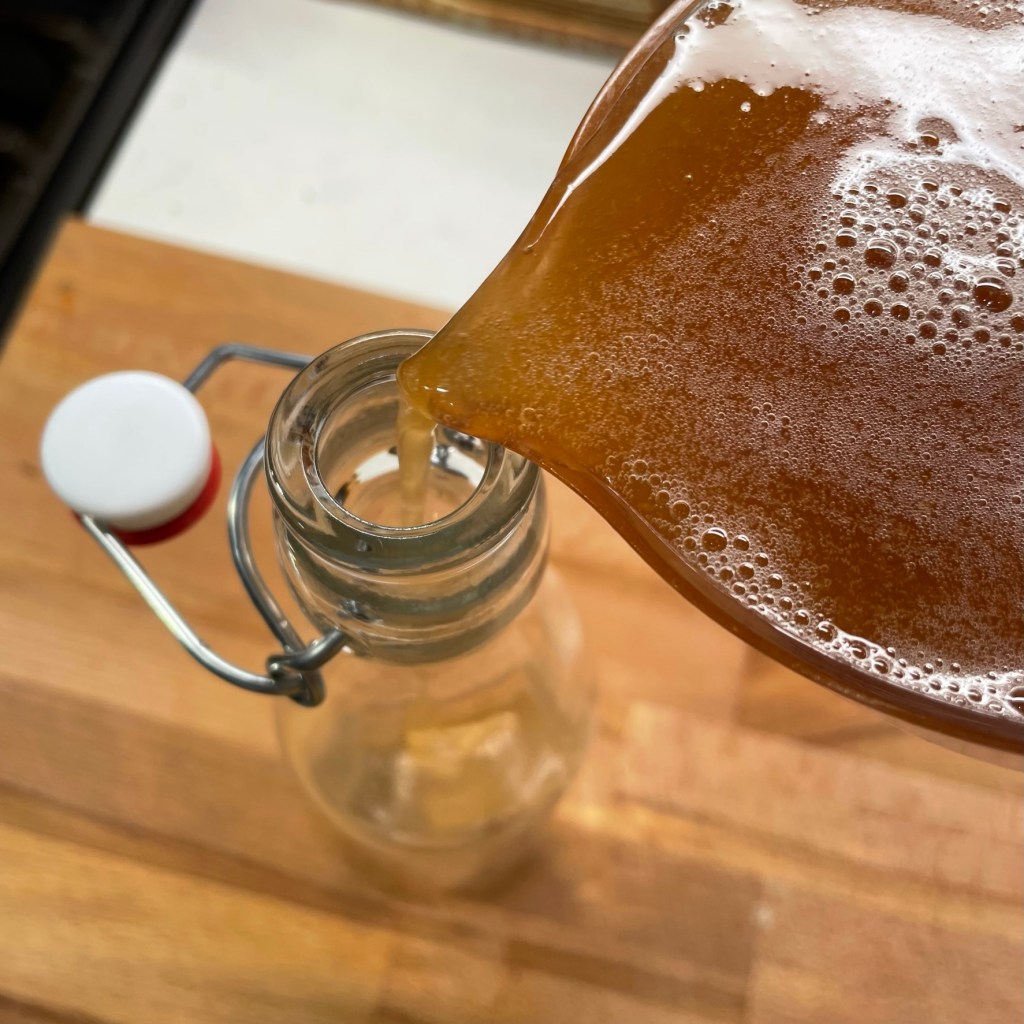
Stir the vinegars into the sweet peach syrup. Transfer to a sealable glass bottle and refrigerate up to 3 months.
I’m ready for fall—there, I said it. Summer has been wonderful this year, especially for the fact that we have enjoyed the company of friends more this year than in the previous two summers. It’s good to be (mostly) back to normal. But my confession is true; I have found myself longing for the goodness that autumn brings—you know, cooler evening breezes, crisp morning air, comfy sweaters and (of course) the food. Soon enough, I suppose.
As we wind our way through these waning days of summer, I am delighted with the freshness we have enjoyed from our own garden and the various other local sources that have supplied our meals.
We are clinging to the end of fresh peach season here in the South, and I have two delicious desserts to share with you. It is unusual for me to share two recipes at once but, given the short time left for enjoying fresh, in-season peaches, I thought it made sense to present these at the same time. Both are prepared in a skillet, and both include fresh peaches, but that’s pretty much where the similarities end. One is super simple to make and serve straight from the skillet; the other is a bit more involved, though not difficult, and serves up with a more elegant flair. Either is delicious, and if you only have enough time (or peaches) to make one of them, you can hardly choose wrong.
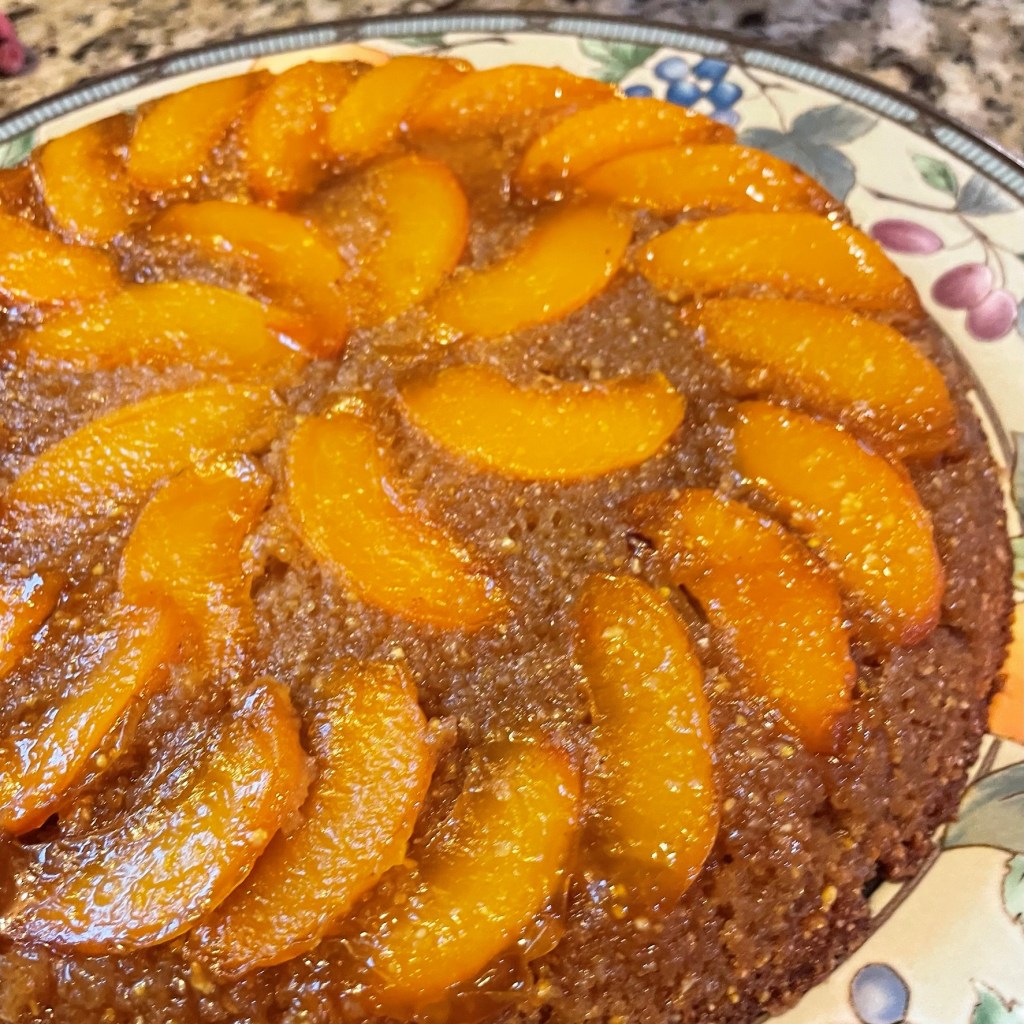
Peach Bourbon Upside-down Skillet Cake
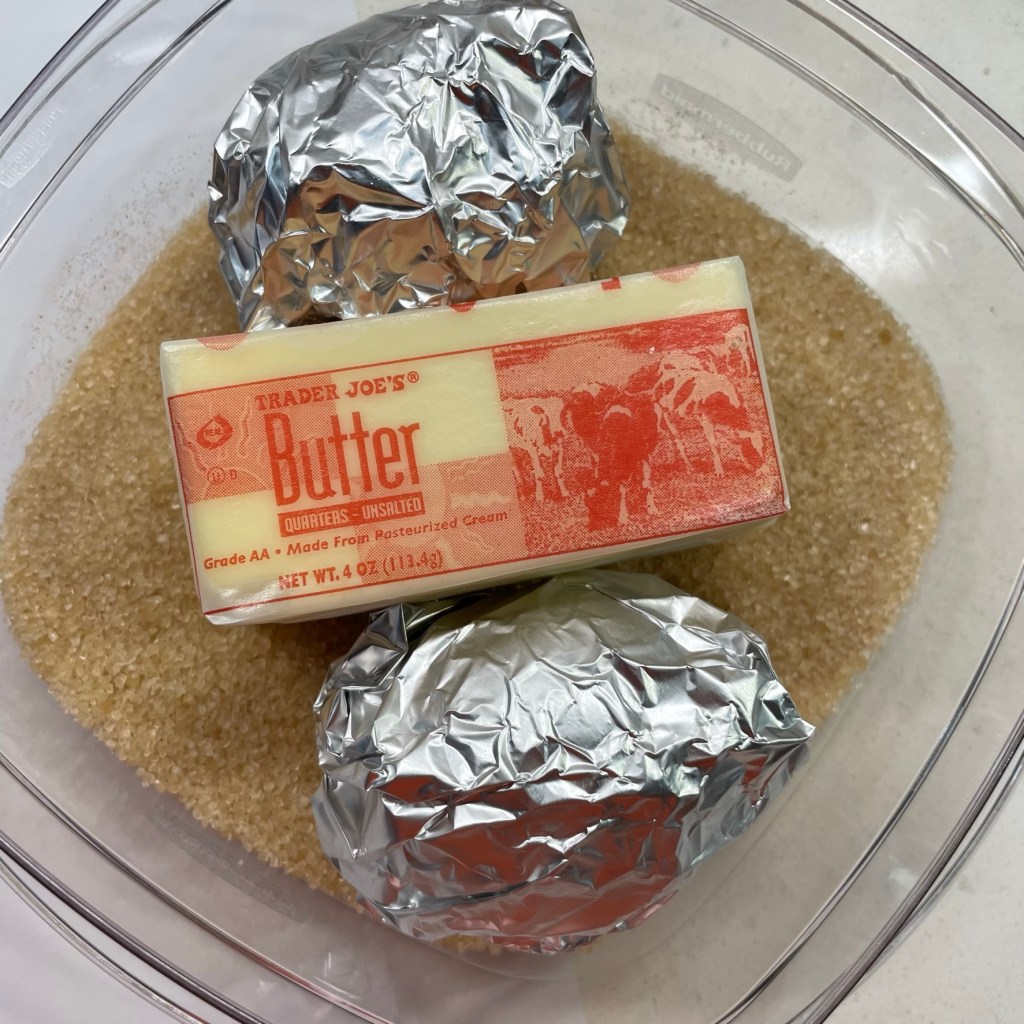
The first of these yummy desserts was made “on location,” just about a month ago, during a visit with friends outside Raleigh, N.C. When we arranged our day trip to visit Bob and Peg, I told them I’d love to make a dessert using the fresh peaches off their backyard tree. If you have the time to invest in a few extra steps, this is the dessert I recommend. For me, the trickiest part is inverting the thing while the heavy cast iron skillet is still warm. If you’re comfortable doing so, this cake is well worth the effort, and it’s one that I have made several times over the years. I turned it into a bit of an adventure this time by packing up all the pre-measured ingredients and then assembling and baking it at Bob and Peg’s. This was easier than it might sound, and it went like this:
I measured my ingredients and grouped them together as I’d need them for the skillet cake. The eggs are wrapped in foil for protection.
As with any upside-down cake, this dessert was built backward, beginning with the sticky-sweet, sugary base in the skillet and finishing with the batter that gets poured right on top—which, of course, becomes the bottom after the cake is baked and inverted.
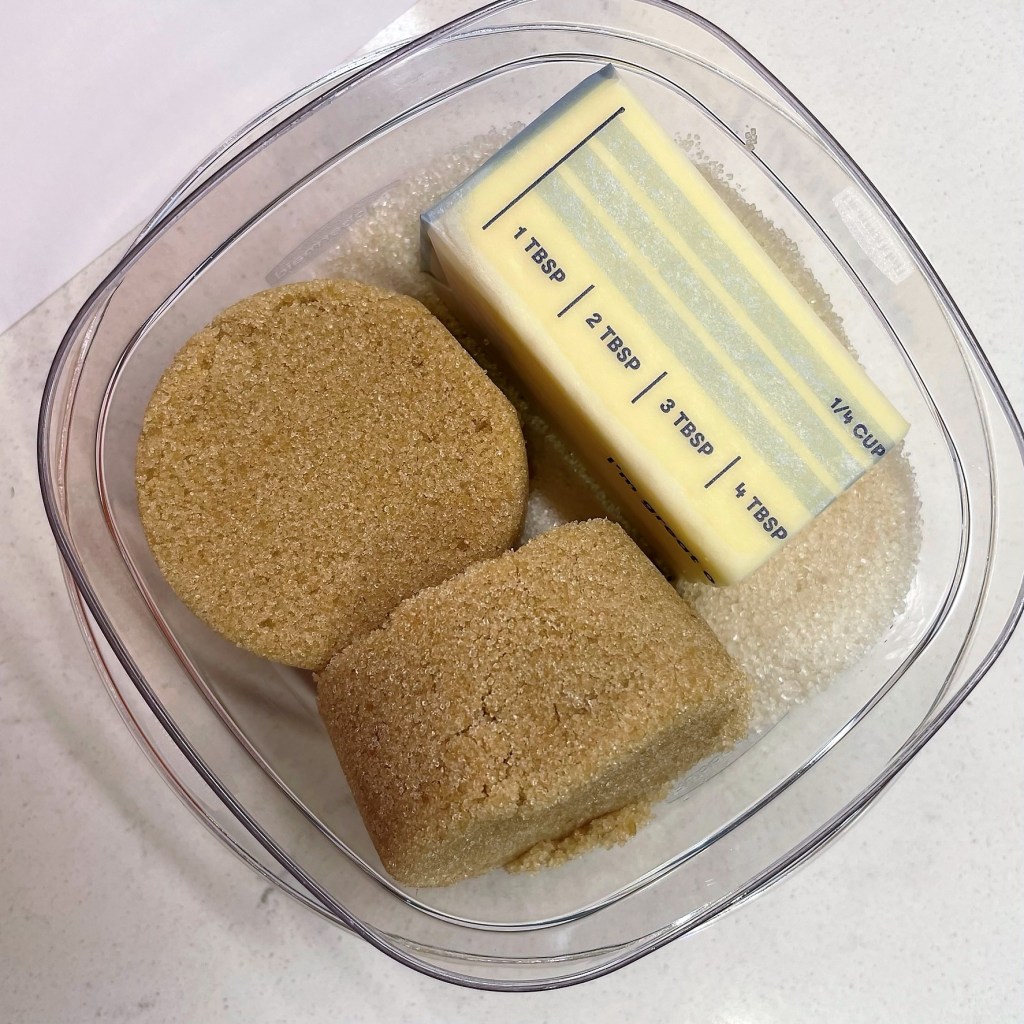
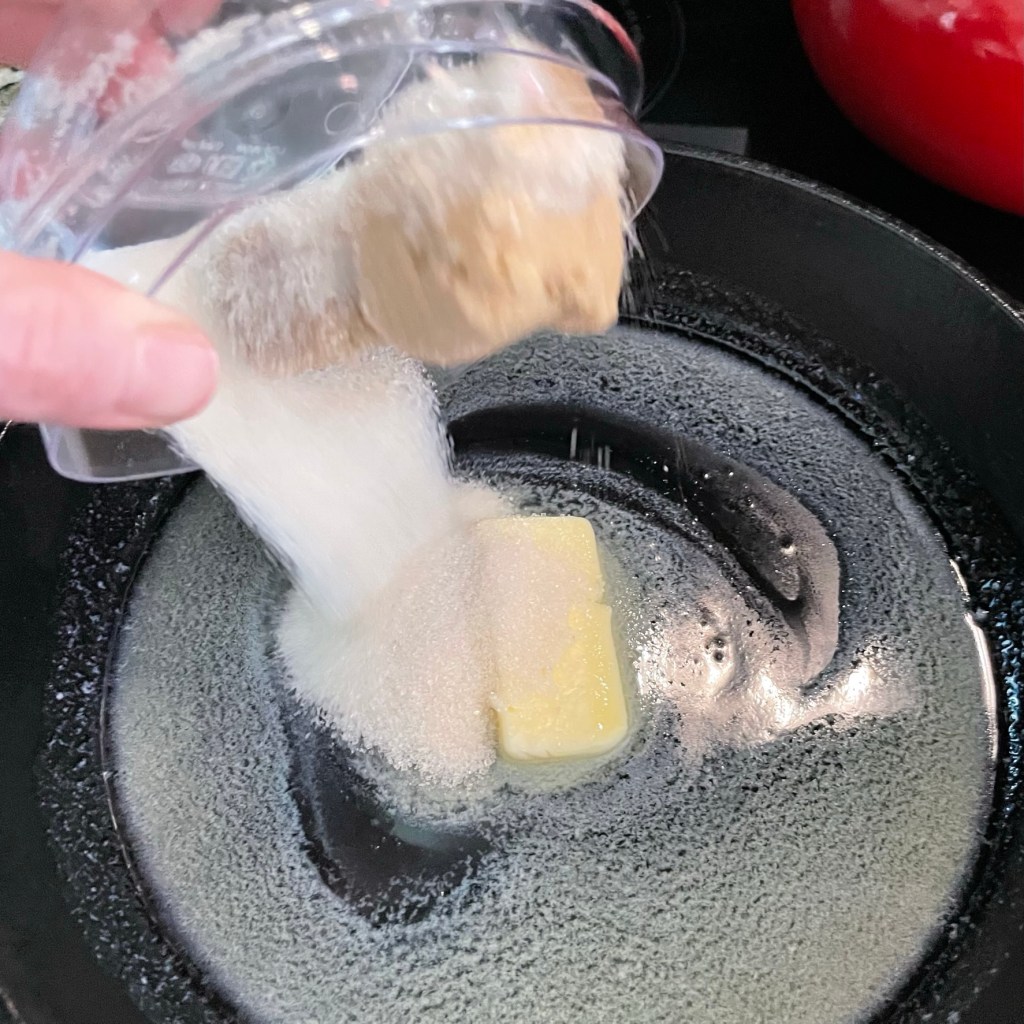
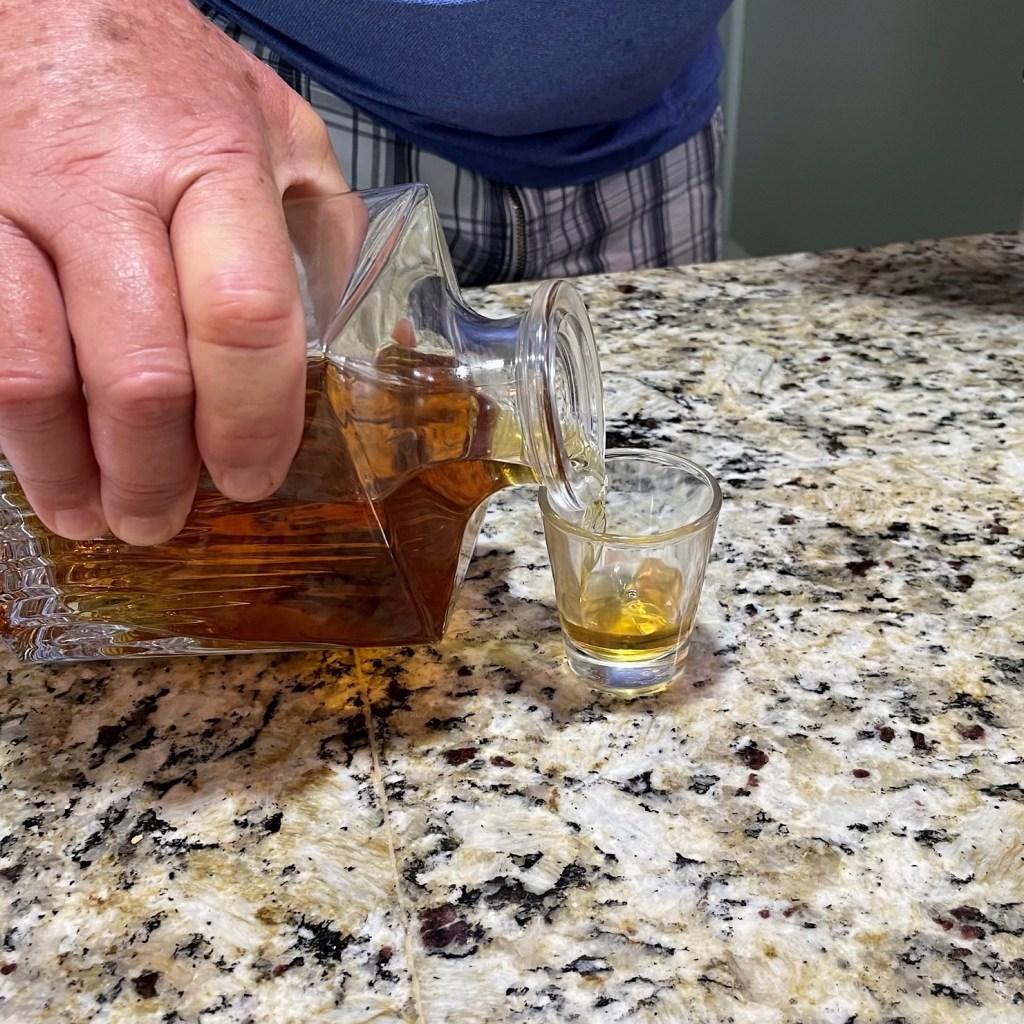
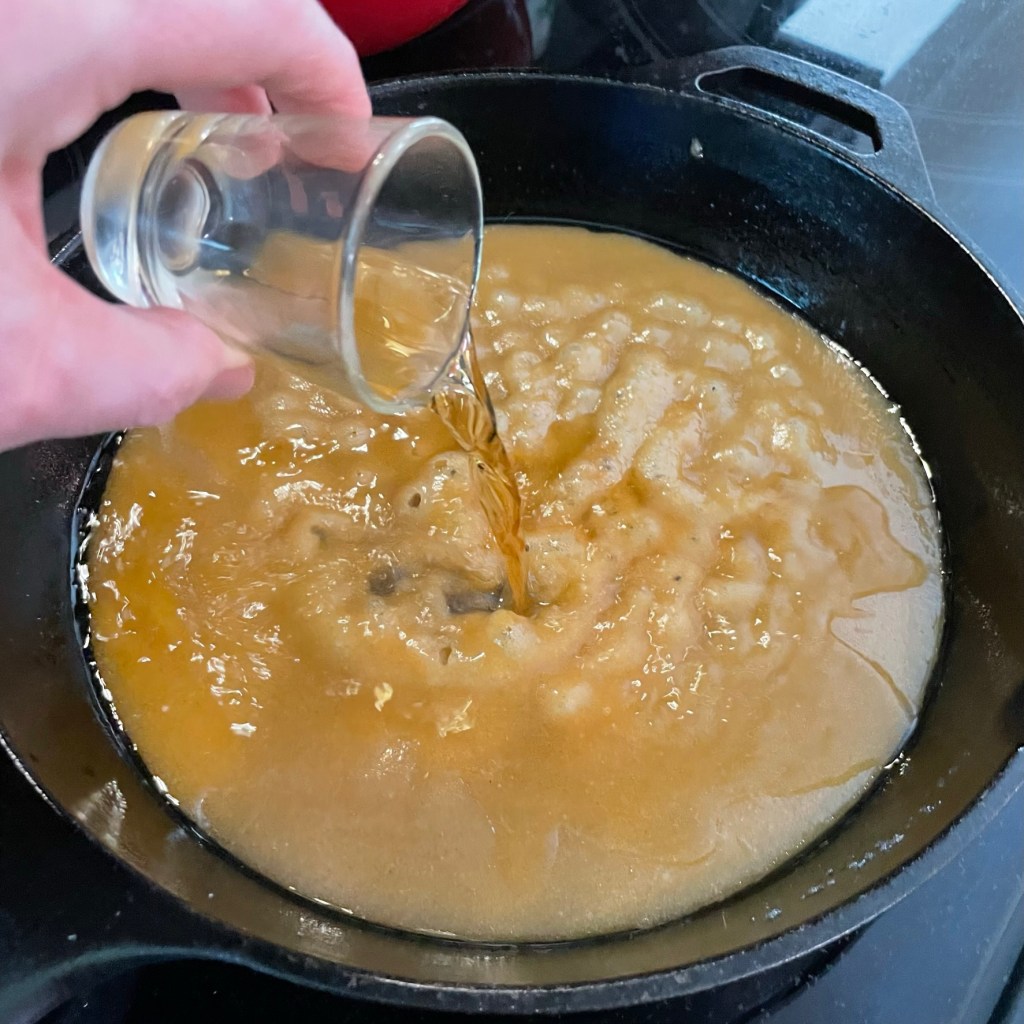
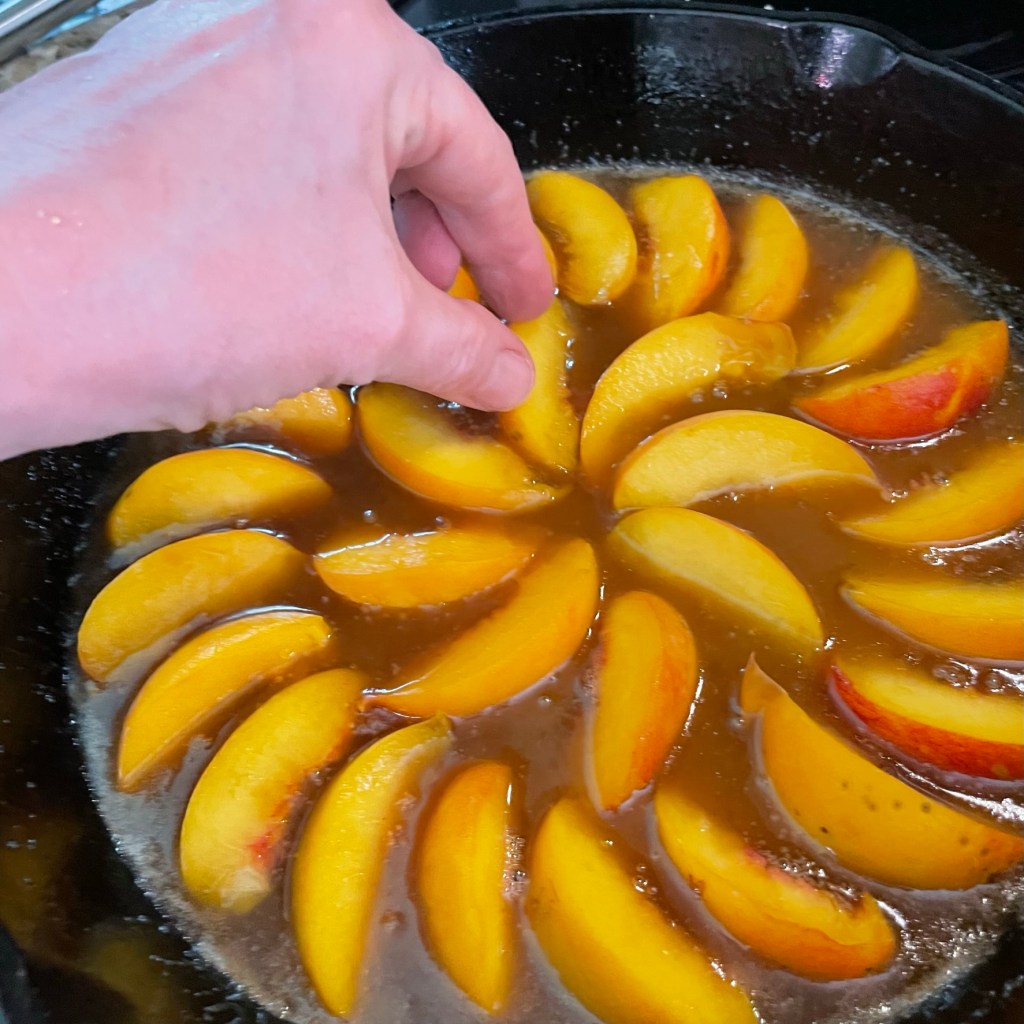
I like a combination of white and brown sugars for the base because the white sugar puts a bit of crunch in the caramel and the brown sugar provides more depth of flavor. Add both to the butter as it melts over a stovetop burner and let it mingle into syrupy lusciousness. If the butter gets a little browned in the process of melting it down, so much the better, and you must know me well enough to know that I had to pour in a shot of bourbon once the sugar mixture was bubbly. Bob was pouring bourbon anyway, and peaches and bourbon is a match made in summer heaven, as far as I’m concerned. Next, arrange sliced peaches all the way around over the butter-sugar base.
“Hey, Bob, pour me a shot for this cake, would ya?”
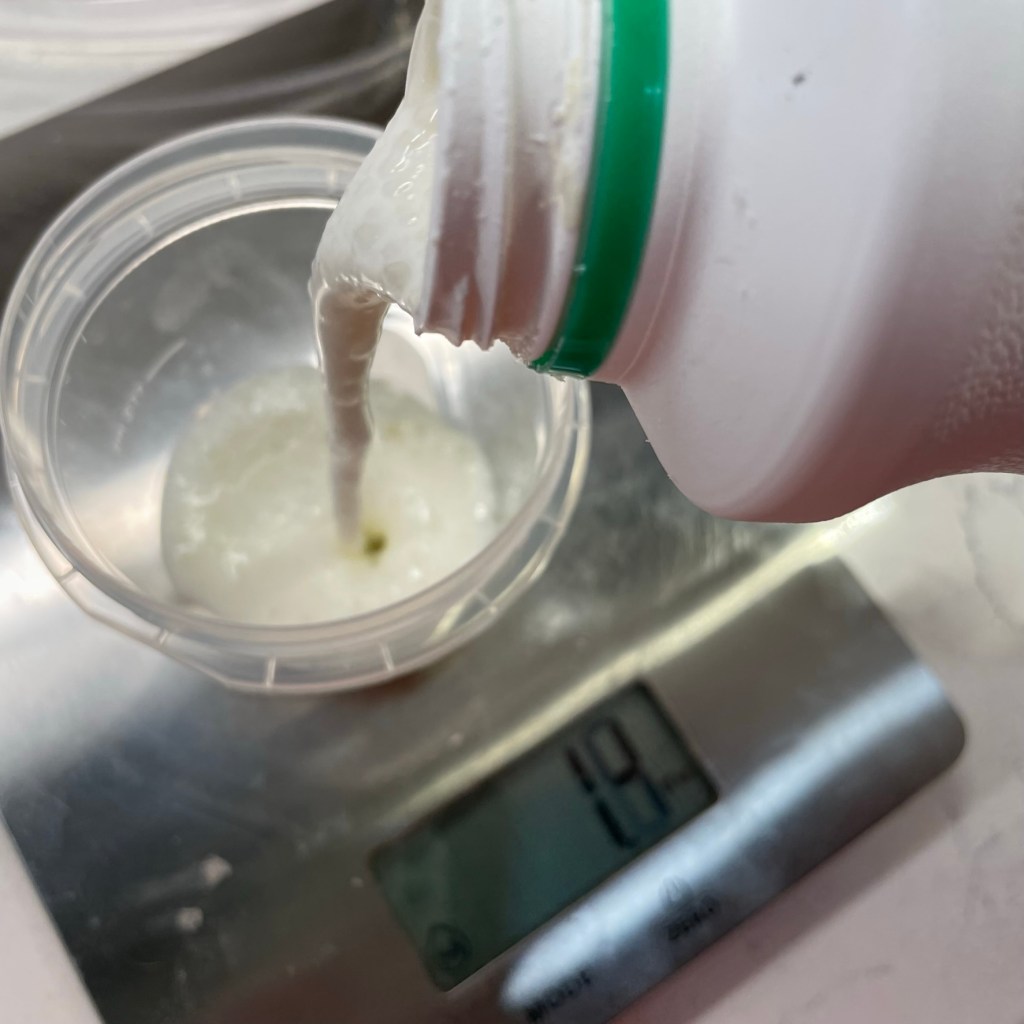
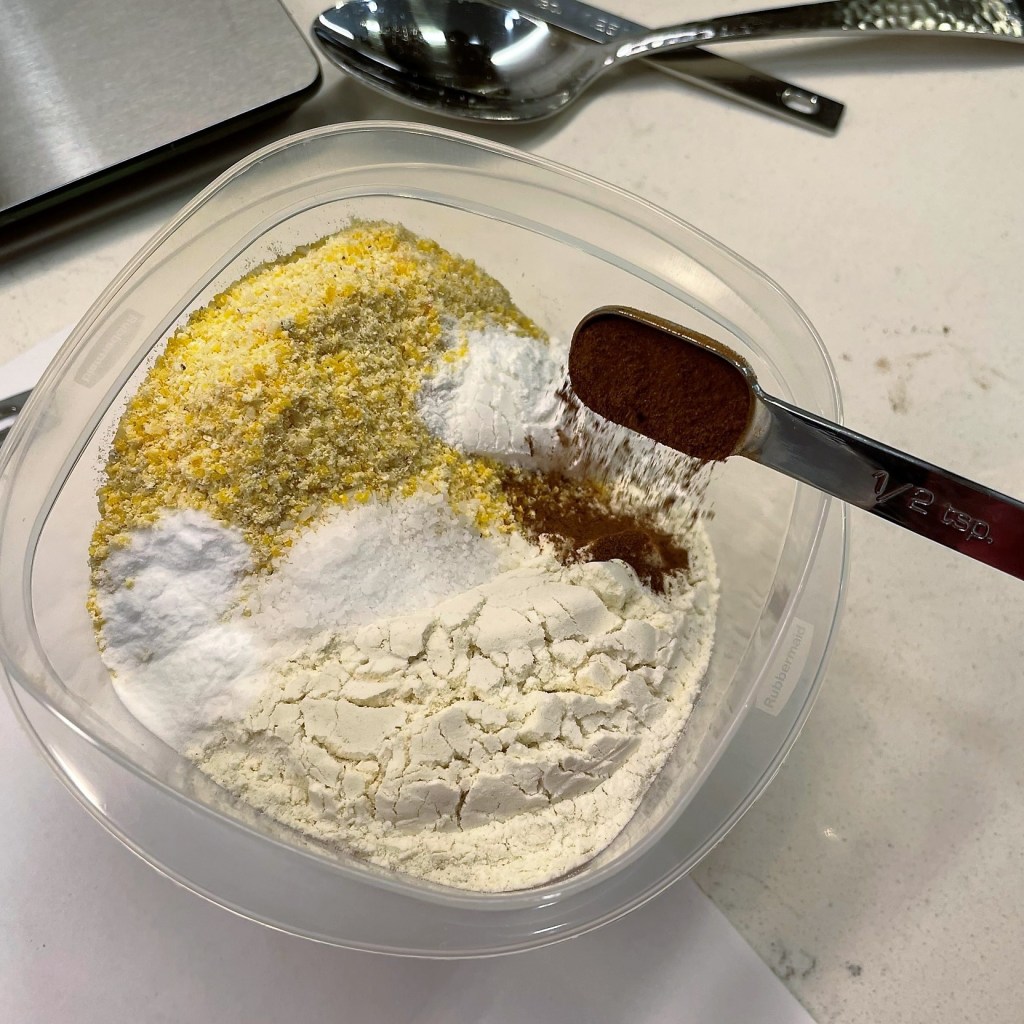
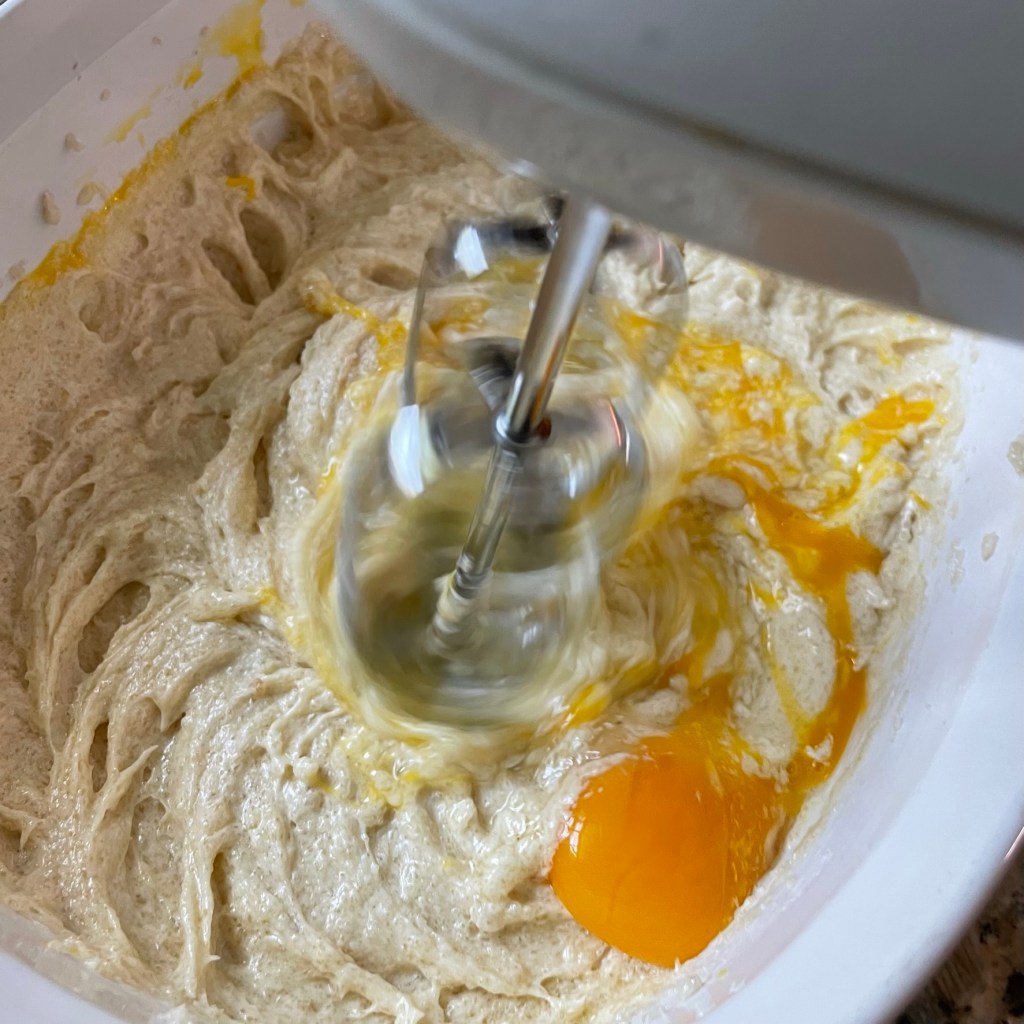
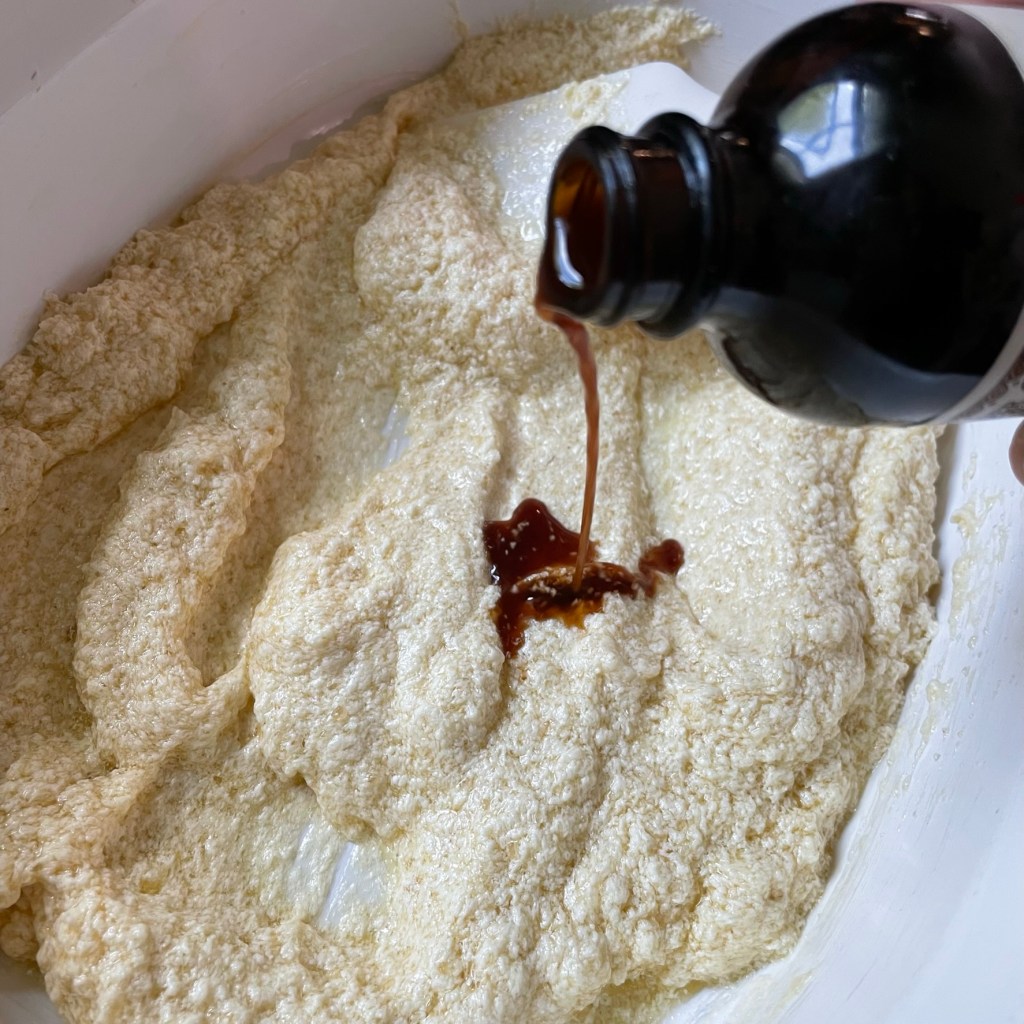
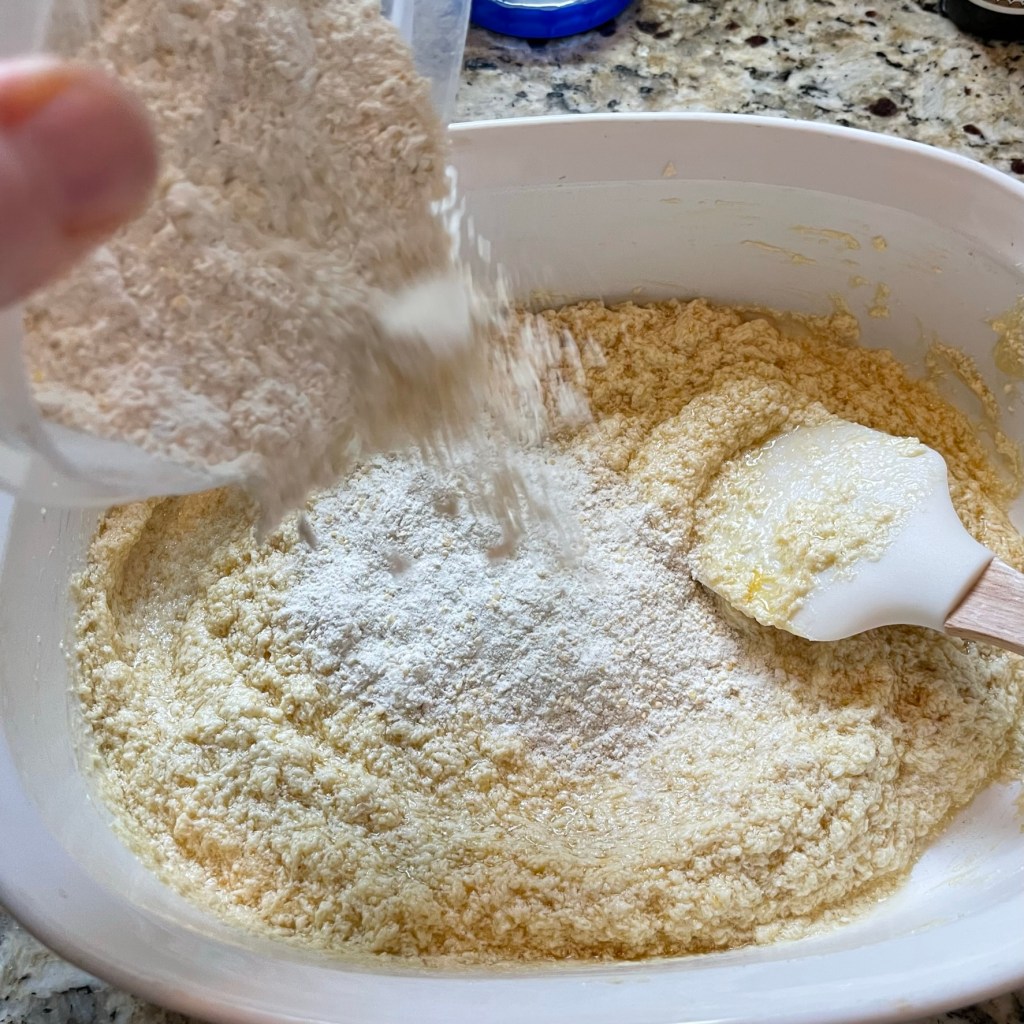
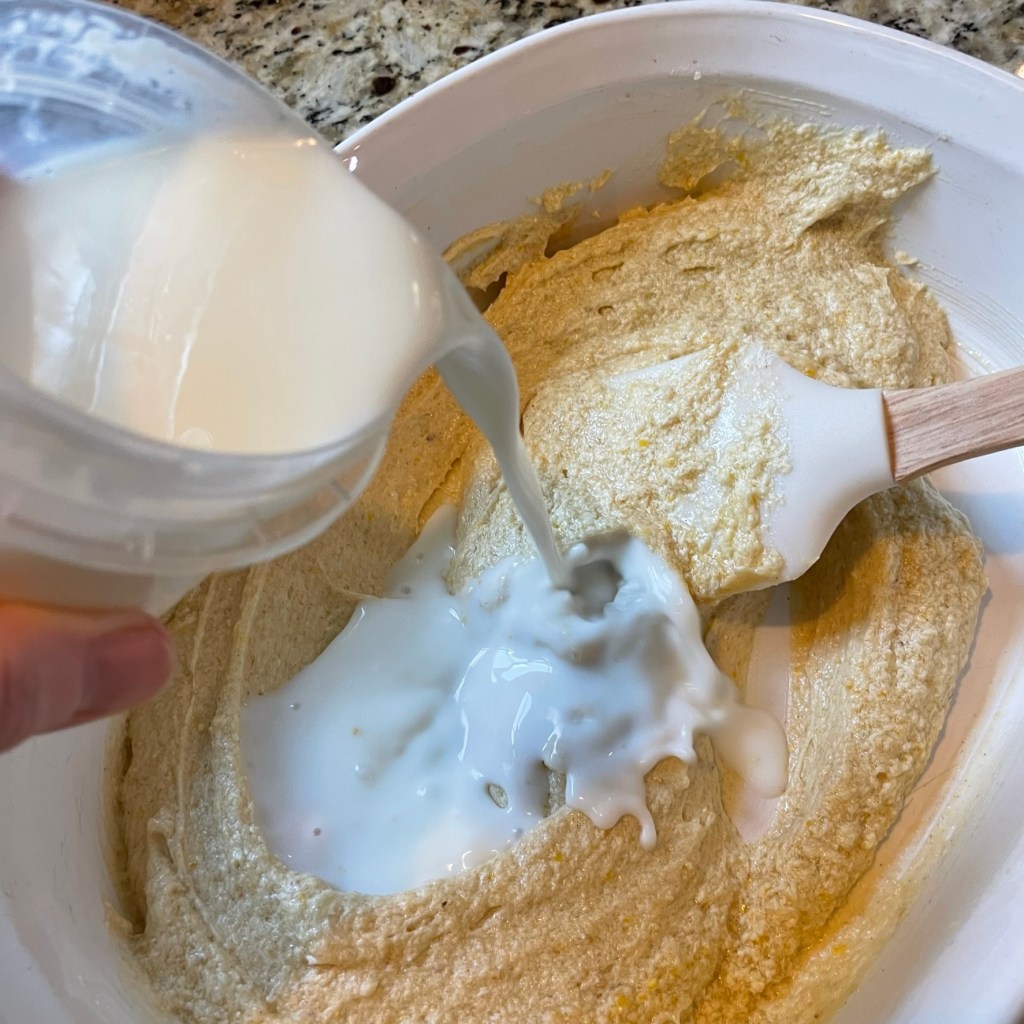
The batter for this cake is pleasantly dense, with cornmeal adding whole grain goodness and texture, and buttermilk providing a necessary acidic boost to the baking powder and soda. Begin by beating softened butter and sugar together, then adding eggs and vanilla, and finally blending in the flour and buttermilk ingredients.
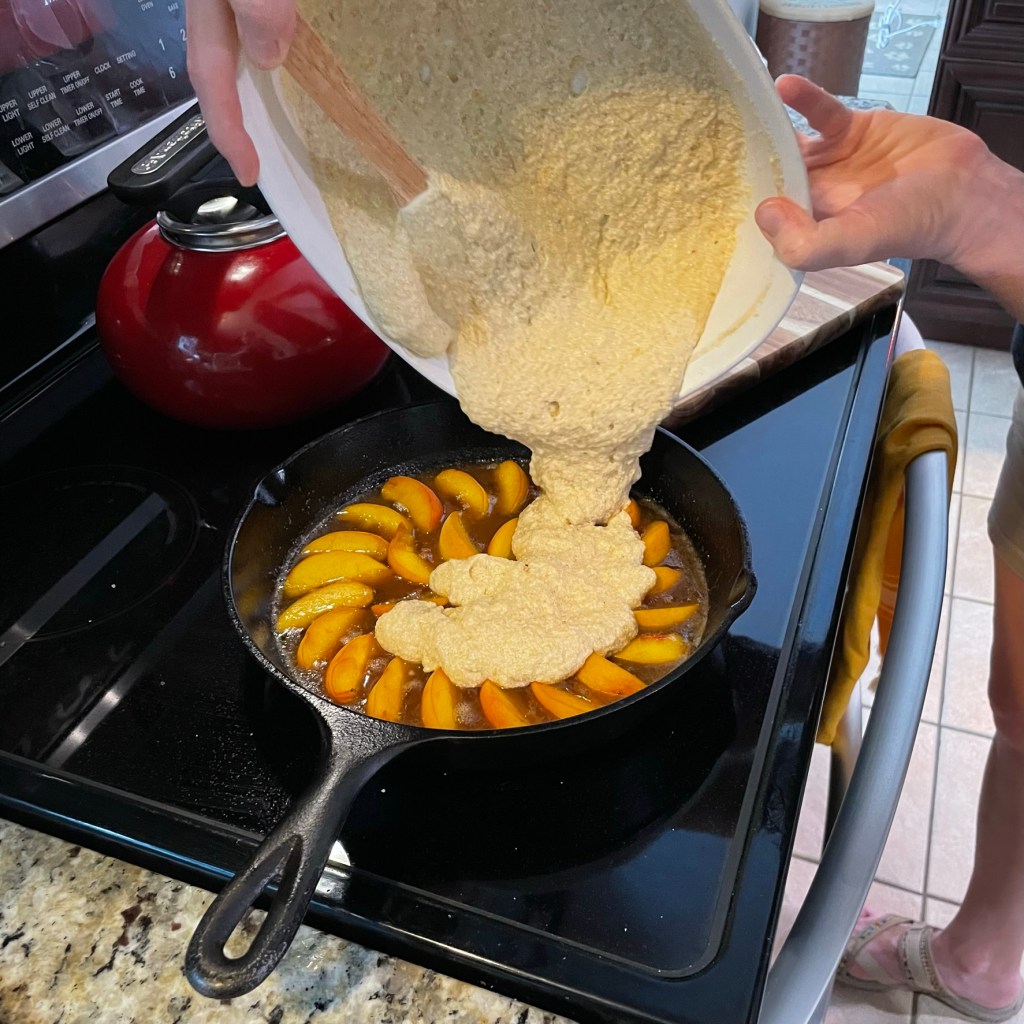
The batter will be kind of thick, and don’t worry if it seems a little broken. It will even out as it bakes.
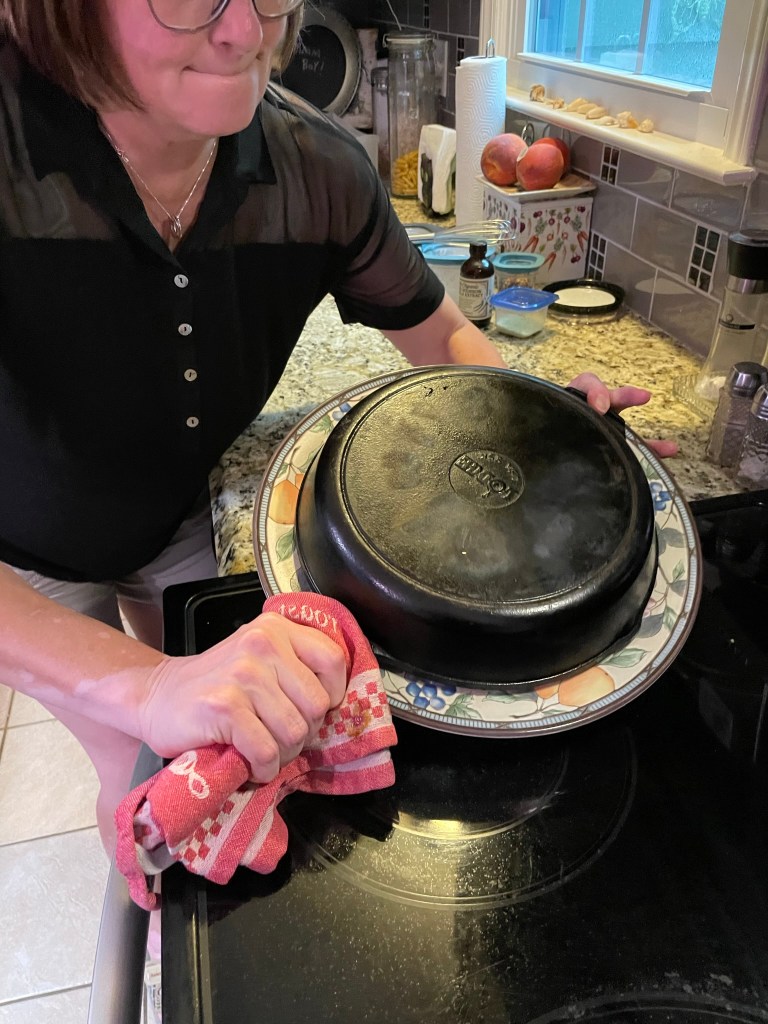
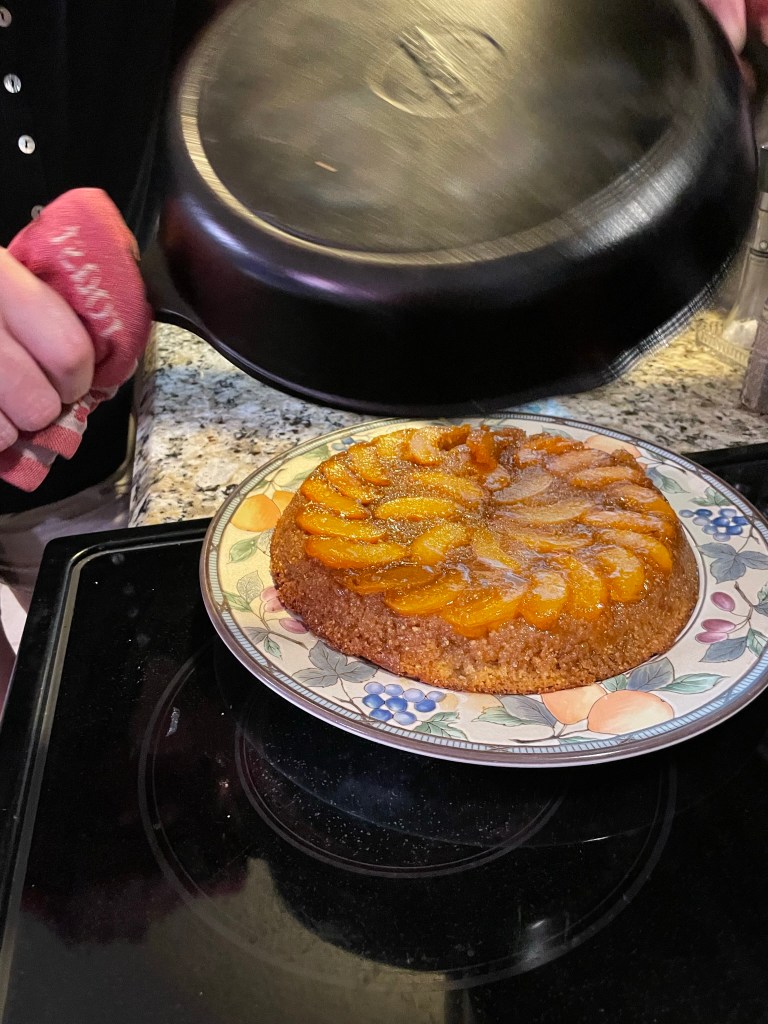
Pour the batter over the peaches in the hot skillet and transfer it directly to a preheated oven until the edges have pulled away from the skillet and the center resembles cornbread. After a brief rest, run a knife around the edge to loosen the cake and carefully invert it onto a serving plate. If any of the “upside-down” sticks, replace it on the cake and smooth it while it is still warm. Delicious!
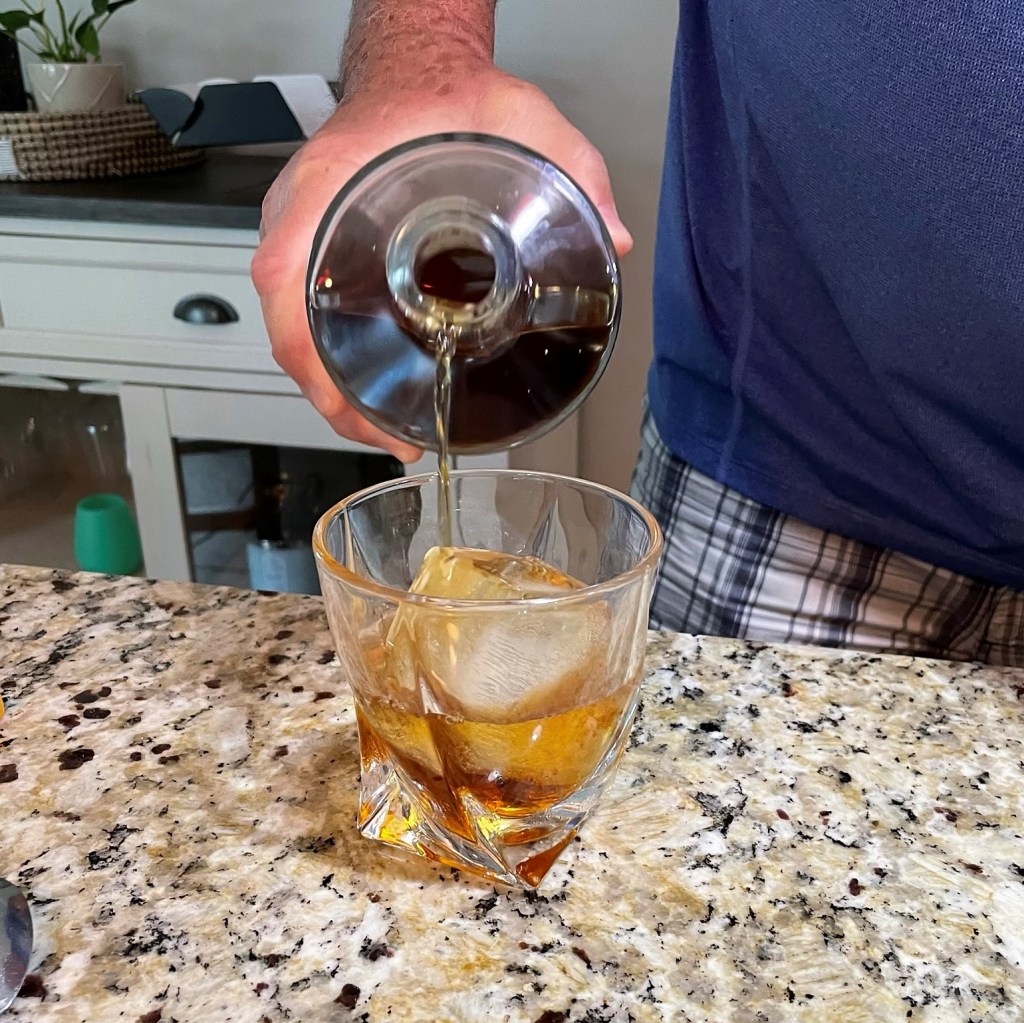
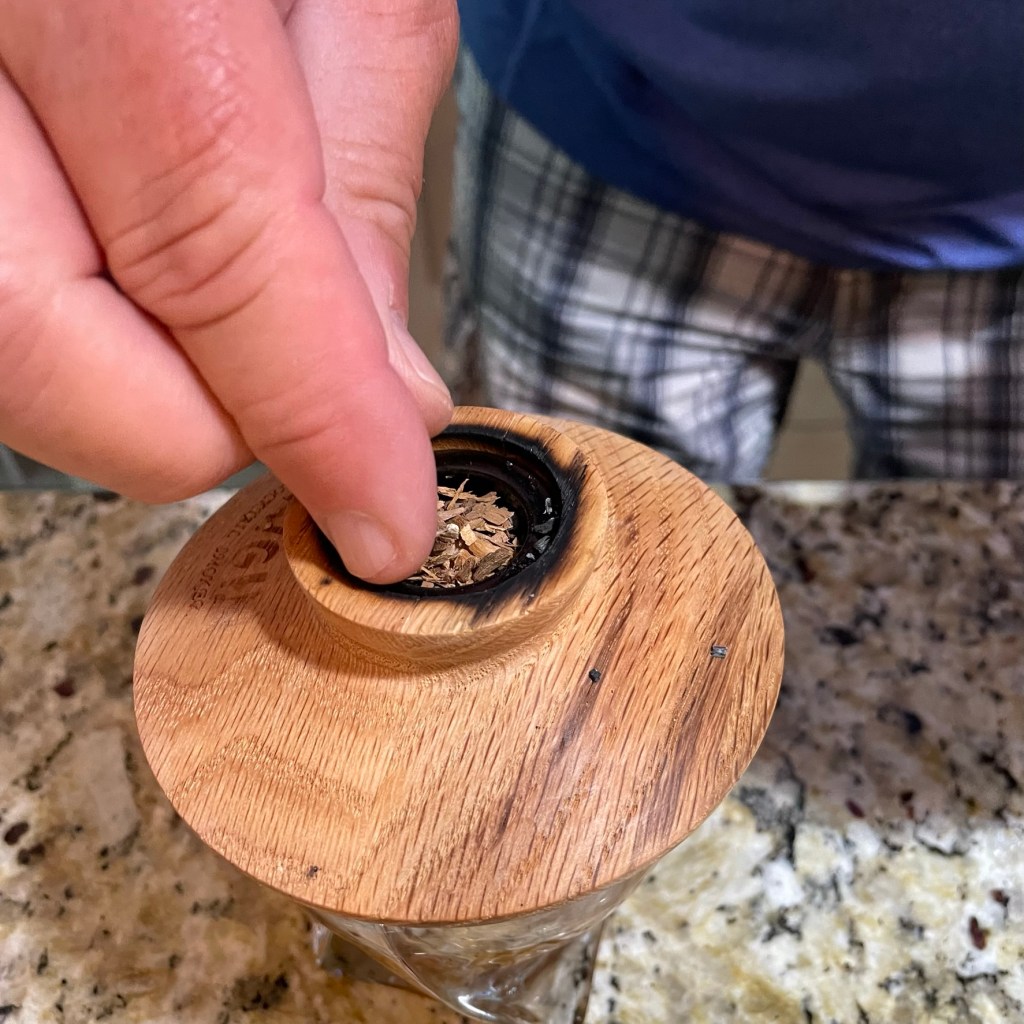
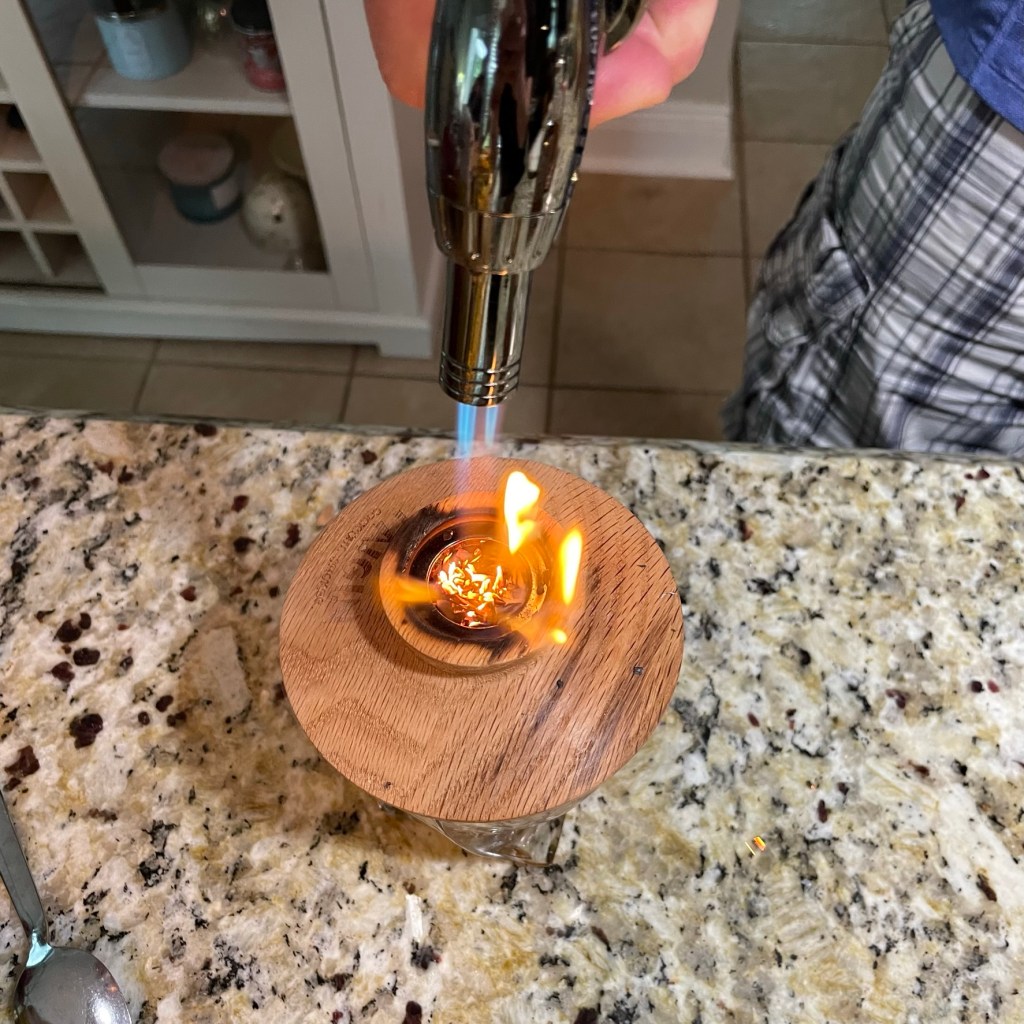
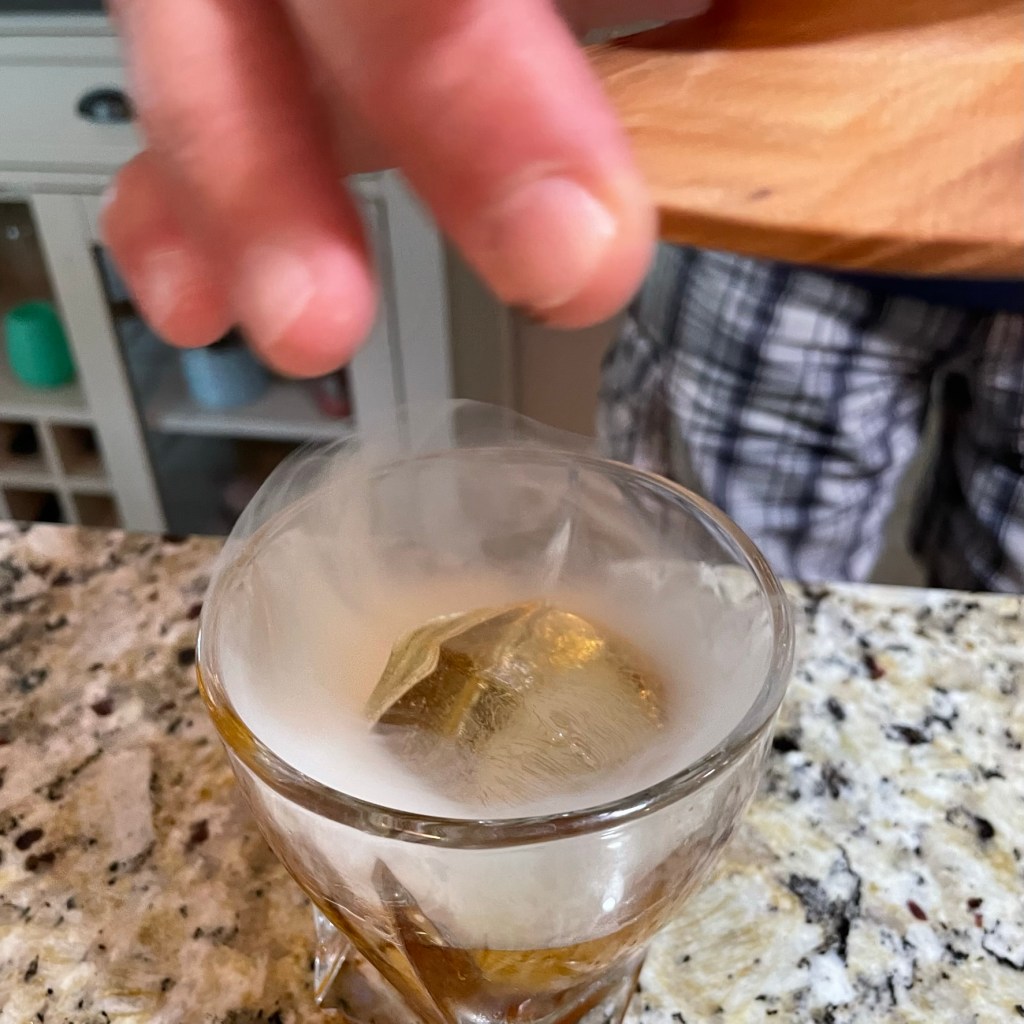
At the end of this post, I will include easy, click-to-print recipe cards for both of these peachy skillet recipes. But first, I must show you what our pal, Bob, was doing to break my baking concentration with his magical cocktail-making abilities. My husband and I always have a wonderful time hanging out with Bob and Peg, and as we waited for the peach bourbon upside-down cake to finish baking, we witnessed a master class in—get this—smoking cocktails. Yes.
This was mesmerizing!
Now, the cocktail itself could not have been simpler. No measuring required, even—it was straight up bourbon over a big-ass ice cube. But that smoke infusion contraption took a nice bourbon into a whole new territory, and you can bet I’ll be getting one of those before I present this year’s signature Halloween cocktail. More to come. 😉
Ready to talk about this other delicious, peachy keen skillet dessert? It’s a cobbler!
Peach Praline Skillet Cobbler
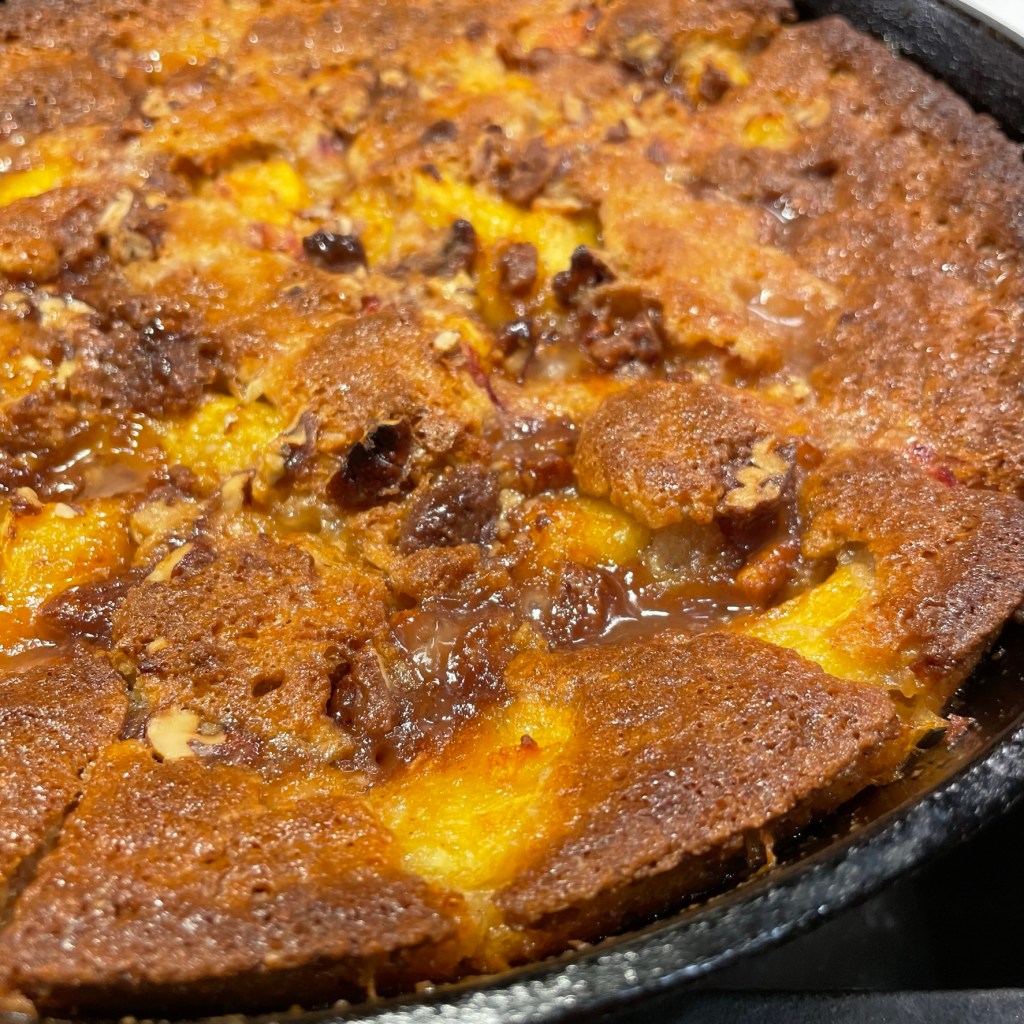
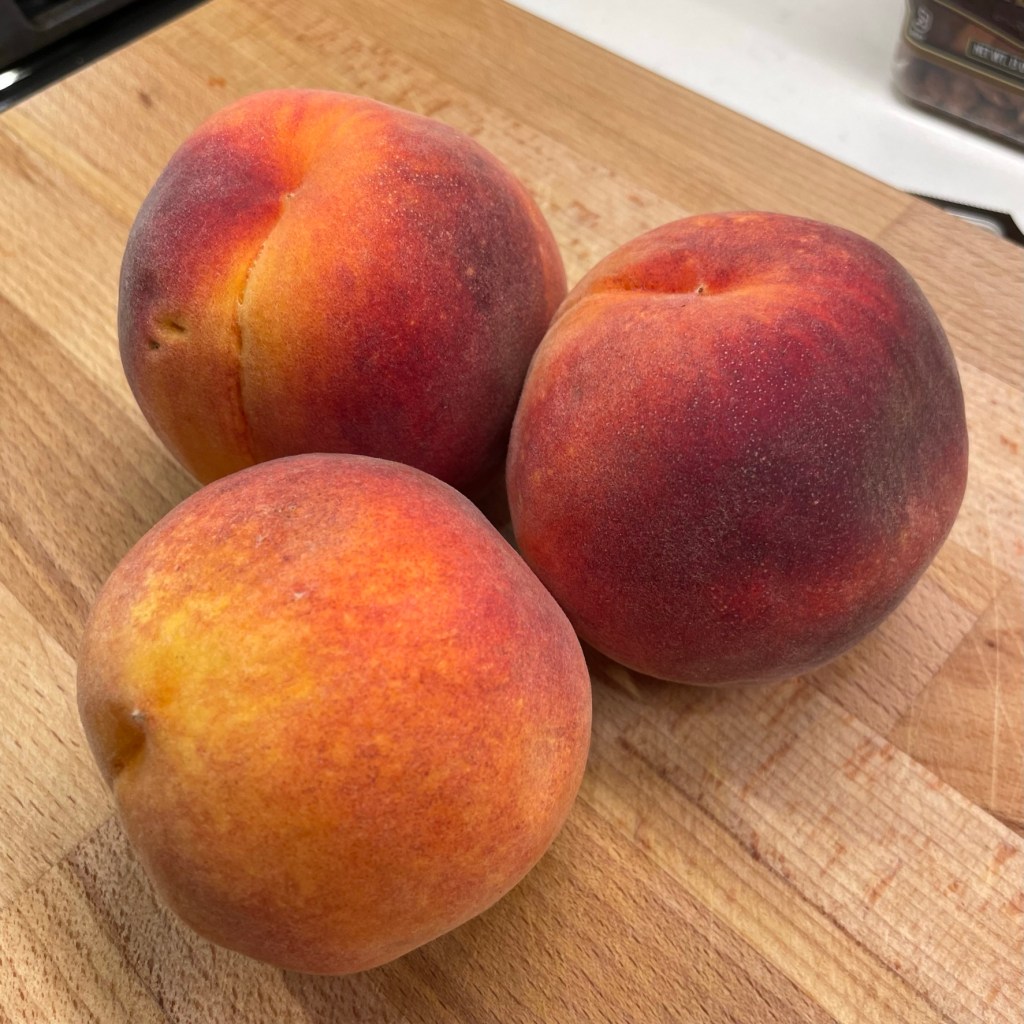
For now, let’s shift gears back to the cast-iron skillet and talk about this ridiculously easy cobbler, which I whipped up in no more than 15 minutes, plus baking. The only time-consuming thing here was peeling and cutting up the peaches, which was hardly a burden, given that I thoroughly enjoyed licking the juices off my fingers when I finished. These particular peaches were gifted to us by our neighbor, Pam, following a day trip she had made to the North Carolina mountains. Pam has followed my adventures on Comfort du Jour from the beginning, and she said upon delivering these perfectly ripe peaches, “I can’t wait to see what you create with these!” Well, here it is—a skillet cobbler!
These peaches were huge and juicy!
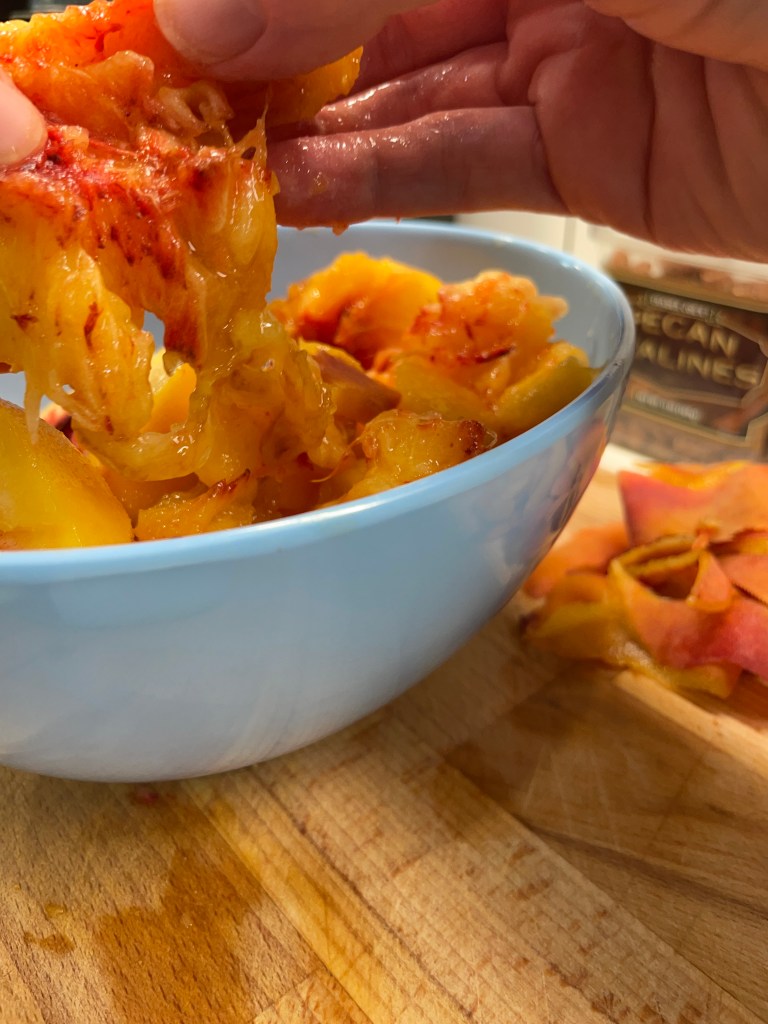
I only used three of the peaches here (they were huge), and that measured about 2 cups, once they were peeled, pitted and cut into bits. In a pinch, I’m sure you could use thawed frozen peaches as well, which means this dessert doesn’t have to be limited to summertime enjoyment.
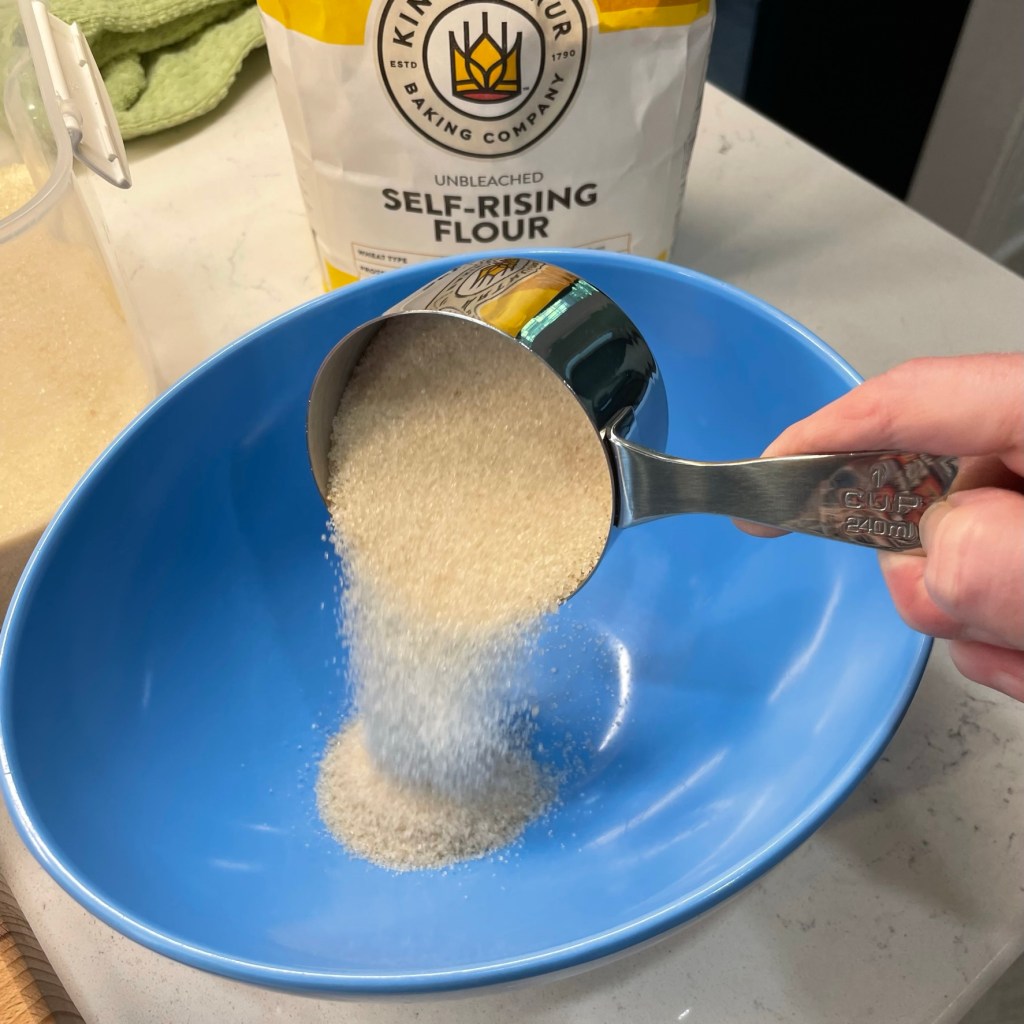
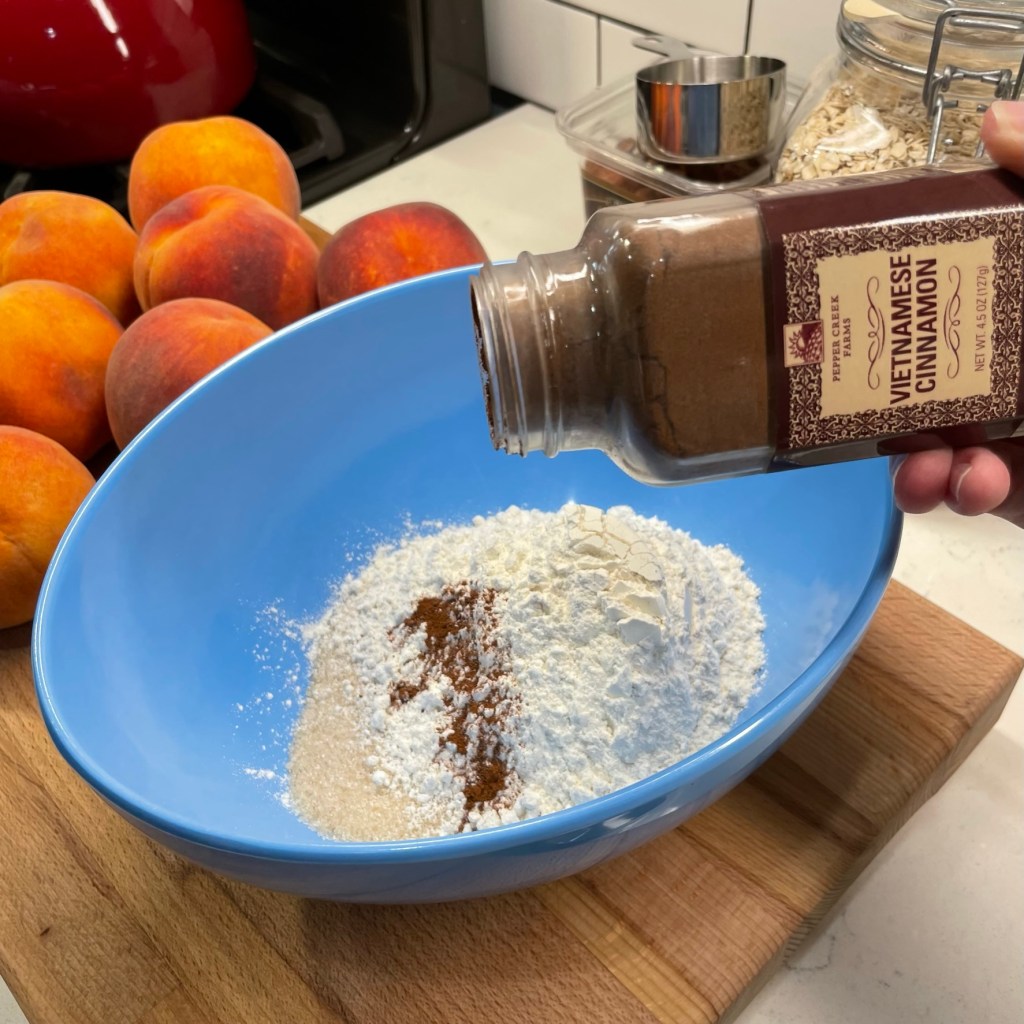
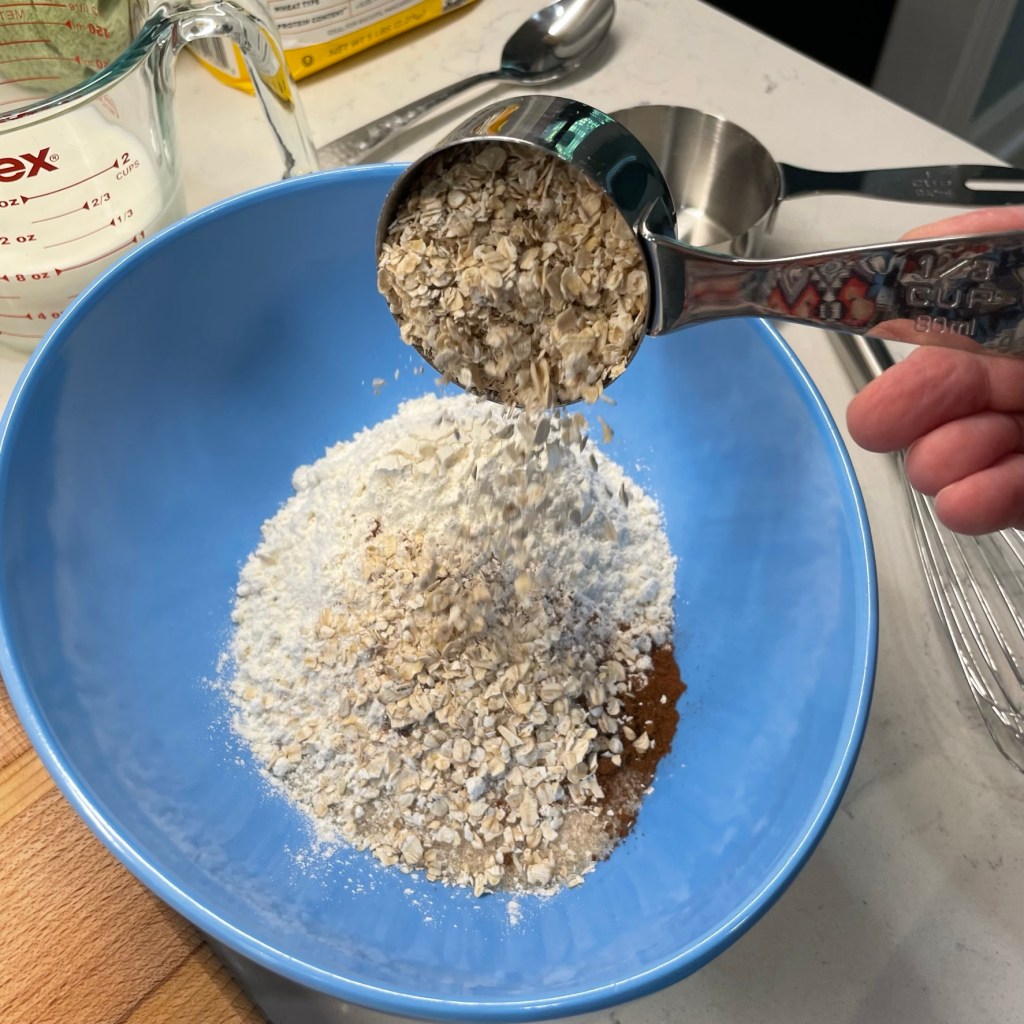
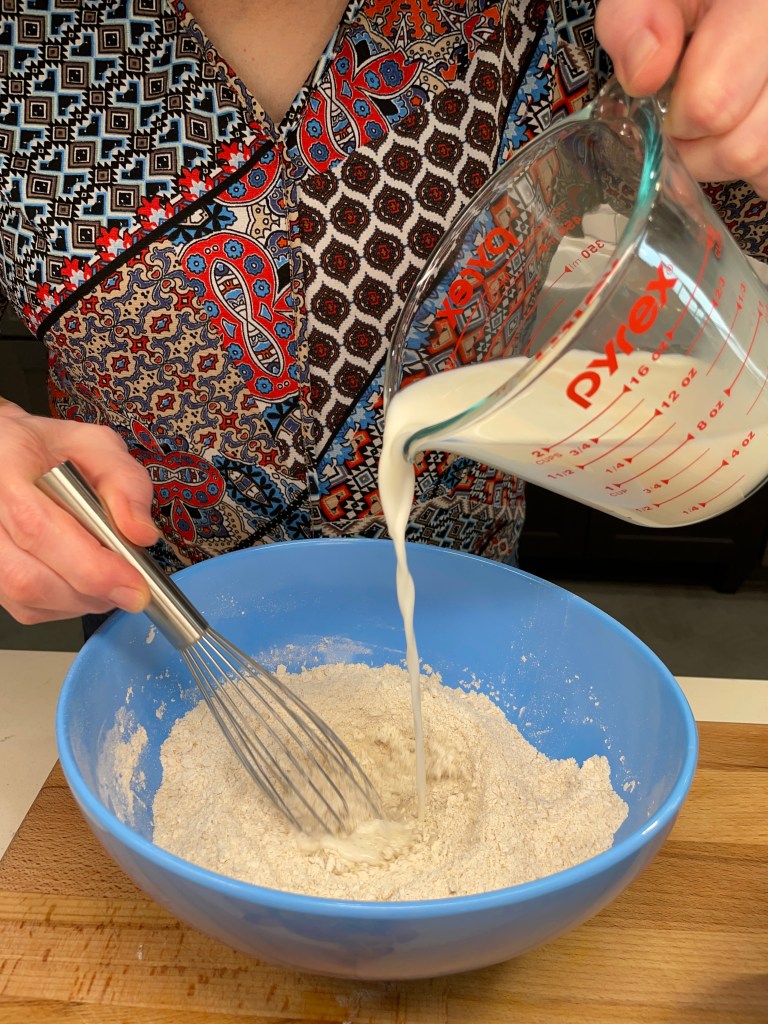
There are several varieties of cobbler out there, and because we roll pretty casual in the South, I skipped over the options that required making biscuits or pastry dough and steered directly to the “batter” option. This is a dessert that seems incorrect, because the batter is quite runny, and it’s hard to visualize how it will come together in the oven (but it does). The batter is made with self-rising flour, sugar, cinnamon and milk—that’s it. Me being me, though, I had to incorporate some amount of whole grain into it, so for this batch, I also stirred in 1/3 cup of quick-cooking oats and that turned out to be a great decision. Unlike a typical cobbler with juicy, almost soupy consistency, this one held together more like a custard because the oats plumped up inside the cobbler. I would not recommend increasing the oats because it might turn out gummy, and I am sure that quick oats is the way to go. Old fashioned, rolled oats may not cook through as tender, or they may absorb too much of the liquid in the batter.
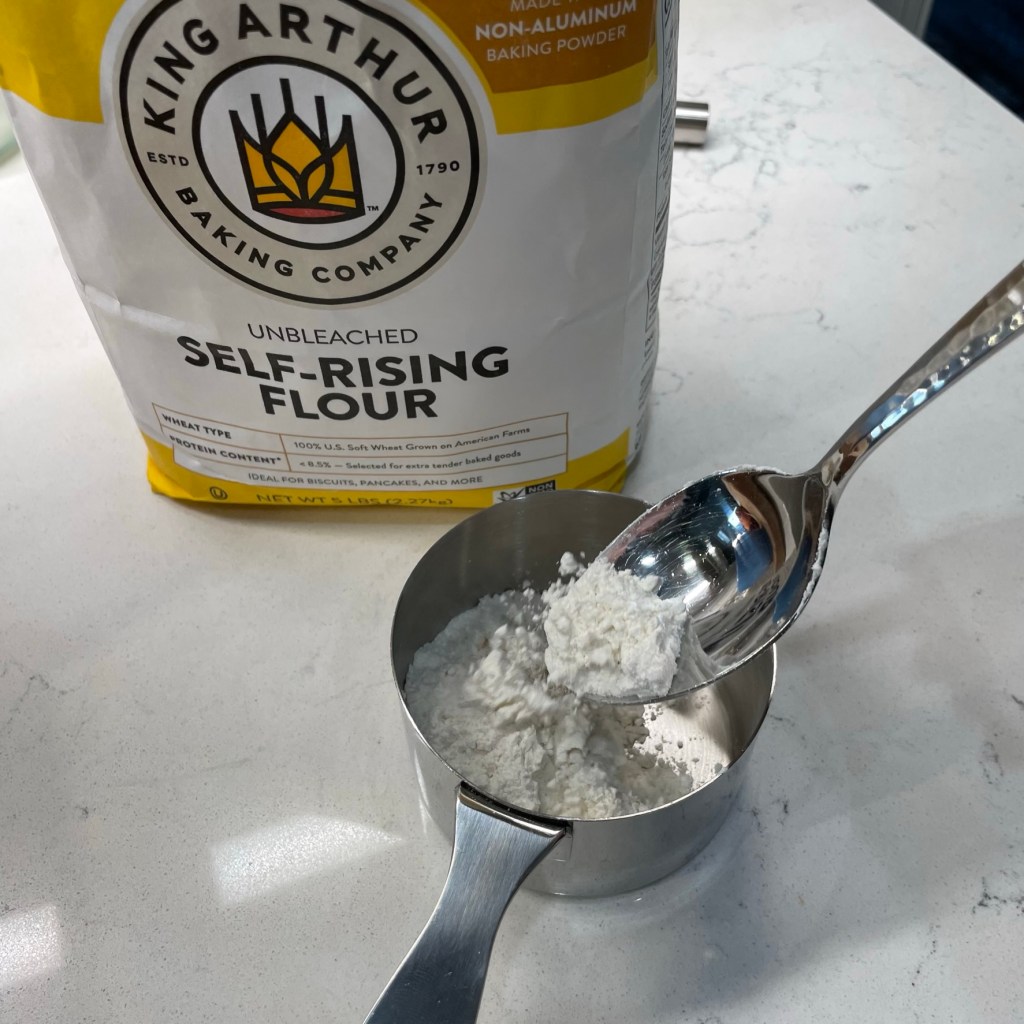
Be sure to measure your flour correctly, using the “fluff, sprinkle, level” method.
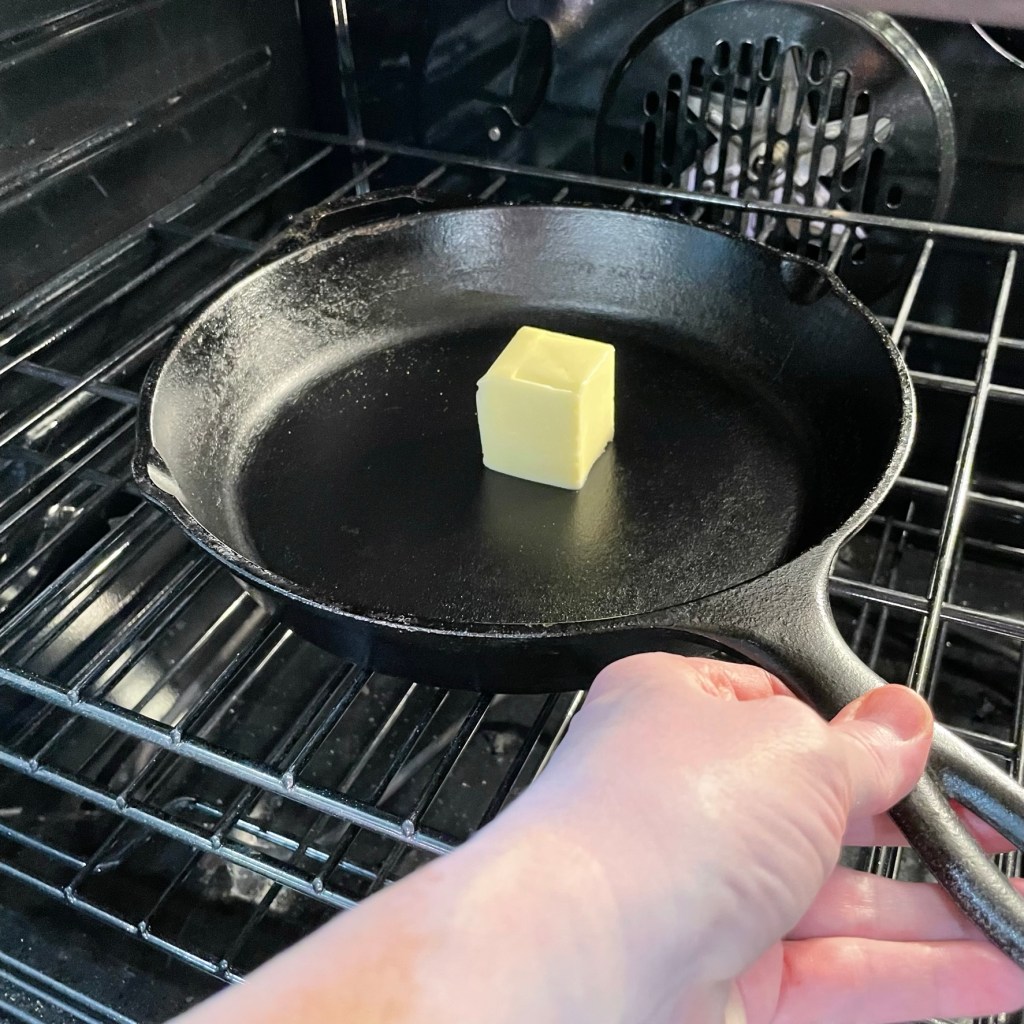
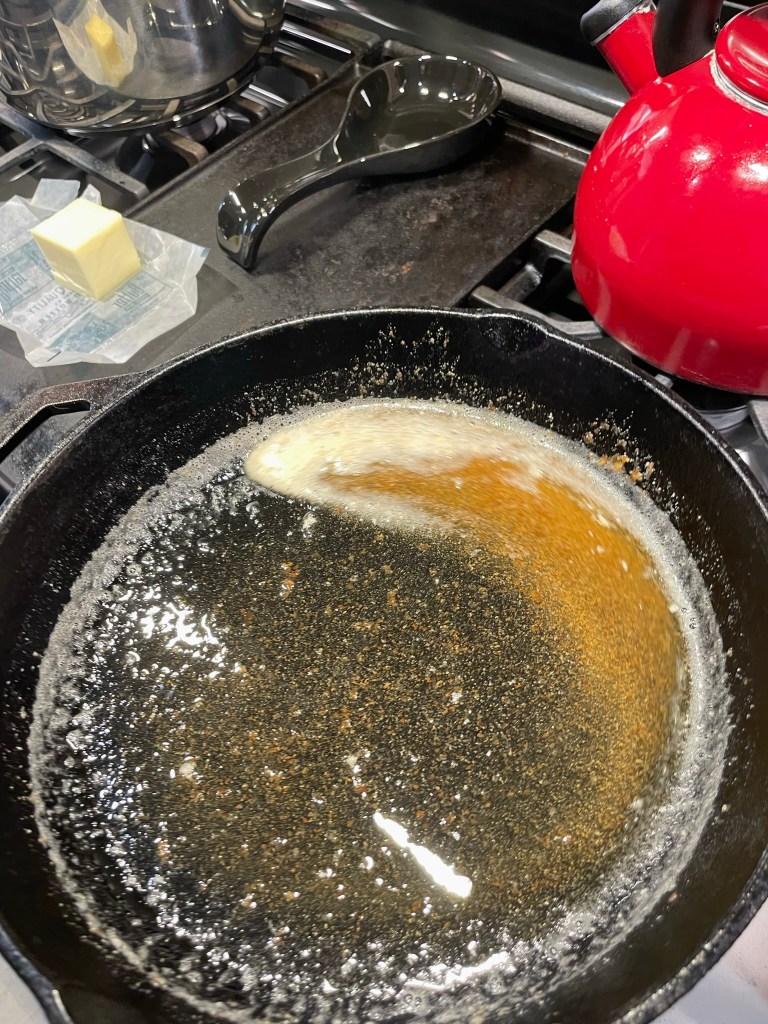
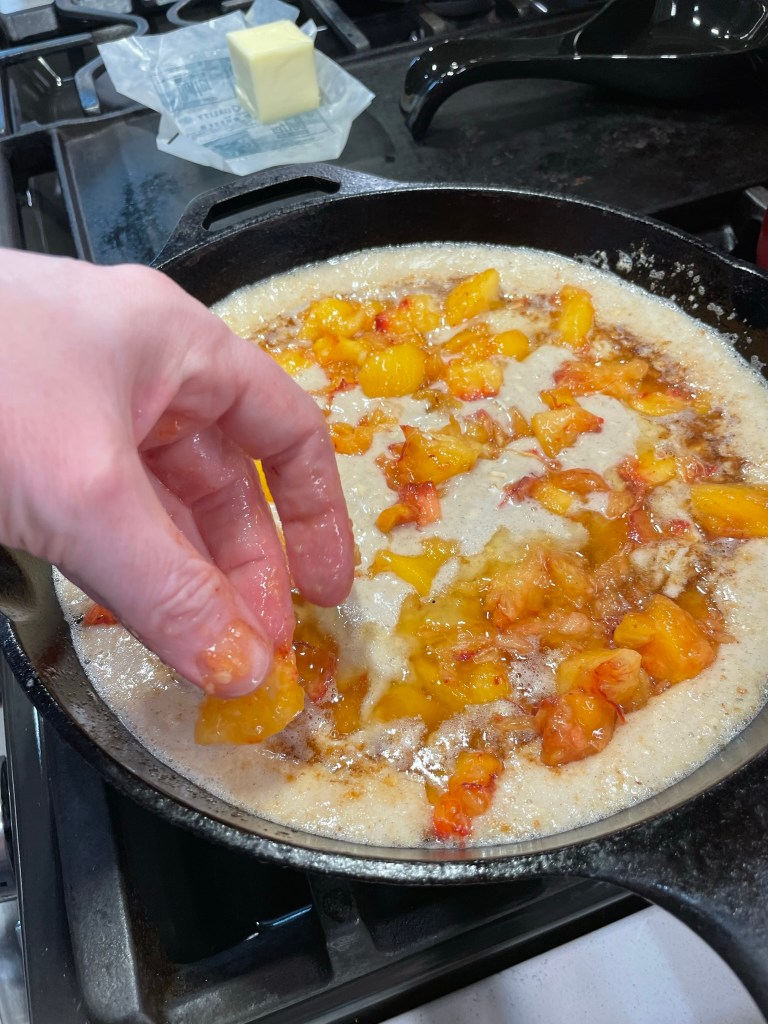
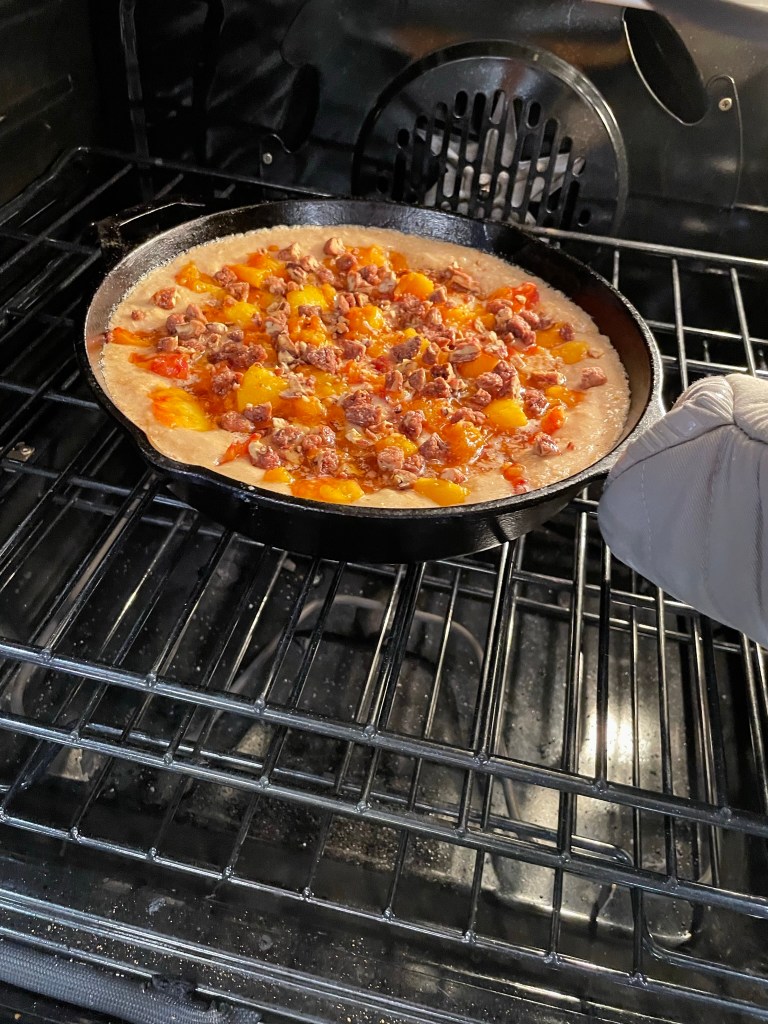
While I measured and mixed those ingredients, I pre-heated the oven with a half stick of butter in it, and then swirled the browned butter around to fully coat the pan once the oven was hot. The batter is slowly poured into the hot buttered skillet, and then the peaches are arranged (if you want to call it that) all over the top. Typically, a cobbler is sprinkled lightly with sugar before it’s baked, but I can’t stick with typical, so I chopped up some pecan pralines (from Trader Joe’s, but anything similar will work) and scattered those on top instead.
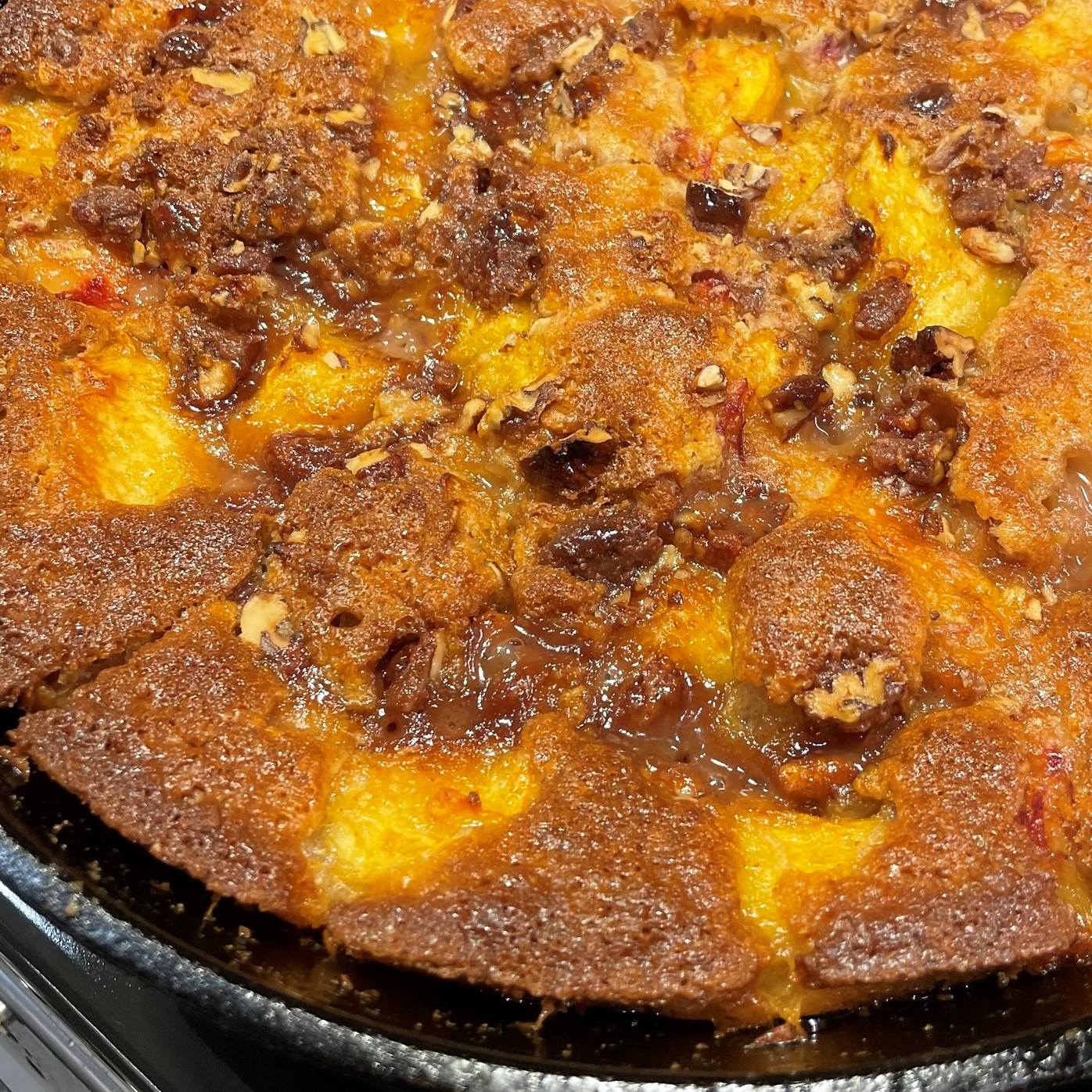
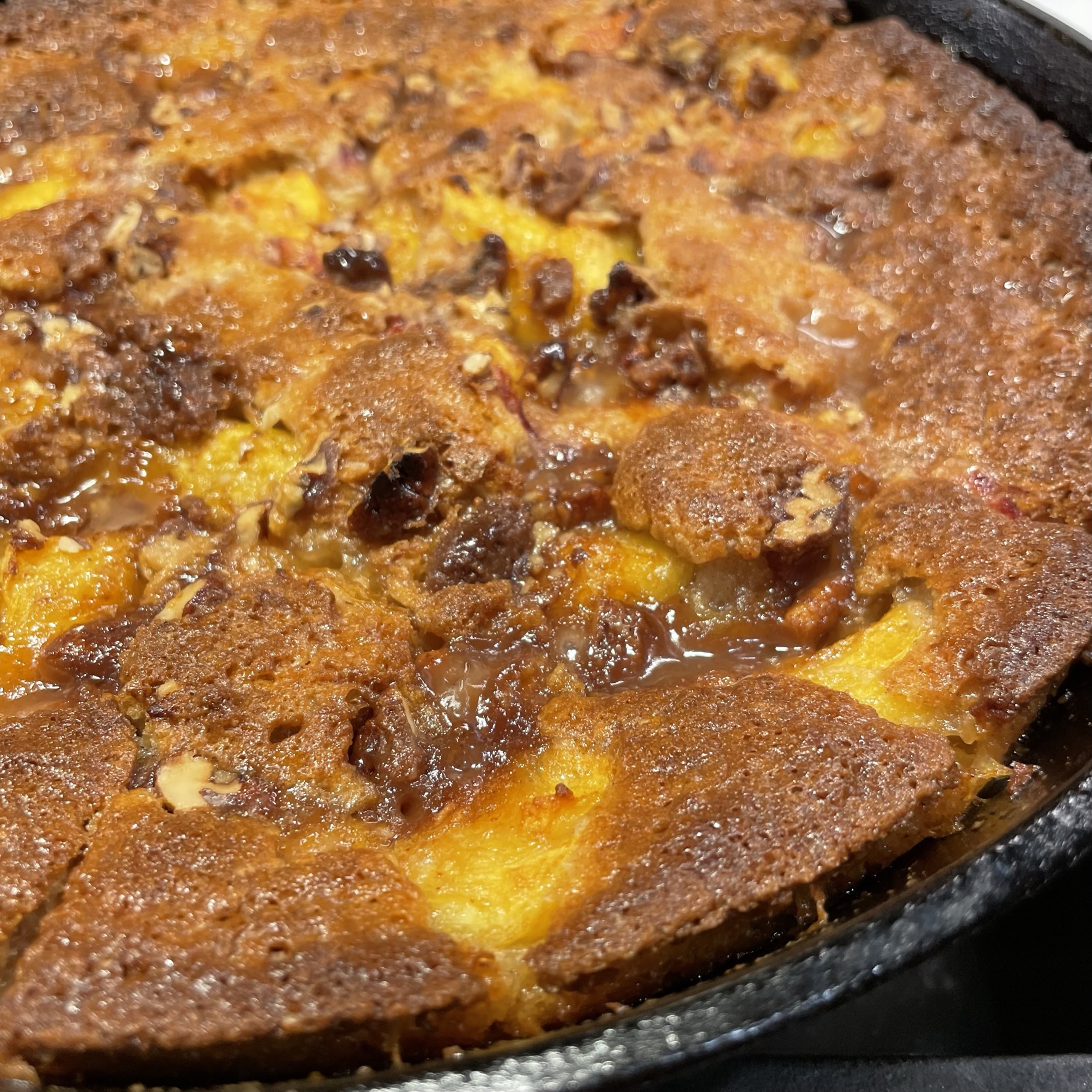
Isn’t this just peachy? 🙂
As I said, you can’t go wrong with either of these peachy keen skillet desserts, so grab your cast iron and peel those peaches and enjoy what’s left of summer.
This beautiful skillet dessert makes the most of fresh, late-summer peaches, and bourbon marries nicely into the “upside-down” as cornmeal brings texture to every bite.
Ingredients
1/2 stick salted butter (for the upside-down)
1/2 cup brown sugar
1/4 cup cane sugar
1 shot bourbon (optional, but heck yes)
4 medium fresh peaches, sliced with peel
1 cup all-purpose flour
1/2 cup medium grind cornmeal
1/4 cup toasted pecan pieces (optional)
1 tsp. baking powder
1/2 tsp. baking soda
1/2 tsp. salt
1/2 tsp. ground cinnamon
1 stick unsalted butter, softened (for batter)
3/4 cup cane sugar (for batter)
2 large eggs
1 tsp. vanilla extract
1 cup buttermilk, shaken well
Whipped cream for serving
Directions
Preheat the oven to 375° F, with oven rack in the center position.
Place a 10″ cast iron skillet over medium heat. Heat first amount of butter until melted. Add brown and cane sugars and stir to combine. Let them mingle over the heat until the mixture looks dissolved and begins to bubble. Add the bourbon (if using) and stir to blend. Reduce heat to low and arrange peach slices in a round pattern over the syrupy bourbon mixture. Set aside while you prepare the batter.
Combine flour and cornmeal in a medium bowl. Add pecans, baking powder, soda, salt and cinnamon. Set aside for later addition to the batter.
Using a handheld mixer, cream together the remaining sugar with the stick of unsalted butter. Beat this mixture until it’s lighter and fluffier in texture. Add eggs, one at a time, beating completely to blend. Beat in vanilla.
Use a rubber spatula to fold about half of the flour mixture into the batter, blending until all dry ingredients are incorporated. Gently mix the buttermilk into the batter, and then fold the remaining flour mixture, again blending until no dry spots of flour are visible.
Pour the batter over the peaches in the skillet, taking care not to disturb the arrangement. Gently smooth the batter, and slide the skillet into the oven.
Bake for 50 to 55 minutes, until baked batter has pulled away from the edges of the skillet and the cake portion tests clean when a toothpick is inserted into the center.
Cool 15 minutes before loosening the cake around the edges. Carefully invert the cake onto a large platter. If any bits of peach get stuck to the skillet, place them back into place and smooth the upside-down caramel coating while it’s still warm.
Slice into wedges when cooled and serve with a dollop of whipped cream or ice cream. Wrap leftovers in plastic and keep in the fridge.
This recipe is easy as can be, and a bit of quick-cooking oats mixed into the batter gives the cobbler a touch of whole grain goodness and a wonderful texture.
Ingredients
1/2 stick unsalted butter (4 Tbsp.)
3/4 cup cane sugar
1 cup self-rising flour (see ingredient note below)
1/3 cup quick-cooking oats
1/4 to 1/2 tsp. ground cinnamon
1 cup whole milk
About 3 large peaches, or enough to measure 2 heaping cups (peel and chop)
1/2 cup candied pecans, roughly chopped (I used Trader Joe’s pecan pralines)
Note: self-rising flour already has the proper ratio of leavening agent; if you do not have self-rising flour, use regular all-purpose flour and add to it 1 1/2 tsp. baking powder and 1/4 tsp. salt
Directions
Preheat oven to 400° F, with oven rack in center position. Place cold butter in a 10-inch cast iron skillet and put it in the oven during preheating. Keep an eye on it so that the butter does not burn.
Whisk together the self-rising flour, sugar, oats and cinnamon. Add the milk to the dry ingredients and whisk until combined, and no pockets of unincorporated dry ingredients remain. The batter will be quite runny.
Remove hot skillet from the oven and swirl the pan to evenly coat with the melted butter. Slowly pour the batter right into the center of the pan. The butter will naturally scoot out to the edges of the pan, and that’s OK. It may also seem to foam a bit at the edges, which is normal.
Top the batter filling evenly with the peach chunks. Scatter the chopped candied pecans over the top. Bake 40 to 45 minutes, until the cobbler is golden brown and bubbly in spots. Serve warm with a scoop of vanilla ice cream.
There were a few big things I had to get used to when I moved to North Carolina from my childhood home in upstate New York. The weather, of course, was wildly different—we have at least eight months of warmth and sunshine each year, compared to seven months of snow and slush and gray that were my normal. People in the South tend to be friendlier (there are exceptions, naturally) and there is a sense of hospitality that I had not experienced before I moved here. It didn’t take long for me to fall in love with the place.
Folks ‘round here invite you to drop by anytime, “sit a spell” and enjoy some tea. The first time someone welcomed me this way, I thought it odd that they would serve tea on a hot August afternoon. But that’s because, where I grew up, tea was a beverage served hot, with the paper tab of a teabag draped over the edge of a dainty cup, and a lemon wedge or tiny cup of milk served on the side.
Not so in the South, where “tea” is sweetened with sugar (white or brown, depending on the whims of the hostess), freshly brewed and poured over ice in a tall glass, best enjoyed on the front porch while listening to the hum of cicadas (which we have every summer in North Carolina). Lemon is optional, gossip is welcomed. Sweet tea is, as Dolly Parton’s character declared in Steel Magnolias, “the house wine of the South.”
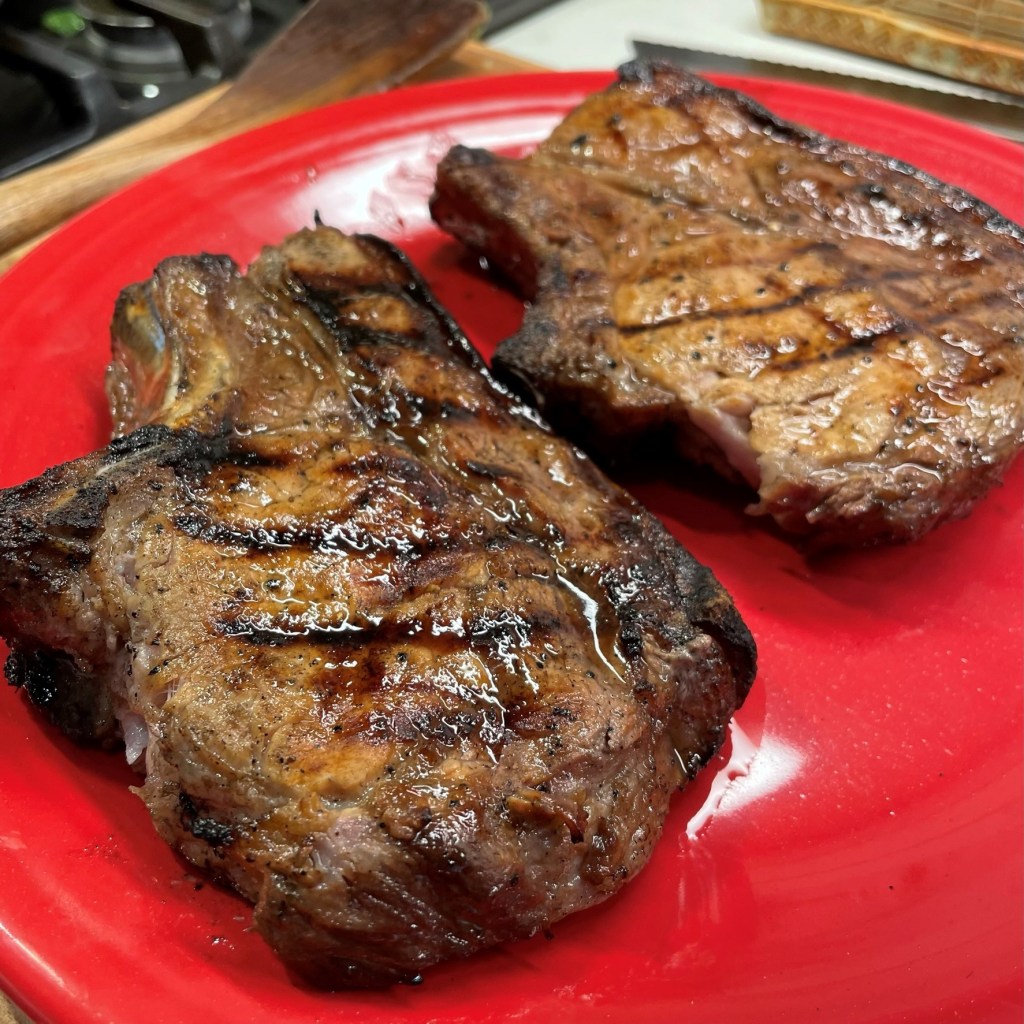
Though my Yankee-born taste buds do not appreciate the level of sweetness in southern sweet tea, I respect its place in the culture and I enjoy giving it a starring role in my kitchen. The polyphenols in tea are said to provide a wide range of health benefits, and beyond that, I knew that black pekoe tea would be acidic enough to help tenderize the beautiful pork chops I picked up at our local butcher shop. The flavor of these chops after brining and grilling was, how shall I say? Freaking awesome, that’s what. They were tender and juicy, flavorful with a subtle sweetness.
Lord, yes, this sweet tea brine was delicious!
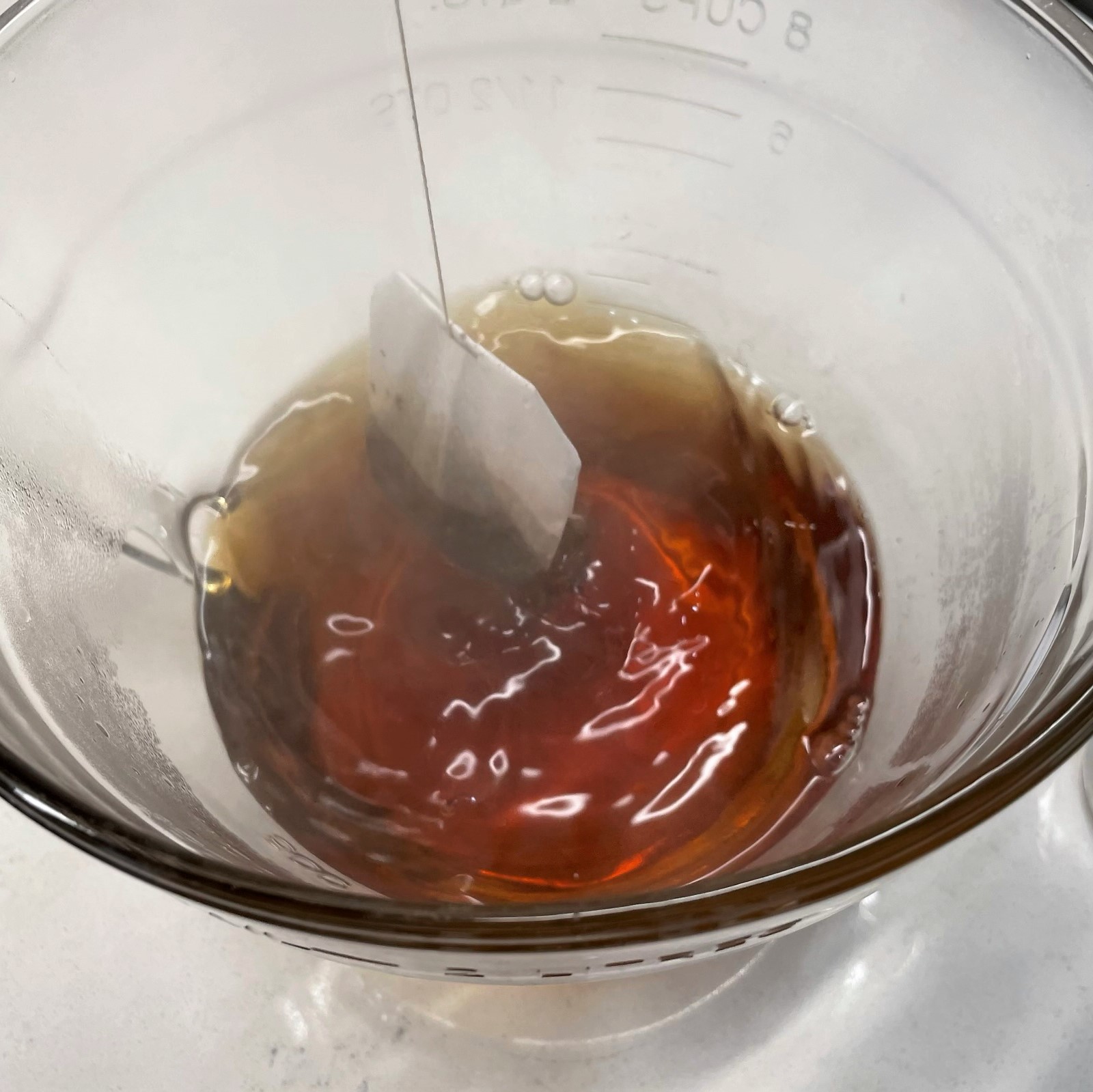
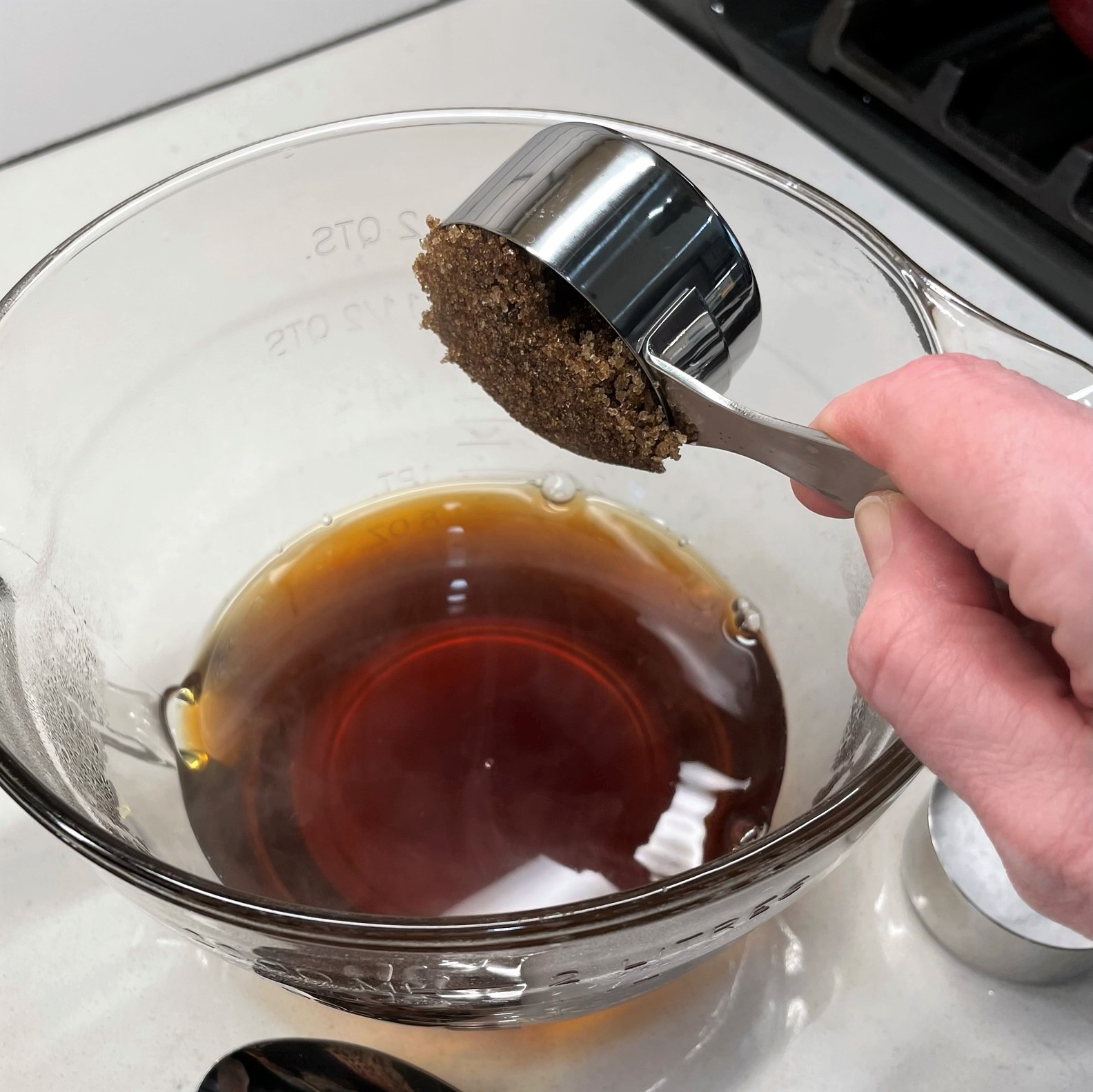
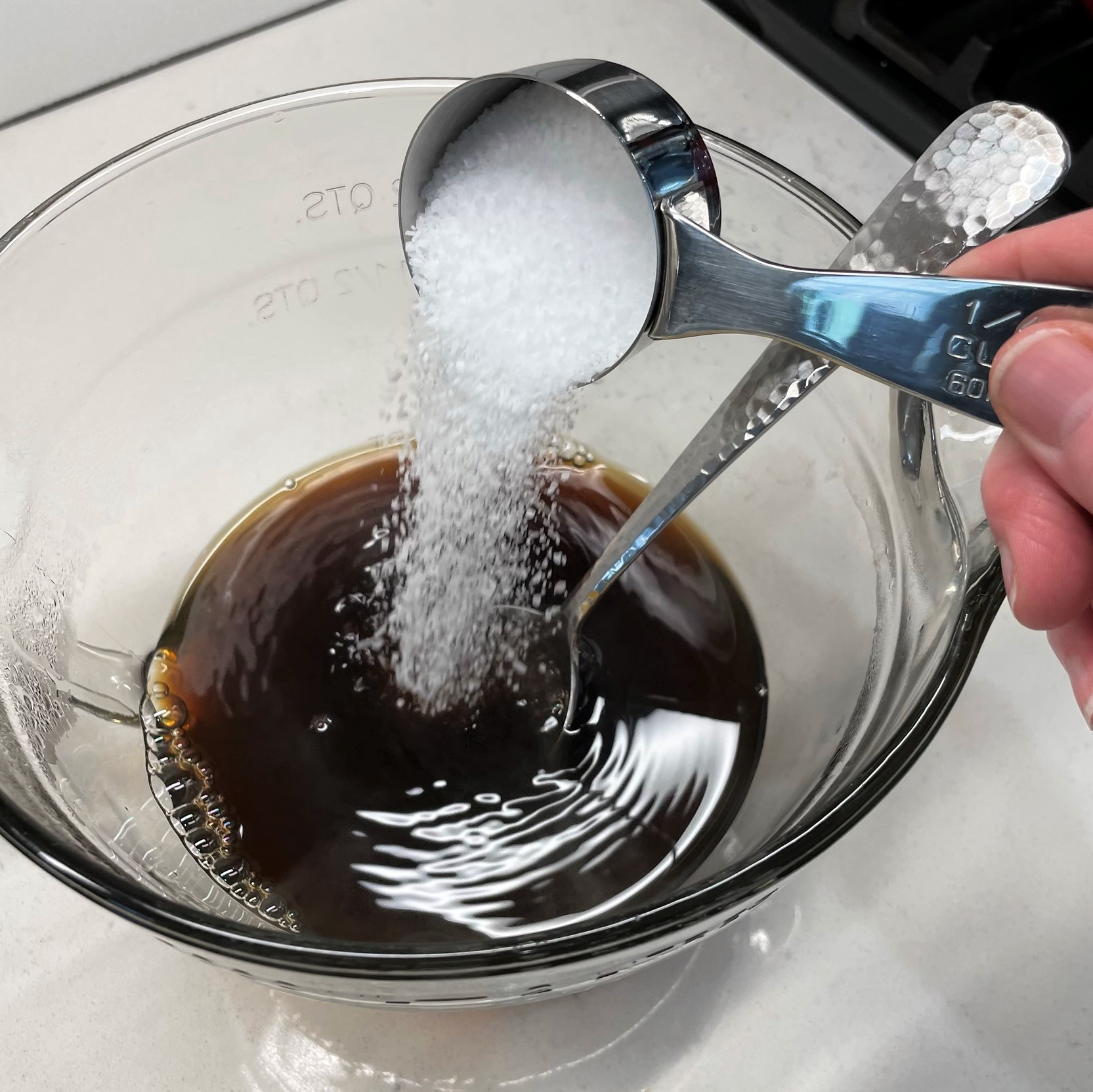
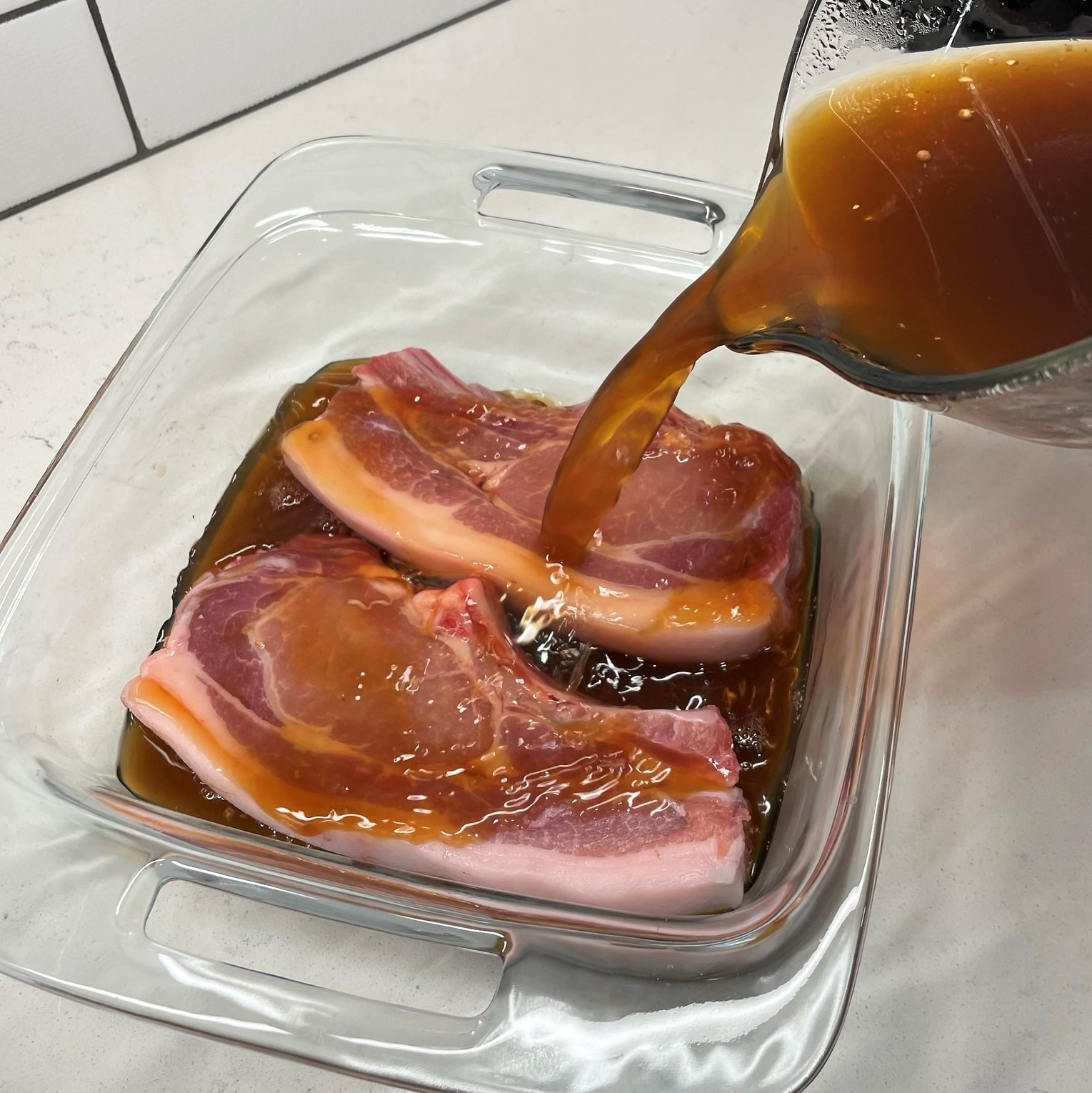
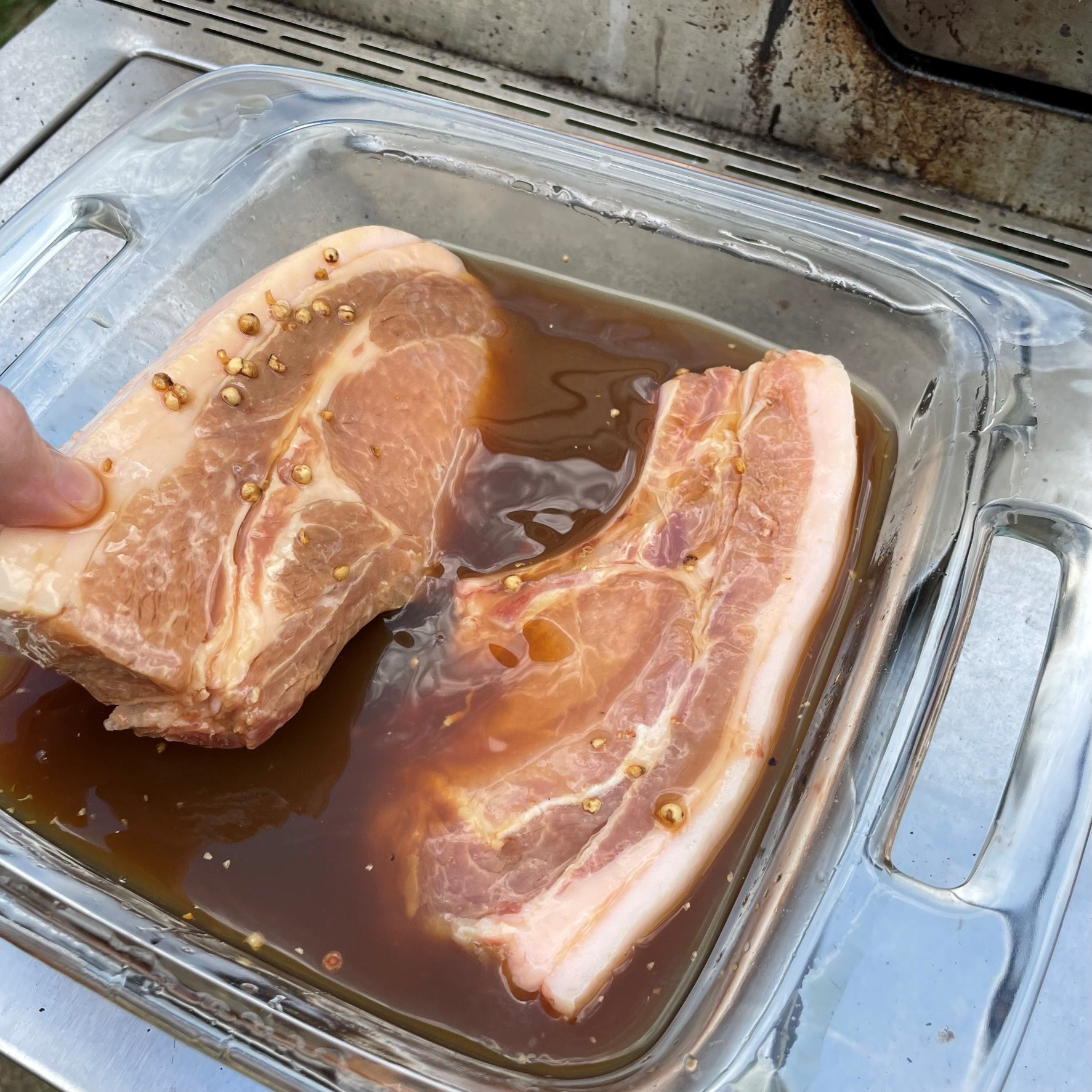
Any recipe involving a brine requires some advance prep, so if you decide to make these, start in the morning. One of the critical rules of brining is to never pour a warm brine over raw meat. I brewed the tea late that morning, following a typical “southern” ratio of tea-to-water and sugar, then I flavored it up with kosher salt (necessary for any brine), white peppercorns and a very generous squeeze of fresh lemon juice. After a three-hour cooldown, I poured the brine over my chops and refrigerated them for several hours before grilling.
Steep the tea in boiling water for only five minutes, or you risk a bitter flavor.Southern sweet tea is often made with brown sugar, and that’s what I’ve used here. Stir until it’s completely dissolved.Do the same with the kosher salt. Remember, we aren’t drinking this sweet tea, we’re brining with it! 😉I used white peppercorn for a bigger punch of flavor, but you can use black peppercorns if that’s what you have on hand.Sweet tea deserves fresh lemon, and I squeezed half a large one right into the brine. Cool then chill it for a few hours before adding it to the chops.Place the chops in a dish large enough to hold them and the entire brine mixture. Pour the chilled brine over the chops and turn them to ensure even exposure.
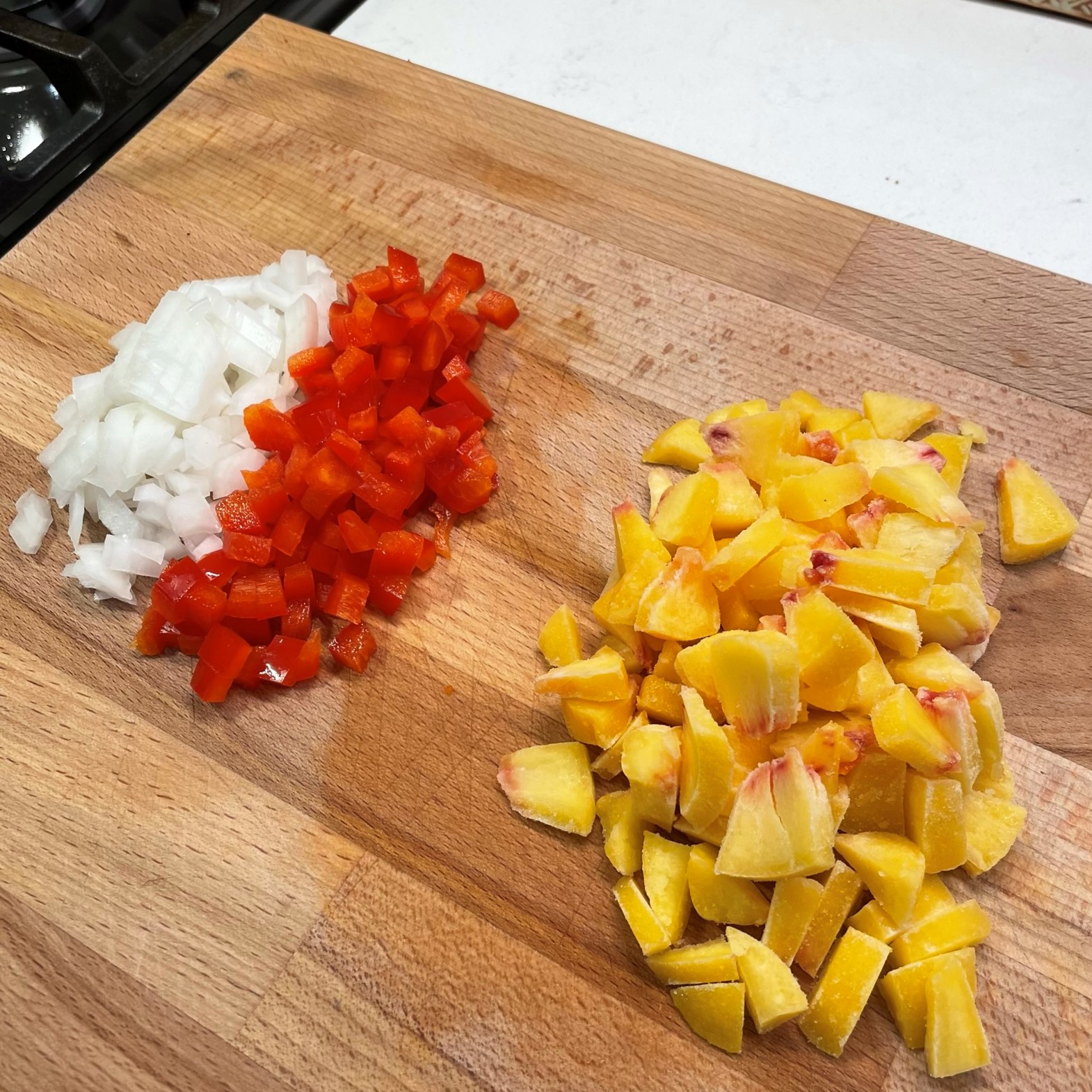
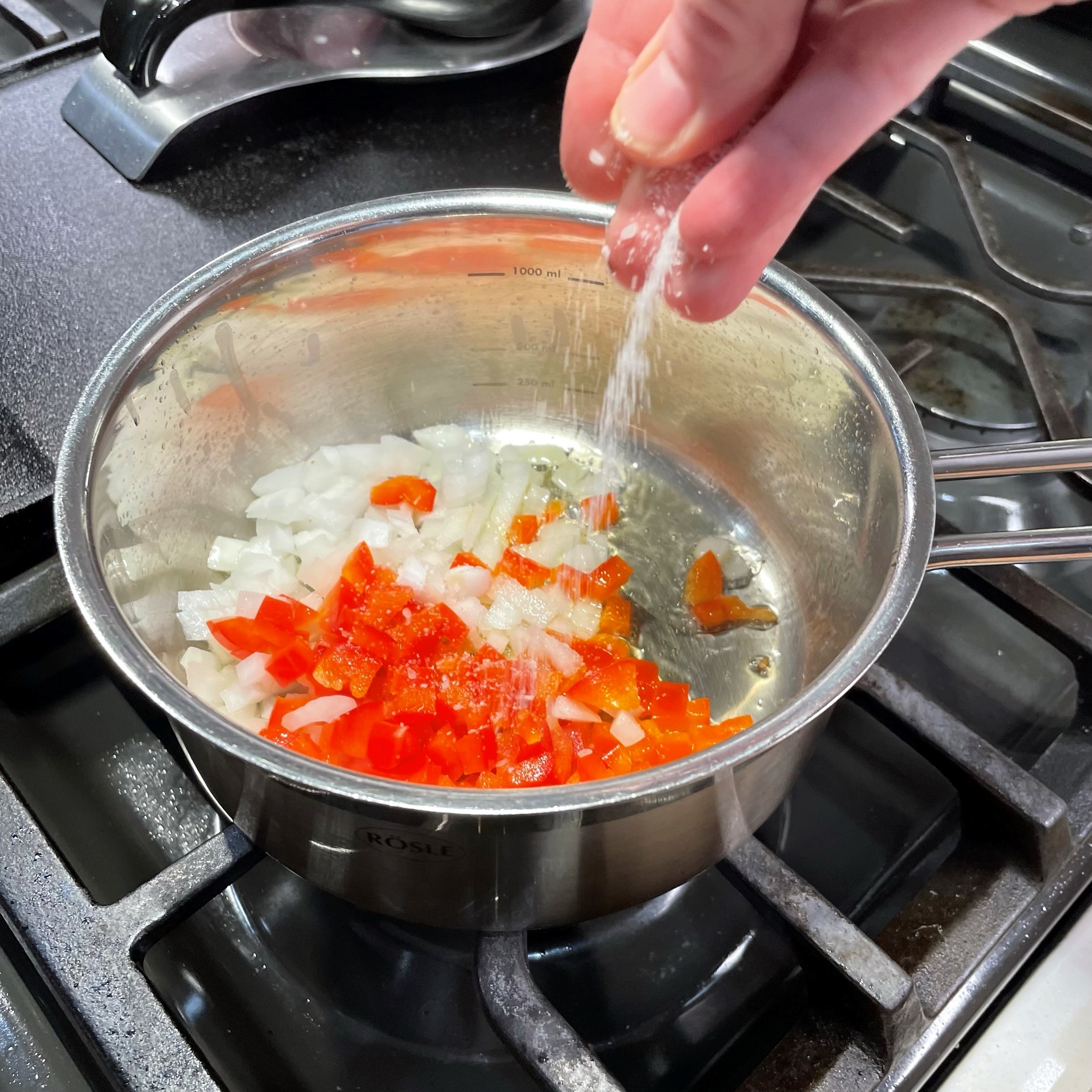
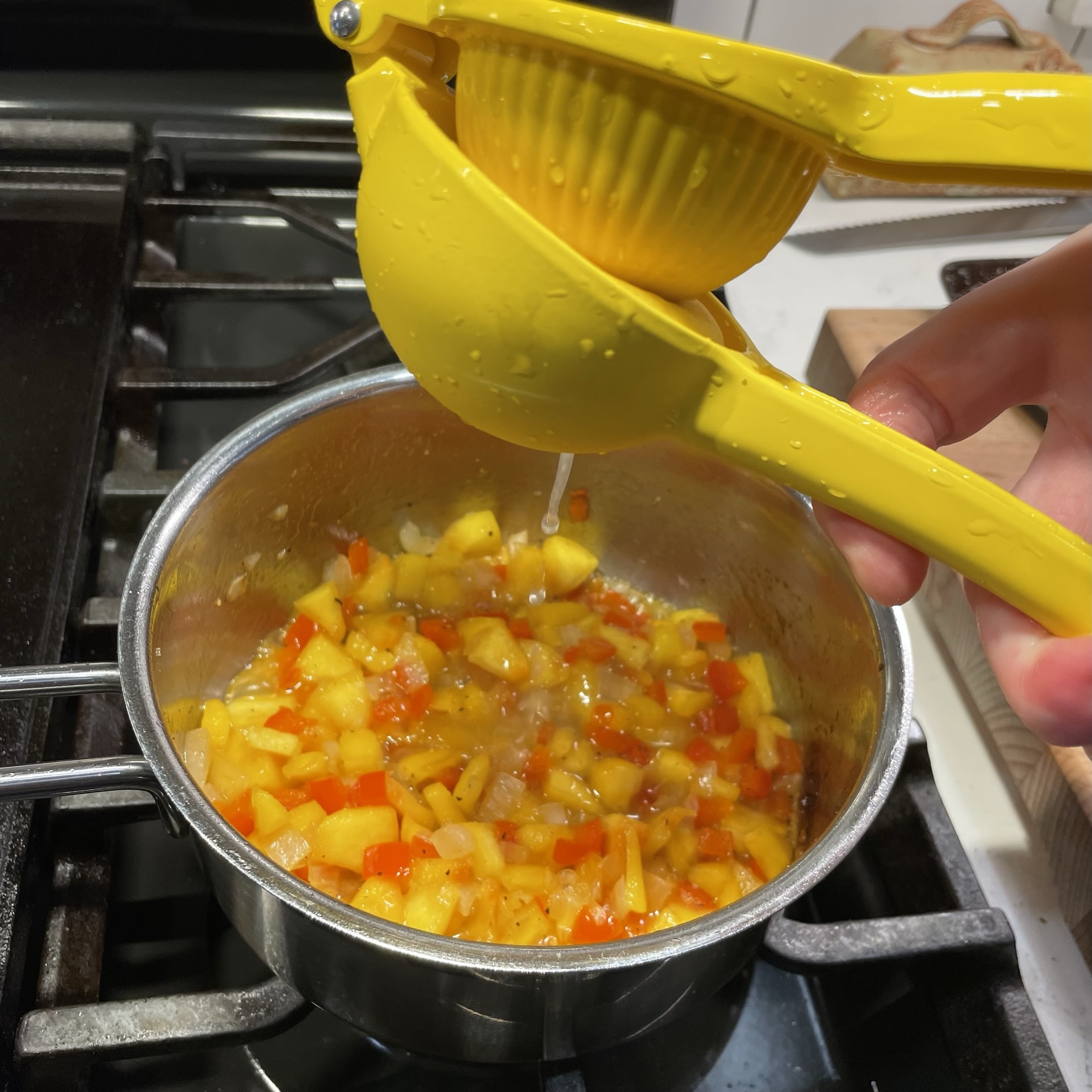
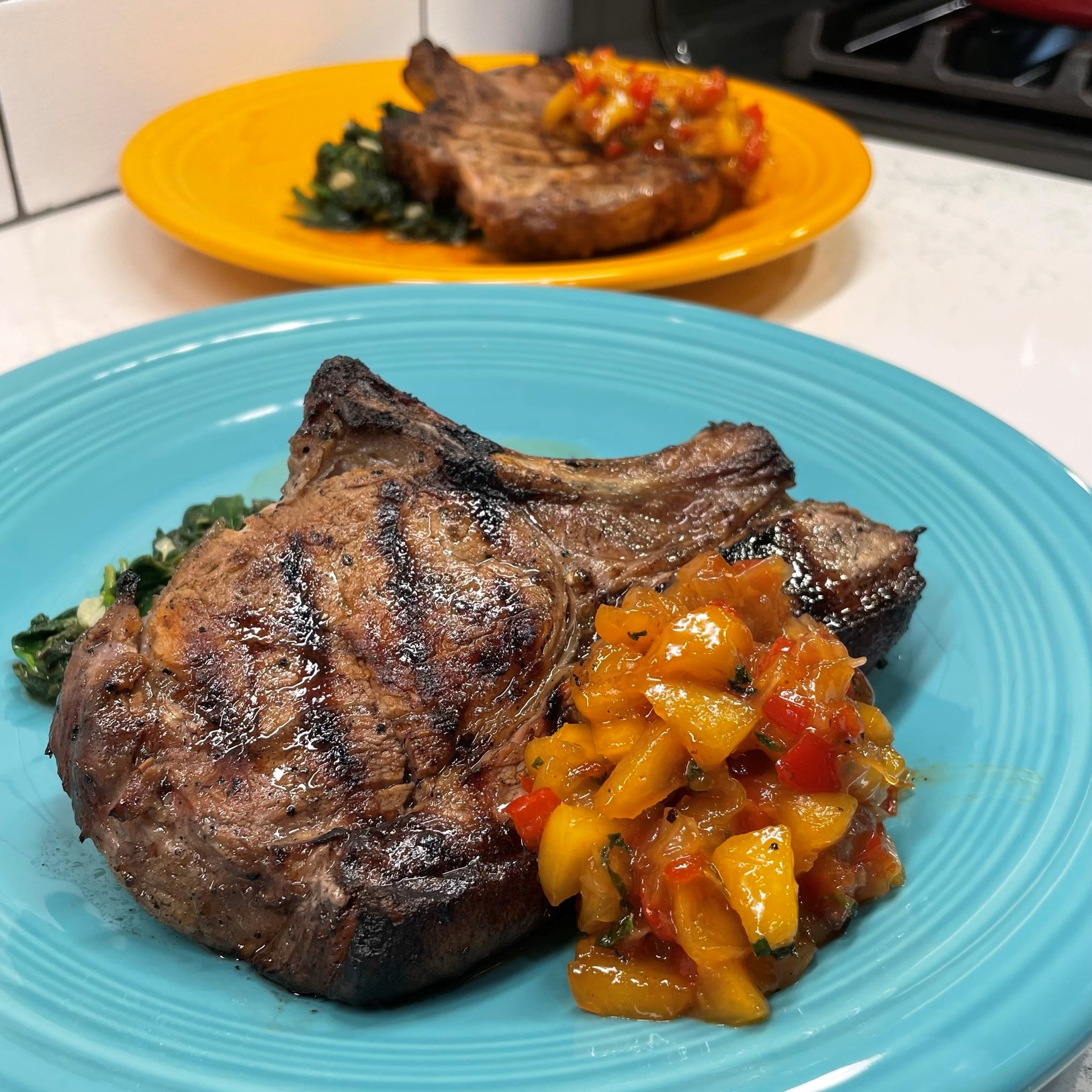
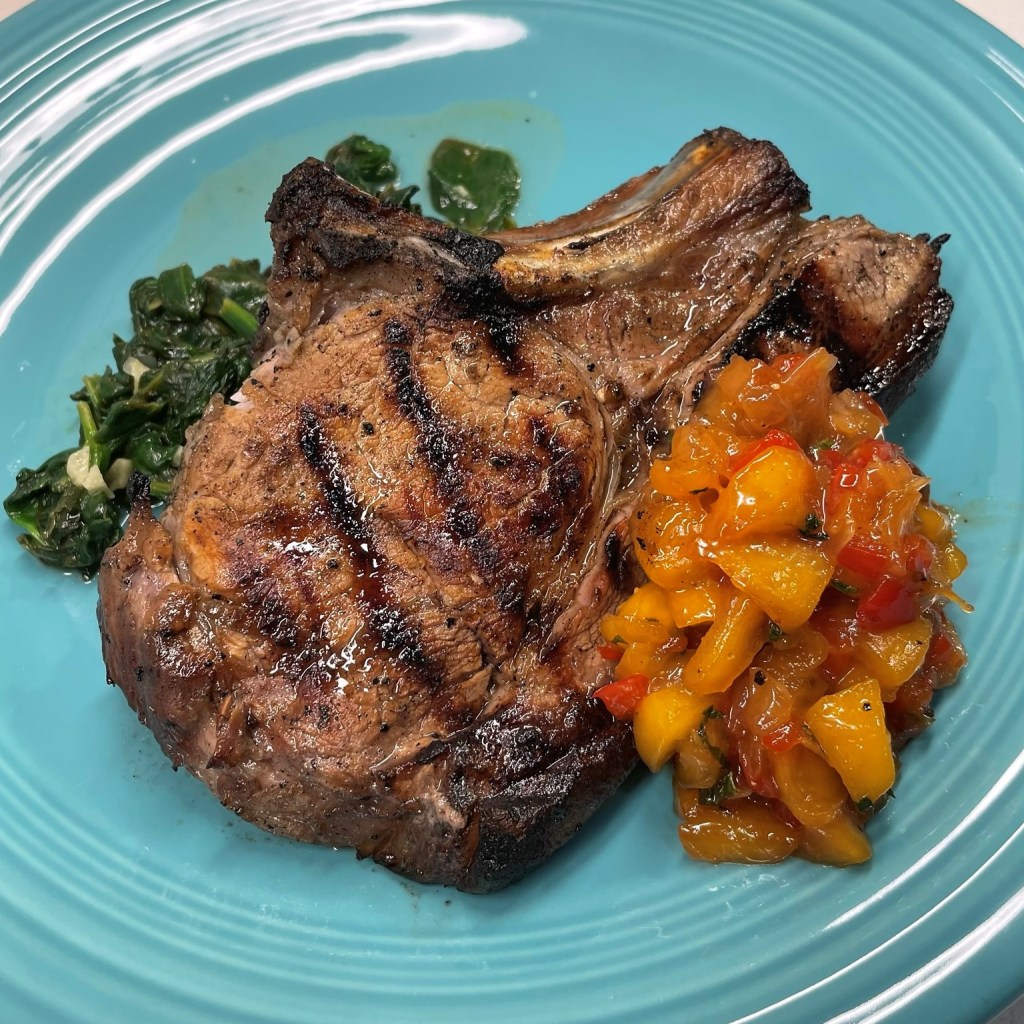
Chops this flavorful needed a strong accompaniment, and I paired them with a sweet-meets-savory chutney, giving two more southern specialties—peaches and Vidalia onions—supporting roles on our plates. As with any chutney, I sauteed the onions first with a handful of sweet red bell pepper, then I added peaches (frozen was my best option this time of year), a bit of brown sugar and fresh lemon juice, a tiny bit of zippy horseradish and a few leaves of fresh mint at the end to brighten it all up.
Chutney is a balance of sweet, tart and savory ingredients. Mine will have red bell pepper, sweet Vidalia onions and peaches. Frozen is fine.Start by sauteeing the onions and peppers, and remember to season every layer! Salt draws out some of the moisture in the vegetables, intensifying their flavors.Add the peaches and stir in the brown sugar.A tiny bit of zesty horseradish gives my peach chutney a gentle kick.Squeeze half a large lemon into the chutney, then stir and simmer until it is bubbly and thickened.Turn off the heat and sprinkle the mint into the chutney. Serve immediately or refrigerate if cooking ahead.
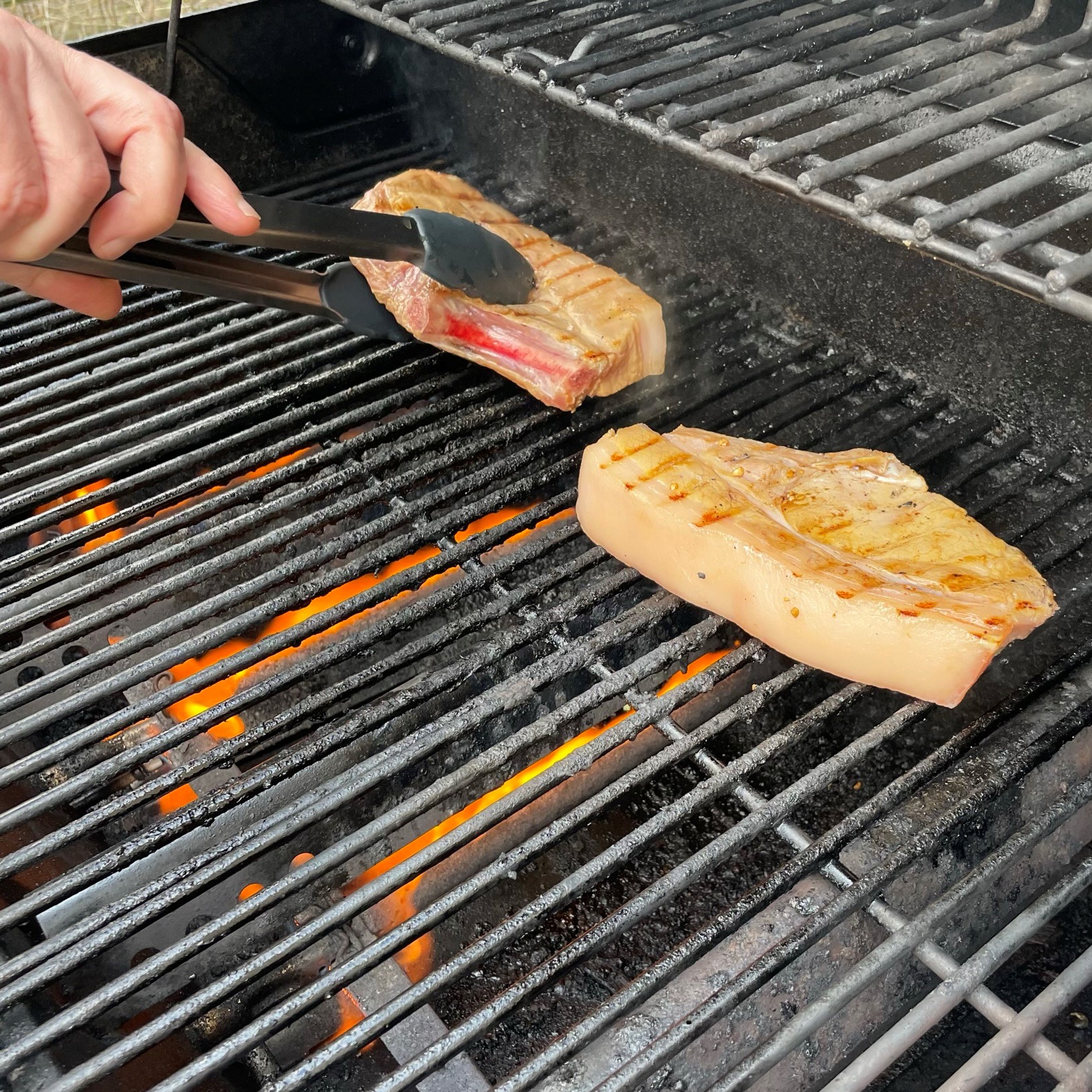
My husband is the grill master at our house, and he did his usual outdoor magic with these sweet tea-brined pork chops. After searing both sides on high heat, he let them hang out at a lower temperature for about 8 minutes on each side, until the meat was beautifully browned, and the chops were done to medium (150° internally). A quick rest on the counter while I plated up some sauteed spinach and the peach-mint chutney, and this was one tasty dinner.
Take the chops out of the fridge a half hour before grilling, and preheat the grill to 500 F.Sear both sides of the chops over direct high heat, for about one minute each side. Then reduce heat to 350 F and cook 6 to 8 minutes each side, depending on thickness.
Well, bless my heart! I’ve fancied up a pitcher of southern sweet tea and made it a brine for the most tender, flavorful pork chops our grill has ever seen! This recipe requires some down time, for cooling the sweet tea brine, as well as brining the pork chops before grilling, so plan accordingly.
Ingredients
2 cups filtered water
1 family size black pekoe tea bag, or 3 regular tea bags
1/3 cup packed brown sugar
3 Tbsp. kosher salt
1 Tbsp. cracked white peppercorns
Juice of 1/2 large lemon
2 thick, bone-in pork loin chops, weighing almost a pound total
Directions
Boil water and pour it over the tea bag to brew the tea. Add brown sugar and kosher salt, stirring until both have fully dissolved. Add white peppercorns and lemon juice. Allow the brine to cool at room temperature for several minutes, then transfer the brine to the refrigerator for about three hours to chill.
Pat the pork chops with paper towels to remove any residue from the butcher wrap. Place chops in a dish large enough to hold the full amount of brine. Pour chilled brine over the chops and refrigerate for 3 hours before grilling. If needed, weigh the chops down with a plate to keep them fully immersed in the brine.
Remove chops from the refrigerator 30 minutes before grilling. Preheat grill to 500 F for searing the chops.
Place chops on grill over high heat, just long enough to sear each side. This should only take about one minute, but trust your instincts on your own grill. Once seared, reduce the heat to medium (about 350 F) and cook on each side for about 8 minutes, depending on the thickness of your chops. Optimal internal temperature is 145-150 F, and the chops will continue to cook a bit after you remove them from the heat.
Rest the chops on a plate for about 3 minutes, then plate and serve with peach-mint chutney.
This quick and easy condiment is a perfect complement to my “Sweet Tea-brined Pork Chops,” and it would also be delicious with fish or chicken. You can make this chutney ahead and refrigerate until ready to serve. It can either be warmed or served cold or room temperature.
Ingredients
1 Tbsp. canola oil
1/4 cup diced red bell pepper
1/4 cup diced Vidalia onion
1 cup fresh or frozen peaches, cut into cubes
2 Tbsp. brown sugar
1/2 tsp. prepared horseradish
Juice of 1/2 large lemon
Kosher salt and ground white pepper
1 tsp. fresh mint leaves, cut into chiffonade or chopped
Directions
Heat canola oil in a small saucepan over medium heat. When it shimmers, add onions and peppers and a pinch of salt. Saute until slightly softened, about five minutes.
Add peaches, brown sugar and horseradish, tossing to combine. Season with a slight pinch of salt and white pepper. When the mixture is hot throughout, squeeze in lemon juice and simmer until it reduces and thickens slightly.
Remove from heat and fold in chopped mint leaves.
Y’all come back, and see what I did with the rest of those peaches! 😉
It was July, 1986. My wardrobe included stirrup pants, big blouses and my favorite pin-striped, high-waisted skinny jeans. The ones with the pleats. My hair was permed and teased out to here, and all the girls were lusting after Tom Cruise in Top Gun. I was restless in my not-so-exciting hometown, and I spent entirely too many weekend nights on the dance floor at a bar called the Rusty Nail, drinking the most sticky-sweet drink that was all the rage that year.
When we were not enjoying our Bartles & Jaymes wine coolers, the “fuzzy navel,” made with orange juice and DeKuyper Peachtree schnapps, was the “cocktail” of choice for me and so many of my friends, whether we were out on the town (which meant we were in the next town over), hanging at home (because our town didn’t have much going on) or gathering for a bridal shower (because getting hitched is what several of my friends were doing that year). Man, we were so cool.
Why did we ever think it was cool to smoke?? But I wish I still had that striped top!
It was an odd time for me, as I turned 21 and I would finally be cleared to order a drink in public. Again. There was a great deal of confusion for my friends and me, as the state of New York had raised the legal drinking age not once, but twice, in a short period of time. First, they raised it from 18 to 19, after I had been legally imbibing for about eight months. Then, when I was 20 and enjoying my fuzzy navels, they upped it to the national standard age of 21. In the next town over, this did not present as much of a problem, because I had a fake ID. Yes, it was bad, but shame on the state for having a no-photo ID that was made of plain old paper. I had used a safety pin to scratch off the bottom part of the 7 and a #2 pencil to reshape it into a 2, giving myself a Feb. 25 birthday! Seriously, it was ridiculous that the powers in Albany did not find a way to “grandfather” in the people who were already considered “of age.”
In my hometown though, everyone knew I was a July baby, so I had to rely on the bottles of DeKuyper Peachtree schnapps I had already purchased (when I was younger, yet “old enough”), and that was what carried me through the final stretch of waiting. Let’s just say that I bought a lot of orange juice during those weird alcohol retrograde months.
A few weeks ago, for nostalgia’s sake, I brought home a bottle of Peachtree schnapps when I spotted it in our local ABC store (that’s what we call our state-run liquor stores in North Carolina), and Lord have mercy, I wish I could have seen my own face when I took a sip! It has a fake fruit flavor and a slight medicinal edge, definitely not what I remembered as being “totally awesome.”
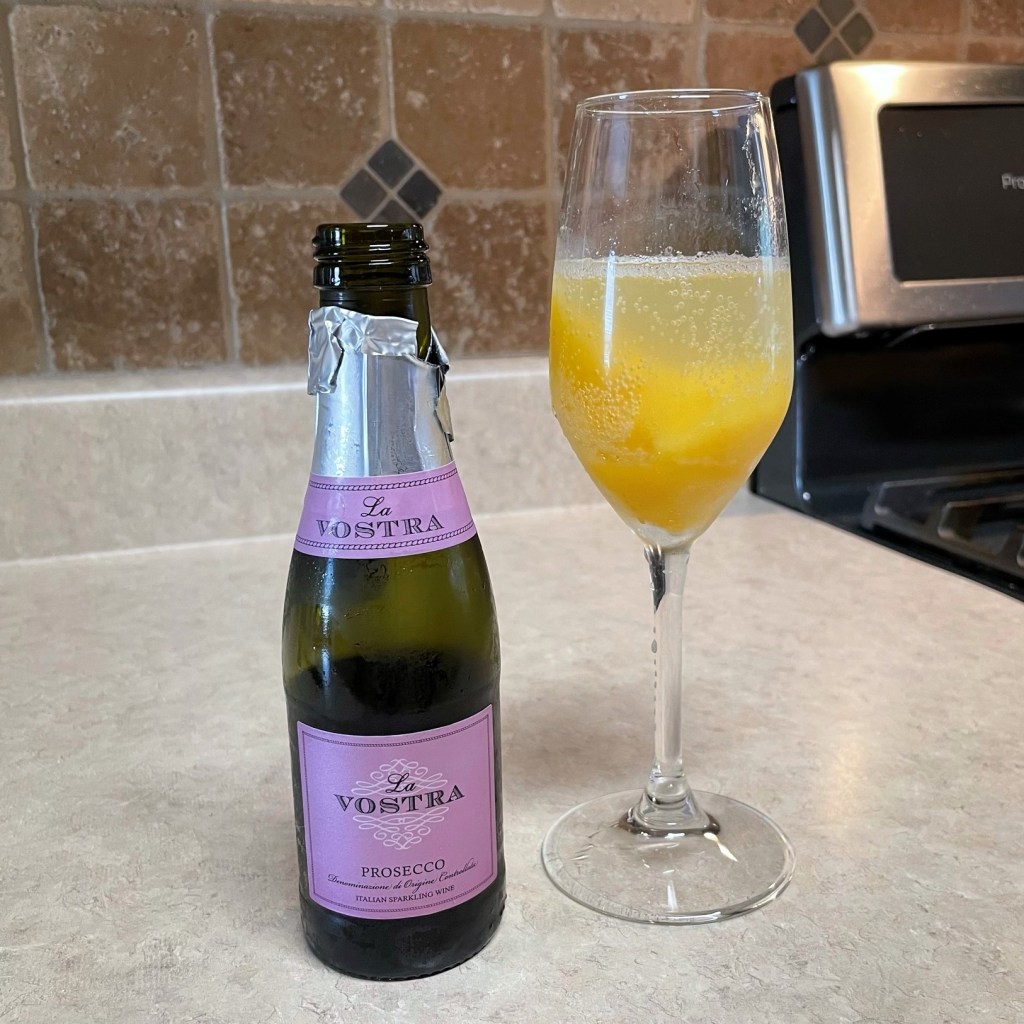
Yes, my taste has changed a great deal (thankfully), but I could not resist finding a fun way to pay homage to the drink of my youth, and this easy sorbet is the result of my effort. I am presenting it during National Ice Cream Month, as an alternative frozen treat for anyone who can’t eat ice cream, and as a nod to my younger self on her 21st birthday. The sorbet is surprisingly refreshing on its own, and I found that it also makes a fun brunch cocktail when topped with prosecco!
Please help me think of a good name for this fuzzy navel brunch cocktail. Mimosa and Bellini are already taken. 🙂
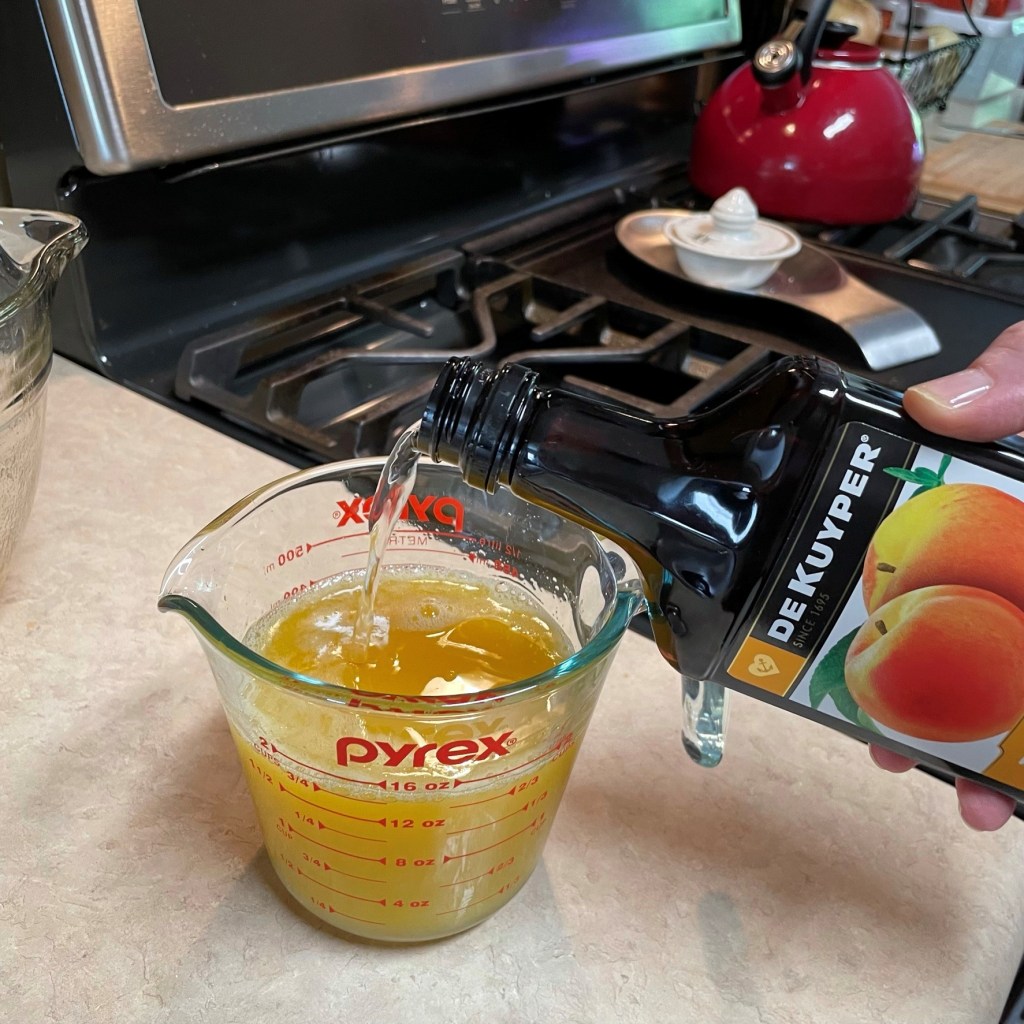
There is a hefty amount of peach schnapps in this sorbet, but fear not—the stuff is only 40-proof, so it isn’t going to wreck you. I pureed a handful of fresh summer peaches to add some freshness and actual peach flavor. The orange juice was a frozen concentrate (which is not as commonly available as in 1986), and I finished the mixture with a light simple syrup of sugar and water.
Ingredients
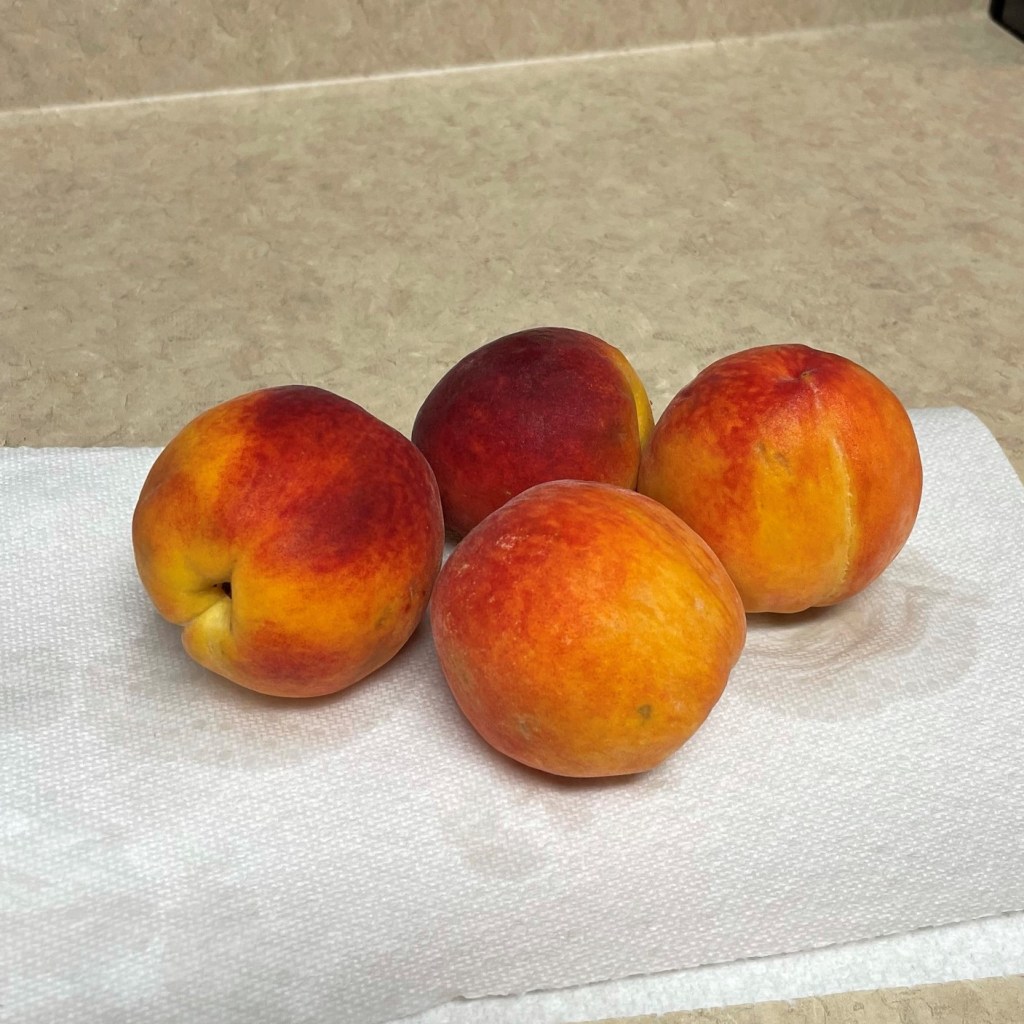
4 medium peaches, peeled and pitted
Juice of 1/2 fresh lemon
2 cups water, divided
1/2 cup cane sugar
2 Tbsp. light corn syrup* (see notes)
1/3 cup frozen orange juice concentrate
1/3 cup DeKuyper Peachtree schnapps
2 Tbsp. vodka, optional for extra kick
*Notes
Corn syrup is not crucial, but I used it to help keep the sugar from forming unpleasant crystals in the frozen sorbet.
Instructions
Fresh summer peaches can’t be beat, and they lend a real fruit flavor to my sorbet.
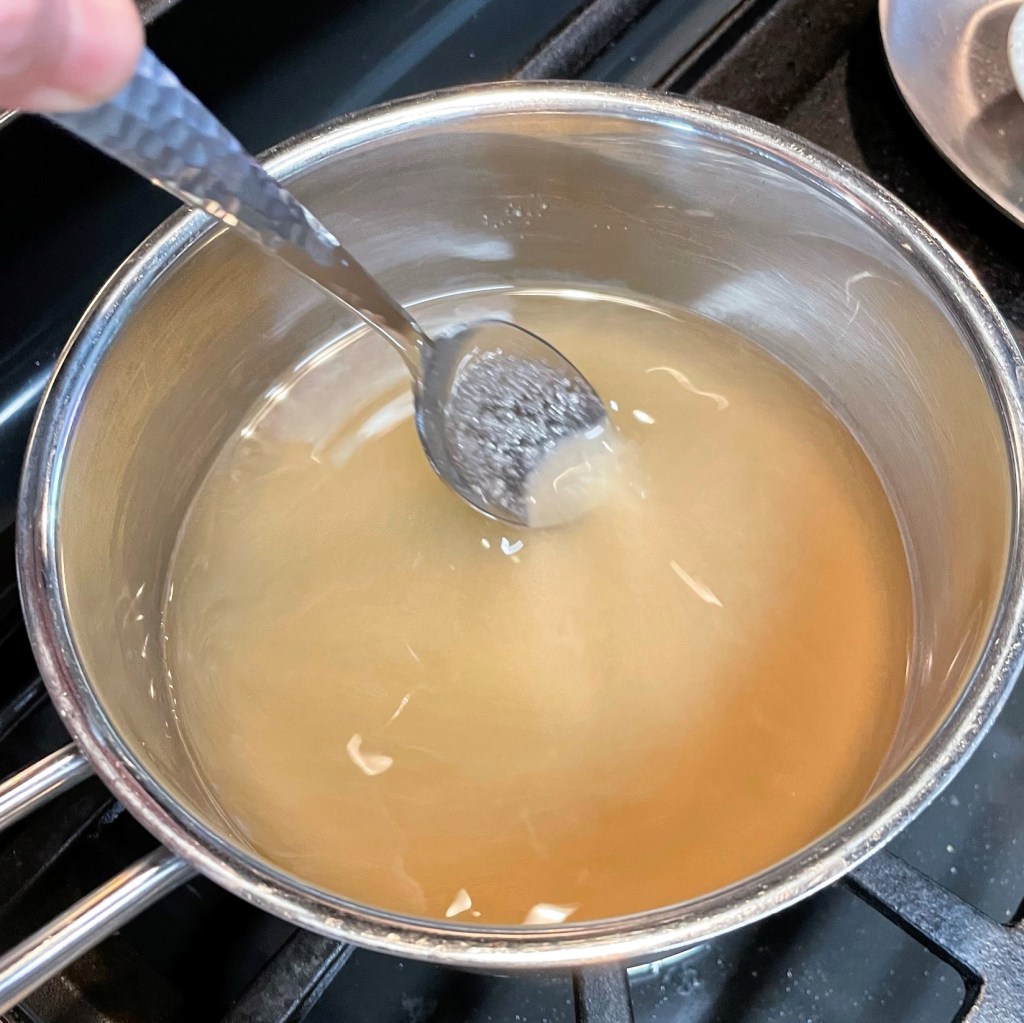
Simple syrup is sugar dissolved into water. Make it as sweet or light as you like.
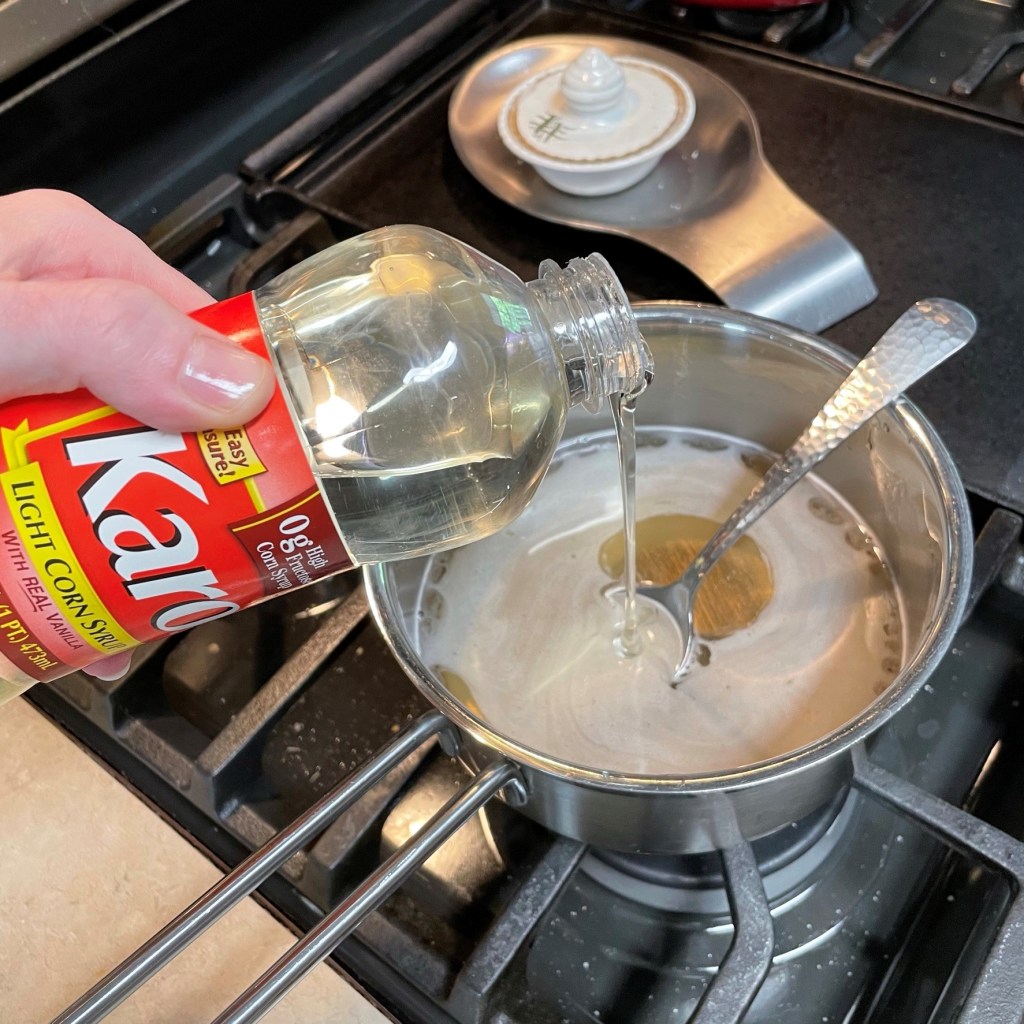
I added a little corn syrup for assurance that my sorbet would not become too icy.
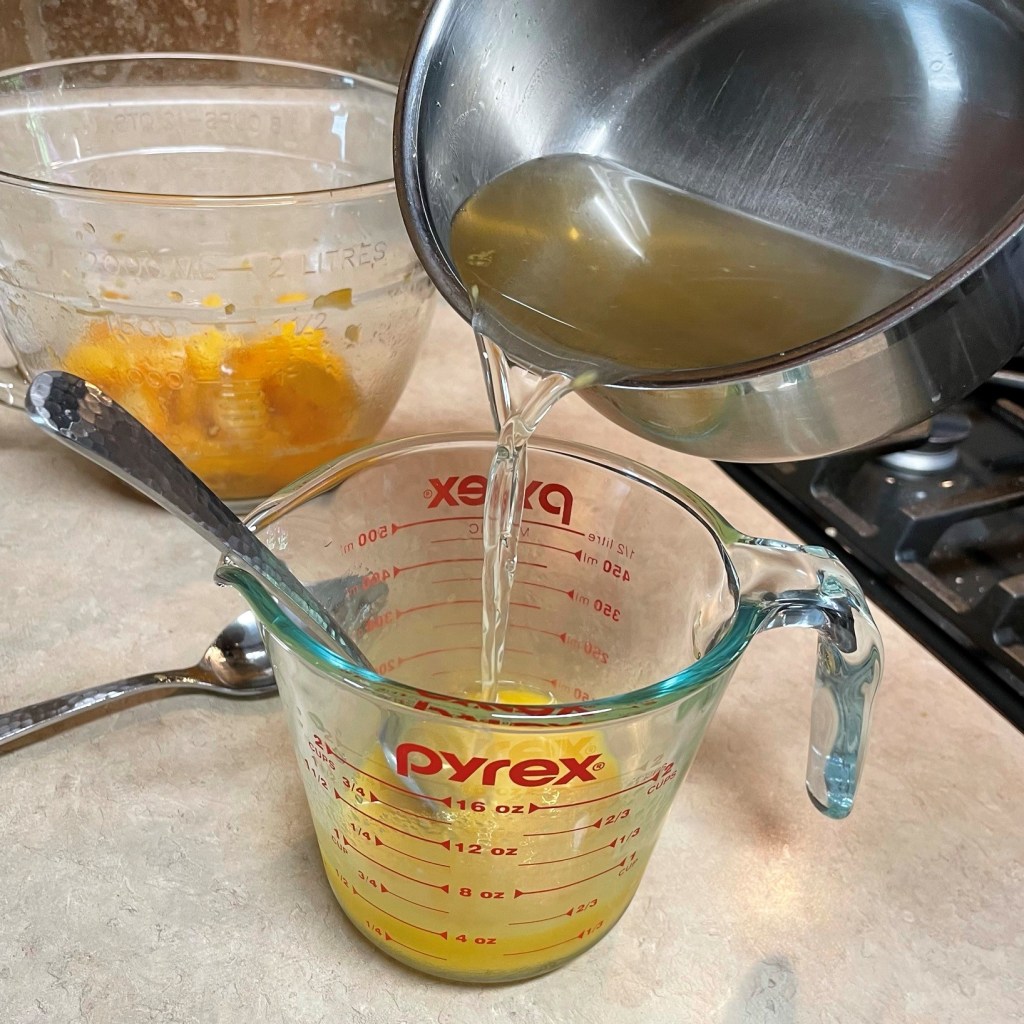
I used the simple syrup to soften the frozen orange juice concentrate.
A hefty dose of the Peachtree schnapps goes into this frozen treat, but don’t worry, it’s not very potent.
I pureed the fresh peaches with a small amount of the juicy syrup mixture.
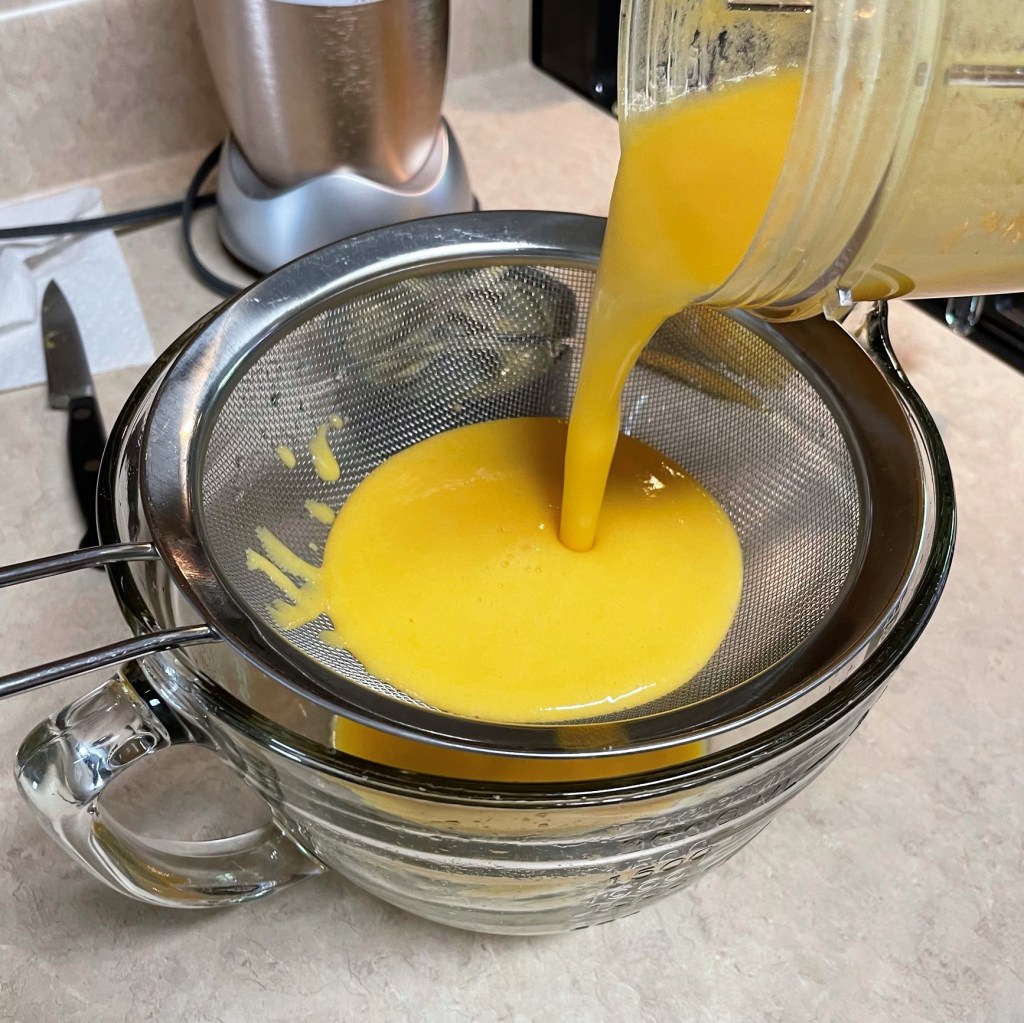
Straining the peach puree removed all those stringy things that hang on around the pit.
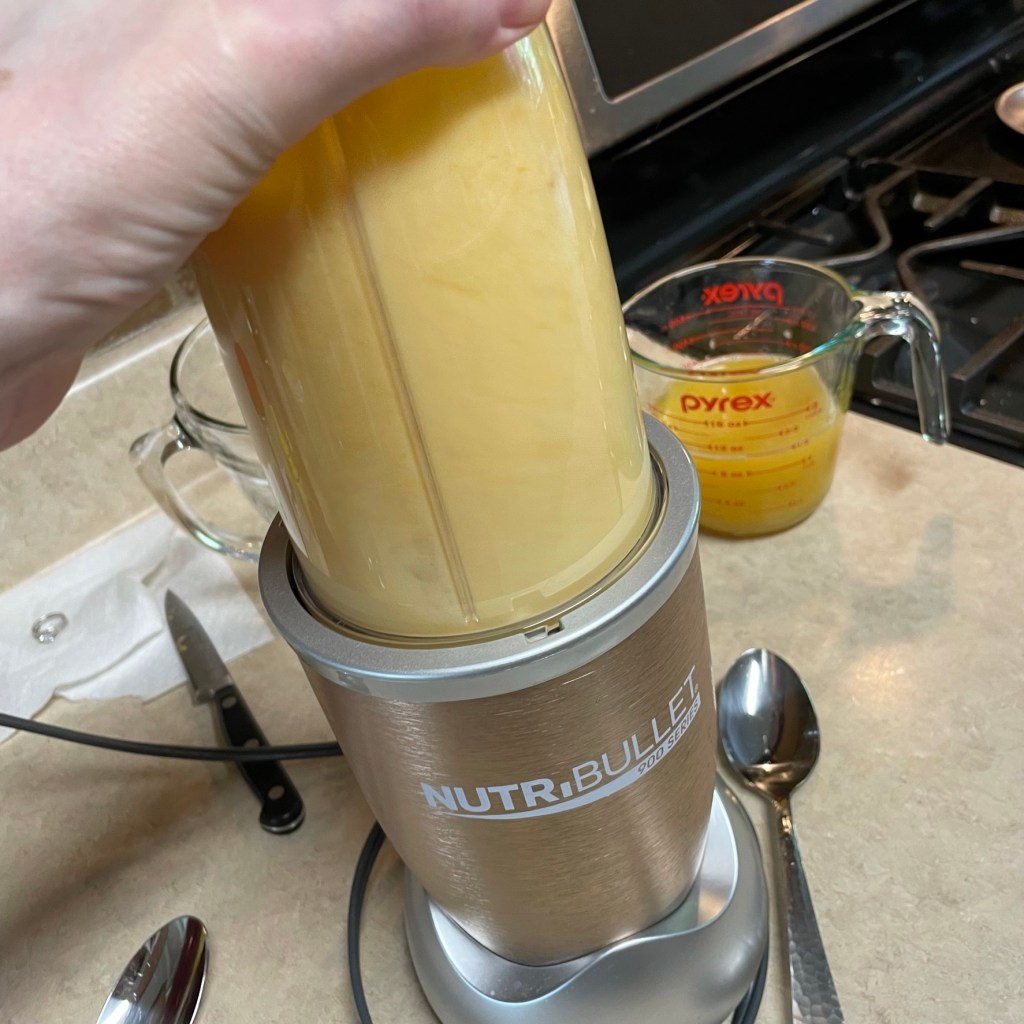
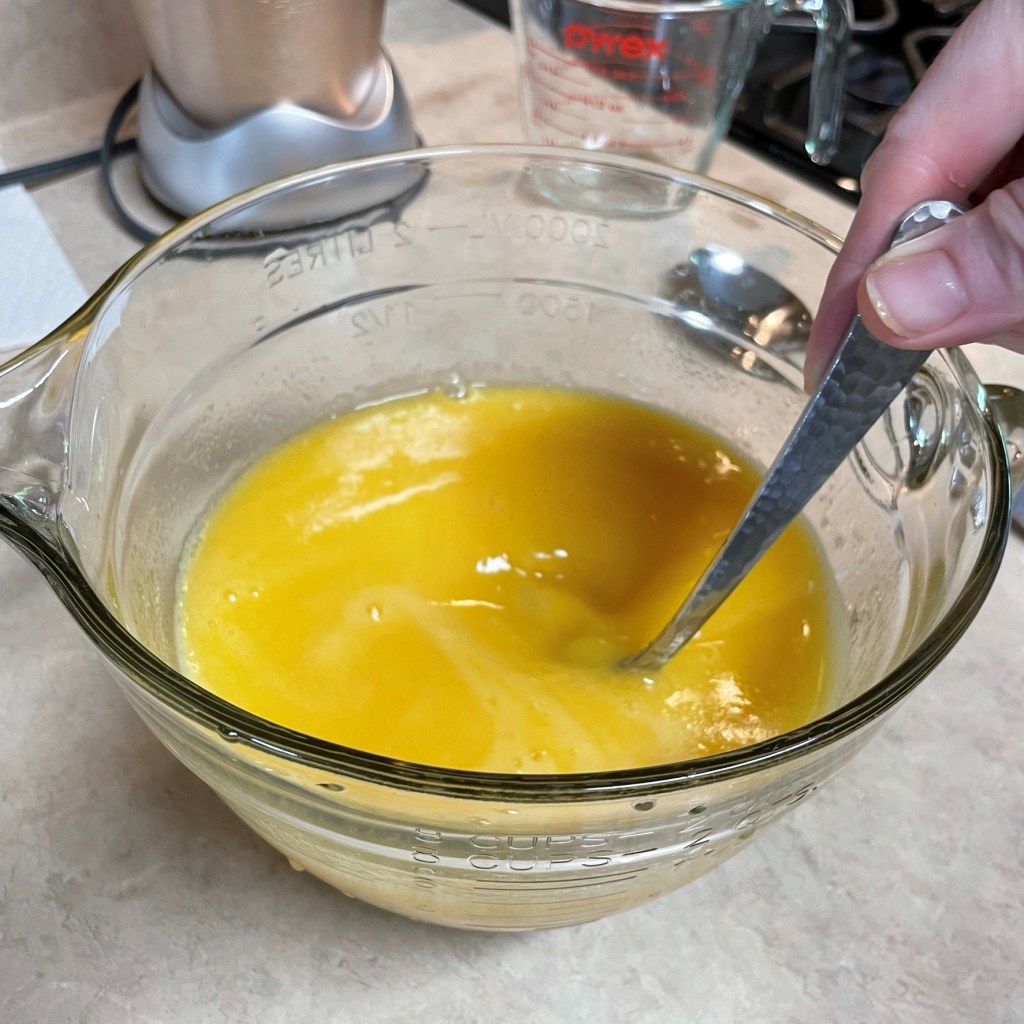
There was a lot of blending and tasting going on. This is a great way to customize the flavor to the right level of sweetness or booziness.
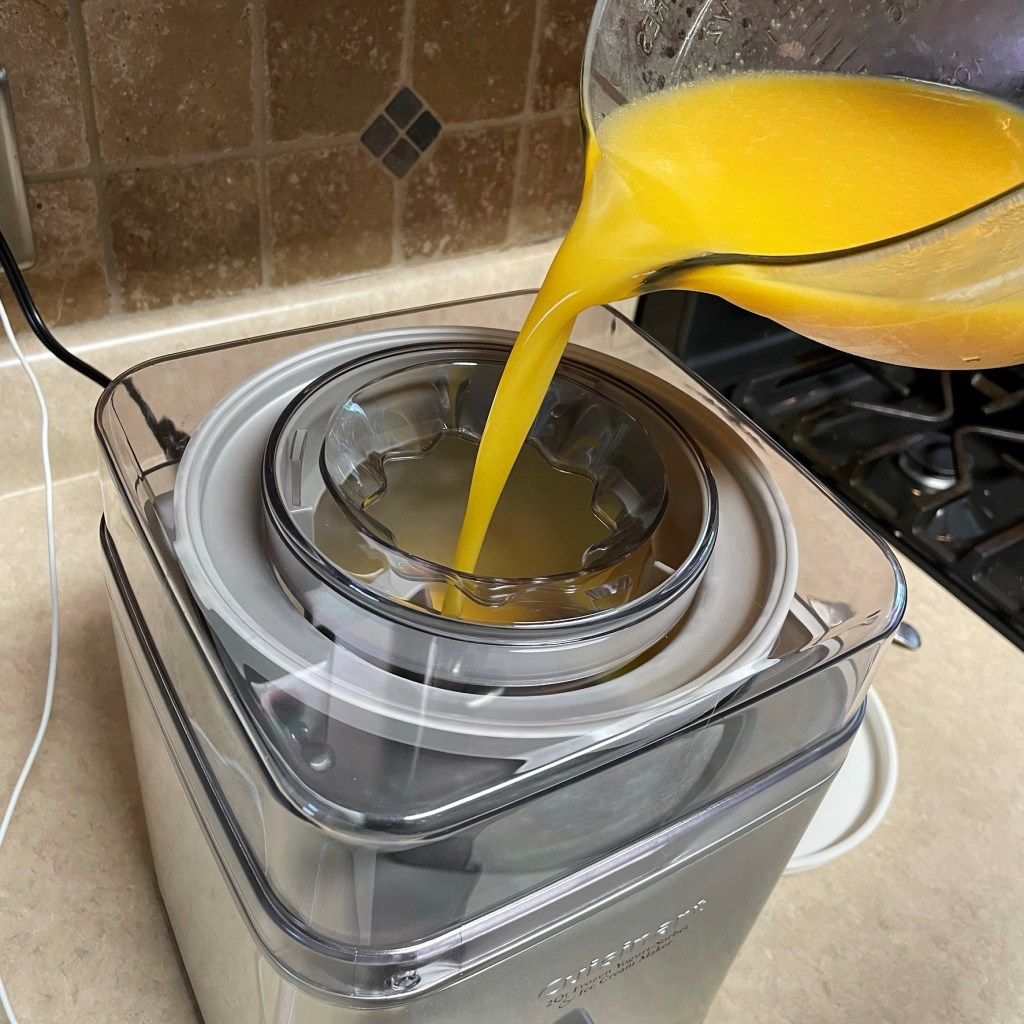
After chilling the mixture several hours, I poured it into my trusty ice cream machine and churned for about 25 minutes.
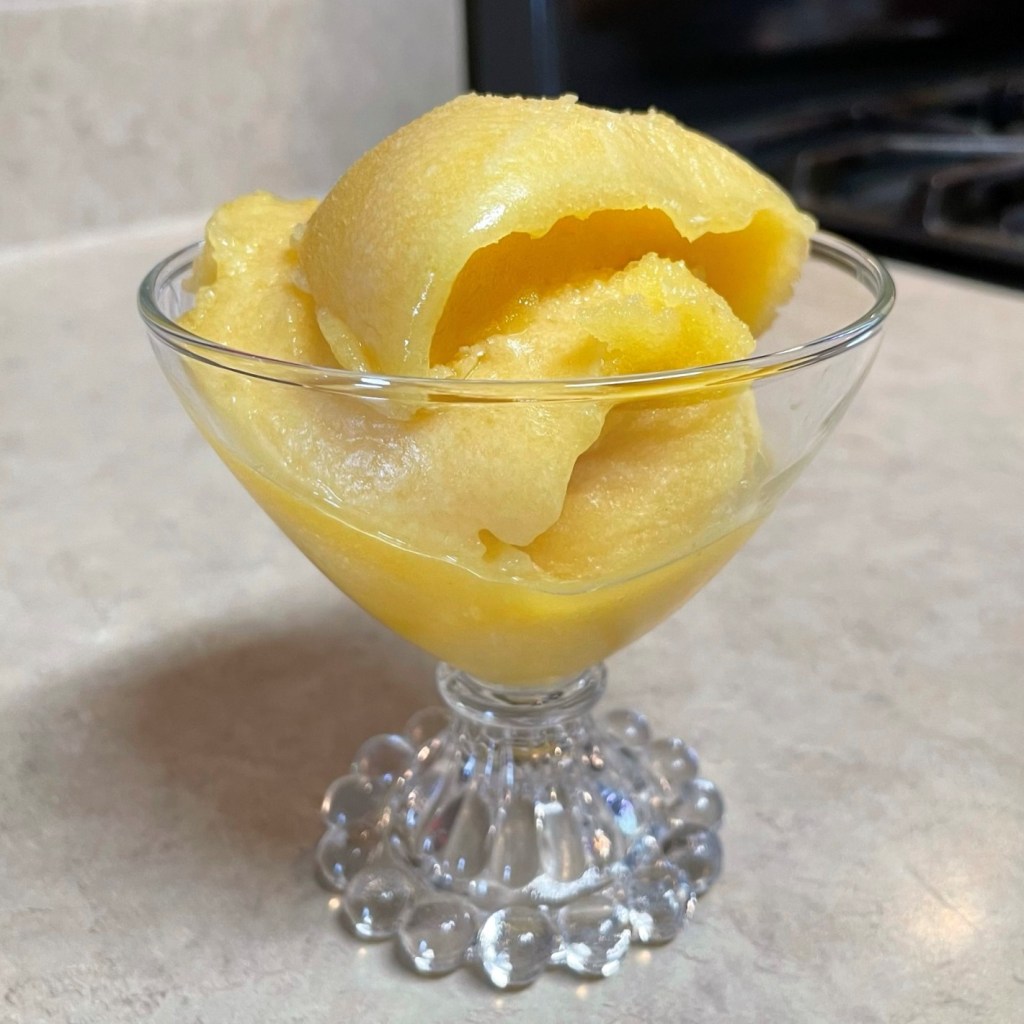
Tastes like 1986! 🙂
My grandmother would have loved that I served this in one of the footed dessert glasses she gave me back in those days. ❤
Cut up the peaches into chunks and transfer them to a regular or bullet blender. Squeeze in the lemon juice and toss lightly to prevent discoloration of the peaches.
Combine 1 cup of the water and all of the sugar in a small saucepan. Bring to a low boil and stir until sugar is dissolved. Stir in corn syrup. Remove from heat and allow the syrup to cool.
Add the orange juice concentrate to the bullet blender, along with the peaches and about 1/2 cup of the simple syrup. Pulse a few times, then blend continuously until the mixture is smooth and uniform.
Strain the puree through a mesh strainer to remove any solids, including the stringy fibers that surround the peach pits.
Combine the pureed mixture, the remaining simple syrup, remaining water and the Peachtree schnapps in a large bowl or pitcher. Stir to blend. Cover with plastic wrap and chill several hours or overnight.
Freeze the fuzzy navel mixture in an ice cream machine for about 25 minutes, until it’s frozen and slushy. Transfer to an insulated container and freeze overnight.
This sorbet can be served as is, or spoon a couple of tablespoons into a flute glass and top with prosecco. It’s a fun little brunch drink, almost as if a mimosa and a Bellini had a baby.
And as for you, young lady—well, you have a lot to learn. But you are awesome just as you are, even with your eyes closed. Don’t ever let anyone tell you different. ❤
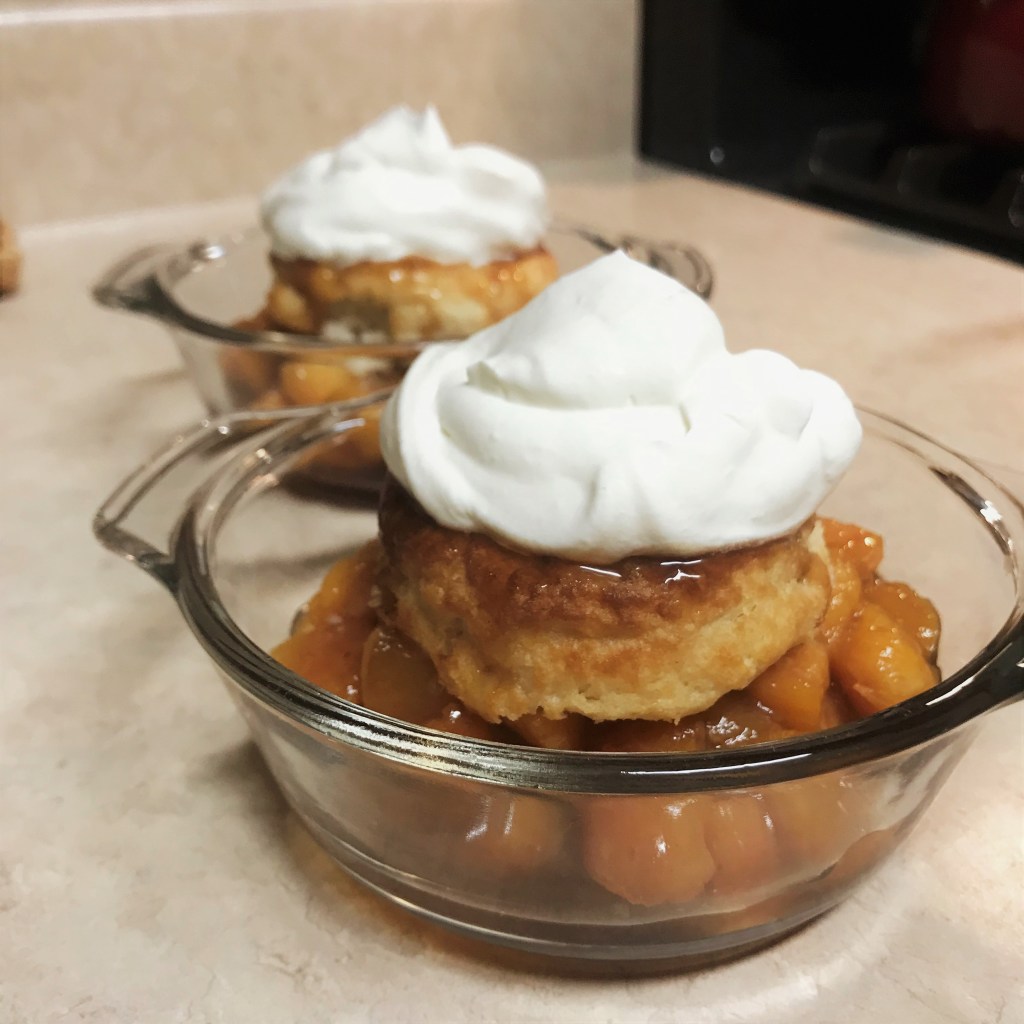
What could be more southern than summer sweet peaches and cream on tender, salty butter biscuits? How about all that, plus a sweet tea syrup? Oh, yeah.
This idea came to me after my first taste of an Arnold Palmer, a non-alcohol summer beverage made of equal parts sweet tea and freshly squeezed lemonade. The drink is attributed to, and named for, one of the greatest American pro golfers of our time. Apparently, after a hot afternoon on the links, it was his go-to beverage, and I can understand why. I still have enough Yankee in me (despite 30+ years living in the South), that sweet tea on its own is decidedly not my drink of choice. But lightly sweetened and combined with tart lemonade, it’s light, refreshing, and I cannot get enough of it. When a flavor combination takes hold of me this way, I can’t help myself from thinking, “what else can I do with this?’”
I had four plump, juicy peaches on the counter—not enough for a cobbler, which would be too much for the two of us anyway.
So here we are. I boiled down the Arnold Palmer blend to concentrate the flavors of the tea and lemonade. My tea was light on sugar to begin with, so I added a couple of teaspoons when the syrup reached the reduction level I wanted. The syrup underscores the sweetness of ripe, juicy southern peaches, which are still undeniably the star. Go ahead and use frozen or canned biscuits if that’s easiest or knock it out of the park with some homemade fluffy biscuits if you’re a rock star (and how about sharing that recipe with me because biscuits are not my forte).
This recipe made exactly enough for 3 generous servings, dessert that night and one leftover for hubby’s lunch.
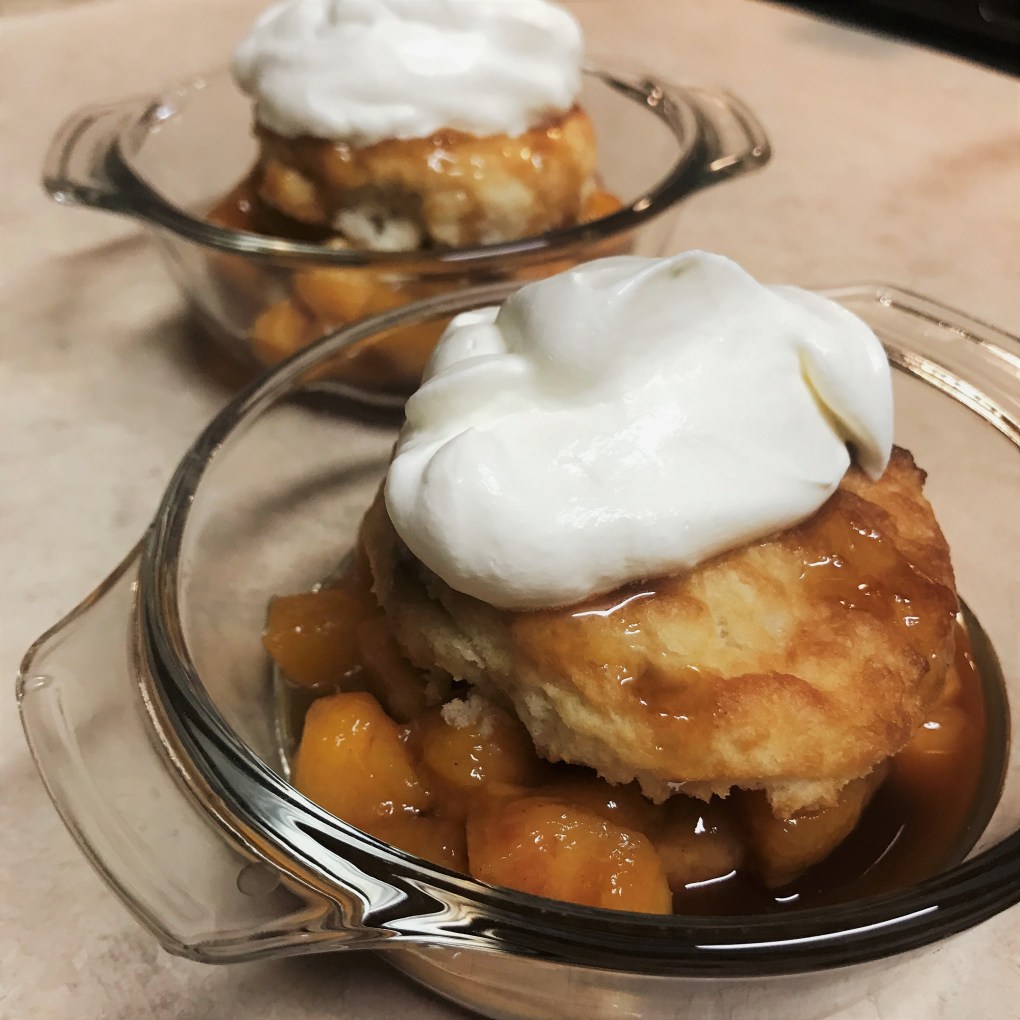
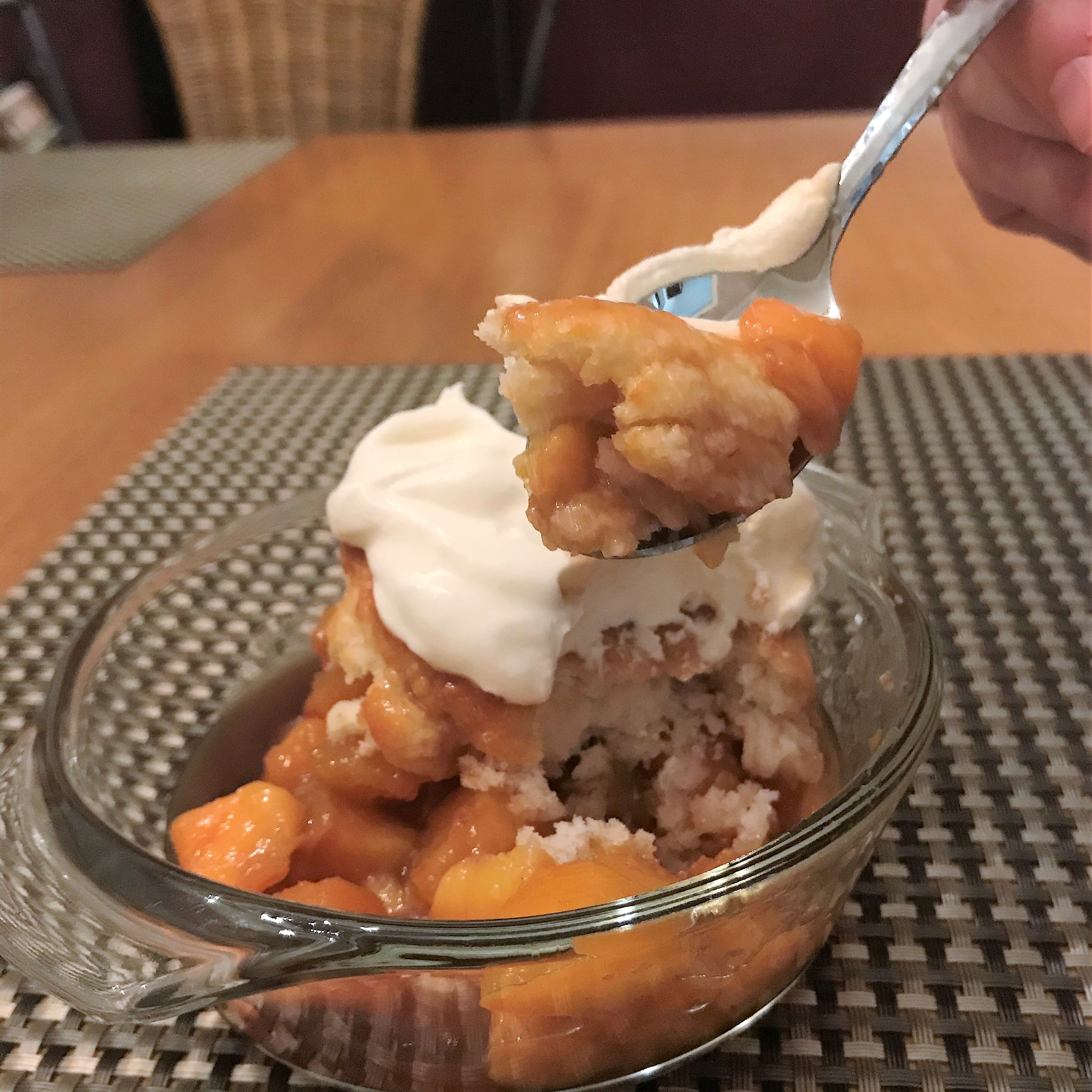
Of course, it’s topped with freshly whipped cream!
Ingredients
4 ripe freestone peaches, peeled* (see notes for peeling tip)
Juice of 1/2 small lemon
3 tsp. cane sugar
3 cups Arnold Palmer* tea-lemonade beverage (see notes for suggestions)
1 Tbsp. corn starch
1 Tbsp. unsalted butter
3 fresh buttery biscuits (I cheated and used purchased biscuits)
Sweetened whipped cream for topping
*Notes
Freestone peaches differ from “cling” peaches in that the soft fruit flesh will release more easily from the pit. The peaches at your market are likely to be freestone unless otherwise labeled.
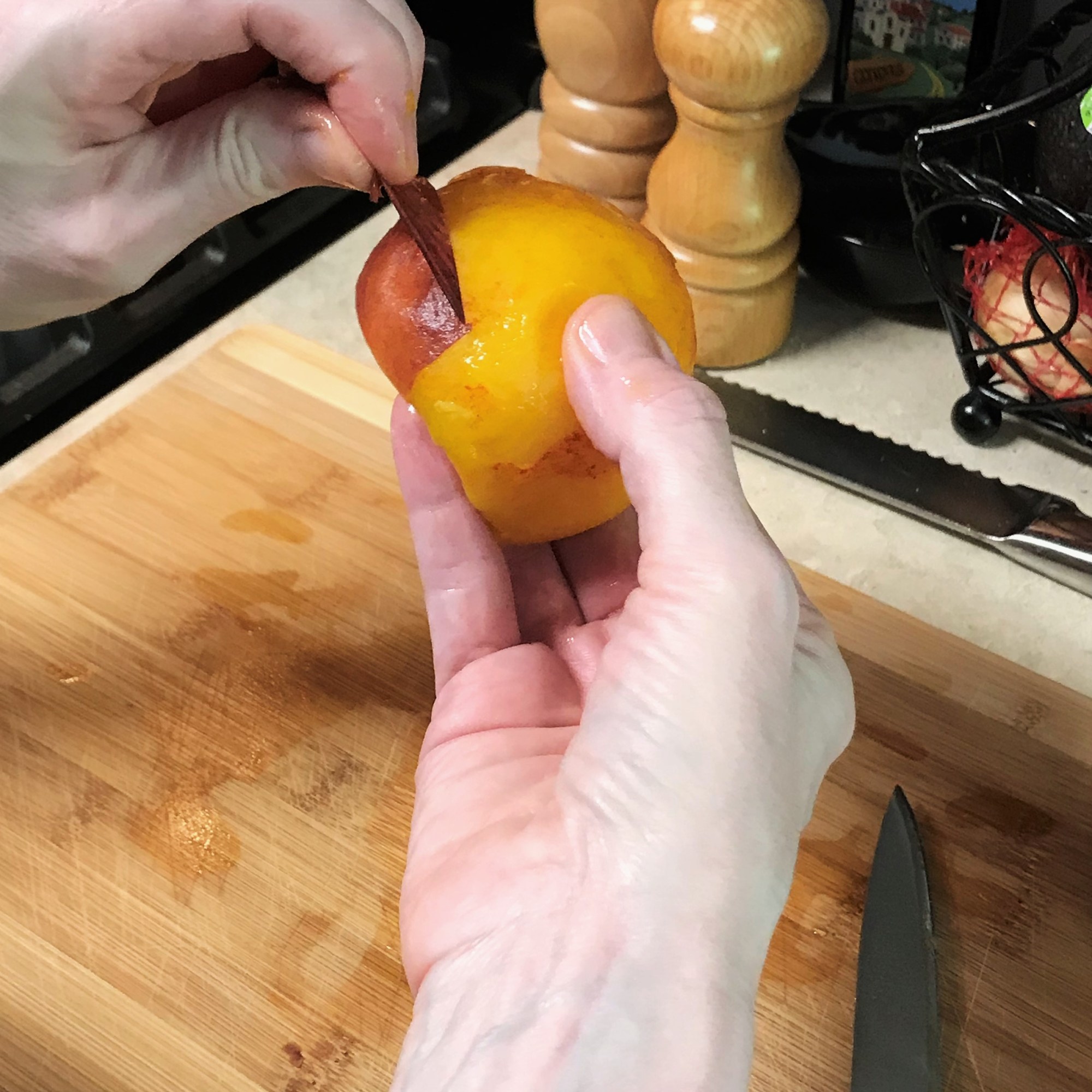
Here’s a tip for peeling peaches without subjecting them to boiling water or crushing them: Use a sharp paring knife at a tight angle to the skin of the peaches and “scrape” against the peel, but not in a way that slices or cuts it. The best way I can describe this process is to pretend you are giving the peach a close shave. This gentle, all-over pressure will cause the skin to loosen from the soft flesh of the fruit. Then, you can slip the point of your knife under a small section of the skin and peel it right off.
For the Arnold Palmer beverage (named for the champion golfer who loved the drink), I mixed equal parts of lightly sweetened tea and Trader Joe’s freshly squeezed lemonade. Simply Lemonade brand would also be good, and homemade would be best of all. Steer clear of instant lemonade drinks such as Country Time. You’ll appreciate the flavors of real lemonade. This blend is so refreshing and summery, I could honestly drink it for breakfast, lunch and dinner.
If you’re not already making your own sweet tea at home, here’s the quick rundown for success. First, get some Luzianne blended tea—this is the real-deal “southern” tea, specifically blended for iced tea (though I can’t identify what makes it so). Seriously, if you aren’t in the South or cannot find Luzianne, there’s nothing wrong with Lipton or another brand, but for this recipe, stick with black tea rather than herbal. If you have the jumbo tea bags, you’ll only need two of them, or six regular sized tea bags.
Southerners swear by this stuff.
May I suggest also, if you expect you’ll be enjoying this beverage in the evening, consider getting the decaf version of the tea bags. On my first experience with the Arnold Palmer drink, I kept filling my glass without a thought about the caffeine (the stuff is that delicious). It was a decision I regretted the entire next day, after having only slept about three hours. I think I’d rather have a hangover than an all-night caffeine buzz. On the plus side, it was a very productive day. 🙂
Bring water to a boil in a tea kettle or pan and pour 6 cups over two family-size tea bags in a heat-safe pitcher. Allow the tea to steep 5 minutes, then remove and discard the tea bags. Add about 1/2 cup pure cane sugar (give or take, depending on your taste) and stir until dissolved.
Allow it to cool a few minutes, then add 2 cups of fresh ice cubes and stir until melted. Refrigerate the tea until you’re ready to enjoy it or, in this case, blend it with equal amount of fresh lemonade.
Instructions
Fresh summer peaches don’t need much help in the sugar department, but I’ve added enough to macerate them and create a little natural peachy syrup.
The syrup bubbles more vigorously when it is finishing reduction.
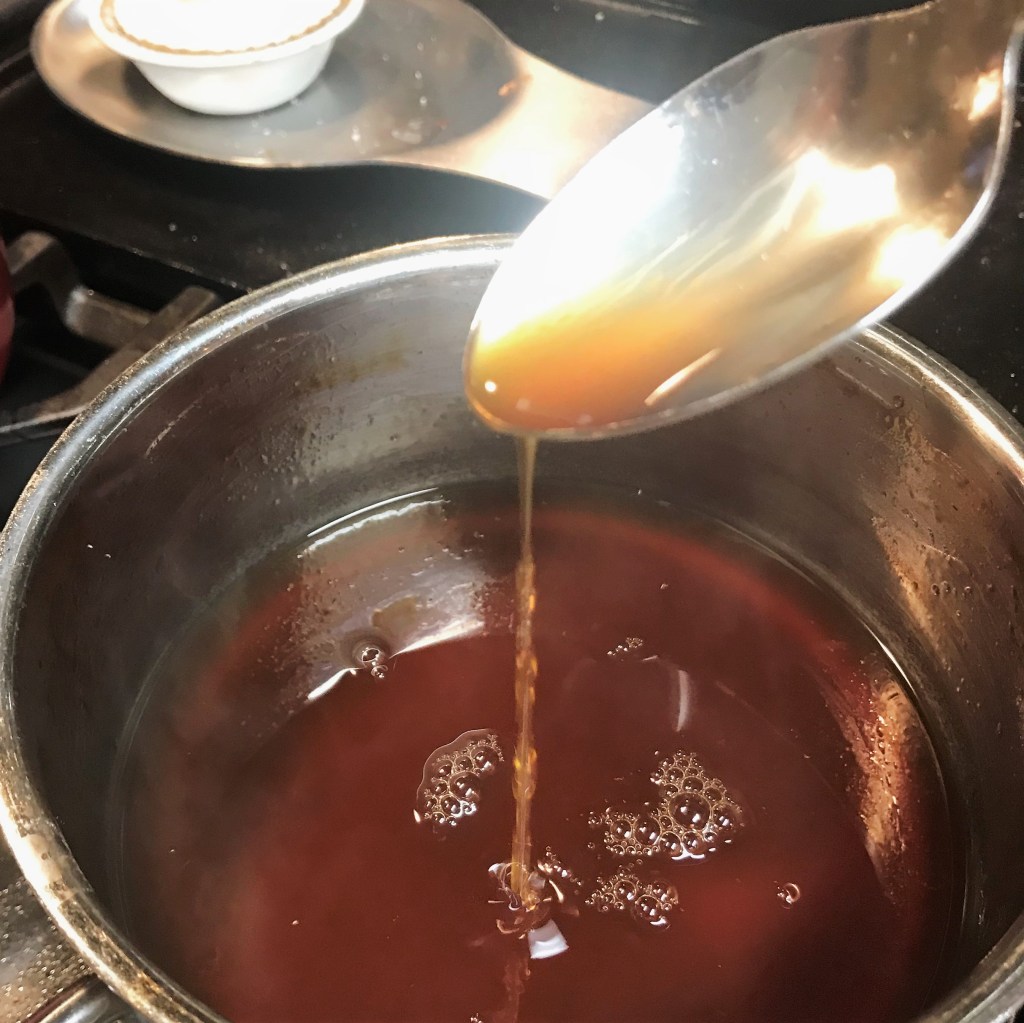
The syrup should be about the same viscosity as the heavy syrup you’d find in canned peaches. But it will be so much tastier!
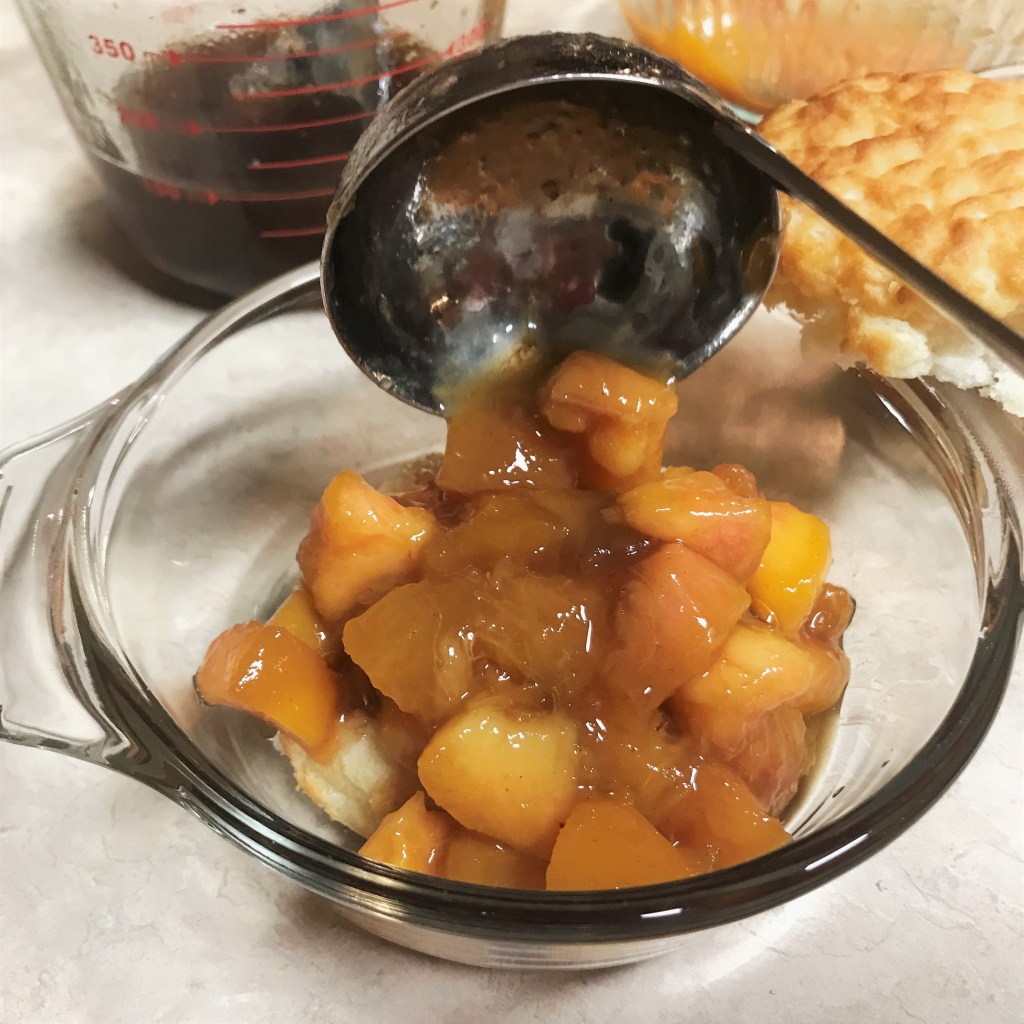
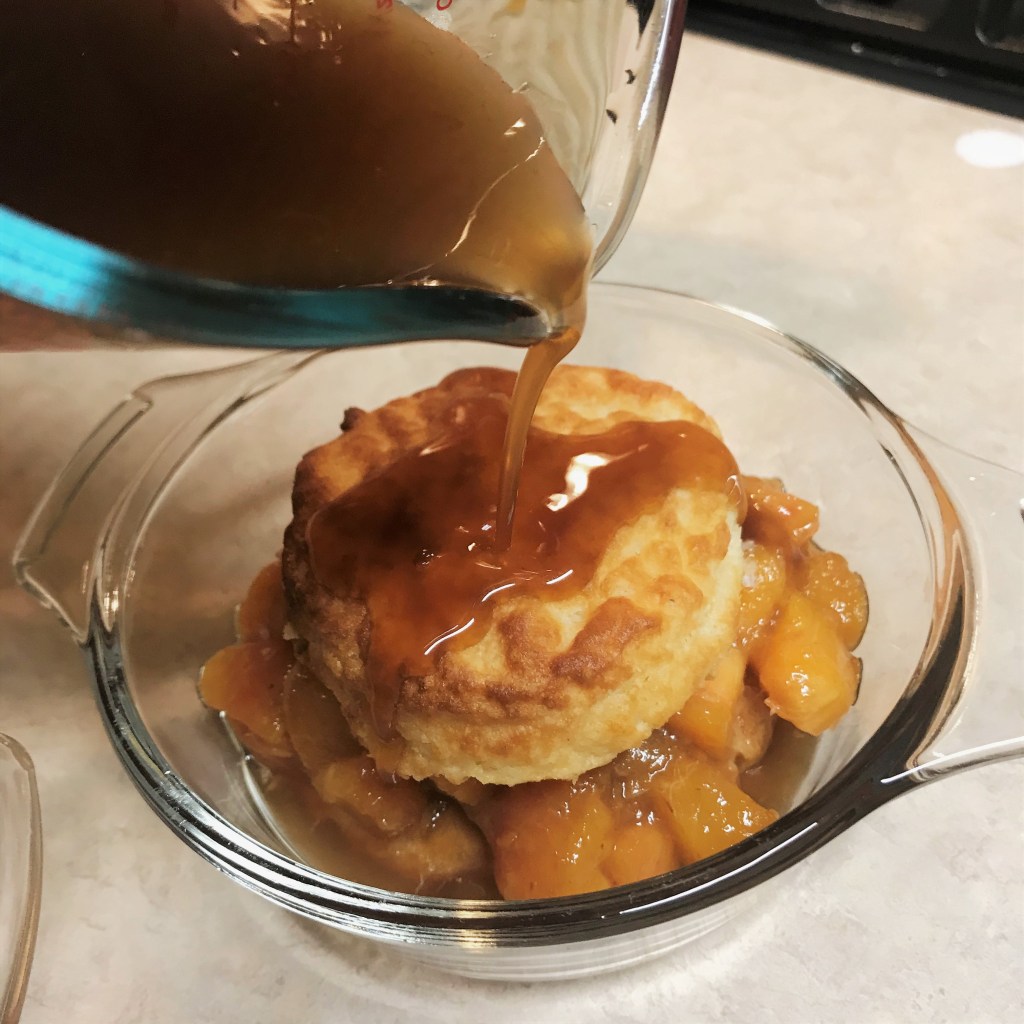
I drizzled sweet tea syrup over the bottom half of the biscuit before spooning in the cold sweet peaches.
The contrast of flavors is terrific, with the slightly salty biscuit and the concentrated lemony sweet tea syrup layered all the way through.
I’m checking to see which one has more whipped cream. That’s the one my husband will want! 🙂
Toss peaches in lemon to prevent browning
Sprinkle sugar over peaches and macerate several hours or overnight in the fridge.
Simmer Arnold Palmer blend down to about 3/4 cup volume.
Taste syrup; if too tart (lemony), add 1 tsp. sugar at a time to taste
Combine 1 Tbsp. cornstarch with 1 Tbsp. cold water. Bring sauce to gentle boil and slowly stream in the slurry to slightly thicken the syrup. You may not use it all. Stir in butter. Transfer to a bowl and refrigerate if you aren’t using it right away.
Split a biscuit, drizzle syrup on the bottom half, then layer on peaches and biscuit top. Drizzle generously with sweet tea syrup and top with whipped cream.
The first bite of a sweet summer dessert is the best, am I right?








































 Comfort du Jour