Figroni!

It’s no secret that fall is my favorite season. We are still a few weeks away from cozy sweaters, but the “official” arrival of the season has me feeling inspired. And to make things even more fun, this also Negroni Week, a fundraiser that benefits the Slow Food Movement, a cause that aims to make the world a better place with a focus on sustainability, equity and education around food and drink. Savvy bartenders get excited about Negroni Week because it gives them reason to flex their creativity with the classic Italian cocktail that is the event’s namesake.

If I had my own bar— and believe me, I’ve pondered it— this is the twist I would serve for Negroni Week. Traditionally, a Negroni is an equal parts drink made with dry gin, sweet vermouth and Campari, the red bitter liqueur that makes Italy proud. Mine is all of that, plus an easy infusion of sweet, earthy fig.
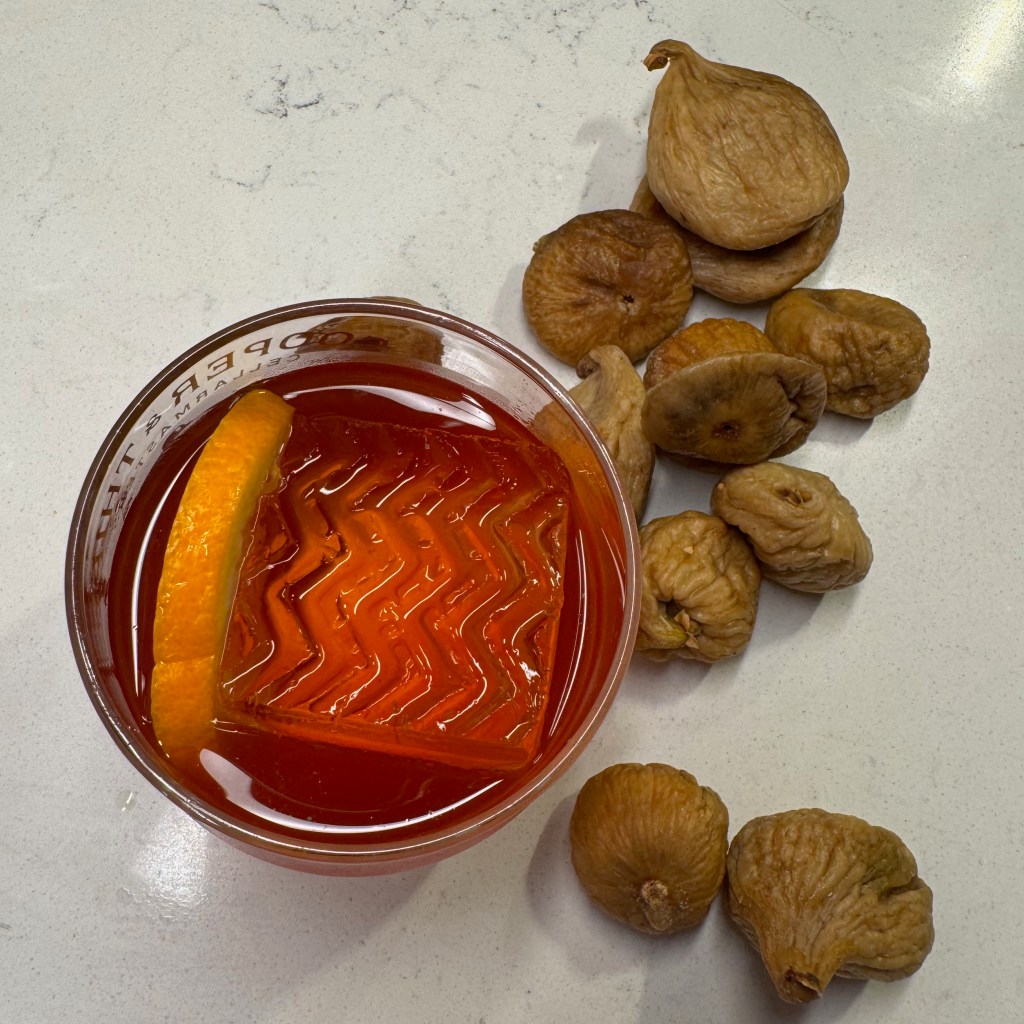
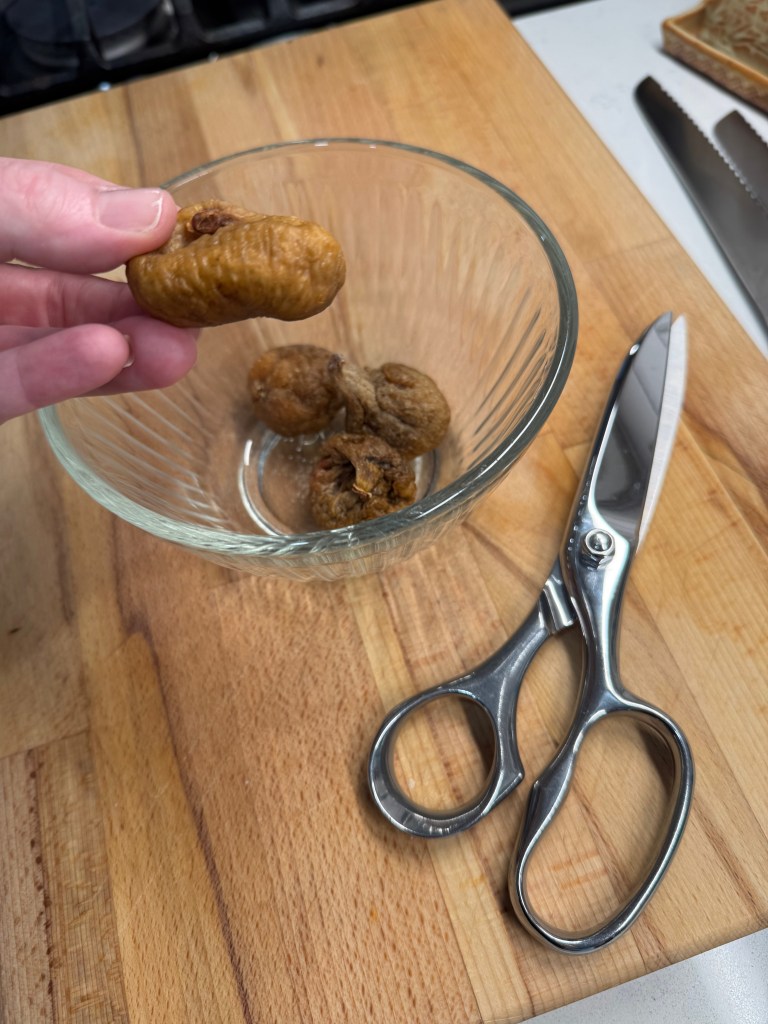
The lighter variety of fig helps keep the Negroni color true.

These flavors feel so right for fall, layered and complex, leaning more toward slow savoring than refreshment. This drink fits right in with cooler temperatures, gentle breezes and the first few leaves making their annual drift toward the ground. It makes me long for sweaters and cozy socks and conversation around our Solo stove. Negroni is delicious with cured meats, cheeses and olive trays, so this one gets high marks as a cocktail for casual entertaining.

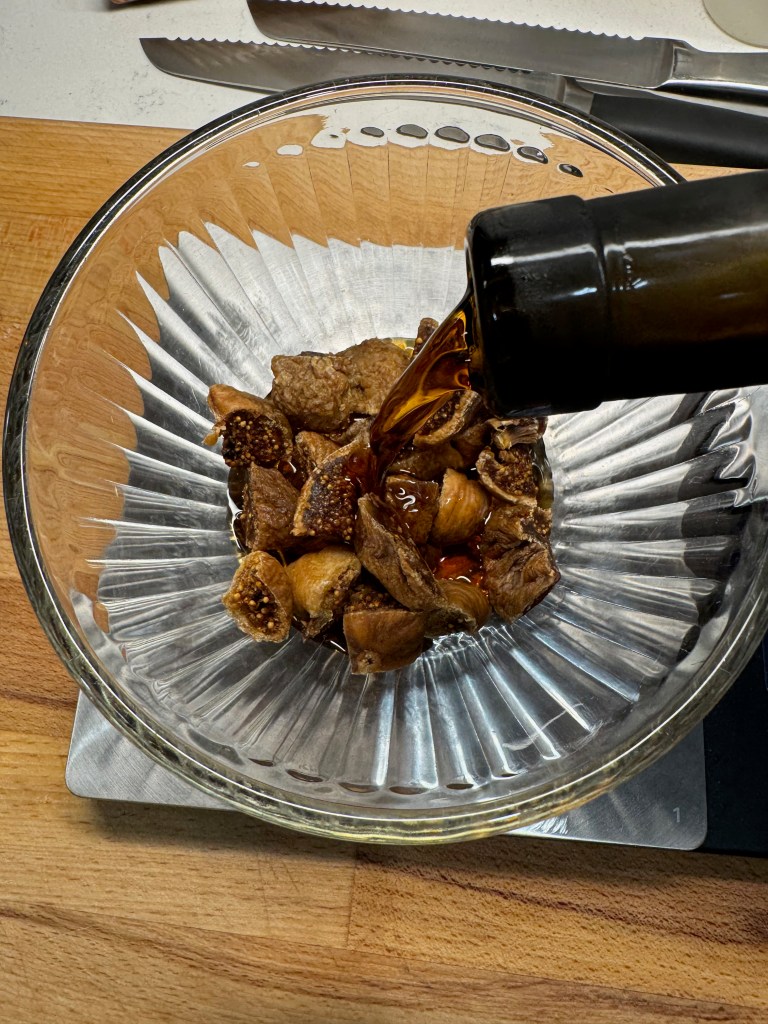
To maximize the fig flavor, I chose to infuse with dried figs rather than fresh. The drying process leaves a concentrated sweetness and intensity behind, and soaking the figs in sweet vermouth pulls that flavor into the spirit without watering it down.
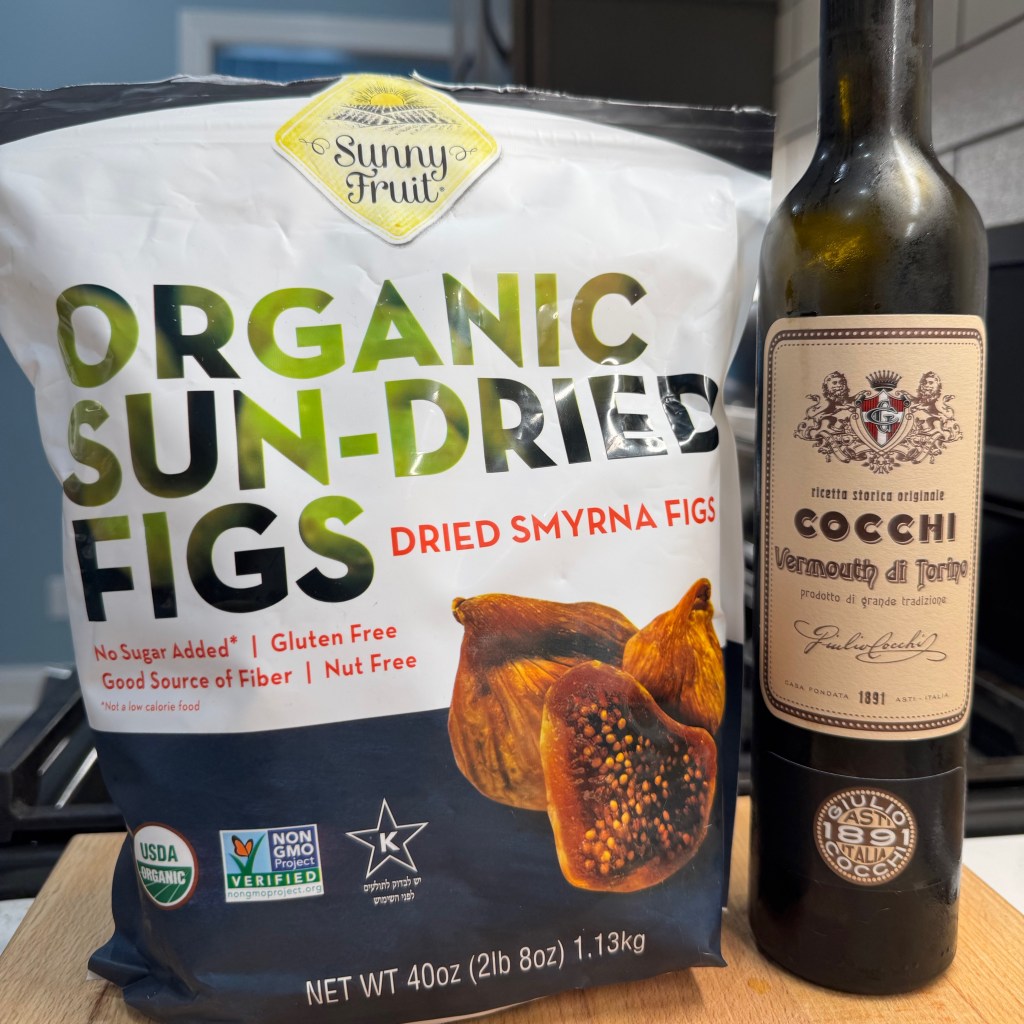
The giant Costco bag of figs always seems like a good idea at the time! 😂

Why infuse the vermouth?

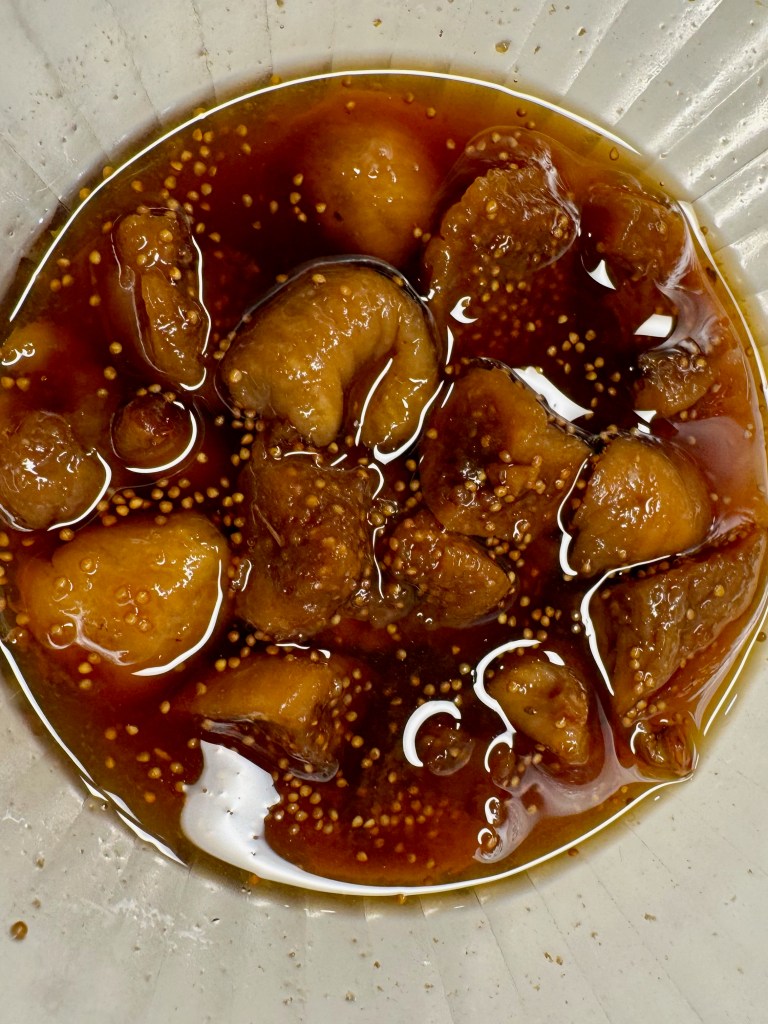
My decision to infuse the vermouth rather than the gin or Campari was quite intentional. Gin is the highest proof spirit of Negroni and I didn’t want to mess with that. I also knew that some of the booze would soak into the figs that I would repurpose— most likely in a bread pudding— and I couldn’t wrap my mind around the thought of Campari-stained figs, so the vermouth won out by elimination. It also bears mentioning that I wanted to try the fig-infused vermouth in a Manhattan, too; alas, I used it all up in my Negronis, so I’ll have to make more. Had I realized how much the figs would soak up the vermouth, I’d have made a double batch! Let this be a lesson to you.
All things being equal

Negroni is one of the simplest cocktails to make because it is equal parts of only three ingredients, plus an orange slice. This means, no math! If you want a small drink, use 3/4 of an ounce of each— gin, Campari and sweet vermouth. For a longer sip, go for a full ounce of each. Living abroad where ounces aren’t a thing? Use whatever measure makes sense to you, and make it the same for all three ingredients. Simple is good.
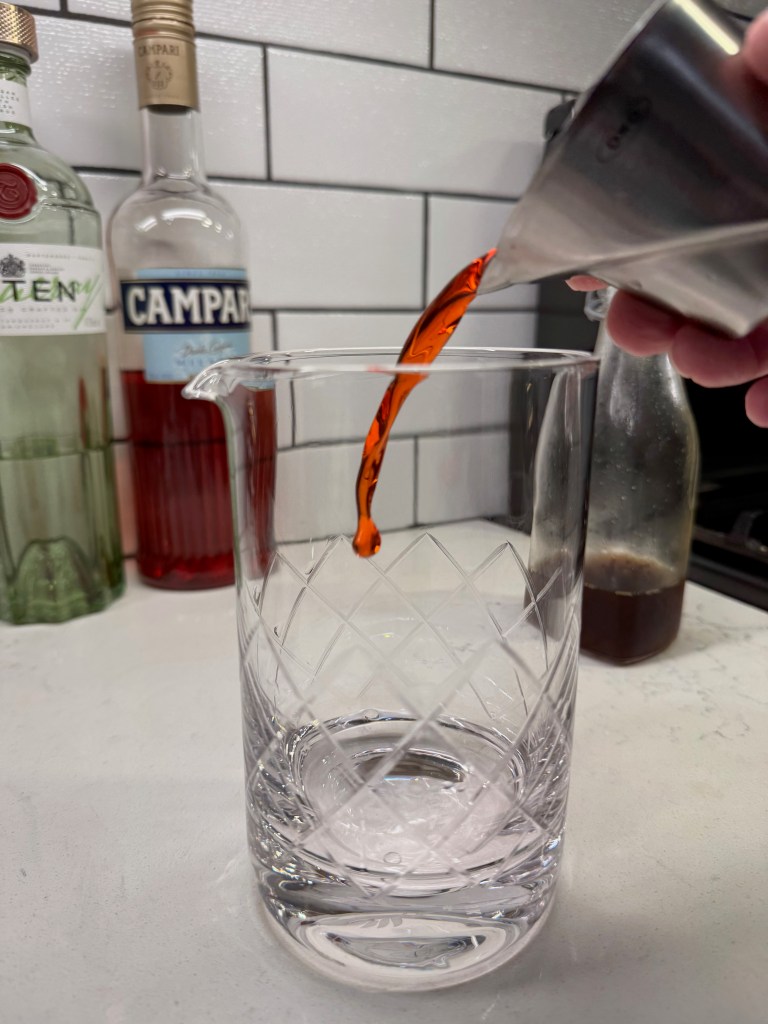
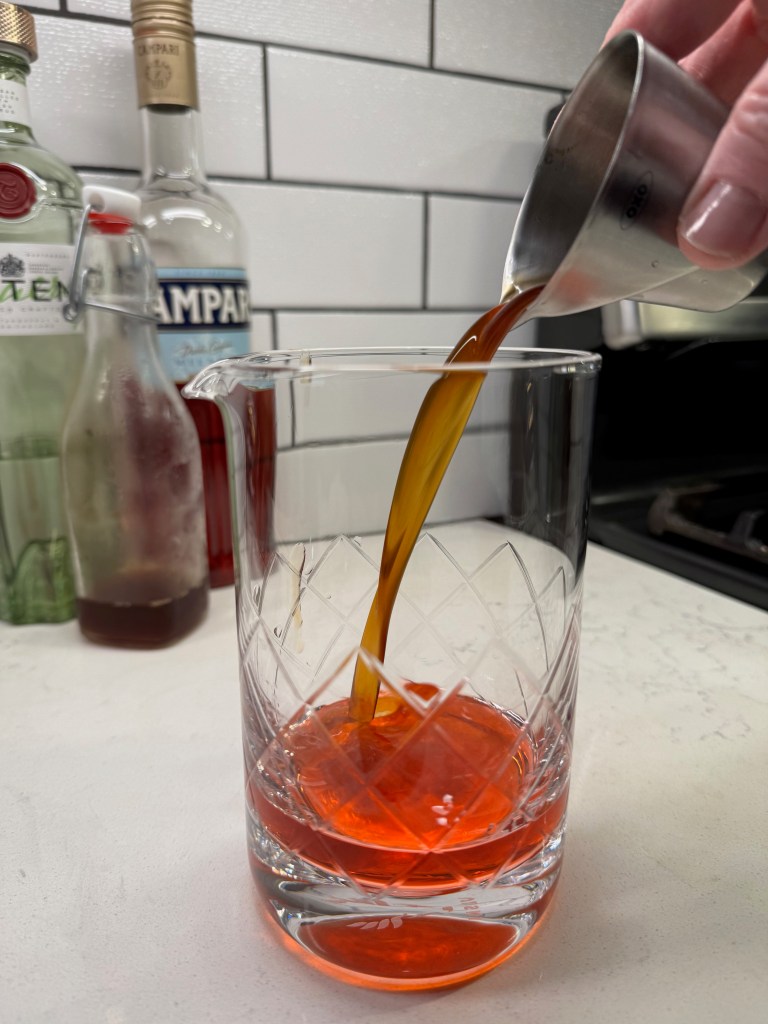
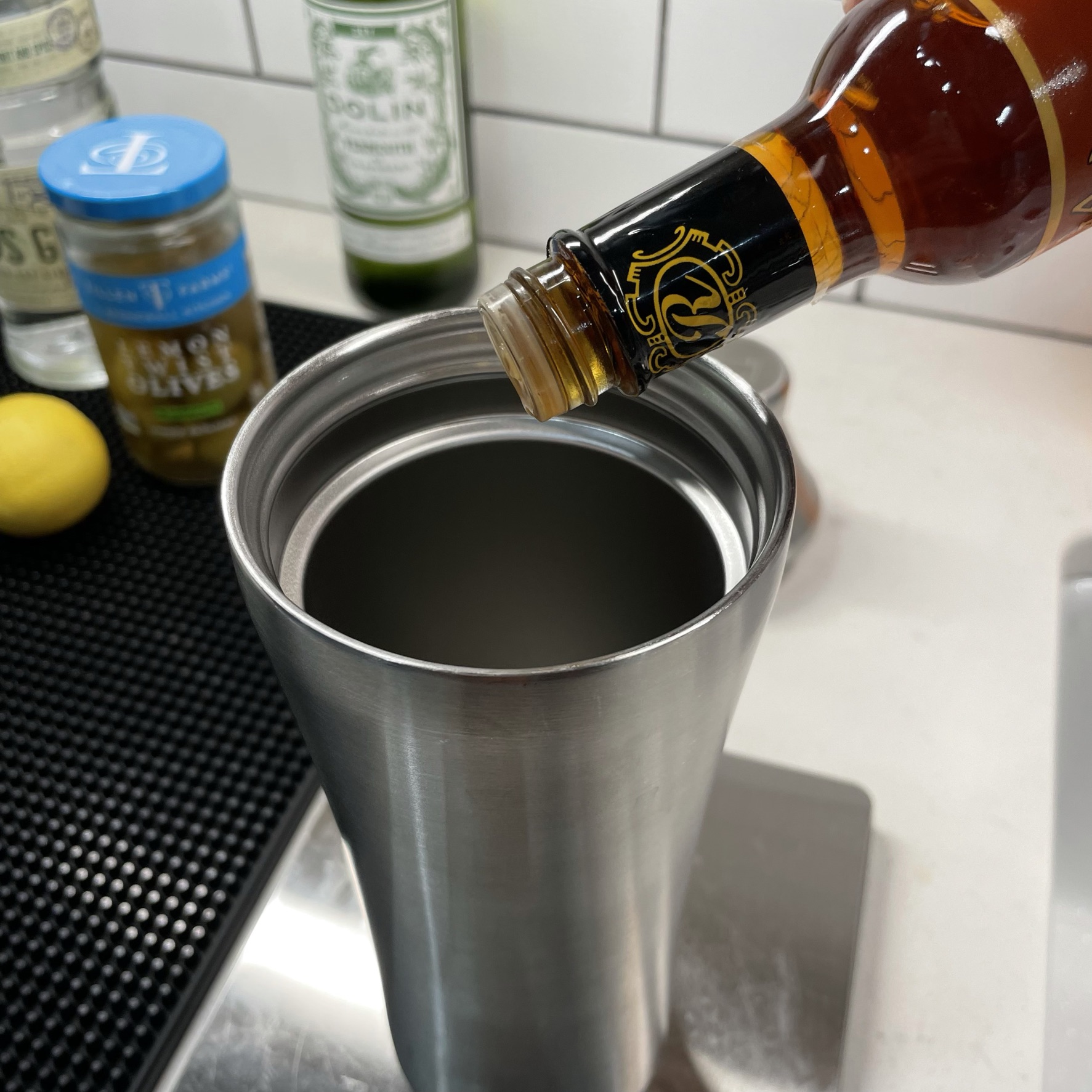
A classic Negroni is made directly in the glass, but I like a little dilution on mine to wake up the nuances of the booze. Plus, the dried figs have turned my vermouth into a thin syrup and I want to be sure it mixes well, so my ingredients went into a cocktail mixing glass with a large cupful of ice. You could use a shaker, I suppose, but don’t actually shake it; just pour it back and forth with ice a couple of times. Strain it over a giant ice cube and garnish with a juicy orange slice.

Always remember to garnish!

Would I make another round?

Absolutely! I found this cocktail to be a real charmer that has lingered in my mind long after the fig-infused vermouth ran dry. If you already like Negronis, you’ll love it. If you’re on the fence or you typically find Negronis to be harsh, I can confirm that the figs soften those bitter edges in a pleasant way. Fig also happens to pair very well with orange, so the classic orange garnish is right at home. You may notice that I also used Tanqueray 10 for this cocktail; it’s distilled with tons of citrus, and that’s working great here.

If you’re into Negronis, I hope you’ll seek out a bar or restaurant in your area that is supporting Negroni Week, going on through Saturday. If not, then encourage your favorite watering hole to participate next year, and at least take a moment to learn more about the Slow Food Movement, which benefits us all, cocktail or no cocktail.

Cheers!

Figroni

  • Servings: 1 cocktail
  • Difficulty: Easy
  • Print

Sweet, earthy figs lend their flavor to one of the most classic apertivo cocktails, making this a fun twist for Negroni Week.


Ingredients

  • 1 oz. citrus-forward gin, such as Tanqueray Ten
  • 1 oz. Campari
  • 1 oz. fig-infused sweet vermouth (details below)
  • Stir all together and garnish with an orange slice

Fig-infused vermouth is simple to make. Plan ahead, as you’ll need at least 24 hours ahead to infuse the vermouth.

Directions

  1. Cut up about two cups worth of dried figs (mine were Smyrna figs, which are light in color) into a medium bowl, and pour enough sweet vermouth to fully cover them. This should be a little over one cup.
  2. Let them rest at room temperature a few hours or overnight before stirring and transferring to the refrigerator for 24 hours.
  3. Strain out the solids through a fine mesh strainer and transfer to a bottle. This will keep in the fridge for two weeks, and should make enough for at least four cocktails. Save the vermouth-soaked figs for another use, such as bread pudding or quick bread.


Cinnamon Espresso Negroni

If your social media feeds are flooded with Negroni cocktails lately, there’s good reason. It’s “Negroni Week,” an event launched in 2013 by Imbibe (print and online) magazine and Campari as a means to spotlight a worldwide sustainable food movement called Slow Food. This program has an ambitious but very noble goal of ensuring “good, clean and fair food” for all human beings everywhere. I’m all for feeding people good food, but let’s explore how a cocktail benefits this cause. The organizers pitched an idea to the hospitality industry— register your venue with the Negroni Week site, and share a percentage of Negroni sales to benefit the Slow Food movement. That might not seem like much but to date, they’ve raised more than $5 million, so it’s working!

You can learn more about Slow Food here: https://www.slowfood.com/, and find a participating Negroni Week venue near you here: https://www.negroniweek.com/find/. If you can’t find a local bar that’s taking part in the annual event, why not donate to a similar cause close to home and make the cocktail (or some version of it) yourself? I’ll show you how.

What exactly is a Negroni?

The Negroni cocktail— invented in 1919 in Italy— is traditionally considered to be an “equal parts” drink with dry gin, sweet vermouth and Campari, the bright red Italian bitter aperitivo. The components are stirred with ice and then the drink is garnished with a juicy slice of fresh orange. It is both refreshing and appetite-stirring, sophisticated yet bold and gutsy.

My first introduction to Negroni came only a few years ago (during Covid, probably), and it took me a while to consider making this drink at home. I didn’t want to drop big bucks on a bottle of Campari unless I was fully committed. The Negroni is what I call a “strong drink”— it’s literally all booze— and if you can’t handle bitter, you definitely don’t want one. But there is something that really works about combining these spirits, and now that I’ve acclimated to it, I cannot refuse a Negroni.

Of course, me being me, I have joined the throng of amateur and pro mixologists on a mission for new ways to twist up this classic. There are already several notable riffs out there, including many that swap the gin for various other base spirits, including bourbon, rum and tequila. I enjoyed a particularly good Negroni variation that subbed Spanish sherry for the vermouth and Cynar for the Campari when we visited Cúrate in Asheville, North Carolina. I can still taste it in my mind. It was so good.

The base personality of a Negroni is the botanicals and bitterness— if these are not your thing, stick with a vodka martini or an old fashioned. But if you do happen to enjoy an adventurous, spirit-forward cocktail that whets the appetite before dinner, I propose my take on this lovely libation for Negroni Week 2024. Cheers!

Cinnamon Espresso Negroni

The color and aroma of this drink are really special!

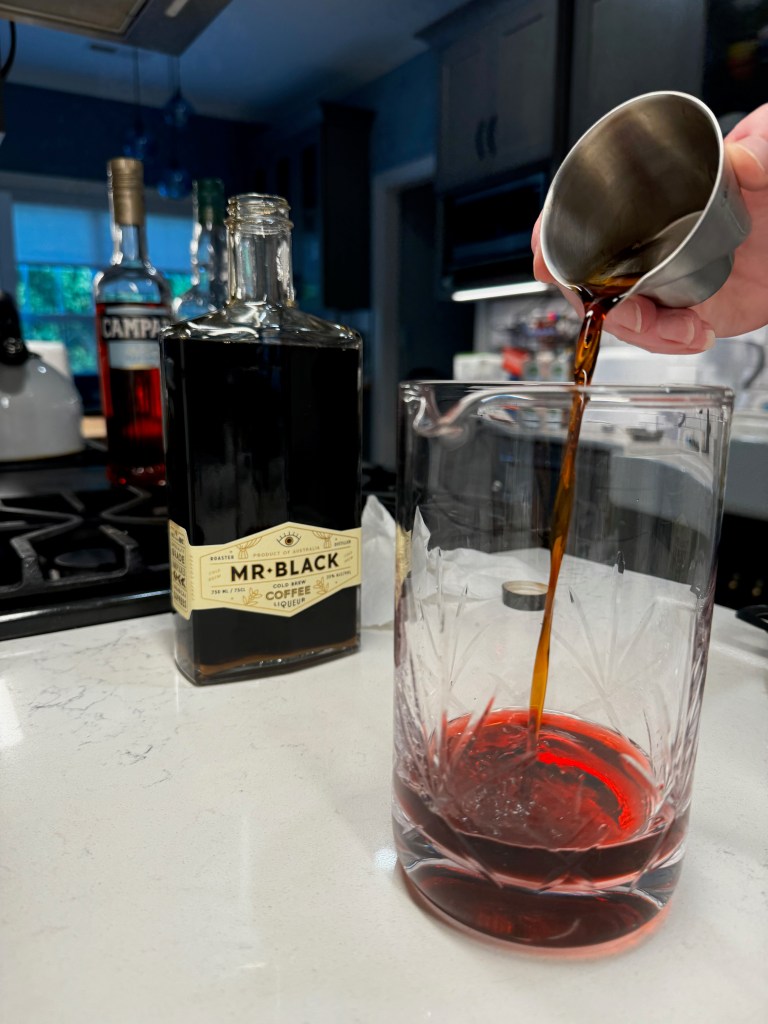
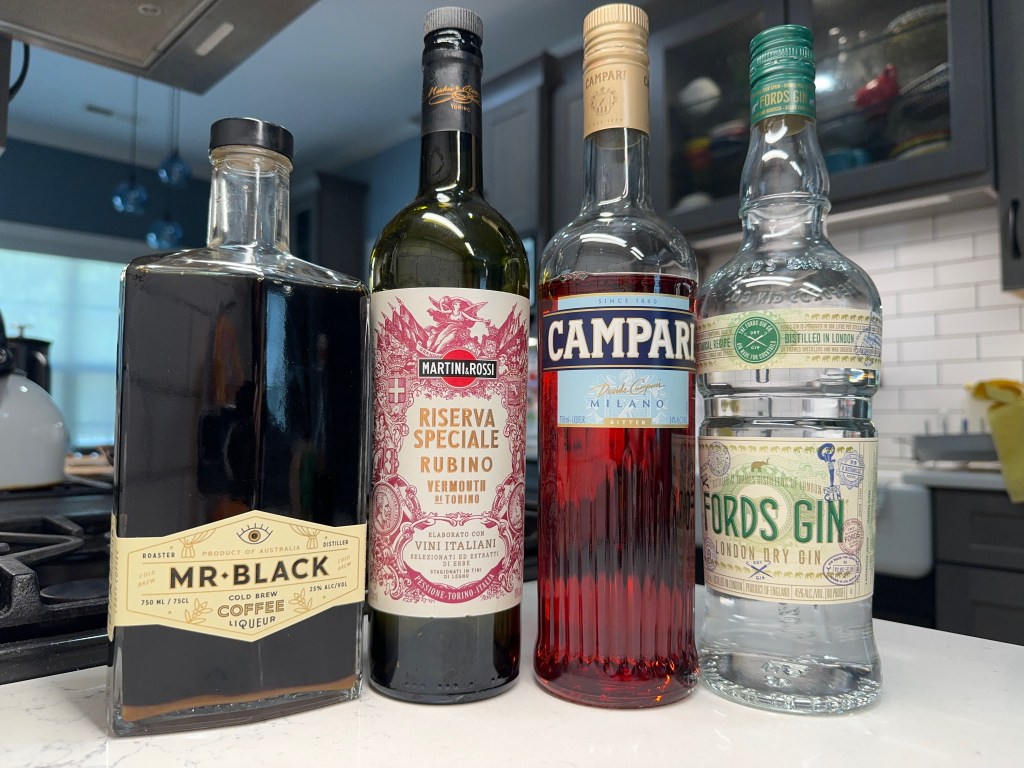
My version includes a couple of twists, including addition of cold brew coffee liqueur. I split the Campari element of the drink 50/50 with the coffee-flavored spirit I like best, Mr. Black. Yes, you could use Kahlua, Tia Maria or Grind Double Espresso liqueur, but I find all of these rum-based spirits to be too sweet for Negroni. Mr. Black is a vodka base, so the emphasis is on the coffee. I had to search for months to find it because our state-run liquor stores are pitifully limited in inventory, but it was worth the wait. I also happen to like Mr. Black in an espresso martini, which I am still working on and will share when I get there.

Ford’s is my house brand of gin. Any London dry is suitable for Negroni, so use your favorite.

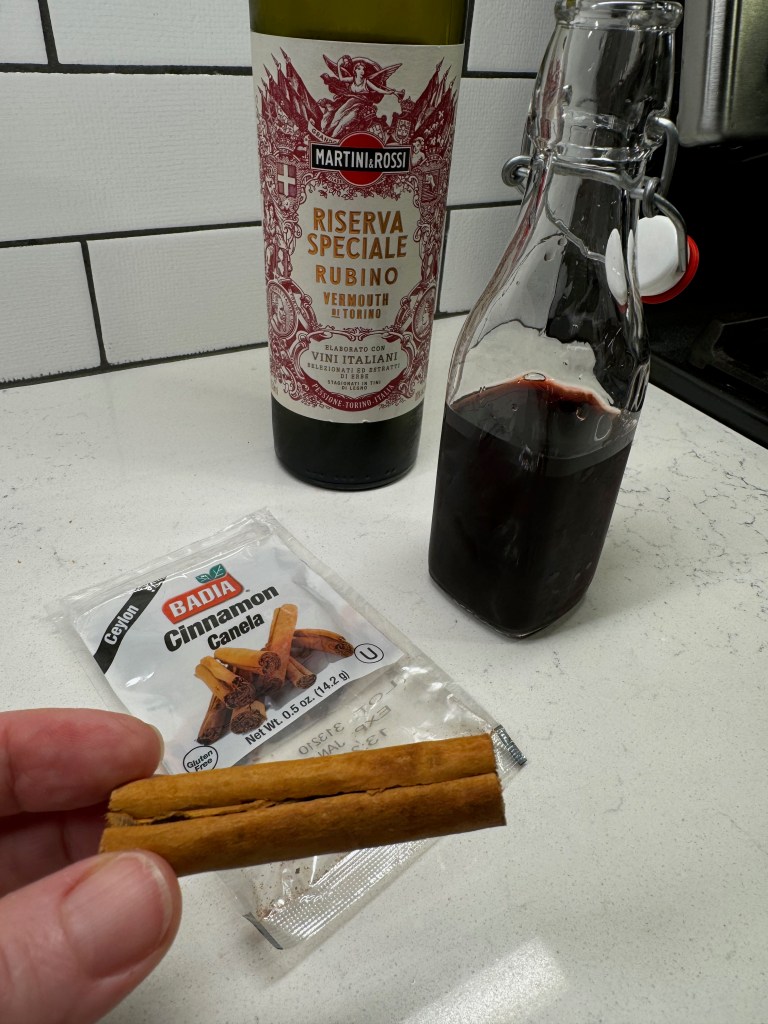
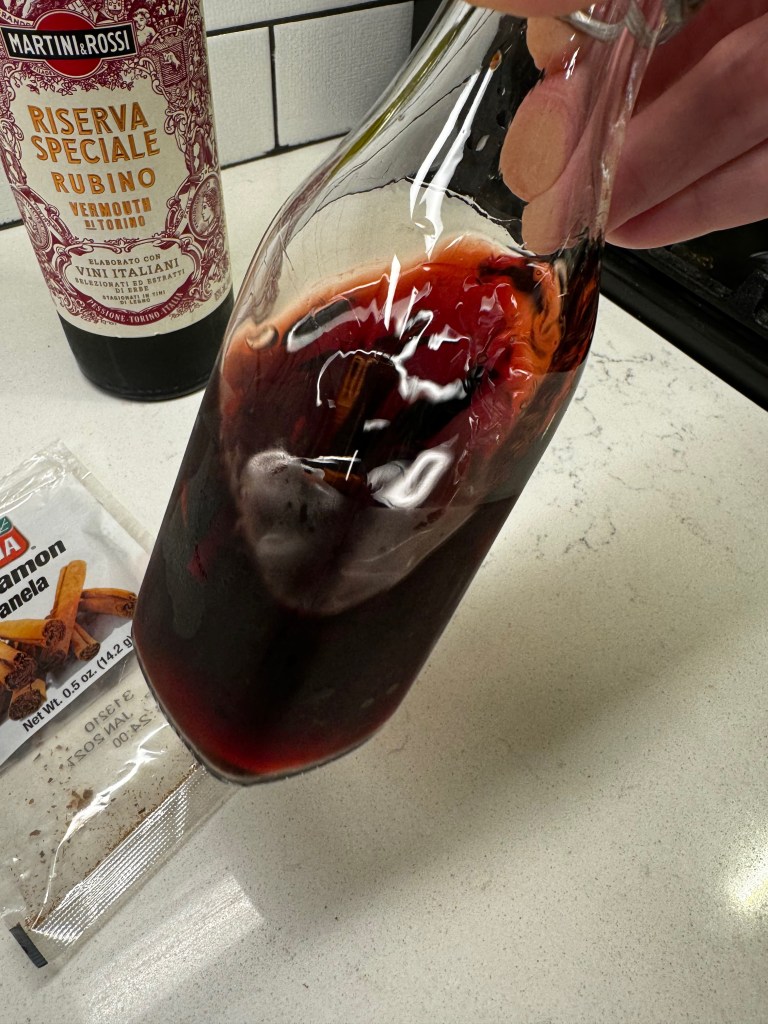
The cinnamon enters the mixing glass in the form of an infusion in the sweet vermouth, and this requires a bit of advance preparation. I added a ceylon cinnamon stick to the vermouth in a small bottle and gave it a day and a half before straining out the cinnamon and filtering the vermouth back into the bottle.


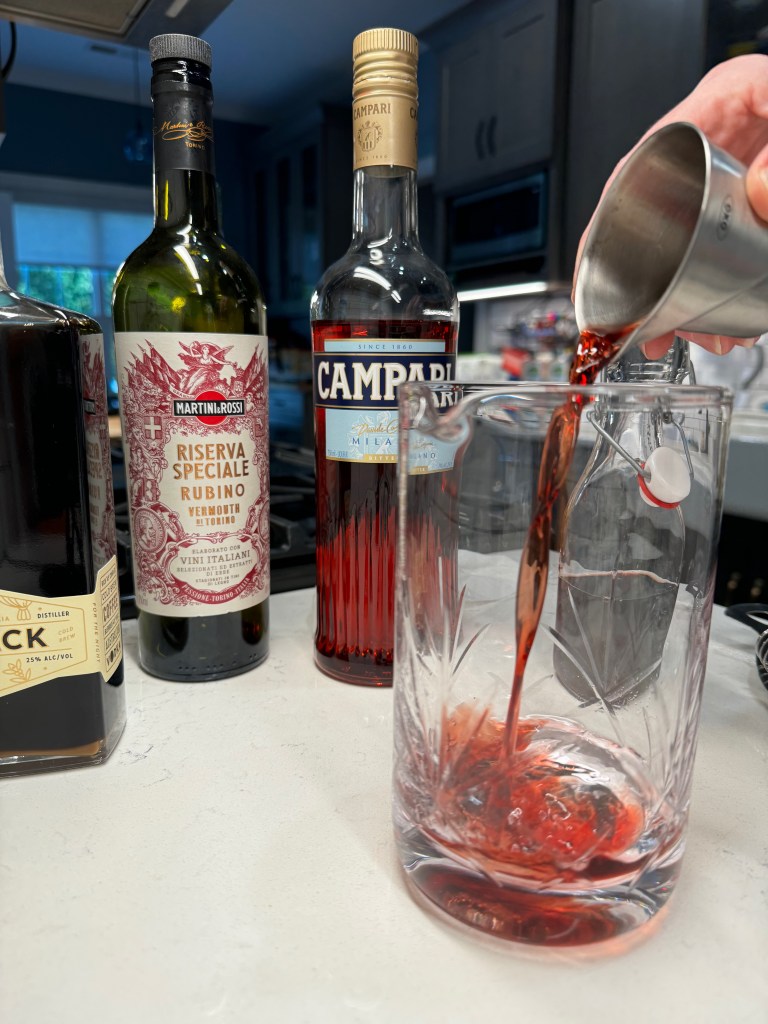
The cinnamon lends a delightful warmth to the vermouth that spices up my Espresso Negroni in the best possible way, and I cannot wait to try this in a Manhattan. My vermouth brand is Martini & Rossi Riserva Speciale Rubino. I’m willing to pay a bit more for the spicy richness and deep ruby red color of this premium vermouth. I panicked last year when our Total Wine stores stopped carrying this product, and then I remembered— it’s a fortified wine, legal in my state for online purchase. Sure enough, I hit the buy-it button on the M & R website and had two bottles shipped directly to my door within days. Thank you, internet! If you already have a favorite sweet vermouth, I’m sure it’ll be just fine.

Campari is what it is, and frankly, there is no true substitute. It is bright red, bitter and complex. Don’t be fooled by other spirits that cost less and claim to be the same— they’re not. If a Negroni riff calls for something else, then the substitute probably works with the other ingredients. But if you love the classics, or if you’re trying a Negroni for the first time, Campari is the right stuff. Also, because Campari is a presenting sponsor of Negroni Week, your purchase will help the sustainable food cause in a secondary way, even if you don’t find a bar participating in Negroni Week.

How to Make a Negroni


The traditional way to make a Negroni is to build it directly in the glass over ice, but that’s not how I like to do it at home because I prefer equal dilution of the ingredients. Here’s what I mean— let’s say you start by pouring the gin first; it’s generally room temperature and it’s going to start melting the ice immediately. If the vermouth goes in next, and the Campari at the end, both are going to be less diluted than the gin because the total contents of the glass are already cold.

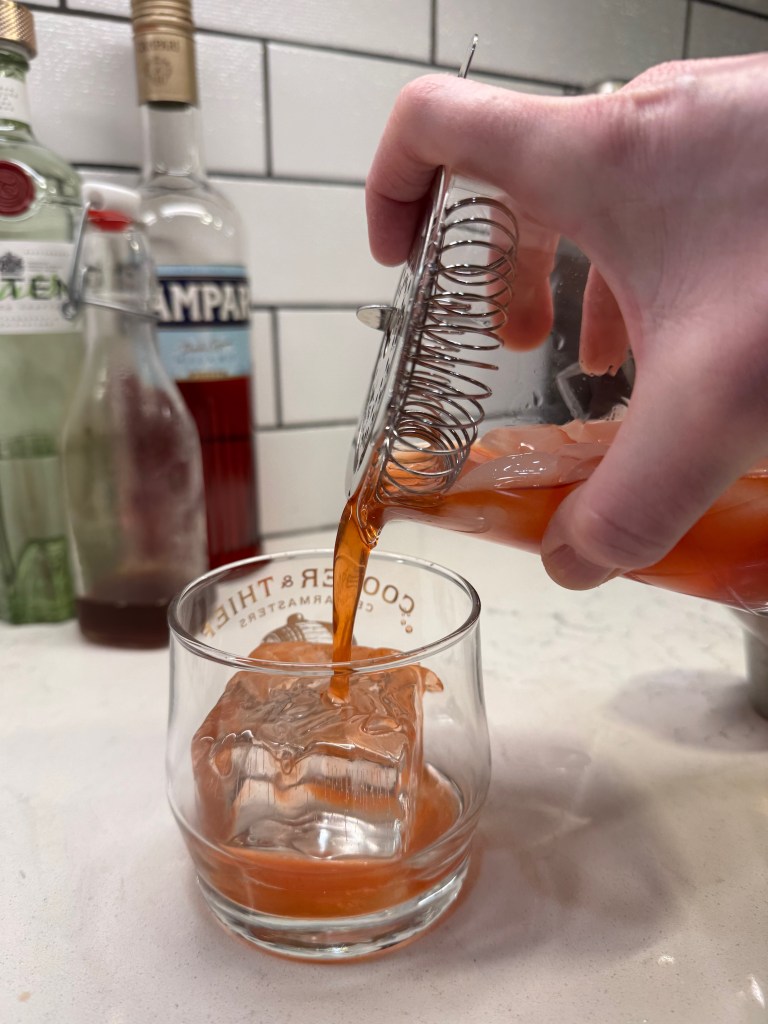
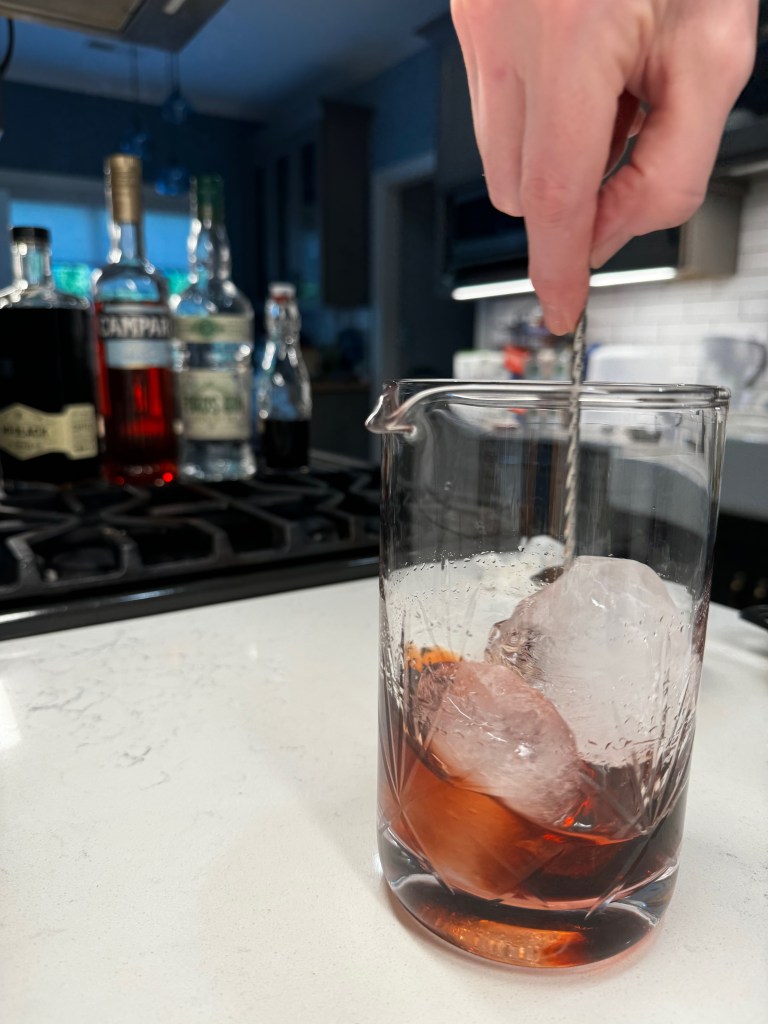
Mixing the ingredients in the glass and then adding the ice doesn’t work for me either, because my giant ice cube will melt at the bottom, creating a weird, top-heavy shape. So what’s the solution? My go-to method is to add the ingredients to a mixing glass first, then add a bunch of ice to chill the whole thing down quickly. Give it a gentle stir for about 30 seconds, or until the outside of the mixing glass is nice and frosty. Then strain it over a big cube of clear ice for a perfectly diluted, evenly chilled cocktail.


Cinnamon Espresso Negroni

  • Servings: 1 cocktail
  • Difficulty: Average
  • Print

For Negroni Week, I am sharing my own favorite variation including espresso liqueur and my favorite autumn spice. Infusing the sweet vermouth with cinnamon lends a warm, familiar flavor to the classic Italian cocktail.


Ingredients

  • 1 oz. London dry gin
  • 1 oz. cinnamon-infused sweet vermouth (recipe below)
  • 1/2 oz. Campari
  • 1/2 oz. Mr. Black cold brew coffee liqueur (see notes for substitution ideas)
  • 1 cup ice
  • Orange slice for garnish

Notes: If you cannot find Mr. Black liqueur, you may substitute another coffee liqueur, but note that most of them are sweeter and this will change the outcome of the drink. My suggestion would be to sub in an equal measure of cold brew concentrate, which you can find in the coffee aisle of the supermarket.

Directions

  1. Add gin, vermouth, Campari and coffee liqueur to a cocktail mixing glass. Add a generous amount of cracked ice and stir about 30 seconds for proper dilution and chilling.
  2. Strain over a large, clear ice cube into a double rocks glass. Garnish with the orange slice.

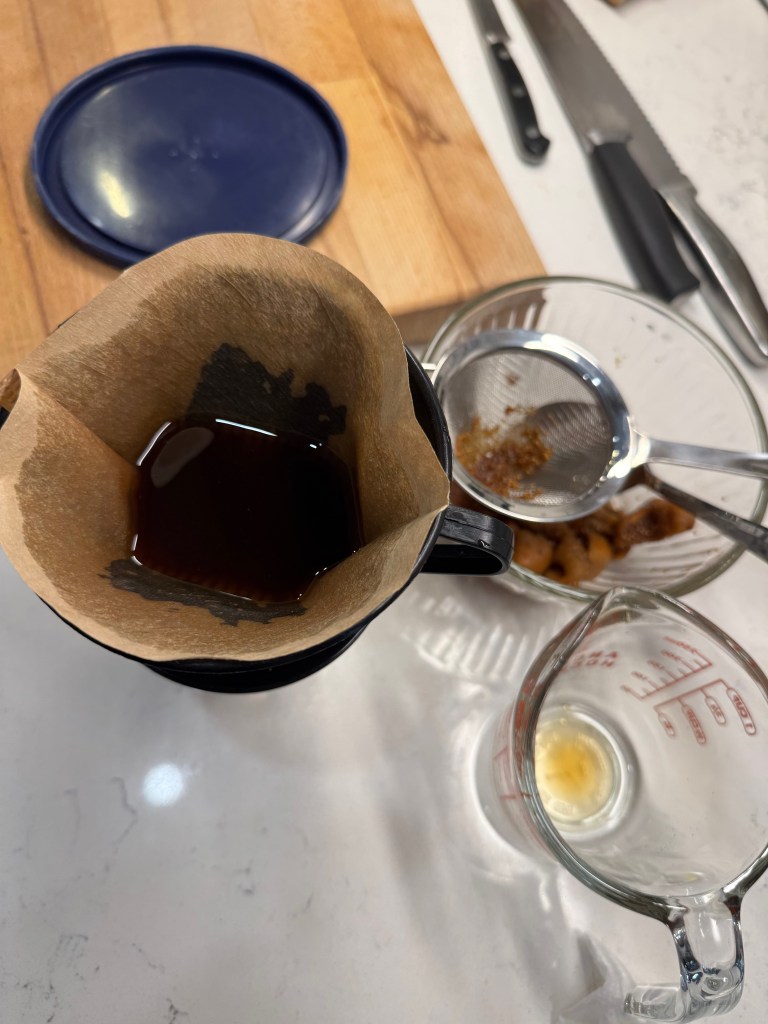
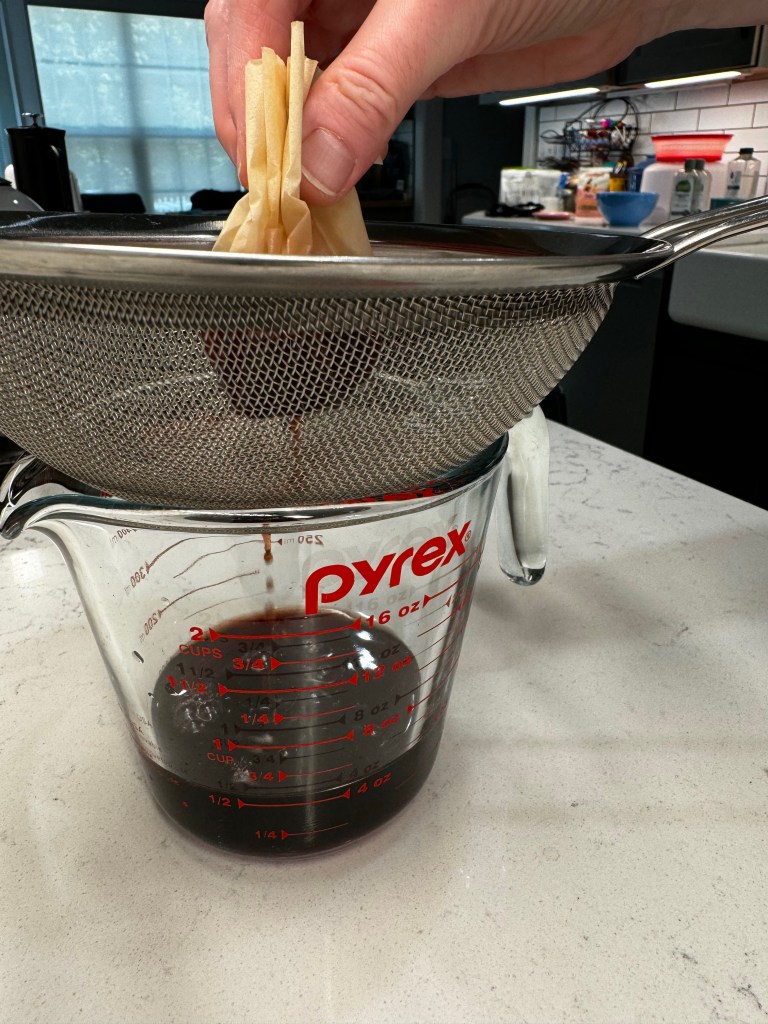
For the cinnamon-infused sweet vermouth: measure out six ounces of vermouth into a mixing bottle or clean jar. Add a 3-inch piece of whole cinnamon stick and infuse 24 to 36 hours in the refrigerator (where vermouth should live anyway). Strain out the cinnamon stick and any lingering shreds through a coffee filter-lined mesh strainer; return the vermouth to the bottle or jar and keep in the fridge for up to two weeks. This will be enough for six Negroni cocktails.


Summer Tomato Water Martini

The truth is, I have been fiddling with this martini since before my own garden-fresh tomatoes came to fruition. My first effort was accidental, right after my husband and I had returned from a vacation at the end of last summer. It was good, but kind of a one-off thing and I didn’t give it much thought. Months later, it popped up in my news feed—on Epicurious or Food 52 or, honestly, I don’t know where—and it sucked because it was February or March and I had to improvise because there were no garden fresh tomatoes available. So let me get this out of the way early: do not try this with grocery store tomatoes. Trust me on this.

Fast forward to mid-August, when fresh, homegrown tomatoes are available everywhere, from your own garden or the farmers’ market, and that makes a world of difference. The flavorful liquid that seeps out of those freshly sliced, vine-ripened tomatoes is absolutely begging to be part of a cocktail. If you love summer tomatoes and you are up for a fun martini experiment, this is for you!

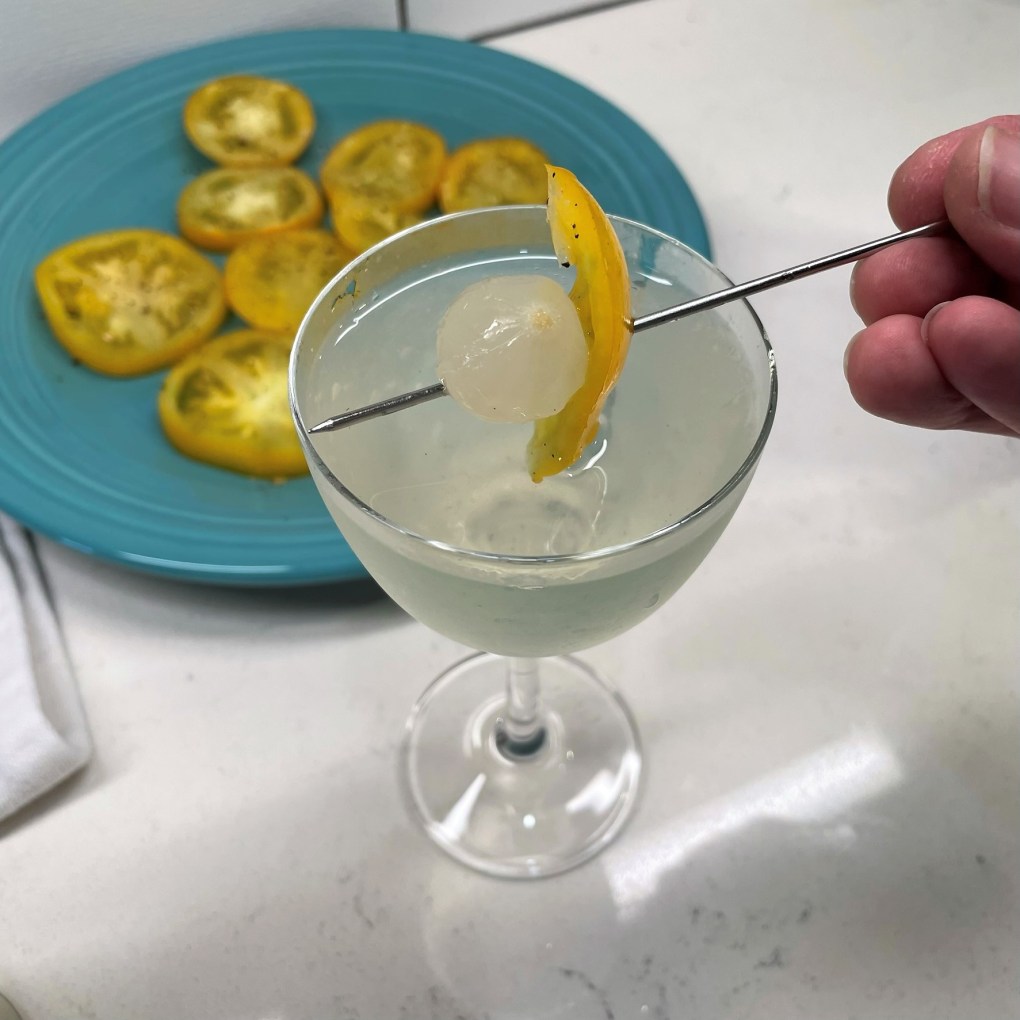
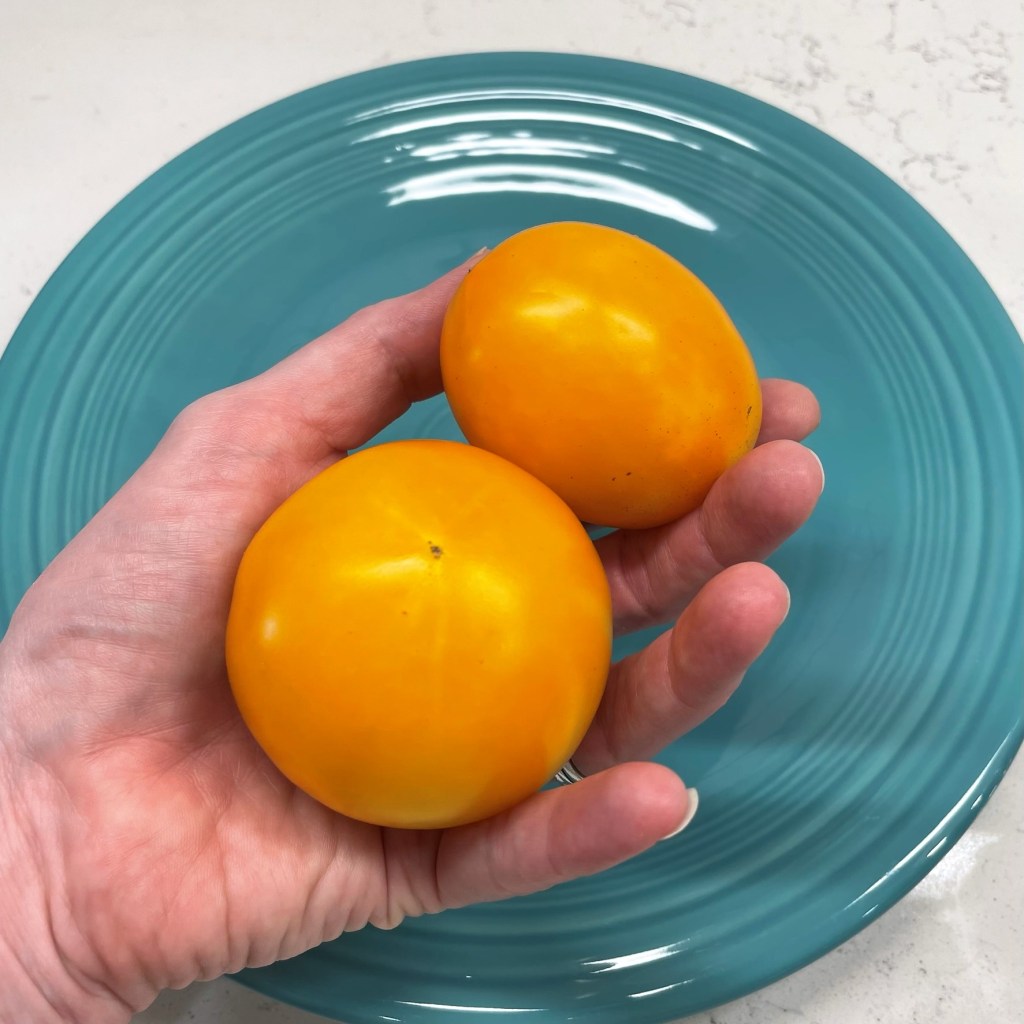
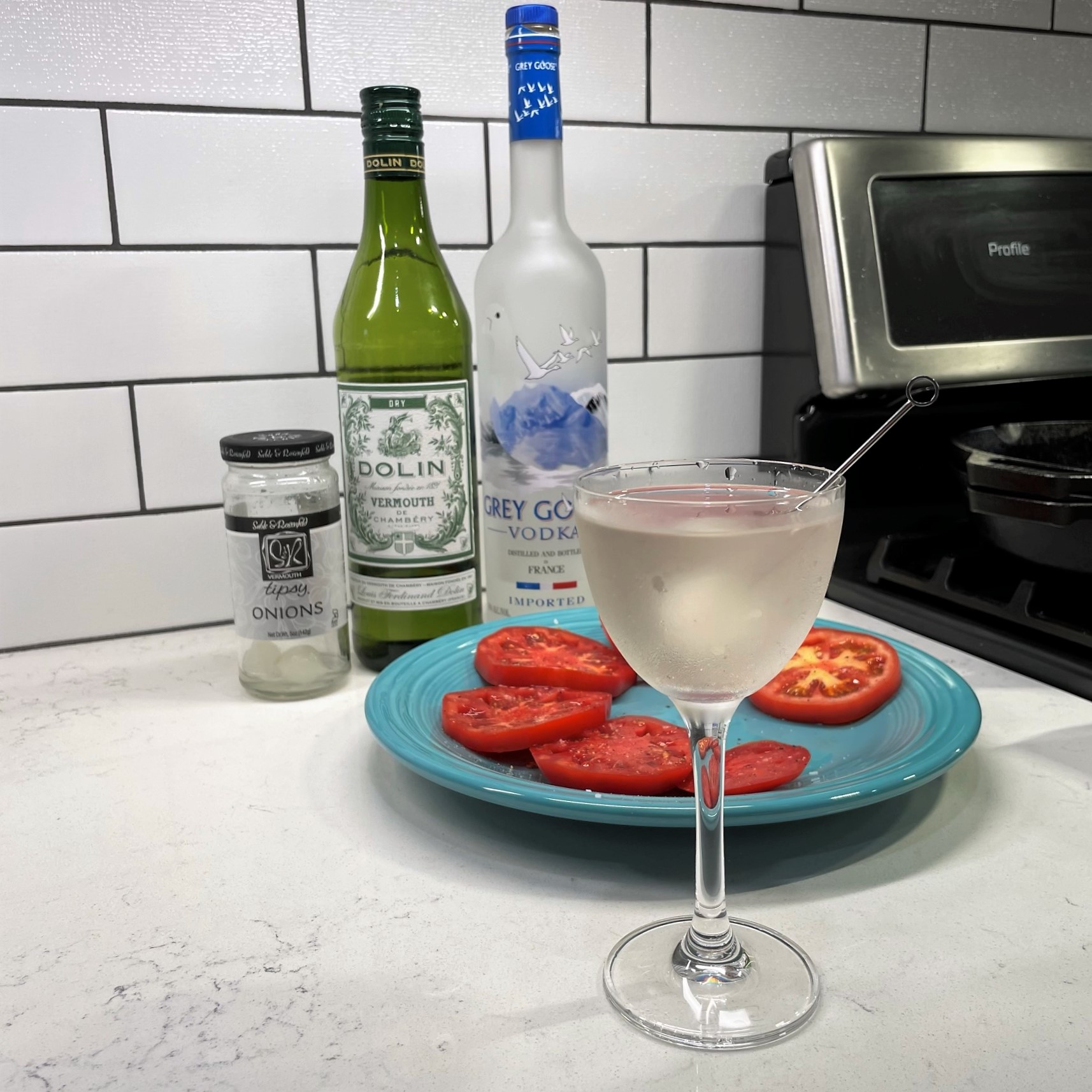
I’ve made this cocktail with red heirloom variety tomatoes, yellow tomatoes, vodka and gin.
Try them all to find your favorite!

When the local growers started selling a few heirloom tomatoes at their market stands, I tried this idea again, and it was so much better. The red heirlooms are so juicy and sweet, and the success of this martini twist gave me even more reason to be excited about my own harvest of heirloom and yellow tomatoes. And here we are. 🙂

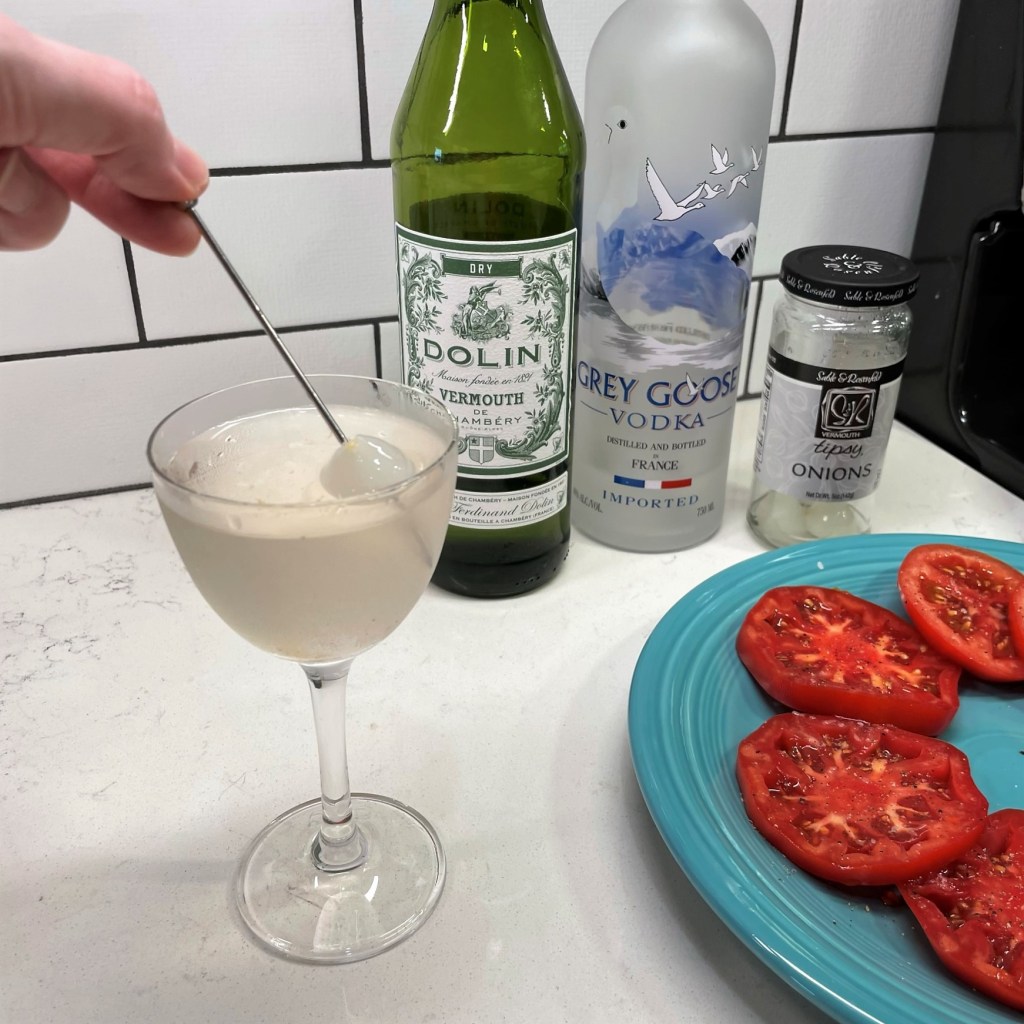
Regardless of the type of tomato you use, the unique sweetness and acidity will add an exceptional brightness to a martini. I have tried this with both gin and vodka, and a variety of spirit-to-vermouth ratios. It’s good many different ways, so my recommendation is to try it yourself to find the balance that is perfect for you. My personal favorite (at least this week) is made with top-shelf vodka, in a 4-to-1 ratio with dry vermouth, no bitters and at least 1 part seasoned “tomato water.” A full description with amounts is at the end of the post, in a click-to-print recipe card.

But for now, watch to learn:

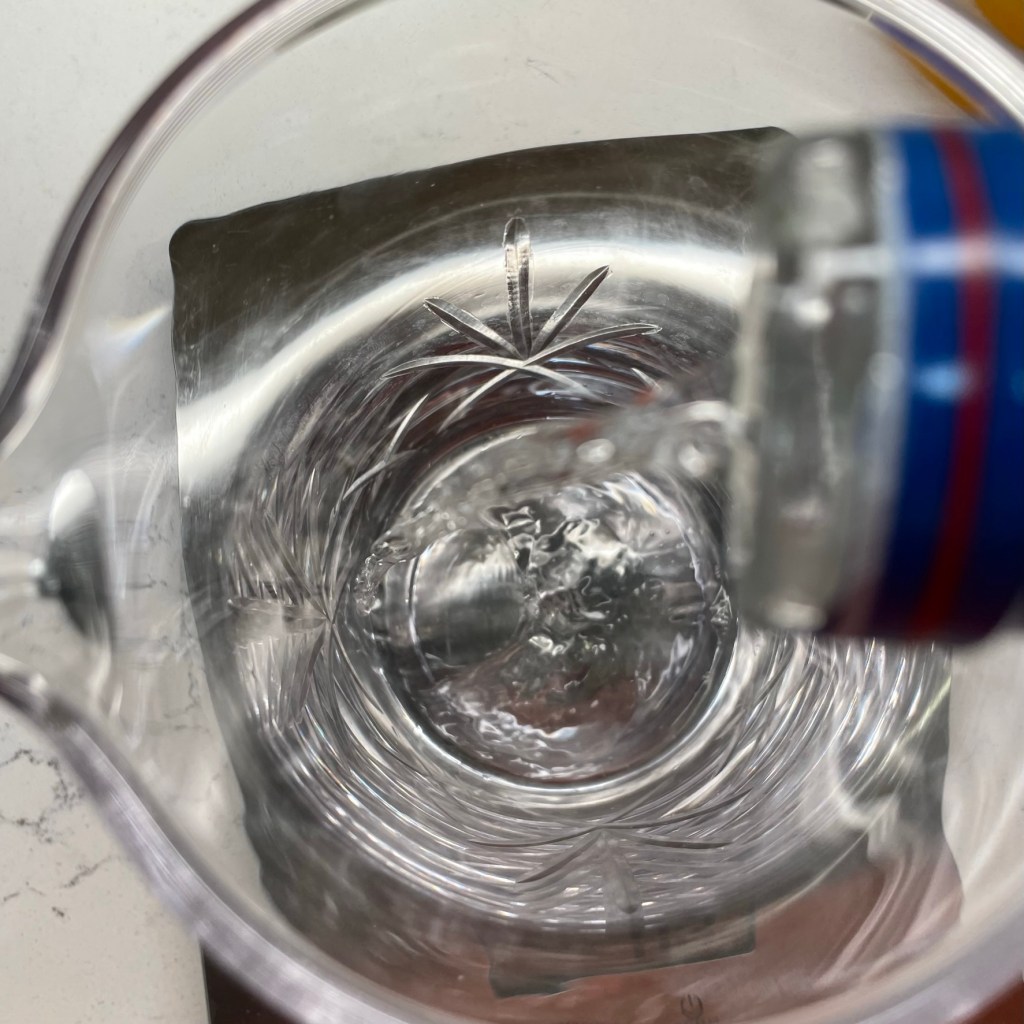
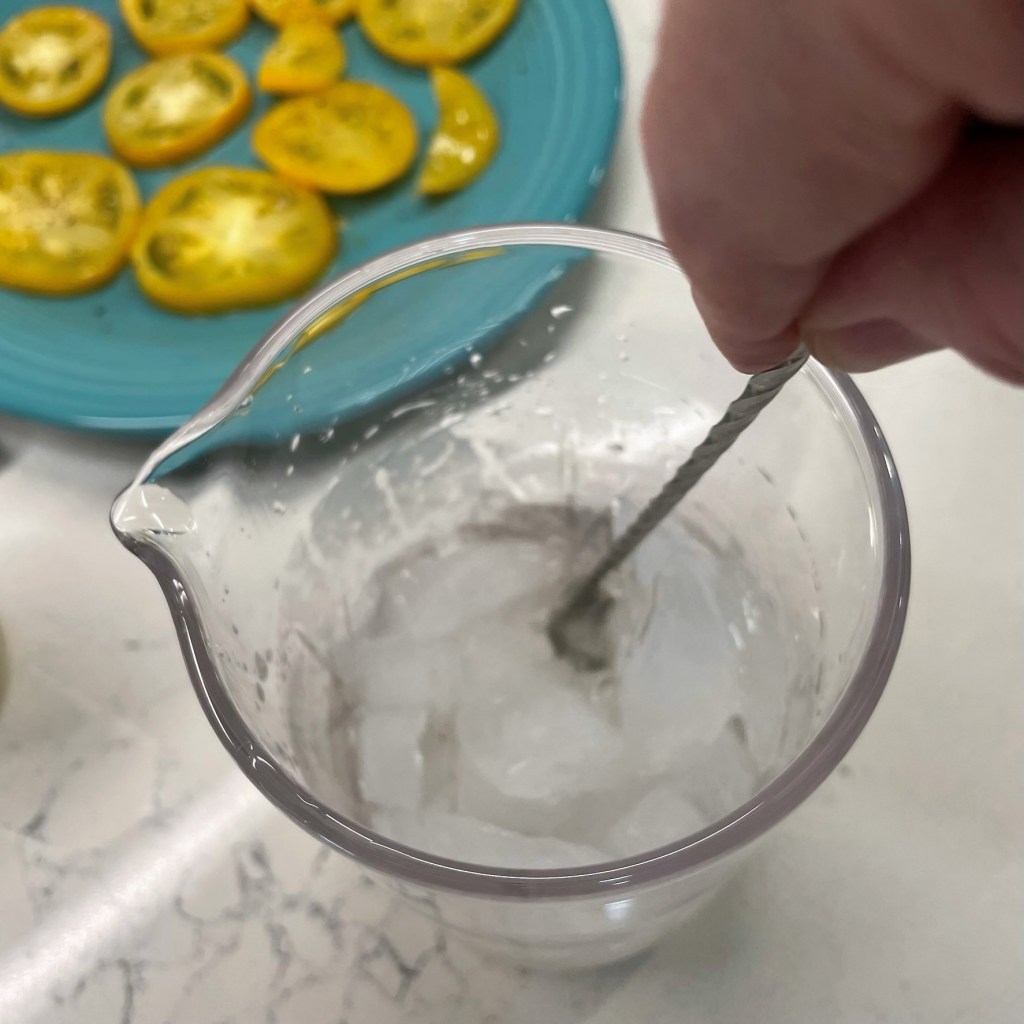
Wash and slice a ripe, room-temperature tomato (or several, depending on what you need them for) and arrange the slices on a plate. Sprinkle with a fair amount of sea salt and freshly cracked pepper (don’t skip this!) and walk away for about 15 minutes. What you’ll find when you return is a plate full of beautifully seasoned tomato water underneath the slices. Use the tomatoes for whatever you wish—a tomato sandwich, perhaps—but don’t toss that tomato water! Carefully pour it off into a shot glass or small bowl, grab your martini fixins and chill down your glass with ice and water.


Measure your vodka (or gin) and vermouth into a cocktail shaker or mixing glass. Add the tomato water to taste. I have discovered that you need at least a tablespoon to really savor the flavor it adds to the drink. If you see excess moisture on top of your tomato slices, drain that off into the mixing container as well. Add a generous cup of ice cubes and shake or stir to chill the cocktail.


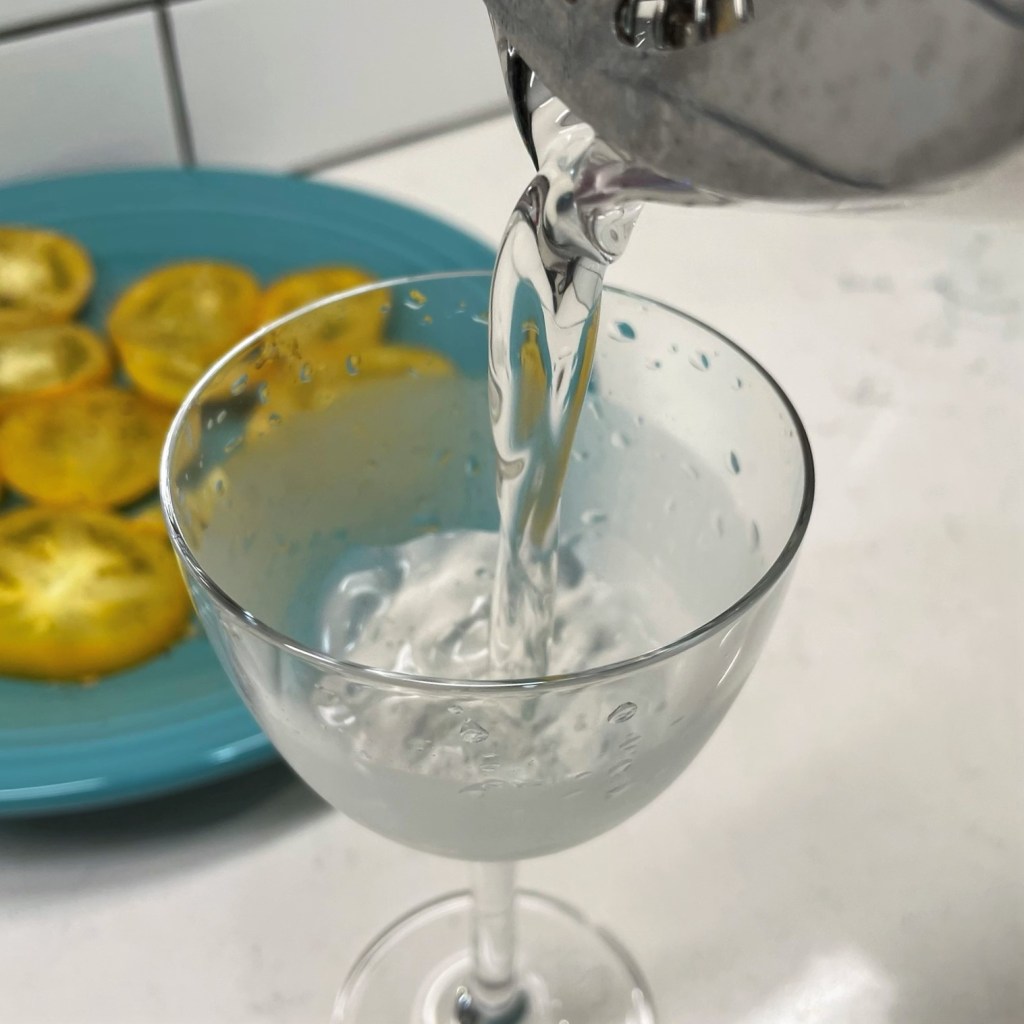
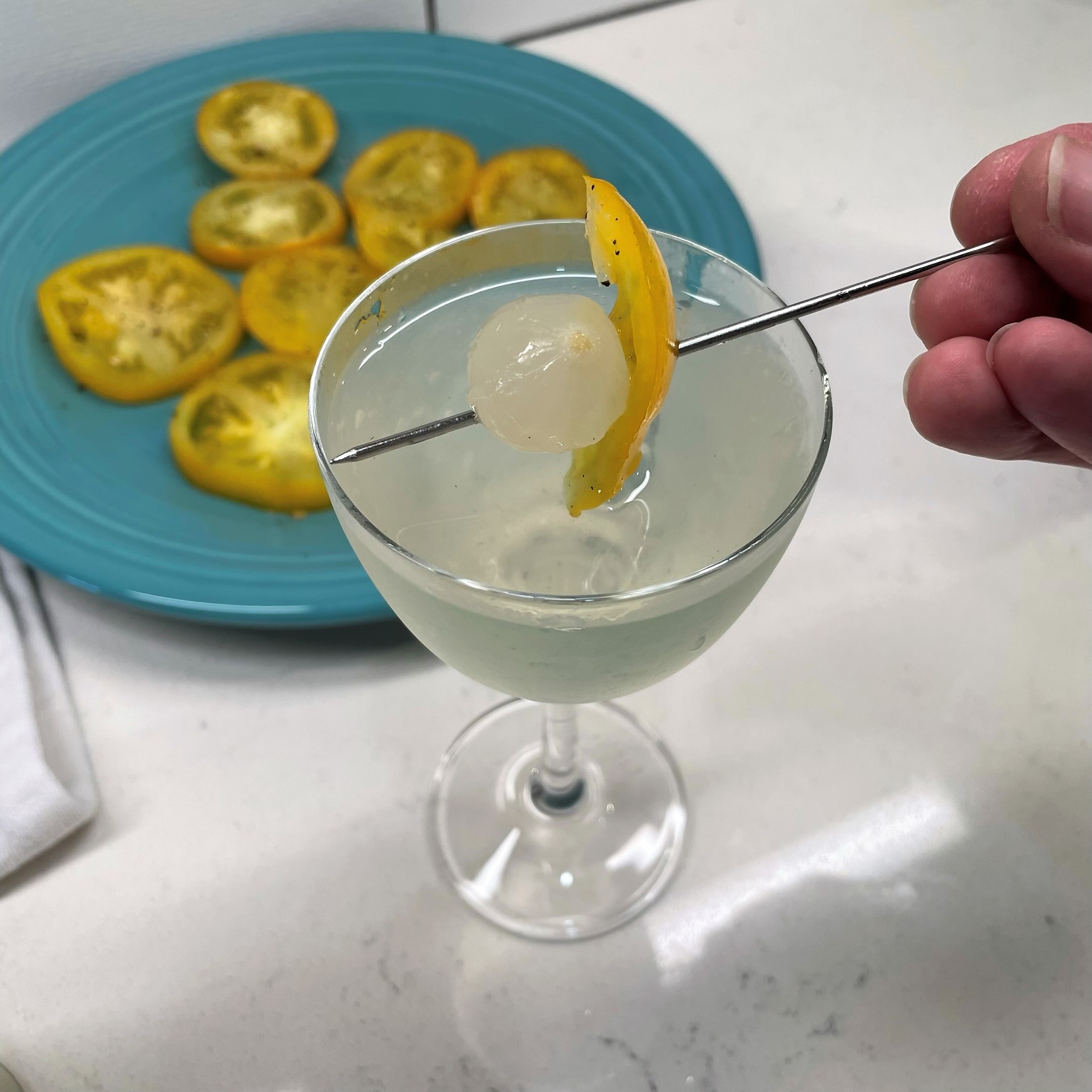
Empty the ice water from your chilled glass, and immediately strain the martini into the glass. Garnish with a pickled cocktail onion or olive, and a small piece of tomato if you wish.

Cheers to summer!

Summer Tomato Water Martini

  • Servings: 1 cocktail
  • Difficulty: average
  • Print

This super-simple twist adds a bright, fresh, summery flair to an otherwise classic martini cocktail, and I have found myself slicing up tomatoes just so I can make another one.

Ingredients

  • 1 ripe, garden fresh tomato (any variety, but heirloom is best)
  • Sea salt and freshly ground black pepper
  • 2 oz. good vodka (I have used Grey Goose and Ketel One with terrific results)
  • 1/2 oz. dry vermouth (my fave here is Dolin)
  • 1/2 to 3/4 oz. seasoned tomato water
  • 1 cup ice (for mixing)
  • Pickled cocktail onion, olive and/or piece of tomato (for garnish)

Directions

  1. Slice tomato and arrange the slices on a plate or shallow bowl. Season with salt and pepper and let rest about 15 minutes. Chill martini glass with ice and cold water.
  2. Add vodka and vermouth to a cocktail shaker or mixing glass. Transfer the tomato slices to another plate, or use them in a salad or sandwich. Drain the remaining tomato water into a small bowl or shot glass. Measure at least one tablespoon of it into the cocktail glass. Add ice and shake or stir until chilled.
  3. Empty ice water from the chilled glass. Strain the cocktail into the glass and garnish as desired.
  4. Repeat at least twice per week until all the tomatoes are gone.


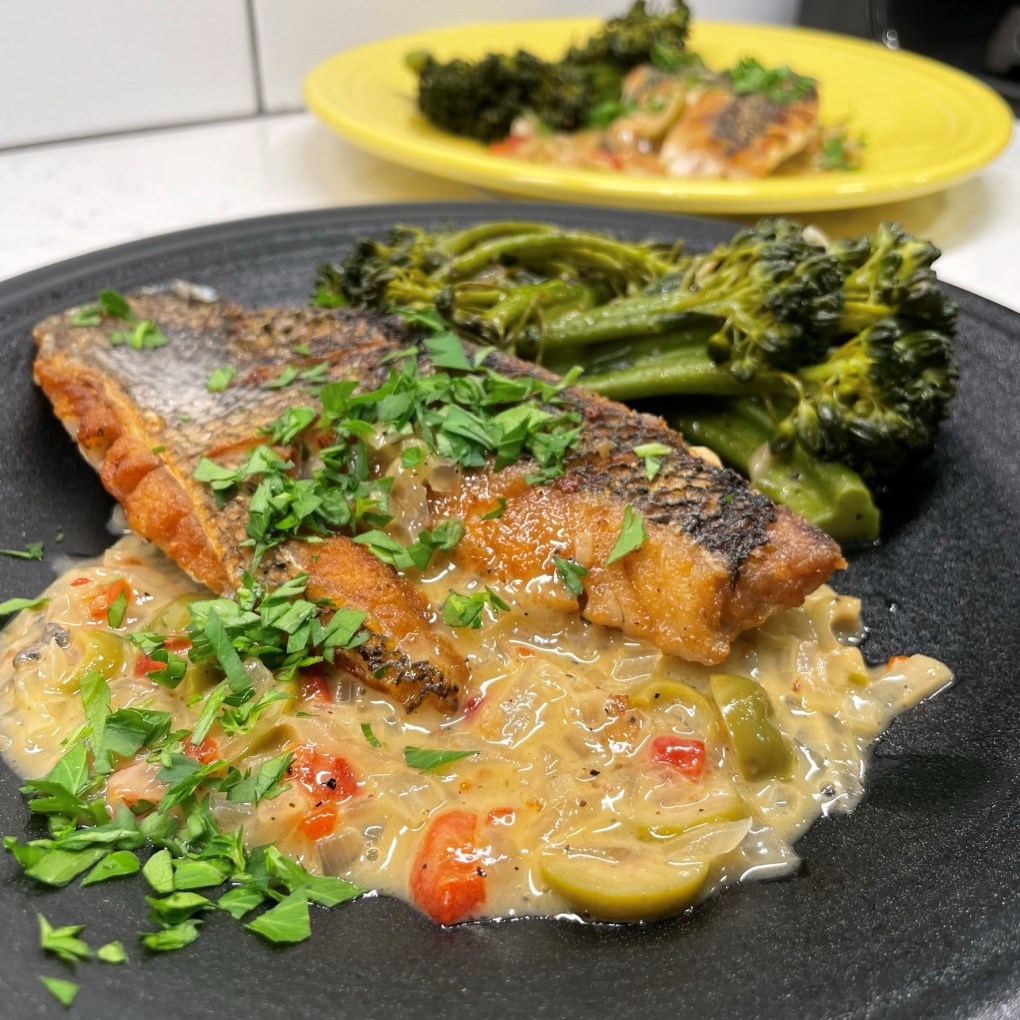
Black Sea Bass with Dirty Martini Butter Sauce

I’ve lived in and around Winston-Salem for 35 years, and from the day I arrived as a fresh-faced 20-something, I’ve explored every corner and tried every restaurant and sought out all the specialty shops in a quest to satisfy my food-loving soul.

Or so I thought.

A few years ago, some friends of ours made mention of Sea Products, a hidden gem that has been in business three years longer than I’ve been here, and their recommendation has changed my life. OK, that’s probably a bit overstated, but it has definitely changed my seafood game for the better.

I love stepping into this little shop in the West End of my city. It smells like the ocean in the best possible way and is always amply stocked with fresh seafood—mostly from our own coastline, but sometimes from as far as Canada—and all kinds of accoutrements for whatever preparation you have in mind for your fresh catch. Sea Products throws in a fresh lemon with every seafood purchase, and sells housemade tartar and cocktail sauces, side salads in ready-to-go containers, and fresh breads from a local bakery. They even have a small, curated wine selection, and every bottle pairs with fish. It’s a one-stop shop, and I am a proud supporter of local businesses such as this. The selections are always interesting, to the point that I don’t even bother making a shopping list.

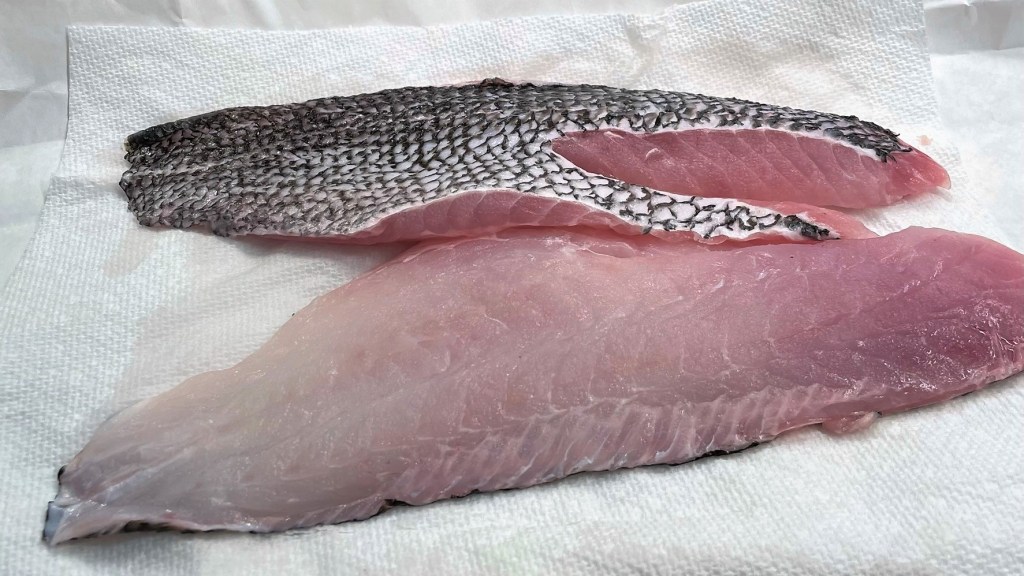
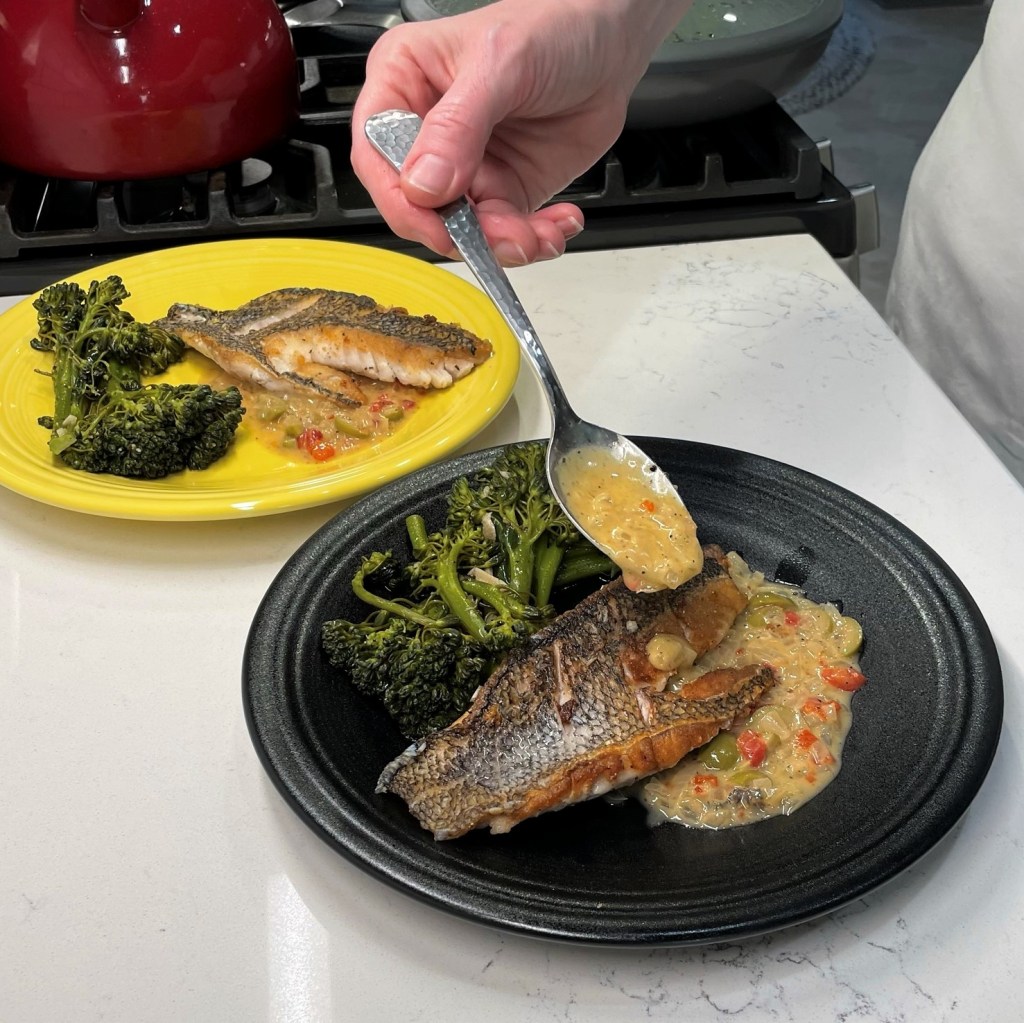
What would it be this day—fresh shrimp, clams or scallops? Pre-made crab or fish cakes? Halibut or grouper? And then something caught my eye from the corner of the case, a fish that I hadn’t seen on previous visits. Black sea bass. The clerk described it as “mild and flaky, similar to snapper but a touch sweeter.”


I am always interested in trying new fish, and thought it made sense to pair the unfamiliar black sea bass with flavors we already knew. OK, I thought, piccata sauce. It’s light enough to let the flavors of the fish shine, and both my husband and I like the balance of brine and tartness, softened by the butter that’s swirled in at the end of cooking. Piccata was the plan, at least, until I opened the fridge. As I shuffled jars to reach the capers, my eyes locked in on a taller jar of pimento-stuffed cocktail olives. Ooh, a martini would be nice right now, I thought.

And then, hmmmm.

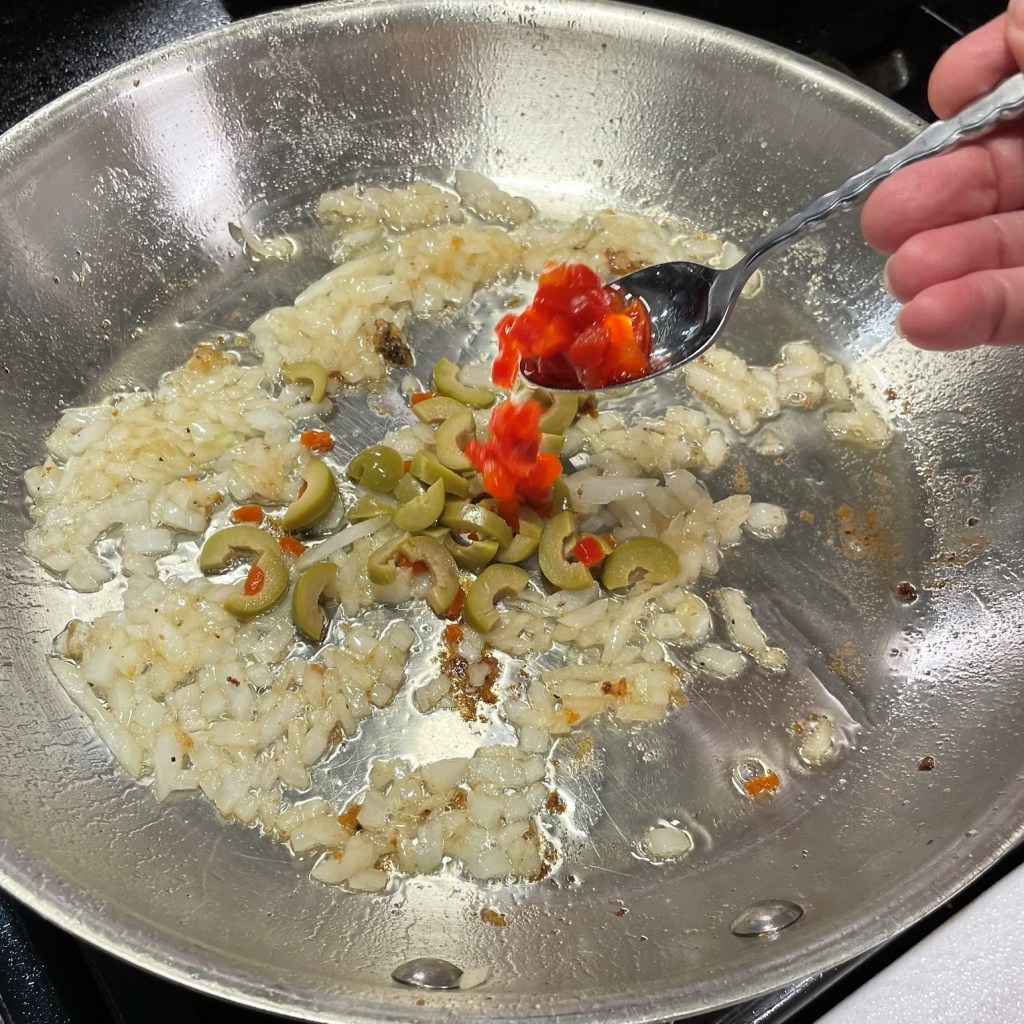
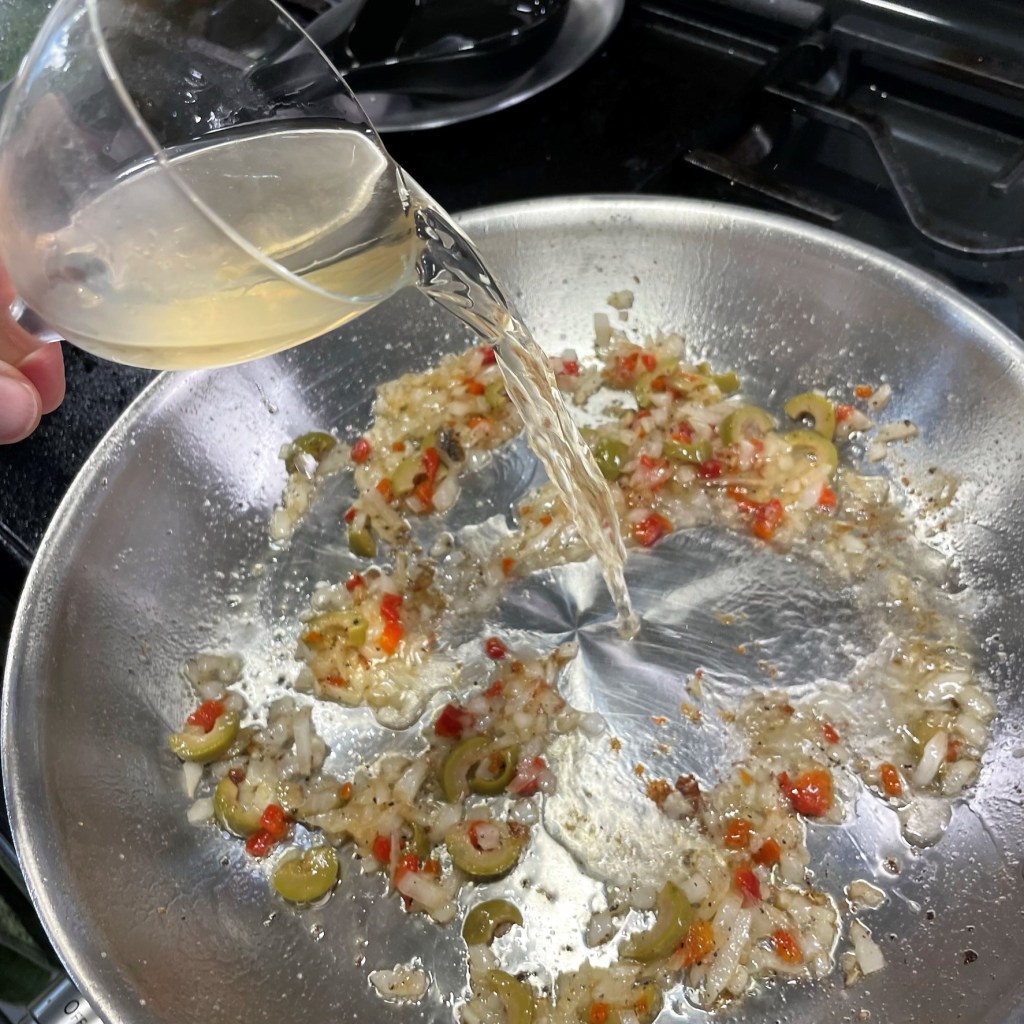
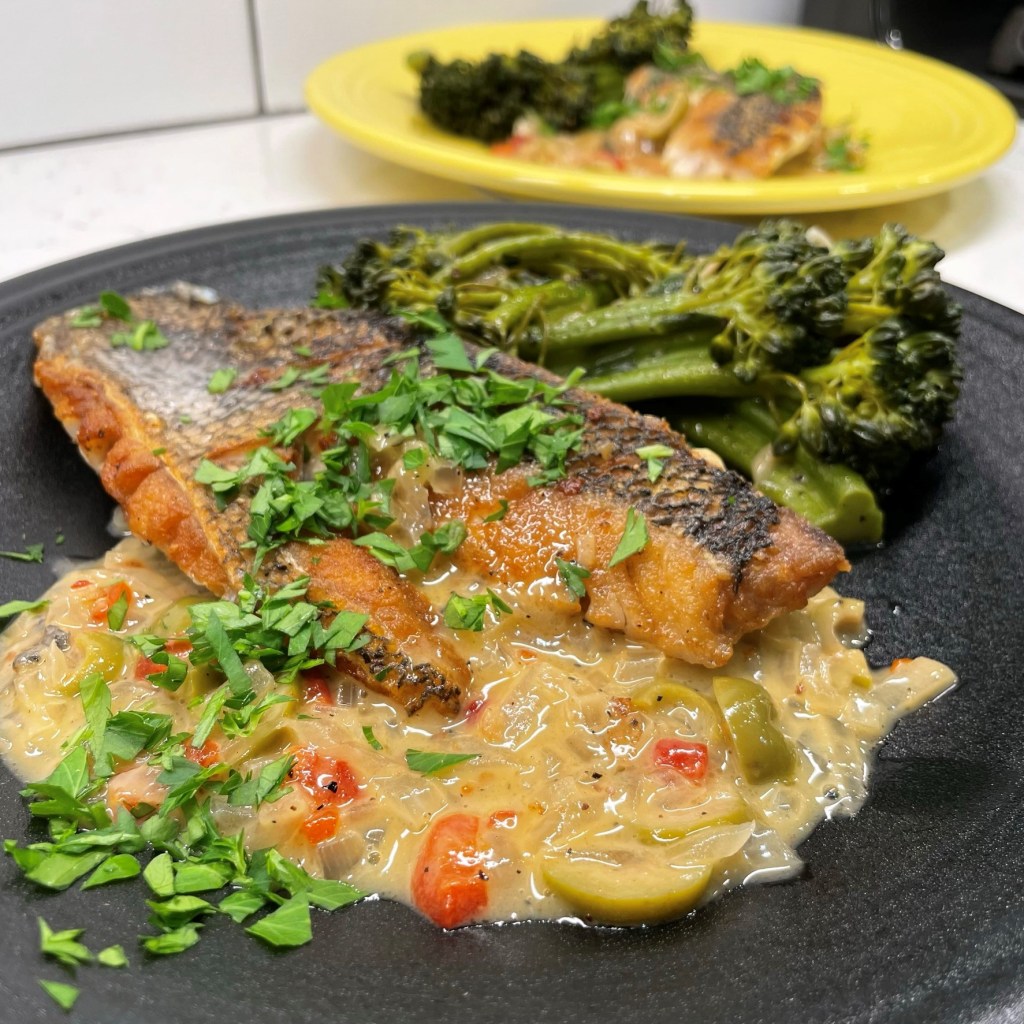
I could not help but wonder what would happen if I made the olives an understudy to the usual capers. And because savory olives work so nicely in a martini, what would happen if I substituted gin and vermouth for the white wine in my piccata? Well, this happened!

Black Sea Bass with Dirty Martini Butter Sauce

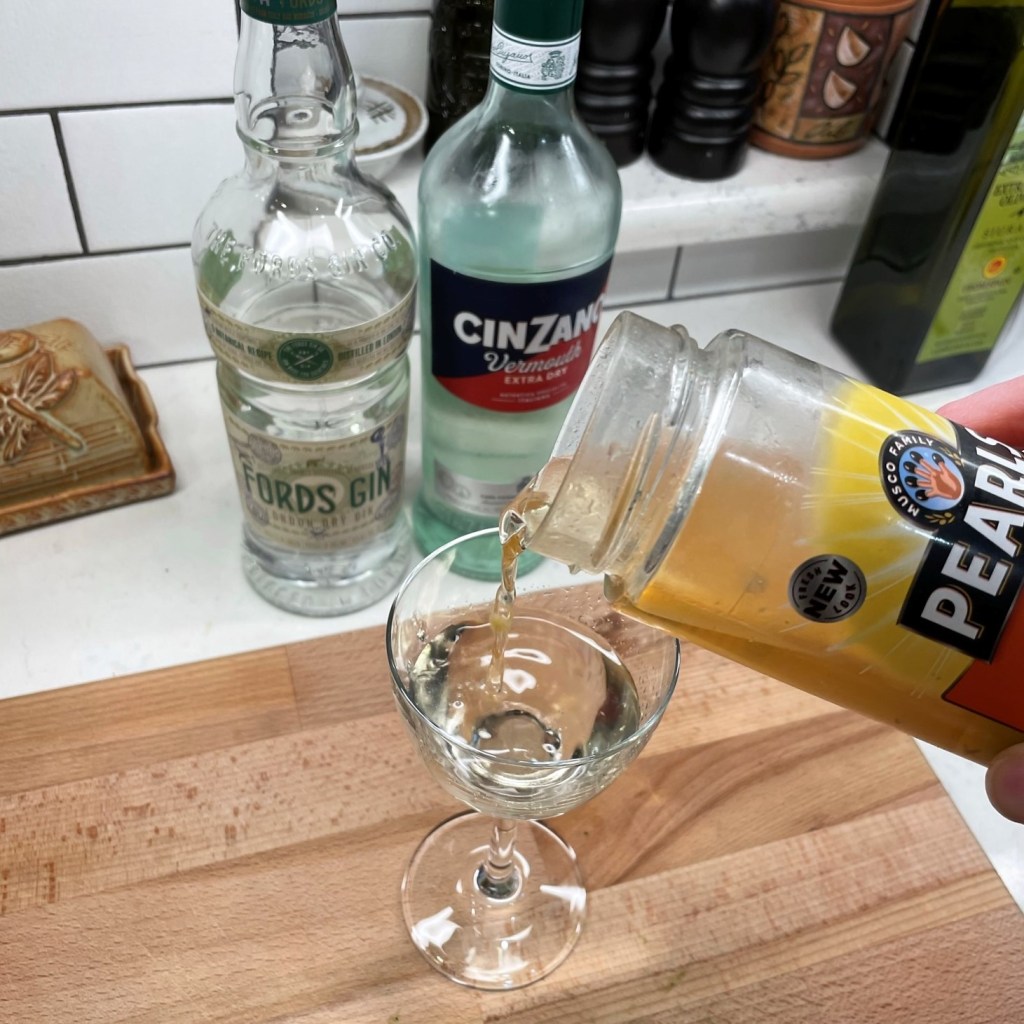
Technically, the alcohol infusion I’ve used here is what a bartender would call a “reverse martini,” because the ratio of gin to vermouth has been flipped. This seemed the right thing to do, not only because my husband is decidedly not a gin lover, but also for the fact that gin is much higher alcohol by volume than white wine. Dry vermouth, on the other hand, is on par with wine, alcohol-wise, and it would be a better flavor choice to highlight the olives without over-boozing the fish. Finally, my splash of olive juice was far more generous than I’d ever drink in a cocktail (I used a full ounce of it), so a bartender would probably declare the drink infusion to be a “filthy reverse martini.” Filthy indeed.

Two olives in a martini is said to be bad luck. One wasn’t enough, I went with three! 😉

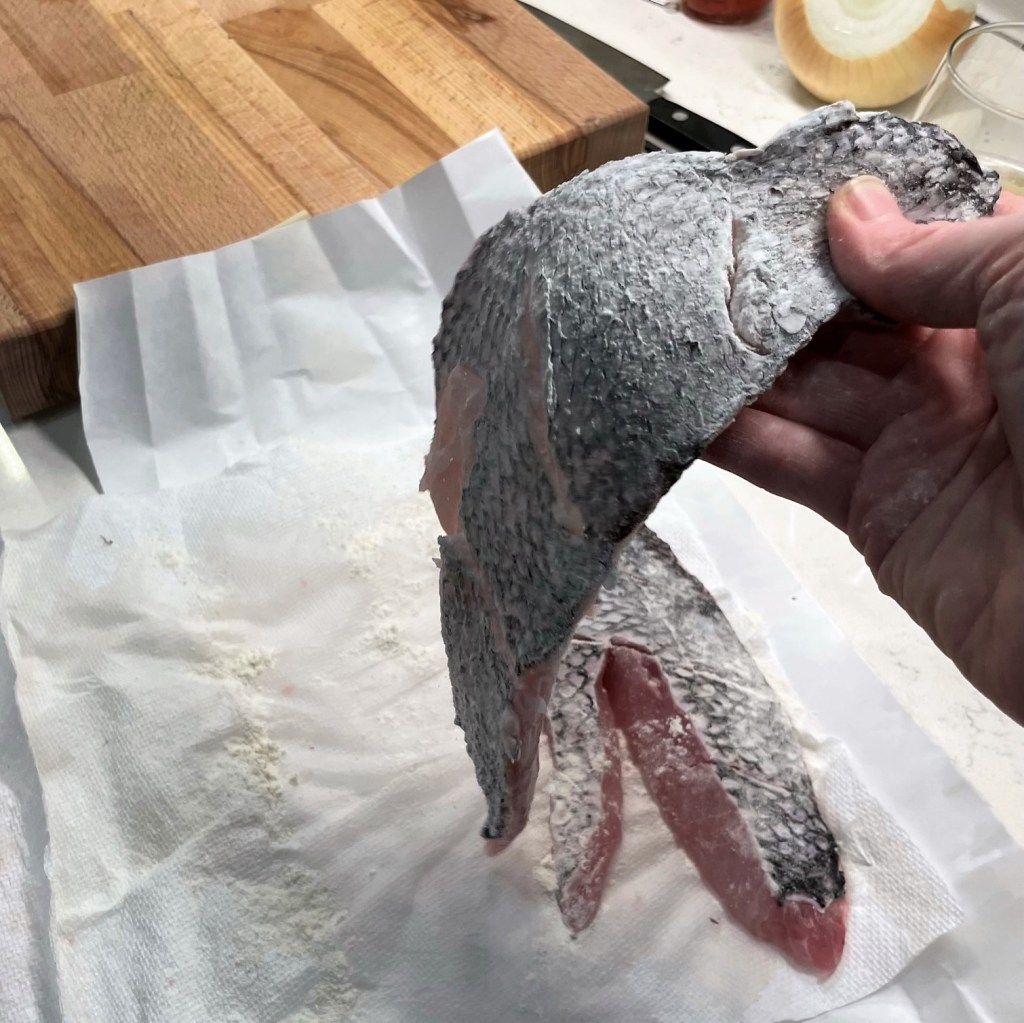
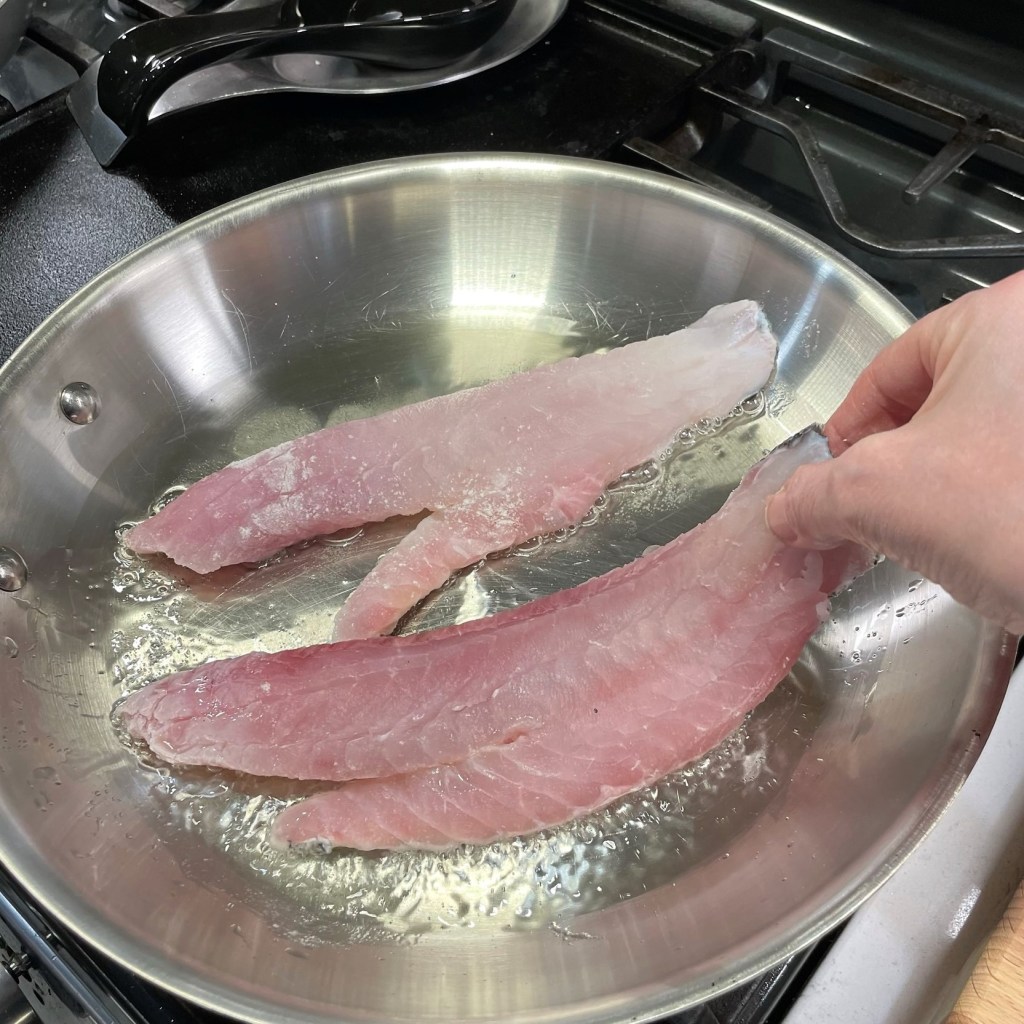
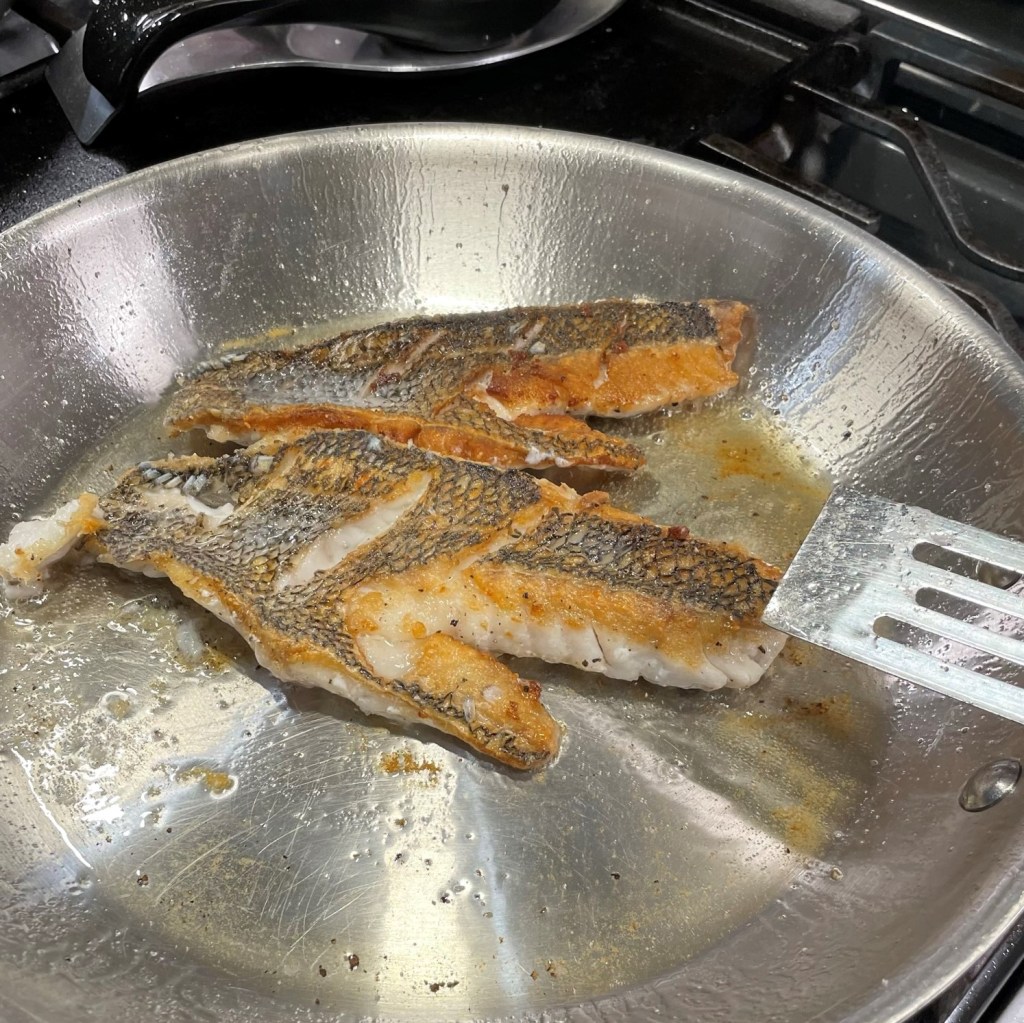
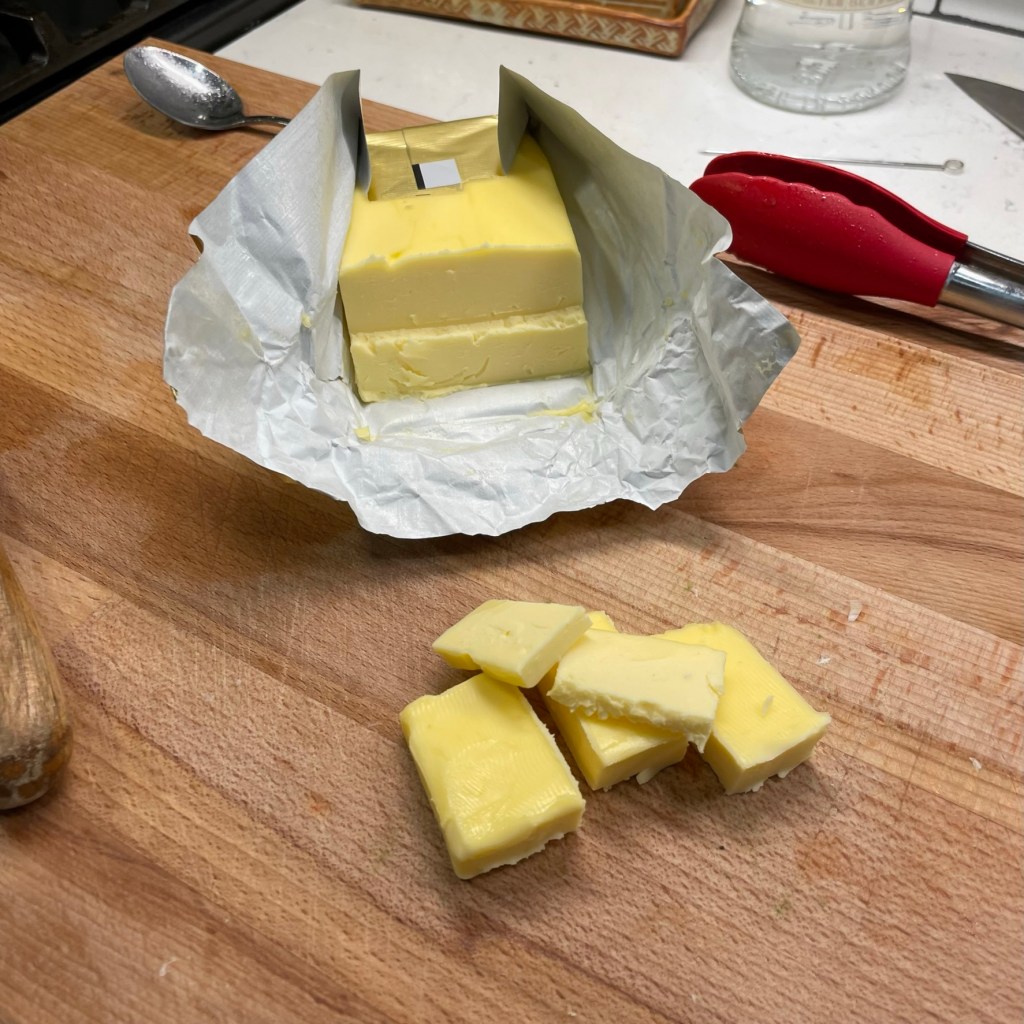
So, those are the flavors and here comes the technique. If you have ever marveled at the elegance of a butter sauce on fresh seafood, you may find it surprising to know that it is simple to make. The trick is to remove the pan from the heat as soon as the juices are reduced, and to swirl cold-from-the-fridge pats of butter into the sauce, one at a time. This easy technique transforms the otherwise liquid leavings in the pan into a silky, rich sauce.

Come, join me in the kitchen!


Ingredients

2 fillets fresh black sea bass (or other mild, flaky whitefish)

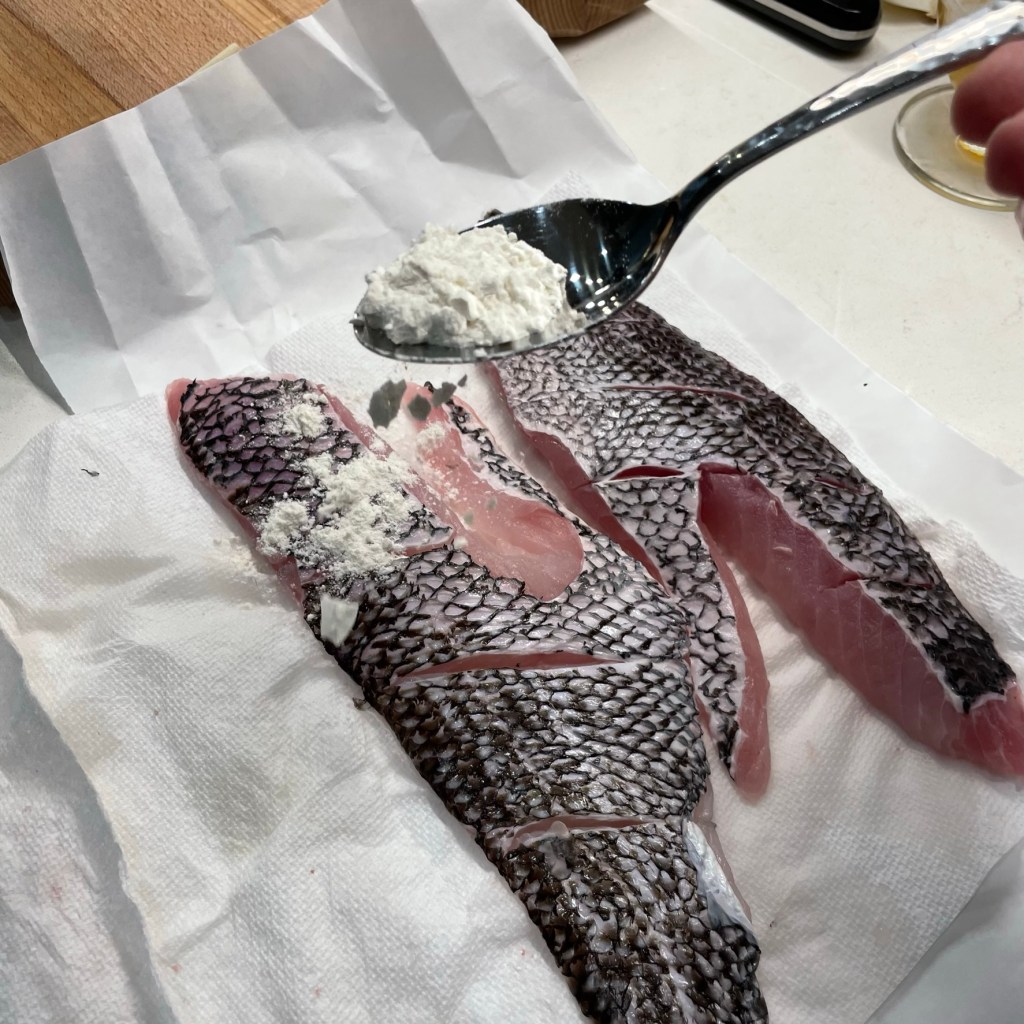
1 Tbsp. all-purpose flour

2 Tbsp. canola or other neutral oil

1 Tbsp. extra virgin olive oil (a rich, fruity one is great)

1/2 medium onion, diced (about 1/2 cup)

1 reverse filthy martini* (see note below)

1 heaping tsp. pimentos from a jar

3 Tbsp. completely cold butter (for swirling in at the end)

Small handful of fresh parsley, chopped (for serving)

Lemon wedge (to squeeze at serving time)


*Notes

Reverse martini ingredients are 1.5 oz. dry or extra-dry vermouth, .5 oz. gin, 1 oz. olive juice, 3 olives. Do not shake or stir the martini with ice, as you would for drinking. Just combine the ingredients in a glass or measuring cup at room temperature. Chop or slice the olives and set them aside.

If you don’t care for gin, swap it for vodka or omit it altogether.


Instructions


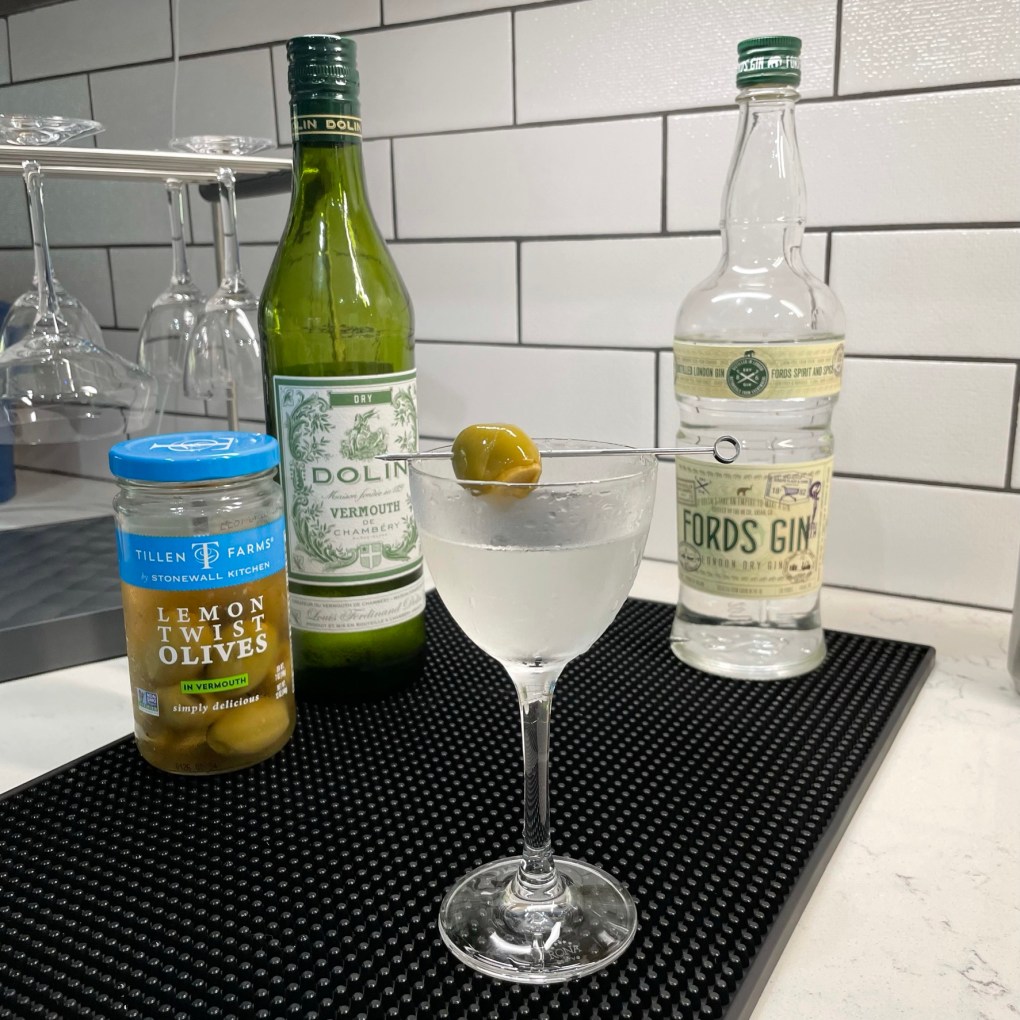
My Favorite Martini

One might look with suspicion at the photos on my smartphone, especially if they didn’t know my backstory or my penchant for showing, rather than telling, what is happening in my life. As I was scrolling my photo roll the other day—looking for a random image of what, I don’t remember—I noticed that I frequently snapped images of mainly three things: bread dough, cats and martinis. Alrighty, then.

Cats have been part of my world for as long as I can remember, and apparently even longer, as I even have a photograph of myself as an infant, with a black and white cat right next to me—a guardian angel, no doubt. Many cats have graced me with their presence and their trust over my lifetime, and I am fascinated by their expressions, their agility and their overall adorableness. I try in vain to capture their essence.

Bread dough has played a major role in my recent life as well, especially after the “birth” of my sourdough starter in 2016. I am fascinated by the development of dough, and humbled that I can be part of the magic that happens in it. I make a lot of bread and I take a lot of pictures of that process.

So what about martinis, and where do they fit in as a most-photographed item? I realized, upon closer inspection, that most of my martini pictures were taken right around 4:30 p.m., the time of day I would regularly wish my Aunt Joy a happy “Happy Hour” across the miles that separate us. However did we manage before texting?

An afternoon martini helped me navigate some of the madness during our kitchen remodel.
Gotta love that blue tape on the door.

In previous years, my happy hour libation would have been a simple glass of wine, and occasionally enjoyed at a wine bar with a girlfriend. But COVID changed everything, and with so much time on my hands for experimenting, the cocktail has had a real renaissance moment at my house. I have dabbled in mixology, trying out different spirits and techniques—even investing in the correct glassware—and my new favorite is definitely the martini. It is simple, but refined. It goes down easy, but not too easy.

I suppose my grandmother had a little something to do with martinis being my chosen cocktail, though I do not remember her ever making them as I do today—gin, shaken with ice and vermouth, sprinkled with bitters and poured into a chilled coupe glass with a skewered, lemon peel-stuffed olive. For her happy hour, Gram simply poured her martini ingredients over ice in a short glass. She made hers with vodka, and always “dirty” with a little bit of briny olive juice, and I don’t remember whether she added vermouth. Maybe if she found it on sale.

The first time I remember sharing a martini with Gram was in Spring 1992 in central Florida, where she and my grandpa retreated each year to escape the brutal upstate New York winters. My week there marked the first time I felt like an adult in my relationship with Gram, but that had nothing to do with the cocktail.

My grandpa had just passed away after a lengthy stay in the hospital, and though my mother had been there to say goodbye, and one of her sisters had stayed a bit longer to spend precious final moments and offer support to Gram, neither was able to stay indefinitely, and Gram was alone when her husband died. Even their snowbird “cronies,” as she called them, had already migrated back to their homes up north. I was living in North Carolina at the time, and I felt compelled, as the geographically nearest relative, to make the 10-hour drive (which is practically nothing, when you’re in your 20s) to be with her. She appreciated my presence, but for most of my visit it seemed clear she did not need it.

We traipsed around town for a few days as if all was normal, visiting the farmers’ market, where we bought fresh tomatoes and cucumbers for all the salads we ate. She taught me how to use the flat edge of a paring knife to loosen the tomato skin for easier peeling, and I still do it that way today. We chatted about my blossoming relationship with my boyfriend at the time, and she beamed with pride as I told stories about my job on the radio. We shared afternoon martinis, including on the day the funeral director dropped by the house to deliver my grandfather’s ashes, and I was astonished that she did not collapse in grief. Then, on the day before I was scheduled to drive home, Gram pulled off the main drag into a gas station lot and I realized the reason for my visit.

“Oops, you’ve stopped on the full-service side, Gram,” I told her, recalling how careful she had always been—and urged me to be—to pinch pennies by clipping coupons, canning her own pickles, stretching out leftovers and stitching handmade clothes. There was no way, I figured, that she intended to pay extra for an attendant to fill her tank. And then she shocked me by explaining that Grandpa had always taken care of gassing up the car and she supposed she’d have to get used to paying more now that he was gone. That’s when I realized that there was an important reason for me to be there. Finally, after so many years of the being the student, I had a chance to teach something new to the best teacher I ever had.

“OK, pull to the other side and step out of the car with me. Today I am going to teach you how to pump gas, Gram.” She was a grateful student.

Would she have appreciated this lesson in martini making? Of course! She’d remark with a lilted voice at how fancy and elegant my version of a martini is, as if I were making a cocktail for the Queen of England (also a martini maven). She would even pretend to hold the stem of a coupe glass very gingerly, with her pinky finger extended.

And then she’d grab a juice glass and pour her own favorite martini, the vodka version, straight over ice.


This is my favorite martini, with orange bitters and occasionally a strip of organic lemon peel.

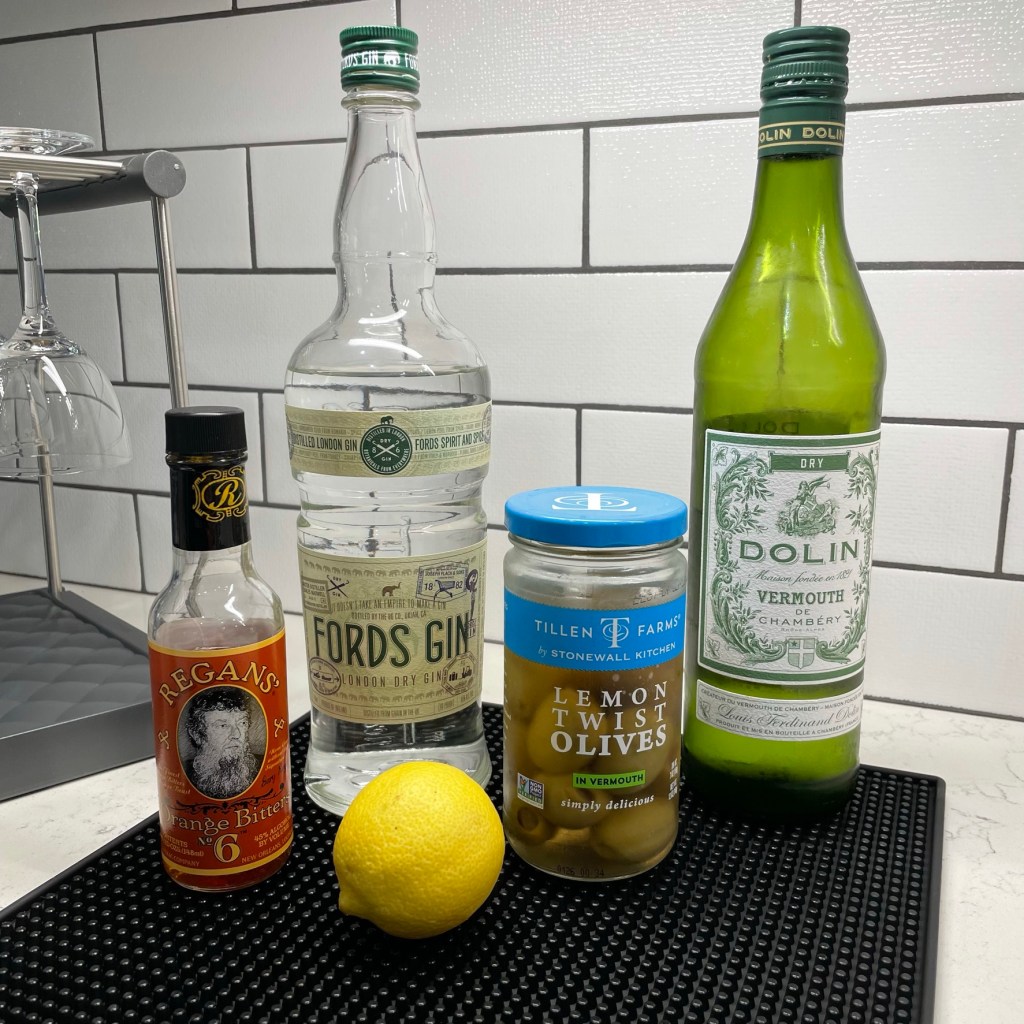
Ingredients

  • 2 oz. Fords gin
  • 0.5 oz. Dolin dry vermouth
  • 2 quick shakes Regan’s orange bitters
  • A lemon peel-stuffed olive to garnish
  • Optional strip of organic lemon peel, if you’re feeling extra fancy (or if they’re on sale)

Instructions

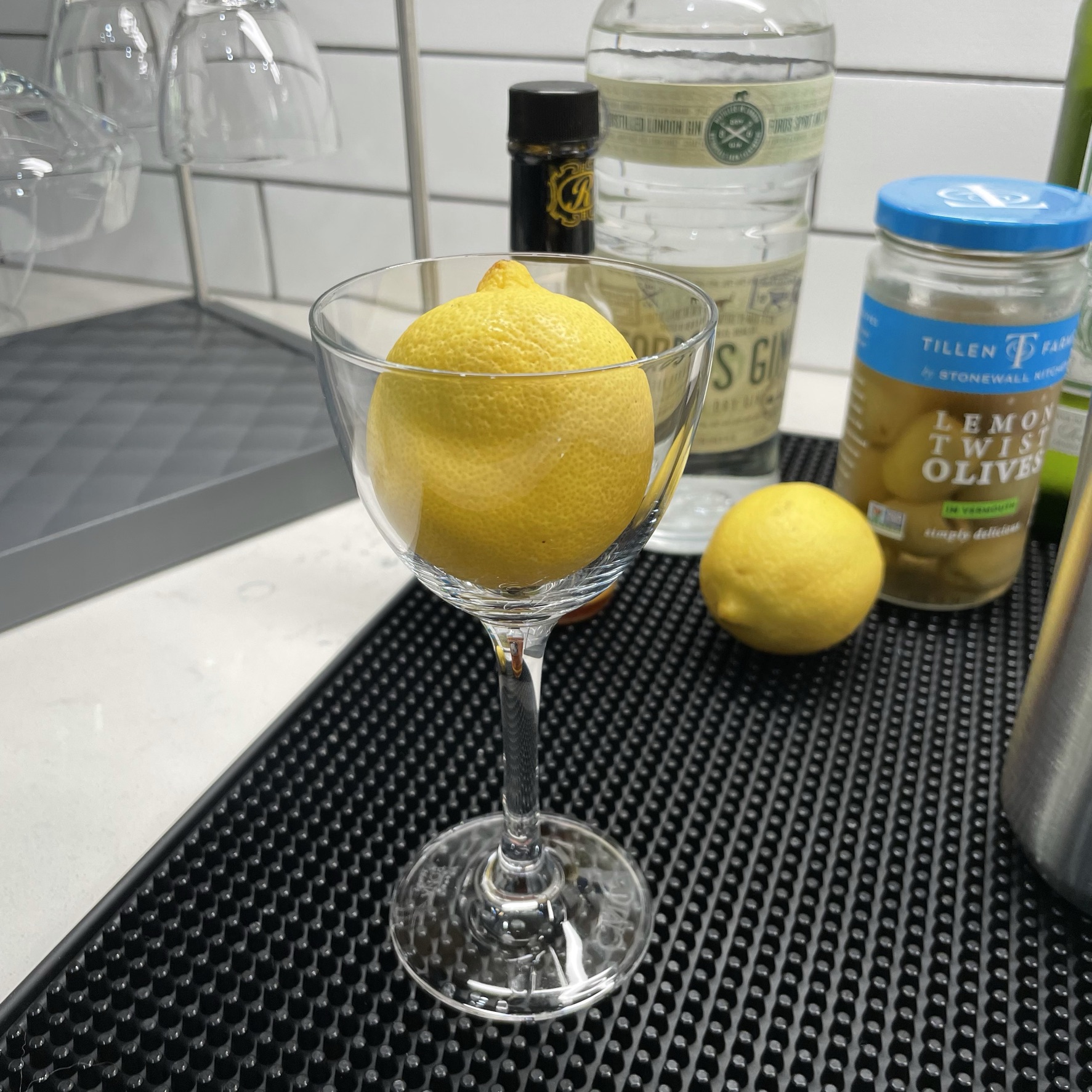
First things first, chill down your cocktail glass. Some people like to keep them in the freezer, but I prefer to chill only the bowl of the glass by filling it with ice cubes and a splash of water. Give it a spin with your cocktail pick. Why? It is a law of physics that the ice-in-motion will chill the glass faster than the ice just sitting there.

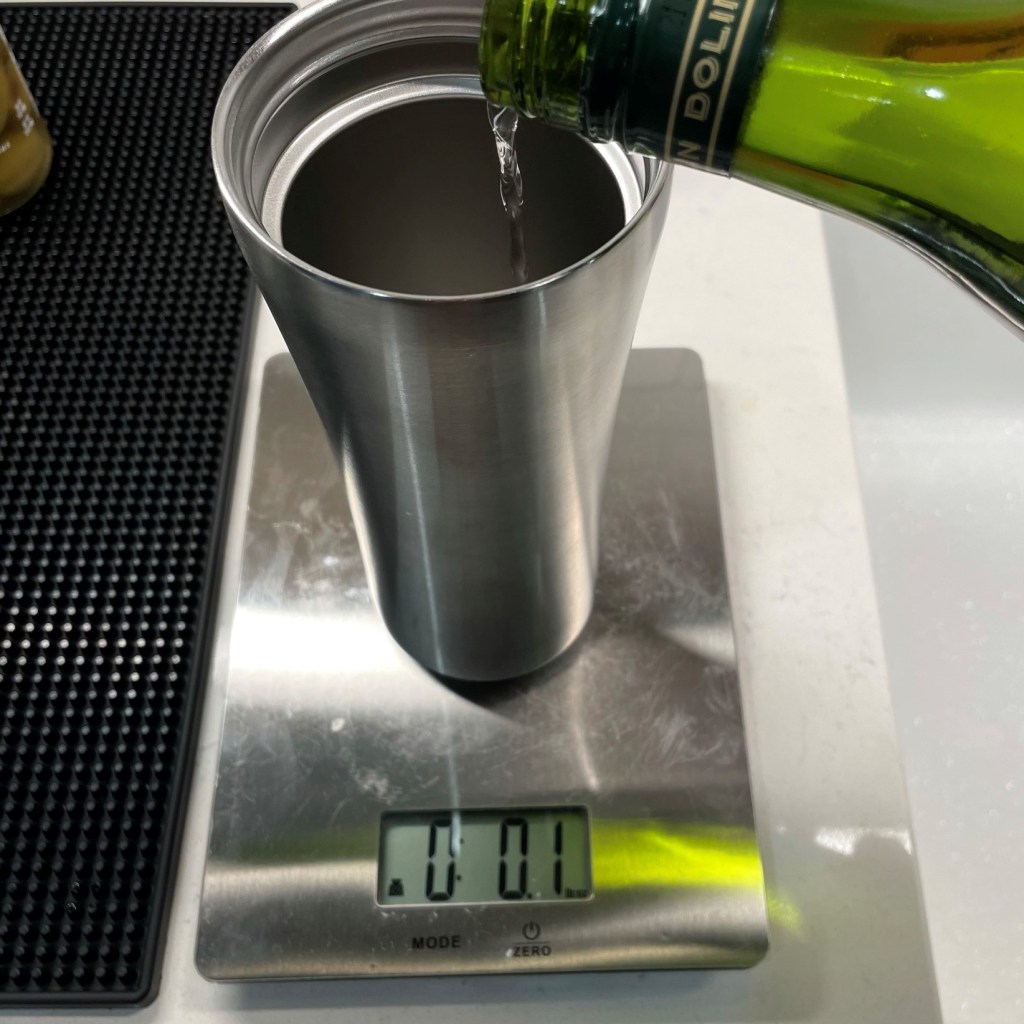
Next, measure the gin and vermouth into a cocktail shaker, and give it two quick shakes of orange bitters. This may seem unusual, but the bitters play very nicely with my preferred gin and makes the drink feel complete.

Now, cap the shaker and give it a good shaking. Some people prefer to stir a martini to prevent over-diluting it, but I generally prefer to shake it and I have found that using a generous scoop of ice chills it down very quickly, also preventing over-dilution. Don’t shake it violently, just enough to mix the ingredients completely. 20 seconds should do it.

Pour the shaken martini into the chilled glass. I like chilling it with ice because the stem of the glass doesn’t get frosty or slippery from the freezer.

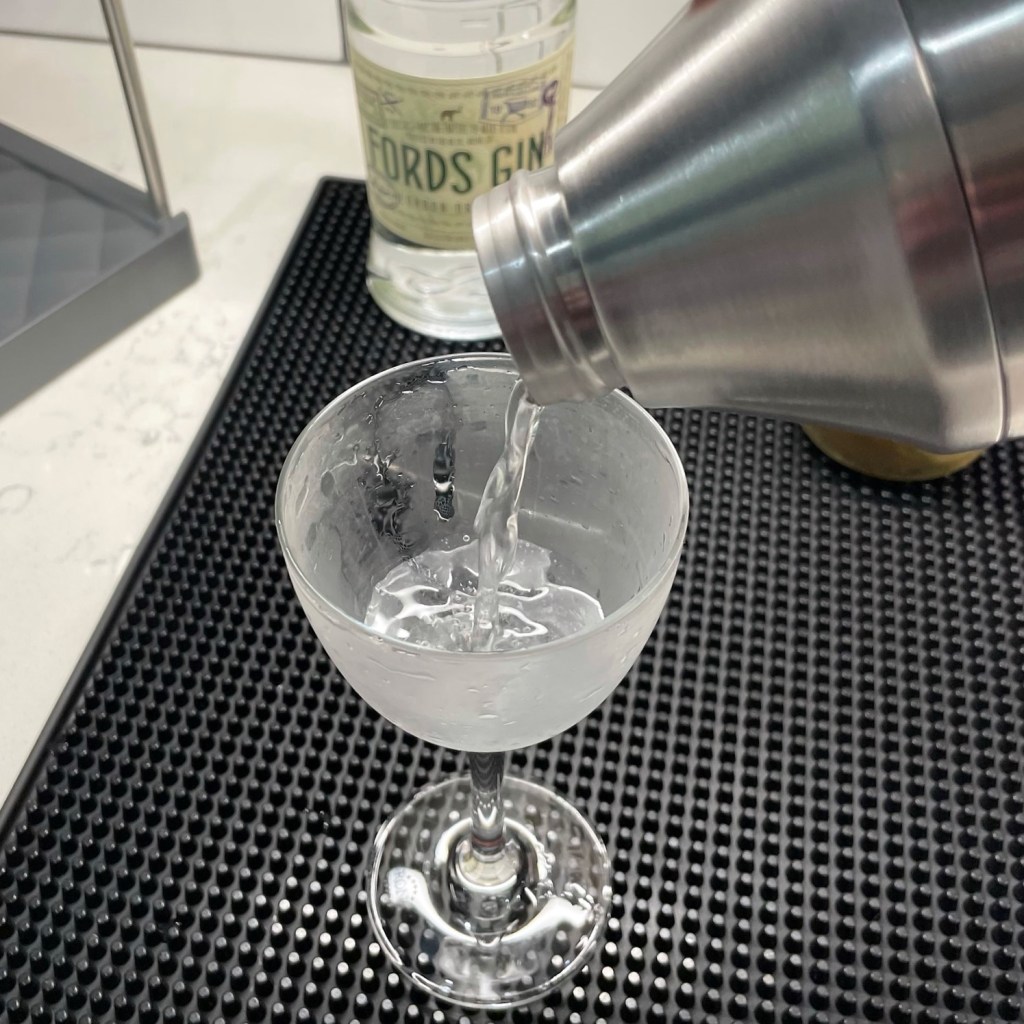
Dump the ice that has been chilling your glass (be sure to let all the water fall out), and strain your beautiful martini right into it. Skewer the olive and drop it into the glass.

Repeat as desired.


Coq au Vermouth

Excuse me, where is the umbrella?

I spent two years in French class during high school, and that is pretty much all I remember how to ask—“excusez-moi, où est le parapluie?” I suppose it is a question that would have been essential had I become a world traveler (I didn’t), and in fact it was a common question asked among my fellow French club members when we took our senior trip to Quebec City, Canada—they don’t speak much English there, in case you didn’t know. It rained the entire three-day weekend, but it was still a glorious visit to a city rich with history and speckled with exquisite, copper-roofed buildings.

Spanish would undoubtedly have been a more useful class for me, given the increase of Spanish-speaking people in the U.S. since I graduated all those years ago. But there was something sooo sexy about the French spoken word, and well, my best friend signed up for French so I did, too. Our teacher was cool and we got to choose our own names for the class, which was good because there wasn’t a name on the list that was a literal translation for Terrie. My friend Debbie became Christine, pronounced CREE-steen, my friend Christine became Danielle and yours truly selected the name Jacqueline, which was fun to say—zhah-KLEEN, like the French fashion designer who steals Nigel’s dream job in The Devil Wears Prada.

French class was always lively, and we were encouraged to play up the accent and the nasal sound as much as possible. We went through round after round of language exercises, covering the French words for common places, including the bookstore (la librairie) and the library (la bibliothèque) and reciting all the various tenses of the verb words, and for every kind of individual and group instance. For example: for the verb “go,” we would cycle through the French words that meant, “I go, you go, he goes, she goes, we go and they go.” Round and round we went, and after all that repetitious recitation, all I remember how to say is “where is the umbrella?”

Anyway, for me, there is still a lot of mystery and intrigue associated with the French language, and I learned during my short time working in the Pinch of Thyme catering kitchen that if you want people to swoon over food, call it something French! As luck would have it, I do at least remember some of the French words for certain foods, including poulet (chicken), champignons (mushrooms) and carottes (carrots, obviously). I was excited to find this recipe in my most recent digital edition of Imbibe magazine because I have used splashes of vermouth in a few dishes and found it more complex and vibrant than wine, which would traditionally be used for braising chicken in the classic coq au vin. But this recipe was more than a splash, it was a generous amount in a very French-technique kind of recipe.

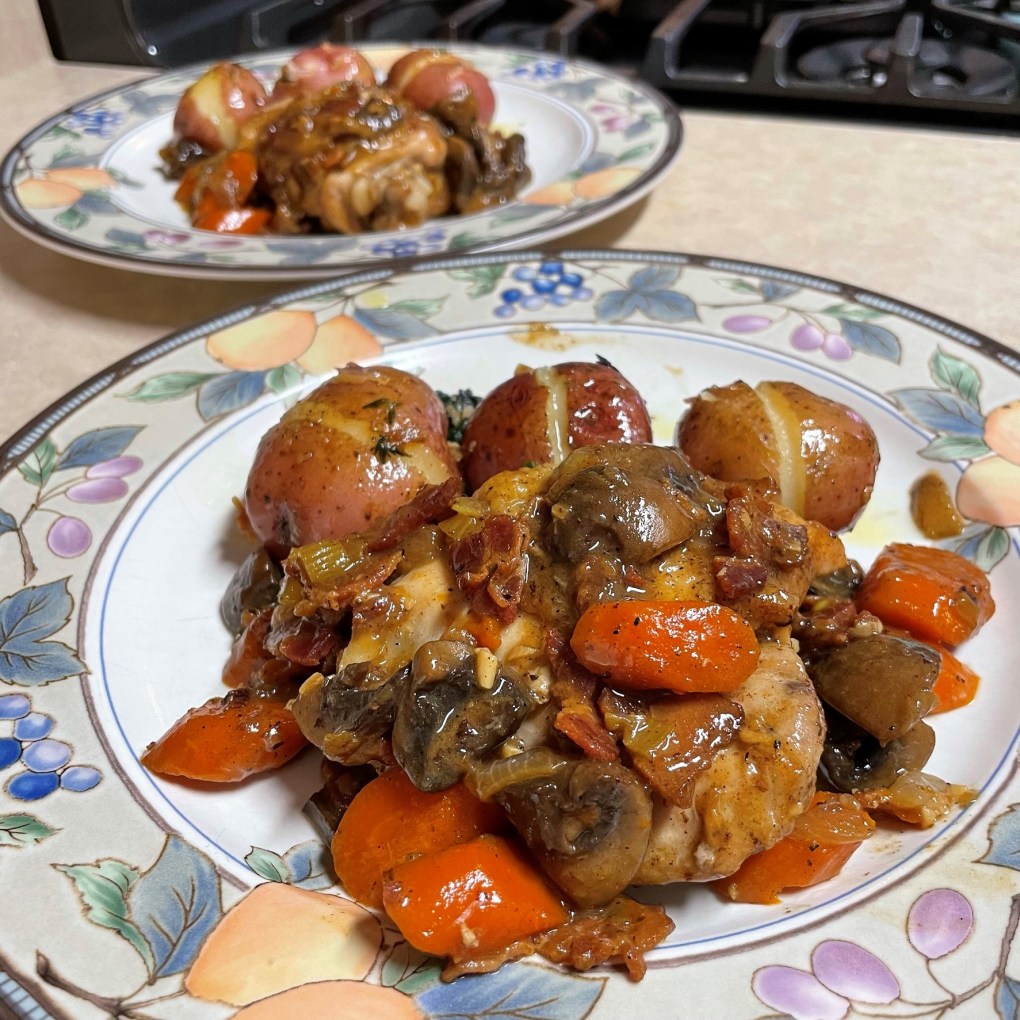
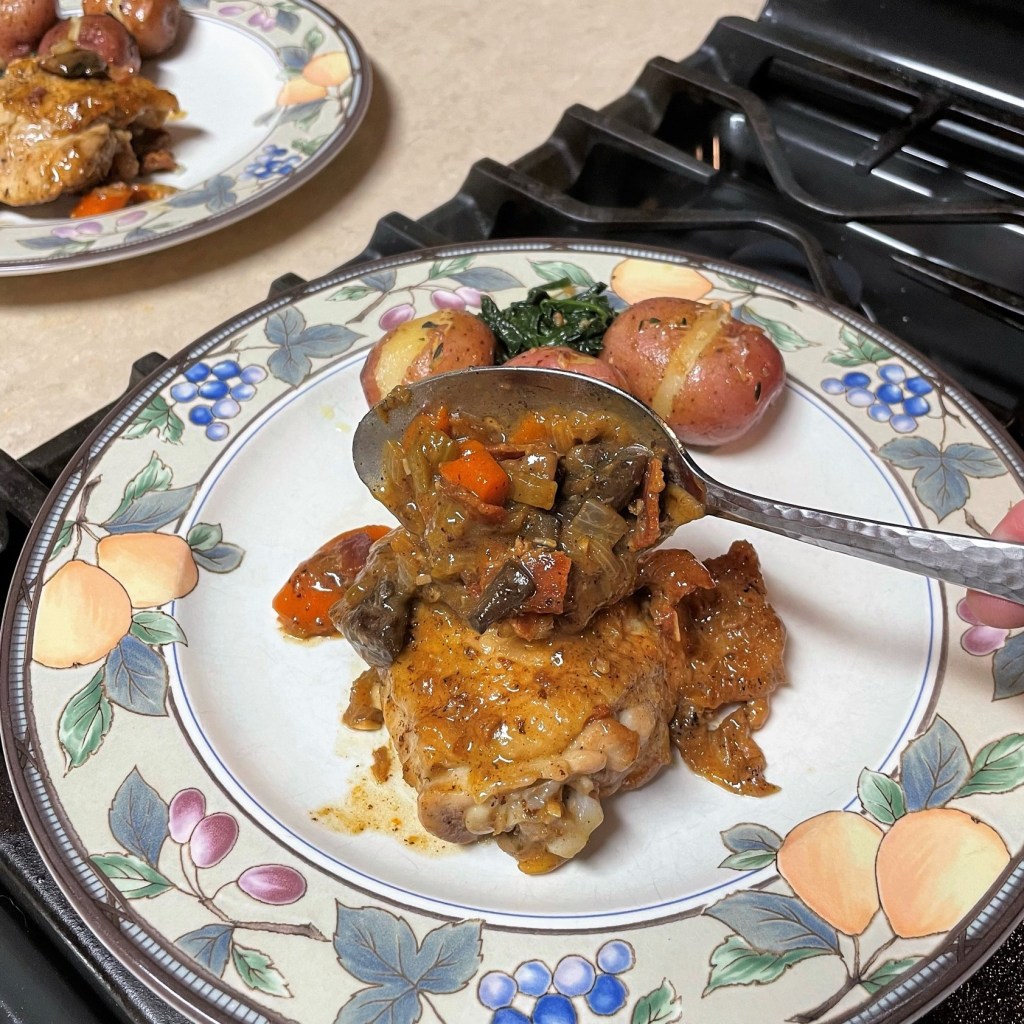
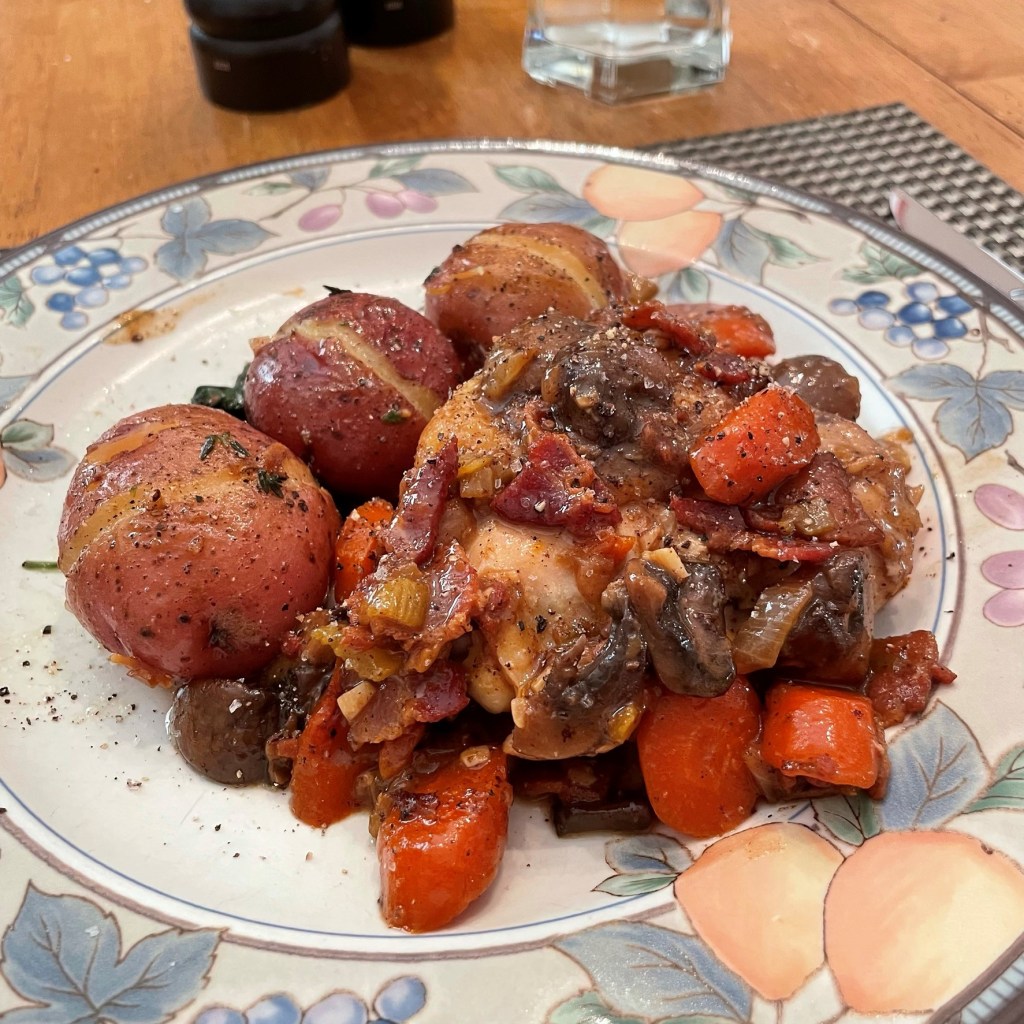
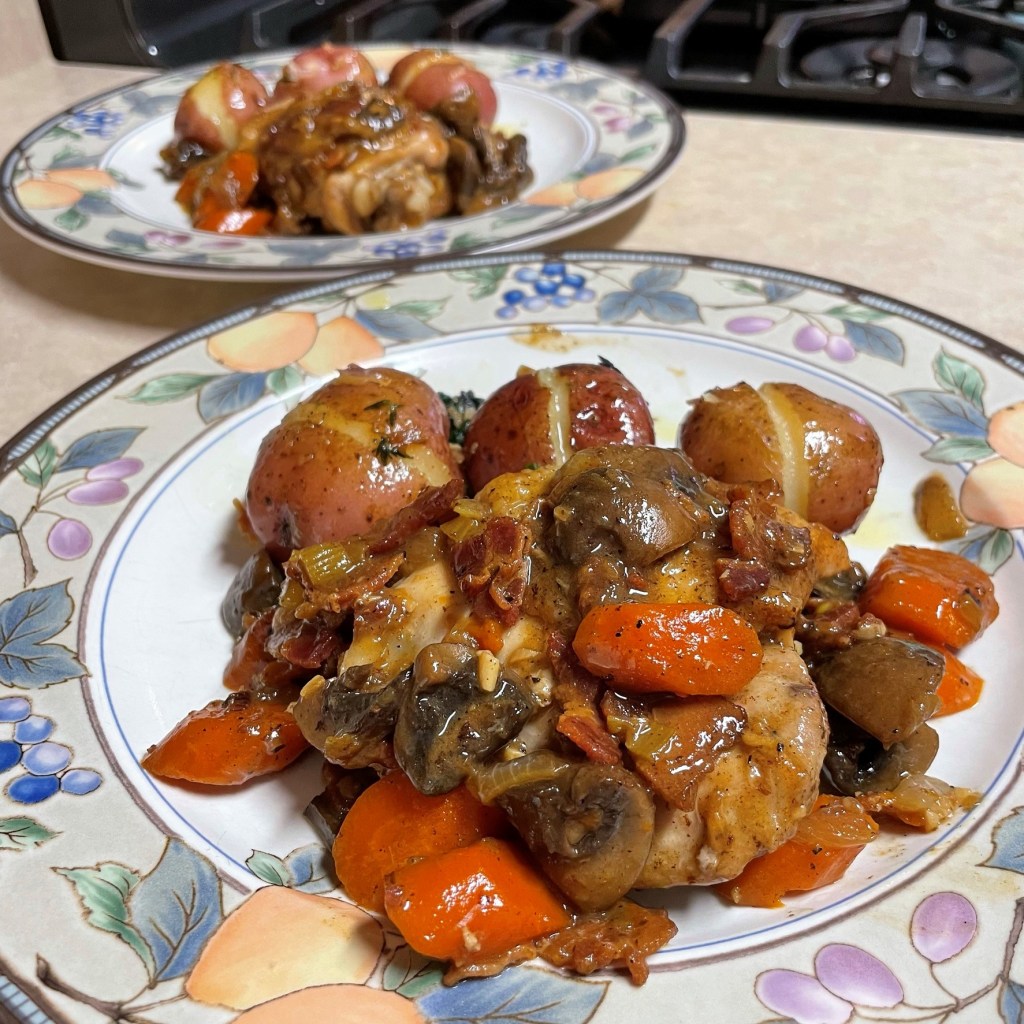
I could not resist turning this into a Sunday Supper meal, with a side of buttered red bliss potatoes and sauteed spinach, and it was—how shall I say—très délicieux!

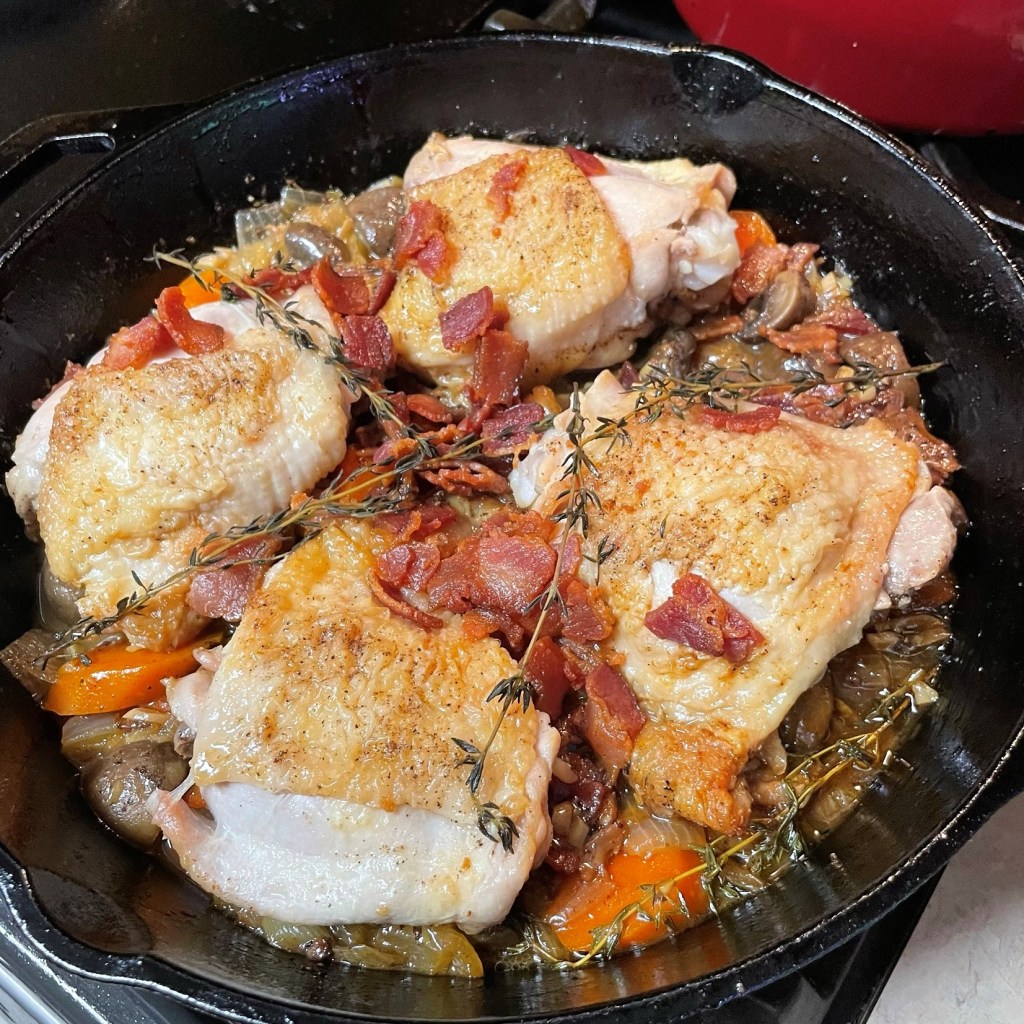
This dish was rich and succulent, exactly as it should be. The chicken thighs remained tender and moist.

A word or few about vermouth…

I have known about vermouth for decades, but it has only been the past couple of years that I have become more closely acquainted with it, and today I almost always have a bottle open in the fridge for an end-of-day gin martini. Vermouth is a fortified wine, which means other alcohol has been added to grapes during fermentation, and that results in higher alcohol by volume than typical wine. Any variety of botanical ingredients are thrown into the process as well, including herbs, bitter ingredients, bark, roots and spices. Vermouth may be red or white, dry or sweet or really sweet, depending on its origin and method, and it is commonly used as an ingredient for classic cocktails, including martinis and Manhattans. Vermouth, on its own, is also a popular apéritif (pre-dinner drink) in Spain, Italy, France and my house.

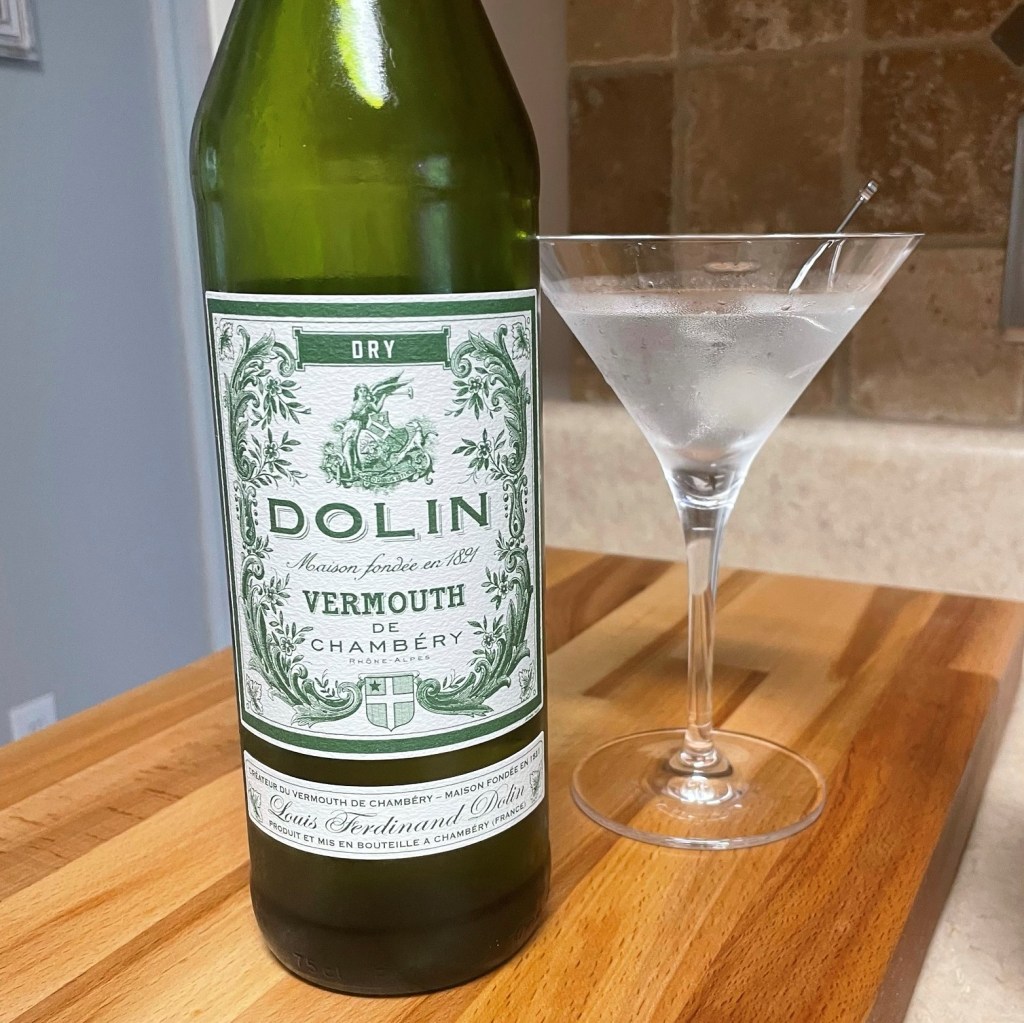
In a literal French-to-English translation, coq au vermouth would demand use of a rooster, but it is not every day that you’d find such a creature in your local market. Large hen thighs is what I used for the recipe, and it was tender, flavorful and oh so fancy. Don’t be intimidated, though, because despite all of the foreign language I’ve been throwing around, this was a very simple dish to make. All you need is a cast iron skillet, chicken thighs, bacon, mushrooms and mirepoix—oops, another French word that is simply a mix of carrots, onions and celery. All that, plus a decent amount of dry white vermouth. Don’t worry, vermouth is easy to find, wherever you might buy wine. To keep the recipe true to its origin, choose a brand from France. I used Dolin Vermouth de Chambéry, dry, in the green bottle. 😊

This is one of my go-to vermouth brands for Gibson cocktails:
2 oz. dry gin, 1/2 oz. dry vermouth, shaken or stirred with ice, strained into a cocktail glass and served with a pickled pearl onion.

Inspired by Coq au Vermouth – Imbibe Magazine

Ingredients

3 slices bacon, cut into thin pieces

4 large, free-range chicken thighs (bone-in and skin-on)

Kosher salt and freshly ground black pepper

1/2 medium onion, sliced or diced

2 medium carrots, peeled and cut into thick diagonal slices

2 stalks celery, cleaned, ribs removed and diced

3 cloves garlic, smashed and sliced

About 1 cup cremini mushrooms, cleaned and cut into quarters

1/2 cup dry vermouth (extra dry would be fine, also)

1/4 cup low-sodium vegetable broth

2 fresh sprigs of thyme

2 Tbsp. cold butter

Juice of 1/2 fresh lemon


Instructions

Let’s run through it in pictures first, and if you keep scrolling, you’ll find the instructions spelled out (in English), and I’ll also include a downloadable PDF for your recipe files.


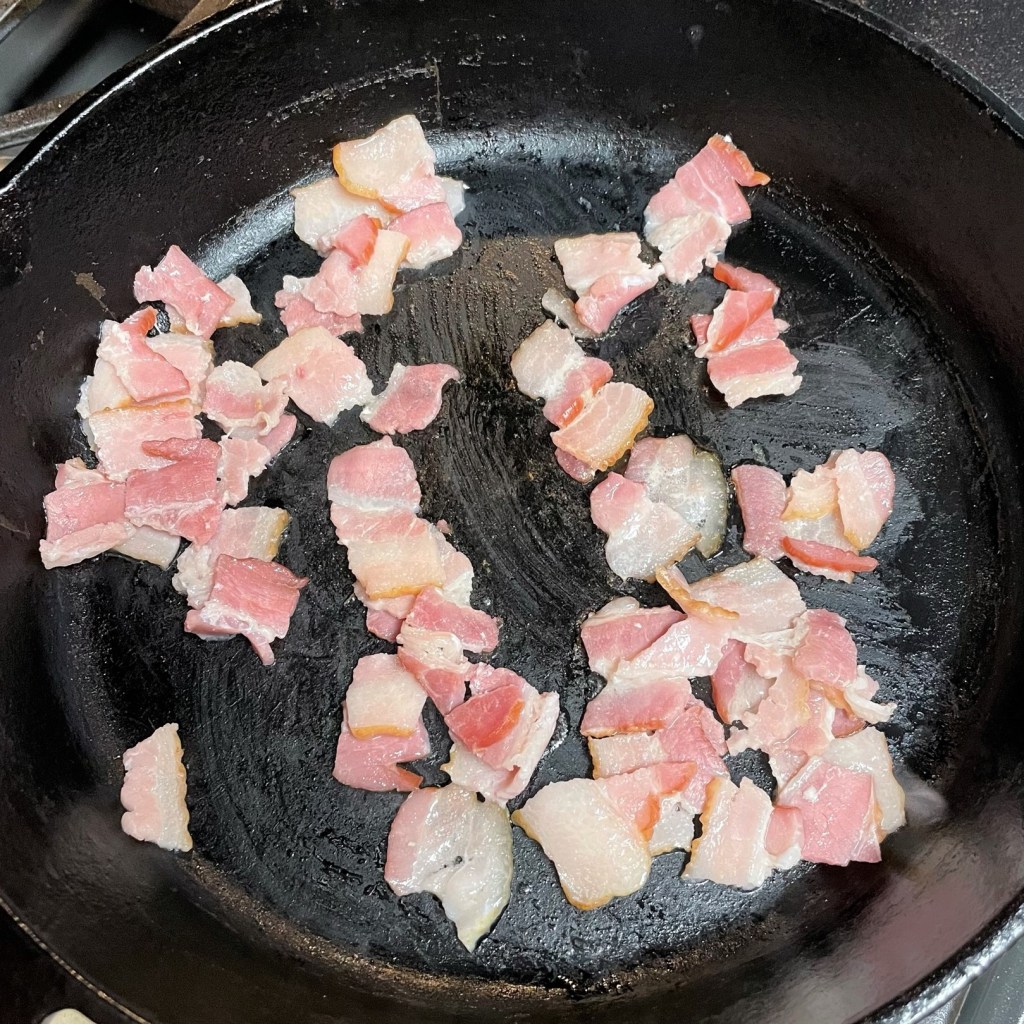
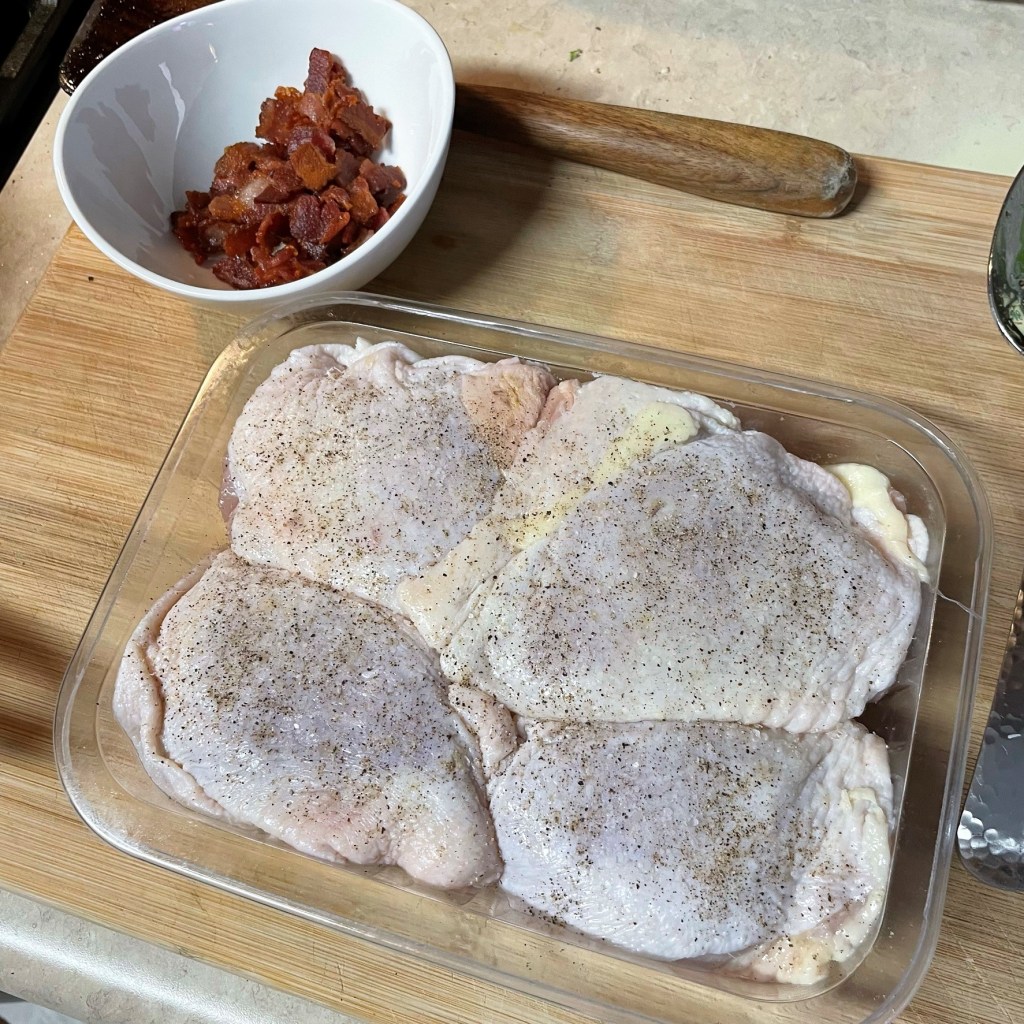
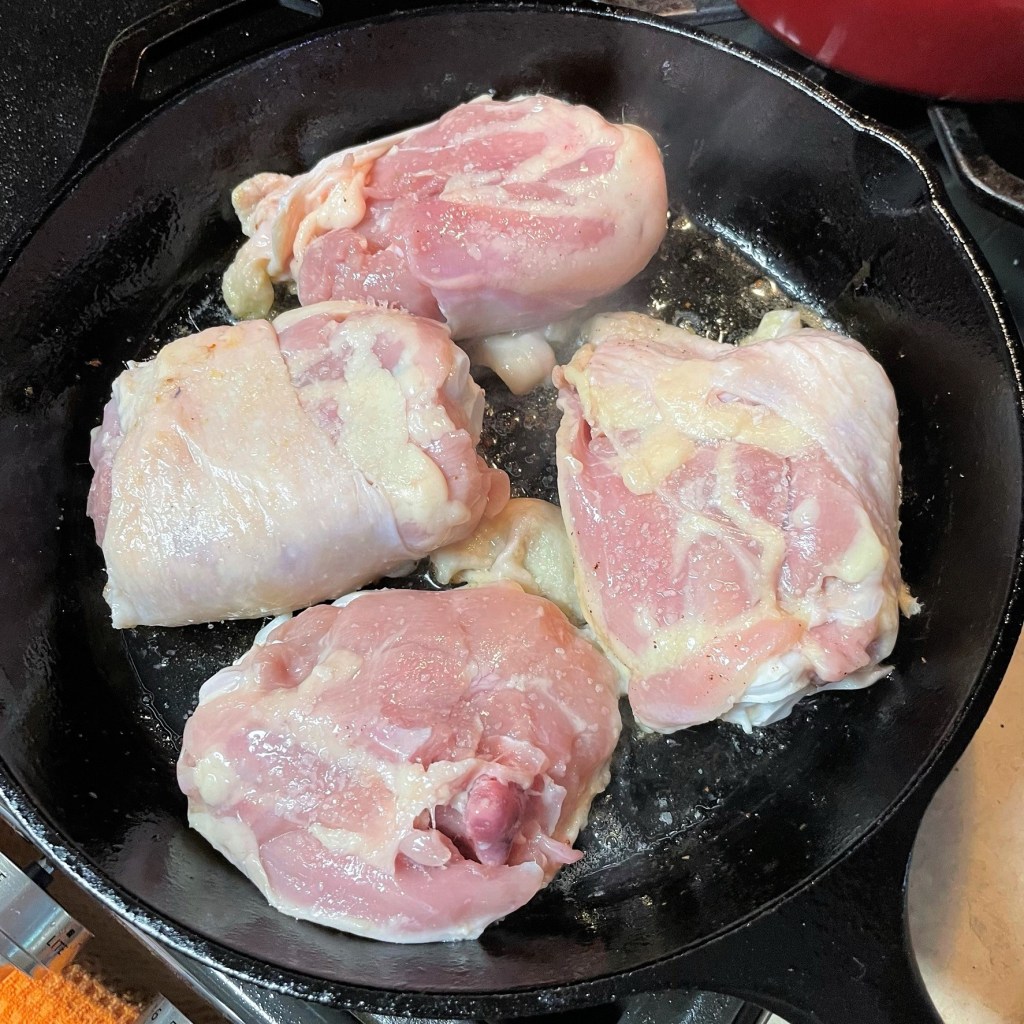
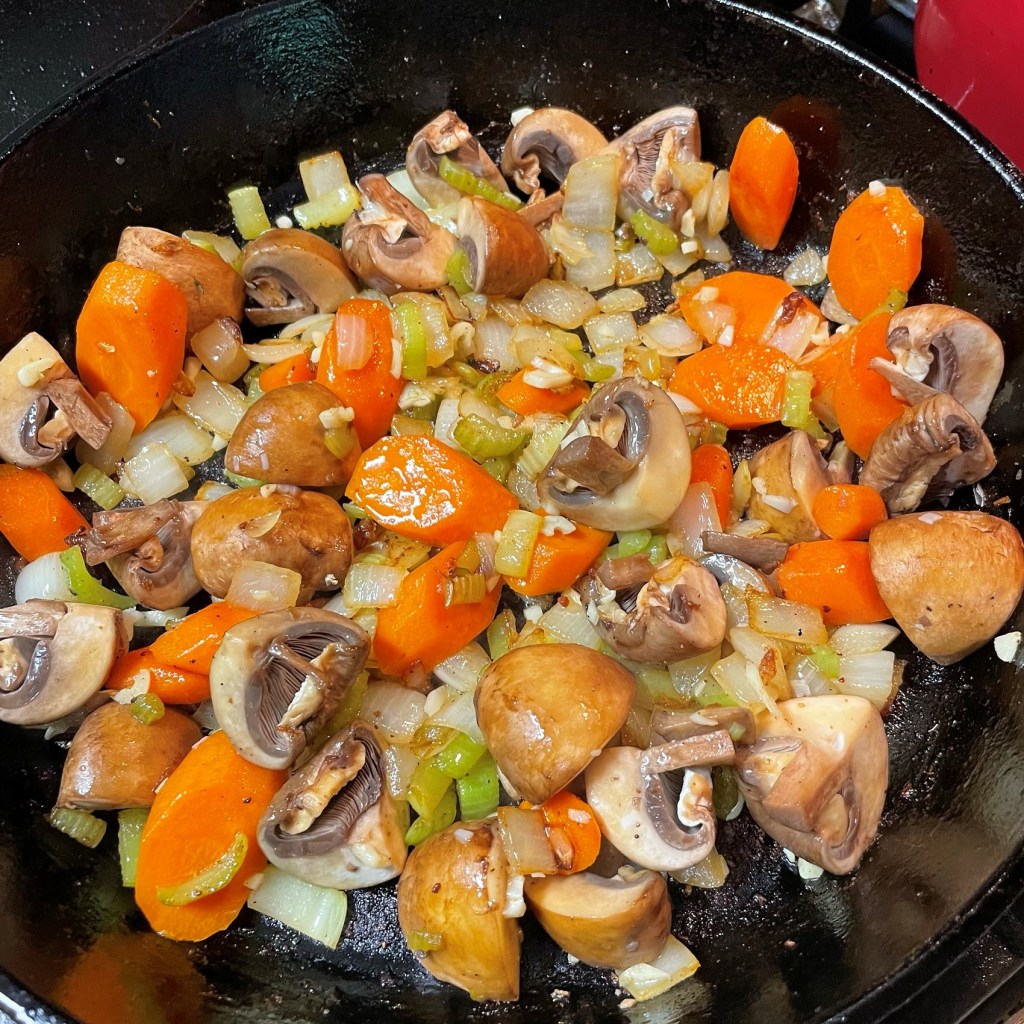
  1. Place a cast-iron skillet over medium heat. Season the chicken thighs liberally with salt and pepper. Cook the bacon until the fat is rendered and the edges begin to crisp. Transfer the pieces to a paper-towel lined dish, keeping all the bacon grease in the skillet. Arrange the chicken thighs, skin side down, into the skillet. Cook them until the skin is crispy and golden, then turn the pieces and cook the other side about two minutes.
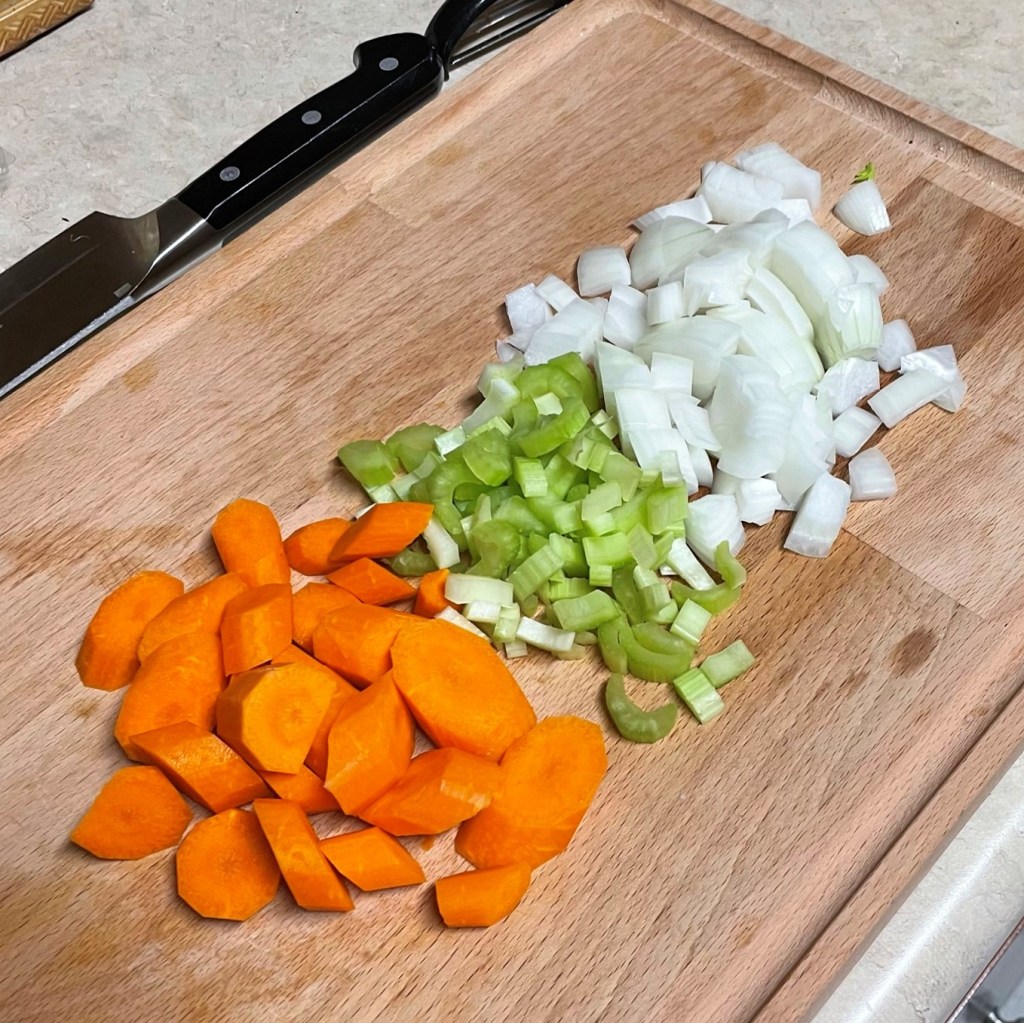
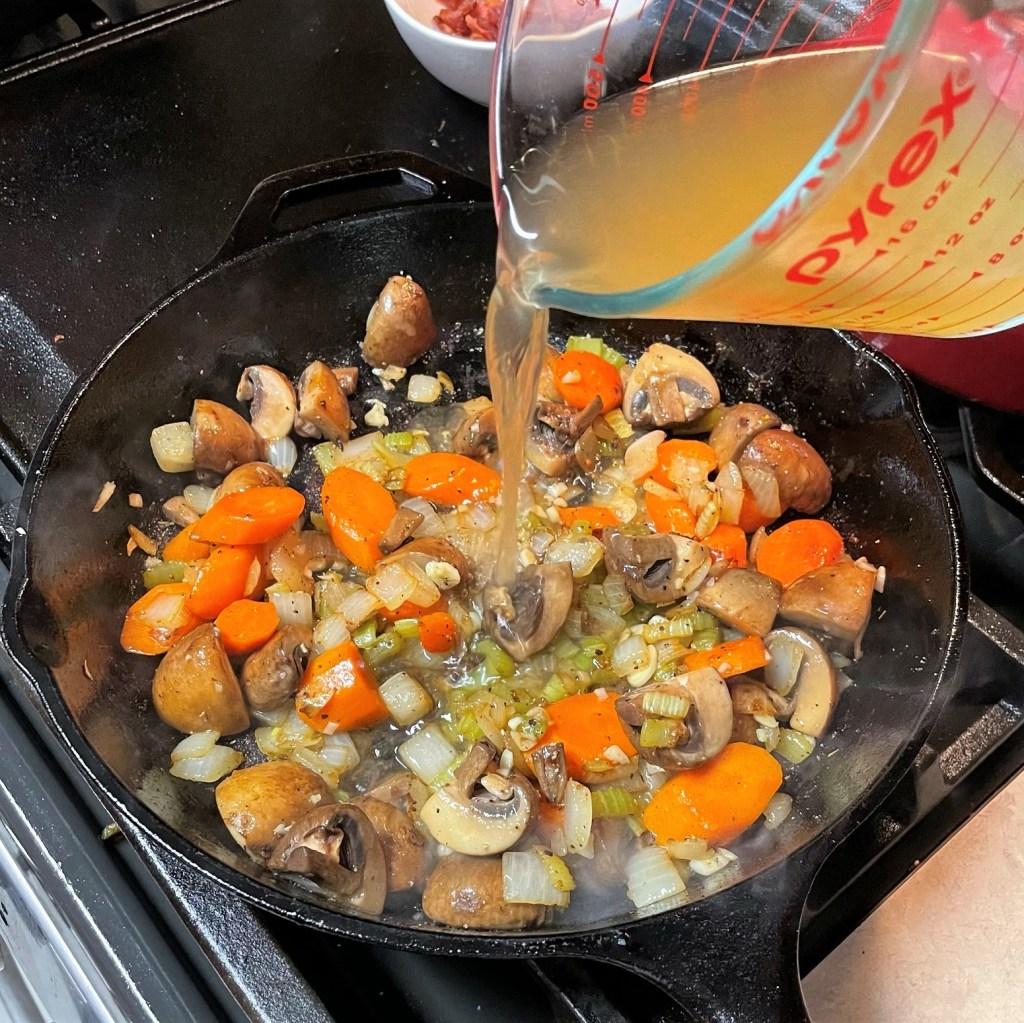
  2. Transfer the thighs to a plate and cover loosely with foil to keep them warm. Add the mirepoix (carrots, onions and celery) to the fond (pan drippings) in the skillet. Cook over medium heat until the vegetables begin to soften. Add the garlic and mushrooms, tossing with the other vegetables until slightly browned. Pour in the vermouth and vegetable broth, and simmer for about two minutes.
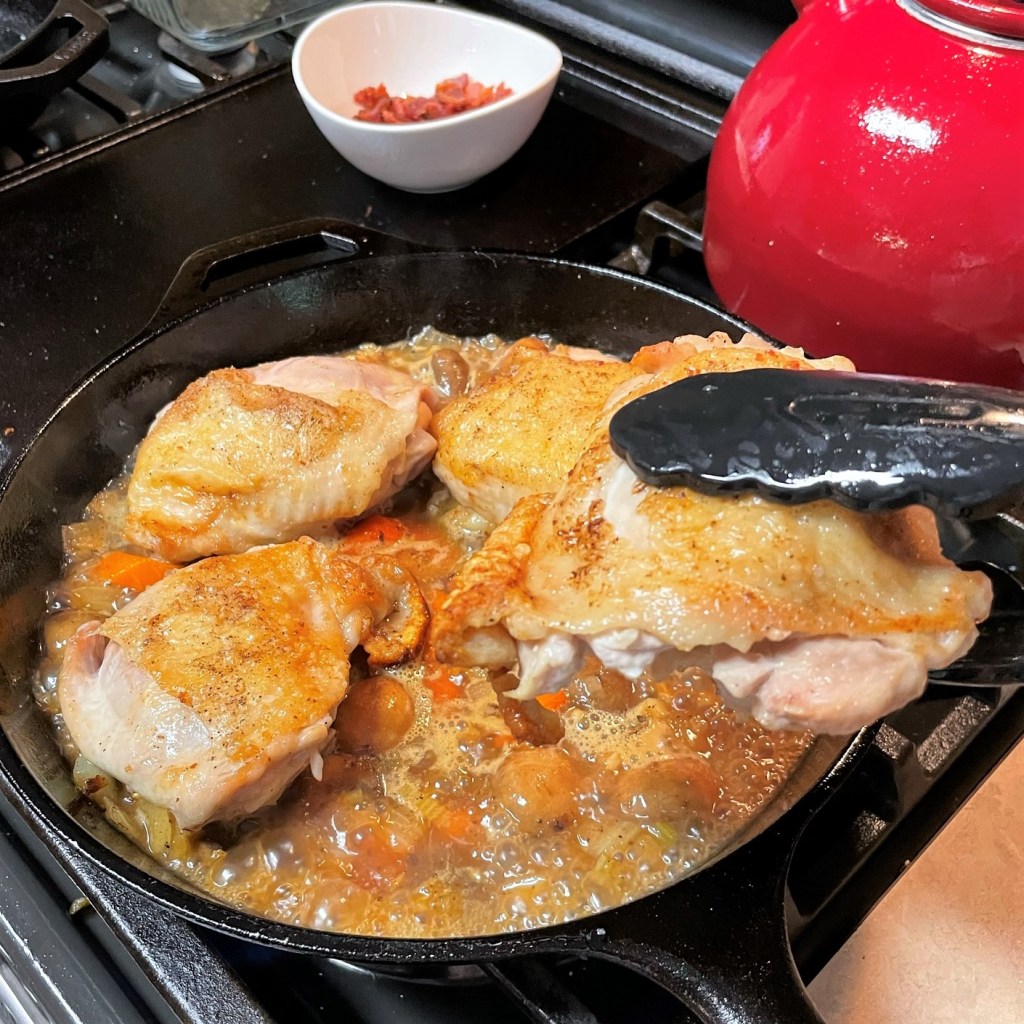
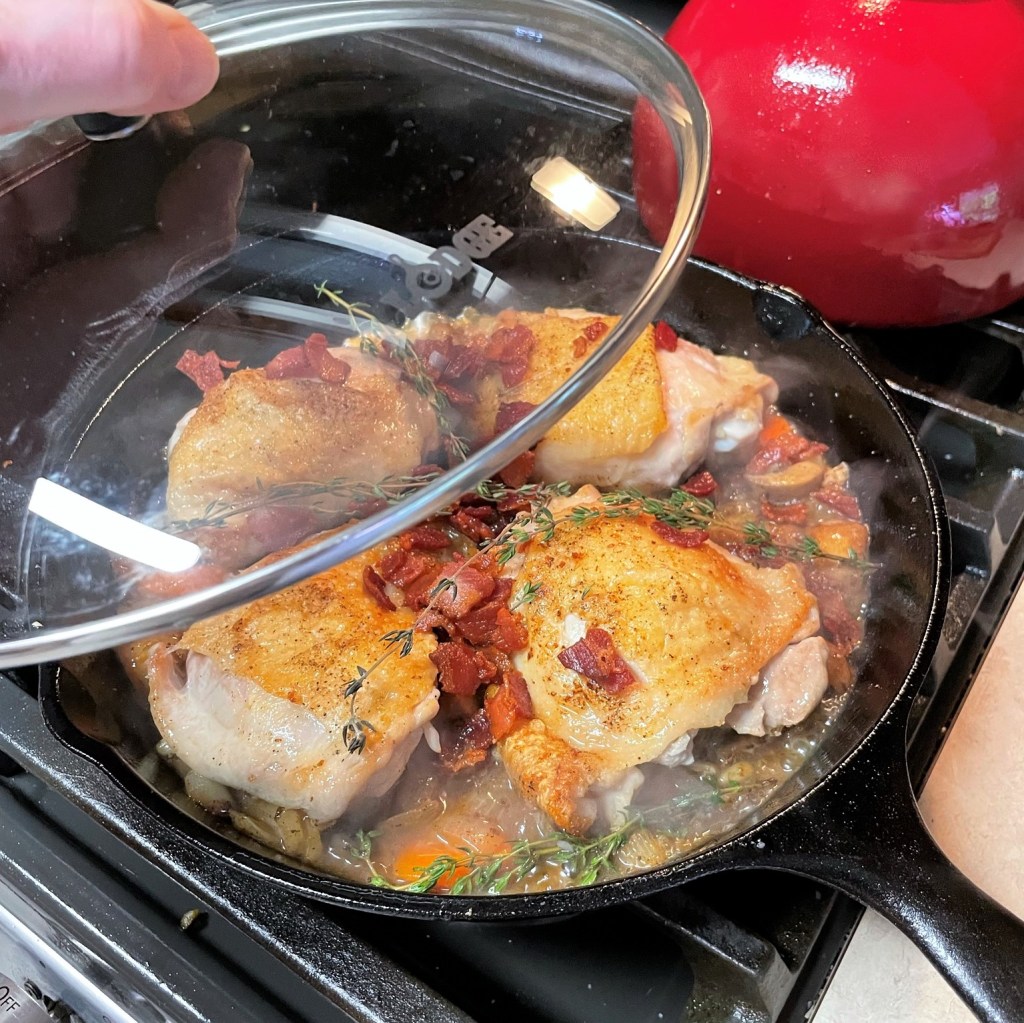
  3. Return the chicken thighs to the skillet, skin side up. Sprinkle the bacon pieces over the top and lay the whole thyme sprigs in a criss-cross fashion over the combination. Reduce the heat to low, cover the skillet tightly and simmer about 30 minutes.
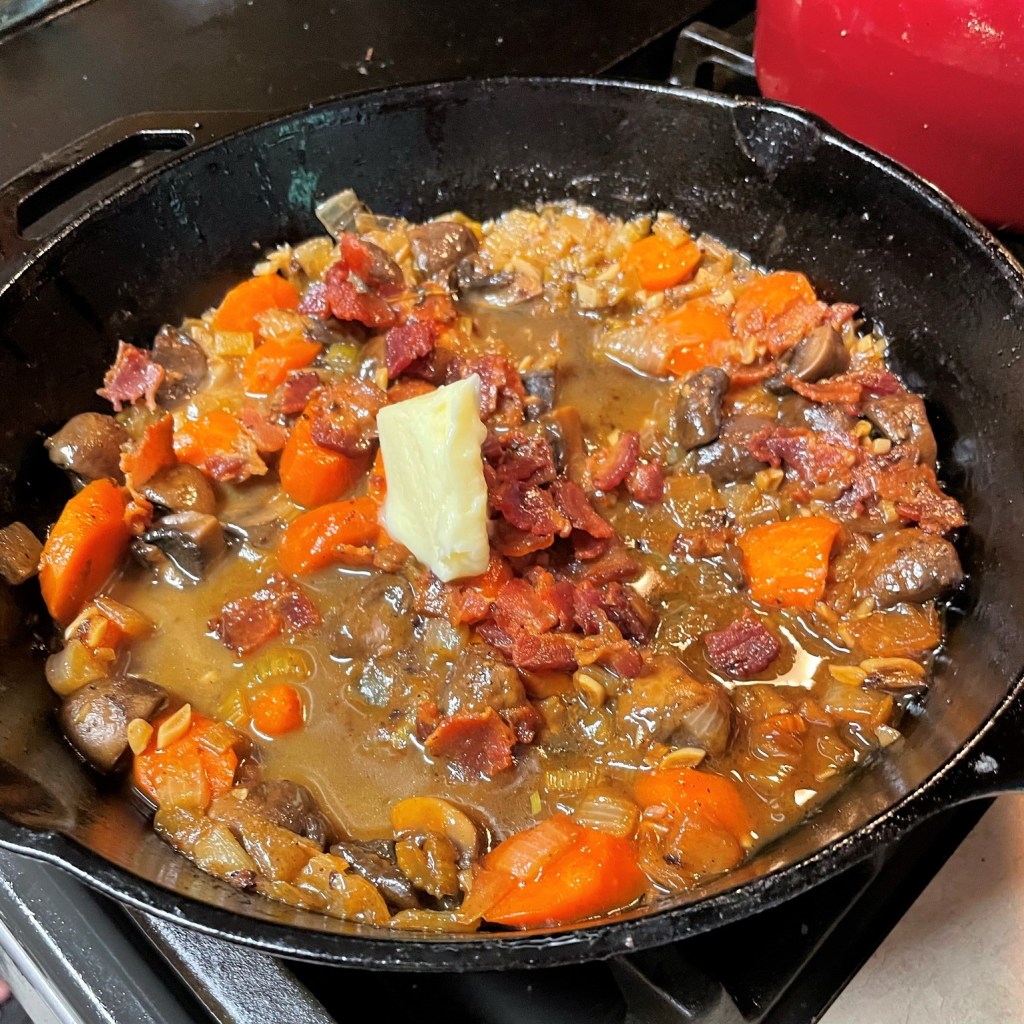
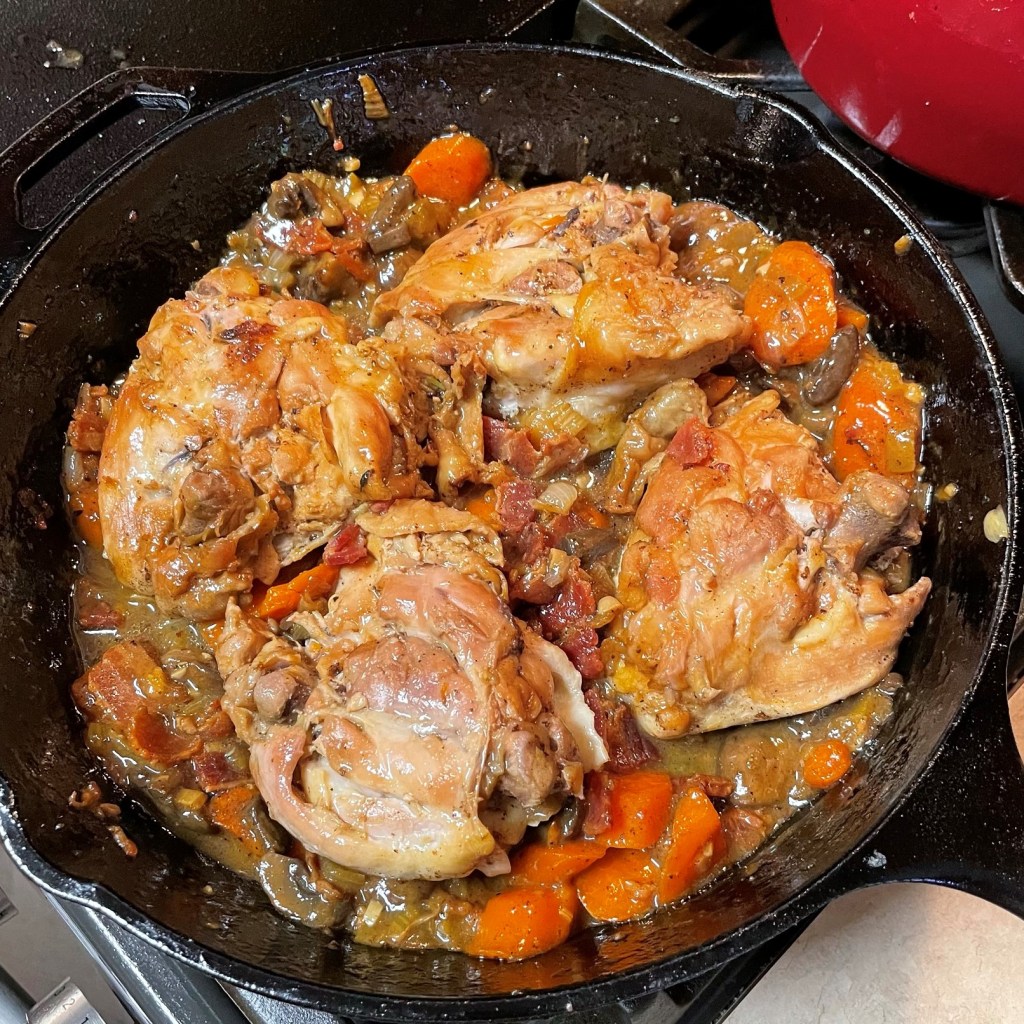
  4. Remove and discard the thyme sprigs. Transfer the chicken thighs to a plate. Add the cold butter and lemon juice to the simmered vegetable mixture and stir until it is a rich, luscious sauce. Just before plating, place the thighs, skin side down, into the skillet to drench them in the sauce. Plate the chicken, then spoon the simmered vegetable mixture (a.k.a. mélange) over the thighs.
I love when an elegant dish is this simple!