Clambake pizza — a delight for Leos!

My interest in astrology has always been one of curiosity. I’ve never been fully invested in the idea that my personality was pre-determined by the stars or whatever phase the moon was in when I took my first breath at the exact latitude and longitude where I was born. I mean, for starters, if I were to ask all-knowing AI for a general description of Leo, this is what I get. Honestly, does this sound like me? 

OK, I’m guilty as charged. 😂

I want to say that it’s all a bunch of hooey, but the Leo description is very much on point. Ahead of my milestone birthday recently, I looked up Leo traits and another related prompt came up in my search: “the best foods for Leos.” This oughta be good, I thought, given that I can count on one hand the foods that I don’t like. The first site that popped up was Harry & David— you know, the mail order fruit basket company— and here’s what it suggested:

Leo (July 23–August 22)

Corn, clams, spinach, and mozzarella are some of the foods to which this fire sign is drawn. This is due in part to some — such as tomatoes — being in season during the sunny summer months when Leos are born.

The moment I read that, I knew exactly what to do.
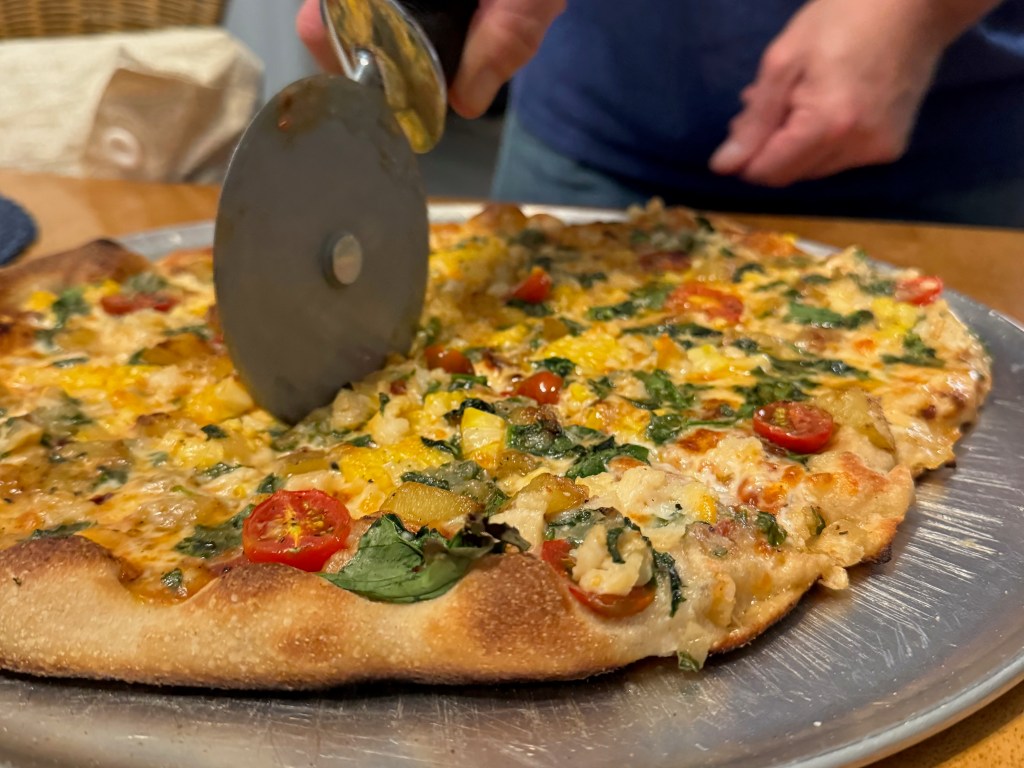
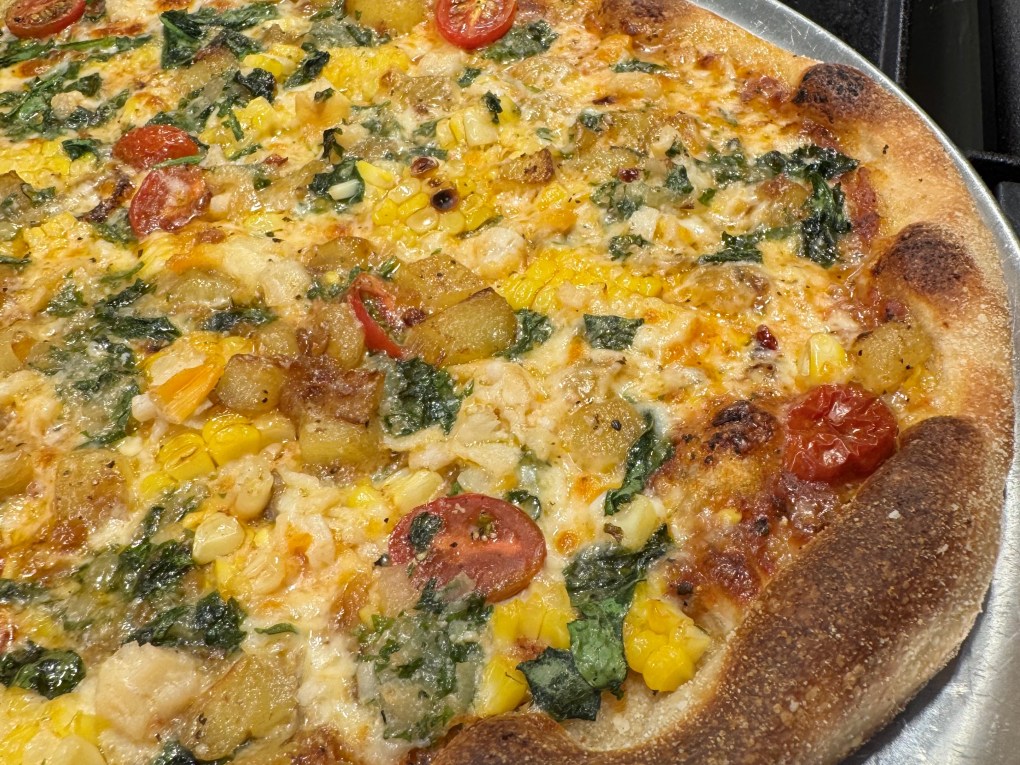
Behold, the clambake pizza!

The clambake connection

Clambakes are not exactly “native” to North Carolina, but we did have a fun one associated with the Crosby pro-am golf tournaments that used to be held around here. This was a charity tournament that Bing Crosby started at Pebble Beach many moons ago, and his widow, Kathryn, moved it in the mid-1980s to Bermuda Run just outside Winston-Salem, where it stayed for 15 years. 

The golf tournament was unsanctioned, so we didn’t always see big-name pros, but there were plenty of stars from the stage and screen and it was always an exciting week in our small city. Anyone could go to the tournament, but tickets to the clambake were highly coveted— I was only able to get in because I dated a guy who worked for Cadillac, one of the sponsors.  It’s where I first fell in love with the music of a barely known country artist named Vince Gill, and everyone who saw him at Groves Stadium knew in an instant that he would become a huge star. Let’s enjoy his breakout song while we talk about this pizza, shall we?

Press play for an enjoyable musical accompaniment!

Ingredients for a clambake pizza

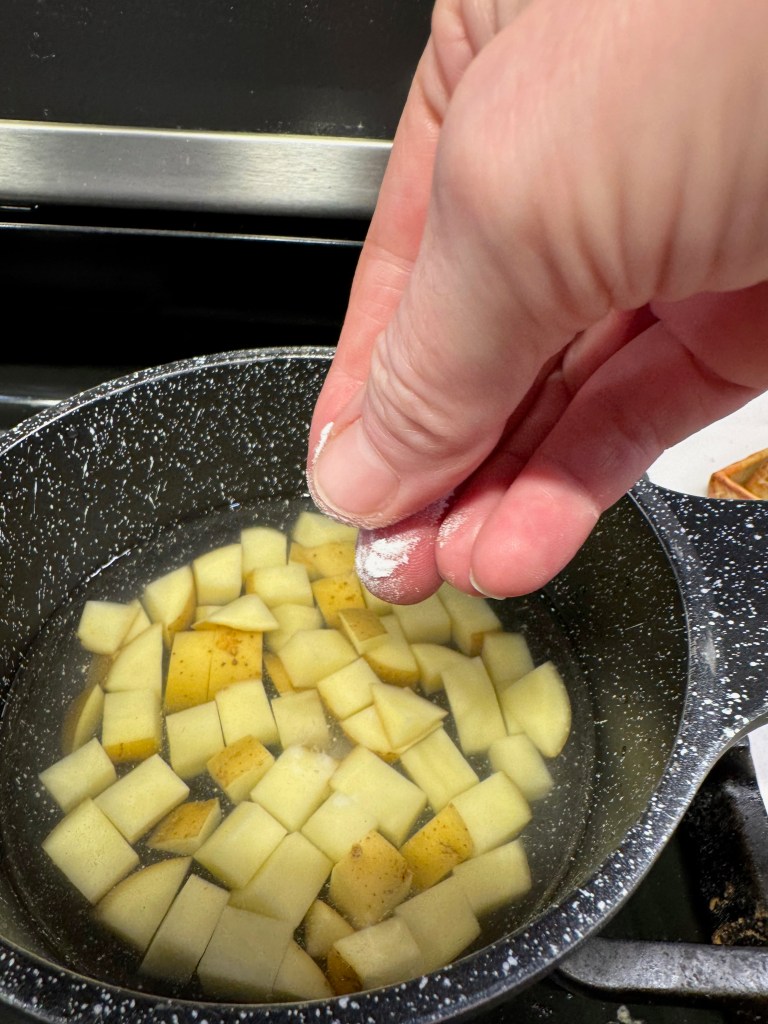
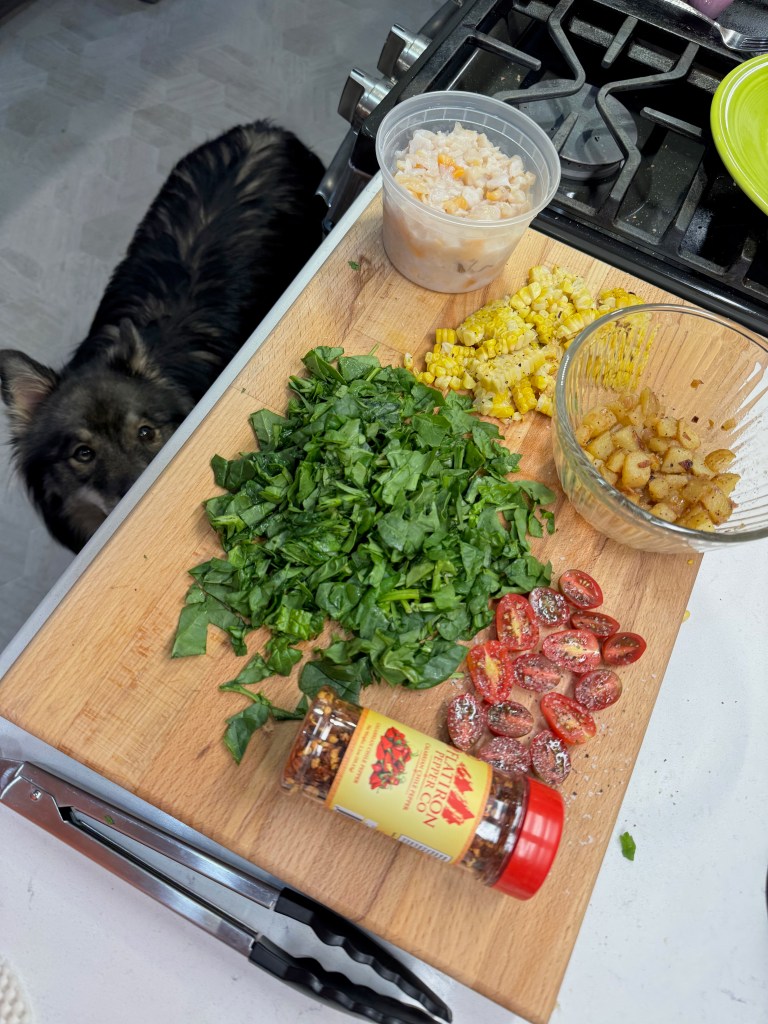
A typical clambake is outdoor cooking at its finest yet most humble. Simple ingredients, cooked over a smoldering fire until the natural flavors of ocean and earth reach their peak. Clams, corn, potatoes, onions, fresh herbs and lemon are the basic ingredients, and my list of “Leo-approved” foods was already overlapped quite a bit. Spinach would be great on this pizza, and baby tomatoes would add a nice pop of color and acidity to balance the richness of the clams. Potatoes may seem like an odd topping for pizza, but it worked really well on my steak and potato pizza a few years ago, so why not? I parboiled cubed Yukon golds and then fried them up in butter with the shallots. 
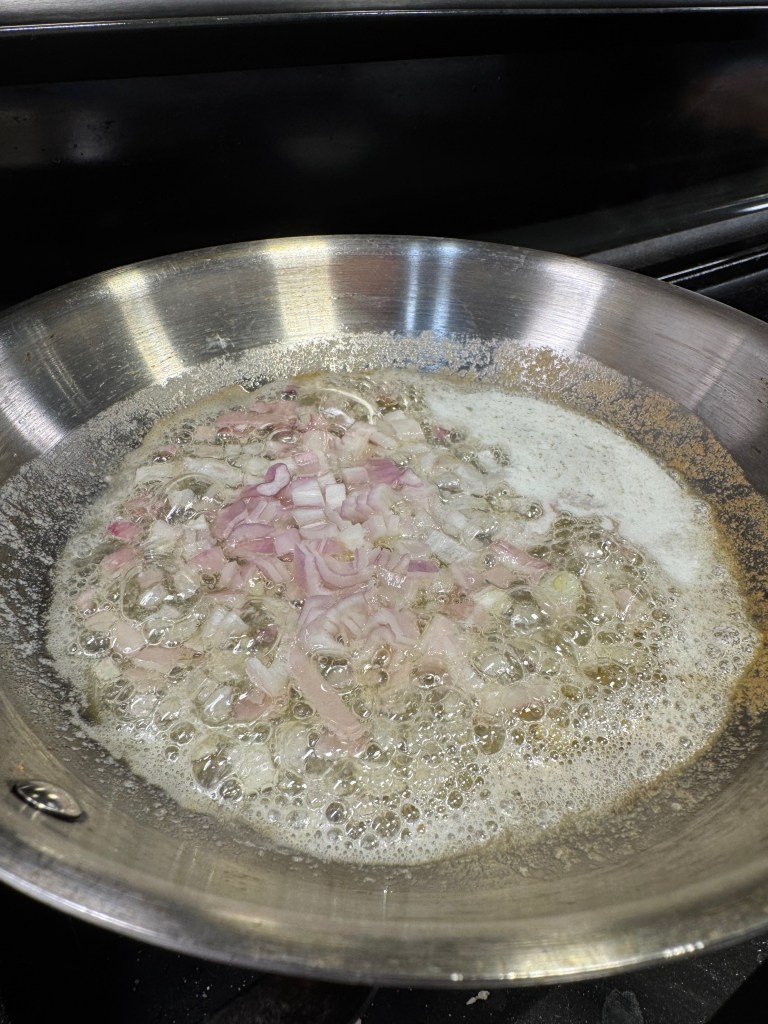

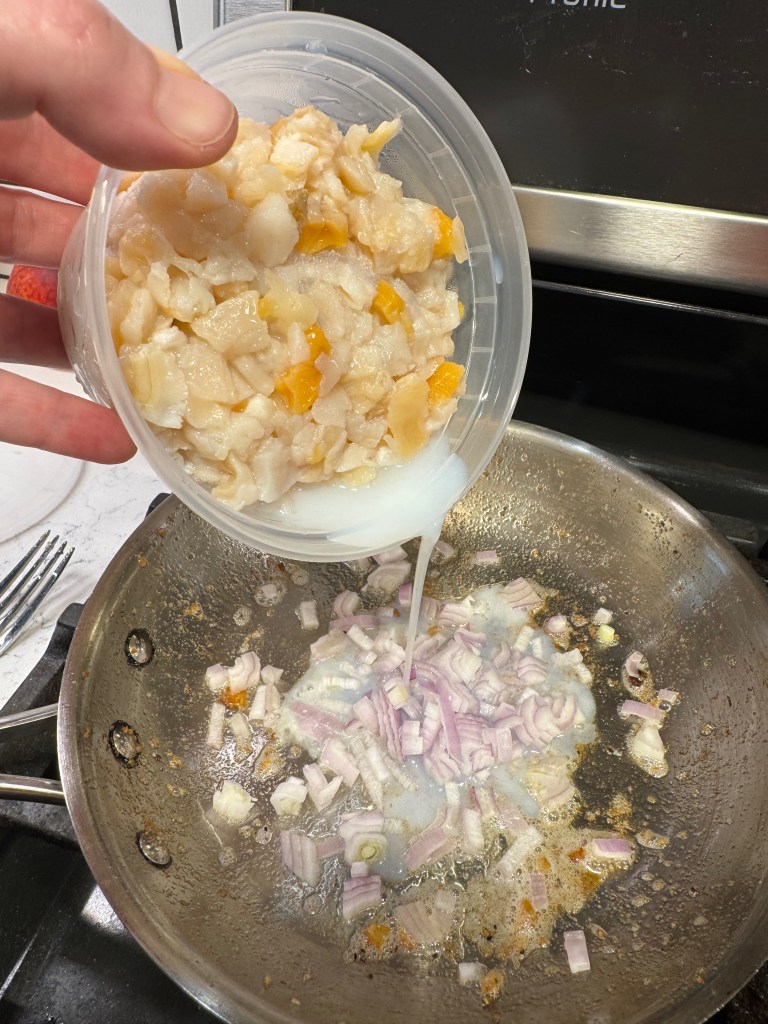
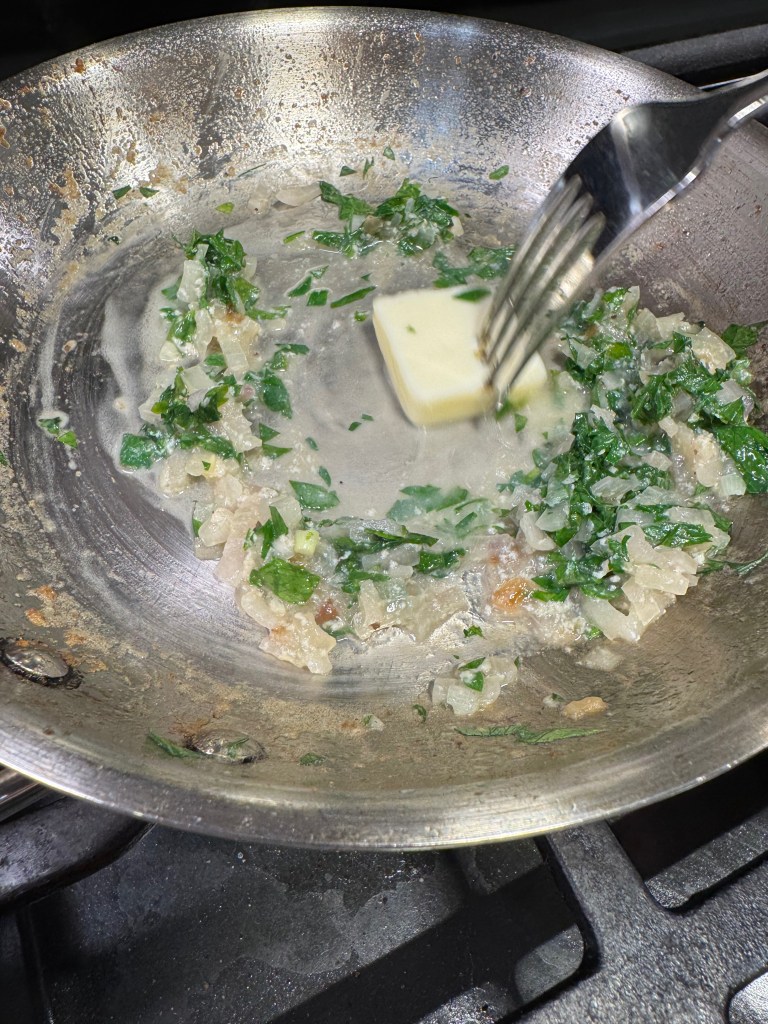
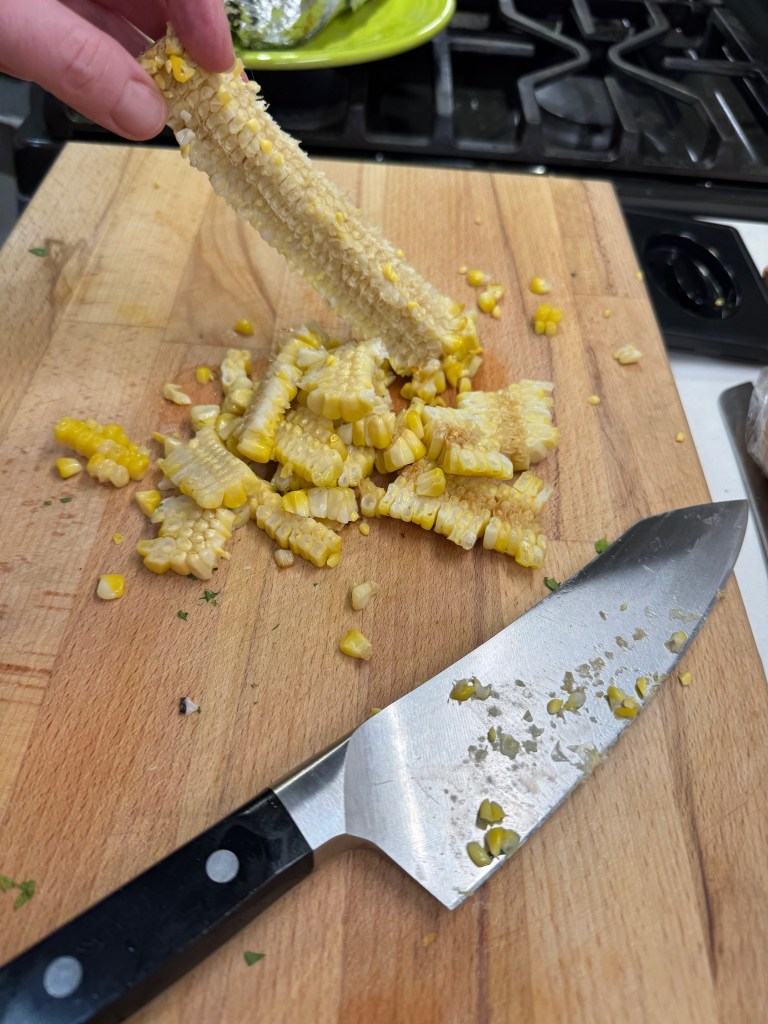
My littleneck clams came from my favorite local seafood shop— fresh from the Atlantic, already cleaned, shucked and chopped. For obvious reasons, they couldn’t go onto the pizza in their shells. After the potatoes were crisped up, I poured the flavorful clam “liquor” into the pan, and swirled in some butter with fresh parsley to dollop on the pizza before baking. I stripped an ear of grilled corn and chopped up the baby spinach, and we were ready to rock and roll.
Cooking pizza on the grill

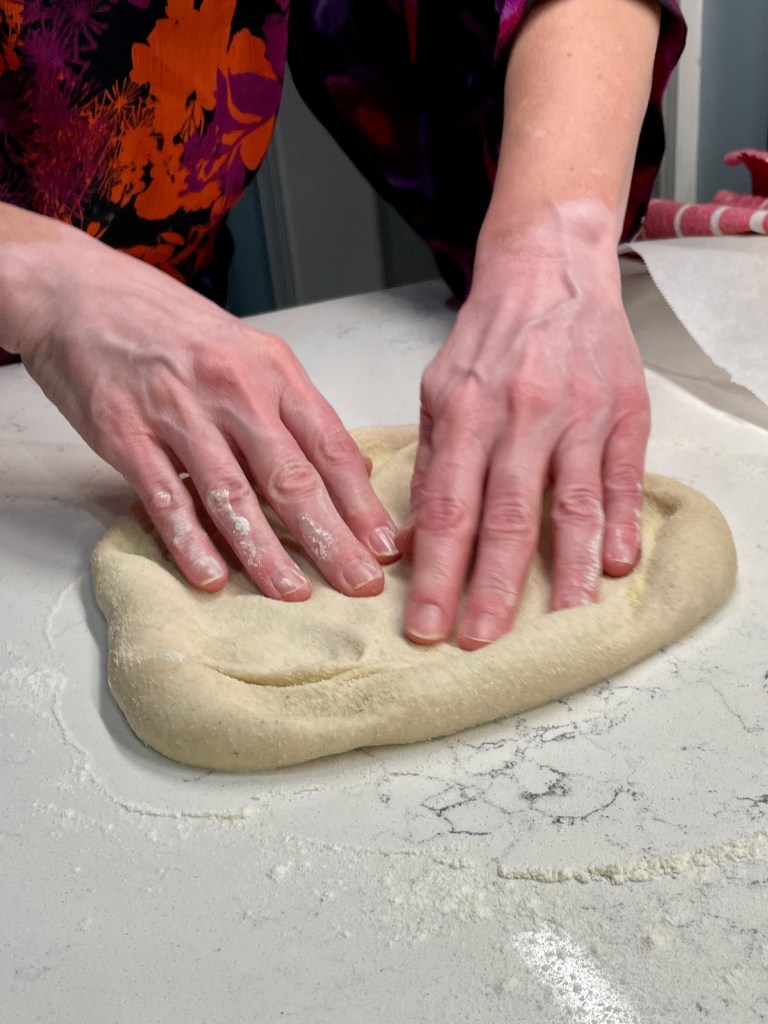
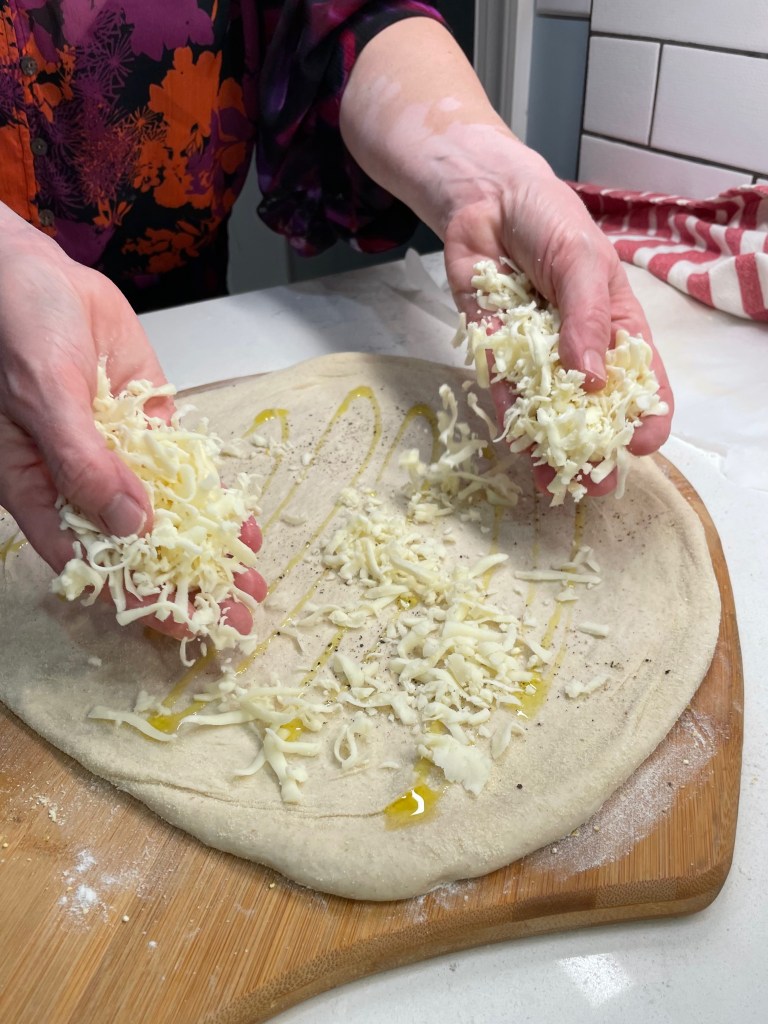
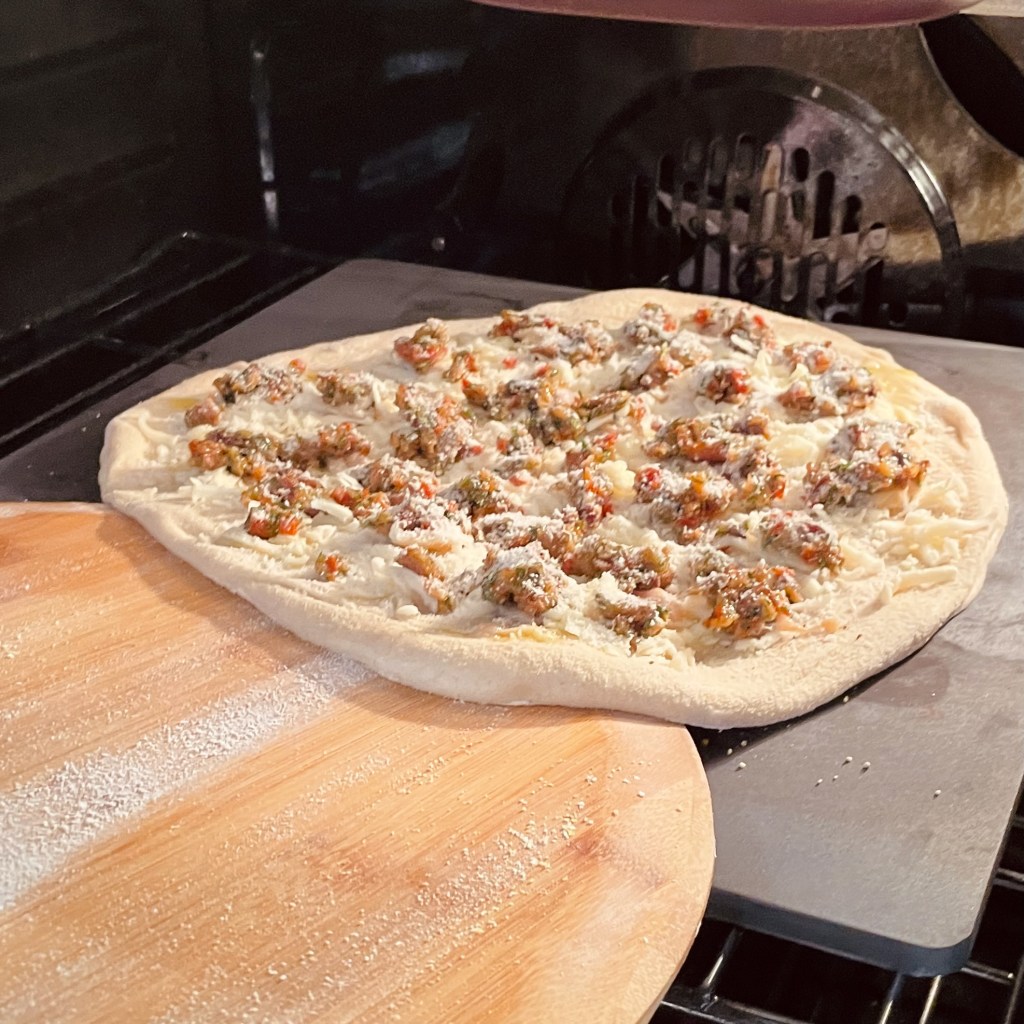
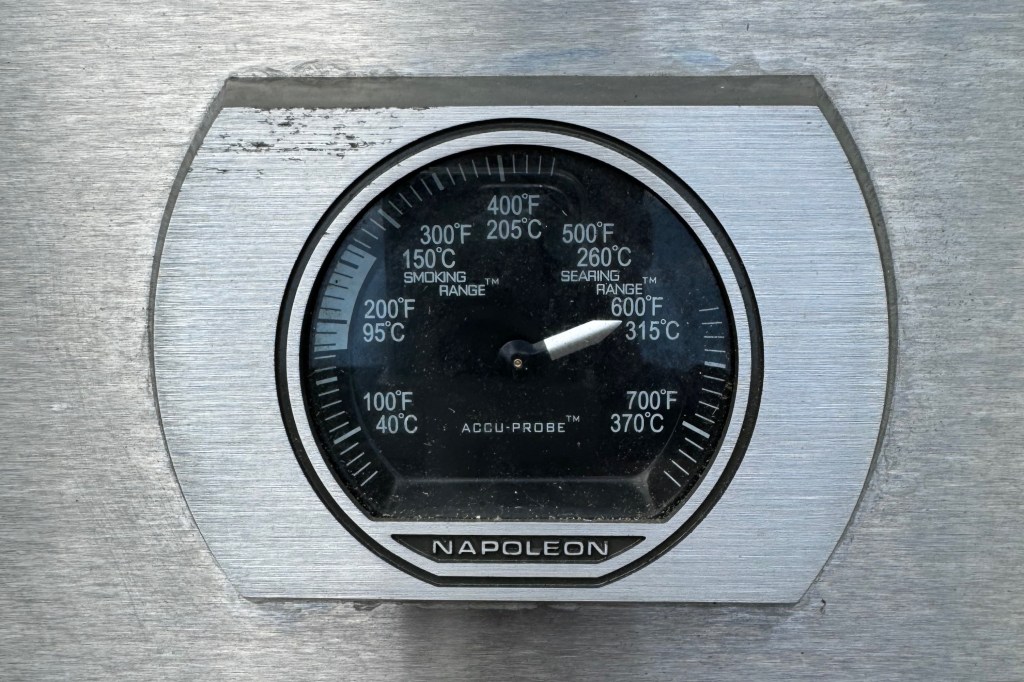
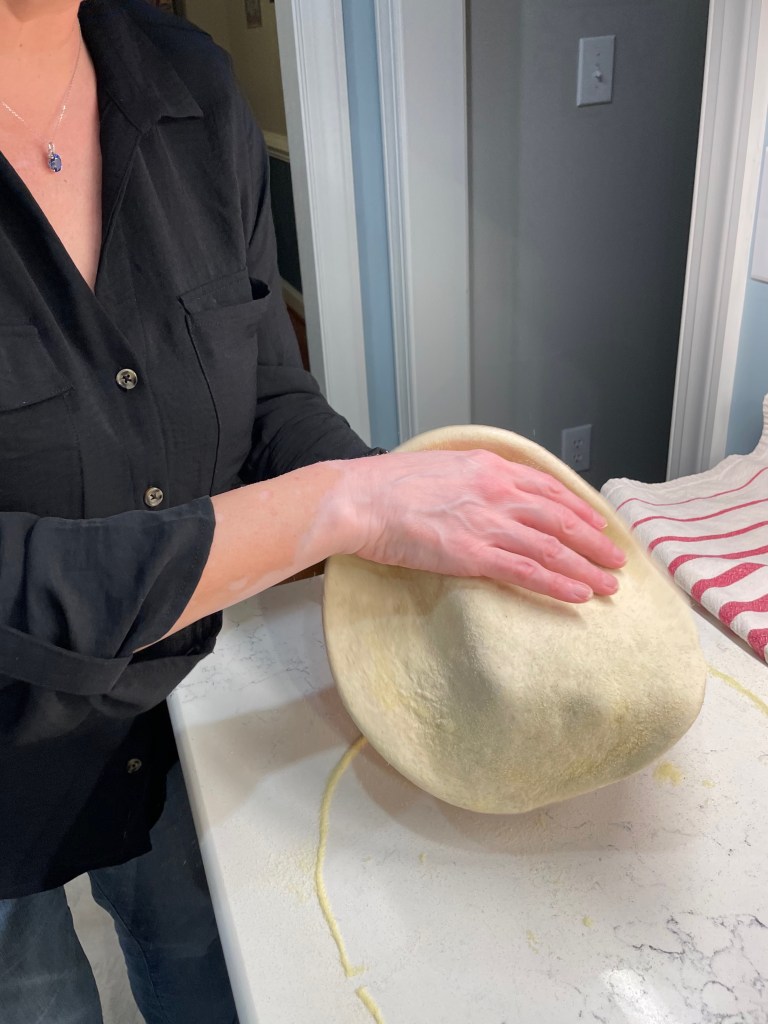
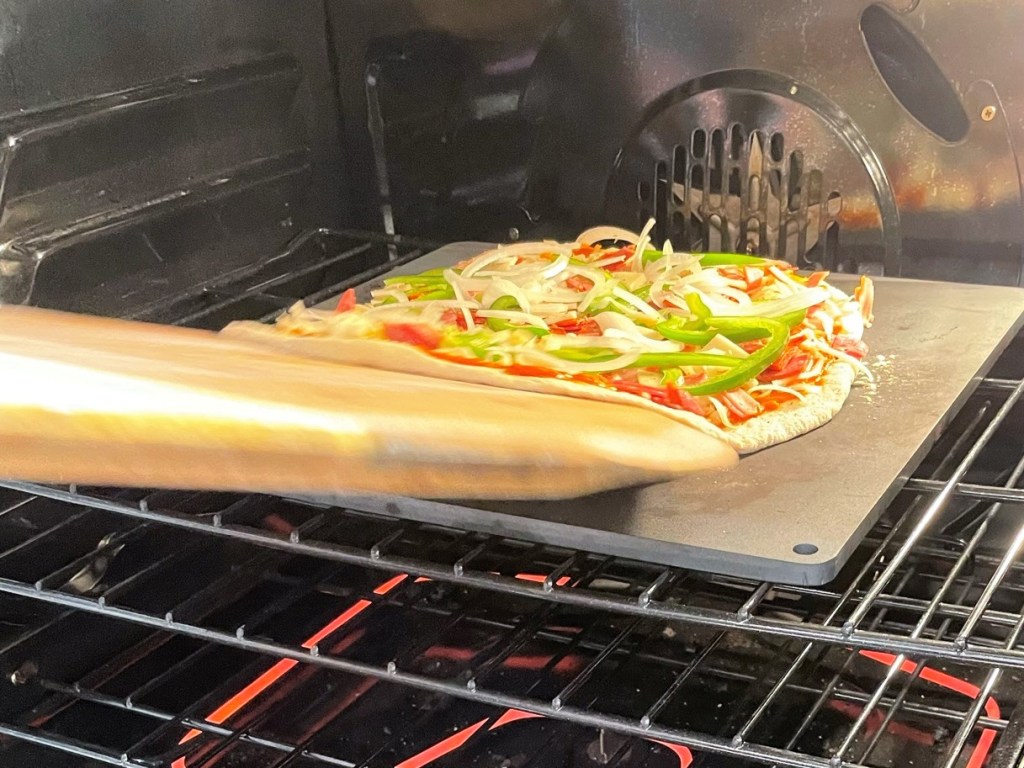
My pizzas are usually done in my home oven, outfitted with a 3/8”-thick slab of steel, preheated to 550° F for at least an hour. In other words, hot! For this one, though, my husband and I did the baking outdoors (clambake style!) on our Napoleon gas grill, which gets even hotter than the oven. We purchased a Weber pizza stone that works great for summer baking when we don’t care to heat up the house. Les handled all of that while I prepped inside, beginning with shaping my dough into a 14-inch round and laying it on a flour- and cornmeal-dusted bamboo peel.
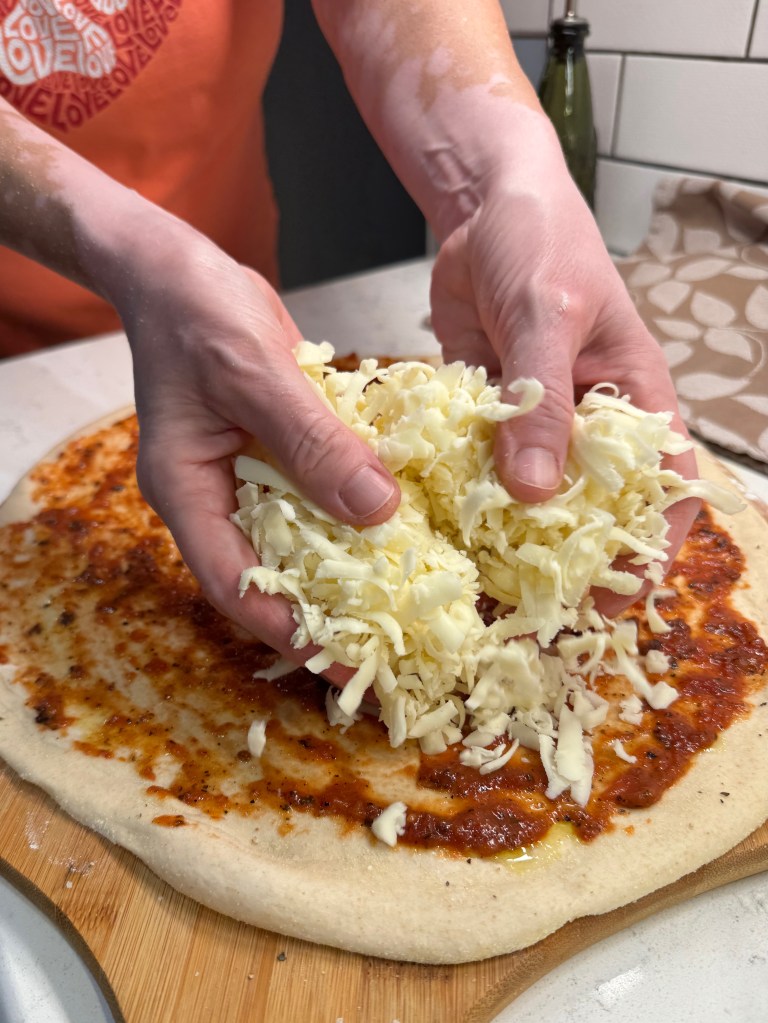
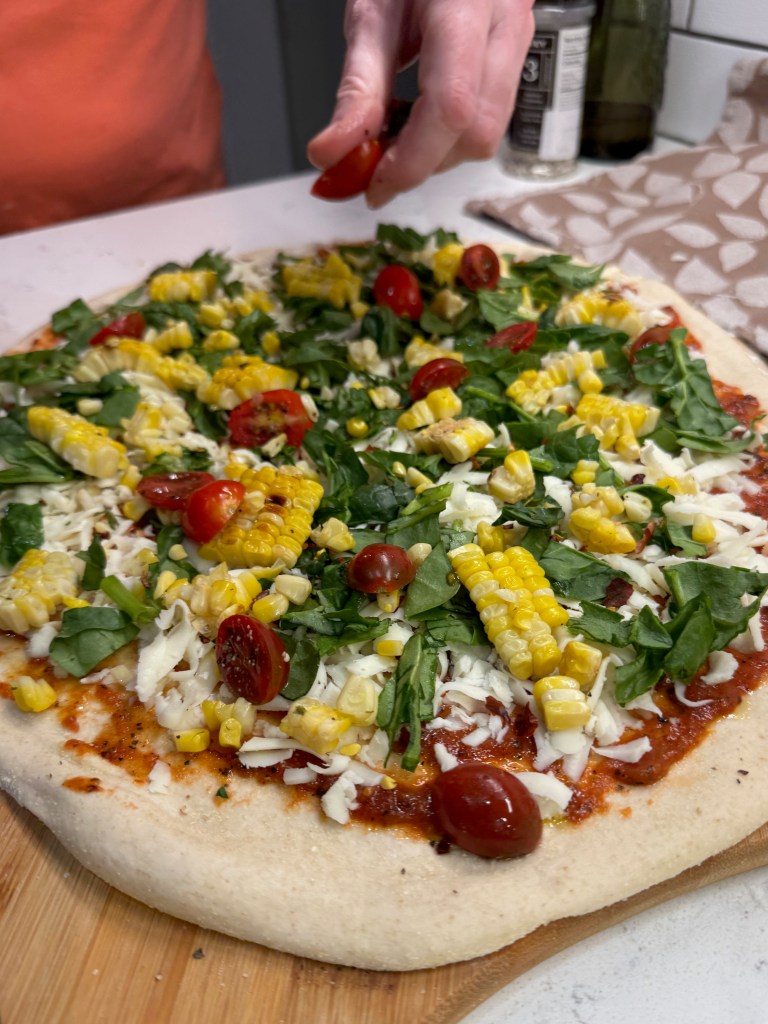
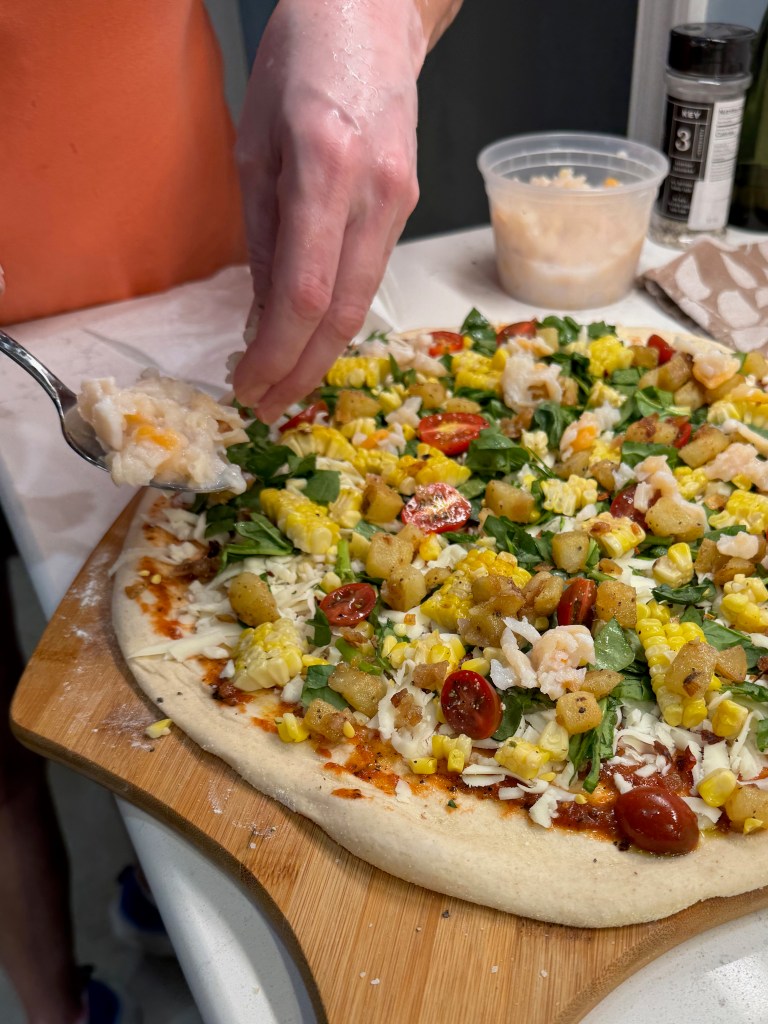
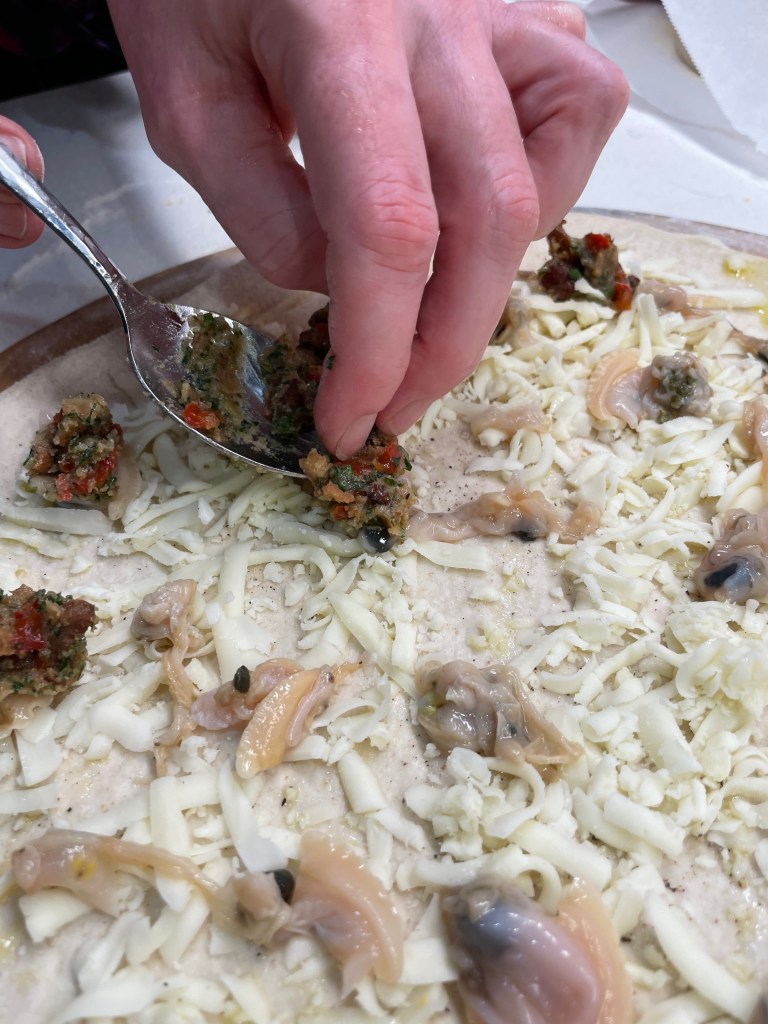
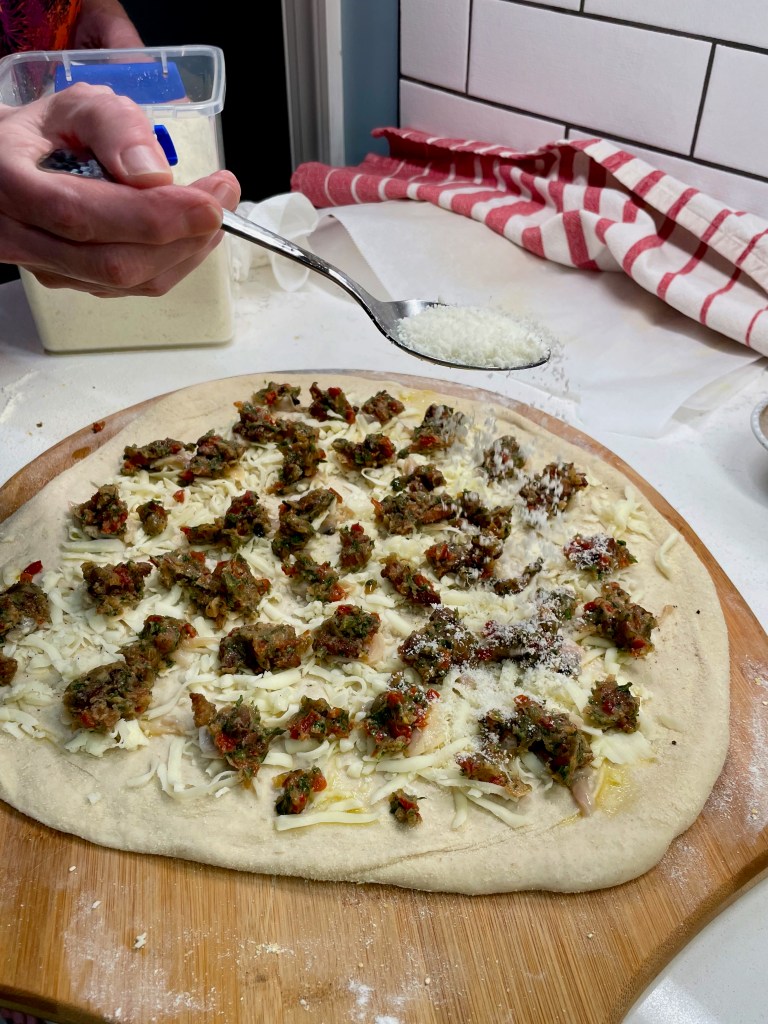
The toppings are straightforward, and I’ve put the wettest ingredients— the corn, tomatoes and clams— on top of the drier ingredients. I want them to get the benefit of the heat without creating too much steam underneath, which would wreck my crust. The clam liquor-butter mixture was laid on last in dollops and this was ready for the bake!
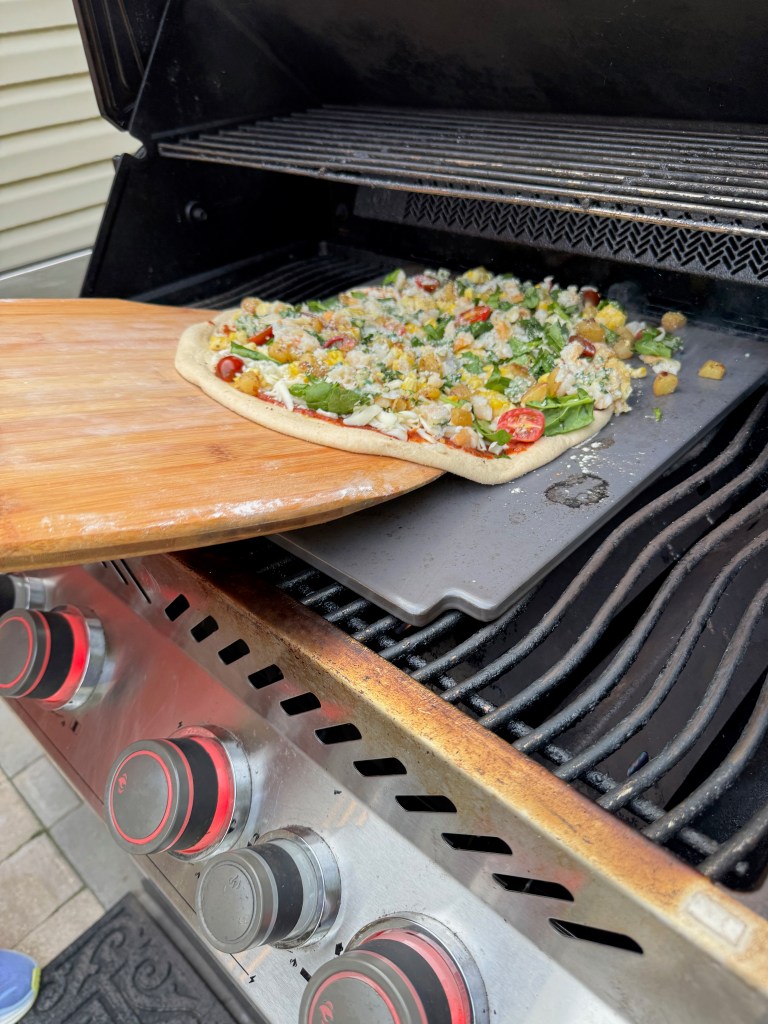
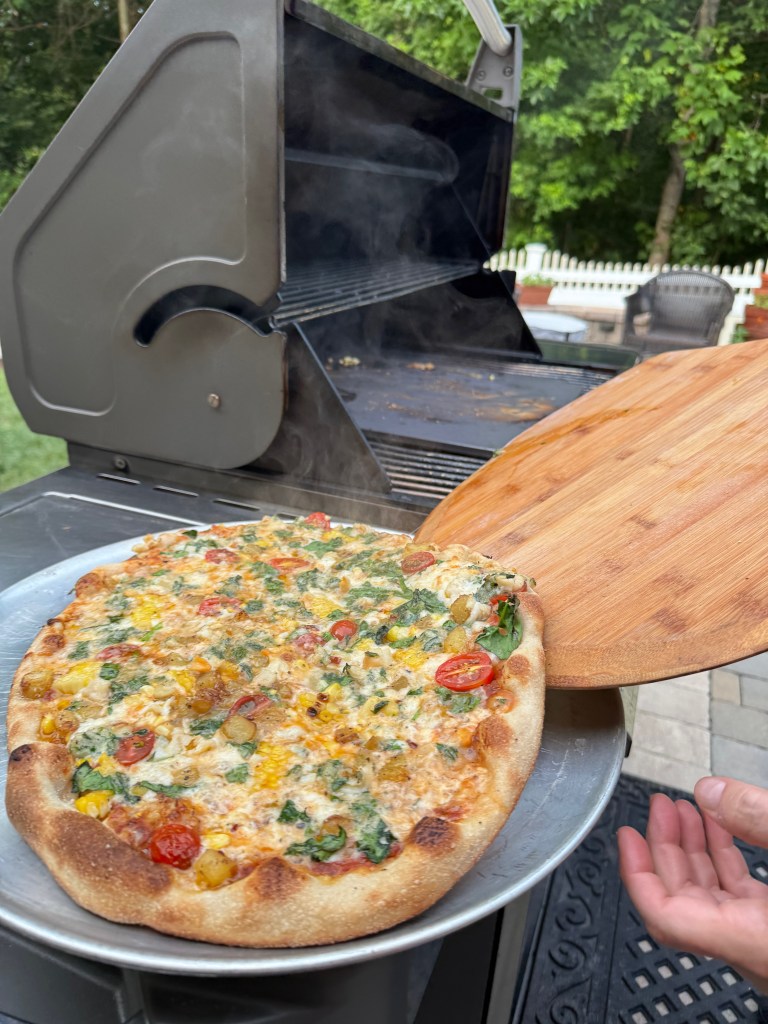
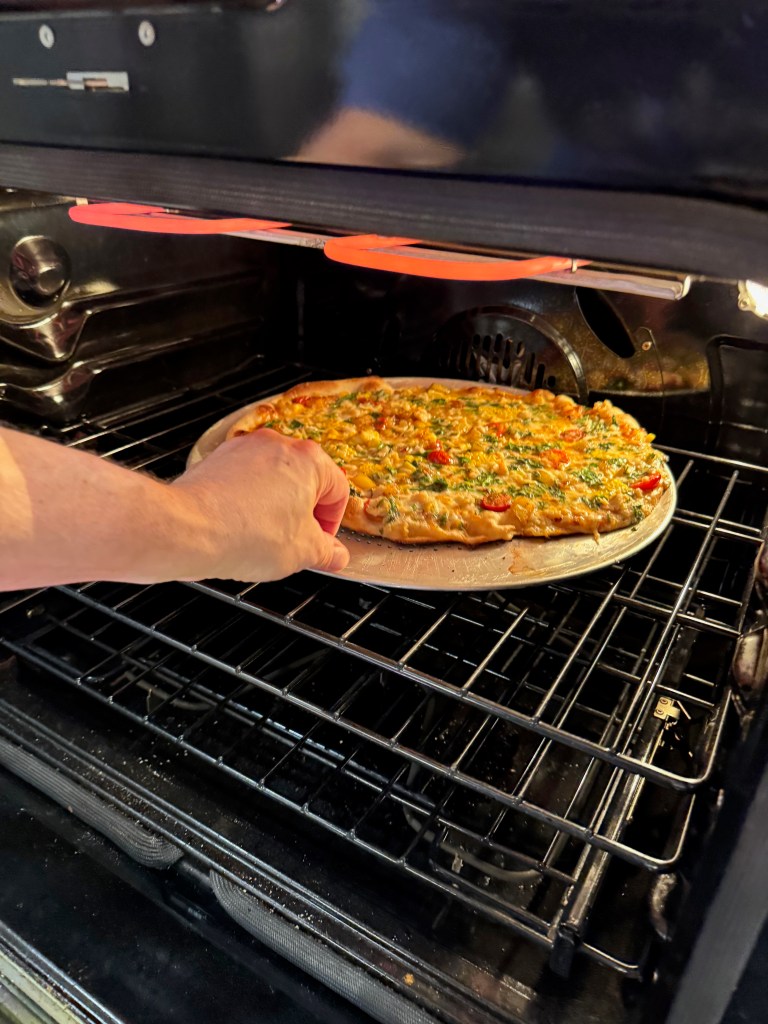
One minor shortcoming of our grill for pizza is that the top of the pizza doesn’t have a chance to brown as it would in the oven. Solution? Easy— we just slide the finished pie under the high broiler in the oven for 30 to 60 seconds. Voila! Blistered crust and perfectly browned toppings, but without heating up the whole house for hours in the dead heat of summer. 

It even smells like a clambake!

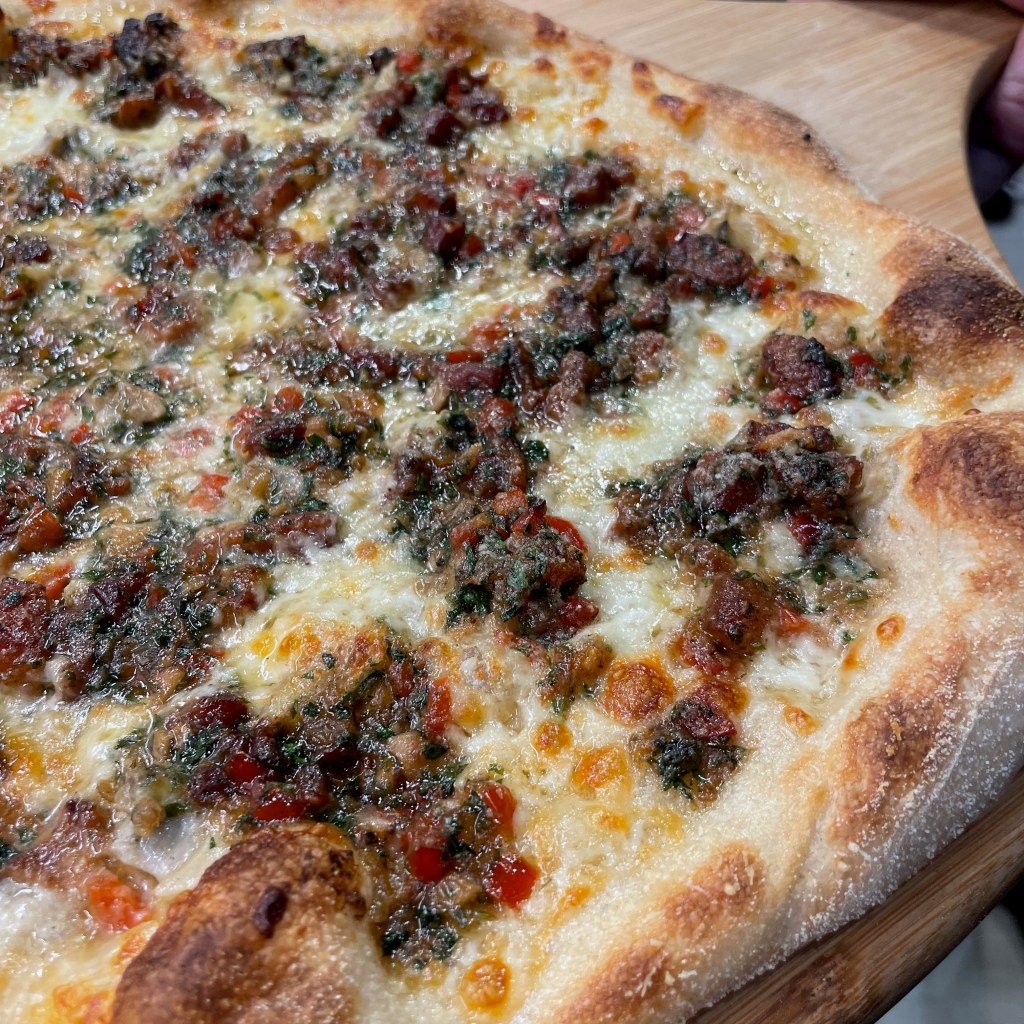
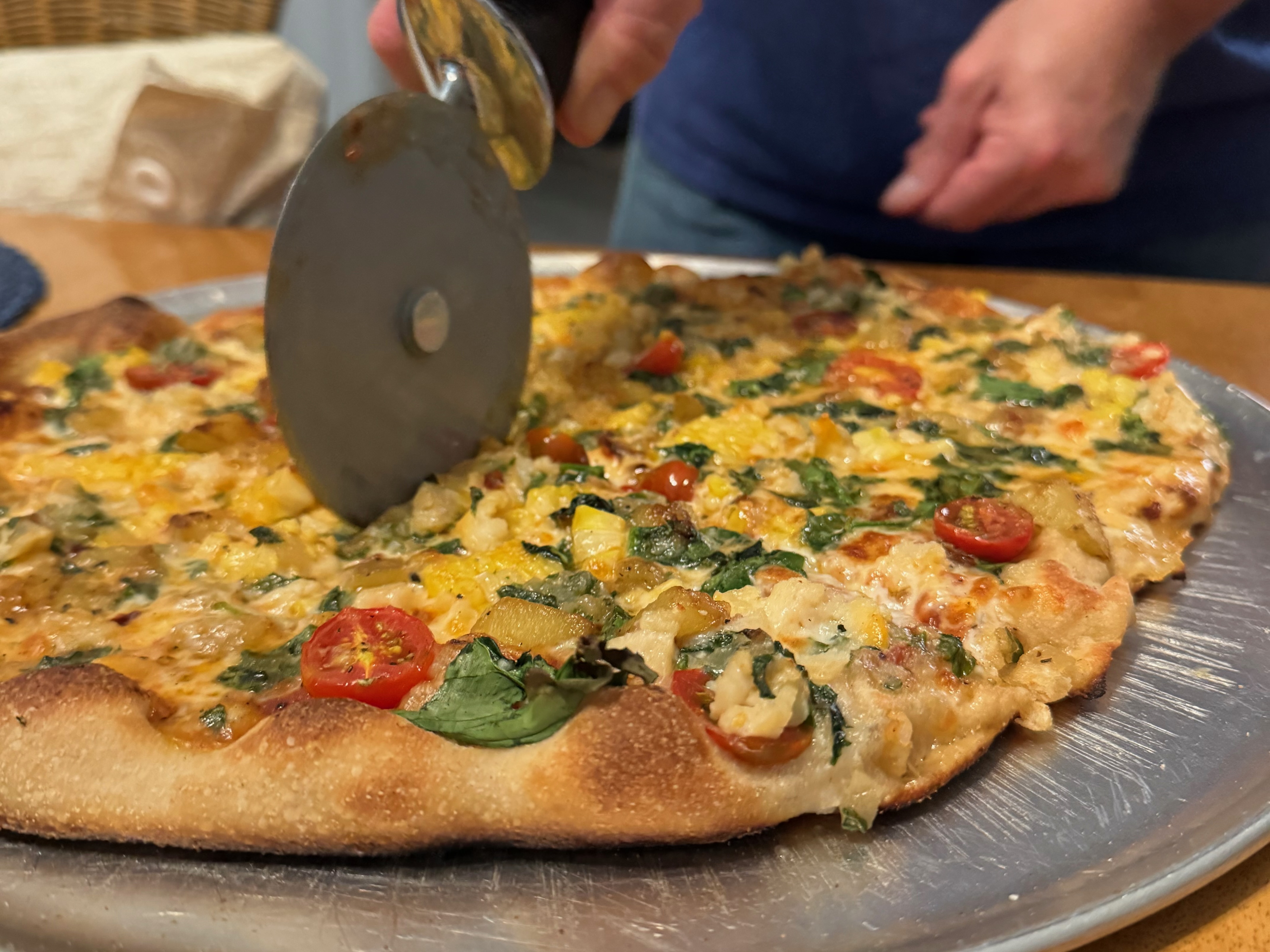
So how was this lovely creation, made of Leo-favored ingredients and served up on this last day of my zodiac sign? Delicious! My husband and I have both come to love clams on pizza, ever since our trip to New Haven and our own adventures with white clam pie, which I’m now Jonesing to do again soon. This fun interpretation brought plenty of other tasty ingredients into play, and we could taste each of them. The tomatoes were a good addition, and the trick of reducing the clam liquor with the buttered onions really added a great finishing note of ocean flavor. Would I make it again? Definitely! And I probably won’t wait until Leo season rolls back around. 

Tomorrow is the first day of Virgo. Now, I wonder what they like to eat? 😉

Clambake Pizza
  • Servings: 6 slices
  • Difficulty: Average
  • Print

Apparently, my zodiac sign (Leo) loves clams, corn, spinach and mozzarella. What else could I do with this information but make a clambake pizza?


Ingredients

  • 2 Tbsp. salted butter (half for cooking onions, half for clam-herb butter)
  • 1 small shallot, minced
  • 1 medium Yukon gold potato, cubed and boiled to al denté tenderness
  • A pinch of baking soda in the potato cooking water
  • 11 oz. pizza dough ball, at room temperature
  • 1/3 cup favorite pizza sauce
  • 3/4 cup freshly grated firm mozzarella
  • 1 ear of grilled corn, stripped from cob
  • A handful of cherry or grape tomatoes, halved and salted
  • A fat handful (about 2 cups) fresh baby spinach, rough chopped
  • A few shakes of crushed red pepper, if you like heat
  • About 1 cup fresh chopped littleneck clam meats (reserve some of the liquor for the herb butter)

Notes: My pizzas are baked on an oven steel, preheated to 550° F for one hour. Alternatively, bake on a pizza stone designed for a gas grill, following temperature instructions for your stone and adjusting time as needed. Either setup will help you achieve a brick oven-style pizza at home.

Directions

  1. Heat a small sauté pan over medium heat with a tablespoon of butter. Sauté the shallots for a few minutes until slightly softened. Drain the potatoes and add to the pan, tossing to crisp up the sides.
  2. Transfer the cooked potatoes to a small bowl. Pour some of the clam liquor into the sauté pan with the shallots and butter and simmer to reduce the liquid. Remove from heat and swirl in the other tablespoon of butter, along with the fresh parsley. Set this aside as a final topper to the pizza.
  3. Shape pizza dough into a 14-inch round and place it on a flour- and cornmeal-dusted peel. Swirl sauce over the pizza and scatter the mozzarella all over it.
  4. Layer toppings on, beginning with the spinach, pepper flakes and corn, then the tomatoes, potatoes and clams. Finally, arrange dollops of the clam liquor-infused herb butter all over the pizza, emphasizing the clams as much as possible.
  5. Transfer to the pizza to the preheated steel (or stone) and bake for 6 to 7 minutes, using peel to turn pizza at the 4-minute mark. If baking on the grill, transfer finished pizza to a heatproof pan and slide it under the high broiler of your oven for up to 60 seconds, to get the roasted appearance of an oven-baked pie.
  6. Wrap any leftover slices individually in aluminum foil. Reheat on a preheated griddle or skillet, loosely tented with foil. This preserves the crispy texture of the crust while allowing the cheesy topping to melt.

Just for fun…

A few famous Leos: 😎 Looks like I’m in excellent company!

Jennifer Lopez
Barack Obama
Mick Jagger
Helen Mirren
Antonio Banderas
Sandra Bullock

Charlize Theron

Steve Carell
Meghan Markle
Arnold Schwarzenegger
Halle Berry

Madonna
Steve Martin
Tony Bennett
Martha Stewart

Everything Bagel Pizza

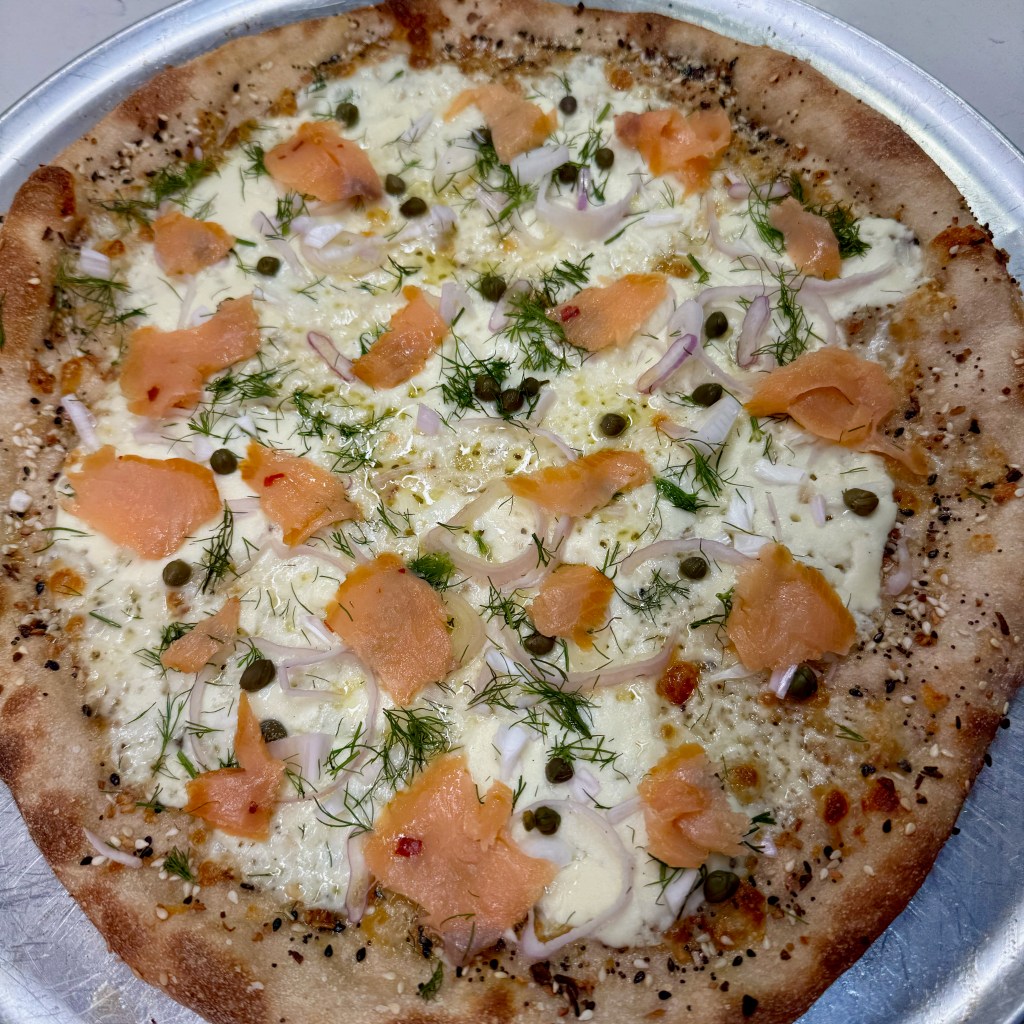
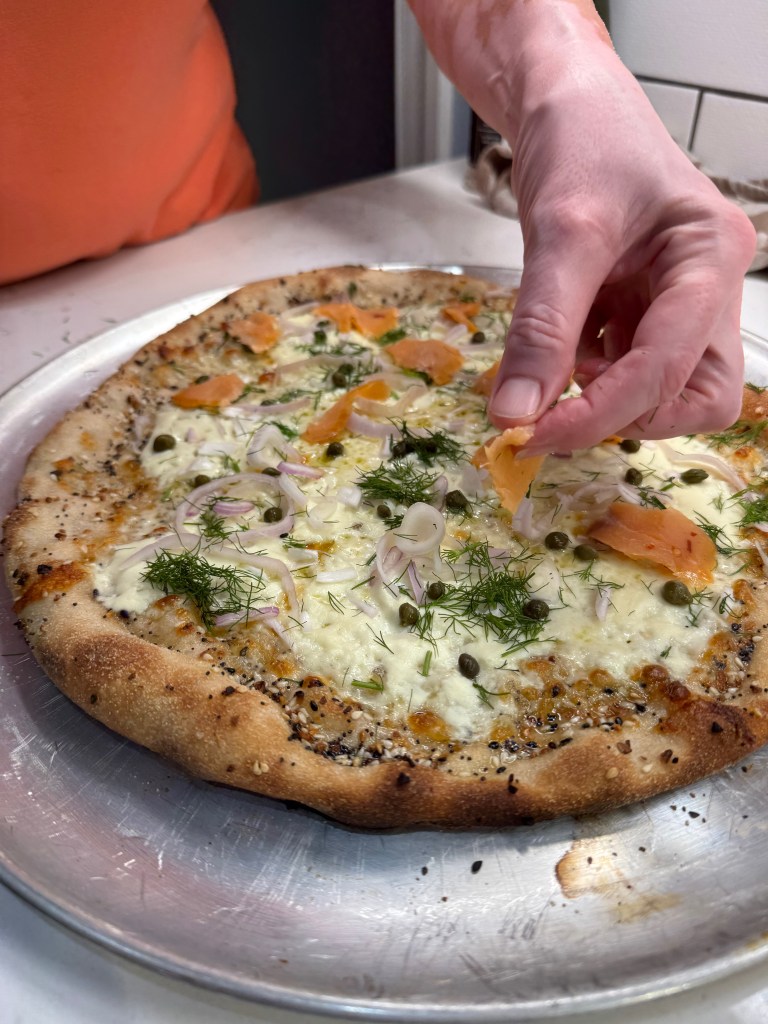
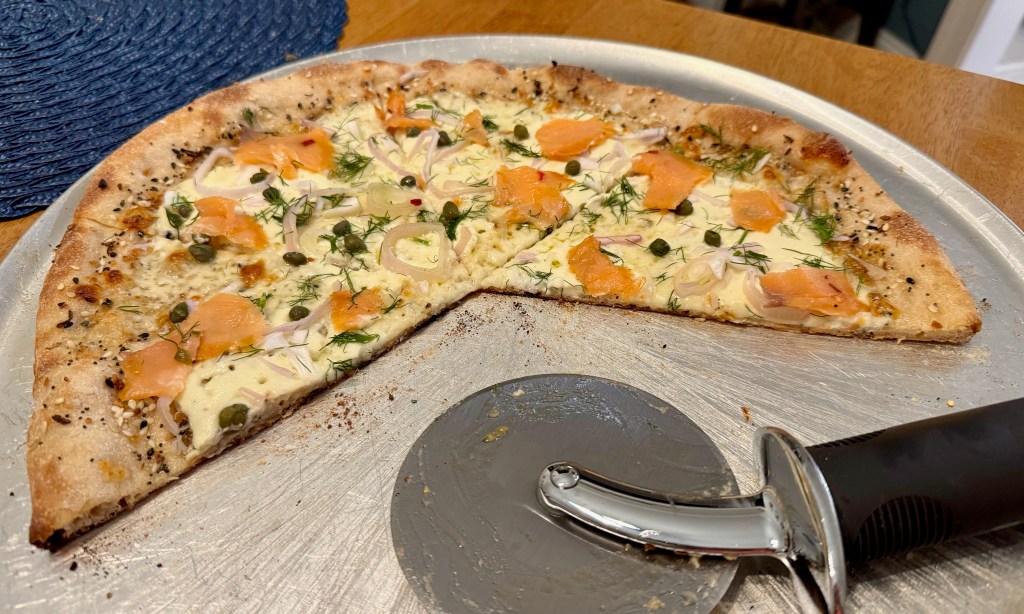
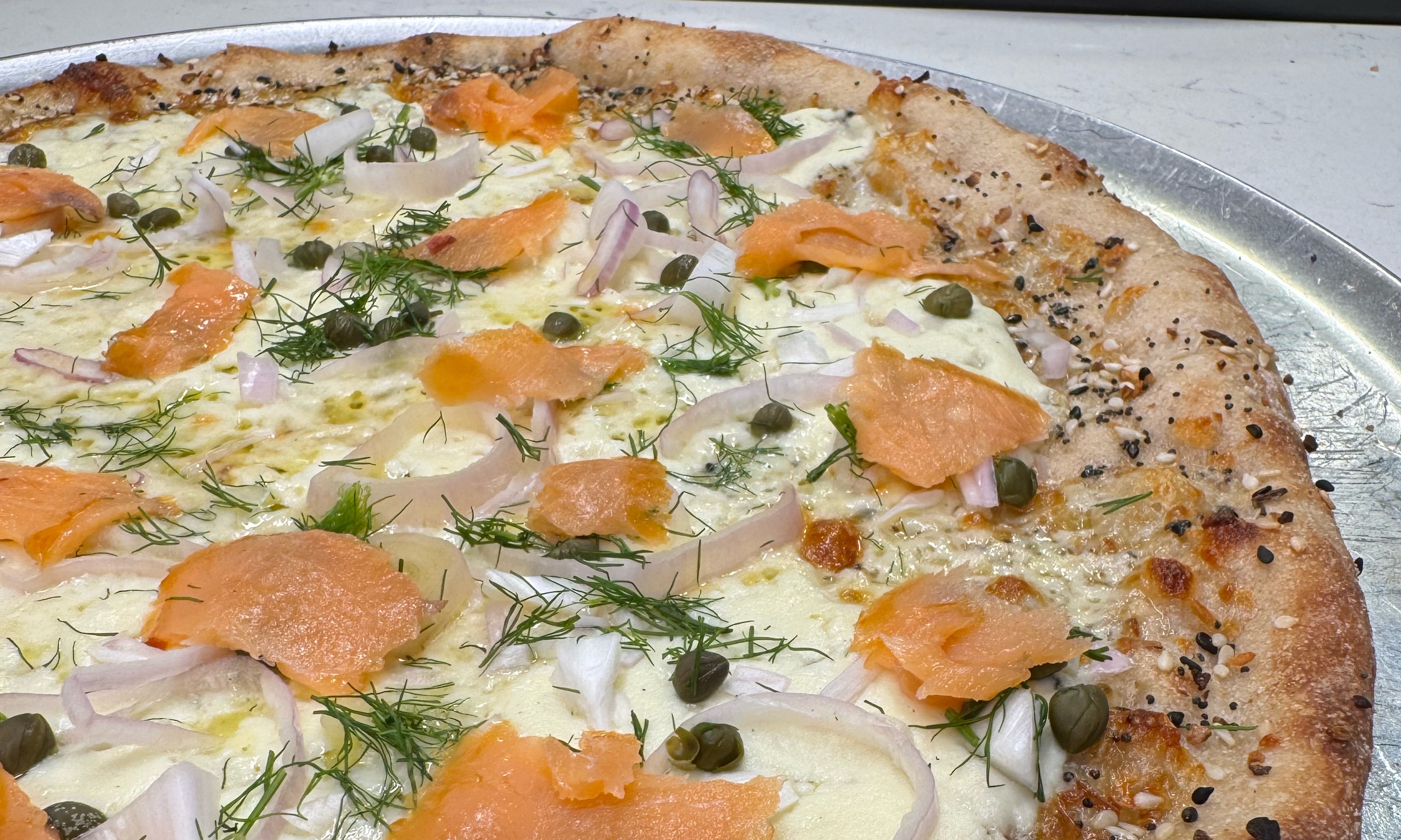
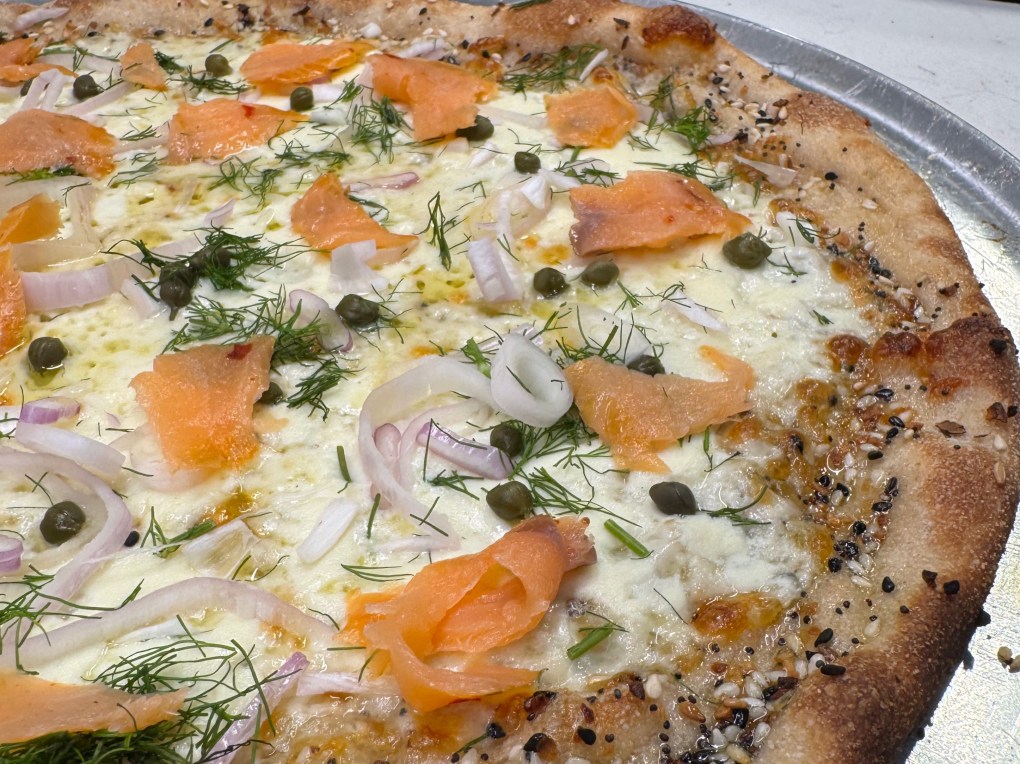
There’s almost no limit to what can be put on a pizza. The question is whether you should. And in this case of Jewish bagel toppings, I’m saying that the answer is yes! It’s a no-sauce, creamy cheese topping on an “everything” seasoned sourdough crust, finished with all the fixings you’d find on a Jewish deli bagel— onions, capers, dill and lox. 

Think of it as a really big bagel!

Before I met my husband, who is Jewish, I could count on one hand the number of times I’d eaten bagels with lox. But this has become very much a staple in our home, and Les and I enjoy it for breakfast at least once a week. I love the flavors (especially when fresh dill is in season), and we’ve adapted it to dips and cheese spreads for parties, but I was eager to apply the unique flavors and textures to something else.

It wasn’t until we finally had a date on the calendar to have Rabbi Charlie and his family over for pizza that I decided to test it. You see, the rabbi keeps kosher rules, and that means meat and cheese cannot co-exist on the table. This regulation stems back to verses in Leviticus that declare you “shall not cook the kid in its mother’s milk,” and over time, the rule has expanded to include any kind of meat with any kind of dairy. Pizza without cheese is a sin in my book, so it would have to be the meat that would be kicked to the curb when we hosted them. 

But isn’t fish meat?

Nope. In Jewish kosher regulations, fish—or at least those fish with both fins and scales— are given a pass; they are considered “pareve,” neither meat nor dairy. The only fish (other than anchovies) that sounds evenly remotely good to me on a pizza is salmon, and this is how I decided to go for it. We used a lox-type of salmon, and it was not cooked but added to the pizza after the crust emerged from the oven. In fact, most of the toppings were added after baking, the same as we would dress a bagel after toasting it.

Now, before I get too far ahead of myself, I want to clarify that we actually did not serve this everything bagel pizza when we hosted the rabbi because I felt it needed some tweaking. When the time came, we opted for all-veggie pizzas for our guests. But this test was tasty and fun, and I learned at least two things that will make it better next time. Ready to see how we made it?

How to make everything bagel pizza

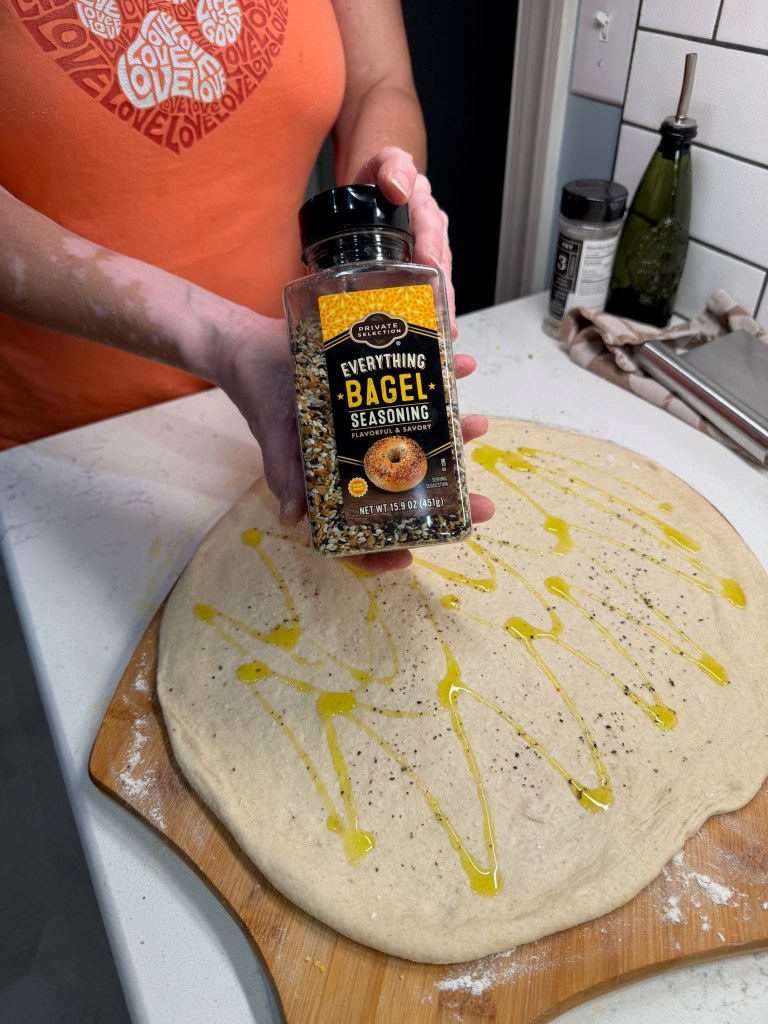
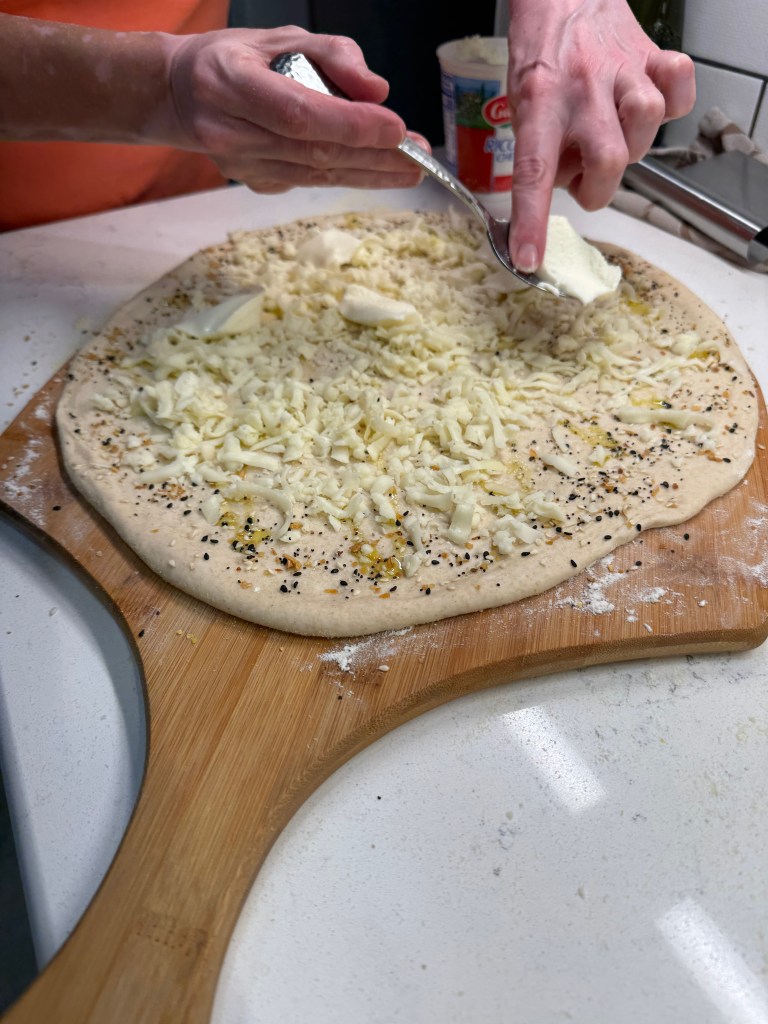
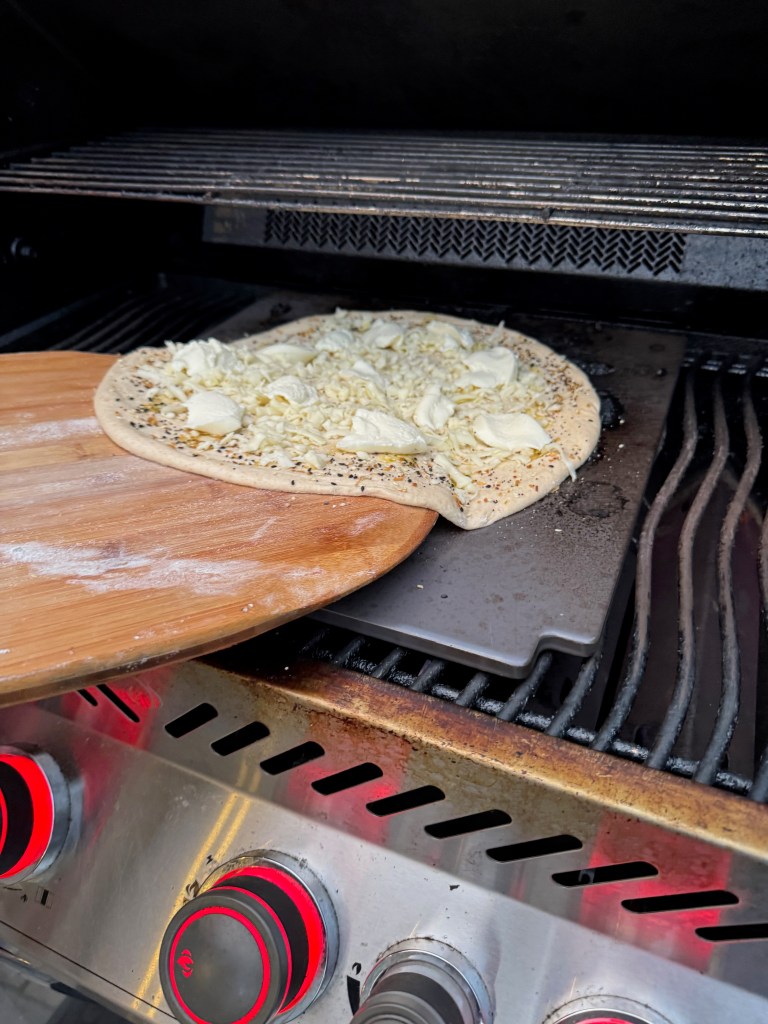
The crust for my pizza is the same as always: sourdough from scratch, made two days ahead and kept in the fridge for a cold ferment until pizza time. There was no sauce on this pizza. I sprinkled the dough generously, especially on the edges, with everything bagel seasoning and then spread a light layer of freshly grated mozzarella and a few dollops of ricotta cheese before we slid it onto the preheated stone on our outdoor grill.


I know what you’re thinking—“doesn’t a bagel get spread with cream cheese?”— and you’d be correct. But I wasn’t sure how well cream cheese would hold up under the intense heat we use for pizza, so I substituted ricotta, which I’ve used successfully on other pies in the past. In hindsight, this is one thing I’ll do differently next time. There was nothing wrong with the ricotta, but I missed the smooth texture of cream cheese. I think if the cream cheese was very cold, straight from the fridge, it would do just fine and would provide a more expected flavor.


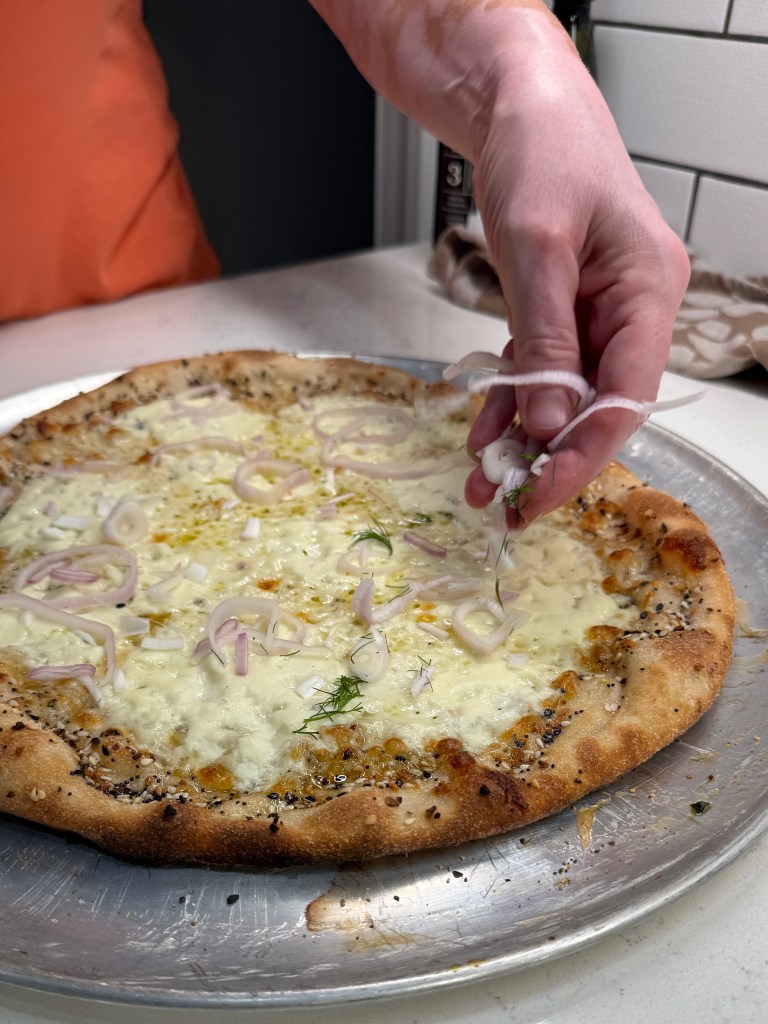
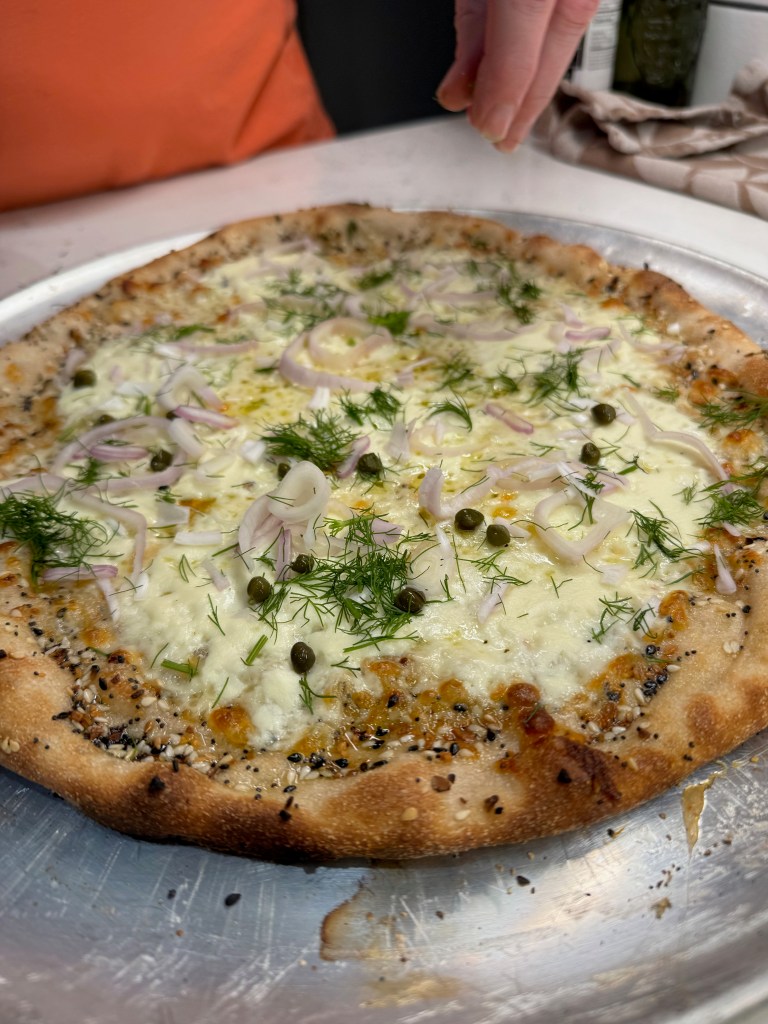
The ricotta oozed out into thin puddles, which gave every bite a nice even base. I scattered thinly sliced shallots, small capers and fresh dill over the hot pizza, and then arranged bite-sized bits of our smoked salmon all over just before serving. This kind of salmon would have shriveled terribly in the oven, so I believe this was the way to go. But here’s the other thing I’ll do differently next time—and there will be a next time—I’ll double the amount of salmon. It looked pretty in pictures to have a sparse amount of salmon, but when sliced and served, it felt a little skimpy. The salmon I used was supposedly a “hot honey” variety, but neither Les nor I found it to taste any different from a regular smoked salmon. I won’t spend extra next time for the fancy flavor (given that it didn’t have any). 

So what did we serve the rabbi and his family?

Pizza without meat is easy-peasy, and we managed just fine with a variety of veggie-forward pies for our kosher-keeping guests. One pizza was half classic veggie (peppers, onions, mushrooms and spinach) and half plain cheese. Here are the other two, and I promise that nobody ended the evening hungry. Especially after the ice cream, which is coming later this week. 😉


One more kosher tidbit…

I learned only within the past few years that traditional Italian hard cheeses, such as Parmigiano-Reggiano and Pecorino-Romano, are made with animal rennet and therefore not generally regarded as vegetarian. This is important to consider when serving guests who steer clear of meat for any reason, and I called this out when we were prepping pizzas, assuring our kosher guests that I had found a Wisconsin-made parmesan that used plant-based enzymes rather than rennet. The rabbi shared the good news that there is a kosher (though not vegetarian) exception, using rennet from kosher-slaughtered lambs. This would not exonerate parmesan for vegetarian diets, but for religious purposes, it has been deemed acceptable. 

If you know me at all, you know that I can’t resist a good rabbit hole, so I dug in a bit and found this interesting article to explain more about it, in case you’d like to check it out.

The leftovers became our next-day breakfast!

Everything Bagel Pizza

  • Servings: 6 slices
  • Difficulty: Average
  • Print

This is a unique twist on an everything bagel, topped with all the ingredients we enjoy at breakfast. But this time, it's on a sourdough pizza crust!


Ingredients

  • 11 oz. pizza dough ball, at room temperature
  • Extra virgin olive oil
  • 2 Tbsp. “everything bagel” seasoning (a combination of sesame seed, coarse salt, poppy seed and dried garlic)
  • 1/2 cup freshly shredded firm mozzarella
  • About 1/3 cup whole milk ricotta, cold from the fridge
  • 1/4 cup thinly sliced shallots (or red onion)
  • 1 Tbsp. small capers, drained but not rinsed
  • Small handful fresh dill, chopped
  • 3 oz. cold smoked salmon (lox)

Note: We make most of our pizzas on a steel that has been pre-heated for one hour at 550° F, or sometimes on a specialty stone on our outdoor grill, also at least 550° F. This very closely replicates a brick oven-style pizza that is finished in about seven minutes. If you are using an oven pizza stone or a pizza pan, you will need to adjust your temperature and cooking time accordingly.

Directions

  1. Preheat your oven or grill, and bring the pizza dough to room temperature.
  2. Shape pizza dough by hand into a 14-inch round and place on a flour- and cornmeal-dusted wooden peel for easy transfer to and from the oven or grill.
  3. Drizzle dough with olive oil and sprinkle salt and pepper over the surface. Generously scatter the everything bagel seasoning over the crust, concentrating mostly on the outer edges.
  4. Spread mozzarella evenly over the center of the dough, and use a large spoon to arrange dollops of the ricotta around the pizza.
  5. Transfer to the pizza steel or stone and bake for 6 to 7 minutes, rotating the pizza after about four minutes.
  6. Transfer hot pizza to a serving pan. Quickly scatter shallots, capers and dill over the pizza, and then arrange the smoked salmon so that every slice has an equal amount.


Clams Casino Pizza

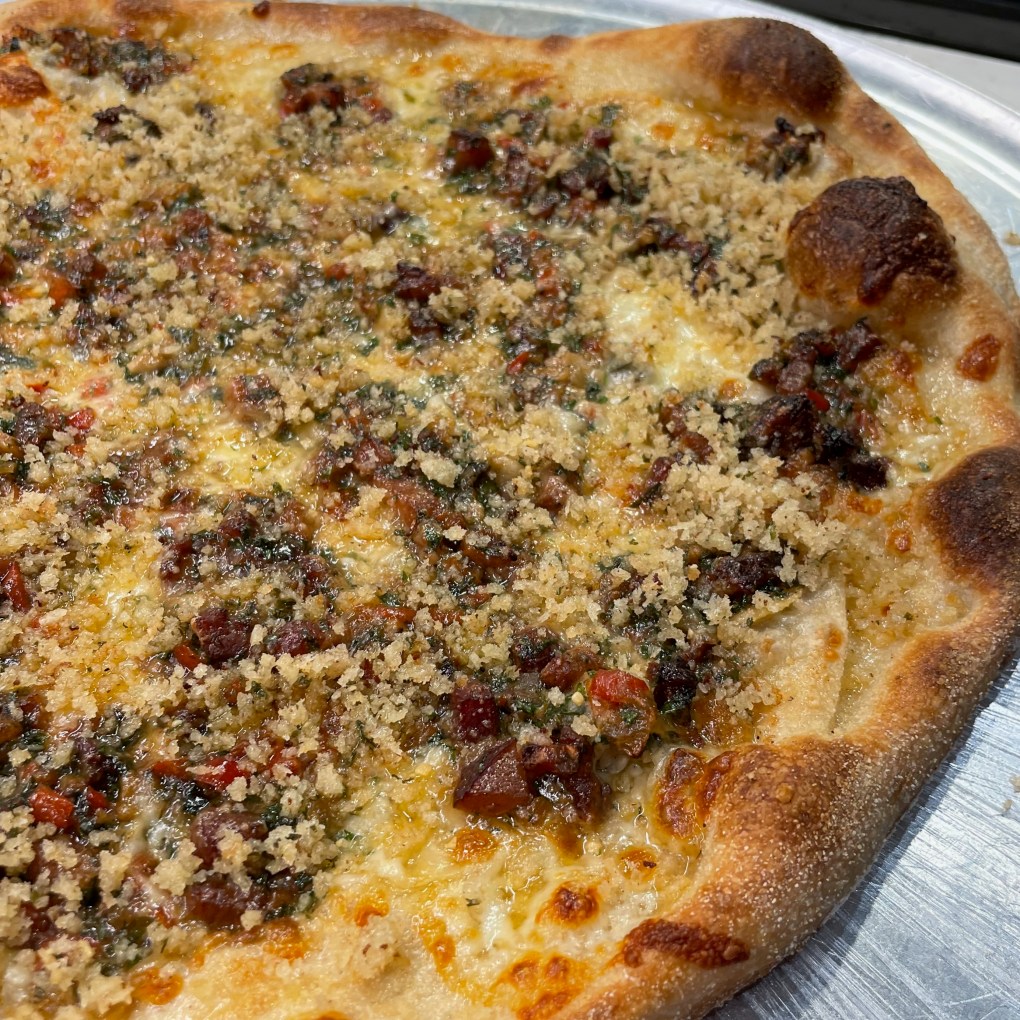
Call me sentimental, but I’ve been digging some of the retro standards lately. Nostalgia hits heavy during the holidays, and my recent tradition of reimagining some old-school favorites on top of a pizza for New Year’s continues with this combination of clams, bacon, pepper, shallots and garlic— it’s a clams casino pizza!

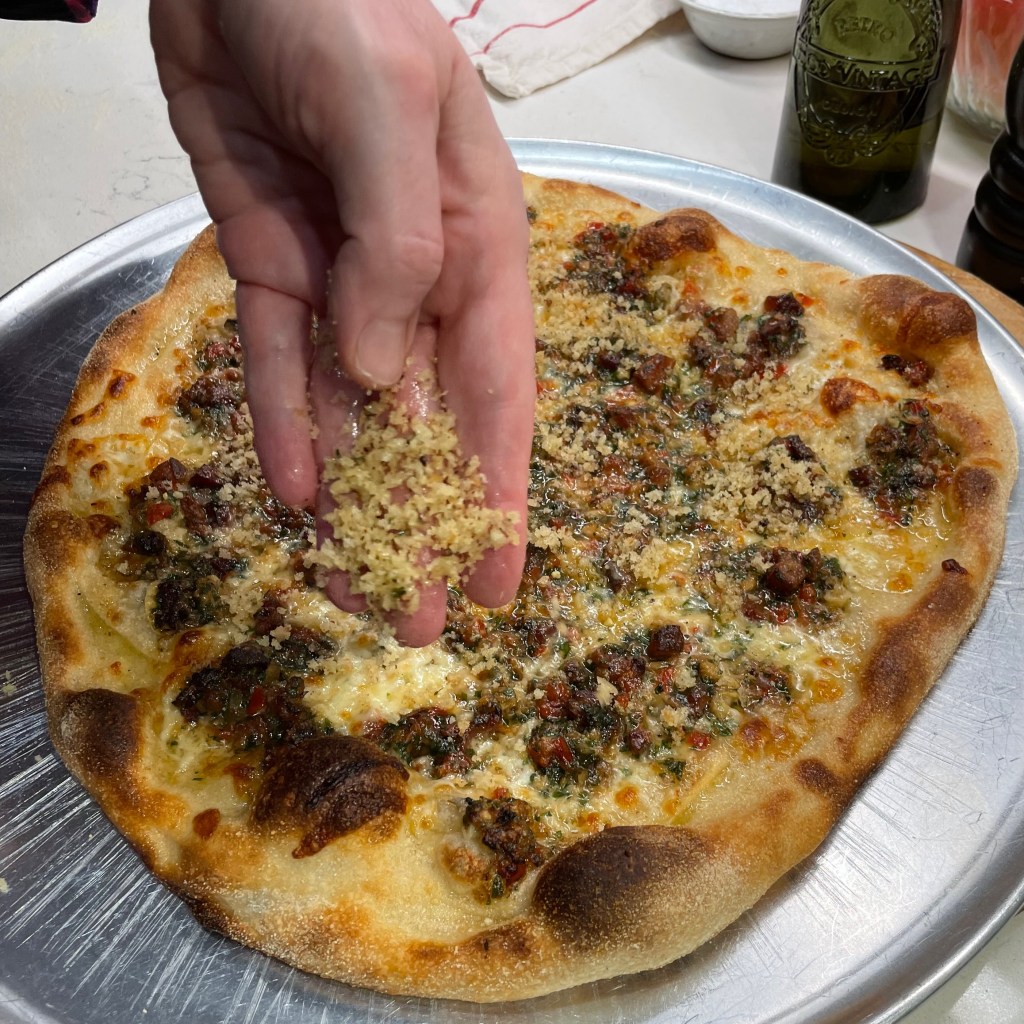
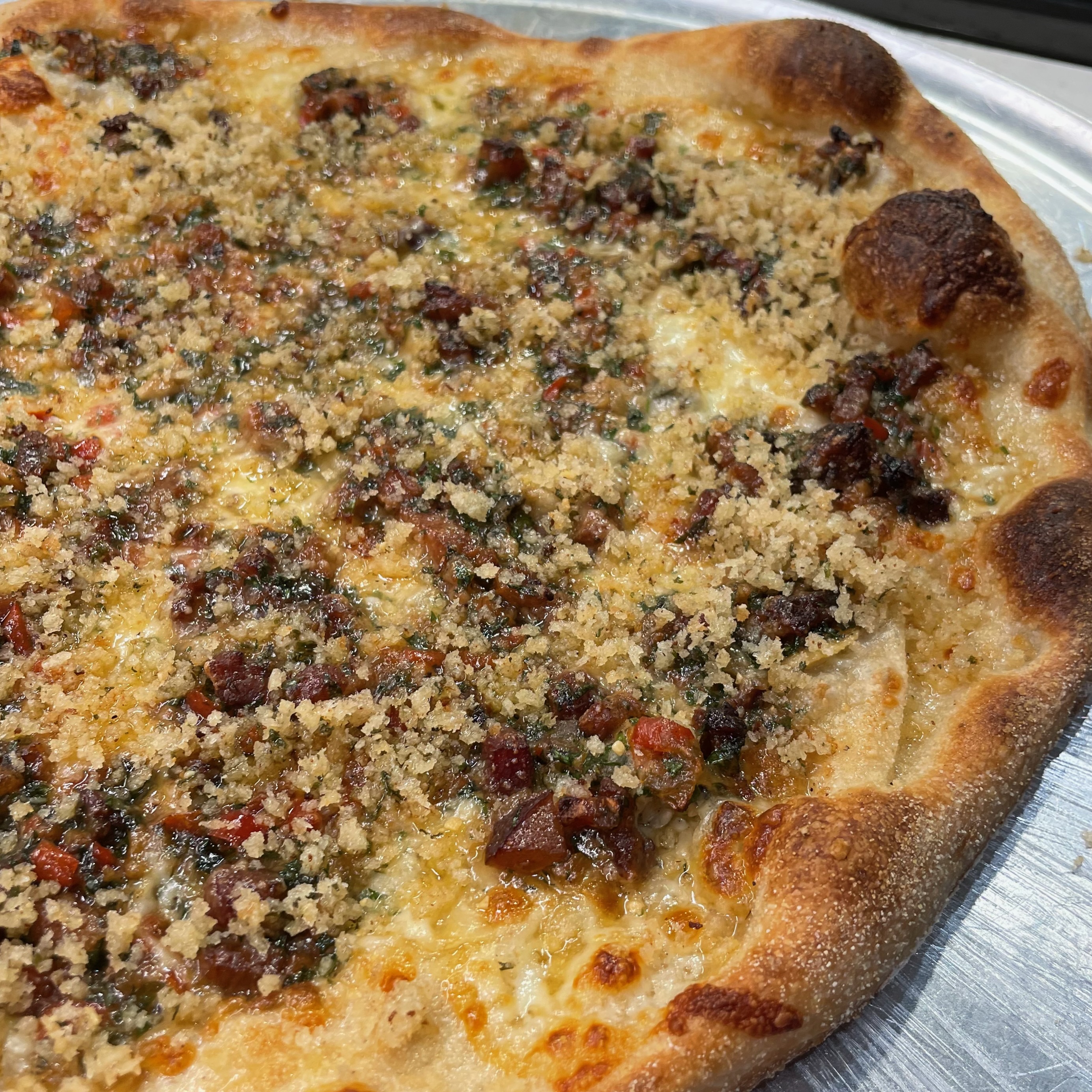
It even has crisp, bacon-y panko crumbs on top!

The literal translation of “casino” from Italian is “big mess,” and I find that more fitting of the dazzling Las Vegas strip than the flavors of the dish that that was first created in 1917 at  Narragansett Pier Casino in Rhode Island— or was it 1900 in New York’s Central Park Casino? As usual with recipe history, the details are murky, but with such a delectable combination of flavors, I can understand why people would fight to lay claim to it.

Transforming these flavors onto a pizza was actually pretty simple. As with my other fancy New Year’s Eve pies, there is no red sauce; only cheese as the base layer, followed by freshly shucked littleneck clams and then the casino flavors that go on by the spoonful. How did I pack all that flavor into one delicious pizza topping? Let’s get into it!

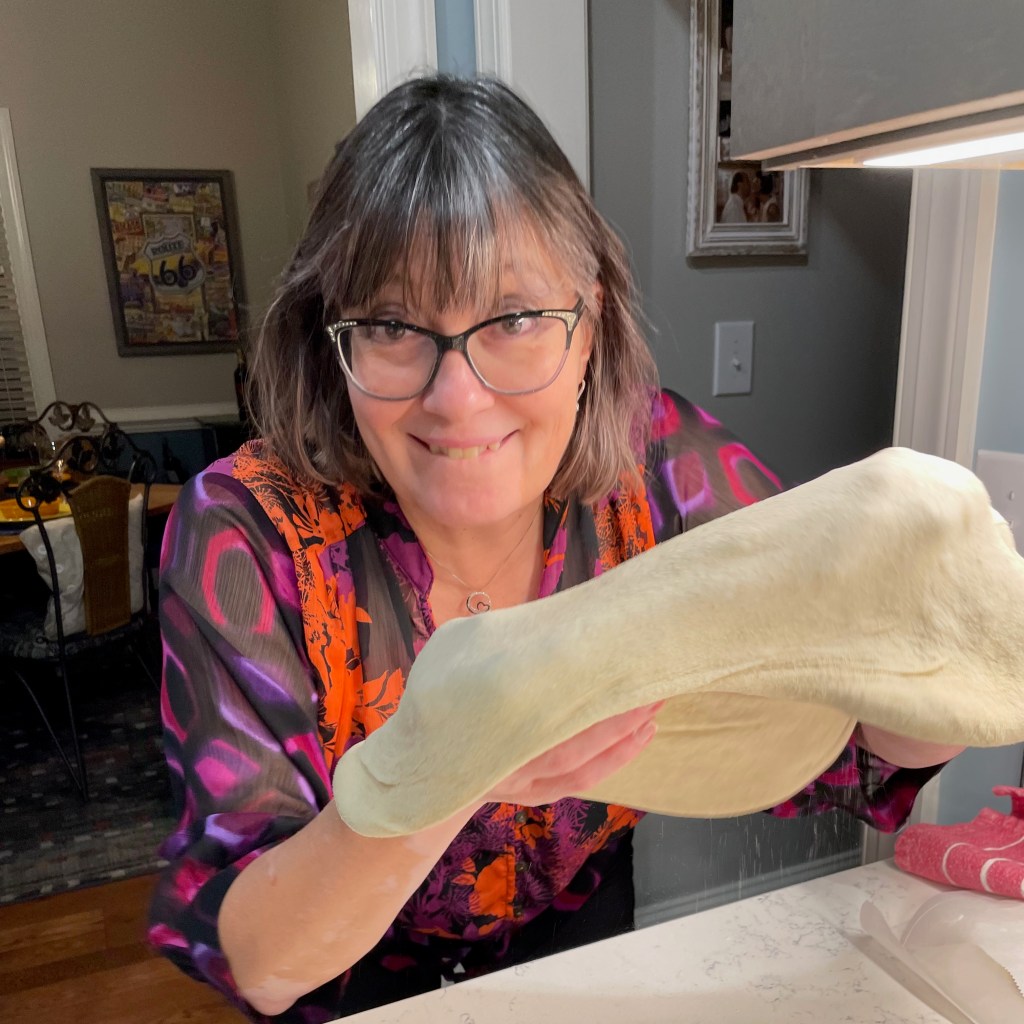
I’m always ready to make pizza!

Clam Prep 101

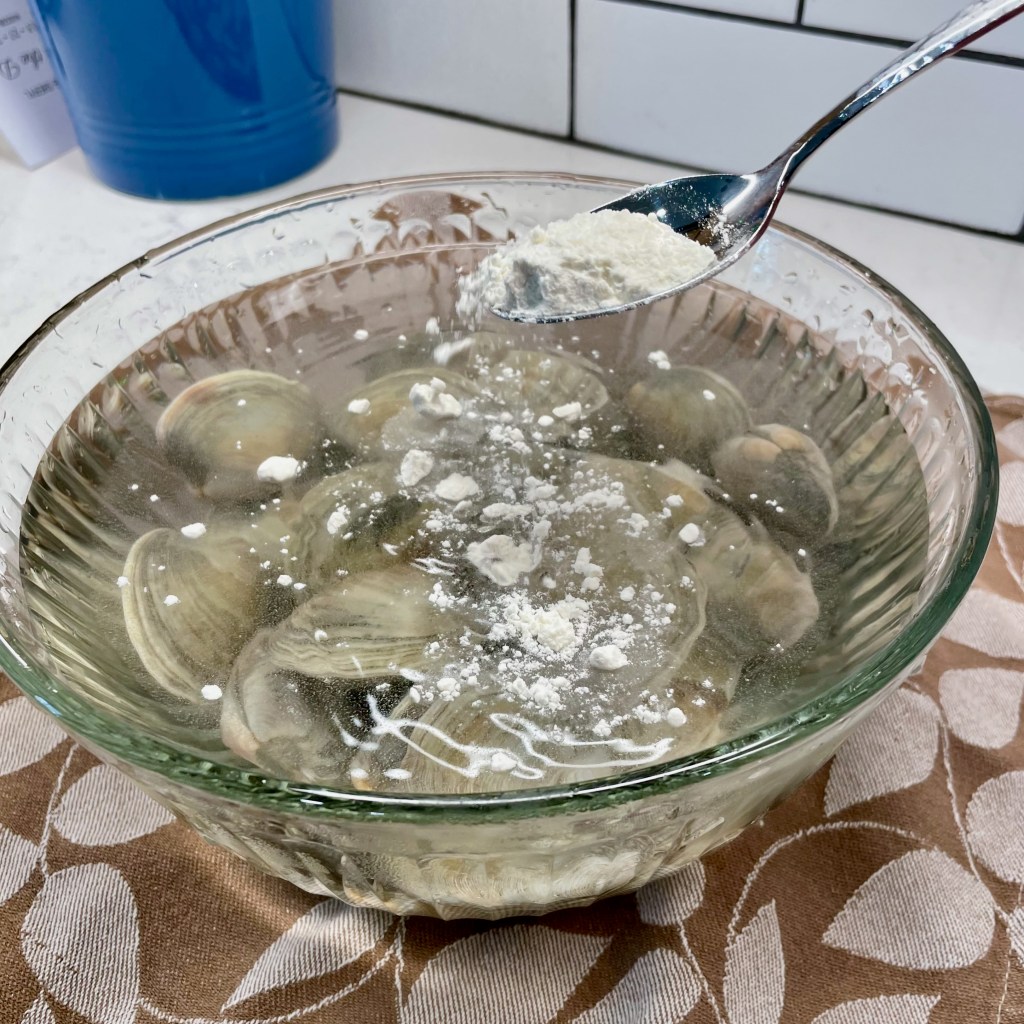
First, you want smallish clams for this recipe; littlenecks are ideal. To prep fresh clams for cooking, you want to clean them, inside and out. Cleaning the outside is straightforward, but how do you check the insides for grit and sand? This is called “purging.”

Place the clams in a bowl with cold water and a teaspoon of salt. Sprinkle a hefty spoonful of flour over the clams, to give them a reason to open and flush out the water they take in. After 30 minutes or so, lift the clams out into a colander and check the bowl for sand and grit. Repeat this process until water appears clear, and then empty the water and give each clam a quick scrub with a stiff-bristled brush, such as a potato brush. Do this purging process right before you plan to cook the clams, and keep them cold throughout.

This process can take more than an hour, so build in some time for this important step.

Clams casino butter

Moment of truth here, this stuff is where the magic happens. I was inspired to make my clams casino pizza when I was scrolling through my search results for “classic seafood appetizers,” and this article by Daniel Gritzer at Serious Eats caught my eye. I have loads of respect for Daniel’s approach to food, and I share his passion for finding better outcomes with less work. The moment I saw that he was making a compound butter for Clams Casino (the appetizer, not a pizza), I knew exactly what to do. 


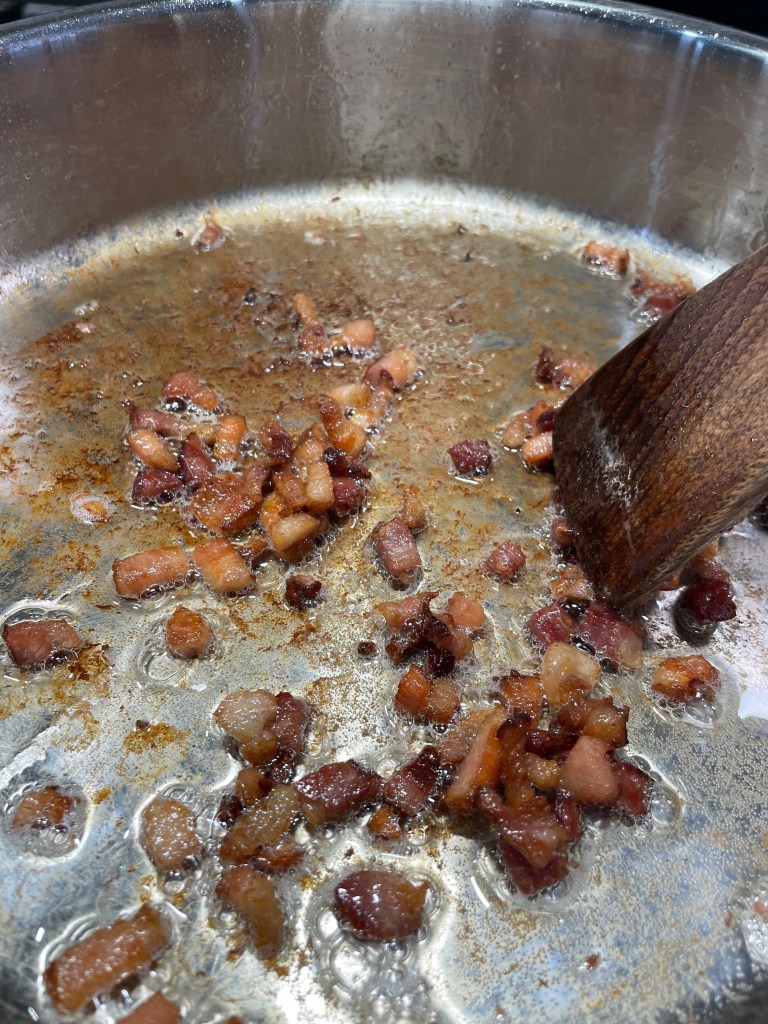
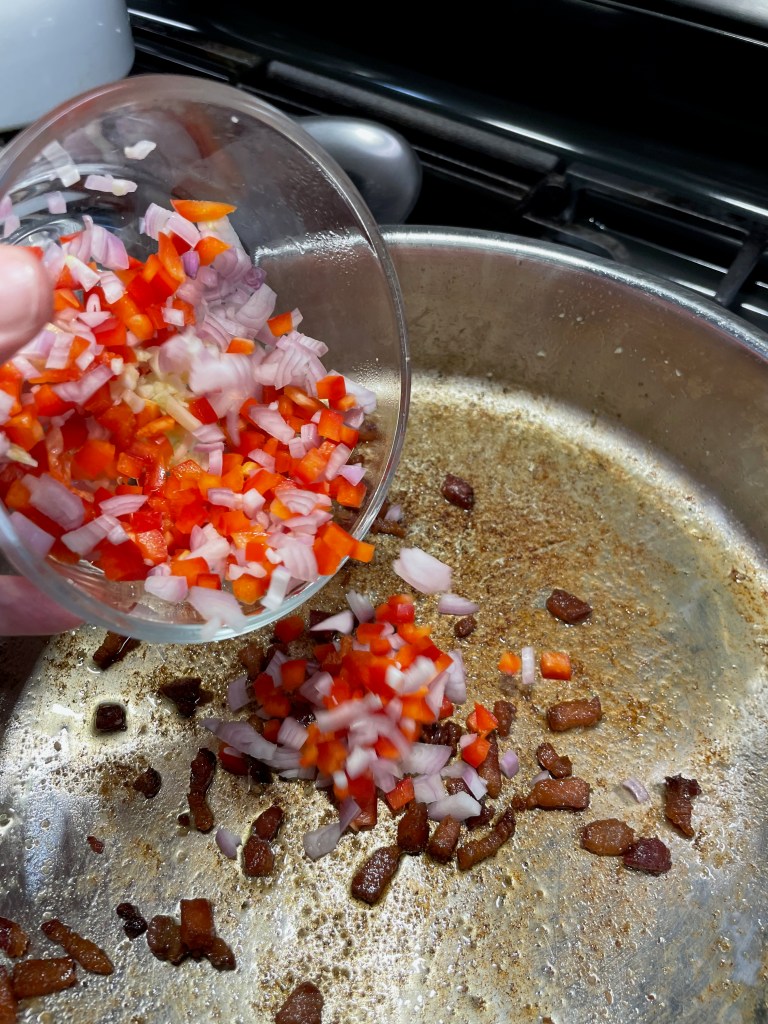
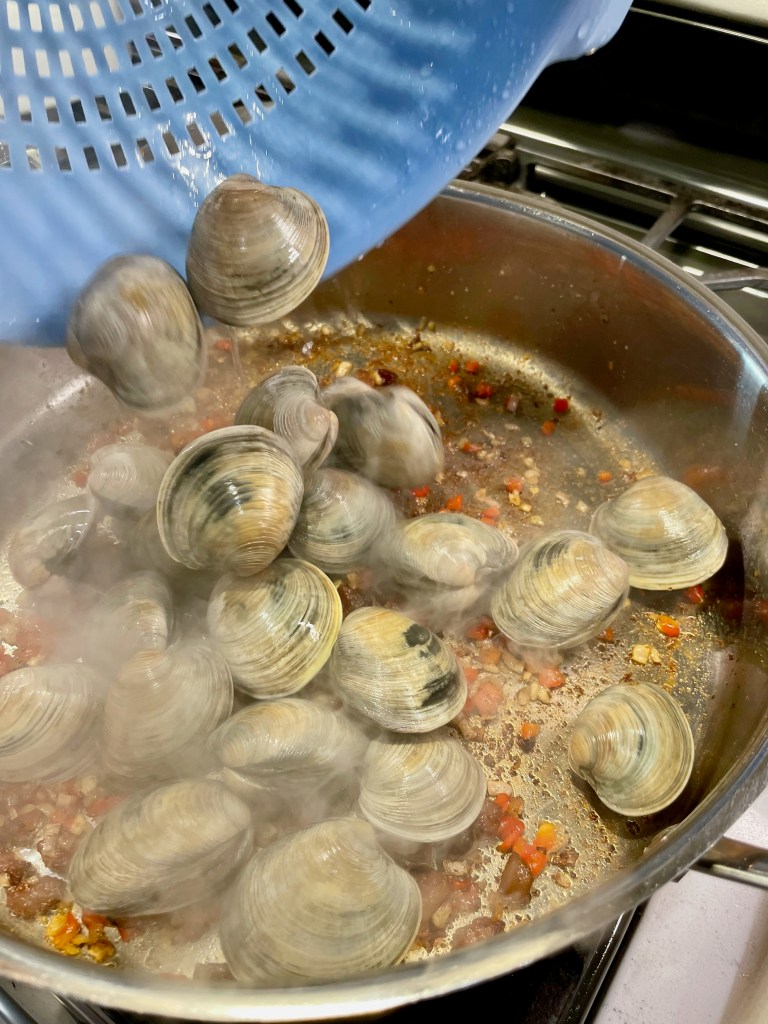
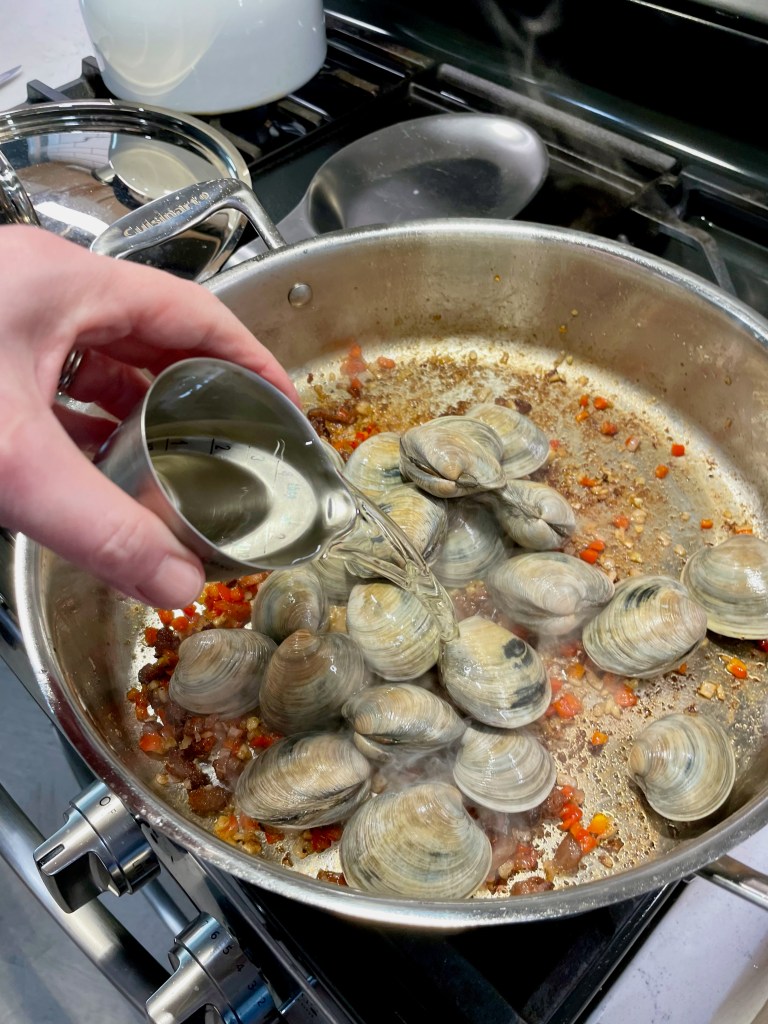
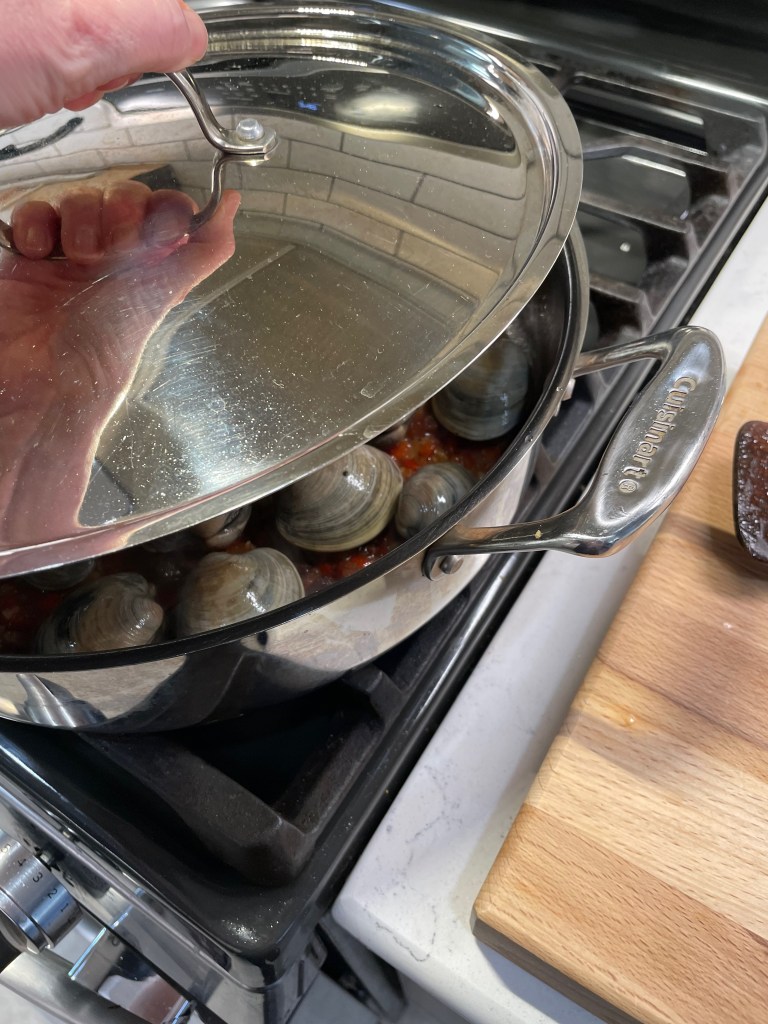
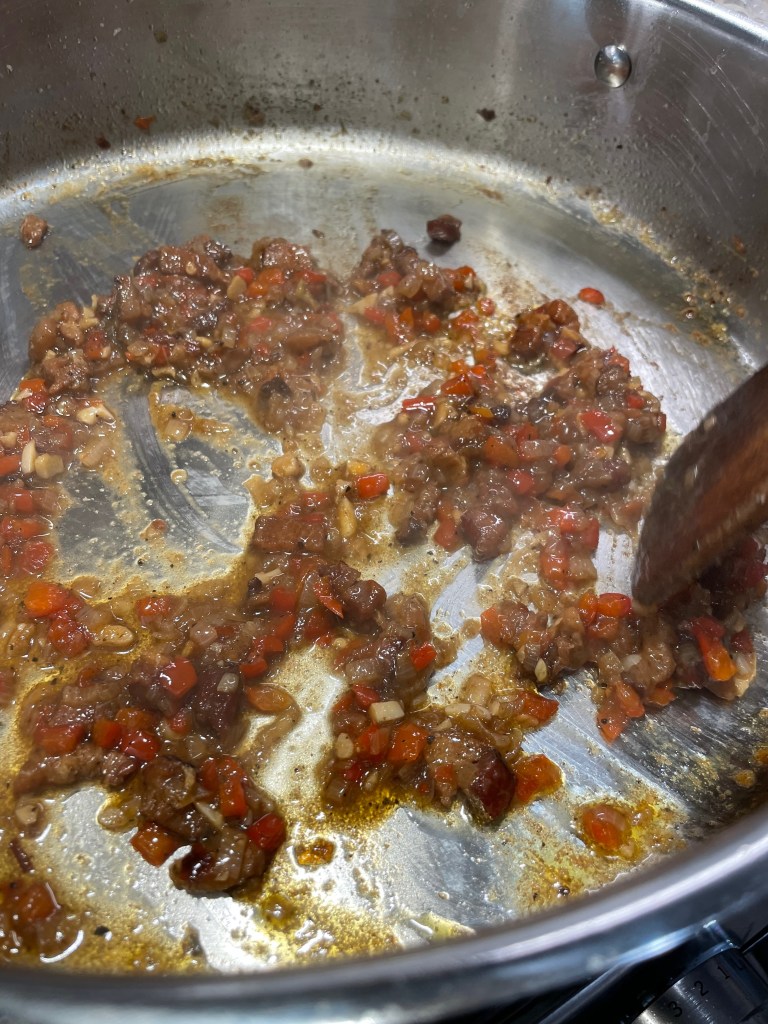
After crisping up some small cubes of really good bacon, I cooked panko crumbs in the grease (they get sprinkled on the pie after baking), and added finely minced red bell pepper, shallots and garlic and cooked them together until the bacon was crispy and the veggies were softened. Next came the clams, and I tossed the lot of them right into the pot with the bacon-veggie mixture and poured in about two ounces (a quarter cup) of dry vermouth— the same thing I use in my martinis. If you wish, you could use pinot grigio or any other dry white wine you like. I just happen to have vermouth open more often than wine, and I love the savory edge it adds when I cook with it.


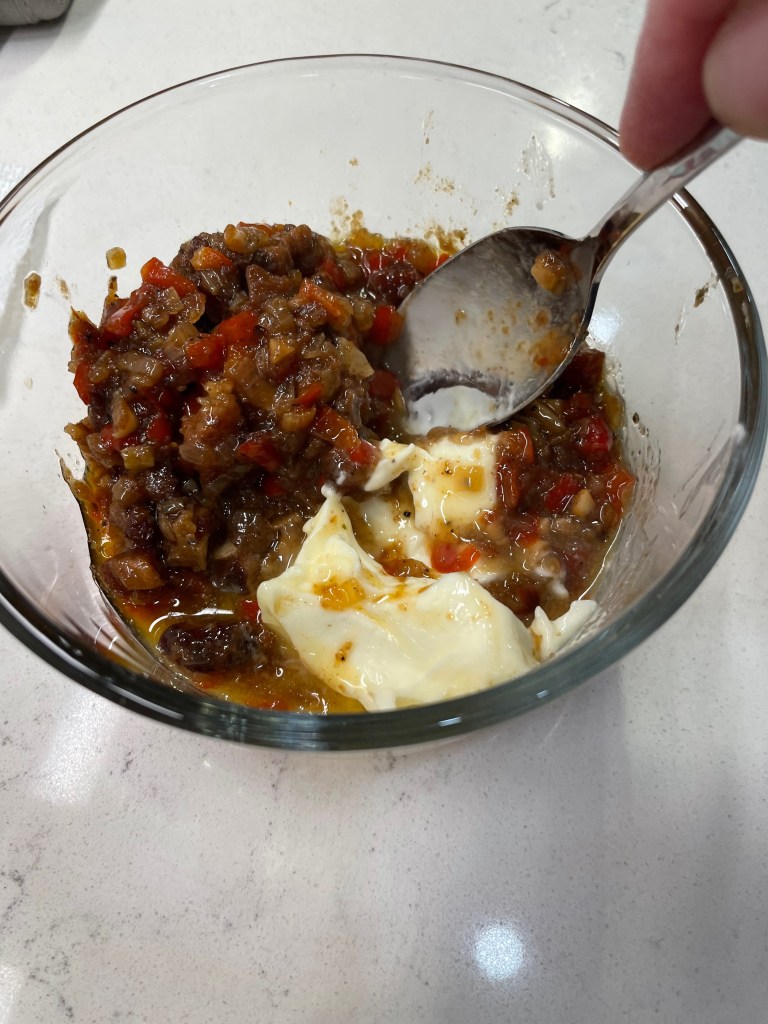
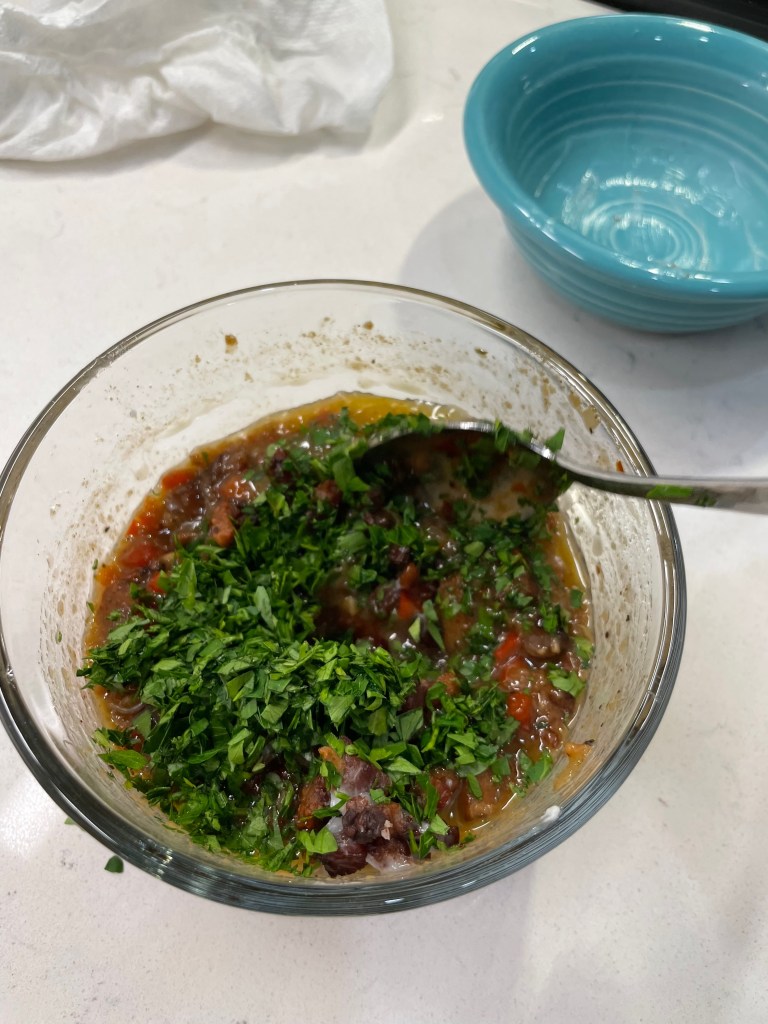
After just a couple minutes of steaming, the clams open up and spill out that glorious, briny liquid. Use tongs to lift them up, and empty that liquid right into the pan. As it reduces with the rest of the pan ingredients, it melds into an intensely flavored mixture that will turn my clams— and my pizza— into something really special. When this mixture cools, I stir in a bit of softened butter and fresh parsley, and chill it until it’s time to build the pizza. 

All of the above can be done ahead, but for sure, you want to take care of the clams so that they remain fresh and tasty, so I wouldn’t recommend working ahead more than one day. Get the clam meats removed from their shells and protect them with layers of damp paper towel or parchment paper so that they don’t dry out. 

What if you don’t eat bacon?

Substitutions are always possible! The main assets of bacon are the smokiness and the deep umami flavor, so a good understudy would be able to do both, but there’s no harm in making up those flavors with more than one addition. I brainstormed about this with my pal, Dorothy, from New Vintage Kitchen because she is mainly pescatarian and she knows all the tricks. We came up with a short list of suitable step-ins, including soy bacon or turkey bacon (both of which I’m sure have the smoke and umami), smoked paprika (never a bad idea in anything, as far as I’m concerned), or a dash of liquid smoke in the veggies, and some chopped up crisp mushrooms, which you can likely find in the snacks section of a larger supermarket. And I thought of one more, just in the last 10
seconds— one so obvious, I’m embarrassed that I didn’t think of it immediately. Anchovies! Bobby Flay even calls them “bacon of the sea.” They are potent, so use them sparingly, and for sure, include one in the toasted panko crumbs that will finish the pizza.

Time to build the clams casino pizza!

If you’ve followed me for any length of time, you know that I do a long preheat on a baking steel, and all my pizzas all begin with sourdough. The flavor imparted to pizza from the long, cold ferment is amazing, but if you already have a favorite dough recipe, or if you prefer the convenience of buying ready-made dough at your nearby deli or supermarket, have at it. These toppings will work, regardless. If you don’t have a steel, a sturdy baking stone will work, but you may need to dial back the temperature a bit and cook an extra few minutes.


Shape the dough by hand, rather than rolling it out, as this ensures some of the air pockets will remain in the dough for an airy texture after baking. Scatter mozzarella all over the dough, then arrange the clams and top each one with a bit of the clams casino compound butter. Sprinkle a bit of Parm-Romano blend cheese over the top, and slide that gorgeous thing into the oven.


Six to seven minutes is all it takes on a 550° F preheated steel. When it comes out of the oven, scatter the bacon-scented panko crumbs over the top and serve at once. 


Clams Casino Pizza

  • Servings: 6 slices
  • Difficulty: Average
  • Print

An easy compound butter is what makes this classic appetizer-inspired pizza special enough for New Year's Eve. Use the freshest clams you can get, and don't skip the bacon-scented panko crumbs on top!


Prep for this pizza should happen earlier in the day, or perhaps even the day before, so that the clams casino compound butter only needs to be divvied out onto the clams when you build the pizza. Note that parsley appears twice in this list; there are different purposes for each amount. You will want to use a heavy-bottomed pan to cook the compound butter ingredients, preferably one that is more wide than high. This will make it easier to steam the clams in a single layer.

Ingredients

  • 1/2 cup cubed thick-cut smoked bacon
  • 1/3 cup Italian seasoned panko bread crumbs
  • 1 Tbsp. finely chopped Italian parsley (for the panko topping)
  • 1/3 cup minced shallot
  • 1/3 cup minced red bell pepper
  • 2 large cloves garlic, minced (about 1 Tbsp)
  • A few shakes red pepper flakes
  • 1/4 cup dry vermouth or white wine + 1/4 cup water
  • 24 littleneck clams, purged of sand and grit (see first step of directions)
  • 2 Tbsp. finely chopped Italian parsley (for the compound butter)
  • 2 Tbsp. unsalted butter, halfway softened

Directions

  1. Purge the clams by placing them in a large bowl of salted cold water. Sprinkle a generous spoonful of flour over the clams and swirl gently to mix it in. Allow to rest 30 minutes, and then scoop out the clams to a platter. Empty and rinse the bowl, inspecting the water for grit and/or sand. Repeat as many times as needed, until water is clear.
  2. Cook bacon to render the fat. Remove the crispy bacon bits with slotted spoon, reserving fat in skillet. Toss panko crumbs in bacon fat. Cook until crumbs are golden and crispy. Set aside to top pizza after baking.
  3. Put half of the bacon bits back into the pot, along with shallots, bell peppers and garlic, and sauté until vegetables are translucent and tender. Shake in red pepper flakes.
  4. Add clams to the pot and pour in the vermouth and water. Cover with a lid for about 90 seconds, then remove lid. Use tongs to remove clams as they open, and pour off clam liquid into the pot as you remove them. Set the clams in a bowl filled with crushed ice; this will abruptly stop the cooking so that they don’t get tough during baking.
  5. When all clams have been removed from the pot, simmer until liquid is evaporated and only the soft vegetable-bacon mixture remains. Transfer mixture to a bowl to cool, then blend in the butter and chopped parsley. Refrigerate butter until you’re ready to build the pizza.
  6. Slide a knife under the clam meat to remove them from their shells. Refrigerate clam meats until you’re ready to make the pizza. Discard the shells.

Remove the compound butter and clam meats from the fridge a few minutes ahead so that the butter is manageable and can easily be spooned. I bake my pizzas on a steel, which is preheated for an hour at 550° F. If you are using a stone or regular pizza pan, reduce heat and adjust baking time accordingly.

Ingredients

  • 11 oz. pizza dough ball, at room temperature
  • Semolina flour for shaping dough
  • 1 Tbsp. extra virgin olive oil
  • Kosher salt and black pepper
  • 1/2 freshly shredded low-moisture mozzarella
  • Reserved clams
  • Clams casino compound butter
  • 2 Tbsp. grated Parm-Romano blend cheese
  • Reserved panko crumbs

Directions

  1. Shape pizza dough by hand (not by rolling), into a 14-inch round. Transfer round to a flour- and cornmeal-rubbed pizza peel for easy transfer into the oven.
  2. Drizzle olive oil all over dough, then season with salt and pepper. Scatter mozzarella evenly over dough.
  3. Arrange clam meats on dough, and then place a small dollop of the clams casino compound butter over each clam. If you have extra butter, place smaller dollops in between the clams.
  4. Slide onto pizza steel and bake for 6 minutes or until crust is blistered and browned and toppings are bubbly. Sprinkle with bacon panko crumbs and serve immediately.


Bacon & Spinach Pizza— on the grill!

If you’ve been following my blog for any amount of time, you know that I love to make pizza at home. Beginning with my favorite sourdough crust, I mix and match ingredients to discover new favorites and I’ve also had a lot of fun transforming other classic dishes into pizza, as I did with jambalaya, queso fundido, spanakopita, ratatouille, shrimp scampi and even Thanksgiving (you can check them all out on my Pizza Party page). My husband, Les, and I truly love a good pizza, and it’s in pretty hot rotation at our house, even in the summer months. 

There’s only one problem now. This god-awful heat!

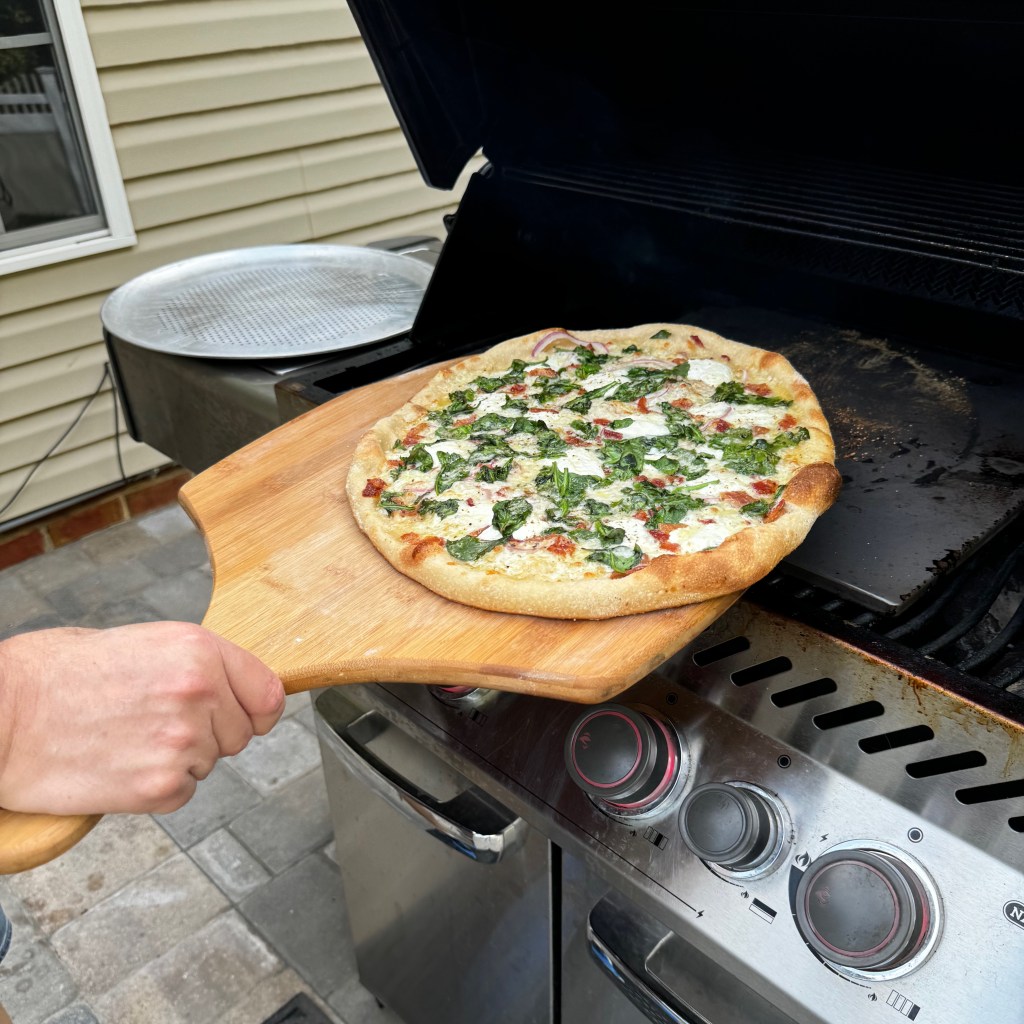
Most of my pizzas (excluding the deep dish versions) are baked on what I lovingly refer to as our “screaming hot pizza steel,” which is preheated at 550° F for one hour. This summer, with outdoor temperatures holding steady in the 90s, we had a choice to make, lest we face similar temps inside. And the solution turned out to be simple— pizza on the grill!

I think we can expect a lot more of these!

Two summers ago, Les and I invested in a Napoleon four-burner gas grill. Part of the reason we chose this grill (besides the fact it was made in Canada, not China) is that the model can support some amazing accessories, including a rotisserie basket and a charcoal smoker insert (both of which we bought but have yet to use). What it didn’t have was a great solution for pizza.
We considered getting an outdoor pizza oven— they’re all the rage now, after all— but having one would require having a place to set it and store it, and then there’s all the accessories for it. And have you seen the price tags? Having just dropped a hefty chunk of change on our fancy grill, we couldn’t justify spending another grand on a device that would only be used for pizza.

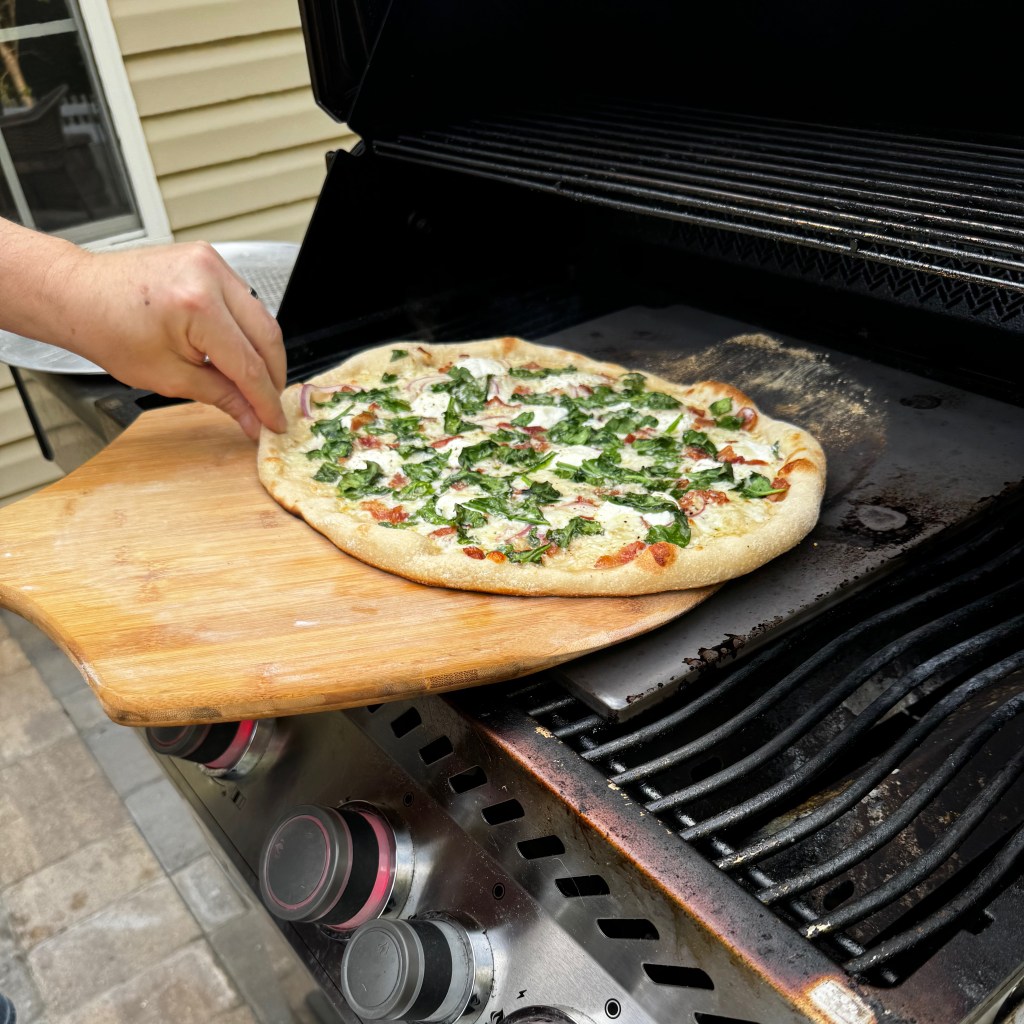
Fortunately, we are not easily deterred, and some quick research led us to a pizza stone made by Weber that is suitable for really high temperatures. The stone is coated with a glaze that gives it an easy-release finish, and although the Weber site says you must use it with their special frame kit on select Weber grills, I’m here to report that it also works great on our Napoleon— we just set it right on top of the grates, and crank up the heat!

This is even hotter than our oven!

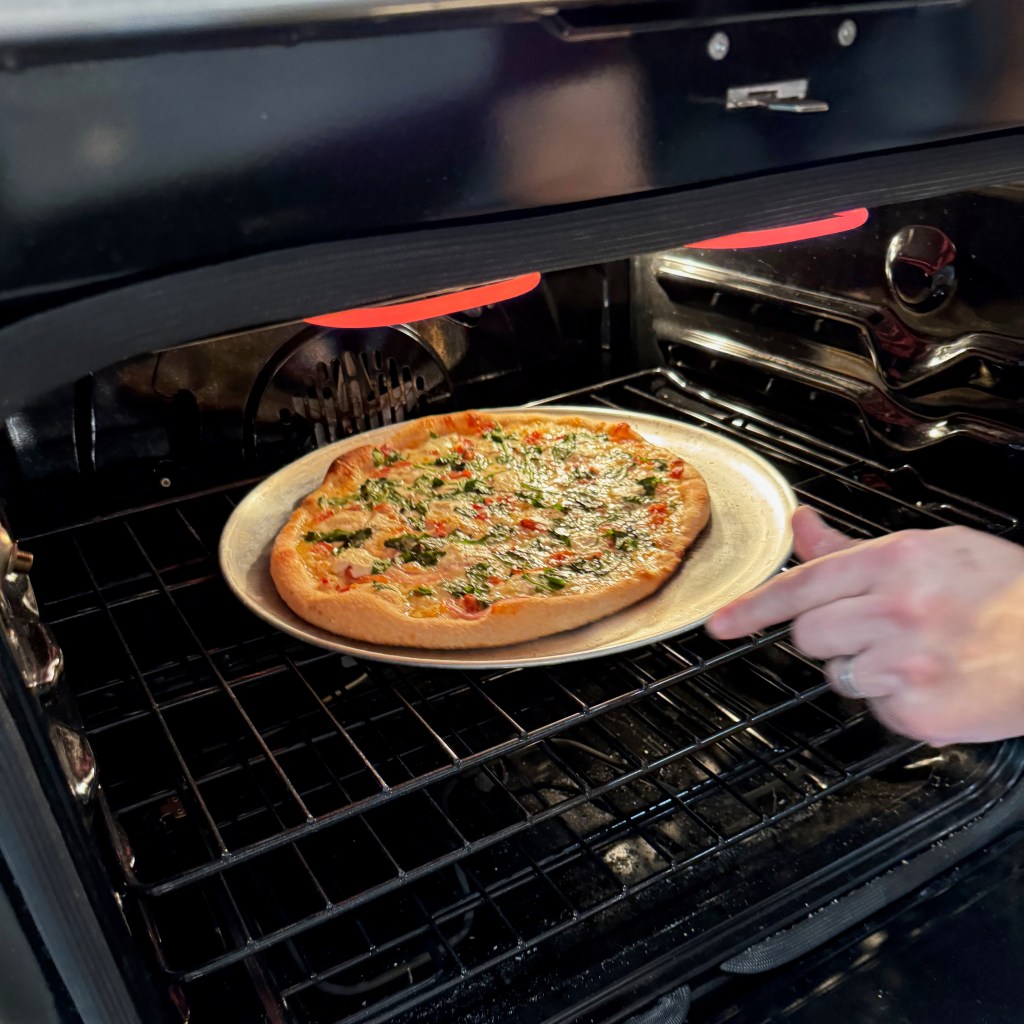
The first couple of pizzas we tried on the grill last summer turned out good, with melty toppings and crispy crust. But we missed the usual top-of-pie blistering that we love from our oven-baked pies, so this year, we’ve figured out a compromise. After our pizza bakes for roughly six minutes on the grill, it hits a perforated pizza pan for a spin under the oven broiler for exactly one minute. Yes, the broiler gets hot, but only very briefly compared to multiple hours at 550° F. It’s a solution that ticks all the boxes for these two pizza snobs!

Hungry for something different?

My pizza dough recipe makes enough for two pies, so I have plenty of opportunity for experimenting. I usually do something classic for one pizza, and the other becomes a blank canvas for new ideas. I’ve been tuned into Les’s suggestions quite a bit lately, and he asked last week whether we’ve ever done a pizza with bacon as a topping. I had to search my own blog to discover that, yes, I did put bacon on the jalapeño popper pizza, the Kentucky hot brown pizza and the oysters Rockefeller pizza (they are also on the Pizza Party page). 

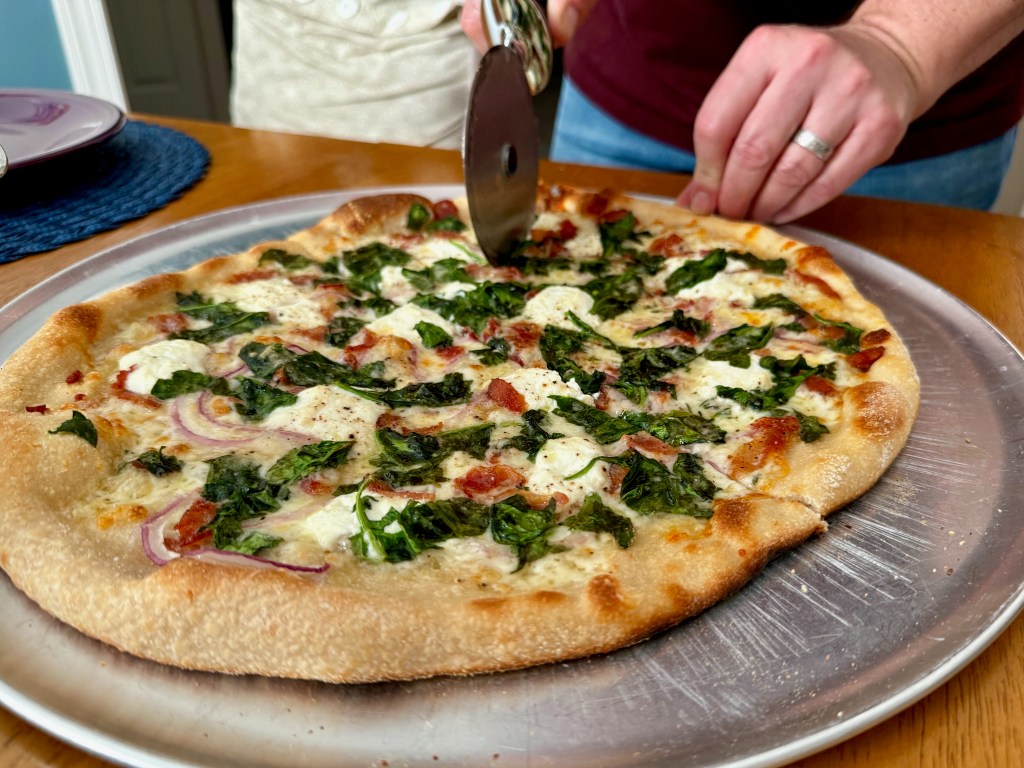
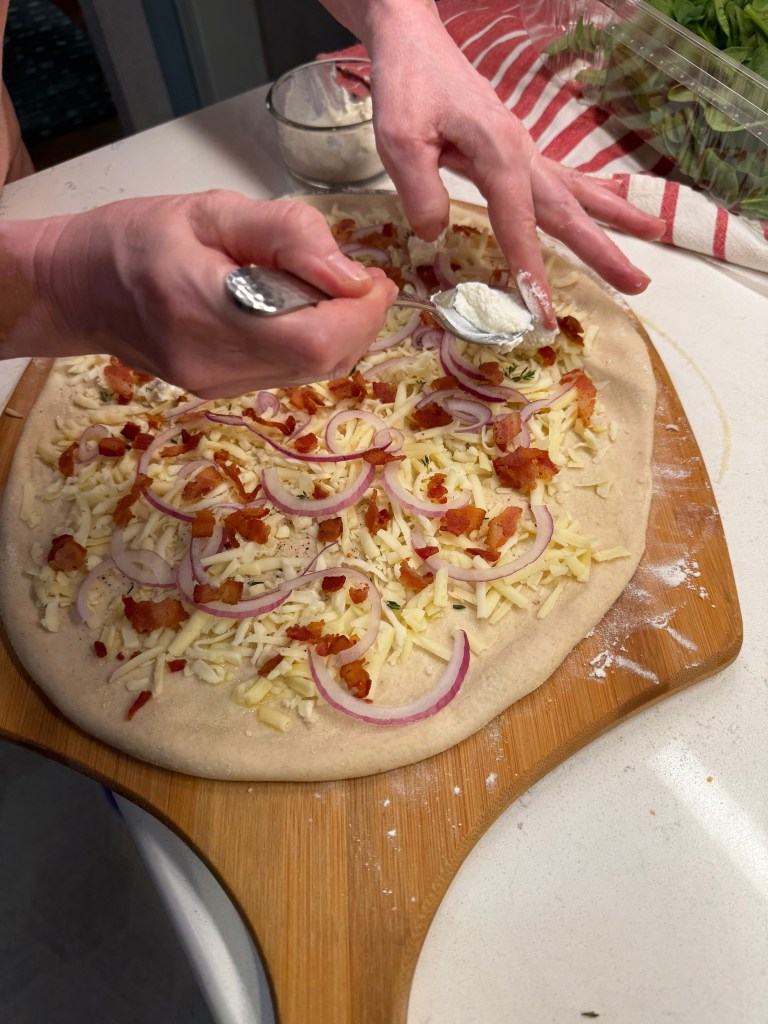
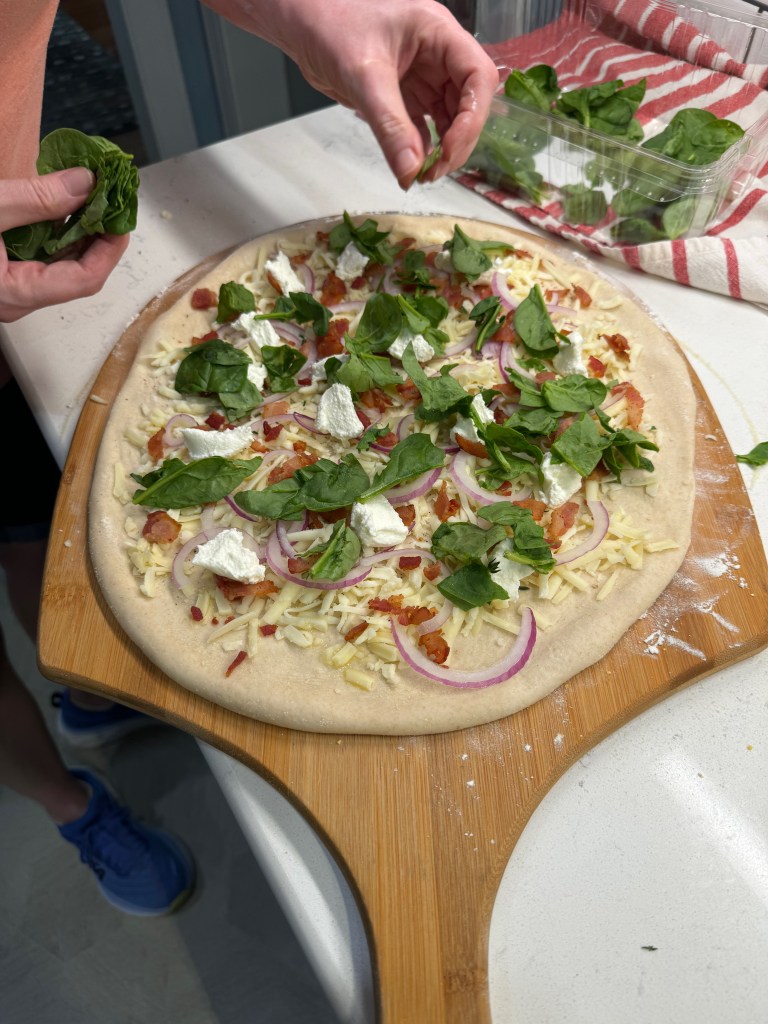
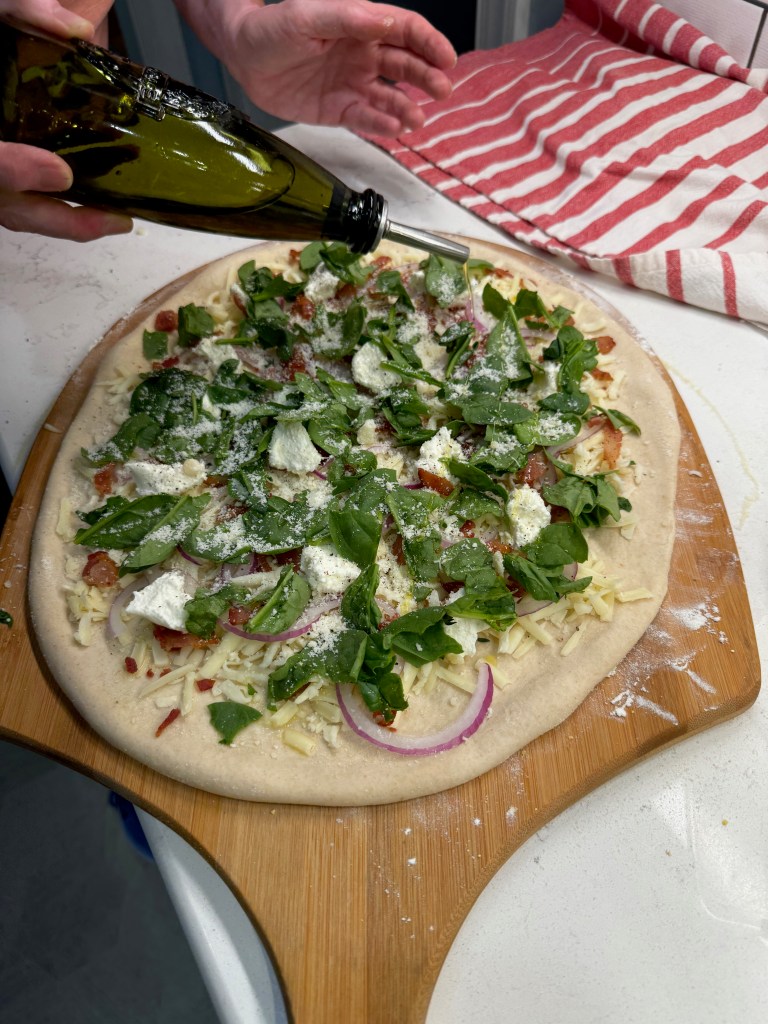
But Les wanted something a little different, using bacon as a salty accent, plus fresh spinach (his favorite), red onions and some gruyere cheese he thought he’d spotted in the fridge. I contributed a topping of my own, ricotta, and this new pizza was born. 

A very tasty experiment, if we do say so.

I cut up the bacon into pieces and cooked it until most of the fat was rendered and it was just shy of crispy, knowing that it would cook further in the heat of the grill. The cheese we thought was gruyere turned out to be white cheddar with “gruyere notes” (whatever that means), and we mixed it about 50-50 with freshly shredded hard mozzarella to be sure there was a good melt. This pizza would not have sauce, so it needed something else with a bit of moisture. Ricotta to the rescue, though next time I would spike it with some garlic to punch up the flavor a bit.


Our six minutes on the grill stone, plus one minute under the broiler method is a winner. This is very good news for us pizza lovers, especially with an entire hot summer ahead of us. The moral of this story? Where there’s a grill, there’s a way! 😉


Bacon & Spinach Pizza— on the grill!

  • Servings: One 14-inch pizza
  • Difficulty: Average
  • Print

This is a fun and different flavor combination for pizza, whether you bake it in the oven or (as we did with this one) on the grill!


Ingredients

  • Pizza dough ball, roughly 11 ounces
  • 1/3 cup freshly grated hard mozzarella
  • 1/3 cup white cheddar (or gruyere blend)
  • 3 thin slices red onion, separated
  • 4 slices uncured smoked bacon, cut up and cooked until shy of crispy
  • 3 sprigs fresh thyme leaves
  • 1/4 cup whole milk ricotta (seasoned with some garlic powder, if you like)
  • Medium handful fresh baby spinach leaves, torn into smaller pieces
  • 2 Tbsp. grated Parm-Romano blend cheese
  • Drizzle of extra virgin olive oil

Baking notes: If you are baking indoors, preheat a pizza steel at 550° F for one hour; for the grill method, heat to high temperature with a stone or steel pan, following manufacturer’s instructions.

Directions

  1. Shape pizza dough into 14-inch round; transfer to a flour- and cornmeal-rubbed pizza peel. Drizzle a bit of olive oil over the dough and season it with salt and pepper.
  2. Scatter both mozzarella and white cheddar/gruyere all over pizza dough, then arrange onion slices, par cooked bacon and thyme leaves over the cheese.
  3. Carefully spoon small dollops of ricotta on the pizza, keeping a bit of distance between.
  4. Scatter spinach leaves all over, then sprinkle with Parm-Romano blend cheese and give it one last drizzle of olive oil.
  5. Slide pizza onto preheated stone or steel; bake about six minutes. If grilling, transfer finished pizza to a perforated pan and slide it under a hot broiler for one minute to achieve a blistered, oven-like finish.


Broccoli, Artichoke and Red Pepper Pizza

What’s your favorite veggie pizza?

While you ponder, I’ll explain how I answered the same question, posed by my high school bestie, Christine. She reached out a couple of weeks ago for ideas, as her daughter had a vegetarian friend coming to visit for a few days and she wanted to help her feel welcome. When you aren’t in the habit of making meatless meals (or if, like Christine, you have allergies to all the common plant-based proteins), the concept of meatless menu planning can feel daunting. I know that feeling well— it’s exactly how I feel about making desserts! 

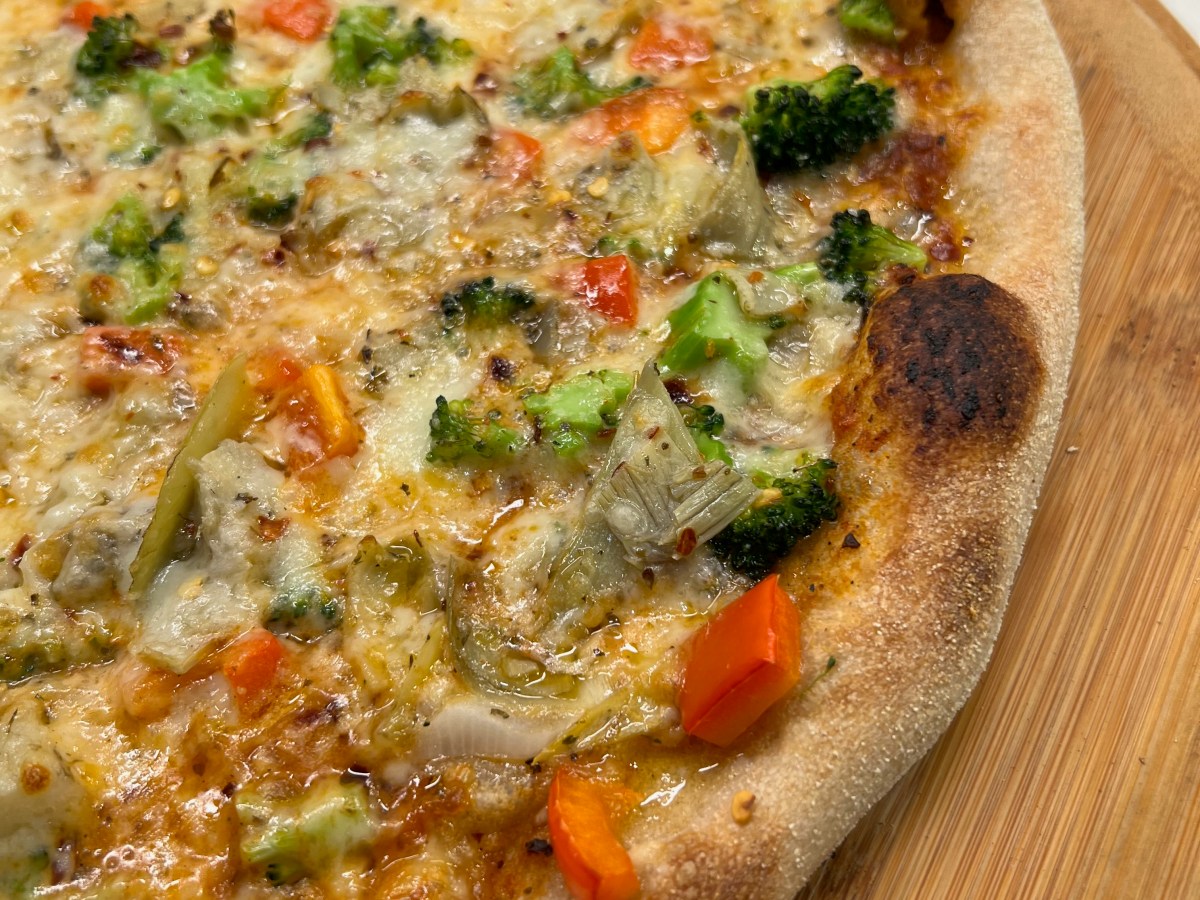
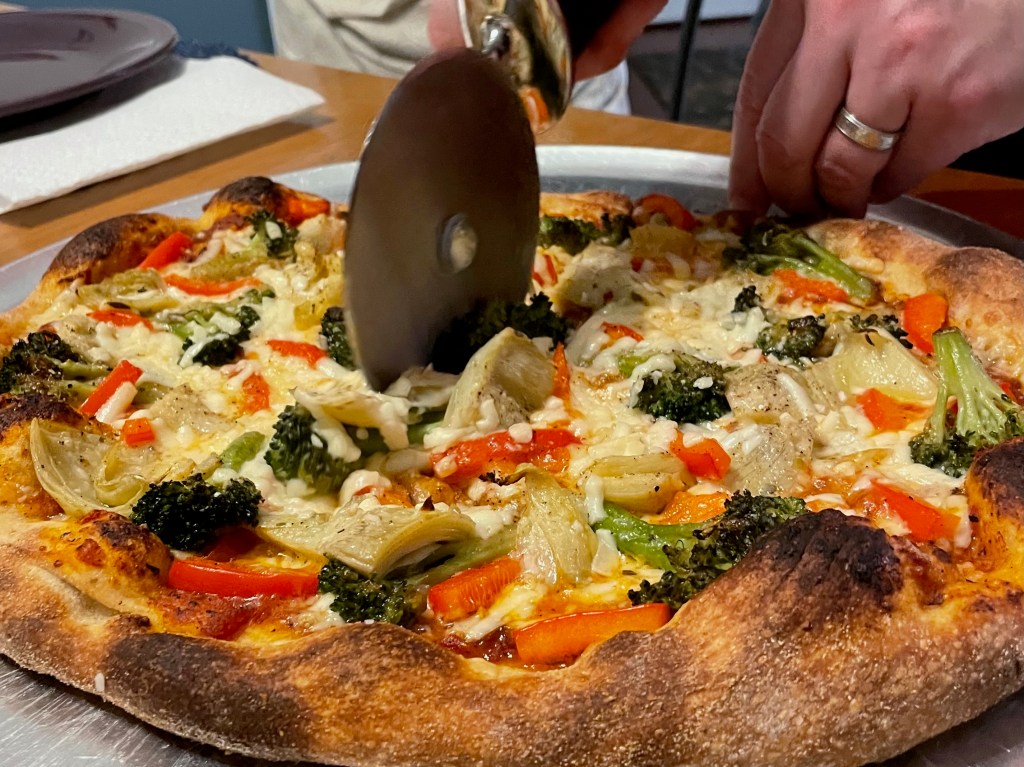
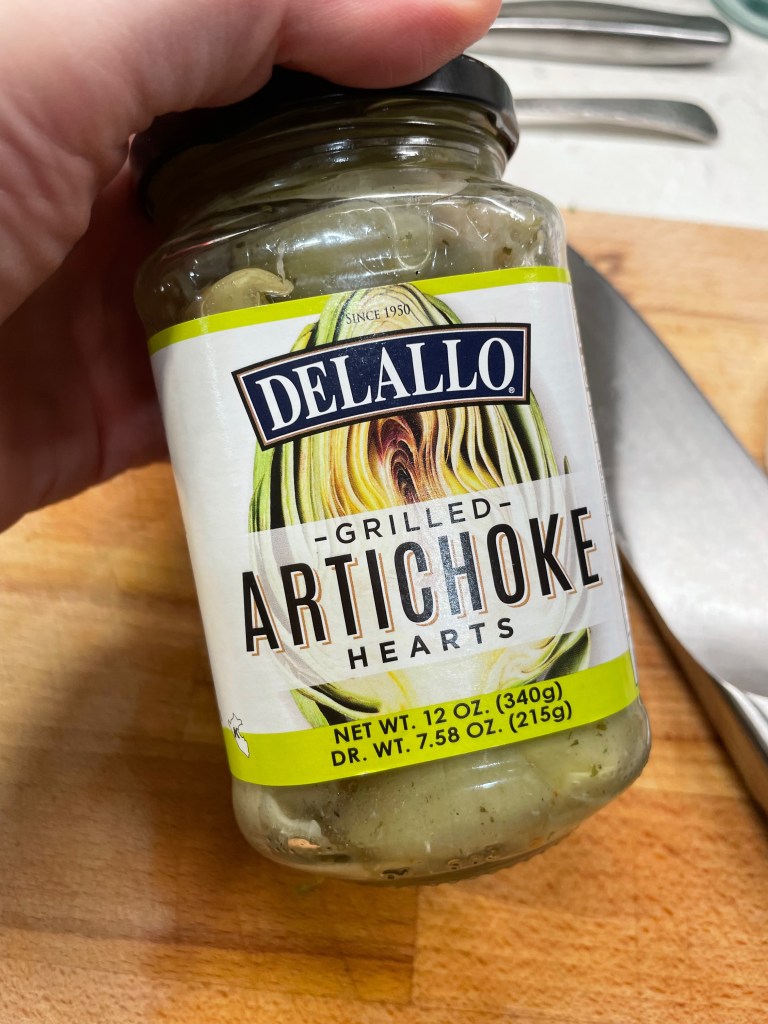
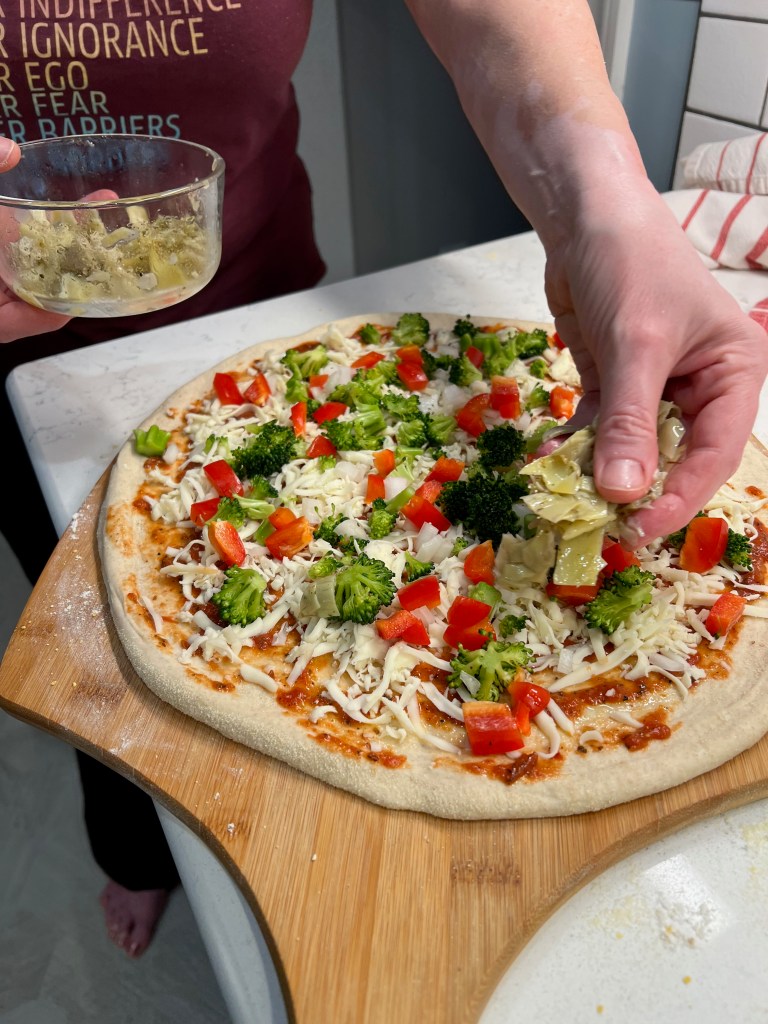
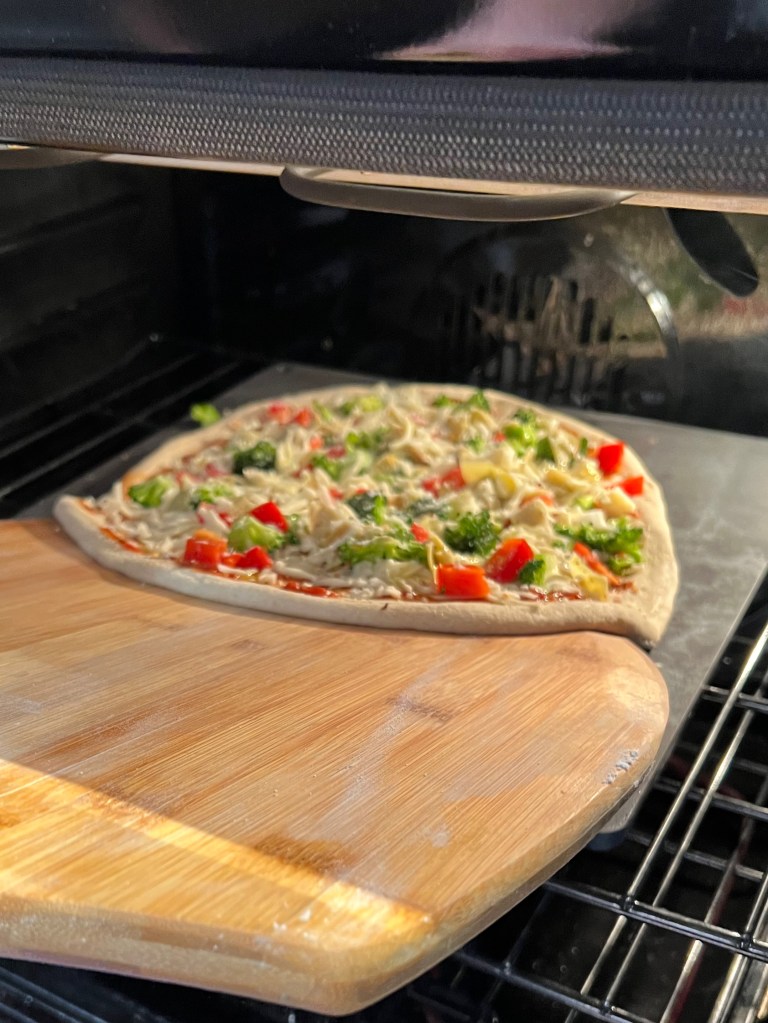
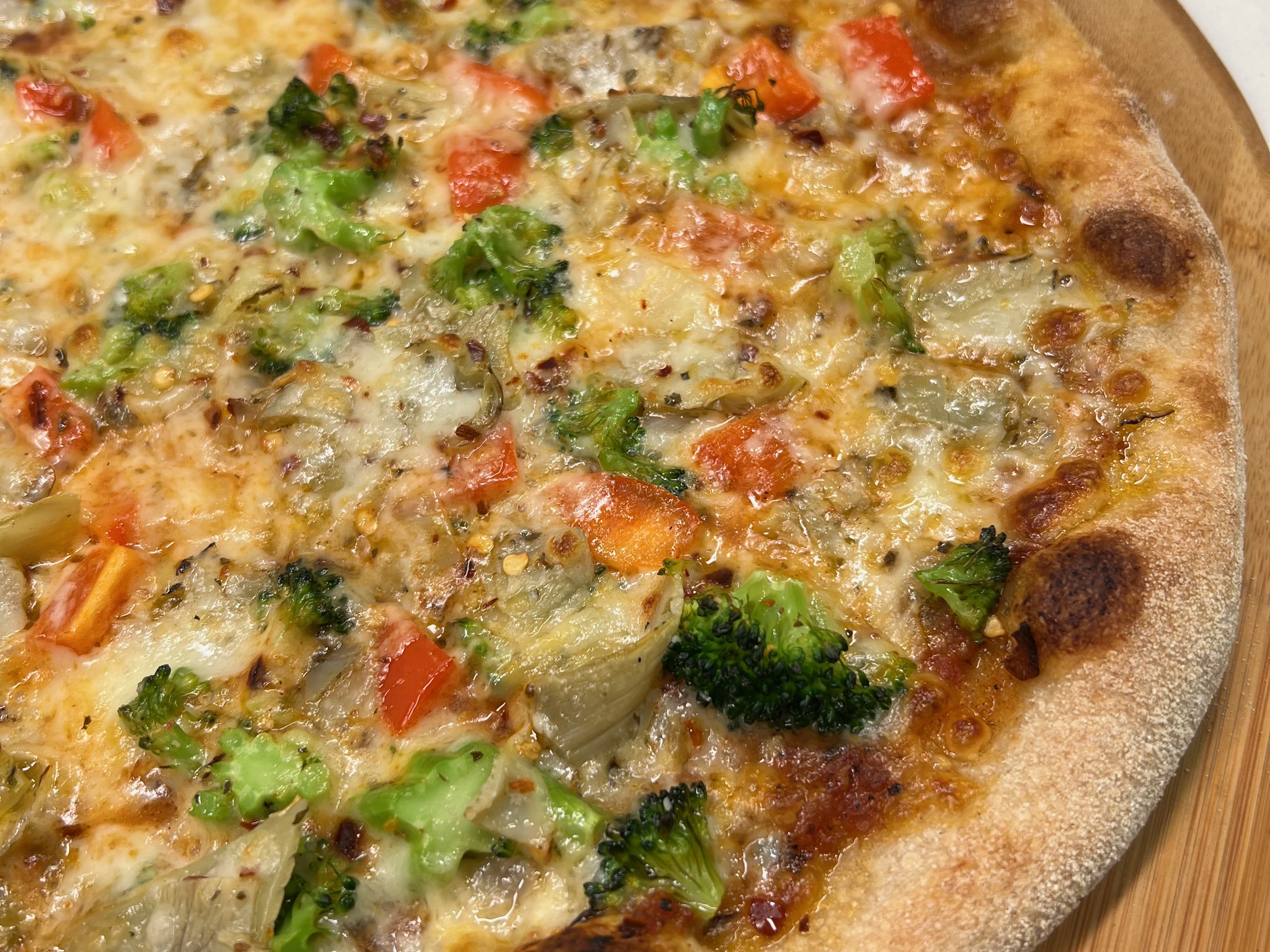
This pizza— with generous scatterings of chopped fresh broccoli, red bell pepper and marinated artichoke hearts— is my current favorite all-veggie pizza. What makes it work for me is the balance of flavors and textures that these ingredients bring to the slice. The red bell pepper bits are vegetal but sweet. The artichoke hearts, especially if you use the ones marinated with olive oil and herbs, are soft and slightly tangy. And the broccoli has a firm enough texture to make the pizza substantial and filling. 

With a healthy dose of fiber, protein (both the artichoke and broccoli contribute a good amount) and vitamins (the red bells have more Vitamin C than oranges), plus all that flavor, this pizza is a winner, any way you, ahem, slice it. 😉

I love the sound when my husband rolls the pizza cutter through the crispy, oven blistered crust! YUM!

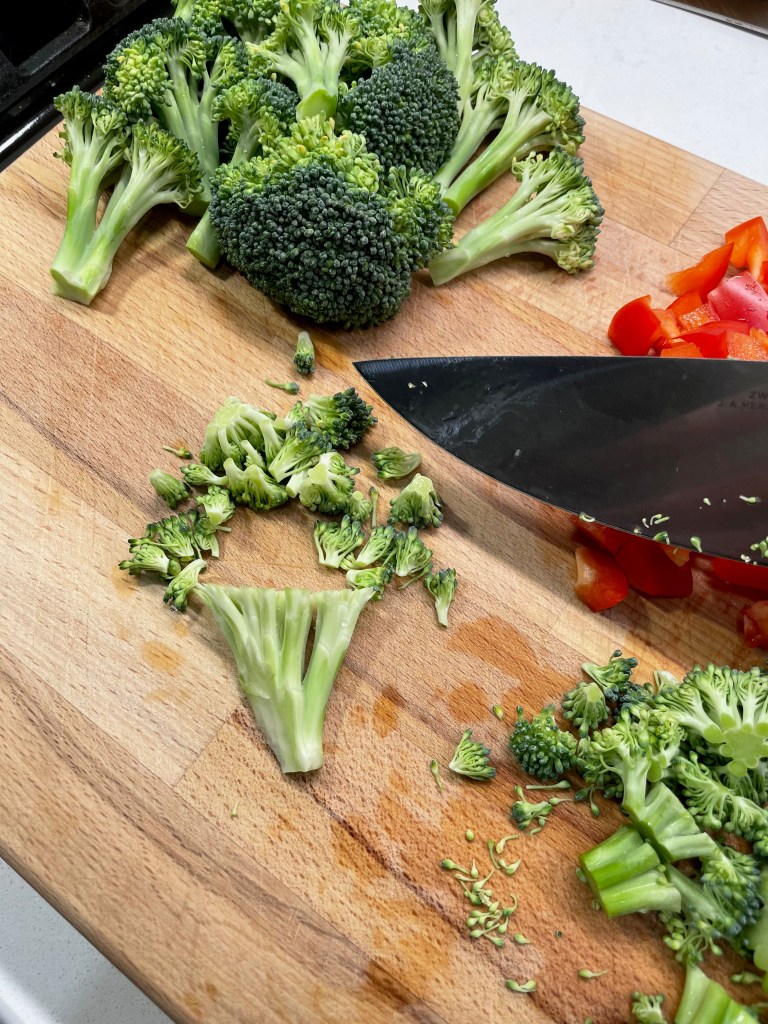
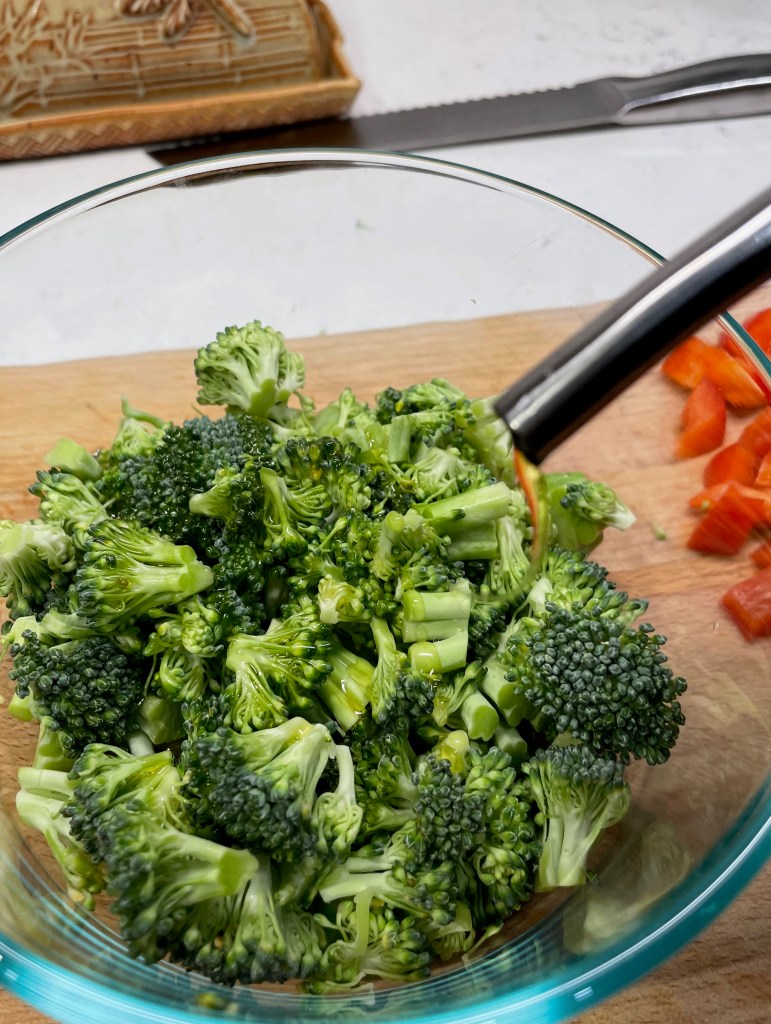
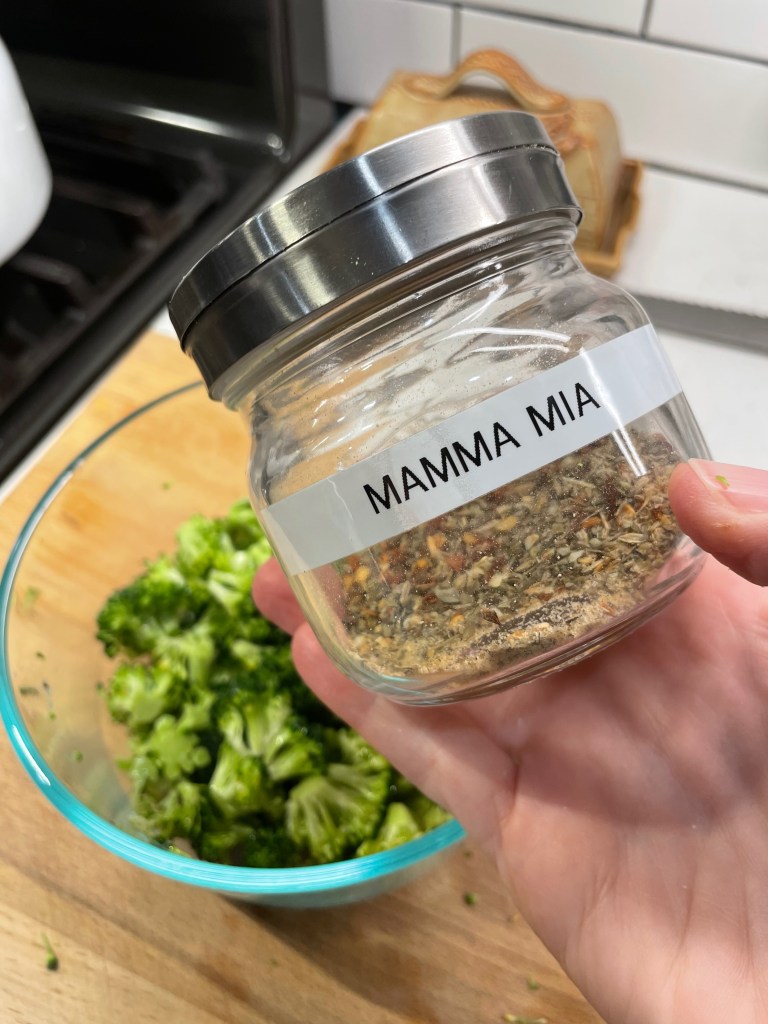
The first time I made this pizza, I used Asiago cheese (delish) and I prepped the ingredients in larger chunks, which made for tantalizing photos (as you can see above), but every bite tasted different because the pieces were farther apart. I also had to add an extra step of par-cooking and chilling the broccoli before topping the cheesy base of the pizza. On this go-around, I kept it simple, with smaller chopped pieces of raw broccoli and smaller chopped artichokes, and the end result was not only easier but a better outcome for the variety of flavor we enjoyed in each bite. A quick drizzle of olive oil and some Italian seasoning revved up the flavor of the broccoli.


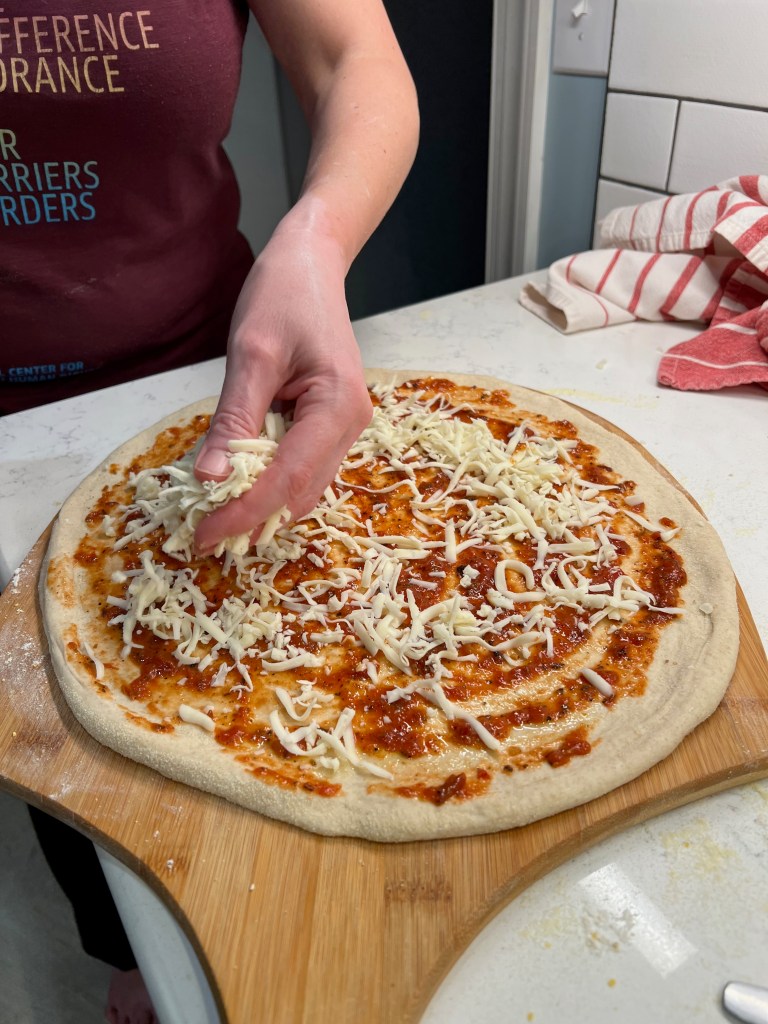
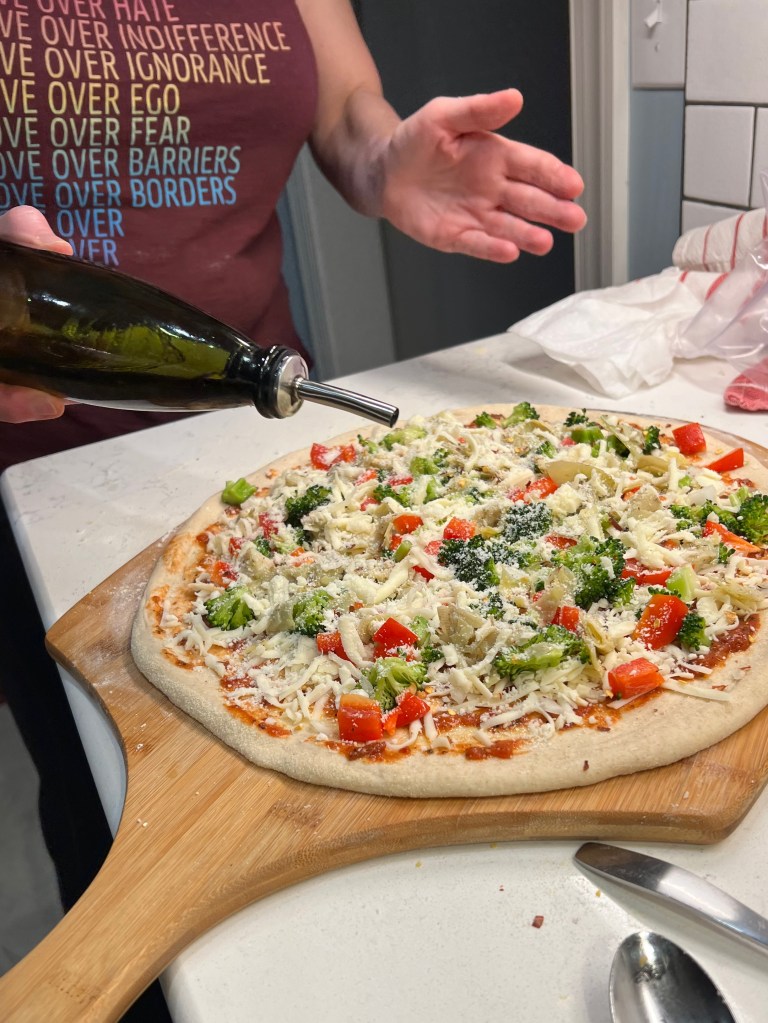
As for the rest of the pizza, you know how that goes at my house. My crust is almost always sourdough, cold-fermented for two days in the fridge drawer, hand shaped and topped with a thin layer of tomato sauce plus hand-grated whole milk mozzarella. A little Parm-Romano blend cheese sprinkled on at the end, plus a quick drizzle of extra virgin olive oil, which is a little trick I picked up during my “backstage” visit to Modern Apizza in New Haven a few summers ago. Here’s a link to my adventure at Modern, in case you missed it! 


We use a steel for all of our indoor pizzas, preheated for about one hour at 550° F, which is the hottest our home oven goes. The intense heat permeates the steel slab for an exceptional crust, and our pizzas are finished to blistery perfection in about six minutes. It’s the closest we can get to brick oven-style pizza at home.

While that bakes, a quick (but important) mention about using cheese on a pizza for vegetarians, especially those who have chosen a meatless lifestyle out of concern for animals. Your guests may be OK with egg and dairy products, but be aware that many hard cheeses, including traditional Parmesan and Pecorino, are not technically vegetarian because animal rennet (an enzyme from the digestive system of young sheep or cows) is used in their production. This enzyme cannot be harvested from living animals, and that means it’s off the table for those following strict vegetarian practices. Thankfully, there are a few producers who have managed to adapt to using a plant-based enzyme to make such cheeses in a way that is approved for vegetarians. It’s a good rule of thumb to scan the label— if it does not explicitly state that it is suitable for vegetarians, you can bet that it isn’t. I only learned this myself a few years ago, so it bears sharing with my foodie friends. 

The smaller bits of veggie definitely work better, making every slice consistently delicious!

So there you have it, my current favorite veggie pizza! After the click-to-print recipe below, I’ll share links to a few others we’ve enjoyed at our house, including the one that Christine found irresistible for her pizza party with her daughter and visiting friend.

Now, your turn— what’s your favorite veggie pizza? I’m always on lookout for a new recipe, so please share! 

Broccoli Artichoke and Red Pepper Pizza

  • Servings: 8 slices
  • Difficulty: Average
  • Print

There's so much flavor and texture going on in this pizza, who needs meat?


Ingredients

  • One fresh pizza dough ball, about 11 oz., at room temperature
  • 1/4 to 1/3 cup favorite pizza sauce (we like Dei Fratelli’s “fire roasted”)
  • 2/3 cup hand-grated whole milk mozzarella
  • 2 cloves garlic, minced
  • 1 cup chopped raw broccoli, tossed with a teaspoon of olive oil and Italian seasoning
  • 1/2 cup diced red bell pepper
  • 1/2 cup chopped marinated artichoke hearts
  • 2 Tablespoons chopped fresh onion (sweet or yellow work well here)
  • 2 Tablespoons grated Parm-Romano blend cheese
 (check labels to ensure suitability for vegetarians)
  • Extra virgin olive oil to drizzle

We bake all of our pizzas at very high temperature on a steel slab, which gives us a near-brick oven quality pizza. If you will be using a pizza stone or pan, you may need to adjust temperature and baking time accordingly. I would highly recommend, for anyone who loves making pizza at home, investment in a pizza steel. I promise, you won’t regret it!

Directions

  1. Preheat oven with steel on center rack for one hour at 550° F. Dust pizza peel with flour and medium grind cornmeal for easy transfer in and out of oven.
  2. Shape dough by hand into 14-inch round, taking care not to deflate too many air bubbles. Salt and pepper the dough, and then spread sauce evenly over dough. You should be able to easily see the dough through the sauce.
  3. Scatter mozzarella all over the sauce, then top with fresh garlic, broccoli, peppers, artichoke hearts and onions. Sprinkle Parm-Romano over the toppings and give the whole pie a quick drizzle of olive oil.
  4. Transfer quickly to preheated steel and bake for six minutes, turning pizza after four minutes if needed for even browning of the crust.


Other veggie pizzas you might enjoy, left to right:

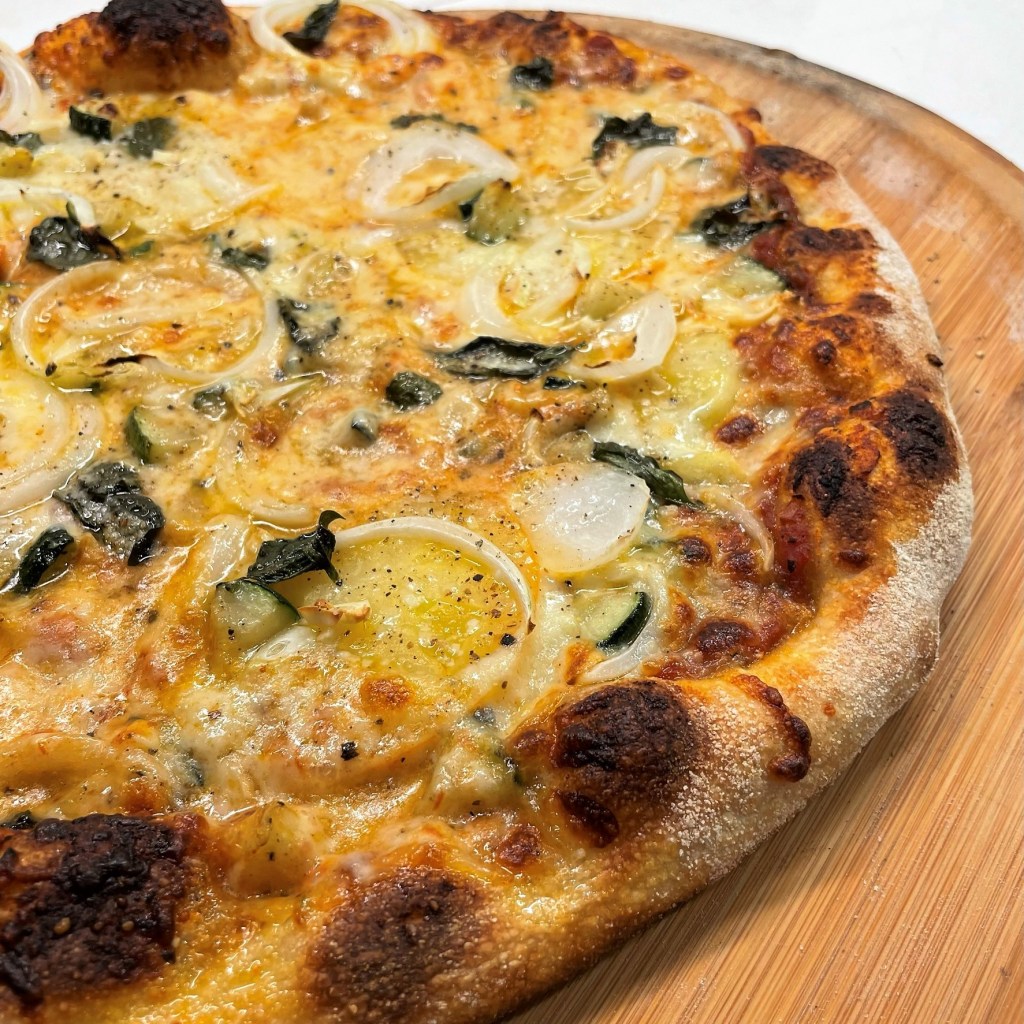
Zucchini and yellow tomato pizza, which I’m really looking forward to making again this summer, when both of these vegetables reach their peak flavor! 

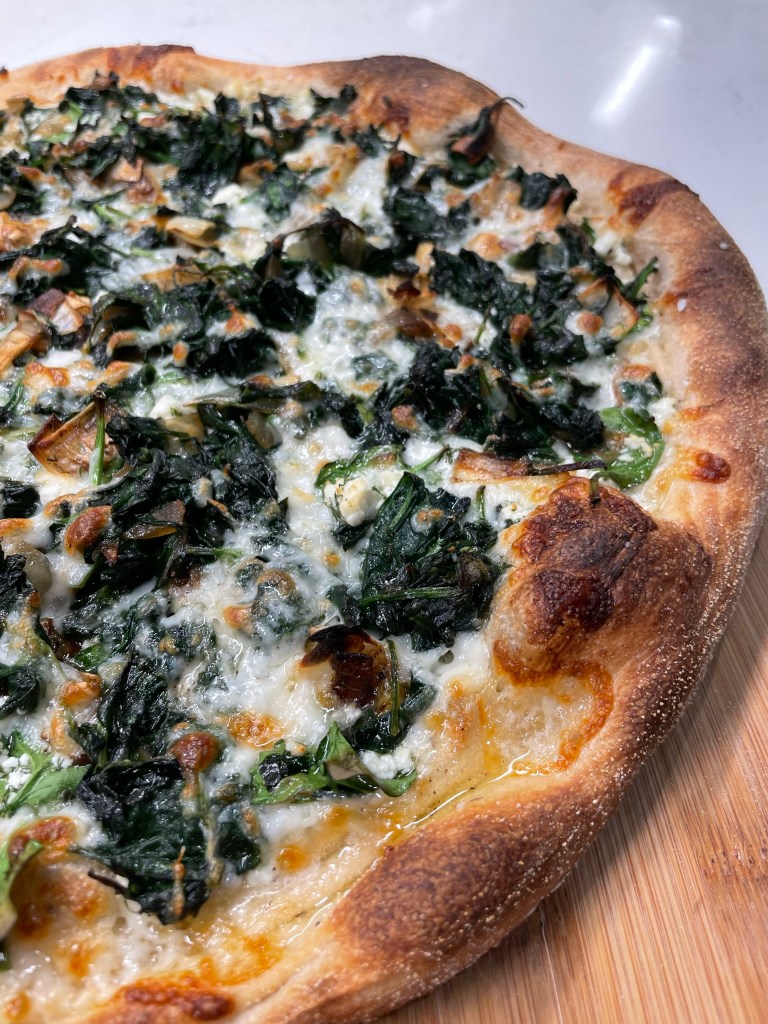
Spanakopizza, loaded with fresh and sautéed spinach, leeks and feta, with a scatter of fresh dill for authentic Greek flavor. This is the one Christine made, and she declared it a big hit!

New Haven-style fresh tomato pizza, another one we enjoyed when we visited Connecticut, and a classic flavor for summer— almost like a margherita pizza but with fresh slices of tomato. So good!

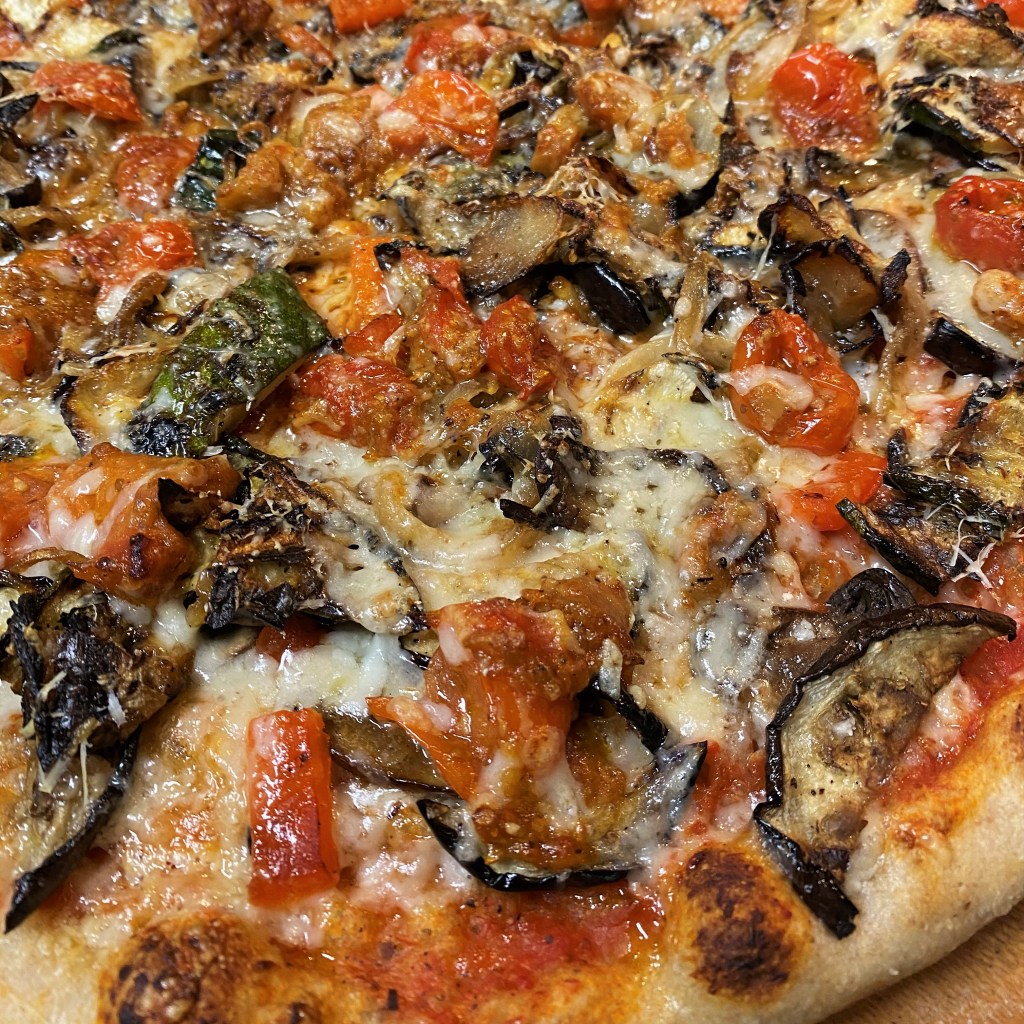
Ratatouille pizza, especially if you take time to grill the eggplant, zucchini, peppers and onions before piling them onto your favorite tomato sauce. 

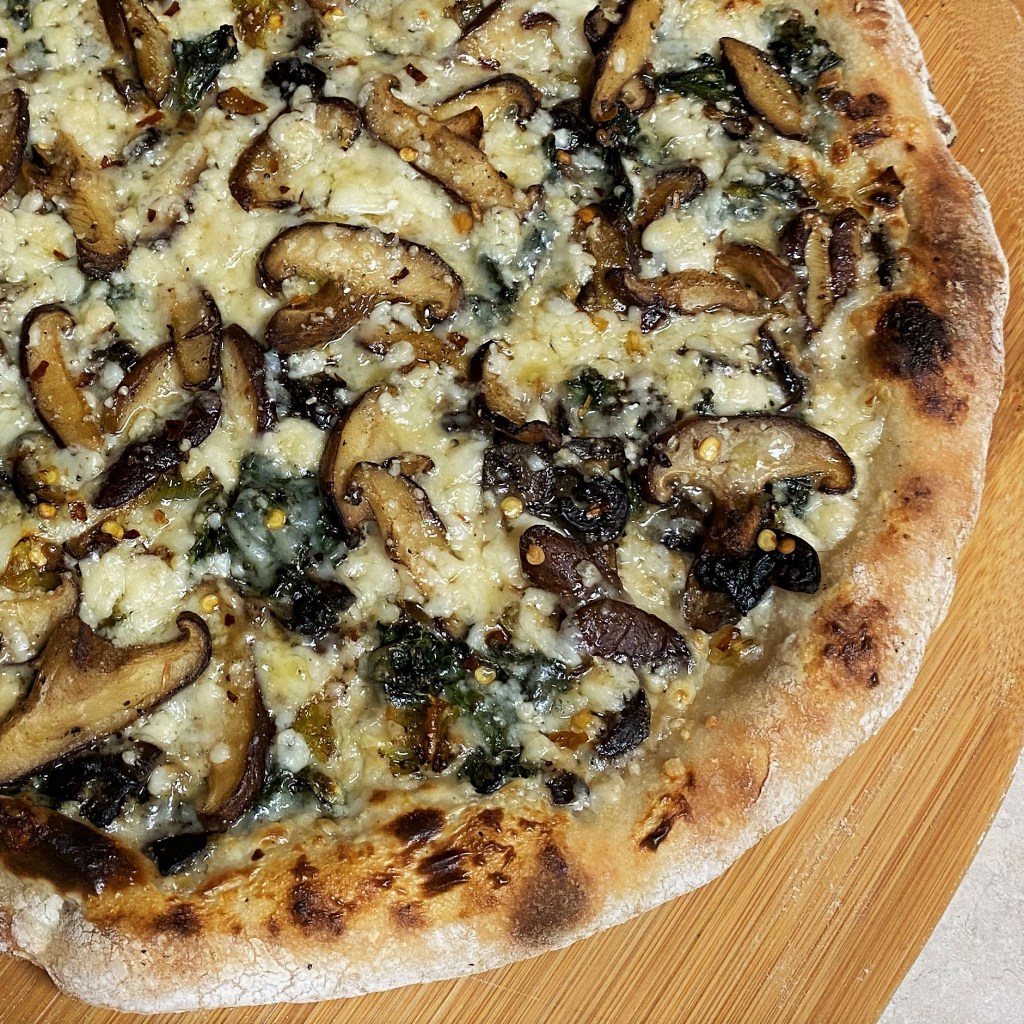
Creamy garlic mushroom pizza, with a roasted garlic béchamel base and two kinds of mushrooms (plus spinach) turns pizza night into a special occasion. My husband has been begging for this one to come back up in rotation, so I’ll be making it again very soon.

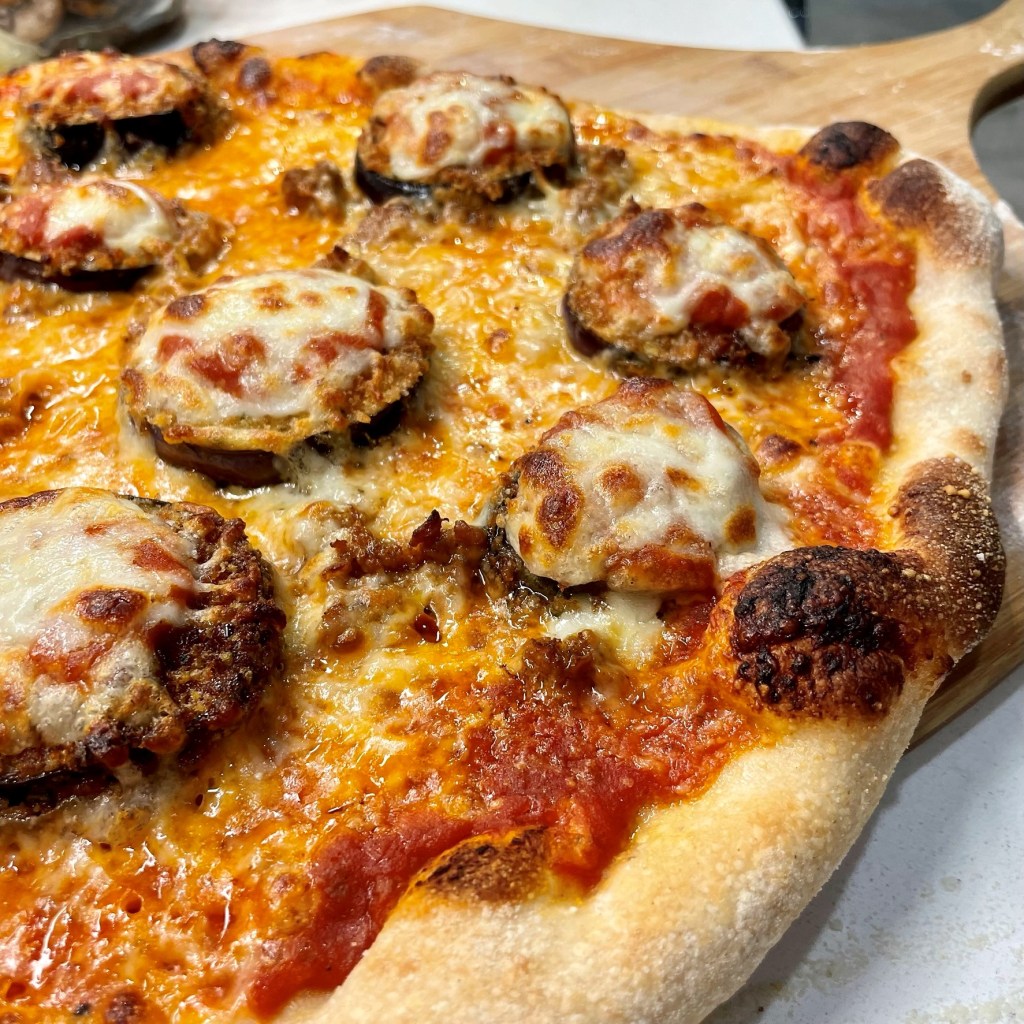
Eggplant parm pizza, but omit the crumbled Italian sausage, which I only used for that recipe because we had a very small amount left over from another meal. Trust me, this pizza would totally rock without the sausage. For this to be truly vegetarian, be mindful of the Parmesan label, to be sure that it uses plant enzymes rather than animal rennet.


Muffuletta Pizza

As we near the end of this year’s Mardi Gras celebration, which wraps up on Feb.13, I’m presenting a pizza twist on the muffuletta, a sandwich that has its origin in New Orleans. You may recall from some of my previous Mardi Gras posts that my travels have not led me to The Big Easy (yet), though it is certainly on my bucket list of foodie places to visit. Still, I love a theme party, and I have a vivid memory of muffuletta, thanks to a part-time job I had more than two decades ago.

Allow me to back up a bit to explain about muffuletta for those who may not be familiar, and why it ties to New Orleans, which we usually associate with Creole-inspired and French cuisine. One glimpse of the muffuletta ingredients list— cured salami, mortadella, ham, provolone and a chopped giardiniera-olive spread— would make one think of Italian food, and rightly so. The muffuletta is said to have been created by a Sicilian immigrant who settled in New Orleans about the turn of the previous century. It is usually presented with loads of layers on a large, round, focaccia-like bread topped with sesame seeds.


My first experience of muffuletta came during my two-year stint in a catering kitchen in Greensboro, N.C., where a friend had recruited me to be a kitchen helper during busy periods. The kitchen was jamming during wedding season, the winter holidays and the twice-a-year High Point Furniture Market, and I was happy to jump in to help fulfill orders. 

At some point in those two years, one of our regular customers must have hosted a Mardi Gras-themed event, because I was charged with making approximately four quarts of the chopped olive and vegetable mix that was to be used for muffuletta sandwiches. Not knowing anything at all about that sandwich, I followed the instructions on the recipe card I’d been given. Green olives, black olives, capers, pickled vegetables, olive oil, vinegar and dried Italian herbs— what in the world was this concoction? And then Rodney, our smart-ass head chef, labeled the giant plastic jar “Muff Stuff.” You can imagine the chaos that ensued over the nickname in our kitchen of mostly immature amateurs.

“Muff stuff” was the briny, pickled relish for muffuletta, and you can easily make this condiment in just a few minutes with a food processor, though my task was to chop up the ingredients by hand. It was delicious on its own, though not very pretty to look at, and it wasn’t until Rodney whipped up a miniature version of muffuletta for the kitchen crew to sample that I understood the importance of what I had made. 

It was like an Italian sub on steroids. A salty flavor explosion that is both rich and fatty, and only makes you feel guilty until you go in for another bite. It’s so good! I’ve wanted to put these flavors on a pizza for a long time, and here you go. Mardi Gras is all about indulgence and excess, and this meat-and-cheese lover’s pizza is doing its part, in the spirit of New Orleans!

You could just call it an Italian meat lover’s dream pizza.

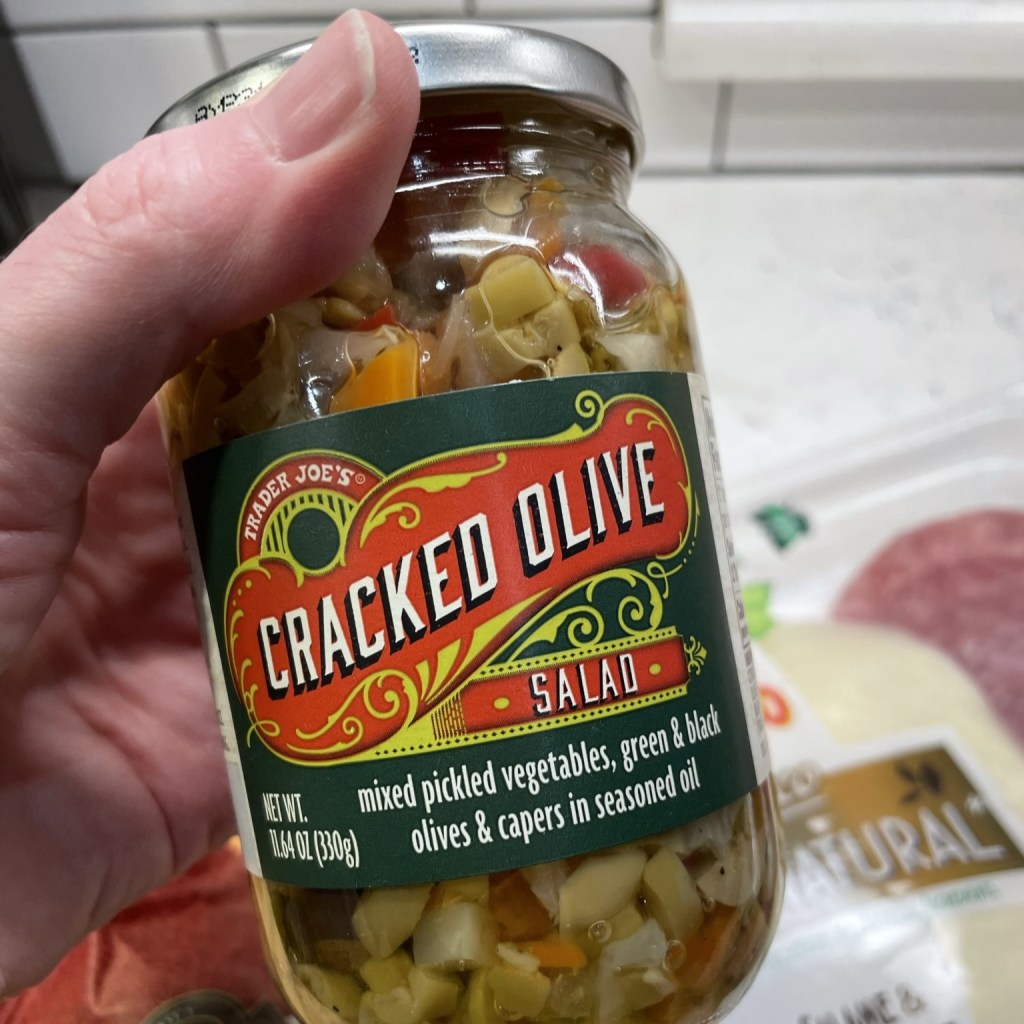
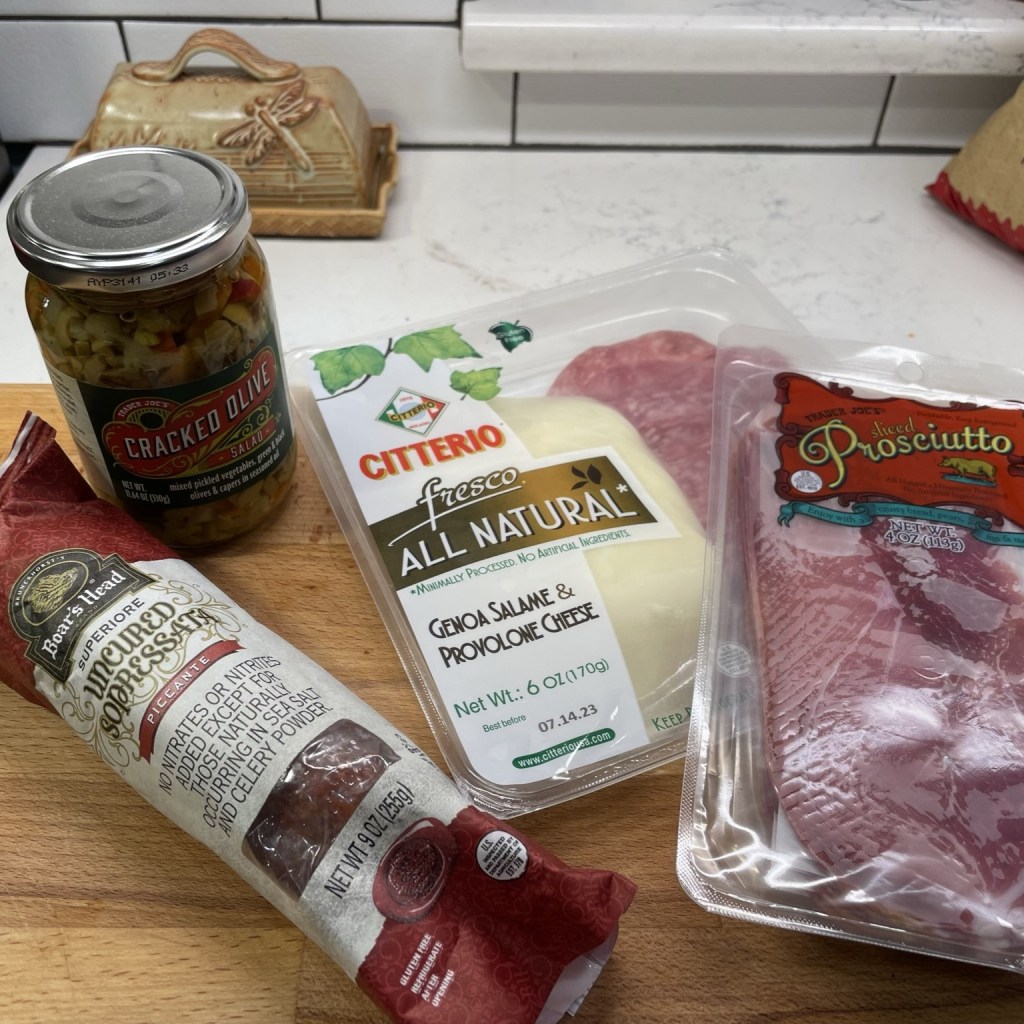
For my muffuletta pizza, I did not delve into making the muff stuff from scratch. Rather, I took advantage of the Trader Joe’s product that pushed me over the finish line to tackle this culinary bucket list item. They call it “cracked olive salad,” and yes, I checked to be sure that TJ’s still sells it, given the store’s tendency to cancel items without notice. Having said that, if you cannot find the cracked olive salad or don’t have a TJ’s nearby, there are similar products in other supermarkets—check the pickle section. If you still can’t find it, check out this recipe on Serious Eats, where my culinary idol Kenji López-Alt will be happy to walk you through making the olive salad, or indeed, the entire muffuletta.


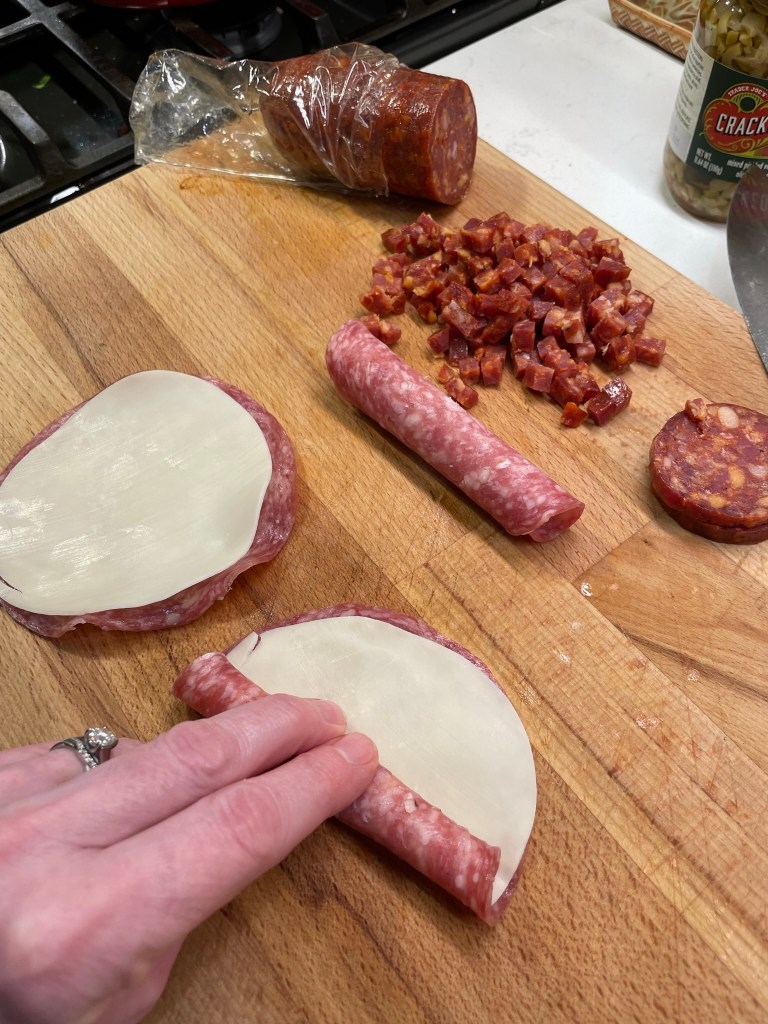
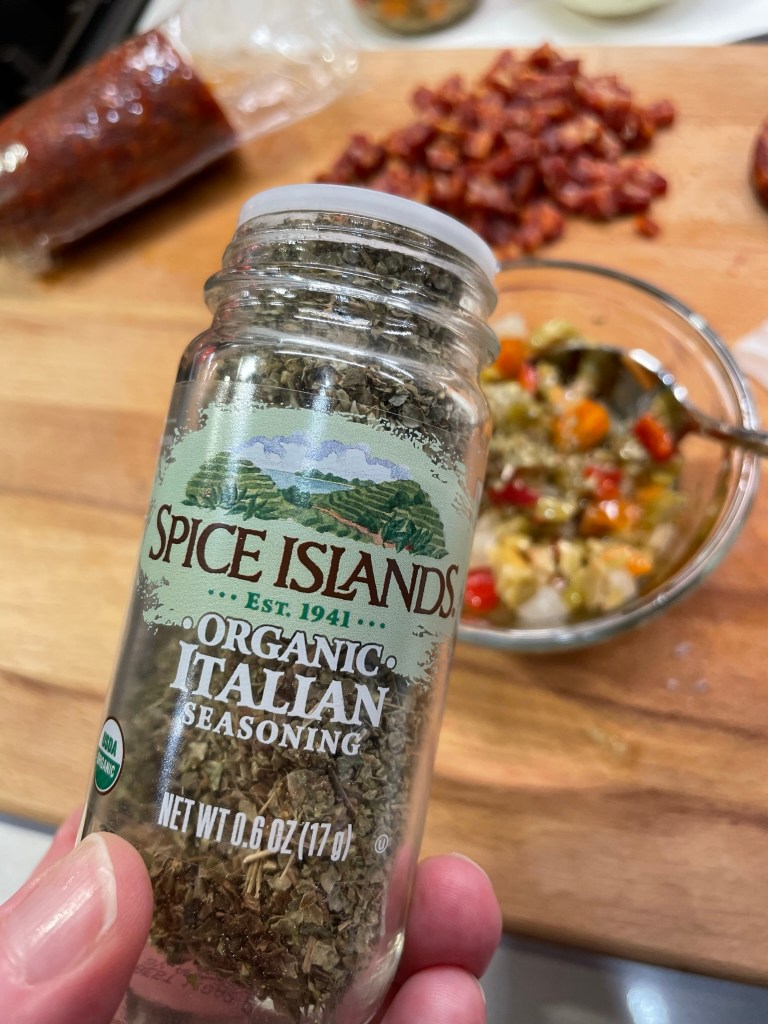
I wanted my muffuletta pizza to have as many authentic flavors as possible, so I considered the three categories of meat recommended by Kenji in the aforementioned article. Mortadella, a fatty, emulsified deli meat, is hard to come by in my city, and bologna was out of the question for me, so I went with three of our favorites from the other two categories— Genoa salami, spicy soppressata and thinly sliced prosciutto. Provolone was in the package alongside the salami, and I rolled them up together for an impression of layers, like on the sandwich. I wrapped the rolls snugly in plastic wrap and stuck them in the freezer for an hour or so to help them keep their spiraled shape after slicing. The soppressata was cut into cubes, and the prosciutto into thin strips, so that my pizza would have plenty of interesting texture. I also bumped up the flavor of the olive salad with a few shakes of dried Italian seasoning.


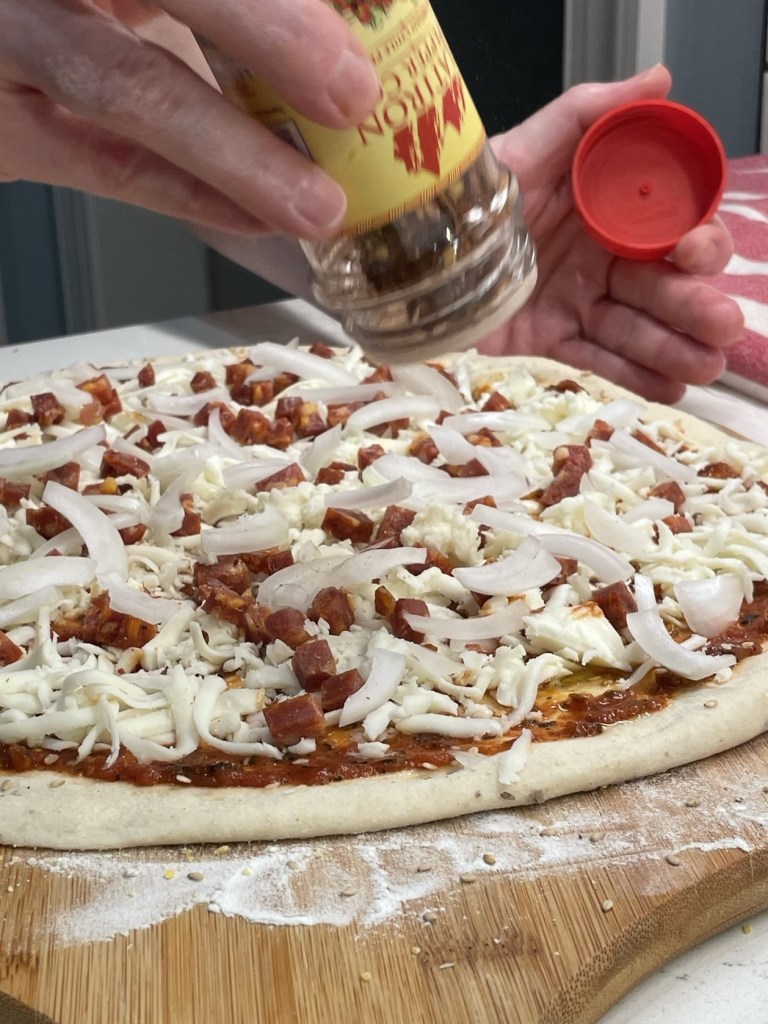
All my pizzas are made with sourdough crust and baked on a screaming hot pizza steel for a brick oven-like finish, but you could replicate the idea of this pizza on any crust you like, perhaps even fresh dough you pick up at the deli. I sprinkled sesame seeds all over the dough, which was more symbolic than anything because we couldn’t detect them on the finished pizza. Sauce went down next, followed by copious amounts of freshly shredded mozzarella, the cubed soppressata, fresh sliced onions and Calabrian chile flakes. Then, the rest of my muffuletta-inspired flavors!


A sprinkle of Parm-Romano blend was a finishing touch, and then into the oven for six minutes— oh, how I love our Dough Joe pizza steel!— and this was possibly one of the most delicious pizzas I’ve ever made. I had some jitters about having “too much meat” on this pizza (my husband would say there’s no such thing), but the flavors worked really well together and the pickled vegetables in the cracked olive salad kept the richness in check.

One of these days, I’m going to get down to New Orleans. Maybe next year. But for now, I’m satisfied to let the good times roll with as many Mardi Gras-inspired foods as I can dream up. What should I make next?

Muffuletta Pizza

  • Servings: 8 slices
  • Difficulty: Average
  • Print

It's an Italian meat lover's dream come true, and with special ties to New Orleans, a fun pizza for Mardi Gras!


Ingredients

  • 3 large slices Genoa salami
  • 3 thin slices smoked provolone
  • 1/3 cup Trader Joe’s “cracked olive salad,” or something similar
  • A few shakes of dried Italian herb blend
  • 1 pizza dough ball, at room temperature
  • Extra virgin olive oil, for drizzling
  • 1 Tbsp. sesame seeds (optional, for effect)
  • 1/4 to 1/3 cup favorite pizza sauce (mine was Dei Fratelli fire-roasted)
  • 1 cup freshly shredded, low-moisture mozzarella
  • 1/3 cup cubed spicy soppressata
  • 1/2 sweet or yellow onion, sliced into crescents
  • A few shakes crushed red pepper, if desired for extra spice
  • 2 slices prosciutto, cut into ribbons
  • About 1/4 cup grated Parm-Romano blend cheese

Note: All my thin-crust pizzas are made with sourdough and baked quickly on a pizza steel, preheated on the center rack of a 550° F oven for one hour. This is an extreme temperature, and the results are very similar to what you would achieve in a brick oven. If you don’t have a steel, a pizza stone works great; follow manufacturer’s recommendations for temperature and adjust baking time accordingly.

Directions

  1. While the oven preheats, layer each slice of salami with a slice of provolone. Roll up into cigar shapes and wrap tightly together in plastic wrap. Tuck this into the freezer for an hour before slicing, so that the twirls keep their shape on top of the pizza. Add a few shakes of Italian seasoning to the olive salad and set aside.
  2. Shape dough into a 14-inch round and place on a flour and cornmeal-dusted pizza peel for easy transfer into and out of the oven. Drizzle the dough with olive oil and season with salt and pepper. Sprinkle all over with sesame seeds, if desired.
  3. Spread sauce over dough to within one inch of the edges; you should be able to see the dough through it. Layer mozzarella generously over the sauce, then scatter the soppressata cubes and onion slices. Shake on crushed red pepper.
  4. Distribute the olive salad evenly over the pizza toppings, then top with the prosciutto and swirls of salami-provolone. Scatter Parm-Romano lightly over the entire pie and slide it into the oven.
  5. Turn pizza 180° after about four minutes to ensure crust is evenly blistered. Remove from oven and transfer to a pizza tray. Serve immediately.


Shrimp Scampi Pizza

There is a special meal tradition at our house on New Year’s Eve. Our annual celebration of fancy pizzas began in 2018, right around the time that I was working to perfect my sourdough pizza crust. Les had shared his memories of the amazing White Clam Pizza he enjoyed while living near New Haven, Connecticut, and we decided to try one at home for New Year’s Eve. It turned out so good that we repeated it the next two years, and in 2020, we added a second specialty flavor to our repertoire— the Oysters Rockefeller Pizza. Last year, we tweaked tradition yet again, trading in the white clam pie with this creative twist on the classic Italian pasta dish, shrimp scampi. Why wouldn’t the flavors of garlic, shrimp, parsley and lemon be amazing on a blistered sourdough crust? Turns out, they most definitely are.


As with most of my specialty pizzas, this one takes a little time to prepare, but the good news is that you’ll do most of it in advance so that you have plenty of time to relax with a cocktail or mingle with guests (or both). There are three components to this pizza, and I’ll break down the details in photos ahead of the click-to-print recipe card at the end. You’re going to love this pizza!

My method for pizza baking

First things first, we bake all our pizzas in a regular home oven, preheated to 550° F with a baking steel on the rack. This combination of slab steel and maximum temperature helps us replicate the effect of a brick oven. If you don’t have a steel, you can get similar results with a pizza stone, but be sure to follow the manufacturer’s guidelines so that you don’t accidentally crack your stone under this extreme heat. With this method, you also need a pizza peel, which looks like a long-handled paddle. It’s helpful for easy transfer of the pizza into and out of the oven.

Our pizza stone doesn’t get much action since we invested in the baking steel.
Whichever you choose, you’ll need a peel for easy transfer of the pizza.

About the pizza dough

Second, my pizza dough is homemade from sourdough starter, and the shaping method is crucial to the kind of texture you see in my photos. We never use a rolling pin on the dough, as this deflates all the lovely air pockets. If you aren’t on the sourdough train, it’s no problem— you can use a yeasted dough or even a store-bought dough if you have a favorite that you trust. The link for my pizza dough also includes a yeast option, if you want to make your own without sourdough. Bring the dough to room temperature when you’re ready to bake.


Cheez, Louise

Traditional scampi— the kind that’s piled onto a dome of angel hair— would not have any kind of cheese. But for my pizza, which does not have a base sauce, I’ve opted to scatter a bit of freshly grated mozzarella over the dough so that the shrimp curls have something to rest on. This is the firm variety of mozz, not the soft variety that is common for Caprese salad. Skip the pre-shredded stuff from the grocery store, as it is packed with an anti-caking agent that also prevents even melting.

My recipe also calls for parm-romano blend cheese, which we make in bulk at home because we use so darn much of it. A good Italian-made Parmesan is acceptable here, but again, do not use the pre-grated stuff. A special occasion pizza deserves the freshest cheese, and a few flicks of a microplane grater will bring big results, I promise.

The star of the show— shrimp

Finally, choose the right shrimp and for the love of flavor, don’t use pre-cooked. Choose fresh large shrimp— somewhere in the 20 pieces-per-pound range is just right— and buy them with the shells and tails on, as you’ll use those parts for the scampi sauce. Be sure to remove the “vein” from the curled back of the shrimp, and take note of the steps below for marinating them a few minutes before baking.

Let’s get cooking!

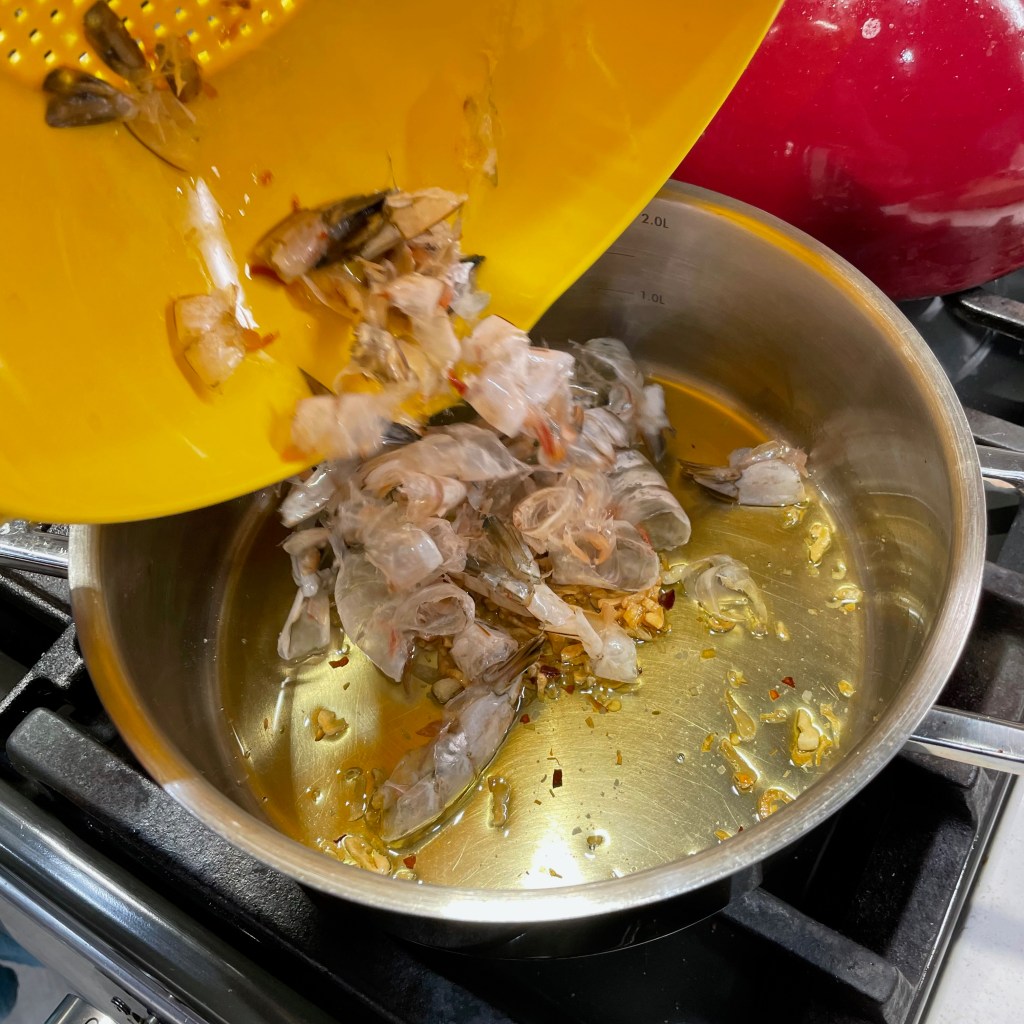
The sauce happens in two stages, beginning with what will seem like a ton of garlic and the parts and pieces that remain after you clean and set aside the shrimp. You’ll sauté the garlic at very low temperature for about 20 minutes, and then you’ll toss in the shrimp shells and tails for a gentle braising in dry vermouth. 


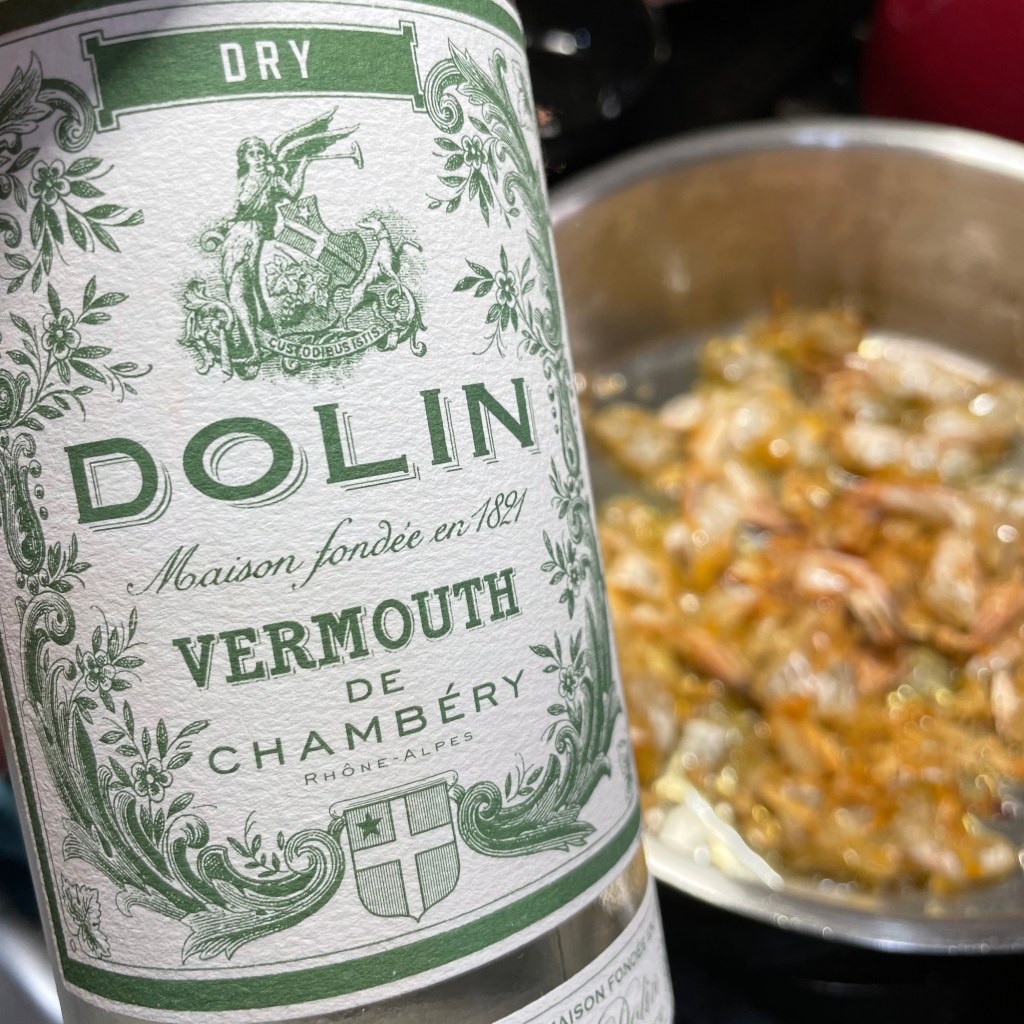
Vermouth— one of the primary ingredients in a martini— is what I always have open, but you are welcome to use a dry white wine such as pinot grigio if that’s more your style. Either way, add only enough to cover the bottom of the pot, and be sure that each shell is at least partially submerged. This will go for about 30 minutes at low heat, until most of the liquid has evaporated. Strain out and discard the solids, and you’ll be left with a small amount of deeply flavored, shrimpy-garlicky oil.


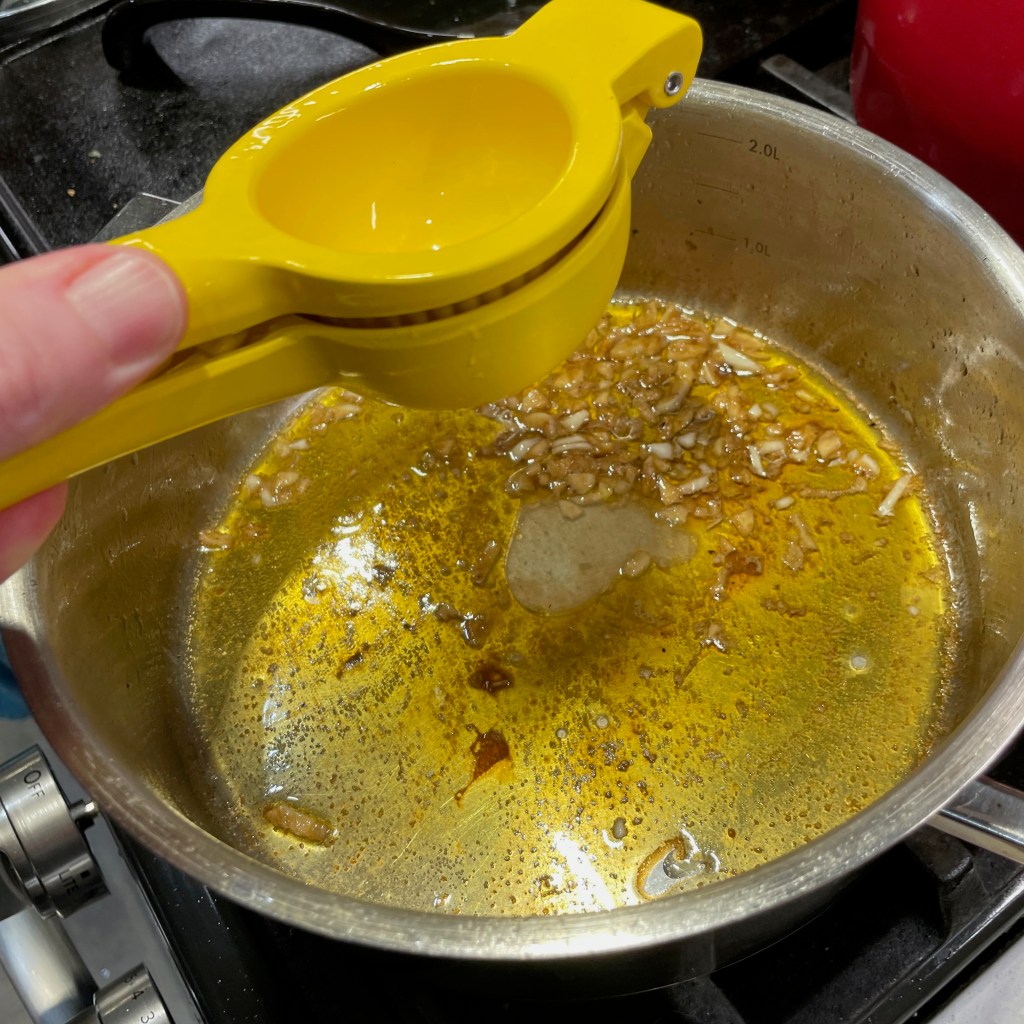
Next, transfer the strained base back to the pan over medium heat and add more minced garlic to it. Squeeze in the juice of half a lemon and simmer this until the garlic is softened (don’t let it burn!), and then turn off the heat. Add finely chopped parsley and swirl in a tablespoon of butter. Transfer to a straight-sided jar and use an immersion blender to whiz this mixture up into a smooth, garlicky butter sauce that you’ll drizzle onto the pizza when it’s hot from the oven. If you’re working ahead, this can be refrigerated and then brought to room temperature just before pizza baking.


Marinate the shrimp

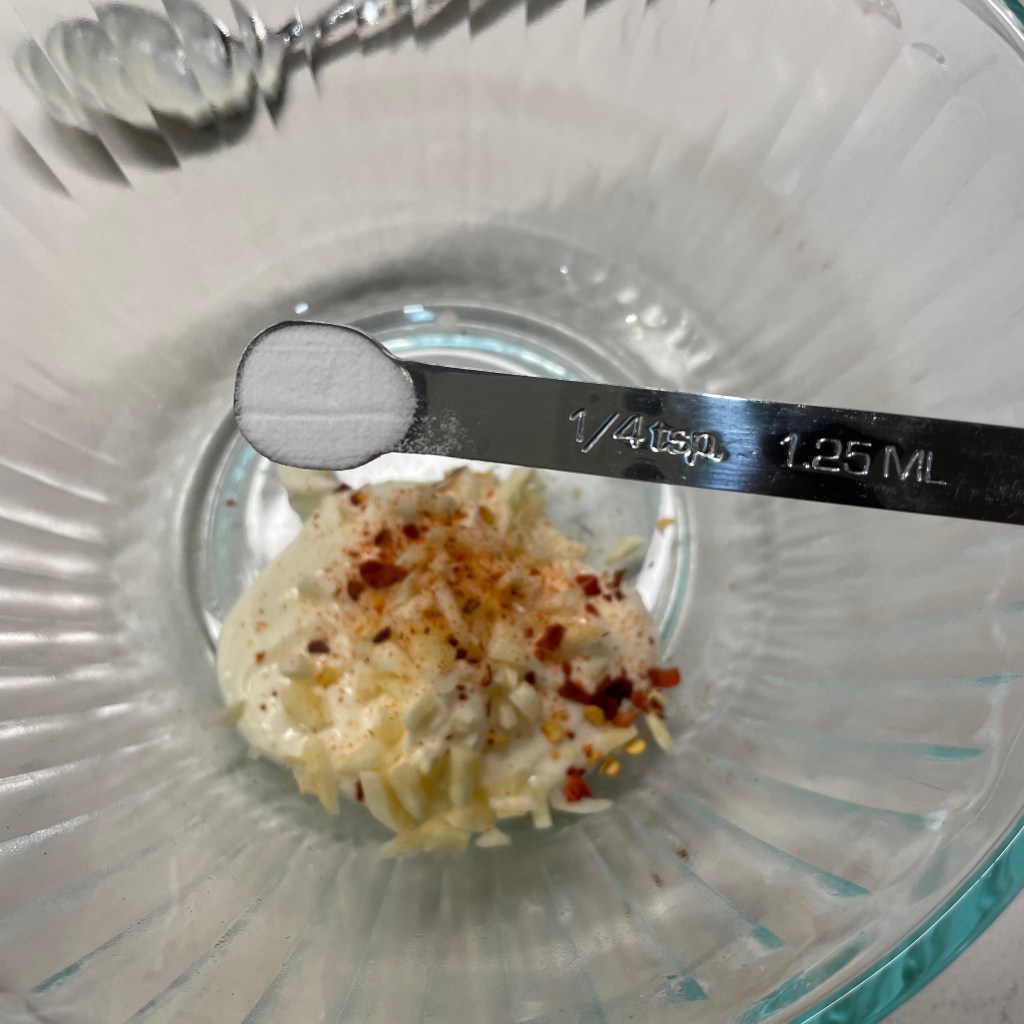
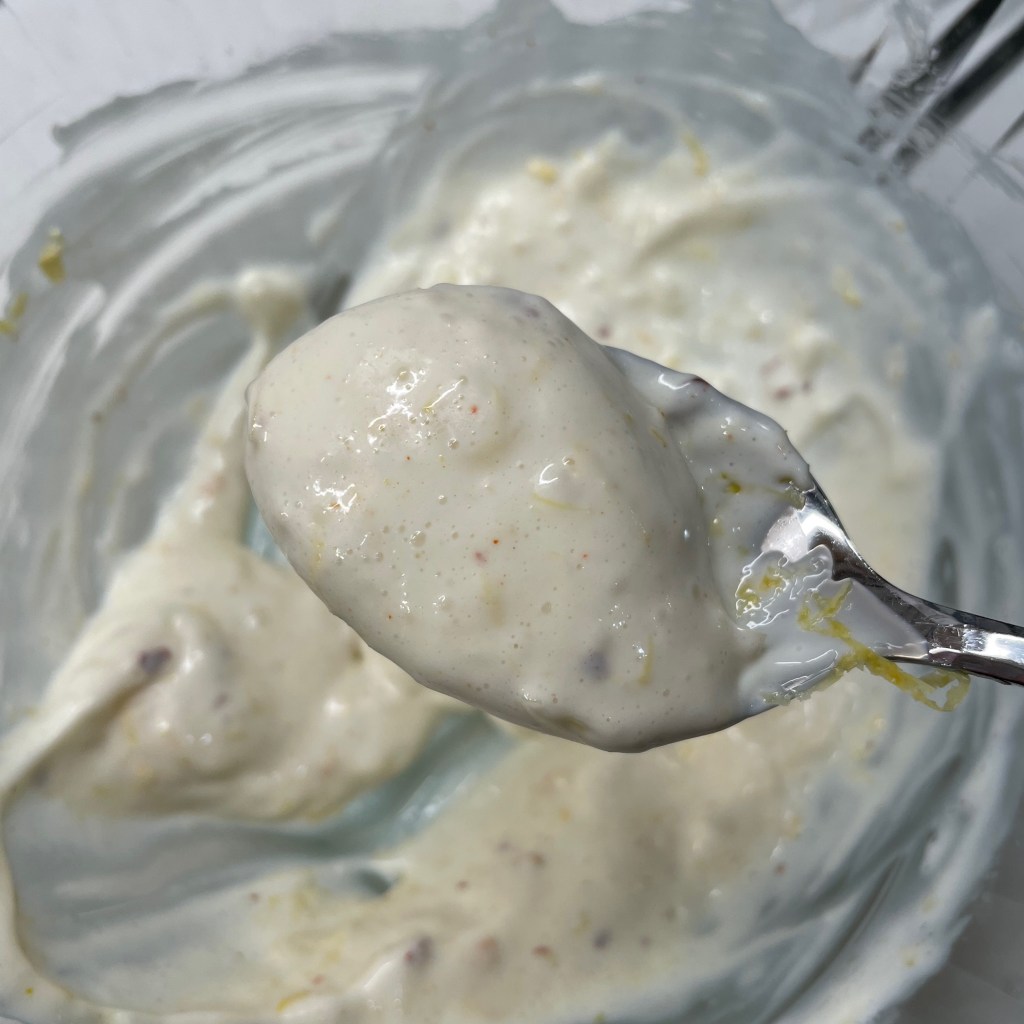
Now, do you remember the temperature this pizza will bake? Five hundred, fifty degrees! Under such extremes, the delicate shrimp needs a little protection, and I’m treating it with the mayonnaise trick I learned from rock star chef Kenji Lopéz-Alt. There is yet another clove of minced garlic in here, plus the zest of a small lemon and a shake of red pepper flakes. And then, the magic ingredient— baking soda! You can read all about my discovery of this technique here, if you wish, but suffice to say that it transforms the marinade to flavor the shrimp and protect it from the high heat. Twenty minutes will do it, but wait until just before pizza time for this step.


Time to build the pizza!

Prep a pizza peel by rubbing in flour and then medium grind cornmeal, and hand-shape the pizza dough into a 14-inch round. Drizzle it with olive oil and season with salt and pepper. Next, scatter a sparse amount of the freshly grated mozzarella onto the dough as a base for the shrimp, and a quick shake of red pepper flakes. Arrange the shrimp (including that mayo marinade) onto the pizza. Give the whole thing a dusting of parm-romano cheese and slide it into the oven. Set a timer for 6 minutes (or longer, if using a pizza stone).


The preheated baking steel retains a great deal of heat, and the high temp of the oven ensures that the crust as well as the toppings will be perfectly browned in this time. Drizzle on the garlic-shrimp butter sauce, toss on more fresh parsley and one more dose of parm-romano blend cheese.


The cheese and garlic butter will melt into the pizza, creating a perfect bite of tender shrimp, intensely flavored butter and garlicky goodness! This will be one of the two pizzas on our table this year as we count down to 2024. 

Now, care to guess what other pizza I’ll be trying this New Year’s Eve? Hint: it’s more seafood. Stay tuned! 😉

Shrimp Scampi Pizza

  • Servings: 14-inch pizza
  • Difficulty: Intermediate
  • Print

Don't let the number of steps scare you away from making this insanely delicious pizza. None of them are difficult, and you'll be greatly rewarded for your effort!


Ingredients

  • 1/4 cup extra virgin olive oil
  • 5 to 6 cloves fresh garlic, peeled and sliced thin
  • Kosher salt
  • A few shakes red pepper flakes
  • Shells and tails of 3/4 pound uncooked shrimp
  • 1/4 cup dry white wine (or vermouth, as I prefer)
  • 2 additional cloves garlic, minced
  • Juice of 1/2 lemon
  • 2 Tbsp. fresh parsley leaves, finely chopped
  • 1 Tbsp. butter

Notes: Don’t skimp on the garlic in this component! It plays a prominent role in scampi, and though it may seem like too much, you’ll end up straining most of it out of the sauce base, so use enough to give it plenty of flavor.

Directions

  1. Add olive oil to a heavy-bottomed pot placed over very low heat. Add first amount of garlic, salt and red pepper flakes and steep for about 20 minutes. Watch this carefully to be sure the garlic doesn’t burn; it should just barely simmer around the edges of the garlic.
  2. Add shrimp shells and tails to the pot and toss until shells begin to turn pink. Raise heat slightly to medium-low. Add dry vermouth and simmer until liquid is mostly evaporated. Cool to room temperature and then strain out solids through a mesh strainer.
  3. Wipe out the pot and add strained shrimp stock, minced garlic and lemon juice. Cook over low heat until garlic softens. Turn off heat, stir in parsley and whisk in butter.
  4. Transfer sauce to a straight-sided jar and use an immersion blender to puree until smooth. Set aside or refrigerate and bring to room temperature before baking pizza.

Next, marinate the shrimp. If you make the marinade ahead, wait until last minute to add the baking soda.

Ingredients

  • 1/3 cup mayonnaise
  • 1 clove garlic, peeled and minced
  • 1 or 2 shakes red pepper flakes
  • 1/4 tsp. baking soda
  • Zest of 1 small lemon
  • 3/4 pound wild-caught shrimp, peeled and deveined

Directions

  1. Combine mayo, garlic, red pepper and baking soda in a bowl large enough to hold the shrimp.
  2. Stir in lemon zest and toss shrimp in the mixture. Set aside for 20 minutes before assembling the pizza.

Time to bake: The oven should be preheated to 550° F for one hour with pizza steel placed about 8 inches from the top heating element of the oven. Dust pizza peel with flour and medium grind corn meal for easy transfer of the pizza to and from the oven. If you don’t have a peel, use the back of a cookie sheet to slide the pizza in, and grab the crust with tongs to pull it out when it’s finished.

Ingredients

  • 11 oz. pizza dough ball, at room temperature
  • Drizzle of olive oil
  • Salt and pepper
  • 1/3 cup freshly shredded hard mozzarella
  • A few shakes red pepper flakes
  • 2 Tbsp. parm-romano blend cheese
  • Additional parm-romano and chopped Italian parsley (for final garnish)

Directions

  1. Shape dough by hand into a 14-inch round and place it on prepared peel. Drizzle oil all over dough and give it a quick seasoning of salt and pepper.
  2. Scatter mozzarella over pizza and shake on red pepper flakes. Arrange shrimp over mozzarella. Sprinkle parm-romano cheese all over pizza.
  3. Slide pizza onto hot steel and bake for 6 minutes. Remove from oven and spoon over the garlic sauce, concentrating on the shrimp (don’t worry, it will melt and ooze everywhere). Sprinkle with parsley and additional parm-romano cheese. Serve immediately.


Spanakopizza!

Today is National Spinach Day, and I would be remiss if I did not share this pizza that I pulled from the oven on Friday. It is absolutely packed with the nutritional powerhouse that is spinach, and a few other key ingredients like feta and dill that give it the signature flavor of Greek spanakopita.

In a roundabout way, this meatless, sauceless pizza brings me full circle to the launching of my blog back in 2020. I have been known at times to take inspiration from the idea of “national” food days, and on this date in that year, I surprised my husband with a batch of spanakopita— the real kind, made with layered phyllo— and served it alongside a Greek salad and easy chicken souvlaki. With spinach being Les’s favorite vegetable, he took a picture of that meal and posted it (along with my national day inspiration) on his Facebook page. 

That’s when it occurred to me that I should probably be doing that myself, not on Facebook but on my own platform. About 10 days later, I started Comfort du Jour.

Pizza, as many of my blog followers already know, is one of my favorite “blank canvas” foods,  and for this tasty pie, I took inspiration from a different kind of recipe made by another food blogger, Diane Kochilas. She is an amazing chef who shares her passion for Greek food not only through her blog (linked here), but also several award-winning cookbooks and her PBS-aired television show, “My Greek Table.” It just so happens that Diane also went to grade school with my hubby back in the day in Queens, N.Y., and the only reason I mention that is because Les follows Diane’s culinary adventures on Facebook and recreates some of her recipes when he takes his turn in our kitchen.

Diane’s “warm spanakopita dip” has become a big-time favorite at our house. When I scanned the ingredients list on the recipe Les had printed— mozzarella, feta, fresh spinach, onions, leeks, dill— I began to imagine them rearranged on a pizza, and I finally brought that idea to life this past Friday. It wasn’t until this morning, when that picture of my spanakopita popped up in Les’s Facebook memories, that we realized the significance of the date. I decided to hustle and get this post ready to mark the occasion. So that’s the story of this pizza— inspired by a dip that was inspired by a Greek specialty— and it was delicious. A delightful way indeed to recognize National Spinach Day, even if it was not intentional!

So. Much. Spinach!

As with most of my pizza creations, this one begins with my own sourdough pizza dough, but any pizza dough you like is probably fine because it’s the toppings that makes this one special. I bake in a very hot oven (550 F) on a pre-heated slab of steel, and the pie is done in only 6 minutes with that arrangement. On a pizza pan, it will take longer. If you have at least a pizza stone, I recommend using it for even baking of the crust. There is a fair amount of moisture in the toppings, and your crust will thank you for the extra bit of heat.

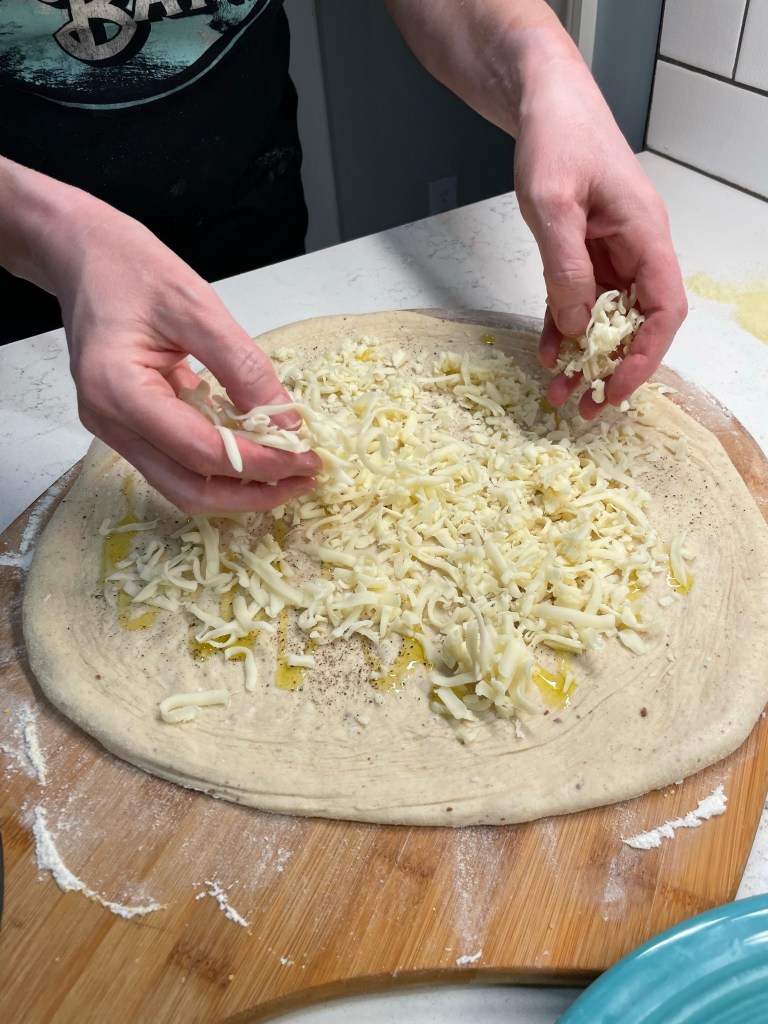
I like to shape the dough by hand, as it results in the light, airy crust we love. A little drizzle of olive oil, and then I layered on freshly grated mozzarella— no sauce is needed for this pie.


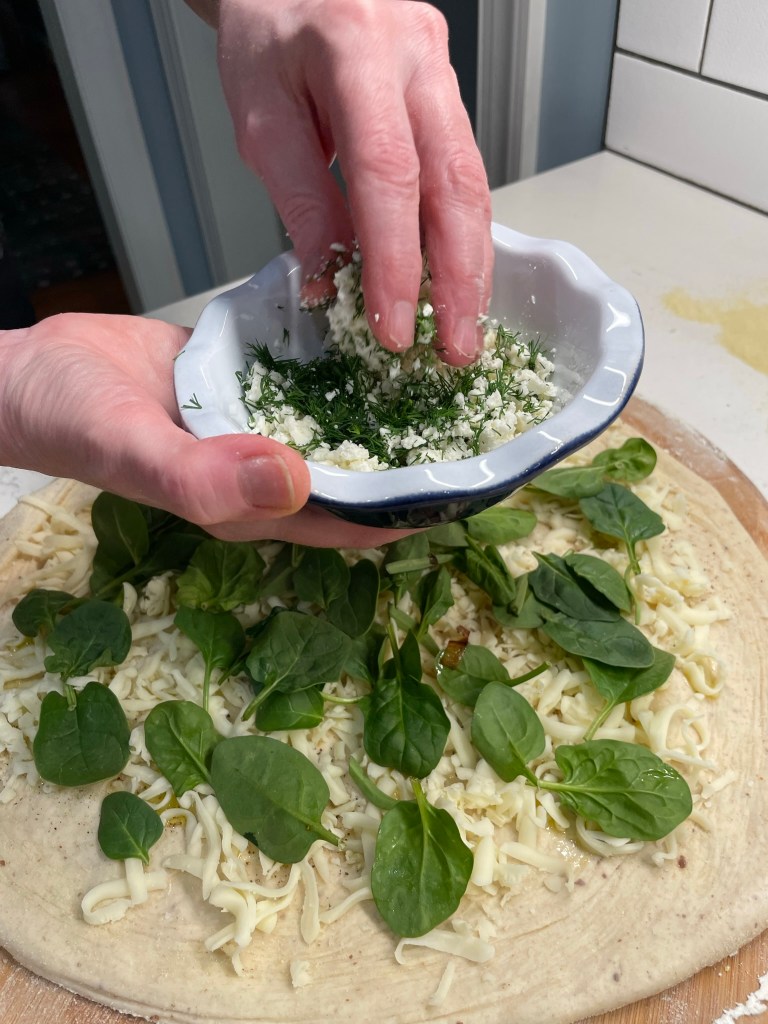
Next was a handful of fresh baby spinach, because I wanted to present the ingredient a couple of different ways. I crumbled up two ounces of feta (the kind packed in brine) and mixed it with chopped fresh dill. This was scattered over the spinach and then buried under a generous amount of spinach that had been sautéed with sweet onions and chopped leeks. A little more mozzarella, and I slid it into the oven!


Spanakopizza!

  • Servings: 6 slices
  • Difficulty: Average
  • Print

This pizza is packed with nutritious spinach and carries all the flavors of the Greek specialty, spanakopita.


Ingredients

  • 1 pizza dough ball (about 11 ounces), at room temperature
  • 3 fat handfuls (about 3/4 pound) fresh baby spinach, divided (you’ll cook most of it, and keep a small handful fresh)
  • 1/2 cup sweet onion, chopped
  • 1/2 cup chopped leeks, white and very light green parts only
  • 1 cup freshly shredded whole-milk mozzarella, divided
  • 1/3 cup brine-packed feta, patted dry and crumbled
  • 2 Tbsp. chopped fresh dill leaves
  • Extra virgin olive oil, salt and pepper

I bake all my pizzas at very high oven temperature (550 F) on a pizza steel that is preheated for one hour. If you have a baking stone or only a pizza pan, you may need to adjust temperature and baking time accordingly. Use a flour- and cornmeal-dusted pizza peel for easy transfer into and out of the oven.

Directions

  1. Preheat oven (and steel or stone) to 550 F, with rack placed about eight inches from the upper heating element.
  2. Heat a non-stick skillet over medium heat with a generous swirl of olive oil in the pan. When the oil begins to shimmer, add onions and leeks and sauté a few minutes until they are softened and translucent. Add two-thirds of the baby spinach (give it a rough-chop first if you’d like) and sauté until most of the moisture is evaporated and spinach is greatly wilted. Transfer the mixture to a bowl and cool to room temperature.
  3. In a small bowl, combine crumbled feta and fresh dill. Set this aside.
  4. Lightly dust a counter or board with flour. Shape dough into a 14-inch round, taking care to keep some airy bubbles in the outer edges of the dough. Transfer to the prepared peel.
  5. Drizzle olive oil onto the dough and sprinkle it with salt and pepper. Arrange most of the mozzarella evenly over the dough, reserving about 1/4 cup for the final layer. Scatter reserved handful of fresh spinach over the mozzarella.
  6. Sprinkle the feta-dill mixture over the spinach. Use a spoon to evenly distribute the sautéed spinach and onion mixture all over the pizza, and be careful not to leave large clumps of it near the pizza’s edges. Top with the remaining bit of mozzarella.
  7. Slide the pizza onto the preheated steel (or stone) and bake 6 minutes, or until cheese is bubbly and edges of crust are puffy and golden brown.


Jalapeño Popper Pizza

Most pizza lovers would agree that there’s never a bad day for pizza. But someone somewhere decided that February 9th should be “National Pizza Day,” and I am here for it with a pizza that is not only delicious, but also especially appropriate for snacking during Sunday’s Super Bowl, er, “Big Game!”

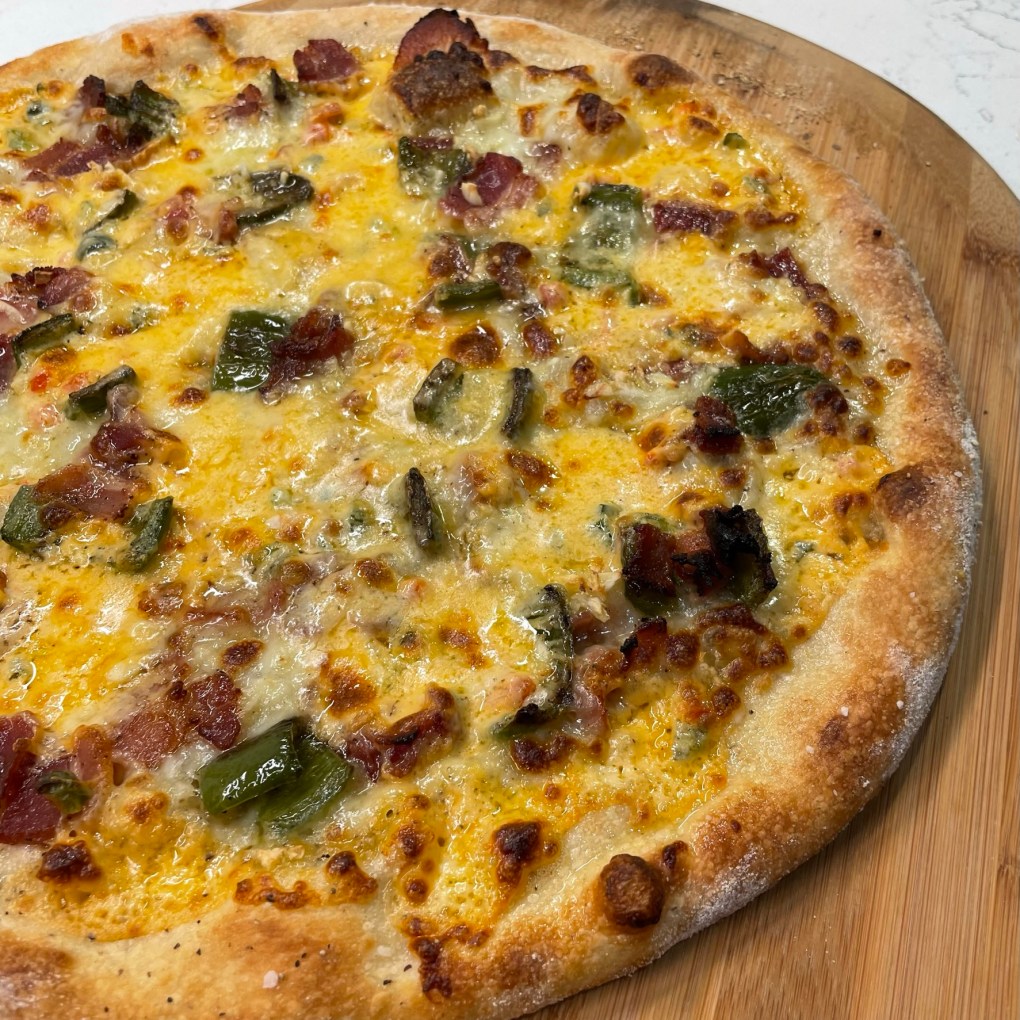
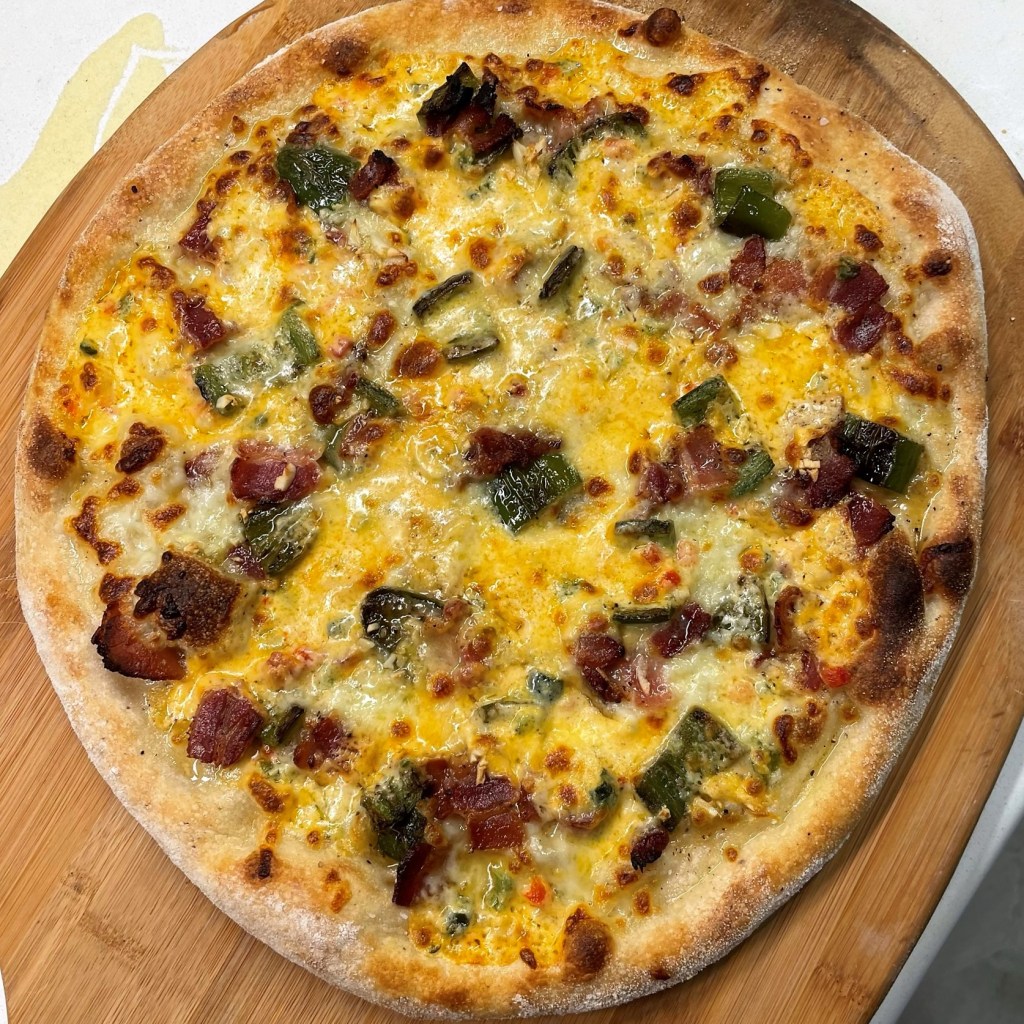
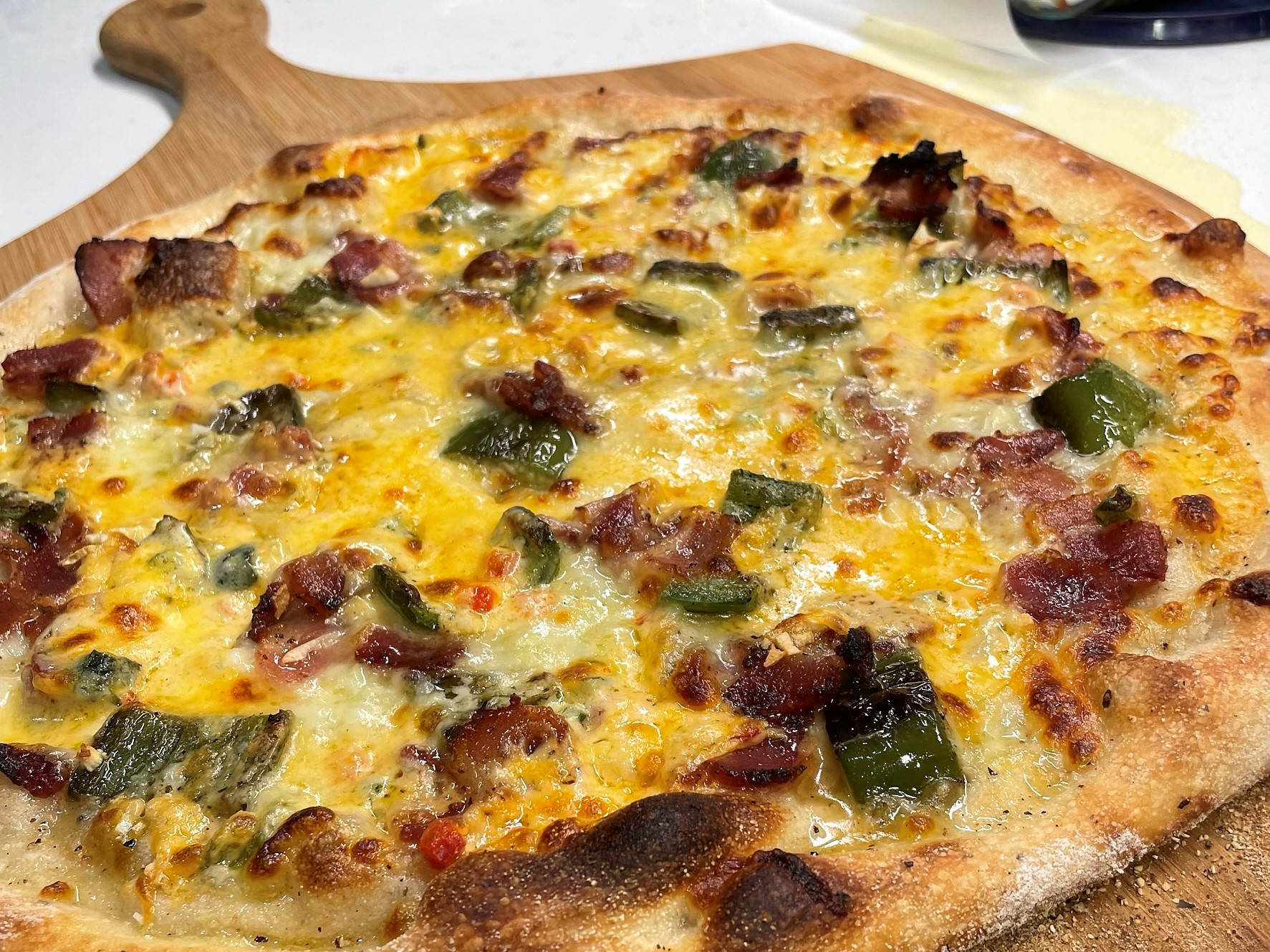
Everything you love about a jalapeno popper, on a pizza!

This pizza, which is built on my go-to homemade sourdough crust, is a fun interpretation of the classic jalapeño popper, which is usually a hot pepper, stuffed with cream cheese and cheddar, then wrapped in bacon and baked.


We focused on those same ingredients, spread them out onto a pizza crust and turned it into a delicious slice. Two game day favorites, one tasty bite!

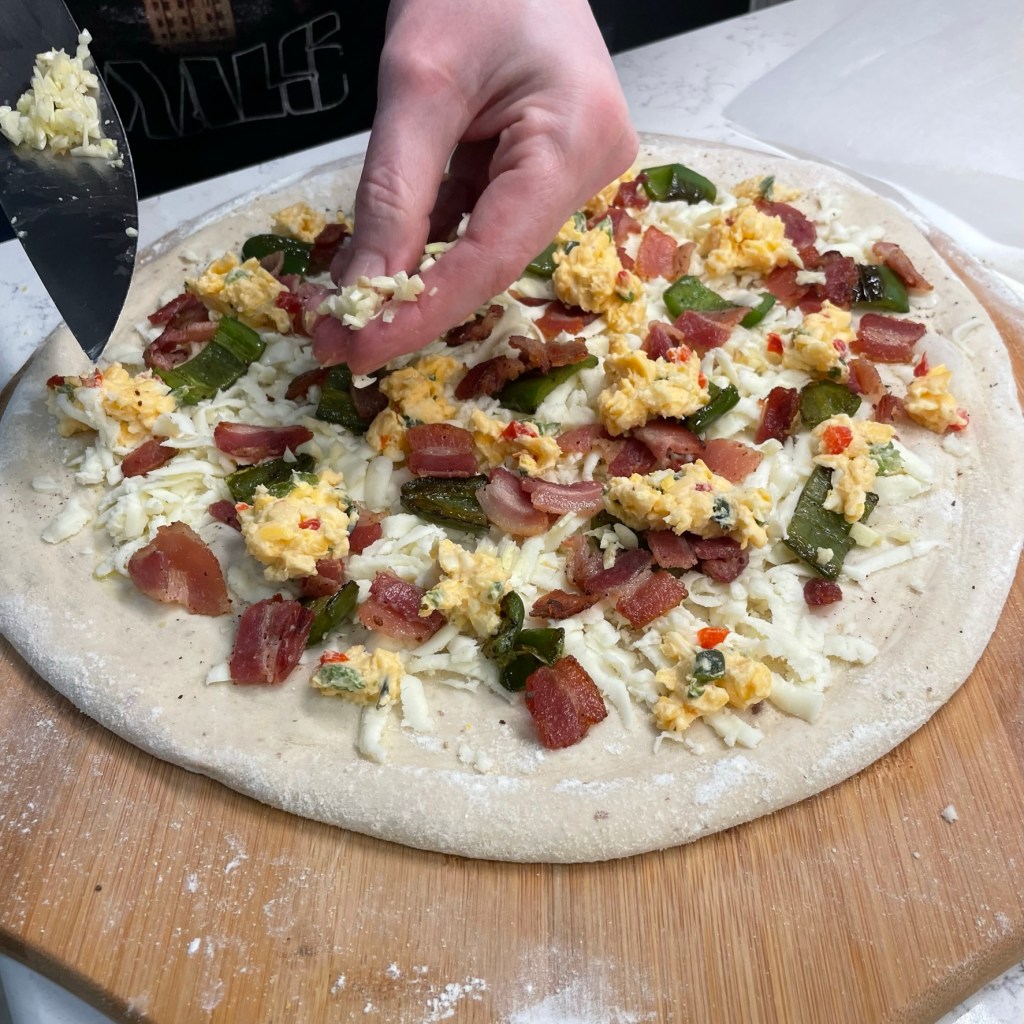
Arrange the ingredients so that every slice has all the flavors!

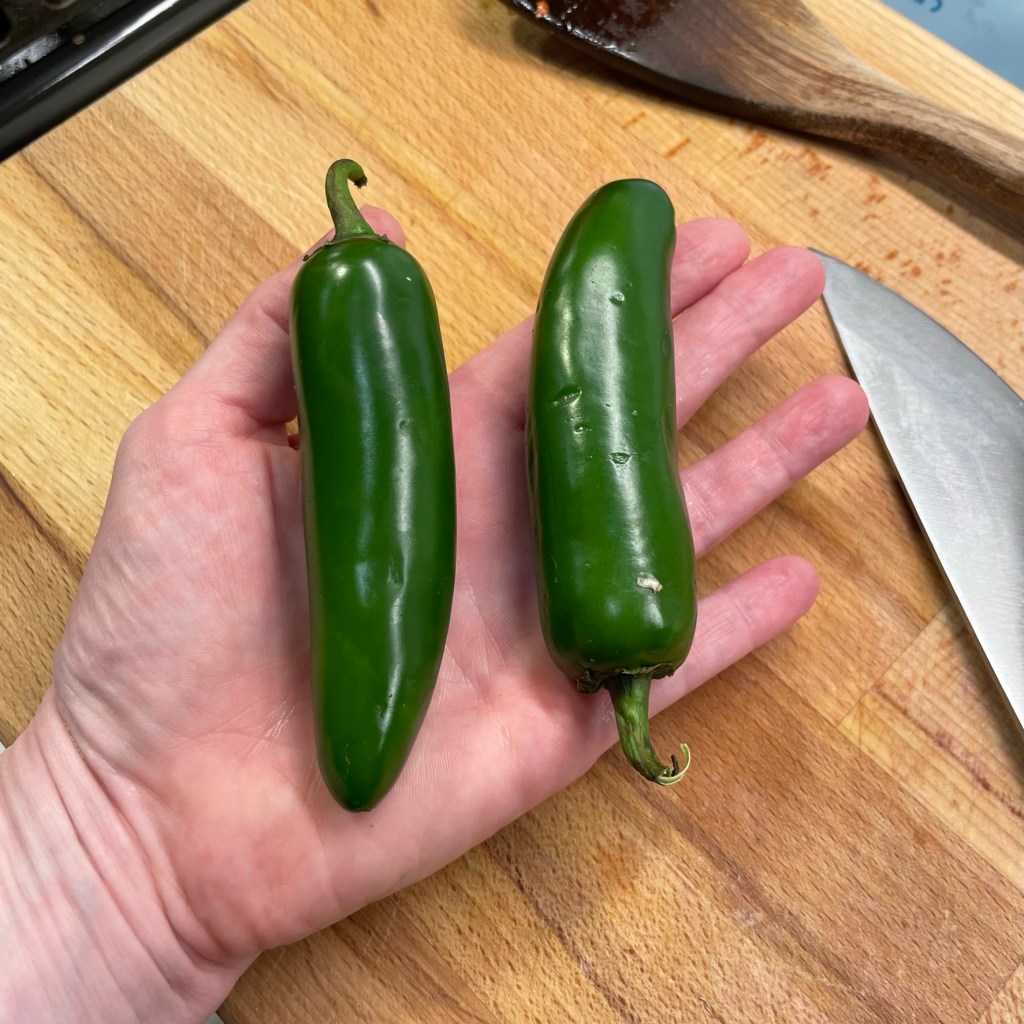
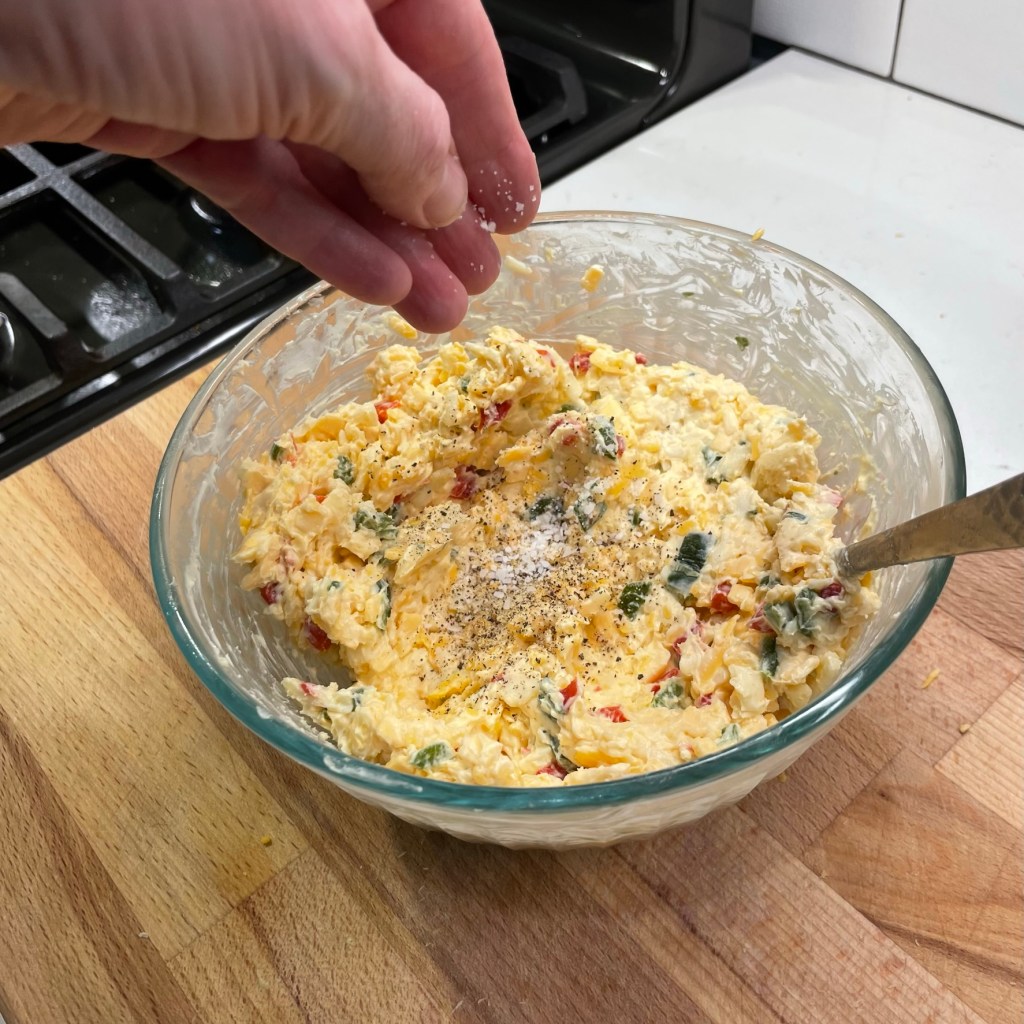
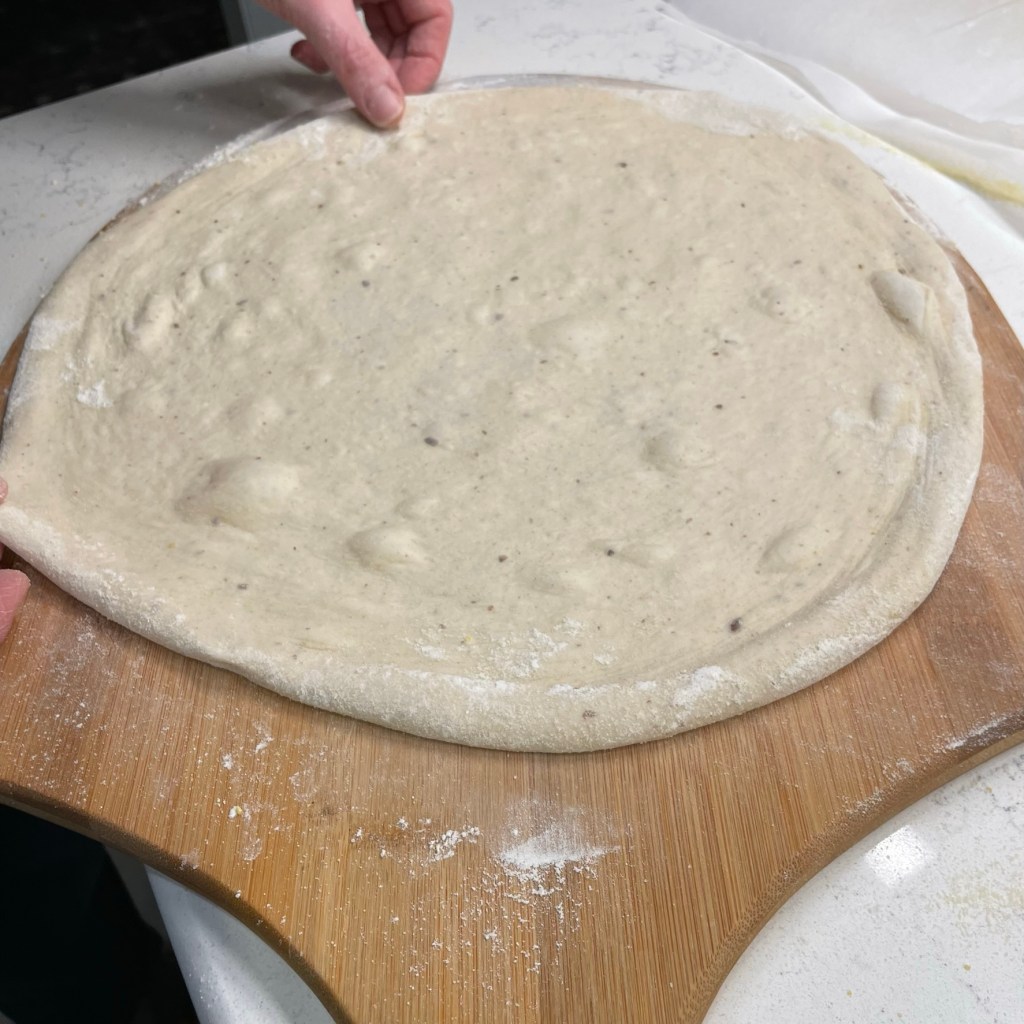
If you aren’t into making your own pizza dough, choose a store-bought dough from the deli department, preferably one that is about 11 ounces, and shape it by hand into a 14-inch round. There’s no sauce on this pizza—it doesn’t need it. Only mozzarella on the base, but also multiple cheeses in a homemade pimento cheese mixture (don’t worry, I’ll share that recipe, too), thumb-size pieces of smoky, salty bacon and fat chunks of fresh jalapeño, which I blistered in the same skillet I used to par-cook the bacon. You know what else would’ve been great on this pizza? Sautéed onions. Next time!


The pizza is surprisingly not all that spicy, despite having those two enormous jalapeños scattered all over it. If you desire more heat, keep some of the seeds on the jalapeños or consider adding some crushed pepper flakes at the table. Personally, we thought the pizza was just right.

The pizza steel has been a total game changer for our home pizzas. I highly recommend it!

We bake all our pizzas on a thick pizza steel, preheated for an hour at 550°F, the hottest our home oven will go. At this temperature, and with the steel, the pizza takes only 6 minutes to achieve blistered, bubbly perfection. If you’re using a stone or a pan, adjust temperature and baking time accordingly.


Jalapeño Popper Pizza

  • Servings: 6 to 8 slices
  • Difficulty: Average
  • Print

All the flavors you love in a jalapeño popper, tossed onto a homemade pizza dough. It's two game day favorites in one delicious bite!


Ingredients

  • 1 ball pizza dough, at room temperature
  • 1 Tbsp. extra virgin olive oil
  • 1/2 cup low moisture mozzarella, shredded
  • 2 large jalapeño peppers, seeded and cut into 1-inch chunks
  • 4 slices thick smoked bacon, cut into 1-inch pieces
  • 1/2 cup pimento cheese (see recipe notes about this)
  • 3 cloves garlic, peeled and finely minced

Use a sturdy pimento cheese that does not have a lot of mayonnaise. If it drips or slides off a spoon, it is too runny for this recipe. Look for an artisan brand or make my Roasted Poblano Pimento Cheese for this recipe.

Directions

  1. Preheat oven to 550 F, with a pizza steel on the oven rack about 8 inches from top heat element. From the time the oven reaches 550, set a timer for one hour. If using a pizza stone or pan, adjust heat and baking time accordingly.
  2. Cook bacon over medium heat in a cast iron skillet, until most of the fat has rendered but the bacon is just shy of crispy. Transfer bacon to a plate lined with a paper towel. Drain off excess grease.
  3. In the same skillet, toss jalapeño chunks until they are slightly softened and the skins are somewhat blistered. Transfer to the same plate as the bacon.
  4. Shape pizza dough by hand into a 14-inch round and transfer it to a floured, cornmeal-dusted pizza peel. Drizzle or brush olive oil onto the crust, and season with kosher salt and freshly ground black pepper.
  5. Scatter mozzarella all over dough, then arrange the jalapeño and bacon pieces. Place small dollops of pimento cheese onto the pizza, so that every bite will have a little bit of every flavor. Sprinkle minced garlic onto the pizza.
  6. Slide the pizza from the peel onto the pizza steel and bake for about 6 minutes, until crust is blistered and golden and the cheeses are melted and bubbling. Serve at once.

Roasted Poblano Pimento Cheese

  • Servings: About 10
  • Difficulty: Average
  • Print

The joy of making your own pimento cheese is that you can spike it with any flavor you like! Here, I've used oven-roasted poblano chiles to complement the tangy pimentos.


Ingredients

  • 2 medium poblano peppers, cut in half and seeded
  • Olive oil spray (or 1 tsp. olive oil)
  • 3 oz. cream cheese or neufchâtel, softened to room temperature
  • 1/4 cup + 1 Tbsp. mayonnaise
  • A dash or two of hot sauce, to taste
  • A few quick shakes onion powder or garlic powder (about 1/2 tsp. total)
  • Salt and pepper
  • 2 Tbsp. drained jarred pimentos
  • 3 packed cups shredded or grated cheese (see recipe notes)

For best results, mix all the ingredients and adjust seasoning before blending in the cheese. Purchase whole blocks of cheese and shred it yourself, as the bagged varieties have a coating to prevent sticking and they won’t blend as well. Several varieties of cheese work great in pimento cheese, and I used a mix of Monterey Jack, American, Colby jack and extra sharp cheddar.

Directions

  1. Preheat oven on low broil setting. Line a baking sheet with aluminum foil (not parchment) and use the heel of your hand to press and break the poblano halves until they’re flat. Arrange them, skin side-up, on the foil. Brush or spray them with oil, and then broil until the skins are blistered and peppers are softened (about 10 minutes). Transfer peppers to a bowl and cover for 20 minutes until they’re cool enough to handle. Peel as much of the skin from the peppers as possible and then chop fine.
  2. In a fairly large bowl (you’ll need plenty of room to stir), blend together the cream cheese, mayonnaise, hot sauce, and onion powder. Mix until smooth. Stir in pimentos and chopped poblanos. Season to taste with salt and pepper, perhaps a bit saltier than you like because the cheese will dull those flavors somewhat.
  3. Stir in the shredded cheese, one cup at a time, blending really well each time until all cheese is mixed in. Cover and refrigerate a day for best flavor.


Italian Deli Sub Pizza

If you’re looking for new ways to enjoy pizza in the new year, you don’t need to look any further than your favorite sandwiches. Ingredients that are delicious on a sandwich are usually very adaptable to pizza. After all, it’s just a rearrangement of some kind of meat, cheese and bread.

The last time we reimagined a sandwich into a pizza, my husband and I were inspired by one of our favorite hot sammies at Jersey Mike’s, the Big Kahuna, and it turned out pretty dang delicious.

All that steak, mushrooms, jalapenos and cheesy sauce could only be contained in a deep dish, and it was awesome!

Wouldn’t you know it? Jersey Mike’s has inspired me again, but this time with a classic Italian deli sub— and as I gazed down at my half-eaten sandwich, I thought, why wouldn’t these ingredients be great on a pizza?

Of course they would!

Salty cured meats and cheeses, thin-sliced tomatoes, onions and peppers, and a shredded salad topping, finished with a zesty Italian oil-and-vinegar dressing. This was so right!

We kept it thin crust this time, which means we started with my favorite sourdough pizza dough. If you haven’t the time or patience to make your own dough, check the deli department of your favorite supermarket, as many of them sell fresh dough balls. And who doesn’t love a shortcut?

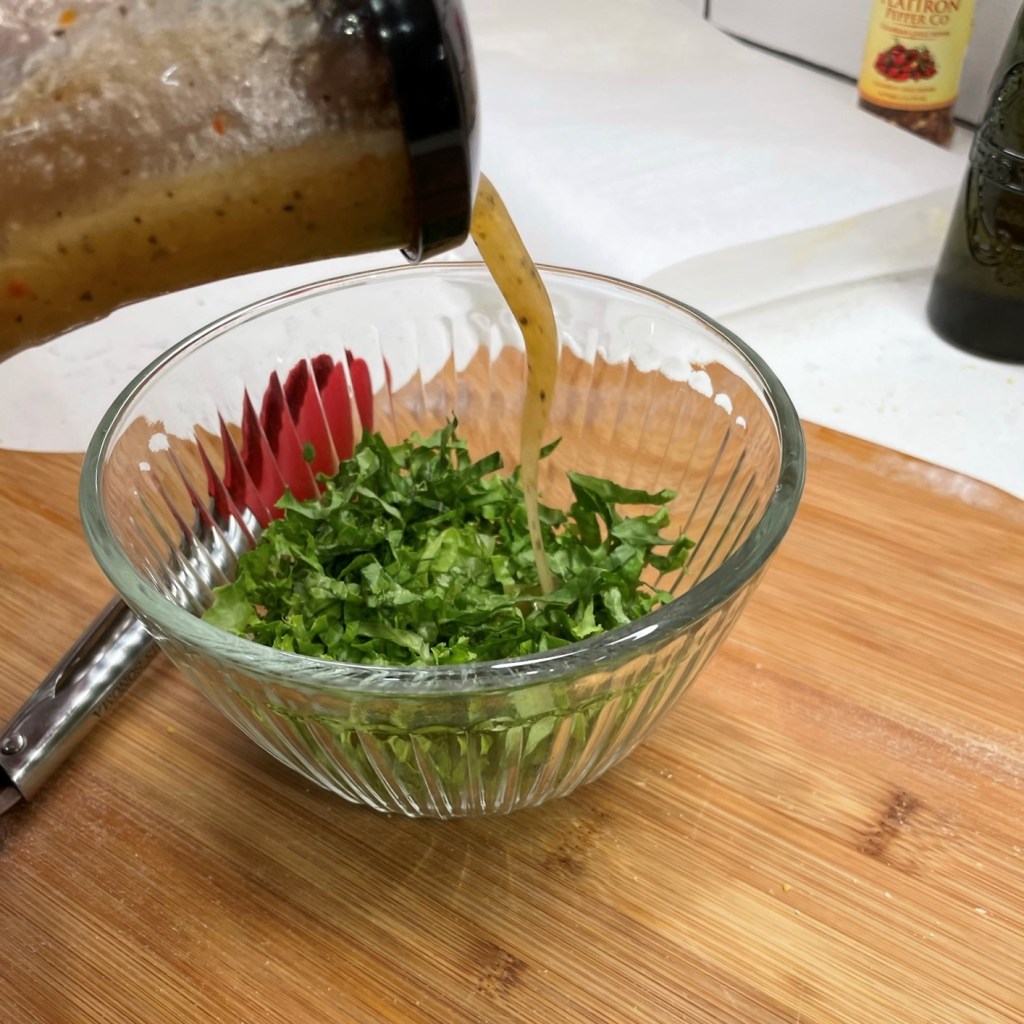
All our homemade pizzas are baked on a steel, at the highest temperature our home oven can handle (550 F), so having things in order first is a must because the baking only takes six minutes. It’s best to slice and season the tomatoes and make the shredded lettuce salad before you begin building the pizza, so it’s ready to pile on as soon as the pie emerges from the oven. Green leaf lettuce has a bit more body than iceberg, but romaine would have been another good choice. A small splash of oil and vinegar dressing added the perfect finishing touch, and I used Good Seasons because it was already made up in the fridge.


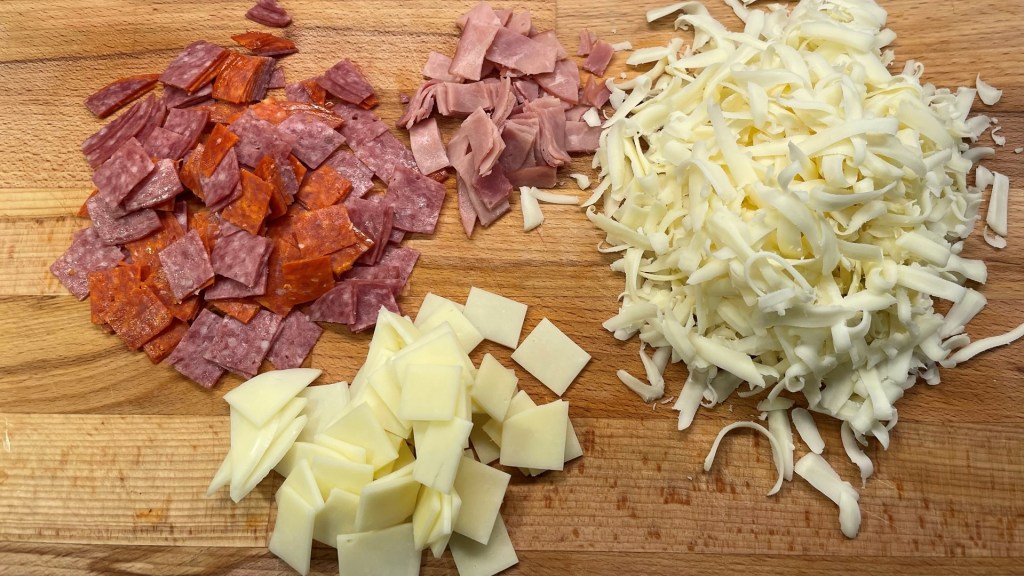
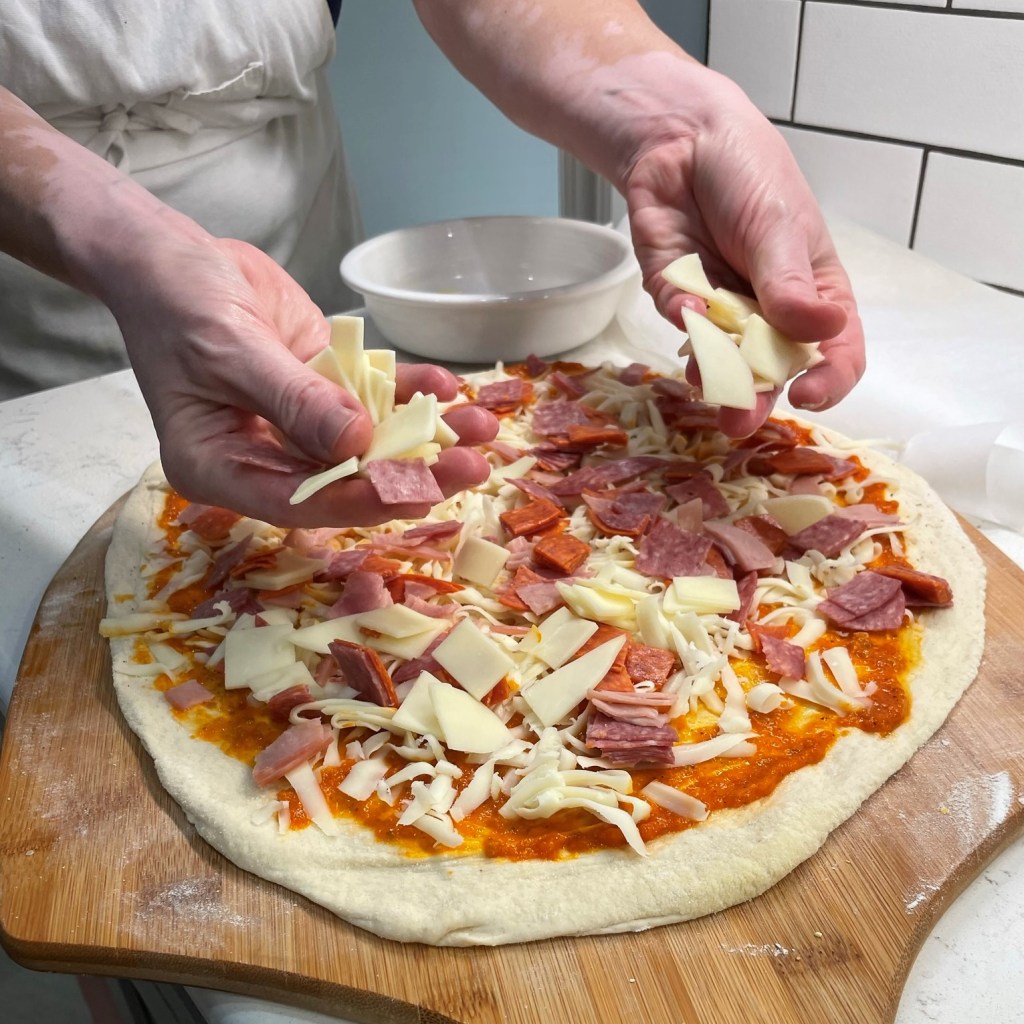
For the other toppings, we cut up thin slices of pepperoni, salami, spicy ham and smoked provolone, and shredded a block of hard mozzarella.


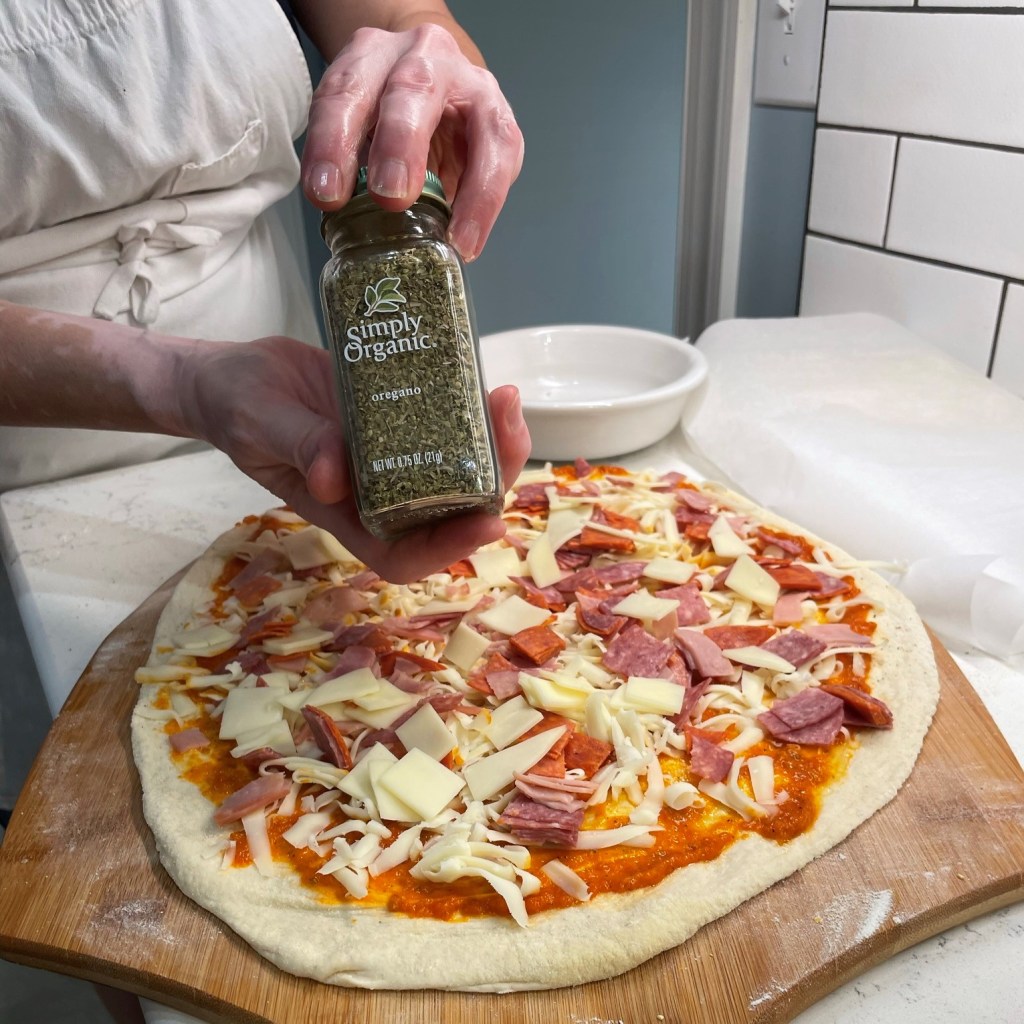
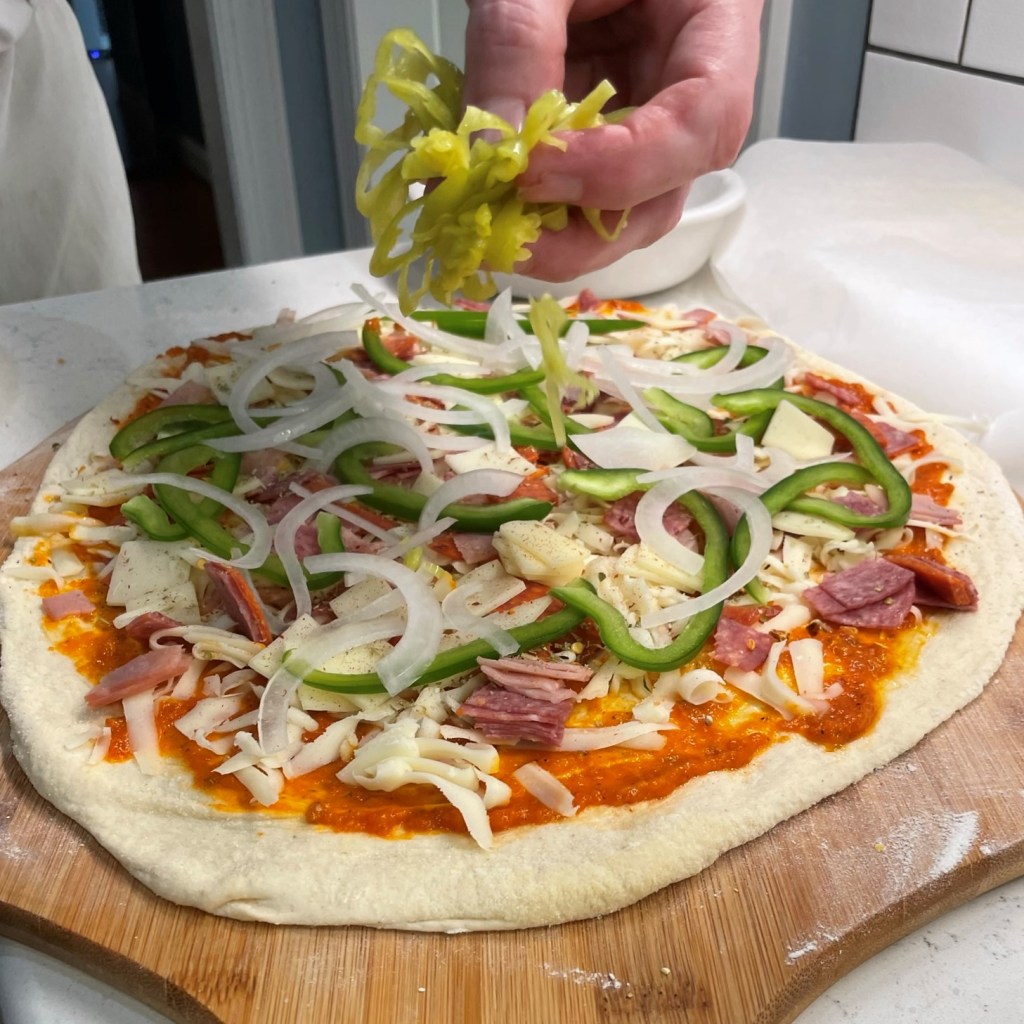
Those were layered onto the sauce with a few shakes of oregano and red pepper flakes, then we arranged very thin slices of onion, bell pepper and pickled pepperoncini, and into the oven it went!


Six minutes later, our kitchen smelled so amazing that we debated enjoying the pizza just as it was, but the shredded lettuce salad is what made it sub-like, and that was a good call. Les sliced it first for easier serving, then we scattered on the salad and sliced tomatoes and sat down for a very tasty dinner!


This pizza had all the flavors of a classic Italian deli sub, so it was a winner! Only one thing left to say (or perhaps to ask) is, “What sandwich will be next??”


Italian Deli Sub Pizza

  • Servings: 6 slices
  • Difficulty: Average
  • Print

If you love Italian subs, this pizza will satisfy all your cravings for salty cured meats, cheese and even the oil-and-vinegar dressing!


Ingredients

  • 1 ball fresh pizza dough
  • 1/3 cup favorite tomato pizza sauce
  • 3 slices smoked provolone, cut into small pieces
  • 1 cup shredded whole milk mozzarella
  • 3 slices spicy deli ham, cut into small pieces
  • 1/4 cup spicy sliced pepperoni, cut into small pieces
  • 1/4 cup sliced Genoa salami, cut into small pieces
  • 1/2 green bell pepper, thinly sliced
  • 1/2 medium sweet onion, thinly sliced
  • 1/4 cup pickled pepperoncini, thinly sliced on an angle (and blotted dry with paper towels)
  • A few shakes of dried oregano
  • A few shakes of crushed red pepper
  • A few leaves of green leaf lettuce or Romaine, thinly shredded and tossed with 1 Tbsp. oil and vinegar dressing or prepared Italian dressing
  • 1 medium ripe tomato, thinly sliced and seasoned with sea salt and pepper

We bake our pizzas on a 3/8″ steel, preheated for one hour at 550F. If you are using a stone or pan, adjust temperature and baking time accordingly.

Directions

  1. Shape pizza dough into 14-inch round; transfer to a flour- and cornmeal-dusted pizza peel for easy transfer to pizza stone or steel.
  2. Drizzle a small amount of olive oil onto pizza dough, then season with salt and pepper.
  3. Scatter mozzarella evenly over dough, and then arrange cut-up pepperoni, salami, ham and provolone onto pizza.
  4. Sprinkle with dried oregano and crushed red pepper to taste, and then arrange slices of pepper and onion and about half of the pepperoncini.
  5. Slide onto pre-heated stone or steel and bake at 550F for about 6 minutes, or until dough is blistered and cheeses are melted and bubbly.
  6. Transfer pizza to serving pan. Cut into slices, then top pizza with dressed shredded lettuce and remaining pepperoncini.