Raise your hand if you got a jar of harissa in your Christmas stocking this year. Really, I’m the only one? 😂 Sincerely, I love that my husband sneaks fun foodie surprises into my gifts, because it sets me up for interesting flavor adventures throughout the coming year.
I’m here to tell you, this isn’t that spicy. 😏
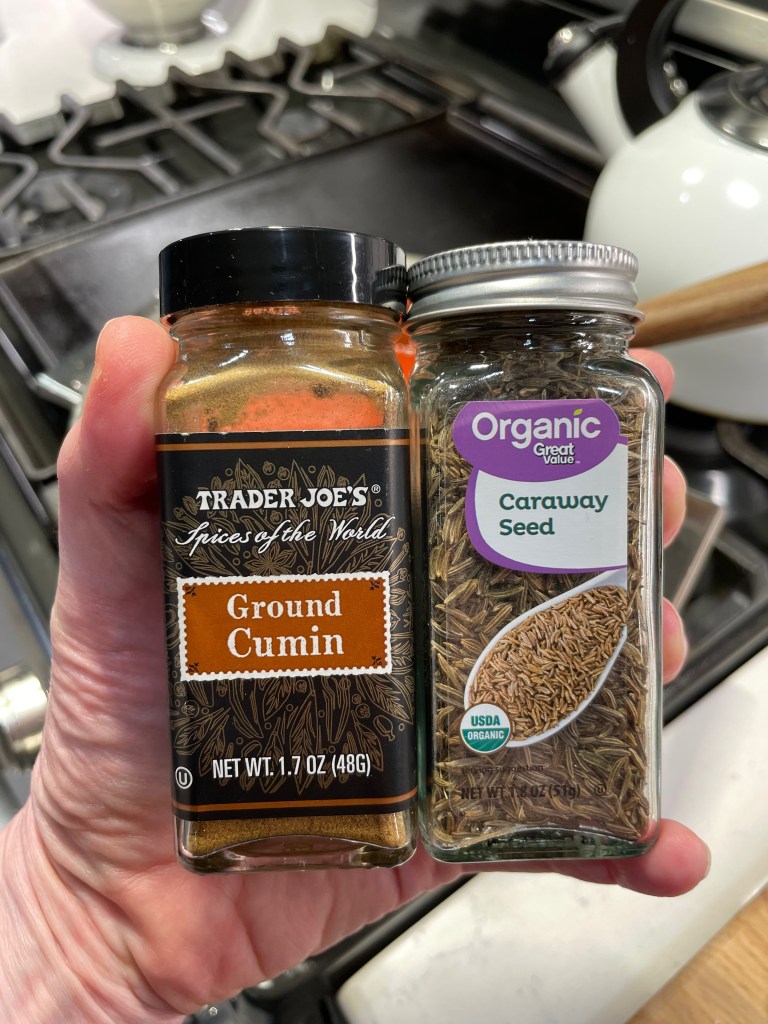
Harissa, if you’re not familiar, is a Moroccan concoction made with roasted red peppers— ranging from sweet to hot—along with garlic and what I like to call the “C spices” of cumin, caraway and coriander. It’s a complex blend of flavors that can be used in a marinade or added directly to a meat or vegetable dish to perk up the flavors. It is typically quite aromatic and spicy, so a little usually goes a long way.
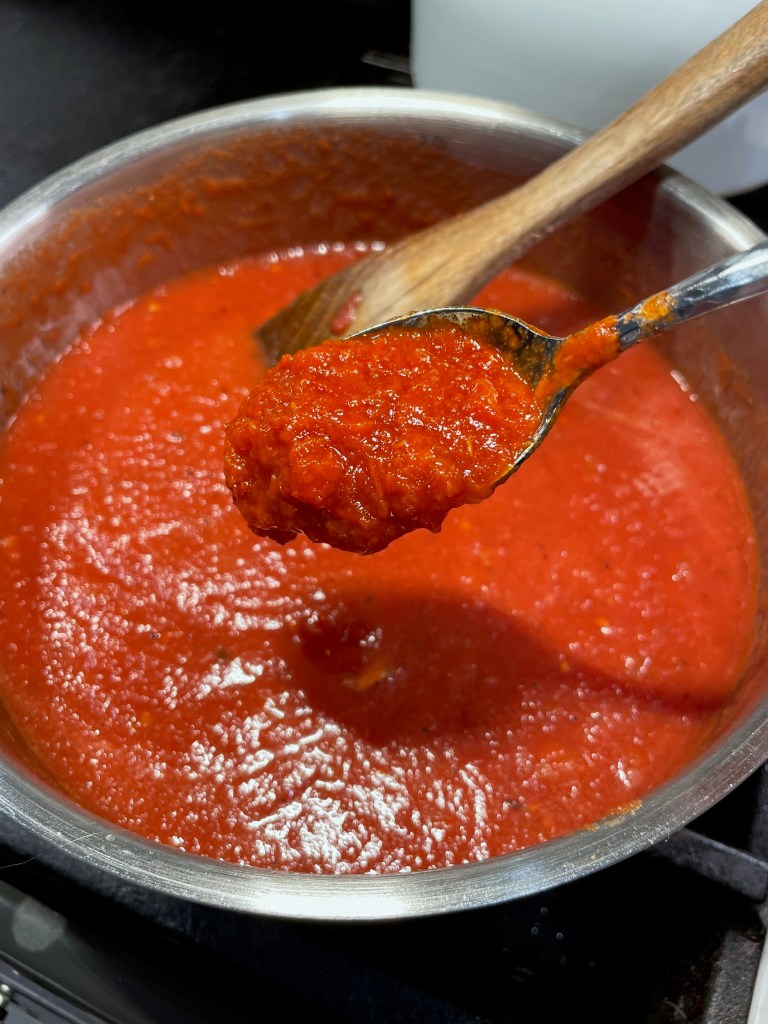
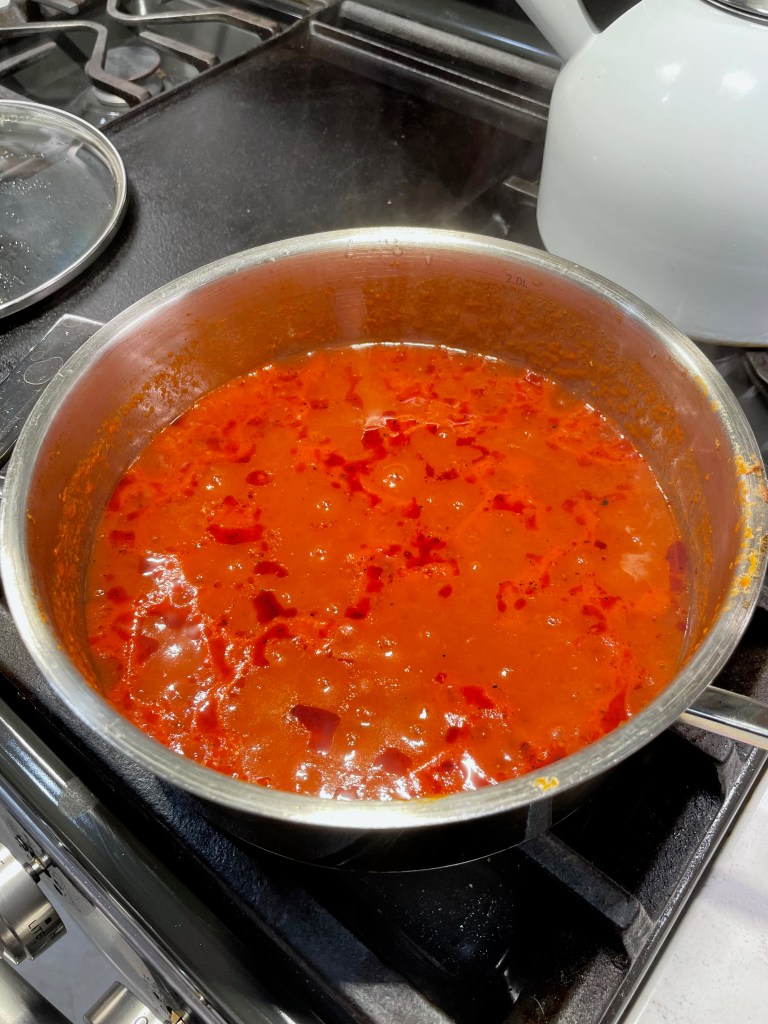
This jar of harissa has already served me well because it transformed what would otherwise have been an ordinary bowl of tomato soup. If you’re bored in the kitchen and tired of making the same things over and over, this post should inspire you to see how easily you can change things up with one ingredient swap or addition. A couple of generous spoonfuls of harissa, along with accompanying spices, elevated this simple, made-from-canned-tomatoes soup to such a degree that Les and I devoured the entire batch in one sitting.
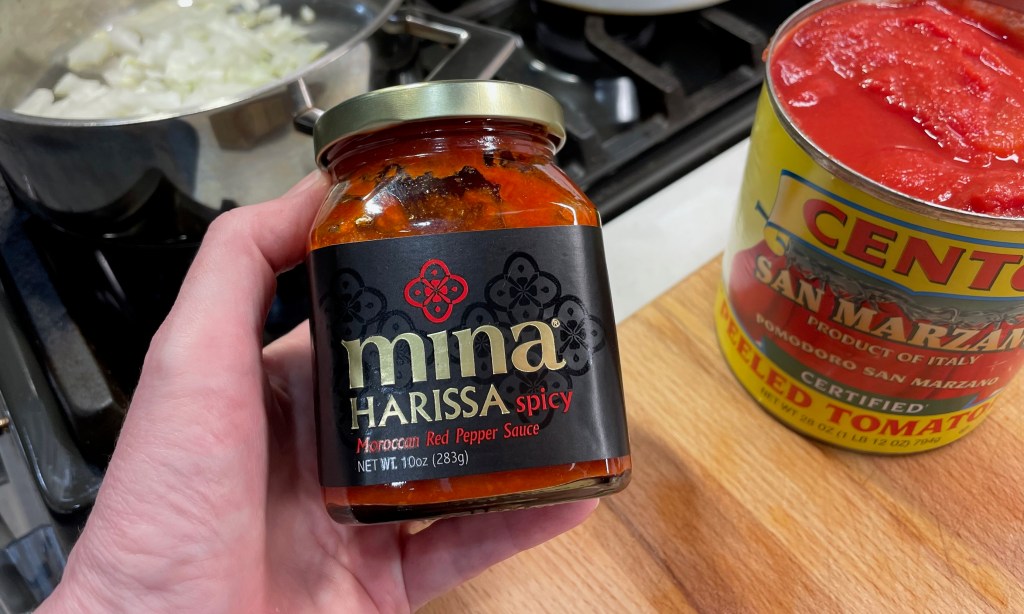
I will confess here that I did not find this particular brand of harissa as flavorful as some others I have tried, including the one carried by Trader Joe’s. My first taste of harissa was during the few years that I worked in a specialty olive oil store. Our harissa-infused extra virgin olive oil was bold, spicy and flavorful, and this jar of harissa paste didn’t quite measure up in the flavor (or heat) department. Still, I found it a good base, which I jazzed up with more of the other flavors I expected— namely hot pepper flakes, cumin and caraway— and this soup did not disappoint!
Most harissa I’ve tasted had distinct heat and spice flavors, so I added them myself!
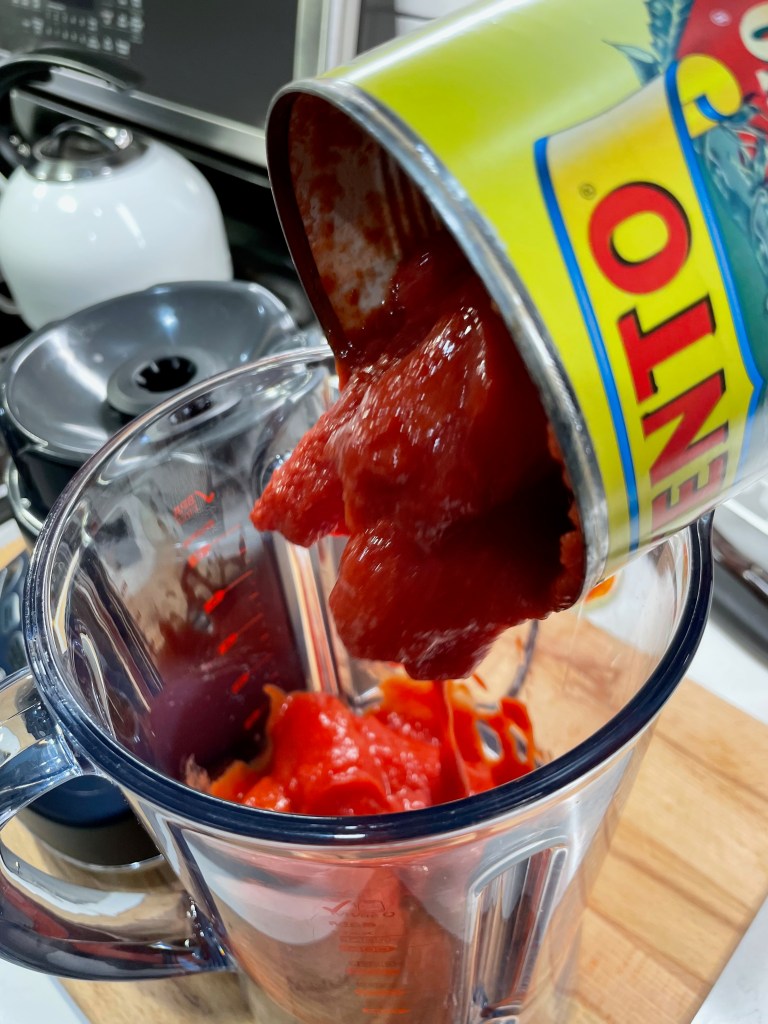
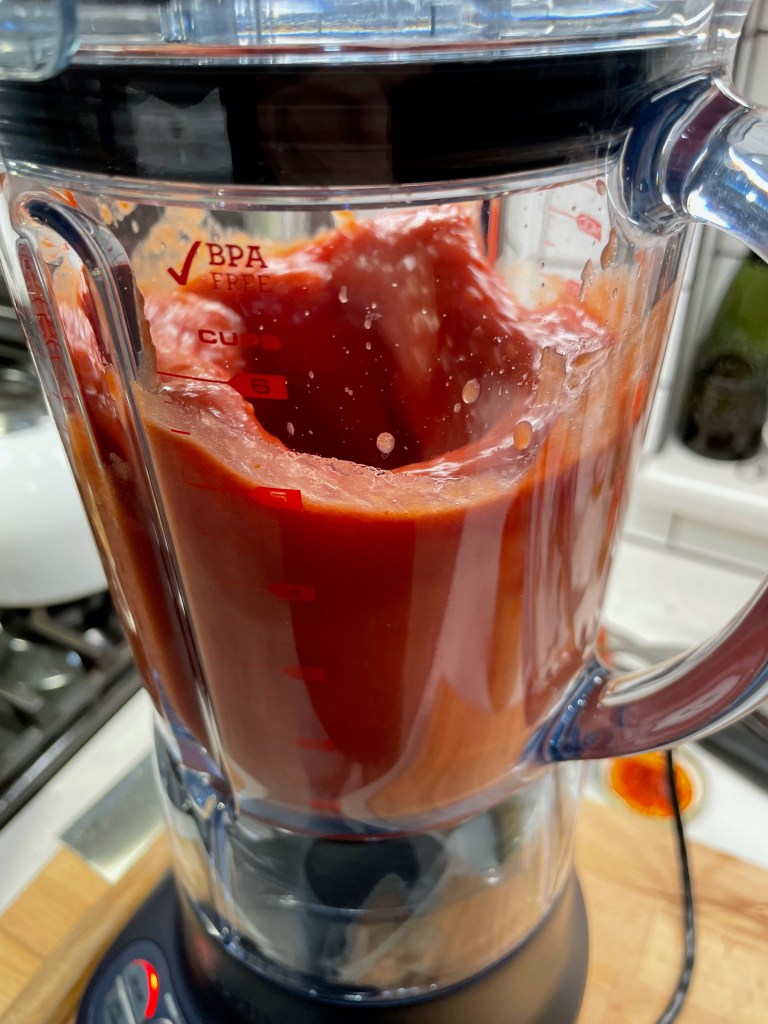
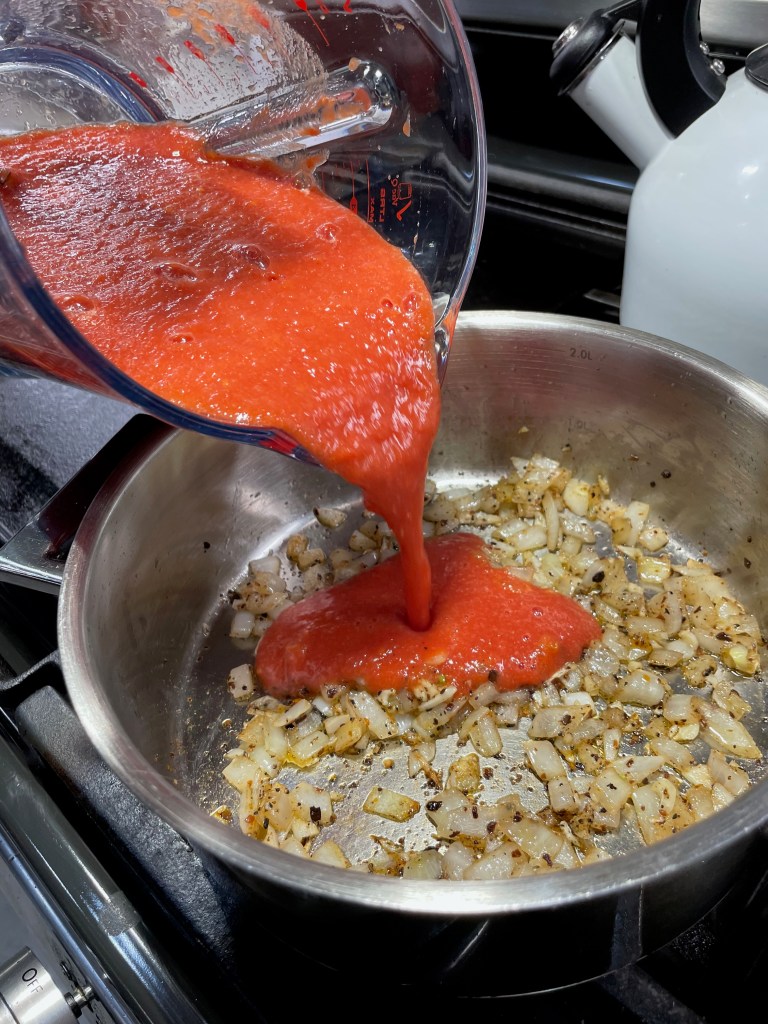
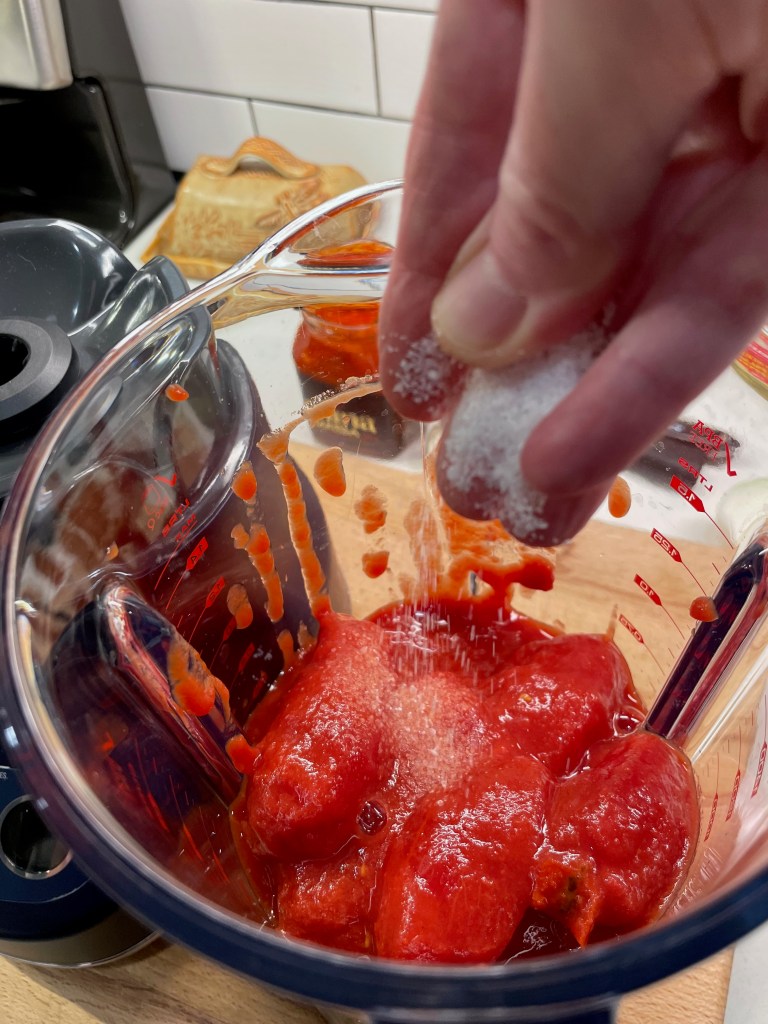
The base of any good tomato soup, of course, is tomatoes! And given that fresh tomato season is still about four months out, I reached for a big can of San Marzanos. I’ve learned the hard way that lesser quality tomatoes don’t have the same depth as real San Marzanos, so choose well. I whizzed these up in my George Clooney blender (so named because it is tall, handsome and versatile), and then I added it to lightly sautéed onions and garlic along with a few tablespoons of the harissa.
I usually blend my soup after simmering, but blending them first this time kept my soup a vibrant red color!
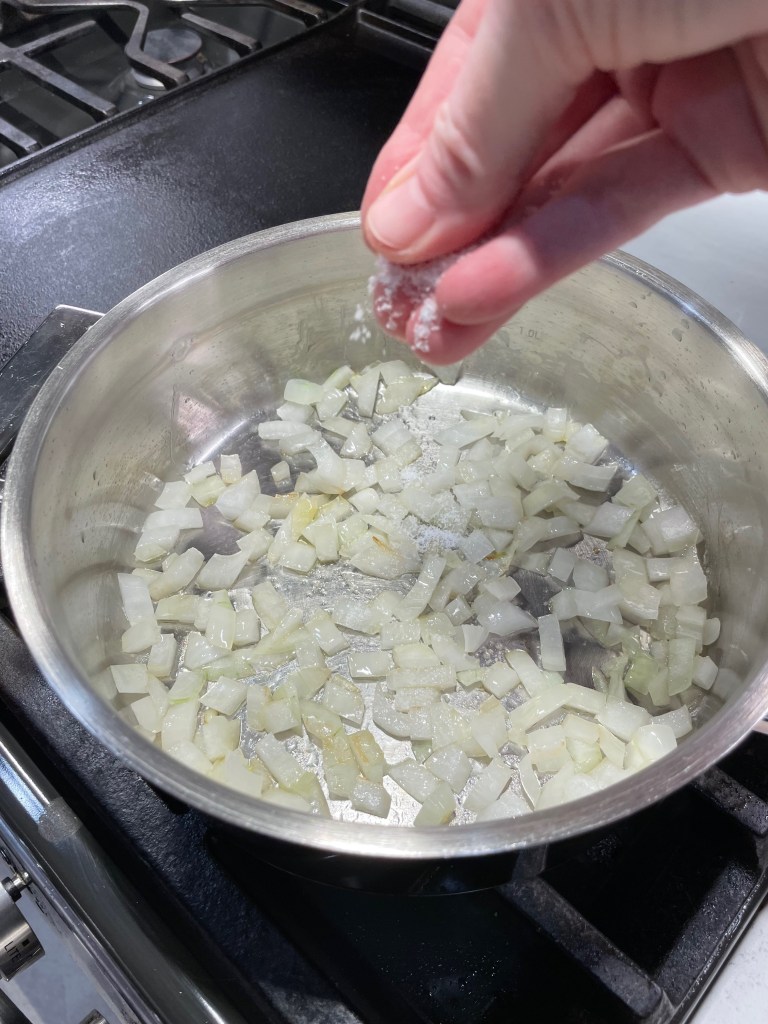
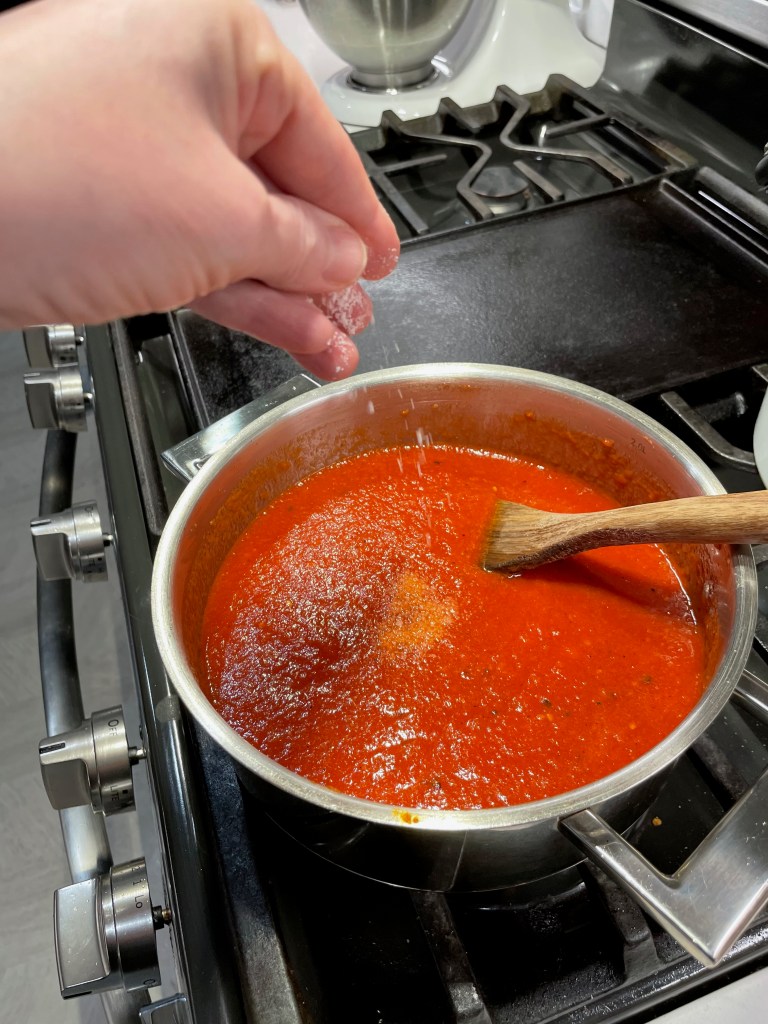
As with any recipe, I followed the advice of every culinary expert I respect, by seasoning every layer— during sauté of the onions, preparing the tomatoes and building the soup over heat. Salt has more purpose than just flavor, and if you miss seasoning the layers of a recipe, you may end up with a meal that tastes under-seasoned and over-salted at the same time.
There’s more to salt than flavor. “Season every layer” is one of the most important rules in my kitchen.The spices added a familiar flavor boost to this milder brand of harissa. Simmering helped the flavors meld.
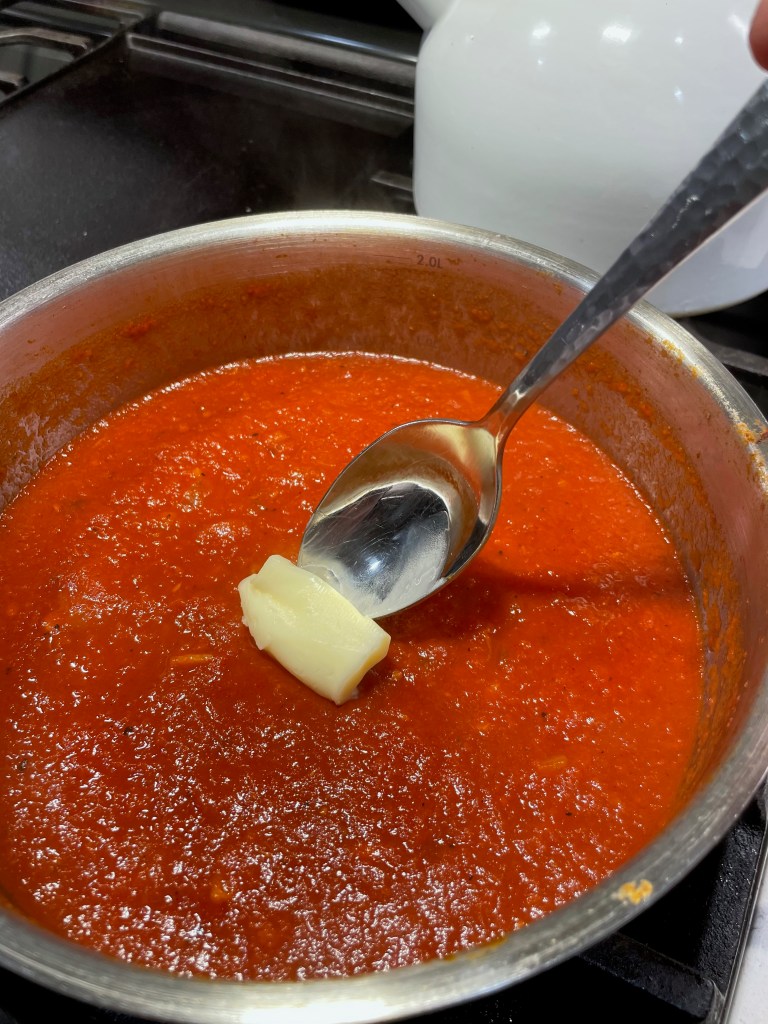
For a rich finishing touch, I melted in about a tablespoon of butter just before serving— borrowing a trick from the playbook of Italian chefs. This may have been the best tomato soup I’ve ever made, and I give credit to the harissa, if only for inspiration. I mentioned earlier that we devoured the whole pot that night. But that’s not quite right. I saved about a quarter cup, which I had in mind for a miniature shakshuka for breakfast the next day, and, no surprise, it was also delicious!
Next time, I’ll make a whole batch of shakshuka with harissa. This was divine!
It's amazing that a few tablespoons of harissa can elevate a classic soup so much, but it really does!
Ingredients
2 Tbsp. extra virgin olive oil
1/2 medium onion, chopped
2 cloves garlic, minced
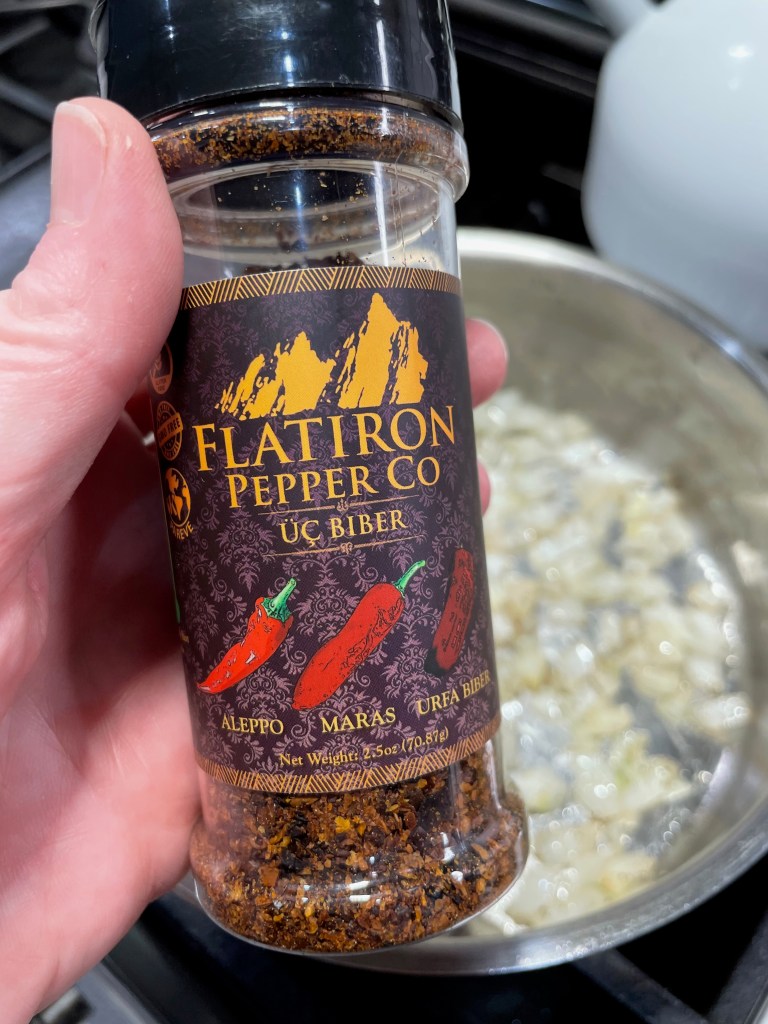
A few shakes red pepper flakes (I used Flatiron Pepper’s Uç Biber variety)
28 oz. can real San Marzano peeled tomatoes, pureed in blender briefly with a pinch of salt
2 Tbsp. Mina brand harissa paste
1/2 tsp. ground cumin
1/2 tsp. ground caraway seed
Salt and pepper for seasoning each layer
1 Tbsp. unsalted butter
My recommendation for adding red pepper flakes, cumin and caraway is based on the mild nature of this particular harissa. If you use another brand with more flavor, adjust additions accordingly.
Directions
Heat a heavy-bottomed pot over medium heat. Swirl in olive oil and sauté onions until slightly softened. Season with salt and pepper to aid in releasing moisture from the onions. Add red pepper flakes and garlic and cook another minute or so.
Pour the puréed tomatoes into the pot with the onions. Add the harissa and stir to combine. Add a pinch of salt and the ground cumin and caraway. Bring the mixture to a low boil, and then reduce heat and simmer for approximately 30 minutes (longer if you have time). Give the soup a taste and adjust seasonings as needed.
Breakfast for dinner is one of my favorite meal categories, and now that I have discovered the joy of shakshuka— the Mediterranean dish that combines vegetables and sauce with gently cooked eggs— there seems a world of possibilities beyond the standard rearrangements of eggs, bacon and pancakes.
Shakshuka, which is very popular in Jewish culture, is typically made with a tomato sauce base and any variety of vegetables. The ingredients are stewed together in one pot, and eggs are simmered on top until set. It’s quick, hearty, simple and inexpensive (depending on egg prices, of course). My husband and I have enjoyed many versions of this dish since I first learned to make it in 2017, including last summer when I made a Ratatouille Shakshuka that was so, so good.
This time, however, my shakshuka is missing the bright red color of tomatoes because I have swapped them out in favor of hearty green ingredients.
Tis the season to be green!
In Spring, it’s only natural that cooks everywhere would begin to lean into the freshness of green vegetables. This past week, I opened my email to find a Green Gumbo, posted by my blog buddy Maylee at Beyond Gumbo. I had never heard of “green gumbo,” made with ham and every leafy green under the sun, but if this is what they’re doing with food in Louisiana, then I’ve got to get down there as soon as possible!
We are still some time away from harvesting the tender vegetables of spring, but consider all the cool-weather vegetables that can carry us until then— broccoli, kale, collards, spinach, leeks and bok choy would all be very easy to incorporate into shakshuka, which is a cook’s choice kind of dish anyway. The main consideration is knowing how long your chosen vegetables need to be cooked so you can plan your time accordingly. The rest is subjective, so find what you like and get cooking!
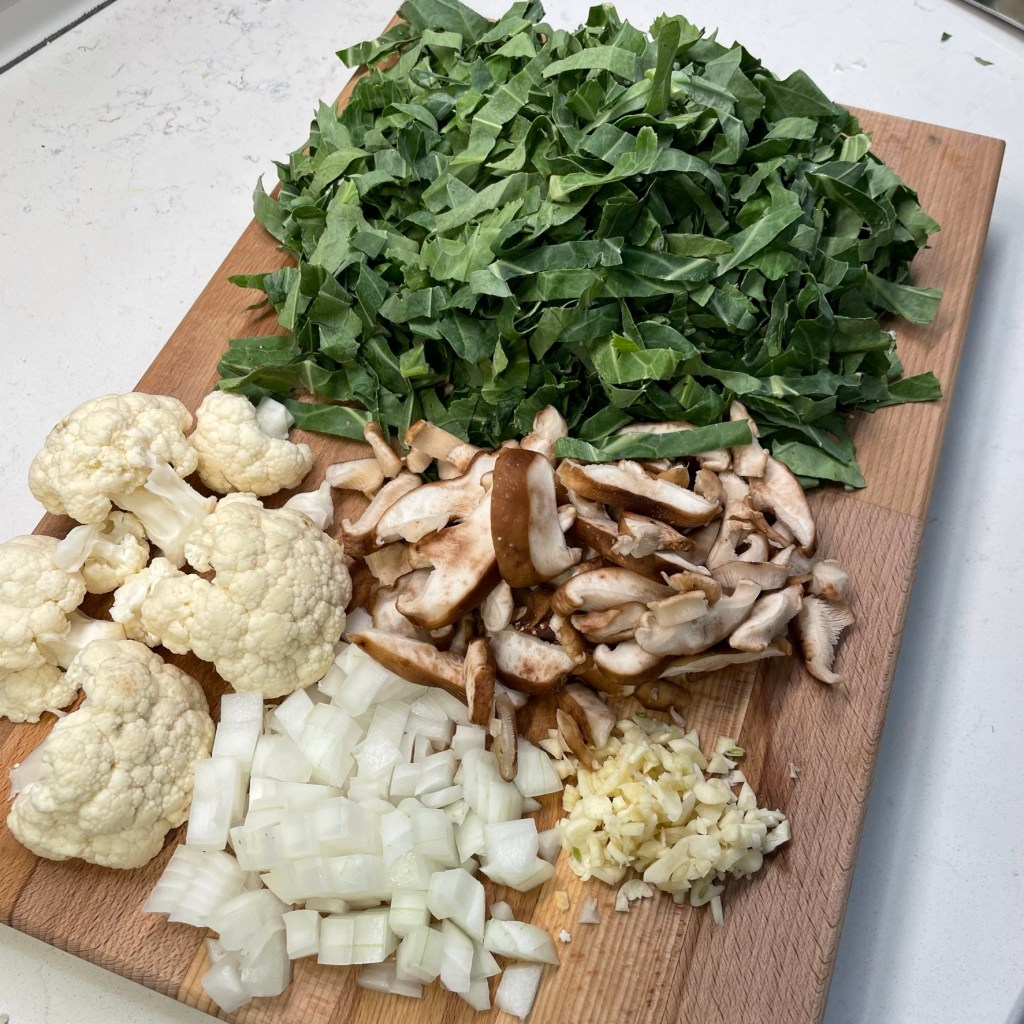
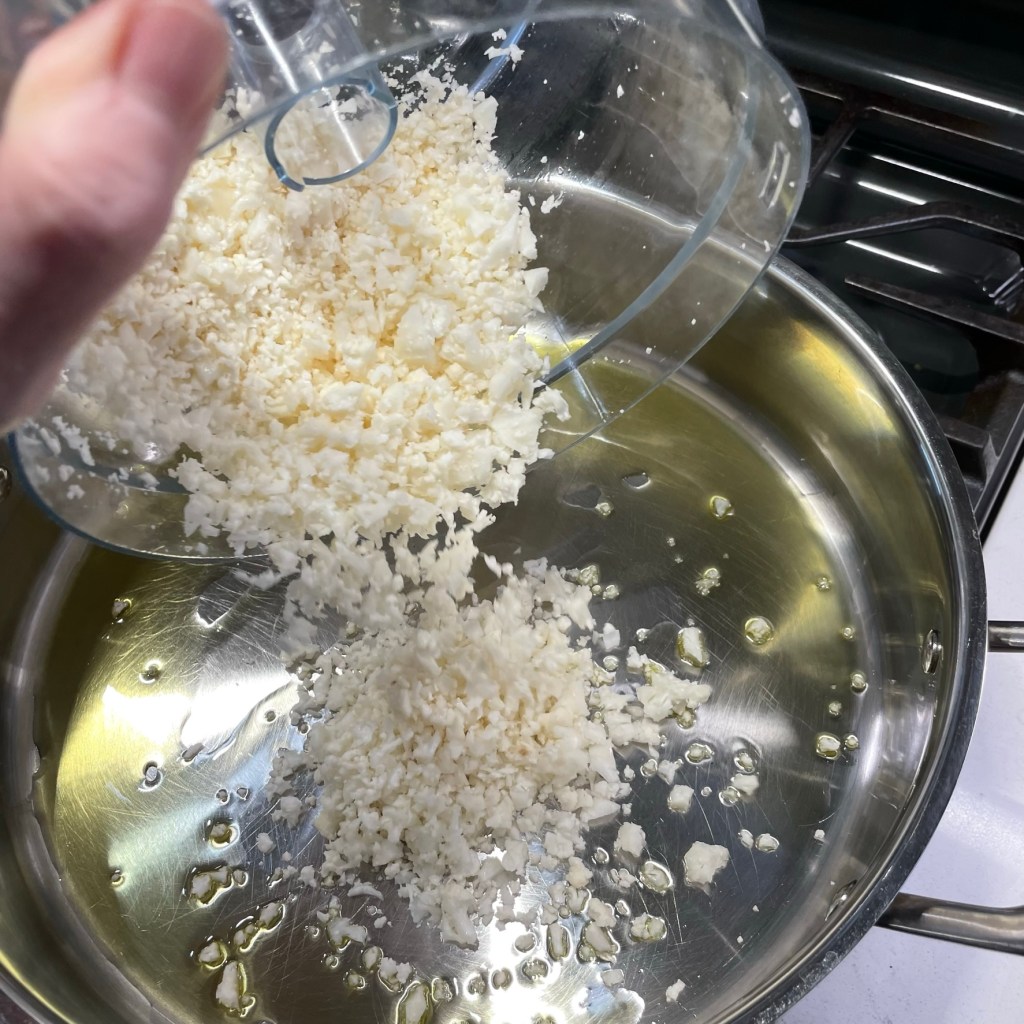
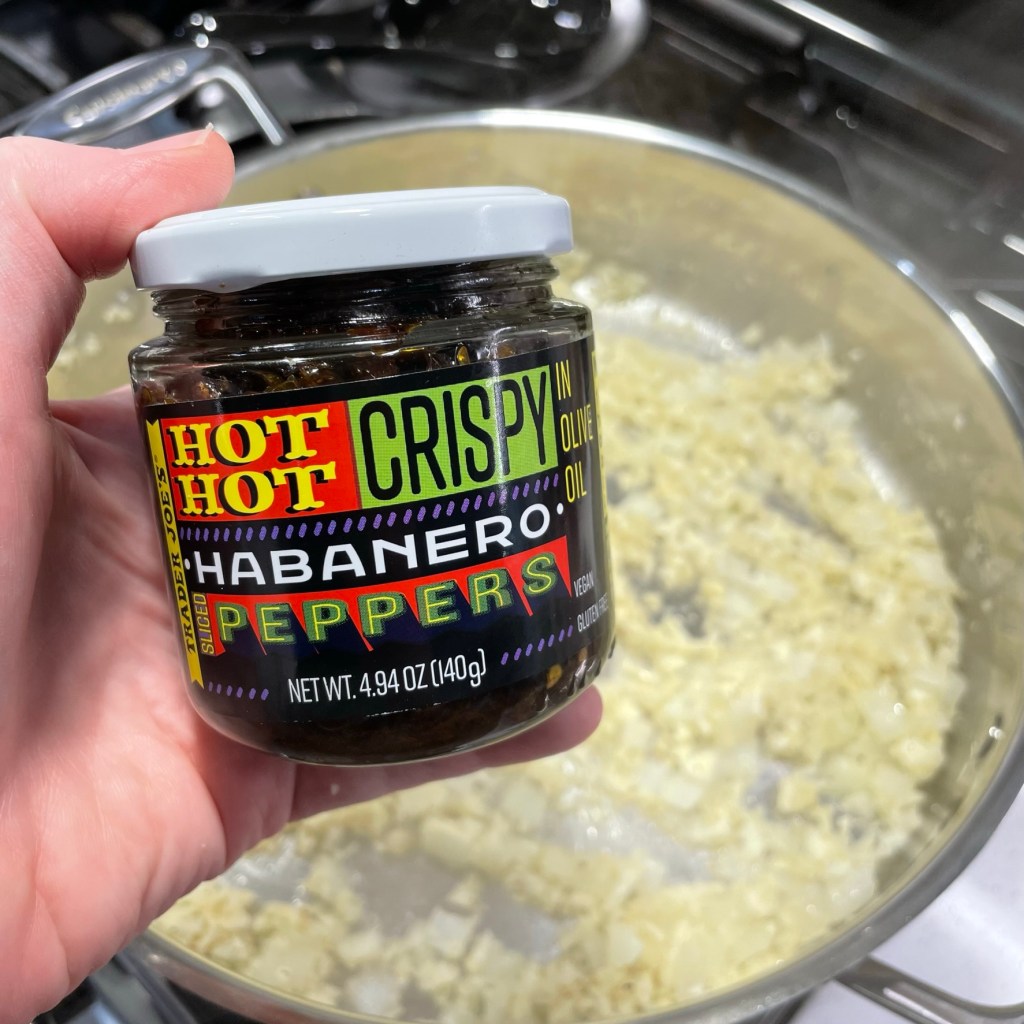
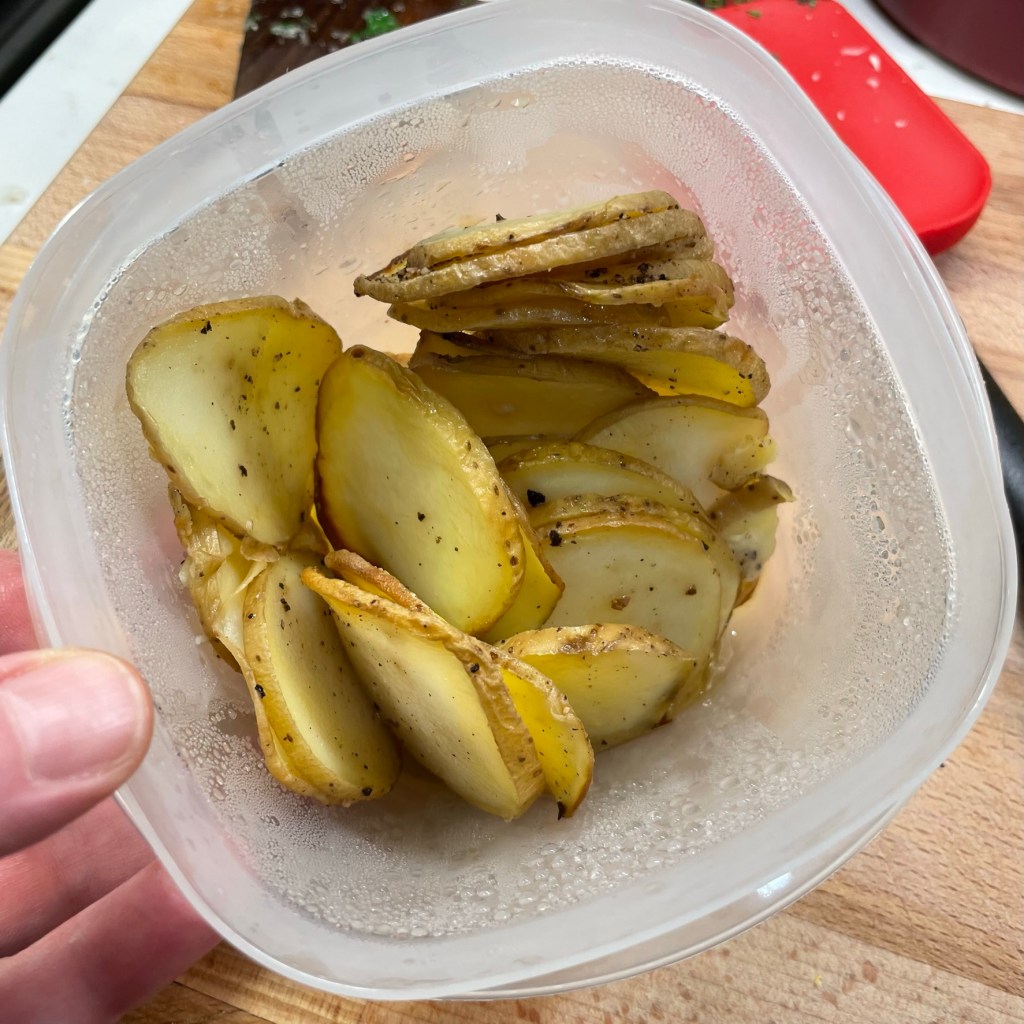
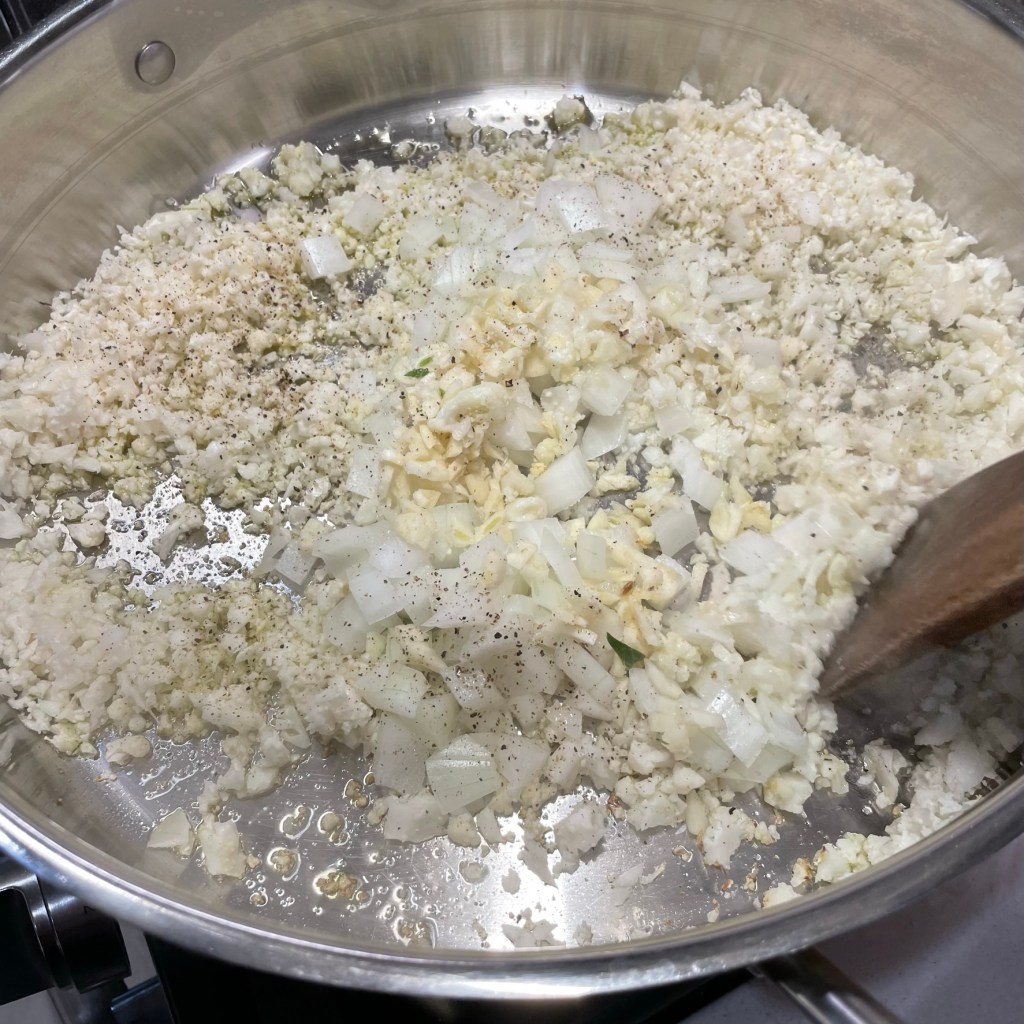
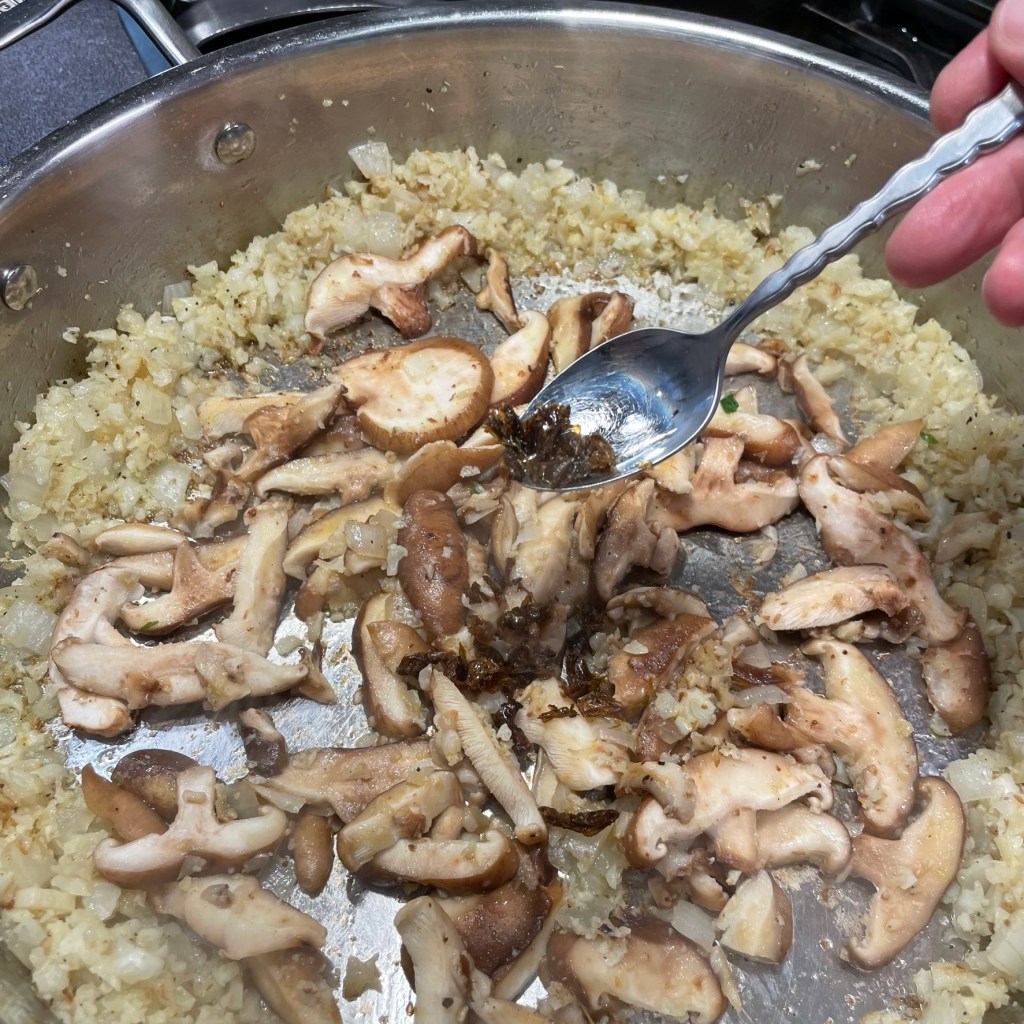
I like a dish to be texturally interesting, so I went with cauliflower, which I pulsed down into “rice” in the food processor, collard greens, also processed into smaller bits for quicker cooking, and shiitake mushrooms for a little bit of chewy, almost-meaty goodness. Onions and garlic, of course, and some sliced cooked potatoes, just because I had a few left over from another meal. They were a good addition. For kicks, I also tucked in a spoonful of the crazy-hot habanero chili crisp that I picked up at Trader Joe’s. They are no longer selling it, but if you bought a jar, you know that it keeps for a long, long time, and it adds a serious punch of spicy flavor to a dish. I’m still looking for ways to use it and it worked here, but you could sub in any other kind of seasoning you like.
An easy approach to shakshuka
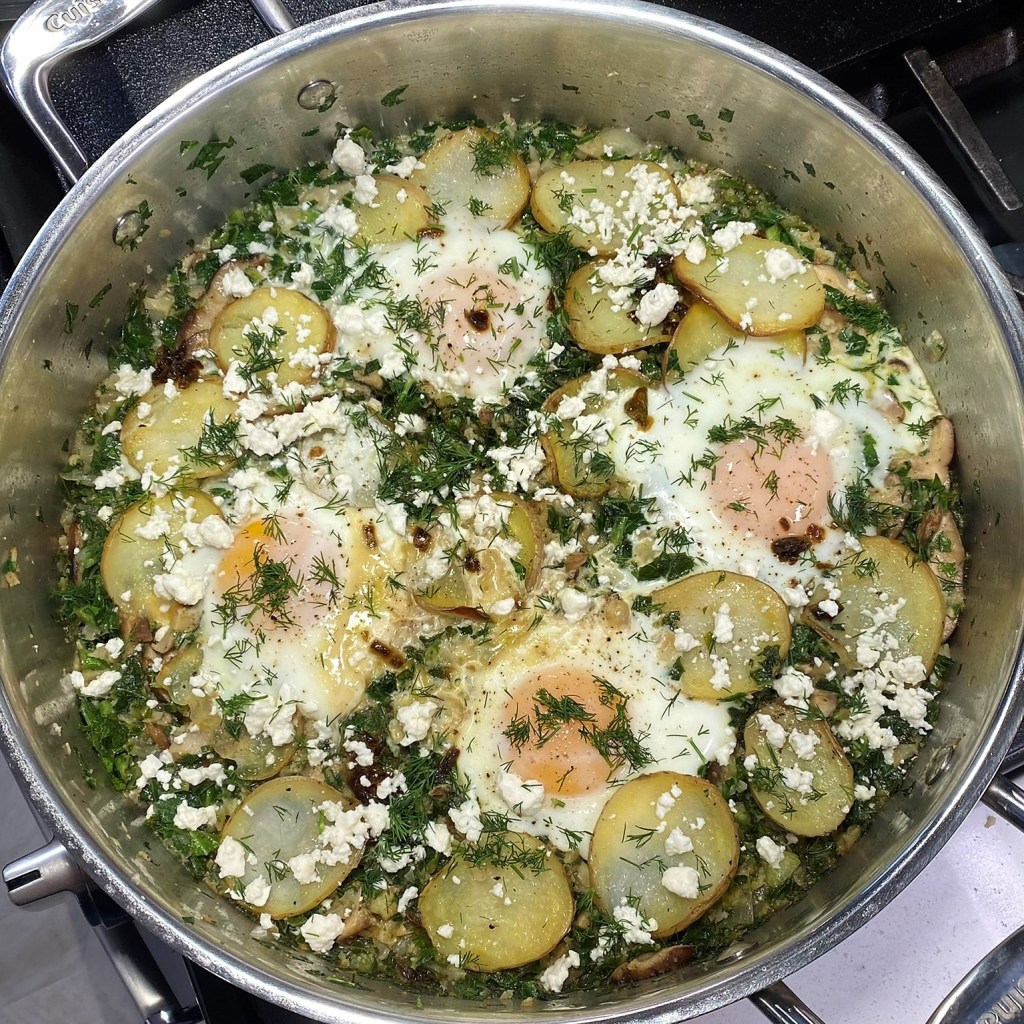
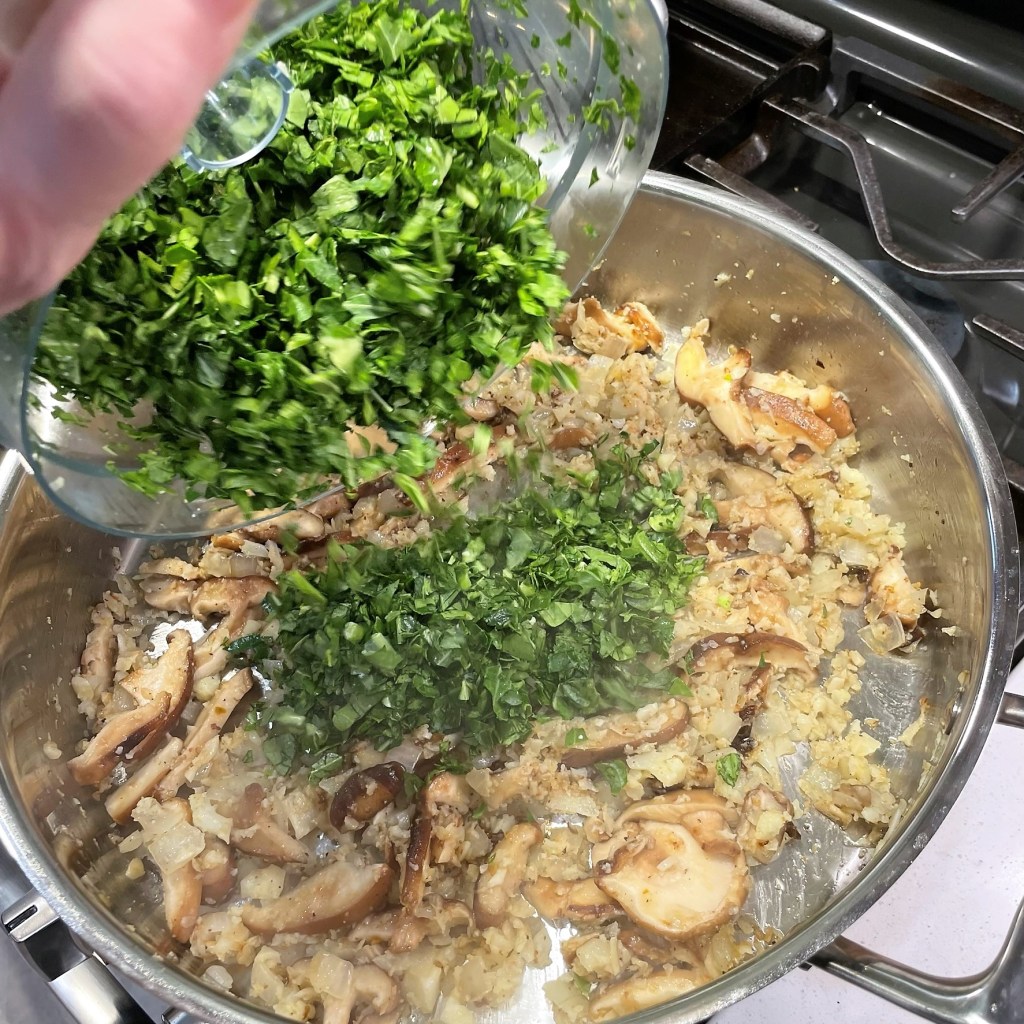
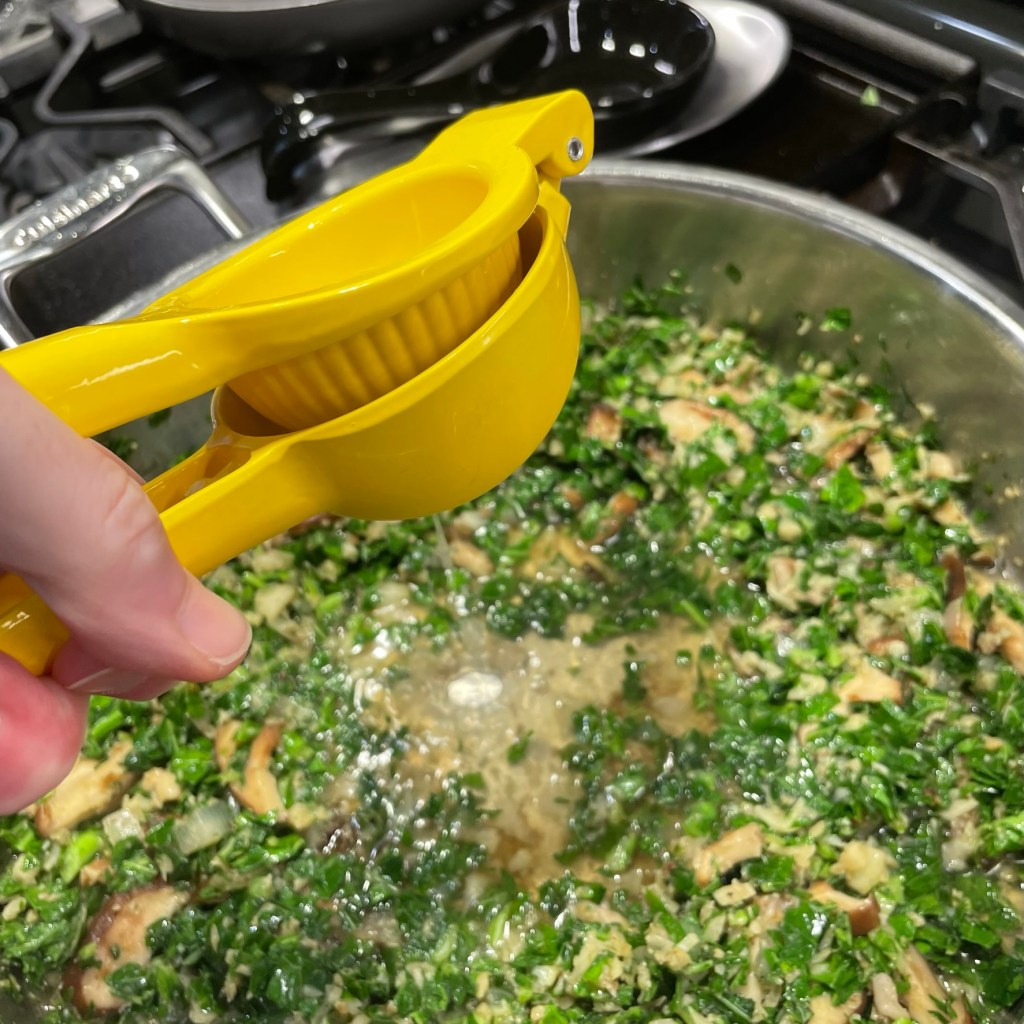
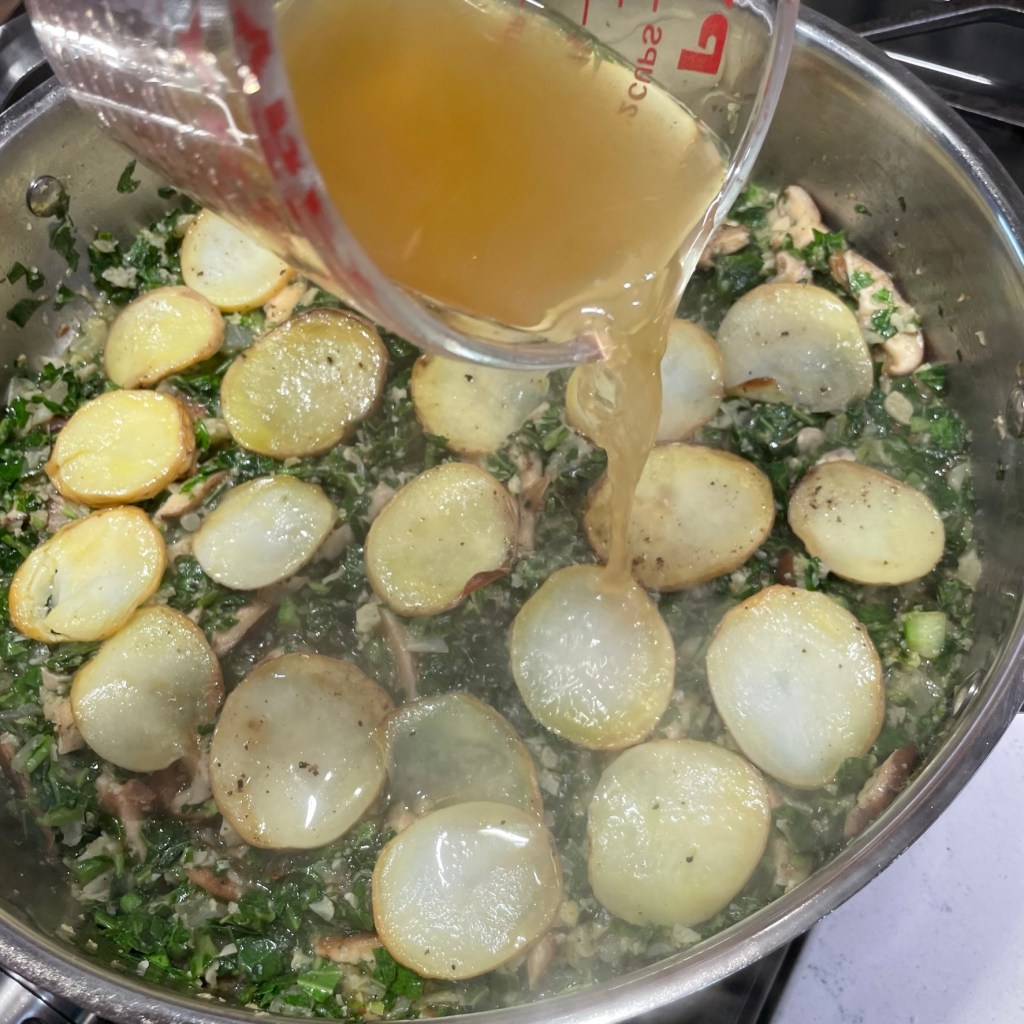
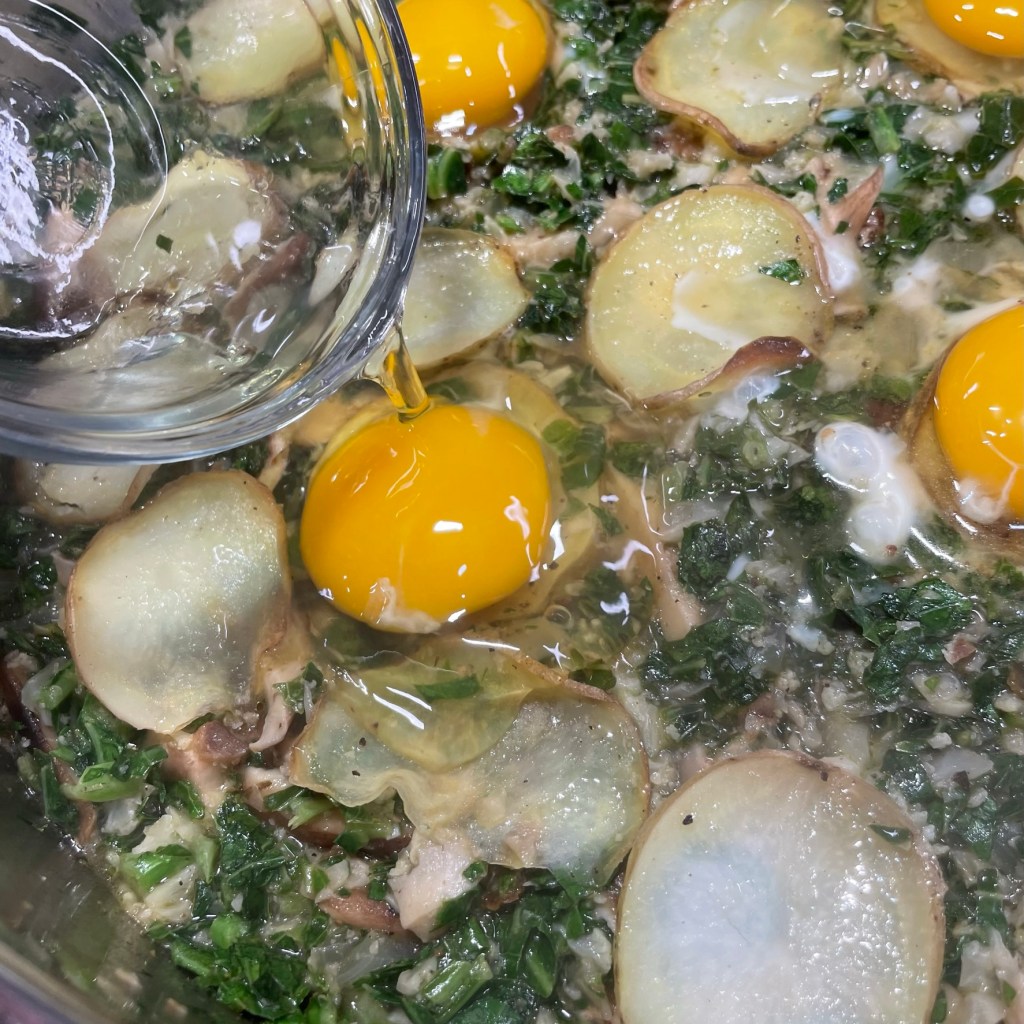
The easiest way to approach shakshuka is to build it in layers, starting with a quick saute of the firmer ingredients and aromatics. Next, I added my mushrooms and chopped collards and steamed the mixture down in a half cup of vegetable broth, plus a squeeze of lemon to balance the slight bitterness of the greens. I spread the potato slices out over the top with a little more broth, and then slipped the eggs into the mixture. This stage of the recipe can be done in the oven, but I have found it simpler and quicker to put a lid on it and keep it stovetop. The eggs cook within a matter of a few minutes, and the meal can be served straight from the pot.
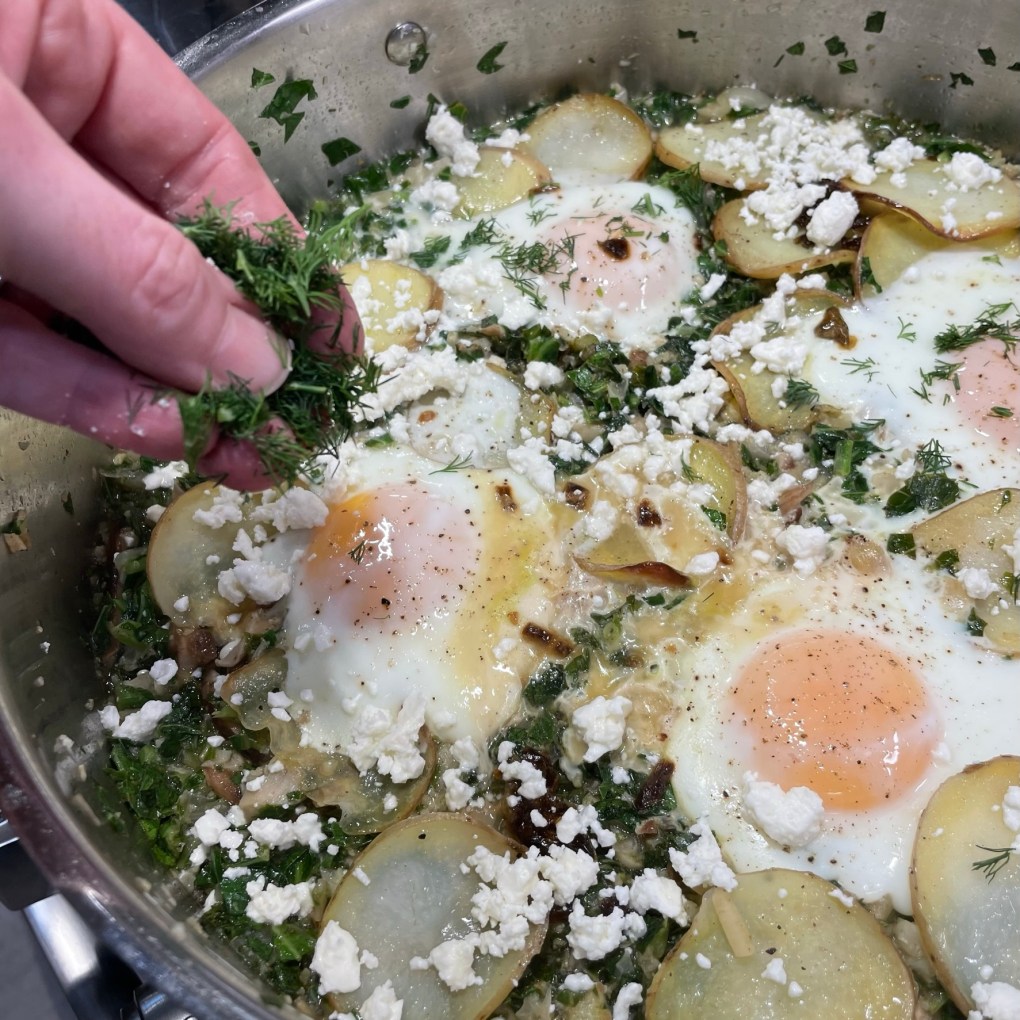
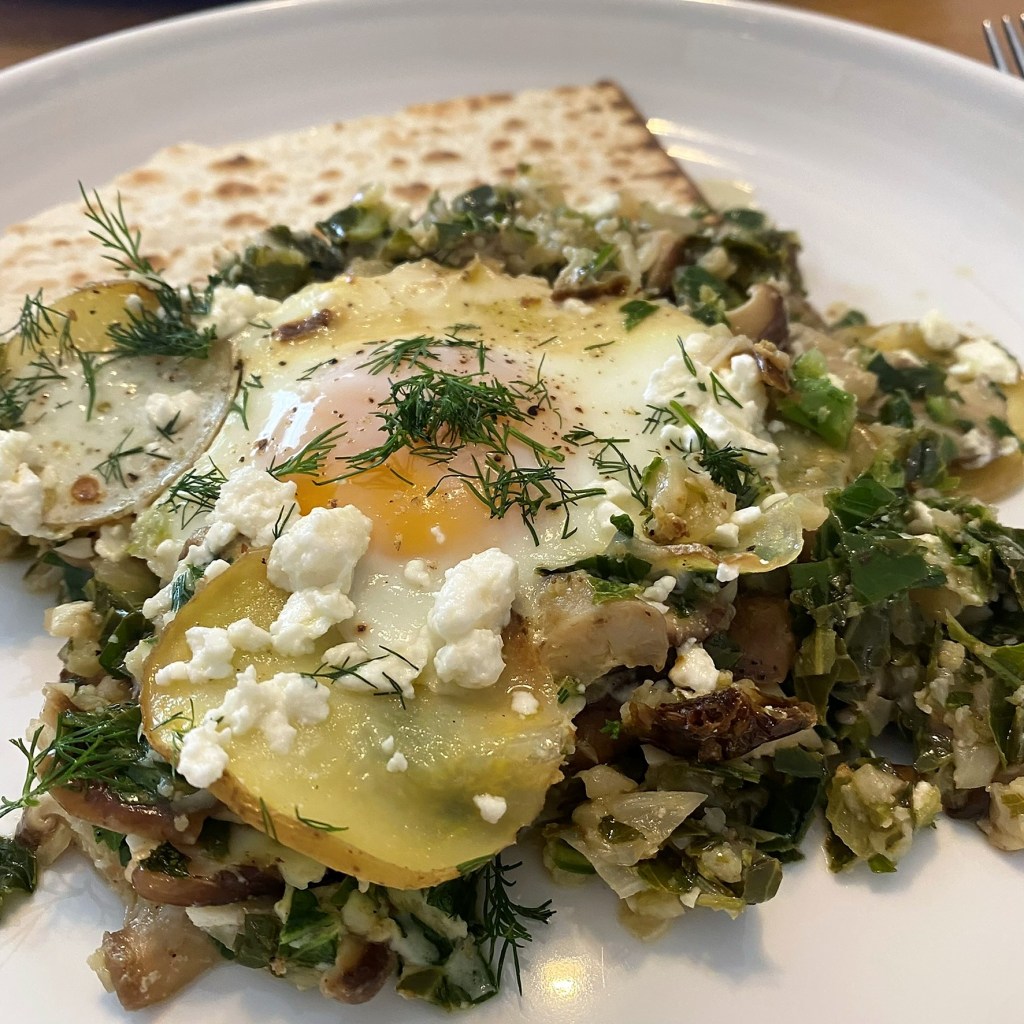
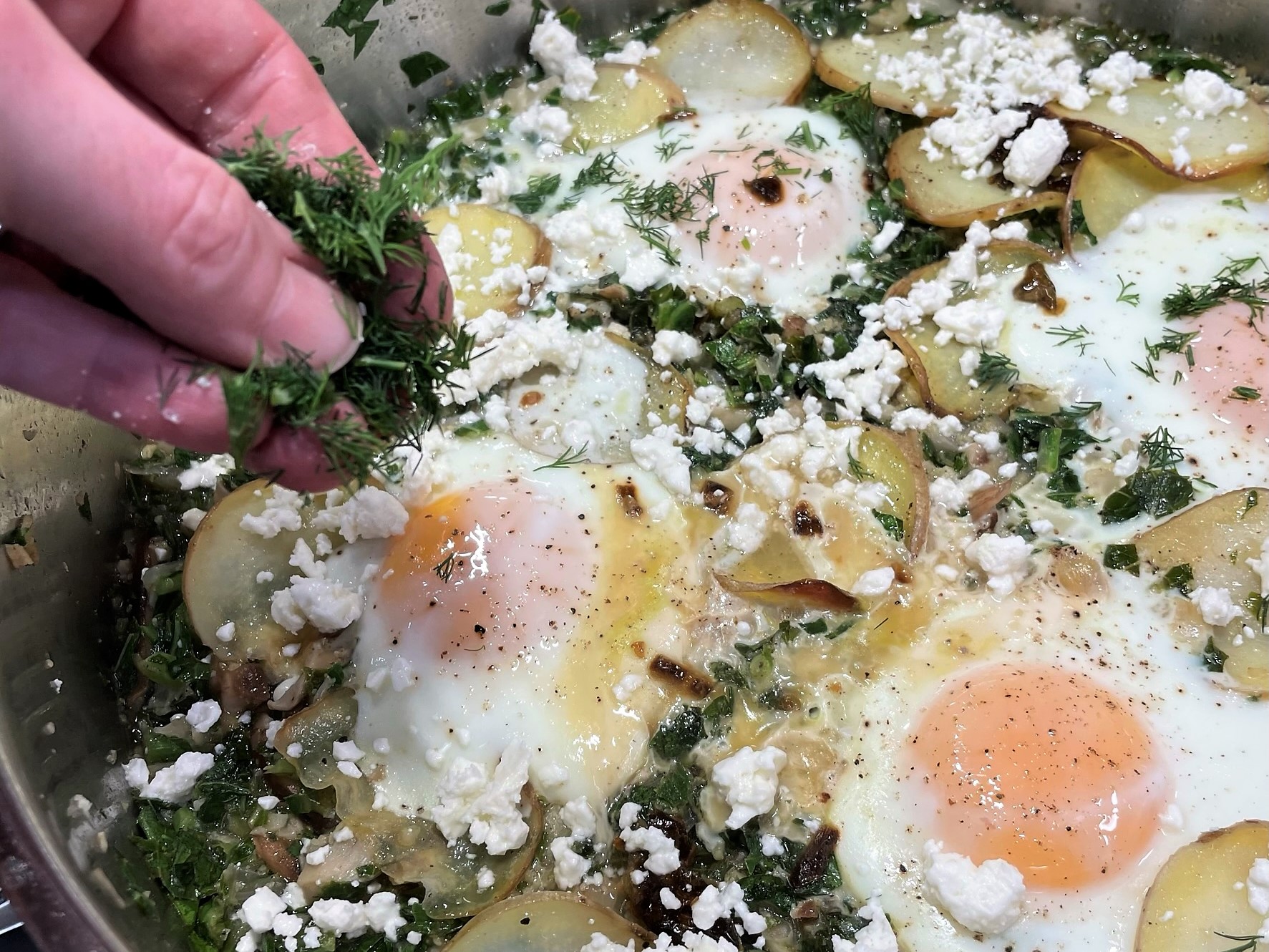
Feta crumbles and fresh chopped dill were a nice final flavor touch to this twist on a classic. We enjoyed our green shakshuka with one of our final pieces of store-bought matzo left over from Passover. We are always so glad to see it go. 😉
What creative twists would you like to see in shakshuka, or which have you already tried? I love reading your comments and I’m always up for a challenge, so please let me know what you think below the printable recipe.
1 tsp. spicy chili crisp (mine was Trader Joe’s habanero)
1 small bunch fresh collard greens, cleaned and rough-chopped
3/4 to 1 cup low-sodium vegetable broth, divided
Juice of 1/2 small lemon
1 cup cooked sliced potatoes
4 large eggs, room temperature
Crumbled feta and fresh dill, optional for serving
This dish can be made with any number of vegetable substitutions. Consider the cooking time for each vegetable you plan to use and add them to the pot accordingly. Chopping the vegetables into very small bits will significantly shorten the cooking time, and is a good way to get this dish on the table in a hurry.
Directions
In the bowl of a food processor, pulse the cauliflower into small bits. Heat oil over medium heat in a wide, heavy-bottomed pot or skillet. Add cauliflower, onions and garlic and season with salt and pepper. When onions and cauliflower are softened, add the mushrooms and chili crisp and saute to cook off some of the moisture.
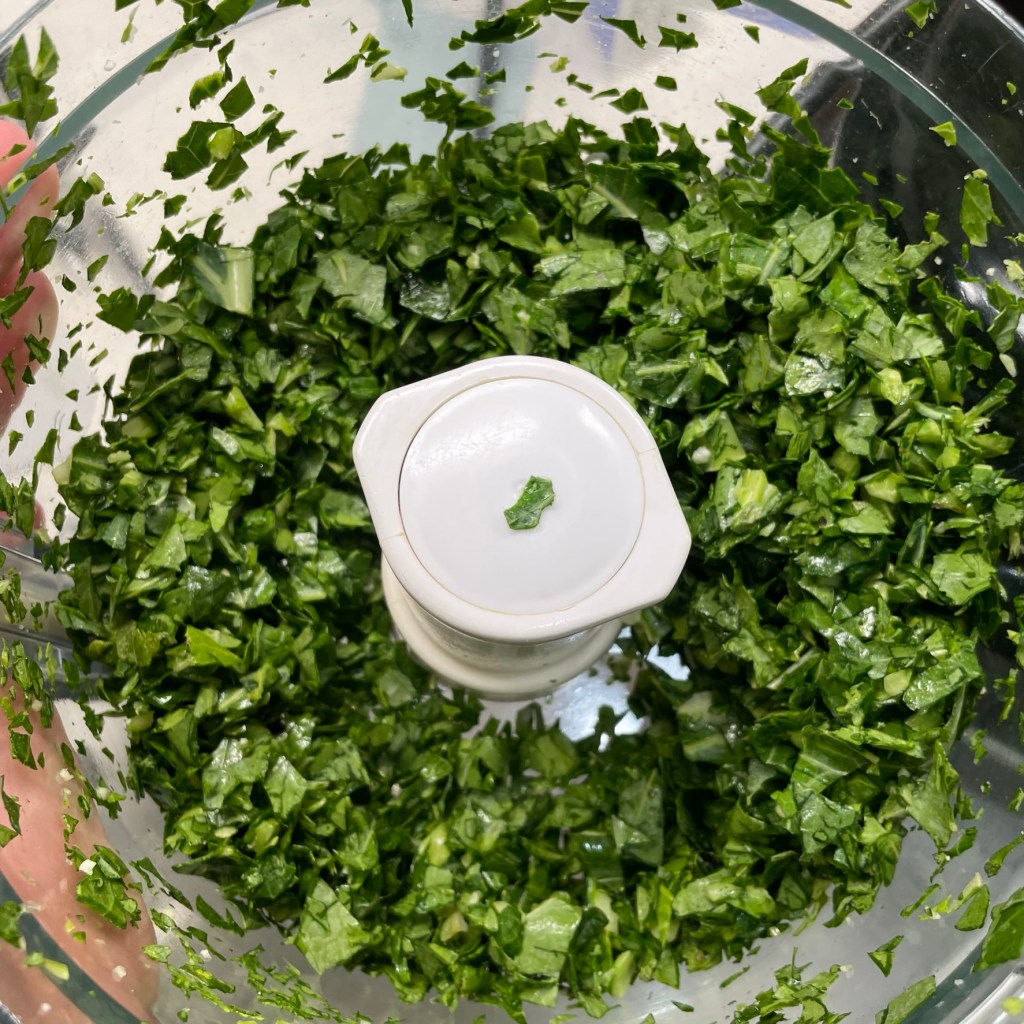
Pulse the collard greens in the food processor to the size of cereal flakes; this will help them cook quickly and will prevent the shakshuka mixture being too chunky. Add greens to the pot and toss to combine. Pour in about 1/2 cup of the broth plus the lemon juice and reduce heat to simmer, until the greens begin to tenderize (about 5 minutes).
Arrange potato slices all over the top of the mixture and pour over additional broth as needed to just cover them. Cover the pot with a lid and steam until potatoes are hot.
Use the back of a large spoon to create four indents in the shakshuka mixture. Carefully slip an egg into each of the indents. Season with salt and pepper and cover the pot with a lid. Steam for about 10 minutes, or until the eggs are set to your liking. Sprinkle with crumbled feta and fresh chopped dill and serve immediately.
How is it possible that the simplest combination of ripe-at-the-same-time ingredients turns out to be such a mouthwatering flavor explosion, no matter how you put it together?
Any way you plate it, this is a great combo!
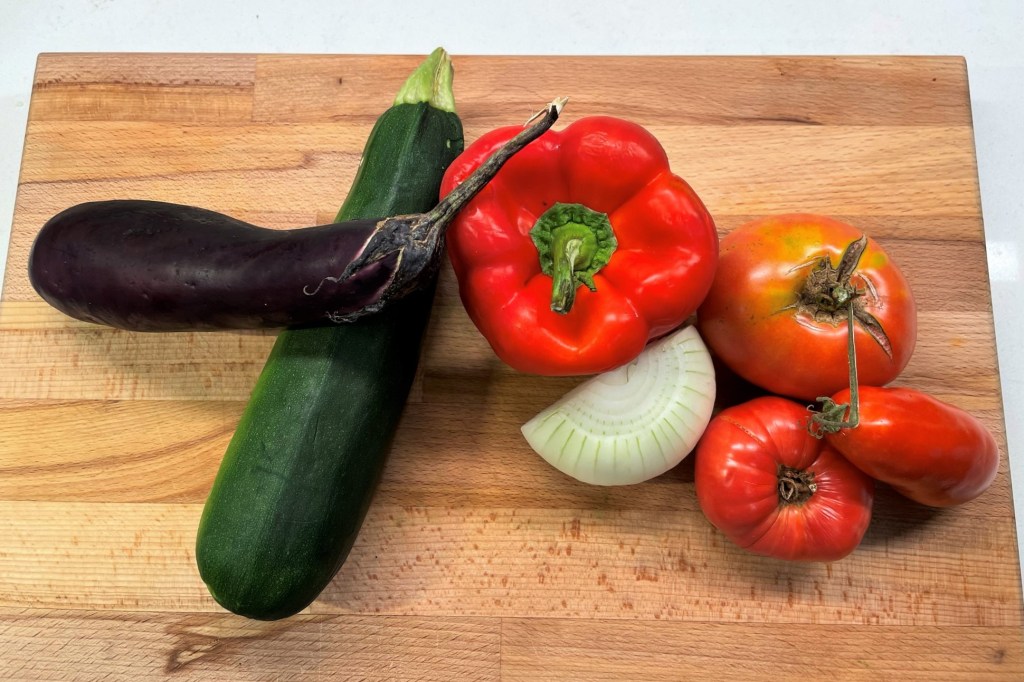
I never get tired of rearranging ratatouille—eggplant, zucchini, red bell pepper, onions and tomatoes—and this time, I married the classic Provencal stew with a classic Jewish breakfast dish, shakshuka.
The first time I heard of shakshuka was during a pre-wedding meeting with Rabbi Mark, who formerly led Temple Emanuel in Winston-Salem, where my then-fiancé, Les, is a member. When our ceremony-planning conversation took a detour toward food and cooking (as literally every conversation with me eventually does), Mark asked if I’d ever made shakshuka, the Middle Eastern dish that is a breakfast staple in many Jewish households. I was stumped because I had never even heard of this dish, let alone made it. But that changed quickly, and it has become an occasional favorite at our house.
Shakshuka is a humble and hearty, tomato-based skillet meal, and a great way to use up whatever other vegetables you have on hand, with eggs simmered right into the sauce. It is very similar to a dish the Italians call “eggs in purgatory.” I especially appreciate how simple it is to pull together when I have had a busy week with little time to plan a menu. Up until now, I have made it only with the spicy flavors that are traditional to the northern African region, where shakshuka originated—cumin, paprika, hot pepper, garlic and oregano.
But this time, I took the concept of shakshuka northward across the Mediterranean Sea, into the south of France, using Herbs de Provence alongside all the beloved vegetables of ratatouille. The result, as you can see, was awesome!
Served with a light sprinkle of Parm-Romano blend cheese at the table.
There was so much nourishing comfort in the stewed vegetables, which simmered long enough to become soft and melded, and the delicate herbs were just right. I’m already craving it again!
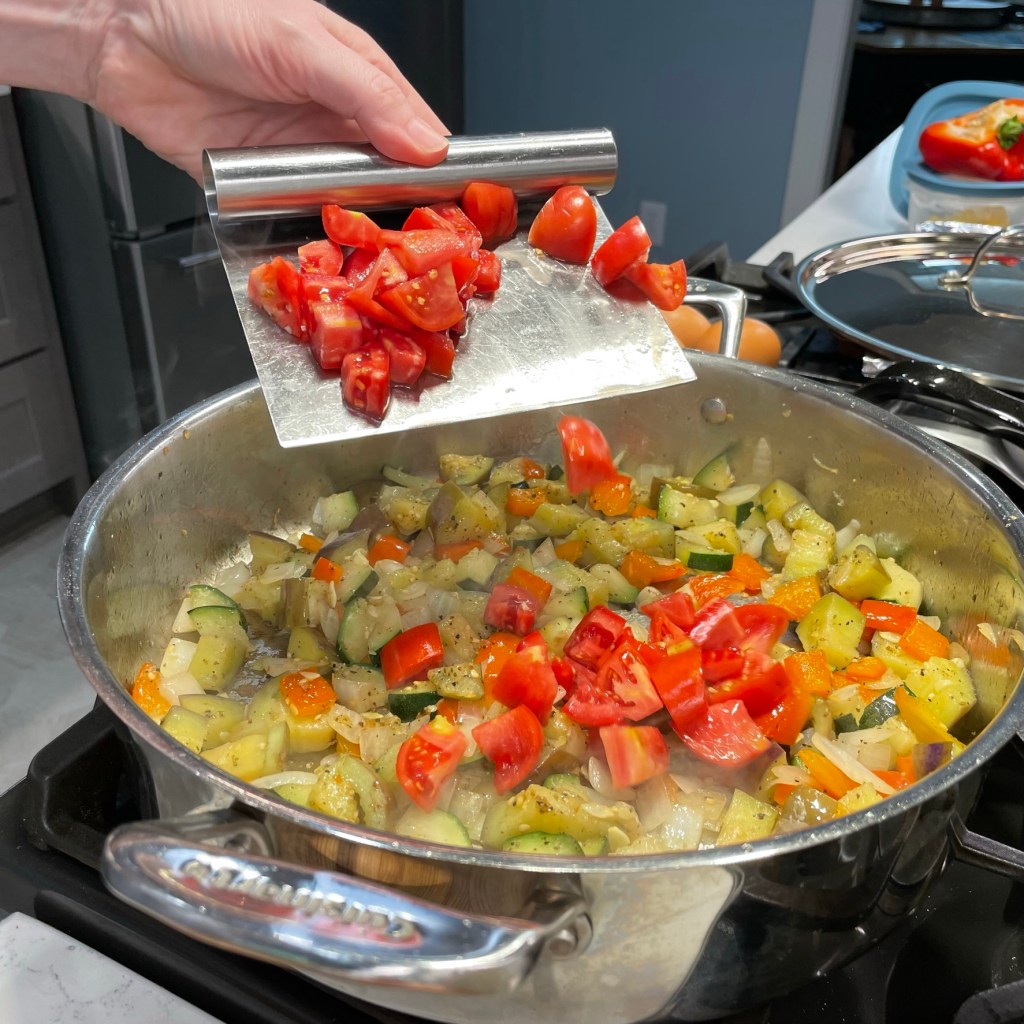
As with most recipes, it’s helpful to have all your ingredients chopped and ready before you begin. For any stew, I like to cut up the vegetables into roughly similar size. This ensures more even cooking, and also makes it possible to get a little bit of everything in each delicious bite. I used a large zucchini, a large “millionaire” eggplant (the slender, Japanese variety), half of a large onion, half of a huge red bell pepper and three fresh, red tomatoes from my garden. In addition to the fresh ingredients, you’ll need a 15 oz. can of tomato sauce, a splash of dry white wine (I used dry French vermouth), a pinch or two of Herbs de Provence, and up to six eggs.
We’re going to need a bigger pot!
That’s a lot of veggies! I made this version of shakshuka in a larger pot than usual because I knew that tossing all of these fresh vegetables in my go-to cast iron would be a serious challenge, and I wanted to avoid making a big mess. The ratatouille also needs to be stirred as it cooks, so be sure your cooking vessel can handle the volume of ingredients as well as the mixing requirement. Choose a pot that has a snug-fitting lid, as this will be important for simmering.
The width of the pot is what matters, so you’ll have plenty of room to place the eggs.
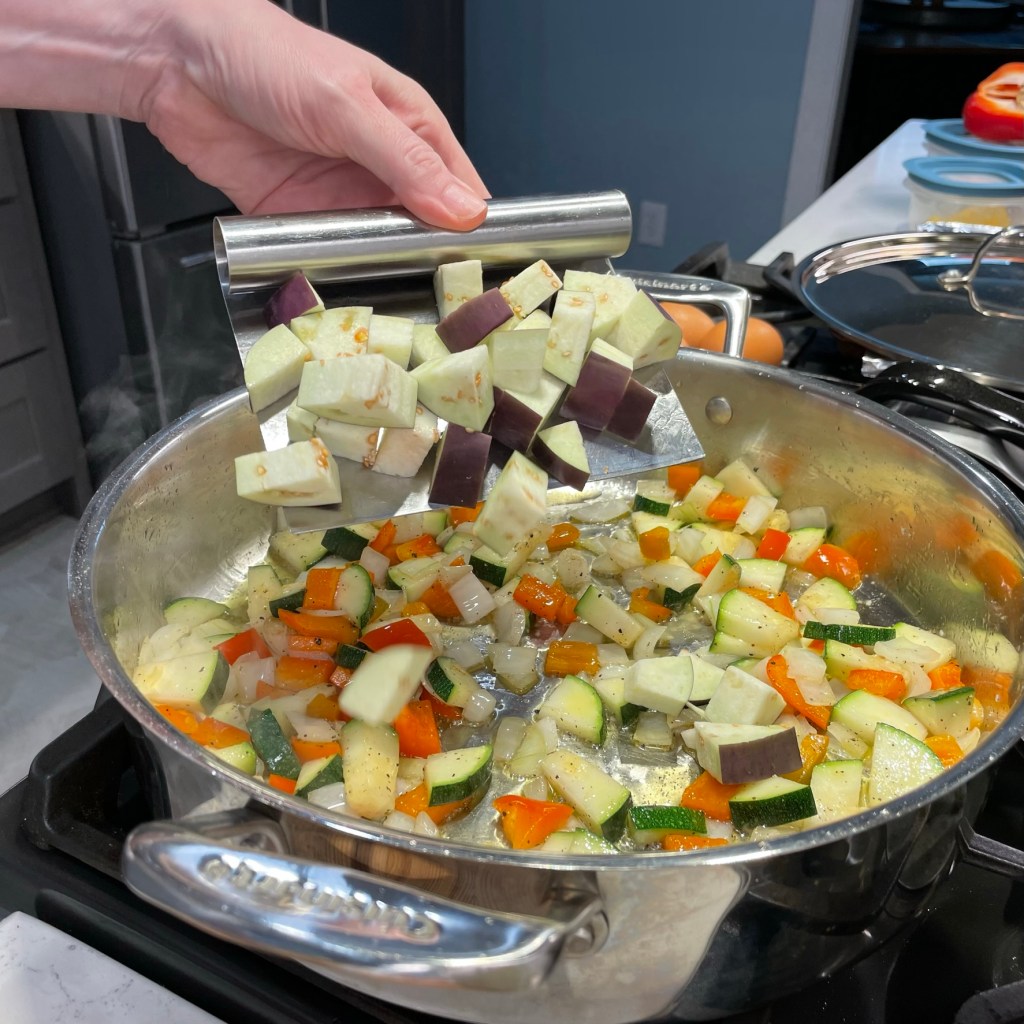
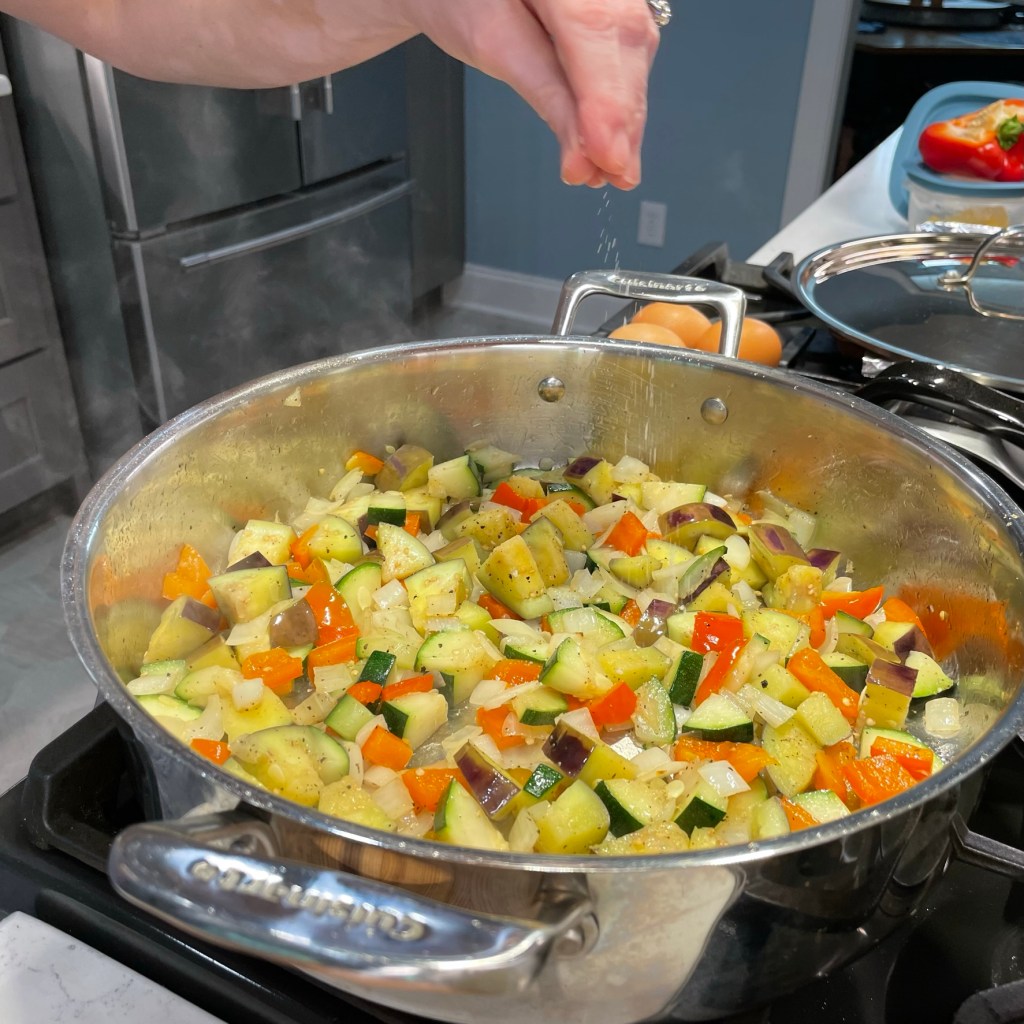
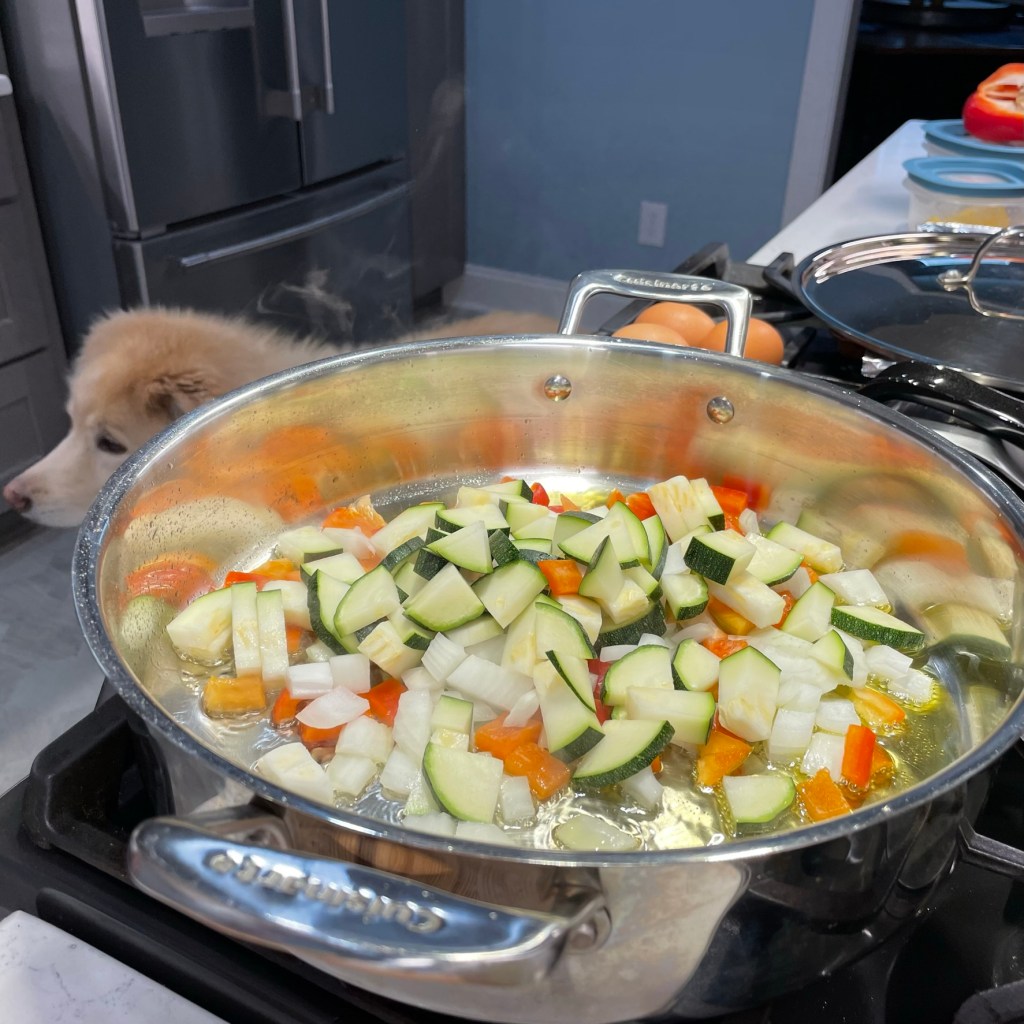
Begin by heating the pan over medium flame. Add oil and start sautéing the vegetables. Eggplant soaks up oil fast so I held that back until the peppers, onions and zucchini had a chance to soften. Remember to season each layer with a pinch of salt and pepper, not only for flavor, but also because salt helps to draw excess moisture from the vegetables as they cook. During this stage, also add a few pinches of Herbs de Provence, a French blend that includes any combination of thyme, savory, rosemary, marjoram and lavender. These are delicate herbs, but they do pack a fragrant punch, so start with a small amount and inch up to taste.
Nilla is always nearby when I’m cooking!There’s no need to peel the eggplant.A pinch of salt helps draw the moisture out of every layer. This is a lovely herb blend that I always use in my ratatouille twists.This stage is all about softening the vegetables and initial seasoning.
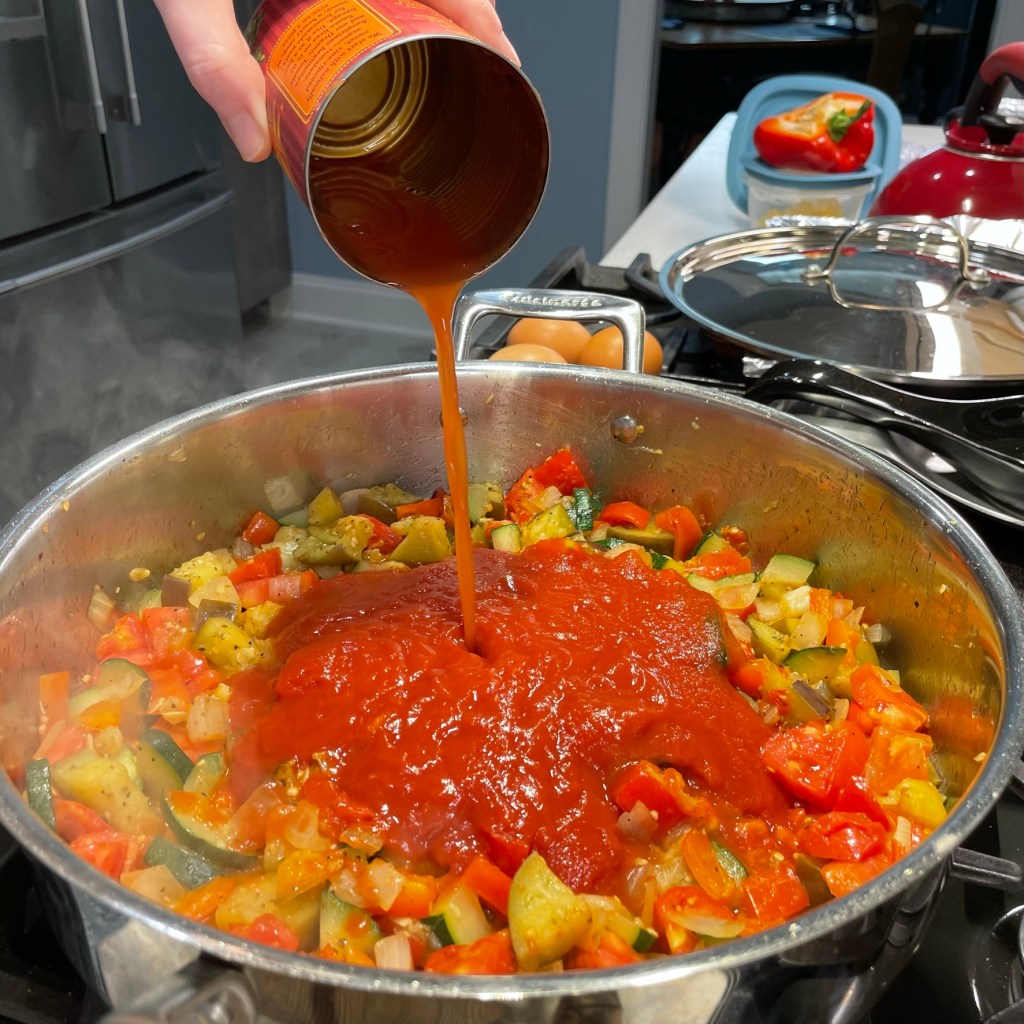
When the vegetables are visibly softened, add the fresh garden tomatoes and give it a stir. Add the tomato sauce and dry white wine. If I have used a canned ingredient, I usually swish the wine around in the empty can to rinse out the last bit of flavor. Another quick pinch of salt and pepper, and then reduce the heat, cover the pan and allow it to simmer for 15 to 20 minutes. The vegetables will continue to soften, melding the flavors together, but the sauce should not reduce too much. While it simmers, take the eggs out of the fridge; they will set in the shakshuka better if they are closer to room temperature.
Three small fresh tomatoes; I didn’t bother peeling them.Be mindful of the sodium in the tomato sauce, and adjust your additions accordingly.Swishing the dry vermouth in the can helped me get every last drop!Put a lid on it and set the table.The tomatoes bring the magic to ratatouille. Cover the pot during simmering so that the sauce doesn’t reduce too much.
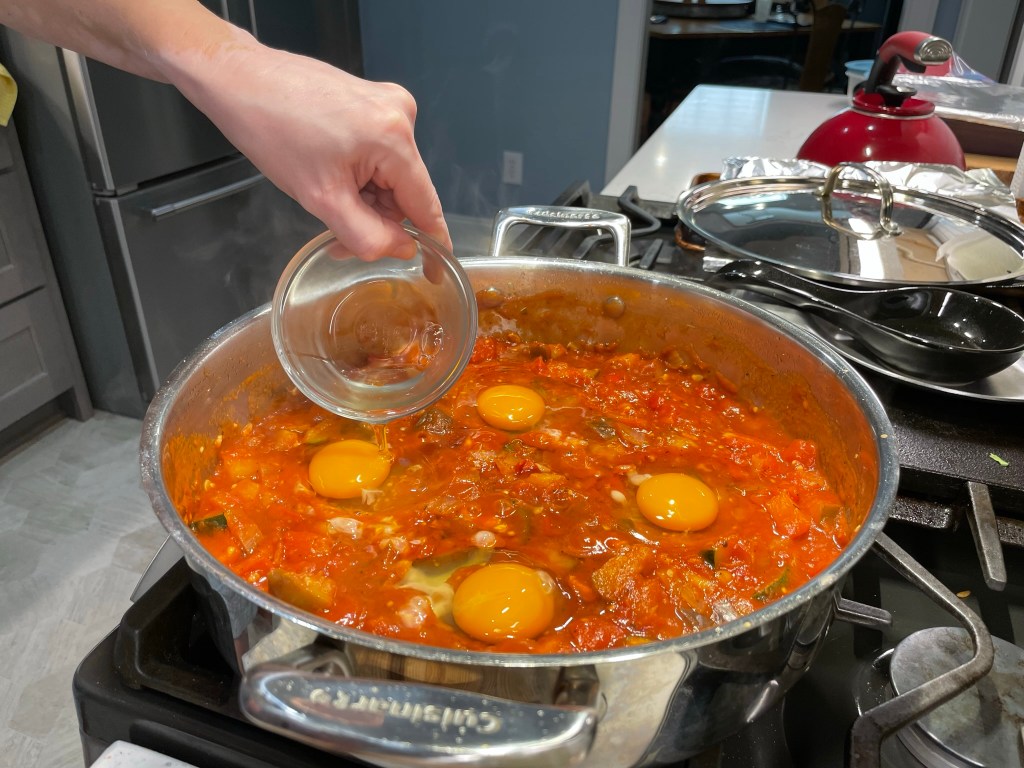
When the ratatouille stew has become very soft, crack each egg into a ramekin dish for easy transfer to the shakshuka. This may seem unnecessary, but trust me when I tell you that it is no fun at all trying to fish out itty-bitty pieces of egg shell that went astray into a big saucy mixture. If anything goes sideways with your cracked eggs, you want it to happen in the ramekin, not in your beautiful recipe!
Give the stew a gentle stir, and then use the back of a large serving spoon to create a slight depression for each egg to rest. This doesn’t have to be perfect, and you only need a spot about 3 inches across for each egg. I had room for six eggs in my large pot, but I only used four because I knew the extras would not warm up well without overcooking. Better to add fresh eggs when you heat up the leftovers.
Cook as many eggs as you plan to serve initially. Make more eggs when you reheat the leftovers.
Slip an egg into each depression and give the shakshuka one final pinch of salt and pepper before covering the pot. Keep the flame set on low and cook for 8 to 10 minutes, until the whites are set but the yolks still have a bit of jiggle to them.
I wish you could smell this! 😋
Scatter fresh, chopped herbs over the dish (I used fresh basil from the garden, but flat-leaf parsley would be nice, too), and serve immediately with a slice of crusty French bread. The best way to serve this dish is to use a wide, somewhat flat spoon to scoop underneath an egg, grabbing as much of the surrounding stew as possible at the same time. Sprinkle on a teaspoon or so of grated Parmesan for a big burst of umami flavor.
Choose a wide, covered pot for making your ratatouille, and prepare your workstation by chopping all vegetables before you begin.
Ingredients
1 large zucchini, trimmed and chopped
1/2 large sweet onion, chopped
1/2 large (or 1 medium) red bell pepper, chopped
1 large Japanese eggplant, chopped (or about 2 cups of alternate variety)
3 Tbsp. extra virgin olive oil
Kosher salt and black pepper to taste
Up to 1 tsp. Herbs de Provence (or Italian seasoning, if preferred)
3 small, fresh tomatoes, chopped
15 oz. can low-sodium tomato sauce
2 Tbsp. dry white wine (or dry vermouth)
6 large eggs* (see recipe note below)
Fresh basil or Italian parsley, for garnish
Note: If you wish, cook only the number of eggs you intend to serve initially. When you use the leftovers, fresh eggs will yield a better result at that time.
Directions
Heat large pan over medium heat. Add olive oil and saute vegetables, beginning with only zucchini, onion and bell pepper. When the first vegetables begin to soften, add the eggplant and saute until all veggies are tender. Season with salt, pepper and Herbs de Provence.
Add fresh tomatoes, tomato sauce and dry wine, stirring to combine evenly. Reduce heat, cover and simmer 15 to 20 minutes. Remove eggs from fridge during the simmer time.
When vegetables are fulley softened, crack each egg into a ramekin cup for easy transfer into the pot. Use the back or a large serving spoon to make a depression for each egg. Slip the eggs into the depressions, season with salt and pepper and cover the pan.
Cook over low heat about 8 minutes, until egg whites are set and yolks are still slightly jiggly. Serve immediately.
Like many of you, I have been filled with agony over Russia’s violent aggression against Ukraine, disgusted by the flippant and cavalier attitudes presented by deniers and Putin sympathizers, and worried that there is little I can do to make a tangible difference in the lives of the Ukrainian people. And yet I feel a kinship with them and want to do something, anything, to show my support.
One of the primary reasons I started Comfort du Jour was to build community with others who, like me, feel deeply connected to the world through food. It is the most universal need of humanity, yet very personal because of the customs and traditions woven into our individual and collective heritage.
Last week, a message from Sam Sifton, the founding editor of New York Times Cooking, arrived in my email inbox and it confirmed that I am not alone in this desire to use food to demonstrate solidarity. Sifton described being inundated with reader requests for recipes for borscht, a traditional sour soup that is common across all of Eastern Europe, most notably with Ukraine. I could not resist digging into the variety of recipes he offered in response to his readers, and this one in particular caught my eye.
Most borscht recipes are based on red beets, and though I adore their earthy flavor, my husband (whose Hungarian mother used to make beet borscht for herself) does not. This version, named “white borscht” by chef and author Gabrielle Hamilton, features potatoes and kielbasa, and seemed more in line with my husband’s palate. The original recipe suggests using real pork kielbasa, but I have substituted a lower fat turkey kielbasa. I also cut the butter amount in half and stirred in a little sour cream at the end rather than the crème fraiche suggested by the recipe’s author.
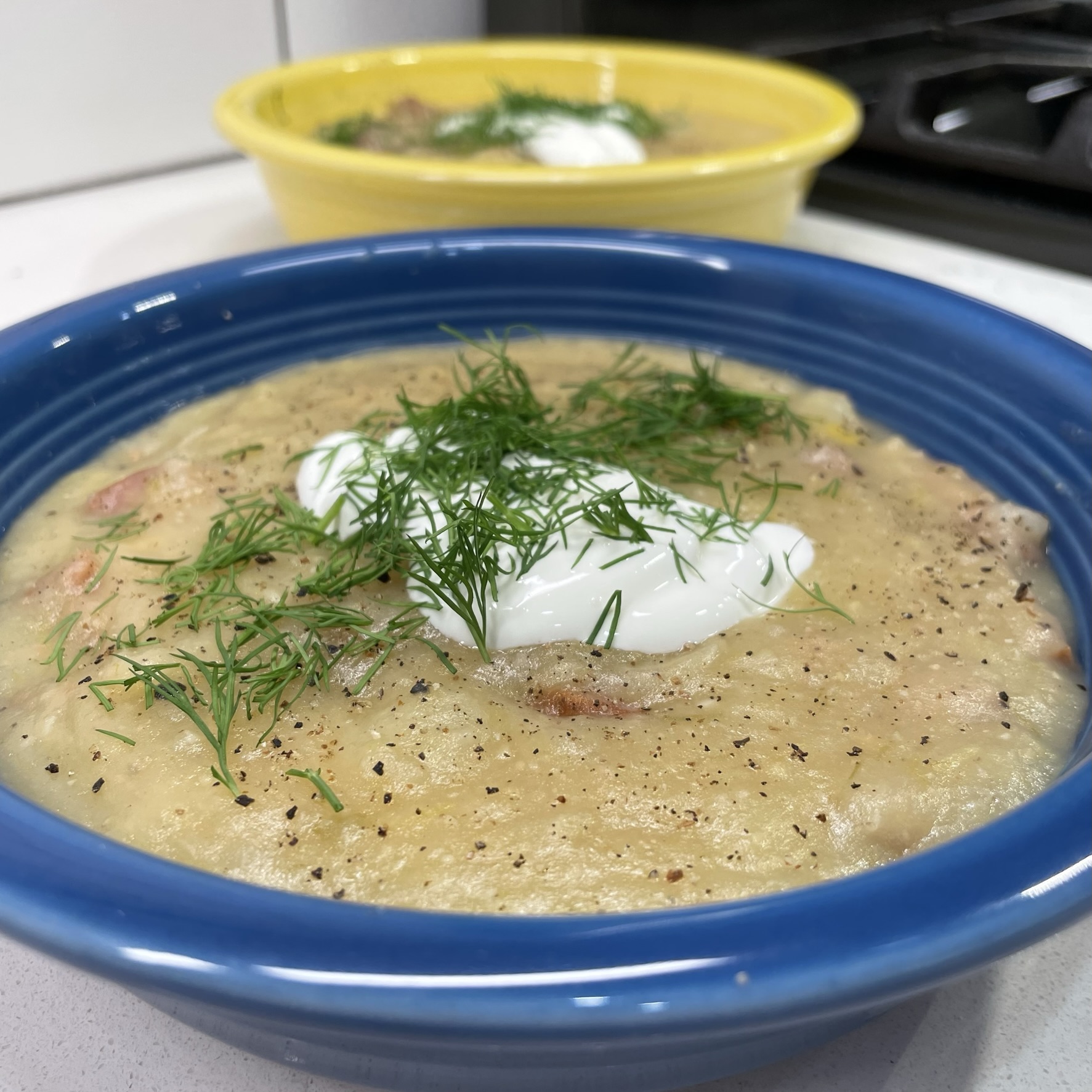
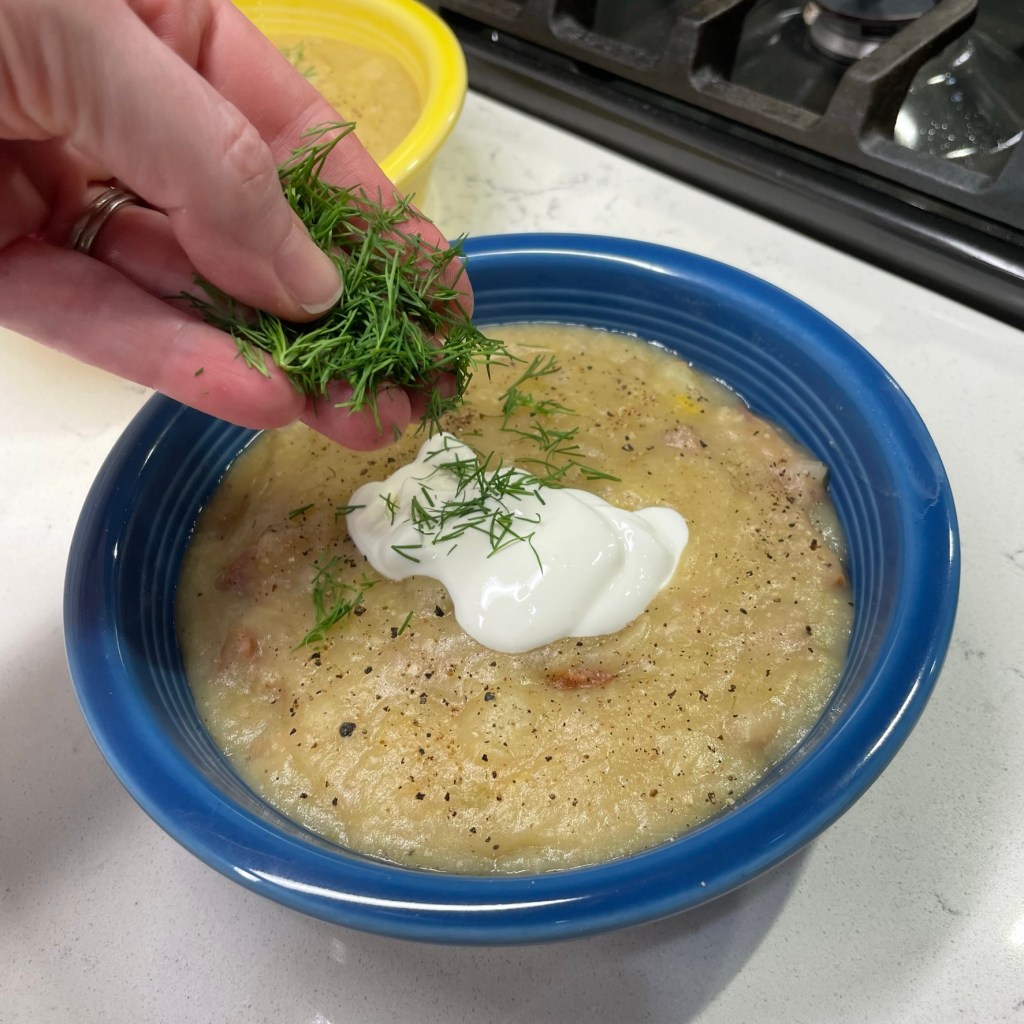
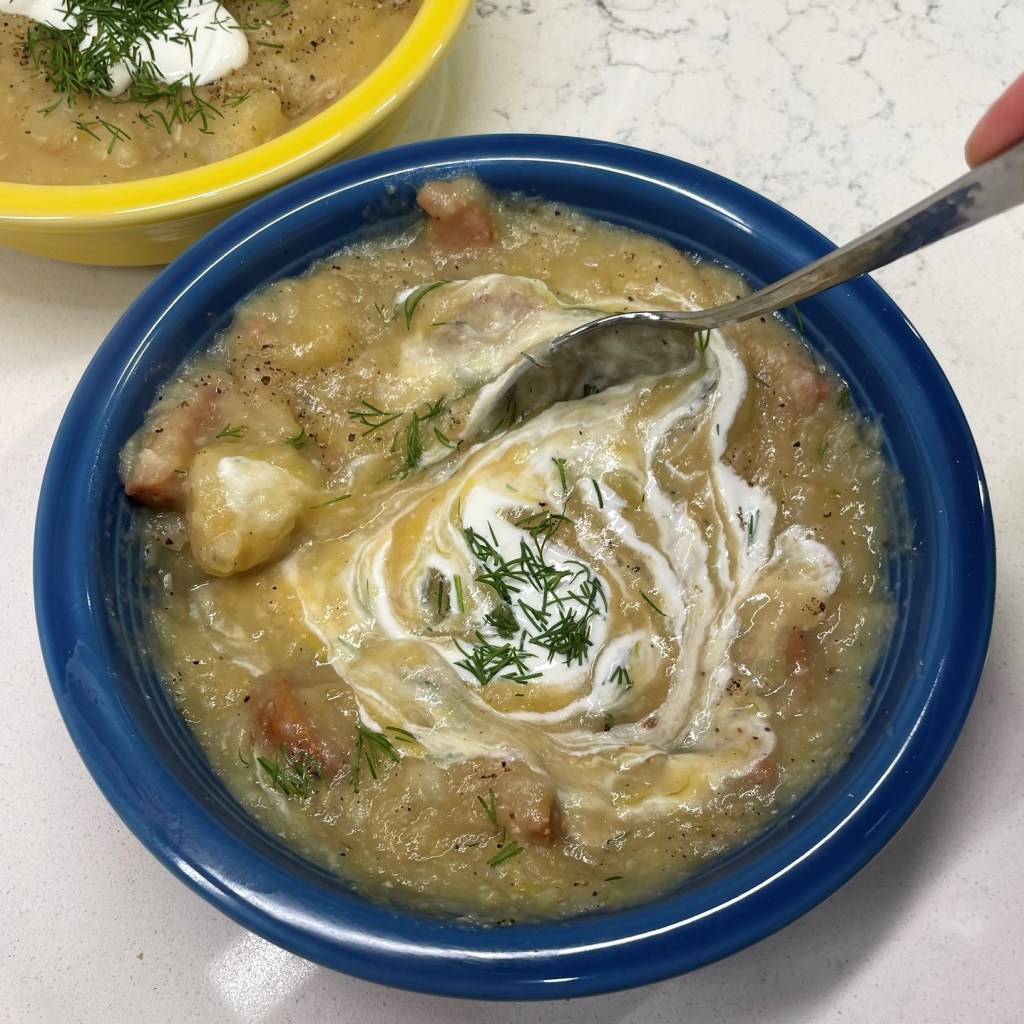
The sour cream and dill add a touch of freshness to this hearty, humble soup.
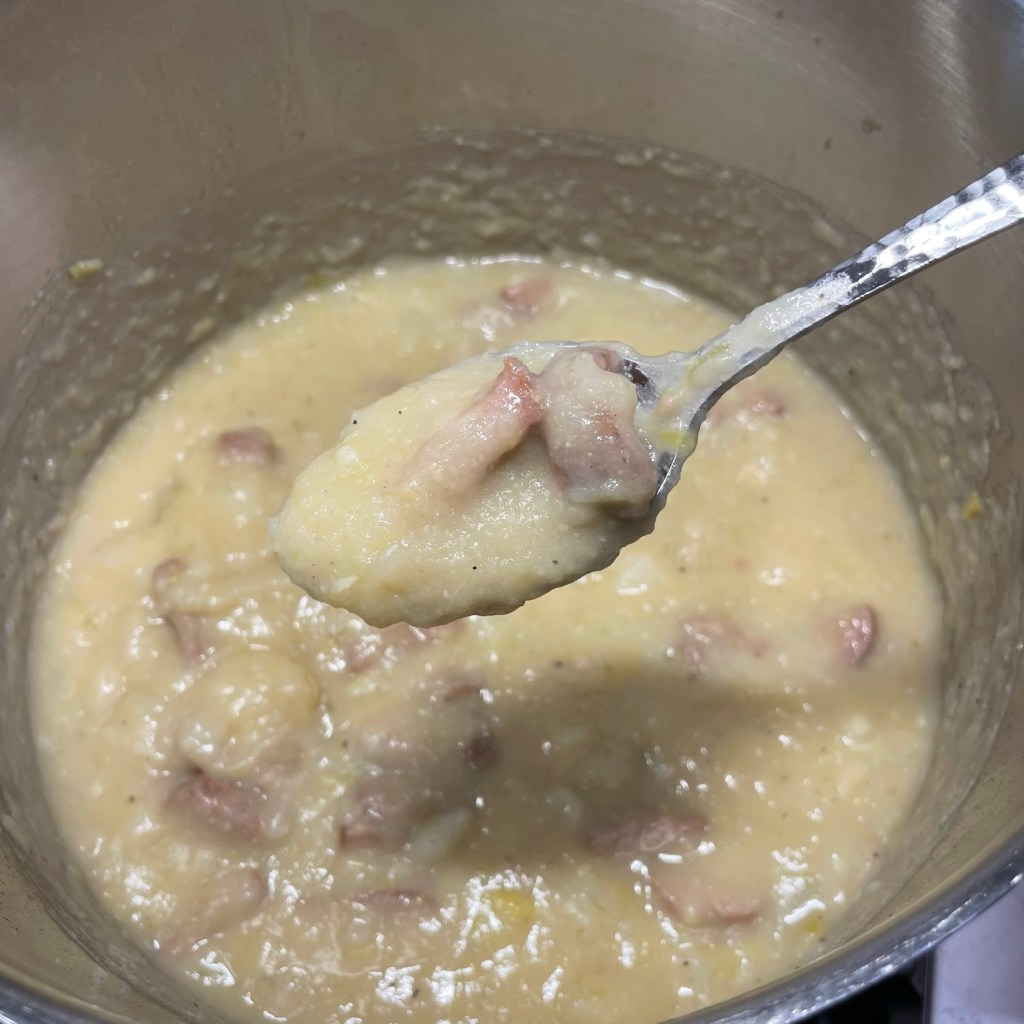
As always, my exploration into other cultures’ cuisine has taught me some lessons, and one thing about this soup surprised me. I have long assumed that Eastern European soups are “sour” because of fermentation or added vinegar (and sometimes they are), but this soup is both soured and thickened with a hefty chunk of sourdough bread, which I always happen to have on hand. This method of soaking and pureeing the bread was a genius move by the author, as it gave the soup a sturdy, almost creamy, texture, as well as a distinctive sour flavor. Always more to learn in the world of food, isn’t there?
My only regret is that I cannot make an enormous vessel of this soup to feed and comfort all of Ukraine, but I hope that somehow, sharing this experience will ripple across time and space to ensure the courageous people of that nation that they do not stand alone. 🇺🇦
Note: The original recipe linked above is only available to paid subscribers of New York Times Cooking (which I am), but my adaptation is very close to the original, except for the aforementioned substitutions and the fact that I halved the recipe for our family of two.
Ingredients
1 lb. smoked turkey kielbasa, cut into three or four pieces
6 cups filtered water
2 dried bay leaves
4 Tbsp. salted butter, divided
1 medium yellow onion, chopped
3 cloves garlic, smashed and minced
1 large leek, cleaned and cut into thin half-moon slices
Kosher salt and about 1 tsp. ground black pepper
A large piece of dense sourdough bread*, crusts trimmed (see notes)
1 1/2 lbs. russet potatoes, peeled
About 1 cup chicken or vegetable broth*
Sour cream and fresh dill for serving
*Notes
Note that real sourdough bread is made from a sourdough starter. Some grocery bakeries take a shortcut that embellishes yeast bread with citric acid, and it is not the same. If you don’t have sourdough bread, consider picking up a loaf from an authentic bakery or use a (seedless) rye. I confess that the sourdough loaf I had on hand was dotted with pumpkin seeds, but after pureeing, this did not have a bad effect on the finished borscht.
The recipe that inspired me did not call for broth, other than the one created by simmering the kielbasa, but in my first-attempt jitters, I accidentally simmered my soup longer than I should have and needed more liquid to keep it from becoming mashed potatoes. It isn’t a bad idea to have some broth at the ready for this purpose. I used a version of vegetable broth called “No-Chicken” broth, and it was perfect for making up the difference in liquid without affecting flavor.
Instructions
The broth develops when you simmer the kielbasa in water. Add a couple of bay leaves for extra flavor.
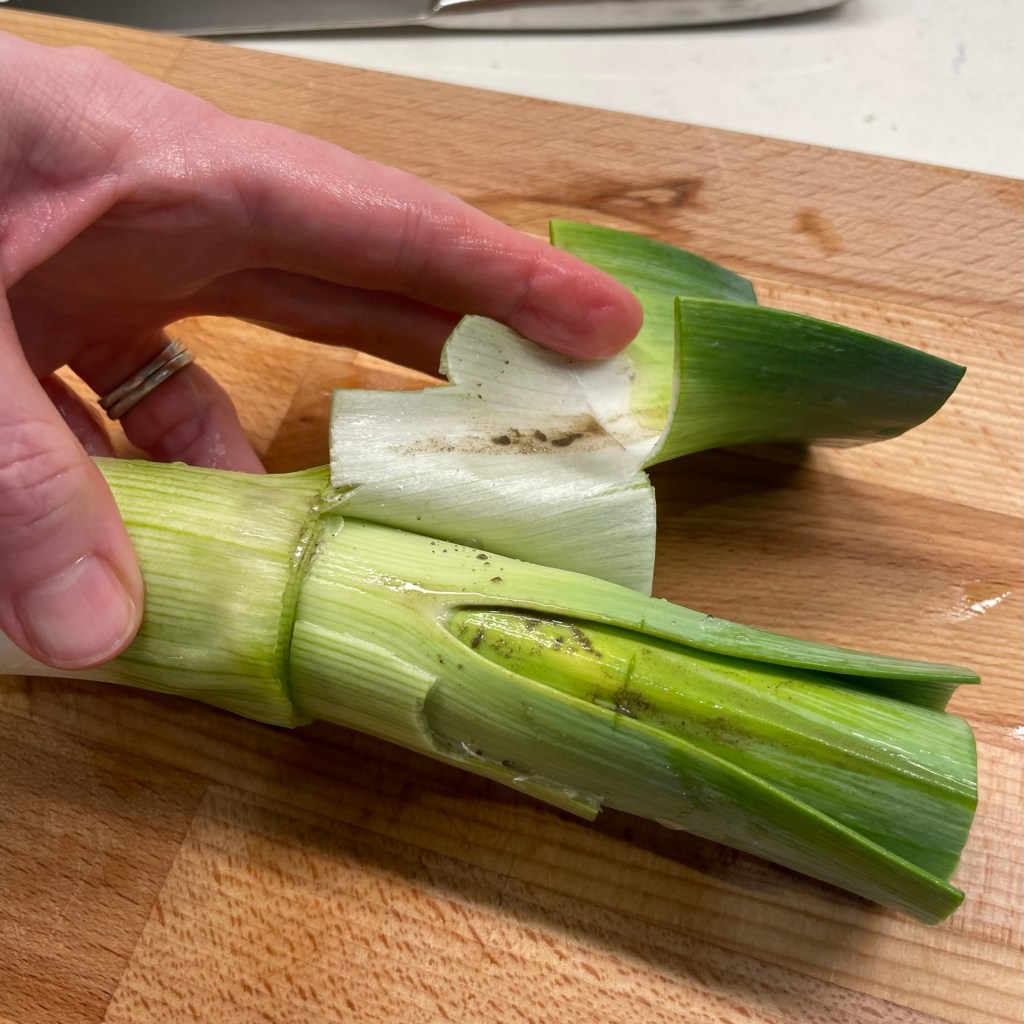
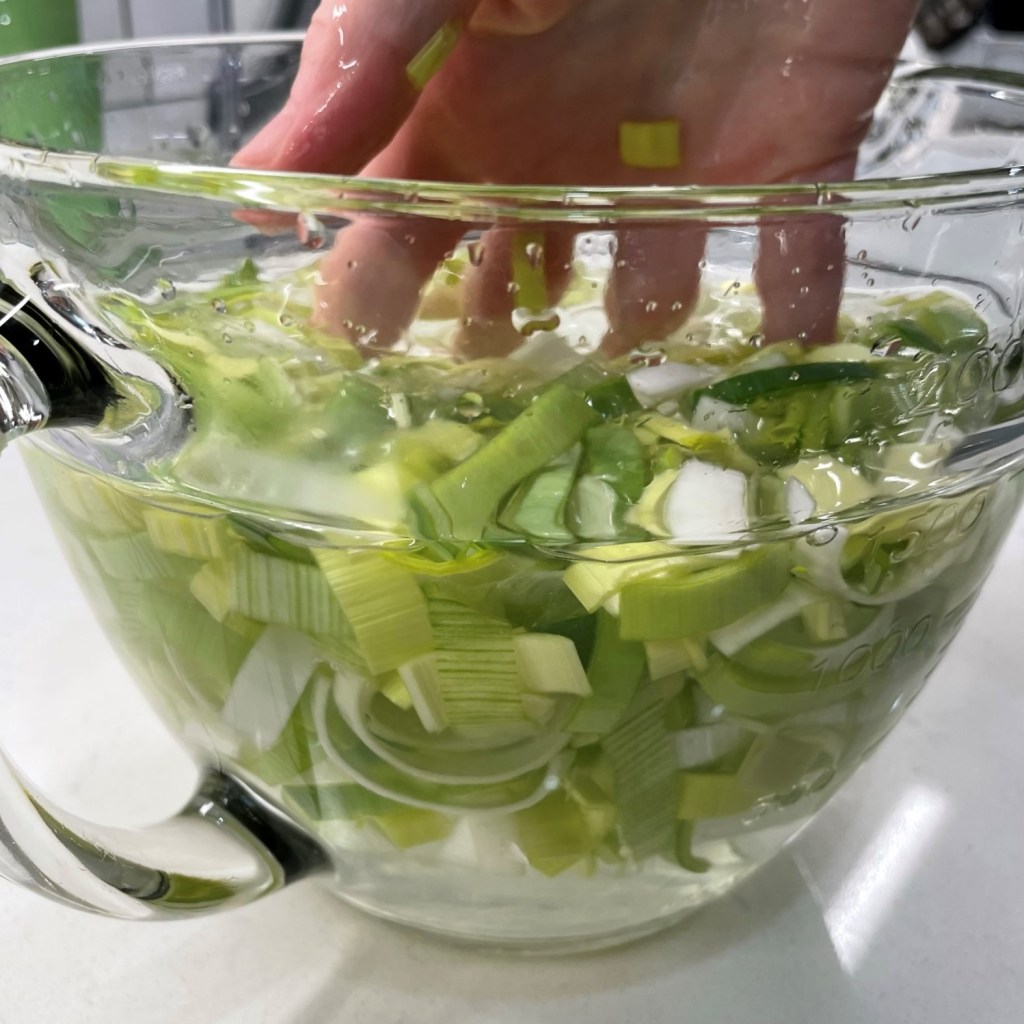
It’s very important to properly clean leeks. Slice it lengthwise, then into half moons and soak them in a large bowl with cold water.
Swoosh the sliced leeks around with your hand and allow time for the sandy grit to settle to the bottom. After about 20 minutes, carefully scoop out the leeks, leaving the grit behind.
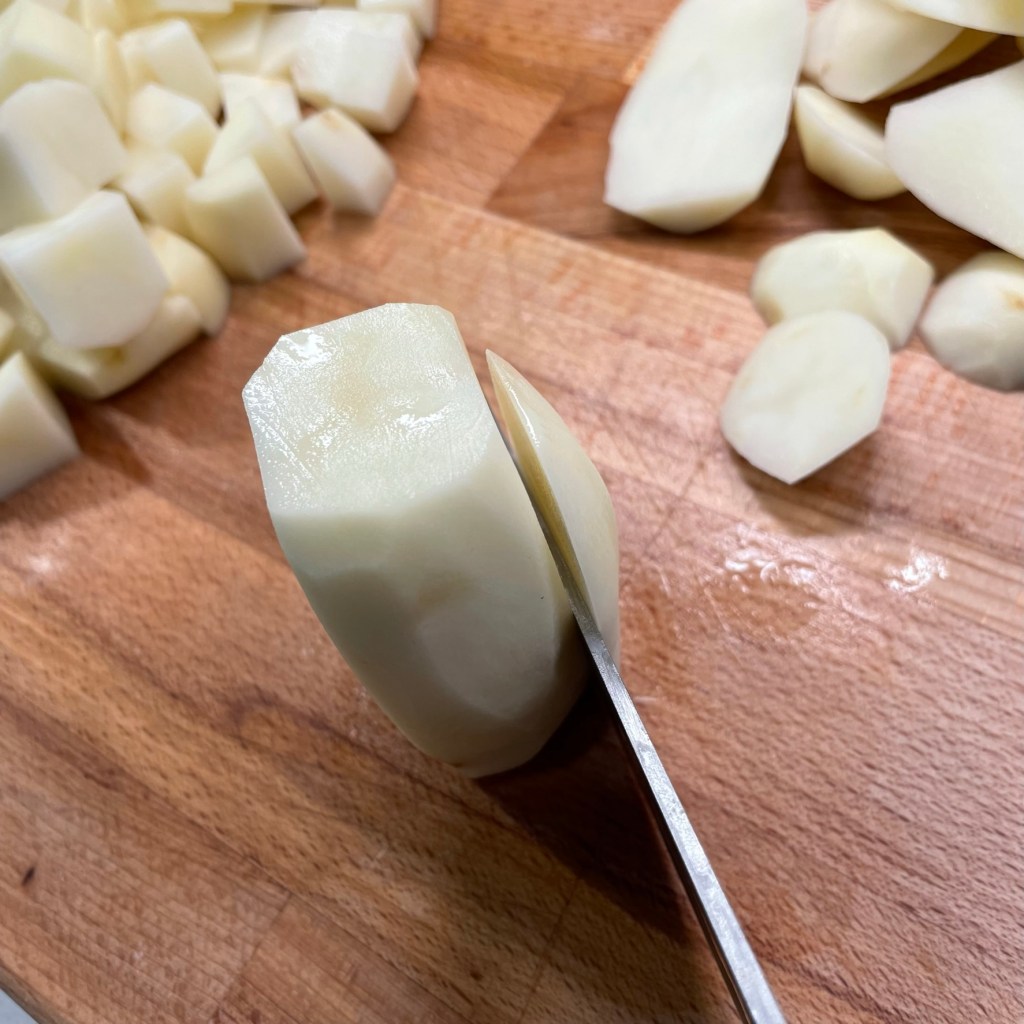
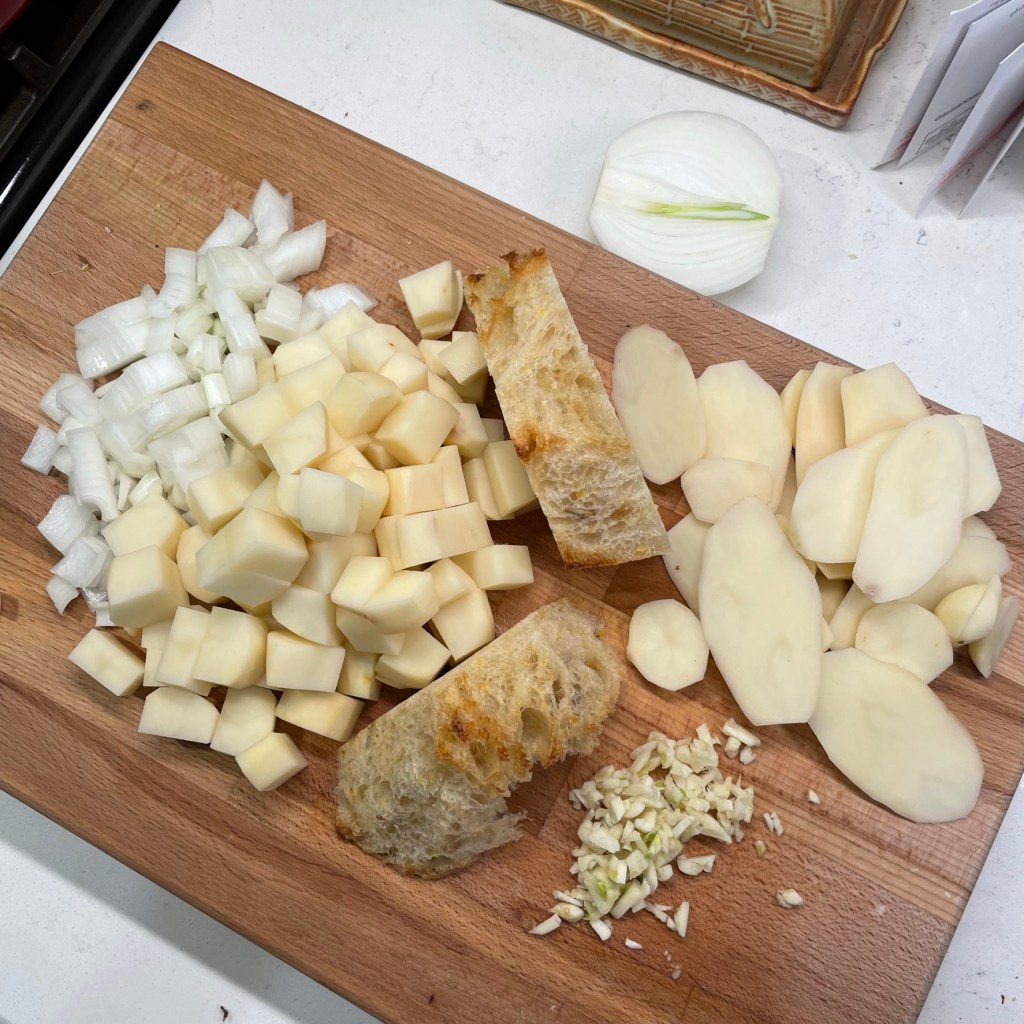
The scrap edges and ends of the potatoes will be used earlier in the recipe, so put them in a separate pile when you do your prep.
The only sourdough I had on hand was this loaf, with polenta and pumpkin seeds baked into it. I cut a large chunk of it and trimmed away all of the crust.
Looks like “beige” is the colour du jour for this soup!
After a nice long simmer, the kielbasa has plumped and infused the water with a smoky flavor and droplets of oil.
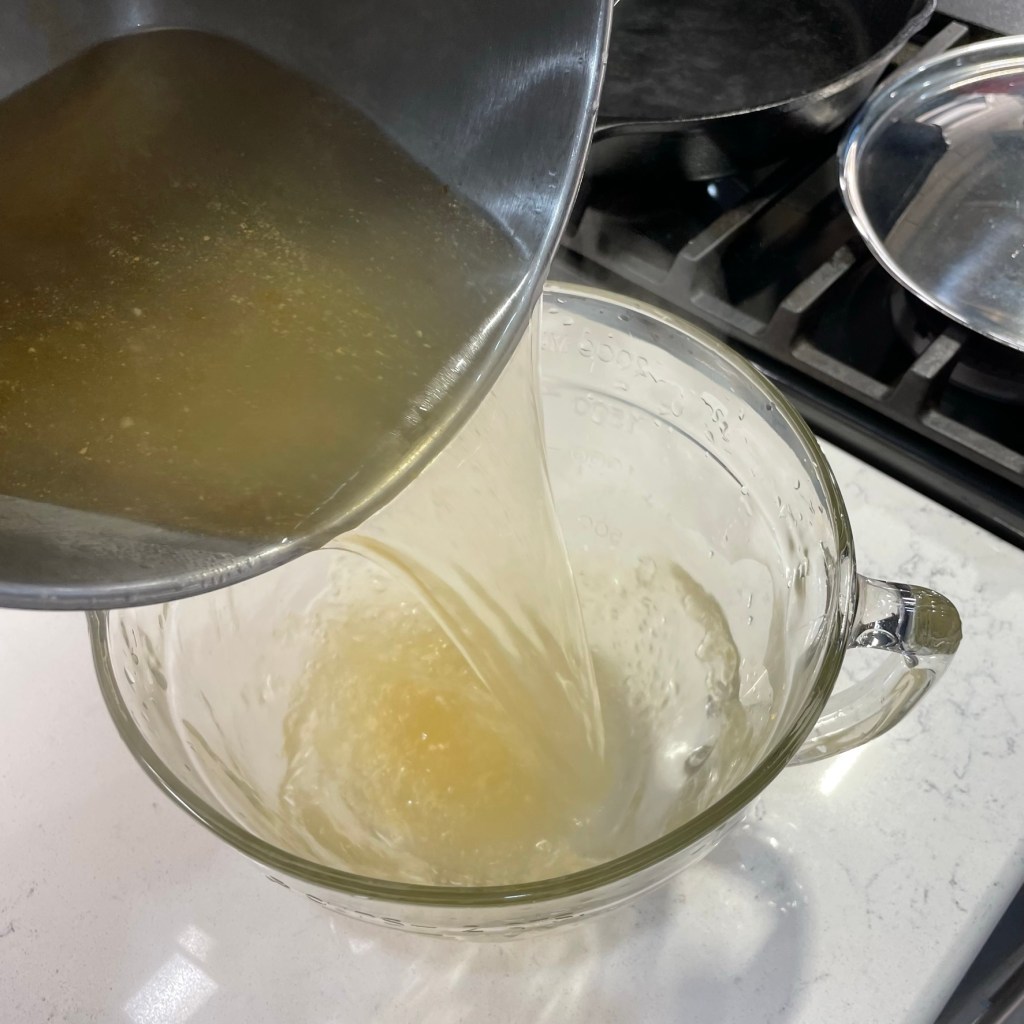
Use tongs to remove the kielbasa and transfer the water to a large bowl for later.
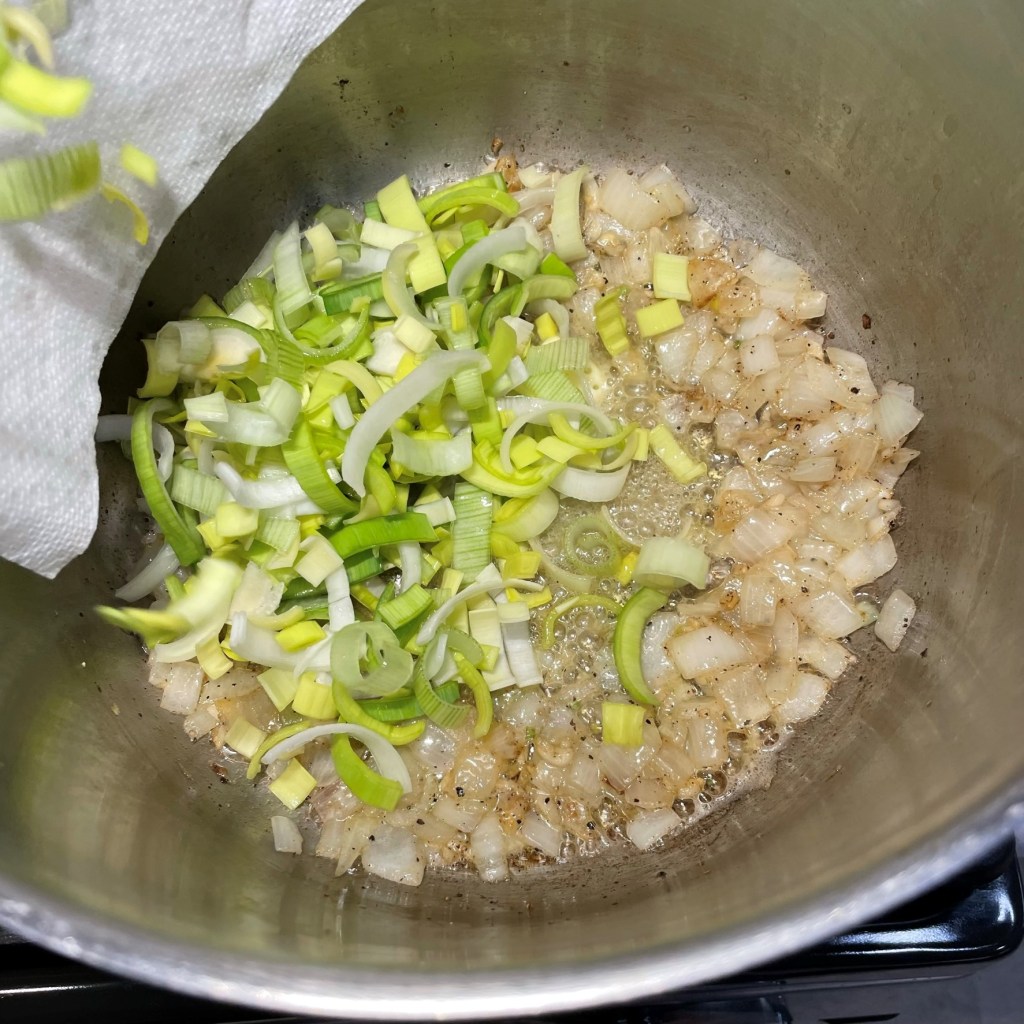
Add half the butter to the pot and cook the onions and garlic. Then add remaining butter to cook the leeks.
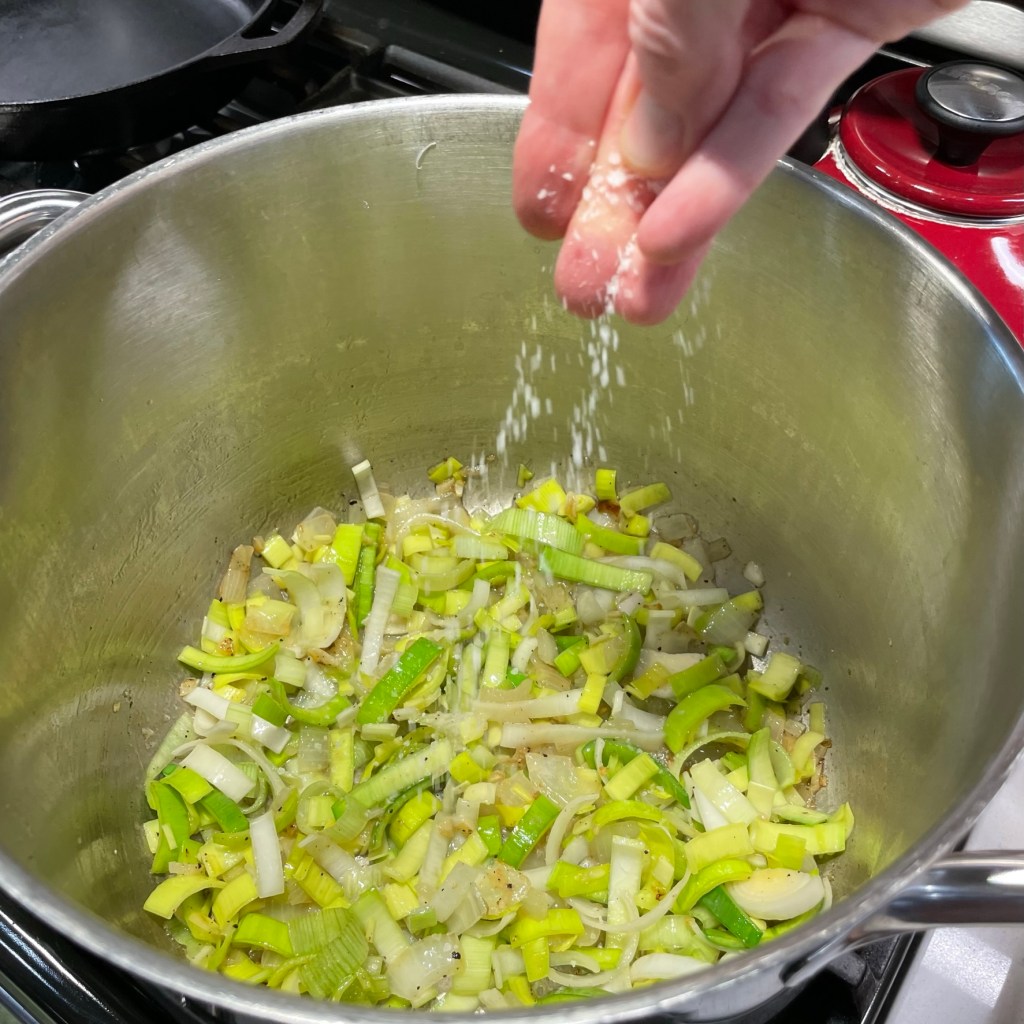
As with any recipe, remember to season every layer. Be especially generous with the black pepper in this soup, as it highlights the kielbasa.
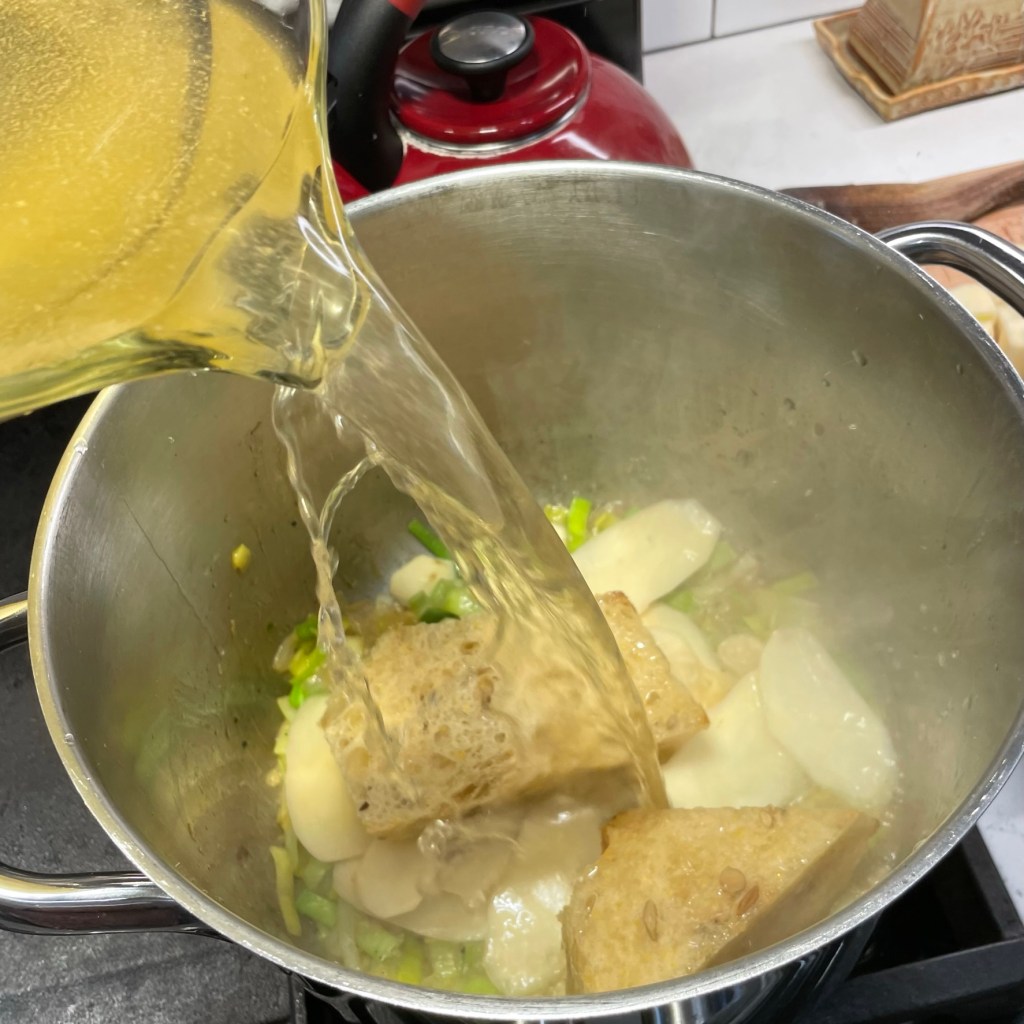
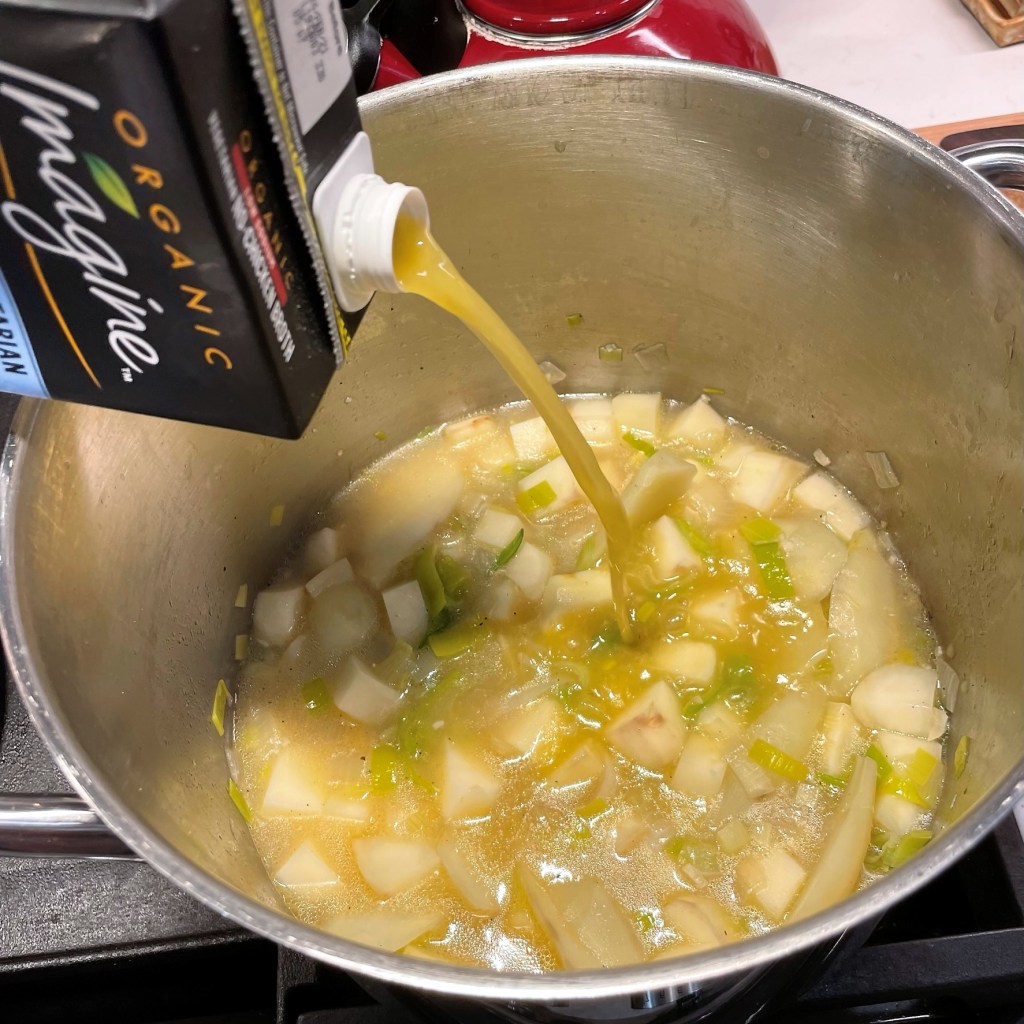
Put the potato scraps and trimmed sourdough into the pot and pour about 2/3 of the kielbasa broth over it.
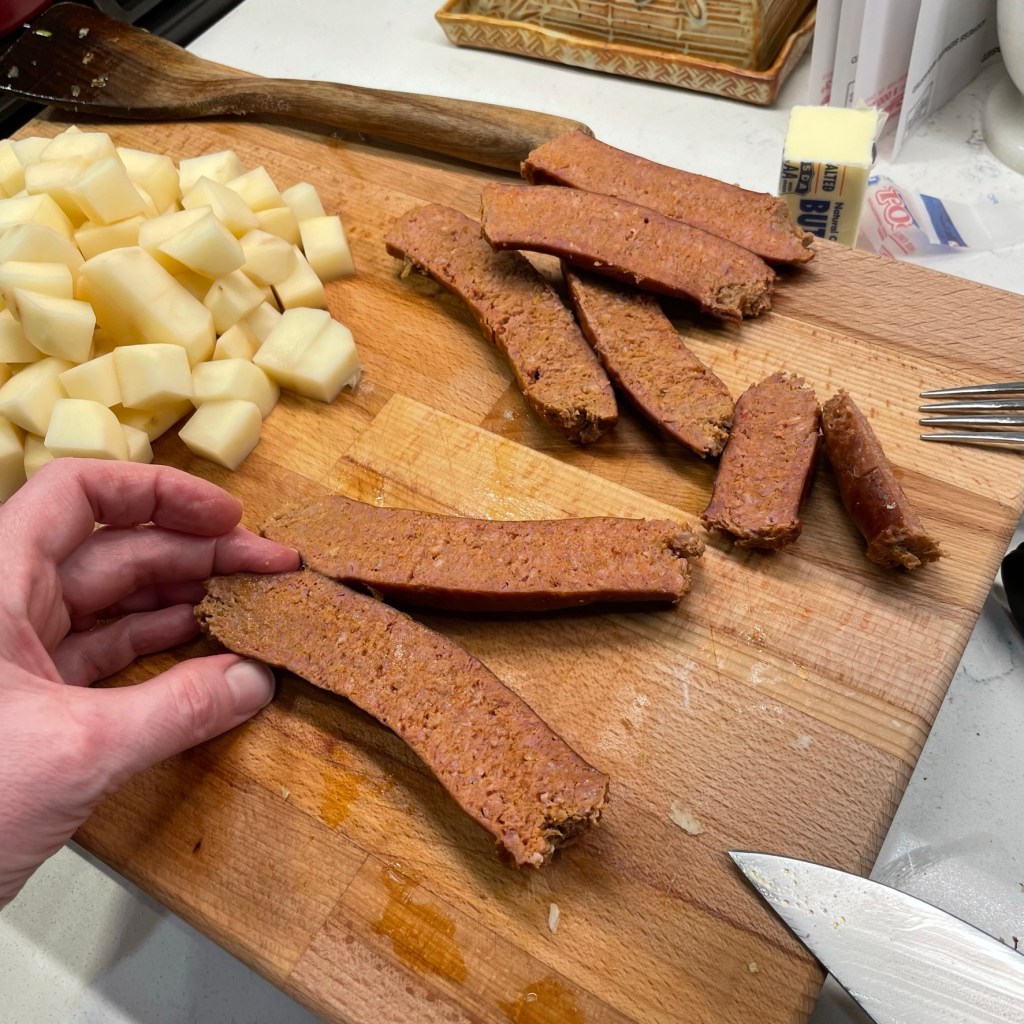
When the kielbasa is cool enough to handle, slice it lengthwise and then into thin half-moon slices.
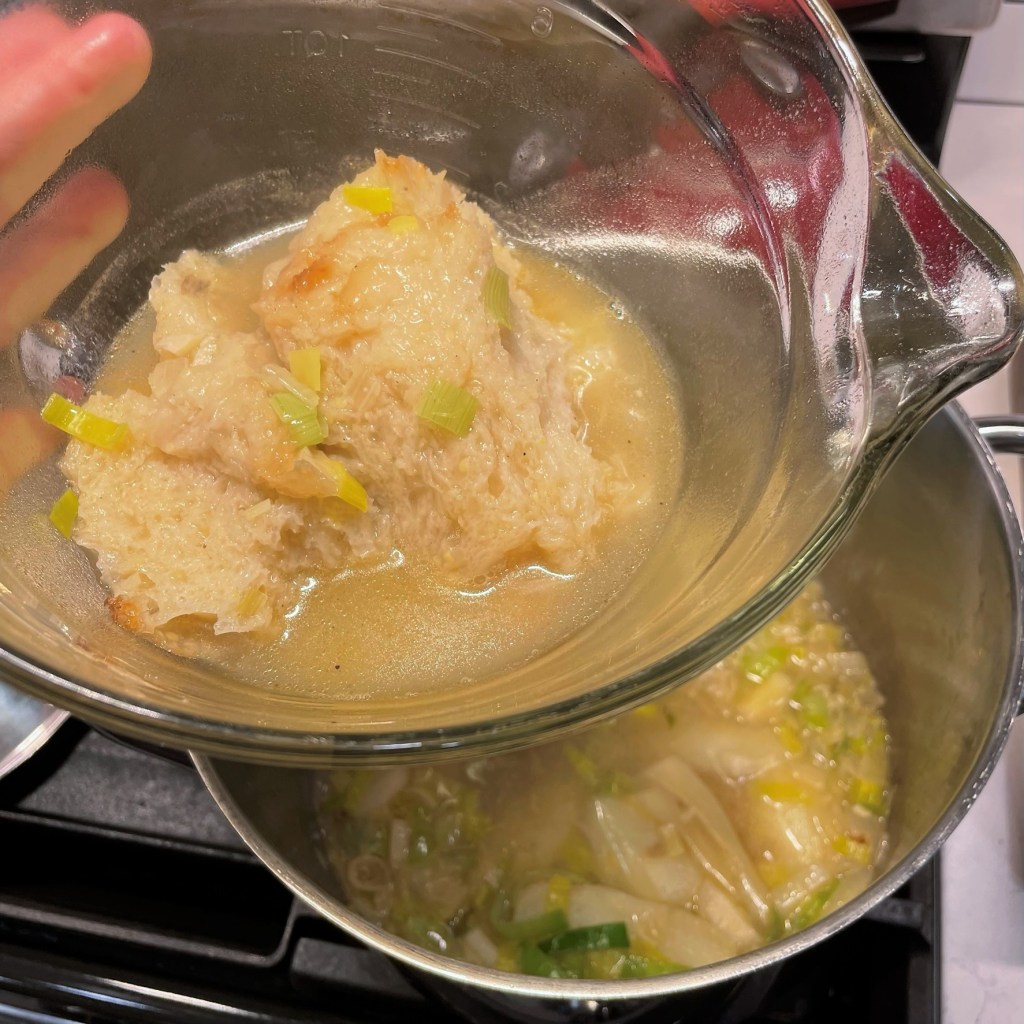
The sourdough chunks will become very bloated and soggy. Carefully scoop them out of the pot, along with about one cup of the cooking liquid. Let it cool a few minutes.
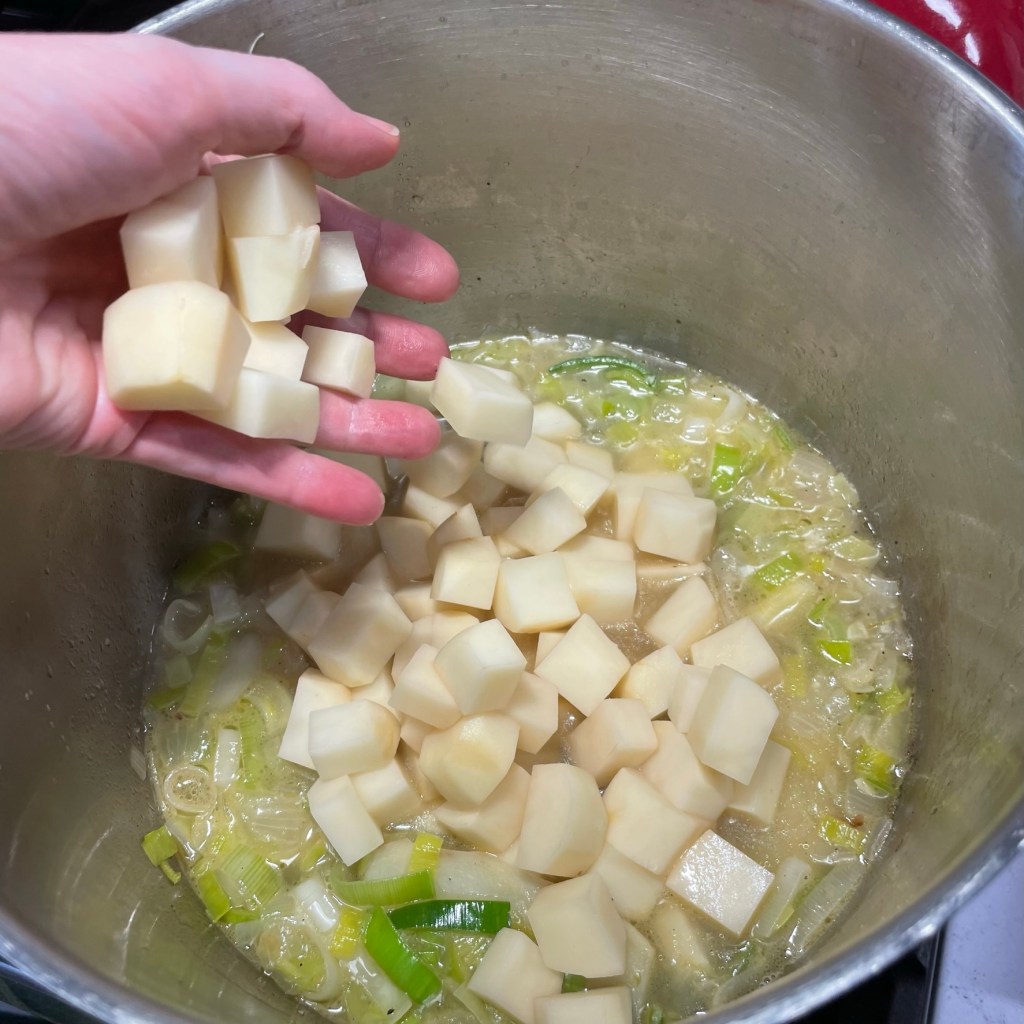
Potato cubes go into the pot to simmer until they are just tender.
I lost track of my simmer and needed to add broth, but just enough to cover the potato cubes. The potato scraps that went in first are already fork-tender and will continue to break down.
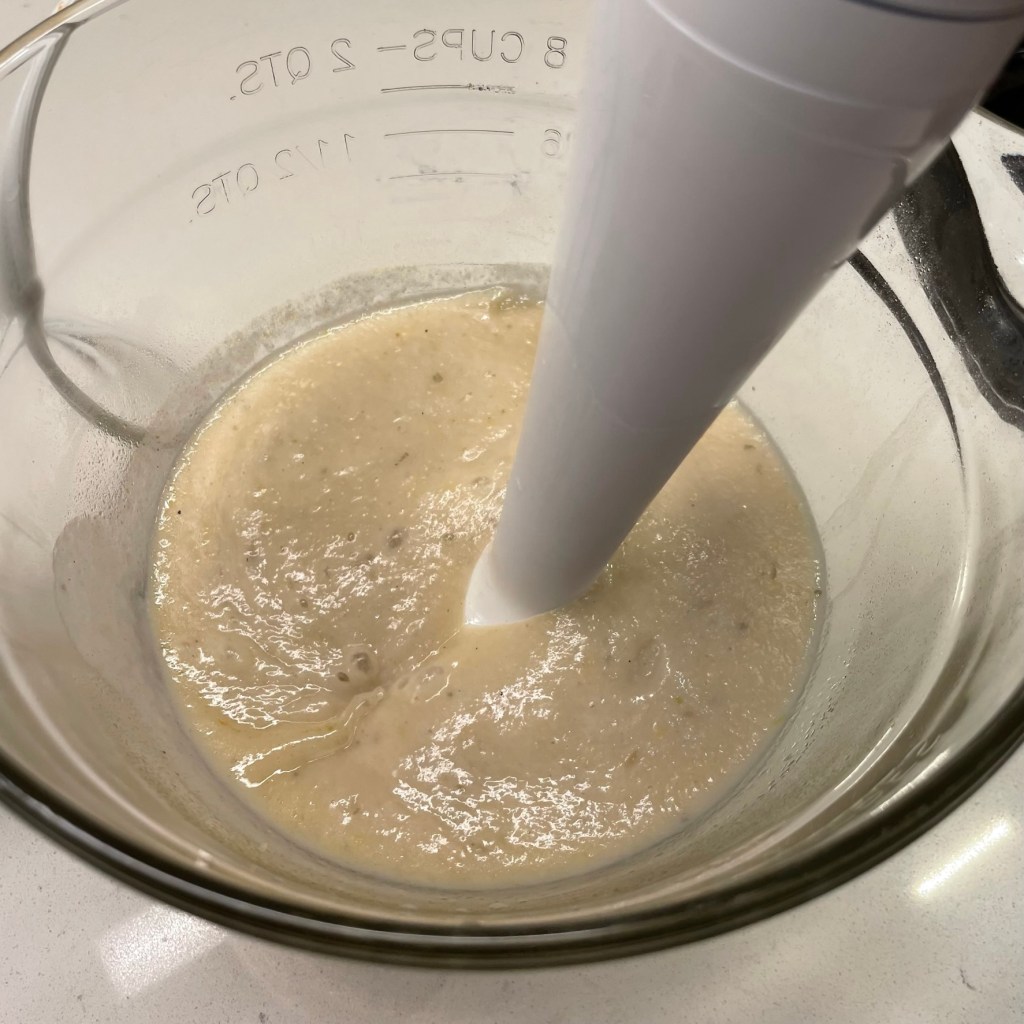
Use an immersion blender to puree the soppy sourdough. If you need to use a regular blender, wait until it cools for safety sake.
I was very surprised at how well this blended, and how creamy the mixture was when I finished. And those pumpkin seeds? Gone!
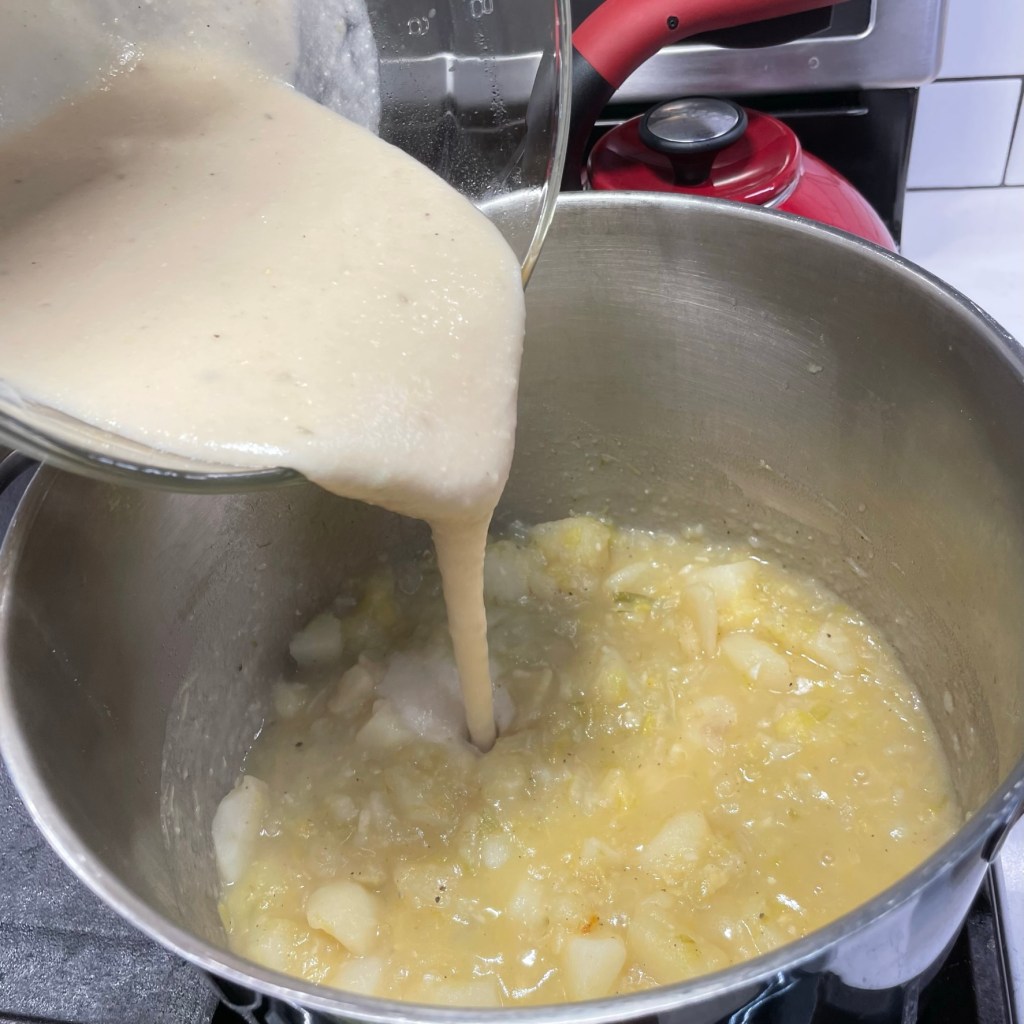
The sourdough puree goes back into the pot. Stir it gently so that you don’t turn the potato cubes to mush (lesson learned).
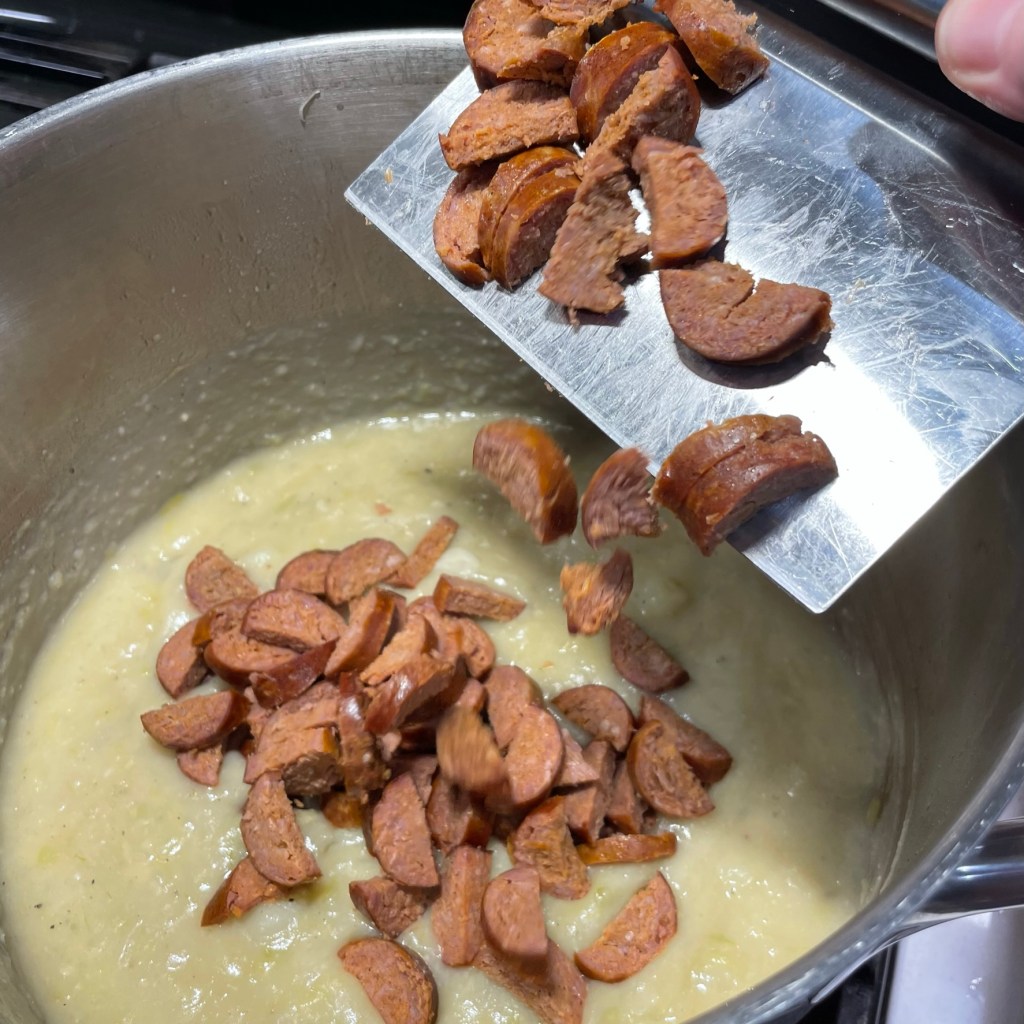
Add the kielbasa and simmer just long enough for everything to be heated through.
For sure, my soup simmered too long, and the starchy russets were overcooked. But this was still delicious! Make final salt and pepper adjustments.
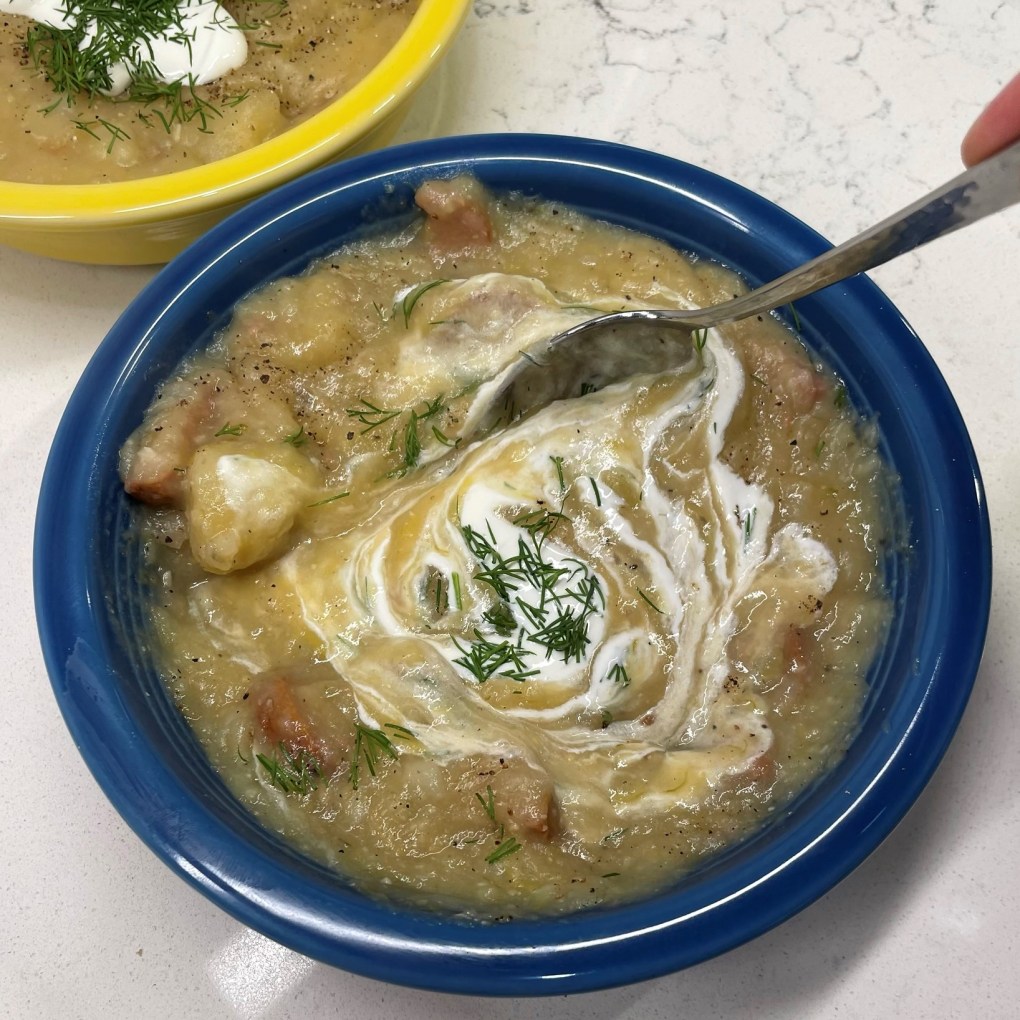
Serve it up with more black pepper, a dollop of sour cream and a sprinkle of fresh dill leaves.
The whole bowlful tastes very creamy and hearty. Real comfort food here!
Place the kielbasa chunks in a large soup pot and cover it with the filtered water. Add the bay leaves and bring to a boil, then reduce heat to a simmer for about 20 minutes.
Prep the potatoes by cutting off the sides and ends, creating mostly flat sides on the potato. Keep the potato scraps in one pile and cube up the rest into a separate pile.
After simmering, the kielbasa should be noticeably swollen, and small droplets of fat from the kielbasa will be swirled throughout the broth. Use tongs to transfer the kielbasa to a cutting board. Pour the broth into a large bowl or measuring pitcher.
Into the same pot, melt two tablespoons of the butter and sauté the yellow onions and garlic with salt and pepper for about five minutes, until tender. Add the remaining butter and leeks to the pot and sauté two more minutes, until those are also tender.
Add the scraps of potato and the large chunks of sourdough bread to the pot. Pour about 2/3 of the reserved broth into the pot and simmer until the bread looks completely bloated, about 10 minutes. Use a large, slotted spoon or tongs to pull out the sopping bread into the measuring pitcher with the remaining reserved broth. It’s OK if some of the leeks and onions tag along. Set the pitcher aside to cool for a few minutes.
Add the potato cubes to the pot, along with enough broth or water to just cover them. Heat to a boil and then simmer for about 15 minutes until potatoes are slightly tender. While that simmers, use an immersion blender to puree the sopping sourdough with the liquid in the bowl or pitcher.
Stir the puree mixture back into the pot, along with the kielbasa. Adjust salt and pepper to taste. Simmer just until heated through, as continued cooking will cause the potatoes to turn mushy.
Serve the white borscht with a dollop of sour cream and a sprinkling of fresh dill.
The first dish I cooked from scratch happened in fall 1981, my first semester out of college, living in Southern California. It was sometime after the appearance of the annual TV Guide Season Preview edition. We all of a certain age remember those, right?
This thick edition featured previews of all the new shows, updates on returning shows and, seasoned amid all that, some unique features. The 1981 edition had a clip-out thing with the actor Vic Tayback, in all his “Alice” glory (rolled-up white hat, white t-shirt), sharing the recipe for Mel’s chili. Curious thing is that I didn’t watch “Alice.” Ever. But I wanted to make that chili, and it came out great. Of course, at the tender age of 22, saying something came out great means it was edible.
Vic Tayback as Mel Sharples. Gruff, but likable. And everyone loved his chili.
My chili has grown considerably in depth of ingredients and flavor over the years, and I no longer need to refer back to Mel’s recipe as I did for at least 10 years, but the baseline recipe still has some “Mel” in it. Namely, I still typically use some type of ground meat, onions, garlic, tomato paste and red kidney beans. I remember my very first modification, probably the second time I made the chili, was adding diced green peppers. Diced red pepper followed shortly after.
Soon enough, my chili became the regular main dish at the annual Gura household Super Bowl party, and I tried to do something different with it just about every year. So, among the additions (which sometimes also required deletions), were diced tomatoes (I now use Rotel hot diced tomatoes), roasted garlic, cocoa powder, various types of chili powders and seasonings rather than the packets of chili seasoning the recipe called for, canned green chiles, and diced jalapeno. A breakthrough ingredient some 15 years ago (I think I have to credit chef Steven Raichlen for this) was dark beer, as substitute for the water needed with the tomato paste. I’ve used ground bison. Used ground venison. Used smoked brisket (that might have been my best chili ever, Super Bowl party 2017).
Now comes a new challenge. Making chili without a kitchen, which became my mission one recent weekend while Terrie was taking a trip to West Virginia to buy colorful new Fiesta dishes for our soon-be-be completed kitchen. Fortunately, in our current state of kitchen-lessness, Terrie and I have two useful things for making chili. A multi-purpose slow cooker and a toaster oven; the former was the star of the day for the new batch.
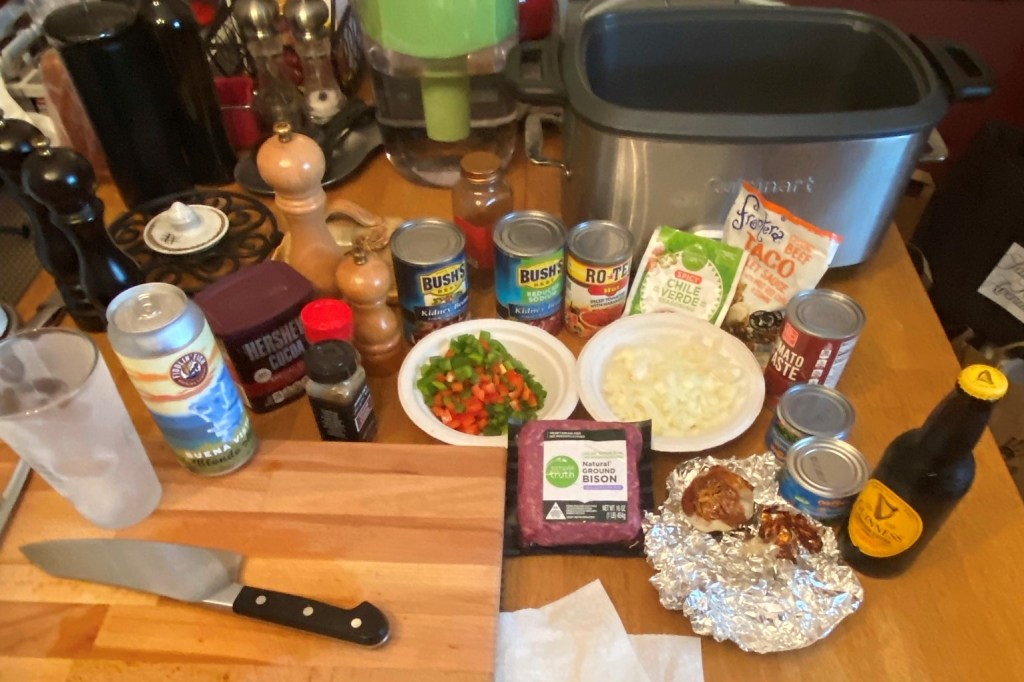
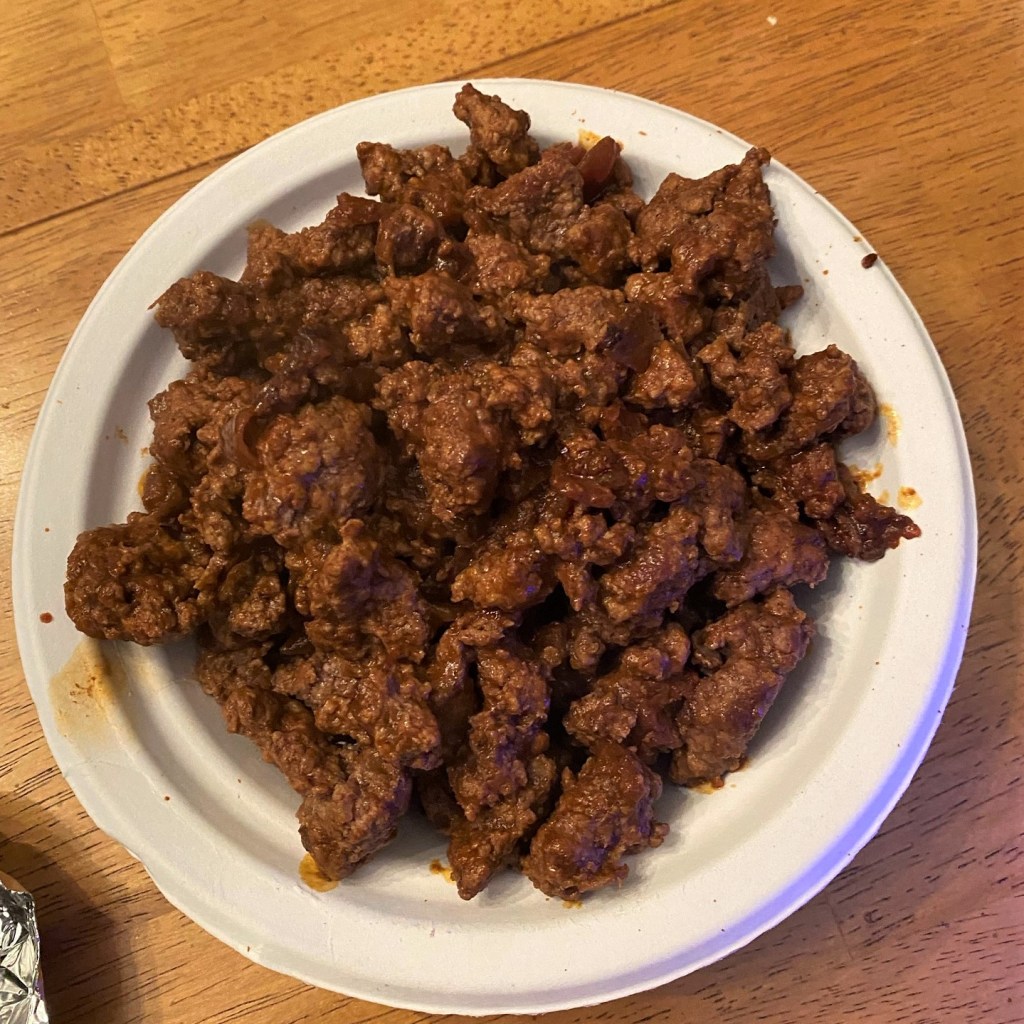
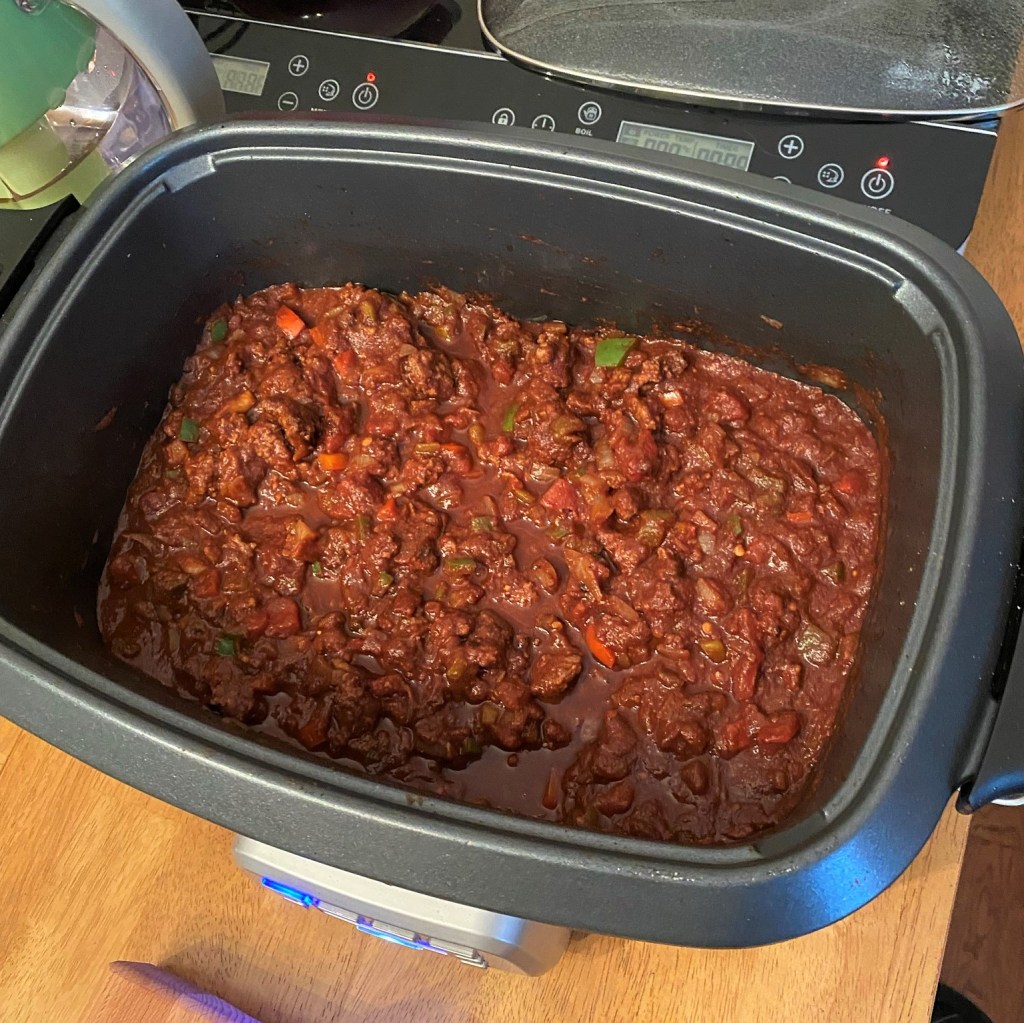
I’m not going to bore you all with the details. Suffice to say, while I roasted a bulb of garlic in the toaster oven, I diced up peppers and onions and lined up the other key ingredients (Guinness Foreign Extra Stout was the beer). I browned the bison in the slow cooker and flavored it with a taco skillet sauce, then removed the bison to sauté the vegetables. Eventually, everything went back into the slow cooker and I left it on low for 2½ hours. With the jalapeno pepper flakes and ground chipotle that I added, this chili came out, to quote Jim Carrey in Masked, “ssssmokin!”
Ingredients (makes about 8 portions)
Counter space and lighting is even worse in the dining room than in the old kitchen, but I like to get “mise en place!” Everything ready, including a frosty beer for myself.
1 pound ground bison* (notes below)
1 medium onion, diced
1/2 each green and red peppers, diced
1 medium jalapeno pepper, seeded and diced
2 Tbsp. olive oil
1 bulb garlic
1 can Rotel diced tomatoes (I used the “hot” variety)*
2 small cans of chopped green chiles*
1 10-ounce can tomato paste
1 12-ounce beer*
1 packet Frontera brand taco skillet sauce (you will need less than half the packet)
2 cans red pinto beans (for this I used dark red; normally I mix dark and light red beans), drained
1-2 Tbsp. ground chipotle*
A pinch or two of dried jalapeno flakes
1 Tbsp. cocoa powder
Salt and pepper
Tools
Slow cooker and toaster oven for cooking*
Toppings/Extras
Shredded cheese*
Sour cream
Scallions
Tortilla chips
Notes
Bison can be substituted with ground beef, ground turkey or other favored protein; chili also works great with different kinds of stewed or smoked meats cut into small chunks.
Rotel makes three varieties of diced tomatoes; use whichever suits your heat preference.
I used Ortega’s fire-roasted, mild chopped green chiles for this batch, but any will do.
I like to use a dark beer; for this batch it was Guinness Foreign Extra Stout, which Terrie thought was too bold but it was the only bottle of dark beer in the “downstairs” fridge.
Ground chipotle can be substituted with other types of seasoning such as ancho chili powder or a seasoning packet mix or a combination of seasonings, all based on heat preference and desired flavor profile. And another thought on seasoning: add in whatever you like on a given day. Chili never comes out exactly the same, at least in our kitchen. And that’s OK.
If you don’t have a multipurpose slow cooker, you could brown the beef and sauté the vegetables in a fry pan, then add all other ingredients into a cast-iron pot.
Needless to say, garlic can be roasted in a regular oven. Unless you’re remodeling your kitchen.
I like to use a block of cheese rather than pre-shredded. Because this batch came out spicy, I used a Colby-jack blend. If your chili’s heat factor is low, Trader Joe’s makes a habanero pepper jack that works great and you can make your own bowl as spicy as you want.
Instructions
I browned the ground bison then tossed it in the taco skillet sauce before removing it from the cooker.
I like to have large chunks of pepper and onion in my chili. They hit the slow cooker next for a quick saute.
My version of chili is thick, rich and meaty.
Pre-heat toaster oven to 400° F. Cut off head of garlic bulb, drizzle with olive oil and wrap in foil. Cook 1 to 1½ hours until the bulb is soft and golden brown.
Brown ground bison in multipurpose slow cooker on brown setting, adding in small batches to avoid steaming. After initial browning, add skillet sauce to coat bison, then remove from slow cooker.
Add olive oil and sauté the vegetables about 5 minutes until soft and translucent.
Change setting to slow cook on low, return ground bison to the slow cooker, and then add in Rotel diced tomatoes, beer and tomato paste. Add seasonings. Mix all ingredients well. If mixture appears too thin, gradually add more tomato paste; if too thick, add water.
After cooking about 90 minutes, add kidney beans and heat through.
If you do an internet search for “authentic arroz con pollo recipe,” you will get at least a dozen pages of results, with very few duplicates. Go ahead, I’ll wait.
Some of the ingredients are consistent across the recipes, but there are many variations and even the pictures can look dramatically different. The reason there are so many “real” arroz con pollo recipes is that there are many, many Hispanic grandmothers passing down their own recipes. And this dish—which is not definitively native to a single country or people—has become a blend of whatever ingredients are available in all the regions where those grandmothers have lived and cooked.
My previous experience of arroz con pollo—or “ACP,” as it is usually listed on many of our local Mexican restaurant menus—has not been completely positive, and that’s because here in the South, the recipe has morphed into an “Americanized” dish that is oozing with cheese and basically bland (it’s a rare instance of a dish being too much about the cheese, in my opinion). And that is a shame because at its roots, arroz con pollo has a lot going on!
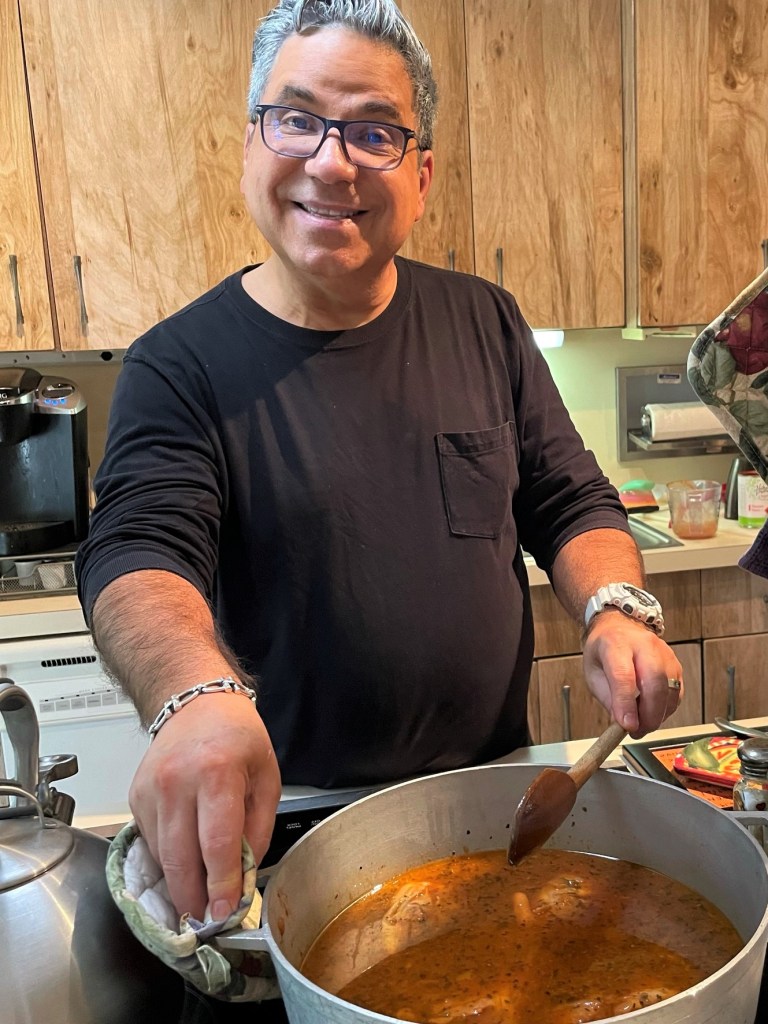
Recently, I had a front-row seat to watch and learn the authentic, real-deal Puerto Rican version of this flavorful dish. During our vacation up north, my husband and I spent a few days on Long Island, where we visited his cousin, Evan. To my good fortune, Evan’s husband, Will, became my own personal “ACP” instructor! His mother hails from P.R. and his father is of Spanish heritage, so Will has good reason to be passionate about this dish that is representative of his family. We had a joyful afternoon in the kitchen!
Will took the day off work to teach me how to make ACP. Love you, Sweetheart! ❤
Throughout this private cooking lesson, Will shared with me all the culinary wisdom handed down to him from his mother, who learned it from her mother, and so on. Because this was an authentic Puerto Rican variation of arroz con pollo, it was packed with layers of flavor, beginning with Sazón and finishing with saffron, and all in one giant pot, called a “caldero.” The pictures of Will’s family recipe tell the story far better than I can, so please join us at the stove as we celebrate this last day of Hispanic Heritage Month!
Ingredients
First, let’s take a look at the special ingredients that make this dish uniquely Puerto Rican.
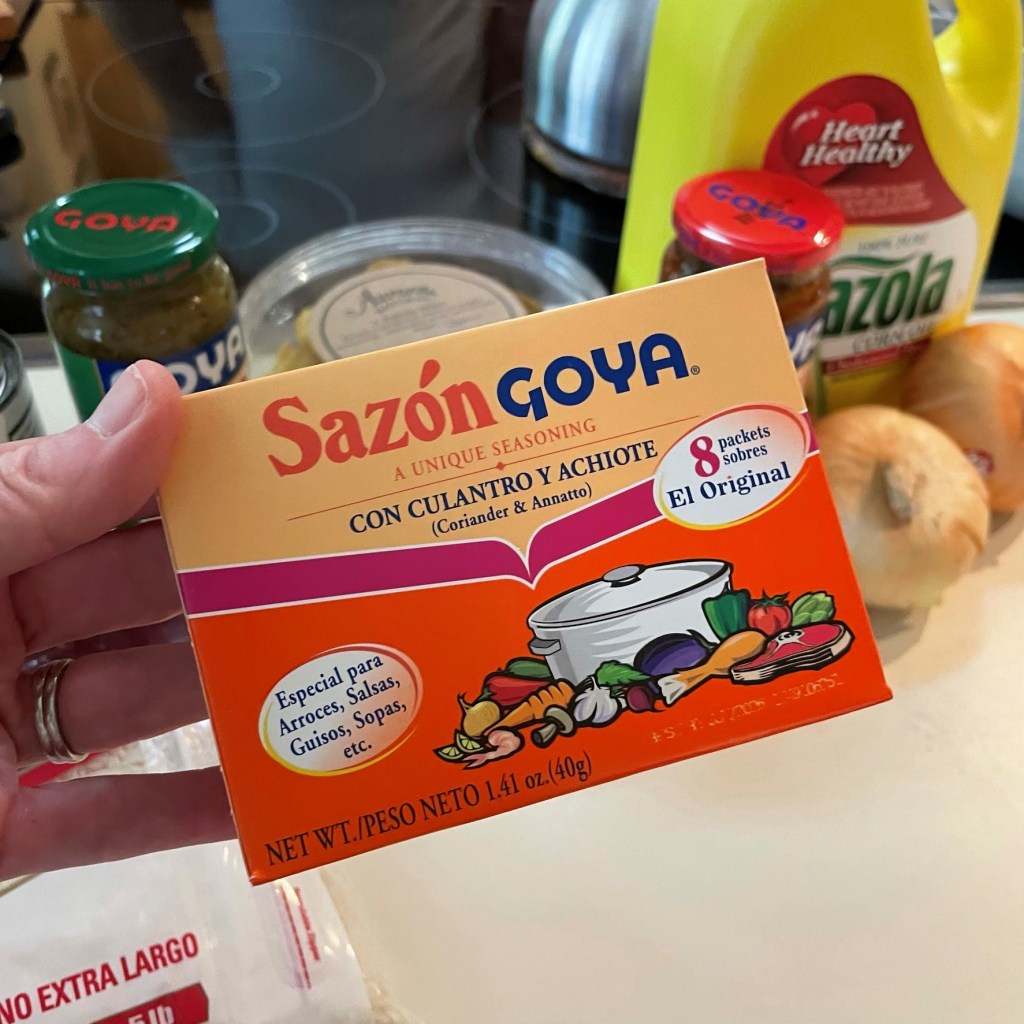
Sazon is a must-have seasoning for Puerto Rican cooking. Ingredients include coriander, garlic, cumin and annatto (for color).
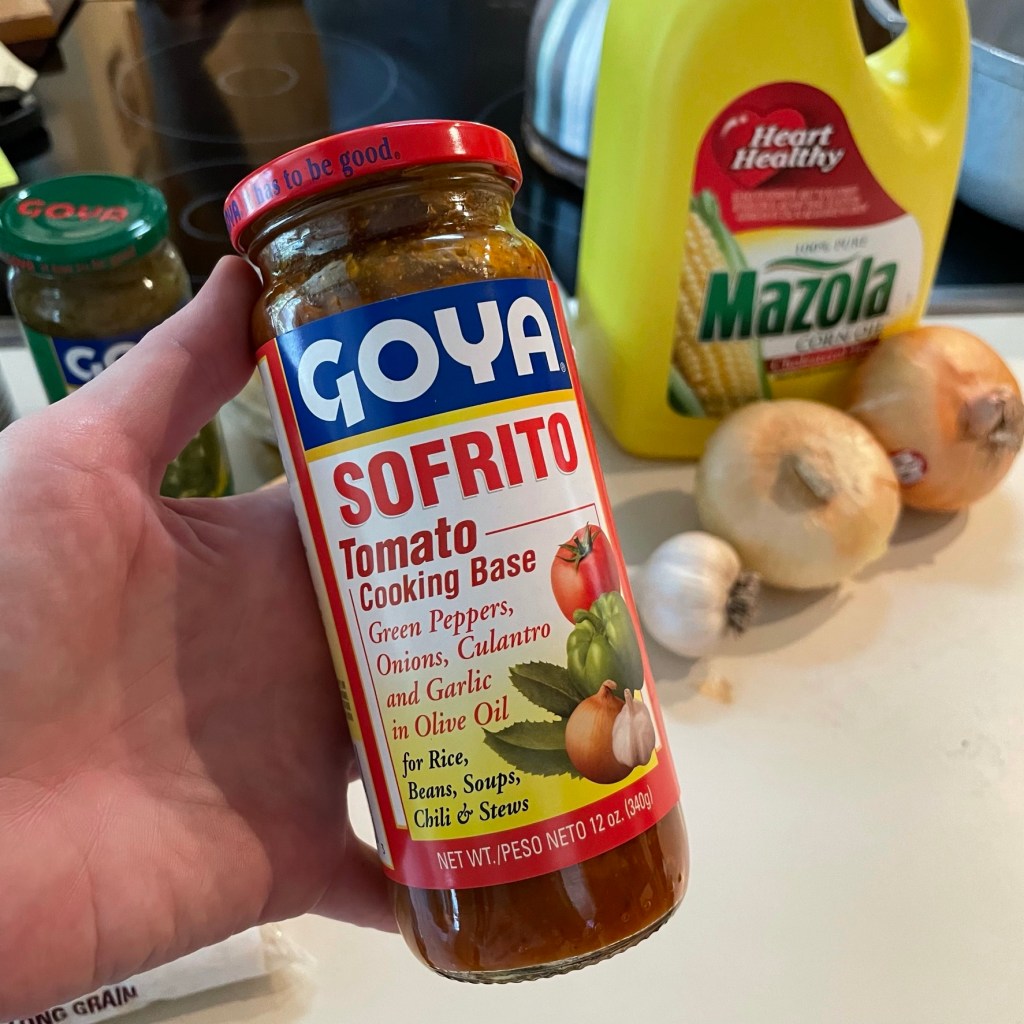
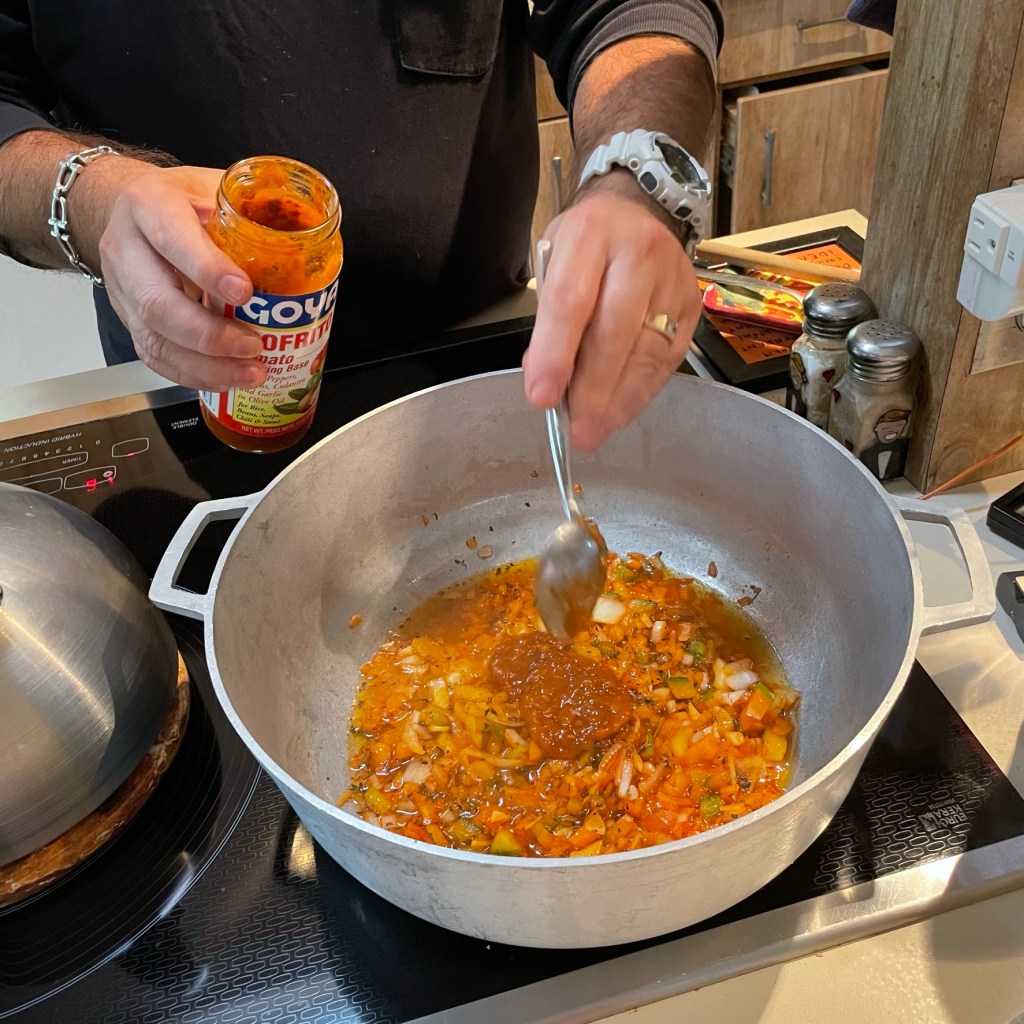
Sofrito is the base of many Latin American dishes. It is tomatoes cooked with peppers, onions, garlic and culantro, a common Caribbean herb.
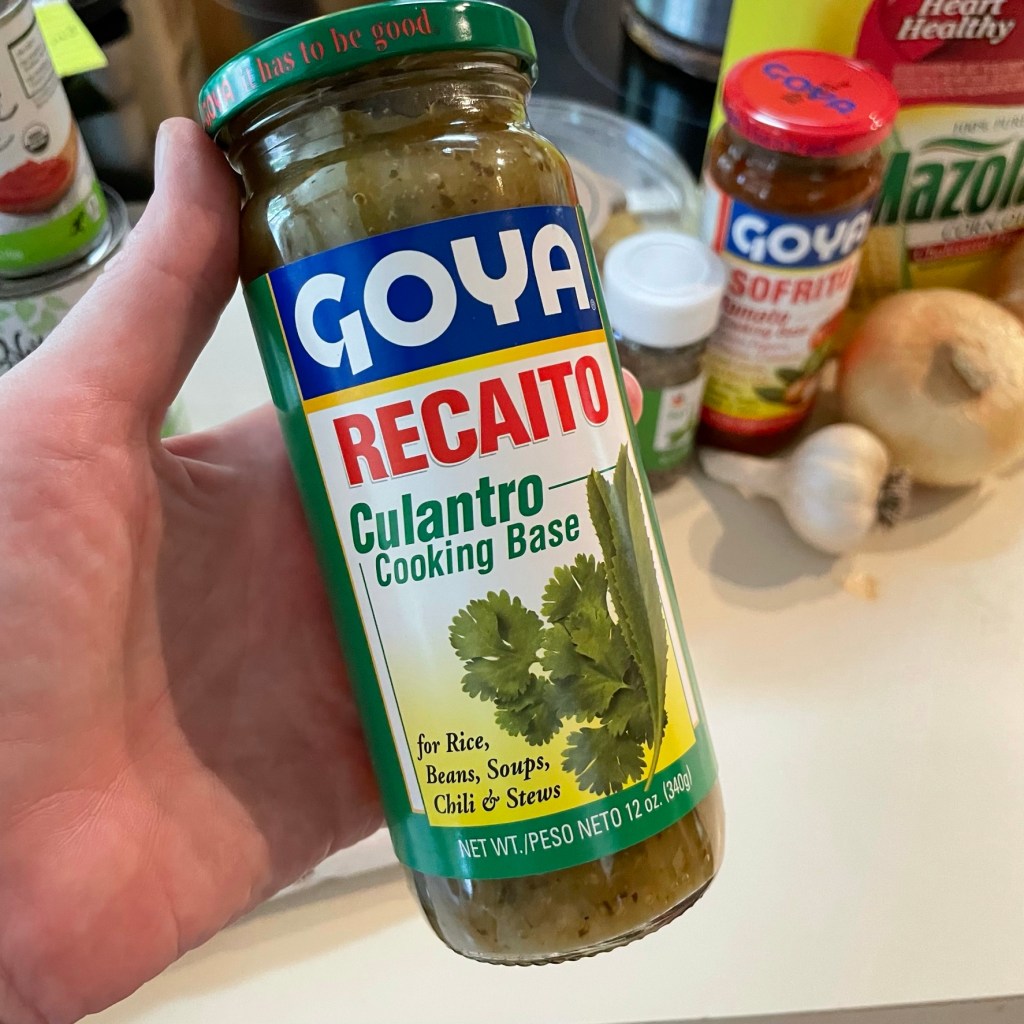
Heck if I can pronounce it, but this stuff was delicious! Culantro is not the same as cilantro, but both are in the recaito.
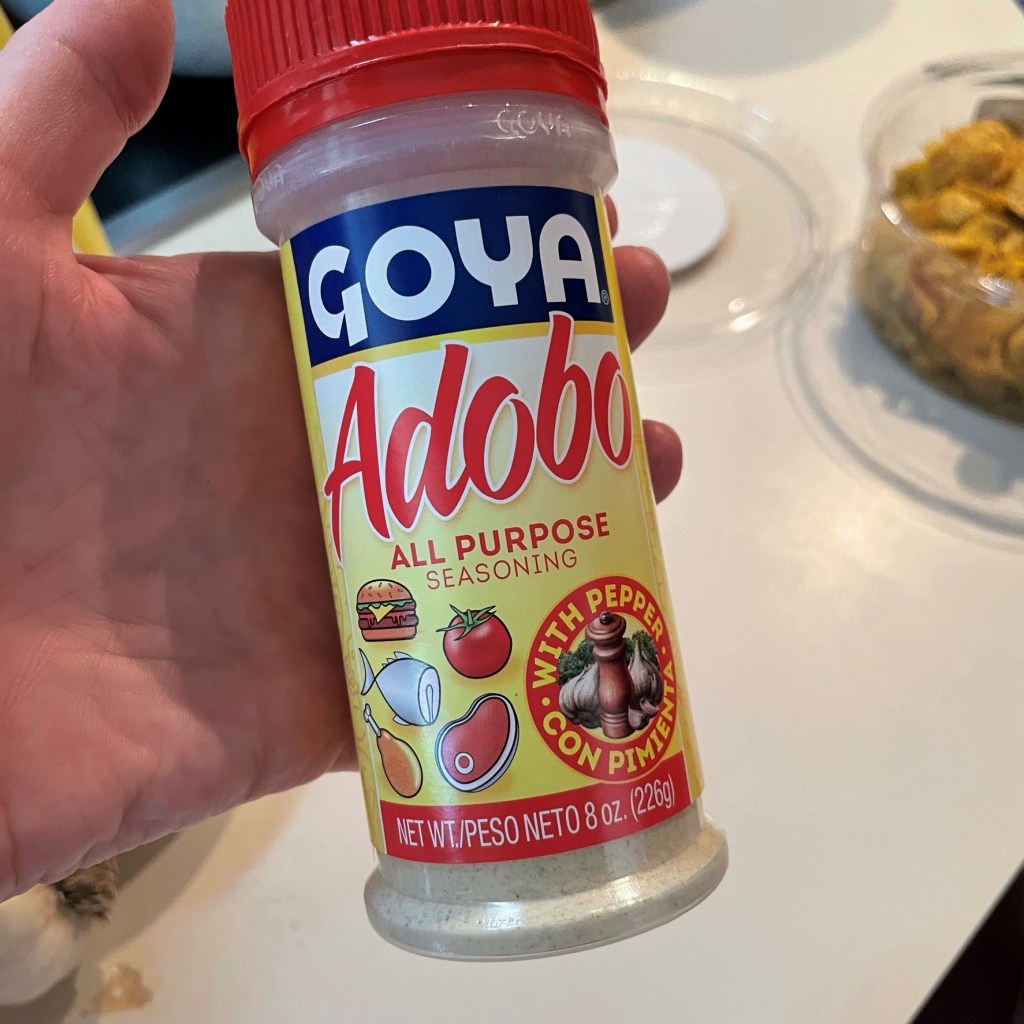
Adobo is a variation of seasoned salt; a savory garlic flavor in every shake.
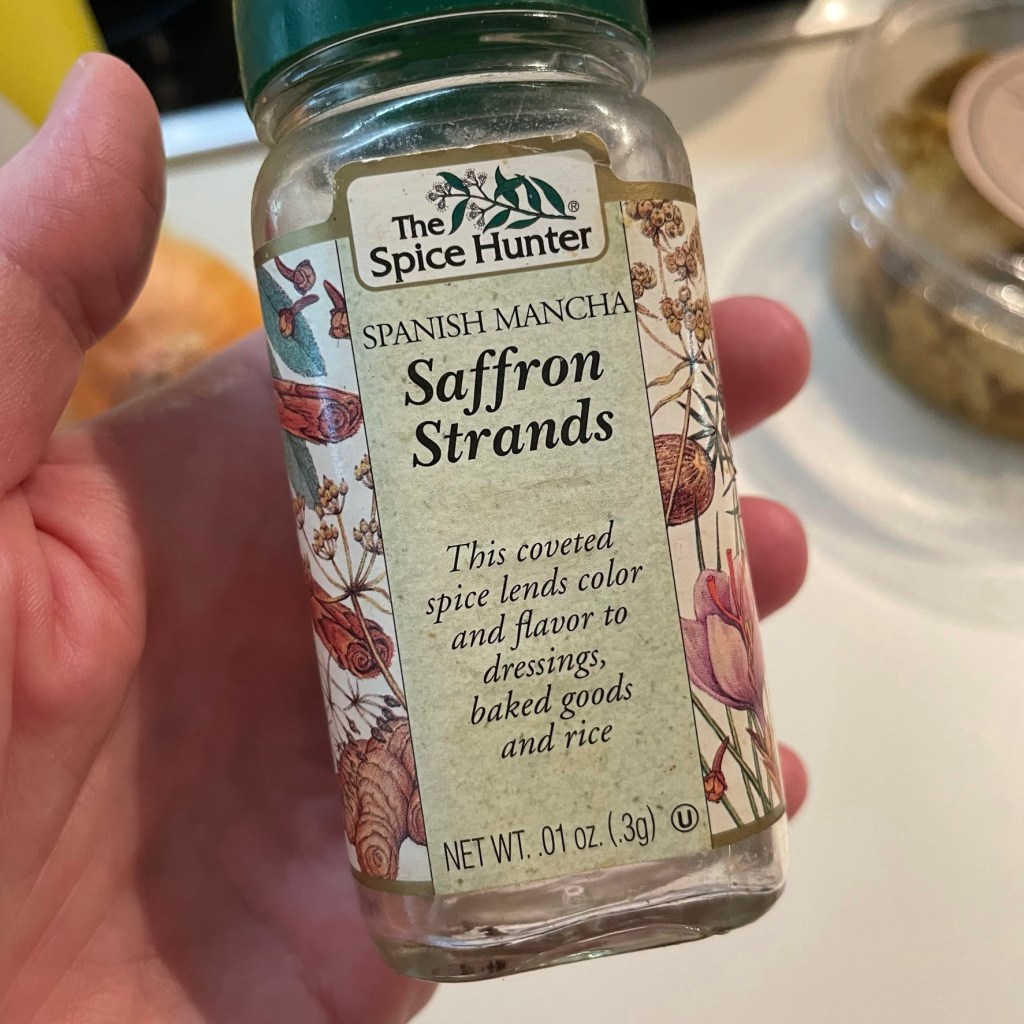
Saffron is an extra special flavor ingredient. Will emphasized to only use “a pinch!”
Hold up, what exactly is “culantro?”
It can seem a little confusing, so let’s address the difference between cilantro, which most of us are familiar with, and culantro, which is an ingredient in both of these cooking bases. Unlike cilantro, which is wispy and delicate and mostly used to finish or garnish a dish after cooking, culantro is sturdier and stronger, both in texture and flavor. It has a similar flavor to cilantro, but its long, slender leaves are mainly included as a cooked ingredient, and during the cooking process, the hearty flavor calms down a bit. This herb is extremely common throughout the Caribbean, so of course it is a staple in the cuisine of Puerto Rico.
The remaining ingredients for the arroz con pollo included bone-in, skin-on chicken thighs, corn oil, onions, peppers, garlic, tomato sauce and rice. I did my best to take notes and catch all the details, but this is the kind of recipe you make from instinct, and that’s exactly how Will prepared it. He was cracking me up as he went along, and reminded me so much of myself—occasionally cursing his stove and fretting about ways that his dish might not turn out perfectly. We are always our own harshest critics in the kitchen, can I get an amen? Trust me, this arroz con pollo was delicious!
Made with love, heart and soul!
At the end of the post, I’ve included a PDF that you can download for your recipe files. You will need to tweak seasonings to suit your taste and adjust cooking times for your own stove, of course, but my outline should provide a good starting point. Here we go!
Instructions
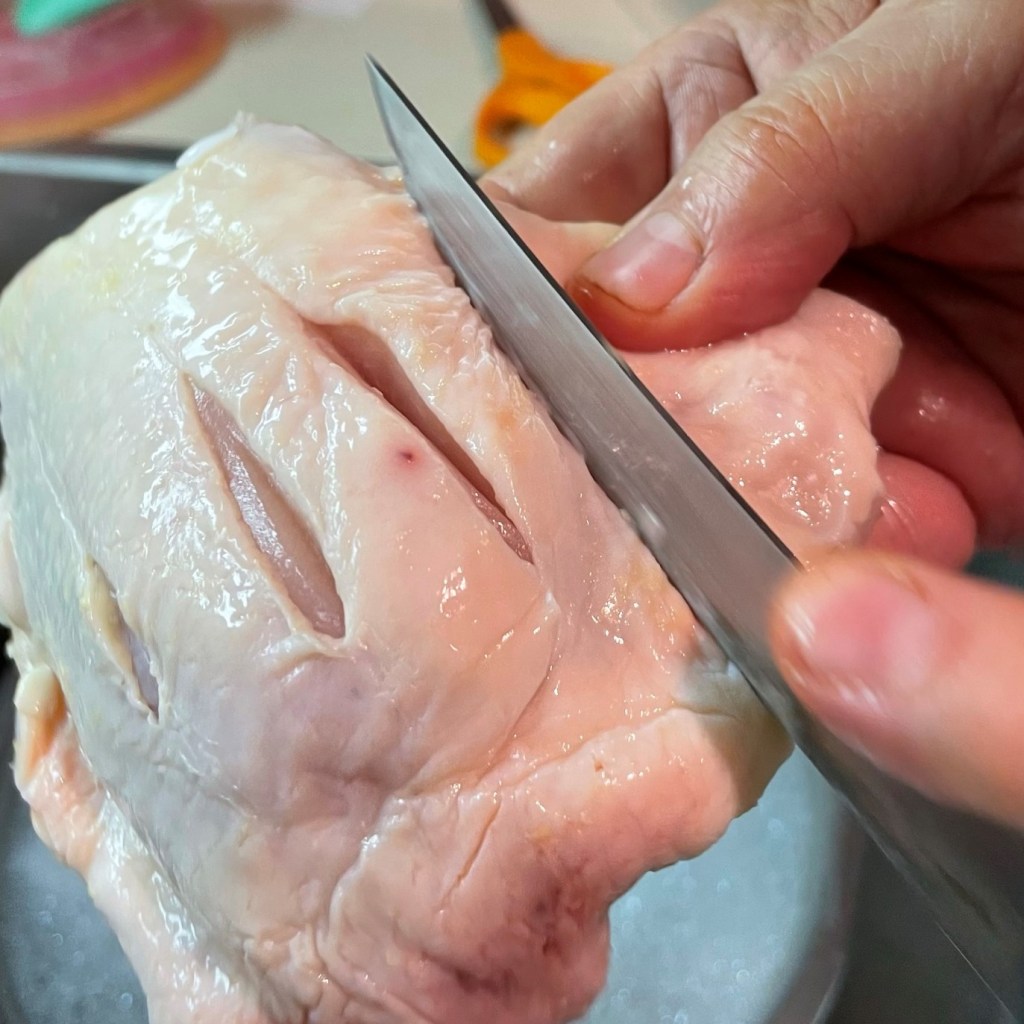
Will prepped the chicken by scoring the skin to season the meat throughout and to help render the fat.
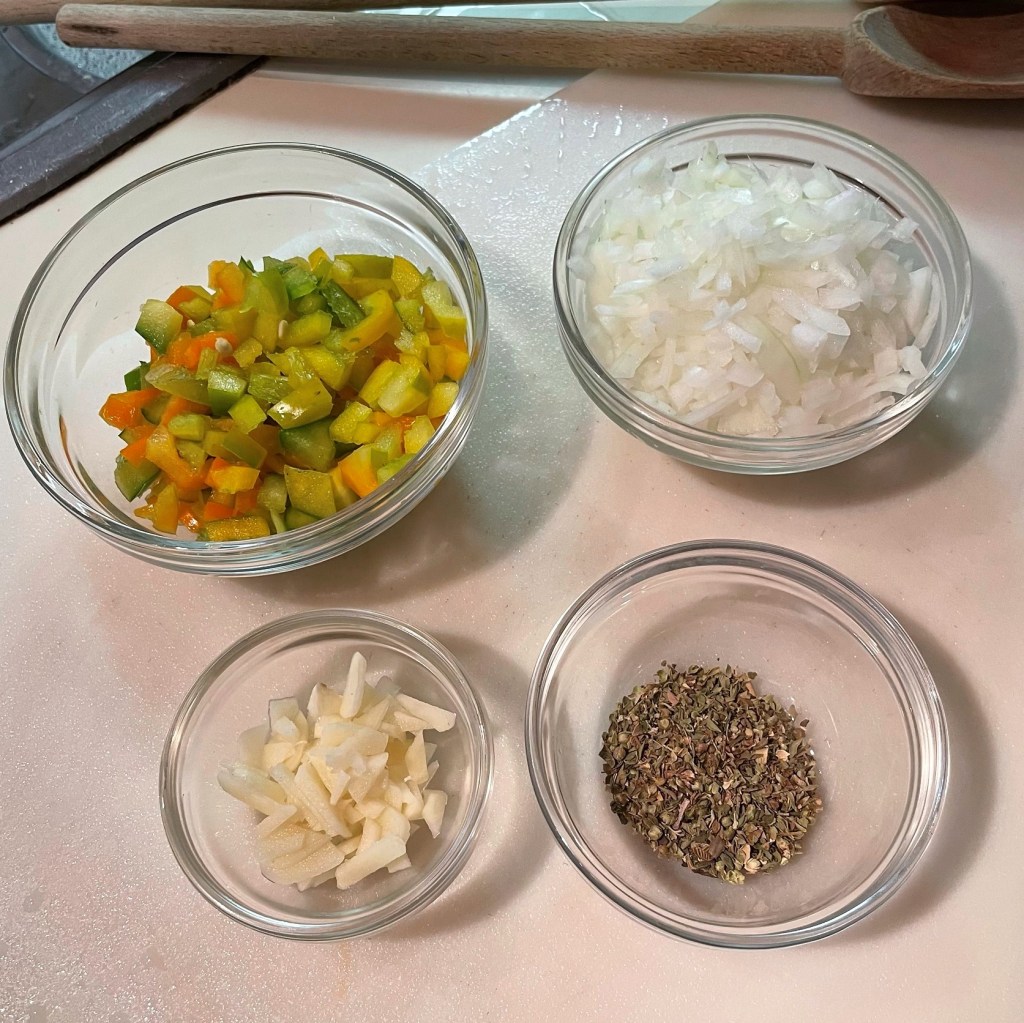
The add-ins: chopped bell pepper, white onion, garlic and oregano with a pinch of basil. I must get some of these cute little prep bowls!
We sprinkled the chicken with Adobo and oregano, then rested it in the fridge while we went out for brunch.
The guys took us to a great local place for brunch. Note to self: everything bagel seasoning makes a fabulous rim on a bloody mary! 🙂
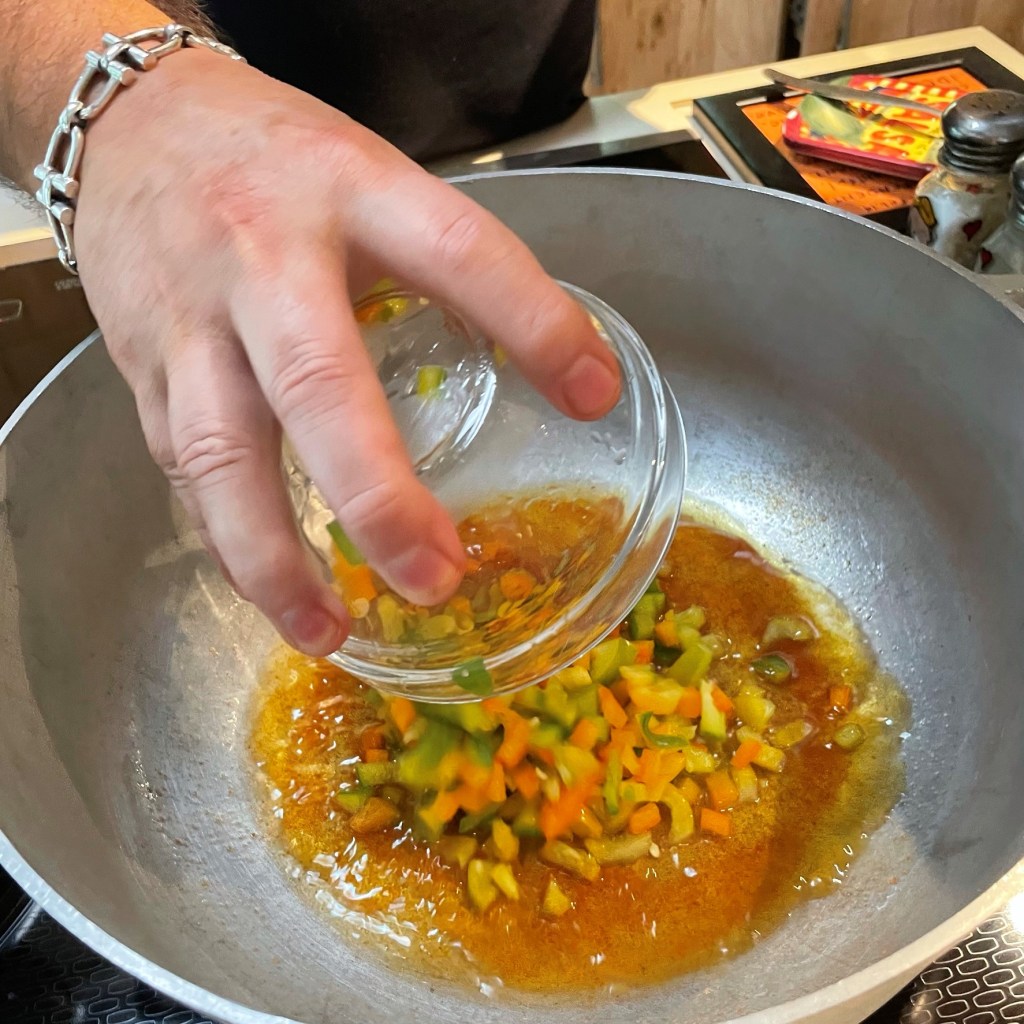
An envelope of the Sazon seasoned the corn oil, then Will began adding all the layers of flavor.
I had a perfect view from the other side of the kitchen island to check out the action!
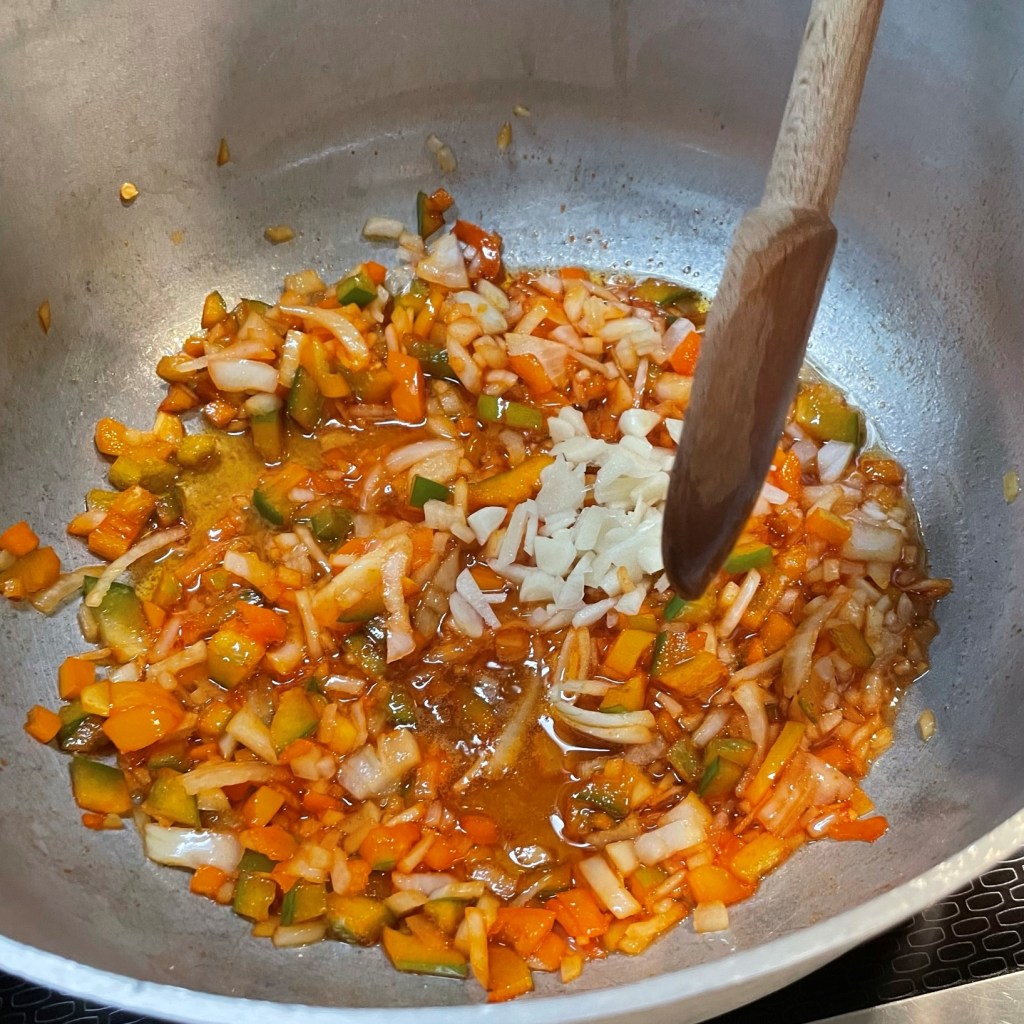
When you have cooked a recipe your whole life, your instinct tells you how much of each ingredient to add. Will used about 1/2 cup each of the sofrito and recaito.
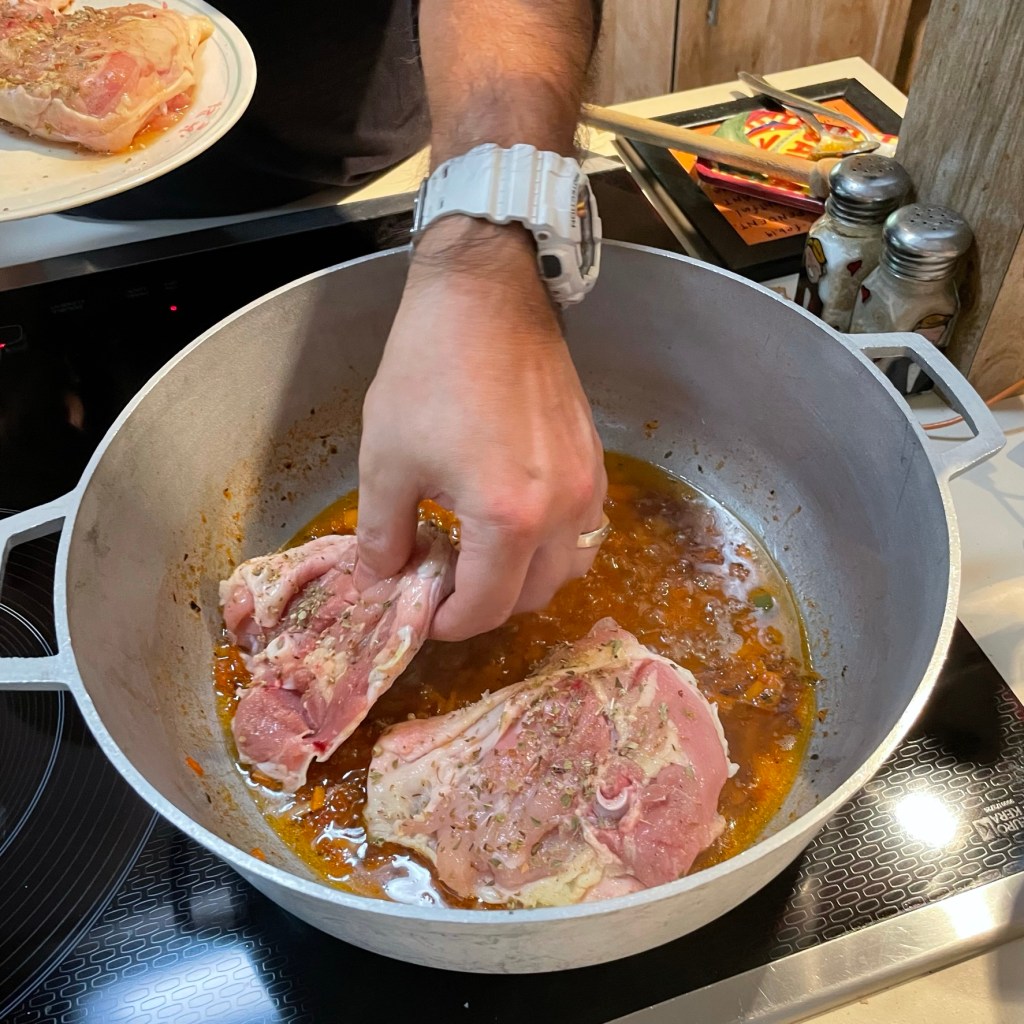
The thighs went into the hot seasoned oil, skin-side down.
After a few minutes, turn the thighs to cook the surface of the flesh side.
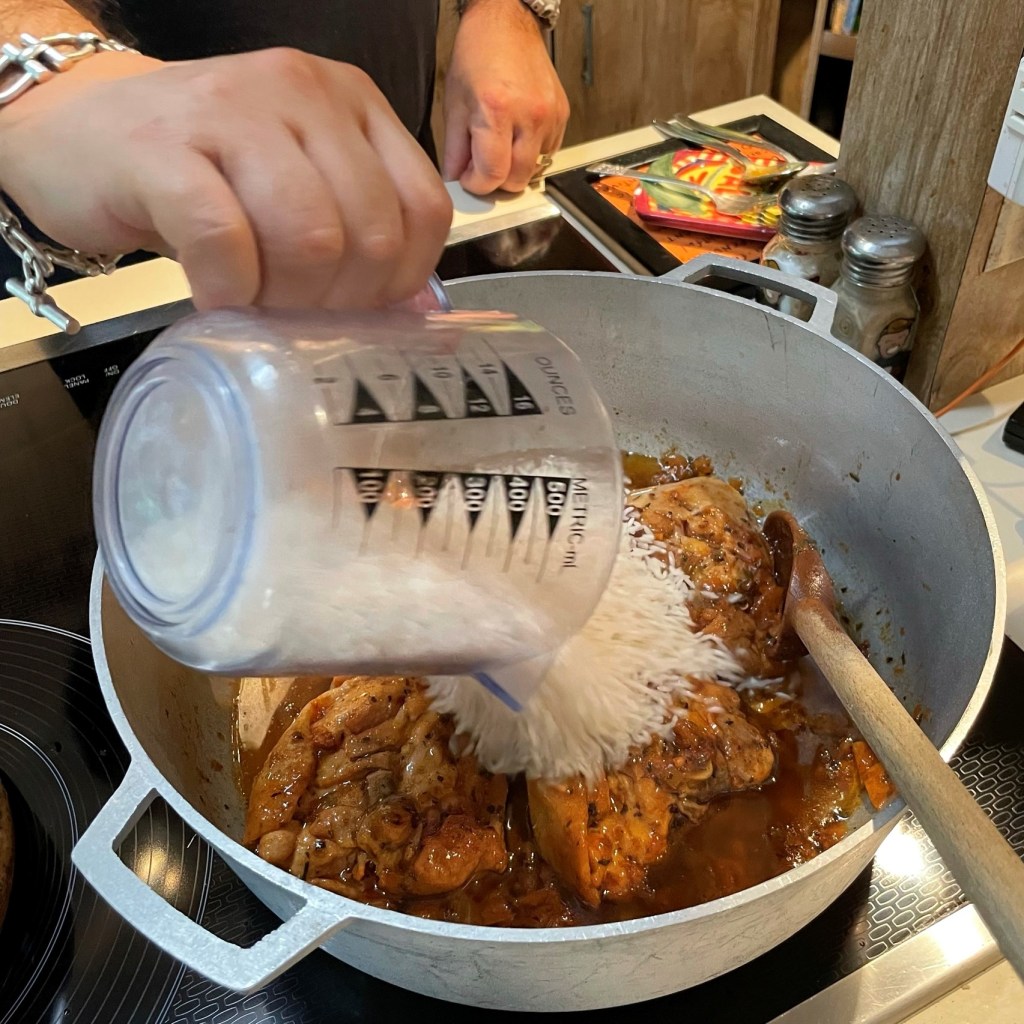
When both sides of the chicken were browned, Will added about two cups of long grain rice.
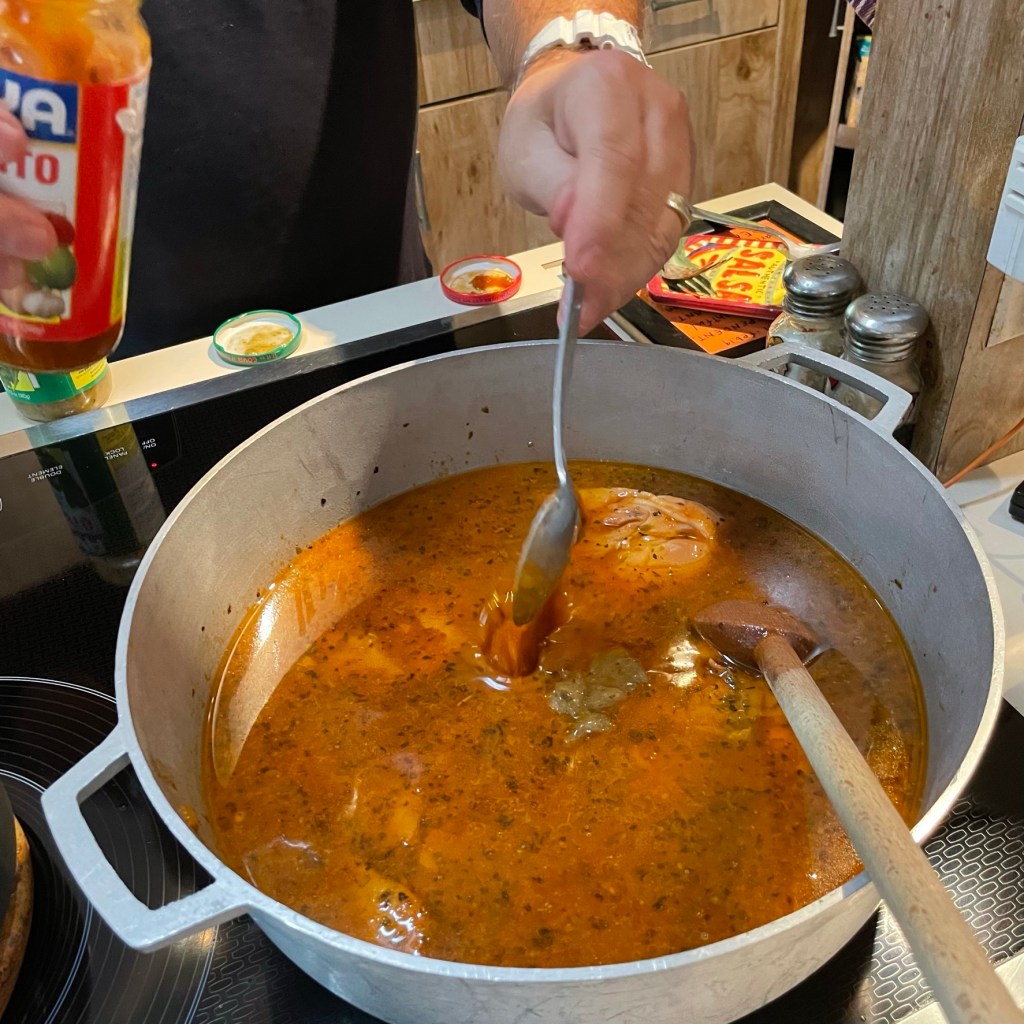
Then, enough water to cover the chicken and roughly one cup of tomato sauce.
Season to taste with a touch more sofrito and recaito.
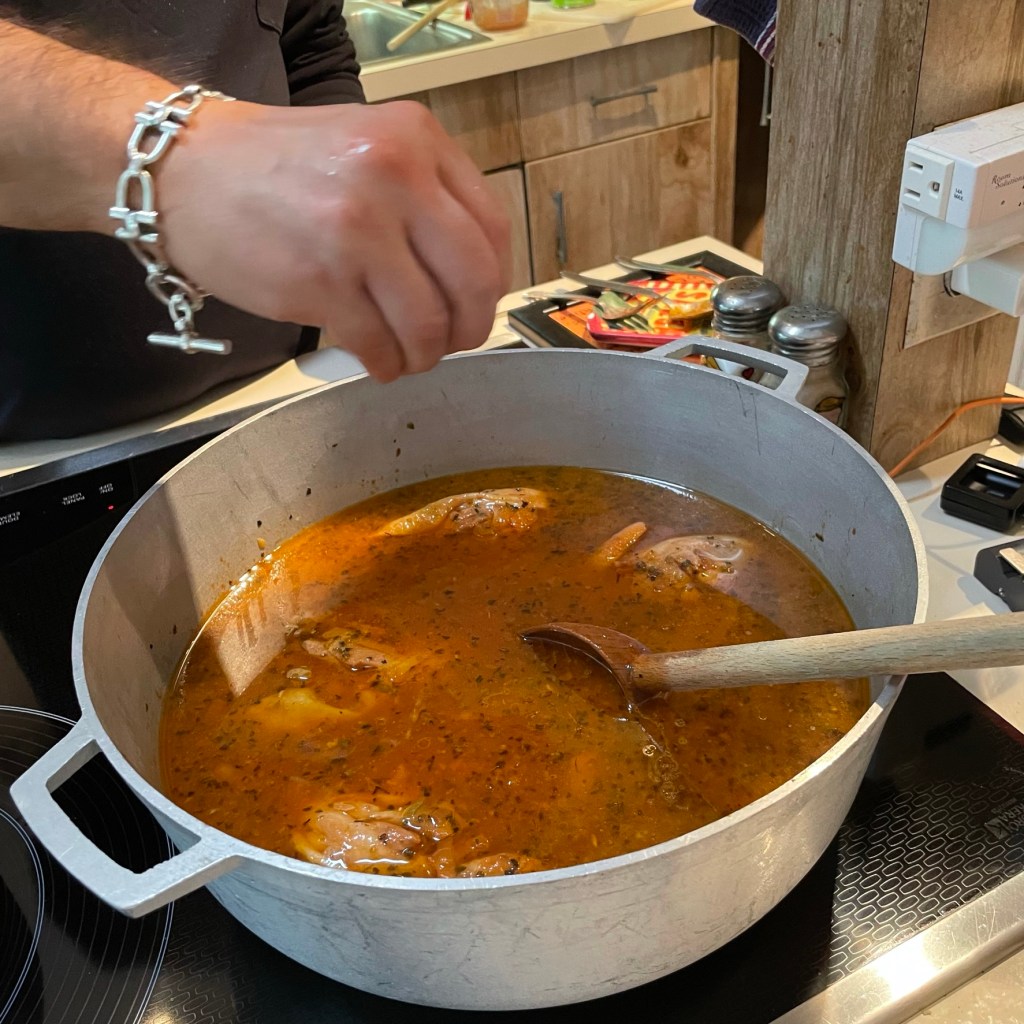
Finally, a pinch…a PINCH of the saffron! 😉
Will’s mother gifted him with the pot he uses for this dish. It is called a caldero, and every Puerto Rican home has one.
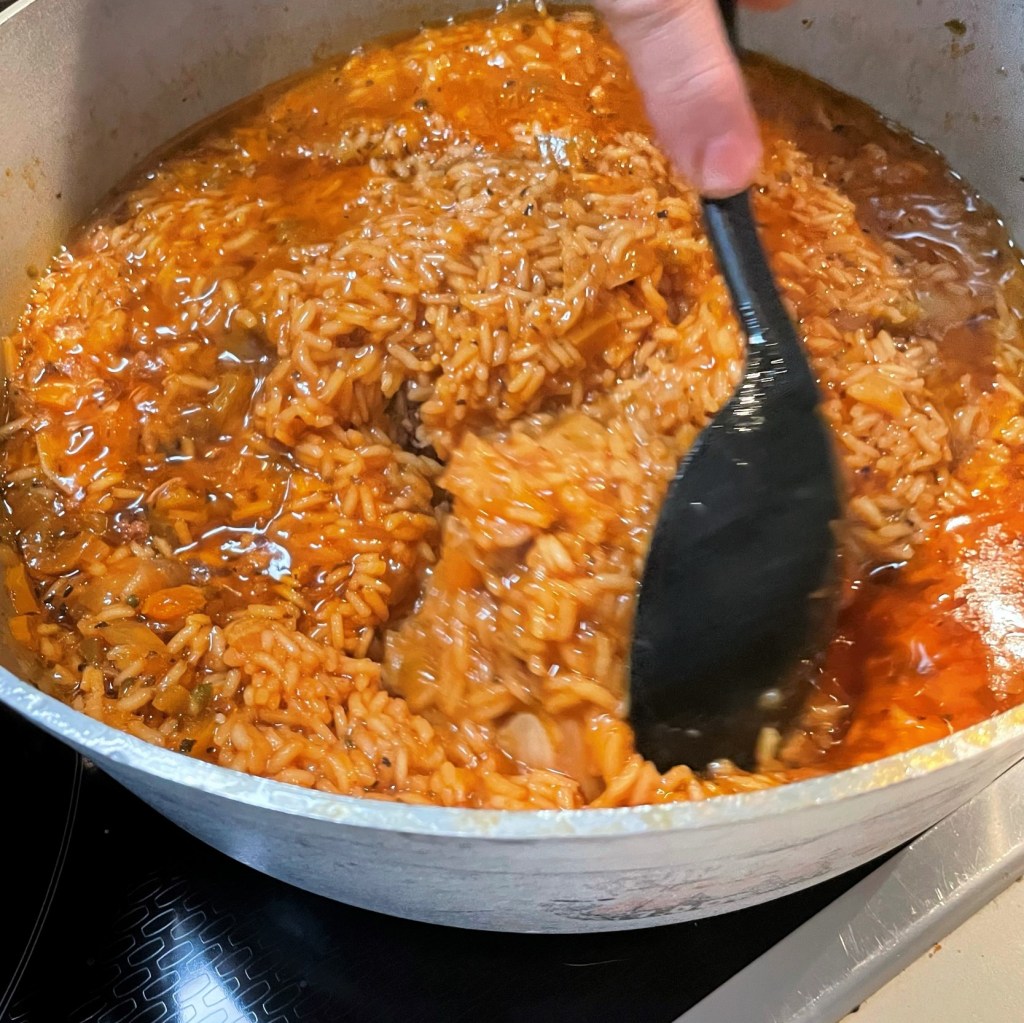
When the mixture came to a boil, he reduced the heat and covered it to simmer. By this time, the kitchen smelled amazing!
After 15 minutes, the rice had already begun to swell and absorb the flavorful liquid. A quick stir, then more simmering.
The arroz con pollo is done when all the liquid is absorbed and the chicken is fall-off-the-bone tender!
Will garnished the plate with crispy fried plantains, another beloved food of Puerto Rico!
The rice that clings to the bottom of the pot is delicious, and I kept sneaking extra forkfuls. It reminded me of paella.
A great day with the cousins. On three, everyone say “sofrito!”
Only Will and I did. See? He and I are a lot alike. 🙂
I spent two years in French class during high school, and that is pretty much all I remember how to ask—“excusez-moi, où est le parapluie?” I suppose it is a question that would have been essential had I become a world traveler (I didn’t), and in fact it was a common question asked among my fellow French club members when we took our senior trip to Quebec City, Canada—they don’t speak much English there, in case you didn’t know. It rained the entire three-day weekend, but it was still a glorious visit to a city rich with history and speckled with exquisite, copper-roofed buildings.
Spanish would undoubtedly have been a more useful class for me, given the increase of Spanish-speaking people in the U.S. since I graduated all those years ago. But there was something sooo sexy about the French spoken word, and well, my best friend signed up for French so I did, too. Our teacher was cool and we got to choose our own names for the class, which was good because there wasn’t a name on the list that was a literal translation for Terrie. My friend Debbie became Christine, pronounced CREE-steen, my friend Christine became Danielle and yours truly selected the name Jacqueline, which was fun to say—zhah-KLEEN, like the French fashion designer who steals Nigel’s dream job in The Devil Wears Prada.
French class was always lively, and we were encouraged to play up the accent and the nasal sound as much as possible. We went through round after round of language exercises, covering the French words for common places, including the bookstore (la librairie) and the library (la bibliothèque) and reciting all the various tenses of the verb words, and for every kind of individual and group instance. For example: for the verb “go,” we would cycle through the French words that meant, “I go, you go, he goes, she goes, we go and they go.” Round and round we went, and after all that repetitious recitation, all I remember how to say is “where is the umbrella?”
Anyway, for me, there is still a lot of mystery and intrigue associated with the French language, and I learned during my short time working in the Pinch of Thyme catering kitchen that if you want people to swoon over food, call it something French! As luck would have it, I do at least remember some of the French words for certain foods, including poulet (chicken), champignons (mushrooms) and carottes (carrots, obviously). I was excited to find this recipe in my most recent digital edition of Imbibe magazine because I have used splashes of vermouth in a few dishes and found it more complex and vibrant than wine, which would traditionally be used for braising chicken in the classic coq au vin. But this recipe was more than a splash, it was a generous amount in a very French-technique kind of recipe.
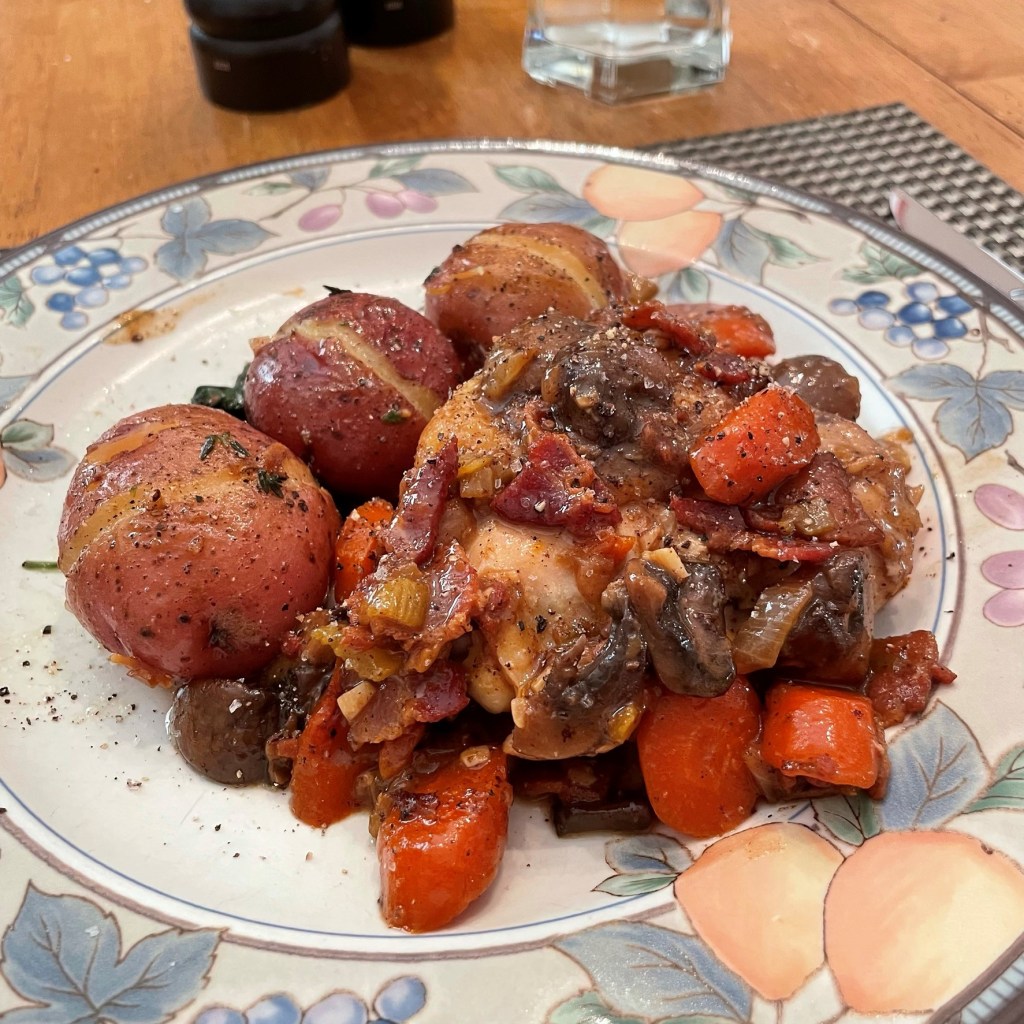
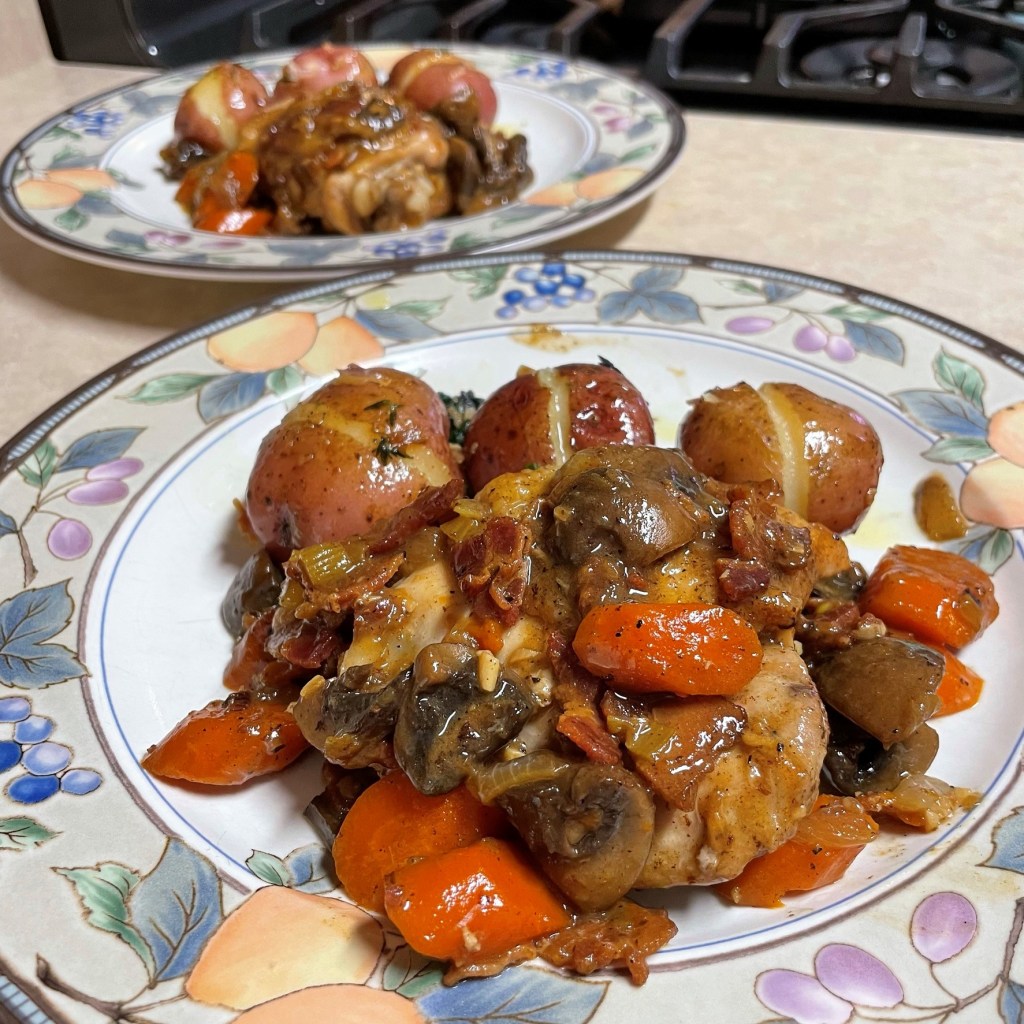
I could not resist turning this into a Sunday Supper meal, with a side of buttered red bliss potatoes and sauteed spinach, and it was—how shall I say—très délicieux!
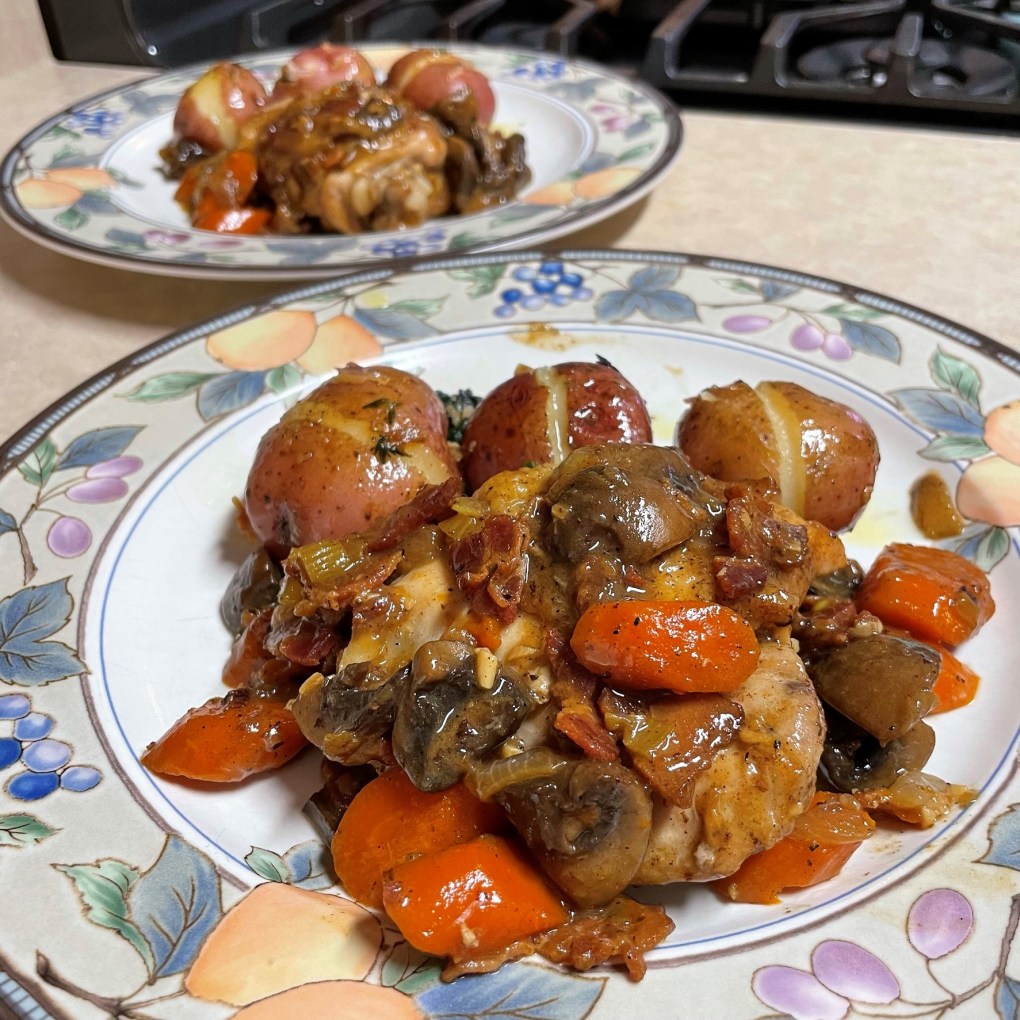
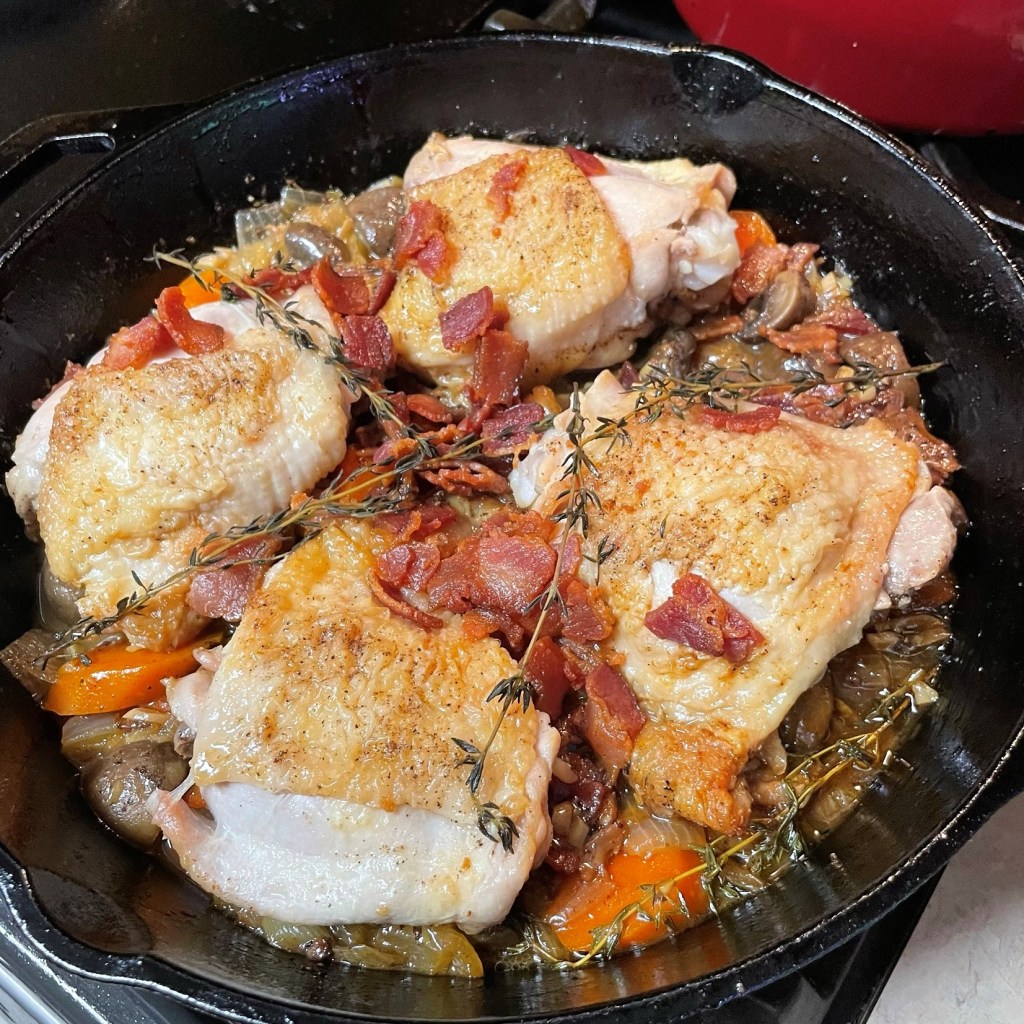
This dish was rich and succulent, exactly as it should be. The chicken thighs remained tender and moist.
A word or few about vermouth…
I have known about vermouth for decades, but it has only been the past couple of years that I have become more closely acquainted with it, and today I almost always have a bottle open in the fridge for an end-of-day gin martini. Vermouth is a fortified wine, which means other alcohol has been added to grapes during fermentation, and that results in higher alcohol by volume than typical wine. Any variety of botanical ingredients are thrown into the process as well, including herbs, bitter ingredients, bark, roots and spices. Vermouth may be red or white, dry or sweet or really sweet, depending on its origin and method, and it is commonly used as an ingredient for classic cocktails, including martinis and Manhattans. Vermouth, on its own, is also a popular apéritif (pre-dinner drink) in Spain, Italy, France and my house.
In a literal French-to-English translation, coq au vermouth would demand use of a rooster, but it is not every day that you’d find such a creature in your local market. Large hen thighs is what I used for the recipe, and it was tender, flavorful and oh so fancy. Don’t be intimidated, though, because despite all of the foreign language I’ve been throwing around, this was a very simple dish to make. All you need is a cast iron skillet, chicken thighs, bacon, mushrooms and mirepoix—oops, another French word that is simply a mix of carrots, onions and celery. All that, plus a decent amount of dry white vermouth. Don’t worry, vermouth is easy to find, wherever you might buy wine. To keep the recipe true to its origin, choose a brand from France. I used Dolin Vermouth de Chambéry, dry, in the green bottle. 😊
This is one of my go-to vermouth brands for Gibson cocktails: 2 oz. dry gin, 1/2 oz. dry vermouth, shaken or stirred with ice, strained into a cocktail glass and served with a pickled pearl onion.
4 large, free-range chicken thighs (bone-in and skin-on)
Kosher salt and freshly ground black pepper
1/2 medium onion, sliced or diced
2 medium carrots, peeled and cut into thick diagonal slices
2 stalks celery, cleaned, ribs removed and diced
3 cloves garlic, smashed and sliced
About 1 cup cremini mushrooms, cleaned and cut into quarters
1/2 cup dry vermouth (extra dry would be fine, also)
1/4 cup low-sodium vegetable broth
2 fresh sprigs of thyme
2 Tbsp. cold butter
Juice of 1/2 fresh lemon
Instructions
Let’s run through it in pictures first, and if you keep scrolling, you’ll find the instructions spelled out (in English), and I’ll also include a downloadable PDF for your recipe files.
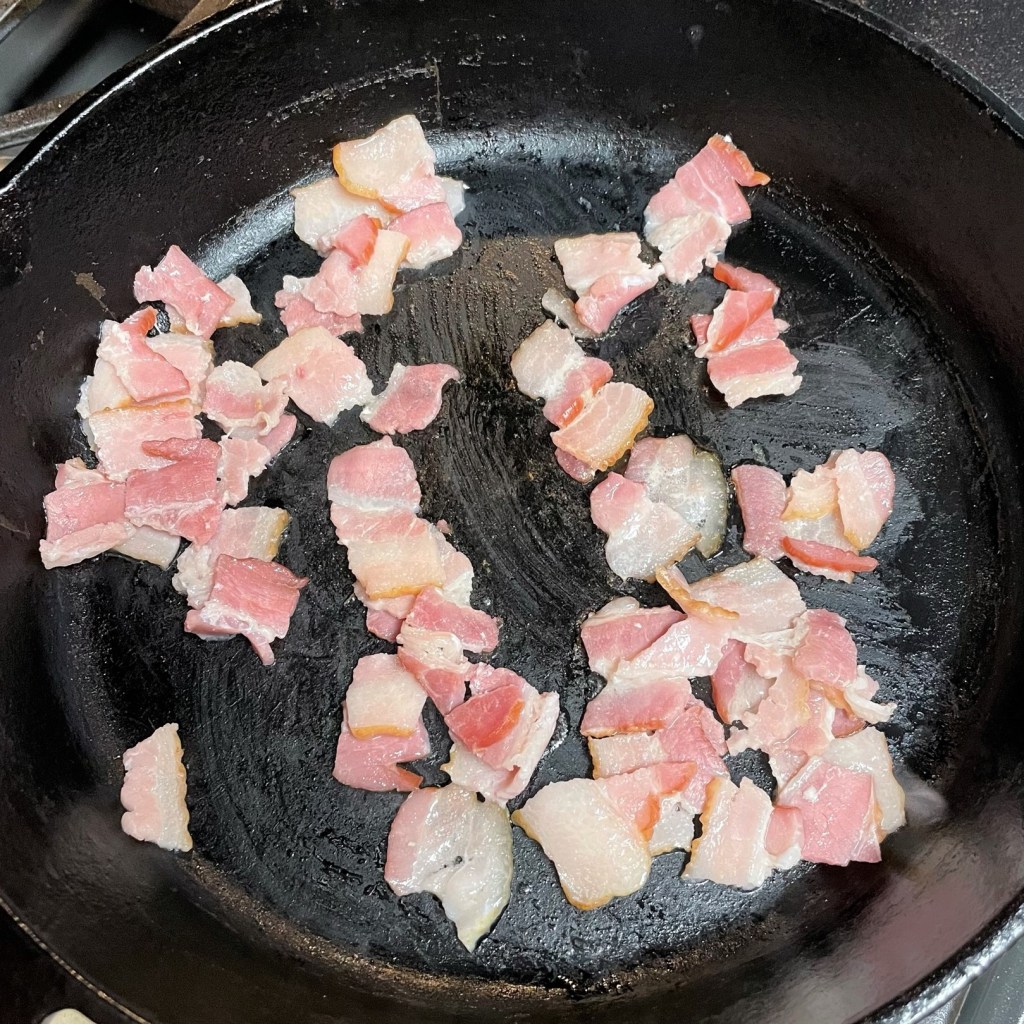
For this recipe, I used bacon with a slightly smoky flavor. Cook in the skillet until the fat renders somewhat and the edges of the bacon are crispy.
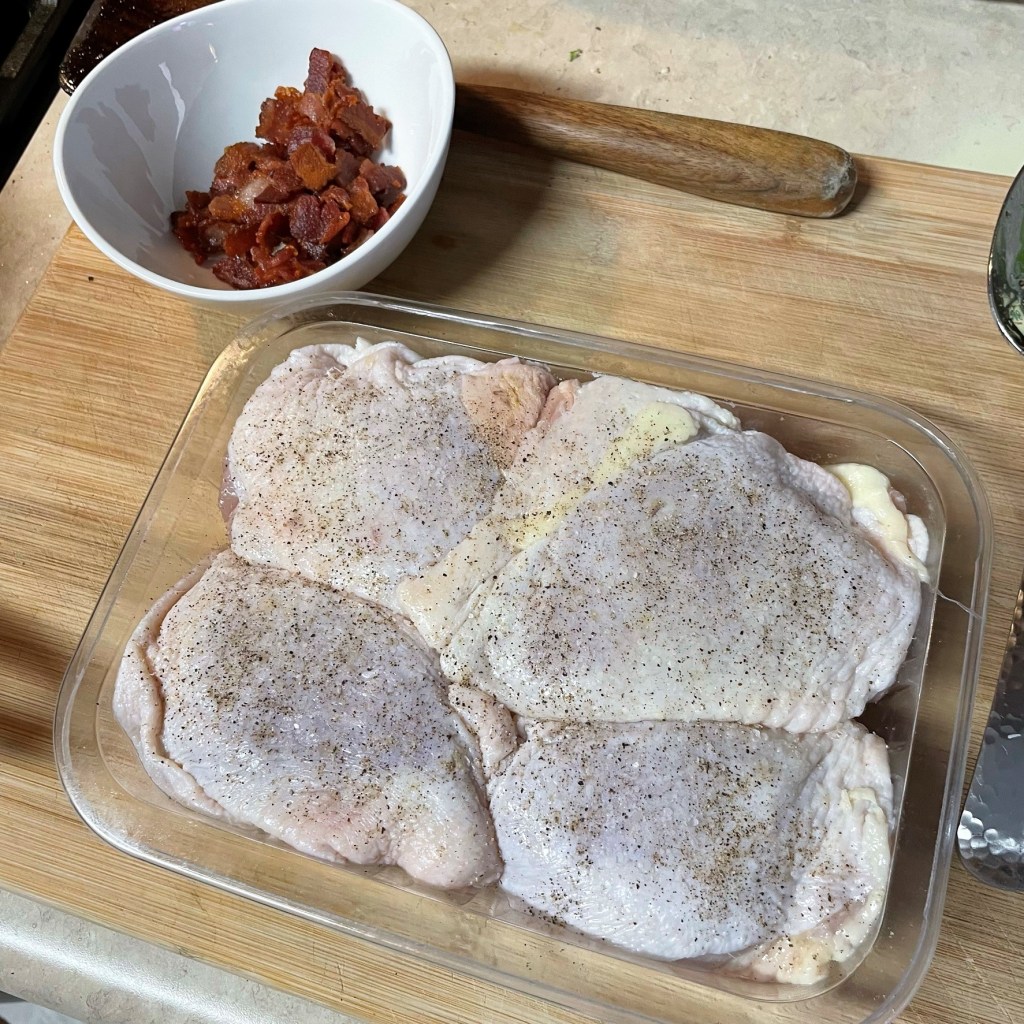
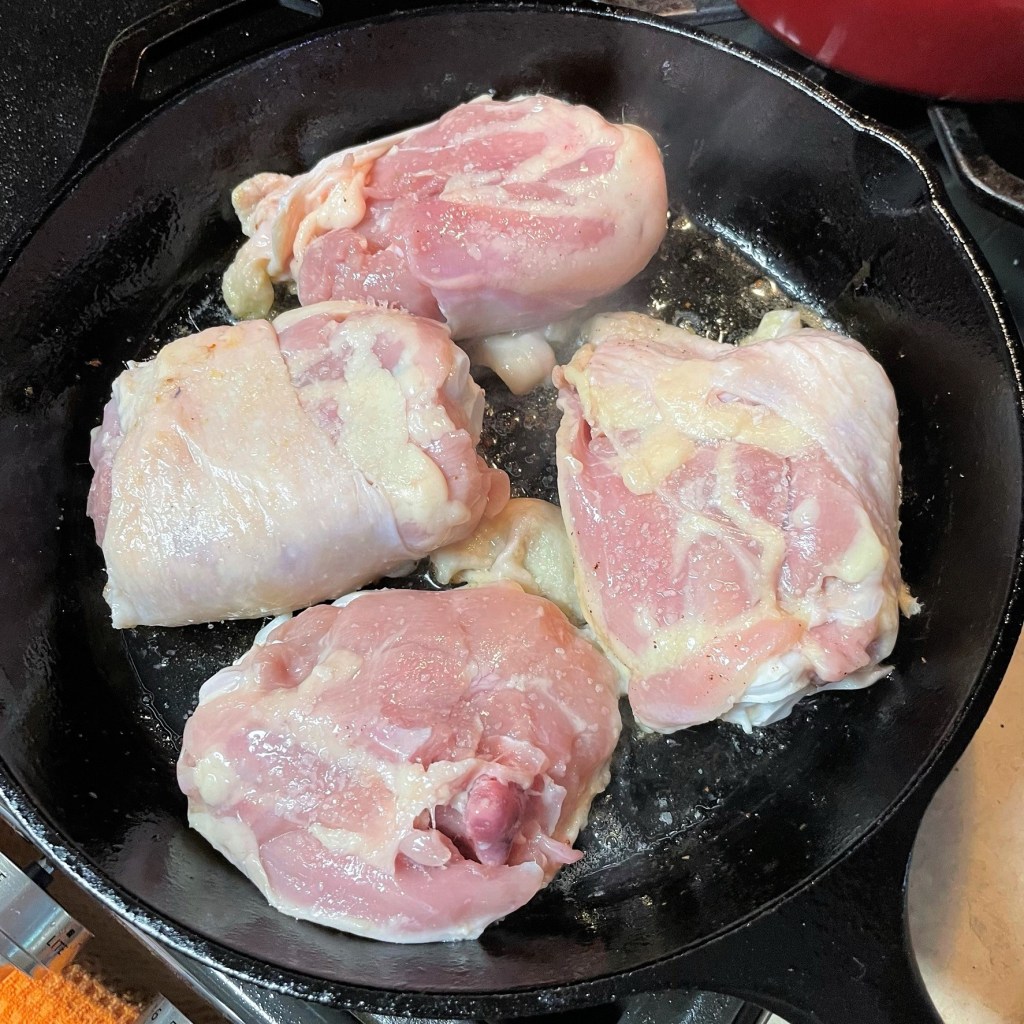
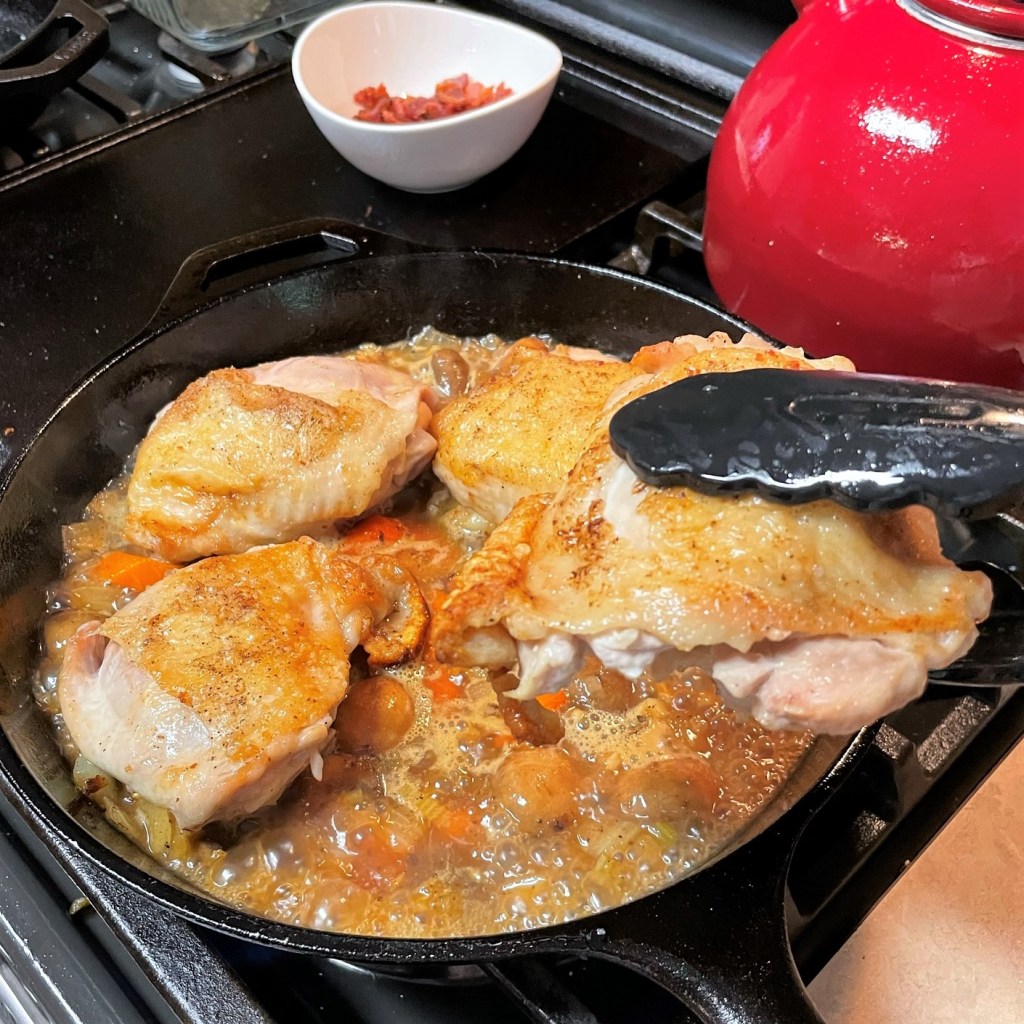
There is no need to rinse chicken parts. Simply pat them dry and season liberally with salt and pepper before frying.
Keep your spatter screen handy, because the thighs will pop and spew as you crisp up the skin!
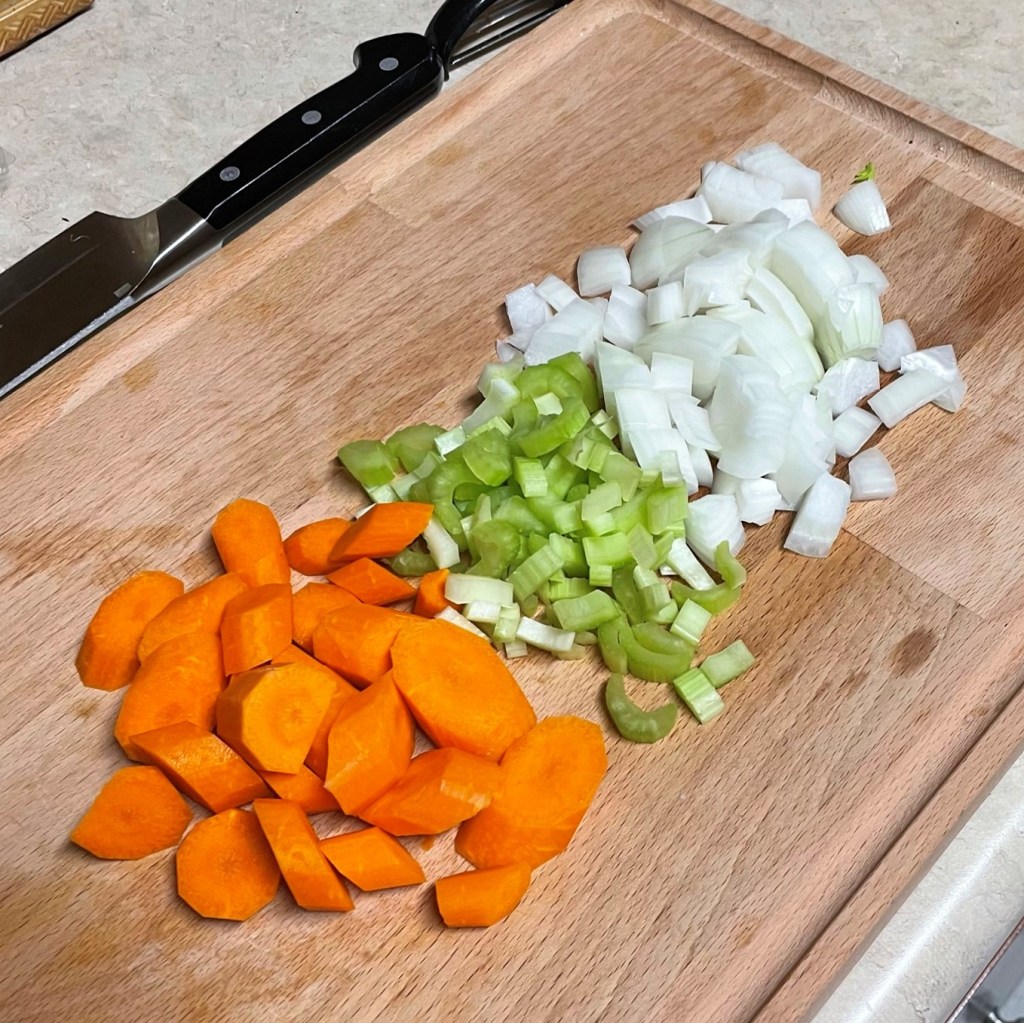
This three-ingredient combo is called “mirepoix” and it sounds almost like you are saying “mirror pwah.” These aromatics are essential in the base of many French dishes.
I’m very fond of these drippy pan leavings. Actually, “fond” is what a French chef would call it. Keep it, because there is incredible flavor lurking in the skillet.
Saute the mirepoix in the fond until the onions and celery are slightly softened.
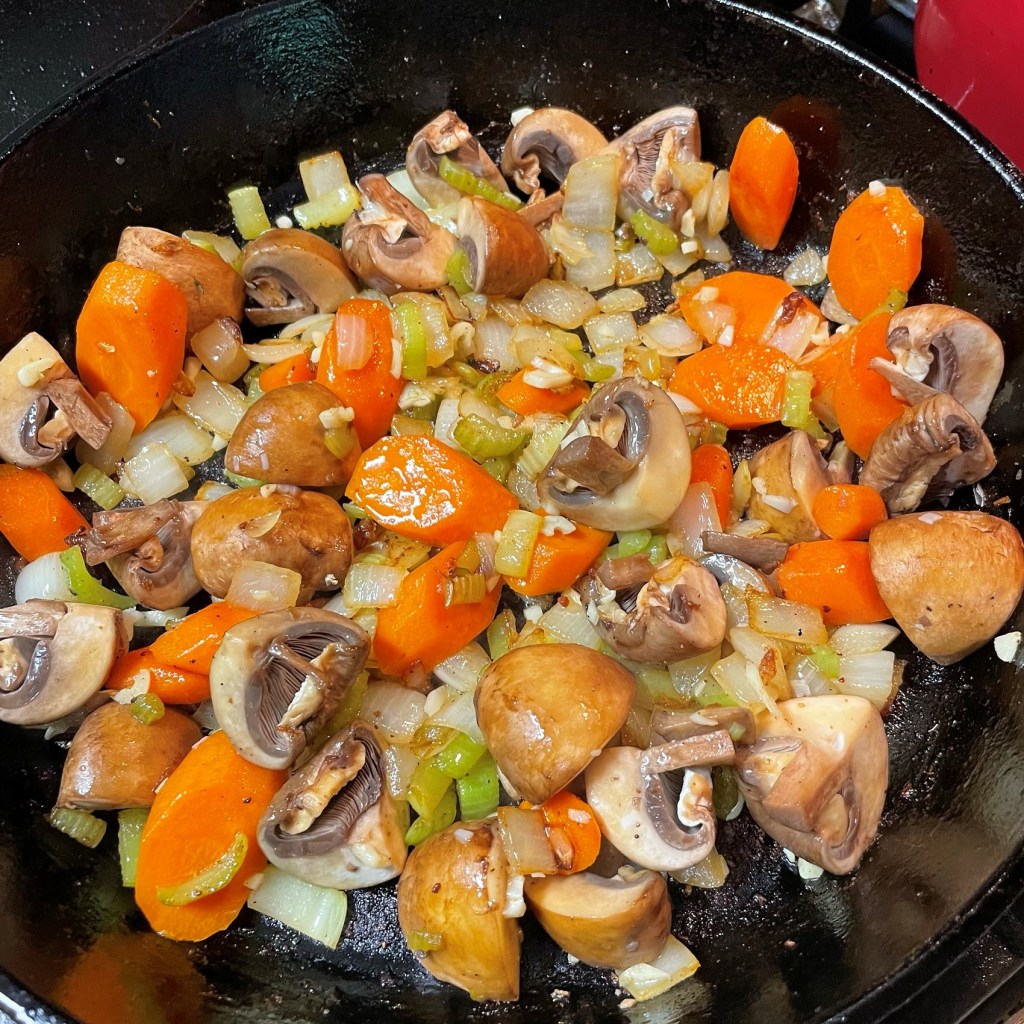
Add the quartered mushrooms and garlic to this medley mixture, which the French would call a “mélange.”
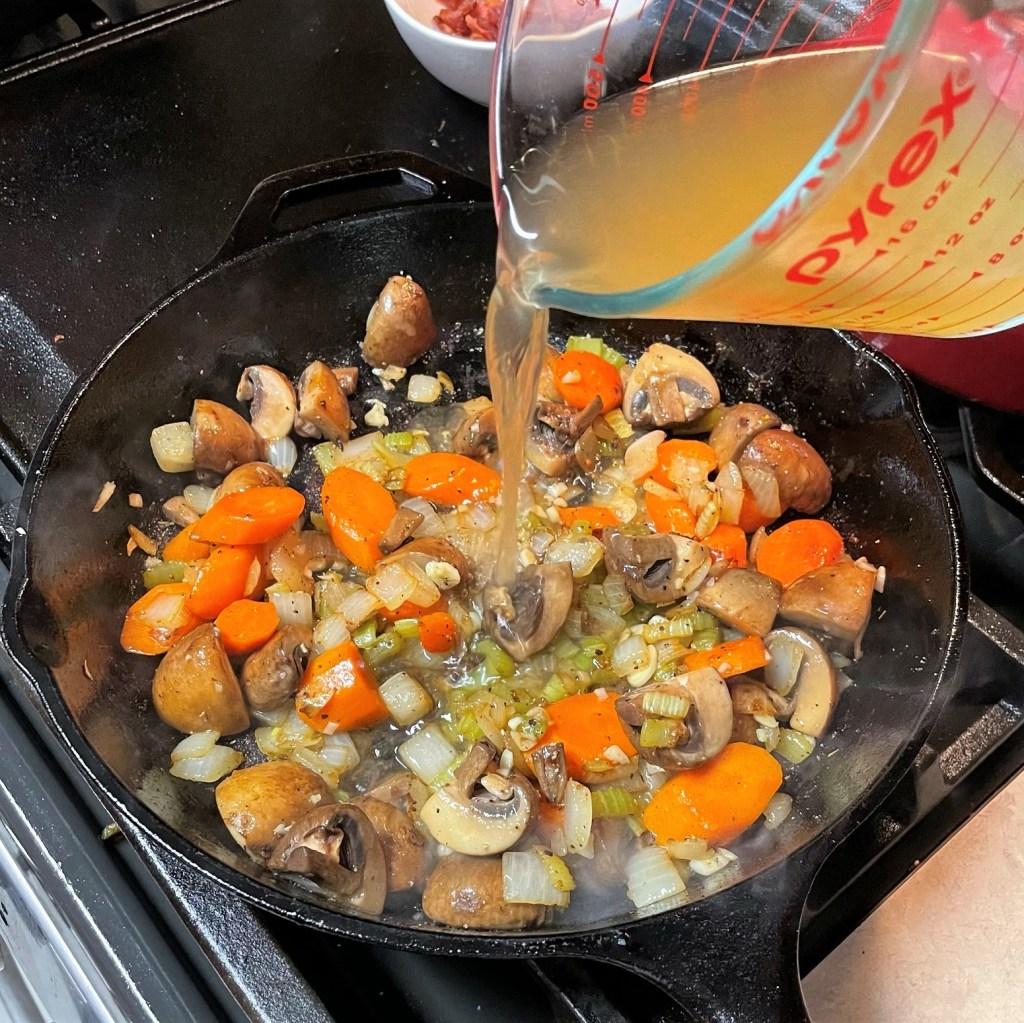
The broth-vermouth mixture will de-glaze the skillet, picking up all that lingering flavor for you to enjoy.
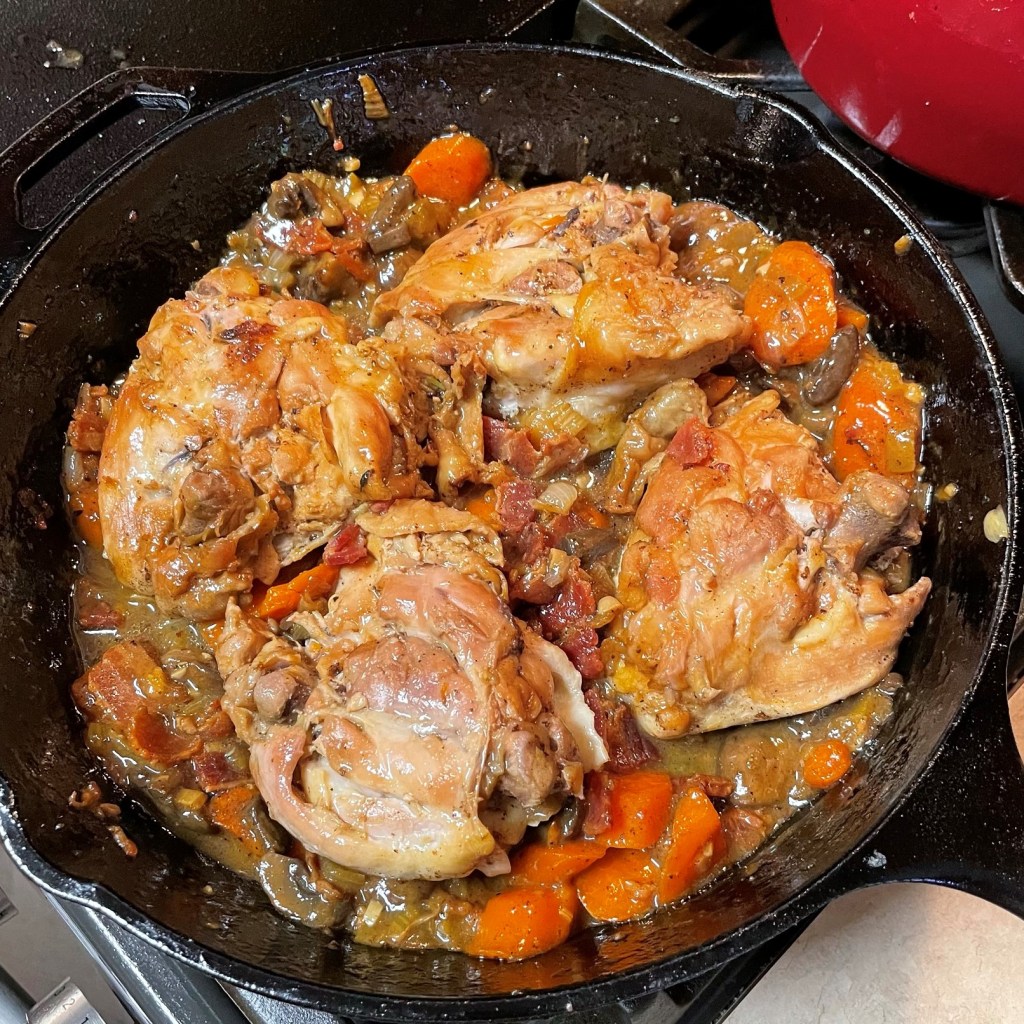
Arrange the crispy thighs right on top of the mélange, Note that they will not stay crispy, but searing them rendered the chicken fat into the skillet, and fat = flavor.
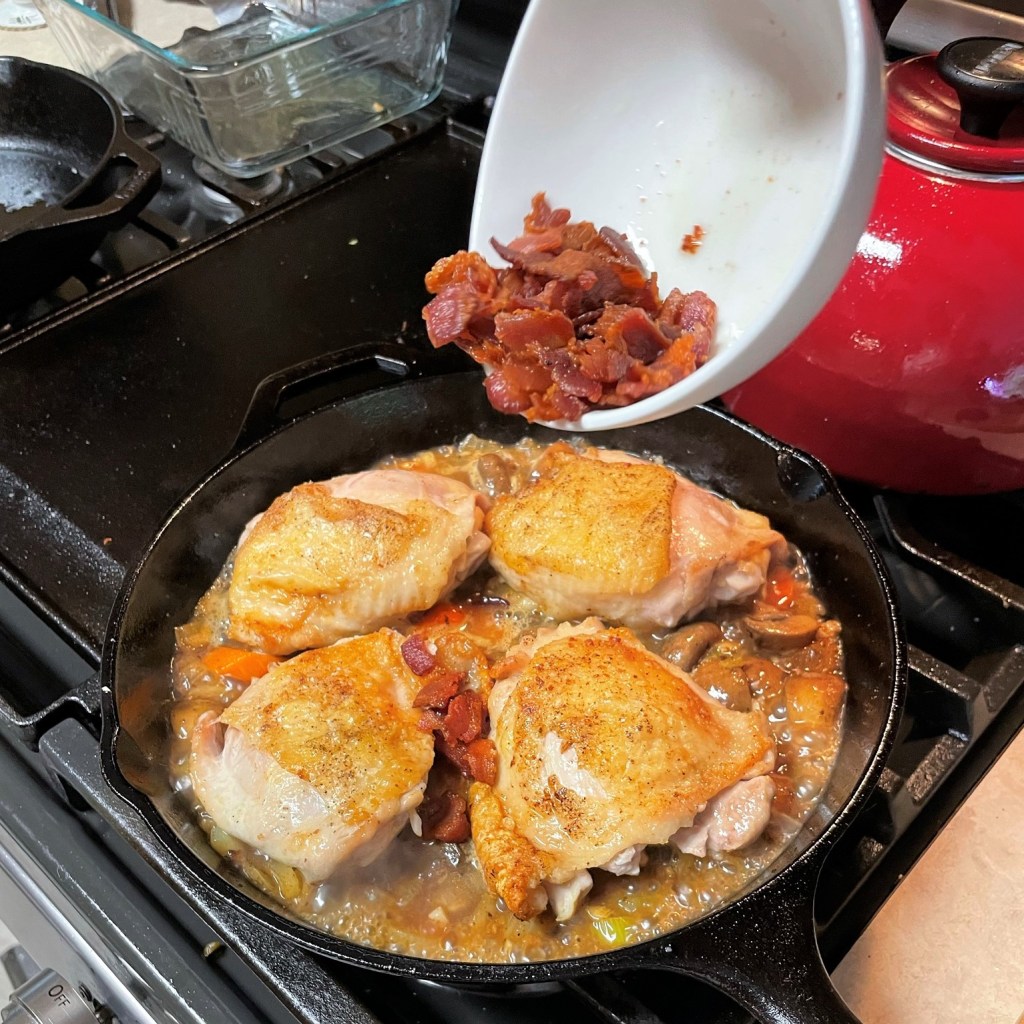
Scatter the crispy bacon all over the skillet ingredients.
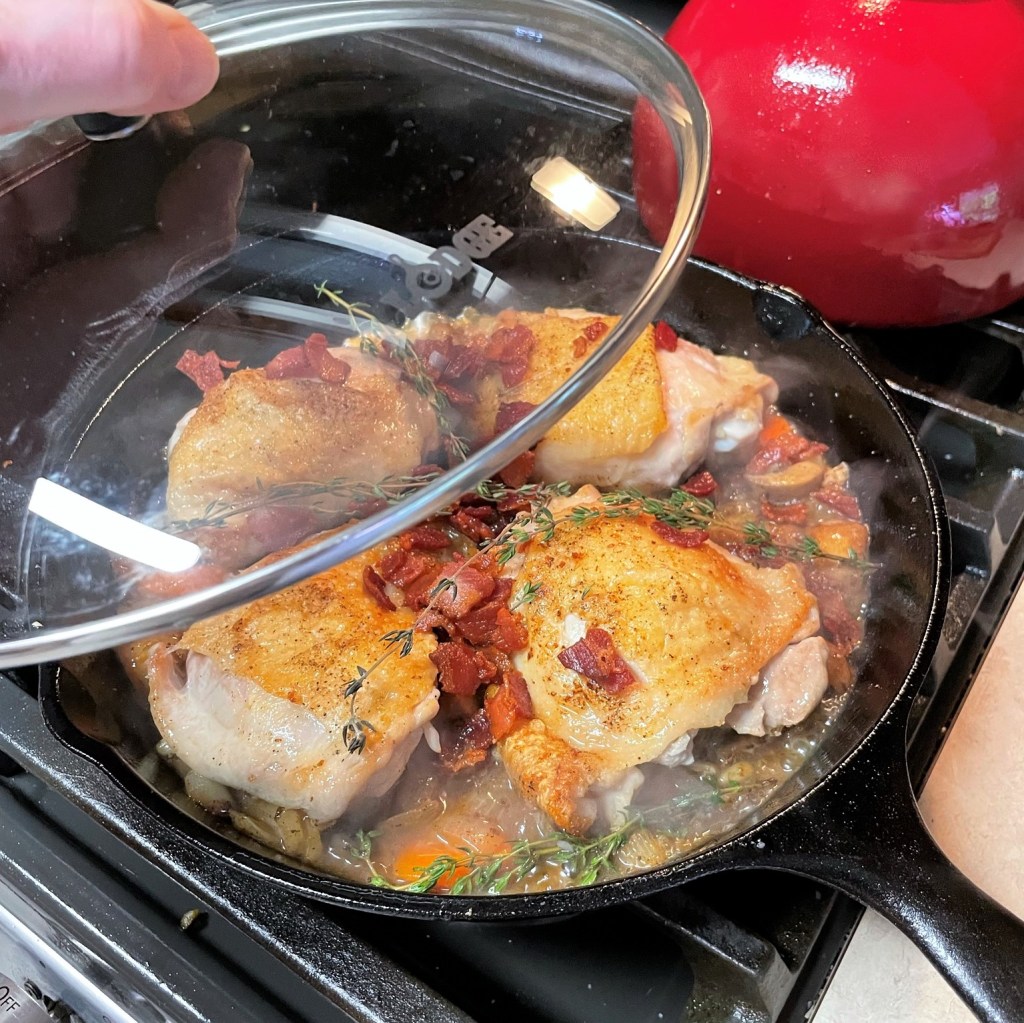
Lay the thyme leaves across the whole thing, and cover the skillet. Reduce the heat to simmer for about half an hour. Just enough time to enjoy a dry martini. 🙂
At the end of simmer time, the chicken skin has softened again, delivering all the flavor back into the skillet. Discard the thyme sprigs and transfer the chicken to a separate dish.
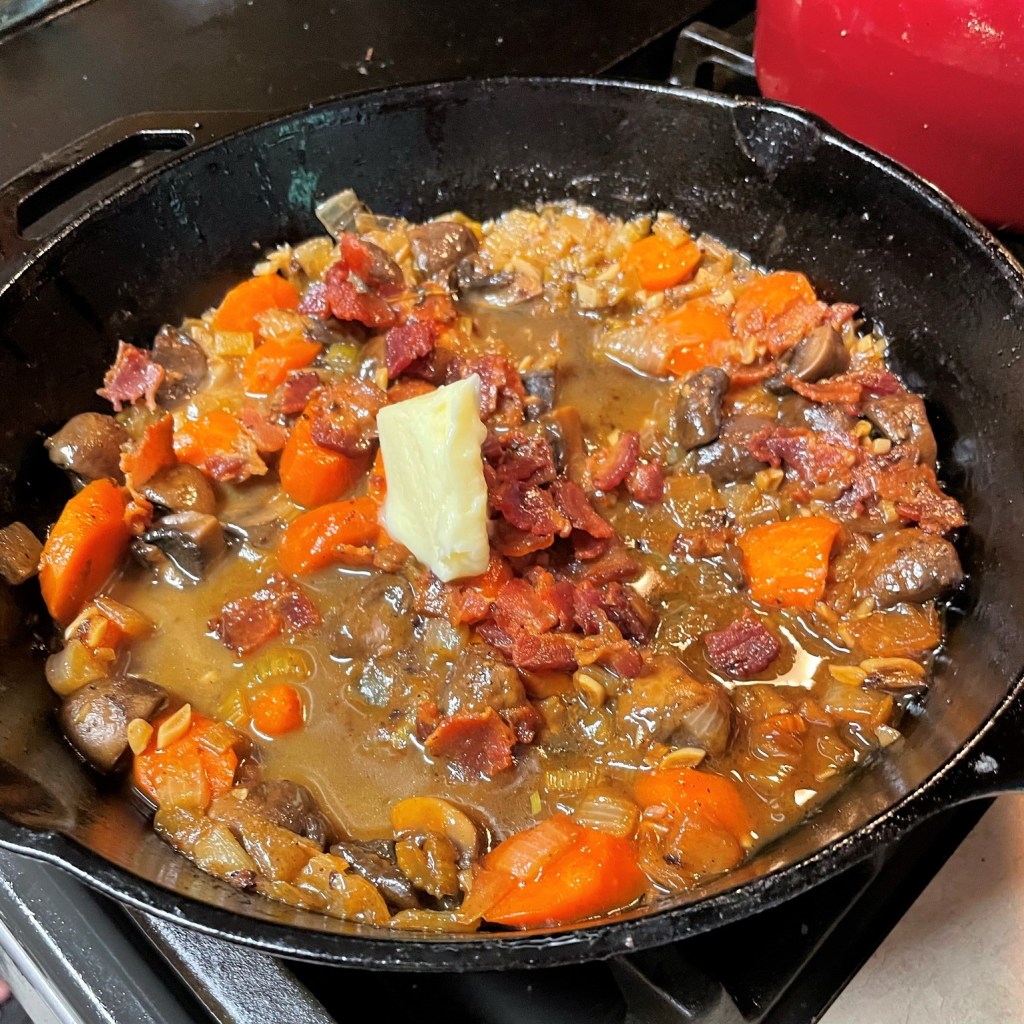
It’s easy to see how rich the mélange is already, but we will push the envelope by blending in the butter. Add a squeeze of lemon at this point, too.
I gave the chicken thighs one final, skin-down dip into the mixture before plating.
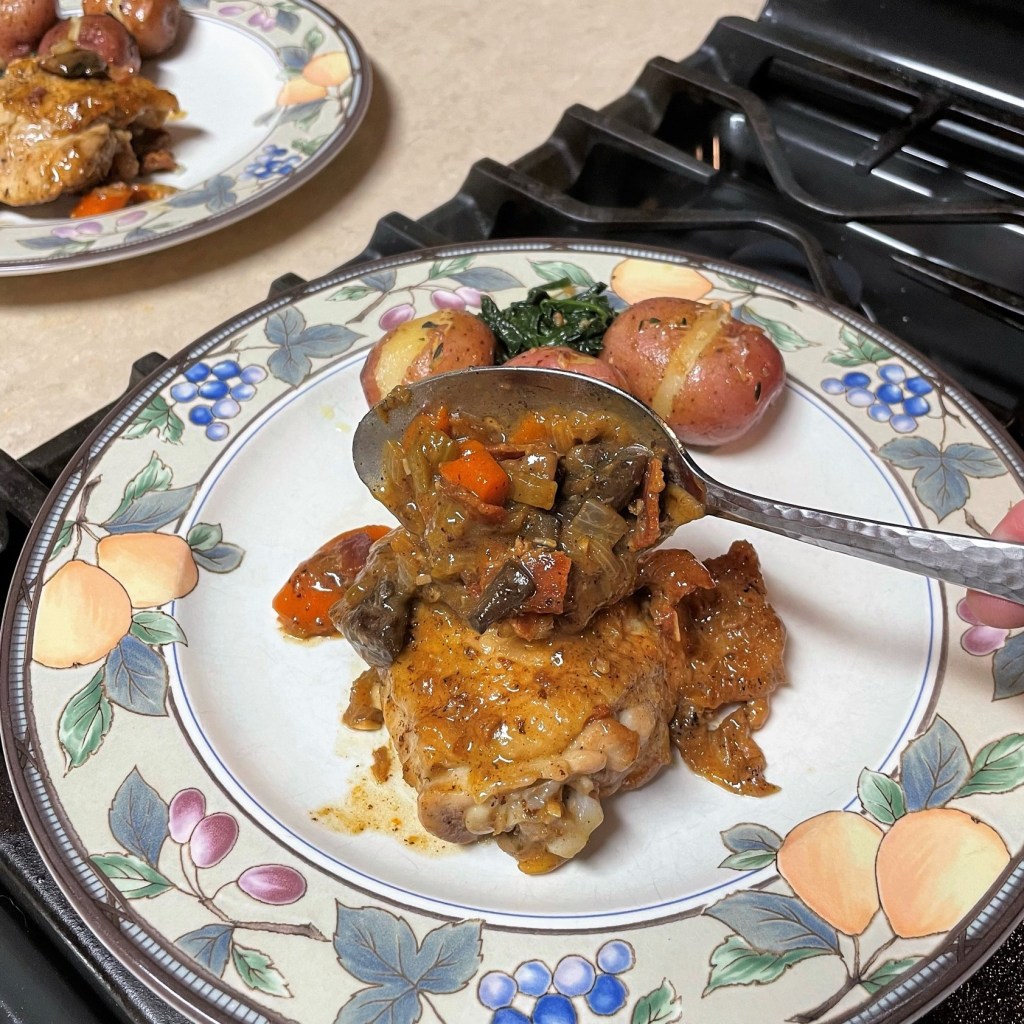
Plate the chicken thighs, and spoon a generous amount of the vegetable mélange over the top of each piece.
Every bite of this meal was utterly delicious! The ingredients are simple, and it all happens in one skillet.
Place a cast-iron skillet over medium heat. Season the chicken thighs liberally with salt and pepper. Cook the bacon until the fat is rendered and the edges begin to crisp. Transfer the pieces to a paper-towel lined dish, keeping all the bacon grease in the skillet. Arrange the chicken thighs, skin side down, into the skillet. Cook them until the skin is crispy and golden, then turn the pieces and cook the other side about two minutes.
Transfer the thighs to a plate and cover loosely with foil to keep them warm. Add the mirepoix (carrots, onions and celery) to the fond (pan drippings) in the skillet. Cook over medium heat until the vegetables begin to soften. Add the garlic and mushrooms, tossing with the other vegetables until slightly browned. Pour in the vermouth and vegetable broth, and simmer for about two minutes.
Return the chicken thighs to the skillet, skin side up. Sprinkle the bacon pieces over the top and lay the whole thyme sprigs in a criss-cross fashion over the combination. Reduce the heat to low, cover the skillet tightly and simmer about 30 minutes.
Remove and discard the thyme sprigs. Transfer the chicken thighs to a plate. Add the cold butter and lemon juice to the simmered vegetable mixture and stir until it is a rich, luscious sauce. Just before plating, place the thighs, skin side down, into the skillet to drench them in the sauce. Plate the chicken, then spoon the simmered vegetable mixture (a.k.a. mélange) over the thighs.
Leave it to the French to take a mountain of sliced onions, a bit of broth and a few Provencal herbs and transform them into a heavenly, melt-in-your-mouth soup. The dismal weather that has become something of a default around here this winter has had me in the soup mood, and this one is astonishingly simple—from ingredients to technique.
One thing that sets French onion soup apart from others is the amount of time spent simply preparing the onions. You can use a mandolin or processor to make quick work of slicing them, but there isn’t much you can do to speed up the cooking. In a Dutch oven on the stovetop, it can take up to two hours to properly caramelize the onions—that is, to draw out their moisture and let all the natural sugars burst forth. If you work too quickly, you’ll have sautéed onions, but they won’t have the luxurious sweetness that is a signature of French onion soup. One way to get this done with minimal fussing is to use a slow cooker, set on the lowest setting. Another is to caramelize them in the oven, allowing a low-and-slow transformation, perhaps even overnight. The extra effort and preparation time has landed this soup in the Sunday Supper category here on Comfort du Jour, but I promise—however you approach the whole onion caramelization thing, it is well worth the wait.
If you’re the make-it-all-yourself type, feel free to slow roast some beef soup bones and make your own stock, too. I had a momentary lapse of reason and tried this myself, but mainly ended up with a bucket full of tallow and two sinks completely filled with dirty pots and bowls. As far as I can tell, a good quality store-bought stock is a gift from heaven, so that’s what I used. Make it vegetarian with a good vegetable stock or combine the two as I did for wonderful layers of flavor.
The final touches on top of French onion soup are toasted baguette or bread slices and melty shredded Gruyere cheese. Yes, it’s a luscious bowl of classic French comfort food that is guaranteed to warm you up in these final weeks of winter.
The melty cheese on top makes this soup even more satisfying!
1/2 cup dry wine (red or white, for deglazing the pot)
8 cups (2 quarts) low-sodium broth or stock (beef, vegetable or combo)
Crusty French bread slices (toasted, for serving)
Shredded Gruyere or Swiss cheese (about 2 Tbsp. per serving)
*Notes
Herbes de Provence is a blend of seasonings native to the Provencal region of France, and the brand I use includes thyme, rosemary, garlic, lemon peel and lavender. The combination of this seasoning is aromatic and typically used somewhat sparingly, but it is such a central flavor to French onion soup, I’ve used a good amount in this large batch. As always, take note of the salt content of any seasoning blend you use so that you can adjust the overall salt accordingly.
Instructions
I’ll walk you through it, and you’ll find written instructions below, plus a link to download the recipe for your files. 🙂
A whole stick of butter may seem like a lot, but this is a large batch of soup, about eight servings.
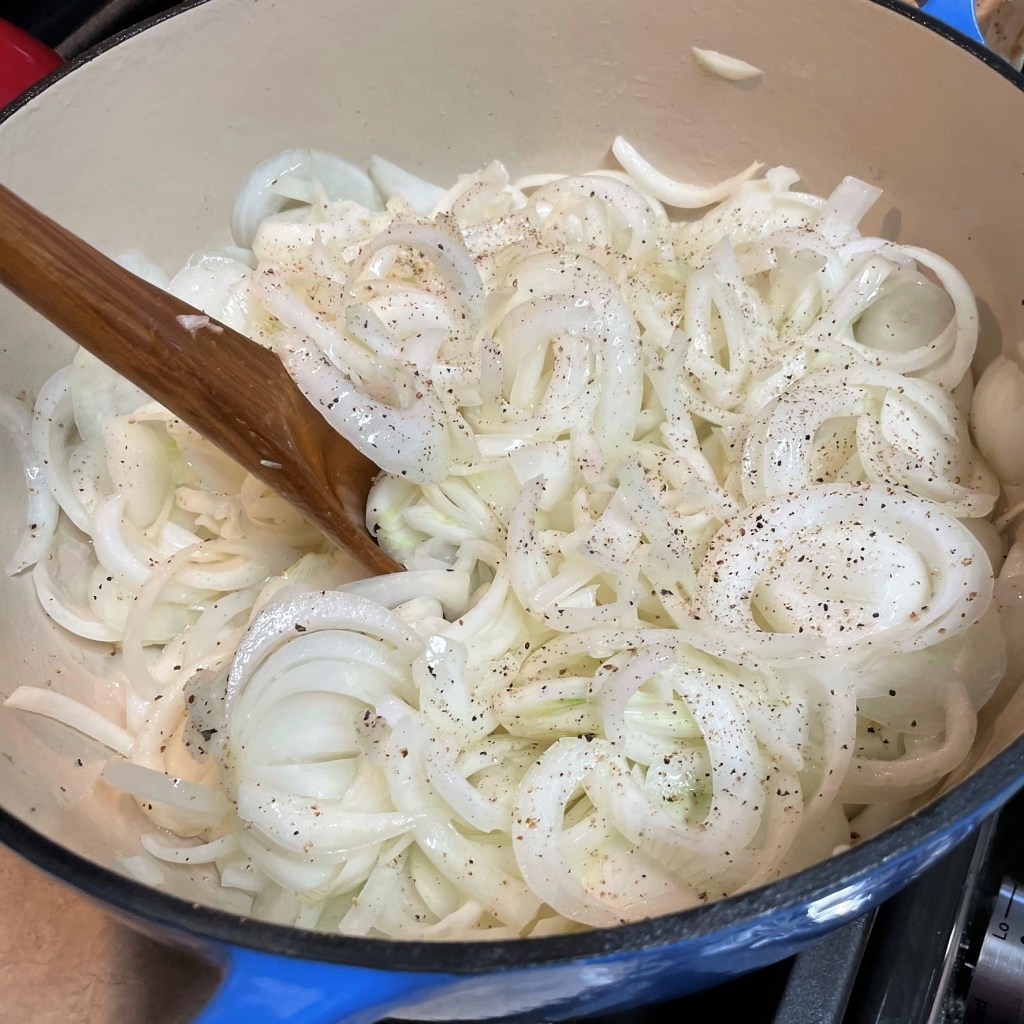
I’ve sliced my onions into 1/4″ thick pieces. Don’t worry if some end pieces are larger or if the crescent slices are still attached in spots. The lengthy cooking will work out the differences.
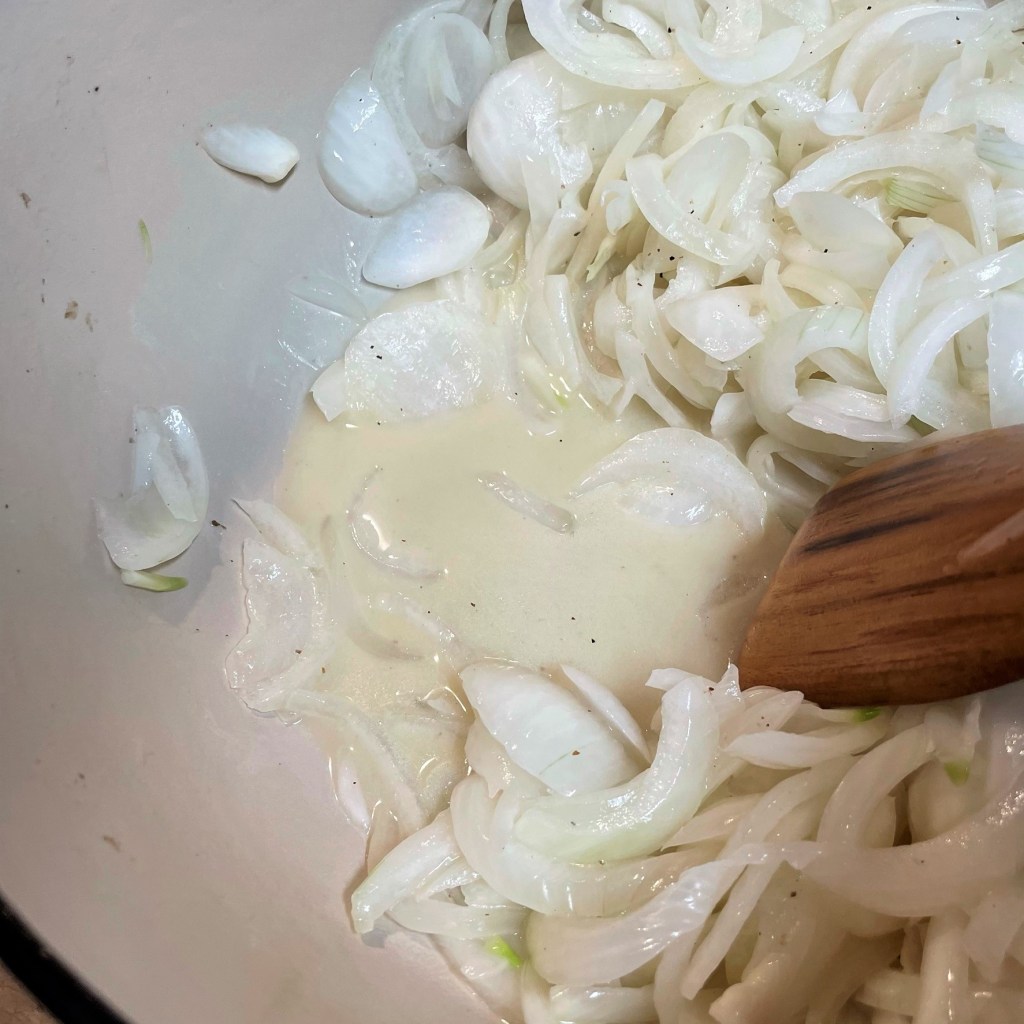
After 20 minutes, my onions still look raw, but they have begun to release a milky liquid. Eventually, this will cook off and only sweetness will remain.
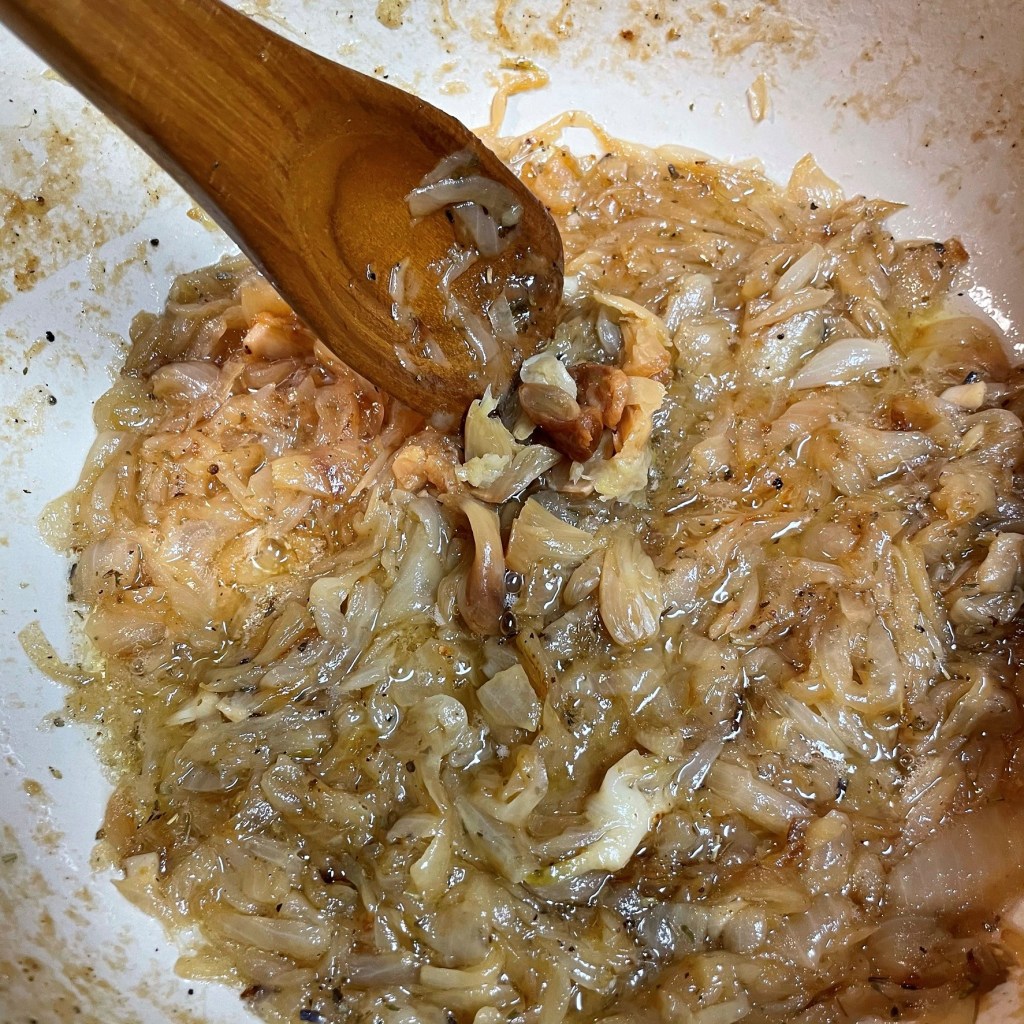
Finally, signs that the caramelizing is happening! This was at 90 minutes, and you can see that the onions are significantly softer and creamier in color. From this point, watch them closely.
These onions are fully caramelized. No milky liquid remains, and the onions sound more like they are frying rather than steaming. Time to make the soup!
Herbes de Provence ingredients may vary slightly, but most have a touch of lavender. It makes this soup taste distinctly French.
For added depth of flavor, I’ve added a whole bulb of roasted garlic. Do you see it there at the end of my spoon? It’s almost the same color as my caramelized onions!
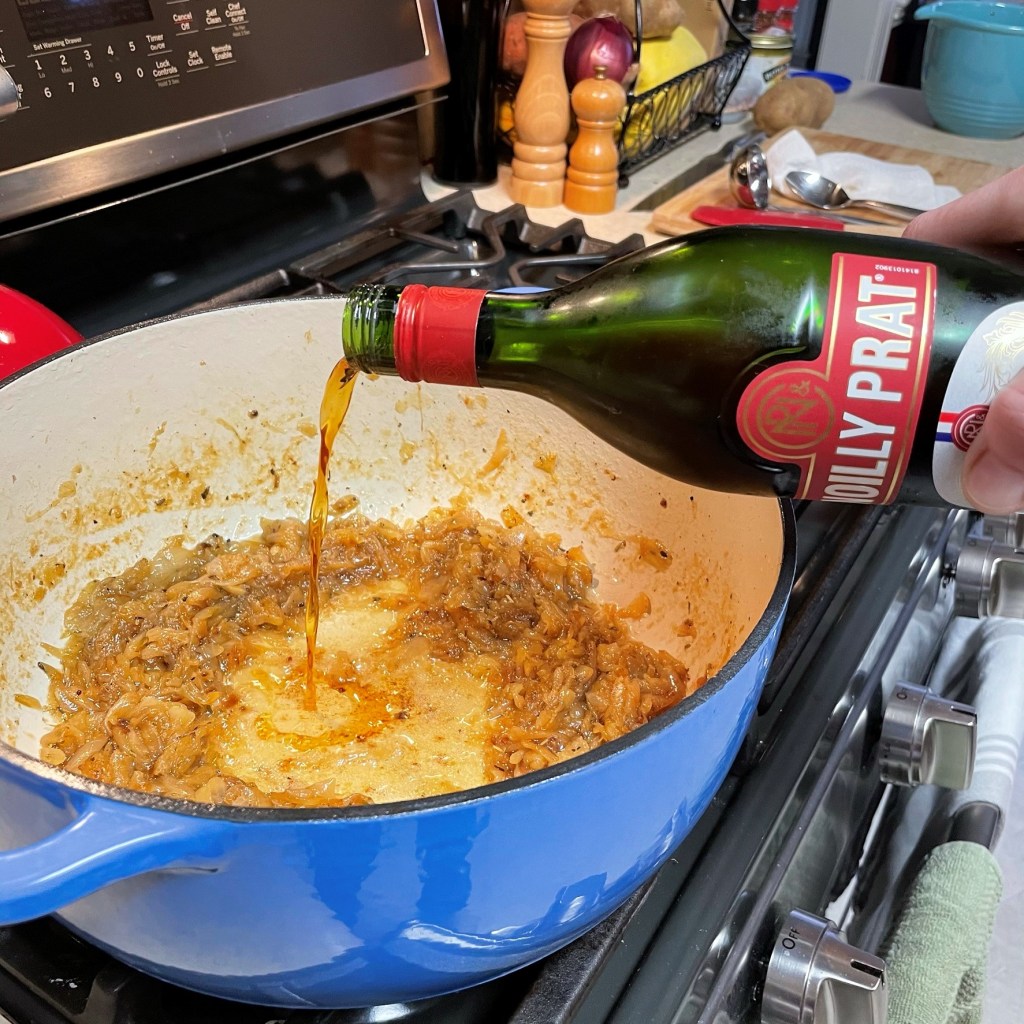
Any browned bits stuck to the pan will loosen right up with a splash of wine, and either white or red is fine. For this batch, I used a bit of red vermouth. From France, of course.
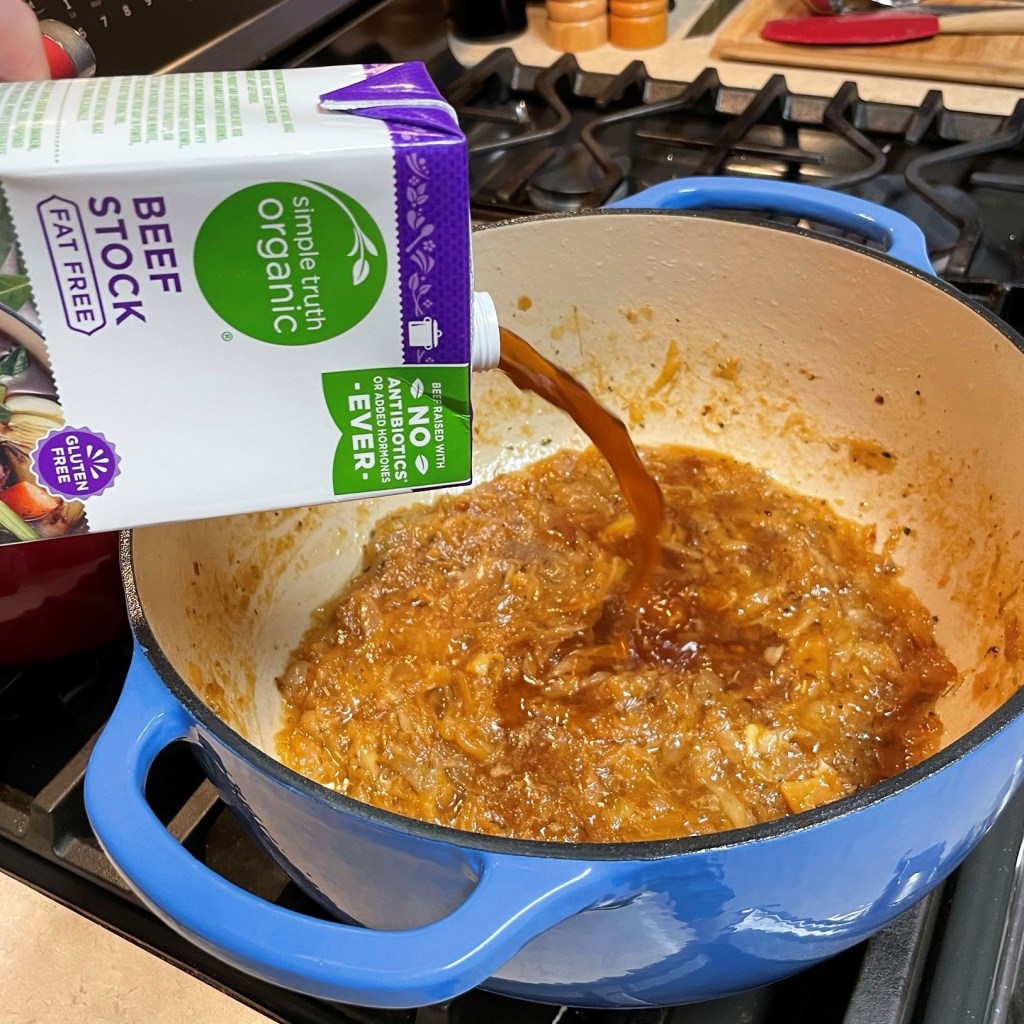
A packaged carton of stock is usually four cups, and you’ll need two cartons for this many onions. I used a carton of organic beef stock…
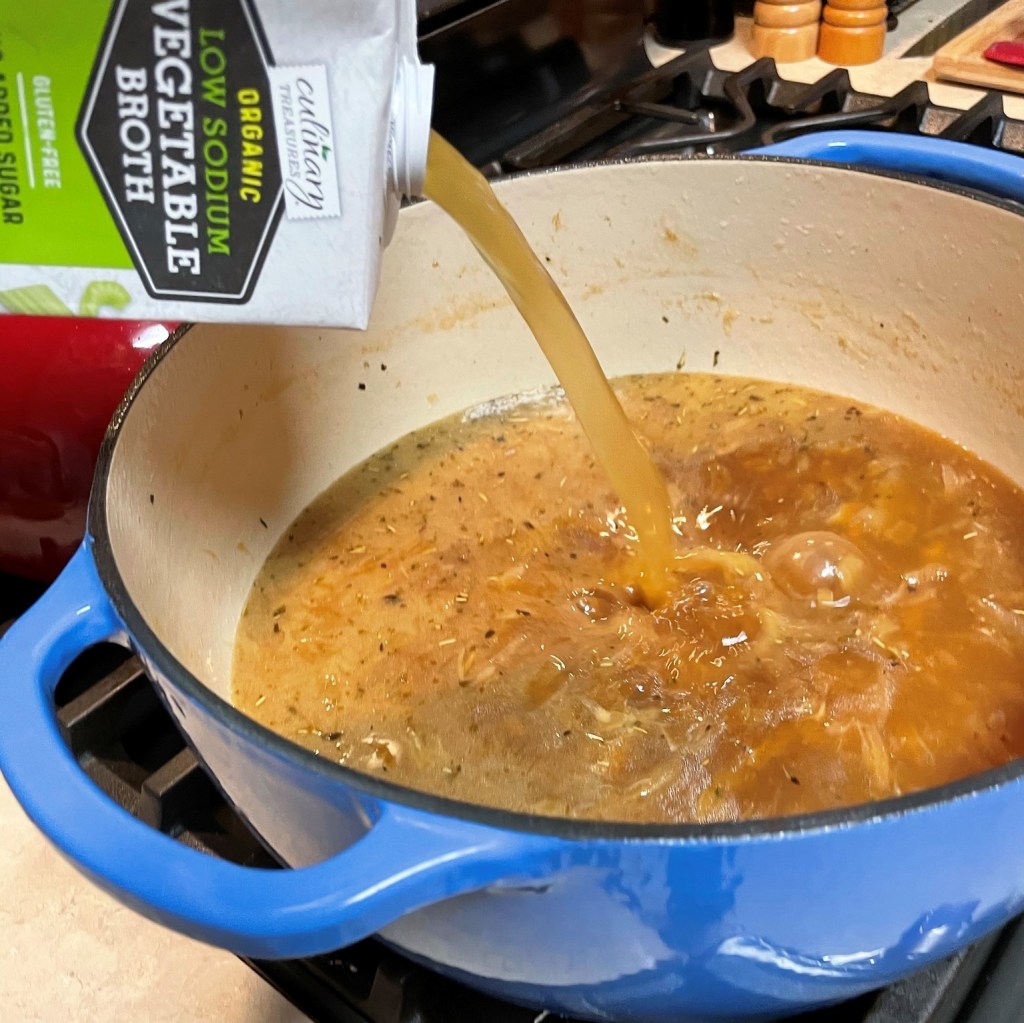
And a carton of my favorite vegetable broth. From here, the soup will simmer (covered) a couple of hours to blend all the flavors.
Give it a taste and add salt if needed. Before serving, increase the burner temperature a bit so your soup will be piping hot.
I topped my soup with slices of homemade sourdough, but toasted baguette slices would be truly French.
Gruyere or Swiss cheeses melt best on French onion soup, about two tablespoons on top of each serving.
Melt the cheese, under the broiler, in the microwave or by kitchen torch if you have one.
Time for soup!
Slice onions about 1/4” thick, preferably from stem to root ends, rather than into rings. For this recipe, I think it’s helpful to have the onion pieces generally the same size, and the top-to-bottom slicing will help you achieve that.
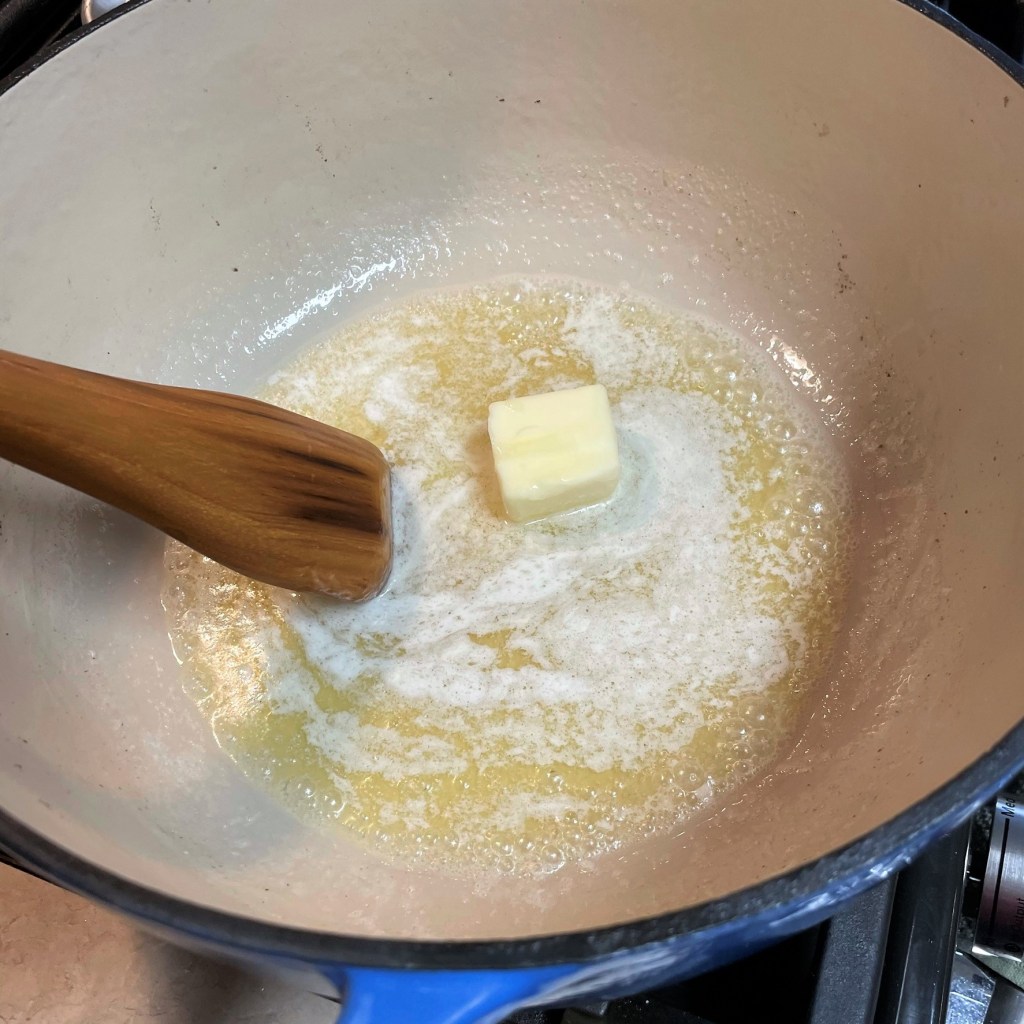
Place a heavy Dutch oven over low heat, and melt the stick of butter in it. Add the onions at the same time as the butter if you’d like. But if you are using a slow cooker, melt the butter first, then toss the onions thoroughly to coat before cooking on low setting. Season with salt and pepper. Stir the onions around in the pot, and resist the urge to turn up the heat. Proper caramelization is important for this recipe, and it’s a long, slow process. Happily, you don’t have to stand over it constantly; as long as you stir the onions occasionally, it’s fine.
After an hour or so, start watching for signs of browning on the bottom of the pot. This is a sign that the onions are caramelizing and once it begins, it proceeds more quickly. Stir more frequently from this point, but do not increase the heat.
When caramelization is complete, the onion mixture will begin to look like it’s frying rather than simmering—this is because the moisture content has fully dissipated. Add the herbs de Provence, roasted garlic, salt and pepper.
Pour the wine into the pot, and use your utensil to scrape up any browned bits that have stuck to the pot. The acidity of the wine will dissolve those tasty bits back into the onion mixture.
Add the stock, bring to low boil and then reduce to simmer, covered, for a couple of hours.
Serve the soup in warm bowls or crocks, place the toasted bread on top, then scatter shredded Gruyere or Swiss over the bread. If your bowls are broiler-safe, put them on a baking sheet and broil just long enough to make the cheese gooey. Alternatively, you could put the bowls in the microwave for about 30 seconds, or go high-tech with a kitchen torch and brûlée the cheese into blissful melty goodness.
I want to plunge a spoon right through this screen and into that cheese!
It’s that moment when you find that the package of chicken you were counting on for dinner is two days past its “best by” date. Or the panic that hits you when you suddenly realize at the end of a hectic work-from-home day that you completely forgot to go to the grocery store. Moments such as these demand improvisation, and when catastrophe occurs, I have one Plan B that I can always count on—breakfast for dinner.
Even if it’s slim pickings in the refrigerator, there’s a very good chance I have eggs and few random vegetables. There’s always some kind of cheese in the deli drawer, and that already sounds like an omelet in the making, which is our go-to dish when we are looking at breakfast for dinner. But this time, I went all in on a big-flavor frittata, pulling together a Greek theme with spinach, onions and red bell peppers I found in the fridge, along with some feta cheese, kalamata olives, oregano and dill. And though frittatas—which are basically quiche’s crustless cousins—usually only have eggs and fillings, this one takes advantage of that half-bag of shredded potatoes I found in the back of the cheese drawer. OK, who’s hungry?
Great Mediterranean flavors and plenty of nutrition in this filling “breakfast for dinner!”
Turning random leftovers into a flavorful breakfast for dinner on a busy weeknight? That’s Comfort du Jour.
Simply Potatoes is a brand of pre-shredded potatoes, usually found in the refrigerated breakfast section of the supermarket, or sometimes in dairy (though I don’t know why). I use this convenience product when I make our favorite Easy Hash Brown Waffles, so I frequently have them in my fridge. If you prefer, use about two cups finely shredded fresh potatoes, but wrap them first in a clean towel and squeeze out as much water as you can. Better yet, skip the potato crust and make it a more traditional frittata. May as well keep it simple. 😉
For readers abroad, “half and half” is a common dairy ingredient in the U.S. that is essentially equal parts cream and whole milk. If you are minimizing fat in your diet, you may also substitute with evaporated whole milk.
Instructions
This was simple to make, as you’ll see in the photos. If you’d like written instructions, or a downloadable PDF for your recipe files, keep scrolling.
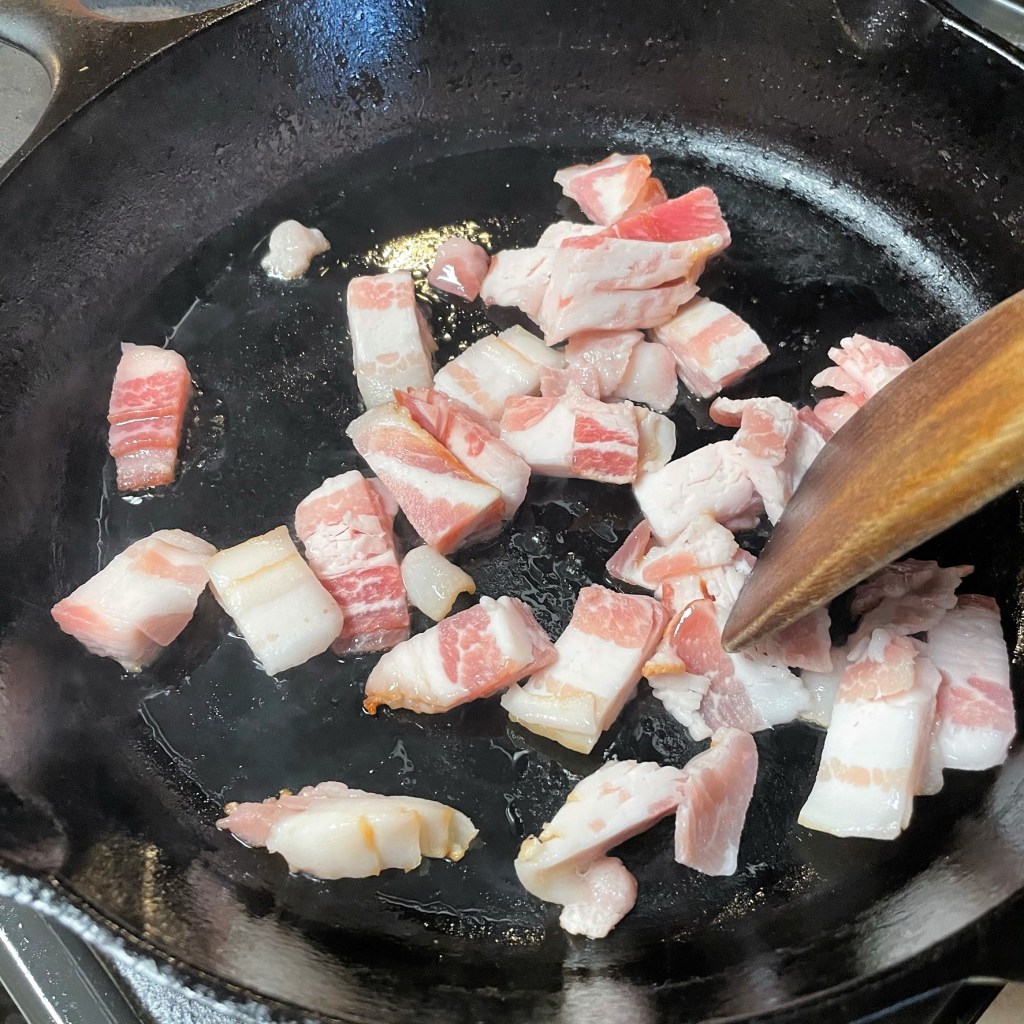
Brown the bacon pieces until crispy, then transfer them to a paper towel-lined plate and drain off the excess grease.
Fresh baby spinach livens up the flavor and the color of this dish. Add one handful at a time to prevent crowding the pan.
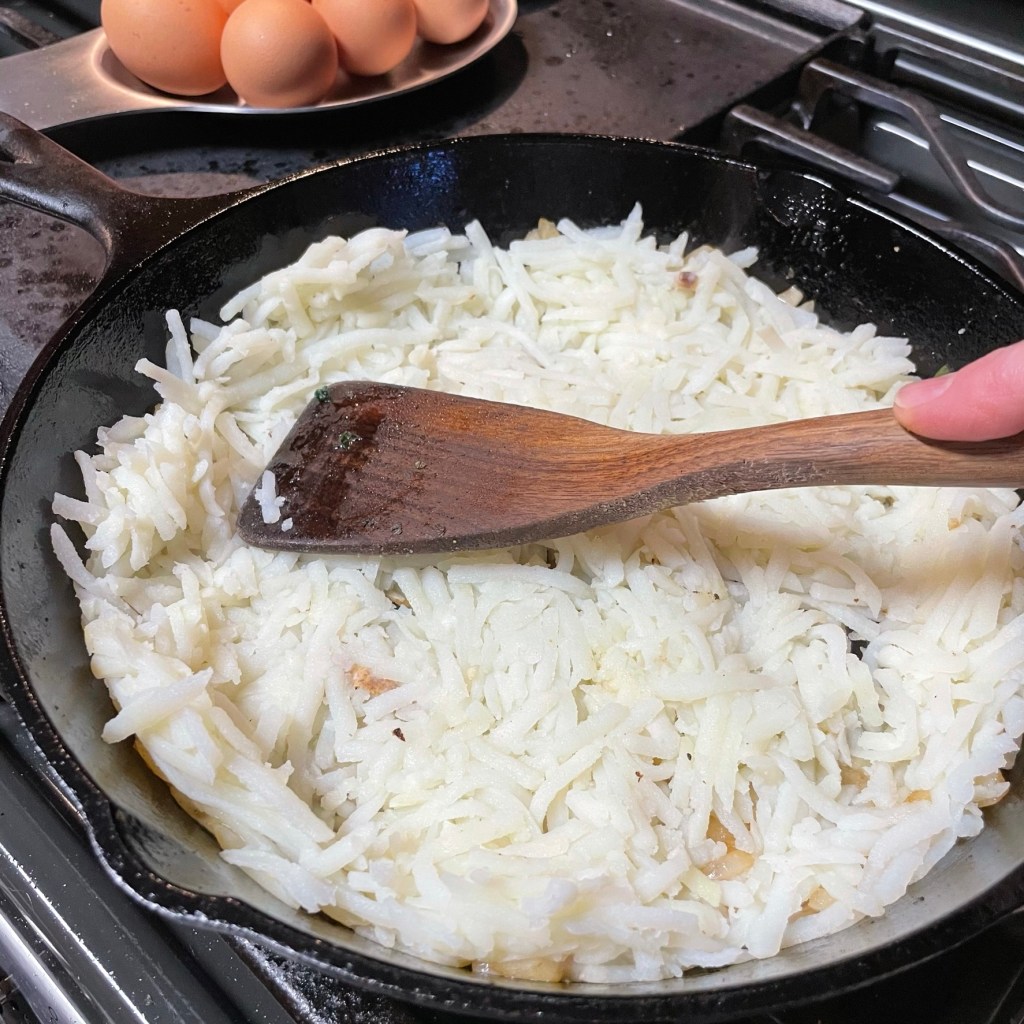
Press the shredded potatoes firmly to the skillet bottom and sides, and cook several minutes on the stovetop before transferring to the oven.
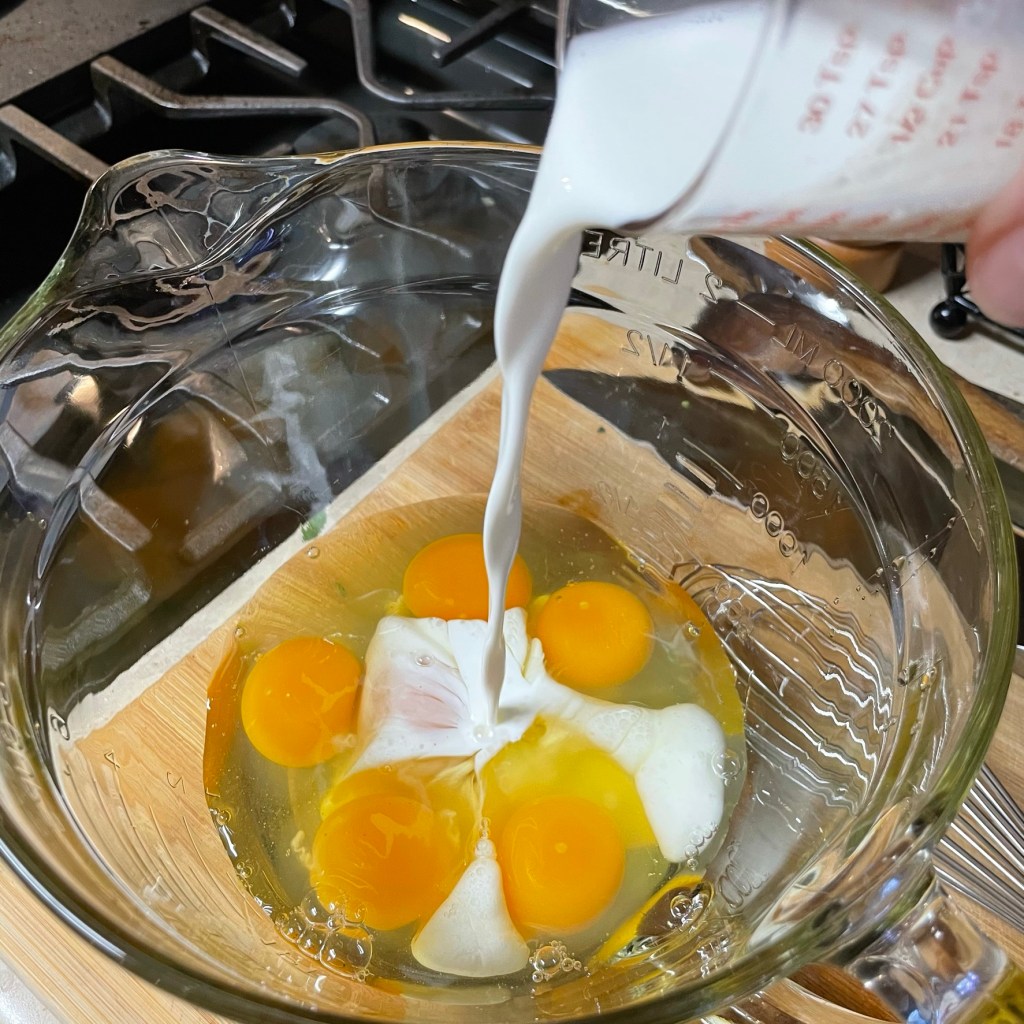
Add half and half (or combination of cream and whole milk) to the eggs, and whisk just until combined.
It occurred to me after the veggies were sauteed that dill would be a great addition to this Greek-themed meal. Feel free to add it earlier in the recipe. 🙂
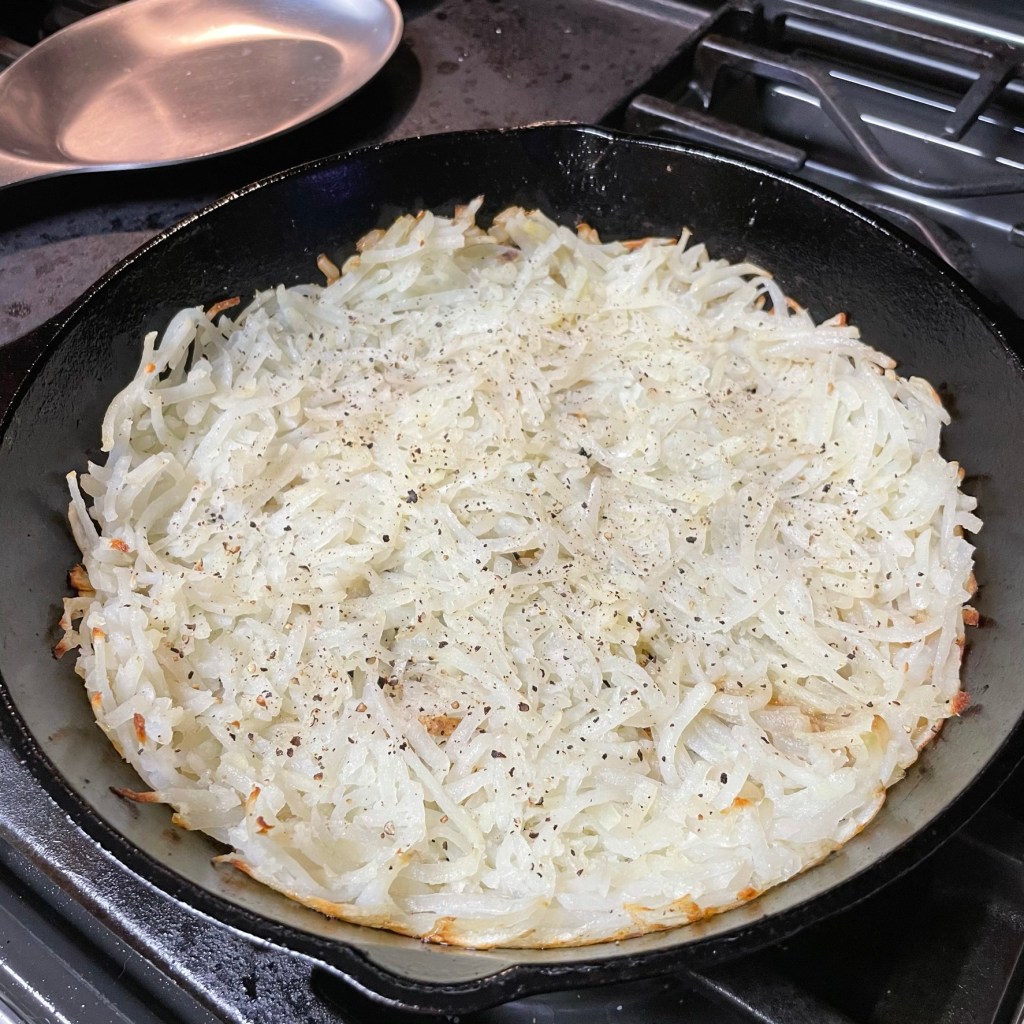
After 20 minutes in the oven, I can see crispy edges of potato. I could have given it another 10 for even more color and crunch.
An egg main dish is a perfect way to use up random bits of cheese from the fridge. I had a couple tablespoons of leftover Gruyere so I tossed it in there!
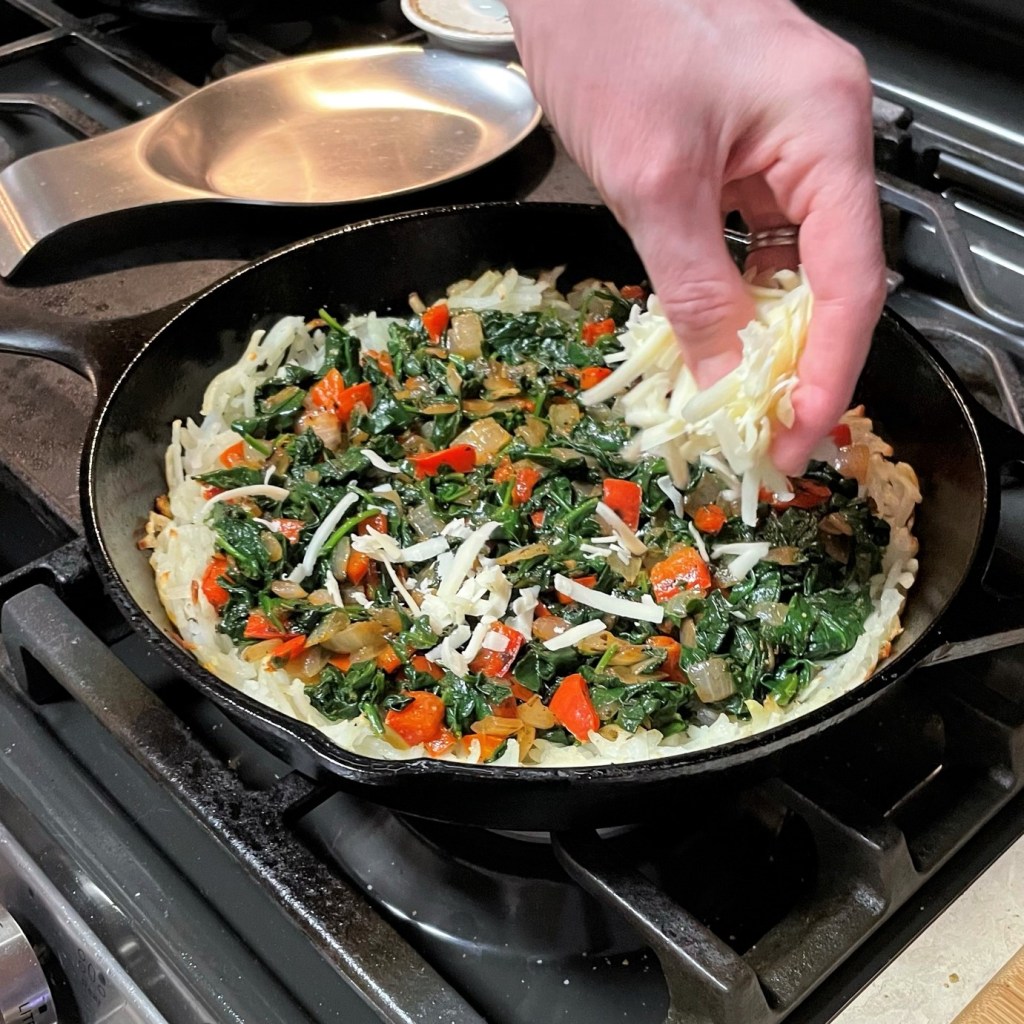
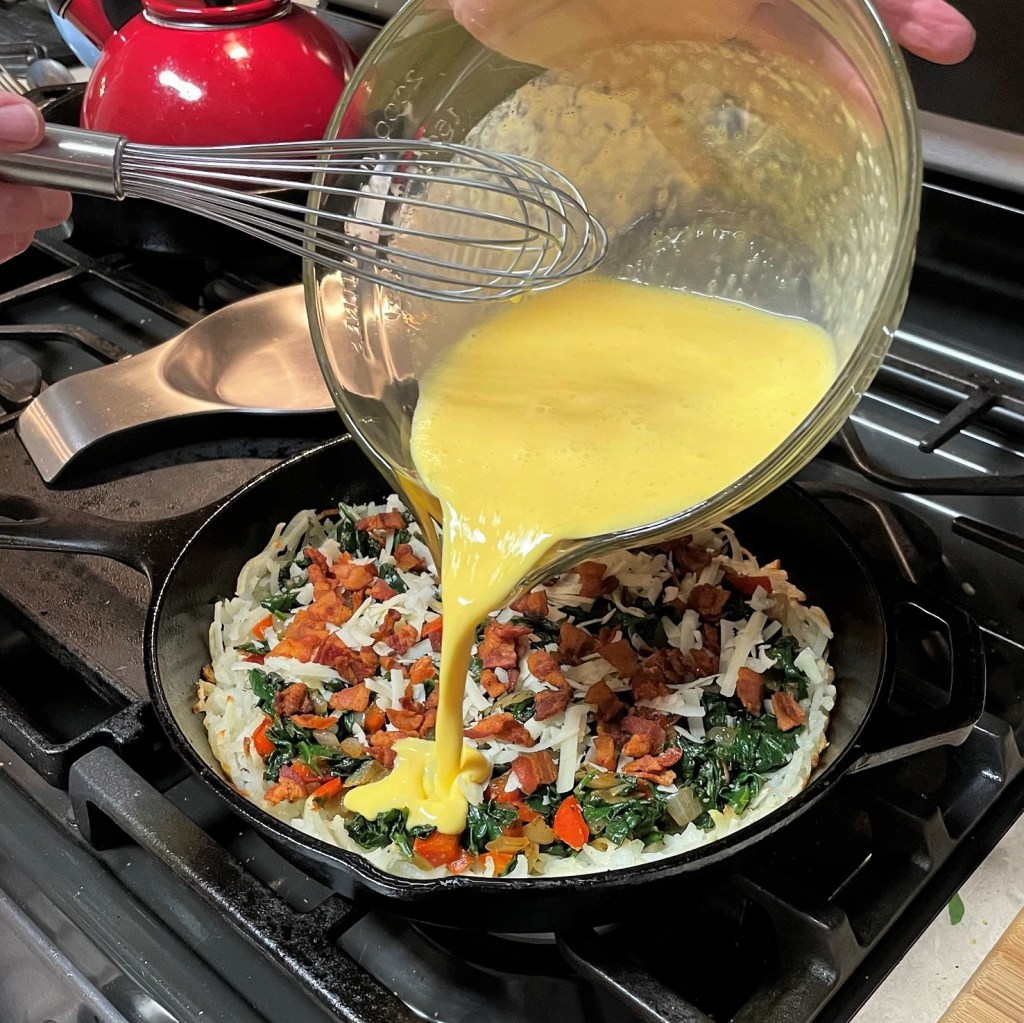
Pour in the beaten egg mixture slowly so that you don’t disturb the other filling ingredients.
The Greek feta was the real cheese for this dish. For the freshest flavor, buy it in chunks and crumble it yourself.
15 to 20 minutes will be plenty of time to finish this frittata.
The frittata is done when the edges are pulled away from the skillet and there’s only a slight jiggle in the center. Rest it a few minutes before cutting into wedges.
Preheat oven to 350° F with rack in center of oven.
Place a cast-iron skillet over medium heat. Add chopped bacon and cook until crispy. Remove with a slotted spoon to a plate lined with paper towels. Drain off most of the bacon grease.
Sauté onions and peppers until slightly soft and translucent. Season with salt, pepper and oregano.
Add chopped spinach, one handful at a time, and cook until wilted. Transfer veggies to a separate bowl and set aside. Sprinkle with dried dill.
Increase the skillet heat to medium-high and drizzle in about a tablespoon of olive oil. Add the shredded potatoes to the skillet, using a spoon or utensil to press it into the sides. Cook the potatoes in the skillet for about five minutes, then transfer the skillet to the oven for about 20 minutes (or additional 10 minutes for crispier crust).
Combine eggs with half and half, whisking only until blended.
When potatoes are golden at the edges, spread the veggies over the crust, and then scatter the crispy bacon pieces.
Pour egg mixture evenly over the frittata filling. Crumble the feta evenly over the frittata.
Transfer to the oven and bake for about 20 minutes, until eggs are set and edges are pulled away from the skillet.
Cool about 5 minutes before cutting into wedges. Top portions with fresh chopped parsley and chopped kalamata olives.
After 30-plus years in the Southeast, I’ve come to appreciate many of the traditions, especially the ones related to food. There’s a particularly tasty tradition that occurs here in the fall, when churches, civic groups and Boy Scout troops set up giant, outdoor cast-iron kettles for their Brunswick stew fundraisers. They sign up volunteers, who take turns stirring the simplest of ingredients into a delicious aromatic stew, and folks arrive in droves to enjoy it by the bowl, and to take home quarts for freezing. It’s tradition and it’s delicious.
If you look into some of the old-time church cookbooks, you’d likely find Brunswick stew recipes that begin with fresh-caught rabbits or even squirrels, but (thankfully) my introduction to this homey, comforting soup was a chicken version, and that’s what I’m sharing today.
Brunswick stew is one of those comfort foods that tastes rich and hearty, but checks in on the low end of the fat-and-calories scale. Feel free to swap in other vegetables that suit your fancy—it’s what folks do in different parts of the South and depending on where you are, you might find potatoes, green beans or carrots in the bowl.
You can roast your own chicken if you’d like (overnight in the slow cooker makes amazing broth at the same time), but to keep it quick and simple, I’m using a rotisserie chicken this time, plus packaged broth, a few simple fresh and frozen vegetables, and a can of tomatoes. Whip up some corn muffins while it simmers, and dinner is served.
Can you taste the comfort?
Ingredients
First, the essentials. This is a Southern classic comfort food, so the “holy trinity” of peppers, onions and celery is the foundation of the recipe. Any color bell pepper is fine for Brunswick stew, but I personally find the red and orange bells to be a bit on the sweet side, so I’m using a green bell.
Okra came to the Americas from Africa in the 1600s, and it remains a staple of Southern cooking. You’ll find it in many Cajun and Creole recipes in Louisiana, and it’s not unusual to see it breaded and fried, or even pickled, which I love in a Southern-style potato salad or on deviled eggs. The pectin in okra gives it some thickening power when it’s cooked in liquid, but some people are turned off by the slightly slimy texture. Two things can minimize this: don’t overcook it (for this recipe, it’s added at the end), and cook it in combination with tomatoes, which is what’s happening in this Brunswick stew.
If you make this stew in the late summer or fall, of course you would want to use fresh corn, lima beans and okra.
For this recipe, I like the trinity to be a bit on the chunky side.
Did I mention that okra is rich in folate, B vitamins and fiber?
1 deli roasted chicken, dark and white meat shredded* (see notes)
2 Tbsp. extra virgin olive oil
1 yellow onion, chopped
4 stalks celery, trimmed and chopped
1 green bell pepper, seeded and chopped
3 large cloves garlic, chopped
15 oz. can diced tomatoes
2 quarts chicken or vegetable broth
1 bay leaf
2 cups frozen corn
2 cups frozen lima beans
2 cups frozen sliced okra
1/4 cup BBQ sauce
2 to 3 Tbsp. tomato paste
A few shakes hot sauce (optional, Frank’s RedHot or Texas Pete recommended)
Salt and pepper, of course
*Notes
If you prefer to roast your own chicken, more power to you! If you have time to work ahead, you might also want to make your own stock. Or you could make your own stock from the frame of the rotisserie chicken. After de-boning and shredding the meat, toss the bones and skin into a pot with cut-up onions, celery, carrots and just enough water to cover it all. Simmer a few hours then strain out the solids, and you’d have a great alternative to the packaged broth (or, at least, some of it).
Instructions
If the pictures here seem to defy the ingredient amounts listed, there’s good reason for it—on this particular day, I only had half a rotisserie chicken, so I halved the entire recipe. The ratios are the same, and this stew is so satisfying and delicious, I’m already regretting that I didn’t run to the store for another chicken!
Sauteing the vegetables isn’t absolutely necessary, but I always do it. If you’re making the stew in a slow cooker, feel free to add them as they are.
Tomatoes can take over this dish, so I keep the ratio fairly low, with only one can in a batch, and I boost their flavor with a little tomato paste.
The best Brunswick stew I’ve ever made included an overnight slow-cooked chicken stock, but packaged chicken or vegetable broth works just fine, and it’s easy!
If your pantry includes canned corn or lima beans, they are perfectly welcome in this stew, but I’d recommend taking note of the sodium content and adjust your seasoning accordingly.
Any BBQ sauce you like is appropriate. this time, I used a bottled steak sauce that we find a little too sweet for steak. It was perfect!
The okra goes in at the end, and it will act as a slight thickener for the stew. Simmer just until the bright green begins to fade.
Brunswick stew is packed with nutrients, fiber and goodness. This is real, down-home Southern comfort food!
Place a large, heavy-bottomed pot over medium heat. Swirl in olive oil. Sauté onion, celery, bell pepper and garlic until vegetables are soft and onions are translucent. Season with salt and pepper.
Stir in tomatoes, tomato paste, shredded chicken and broth. Add bay leaf, reduce heat and simmer up to an hour.
Add frozen corn and lima beans, but reserve frozen okra until about 20 minutes before serving, to prevent the okra from breaking down too much. Give it a taste and add salt and pepper to your preference.
Stir in BBQ sauce (and hot sauce, if using), and add the okra to the pot. When the bright green color of the okra begins to fade a bit, it’s ready to serve!