Festive Chicken Roulades

Special occasion food doesn’t have to be complicated. Sometimes, it’s the simplest flavors that have the most impact, and this is one of many lessons I learned during the few years that I pitched in at a catering kitchen back in the ’90s. But when an occasion calls for something “fancy,” there are a few tricks you can use to elevate your presentation of simple ingredients. Roulades are a great example of this concept, and it’s only a little bit of extra effort, but the impact is always great!

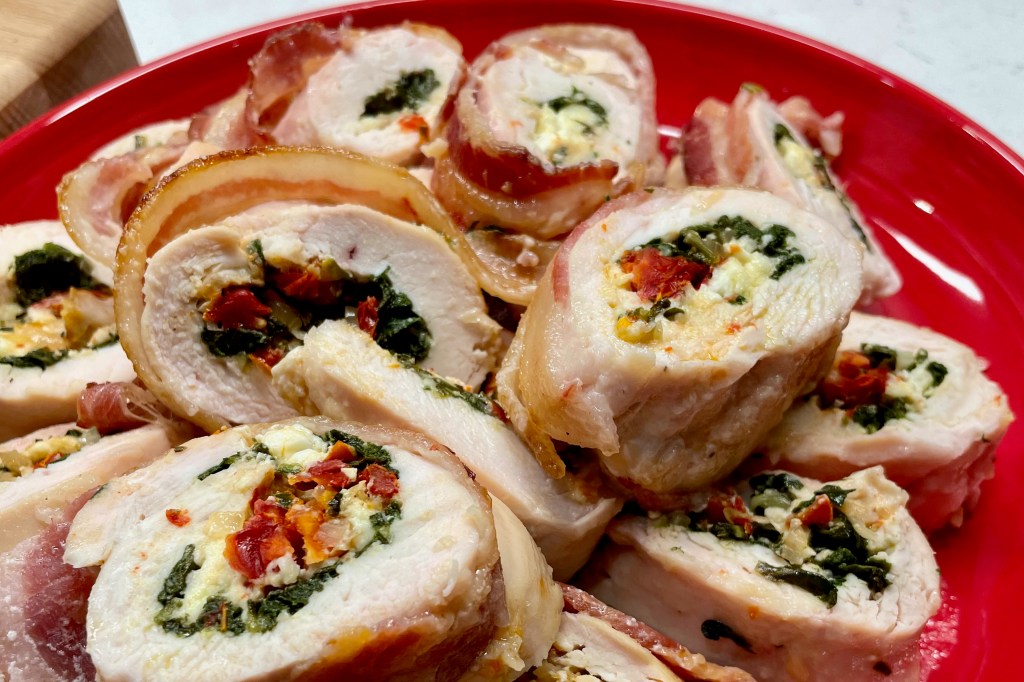
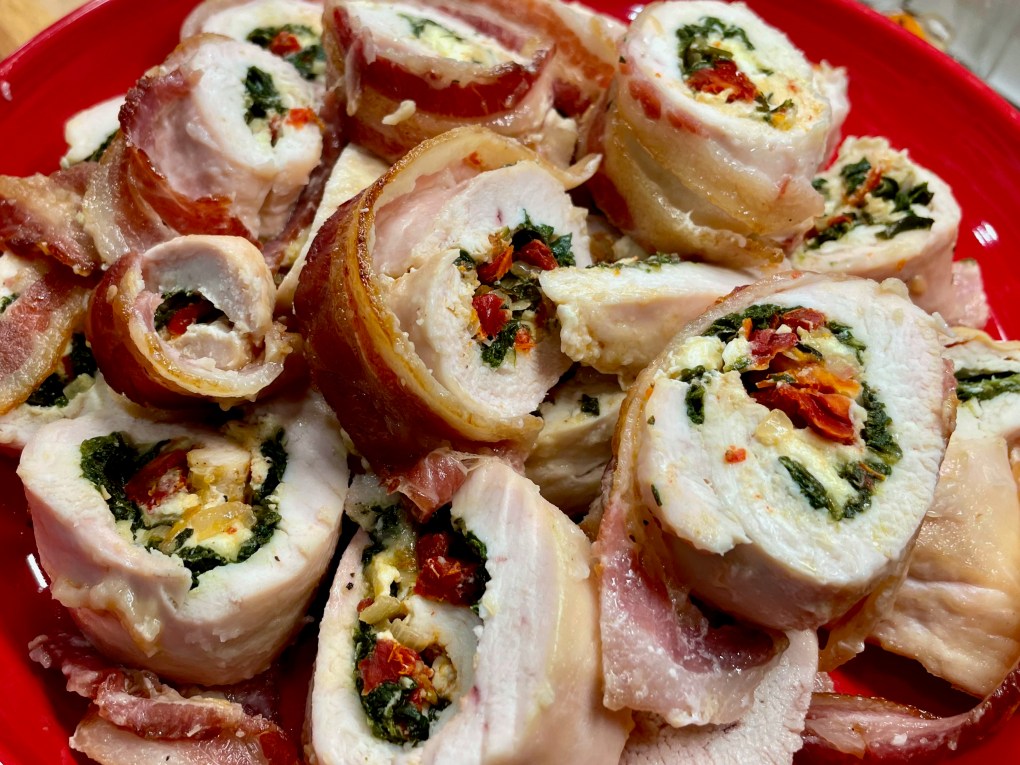
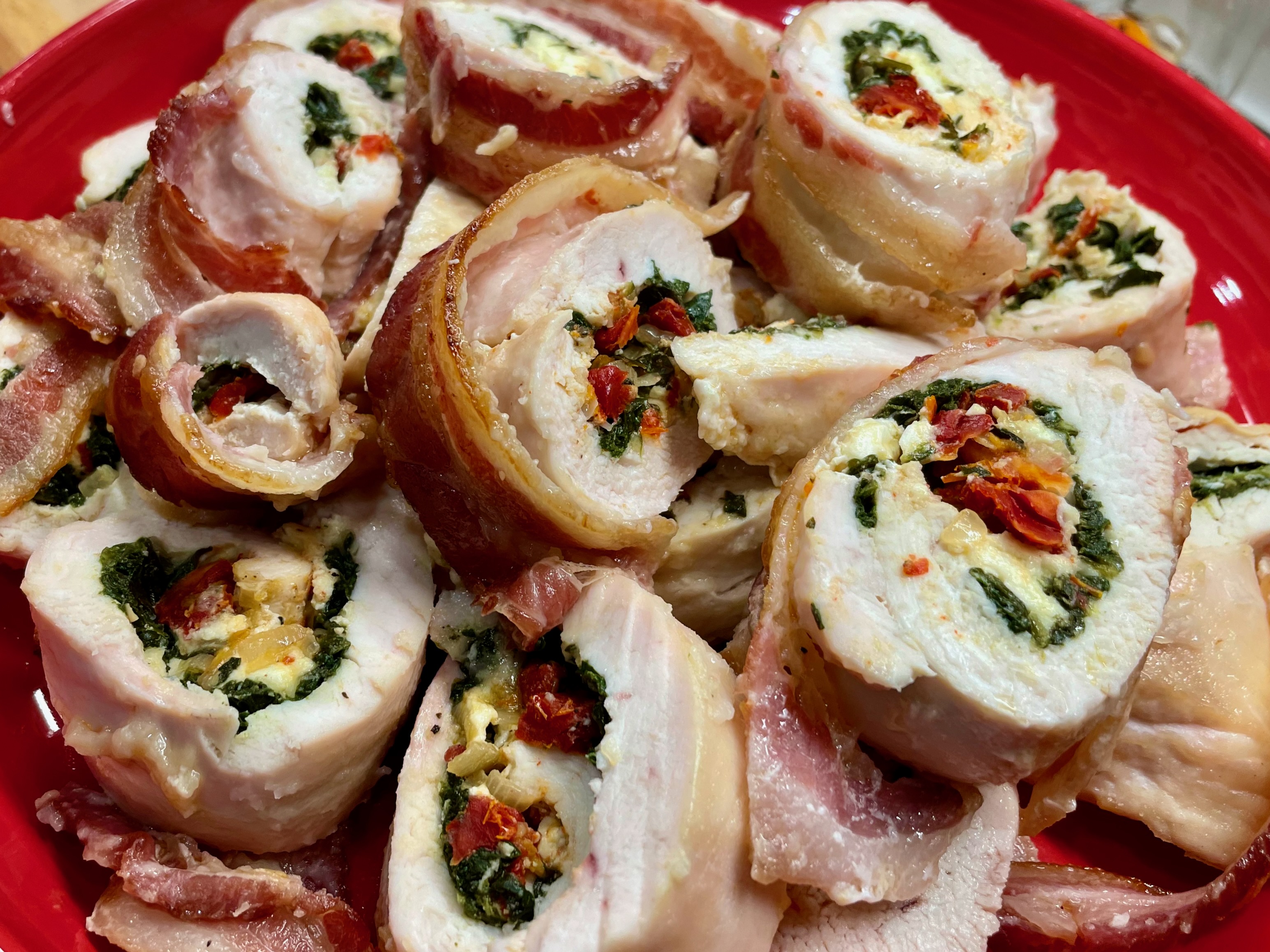
Despite the special appearance of roulades, they’re actually quite easy to make, using whatever fillings sound good to you. This time, mine are bearing festive hues of green and red (just like Christmas), with crowd-pleasing flavors of spinach, feta and sun-dried tomato. The filling is accented with sautéed shallots, garlic and Italian herb blend, and these pretty pinwheels are delicious alongside some roasted garlic mashed potatoes

Are you ready to get cookin’?

My flavors are Mediterranean, but there are so many possibilities!

Special tools

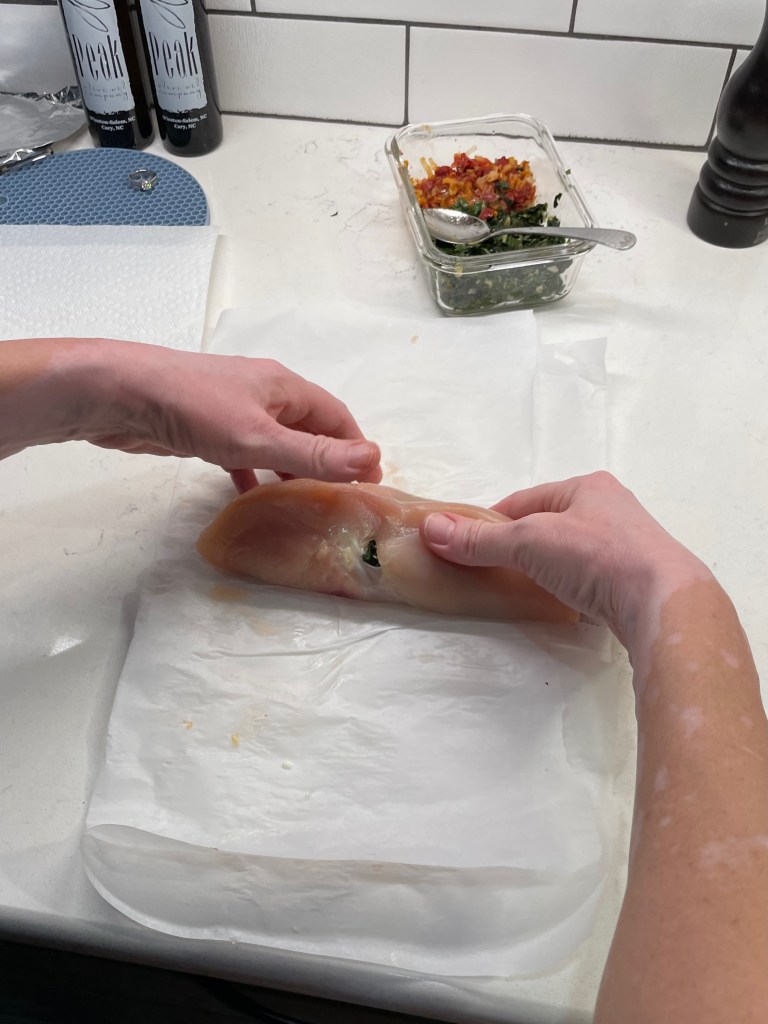
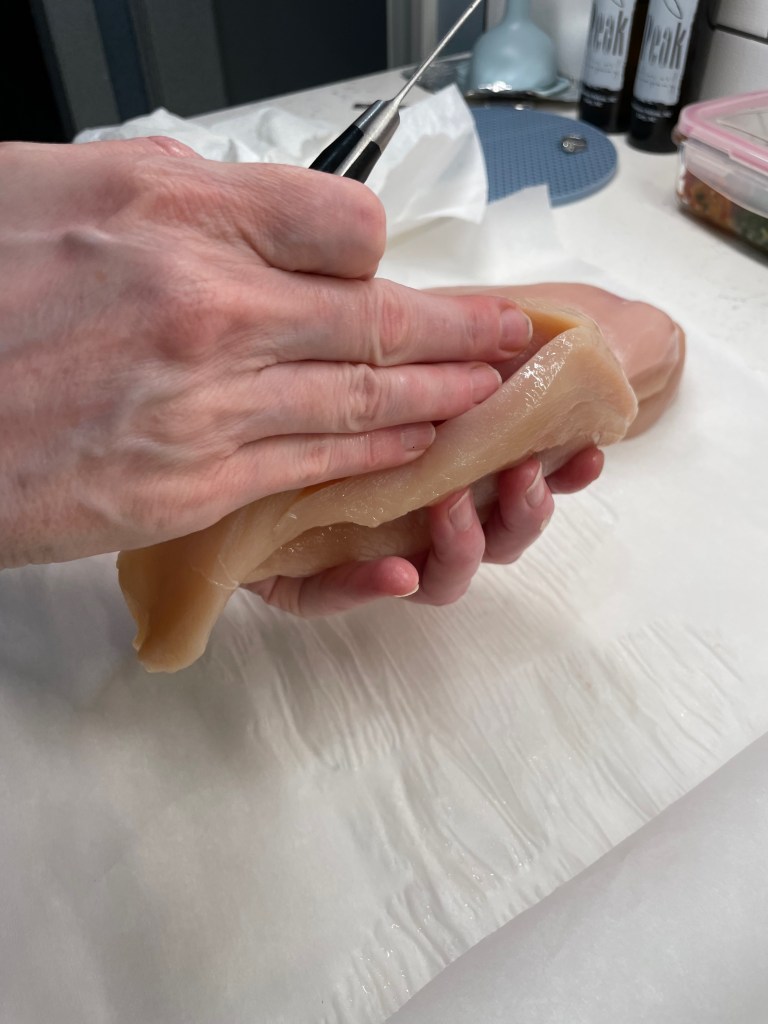
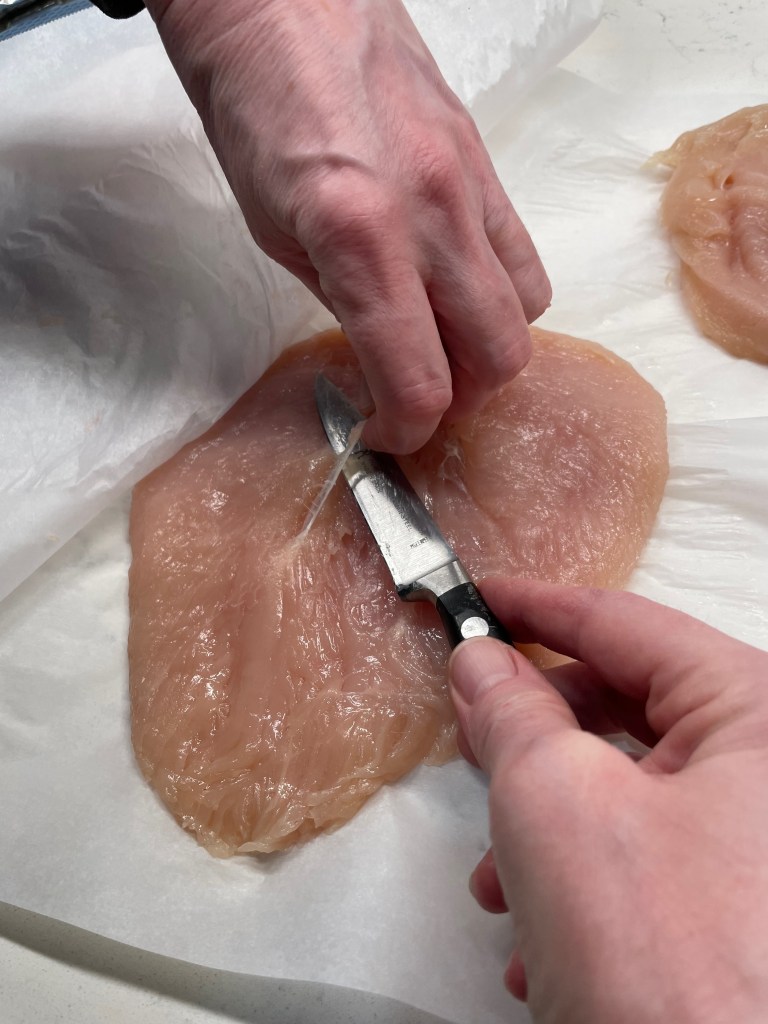
You’ll want to have a few items handy to successfully prep the chicken breasts, and the most important is a sharp, sturdy paring knife that you can use to open up a plump breast into a wider piece that can be pounded flat. A large chef’s knife is not recommended for safety reasons; using a smaller knife allows you to cut with more precision. Begin by holding the thick side of the breast toward you, and make several shallow slits lengthwise, opening the breast as you go, until it lays flat on the parchment. Take your time, and don’t use heavy pressure on the knife. Nobody wants to be at urgent care the week before Christmas.

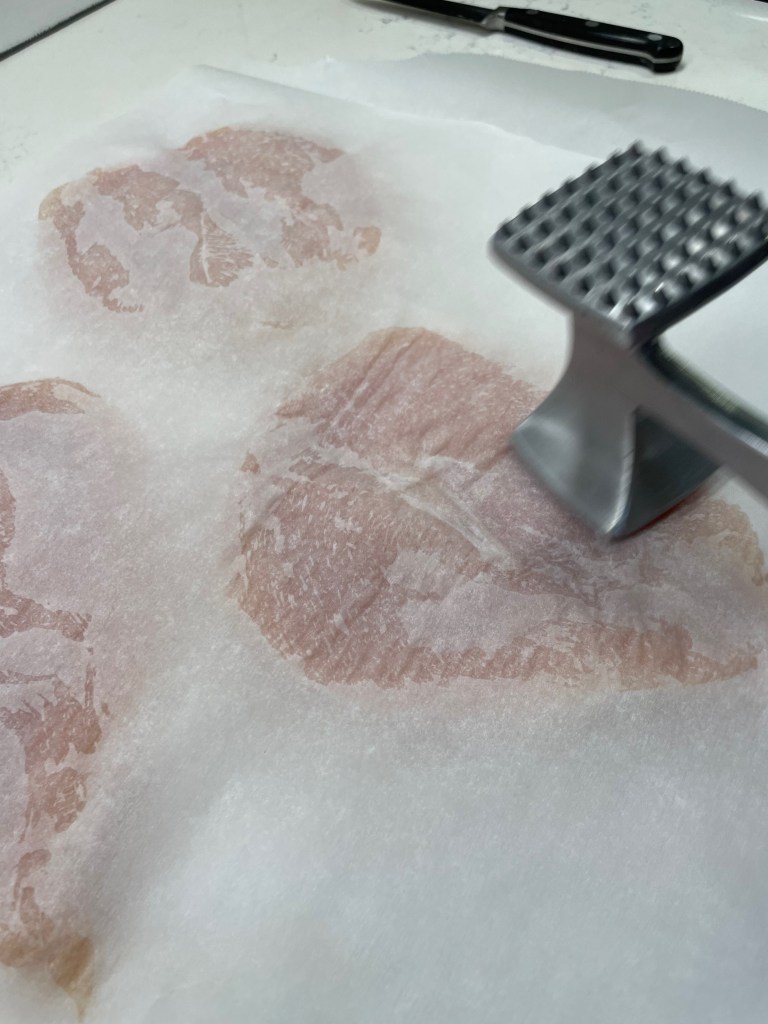
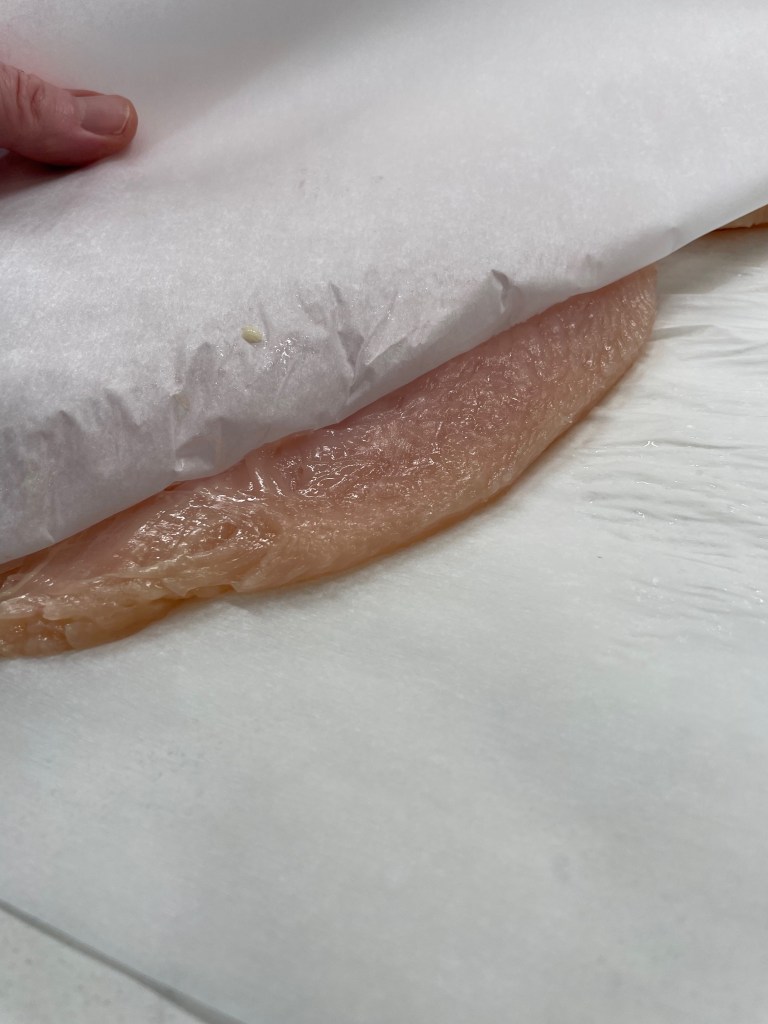
Next, you’ll need parchment or waxed paper and a smooth meat mallet for pounding the chicken. Don’t rush this, and don’t use the textured side of the mallet or you may accidentally split the fibers of the meat. The goal is to gently pound out the breast between layers of paper until it is an even 1/4-inch thickness (or as close to it as you can get). This makes the chicken more flexible for rolling up around your chosen filling ingredients, but don’t go thinner than 1/4-inch, or your chicken will tear apart.
Filling for the roulades

Just about any ingredients you like can be layered into chicken roulades, though I don’t recommend “melty” cheeses because they will always ooze out and make a mess in the oven. If you want a cheesy accent, stick with small amounts of firm cheeses, such as feta, bleu or Parmesan. Whatever vegetables you choose, chop everything small so that the filling rolls up easily and doesn’t fall out of the roulades when you bake them.

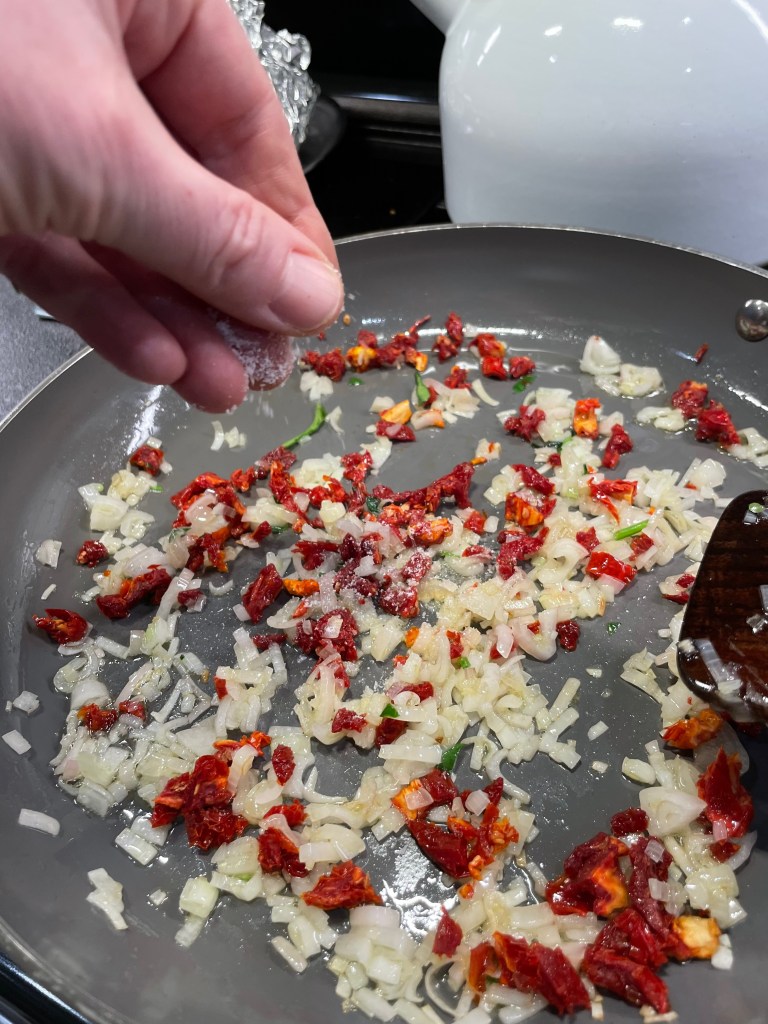
Second, cook any vegetable fillings until they are soft and tender. Raw ingredients rolled up inside the chicken will give off extra moisture and throw off the cooking time, and you’re also likely to have some unpleasant textures. To make the colors of my filling stand out, so I cooked the sun-dried tomatoes and spinach separately, but there would be no harm in cooking it all together to save a little time.

Don’t miss a chance to add flavor!

A little Italian herb seasoning and a pinch of Calabrian chile flakes gave my sun-dried tomato mixture some pizazz, and then I simmered with a splash of chicken stock until all the liquid was cooked off. To add depth to the spinach and garlic filling, I braised it in a shot of dry vermouth, again cooking until the excess moisture was evaporated. Dry white wine would be fine here; I just never have one open anymore and the vermouth is more interesting.

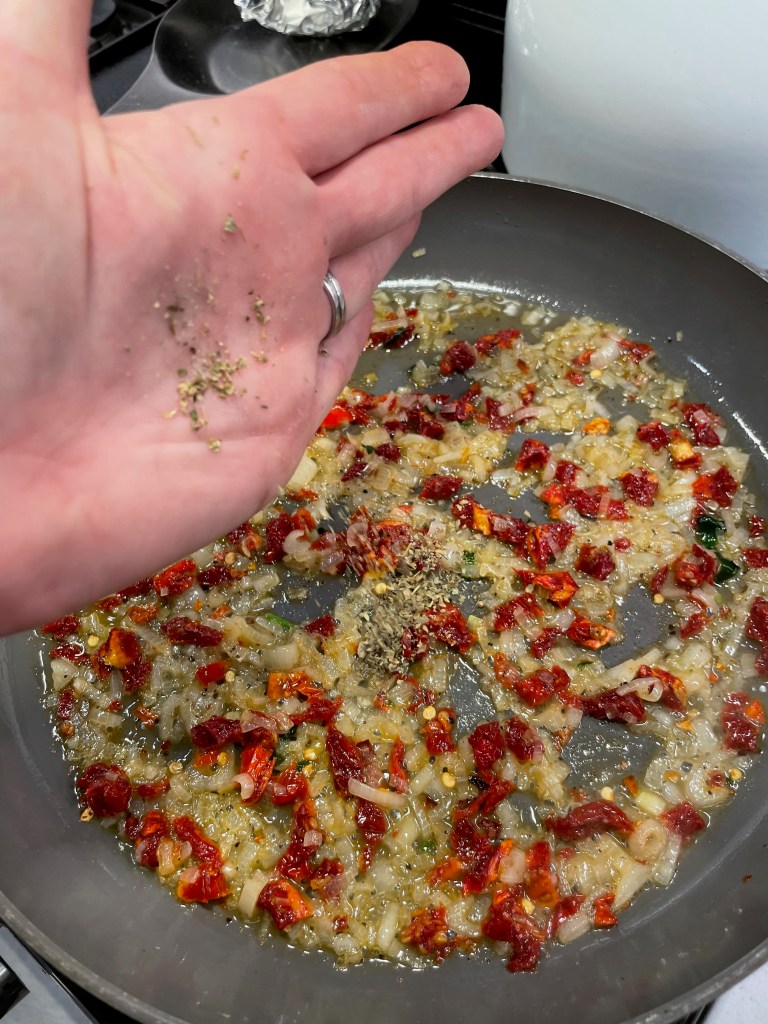
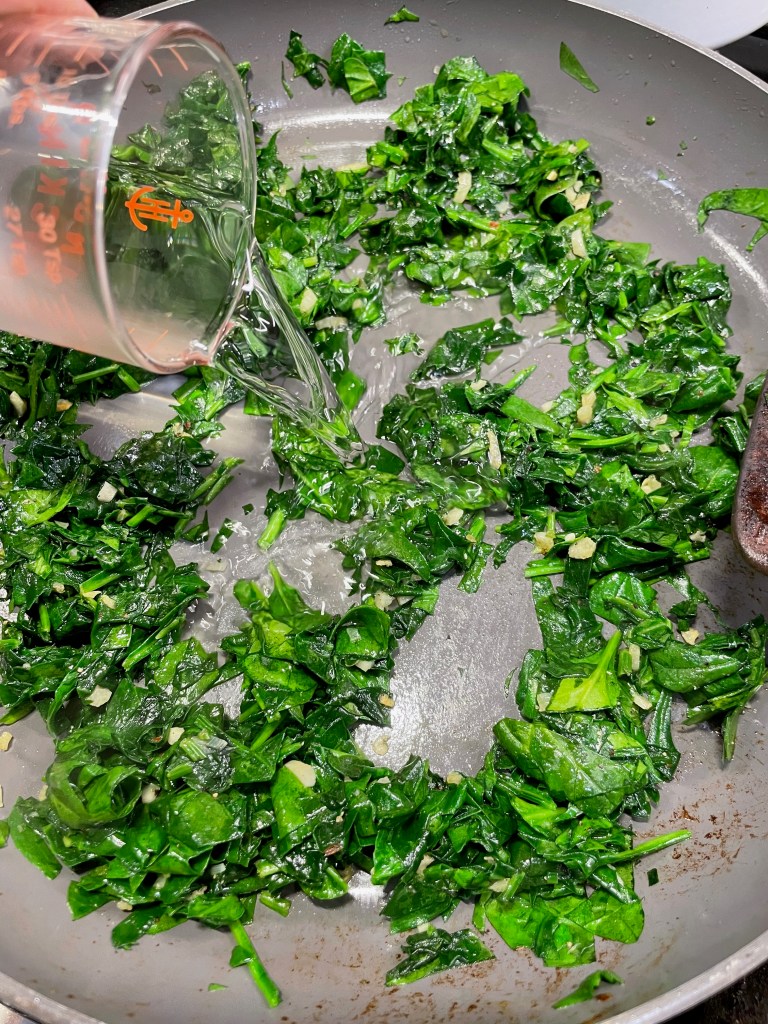
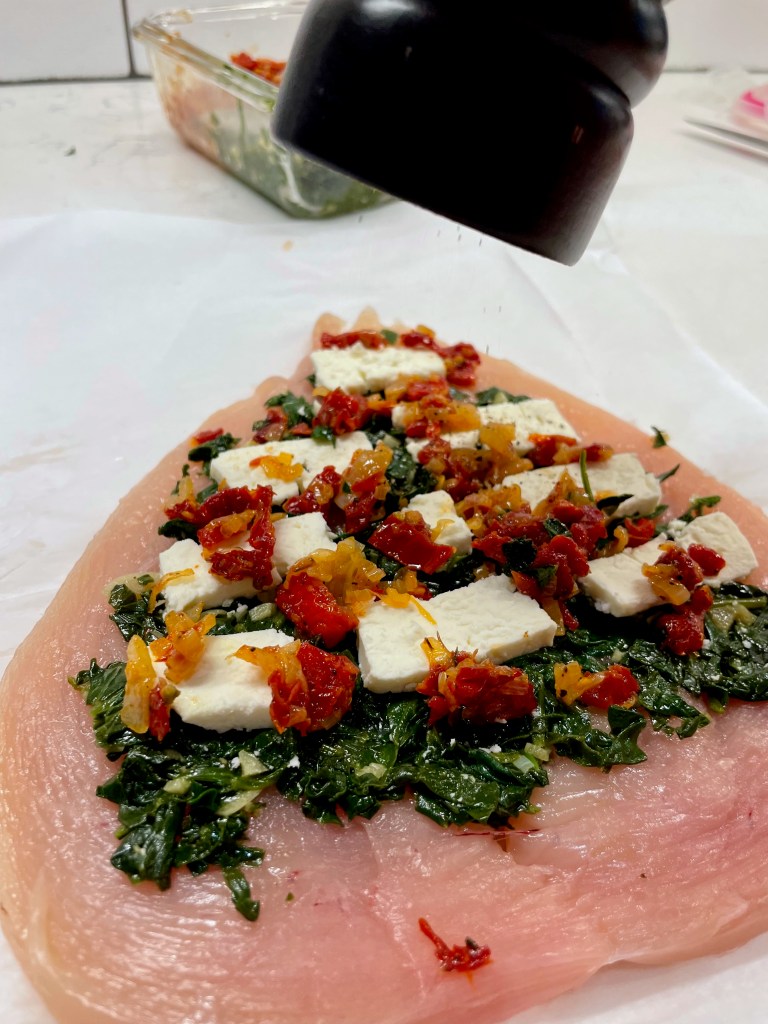
My chicken was layered with the spinach mixture, then thin slices of salty feta, and finally the sun-dried tomato mixture. Begin rolling from the pointed end of each butterflied breast, so that the fillings stay secure inside. The great thing about roulades is that any part of this could be done in advance to save precious time when you’re ready to entertain. You could even roll and refrigerate them in advance and just pull the whole baking sheet out of the fridge an hour before you bake.
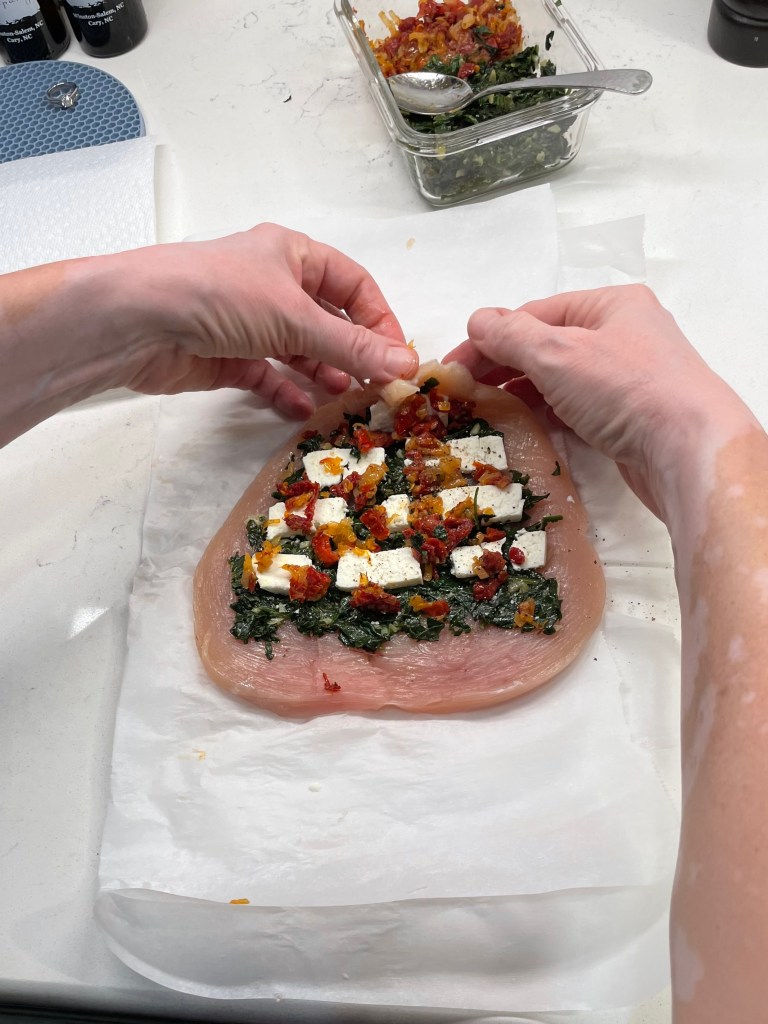
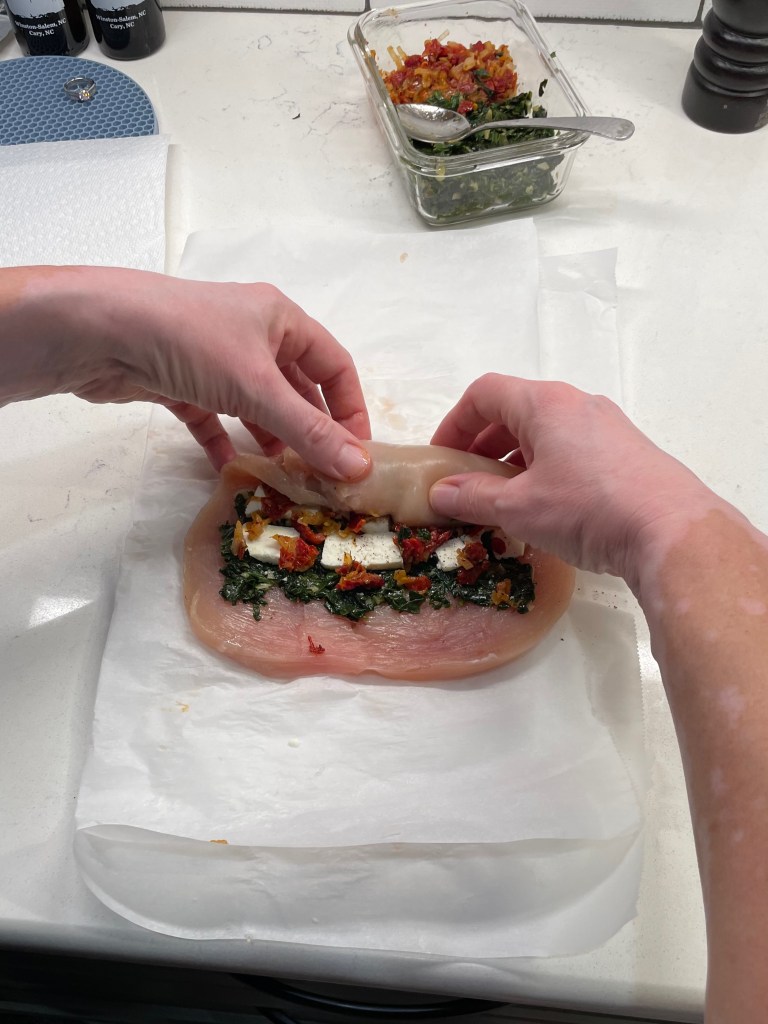
Secure the roulades with toothpicks, or stretch and wrap thin bacon slices all around before placing them (seams or bacon ends down) on a parchment-lined baking sheet. These go straight into the oven— no browning or searing is needed— and they’ll need about 40 minutes at 350° F. Let them cool a few minutes before slicing into one-inch thick rounds. Serve immediately.

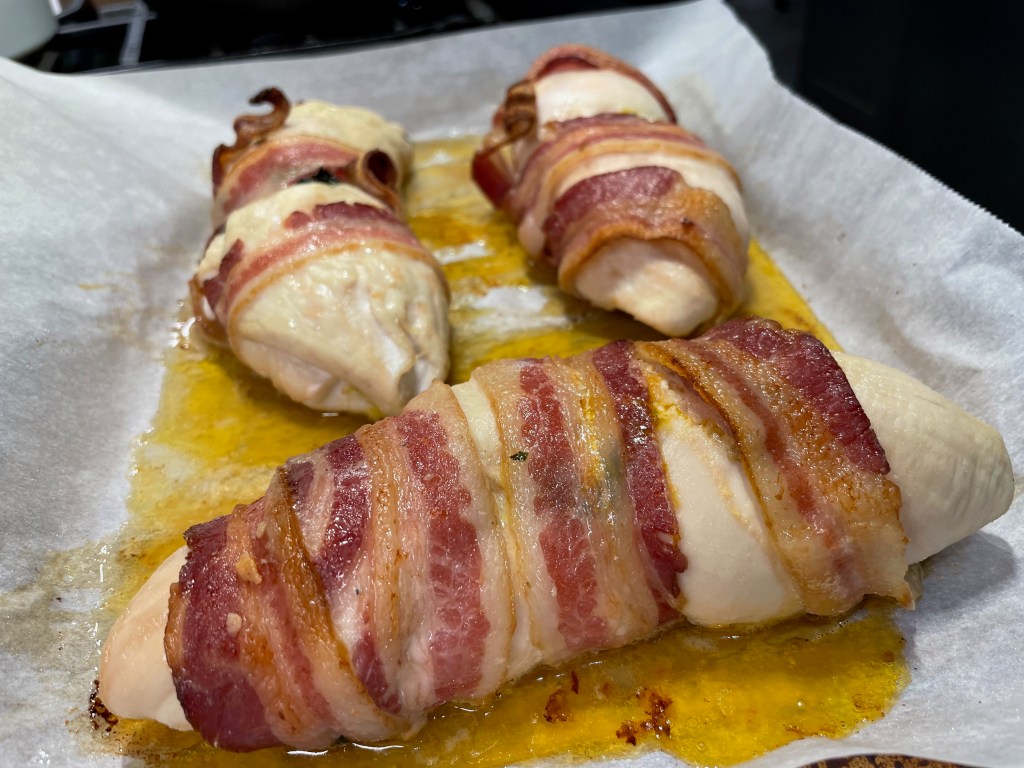
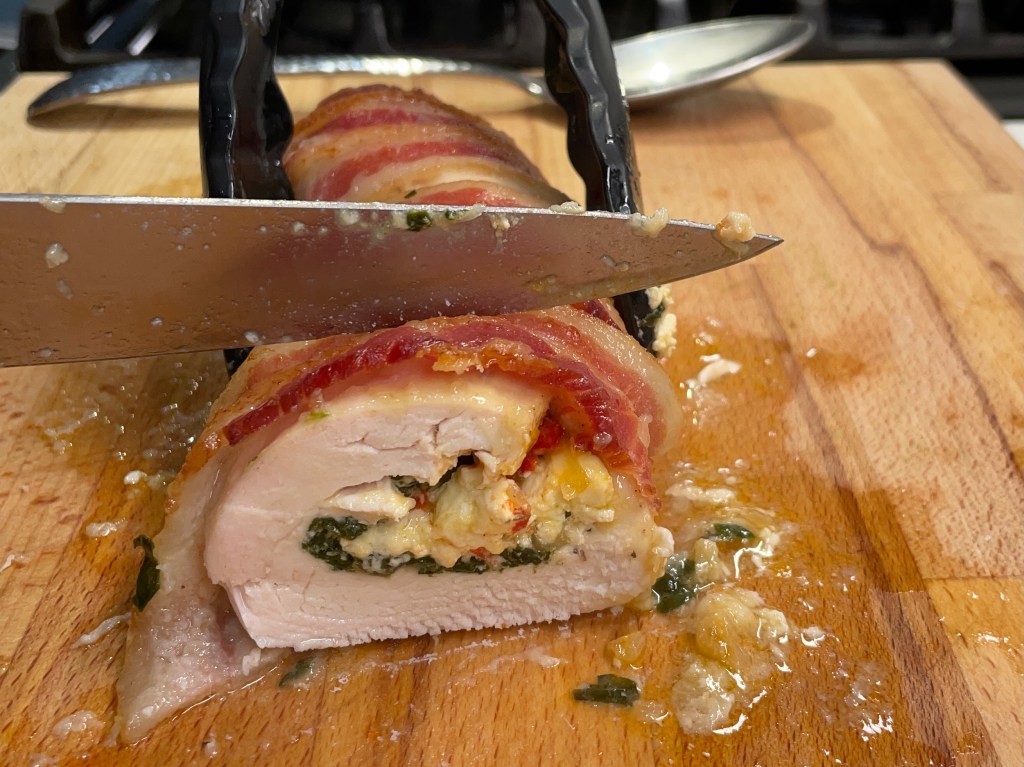
These festive chicken roulades were moist, tender and so flavorful. It made a delicious entree with Les’s amazing roasted garlic mashed potatoes, but I could also imagine them with polenta or risotto with these Italian-themed ingredients. But there are lots of other flavorful possibilities. Now that you know how to make roulades, drop a note in the comments to let me know what filling flavors you would like to try!


Festive Chicken Roulades
  • Servings: 4 generous portions
  • Difficulty: Average
  • Print

With favorite flavors and a few easy techniques, you can transform simple ingredients into something special for holiday entertaining. These roulades are filled with spinach and sun-dried tomato, but as long as your filling ingredients are chopped small and pre-cooked, the possibilities are endless!


Ingredients

  • 1 1/2 pound package skinless, boneless chicken breasts (see notes)
  • 2 Tbsp. extra virgin olive oil, divided (you’ll use half each for sautéing the spinach and tomato mixtures)
  • 2 fat handfuls baby spinach leaves, chopped
  • 2 cloves garlic, finely minced
  • 2 Tbsp. dry white wine (or vermouth, which is my go-to)
  • 1/4 cup chopped sun-dried tomatoes (see notes)
  • 1 medium shallot, finely diced
  • 1/2 tsp. dried Italian herb blend
  • A pinch of red pepper flakes
  • 1/4 cup chicken broth or stock
  • Kosher salt and freshly ground black pepper
  • 4 oz. dry feta, cut into thin slices or crumbled
  • 2 slices thin-cut bacon for each chicken breast used

Notes: The chicken breasts can be any size, and you don’t need to have one breast for each person you’re serving. They will be sliced into rounds, so as long as you have the appropriate weight package, you’ll have enough.

The sun-dried tomatoes I use are soft and pliable, ready straight from the package. If using very dry ones, rehydrate them briefly in hot water or chicken broth and then pat them dry. If using sun-dried tomatoes packed in oil, there’s no need for additional oil for sautéing them with the shallots.

Directions

  1. Preheat oven to 350° F, with rack in center position. Line a baking sheet with parchment paper.
  2. Butterfly the chicken breasts; use a sharp paring knife to cut shallow slits along the fat edge of the breasts, opening as you go until the breasts lay flat on the counter. Place between layers of parchment or waxed paper and pound gently with the smooth side of a meat mallet until they are a uniform, 1/4-inch thickness. Season with salt and pepper and set aside.
  3. Heat one tablespoon of the oil over medium heat. Add the sun-dried tomatoes and shallots and sauté until tender. Season to taste with salt and pepper, plus Italian herb blend and red pepper flakes. Add chicken stock or broth, simmering until the liquid evaporates. Cool completely.
  4. Heat remaining olive oil over medium heat. Add the chopped spinach and garlic and sauté until spinach is fully wilted. Season with salt and pepper, and stir in dry white wine; continue cooking just until the liquid evaporates. Cool completely.
  5. Place the butterflied chicken breasts in front of you, with the pointed ends at the top. Divide spinach mixture evenly over the breasts, then arrange the feta and sun-dried tomato mixture. Roll each chicken breast tightly, starting at the narrow top so that you finish with a long edge. Use toothpicks to secure the edges of the chicken to the roulades, or gently stretch two slices of bacon to wrap around each breast, covering as much as possible.
  6. Bake the roulades (uncovered) 35 to 45 minutes, or until bacon is fully cooked and chicken is opaque but not dry. Internal temp should be ~165° F. Let roulades rest at least five minutes, then slice into one-inch thick rounds and serve immediately.

Smoky Jalapeño Baked Beans

One of the down sides to being a creative home cook is, well, the pressure to be creative all the time. It’s a self-imposed expectation, I know. But more than a few times in the recent couple of months, I’ve hit a brick wall on getting new ideas on the table. We have eaten well, but I have mostly pulled out familiar, favorite recipes because we’ve had too much going on. And a good many of our meals have been takeout, which is far more exception than rule at our house. This is not easy for me.

Last month, I had an epiphany—OK, it was more a reluctant acceptance of something my husband has been trying to tell me, and I finally gave in—and what a relief: I don’t have to make a rock star meal every night, and I don’t have to make everything from scratch. Sometimes it’s OK to take it easy. And that’s what I did with this baked bean recipe, which is begging to be part of someone’s July 4th table.


Sure, it’s special, with the salty bacon, slices of fiery jalapeno and a shot of charred oak barrel-rested whiskey, but here’s a secret I’m eager to share— I cheated! I dressed up a can of store-bought baked beans. And they were awesome.

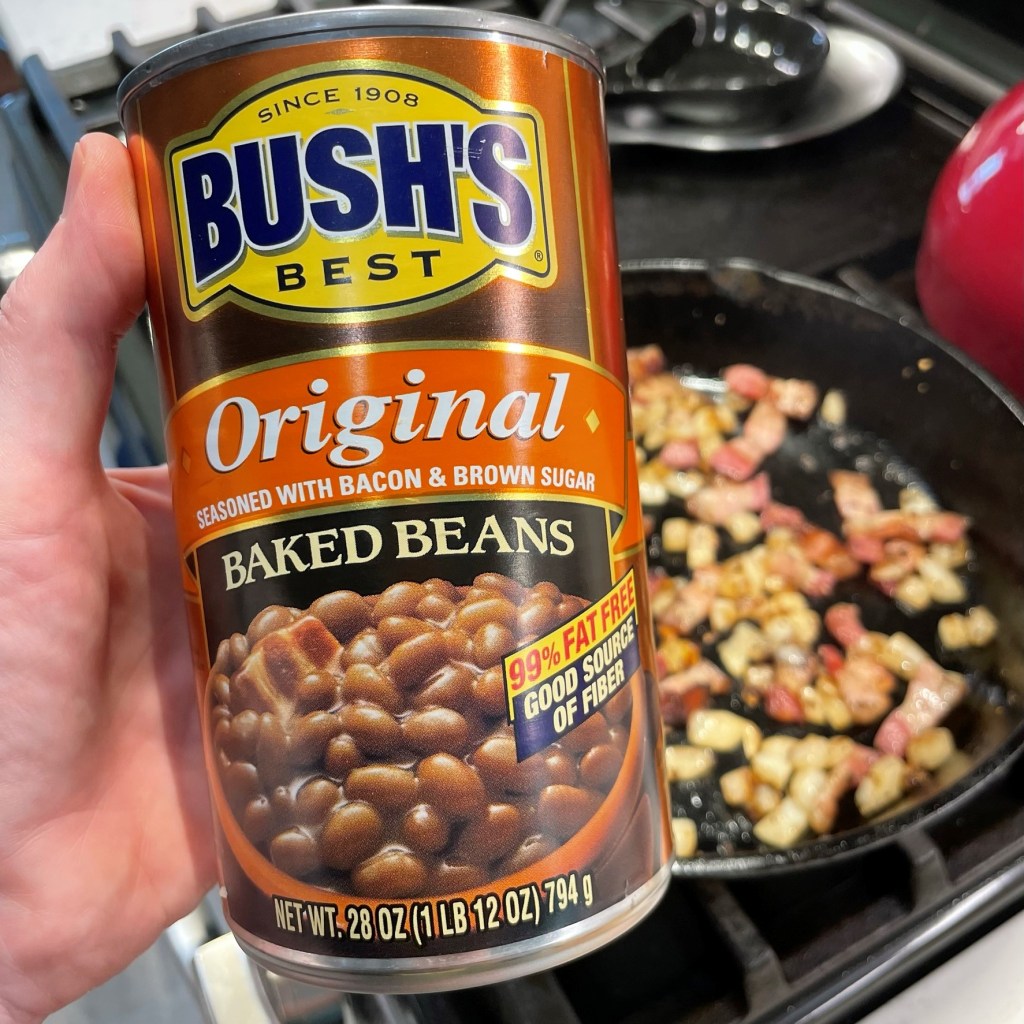
Whew. It feels good to let that go, and I’m not going to pretend that I discovered the can of beans in the back of the cabinet and just whipped up a fun spin on them. Nope, I had every intention of taking a shortcut when I made my grocery list, and let me tell ya, it was just as much fun jazzing up a pre-made can of baked beans as it would have been if I’d made them from scratch. I chose the most basic variety of beans I could find, without too much embellishment. They only had a touch of brown sugar, and this made it easy to spin the beans in the savory direction my palate was craving.

Elevating a store-bought product can be just as rewarding as making a dish from scratch!

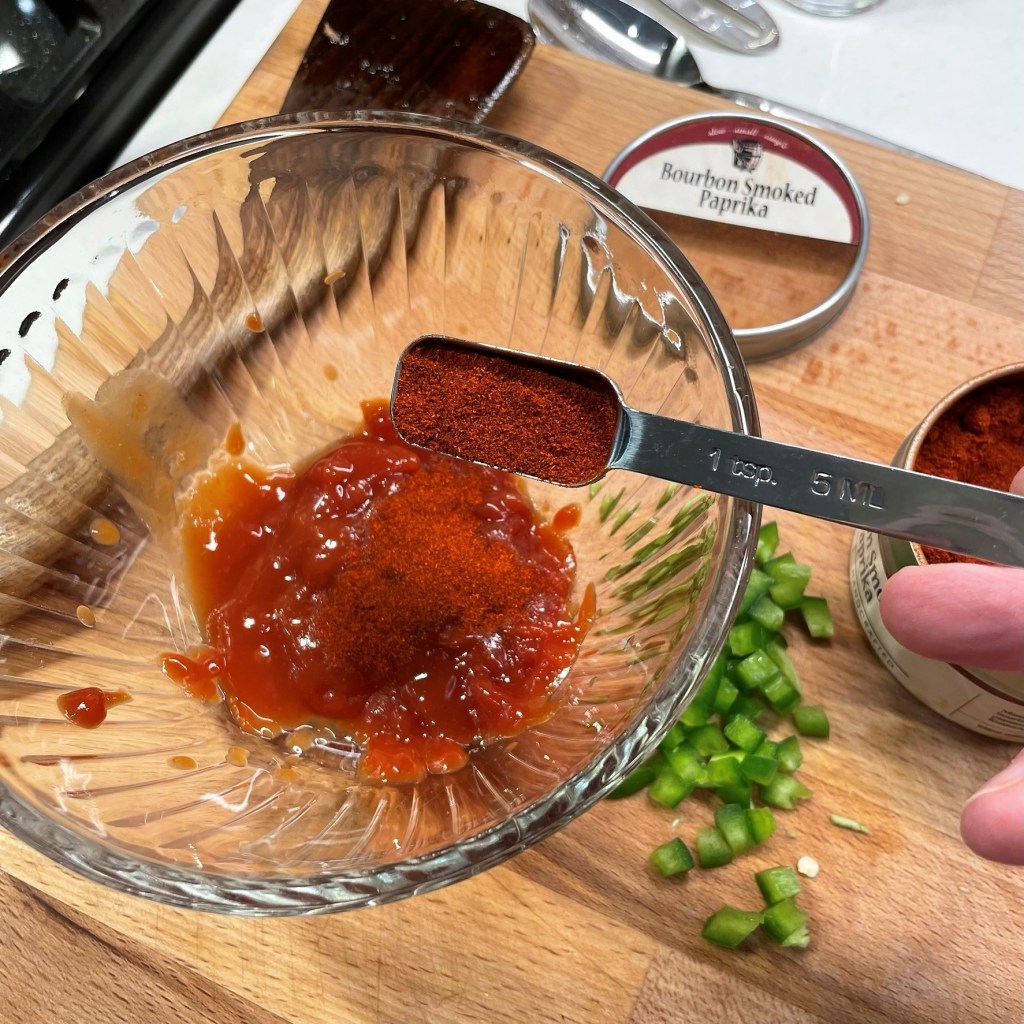
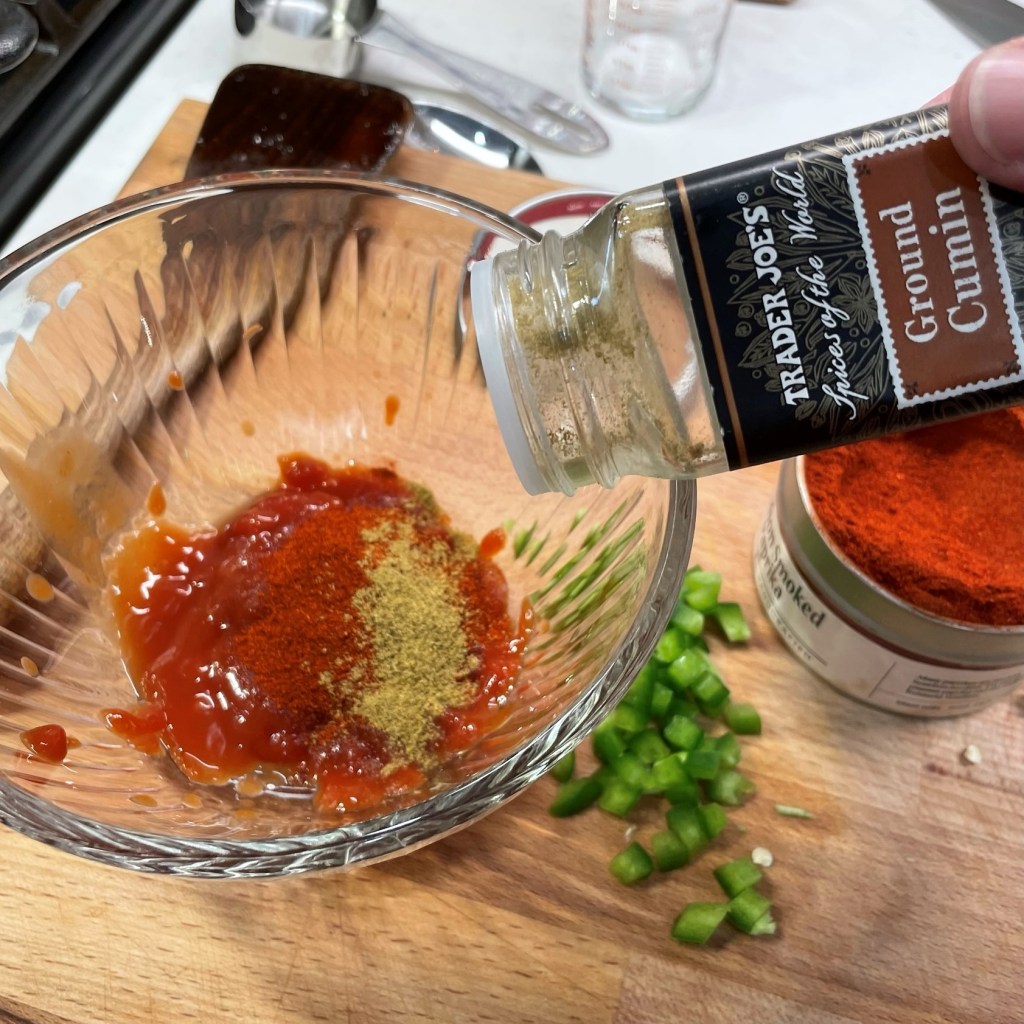
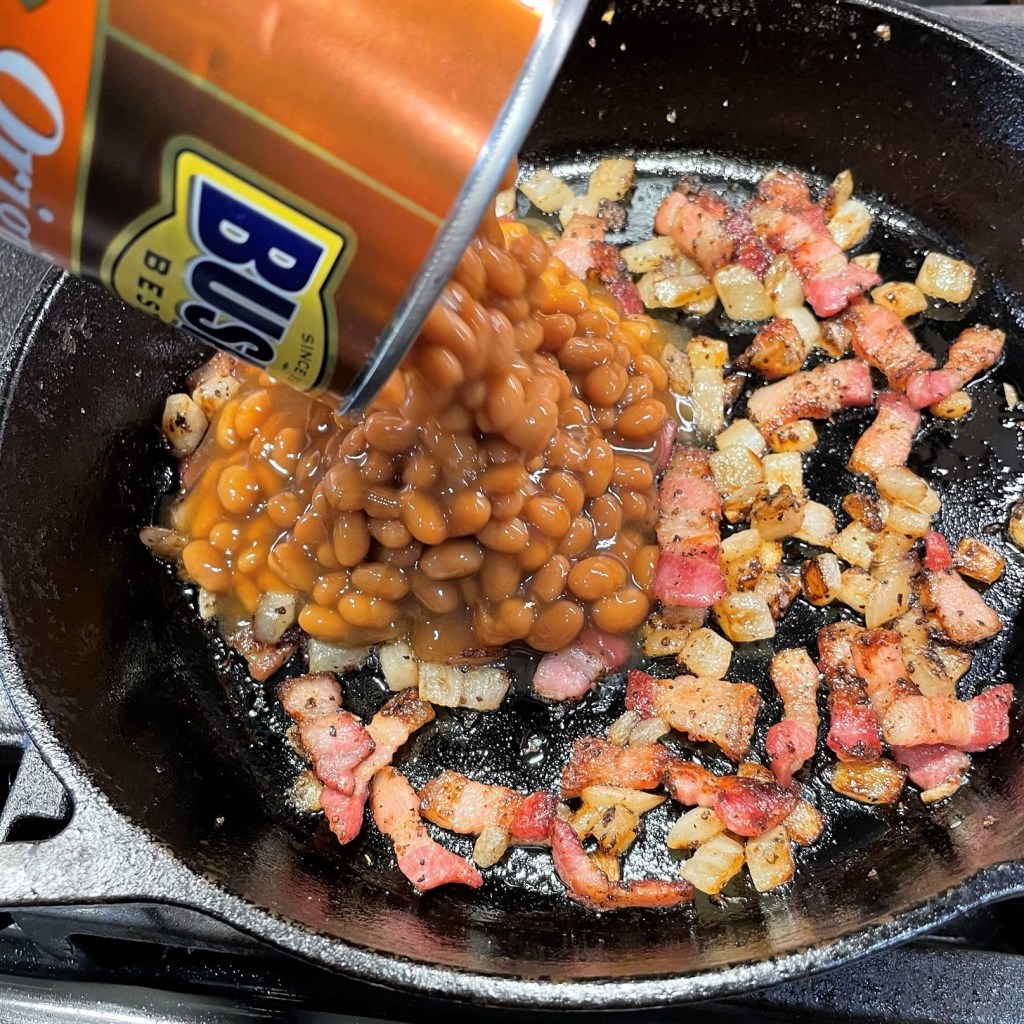
Dressing up the store-bought beans was easy, and they got a big flavor boost from two very thick slices of savory bacon, cooked up to just-shy-of-crispy with half of a sweet onion (I reserved the other half for the top). I didn’t want the beans to dry out in the oven, so I enhanced the sauce with a few tablespoons of ketchup, a splash of vinegar, some smoked paprika and a few shakes of cumin. Then, just for fun, I stirred in a shot of whiskey, the same one I used in the Kickass Whiskey-Braised Collards that we enjoyed a few months ago.


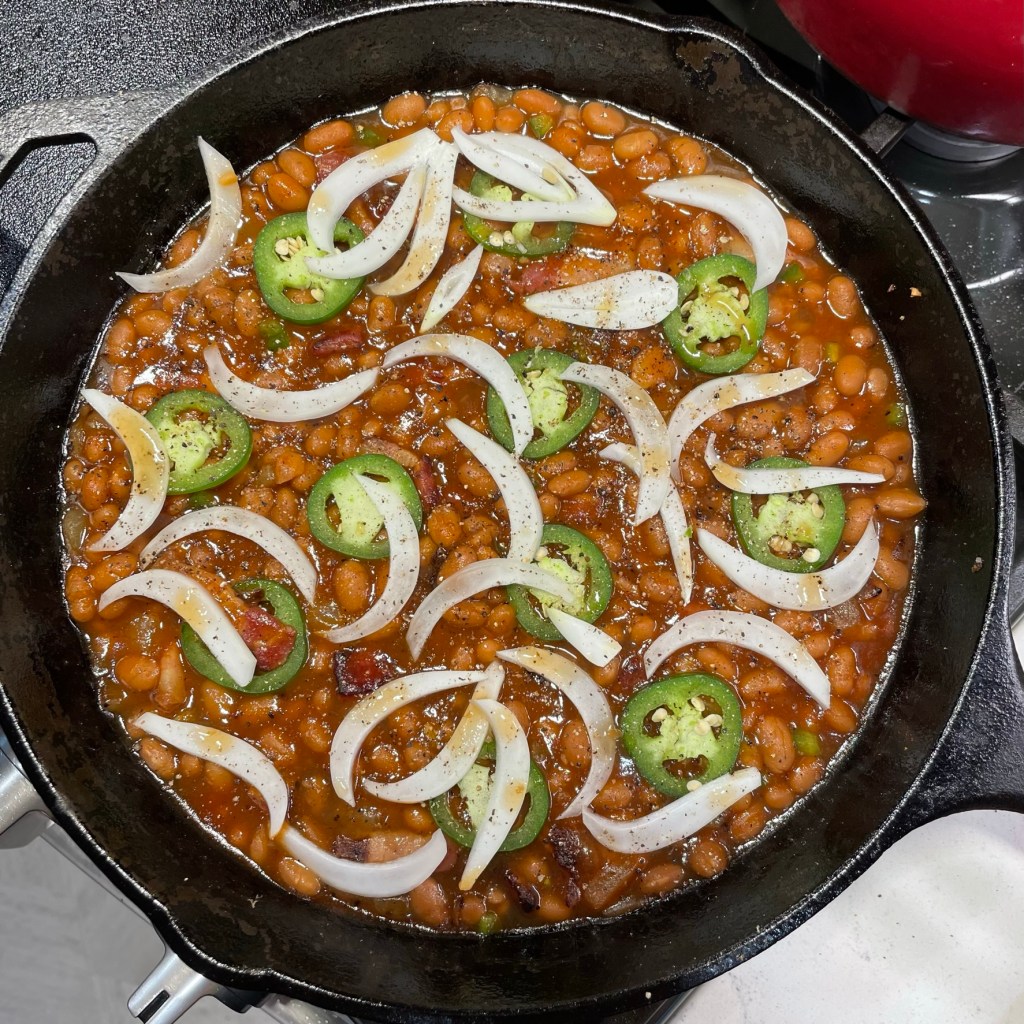
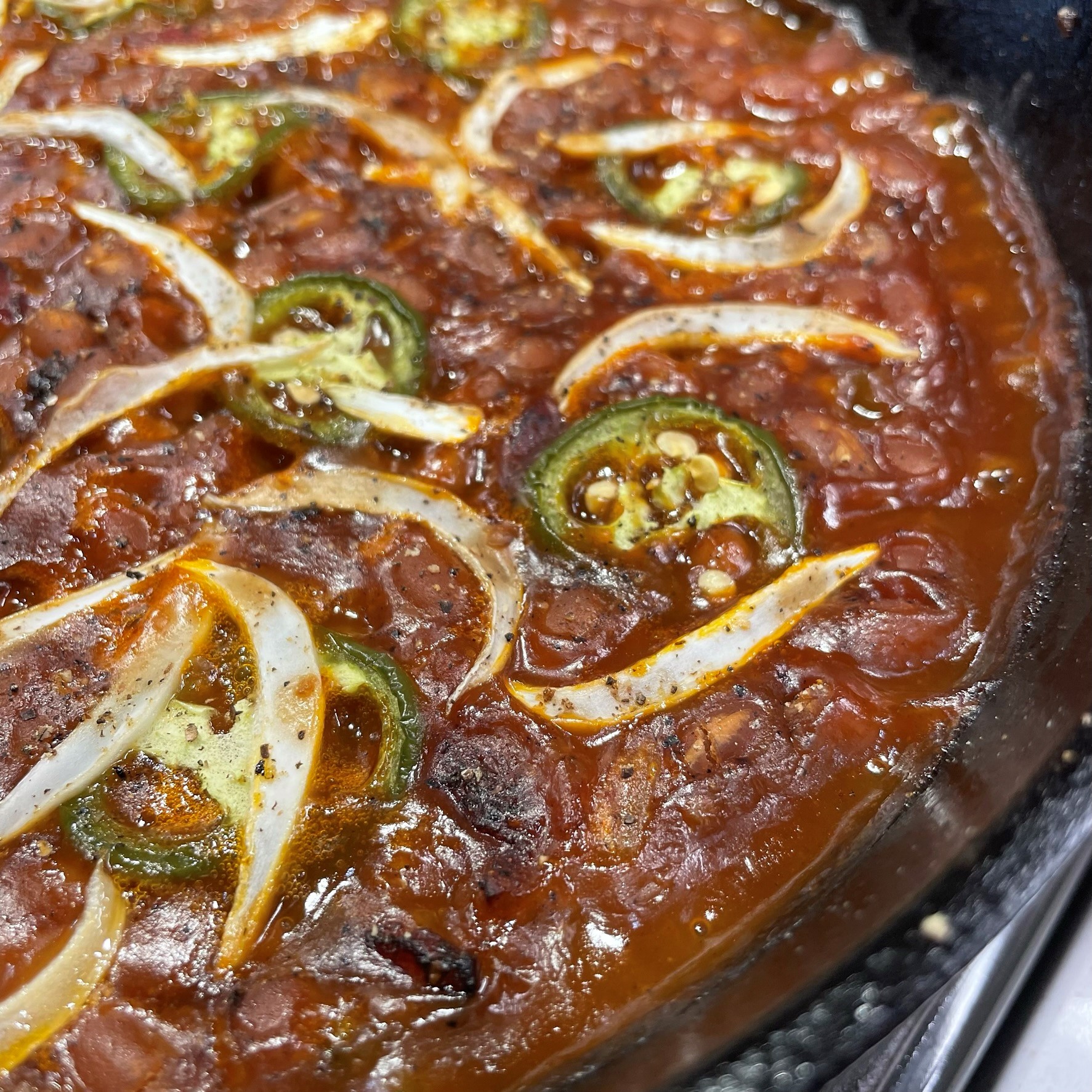
After dumping the beans into the same skillet, I stirred in the smoky sauce and topped the baked beans with the remaining onion slivers and jalapeno slices and slid it into the oven. Baking the smoky beans in the same skillet meant that I also saved time and energy on cleanup, which was a welcome relief. And, there’s just something cool about taking the skillet right to the table.


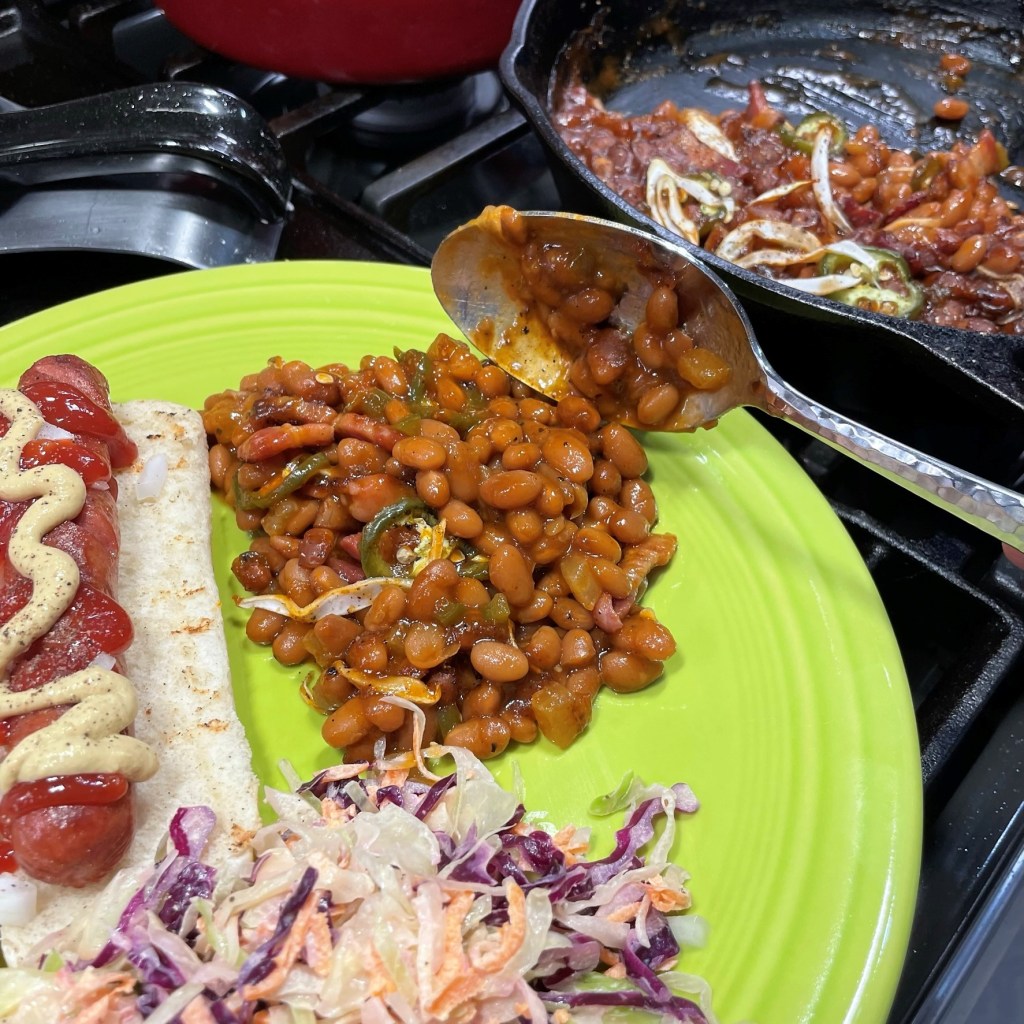
This dinner was easy all around, as we served the smoky jalapeno baked beans with an All-American favorite—grilled, all-beef hot dogs with (gasp!) store-bought buns. Don’t worry, there is no danger of me permanently trading in my “do-it-yourself” personality in the kitchen, but occasionally, I could get used to this.


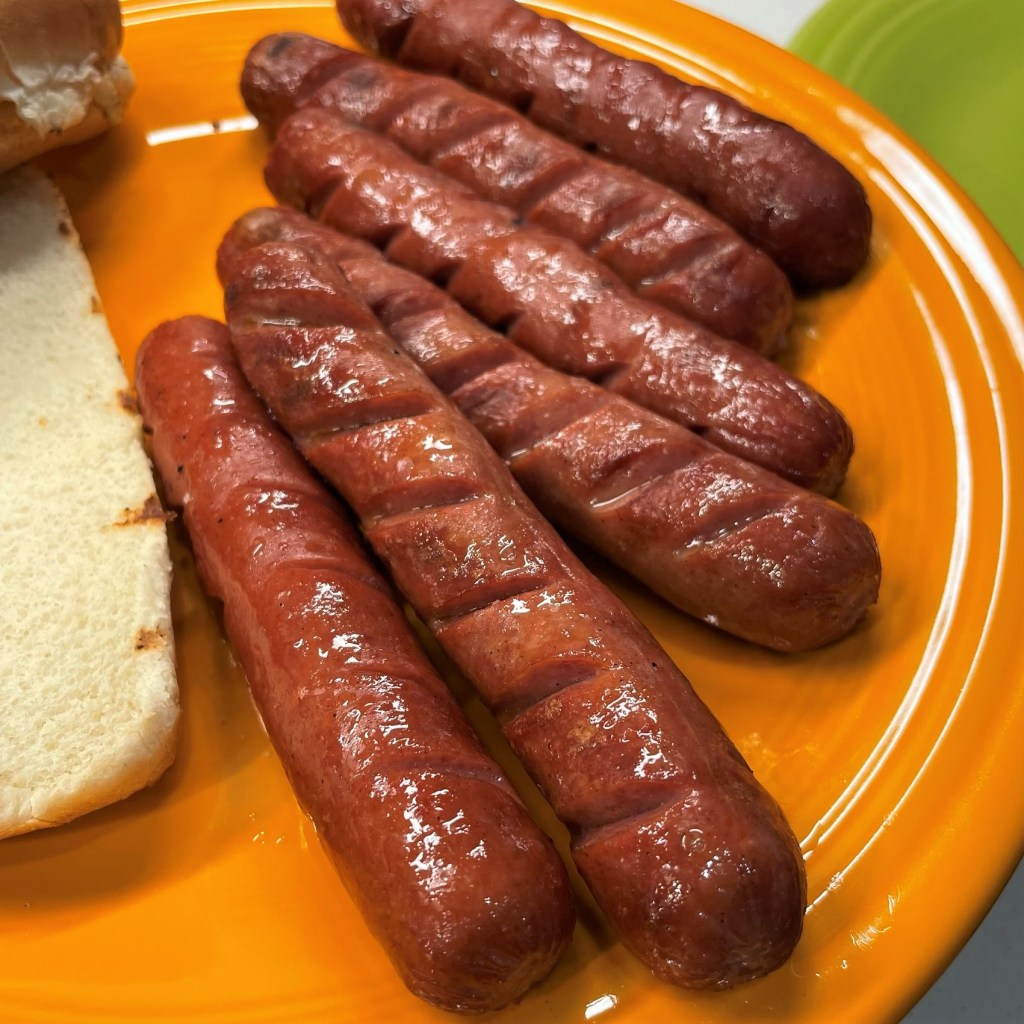
By the way, are you already doing this with your hot dogs? It only takes a few seconds, and you end up with so many crispy crevices to support your favorite toppings. 🙂


Smoky Jalapeño Baked Beans

  • Servings: 6 to 8
  • Difficulty: easy
  • Print

This recipe builds on the flavors of store-bought canned baked beans (or pork and beans). For best flavor results, purchase a simple flavor, such as Bush’s “original” baked beans with bacon and brown sugar, or Bush’s vegetarian baked beans. You can kick up this recipe in multiple ways—for big, bold flavor, keep some of the jalapeno seeds and use the whiskey. For milder flavor, substitute green bell pepper and skip the whiskey.

Ingredients

  • 2 slices thick smoked bacon, cut into 1-inch pieces (omit for a vegetarian version)
  • 1 medium sweet or yellow onion, half chopped, and half slivered into crescents
  • 1 medium fresh jalapeno, half diced, and half sliced into thin rings
  • 3 Tbsp. tomato ketchup
  • 1 Tbsp. apple cider vinegar
  • 1 tsp. smoked sweet paprika
  • 1/2 tsp. ground cumin
  • 1 oz. smoky whiskey (optional, but heck yeah!)
  • 28 oz. can Bush’s “original” or “vegetarian” baked beans, or equivalent substitute
  • Salt and pepper to taste

Directions

  1. Preheat the oven to 350° F, with rack in center position.
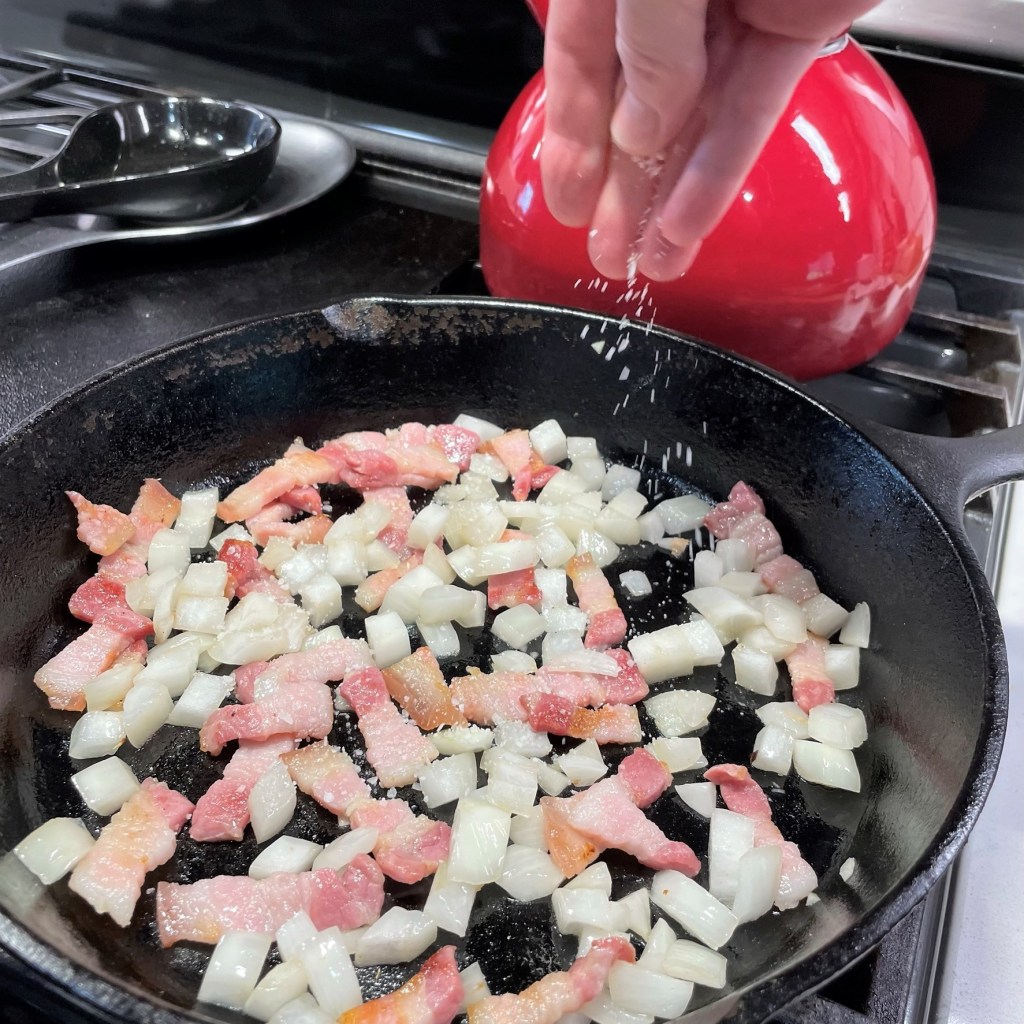
  2. Place a 10-inch cast iron skillet over medium flame. Add bacon and onion, and season it a bit with salt and pepper. Cook, stirring occasionally, to soften onions and render some of the fat off the bacon. If a great deal of fat results, drain off as much as you wish.
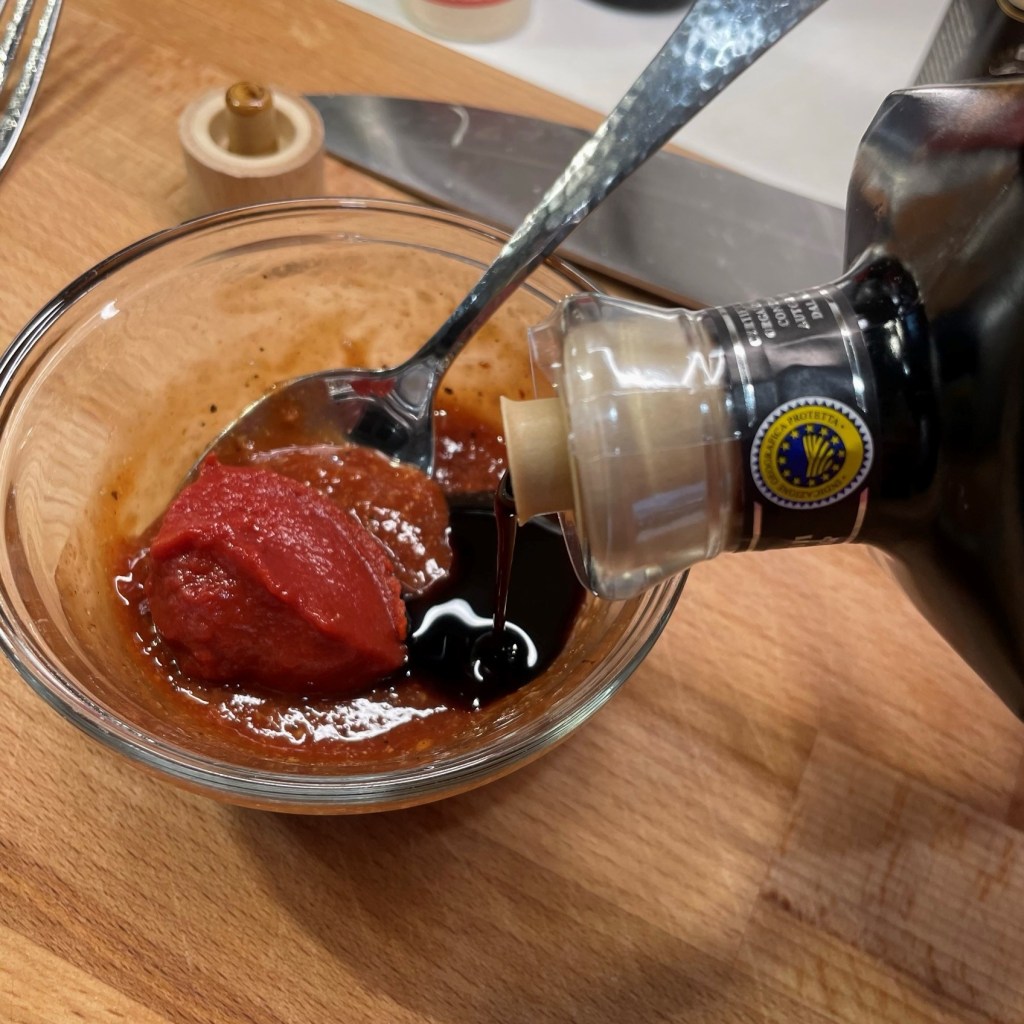
  3. Combine the ketchup, vinegar, paprika and cumin in a small bowl. Stir in the whiskey (if using) and set the mixture aside.
  4. When bacon is slightly crisp, add the canned beans to the skillet, including all the sauce. Stir in the diced jalapenos and the sauce mixture. Adjust salt and pepper to taste.
  5. Top the baked beans with the remaining onion slivers and slices of jalapeno. Twist some freshly ground black pepper all over the top. Bake for 40 minutes, until sauce is bubbly all around.


Thai Basil Chicken

To say that I’ve been under stress lately would be a gross understatement. I know that many of you feel the same angst related to the stories that plague our newsfeeds, and that alone is enough to make anyone shaky. On top of the stressors of life, things at home have been a little, um, hectic.

Besides the uncharacteristically high pressure of late in my day job (which is usually quiet in June), and beyond the fact that we are now past the 90-day mark since the start of our master bath remodel (with issues still happening every day), I had an unwelcome bit of news this week at my first primary care visit in nearly a decade. It’s nothing serious—at least, not yet—but I am considering the results of my blood workup to be an important wake-up call.

At the risk of TMI, I’ll summarize to say that several key markers are out of whack, and I need to get my act together quickly as it relates to my diet and my overall health. As luck would have it, going through menopause, starting a food blog, and signing up for not one, but two major home renovations during a world pandemic did not have positive effect on my body. I should have seen it coming.

For the first time in my life, a doctor told me that I must make changes, and that was a little scary. There’s plenty of time to turn things around, and I am truly thankful for that, but it means healthier options will be my first choice and decadence is on the bench for a while. I need to embrace regular exercise, too, but that’s another post entirely. Today, I’m focusing on healthier eating. It does not mean that we can’t have pizza or ice cream or some of the other fun things my husband and I love; rather, it only means that I must be more mindful of what goes into those dishes in the first place. Luckily, I do love experimenting!

For me, what makes a meal truly satisfying is variety of texture, big flavor and interesting spices. I’m not suddenly turning vegan or entirely giving up any food groups—I have never been one for a total elimination diet. I can move toward better health with a few lightened-up favorites, more meatless dishes and plenty of vegetables, and that’s what I intend to do. Truth be told, part of the reason I’m telling y’all this is that it builds in an extra level of accountability. Now that you know, I’ve painted myself into a bit of a corner. So here comes the first of several fresh and healthy meals served up at our house recently.

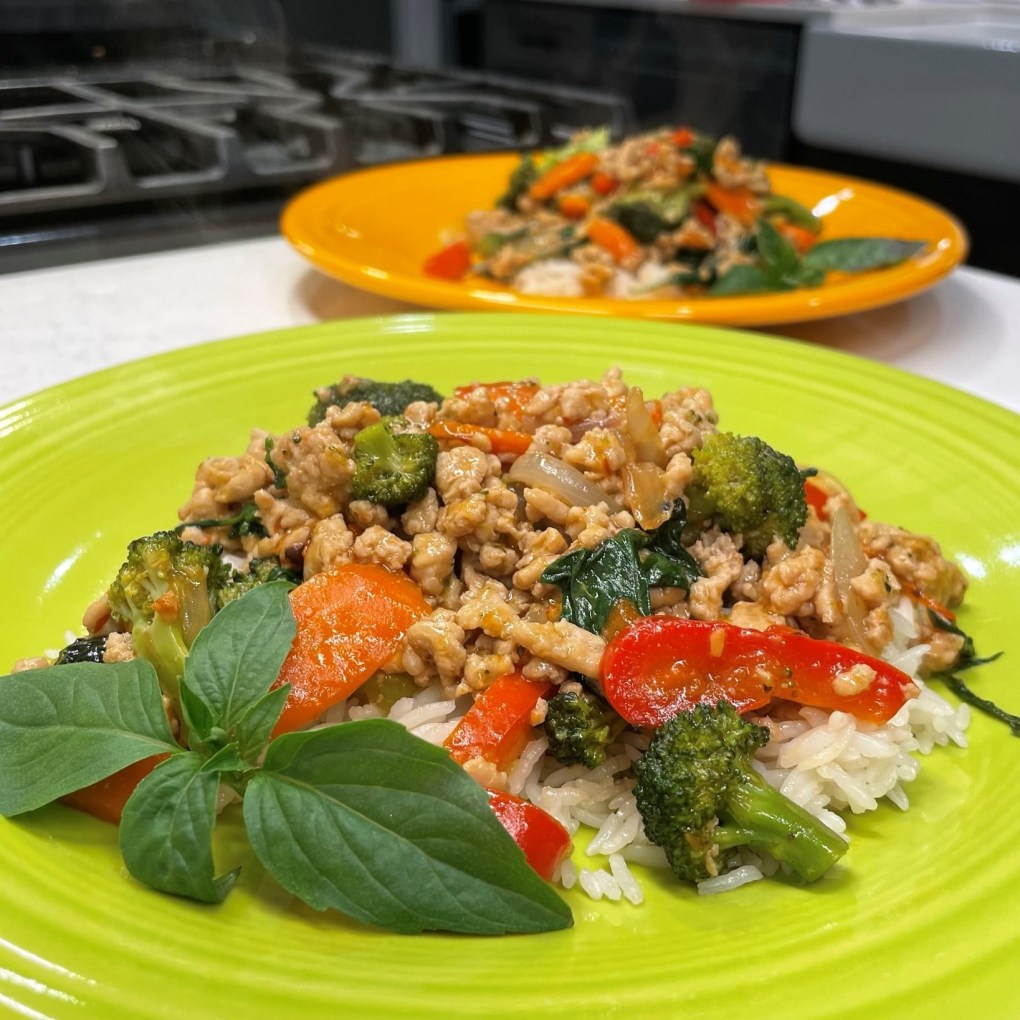
It smells even more delicious than it looks!

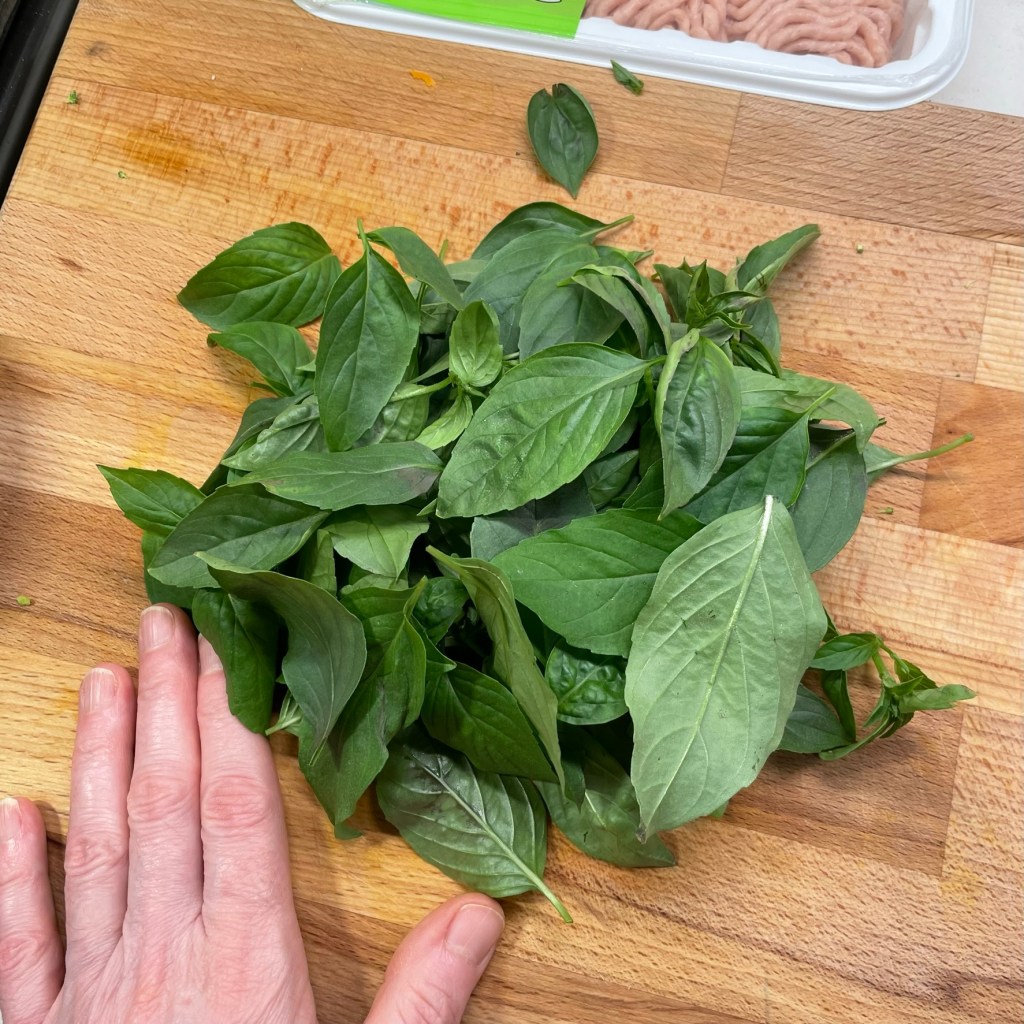
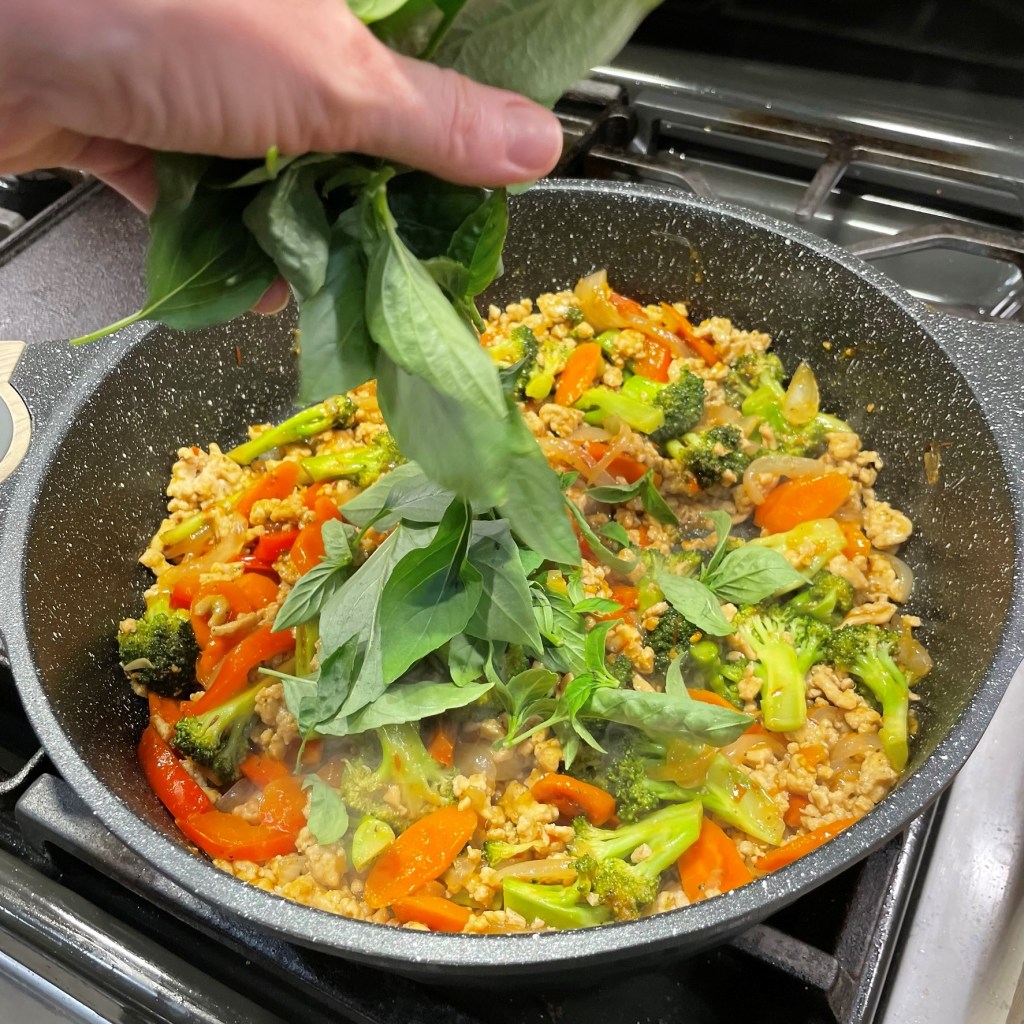
Thai basil chicken meets all the criteria I mentioned for a satisfying meal. The texture is amazing and packed with crunchy vegetables, including carrots, broccoli and red bell pepper. The flavor is phenomenal, with a complex blend of spicy ingredients in the Thai-inspired sauce that gently coats the vegetables and lean ground chicken. The signature flavor that gives this dish a little extra “zhuzh” is Thai basil, a fresh herb in the mint family that is similar to the Genovese basil you’d recognize in Italian food, but with a spicy undernote and a hint of anise or licorice. I’ve had an abundance of this ingredient lately, since my husband and I reinstated the Aerogarden that he gave me for Christmas a couple of years ago. This gorgeous herb has taken over the whole dining room, even visible from outside the window because it’s growing through the blinds (which, I suspect, is causing the neighbors to whisper). I prune the plants every couple of days, which only makes them grow faster, and so I needed a dish that uses a lot of Thai basil at once. This recipe is perfect for it!


The prep for Thai basil chicken is easy; it’s just a bit of chopping and slicing of fresh vegetables that have plenty of texture, color and nutrition. The other essential prep is making the sauce. My recipe includes chili-garlic paste for heat, soy sauce and coconut aminos for an umami burst, oyster and fish sauces for a little funky depth, rice vinegar for a slight acidity and a touch of coconut sugar to round it all out. There’s also a bit of corn starch in the mix to keep it silky. If you like Asian flavors even a little bit, you won’t regret having these ingredients in the door of your fridge, and in no time at all, you’ll be mixing and matching them to come up with your own amazing recipes. One final note on the point of these Asian sauces, and this is not a joke. There is an imminent shortage of both sriracha sauce and chili-garlic paste, so you may want to grab a jar of each now to avoid the drought that’s coming on these ingredients. Now, let’s get cooking on this dish!


I used carrots, red bell pepper, onions and broccoli in my recipe, but there are other veggies that would feel right at home here, including scallions, cauliflower, celery, crunchy green beans or snow peas. Sliced fennel would also be terrific, and if you can only find Genovese basil, having fresh fennel in the mix would help fill the gap of the licorice flavor that Thai basil offers. Basically, aim for lots of color and texture and you’ll have a winning dish. The only vegetable I wouldn’t recommend is tomato, which is too soft, and hardly ever used in Asian cuisine.

Cooking the dish is simple, beginning with a little bit of oil in a large, fairly deep skillet or wok. Because this recipe is cooked over medium-high heat, you need an oil with a high smoke point, such as peanut, coconut or canola oil, but you won’t need more than a few tablespoons. Extra-virgin olive oil is not best for this kind of cooking because it overheats easily and turns bitter.


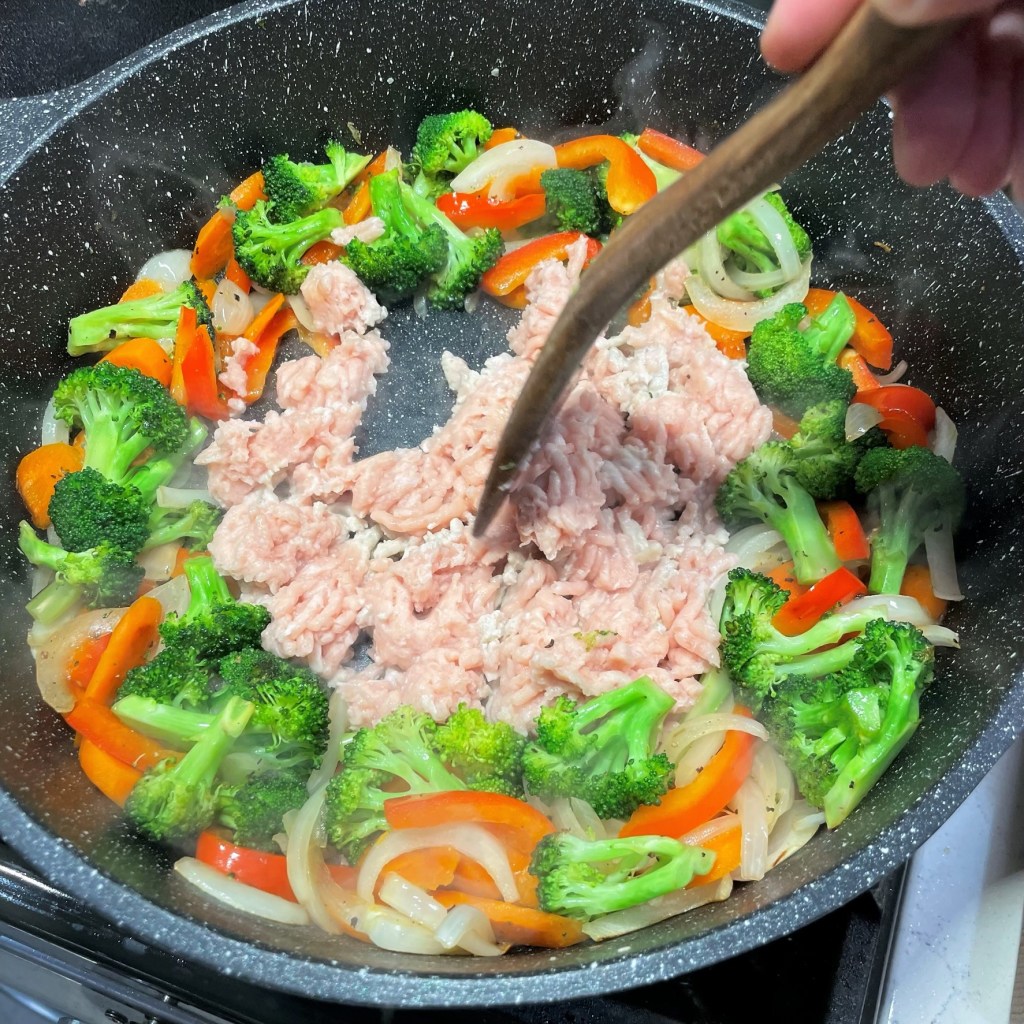
You’ll cook the veggies first, only a few minutes until they begin to soften, then move them to the outside edges of the pan and cook the ground chicken, half at a time. You could use cut-up pieces of chicken breast, also, but I find that ground chicken cooks more quickly and evenly. I normally use a wok when I make this dish, but that is one of the few tools that didn’t earn prime kitchen real estate after our remodel, and the overflow of stuff in the garage is a bit of a nightmare right now. If you have a wok, of course it would be the best vessel for cooking, but any large, sturdy skillet or pan with deep sides will work fine.


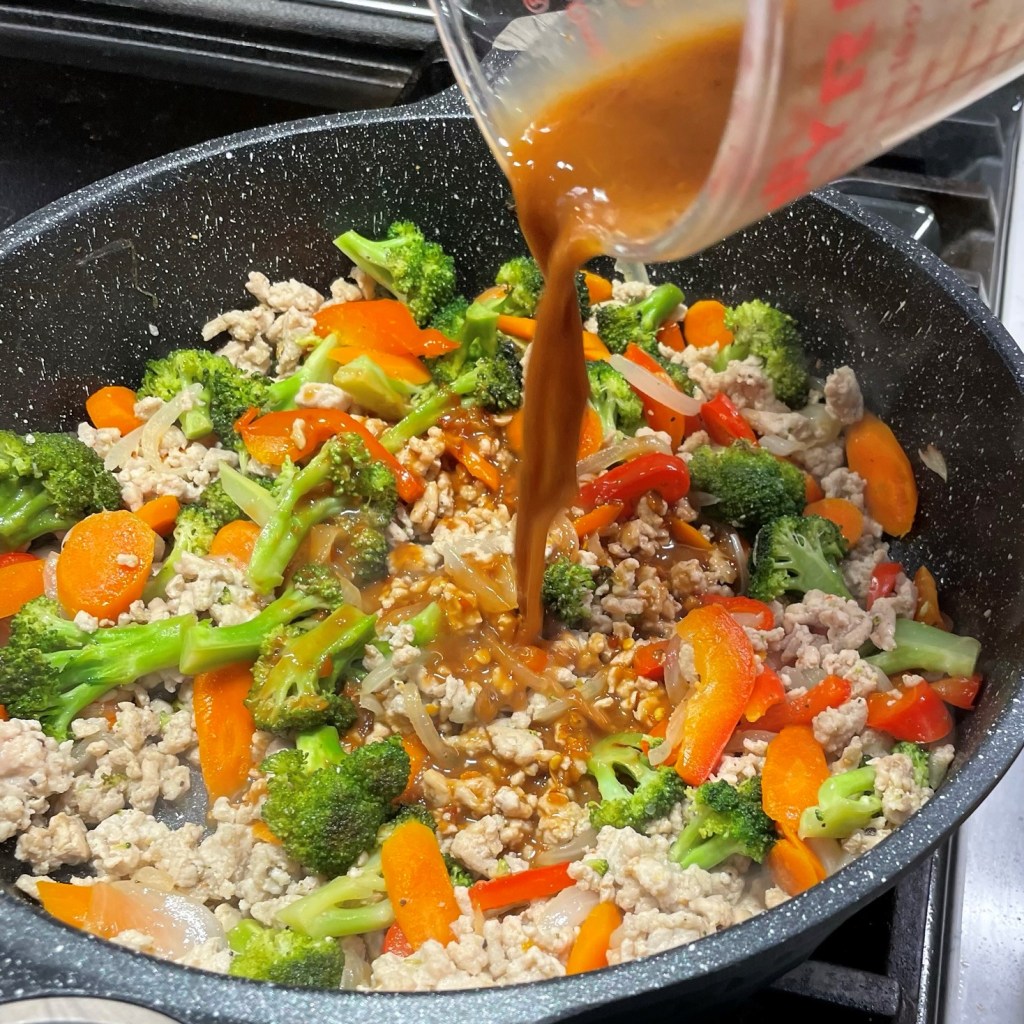
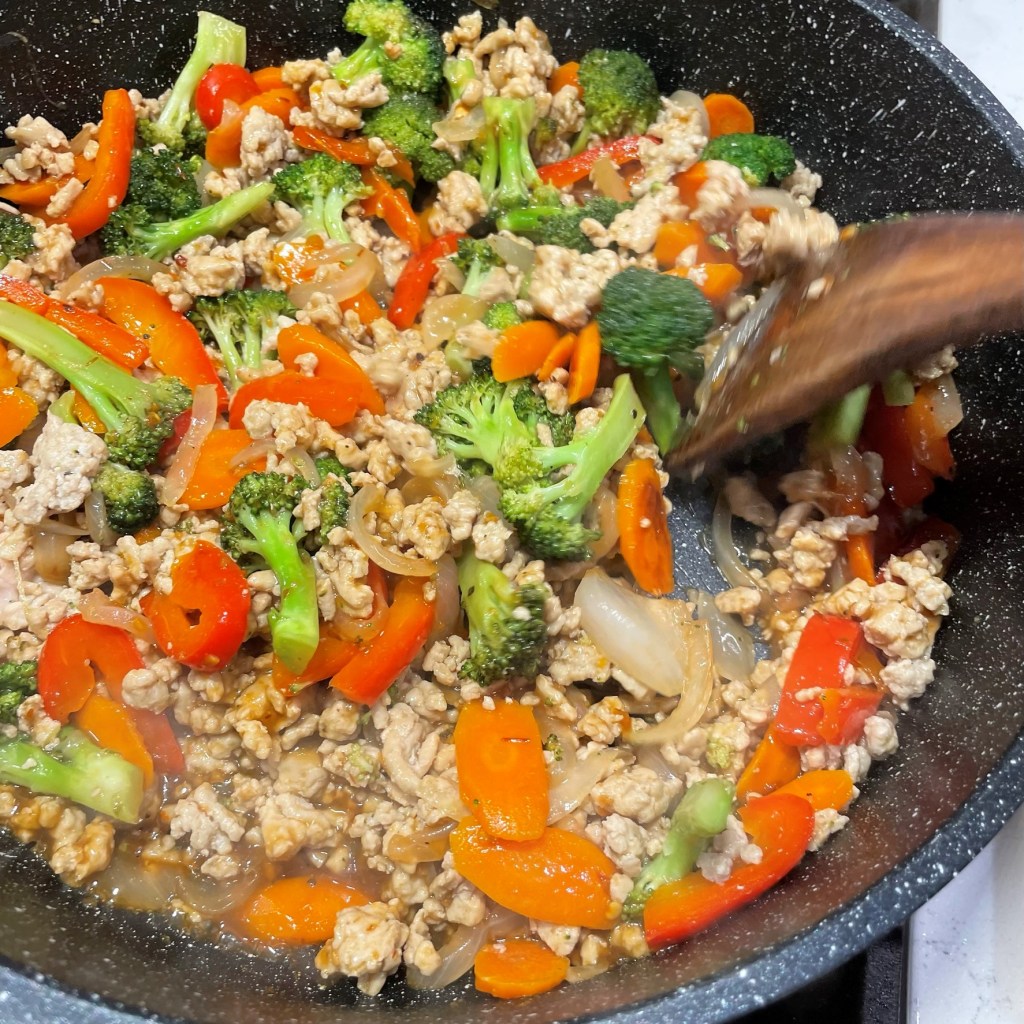
After the chicken has lost its pink color, whisk the sauce to mix it up again, and pour it all at once over the pan ingredients. Toss a few times to coat, and you should see the sauce thicken quickly, thanks to the cornstarch in the mix. Add the Thai basil at the very end, and when it wilts down and turns darker green (which takes no more than 30 seconds), this meal is ready to serve!

I’ll be looking for other fun ways to use my Thai basil, and I’m already planning to do something with the shrimp we have in the freezer—maybe a drunken noodle kind of thing? Oh, aaand, I don’t think I have mentioned that I planted a vegetable garden this year, and we have found a new weapon against deer invasion. More on that next time. 🙂

Fingers crossed, we will have fresh zucchini, tomatoes, peppers and eggplant soon. Stay tuned!


Thai Basil Chicken

  • Servings: 4
  • Difficulty: average
  • Print

This recipe moves quickly, so it’s best to have your fresh ingredients and sauce ready before you begin. If you have a favorite store-bought, spicy Thai sauce, you could substitute that, using about 2/3 cup. If you cannot find fresh Thai basil, a regular Italian basil can be substituted but the flavor will not be quite as authentic. As long as we are talking substitutions, the chicken could also be swapped out for shrimp or even extra firm tofu cubes. Go on, make it yours!

Ingredients

  • 1 pound ground chicken
  • 1 small onion, halved and cut into slivers
  • 1 large broccoli crown, trimmed and cut into florets
  • 1/2 large red bell pepper, cut into strips
  • 3 small carrots, peeled and cut on bias into thin slices
  • a fat handful fresh Thai basil leaves
  • 3-4 Tbsp. high-heat oil, such as coconut, peanut or canola (you will divide this to cook the vegetables and the chicken)
  • Spicy Thai basil sauce (ingredients listed below)
  • Cooked jasmine rice, for serving

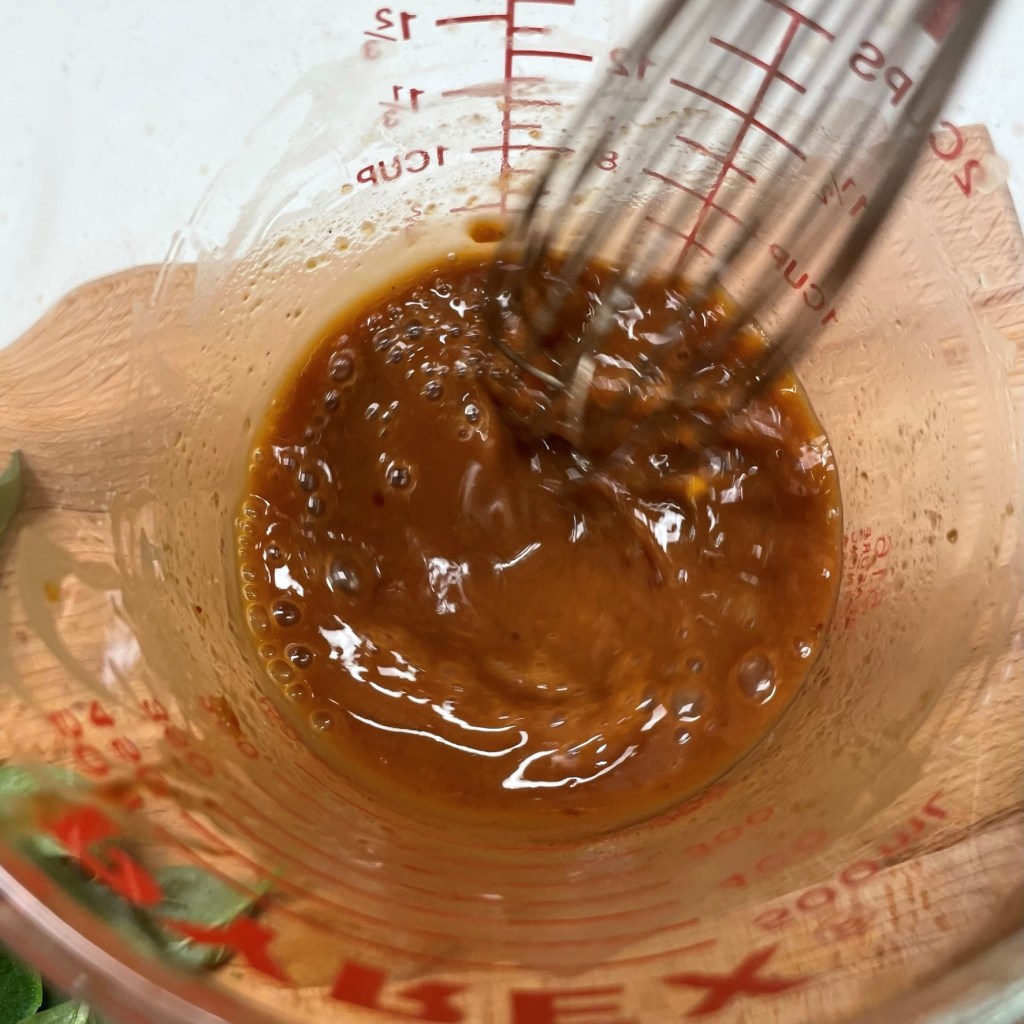
Whisk the sauce ingredients together in a glass measuring cup or other bowl that is suitable for pouring. Have it ready before you begin cooking.

Ingredients

  • 2 Tbsp. garlic chili paste
  • 1 Tbsp. oyster sauce
  • 1 Tbsp. low-sodium soy sauce
  • 1 Tbsp. coconut aminos
  • 2 Tbsp. rice vinegar (not seasoned)
  • 1 Tbsp. coconut sugar
  • 1 tsp. fish sauce
  • 1 Tbsp. corn starch
  • 2 Tbsp. COLD water

Directions

  1. Place a large, high-side pan over medium-high heat. Add half of the oil, and when it shimmers, add all vegetables to the pan. Sprinkle with a slight pinch of salt (not too much, because the sauce has plenty), and toss in the pan until they begin to soften, or about 7 minutes.
  2. Push the vegetables toward the outside edge of the pan. Add half of the remaining oil in the center of the pan, and add half the ground chicken, tossing to cook just until it’s no longer pink. Repeat with the remaining chicken.
  3. Whisk the sauce to reincorporate ingredients that have settled. Pour the sauce all over the pan mixture and stir or toss to coat. The sauce should begin to thicken very quickly.
  4. Add the Thai basil to the skillet all at once and toss to wilt it into the recipe. This will happen very quickly.
  5. Spoon the Thai basil chicken over portions of hot cooked rice, and enjoy it while it’s hot!


Steak & Potato Pizza

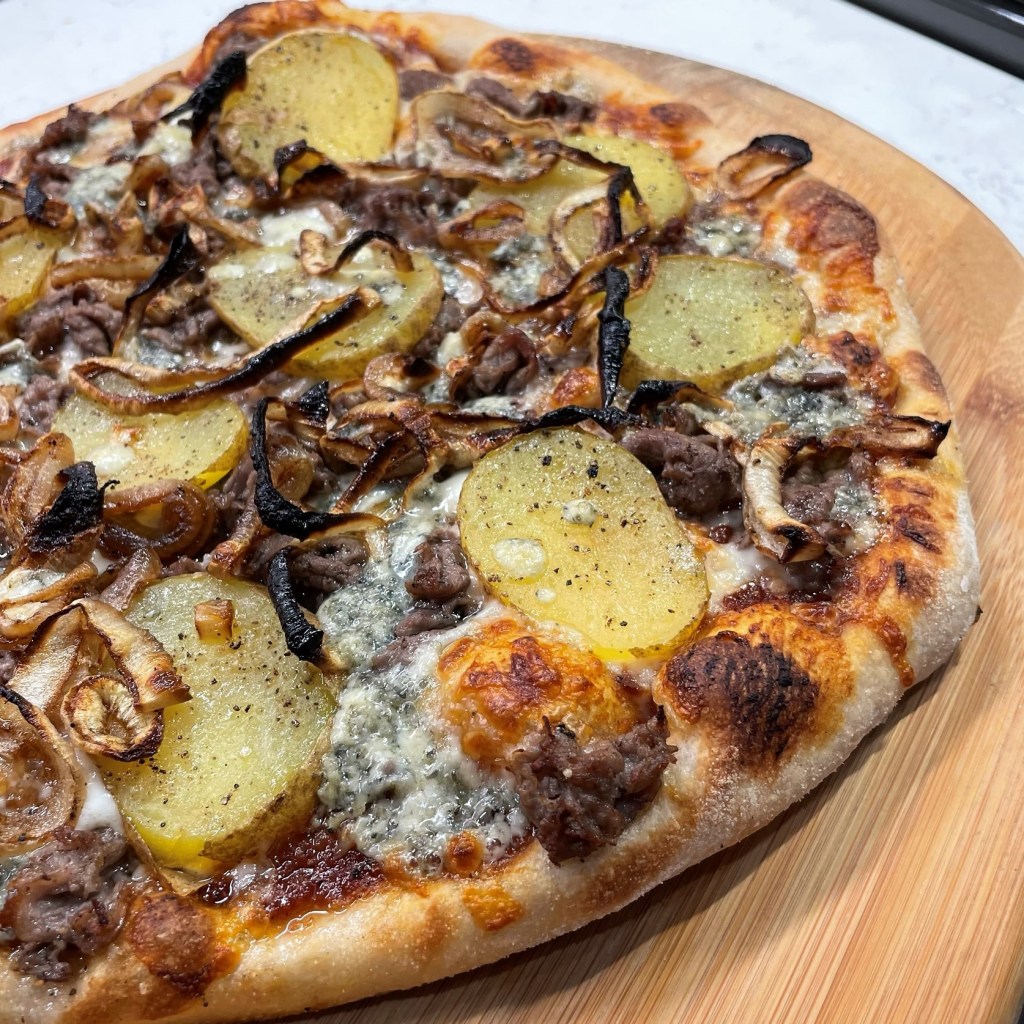
At our house, we have our share of classic, pepperoni-and-cheese style pizzas. But I really enjoy bringing unexpected toppings to a pizza—to shake up the pizza, yes, but also to enjoy other favorite food combinations in a new way. Just about any meal can be transformed into a pizza, and if you have any doubt, peek at my Pizza Party page to see some of the other fun combinations we’ve enjoyed over the past couple of years. Even I was surprised to see how easily Buffalo wings, oysters Rockefeller or jambalaya can be transformed into a perfect, tasty slice.

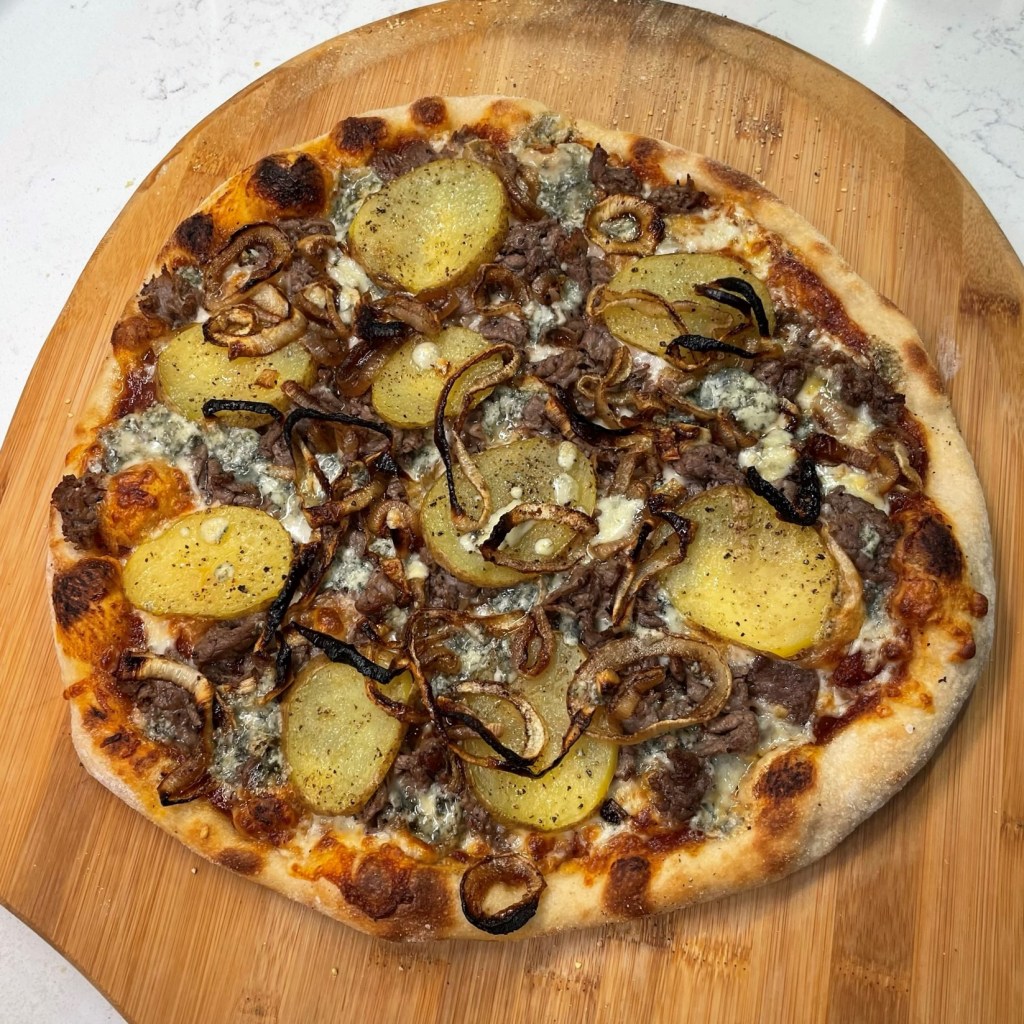
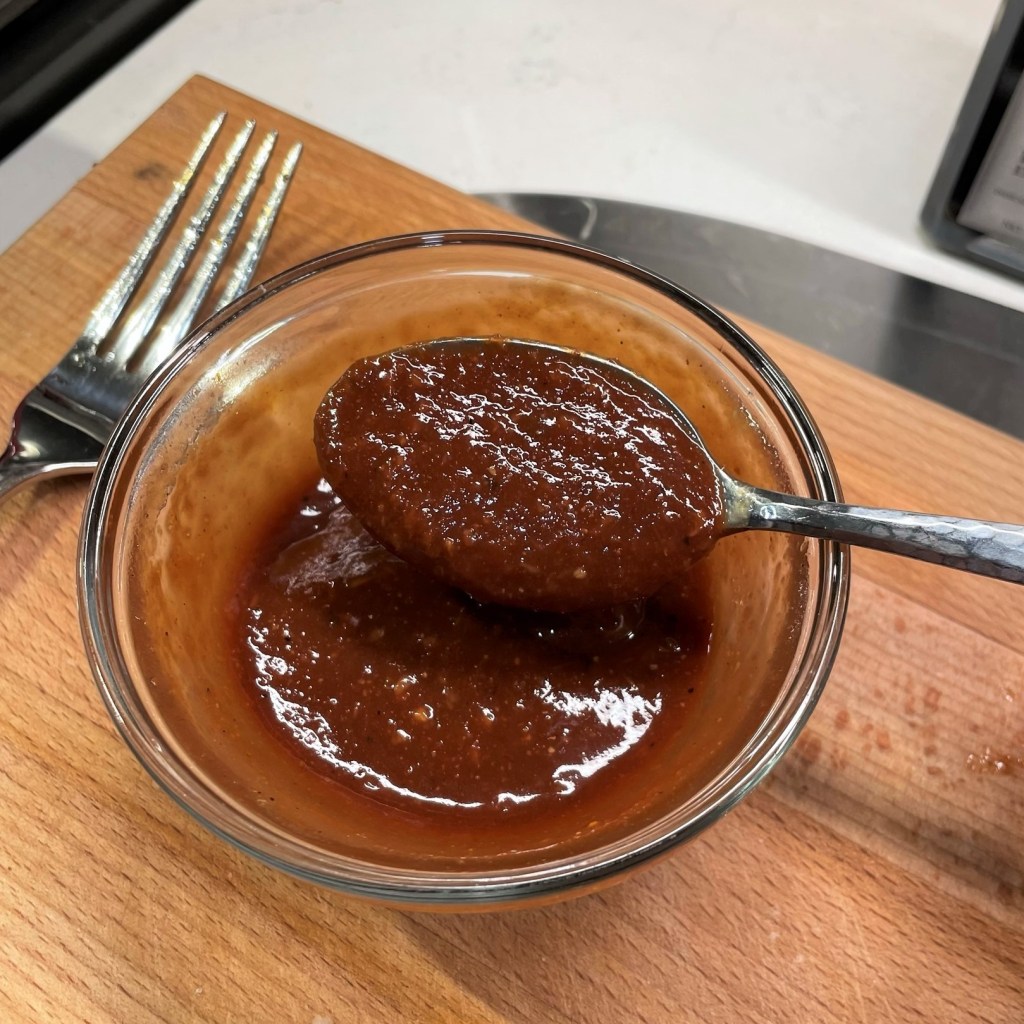
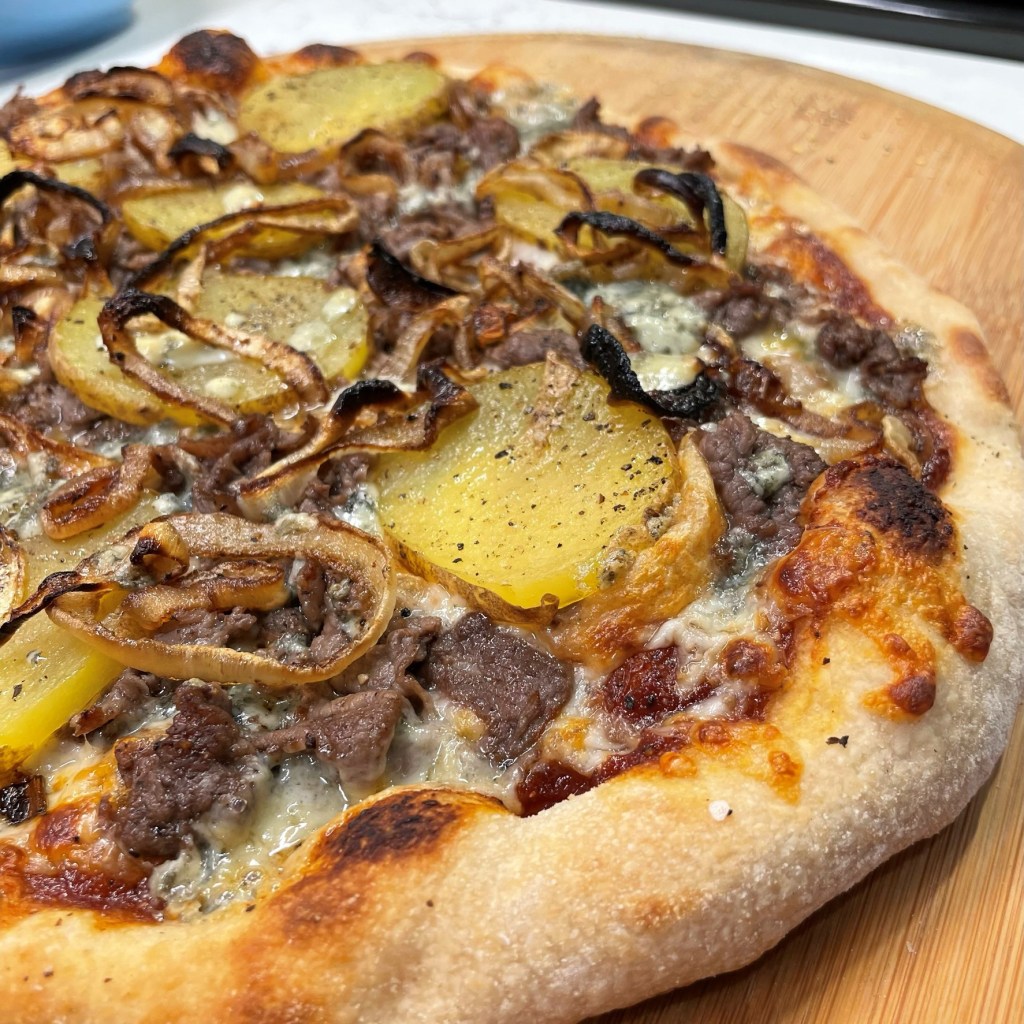
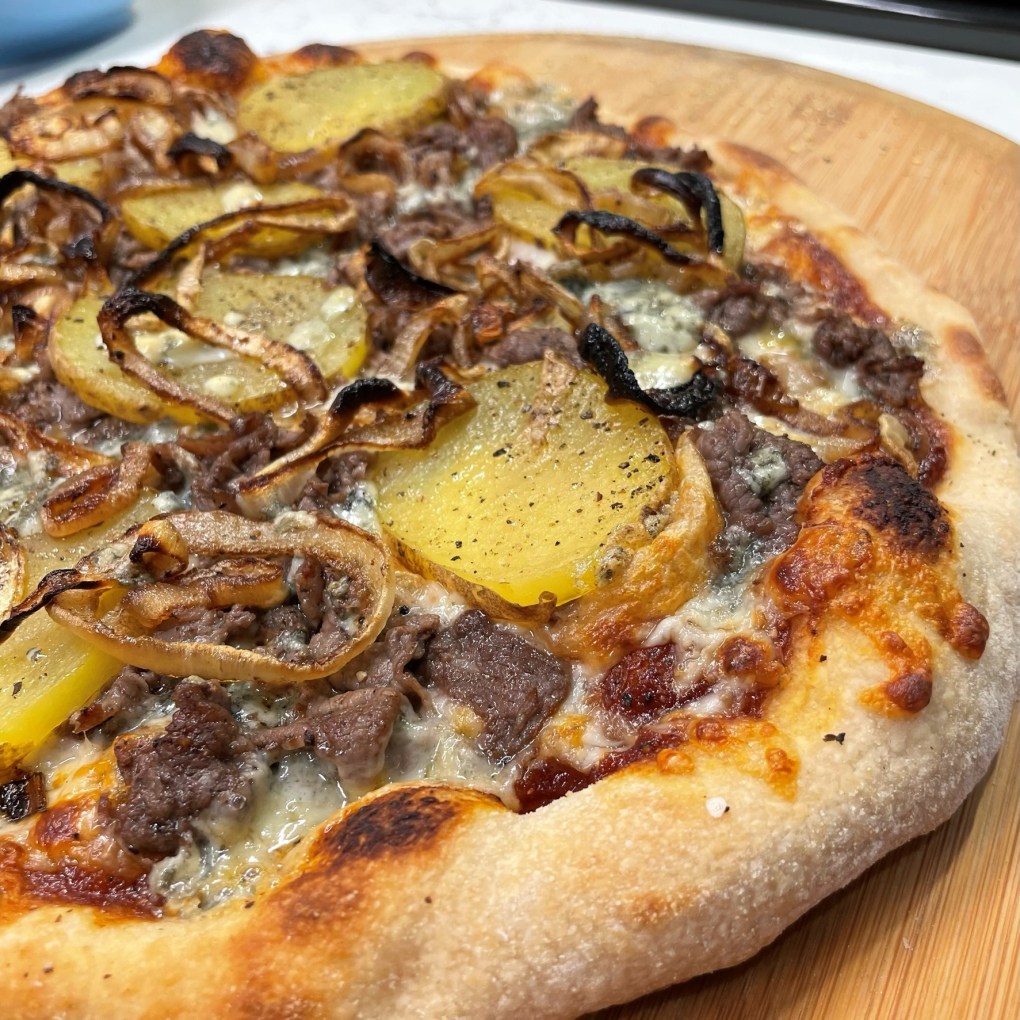
My goal with this pizza was to recreate the experience of dining at a classic steakhouse, but without the heavy, overstuffed feeling that always seems to follow a glorious meal of steak and potatoes. I knew that balsamic roasted onions belonged on this meat and potato pie, and definitely a touch of bleu cheese, but I needed a minute to figure out the sauce. A typical red sauce wouldn’t do, but I found a few things in the door of the fridge and whipped up an easy steak sauce that was tangy, spicy and just slightly sweet.

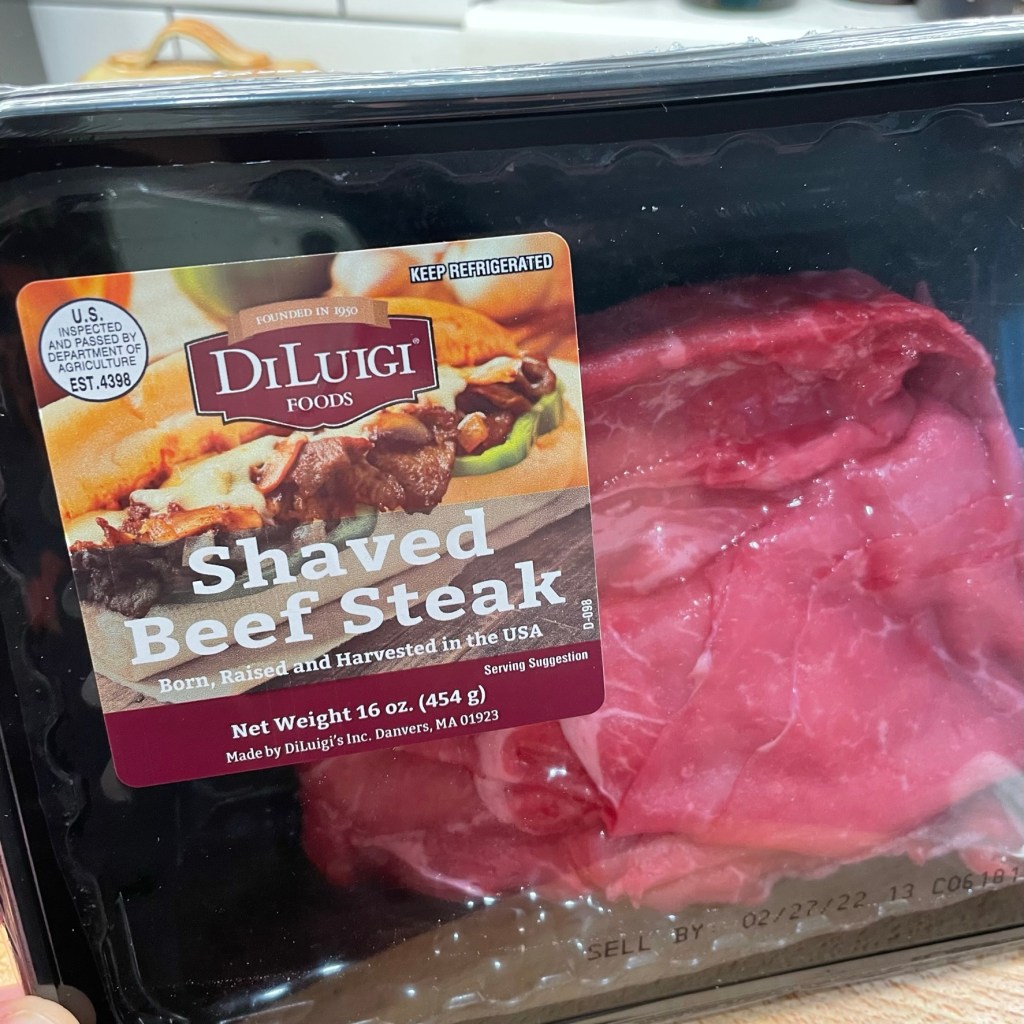
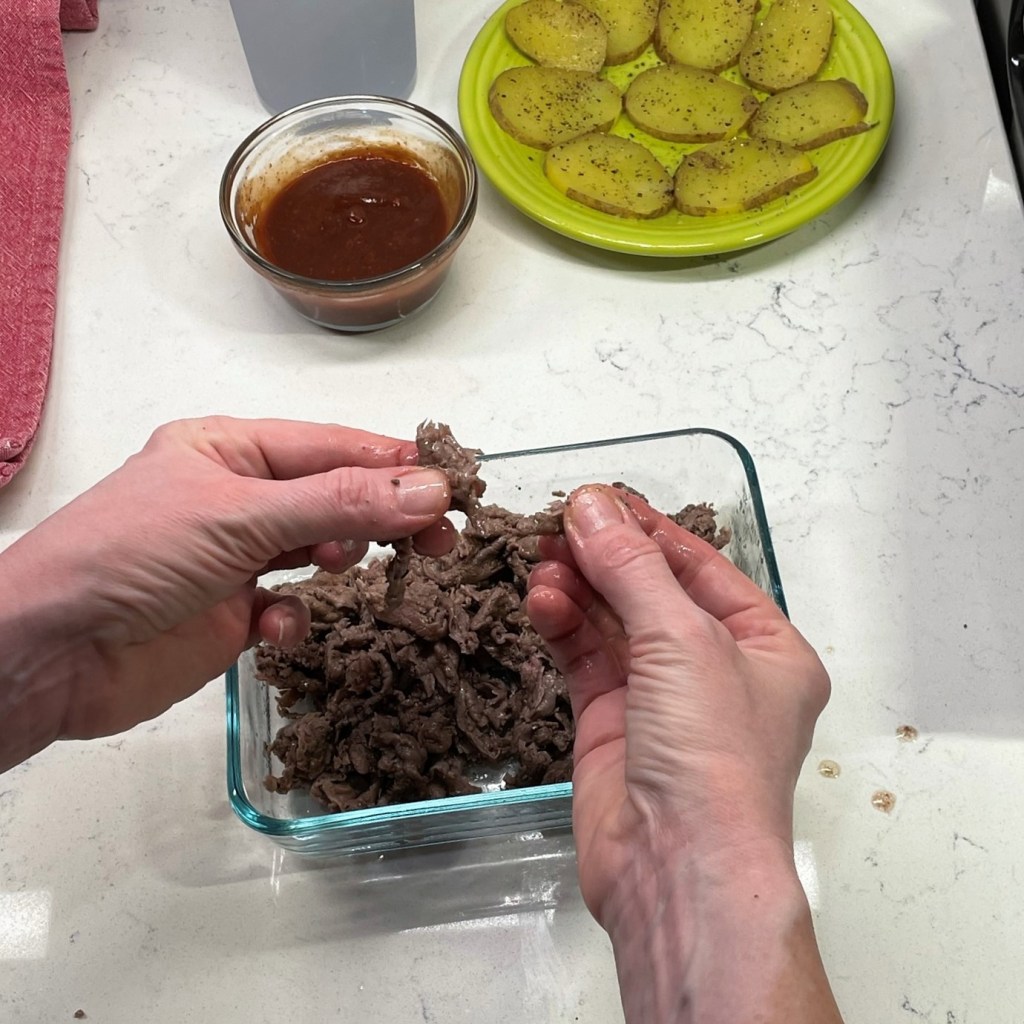
A thin crust is right for this pizza and lets the steak and Yukon gold potatoes take center stage. If you have leftover steak, slice it really thin for this pizza. Or follow my lead and use half a package of shaved steak—the kind you’d cook up for a Philly cheesesteak.  I used mozzarella on the base, but Monterey jack or any other mild, neutral cheese would be a good choice as well.


The result was just right, with enough meat to satisfy but not so much to overwhelm. The Yukon gold potatoes were soft and creamy, and the accent of bleu cheese reminded me of a real steakhouse dinner. Except, of course, for the belly bloat or the outrageous steakhouse price.


Ingredients

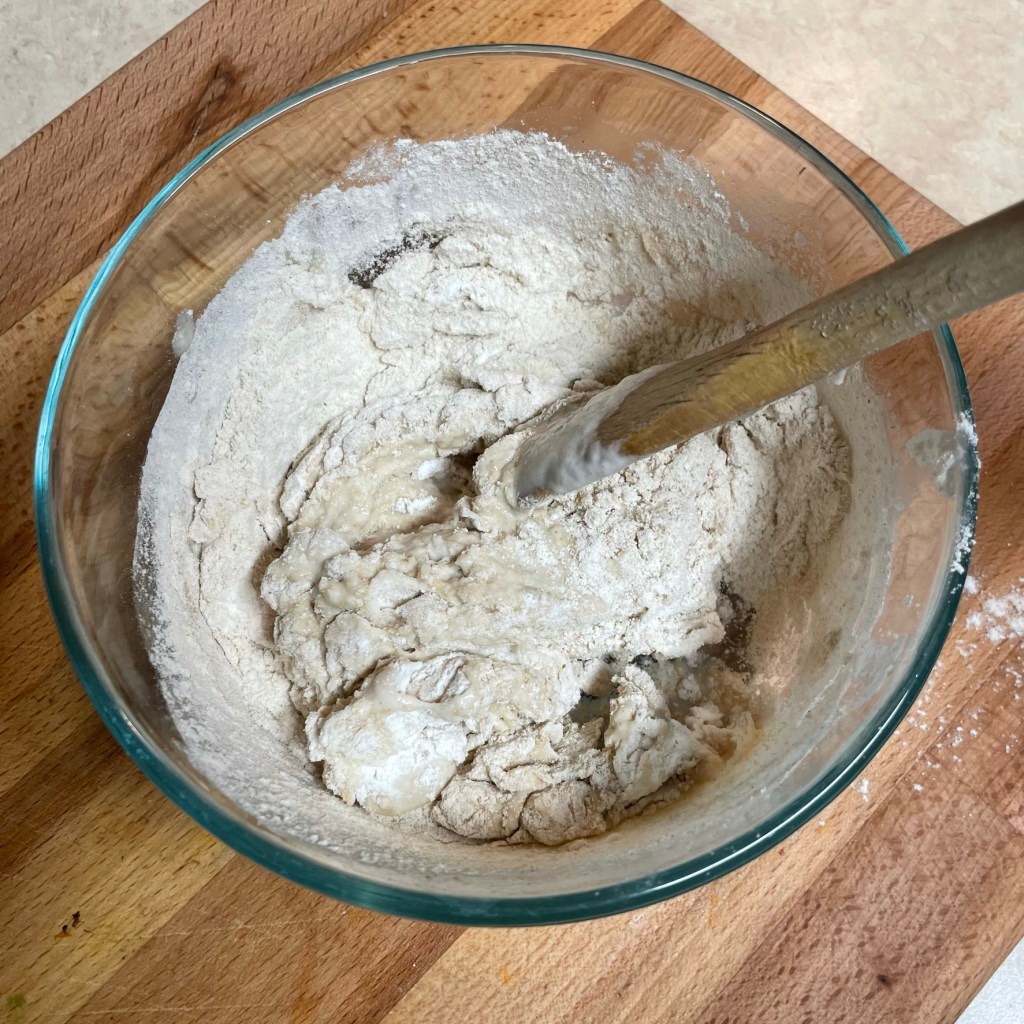
1 ball sourdough pizza dough

3 Tbsp. homemade steak house (recipe below, or use your favorite)

1 cup shredded mozzarella

1/2 lb. thinly shaved steak

1 large Yukon gold potato, boiled until fork-tender and sliced thin

1 medium sweet onion, roasted and drizzled with 1 Tbsp. balsamic vinegar

2 oz. bleu cheese crumbles


Steak Sauce

2 Tbsp. natural ketchup

1 Tbsp. Worcestershire sauce

1 Tbsp. dark balsamic vinegar

1 Tbsp. tomato paste

1 tsp. hot sauce (any kind you like)

1/2 tsp. prepared horseradish

1/2 tsp. Dijon mustard

1/4 tsp. garlic powder

1/4 tsp. onion powder

Salt and pepper to taste

Thin with a little water if needed


Instructions

Prepare the onion by slicing it into thin rounds. Arrange the slices on a parchment-lined baking sheet and drizzle them with olive oil. Roast at 350 for about 30 minutes, or until onions have softened and the rings slide apart evenly. Drizzle with balsamic and roast another 10 minutes, taking care not to burn the onions. Set them aside to cool.

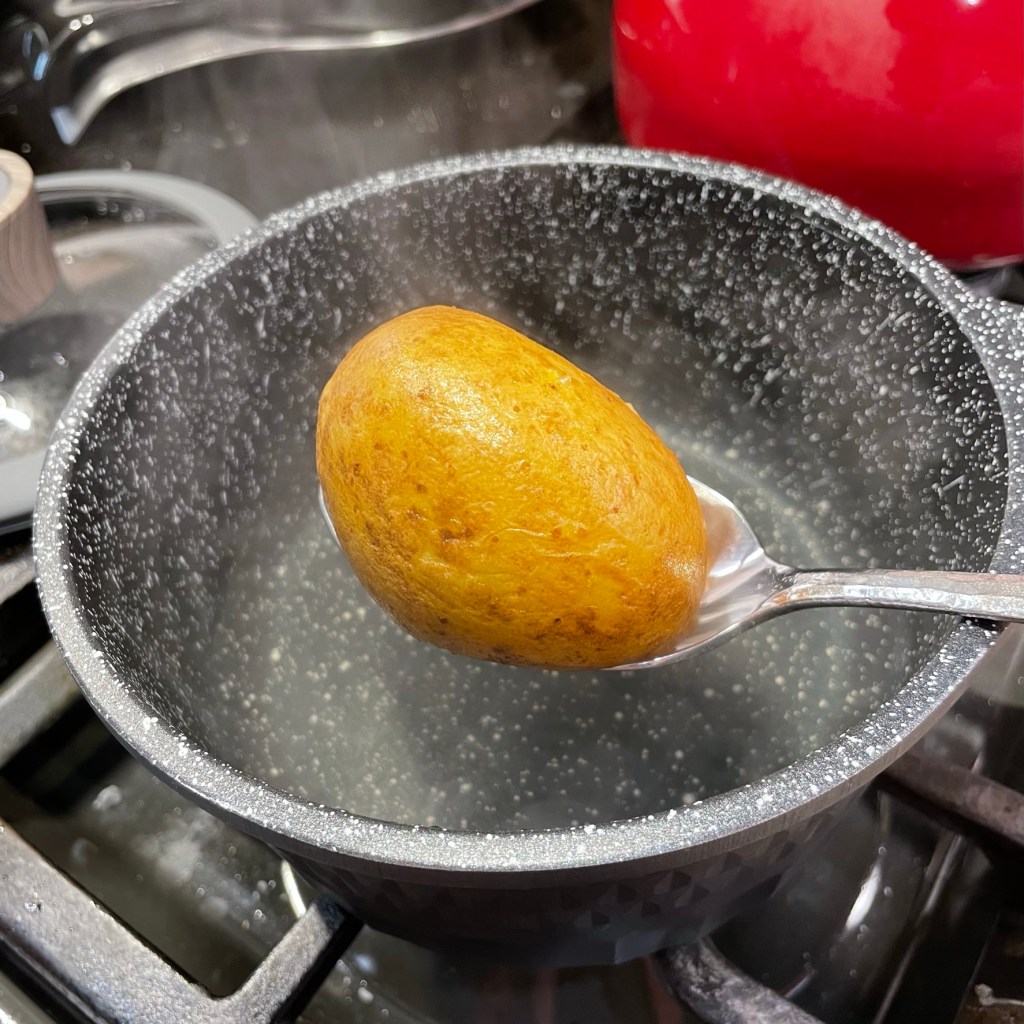
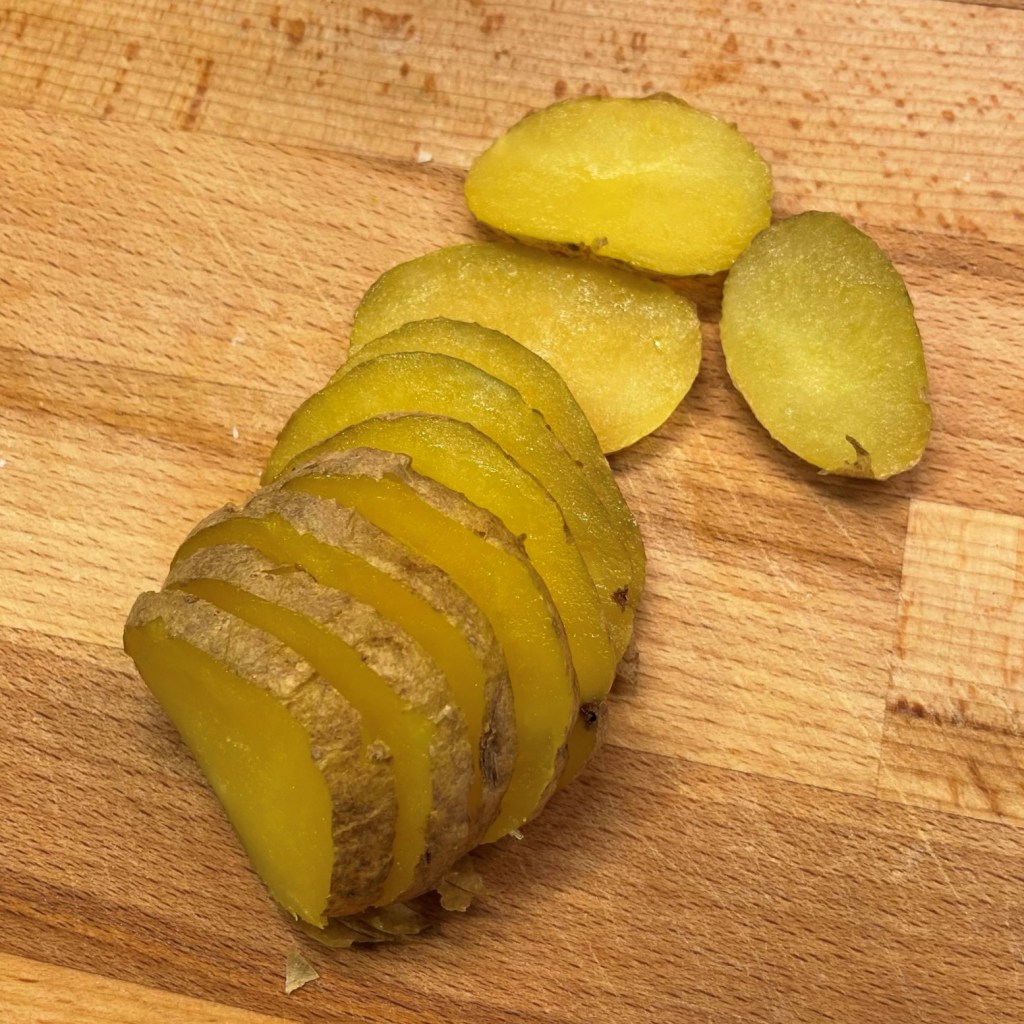
Meanwhile, boil the Yukon gold potato until it can be pierced with the tip of a knife, but not to the point of being too soft. Let the potato cool completely, then cut it into slices about 1/4” thin.

Sear shaved steak in a small amount of olive oil just until lightly browned. Shred steak into smaller, bite sized pieces and season with salt and pepper. Set aside until ready to make the pizza.

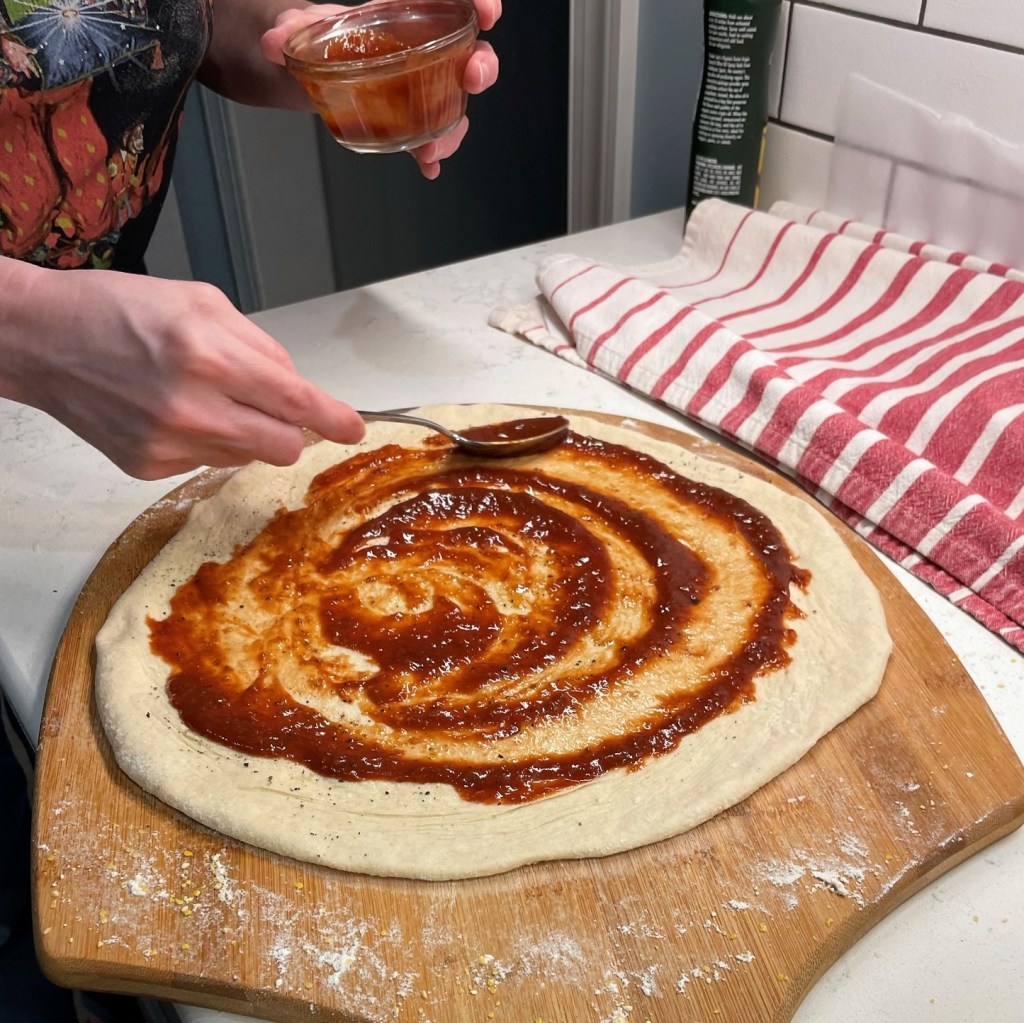
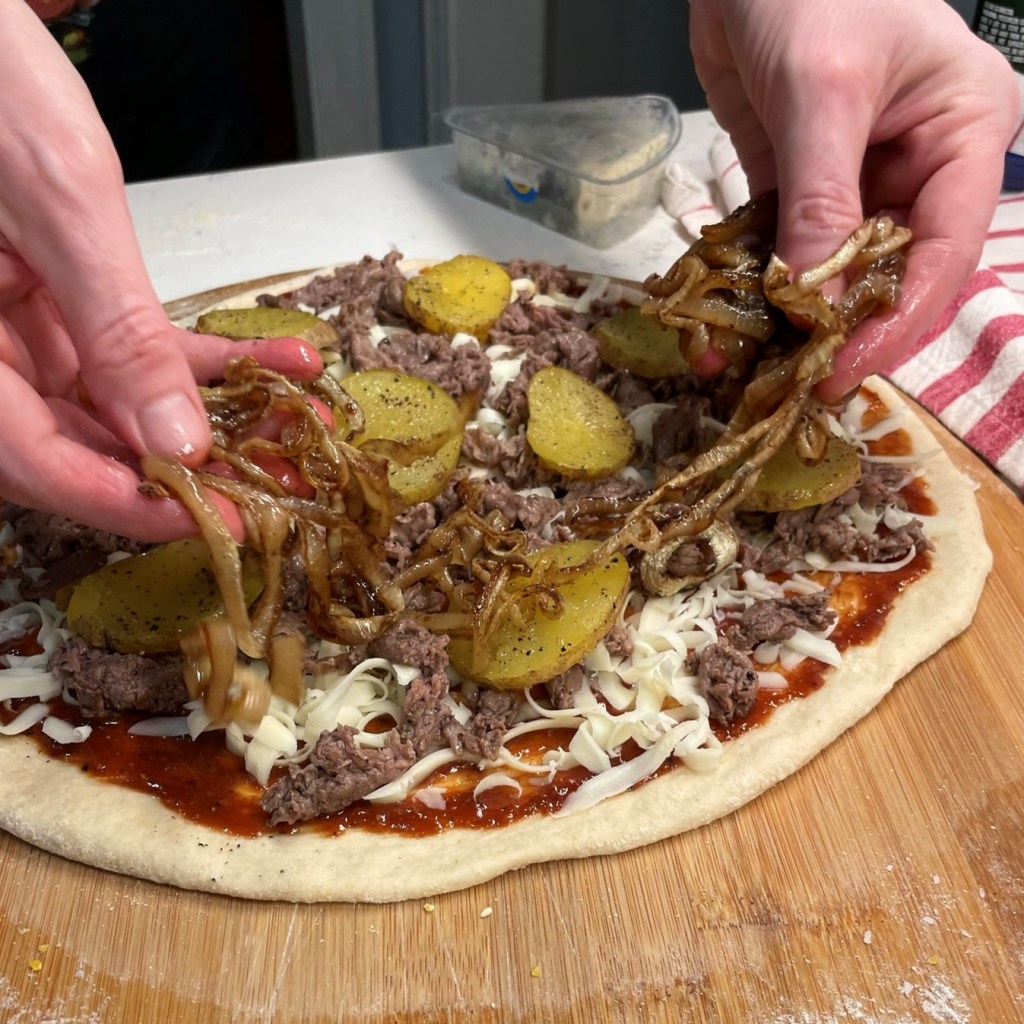
Shape pizza dough into a 14” round and transfer to a floured and cornmeal-dusted pizza peel. Season the dough with salt and pepper, then swirl on about 1/4 cup of the steak sauce. Scatter mozzarella all over the sauce. Arrange the shredded steak over the cheese, followed by the potato slices and the balsamic onions. Place dots of bleu cheese crumbles over the top of the pizza.

Slide the pizza into a very hot (550° F) oven, preferably onto a pizza steel or stone. Bake for 6 minutes, until cheese is bubbly and crust is golden brown.


Sourdough Onion & Sage Bread

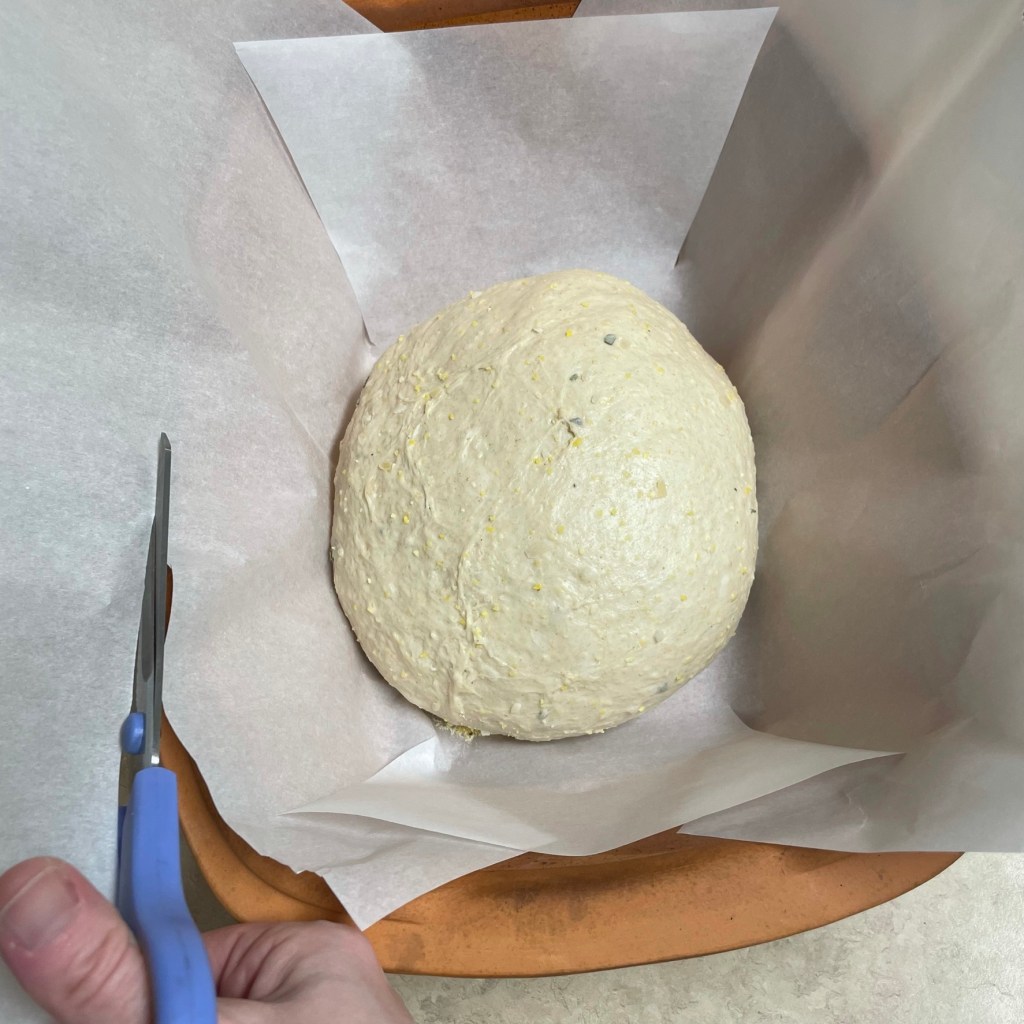
With the arrival of fall comes the joy of having the house filled with the addictive aromas of meaty stews, roasted vegetables, and every variety of freshly baked breads and desserts. A few days before we dismantled the kitchen for our remodel, I pulled this favorite sourdough recipe out of my arsenal and baked it to accompany the roasted butternut squash lasagna that I shared last month.

The recipe I share today is a mashup of several bread recipes I have tried from an amazing blog called “The Fresh Loaf.” The site is a virtual community and message board for sourdough lovers—from novice to expert—and over the years, I have gained invaluable wisdom by eavesdropping on the conversations of those I consider to be far advanced of my own skills. I was barely beginning my own sourdough journey when I discovered TFL, but the pictures and formulas I found there inspired me to attempt new techniques, and I now proudly consider myself to be an “intermediate” bread maker.

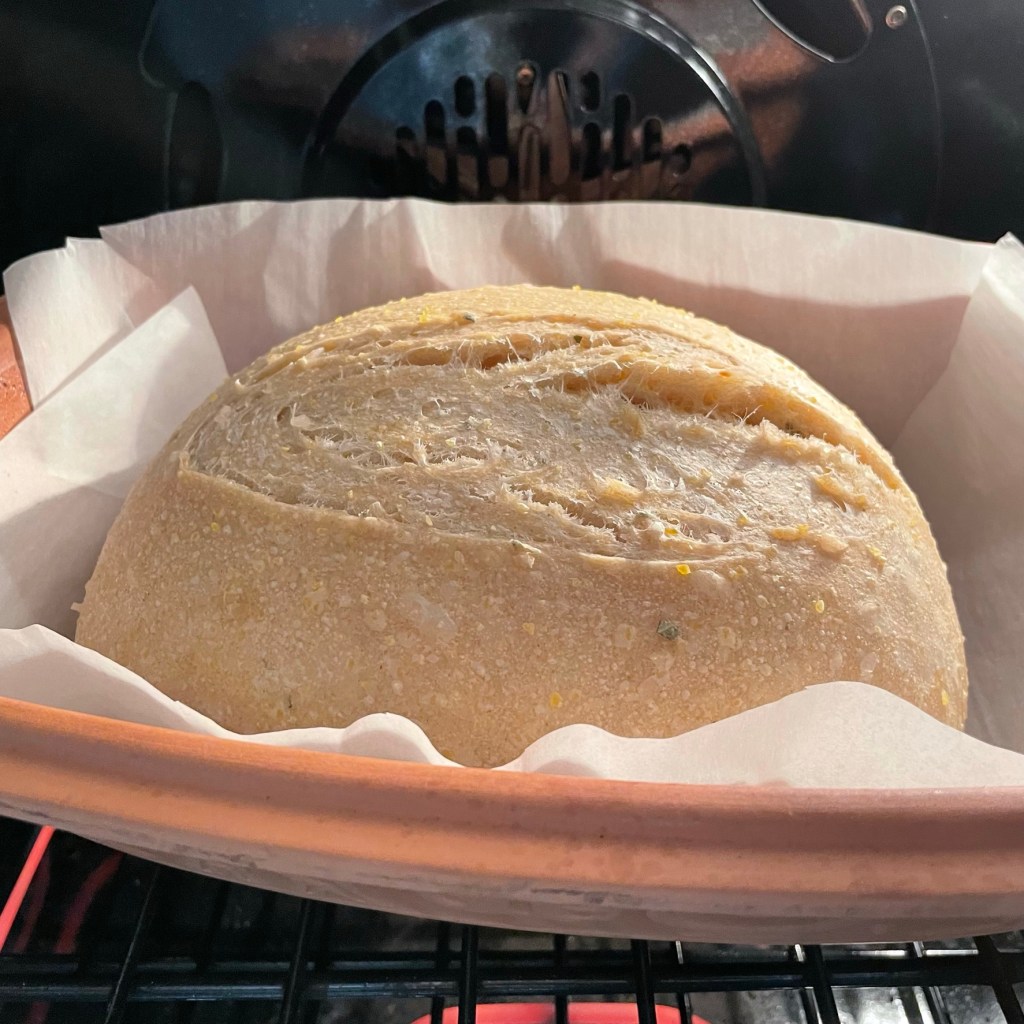
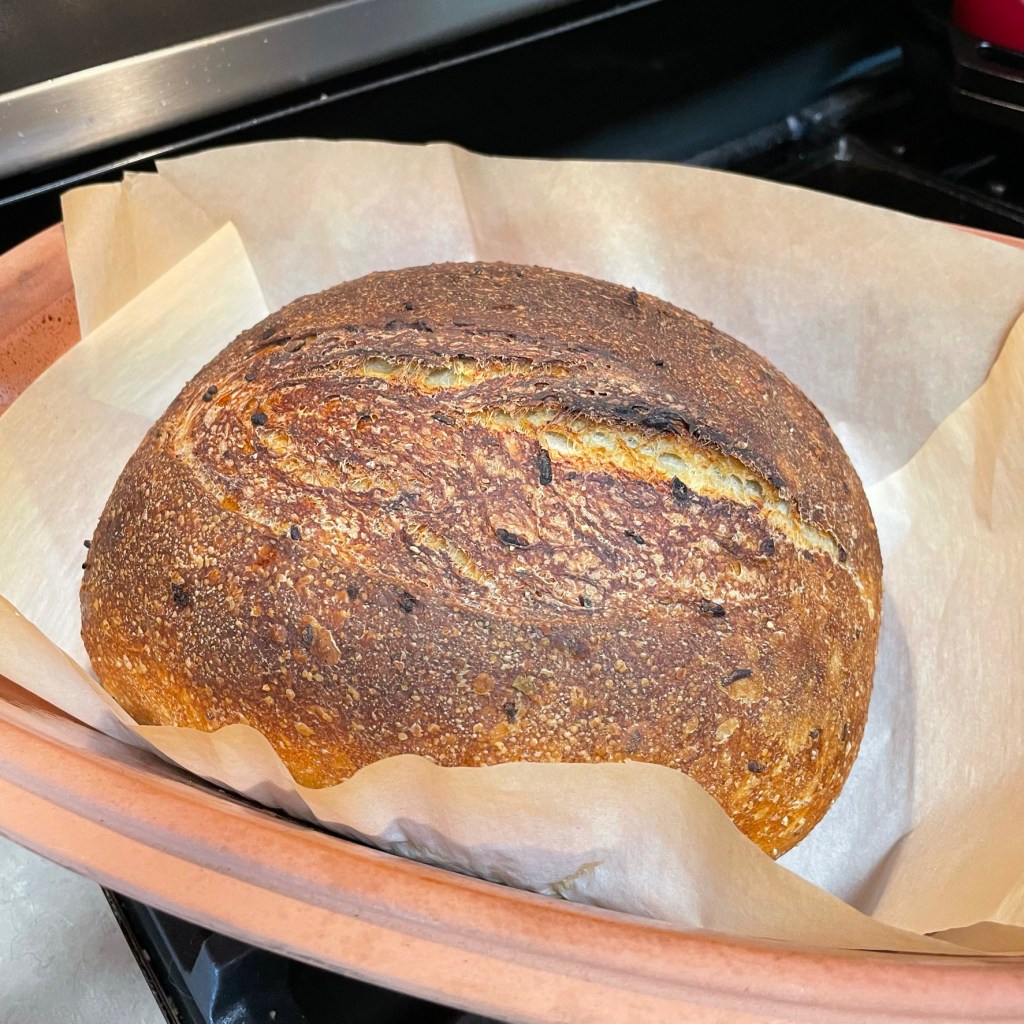
One of the methods I learned is baking with steam, a simple technique that results in a perfectly crusty yet chewy exterior and lovely crumb texture that the aficionados would call “gelatinized.” Breads made with this steam-baked method make fantastic toast and sandwiches (especially grilled cheese).

The extra hydration of the dough creates the big, open crumb inside the bread. The steam makes the crust perfectly chewy.

The generous amounts of onion and sage I’ve added to this loaf also make it perfect for Thanksgiving stuffing or dressing, or you can follow my lead with any stale leftovers and turn it into savory croutons for hearty salads and all the soups you’ll be simmering during the autumn and winter months ahead.

Up close, you can see the golden polenta, the bits of onion and flecks of sage. This bread is perfect for fall!

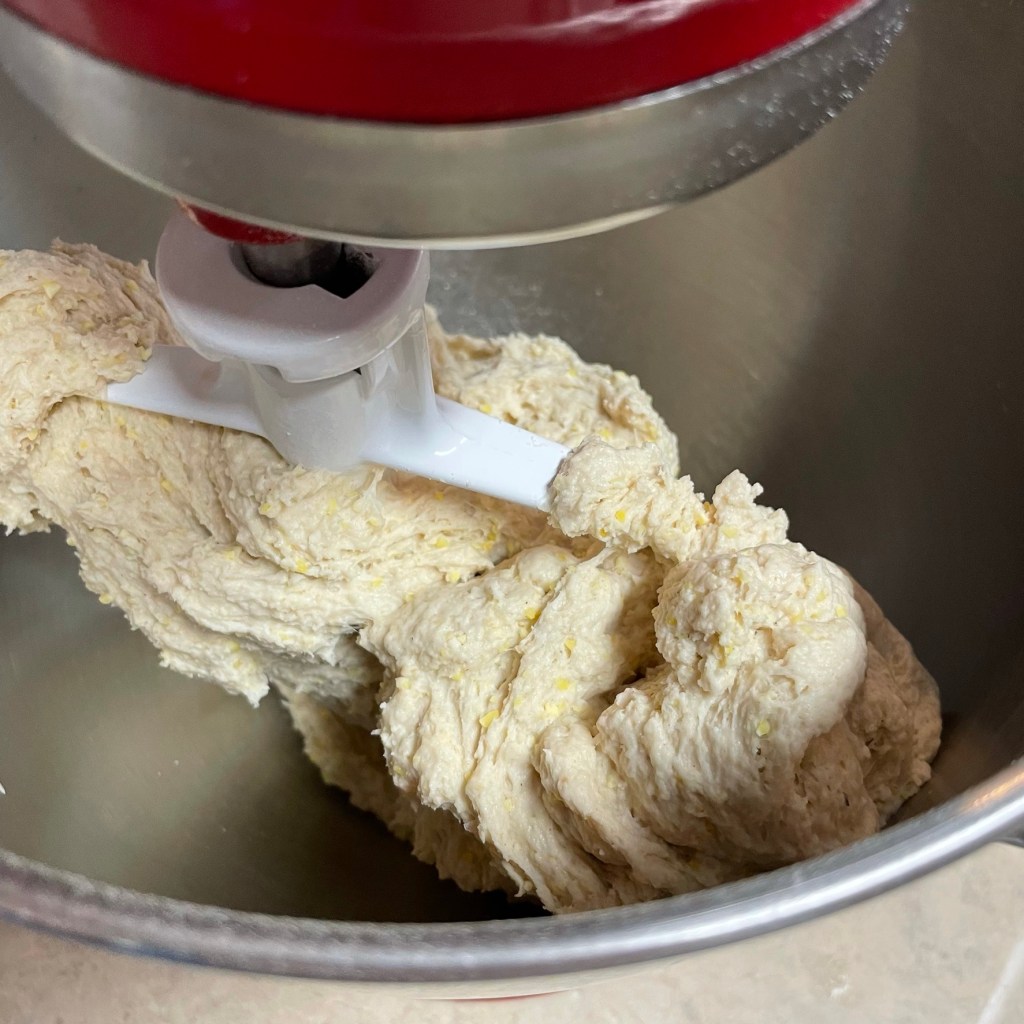
Besides the intoxicating fall-scented flavors, this loaf also uses a pre-ferment, which is a fancy way of describing a pumped-up sourdough starter, and a soaker, which is nothing more than grains (in this instance, corn) that have been soaked overnight in water—a technique that coaxes the deepest flavors out of the grain and into the bread.


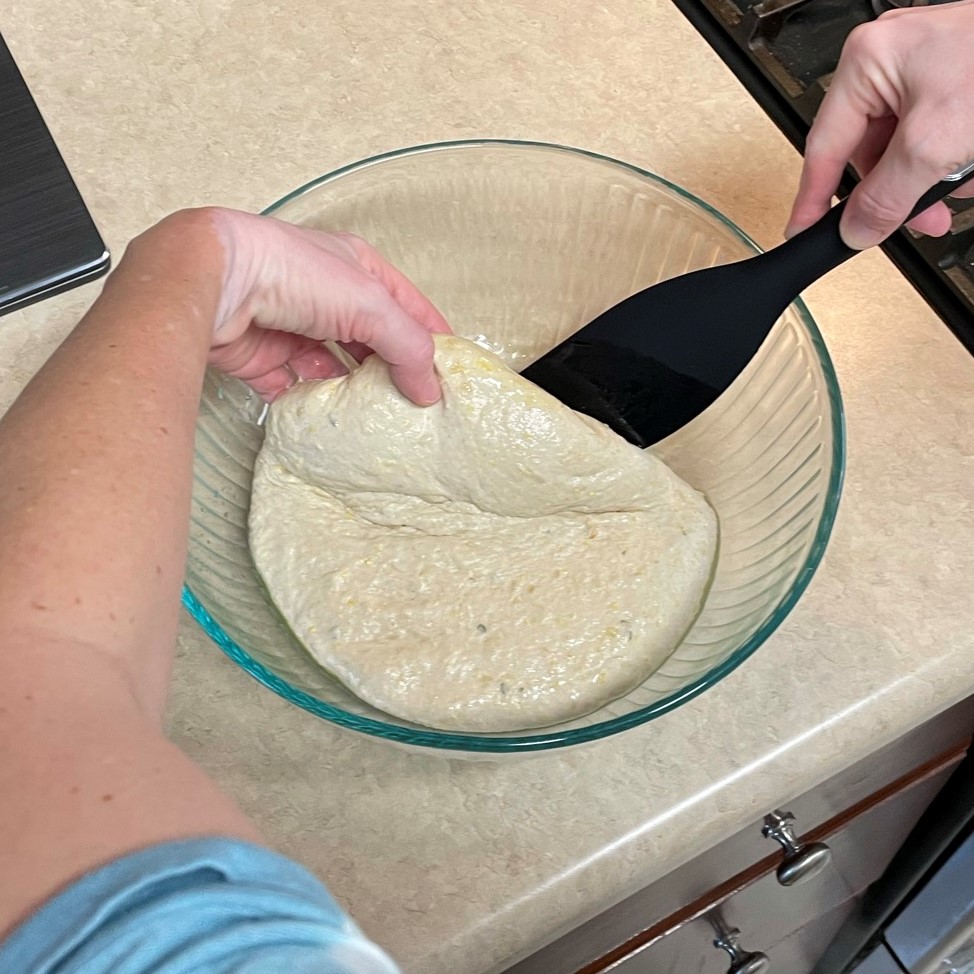
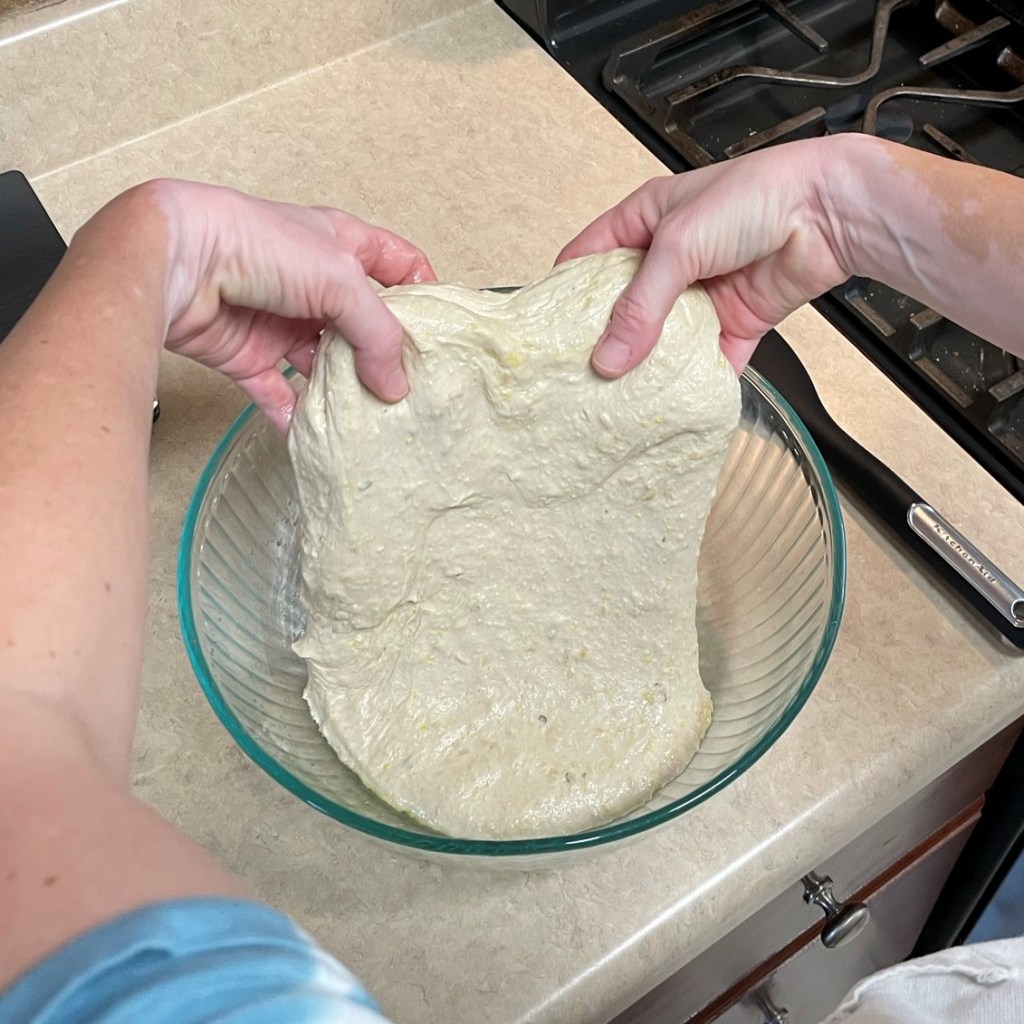
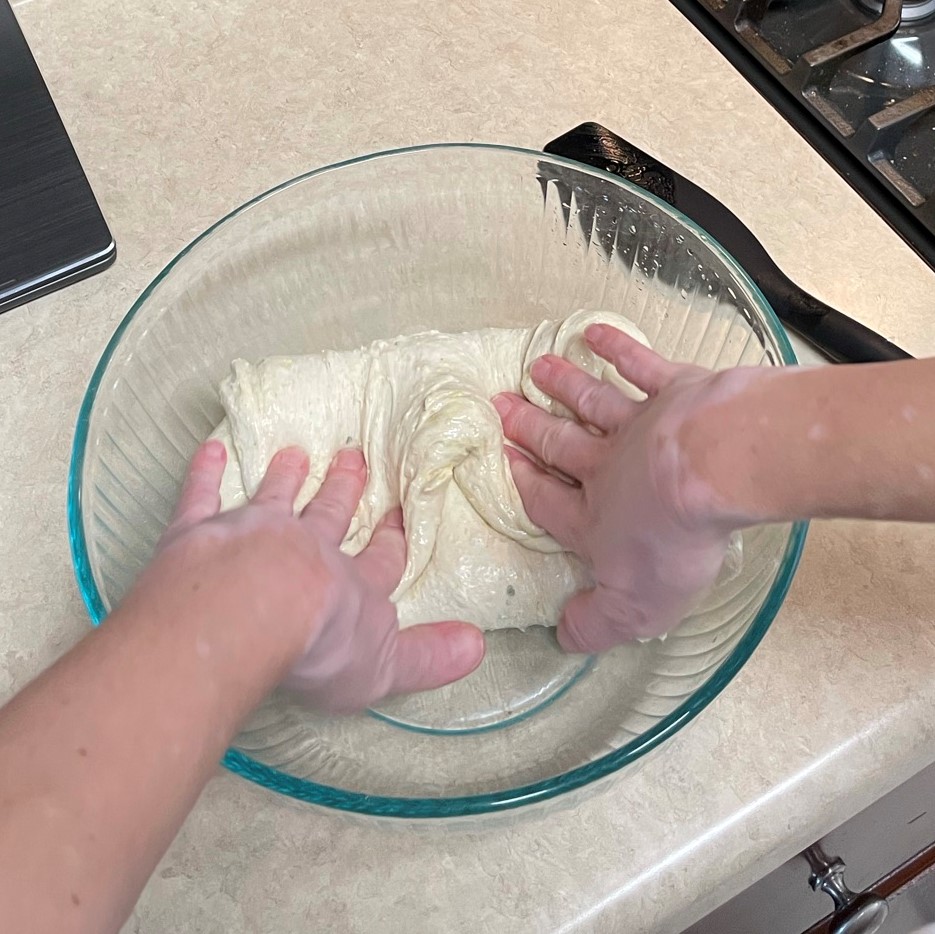
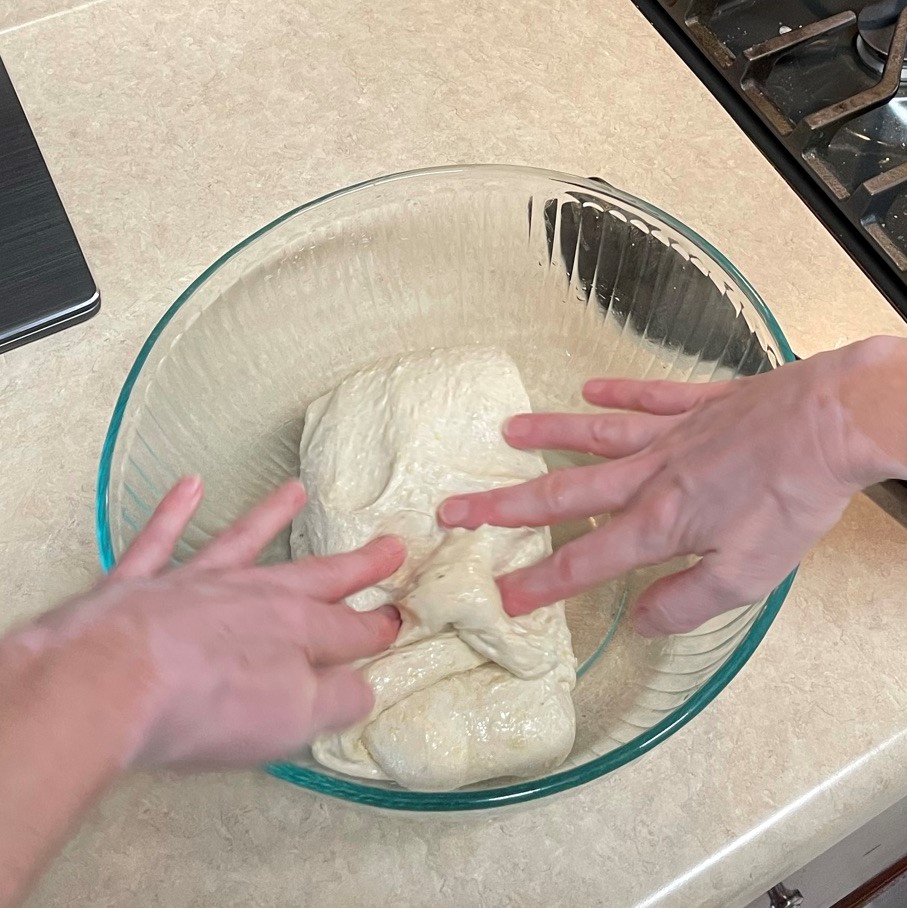
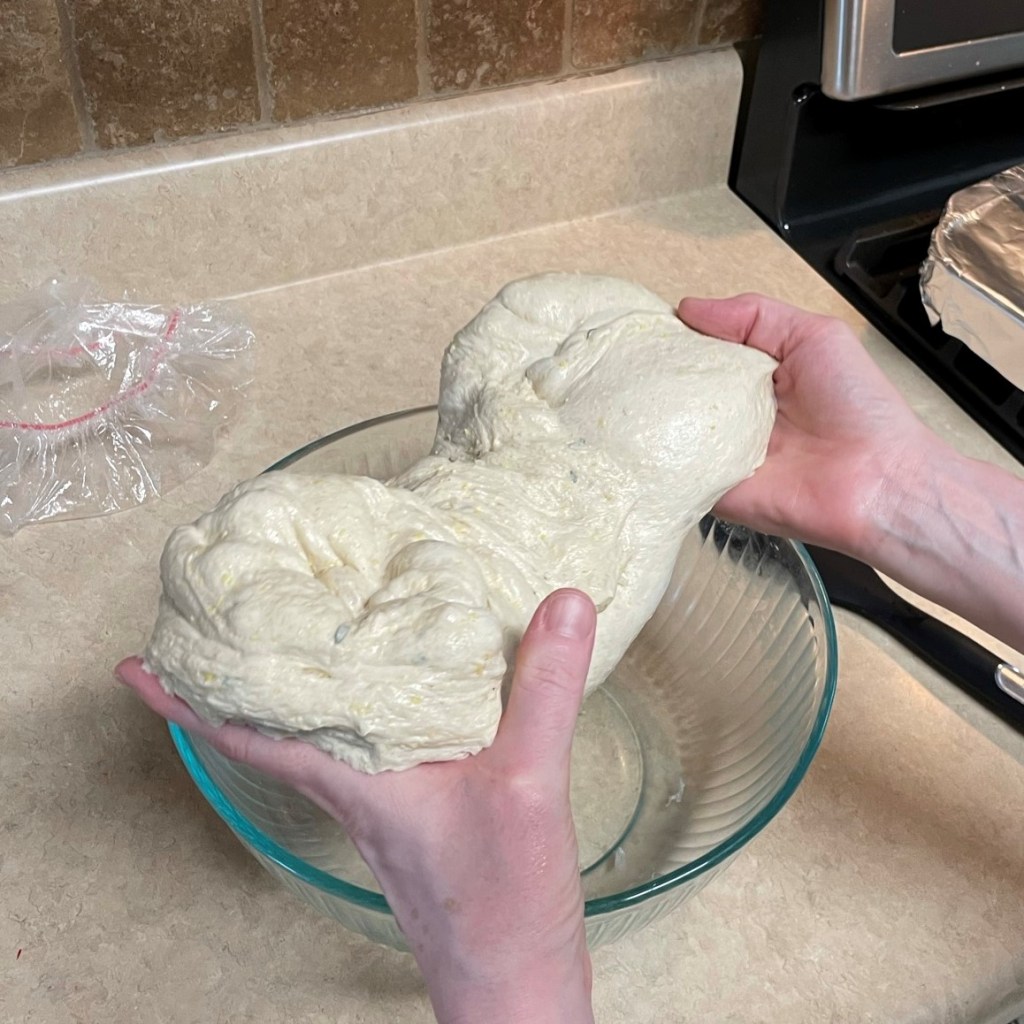
The kneading method used for this bread is also a bit different. It’s called “stretch and fold,” and it is an easy way to build strength in dough with a high volume of water, without so much messy, sticky kneading. Try this a few times, and you will be astonished at the elastic texture and volume achieved in the bread dough.

If this all seems confusing, trust me, it isn’t. I have found sourdough baking to be joyfully simple once you get the hang of it. As I mentioned last fall when I made the sourdough pumpkin challah, this kind of baking—naturally leavened and slow-fermented—is like a good relationship; the more you open yourself up to it, the more it comes back to you until you finally reach a point of familiarity that you can’t imagine ever buying a loaf of bread at the grocery store.

One more note: I strongly recommend measuring ingredients by weight when baking any kind of bread, but especially sourdough. Weight measuring takes the guesswork out of your ingredient ratios, and you can find an inexpensive, easy-to-use kitchen scale just about anywhere, including Walmart (where I bought mine).

That’s my story, and this is my favorite sourdough for autumn. I hope the pictures entice my fellow sourdough bakers to give it a go, and if you scroll to the bottom of the post, you’ll find a downloadable PDF for your recipe files. My ingredients are listed in grams (sorry, no volume measurements), so go on and get your kitchen scale and get baking.

Enjoy!


I could eat the whole loaf all by myself! 🙂


“Big Kahuna” Pizza

I didn’t have much notice to plan for it or I would have announced to all of you that this past Friday was “National Make a Ruckus Day.” My husband, Les, and I have been planning various improvement projects this spring, and we had no sooner made a final decision on the color of architectural shingles we liked for a roof revamp when his phone rang just after dinner Thursday night. The shingles were in stock and the weather was right, so the crew would arrive at the crack of dawn!

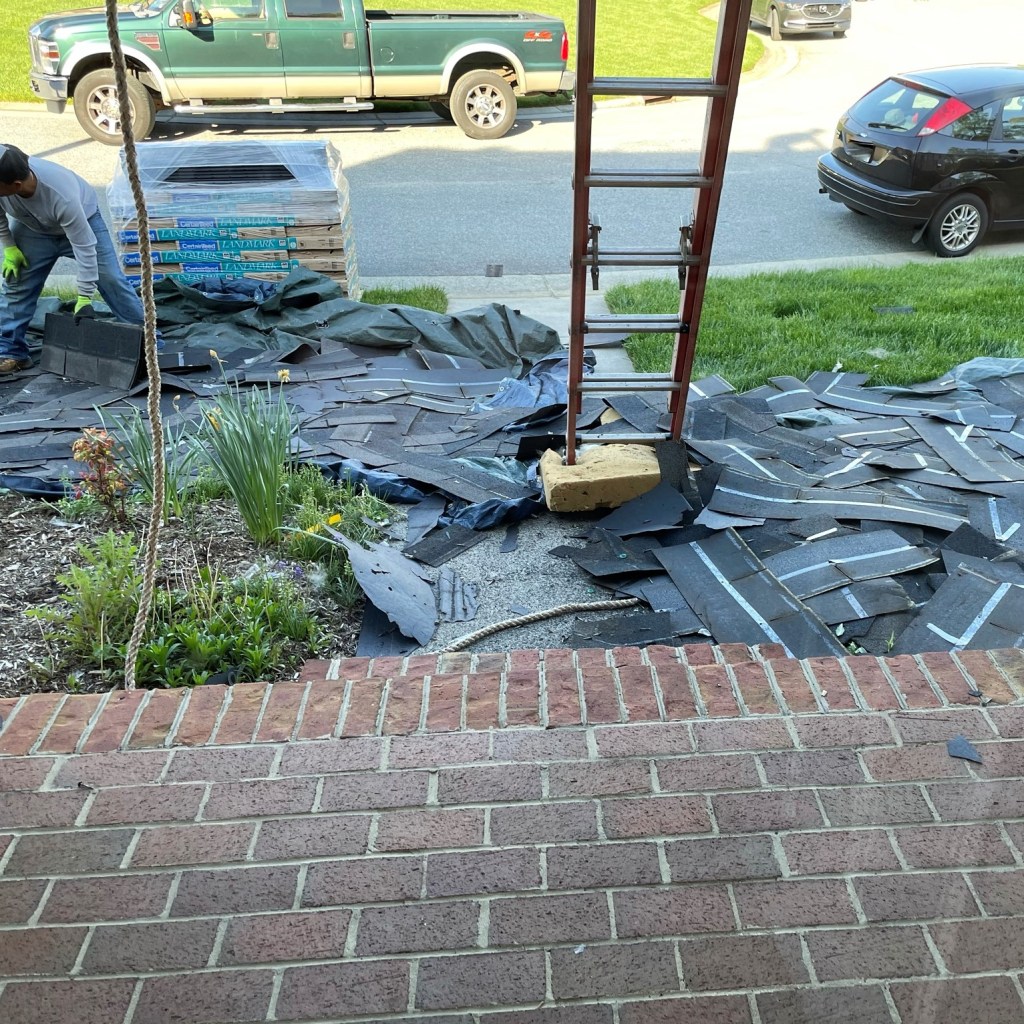
The crew arrived early, and there were either six or seven of them—it was hard to tell because they didn’t stand still long enough for a headcount, and I am still in a bit of shock that their work was completed in one day. The noise was non-stop, from the stomping overhead, to the ripping and peeling sounds of the old shingles coming off, to the banging of hammers and air nailers installing the new roofing materials, to the construction-grade boombox that was blasting lively mariachi music just outside my home office window. All day Friday, both entrances to our home were blocked, and tarps stretched out across the yard to catch the refuse that was being flung from above. Les was working from home that day, so we were sequestered into our own “zones” of the house. The dog, who is terrified of any noise she cannot see, spent most of the day crammed against my knees underneath my work desk, the cat was just plain pissed that she couldn’t go outside (she didn’t understand that her life might have been at risk), and I was so frazzled about all of the above that I started contemplating tequila shots at about 2 in the afternoon.

On top of what was happening at our address, the neighbors across the cul-de-sac had a contractor show up to replace flooring in their master bedroom, and our yard crew was running a day behind on mowing and trimming, so they showed up on Friday to pretty up the common spaces.

There were trucks and trailers and service vans everywhere, and full-on RUCKUS.

There was no way I could escape the house, even to take my daily walk, let alone to make a grocery run, and so I was thankful that dinner was already planned. The whole experience of chaos, Les said, was good practice for the excitement we will experience if we follow through on remodeling our kitchen later this year. I’ve been griping about our kitchen since I moved into the house with him a few years ago, and we are finally ready to apply solutions for our lack of counter space, poor traffic flow and shortage of pantry storage. But committing to the project is scary, not only for the cost, but the time involved. Each contractor we have spoken to has said, “plan for at least six weeks without your kitchen.” And it is true—no matter what Chip and JoJo seem to accomplish in one hour on HGTV—new kitchens take time, and that will be a big challenge. We will figure out how to eat, but how will I be able to sustain the blog?

There might be a lot of grilling recipes coming your way, or it could be a good time for me to catch up on the vast backlog of recipes I have made but not yet transformed into posts. Or I may turn my attention to other ideas I have had for Comfort du Jour, including fun furniture projects and artistic ventures. I’ve gotten pretty good over the years at upcycling tables and worn out chairs. Of course, I may also spend six weeks sharing nothing but cocktail recipes, which—given my low tolerance for ruckus—will probably be in hot rotation.

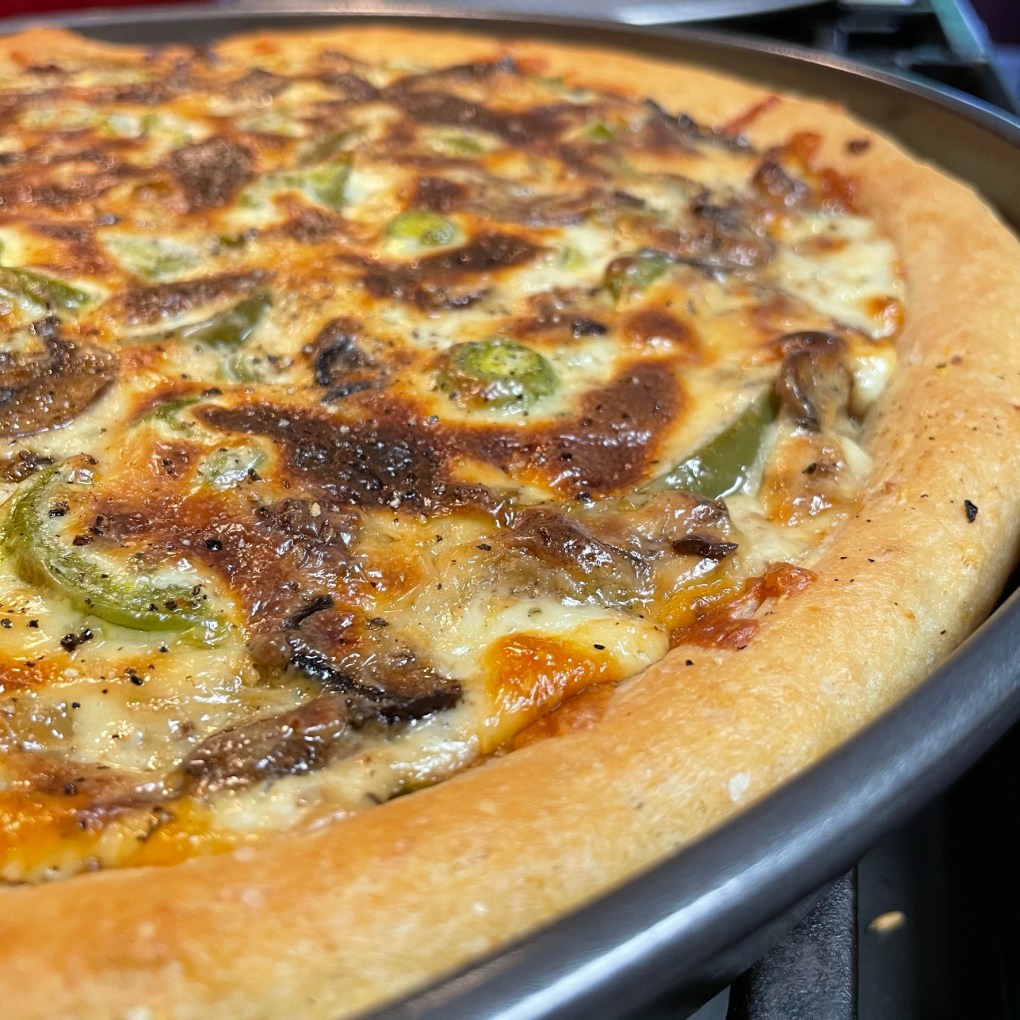
Anyway, we relaxed under our new roof Friday night with this pizza, our interpretation of one of our favorite take-out sandwiches. We have long enjoyed the “big kahuna” sandwich from Jersey Mike’s, which is a variation of a Philly cheesesteak, but with mushrooms and jalapenos thrown into the mix, and plenty of gooey white cheese. The sandwich is awesome (especially when we ask for extra jalapenos), but it’s so packed with ingredients that we knew that our usual N.Y. thin crust could not hold it all in pizza form.

This beautifully browned pie emerged from the oven with the most pleasing aroma.

We went with a deep-dish pie this time, beginning with the crust, adapted from a King Arthur Baking recipe. I followed the recipe nearly to the letter except for a partial sub-in of white whole wheat flour. You know I’m always going to share my honest opinion, and frankly, I did not love this crust. It was easy enough to make, and instructions were clear and complete, but the recipe called for oil and also quite a bit of melted butter, which I haven’t really seen before as an ingredient for pizza dough. It rose on schedule and baked up beautifully, but the end result, for me, was too similar to pie crust or biscuits, and not quite right for pizza. I would consider it again for some kind of vegetable tart, but for pizza I will stick with the formula offered by Jeff Mauro from Food Network. His recipe with all olive oil makes a wonderful, crunchy-but-soft crust that is so, so good on a deep-dish pizza.

As with most near-misses in our kitchen, this pizza was still delicious. And it was extra yummy after such an unexpectedly noisy Friday.


Ingredients

One deep-dish pizza dough—you choose: King Arthur Baking or Food Network’s Jeff Mauro

Extra virgin olive oil

1 medium yellow onion, thinly sliced

1 green bell pepper, thinly sliced

5 or 6 cremini mushrooms, cleaned and sliced

3 cloves garlic, finely chopped

2/3 lb. thinly shaved steak*

1/2 cup pickled jalapenos, patted dry and chopped

2 Tbsp. salted butter

1 Tbsp. all-purpose flour

1 cup whole milk

About 4 oz. white American cheese, cubed

1 1/2 cups shredded pepper jack cheese

Let’s walk through it together:

Instructions

  1. Prepare the dough for your deep-dish pizza. This will take some time, depending on the recipe you choose.
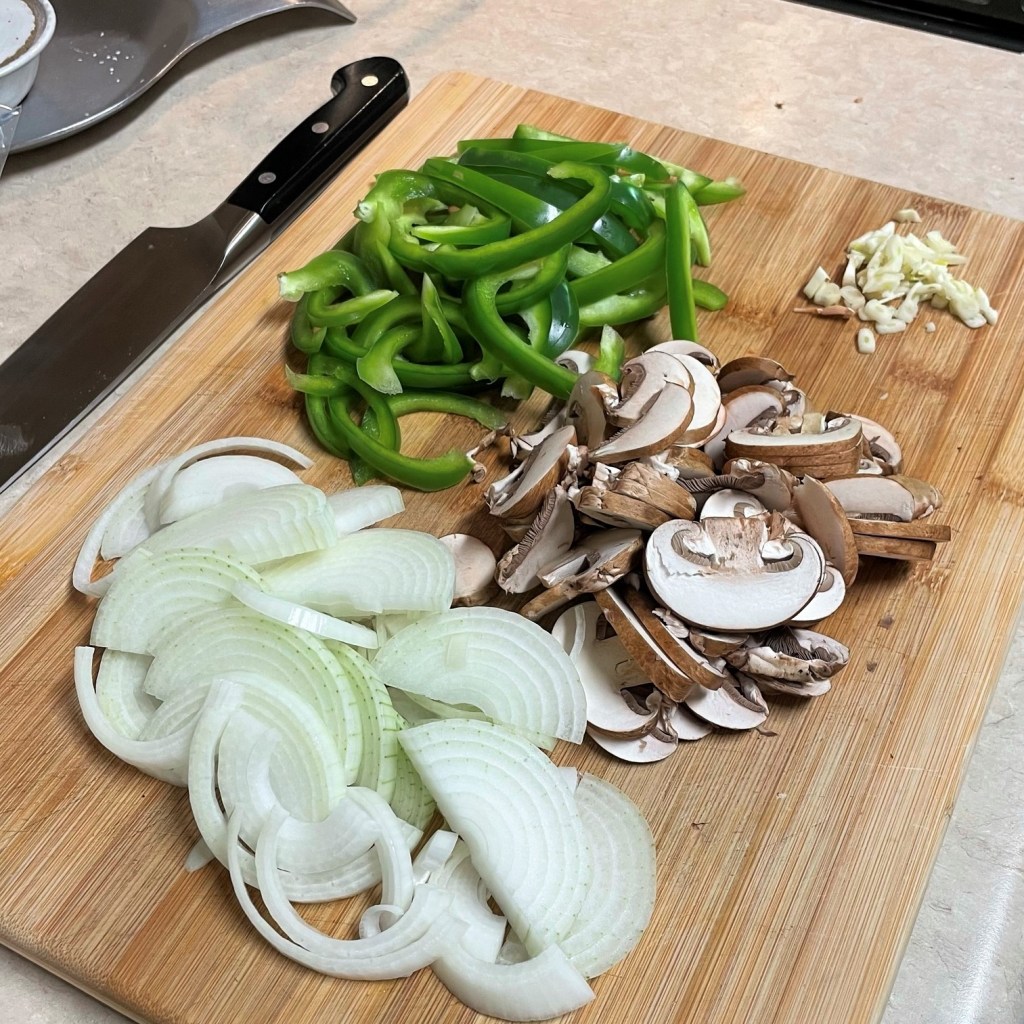
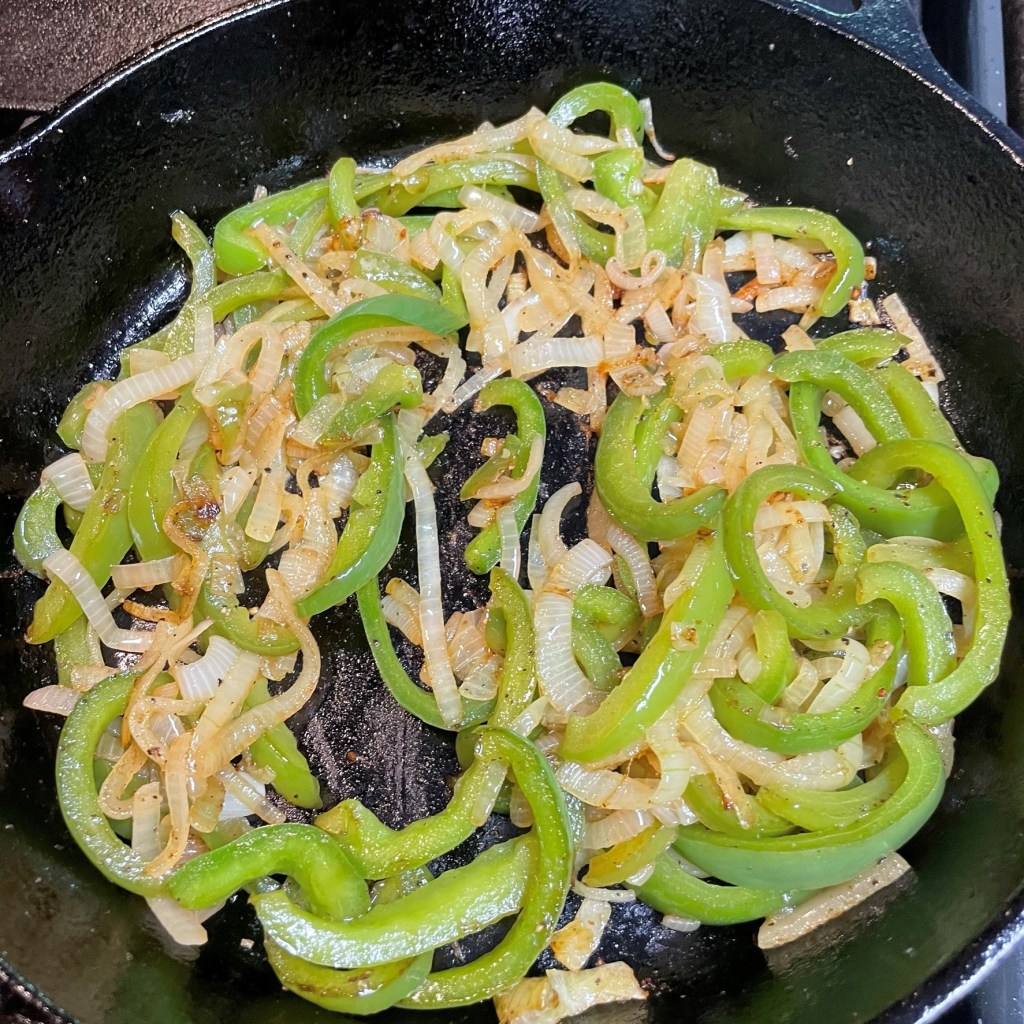
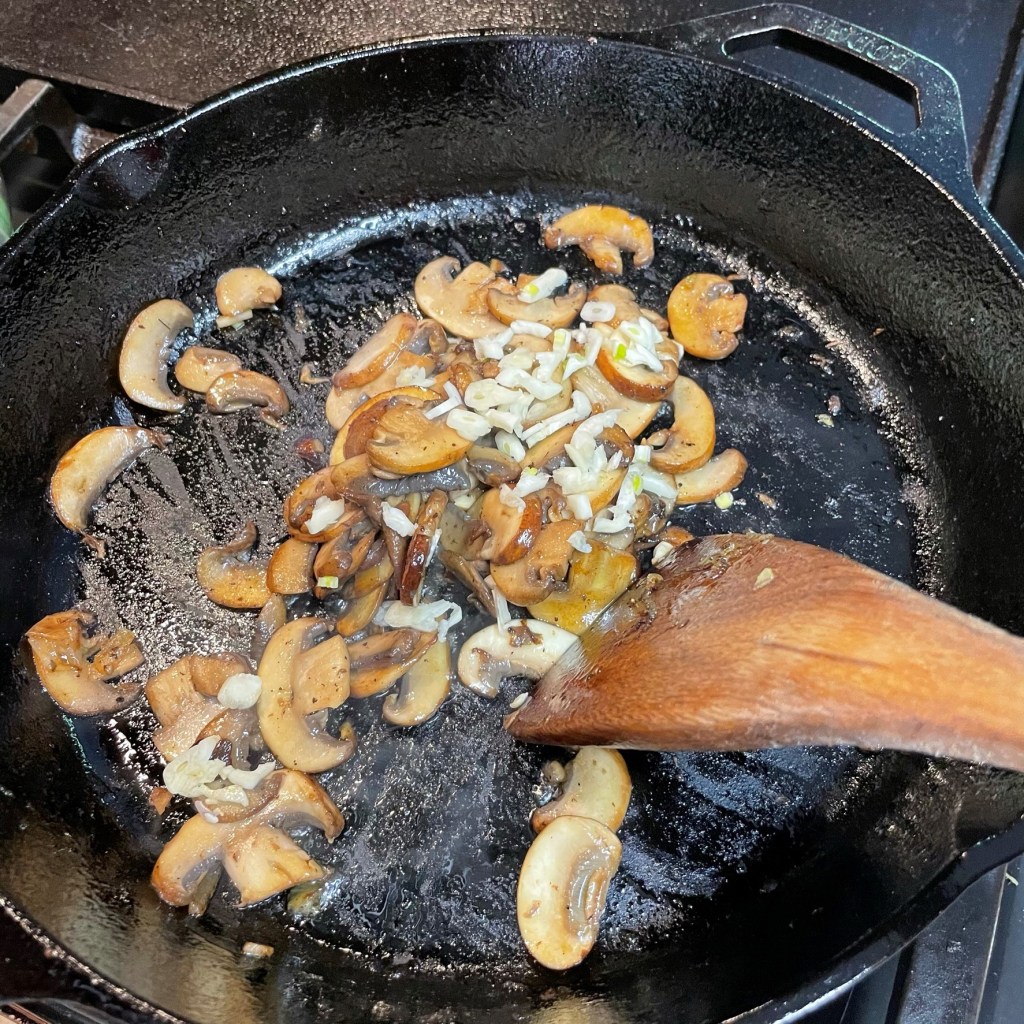
  2. Place a cast-iron skillet over medium heat. Add a couple swirls of olive oil and saute the onions, bell peppers, mushrooms and garlic. Season with salt and pepper. Onions should be soft and translucent and mushrooms should be browned on both sides. Transfer vegetables to a dish and set aside.
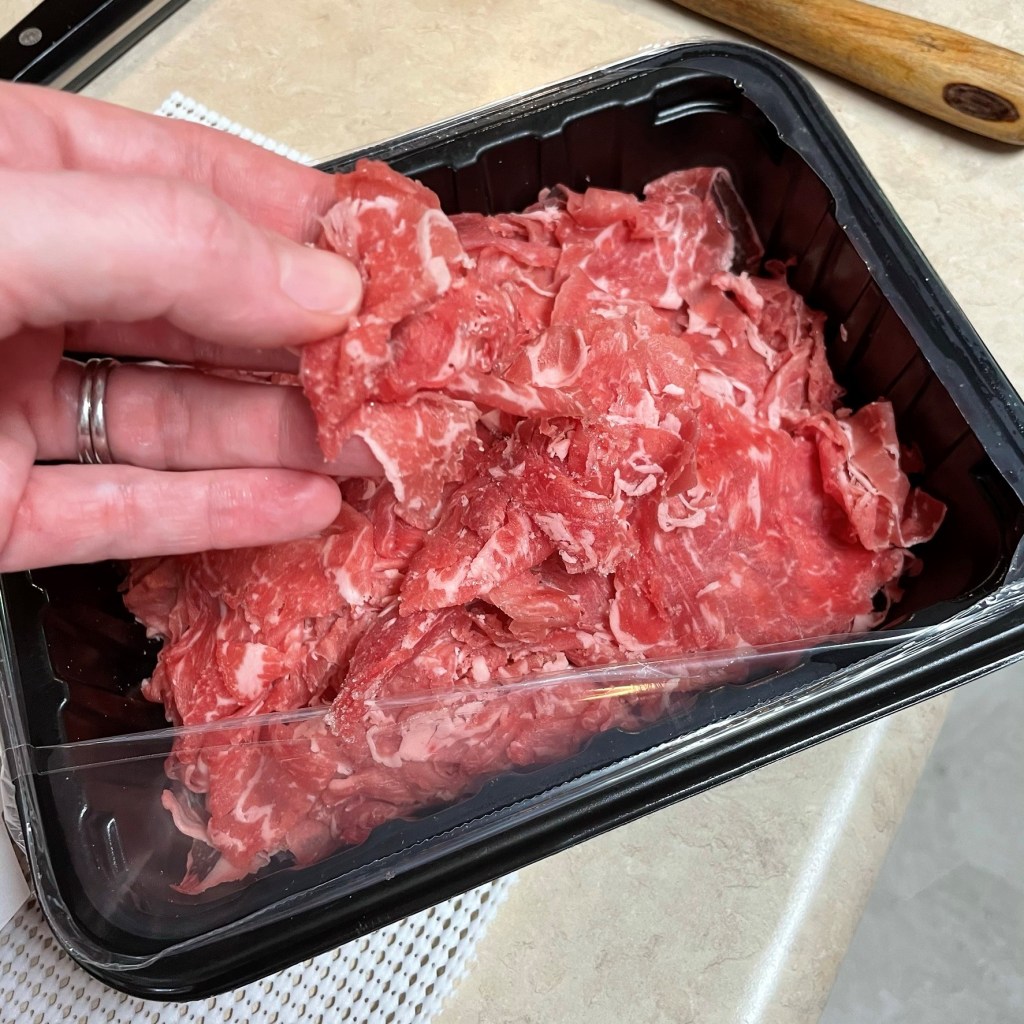
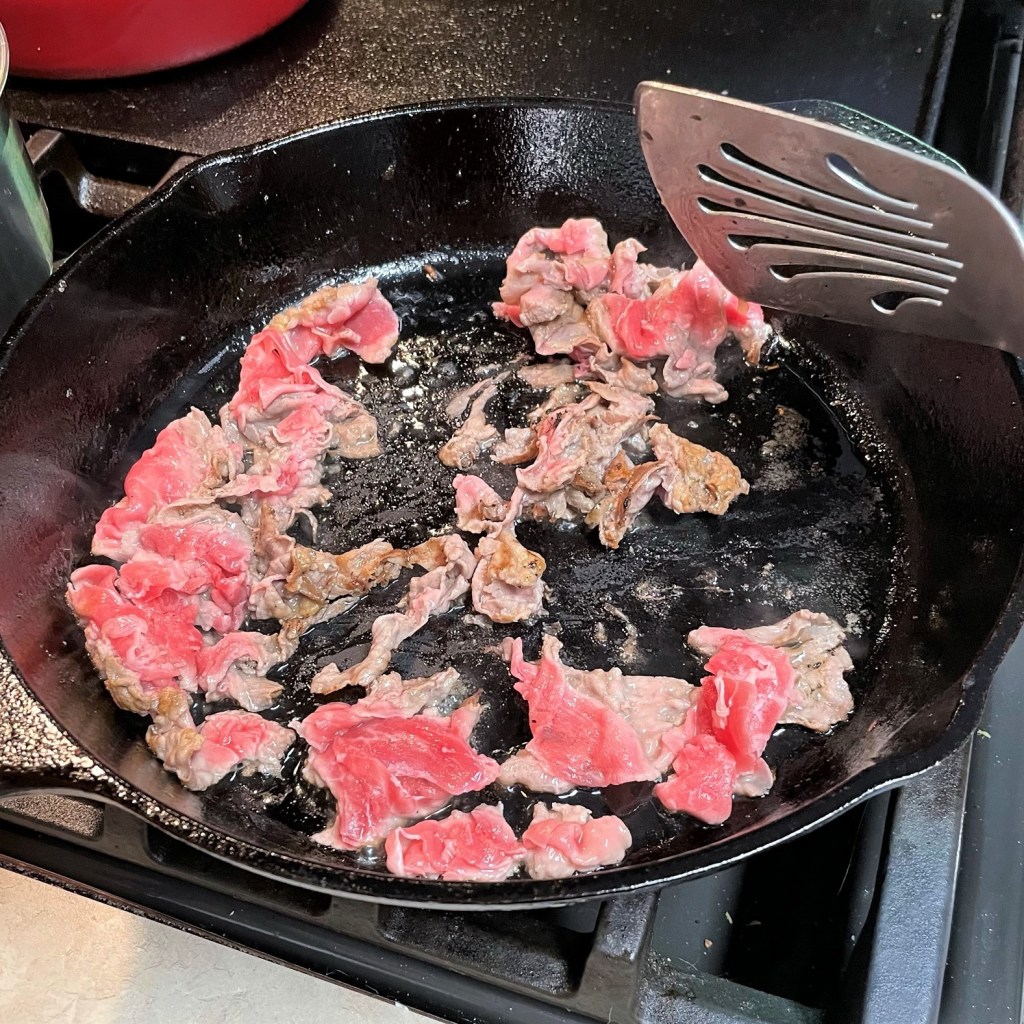
  3. In the same skillet, over medium-high heat, swirl in olive oil to cover the bottom of the pan. When oil is shimmering, add the shaved steak, a few pieces at a time, and toss around to brown it all over. Don’t overcrowd the pan, or the meat will steam rather than brown. Transfer cooked steak to a dish and continue until all the steak is cooked. You may not use all of it on the pizza.
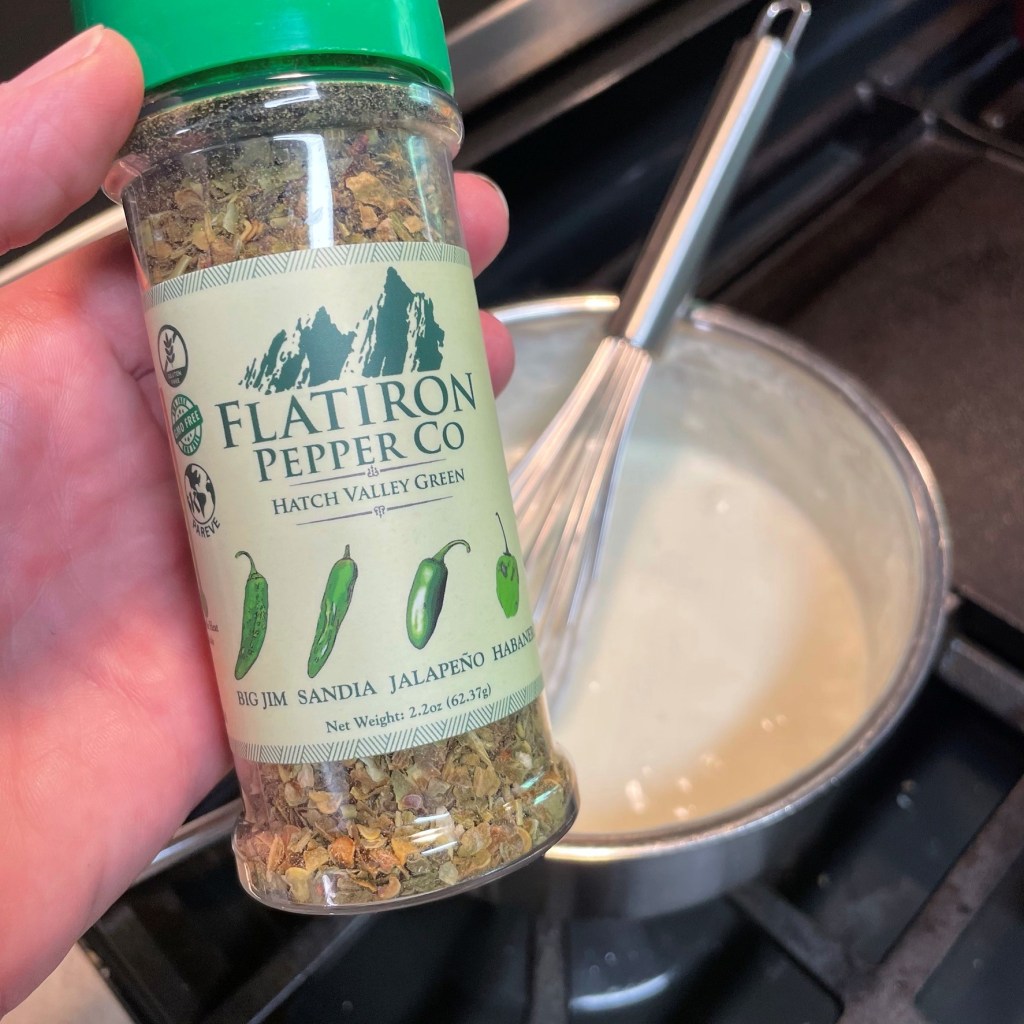
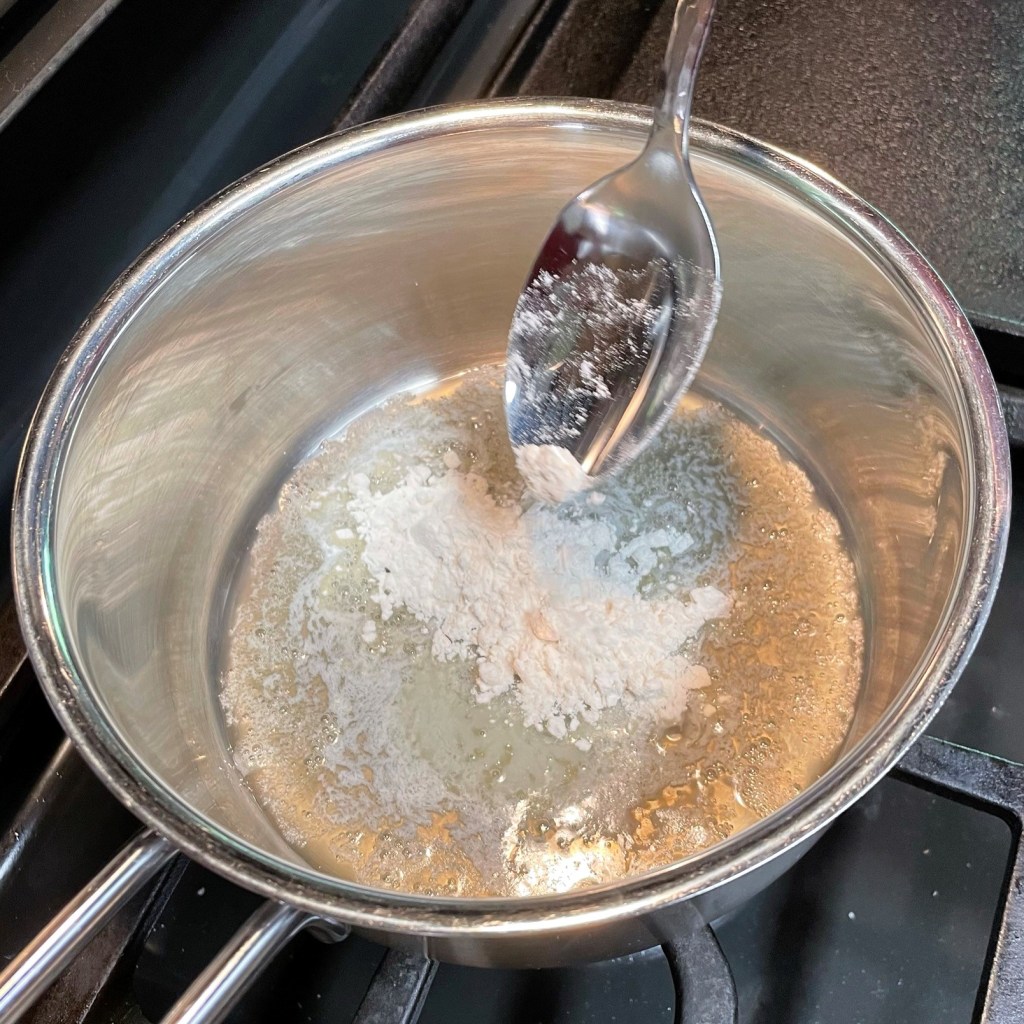
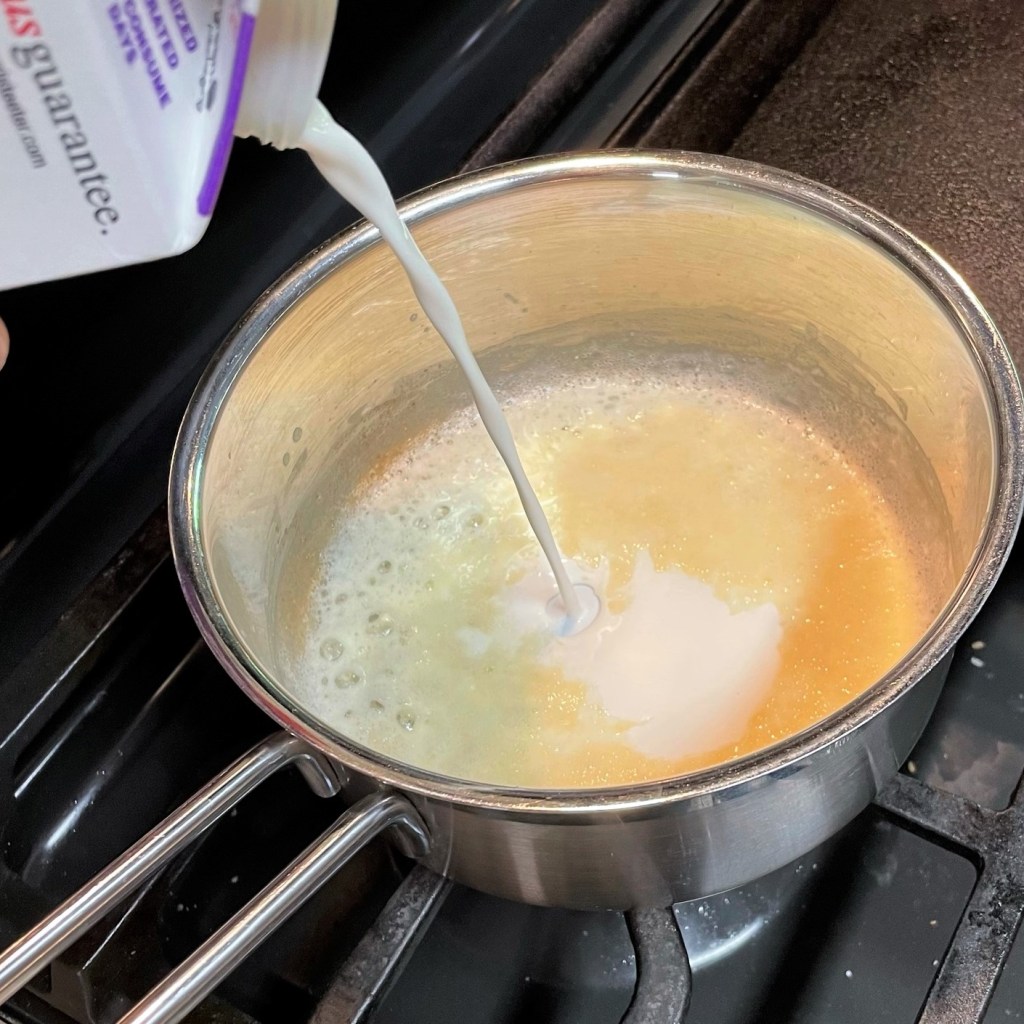
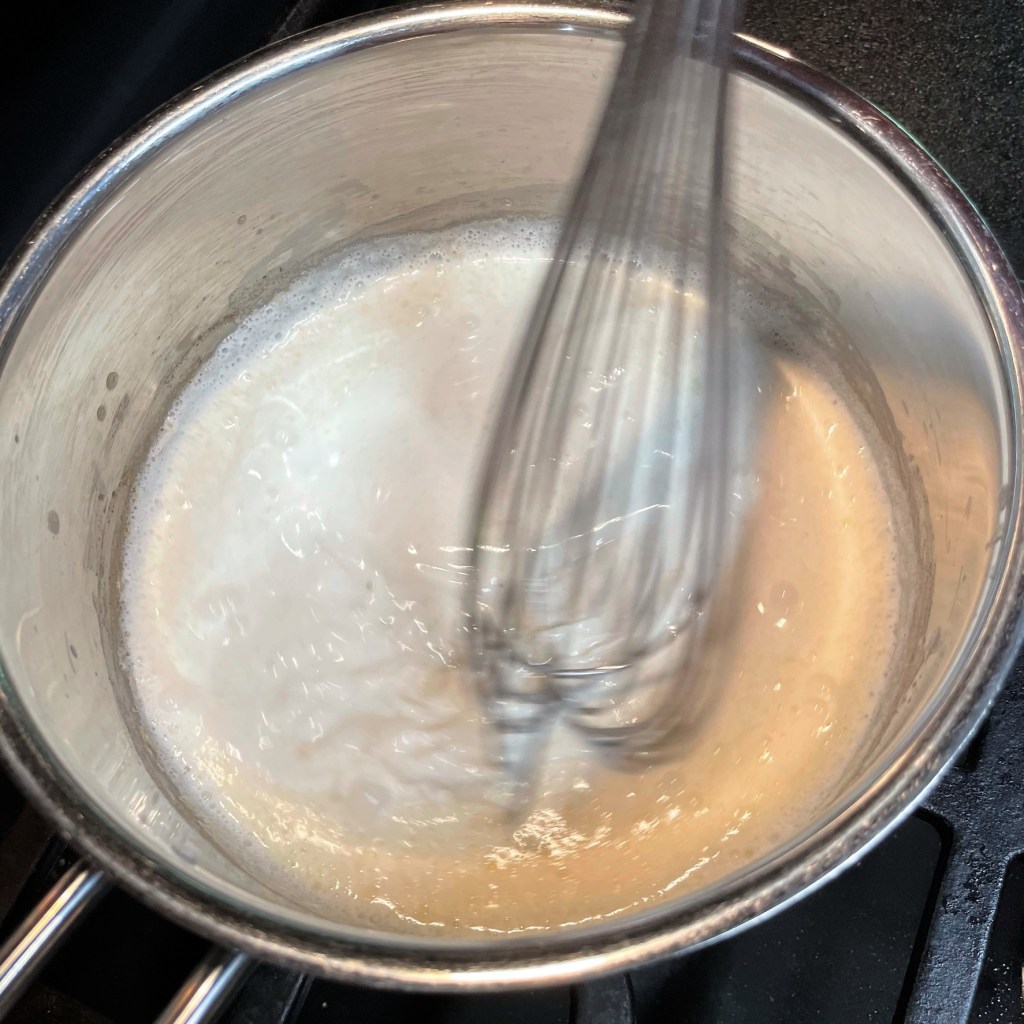
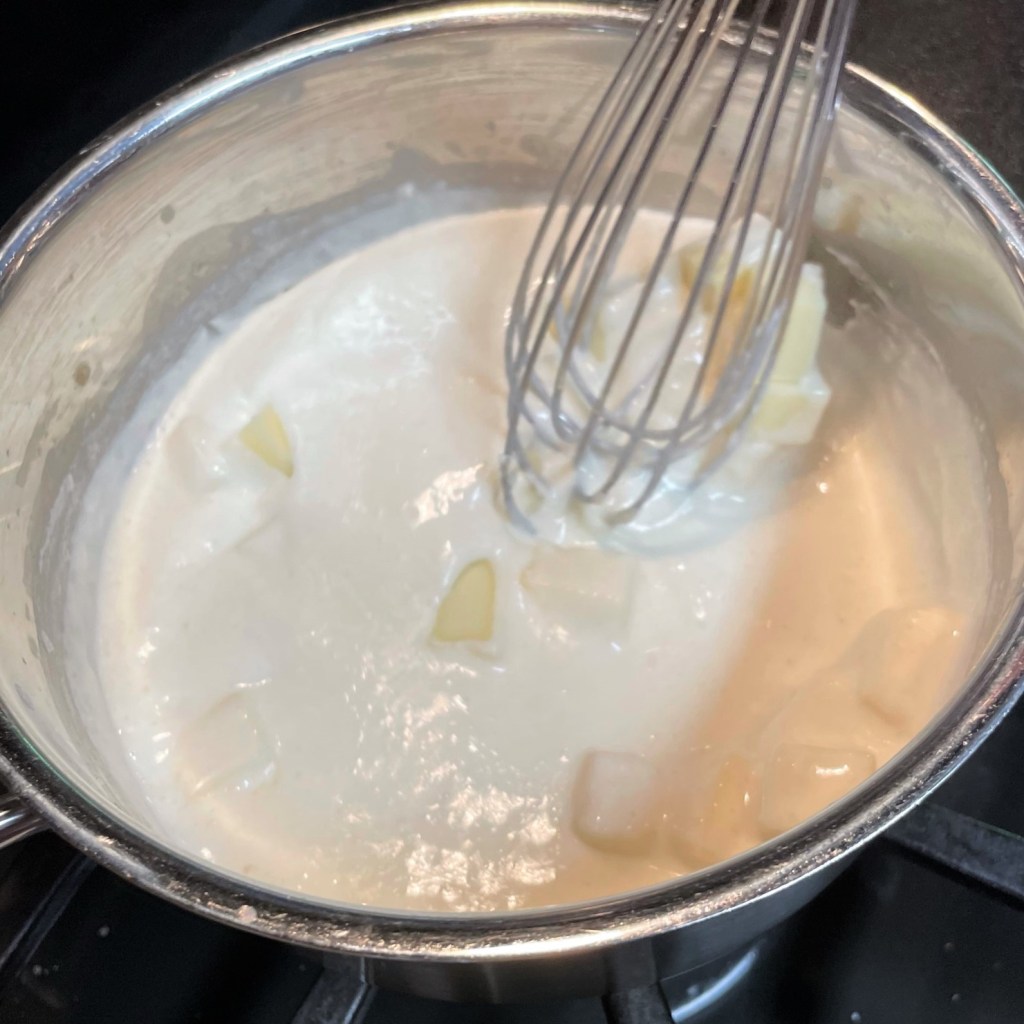
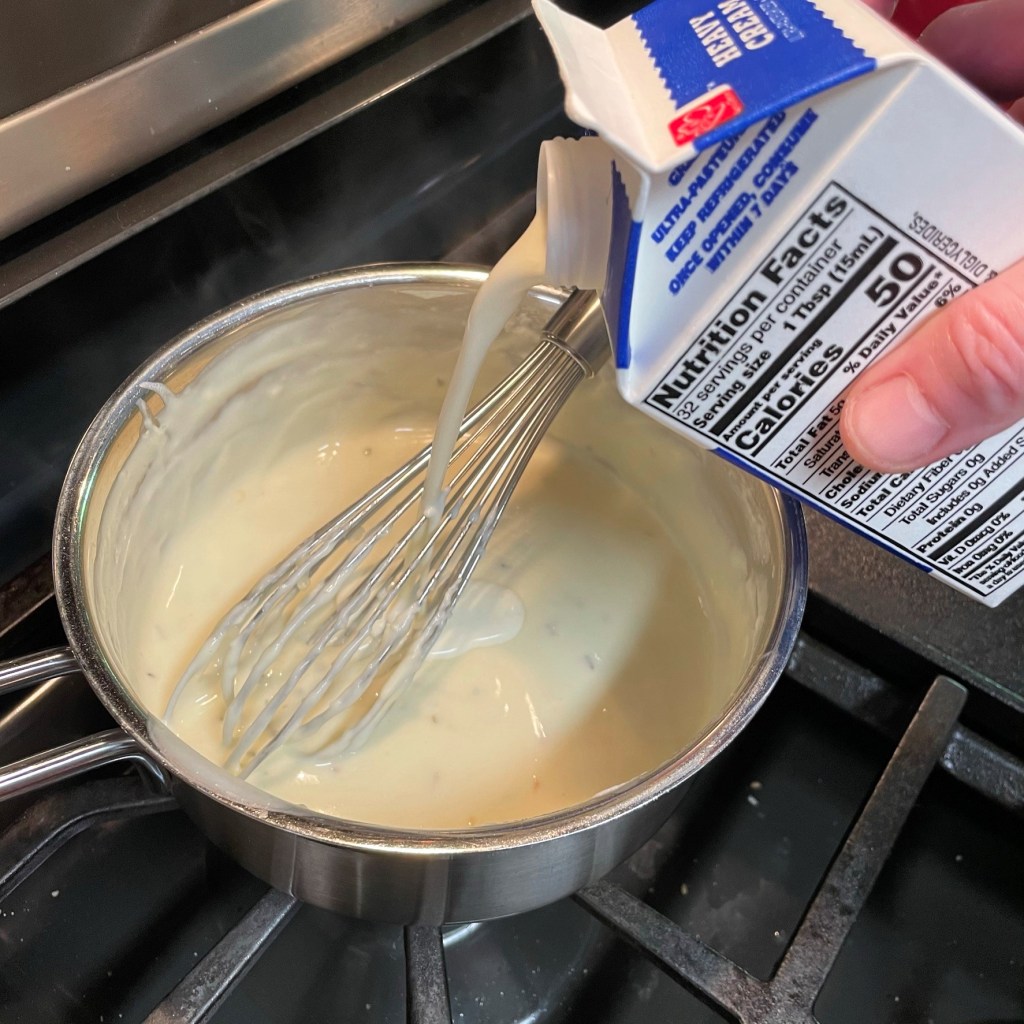
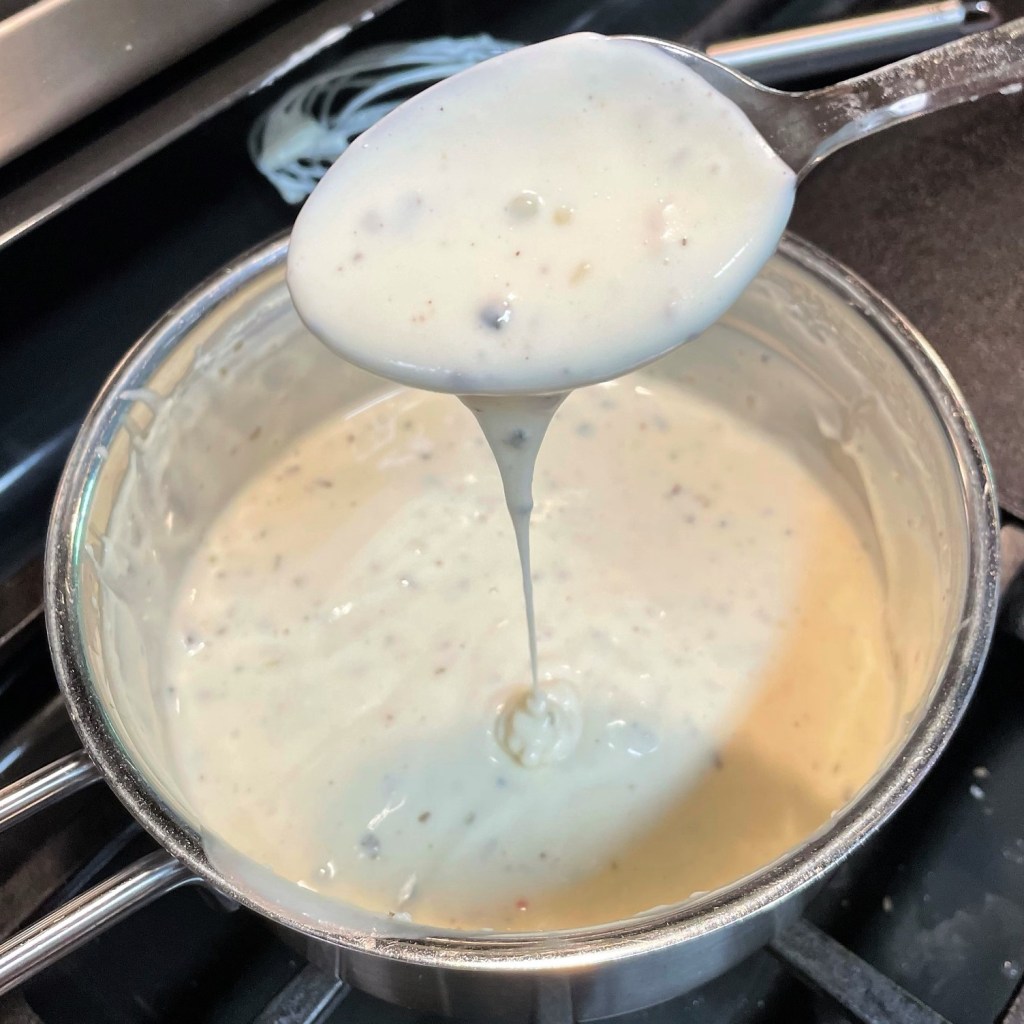
  4. Make the white cheese sauce, beginning with a butter and flour roux in a medium saucepan. Heat the butter until bubbly, then add the flour and whisk together until it appears foamy and the butter is browned. Add the milk all at once and whisk constantly until mixture is smooth, thickened and lightly bubbling. Add cubed American cheese and stir or whisk until melted. Reduce heat to very low to keep sauce slightly warm and pourable while you prep the pizza crust.
  5. Preheat oven to 450° F, with oven rack in the center of the oven.
  6. Place your prepared deep-dish dough into a 14-inch pan (or two 9-inch cake pans), and press gently to spread the dough out to the edges and up the sides about an inch. If the dough is very springy, cover the pan for 15 minutes, allowing the gluten to relax before proceeding.
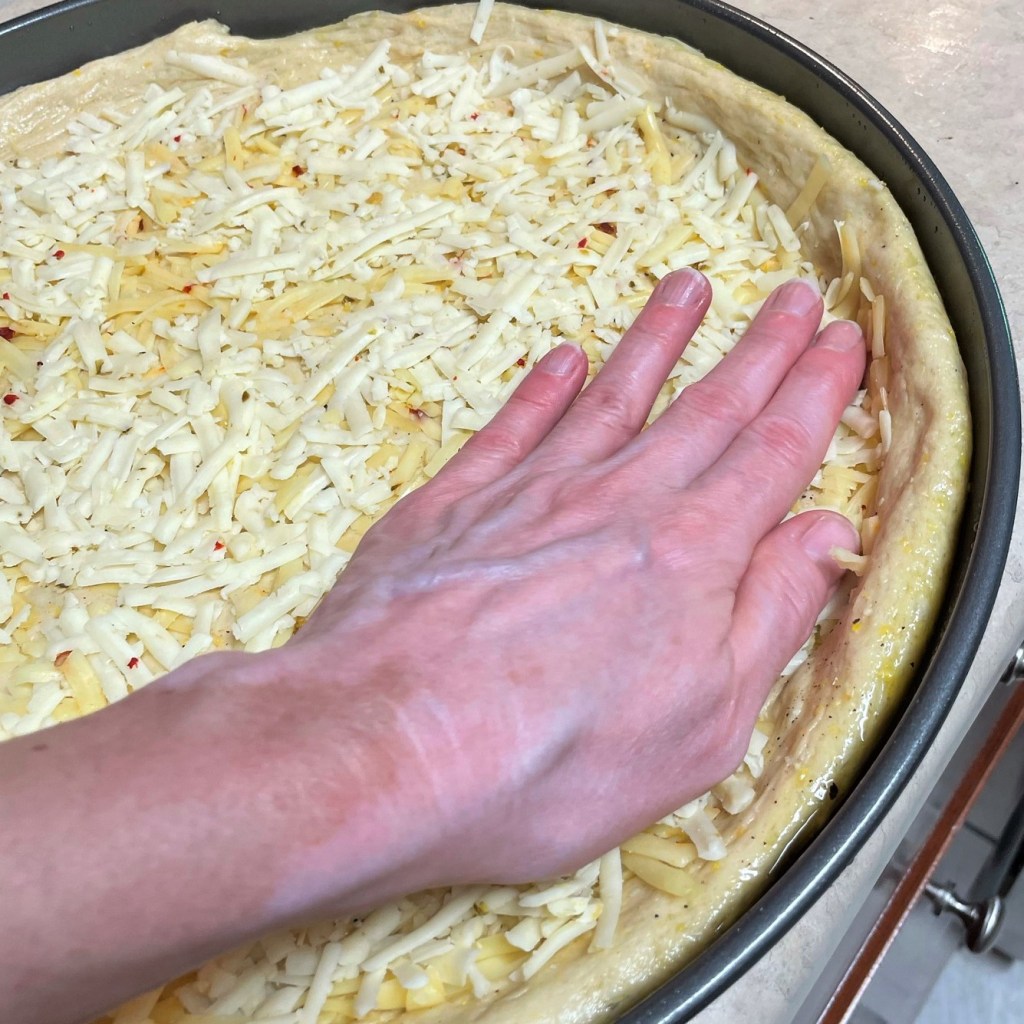
  7. Scatter the shredded pepperjack cheese evenly over the pizza dough, and press down firmly to ensure good coverage.
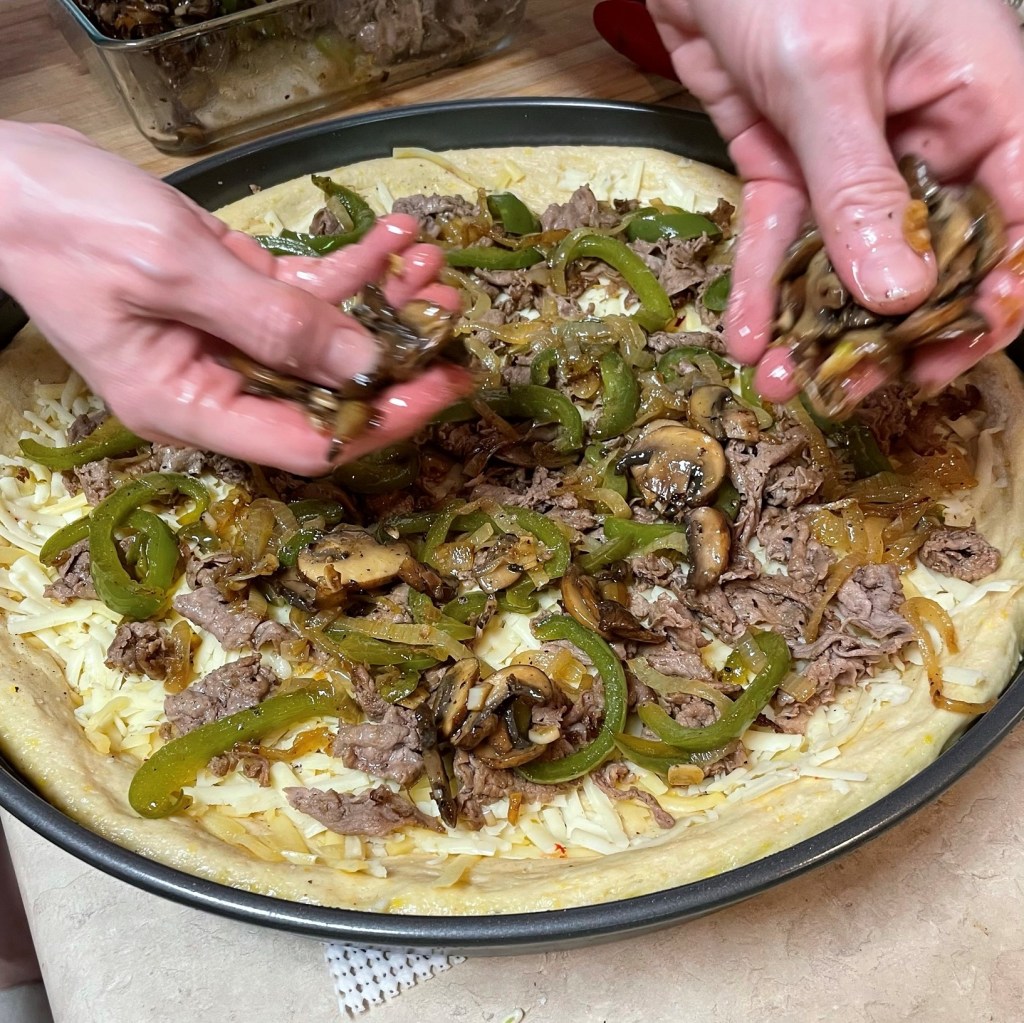
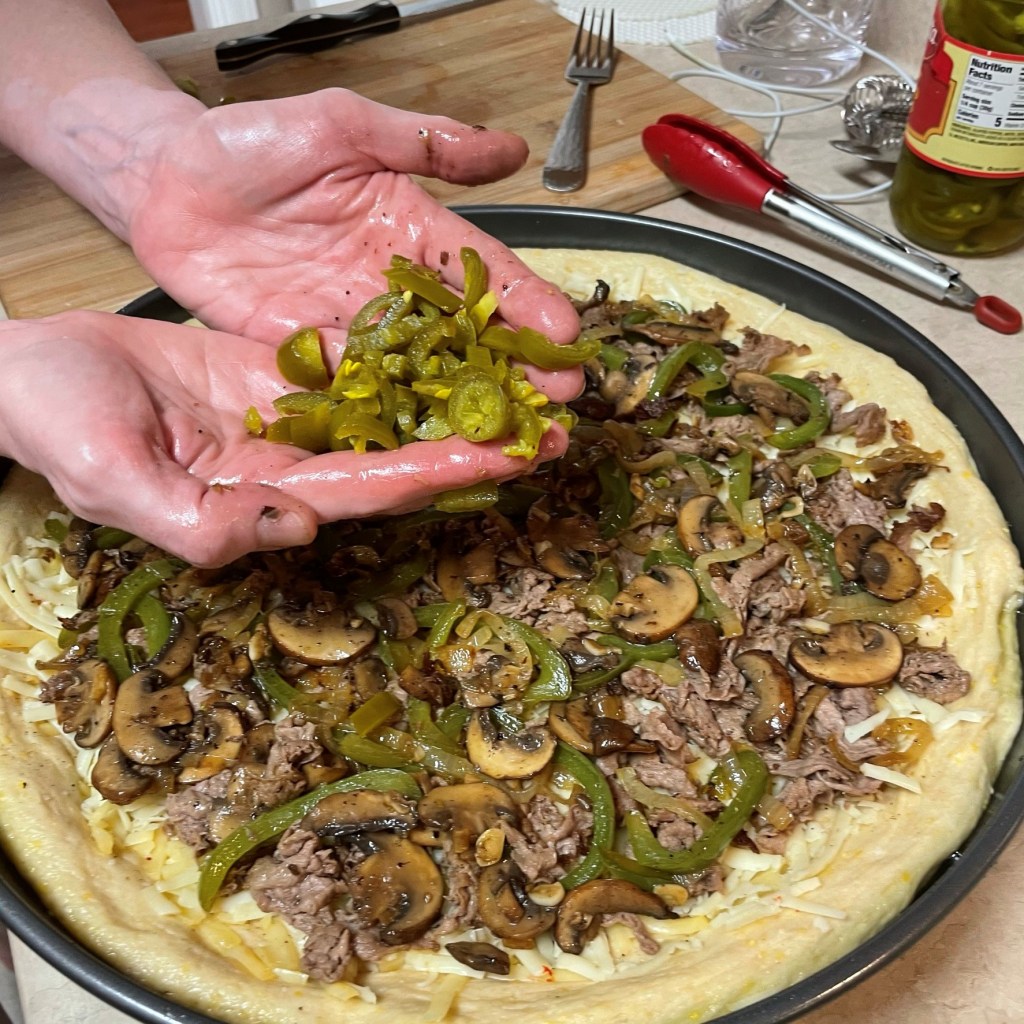
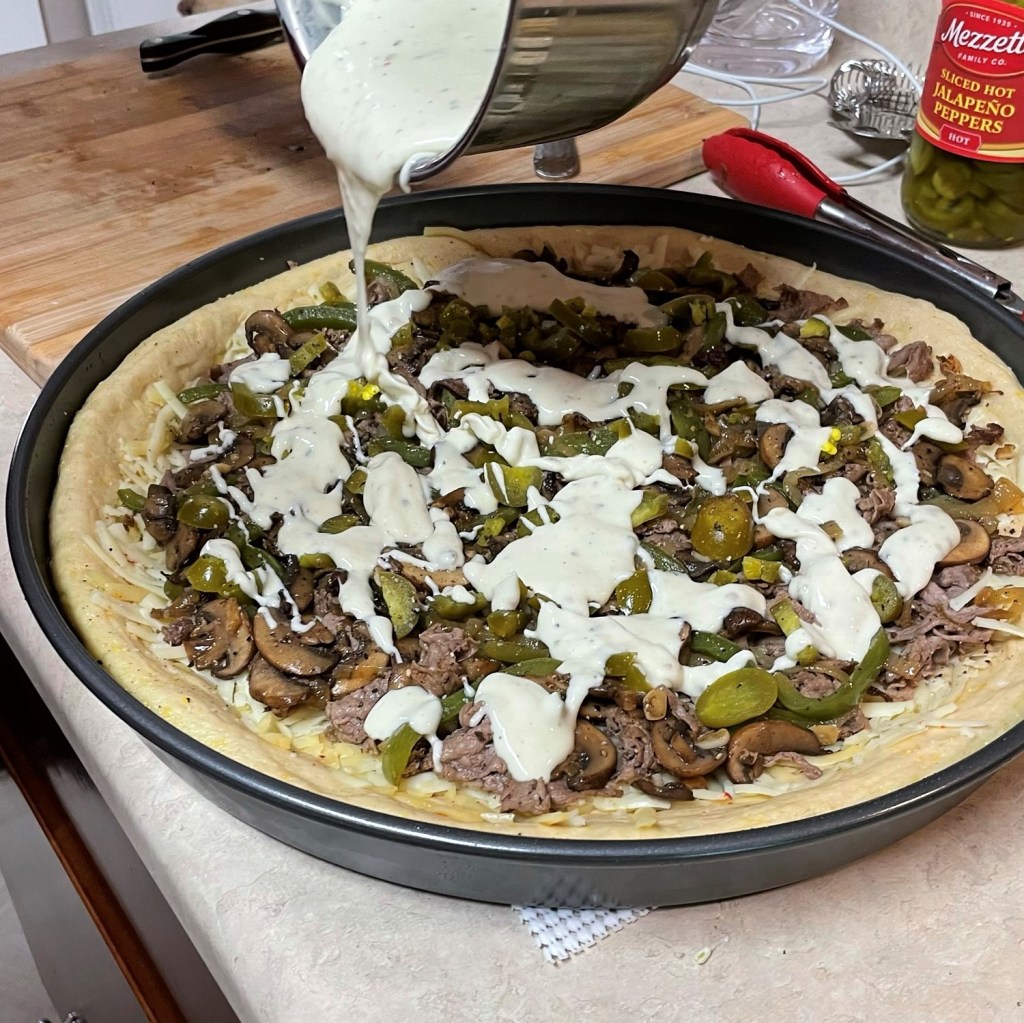
  8. Load up your toppings, including the steak, vegetables and jalapeno peppers.
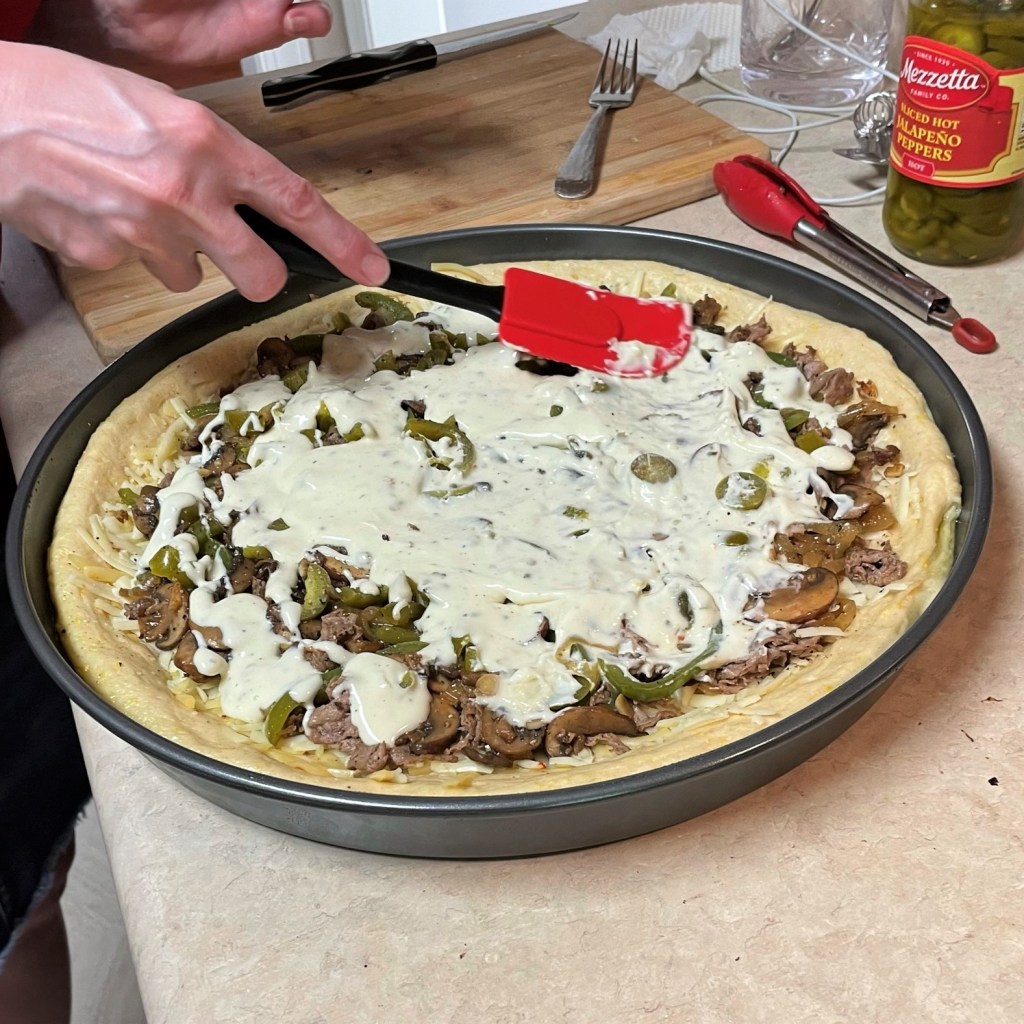
  9. Drizzle the white cheese sauce all over the top. If the sauce does not readily flow into the nooks and crannies, give it an assist with a spatula or spoon.
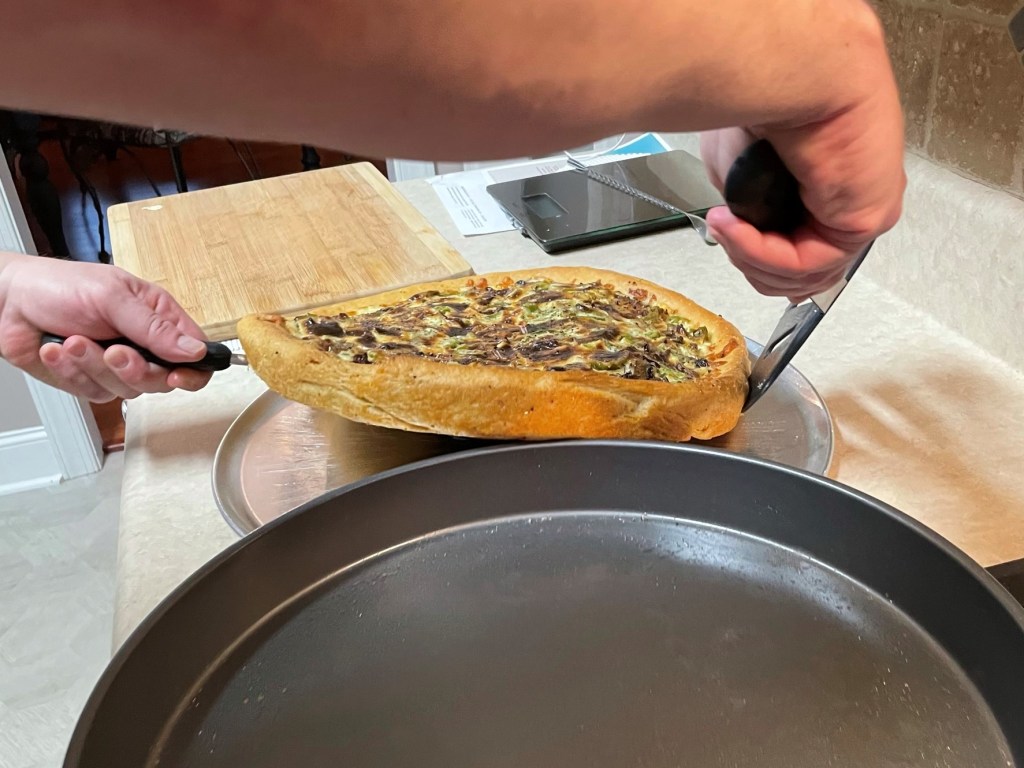
  10. Bake for about 25 minutes, until the cheese sauce is browned and bubbling, and crust is a deep golden brown. Check on it at the halfway point, and tent loosely with foil, if necessary, to prevent over-browning of the cheese. Rest finished pizza about 15 minutes before using large spatulas to transfer it to a cutting board or round pizza sheet.

Les is so good at this part! He uses a large spatula and a fish turner to move the whole pie.

In case you are curious about the outcome… Wow, what a difference a day can make!

Before and After!


Bangers & Mash!

There cannot possibly be a food more deserving of the title “pub grub” than bangers and mash. This hearty, stick-to-your-ribs dish is original to Ireland and other parts of the U.K., and a real treat on St. Patrick’s Day, but its history reflects hard times for the Irish people. During W.W. I meat shortages, sausage makers resorted to stuffing the links with lesser amounts of pork or lamb, substituting fillers and higher-than-usual water concentration. As they cooked, the sausages exploded from their casings with a banging sound. Thus, “bangers.”

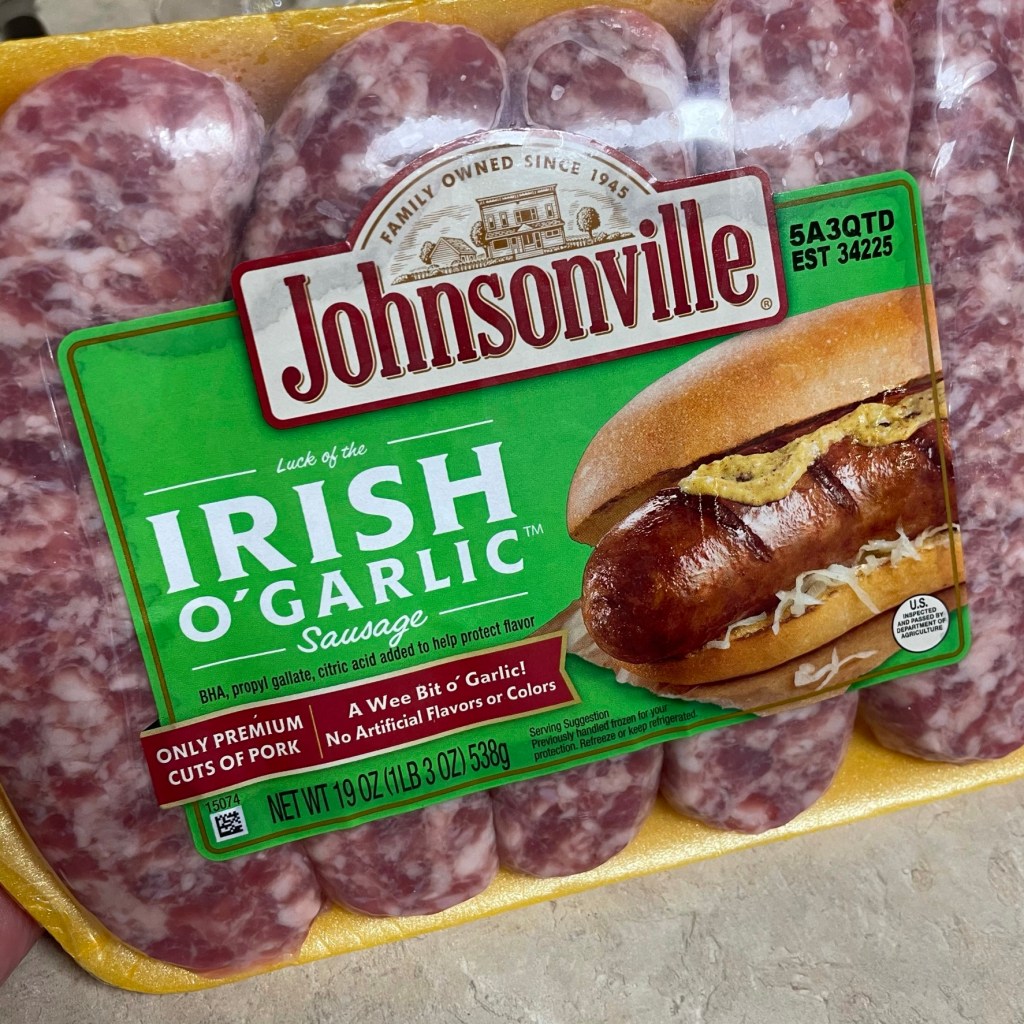
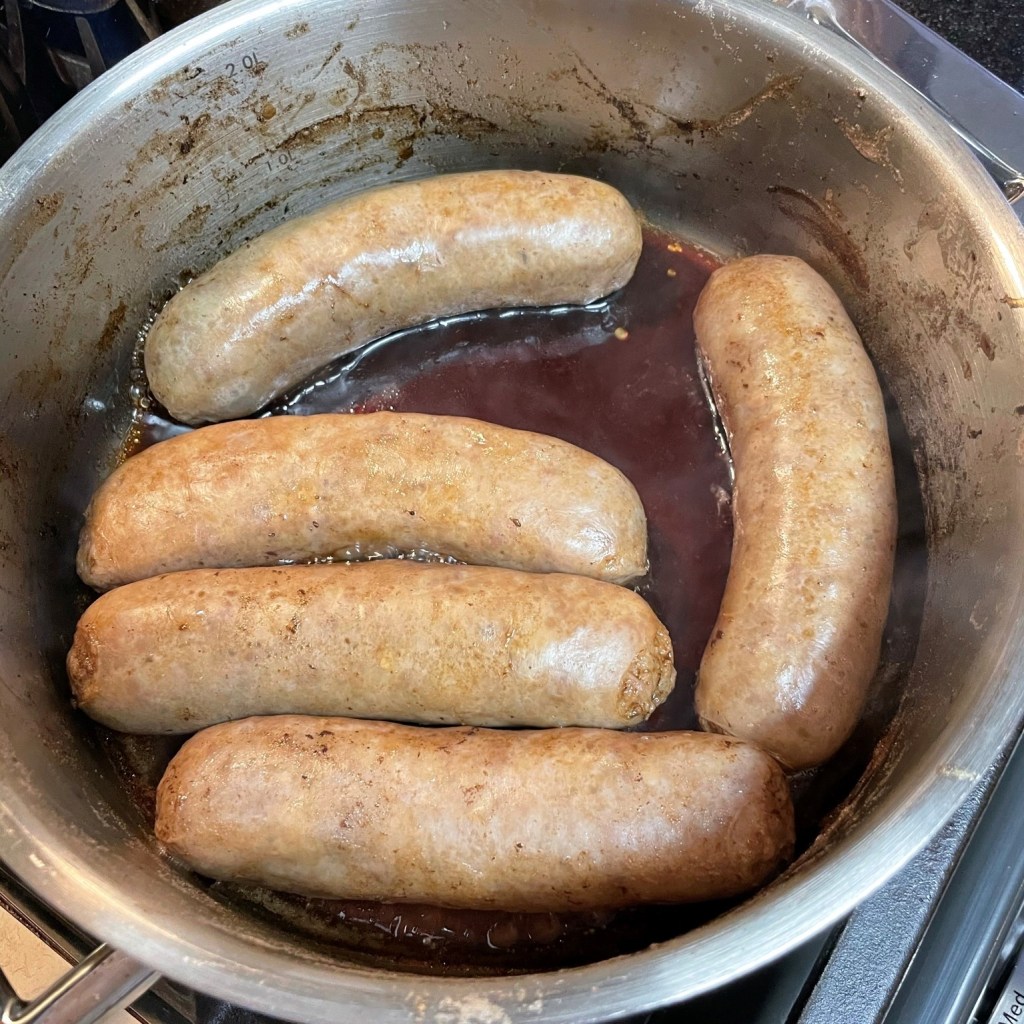
Today, you don’t have to look very hard to find a more meat-centric version of the sausages, and I found this delicious variety made by Johnsonville. They are slightly sweet, but with plenty of garlic flavor that I think holds up nicely to the dark stout beer used in the thick onion gravy. If you can’t find sausage that is labeled specifically as “Irish,” I would recommend any bratwurst-type of sausage as a fine substitute.

These Johnsonville sausages were delicious! If you do not find sausage labeled as “Irish,” I think bratwurst would be a good substitute.

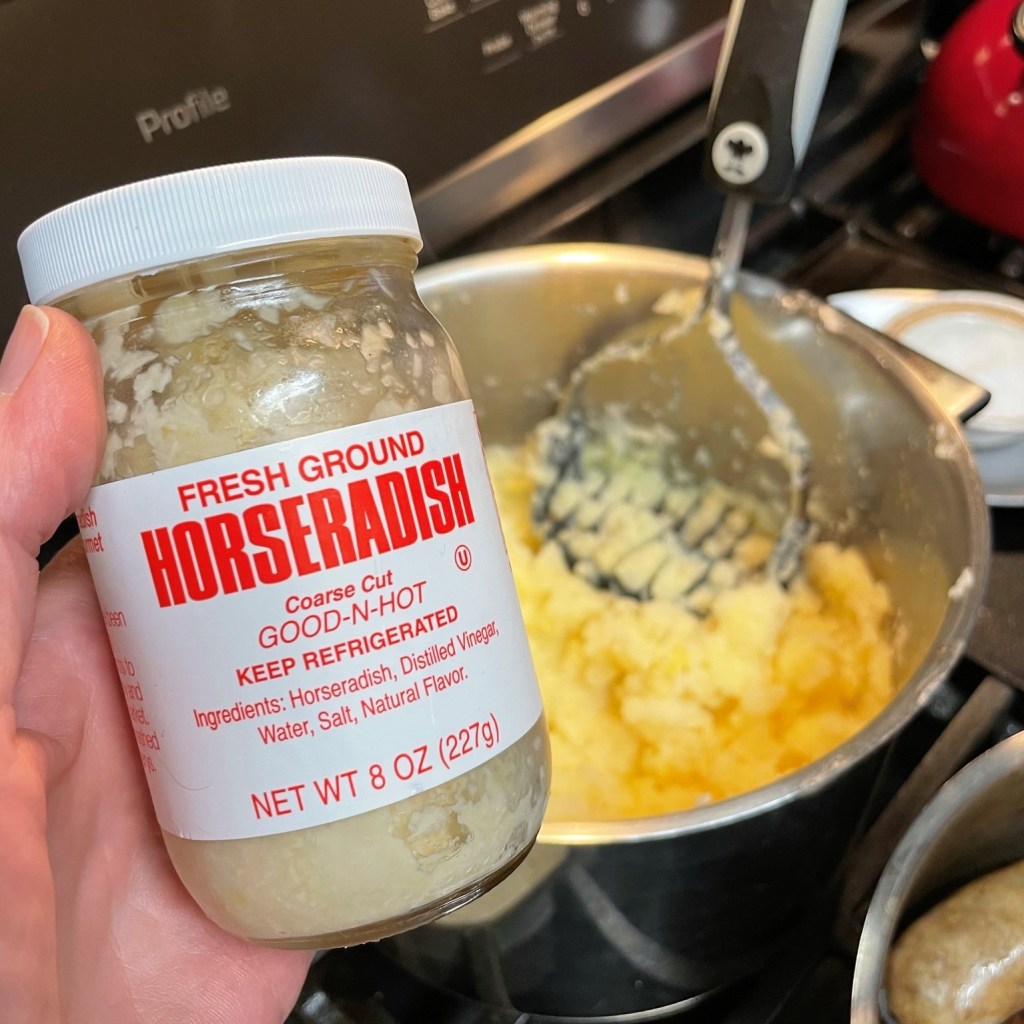
The Irish, especially peasant populations, have always relied heavily on the nutrient-dense potato, for its fiber, antioxidants and minerals (especially potassium). Potatoes contain a resistant starch that is not absorbed by the body, but provides a vehicle to deliver nutrients to feed our gut bacteria, which is crucial for overall good health. Isn’t it nice to know that a favorite comfort food can actually be good for you? At our house, it’s a rare occasion to have any kind of potatoes other than my beloved’s fabulous garlic mashed, but their richness, and especially the parm-romano flavor, is not quite right for this meal. I’ve taken a different direction, using buttermilk and a moderate amount of butter to cream them up a bit, and a couple of spoons of horseradish, which gives them legs to stand under the intensely flavored Guinness onion gravy.

My version of the gravy begins with sautéed onions, and is finished with a very generous glug of Guinness stout, plus some broth. This gravy is big and bold, and if you wish, you can shift the ratio of stout or leave it out altogether in favor of beef broth—that’s up to you.

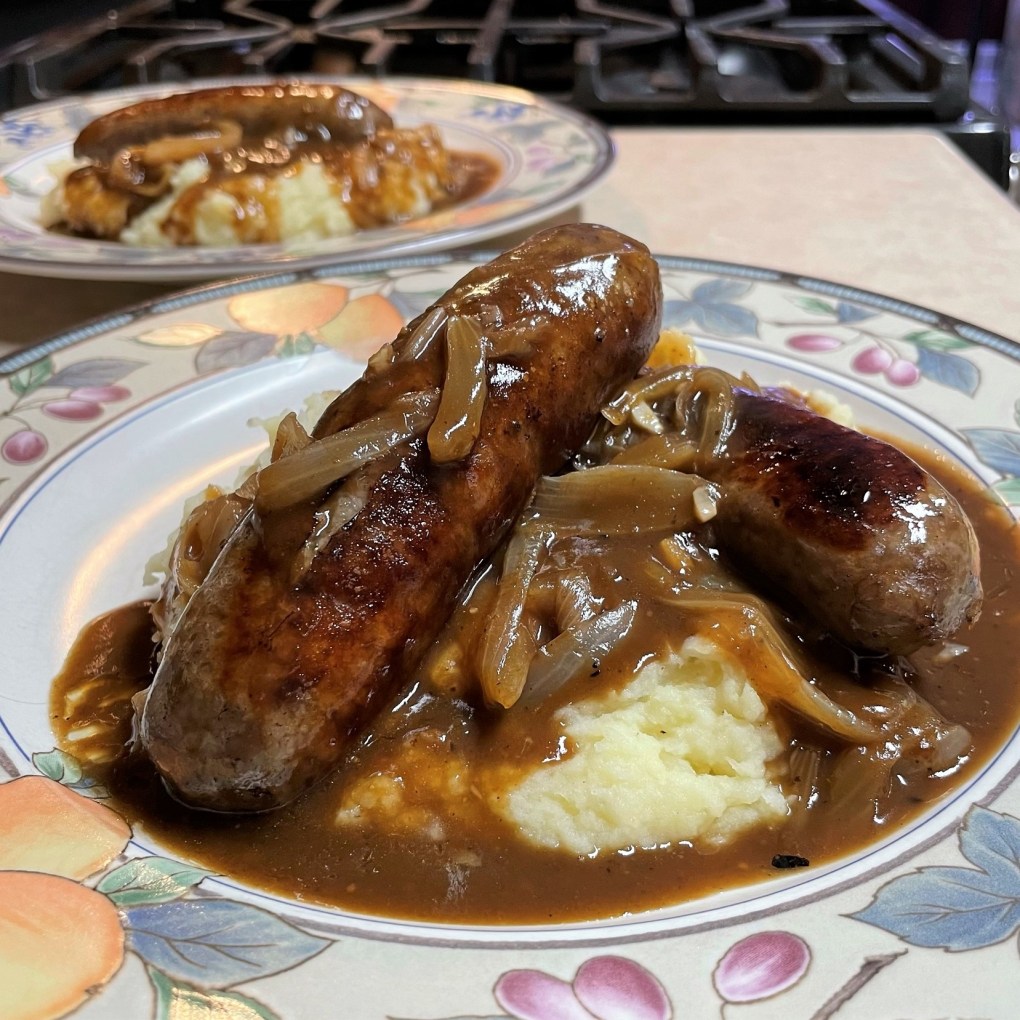
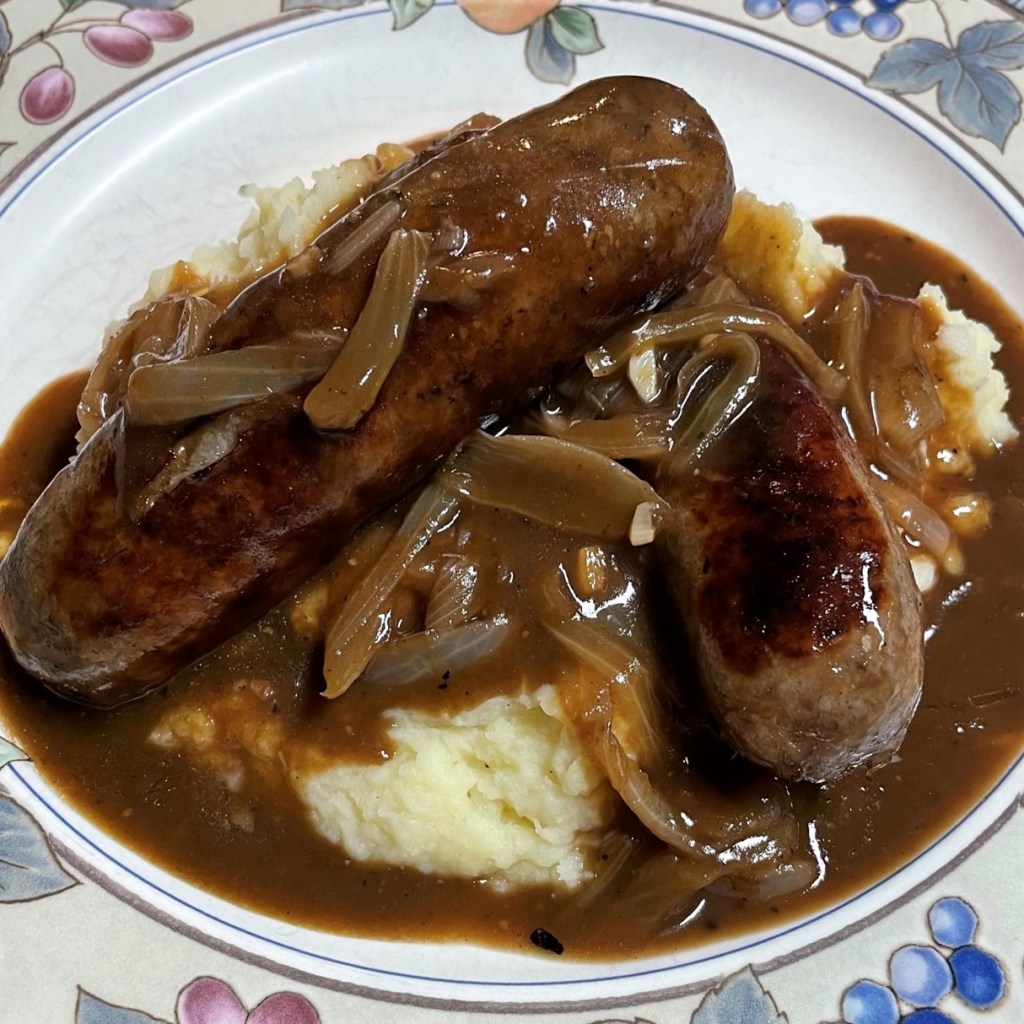
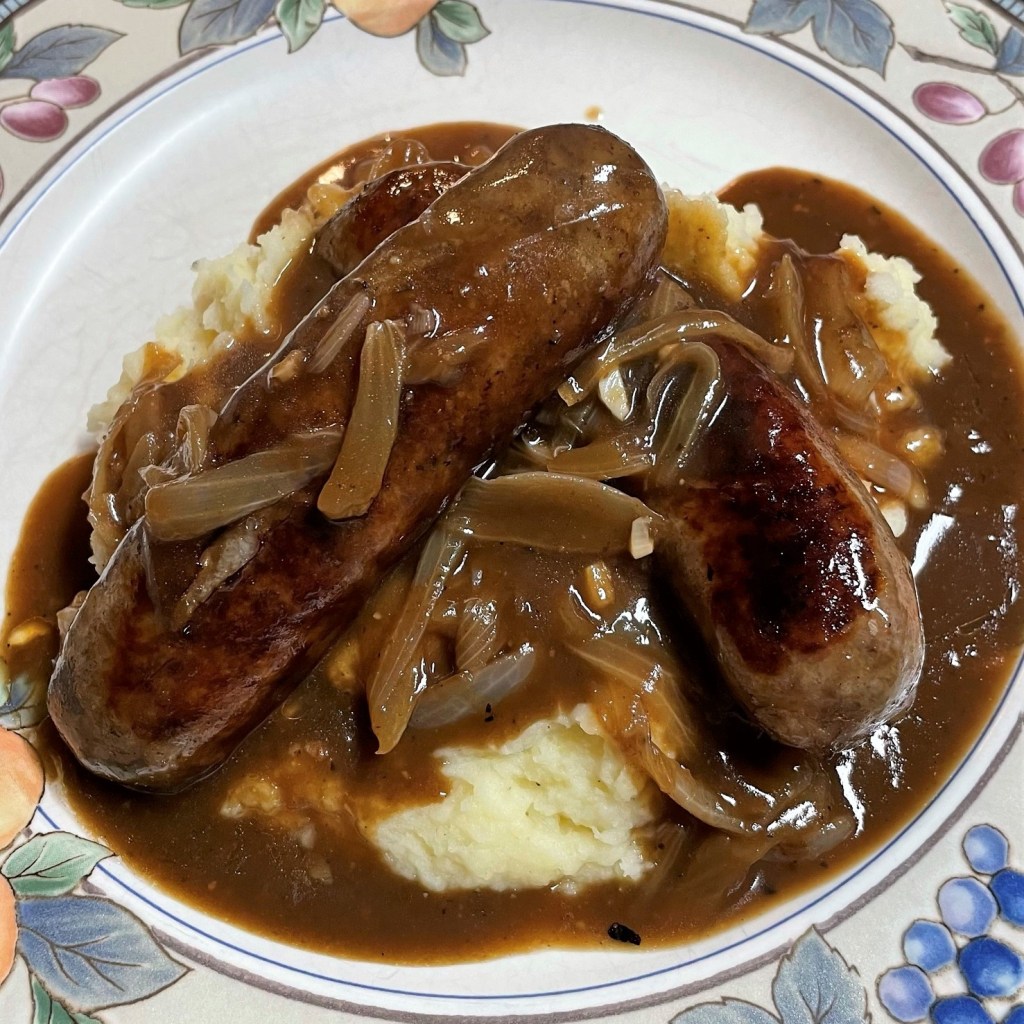
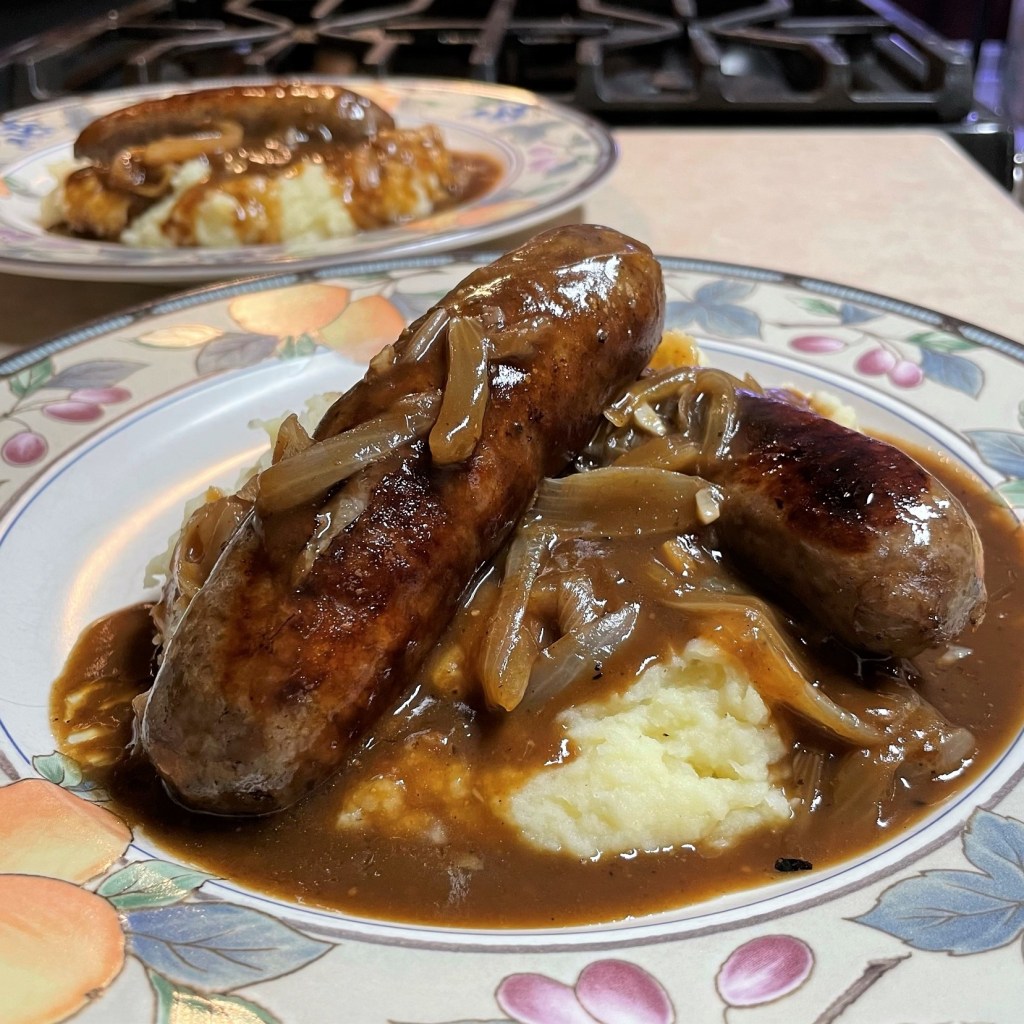
Garlicky sausages, simmered in Guinness and then piled onto hearty potatoes with the Guinness-onion gravy. This is some serious Irish pub grub!

The preparation of these three components (bangers, mash and gravy) will happen concurrently; if you are working ahead, the whole meal heats up nicely as leftovers.

Ingredients

Package of Irish banger sausages (or similar substitute)

1/2 cup Guinness stout ale*

2 1/2 lbs. starchy potatoes (I used a combination of russet and golds)

4 Tbsp. salted butter

1/2 cup thick buttermilk

1 1/2 tsp. prepared horseradish

Salt and pepper

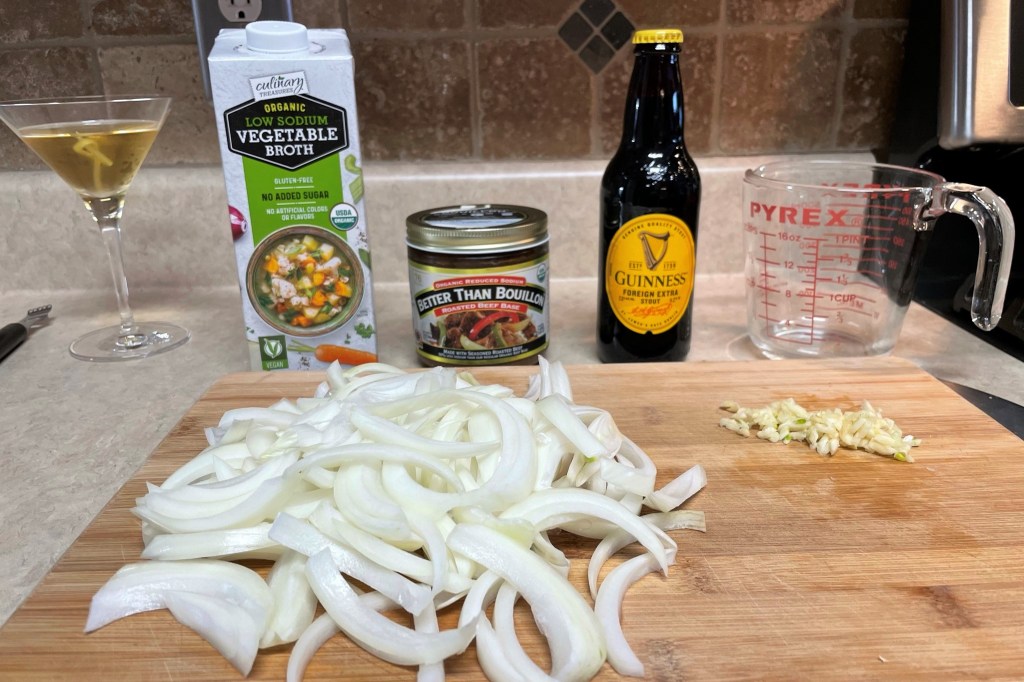
It’s surprising to get so much flavor from so few ingredients. The scotch cocktail in the back is for the cook, not the gravy. 🙂

Guinness Onion Gravy

3 Tbsp. salted butter

1 large yellow onion, sliced (mine was about the size of a softball)

2 cloves garlic, minced

3 Tbsp. all-purpose flour

1 cup Guinness stout ale

1 cup low-sodium vegetable broth

2 tsp. beef bouillon base*

2 tsp. dark brown sugar

Salt and pepper

*Notes

The Guinness stout ale is very strong, and carries a somewhat bitter note. I believe the secret to making delicious gravy with the stout is cooking it slowly, so the malty flavors remain but the alcohol cooks out and mellows in flavor. If you are averse to the bitter flavor, or avoiding alcohol, substitute a hearty beef stock for similar results. This recipe calls for a 12 oz. bottle; you will use part of it to simmer the sausages and the rest to finish the onion gravy. I purchased the “Foreign Extra” stout, but for less intense flavor, use a Guinness draught stout.

I use vegetable broth regularly for the nutrients and flavors, and I have amped up the flavor with a hearty spoon of beef bouillon base. If you prefer, skip the base and use beef broth.

Instructions

Let’s run through it together in pictures, then scroll to find written instructions, and a downloadable version you can print for your recipe files.

  1. Peel the potatoes and cut them into large chunks. Cook in salted water over medium-low heat until fork tender.
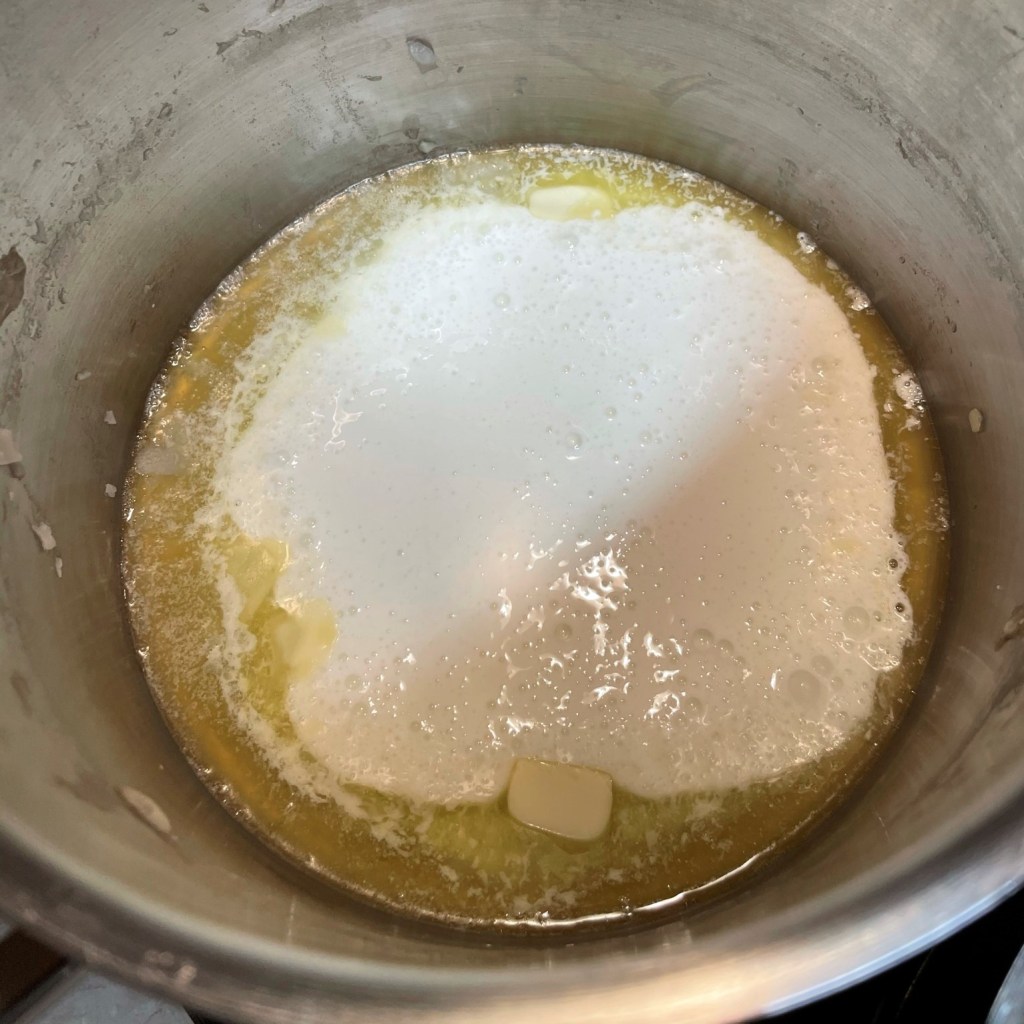
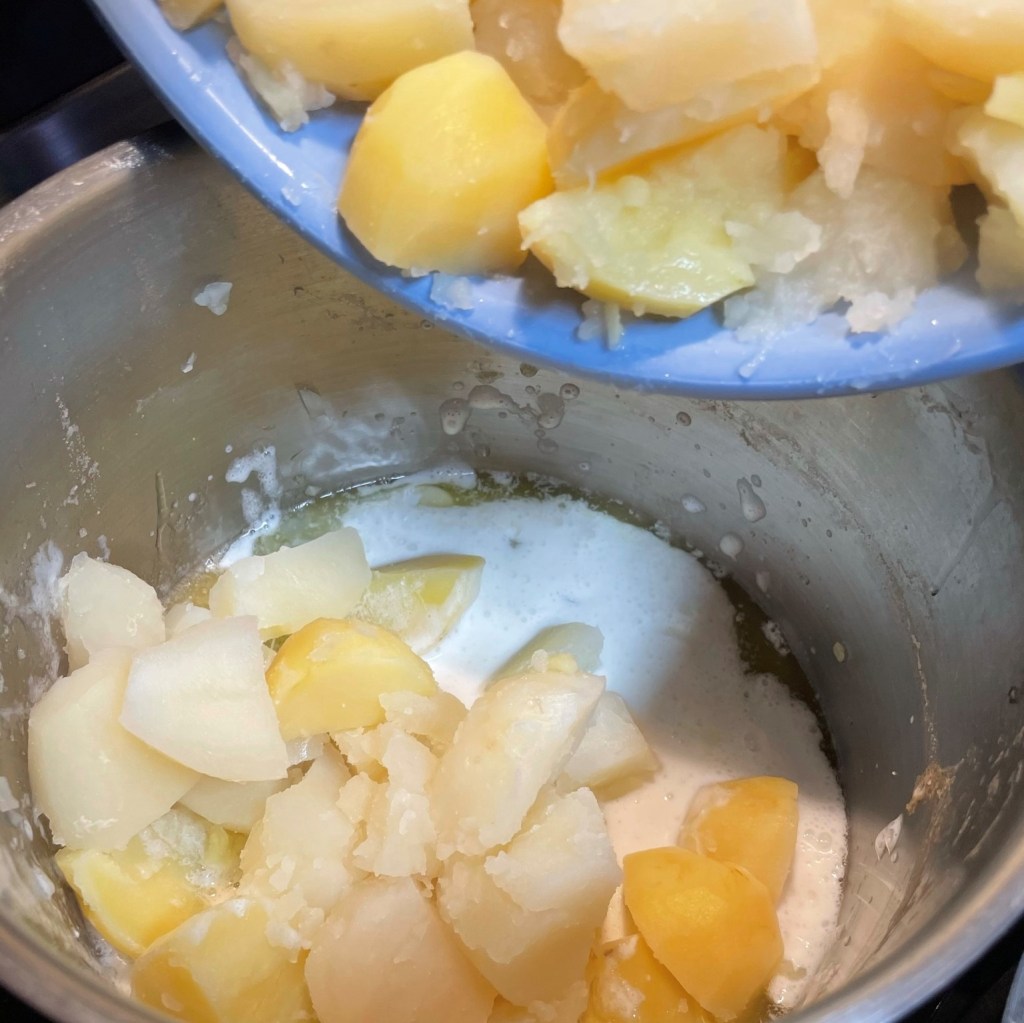
  2. Drain potatoes in a colander (reserve the water, if you wish, to make a batch of my sourdough potato bread with onions and dill). While potatoes drain, add butter and buttermilk to the cooking pot over medium heat until butter is mostly melted.
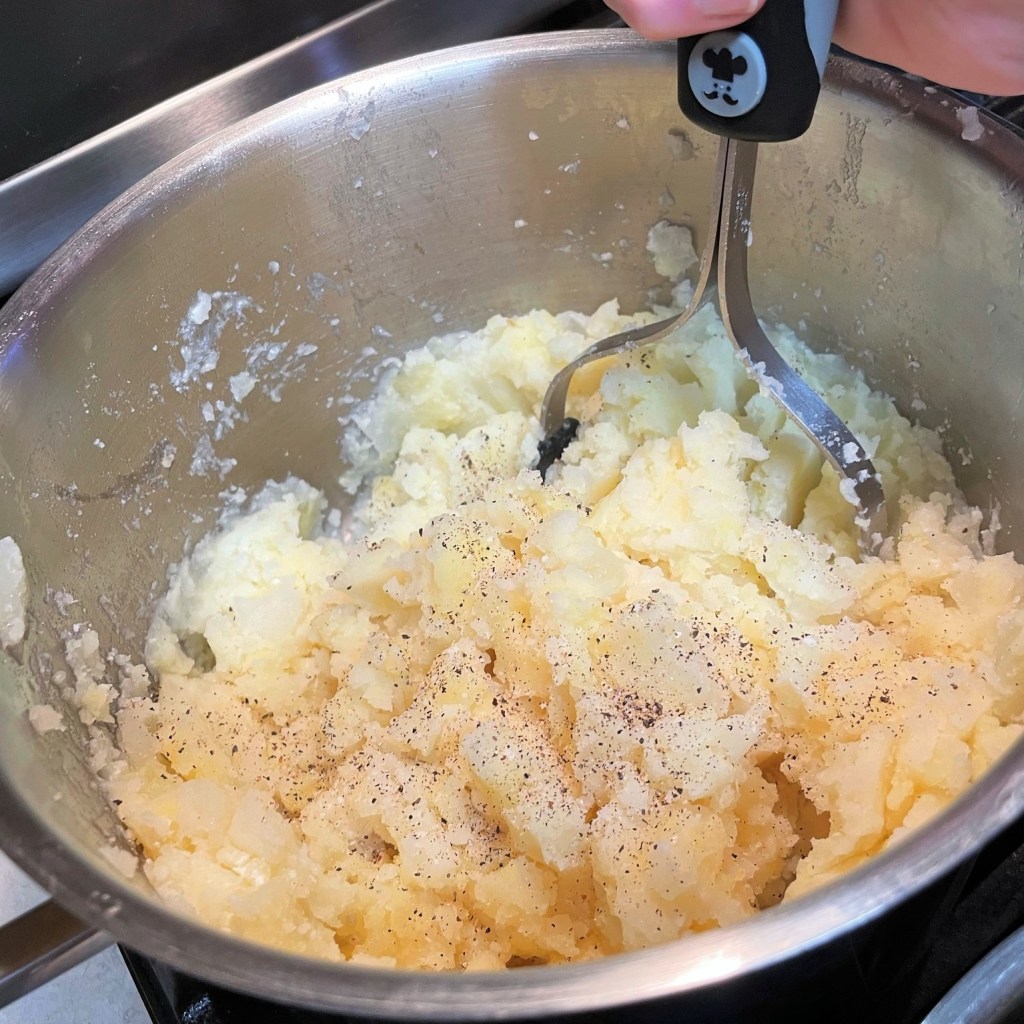
  3. Return hot potatoes to the pot and mash, seasoning with salt and pepper. Stir in horseradish and additional butter, if desired.
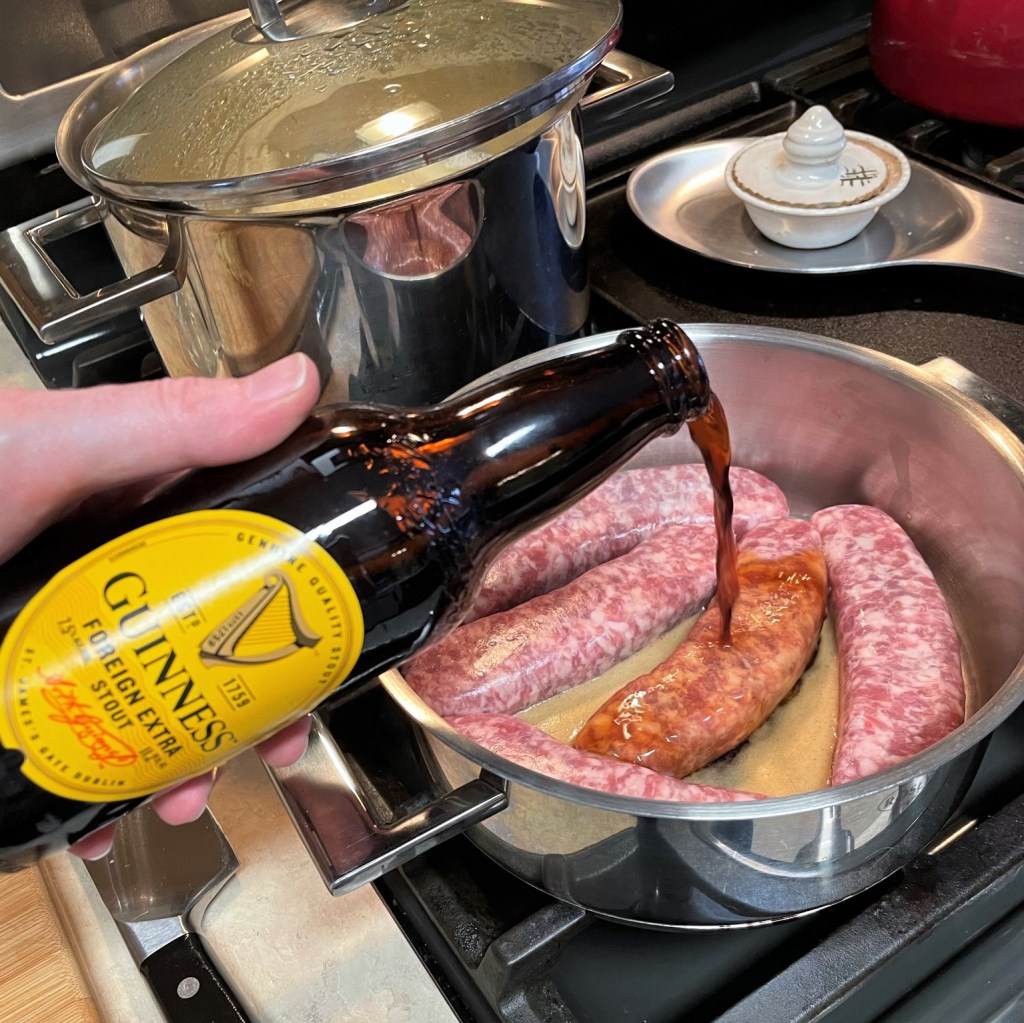
  4. While the potatoes are cooking, place a medium, heavy-bottomed pot over medium heat and pour in 1/2 cup of the Guinness stout. Add sausages to the stout and simmer, turning sausages a few times, until sausage is plump and stout is reduced to a couple of tablespoons. This should be about 25 minutes. Transfer sausages to a separate dish and set aside to make the gravy.
  5. Pour any reduced stout into a glass measuring cup, along with vegetable broth and beef base.
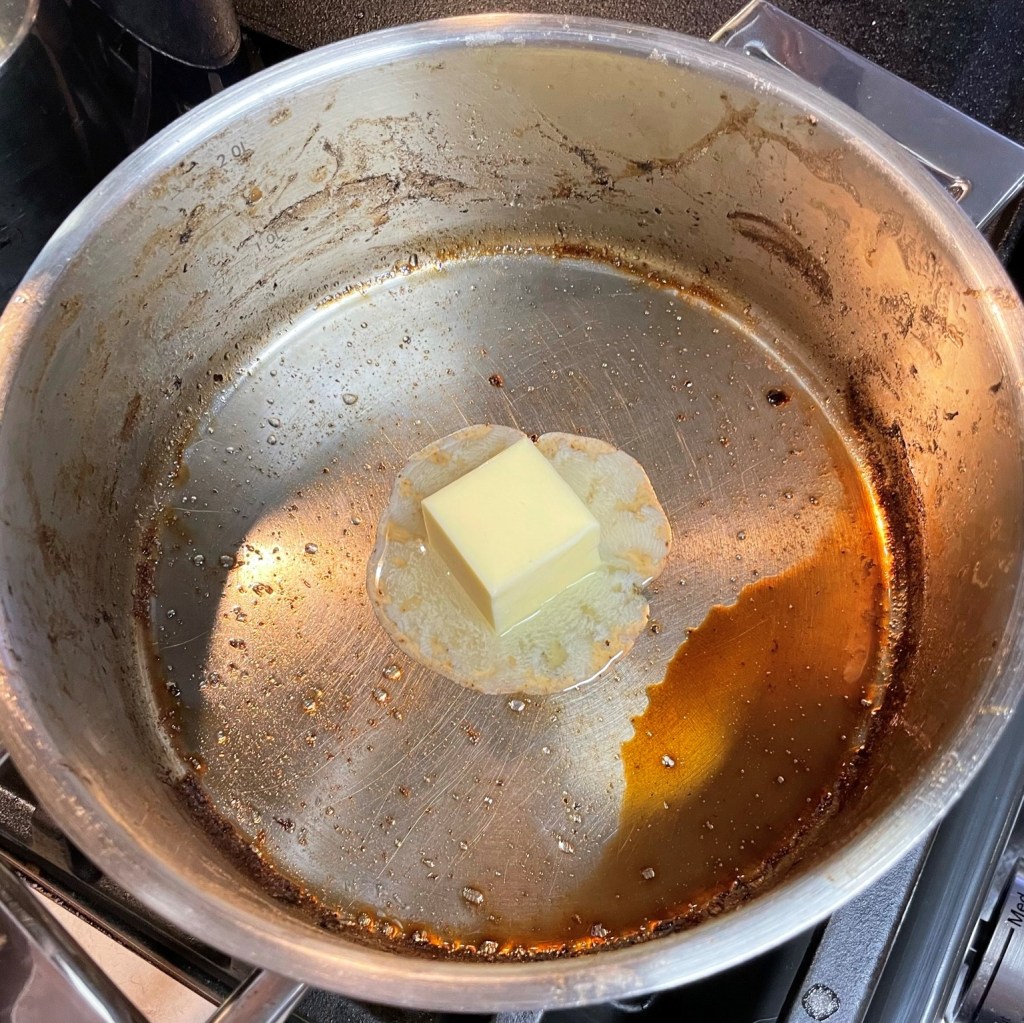
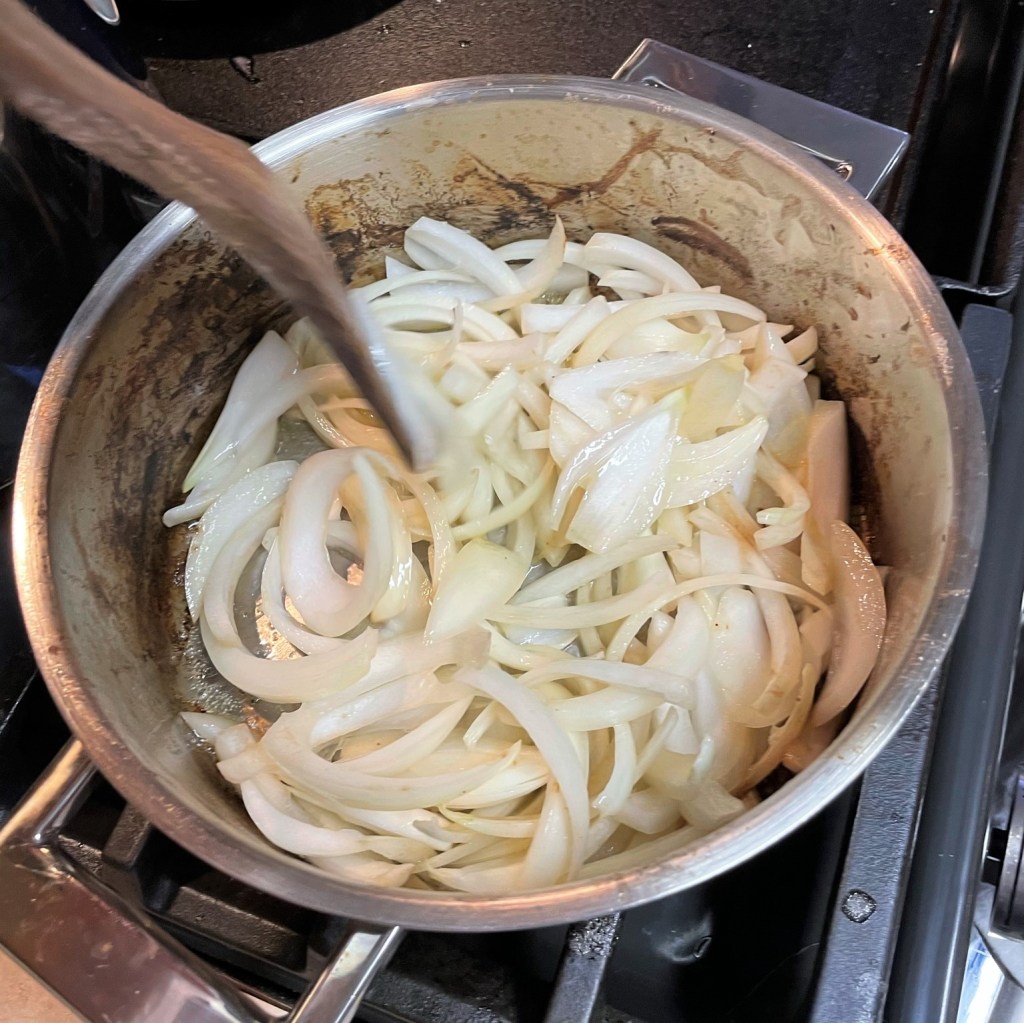
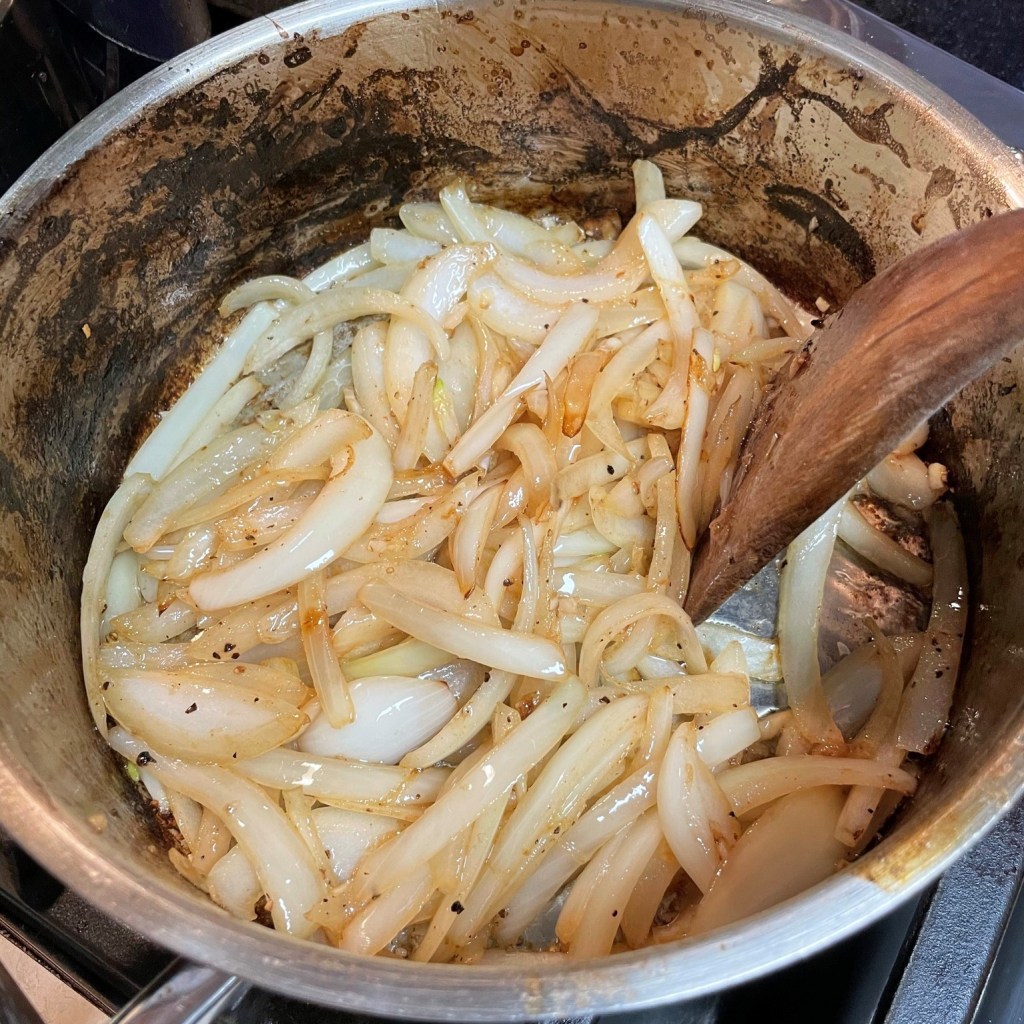
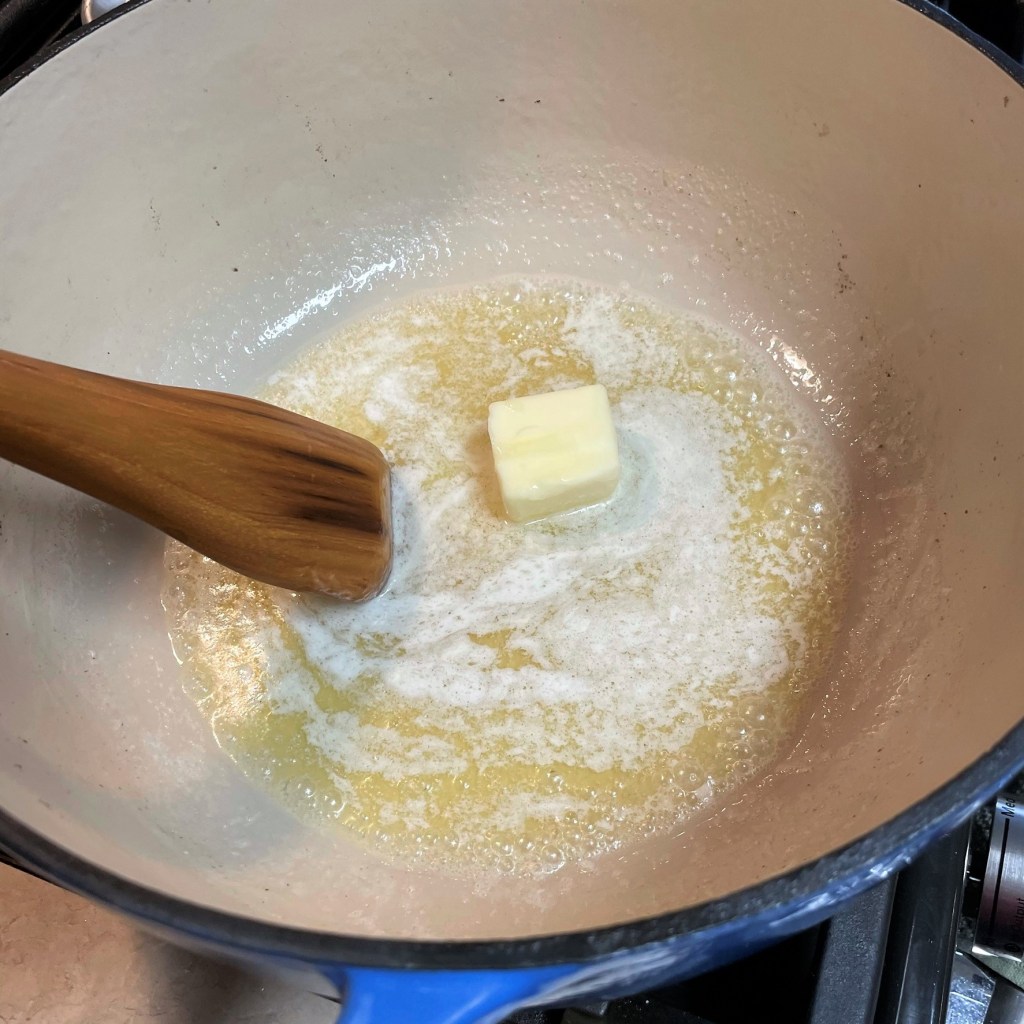
  6. Add butter to the same pot used to simmer the sausages, and add onions and garlic. Season with salt and pepper and sauté over medium heat until onions are soft and translucent, at least 10 minutes.
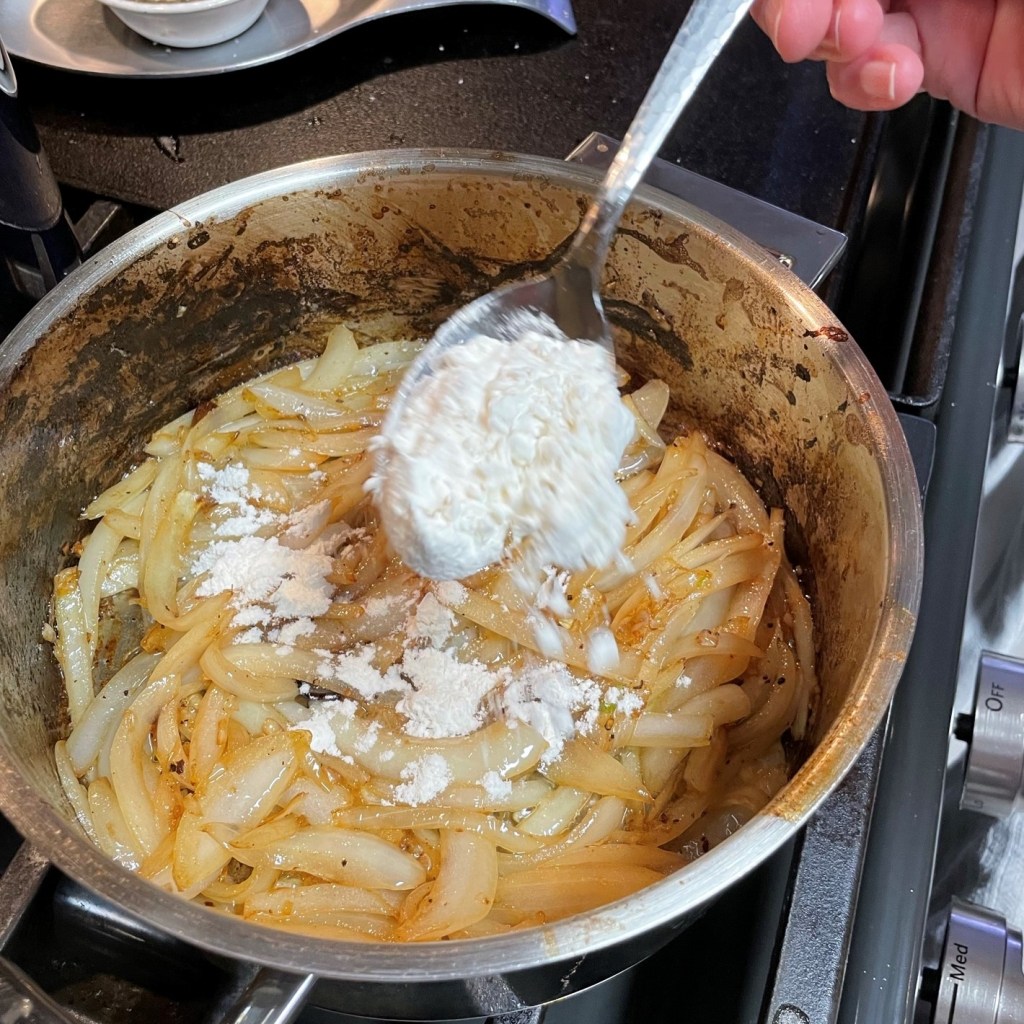
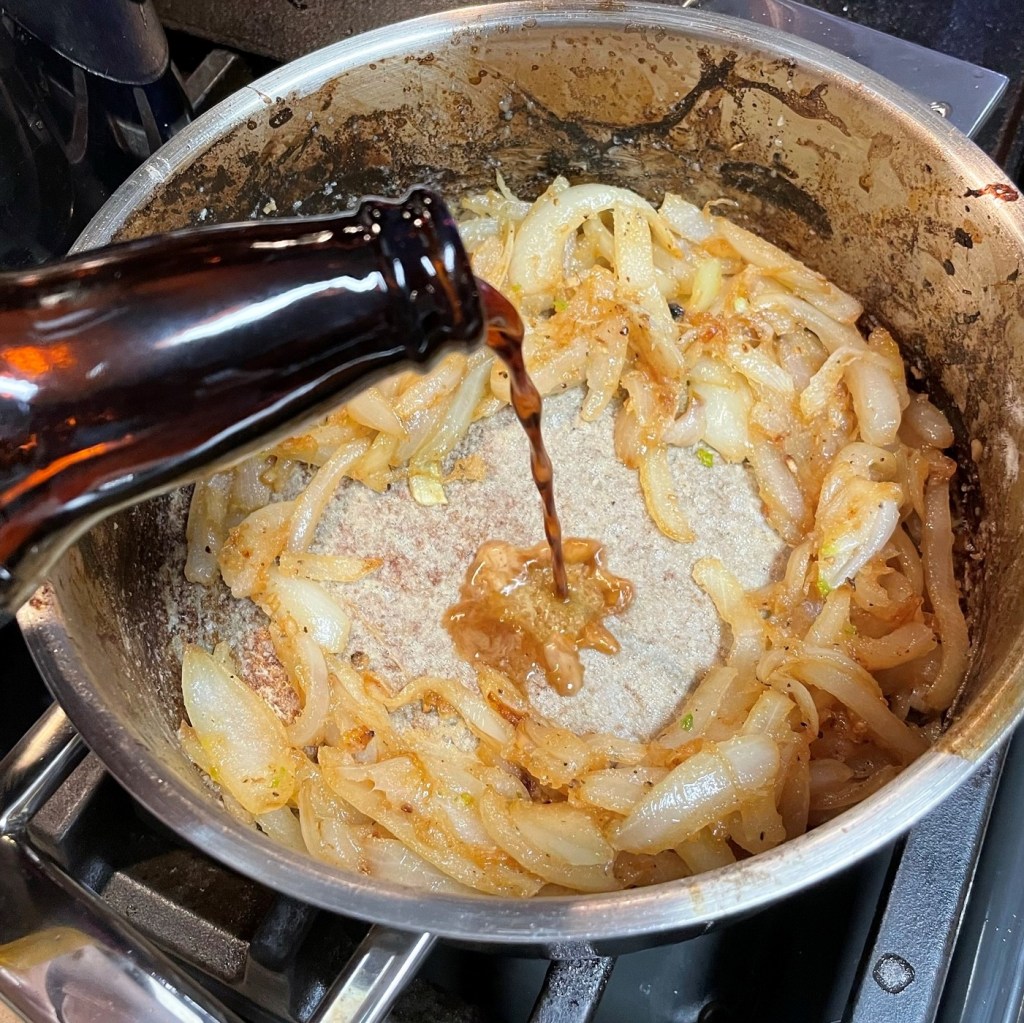
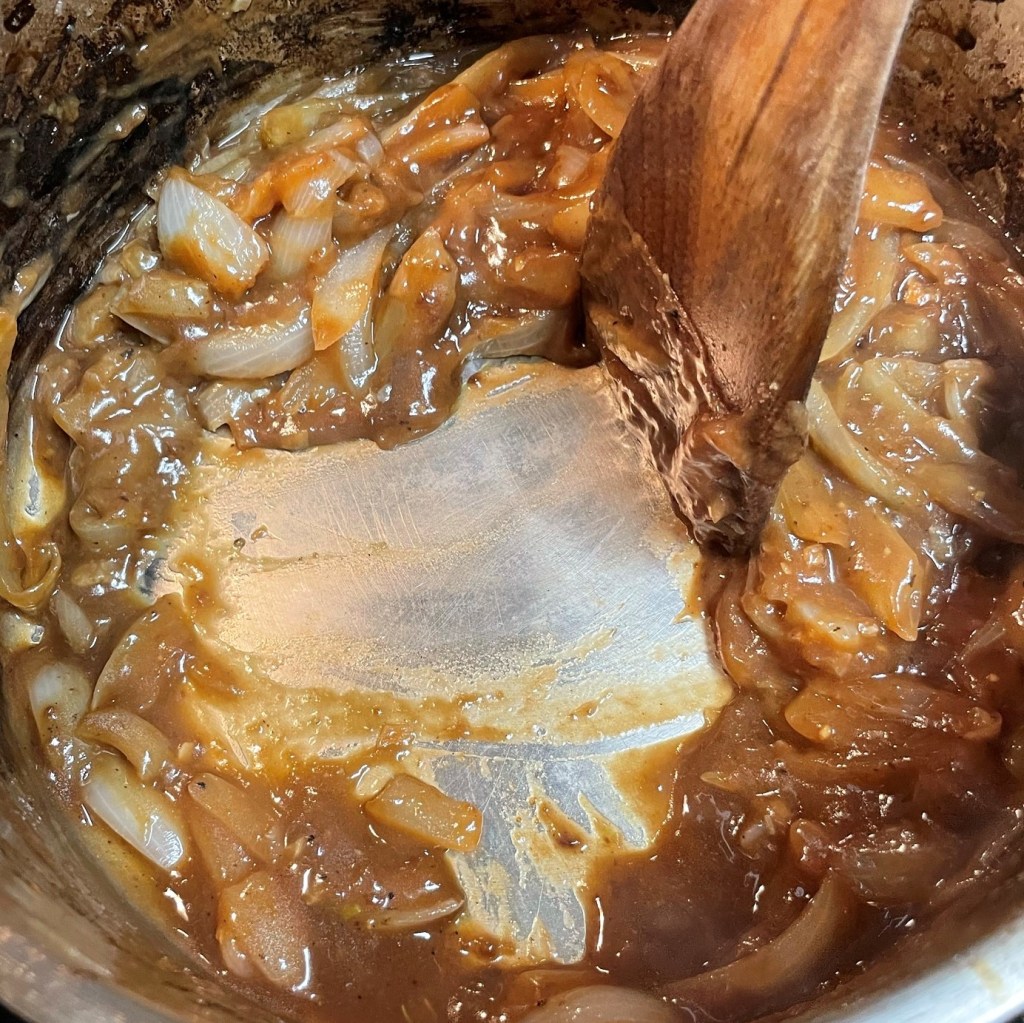
  7. Sprinkle flour over onions in butter and stir until onions are coated and flour begins to cook. This is a roux that will be the thickener for your gravy. When the bottom of the pan begins to accumulate cooked, stuck-on flour, move the onions aside and pour in about half of the remaining Guinness stout. Stir, scraping up the cooked flour from the bottom.
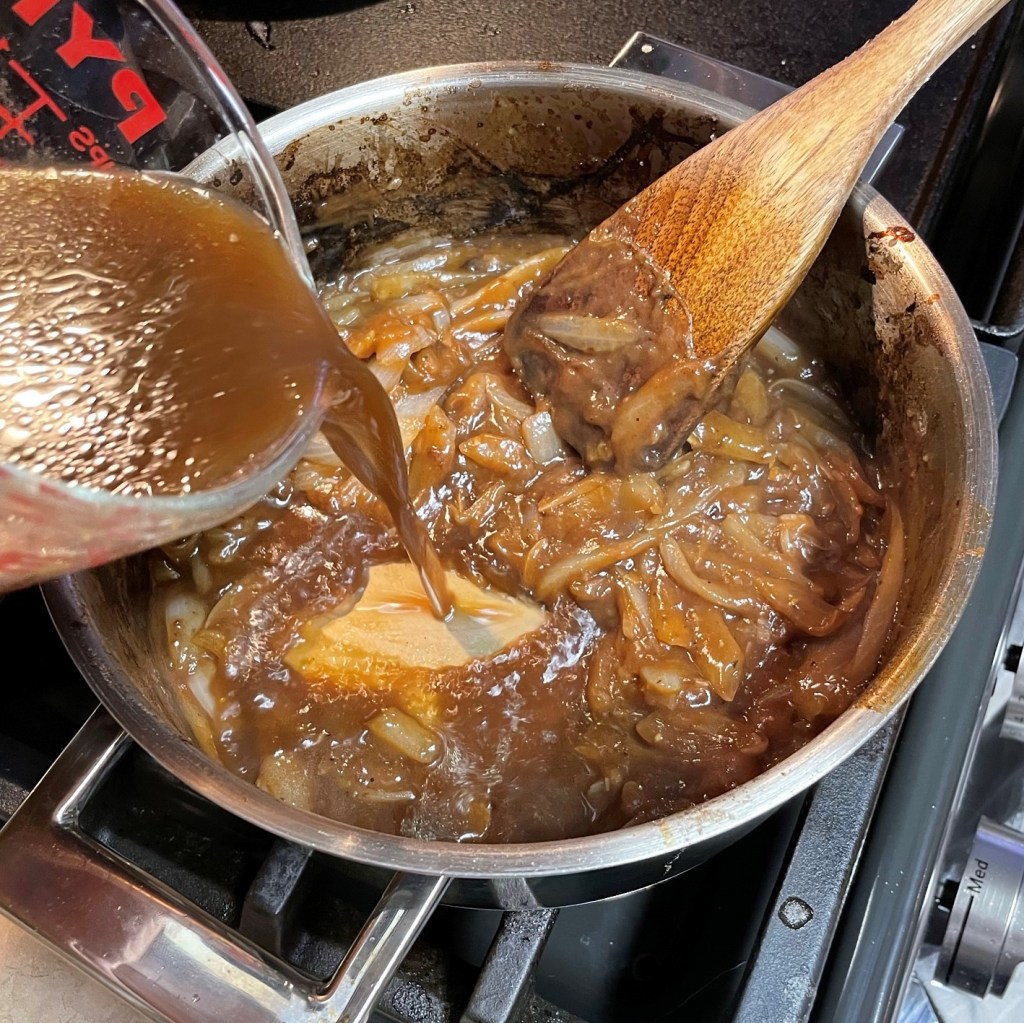
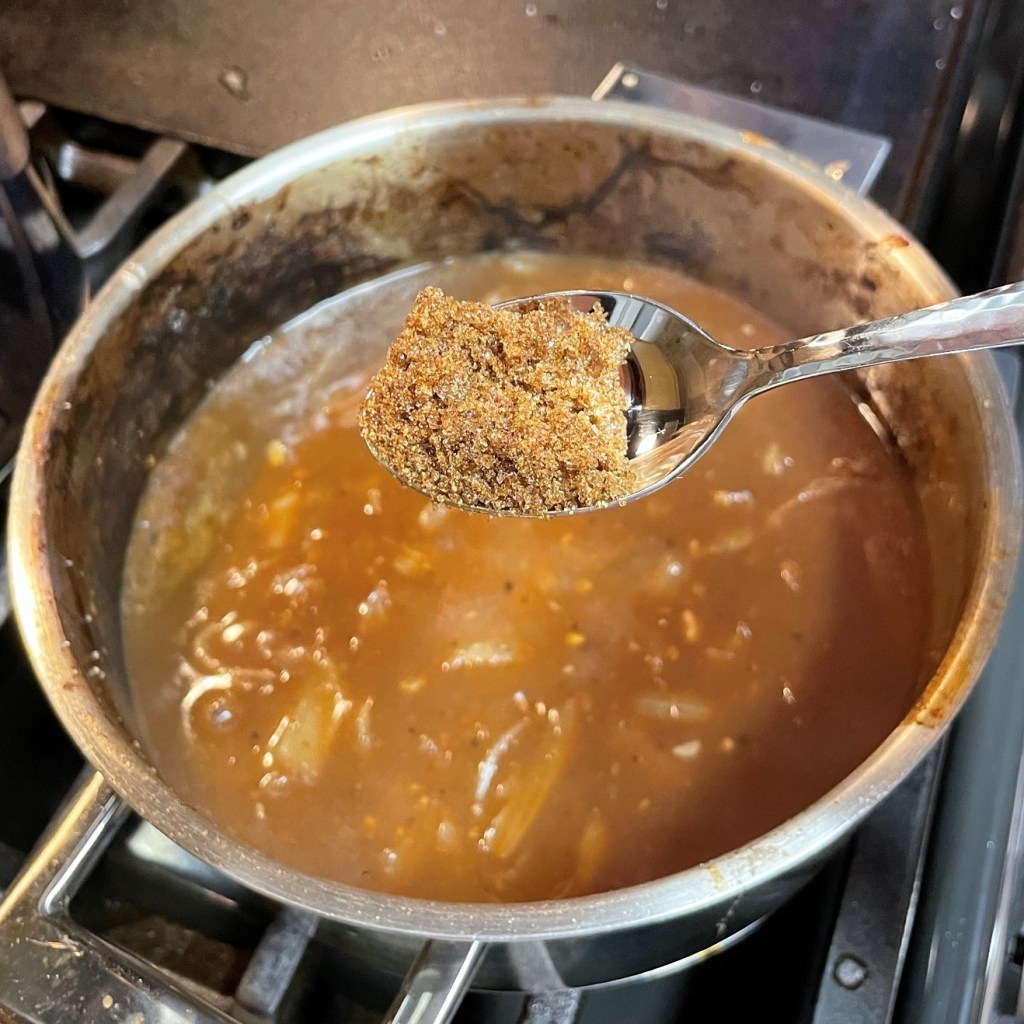
  8. When the pan is de-glazed, pour in the remaining stout and the broth mixture, and cook over medium heat, stirring occasionally, until mixture is thickened and reduced. You should take about 25 minutes for this step; don’t rush it, as simmering is necessary to blend the flavors and reduce the bitterness of the stout. Give it a taste and adjust salt and pepper as desired. If the gravy is overly bitter, stir in the brown sugar and simmer a few more minutes.
  9. Heat a cast-iron skillet over medium heat. Swirl in a small amount of olive oil and add the plump banger sausages. Cook and turn until sausages are fully reheated and nicely browned.
  10. Plate the mashed potatoes, spoon on a bit of Guinness gravy, then top with bangers and a generous ladle of the onion gravy.

Want to make this classic Irish pub grub?


French Onion Soup

Leave it to the French to take a mountain of sliced onions, a bit of broth and a few Provencal herbs and transform them into a heavenly, melt-in-your-mouth soup. The dismal weather that has become something of a default around here this winter has had me in the soup mood, and this one is astonishingly simple—from ingredients to technique.

One thing that sets French onion soup apart from others is the amount of time spent simply preparing the onions. You can use a mandolin or processor to make quick work of slicing them, but there isn’t much you can do to speed up the cooking. In a Dutch oven on the stovetop, it can take up to two hours to properly caramelize the onions—that is, to draw out their moisture and let all the natural sugars burst forth. If you work too quickly, you’ll have sautéed onions, but they won’t have the luxurious sweetness that is a signature of French onion soup. One way to get this done with minimal fussing is to use a slow cooker, set on the lowest setting. Another is to caramelize them in the oven, allowing a low-and-slow transformation, perhaps even overnight. The extra effort and preparation time has landed this soup in the Sunday Supper category here on Comfort du Jour, but I promise—however you approach the whole onion caramelization thing, it is well worth the wait.

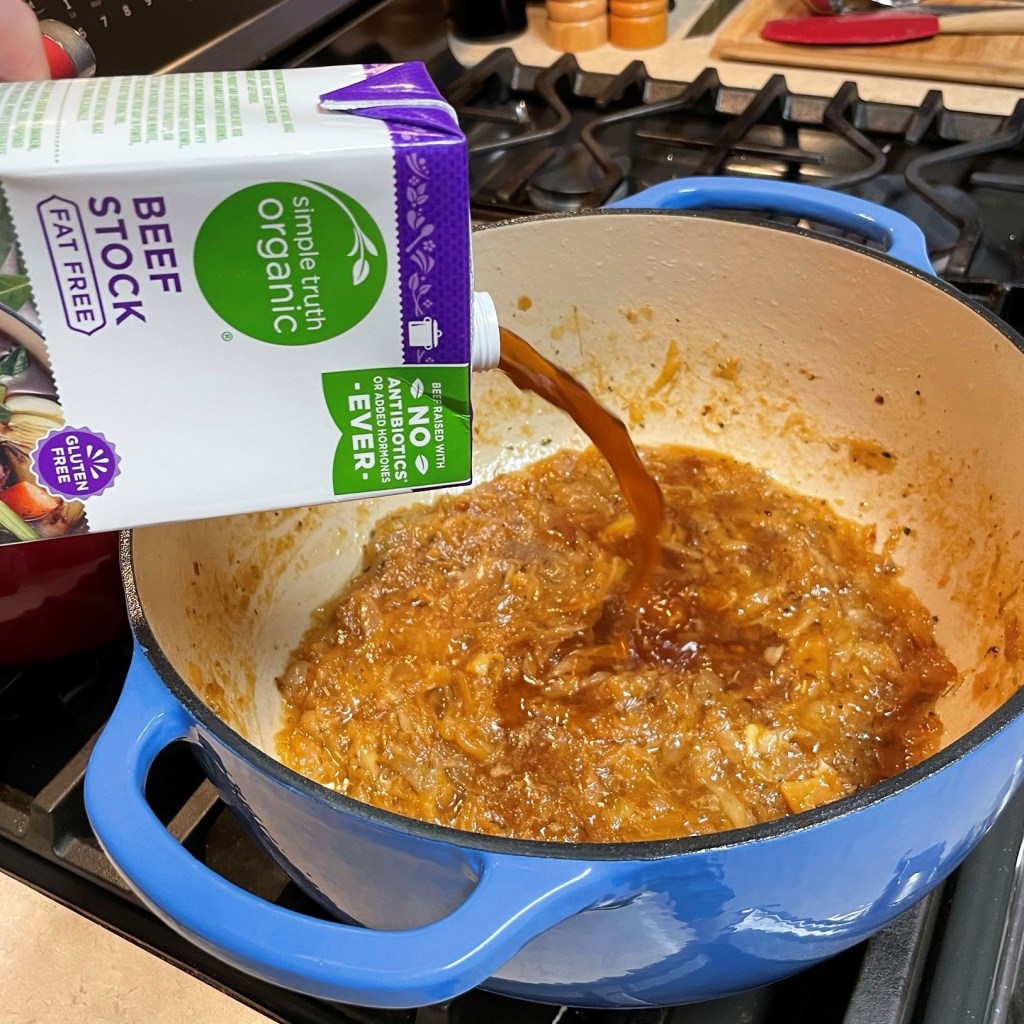
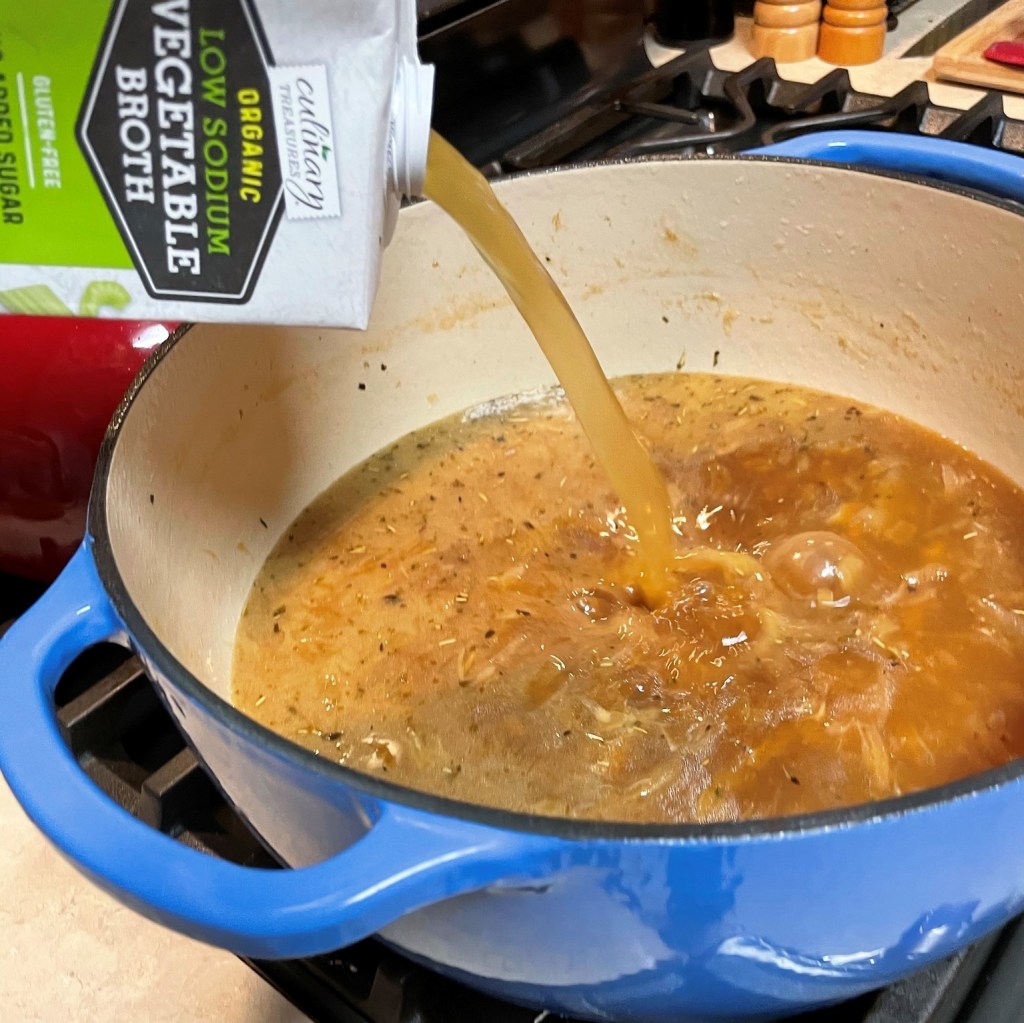
If you’re the make-it-all-yourself type, feel free to slow roast some beef soup bones and make your own stock, too. I had a momentary lapse of reason and tried this myself, but mainly ended up with a bucket full of tallow and two sinks completely filled with dirty pots and bowls. As far as I can tell, a good quality store-bought stock is a gift from heaven, so that’s what I used. Make it vegetarian with a good vegetable stock or combine the two as I did for wonderful layers of flavor.

The final touches on top of French onion soup are toasted baguette or bread slices and melty shredded Gruyere cheese. Yes, it’s a luscious bowl of classic French comfort food that is guaranteed to warm you up in these final weeks of winter.

The melty cheese on top makes this soup even more satisfying!

Ingredients

4 pounds sweet onions, sliced

1 stick unsalted butter

Kosher salt and freshly ground black pepper

1 1/2 teaspoons Herbes de Provence seasoning* (see notes)

1 bulb roasted garlic

1/2 cup dry wine (red or white, for deglazing the pot)

8 cups (2 quarts) low-sodium broth or stock (beef, vegetable or combo)

Crusty French bread slices (toasted, for serving)

Shredded Gruyere or Swiss cheese (about 2 Tbsp. per serving)

*Notes

Herbes de Provence is a blend of seasonings native to the Provencal region of France, and the brand I use includes thyme, rosemary, garlic, lemon peel and lavender. The combination of this seasoning is aromatic and typically used somewhat sparingly, but it is such a central flavor to French onion soup, I’ve used a good amount in this large batch. As always, take note of the salt content of any seasoning blend you use so that you can adjust the overall salt accordingly.

Instructions

I’ll walk you through it, and you’ll find written instructions below, plus a link to download the recipe for your files. 🙂

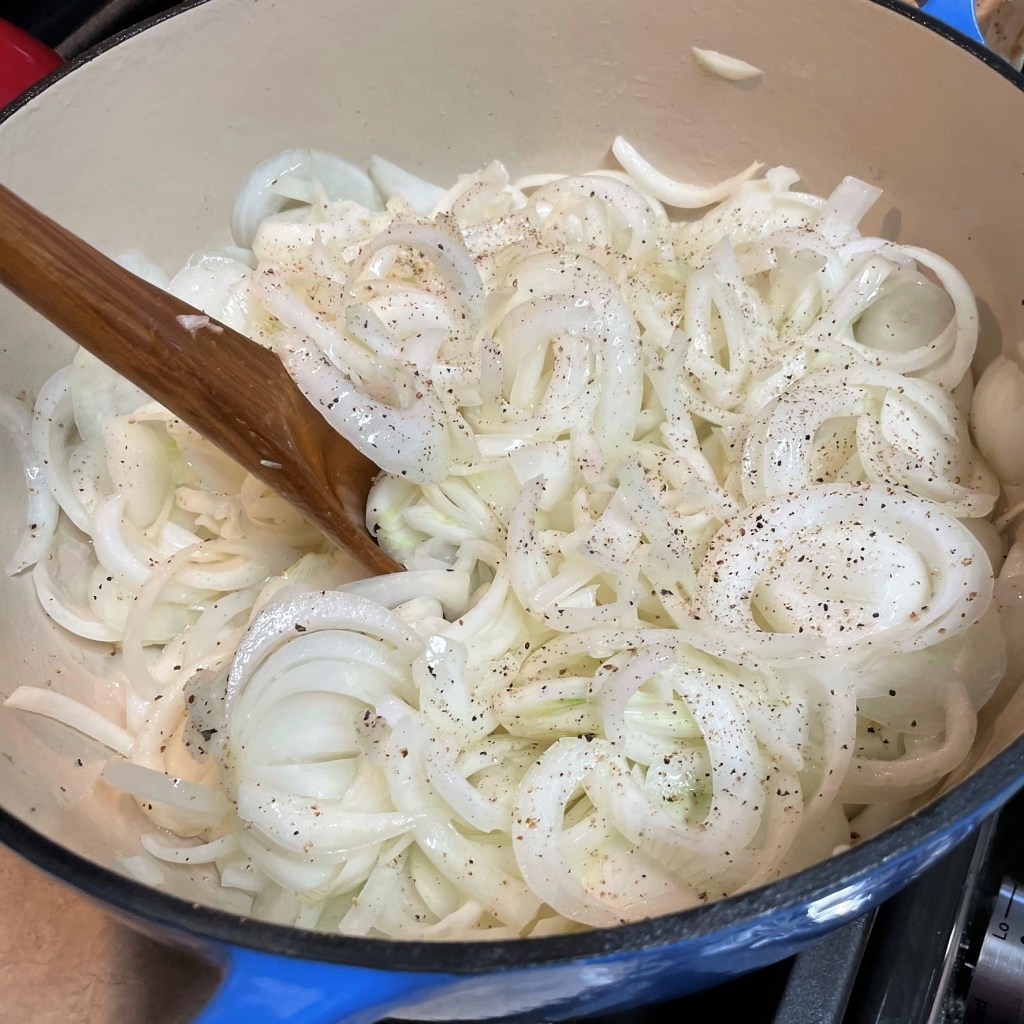
  1. Slice onions about 1/4” thick, preferably from stem to root ends, rather than into rings. For this recipe, I think it’s helpful to have the onion pieces generally the same size, and the top-to-bottom slicing will help you achieve that.
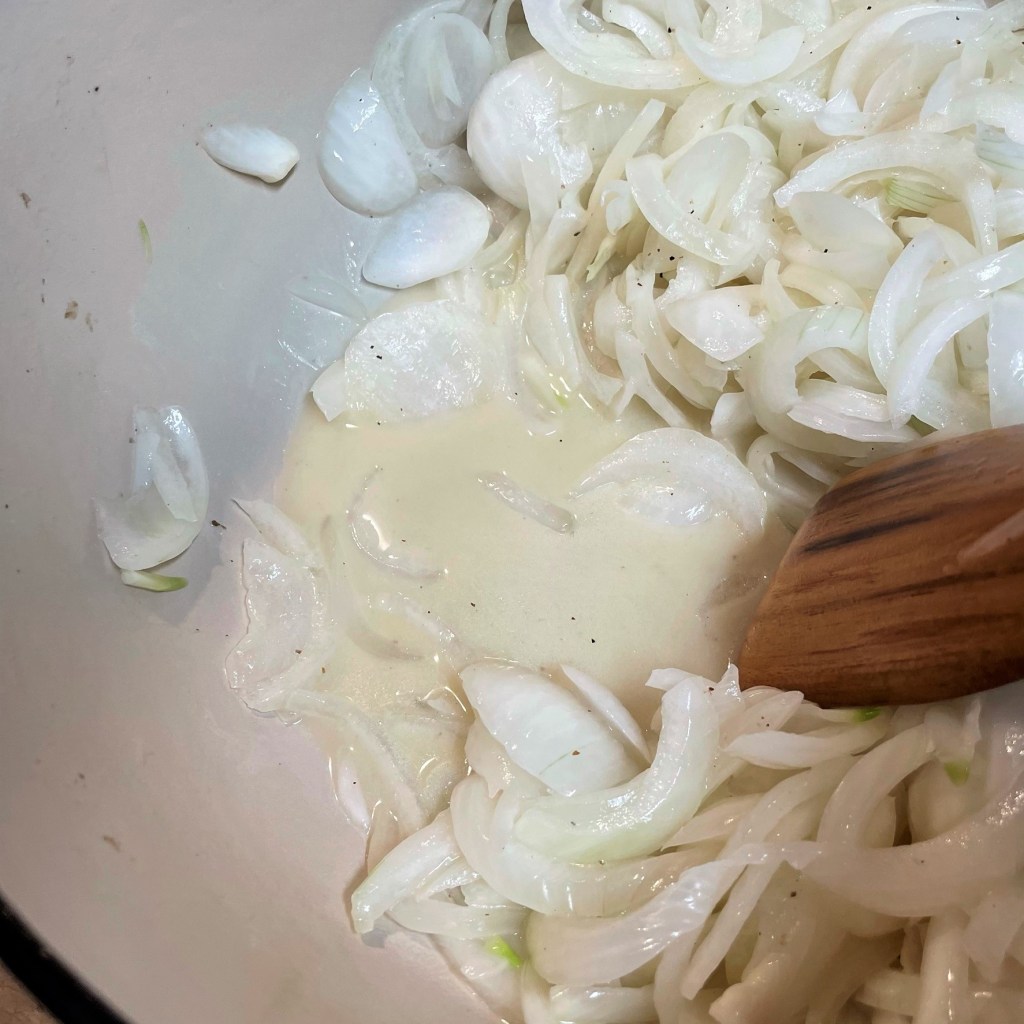
  2. Place a heavy Dutch oven over low heat, and melt the stick of butter in it. Add the onions at the same time as the butter if you’d like. But if you are using a slow cooker, melt the butter first, then toss the onions thoroughly to coat before cooking on low setting. Season with salt and pepper. Stir the onions around in the pot, and resist the urge to turn up the heat. Proper caramelization is important for this recipe, and it’s a long, slow process. Happily, you don’t have to stand over it constantly; as long as you stir the onions occasionally, it’s fine.
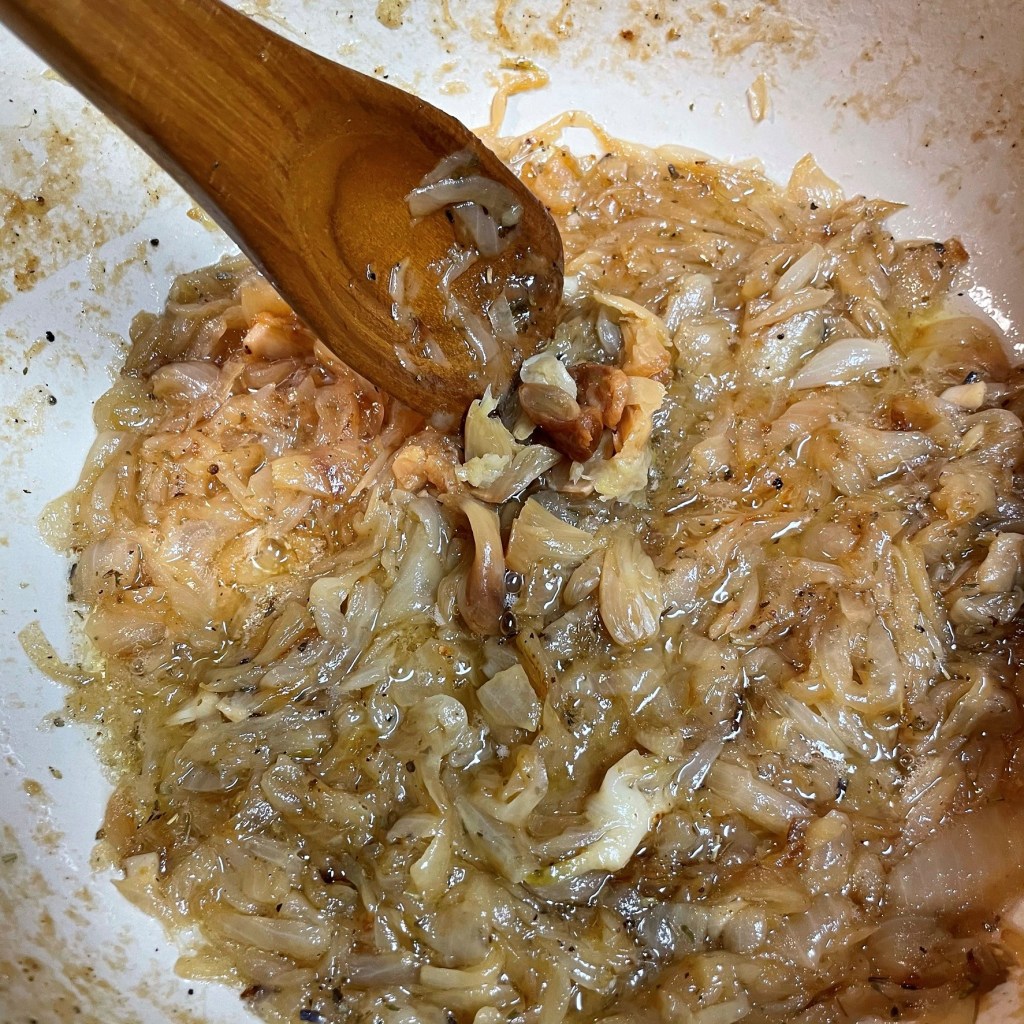
  3. After an hour or so, start watching for signs of browning on the bottom of the pot. This is a sign that the onions are caramelizing and once it begins, it proceeds more quickly. Stir more frequently from this point, but do not increase the heat.
  4. When caramelization is complete, the onion mixture will begin to look like it’s frying rather than simmering—this is because the moisture content has fully dissipated. Add the herbs de Provence, roasted garlic, salt and pepper.
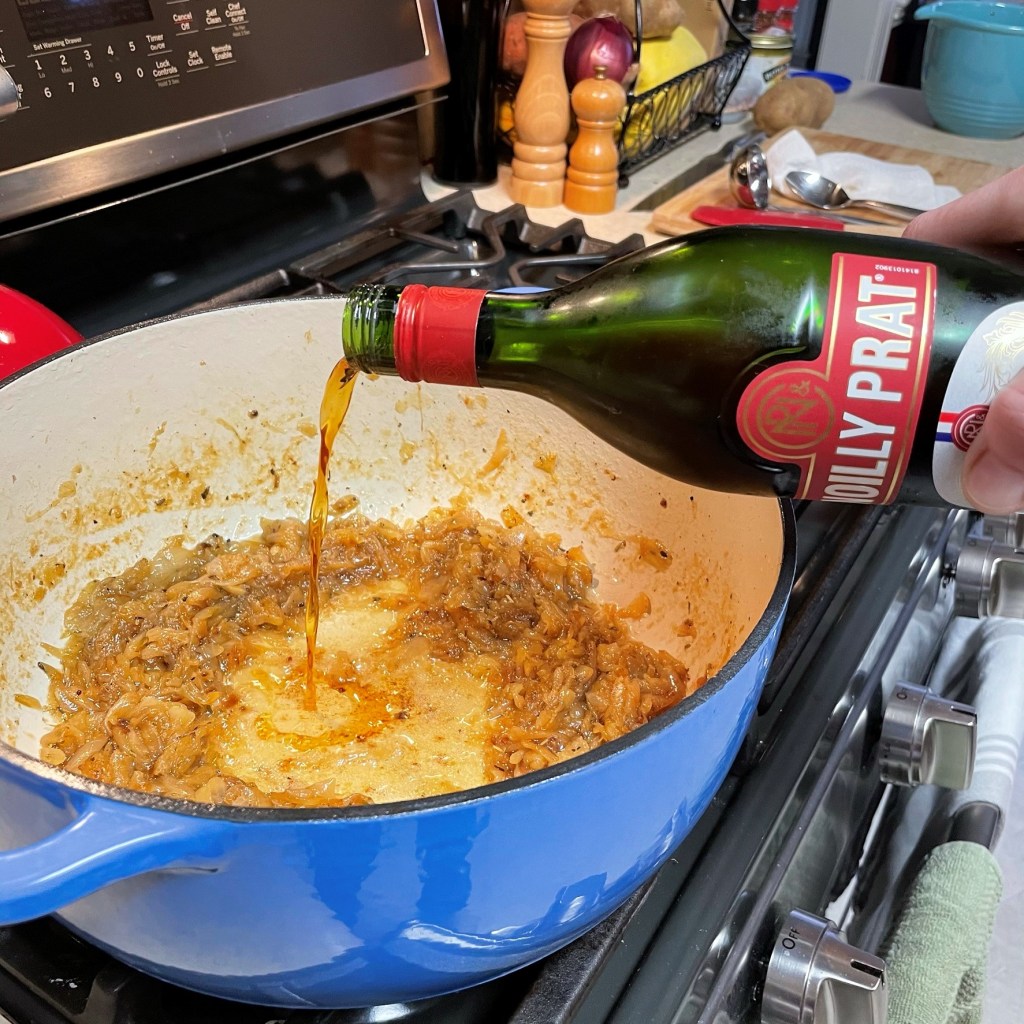
  5. Pour the wine into the pot, and use your utensil to scrape up any browned bits that have stuck to the pot. The acidity of the wine will dissolve those tasty bits back into the onion mixture.
  6. Add the stock, bring to low boil and then reduce to simmer, covered, for a couple of hours.
  7. Serve the soup in warm bowls or crocks, place the toasted bread on top, then scatter shredded Gruyere or Swiss over the bread. If your bowls are broiler-safe, put them on a baking sheet and broil just long enough to make the cheese gooey. Alternatively, you could put the bowls in the microwave for about 30 seconds, or go high-tech with a kitchen torch and brûlée the cheese into blissful melty goodness.
I want to plunge a spoon right through this screen and into that cheese!

Want to make this recipe?


Harvest Turkey Salad

Thanksgiving leftovers are a little bit like family—you can wait ‘til they arrive, and you sure are glad to see them go. So far, we’ve enjoyed full leftover plates, grilled cheese sandwiches made with leftover turkey and other accoutrements, and of course the comforting leftover turkey gumbo that I shared yesterday.

On the fresher side of things, how about a fall harvest-themed salad option that makes the most of leftovers in a bright new way? There are plenty of autumn ingredients in here, but lots of fresh and healthful things to soften the reality that you’re still eating leftover turkey.

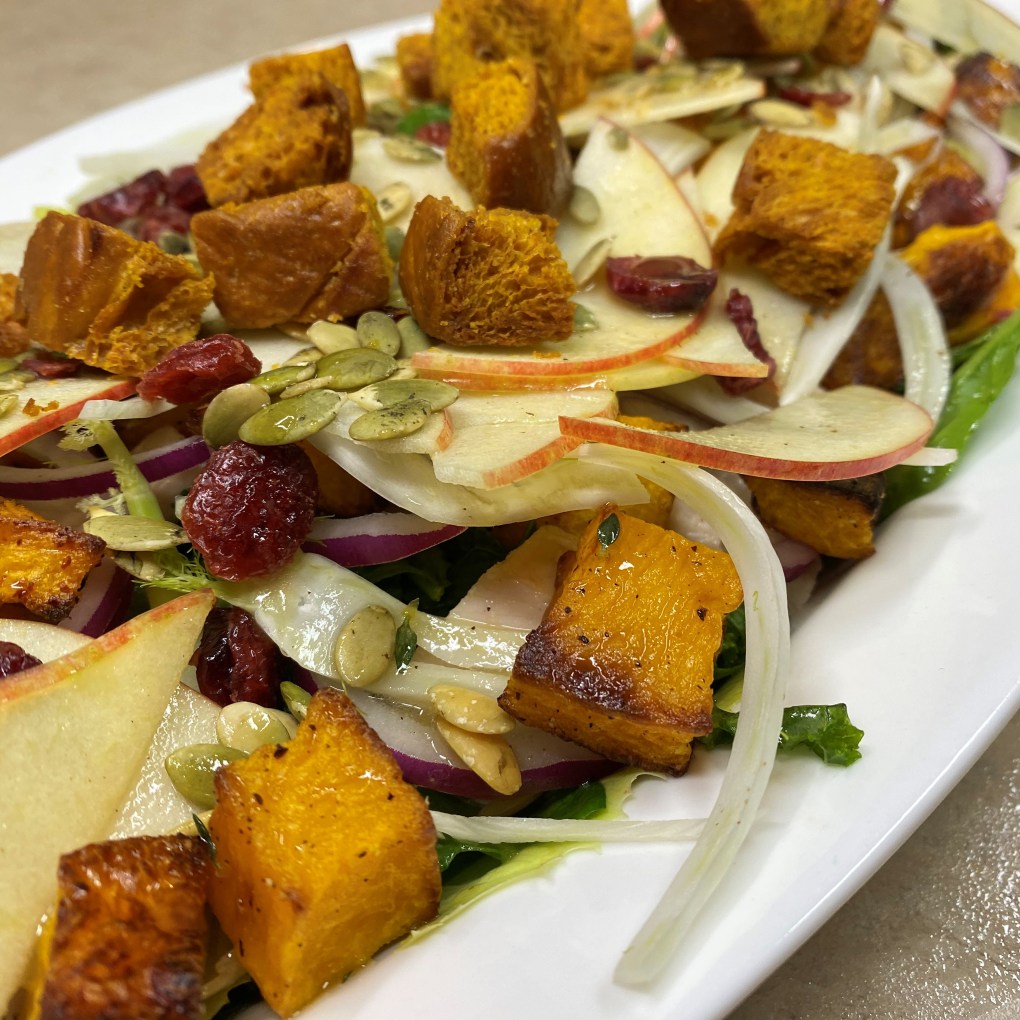
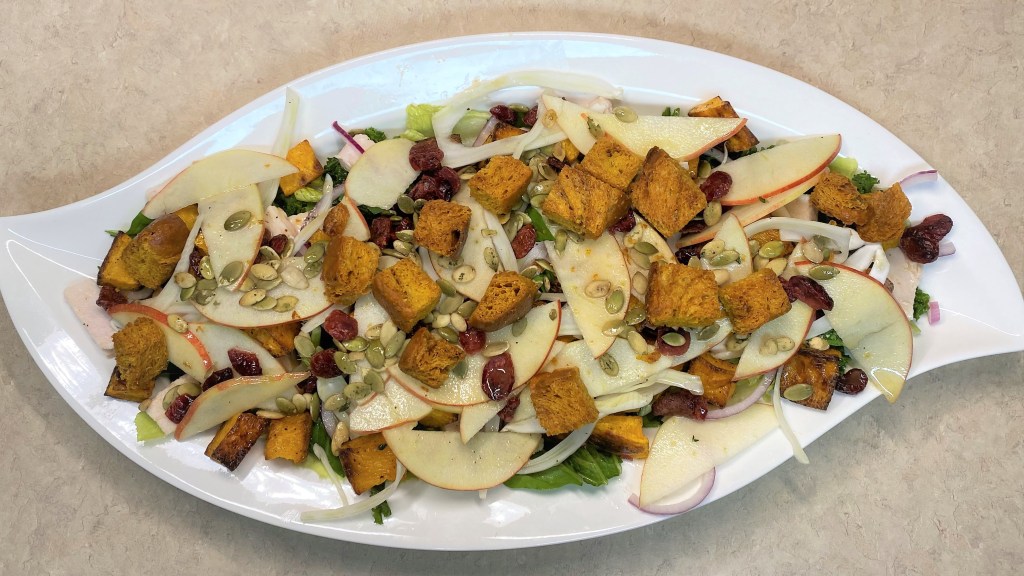
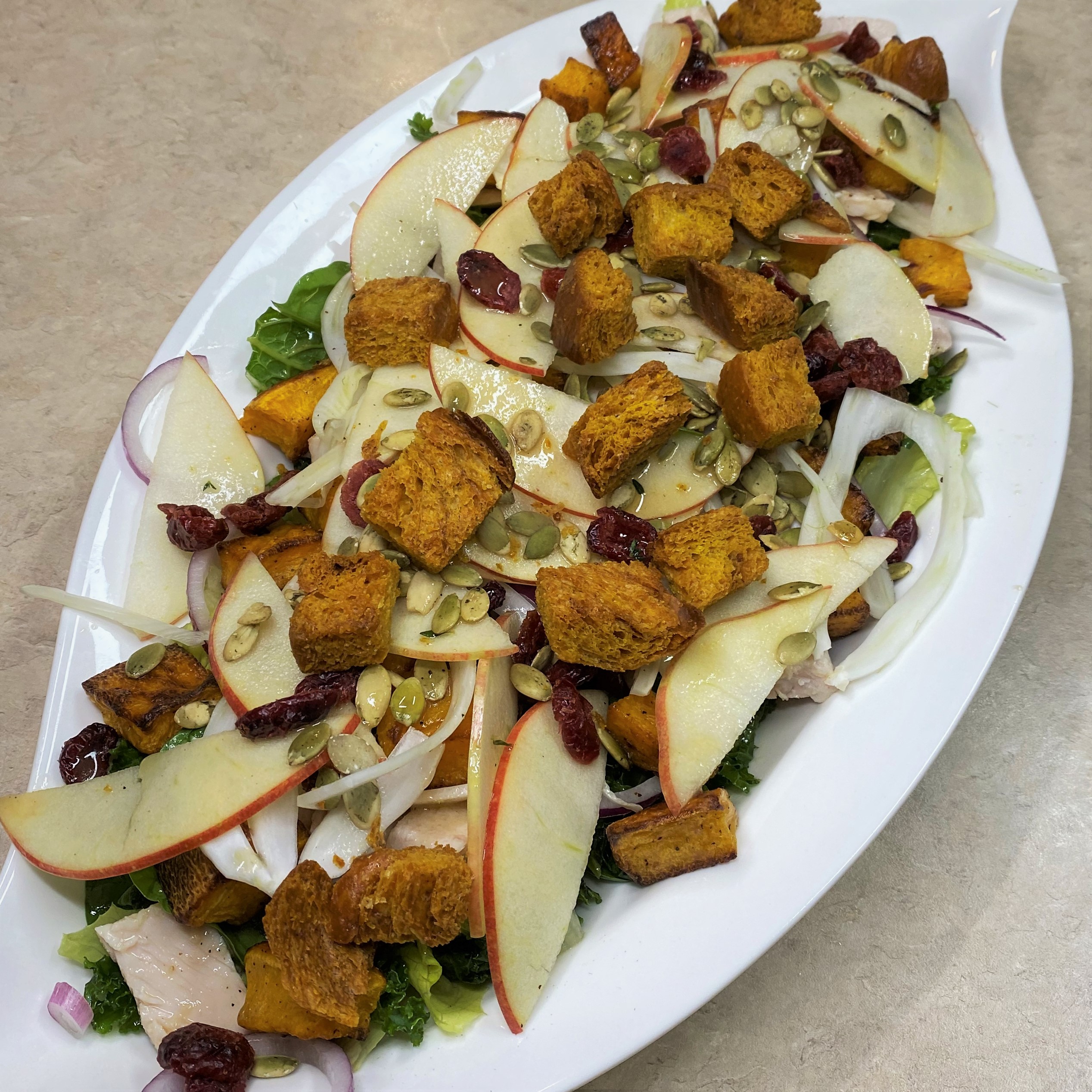
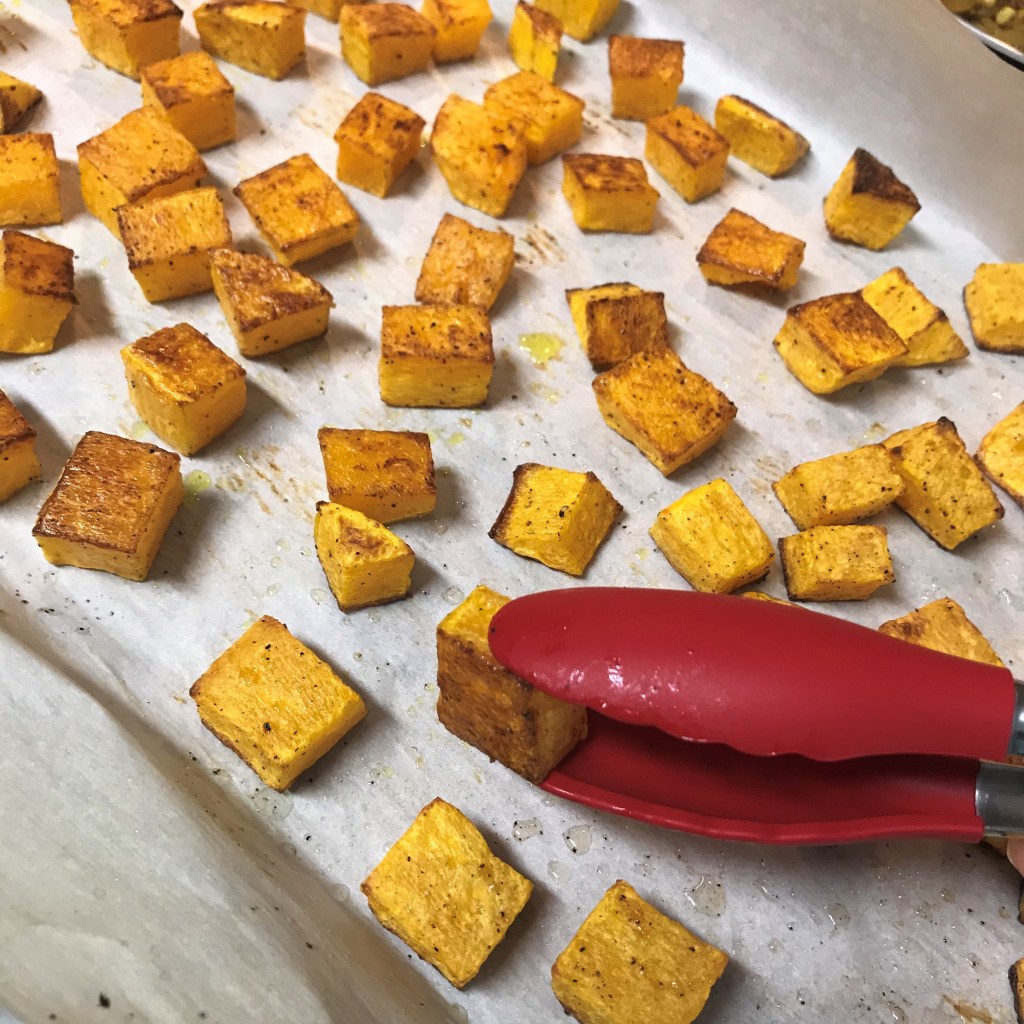
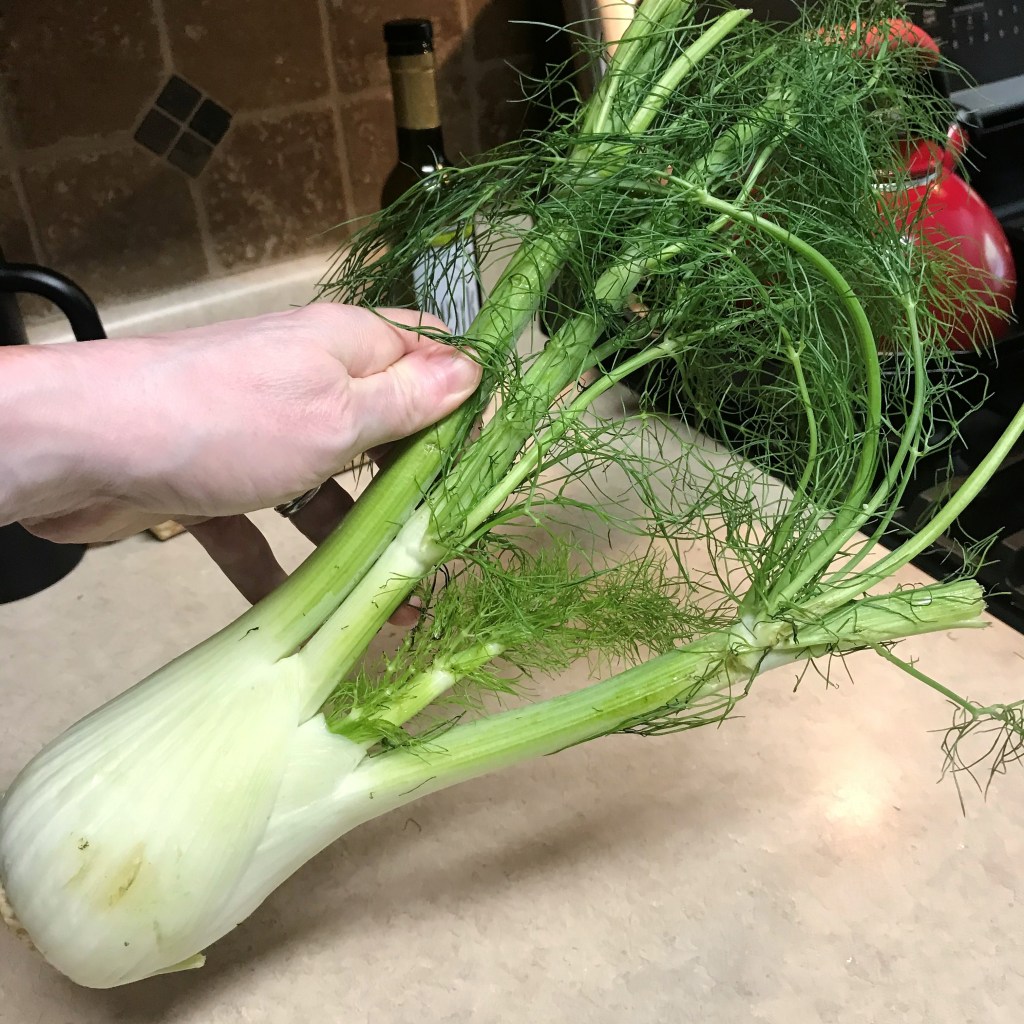
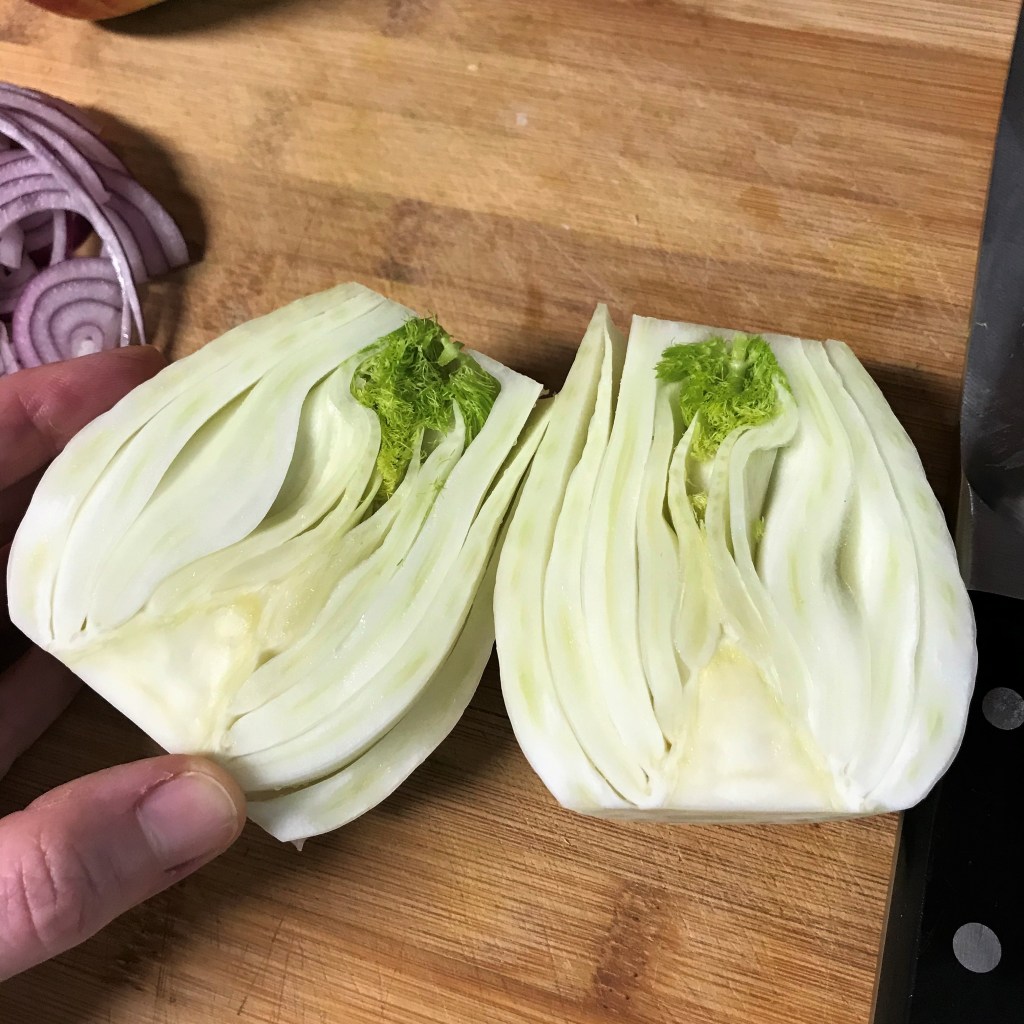
For me, a salad must hold a variety of interesting flavors and textures, so this one has shaved fennel for a little crunch, dried cranberries for a little chew, roasted bites of butternut squash for soft sweetness, thin slices of gala apple for a little snap and an easy citrus-maple vinaigrette for a whole lot of mouthwatering goodness in every bite. The prep is minimal and the salad is pretty.

In the interest of full disclosure, I’ll admit that I made this salad more than a month ago, with a roasted turkey breast that we purchased at Costco for sandwiches and salads. It was filling but light, and it gave my taste buds a bit of that autumn pizzazz I was craving so much. But I know this salad would be just as good today with leftover roasted or smoked turkey breast, or if you downsized Thanksgiving this year for safety reasons and didn’t do a turkey, you could easily swap in cubes of deli roasted chicken. Heck, leave out meat altogether and make it vegan. As always, I hope you find inspiration and flavor in my recipe. Enjoy!

It’s fresh and light, but satisfying with so many fall flavors.

Ingredients

2 cups butternut squash cubes

Extra virgin olive oil

Kosher salt and black pepper

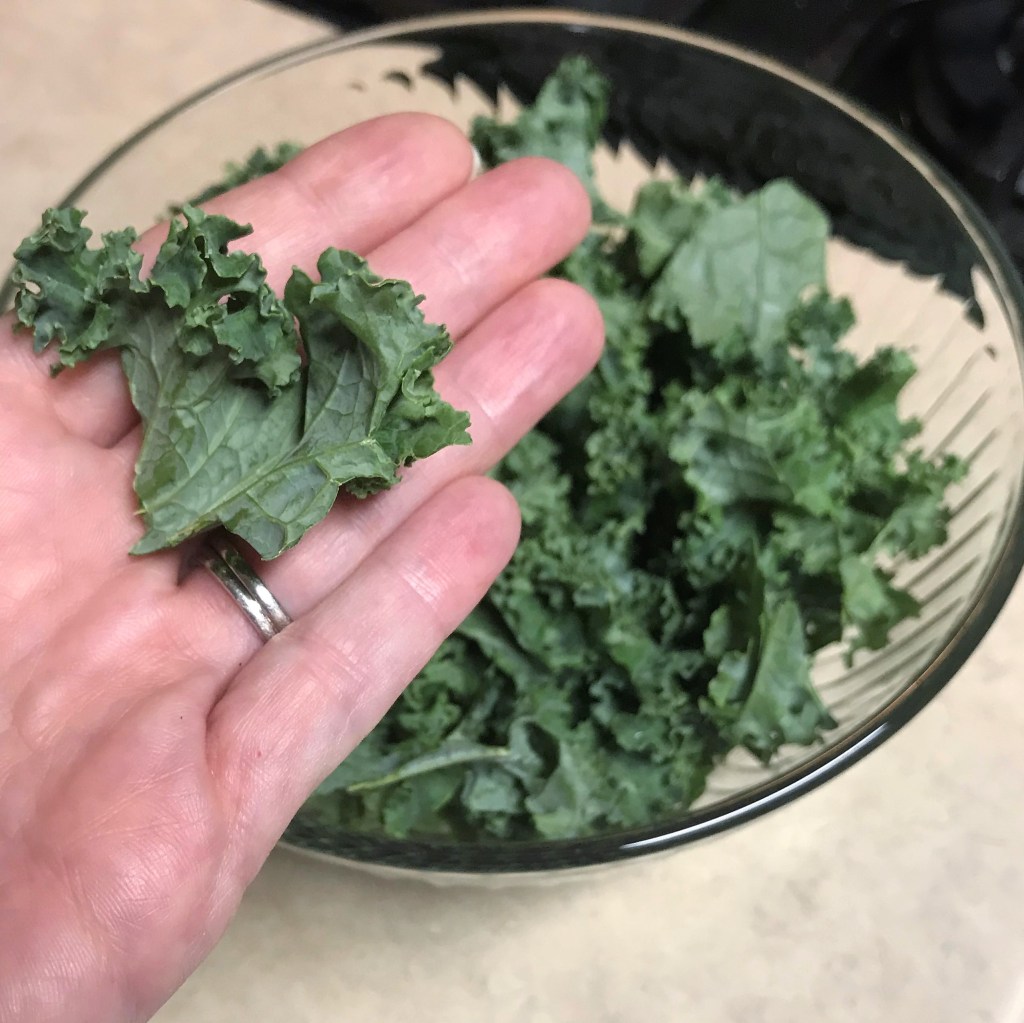
1 fat handful fresh washed kale leaves, rough chopped and thick stems removed

1 fat handful baby spinach leaves

4 romaine heart leaves, torn into bite-sized pieces

1 cup chopped leftover turkey (or deli chicken)

1/2 fresh gala apple, washed and sliced thin

1/2 fennel bulb, trimmed and sliced thin

1/2 small red onion, sliced thin

1/4 cup dried cranberries

2 Tbsp. roasted, salted pumpkin seeds

Citrus-maple vinaigrette (recipe below)

Challah or brioche croutons (instructions below)


Citrus-maple vinaigrette w/sunflower oil and thyme

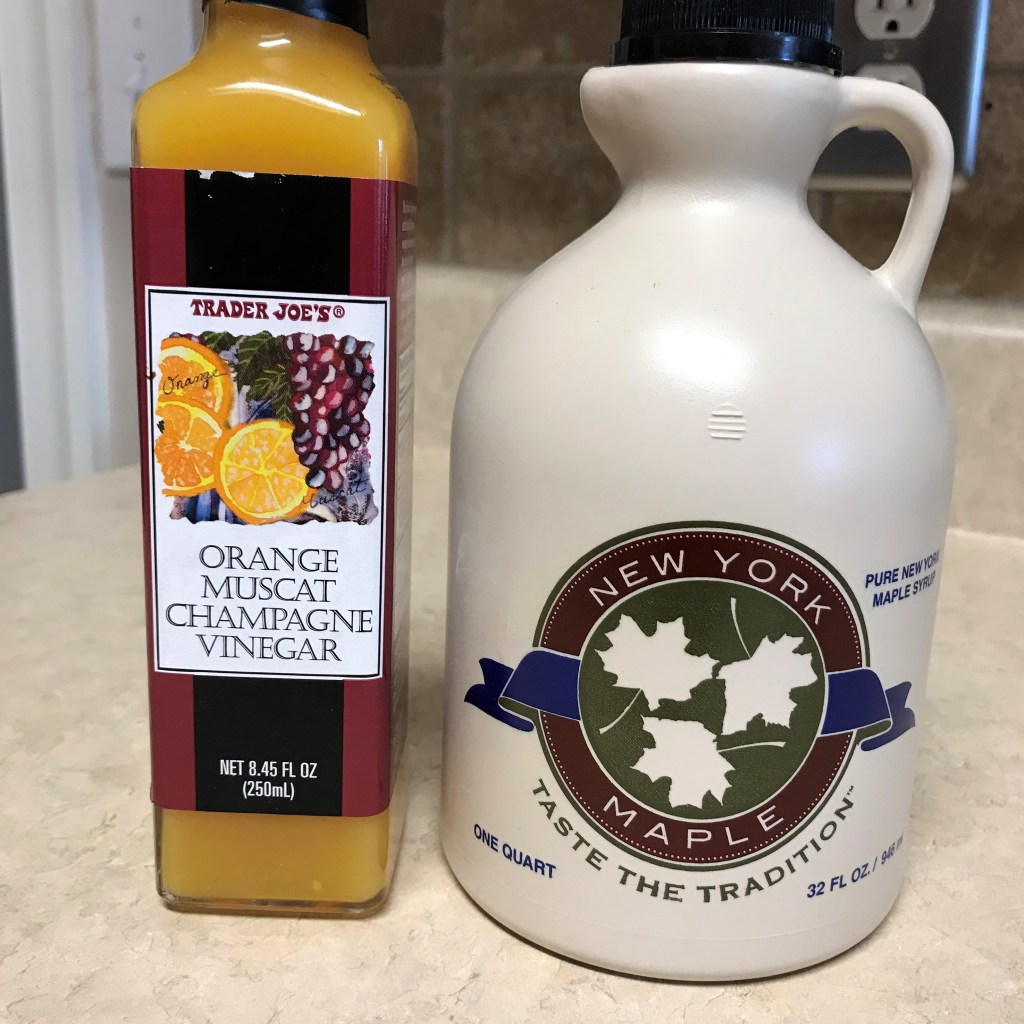
2 Tbsp. orange muscat champagne vinegar* (see notes)

1 Tbsp. maple syrup*

1 tsp. Dijon mustard

Salt and pepper

1 Tbsp. toasted sunflower oil

1 Tbsp. extra virgin olive oil                                                                                           

2 sprigs fresh thyme, leaves stripped

*Notes

The orange muscat champagne vinegar is a product from Trader Joe’s. If you cannot find it, I’d recommend substituting half apple cider vinegar and half freshly squeezed orange juice.

If you need to swap the maple syrup, I’d recommend half as much honey or a teaspoon of regular sugar.

Instructions

Most of this recipe needs no instruction; I don’t need to tell you how to slice an apple or sprinkle on dried cranberries. But here’s a bit of info you may find helpful for the prep of the other ingredients.

  1. Preheat the oven to 400° F. Line a rimmed cookie sheet with parchment paper or foil.
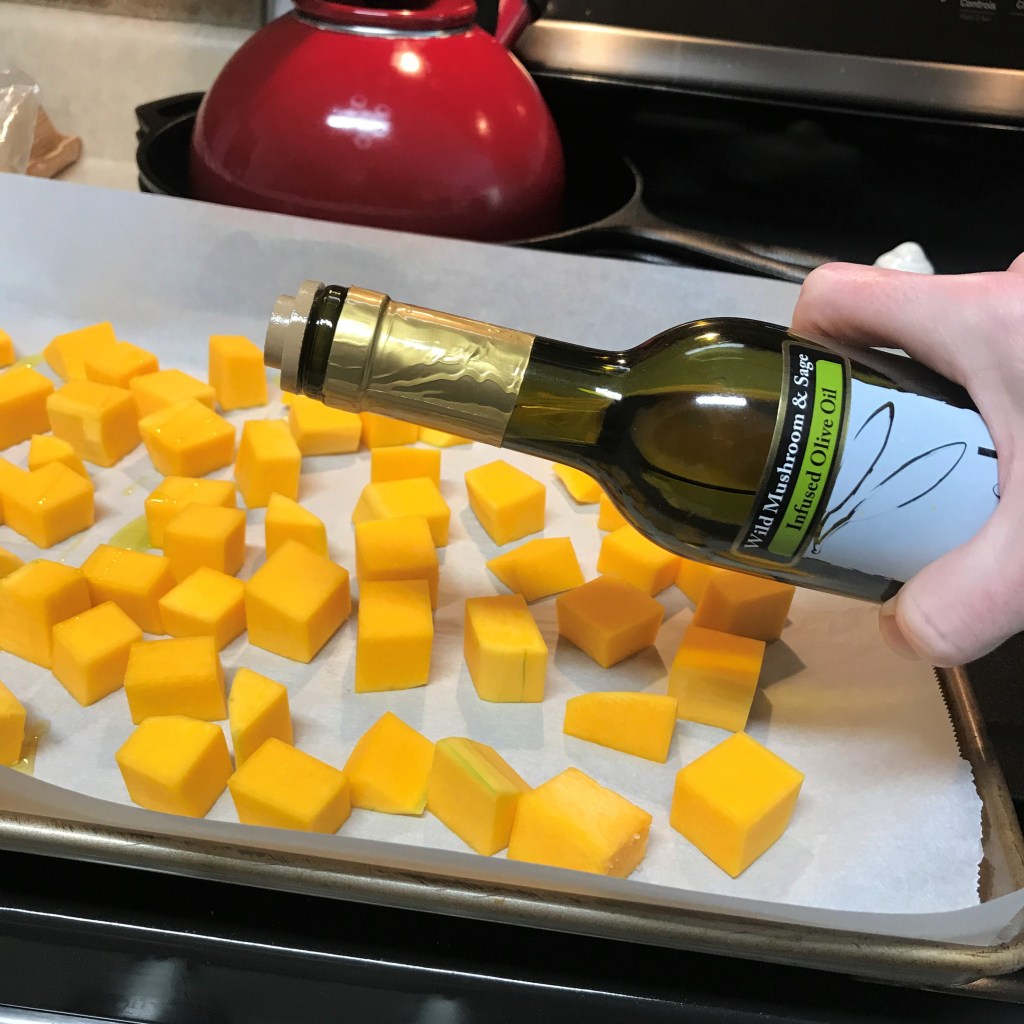
  2. Toss squash cubes with a tablespoon of olive oil, and arrange the cubes on the cookie sheet. Season with salt and pepper. Roast for 35 minutes, or until fork tender and lightly caramelized. Cool completely.
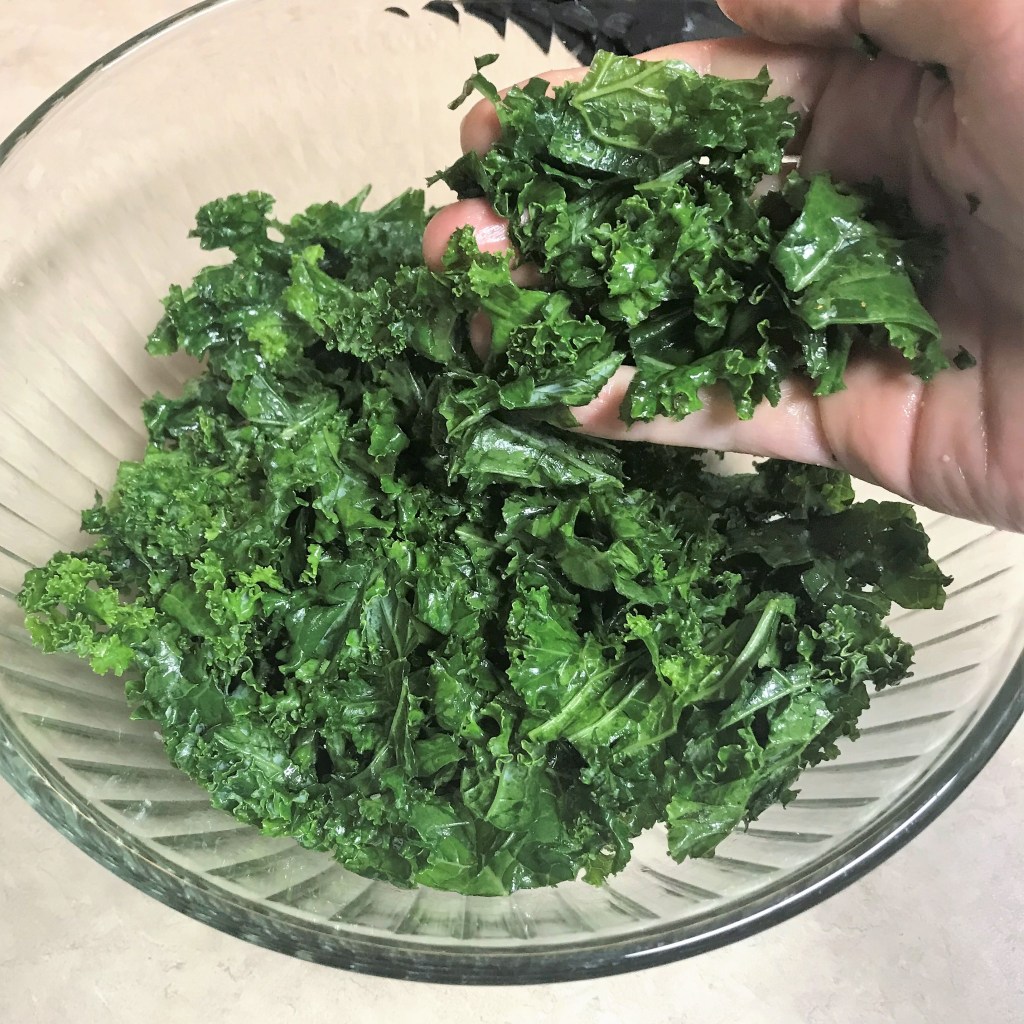
  3. In a large, deep bowl, drizzle a tablespoon olive oil over the chopped kale leaves. Using your hands, reach into the bowl and “scrunch” the kale throughout the bowl. As you massage the greens, they will soften up and wilt in volume. Give it a light sprinkling of kosher salt and pepper and then let it rest while you prep the other salad ingredients.
  4. Make the dressing: combine vinegar, maple syrup, Dijon mustard, salt and pepper in a small bowl or glass measuring cup. Gradually stream in sunflower oil and olive oil, whisking constantly to emulsify the dressing ingredients. Alternatively, you could combine all dressing ingredients in a lidded jar and shake the daylights out of it. Whatever works for you.
  5. Massage the kale once more, then add the spinach and torn romaine leaves and toss to combine.
  6. Drizzle about half of the citrus-thyme vinaigrette over the greens and toss again. Transfer the greens to a platter or individual serving plates.
  7. Add the cubed turkey to the salad. Scatter the pieces of onion, apple and fennel evenly over the greens. Sprinkle with dried cranberries and roasted pumpkin seeds and drizzle the remaining dressing over the entire platter.
  8. Serve with croutons, if desired.

Homemade Croutons

Cut up stale challah or brioche into large cubes or torn pieces. Drizzle with olive oil. Season with salt and pepper and arrange the bread pieces on a parchment-lined baking sheet. Bake at 300° F for about 30 minutes, tossing occasionally to ensure they dry uniformly. When they are crisp but still slightly soft, remove from the oven and cool completely. For this salad, I pulled leftover sourdough pumpkin challah from the freezer. The cubes roasted up nearly the same color as the butternut squash! 🙂

Want to print this recipe?


Sassy Succotash

All’s well that ends well, and after a few unexpected issues with the ingredients in this dish, I’m pleased to deliver the end result. It’s a colorful mix of healthful ingredients, with a little bit of crispy bacon on top, just because.

In case you aren’t familiar, succotash is a very popular dish in the southeast U.S., one that I first met when I dated a guy who was born and raised in rural North Carolina. His mother made succotash with sweet corn and lima beans as a regular part of her Sunday supper, which was immediately followed by three hours of gazing at a NASCAR race (yawn). They were nice people and she made juicy fried chicken (and the best coconut cake I’ve ever had the pleasure of eating). When I dared to make Thanksgiving dinner for them, I was admonished by boyfriend’s dad, who informed me that I needed to learn how to cook green beans. In the South, this would customarily involve a pressure cooker and a pound of “fatback,” a pretty dramatic contrast to my “upstate” green beans, which were delicately blanched and served with butter and almonds. Yep, they were still actually green. My bad.

I’m quite sure his family would not have approved all the liberties I’ve taken today with this succotash, adding all this crazy color and bold flavor, but what can I say—you can’t fix sassy.

For my version of succotash, I changed course for a moment with an idea to use golden hominy rather than corn because the hominy matched the size of the butter beans and roasted squash pieces. But as they say about the best-laid plans, things didn’t work out when the canned hominy proved to have texture equal to hog slop—it would have looked even worse in pictures than it did in the bowl. That’ll teach me second-guessing myself (this time, anyway).

I suspended preparation of the dish, long enough for my super-efficient husband to pick up a bag of our favorite frozen roasted corn, which brought me back to my Plan A. The roasted corn is pretty and rustic, and with addition of the big pieces of red onion and dark, earthy poblano pepper, my sassy succotash is a bona fide hit for Thanksgiving this year.

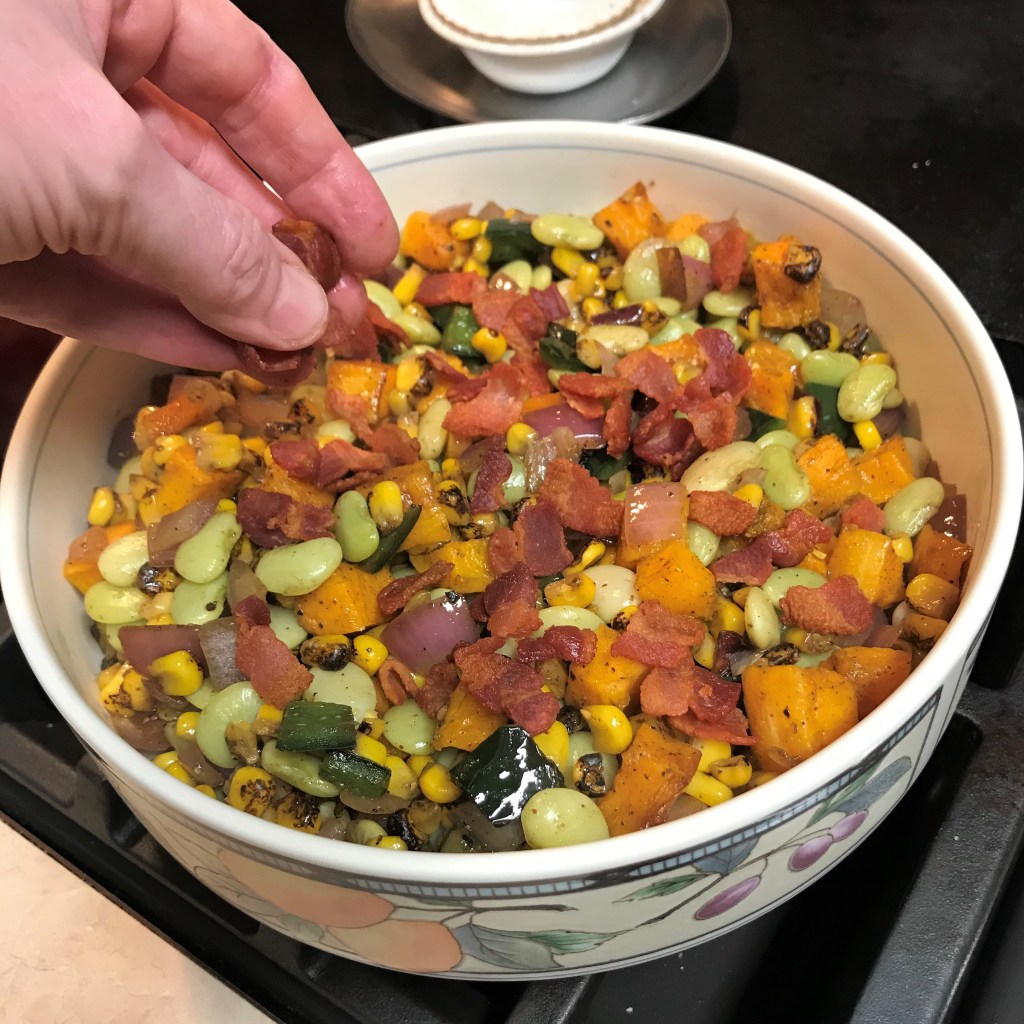
The finished dish has so many different colors and textures. It’s flavorful, and full of nutrients, too!

Oh, and I married the right guy, too—born and raised in NYC, and couldn’t care less about NASCAR. All’s well that ends well. ❤


Ingredients

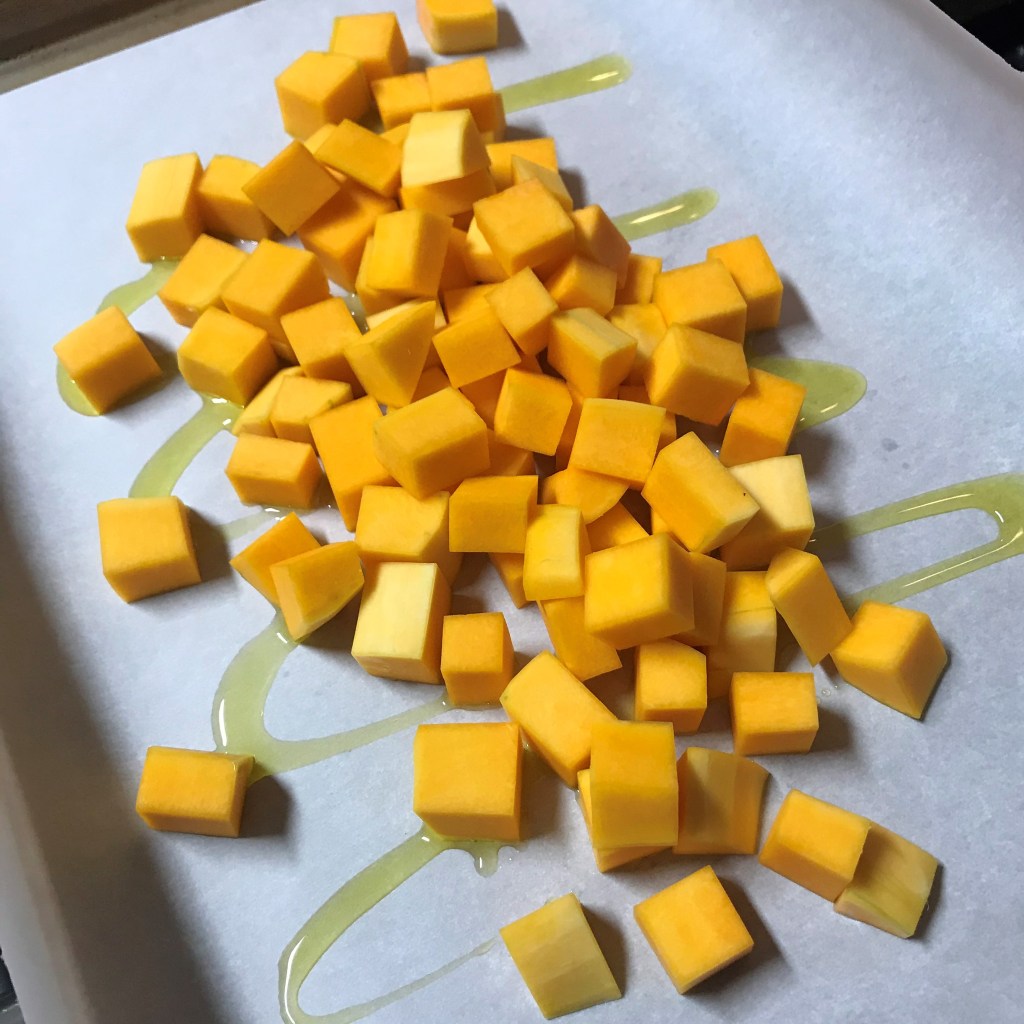
2 cups butternut squash cubes (roasting instructions below)

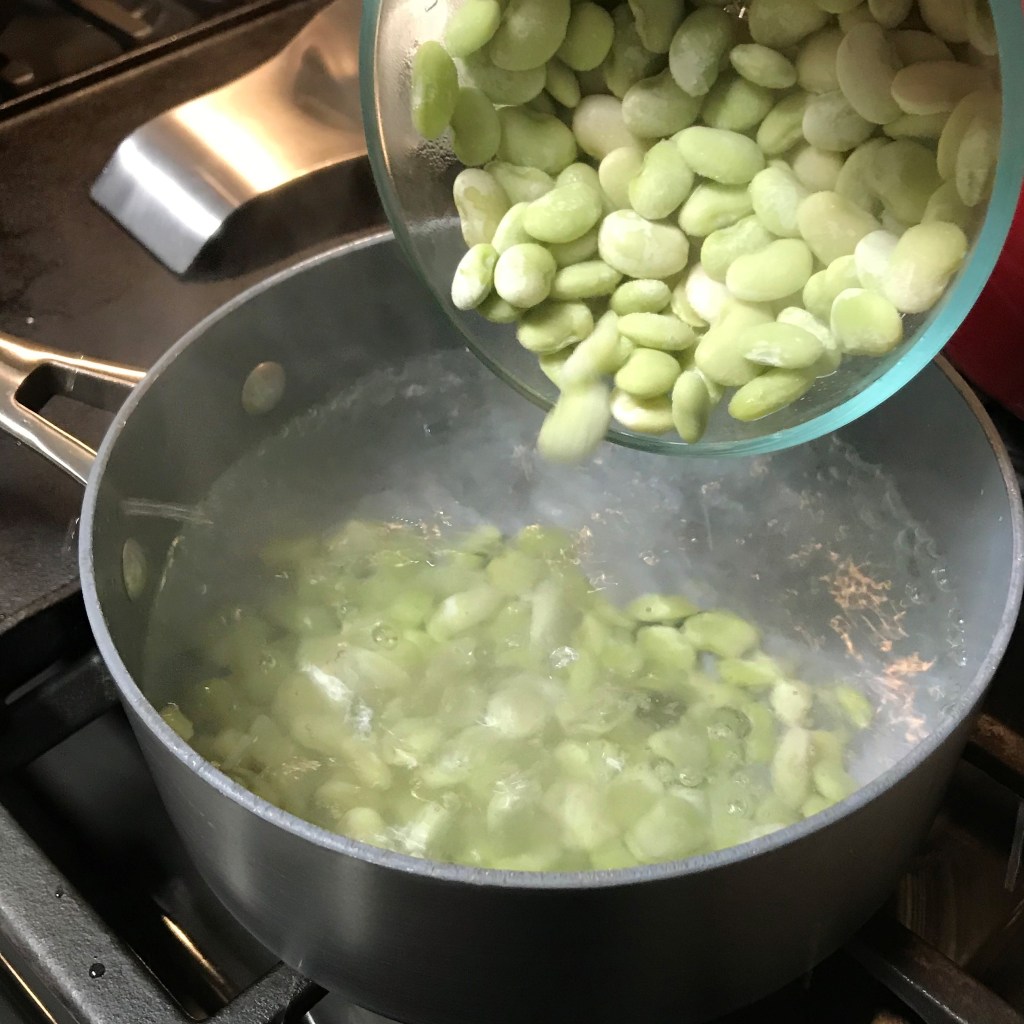
2 cups frozen butter beans*, cooked according to package

3 slices uncured, smoked bacon, cut into 1” pieces

1/2 medium red onion, chopped

1/2 large poblano pepper, chopped*

1/4 tsp. ancho chile powder* (see notes)

1 1/2 cups frozen roasted corn*

*Notes

Butter beans are usually a bit larger than lima beans, although I’m not sure it was the case with the bag I purchased. Either will work fine in this dish, so don’t sweat it.

I chose poblano for this dish because of its dark green color and mildly smoky flavor. It’s not as hot as jalapeno, but does have a little kick to it, though the heat dissipates during cooking. You could substitute a dark green bell pepper if you prefer.

Ancho chile is the dried, smoked version of poblano peppers. If you cannot find it, substitute any chili powder—it’s a small amount, so you won’t compromise or alter the flavor much.

We love the roasted corn from Trader Joe’s in so many things. I have seen other brands occasionally, but it would also be fine to use regular frozen corn, or, of course, you could upstage me and grill fresh corn!

The hominy setback turned out to be a blessing, because everything was prepped and ready to go for assembling the dish. Here’s how it goes, and you’ll find written instructions below, along with a downloadable version for your recipe files. Enjoy!


Instructions

  1. Preheat oven to 400° F. Line a rimmed baking sheet with parchment paper.
  2. Toss the butternut squash pieces in olive oil, just enough to coat all sides. Season with salt and pepper and roast them for about 25 minutes, or until fork tender, but firm.
  3. Prepare the frozen lima beans according to package instructions, and then shock them in cold water to halt the cooking so they don’t get mushy. Drain and set aside.
  4. Heat a large, nonstick skillet over medium heat. Add the bacon pieces and toss to cook until they are done and crispy; remove to a drain on a paper towel. Do not drain the bacon grease.
  5. Add the red onion and poblano peppers to the skillet and sauté in bacon grease until they are very slightly soft. Sprinkle ancho chile powder over the mix and toss to coat.
  6. Add the frozen corn to the skillet and toss until heated through. Add the cooked butter beans and toss again.
  7. Just before serving, toss the butternut squash into the pan and toss the mixture to reheat the squash and combine everything evenly. Transfer the succotash to a serving bowl, and sprinkle with the reserved crispy bacon pieces.
About that extra squash…I had a sweet patient girl waiting for just such an occasion. Good catch, Nilla! ❤
(She is lightning fast!)

Want to make this dish vegan?

Omit the bacon, and saute the onions and peppers in a tablespoon of olive oil rather than bacon grease. No other adjustments will be necessary. I love an adaptable recipe!
Get the recipe!