S’mores Cupcakes

My cousin, Annie, has a wicked sense of humor. Wicked, meaning funny, but also just a little bit wicked. During my visit last month at her lake house in Connecticut, Annie caught me off guard with what seemed like would be important, somber information.

“OK, listen” she began, cracking open a tall pantry door next to the kitchen of her sweet, cozy cottage. “If something happens to me, and you guys have to come here to the lake after I’m gone…”

“Yes,” I said, swallowing hard at that awful thought, as she pointed to a lower shelf inside the cabinet.

“Here’s where you’ll find the stuff for s’mores.”

Honest to God, I don’t know how she keeps a straight face when she delivers a punchline like that. But one thing is for sure, if there is an opportunity to bring joy to any situation or gathering, she has it covered— including s’mores, which we enjoyed as we relaxed in front of her patio fireplace, with the backdrop of gentle lapping sounds of the lake and an occasional bullfrog bellowing somewhere off in the distant darkness.


Who doesn’t have fun s’mores memories? The sweet little campfire sandwich of graham crackers, chocolate bar and toasted marshmallow has been a favorite of mine since I was a kid, and I was thrilled a few years ago to learn that the sugary treat has been awarded its very own day of celebration— National S’mores Day! Each August 10th since I started Comfort du Jour, I have presented a fun interpretation of s’mores. In 2020, it was a duo of treats with a s’mores cocktail and dessert pizza. In 2021, I gave you s’mores ice cream. Last year, those ooey-gooey s’mores brownies. And this year, well, it isn’t really a surprise, is it?

Behold, s’mores cupcakes!
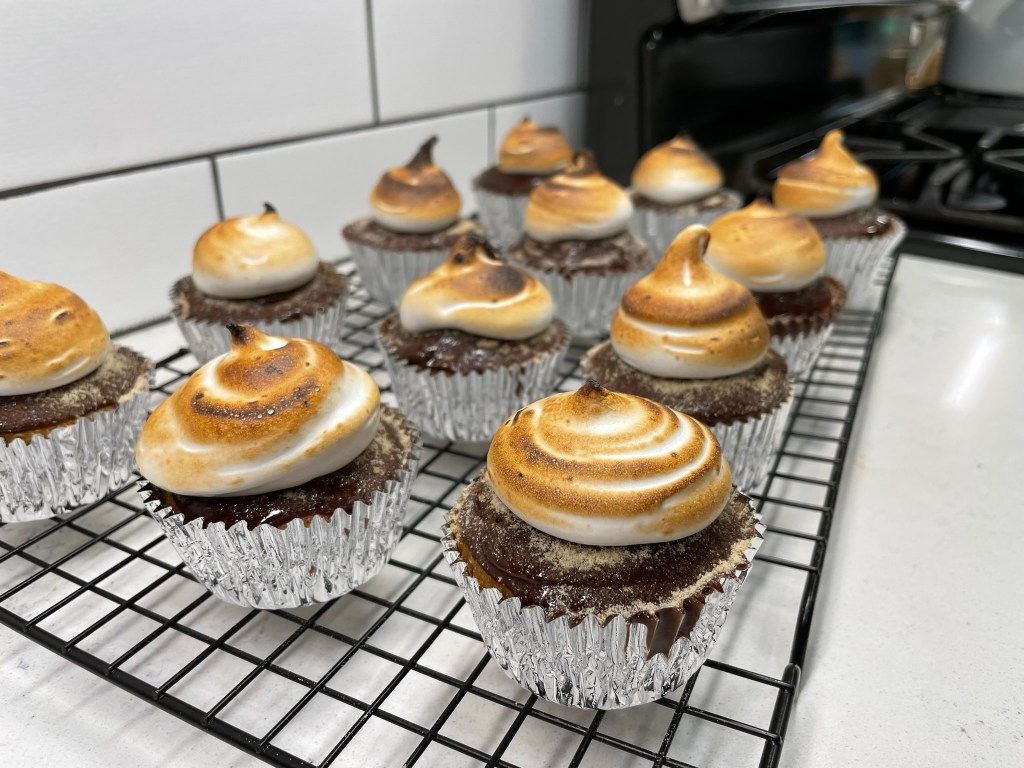
These turned out to be everything I wanted!

With a sweet honey-graham cake base, hollowed out for a dark-and-milk chocolate ganache filling, and topped with a homemade marshmallow frosting (toasted, of course), this may be my favorite s’mores treat to date. 


I’d been scouting out component recipes for these for several months, and finally nailed it down after flipping through a special edition Food Network Magazine, called “The Cupcake Cookbook.” The pages held all kinds of cupcake creations, from fruit to spice to chocolate and vanilla, plus numerous flavors and types of frosting, icing and glaze. It was their recipe for “honey-graham cupcakes” that sealed the deal for my s’mores recipe, but I did (of course) put my own spin on them, using honey in place of sugar for an extra-sweet, extra-“graham-y” impression. 

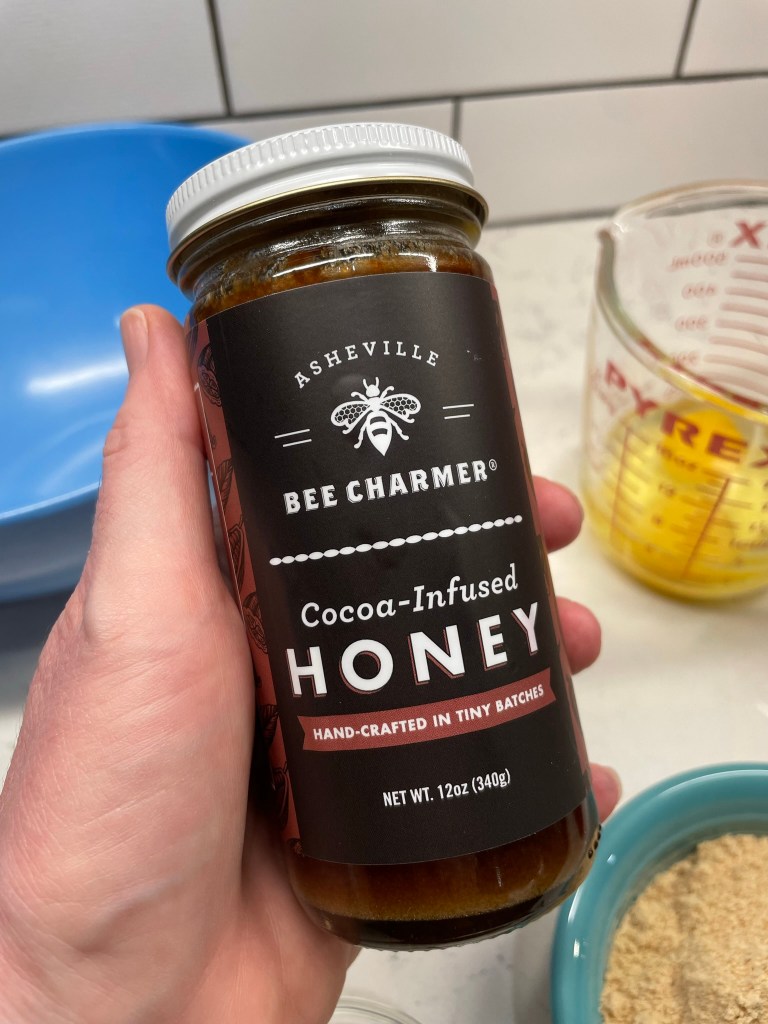
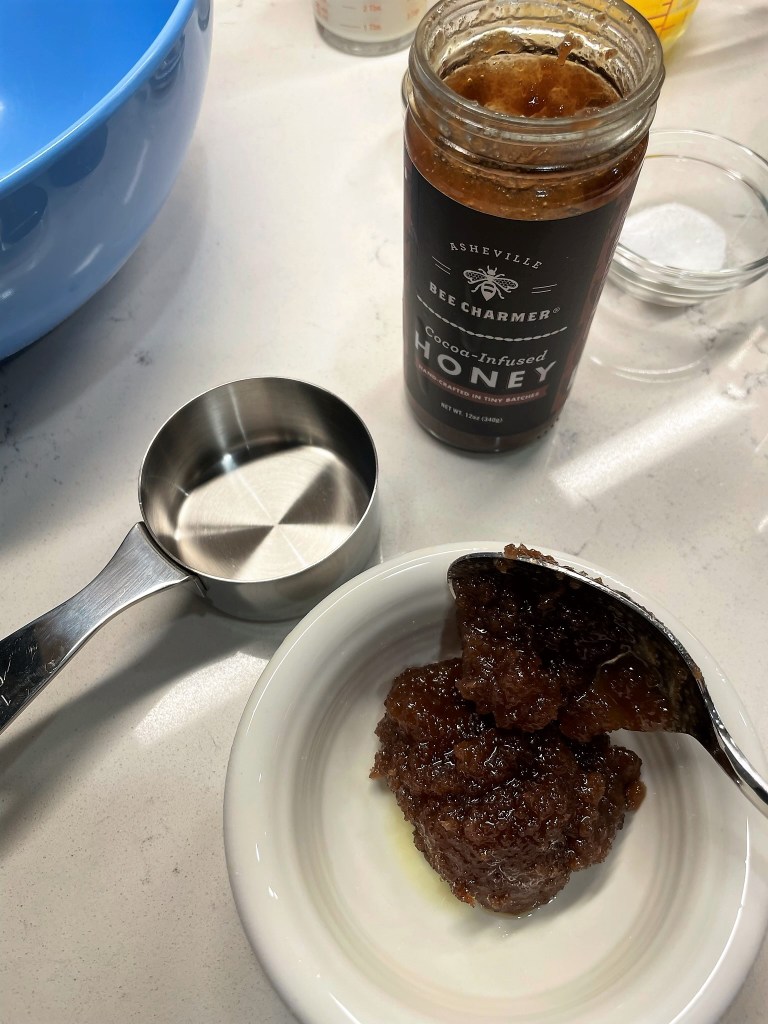
I had this cocoa-infused honey that I had picked up on an earlier trip to Asheville, N.C., where we go occasionally to visit my husband’s adult daughter. I suspected that the cocoa infusion would lend itself nicely to the s’mores vibe, and I was correct. The honey has been in my cabinet for about a year, so it was fairly crystallized, but the texture was no problem for my baked recipe.
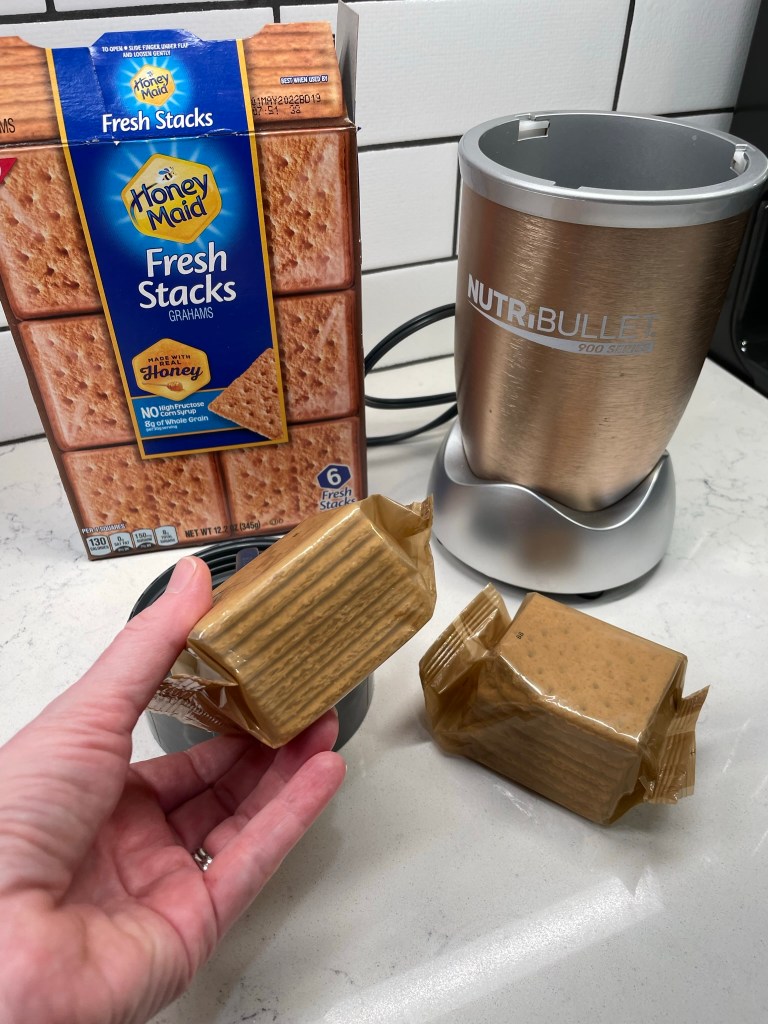
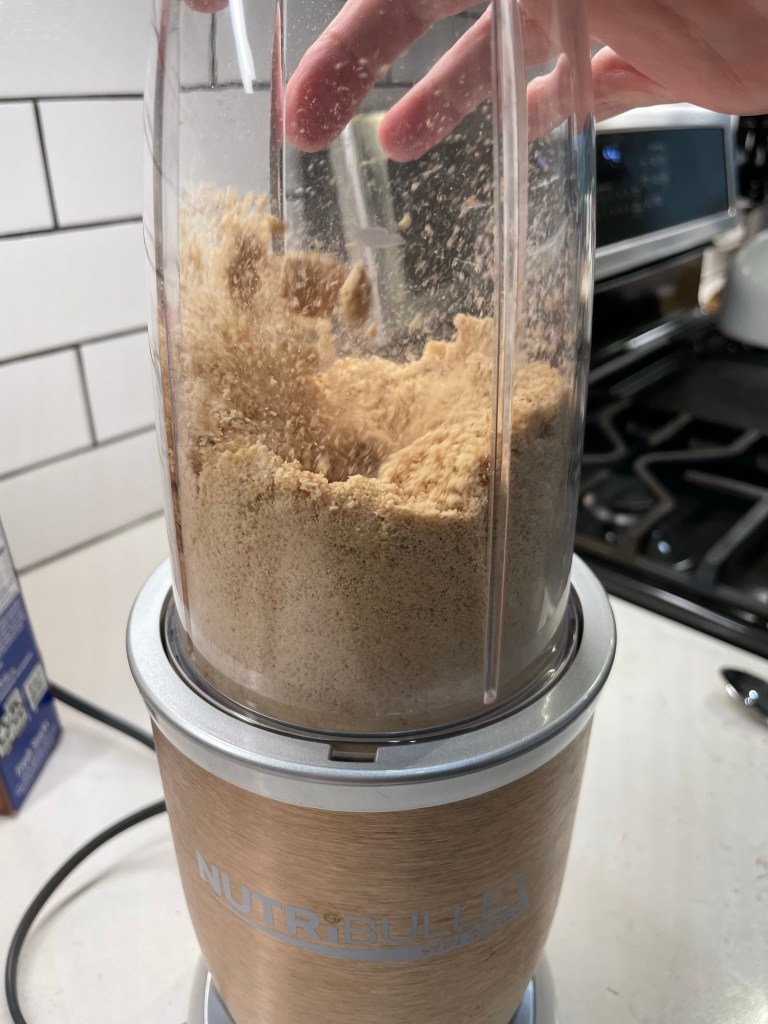
One of the things that appealed to me about the Food Network cupcake recipe is that it included actual crushed graham crackers. I was guaranteed to have the flavor I wanted, along with a slightly grainy feel from the already baked crumbs mixed into the cupcake batter. To crush the graham crackers, I piled a couple sleeves of them into my bullet-style blender and pulsed them for about 20 seconds, until they were reduced to a fine powder. I had the 3/4 cup of crumbs that I needed, plus 1/4 cup left over that I figured I’d use in the topping.
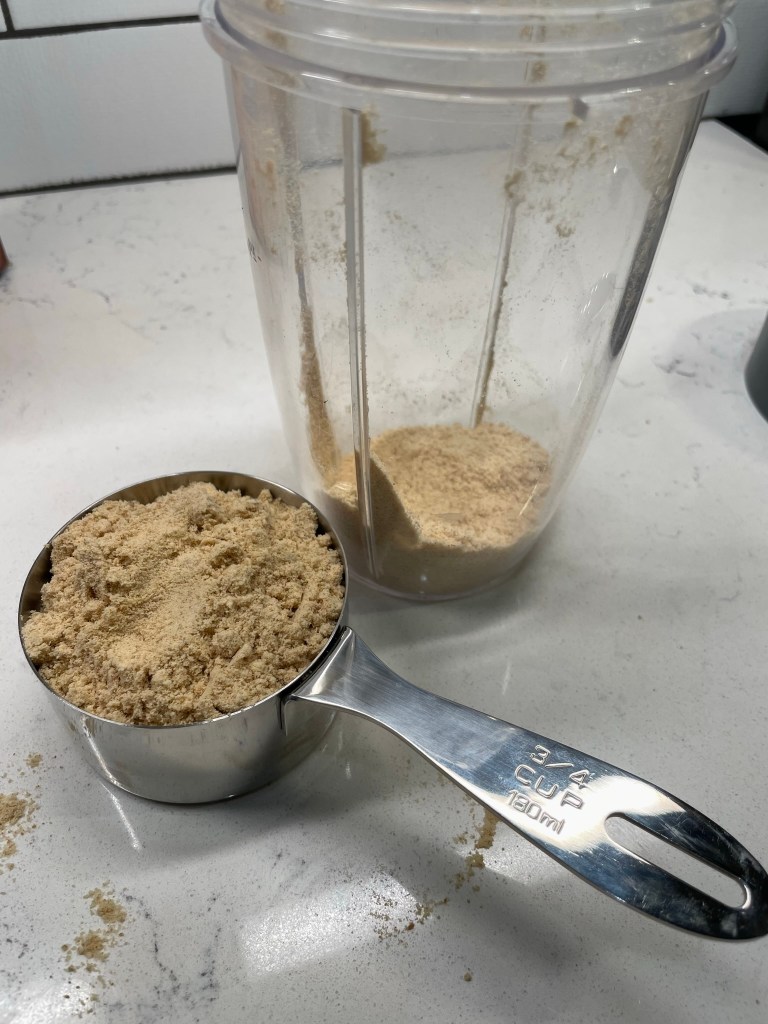
With all my ingredients lined up and measured, I was finally ready to bake!

Generally speaking, you can swap honey for sugar in a baking recipe, but you must take a few things into consideration, which I learned thanks to this article from an online honey supplier. Following those tips, I made the following adjustments:

  • used less honey than the sugar amount called for (because honey is sweeter)
  • reduced the milk amount slightly (because honey is also somewhat liquid)
  • added a touch of baking soda to balance the acidic effect of the honey
  • reduced the baking temperature a bit (because honey burns more easily than sugar), and slightly increased the baking time to compensate

I have accounted for all of those adjustments in my instructions, but the click-to-print recipe below also describes how the recipe should look if you’re using sugar to sweeten the cupcakes.
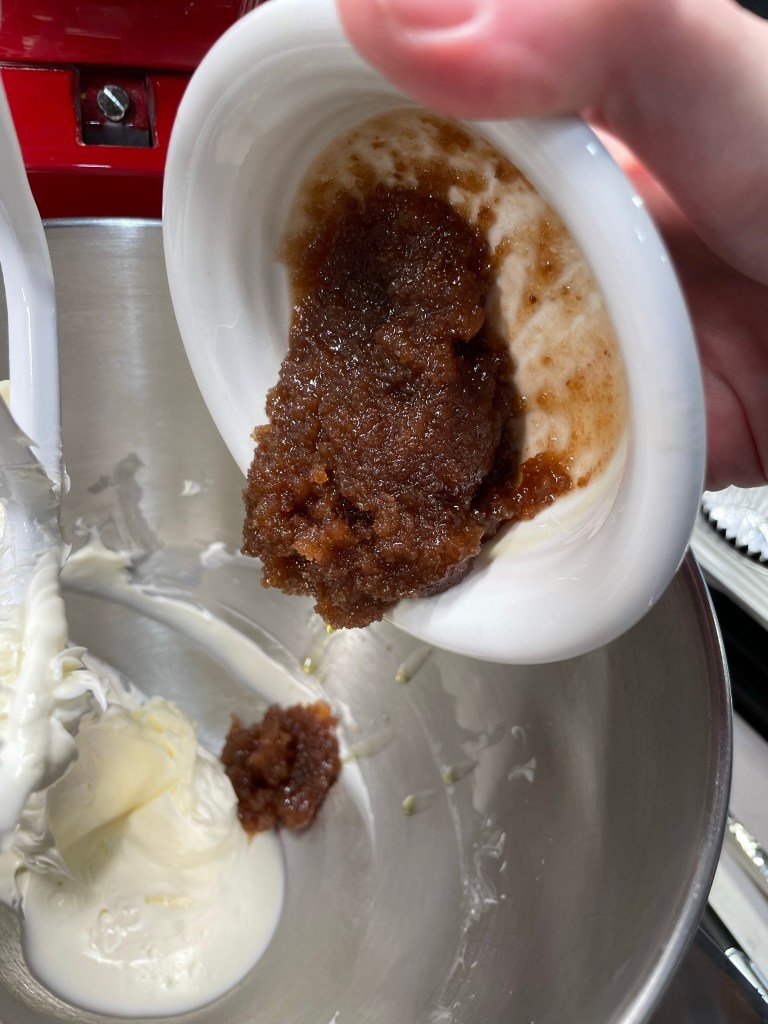
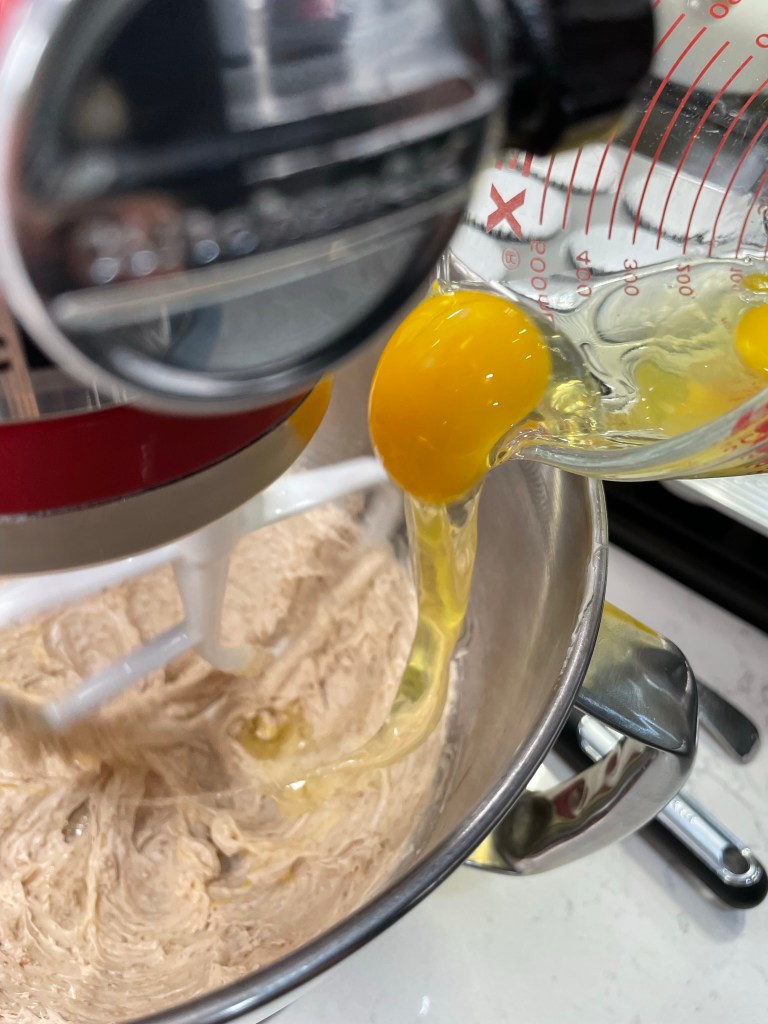
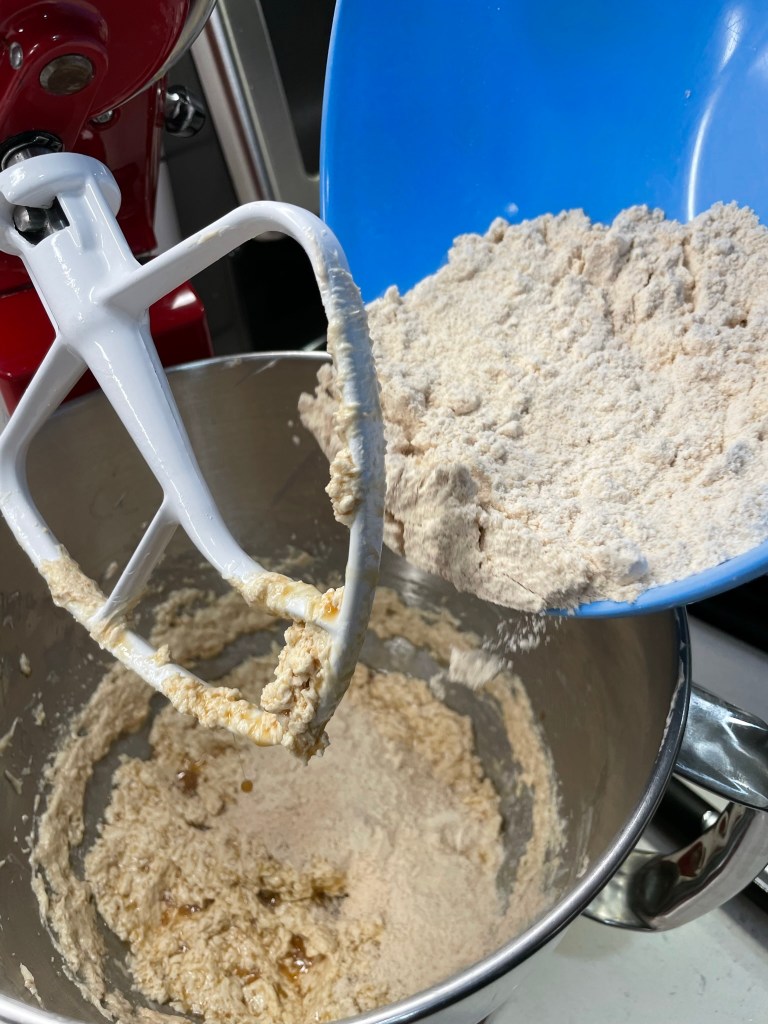
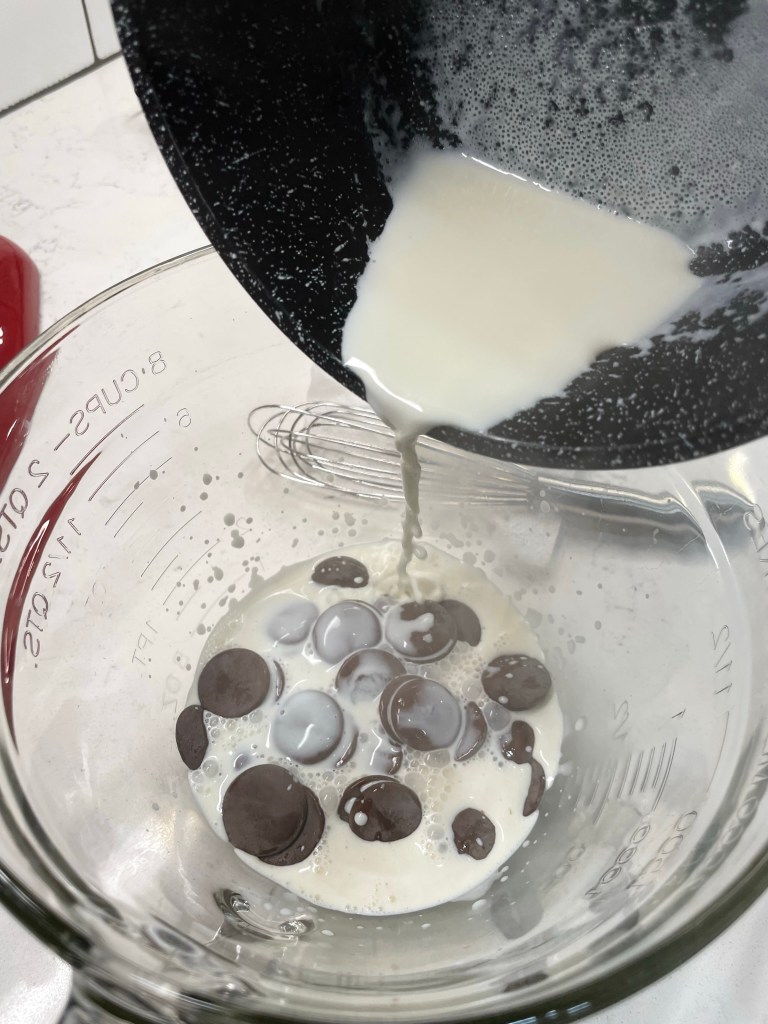
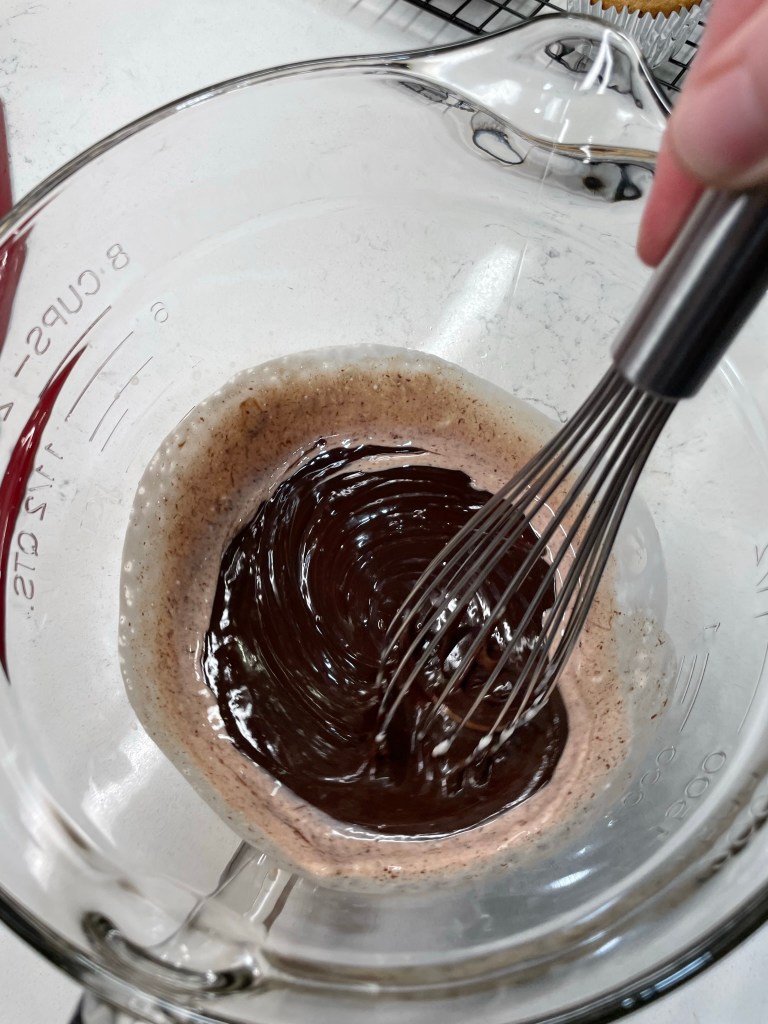
The ganache filling was the simplest component of this recipe; nearly equal parts chocolate— I used a combination of dark and milk chocolate for this— and heavy cream heated to just-shy of boiling. If you’ve never made ganache, you might be surprised how simple it is. Just heat the cream, pour it over the chocolate so it’s complete covered, wait 10 minutes, and stir to blend. Don’t be alarmed if the mixture seems very runny at first— it will thicken and firm up a bit as it cools. I wanted the ganache to be soft but not too messy, so I used slightly more chocolate than cream. In hindsight, equal parts would have been fine.
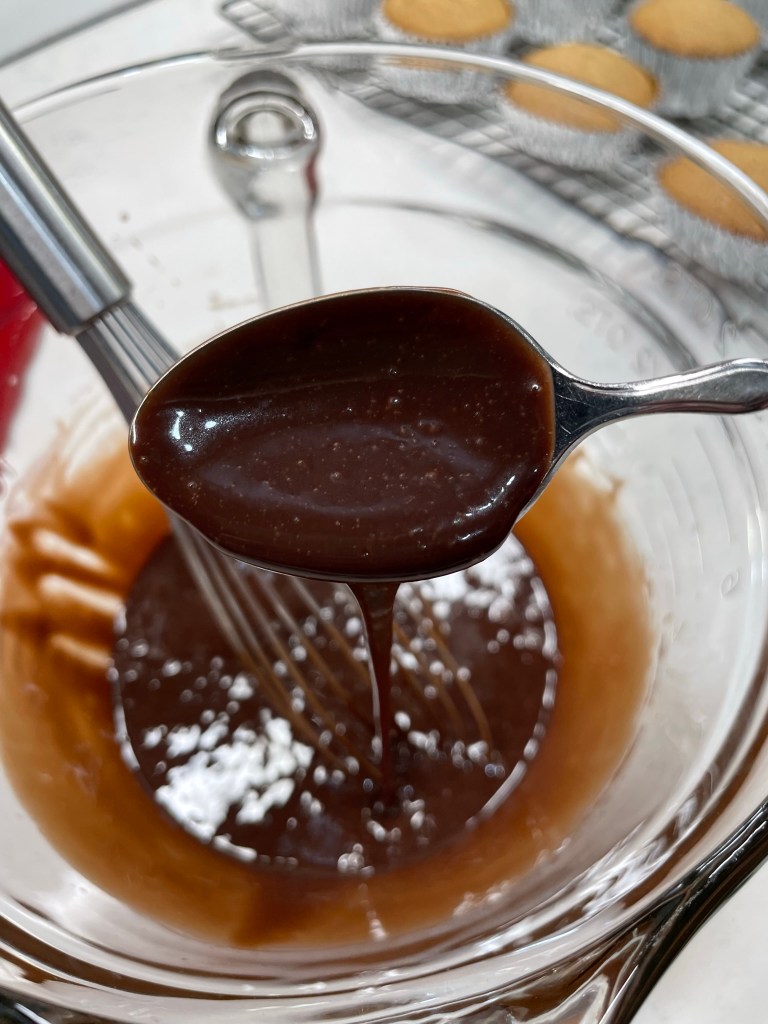
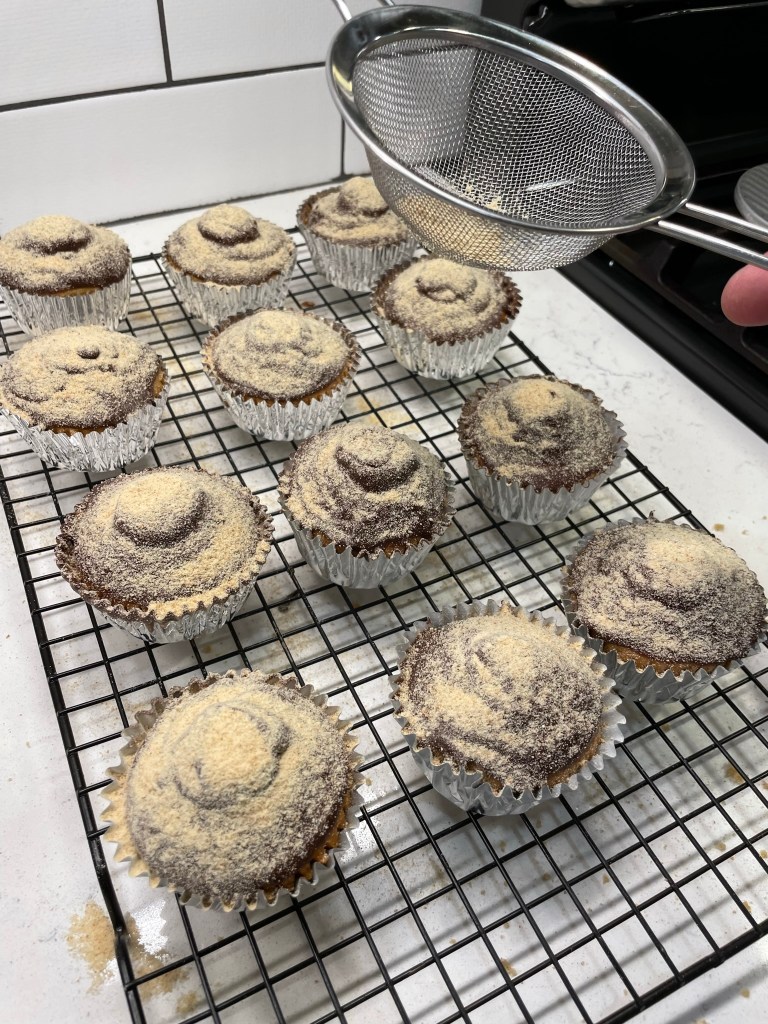
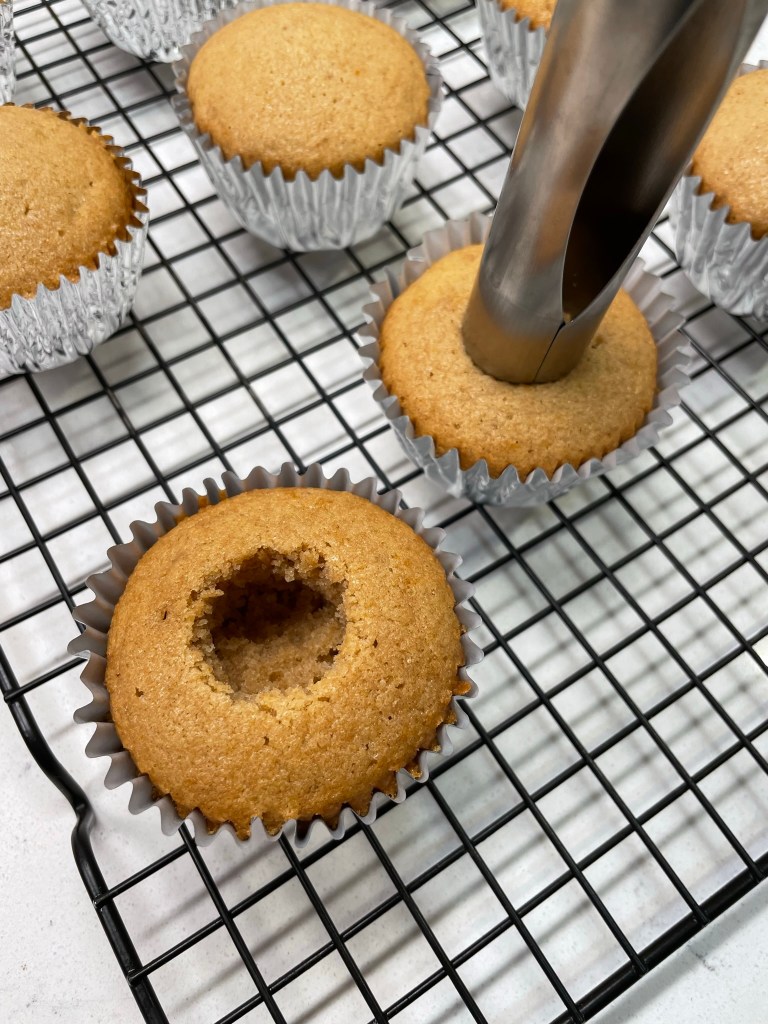
When the cupcakes were cooled, I used my apple corer tool to carefully cut out a plug shape bit of cake, keeping those pieces intact, to place back on top of the ganache, which I spooned inside the cupcake cavity. I didn’t mind that the tops didn’t sit flush with the cakes, because the whole thing would soon be buried in marshmallow frosting anyway. I had some ganache left over after filling the cupcakes, so I warmed it over hot water back to a spreadable consistency, and glazed the top of each cupcake, and then sifted some of the remaining graham crumbs on top as a bed for the marshmallow frosting.
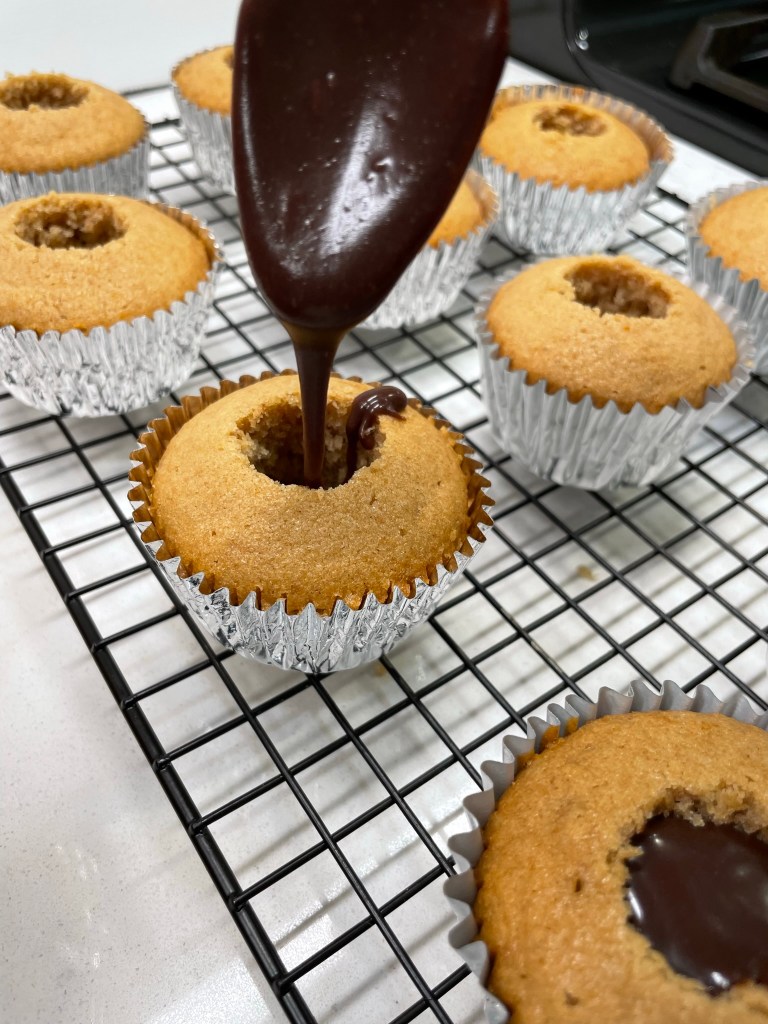
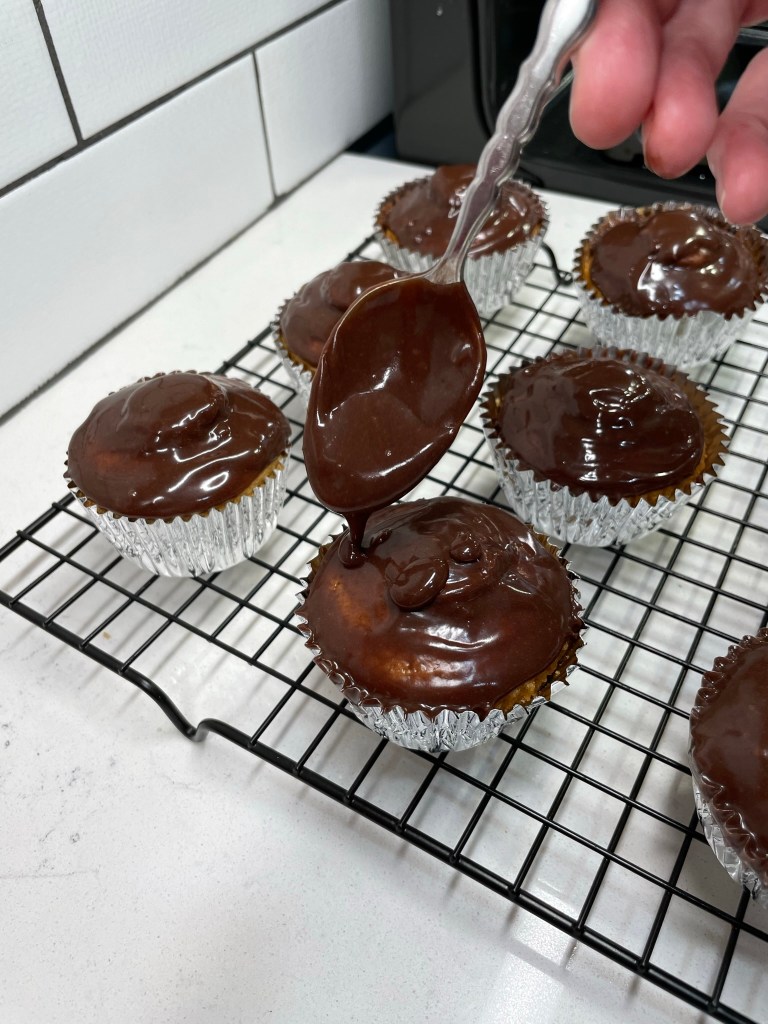
Almost done! I agonized a bit over which frosting recipe to use, and considered one in the Food Network Cupcake magazine, but it sounded more like meringue than frosting, and I wanted mine to be stable enough to keep its shape without getting watery. I finally found a “marshmallow frosting” recipe online that sounded more hefty, and about the time I got to the step to “whip it with a mixer for seven minutes over simmering water,” it occurred to me that this was exactly the same as a topping that my grandmother frequently made during her having-company-over days.
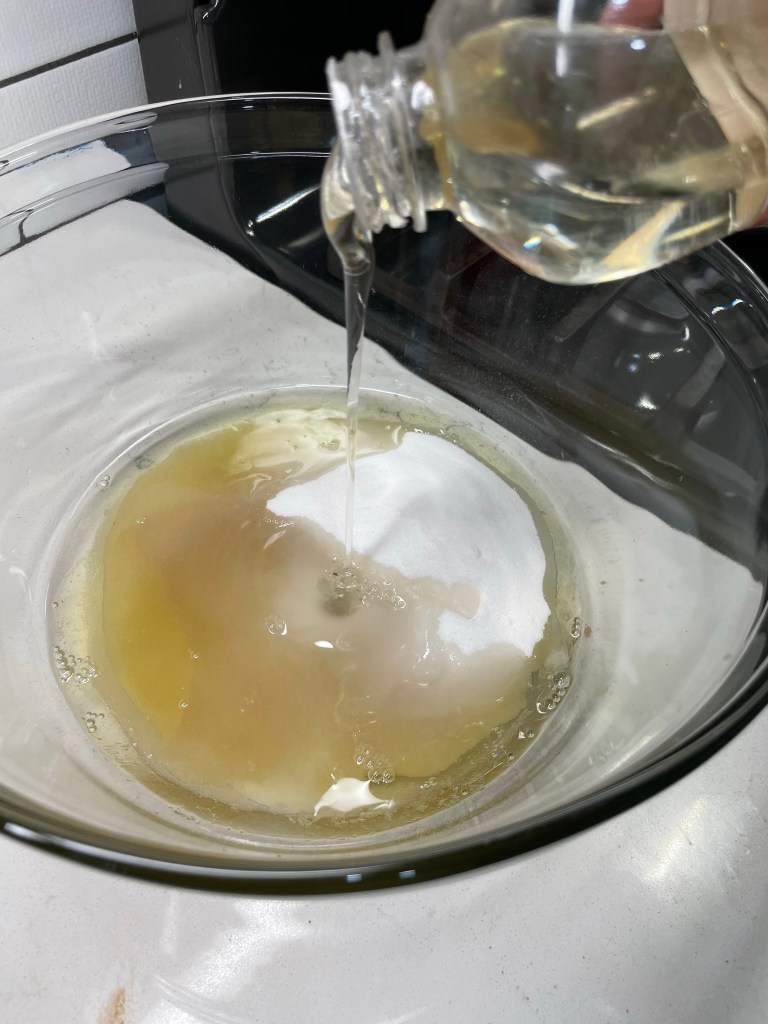
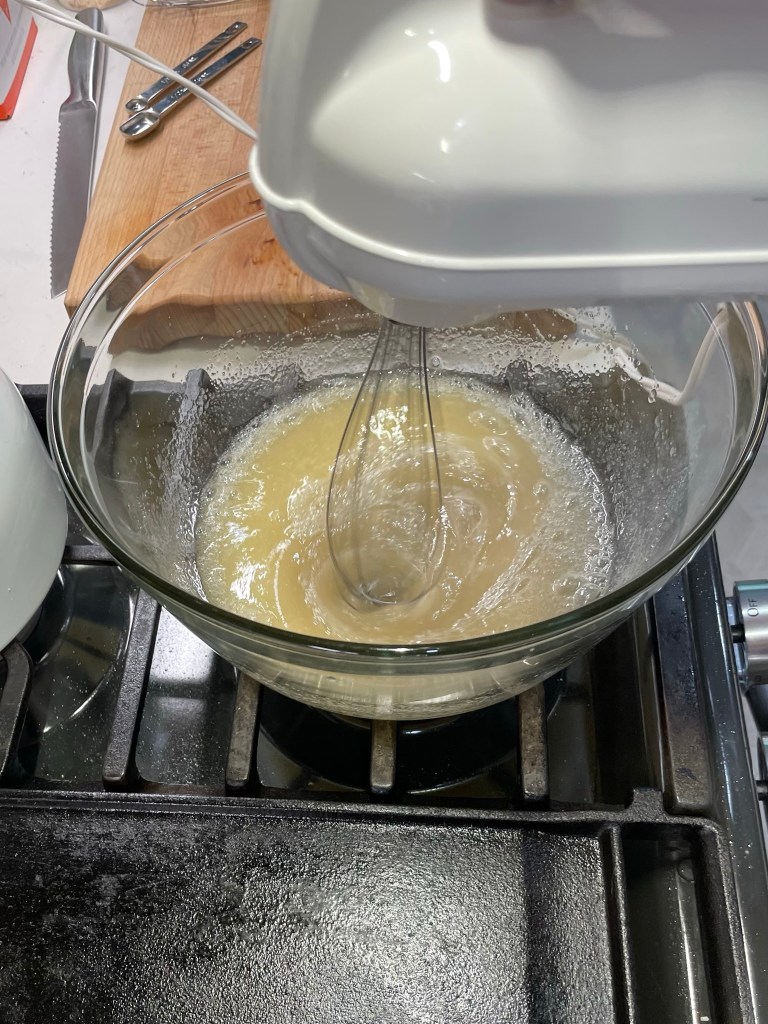
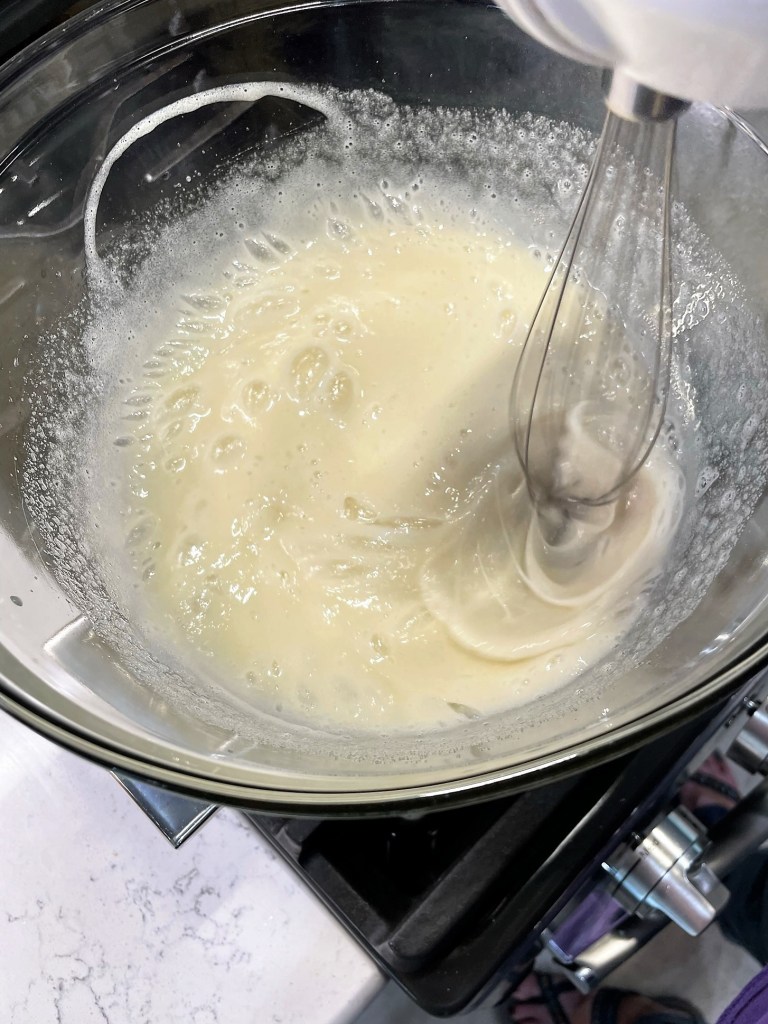
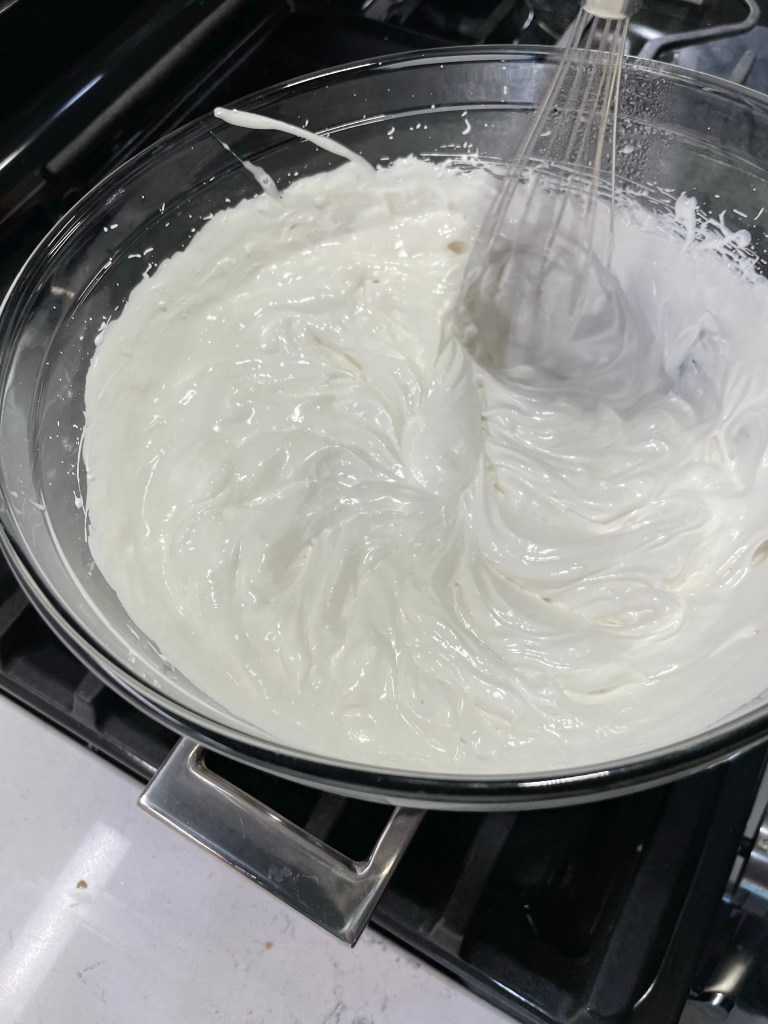
Turns out, seven-minute frosting is essentially marshmallow creme. I suppose you could probably just top the cupcakes with store-bought marshmallow creme, but by this time, my frosting was already done and I did enjoy piping the stuff onto the cupcakes— it made me feel like a real baker!

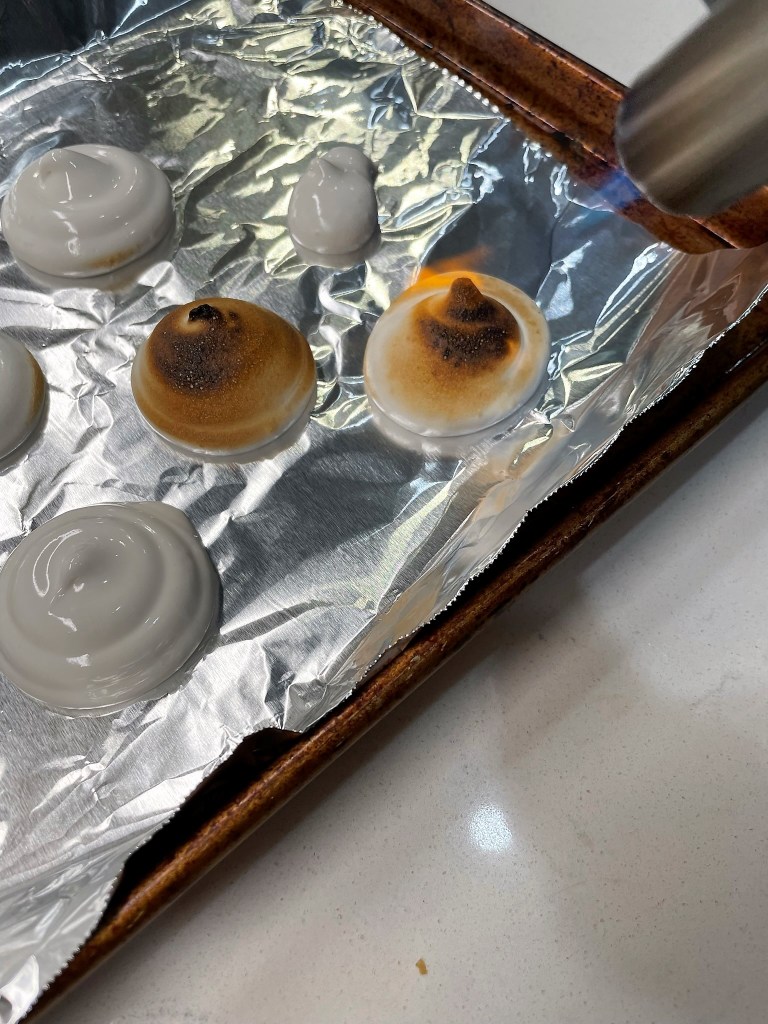
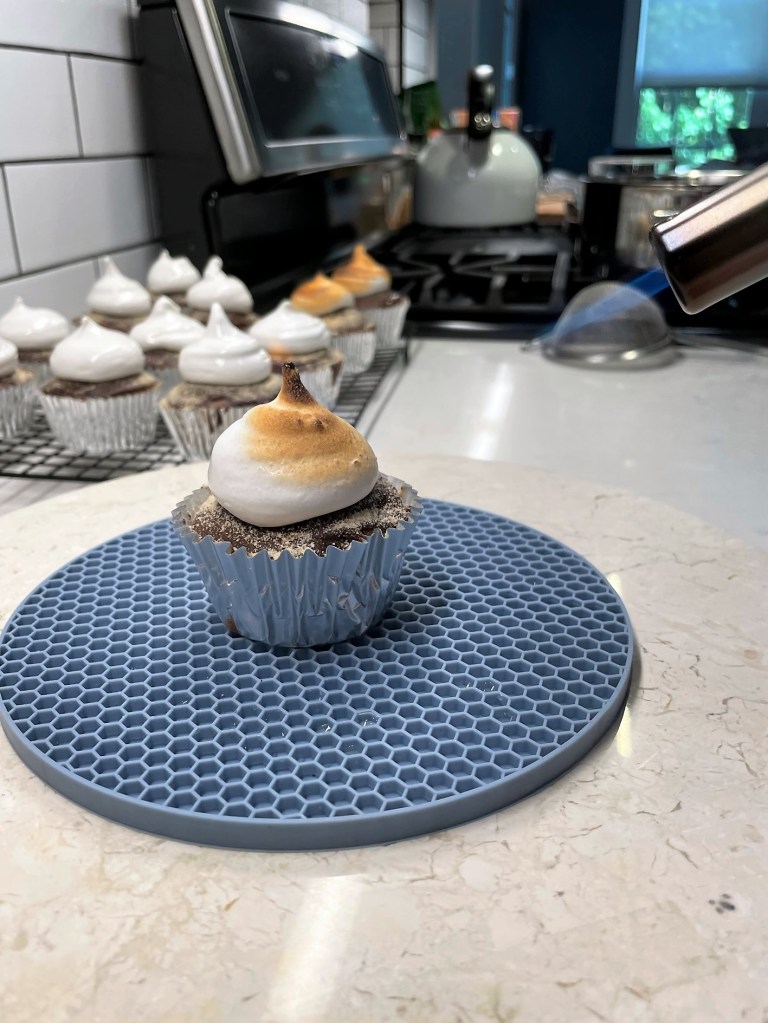
The only thing left to do was was toast the marshmallow topping. Having never done this before, and not wanting to ruin my pretty little s’mores cupcakes, I piped out some of the leftover marshmallow frosting onto a sheet of foil, and hit the dollops with my culinary torch to practice. Would you believe, this turned out to be the simplest part of the recipe?! The frosting toasted beautifully, and it stayed pretty for a few days after I made the cupcakes. 
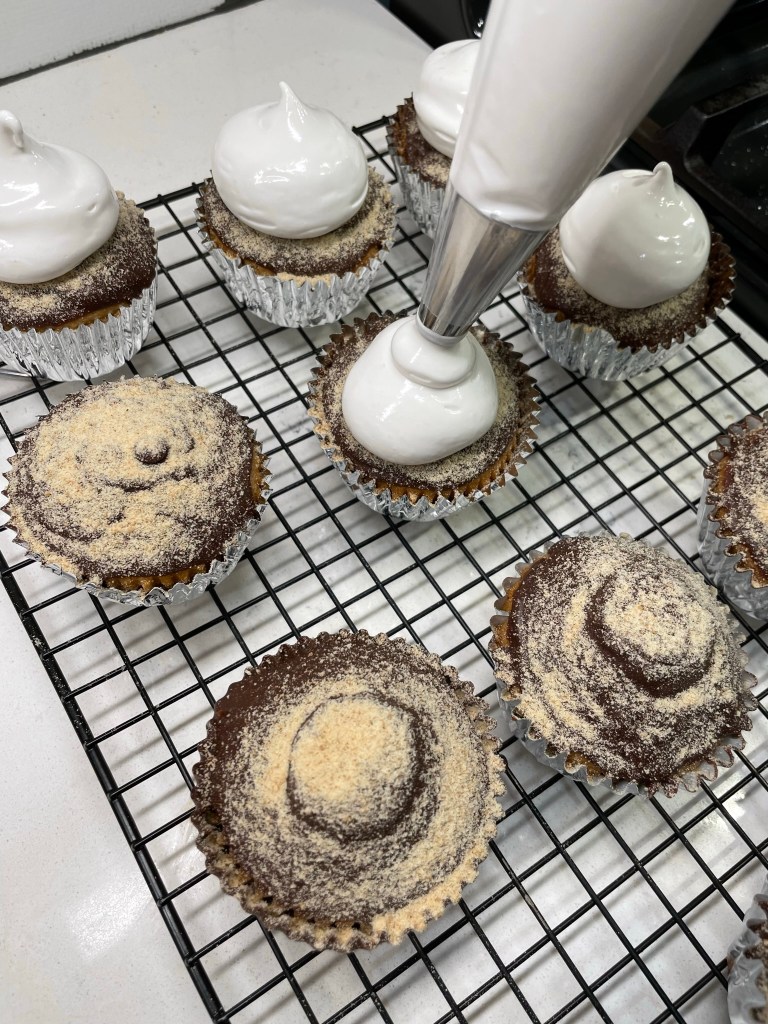

Incidentally, I had enough marshmallow frosting left over to cover at least two more batches of cupcakes, and most of the extra went to waste because I didn’t have a plan ready for using it. Perhaps I could have whipped up a quick batch of Krispie treats— and that of course, gives me an idea for National S’mores Day next year. 😉


S'mores Cupcakes

  • Servings: 12
  • Difficulty: Intermediate
  • Print

With a sweet honey-graham cake base, hollowed out for a dark-and-milk chocolate ganache filling, and topped with a homemade marshmallow frosting (toasted, of course), this may be my favorite s’mores treat to date. There are three components of this treat, and I've described each separately below.


Ingredients

  • 3/4 cup honey graham crackers, crushed fine (see notes)
  • 3/4 cup all-purpose flour
  • 1 tsp. baking powder
  • 1/8 tsp. baking soda (omit if using sugar in place of honey)
  • 1/2 tsp. salt
  • 1 stick unsalted butter
  • 1/2 cup honey (or 1 cup granulated sugar)
  • 2 eggs
  • 2 tsp. real vanilla extract
  • 1/2 cup milk (minus 2 tablespoons if using honey)

Notes: Butter, eggs and milk should be at cool room temperature. Remove them from refrigerator about one hour before you plan to start the recipe.

To get a fine crush on the graham crackers, I broke them up into my bullet-style blender and processed them for about 15 seconds. Sift through them with your fingers to remove any remaining chunks. I used two wrapped packs of “Fresh Stacks” crackers, and had about 1/4 cup of crumbs left over, which I sprinkled on top of the ganache before frosting.


Directions

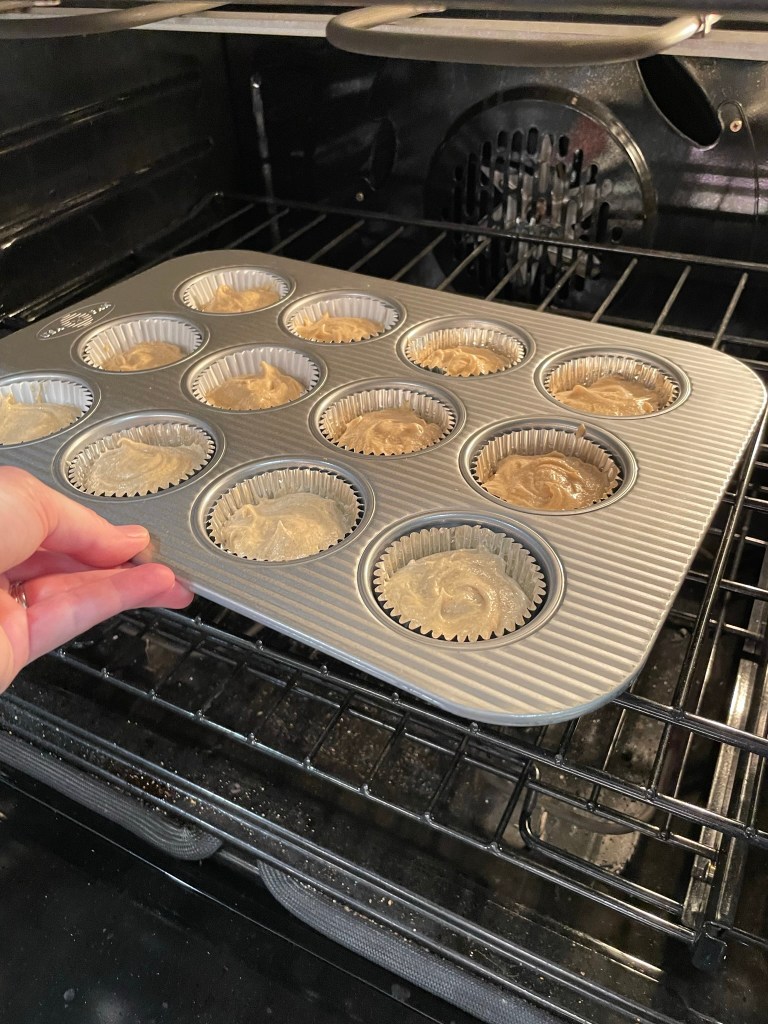
  1. Preheat oven to 330° F (or 350° F if using sugar), and line cupcake pan with foil liners.
  2. Combine crumbs, flour, baking powder, soda and salt in a medium bowl and set aside.
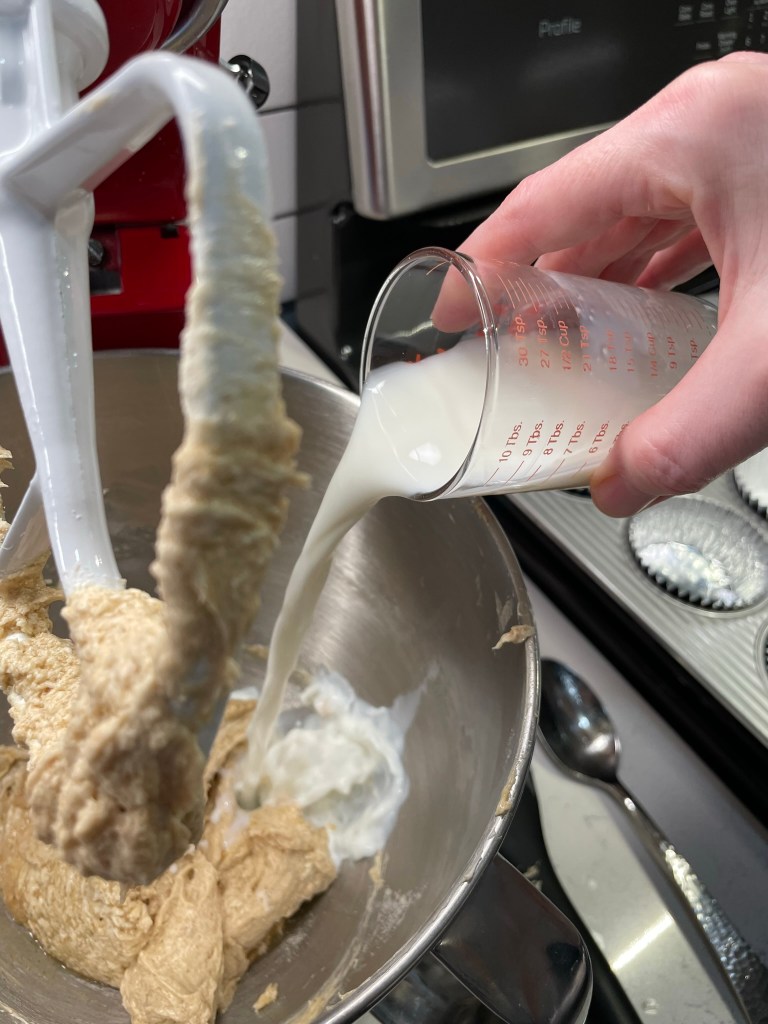
  3. In a stand mixer, cream butter on medium speed until light and airy, about one minute. Add honey and beat on medium speed until fluffy and evenly blended, about four more minutes. Scrape down sides of the bowl.
  4. Add one egg at a time, beating to blend after each. Scrape down sides of the bowl. On low speed, beat in one-third of the flour mixture just until no visible dry ingredients remain. Beat in half of the milk. Repeat with dry ingredients, then milk, then final dry ingredients. Scrape down sides.
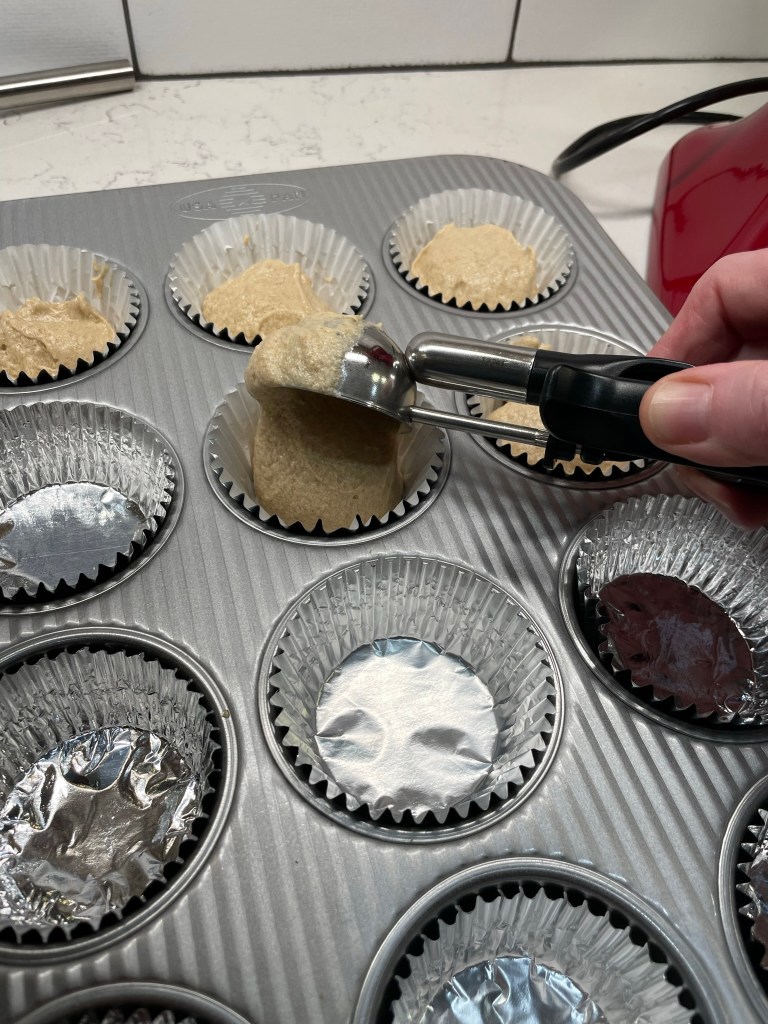
  5. Scoop cupcake batter into lined cupcake pan. Each cup should be about 2/3 filled.
  6. Bake 25 to 30 minutes (less if using sugar), until cupcakes are golden and spring back easily when touched in the center.
  7. Cool cupcakes in pan 5 minutes, then transfer to a wire rack to cool completely.

While the cupcakes are baking, prepare the ganache filling. It’s best to fill the cupcakes while the ganache is still somewhat warm and easily drizzled.

Ingredients

  • 2/3 cup quality chocolate, wafers or bars preferred over chips
  • 1/2 cup heavy cream

Directions

  1. Add chocolate pieces to a medium bowl. Heat cream to just-shy of boiling point. Pour cream over chocolate and let sit 10 minutes.
  2. Gently whisk or stir cream and chocolate together until evenly blended. This will seem impossible at first, but within one minute, it should be glossy and silky.
  3. When cupcakes are completely cool, used an apple corer tool or paring knife to carefully cut a one-inch plug from the center of each cupcake. Set these aside.
  4. Use a spoon to drizzle the warm ganache into each cupcake hole, then press the plugs back onto the cupcake. Carefully glaze the filled cupcakes with any remaining ganache. Scatter some of the remaining graham crumbs over the top and cool completely while you make the marshmallow frosting.

To prepare the frosting, you will need an electric hand mixer and a double boiler or a large, heatproof bowl that will fit over, but not inside, a medium saucepan. Be sure the mixing bowl and beater blades are completely clean, as any amount of oil or fat on them will prevent the egg whites from forming peaks.

Ingredients

  • 2 egg whites, at room temperature
  • 1 1/2 cups granulated sugar (I used a 50/50 mix of cane sugar and superfine caster sugar)
  • 1/3 cup water
  • 1 Tbsp. light corn syrup (prevents crystallization)
  • 1/8 tsp. fine salt
  • 2 tsp. real vanilla extract

Directions

  1. Bring a medium saucepan of water to a slight boil over medium heat. The water should not be high enough to touch the bottom of the bowl used in the next step.
  2. In the heatproof bowl, combine all ingredients except vanilla. Do not place the bowl over the hot water yet.
  3. Use a hand mixer to whip the frosting ingredients together. Start on low speed and increase slightly when the mixture starts to get frothy. After a minute or two, place the bowl over the simmering water.
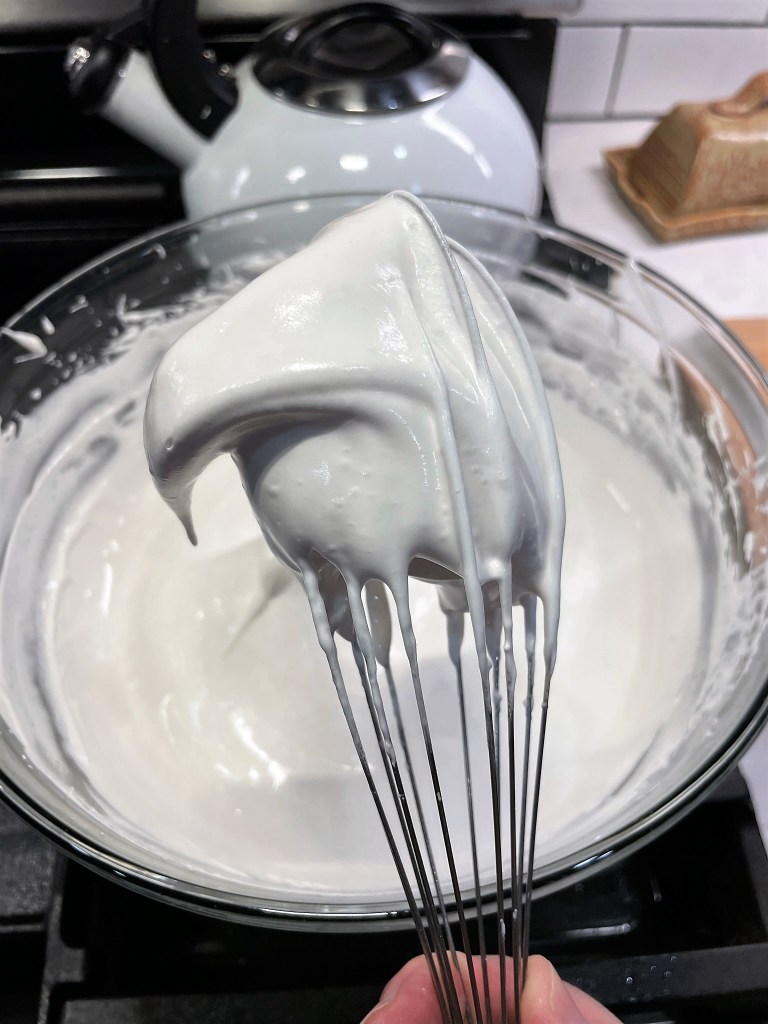
  4. Continue to whip with the mixer for 7 minutes, until all the sugar has dissolved and soft peaks form in the frosting. Remove from heat.
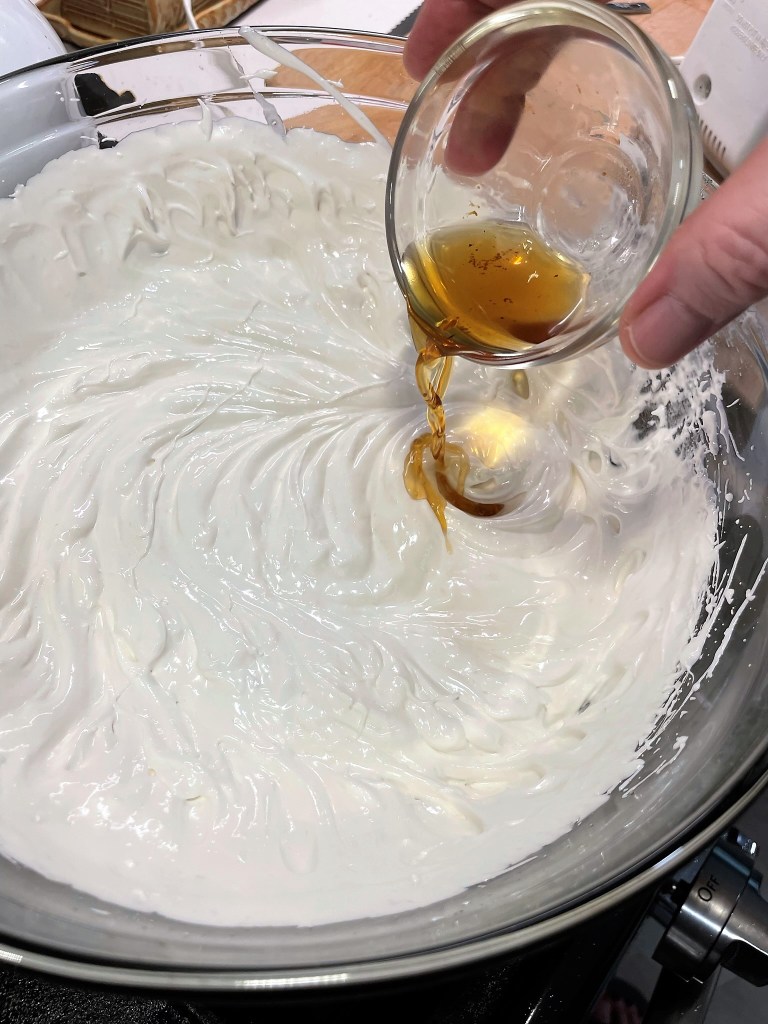
  5. Add vanilla and beat again just until incorporated. Cool a few minutes before frosting cupcakes.
  6. Load frosting into a piping bag with a wide, round tip. Pipe frosting onto cupcakes.
  7. Use a culinary torch to carefully toast the marshmallow topping. Cool before enjoying.


Peach Cobbler Ice Cream

It’s interesting to me that some foods have their own variations in different parts of the country. Take barbecue, for example. Depending on where you go— Texas, Kansas City or the Carolinas— you might be presented with dry-rubbed beef brisket, saucy ribs or burnt ends, or slow-braised, pork shoulder with vinegar sauce. And for sure, natives of each area will proclaim theirs to be the “true” barbecue, the best or most authentic. It is, of course, a matter of opinion and upbringing. 
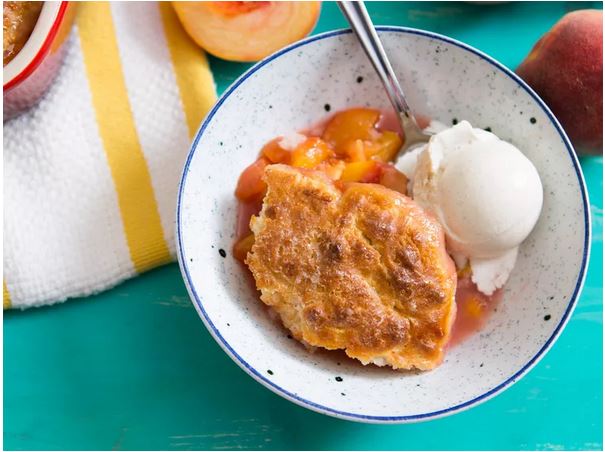
The same can be said for peach cobbler. Here in the South, most cobblers I’ve had at church potlucks, diners or restaurants resemble another popular dessert here, the dump cake. Everything gets slopped into a pan, usually with the batter on the bottom and the fruit on top, and somehow during the baking process, the dough finds its way to rise up through the peaches. It’s tasty, but a bit soupy and mostly a mushy texture— definitely not the peach cobbler of my childhood, and we all know that comfort food is what you remember from those early days. So I’m about to say something that irritates Southerners more than anything else, ever:

Let me explain how we do it up north. 😏

This looks amazing! (photo credit: Serious Eats/ Vicky Wasik)

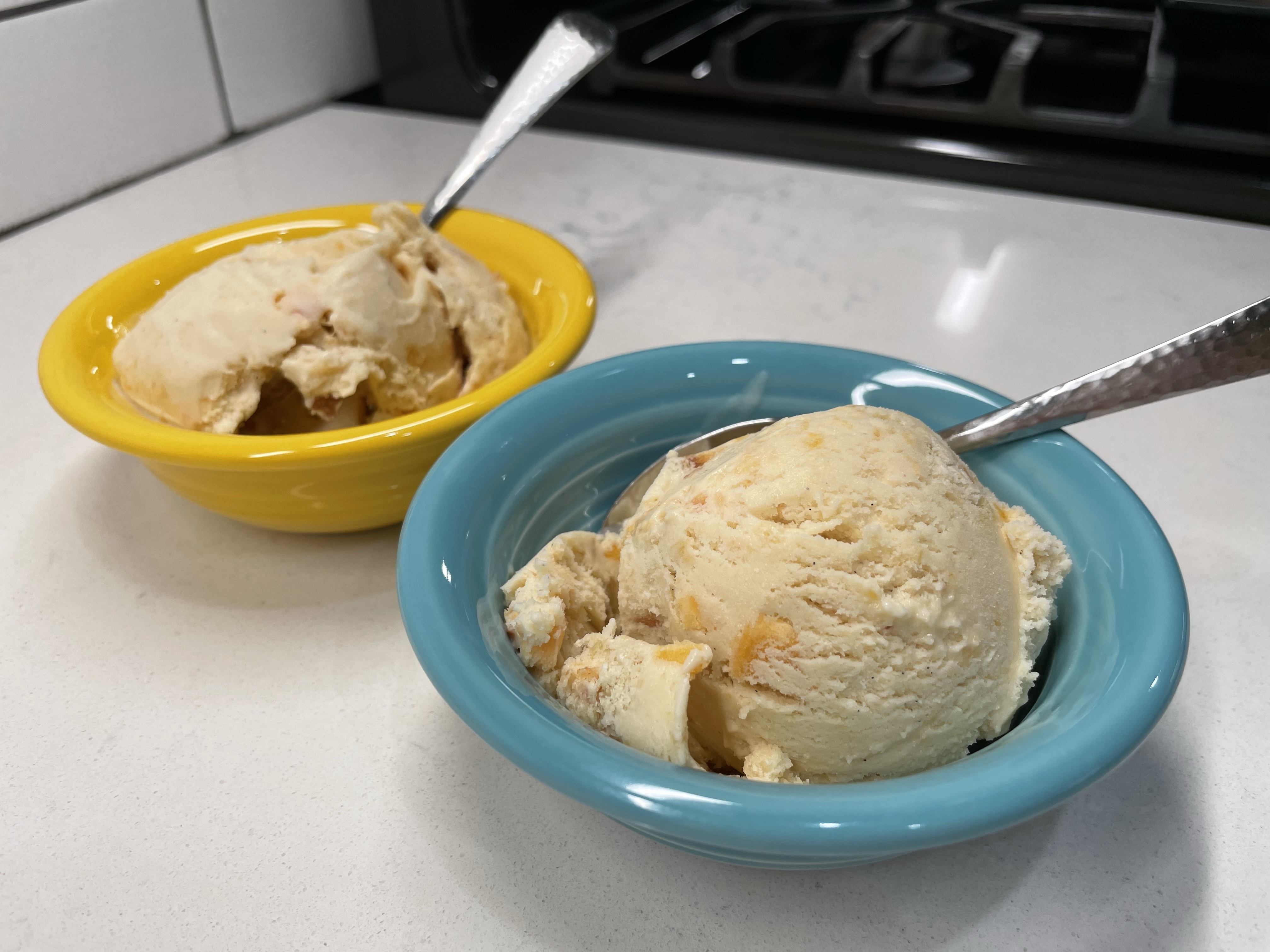
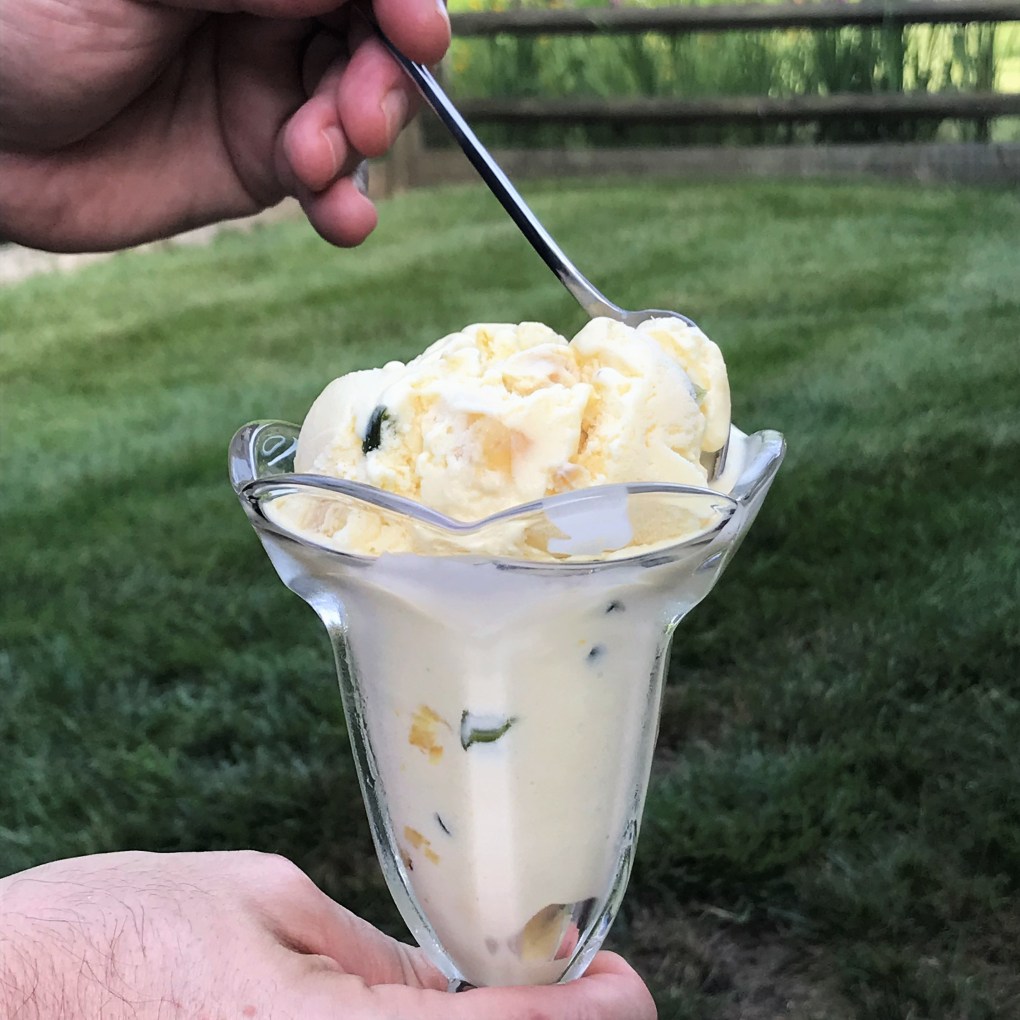
Sweet juicy peaches, tossed with sugar, corn starch and a touch of cinnamon, cooked until tender and saucy under a crown of tender biscuits that have just a touch of crunch on the edges. Crystals of sugar on top that add a little extra something with each bite. Served warm with a scoop of vanilla ice cream. That, to me, is a real deal peach cobbler. As the sun sets on National Ice Cream month this year, I’ve transformed that favorite summer dessert into a single, glorious scoop of peach cobbler ice cream.


This recipe is my own, developed out of my experience with several other past recipes, with and without peaches. To explain how I got here, it makes sense to share what I’ve learned from past efforts and mistakes.

What’s the best way to make ice cream with fruit? 

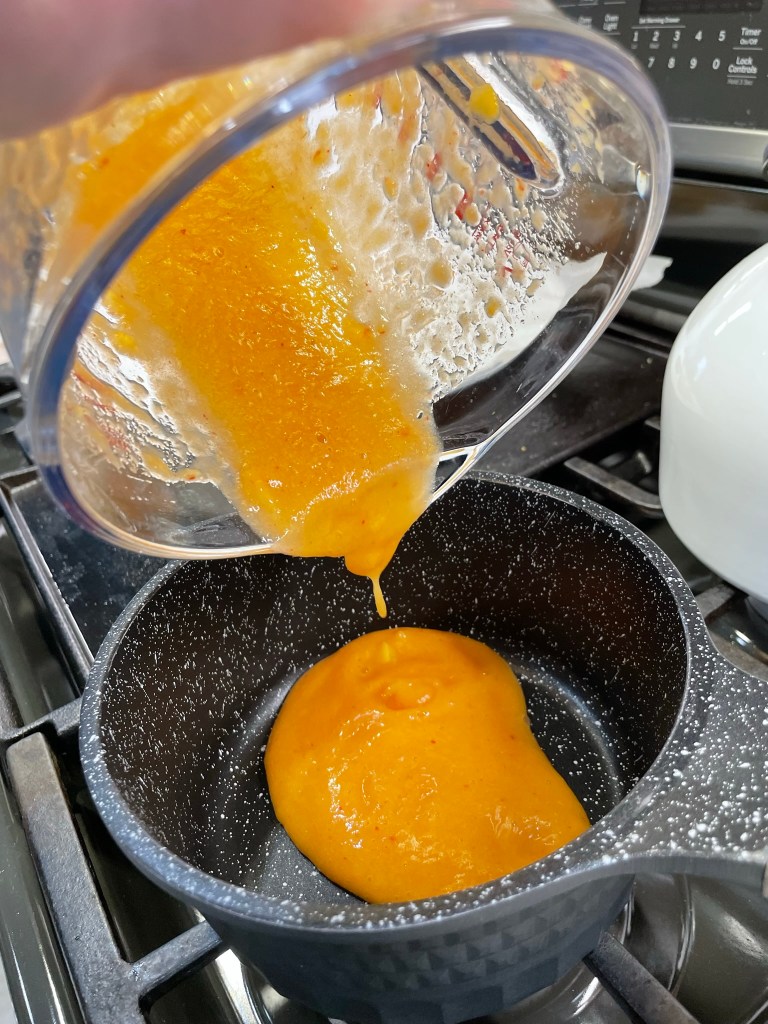
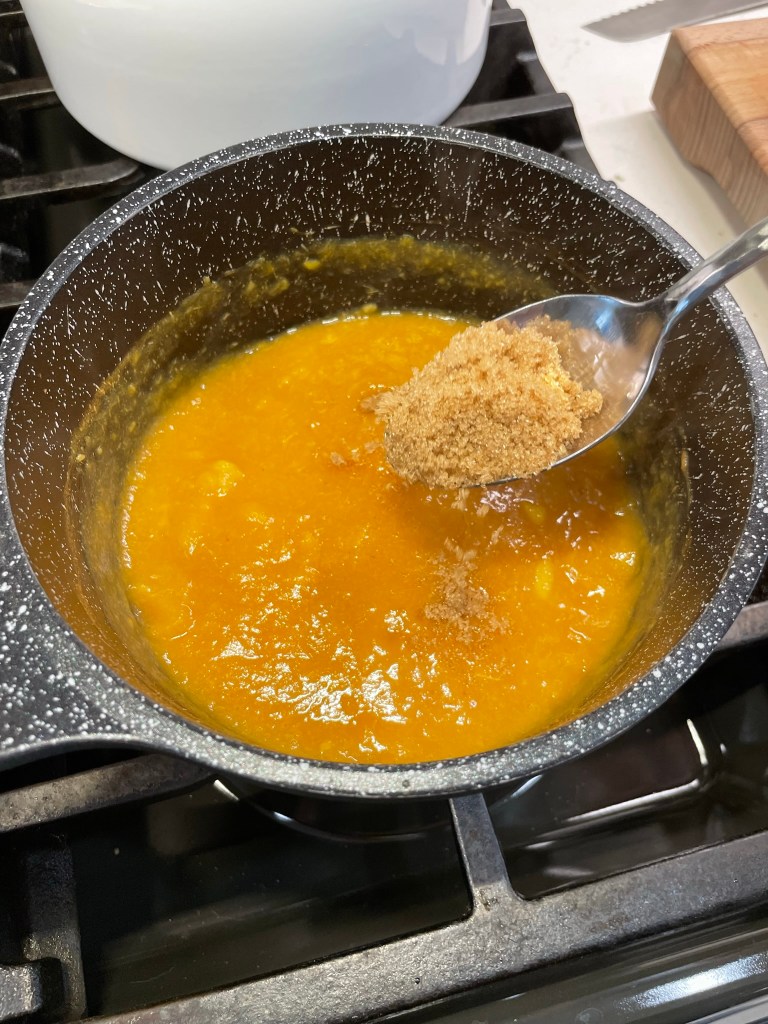
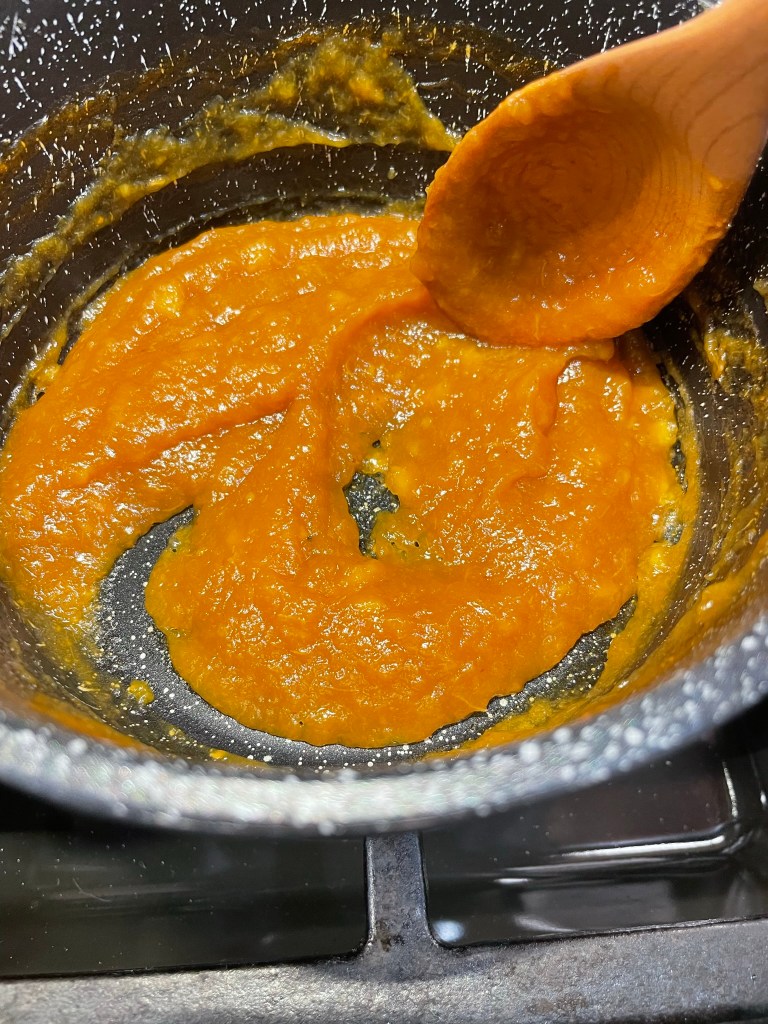
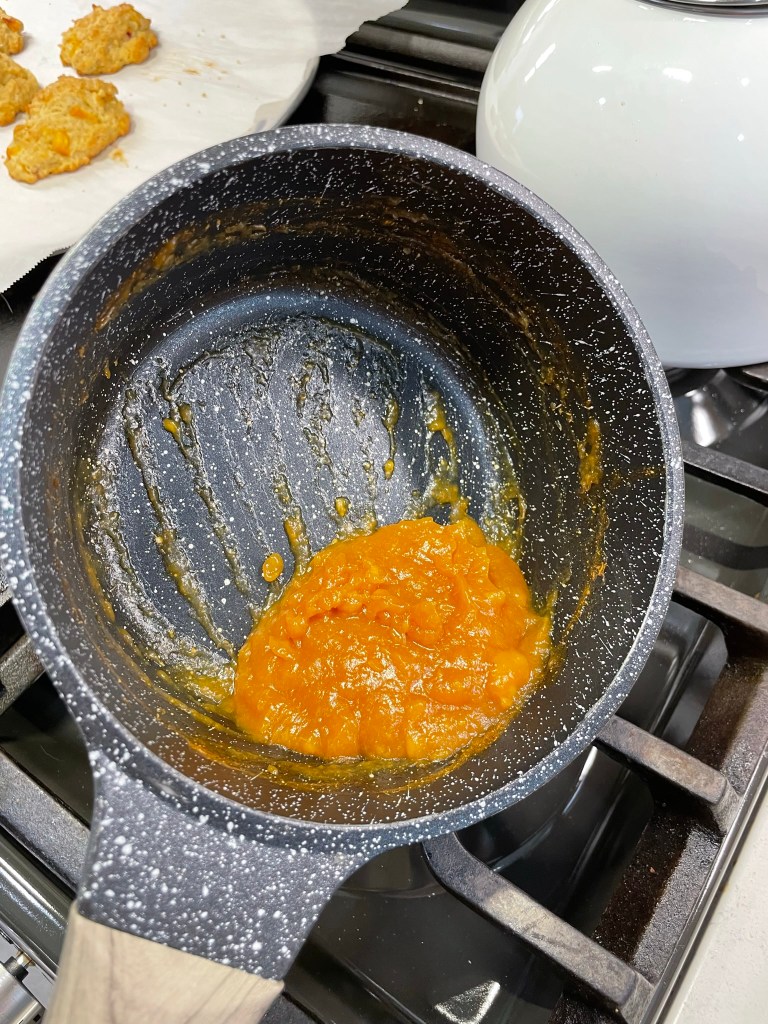
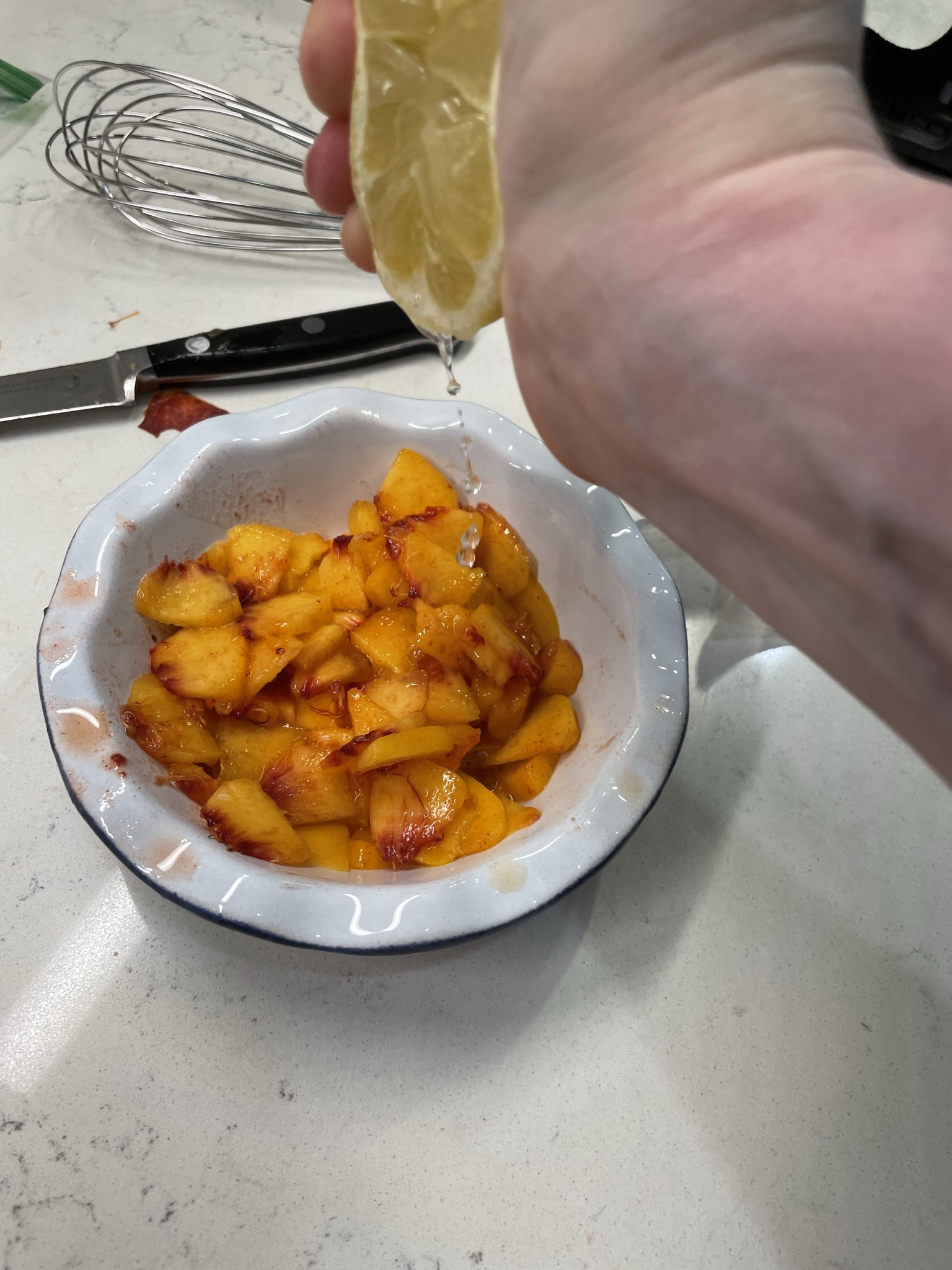
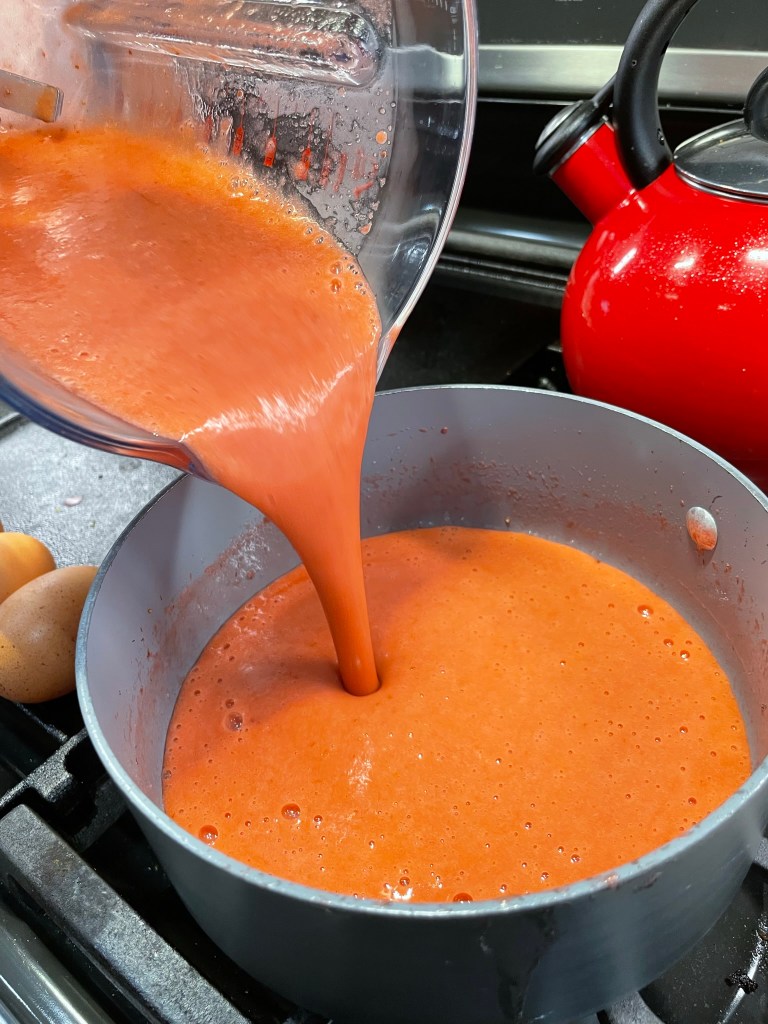
Too many fresh fruit bits can make the finished ice cream feel too icy. I learned this especially when I made a strawberry-mascarpone ice cream a few years ago. Fruit, especially fresh fruit, contains a great deal of moisture, and when you freeze it, ice crystals form inside, making for an unpleasant bite that hurts my teeth. One day, I will re-work that recipe to improve the texture. But to counter the icy effect in this peach cobbler ice cream, I cooked the peaches, borrowing a technique I learned recently when I made that heavenly, boozy strawberry daiquiri cake. Cooked fruit loses volume as the moisture evaporates, but all the flavor remains, so I peeled and pureed a couple of peaches, then cooked them down into a sticky, concentrated peach paste. I still embellished the ice cream with a few bits  of fresh peach for pops of color and flavor, but the ice cream gets most of its peachy keen flavor from the puree.


How do you incorporate other foods into an ice cream?

I’ve had to get a little creative with some ingredients, because adding the ingredient directly would have resulted in a weird texture. For my s’mores ice cream, I wanted every element of a s’more— the melty chocolate, toasty marshmallow, the sweet graham cracker— but can you imagine what would happen if I tried to swirl actual melted chocolate into an ice cream base? Yep, a big mess. Same with toasted marshmallows, which just get hard and sticky in the refrigerator, let alone the freezer. My solution for that ice cream was to use a dark chocolate syrup to play the role of the Hershey square, and a marshmallow fluff-cream cheese mixture to stand in for the toasted marshmallow element. It was delicious, but I’ve been hankering for a re-do on that one as well, so stay tuned! For this peach cobbler ice cream, I wanted the “biscuit” texture that I loved in my up-north cobblers, but a plain old biscuit would have been dry and crumbly. That’s when I remembered one of my baking class experiences at King Arthur earlier this month— we made scones!

Thanks to Michelle, my baking partner, for taking this picture! It was such a hectic day, I forgot! 🙂

What’s the difference between a biscuit and a scone?

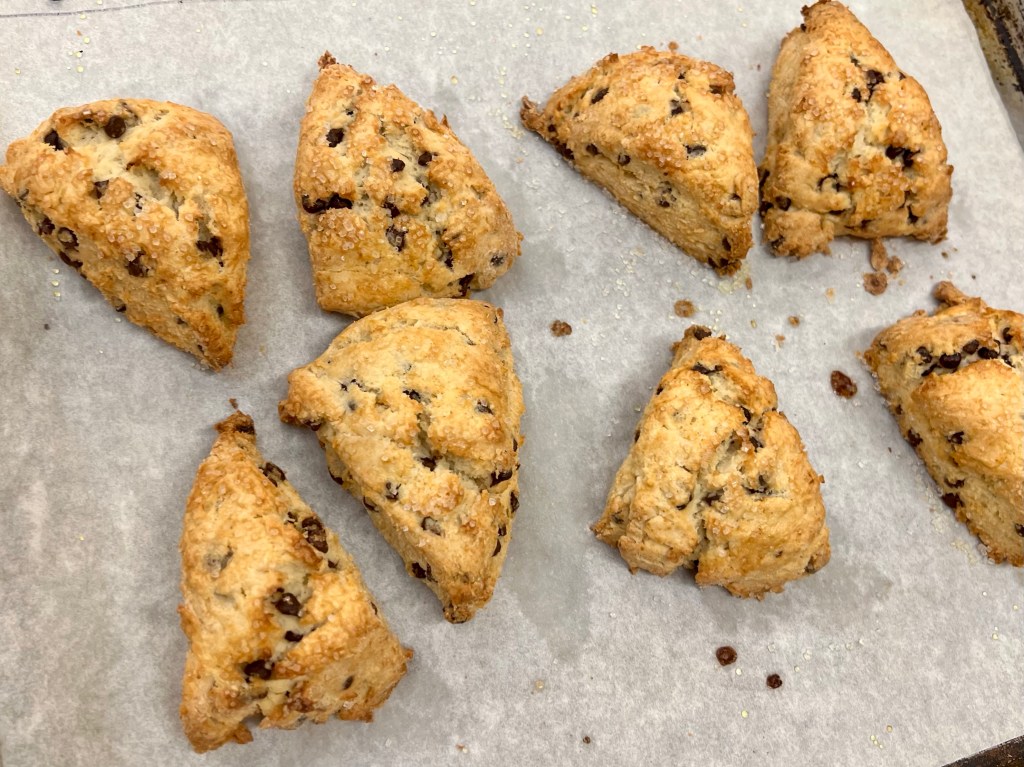
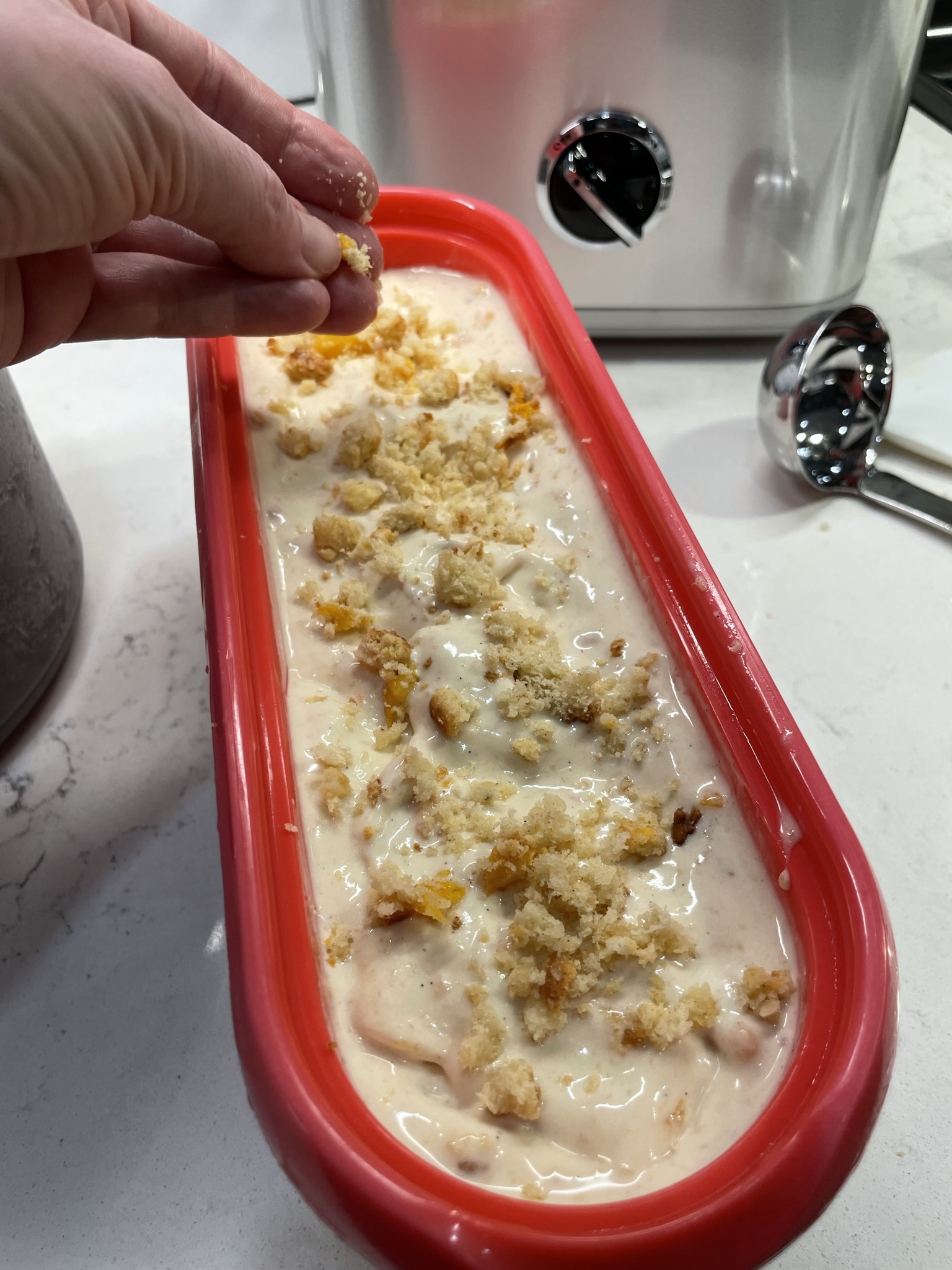
Scones are similar to biscuits in that they use a chemical leavening— baking powder, in this instance— but different because the dough usually incorporates more sweetness and an egg for richness and texture. At the tail end of my Bread: Principles & Practice class, we whipped up a batch of scones as we waited for another bread recipe to do its thing. The scones were delightfully tender, like a biscuit, but sweeter, softer and almost cookie-like. That, I decided, would be a perfect solution for the “cobbler” element of my ice cream, and would you believe it? King Arthur Baking has a recipe for tender peach scones! I whipped up half a batch (exactly as written, if you can imagine), and crumbled two of them to layer in my ice cream. 


I hope I always find something new to learn in the kitchen. This is my blue ribbon-hopeful peach cobbler ice cream, my final bow for this year’s National Ice Cream Month. Enjoy!


Peach Cobbler Ice Cream

  • Servings: About 8
  • Difficulty: Average
  • Print

A cooked puree of peaches adds a concentrated fruit flavor to the base of this ice cream, and tender peach scones provide the 'cobbler' element.


Ingredients

  • 3 fresh, ripe peaches (you’ll puree two and dice the third)
  • 2 teaspoons fresh lemon juice (divided between peaches above)
  • 1 Tbsp. light brown sugar
  • 14 oz. sweetened condensed milk (regular or fat free)
  • 1 cup whole milk
  • 1 cup heavy cream
  • 1 Tablespoon vanilla bean paste
  • 1 Tablespoon vodka (optional, added at end for improved scooping texture)
  • 1 cup crumbled peach scones (recipe linked in story), or substitute as noted below.

To mimic the texture and sweetness of cobbler batter, I baked a half batch of tender peach scones, found on King Arthur Baking website, and crumbled two of them to layer in this ice cream. Other great options would be buttery sweet drop biscuits, a yellow cupcake or even a few snickerdoodle cookies! If you want to skip the cobbler portion, the peach ice cream on its own will still be sweet and summery.

Directions

  1. Peel two of the peaches and add to a blender or food processor bowl. Add one teaspoon of lemon juice. Puree for 20 seconds, keeping a few bits if you wish. Cook the puree and brown sugar over medium heat, stirring constantly, until reduced to about 1/2 cup volume (about 20 minutes). Cool to room temperature, then press a piece of plastic wrap directly onto puree. Refrigerate until thoroughly chilled. Peel and dice the third peach and toss bits with lemon juice to prevent browning. Cover with plastic wrap and keep chilled until ready to freeze.
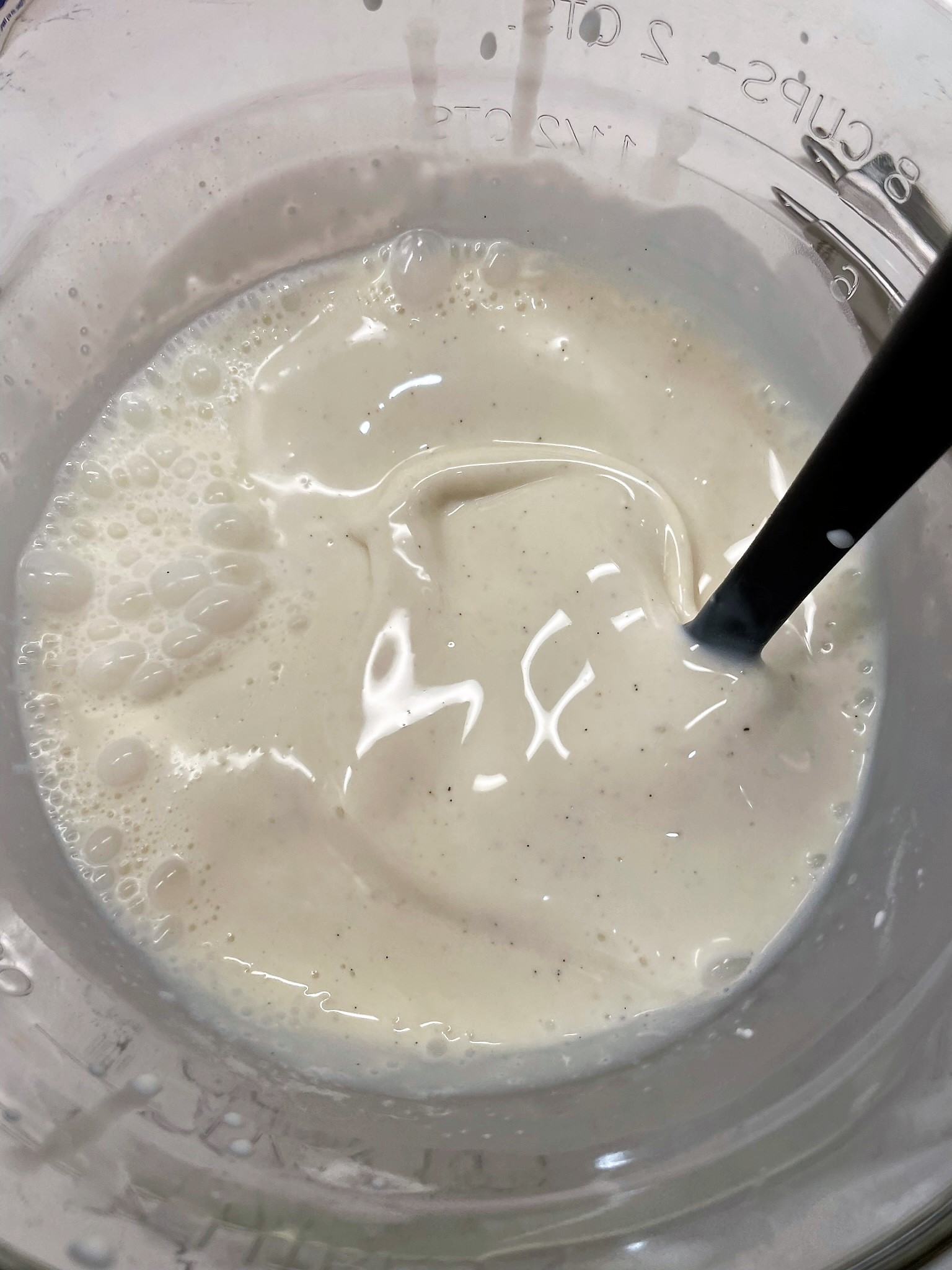
  2. In a large bowl or pitcher, combine condensed milk, milk and heavy cream until evenly blended. Stir in vanilla bean paste. Refrigerate at least 3 hours until thoroughly chilled.
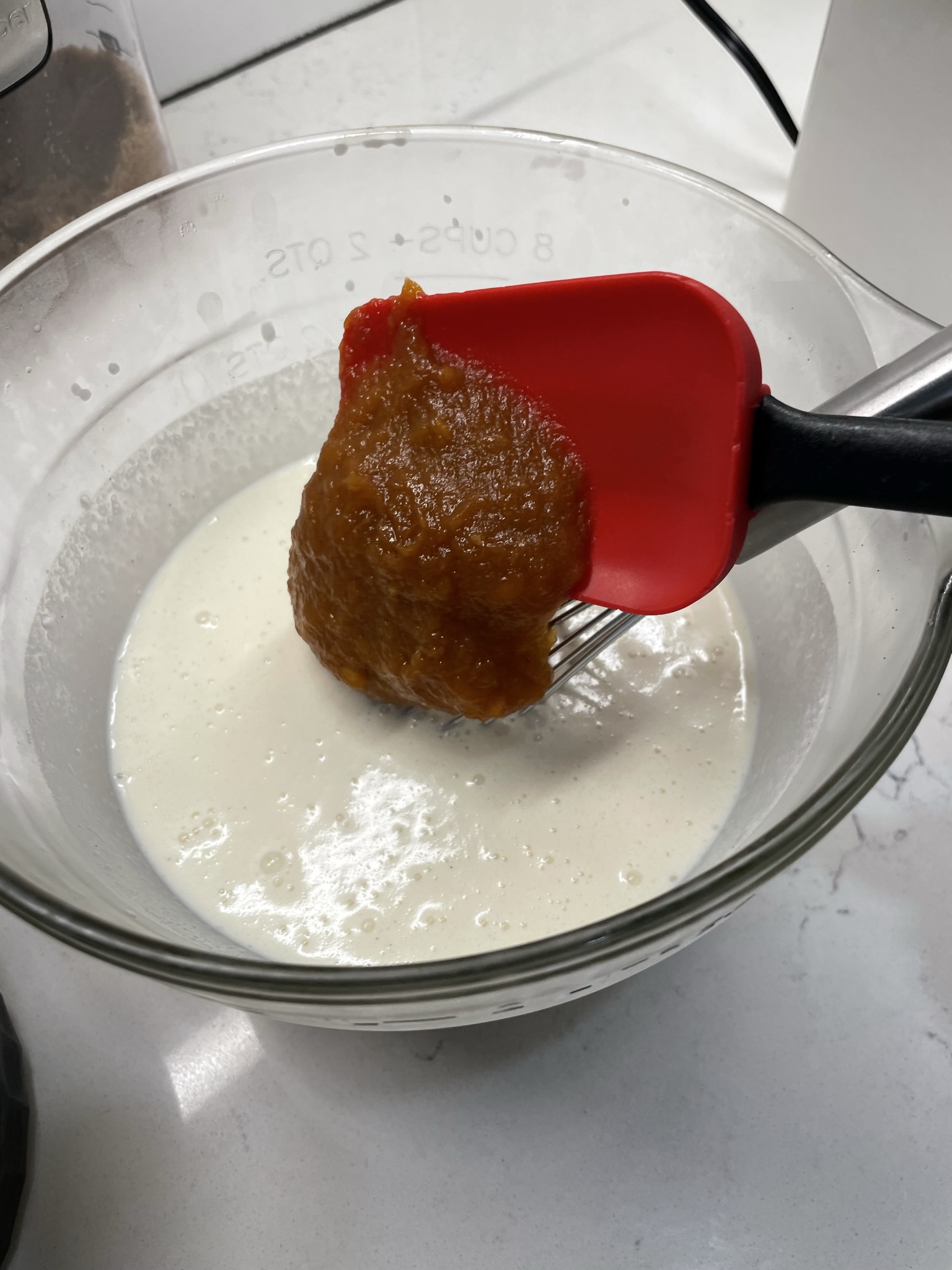
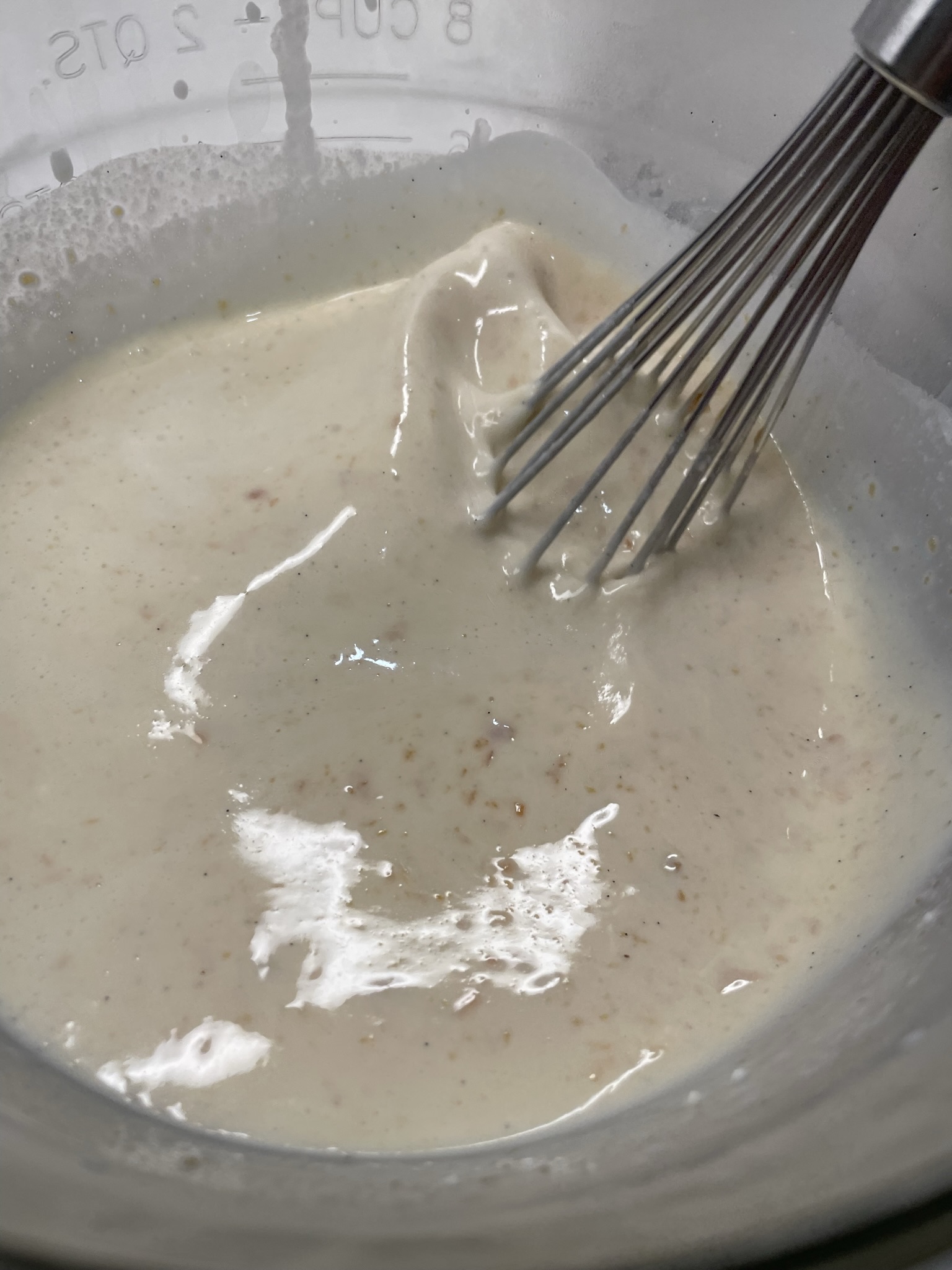
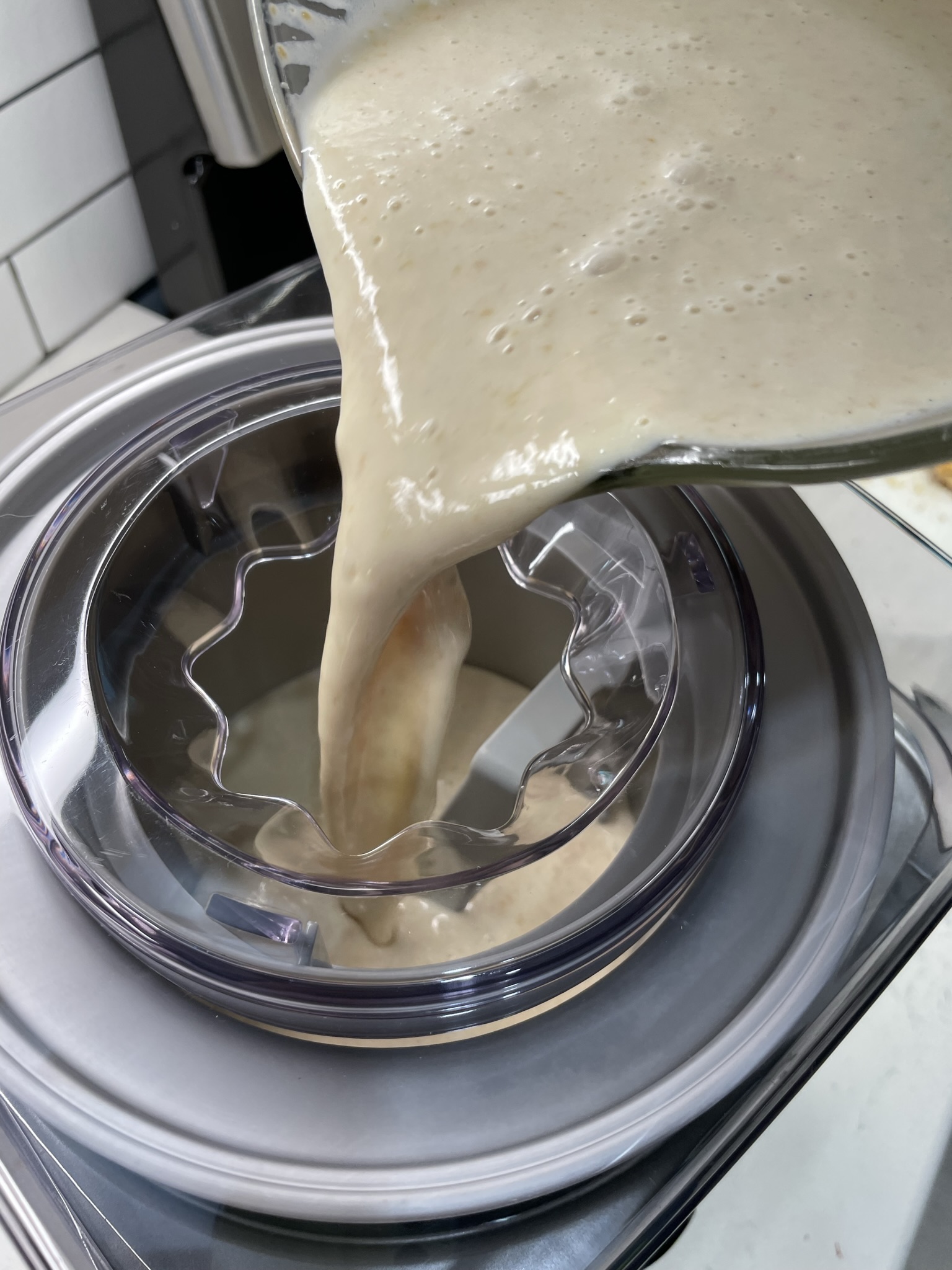
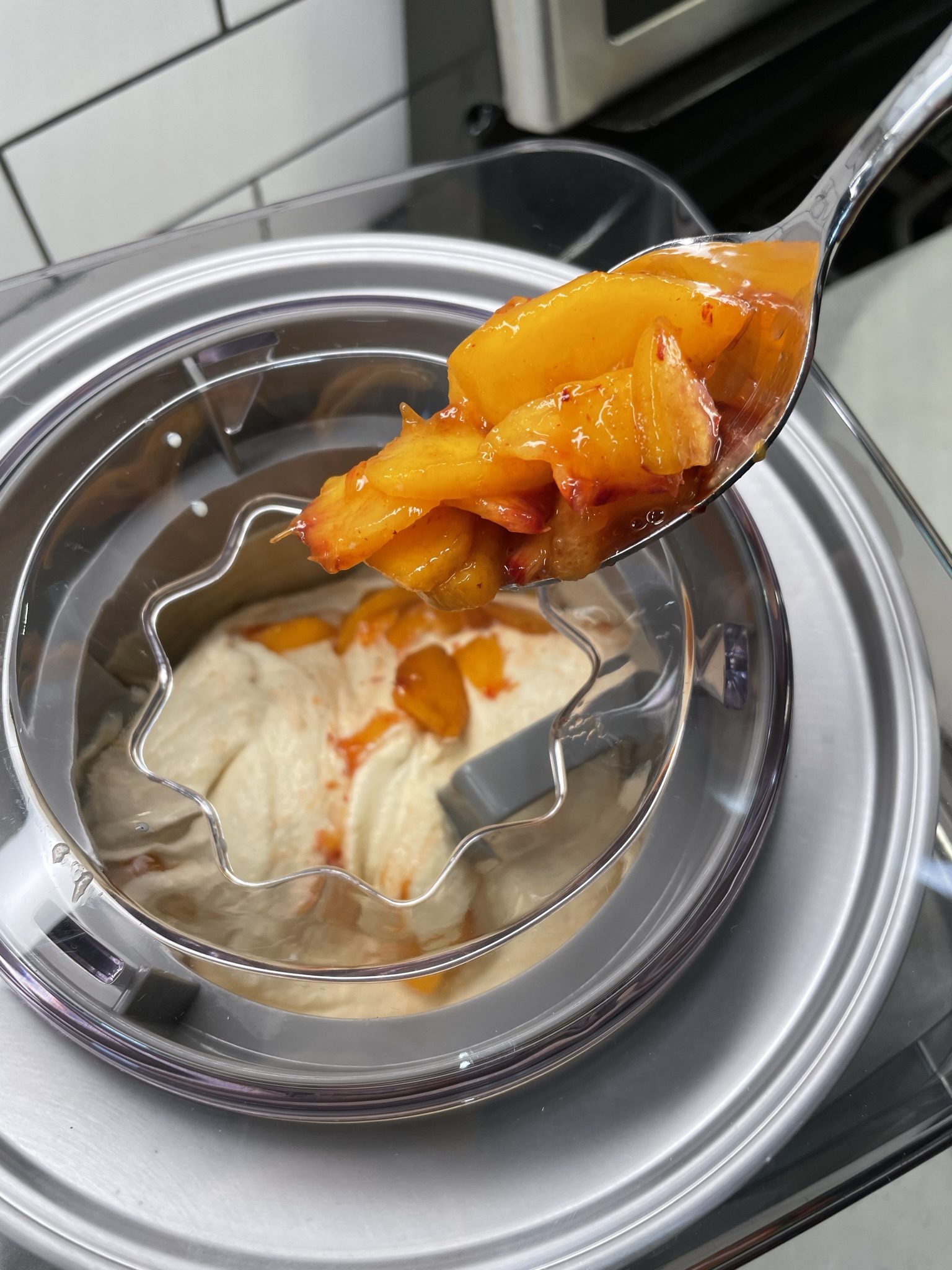
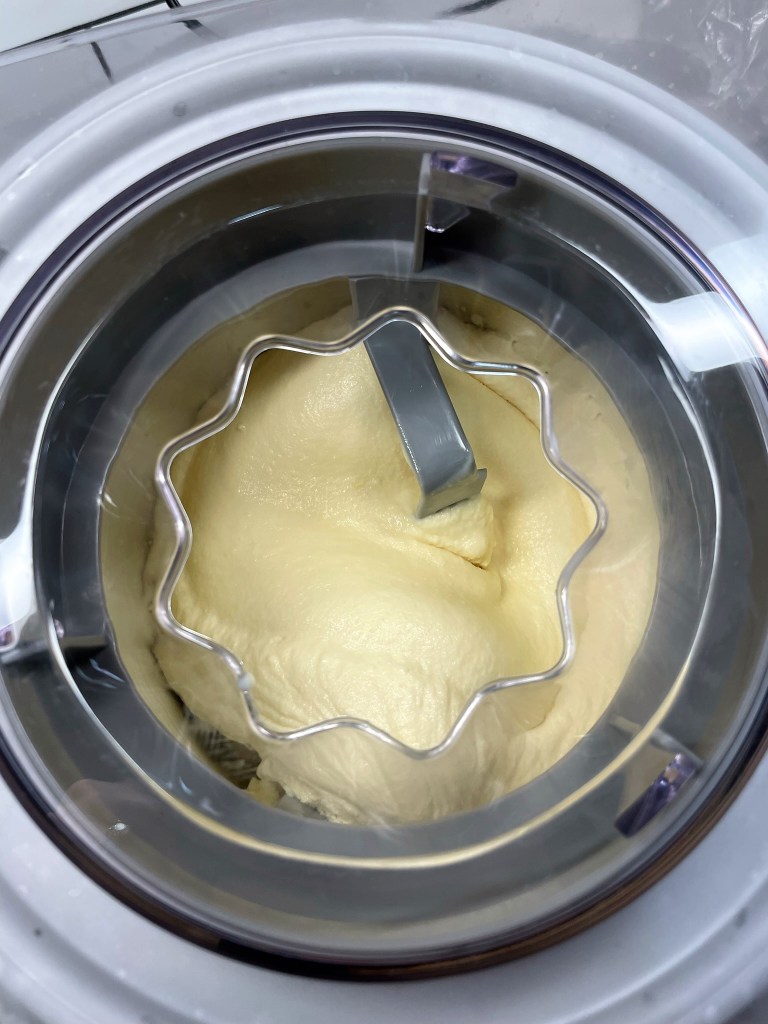
  3. Gently whisk cold peach puree into ice cream base. Freeze in ice cream machine according to manufacturer’s instructions. In the final two minutes of churning, spoon the reserved diced peaches into the machine and pour in vodka (if using). Churn until fully blended.
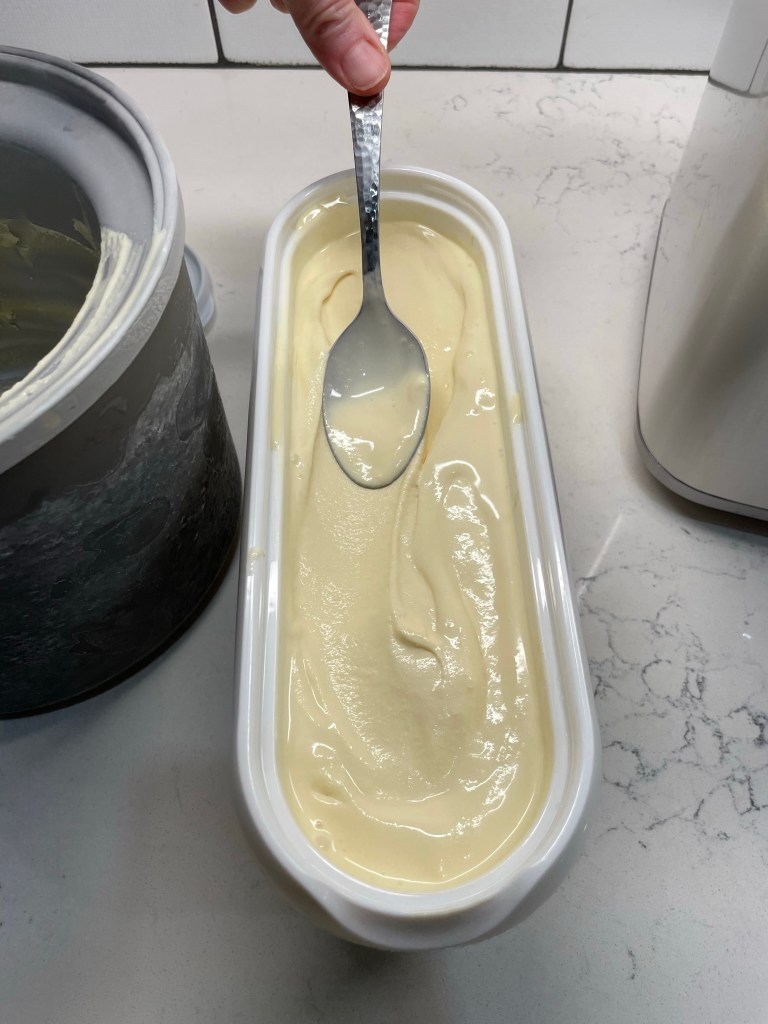
  4. Transfer ice cream to an insulated freezer container, layered with scone crumbles. Cover and place container in freezer several hours or overnight for best texture.


Peach Panzanella

The heat is getting to me, I think. Since I returned from my solo trip through New England, I have barely wanted to cook. It’s just too hot to think about standing at the stove in the late part of the day. Usually in summer, we at least enjoy firing up the grill for a backyard barbecue, but with it being 97° F in the shade at dinner time, the idea of the grill feels even more oppressive than turning on the stove. I only want cool foods, and it better not take long to prepare. Thank goodness for ripe summer tomatoes and sweet southern peaches! 

There’s a saying out there in foodie land that “if it grows together, it goes together,” and I’m not claiming that peaches and tomatoes are good companions in the garden— how could they be, with peaches growing on trees and all— but I do know that they’re both coming ripe right about now, and I may be onto something with this fresh, light (and did I mention easy?) summer salad.

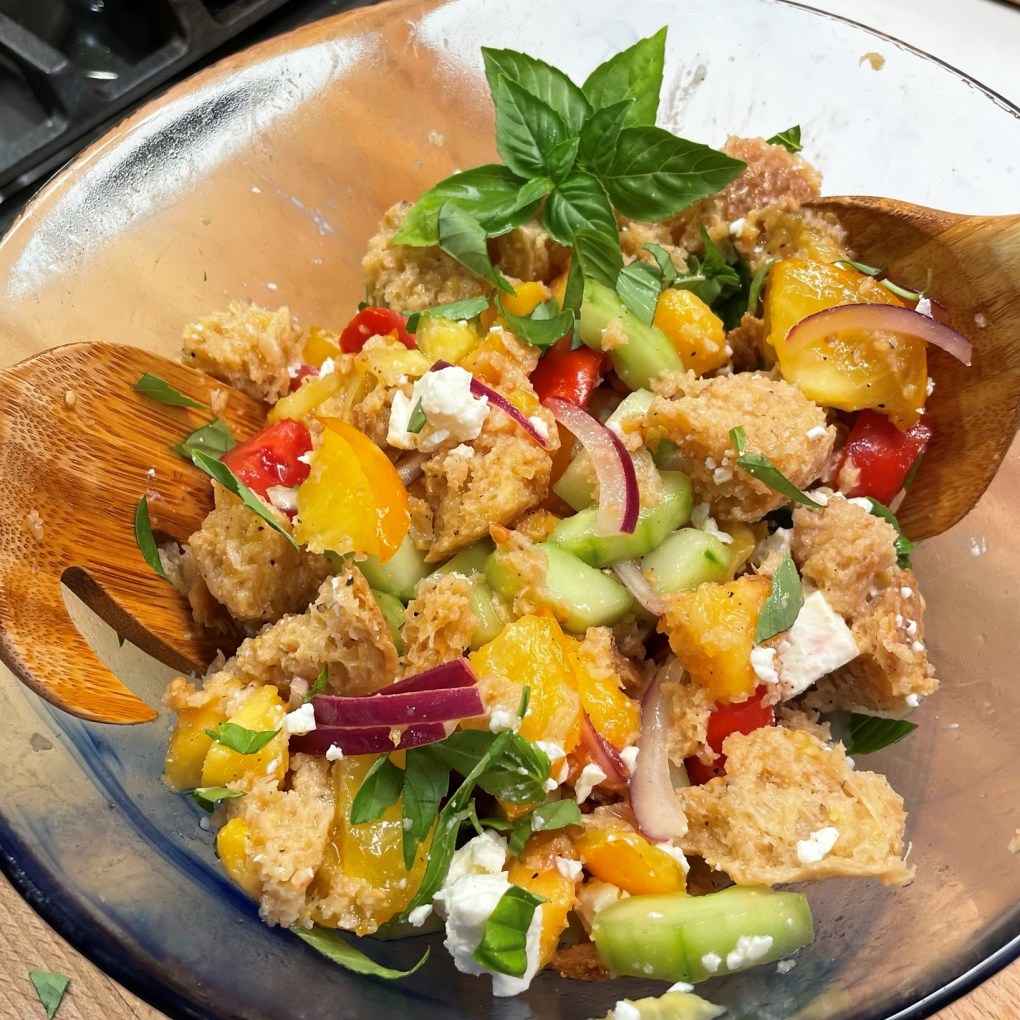
This is one more thing to love about summer!

Panzanella, in case you have never had the pleasure, is a rustic dish of Tuscan origin, usually made with ripe, juicy tomatoes, cucumber and other fresh ingredients, along with chunks of day-old bread that soak up the juices. The bread gives the salad body and bulk, and the rest of the ingredients are cool and refreshing when the summer weather is everything but. 

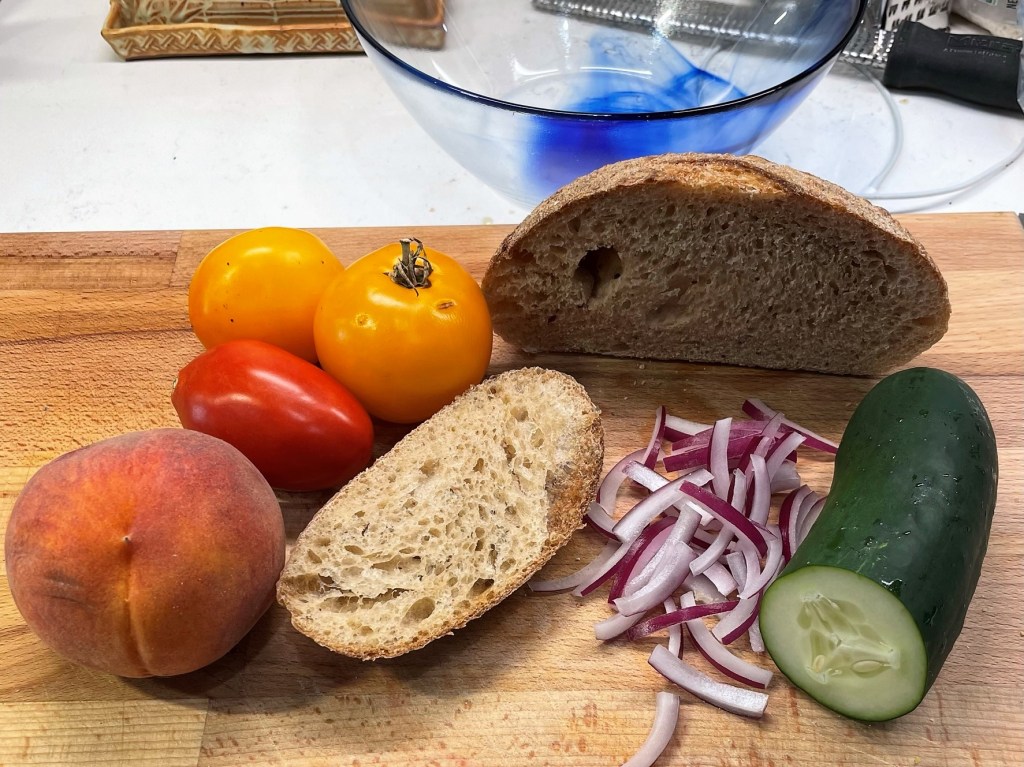
I was about to make a classic panzanella, but then I spotted that peach!

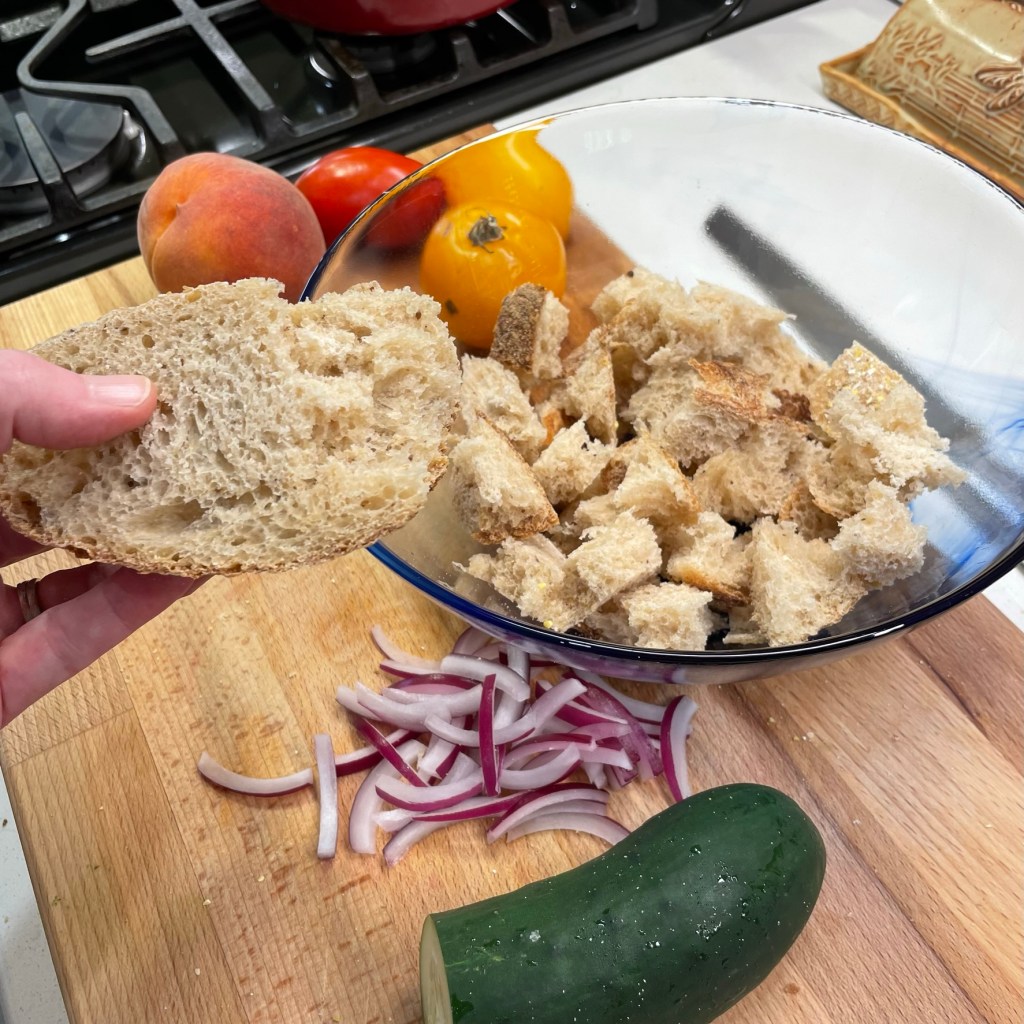
It seems I always have a stale end of bread hanging around the kitchen, and for panzanella, you want the bread to be a “lean” one— that is, not enriched with fats, dairy or sugars. If the bread is soft and pliable, it will quickly turn to mush and you’ll be disappointed in your panzanella. Something like a French baguette or crusty homemade sourdough loaf is perfect because it will generally holds its shape. Whole grain works well, and even seeds on top will work! Tear or cut the bread into small, bite-size chunks, and remove the crust if it seems extra thick or chewy.


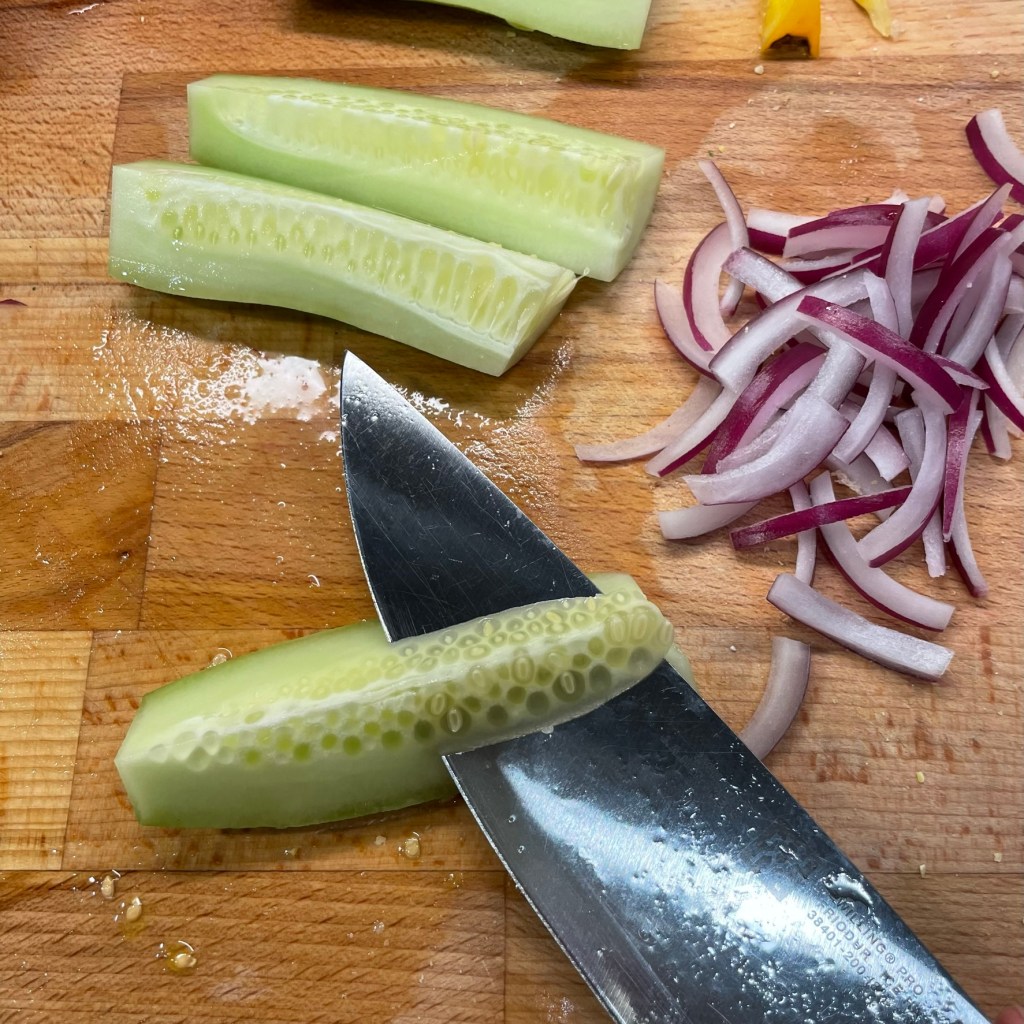
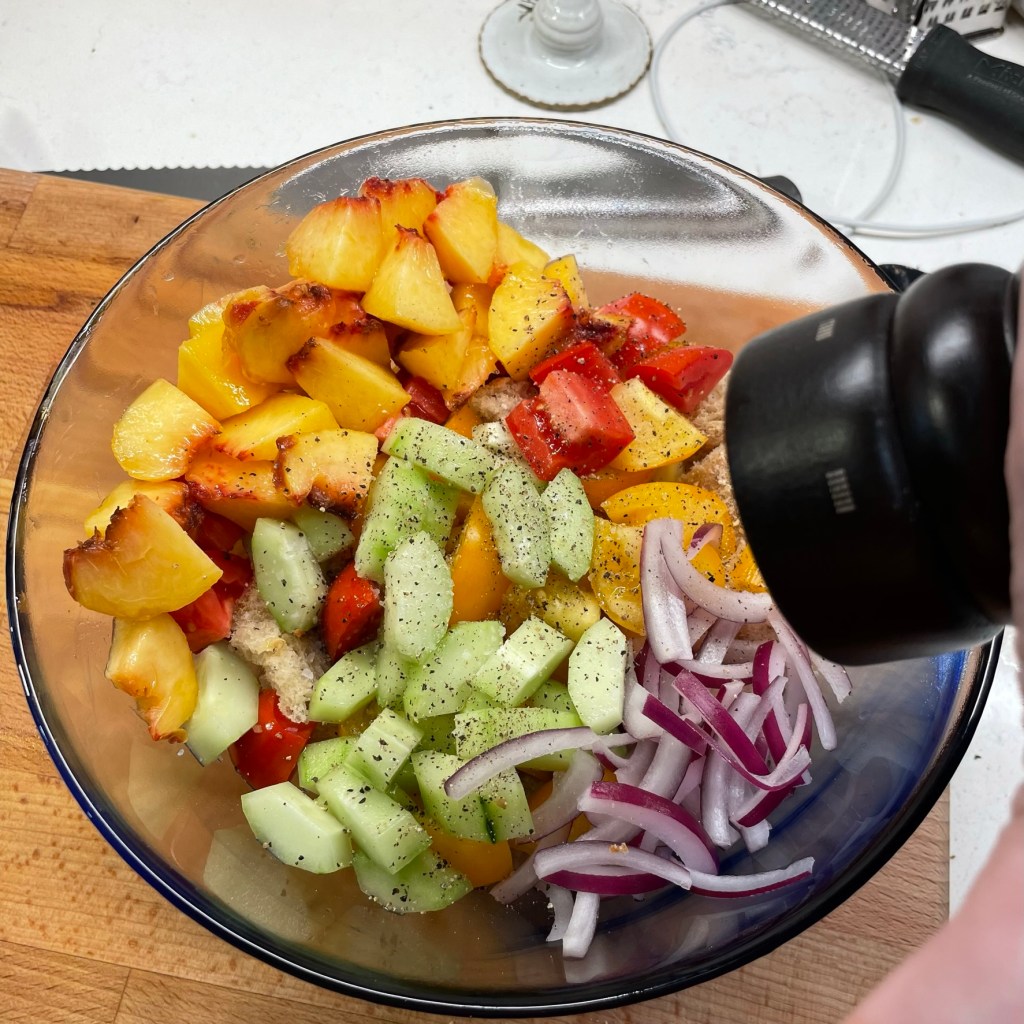
Next, prep all the fresh ingredients, cutting each into smallish bites. My personal rule of thumb for salads to break down the ingredients into small enough pieces that I will be able to get a little bit of everything in a single bite, but not so small that it’s hard to spear them with a fork. I only had a slicing cucumber, so I did remove the tough peel and most of the seeds, but with a Persian or English cuke, there’d be no harm in just washing and cutting it up. A quick seasoning with salt and pepper on all of that, and then I’m on to the dressing. 

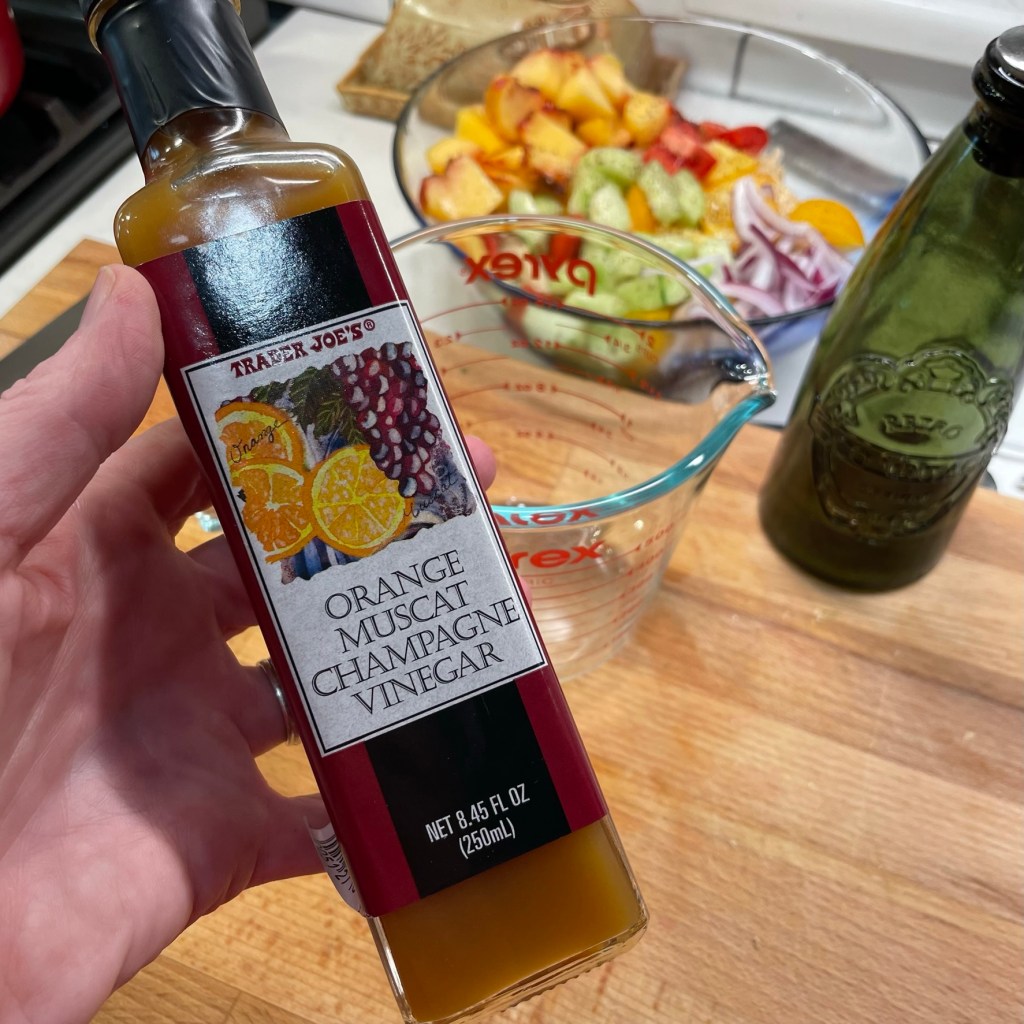
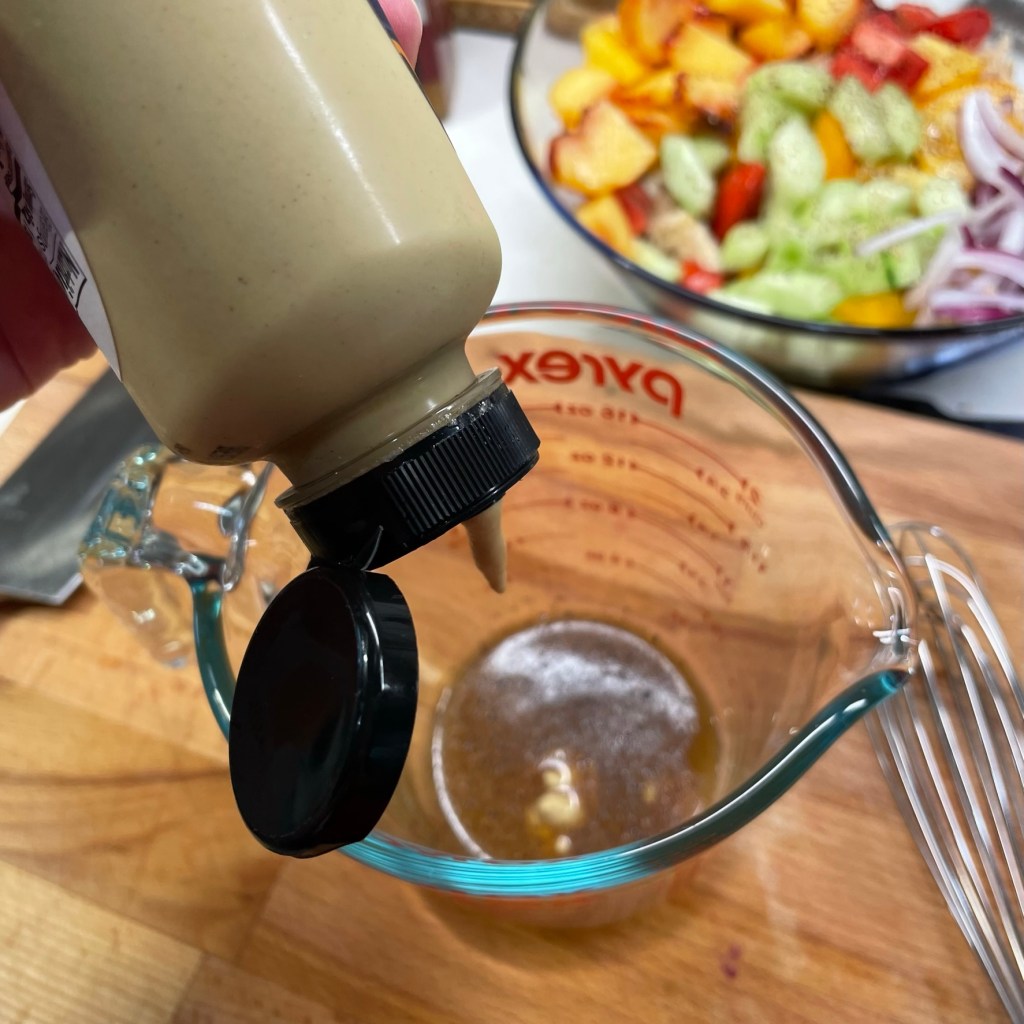
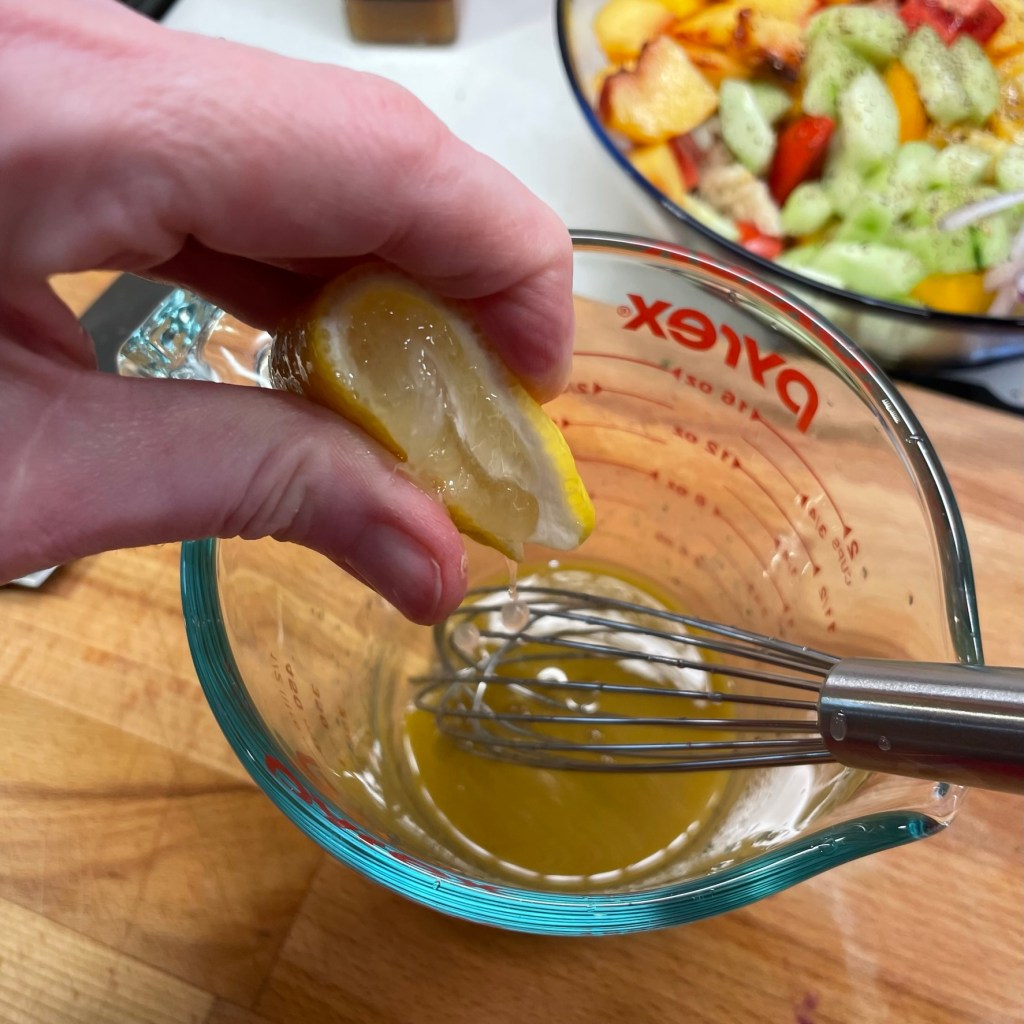
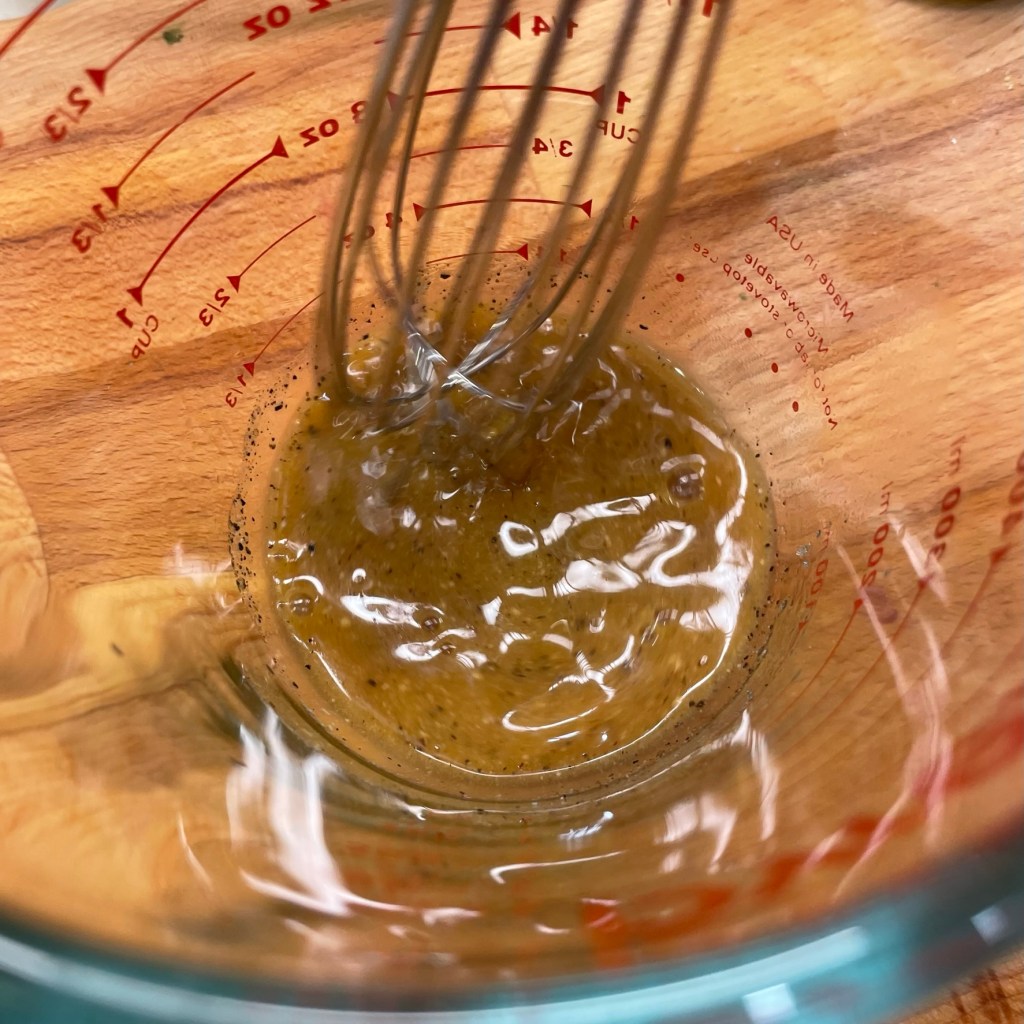
A classic panzanella would be strictly savory, so a vinaigrette with Italian herbs and garlic would be appropriate. But I wanted a lighter, fruitier touch for this one because of the sweet summer peach, so I started with a citrus-y vinegar from Trader Joe’s and jazzed it up with Dijon, a squeeze of fresh lemon and a generous drizzle of fruity, extra virgin olive oil. Any light, fruity vinegar would work well here, or even a white wine or champagne vinegar. If yours is tart and sharp, give the dressing a little balance with a bit of honey or a few pinches of cane sugar. And don’t forget salt and pepper.

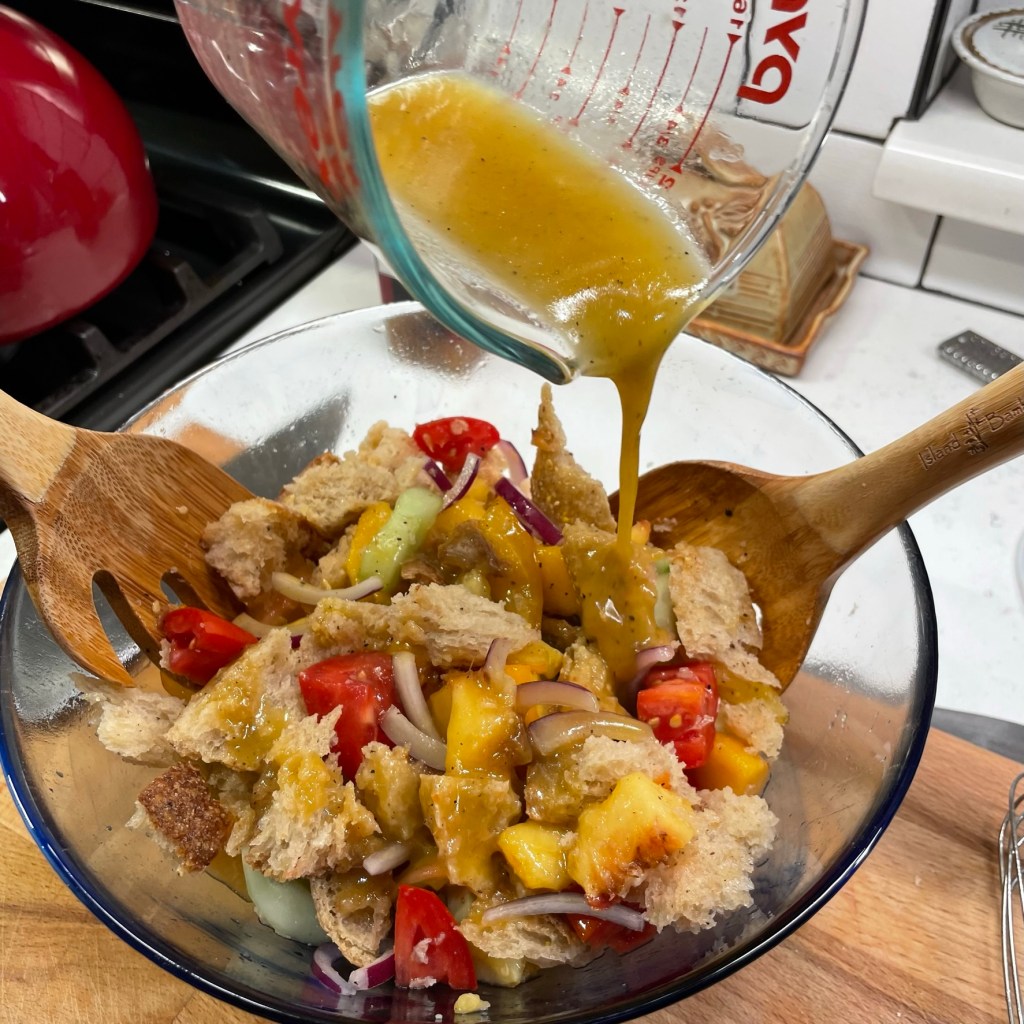
Here comes the best part! Drizzle that dressing all over the salad, and don’t worry if it seems like a lot— the stale bread will slurp it up so it won’t go to waste. Toss gently a few times to fully incorporate the dressing, and allow the panzanella to rest while you set the table. Just for fun, I sprinkled on some feta chunks and fresh, summery basil. Italian parsley would have been just as delicious, or even fresh mint to add another cooling layer.


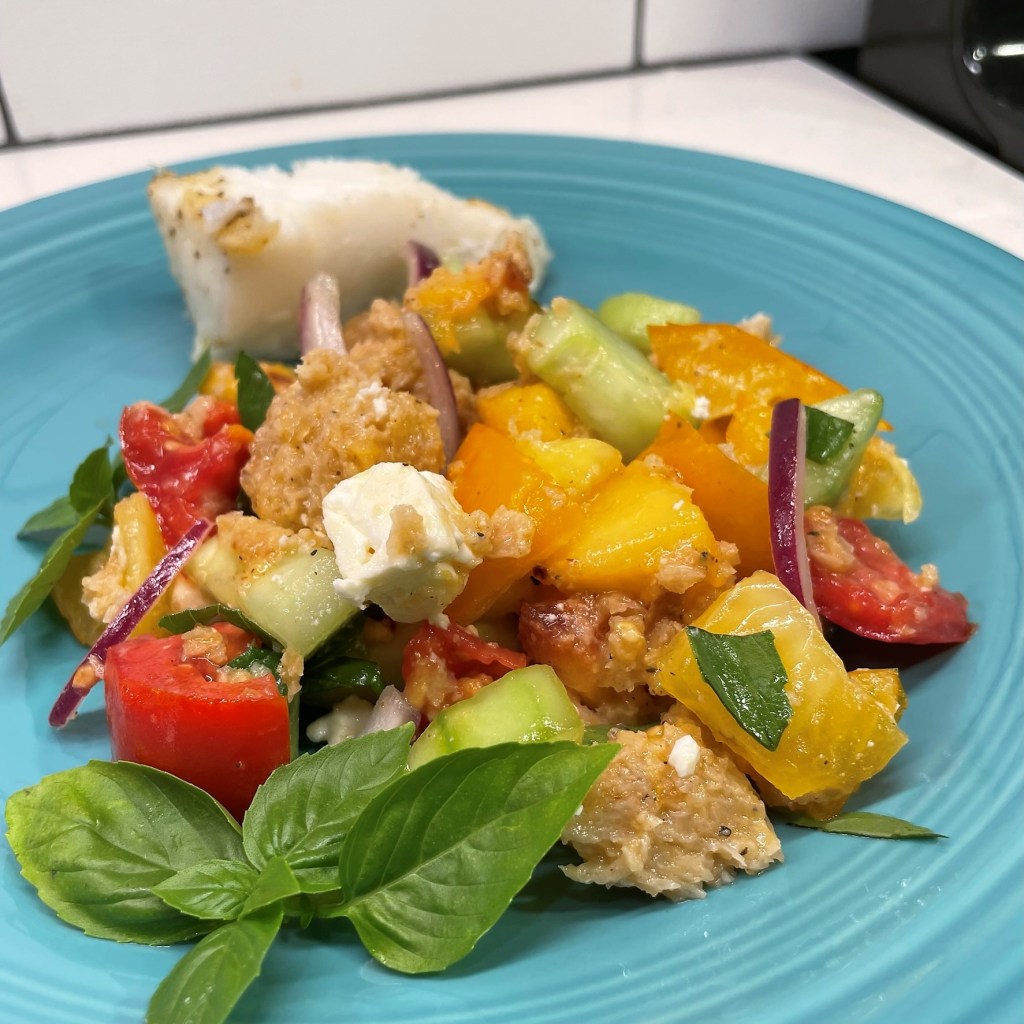
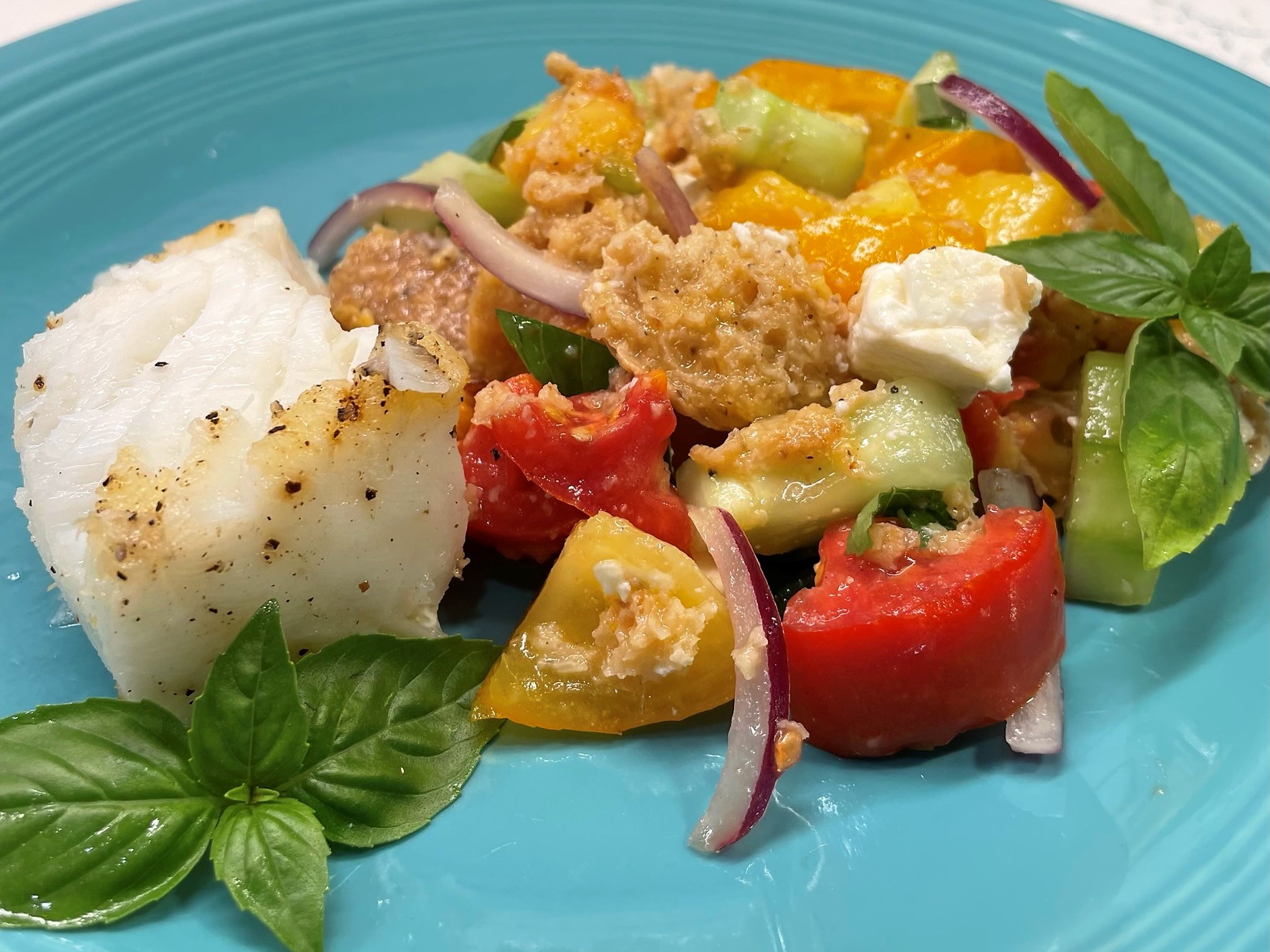
I served my peach panzanella with petite fillets of halibut. They were super easy to make, seasoned with only salt and pepper and baked in the oven for a mere 15 minutes. Easy, quick and done!


Peach Panzanella

  • Servings: About 3
  • Difficulty: Easy
  • Print

A ripe and juicy summer peach puts a delicious and unexpected twist on a classic panzanella. It's a cool and tasty way to beat the summer heat!


Ingredients

  • 3 cups torn sourdough bread (dry or stale)
  • 1/2 slicing cucumber, peeled and seeded
  • 2 small yellow tomatoes, halved and cut into wedges
  • 1 Roma tomato, quartered lengthwise and cut into wedges
  • 1 large ripe peach, peeled and pitted then cut into chunks
  • 1/4 cup thinly sliced red onion
  • 2 oz. real feta, crumbled or cut into cubes
  • Small handful of fresh basil, torn or rough-chopped for garnish
  • Vinaigrette dressing (see below)

The dressing for the panzanella can be made ahead if desired. Choose a vinegar that is light and summery, such as white wine vinegar or something infused with citrus.

Ingredients

  • 3 Tbsp. Muscat orange-champagne vinegar (or something fruity and tart)
  • 1 tsp. Dijon
  • Salt and pepper
  • 1/4 cup extra virgin olive oil
  • 1 tsp. honey or sugar if vinegar is very tart

Directions

  1. Add all salad ingredients except feta and basil to a large bowl, in order, so that bread pieces are on the bottom. Season with salt and pepper and set aside while you make the vinaigrette.
  2. Whisk together dressing ingredients. Adjust salt and pepper to taste.
  3. Pour dressing all over salad. Toss gently to incorporate, and allow the bread a few minutes to soak up the dressing and juices.
  4. Sprinkle with feta and fresh basil. Serve at once.


Spicy Pineapple Daiquiri

I know, I know, the whole “national-whatever-day” may seem a little overboard to some, but the idea of dropping a spotlight onto a special food or drink is fun for me. Without this occasion of National Daiquiri Day, I’d be muddling through a regular old, hum-drum Wednesday. Oh yes, this is much better!

Happy daiquiri day!

If you have never made a daiquiri, I can tell you from experience that it is one of the simplest cocktails out there. Rum, sugar and lime is the essence of this drink, though you have probably also seen variations that included strawberry, and options for the drink to be served frozen, almost like a slushy. Given the brutal heat that is gripping so much of the U.S. this week, nobody would argue against a slushy cocktail right about now, right?

When people are paid fairly for producing excellent products, everyone wins!

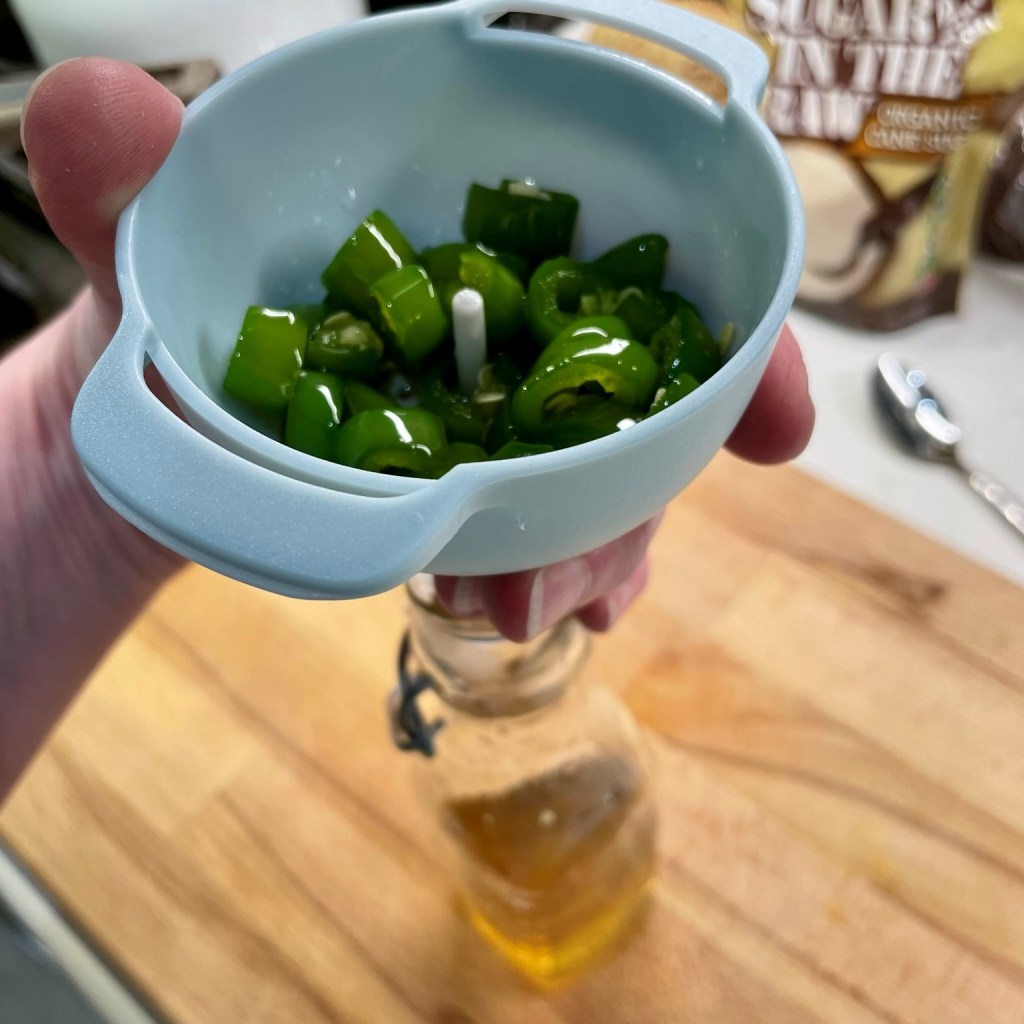
For my fun, Comfort du Jour spin, I’ve applied one of my favorite flavor combinations for a spicy-meets-tropical twist on a classic daiquiri. Fresh pineapple and a Serrano-infused simple syrup are the stars of this show. The syrup can be made ahead in a matter of minutes, and if you don’t have Serrano on hand, a jalapeño will do just fine. Any sugar can be used, but I love the richer, warmer flavor of turbinado, and we always shell out a little extra for fair trade. Equal parts water and sugar will make the simple syrup, and a cut up Serrano adds the spicy zip. Intensify the heat, if you’d like, by keeping the pepper’s seeds and membranes intact during infusion. Or scoop them out first for a milder bite. I’ll bet you can guess what we did at our house!


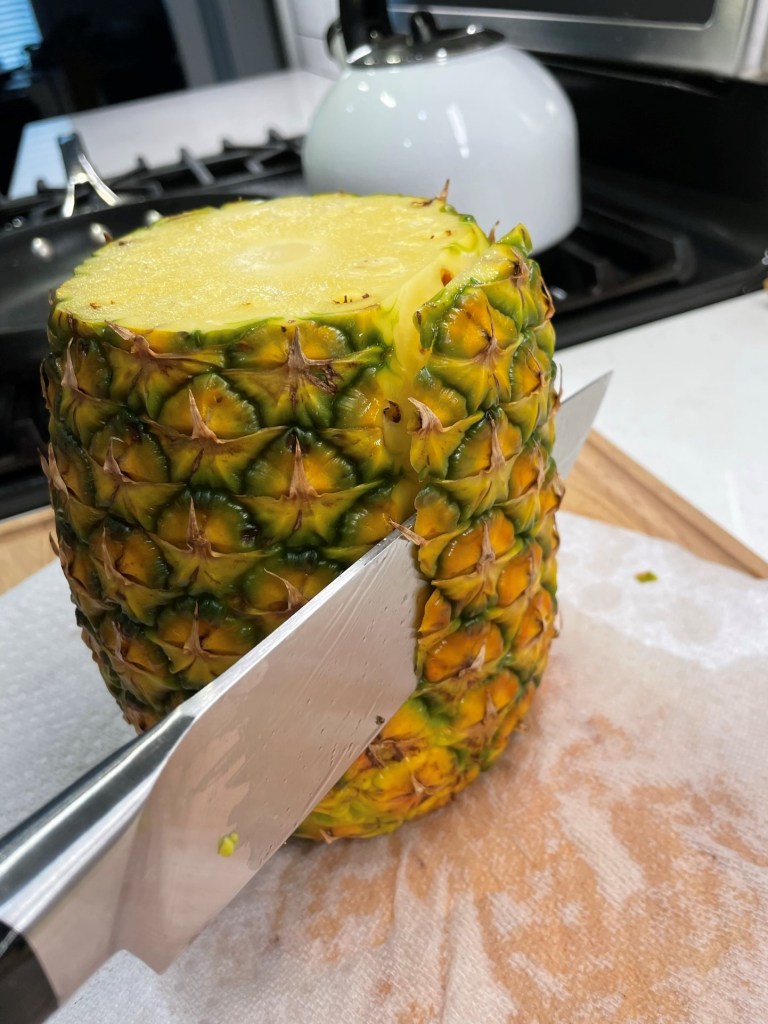
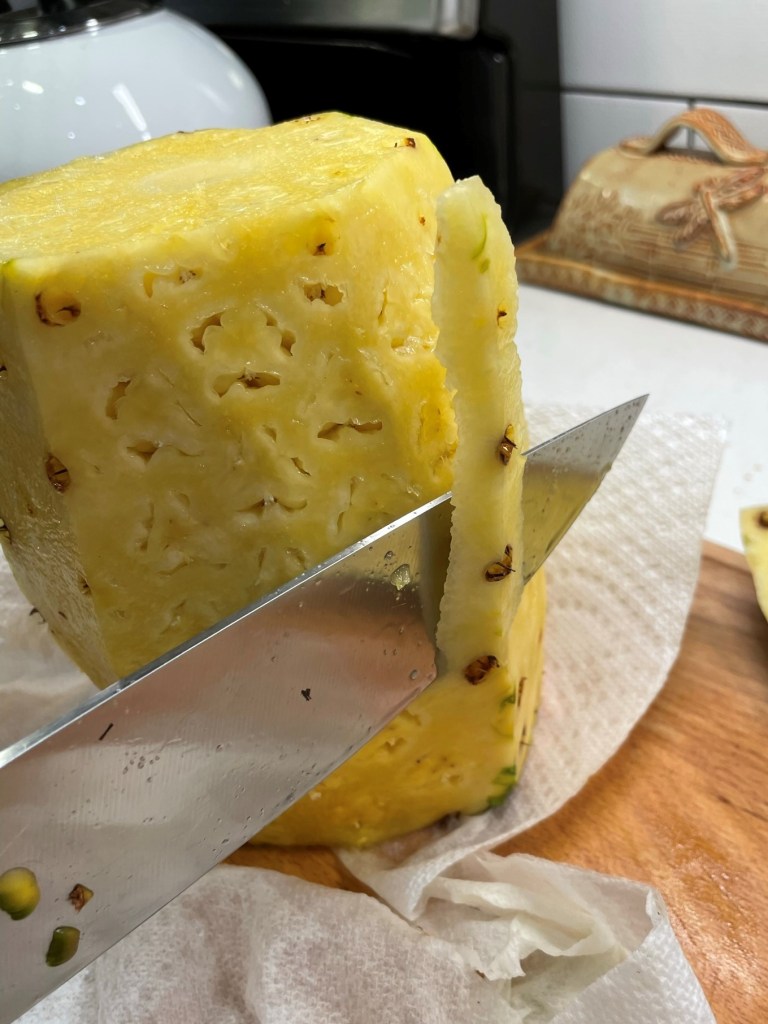
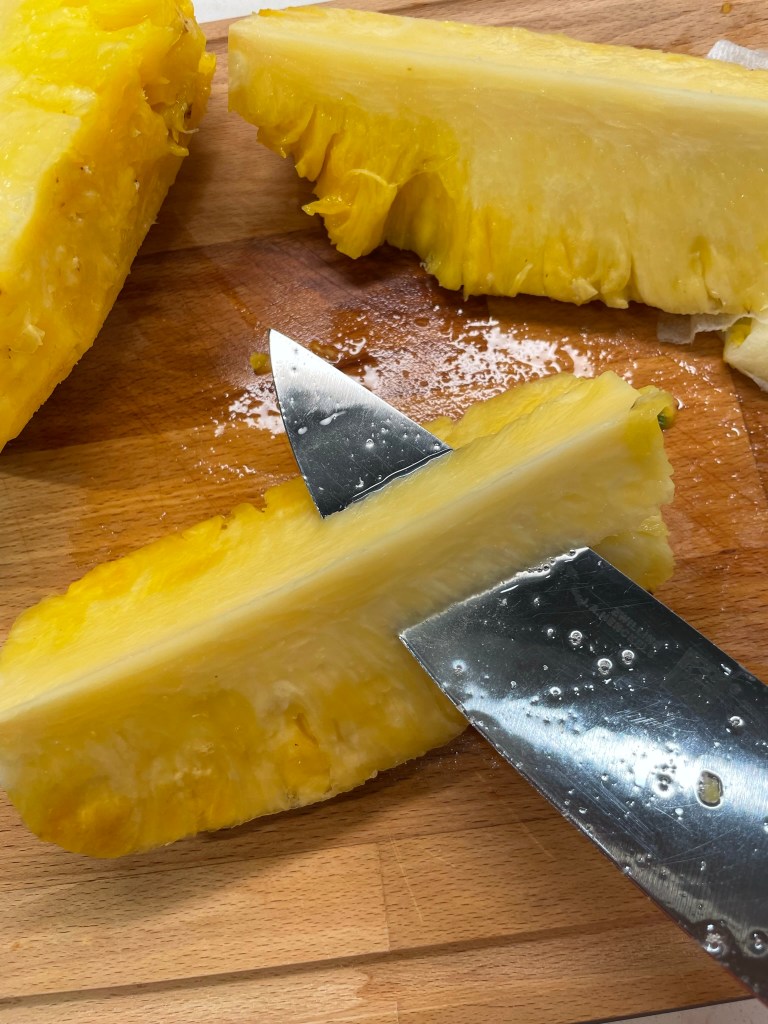
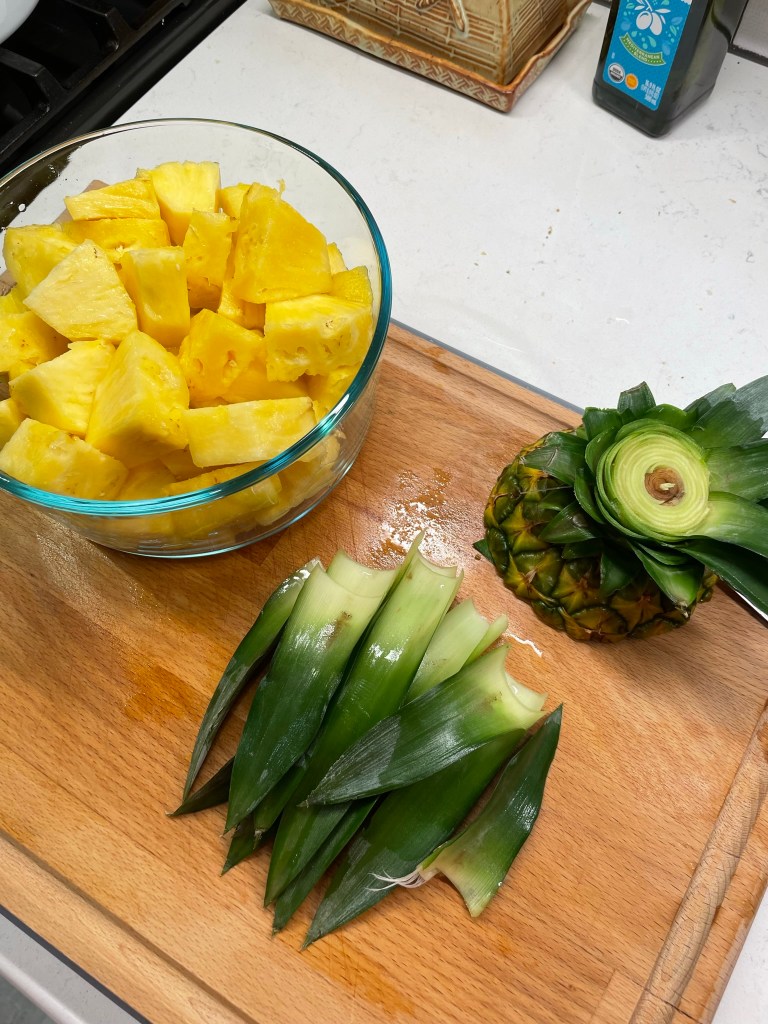
Cool it down completely, then strain out the pepper chunks and transfer it to a jar or bottle. Keep the syrup in the fridge until you’re ready to mix. Breaking down a fresh pineapple is easy to do, as you’ll see below. This one was so fresh and juicy, and the aroma was positively intoxicating!


I used the sweetest, freshest pineapple, and I highly recommend that you choose one at its peak ripeness. Not sure how to tell? Check out this article for tips on selecting the best of the bunch, and if you need help finding other ways to enjoy the rest of your perfect pineapple, I’ve placed a carousel of ideas at the end of the post, just after the click-to-print recipe.

Easier than you thought, right?

The other ingredients in my daiquiri are simple and obvious— light rum, and for this beauty, I relied on Sungrazer golden rum from Broad Branch Distillery, our favorite local spirits provider. But any light rum that isn’t “spiced” or “aged” will work great here. Fresh lime is important; please don’t ever use the green plastic squeezy bottle when making a cocktail. Your taste buds deserve the real deal! And you’ll need ice, of course, either for shaking the drink or (as I opted) blending it right in.

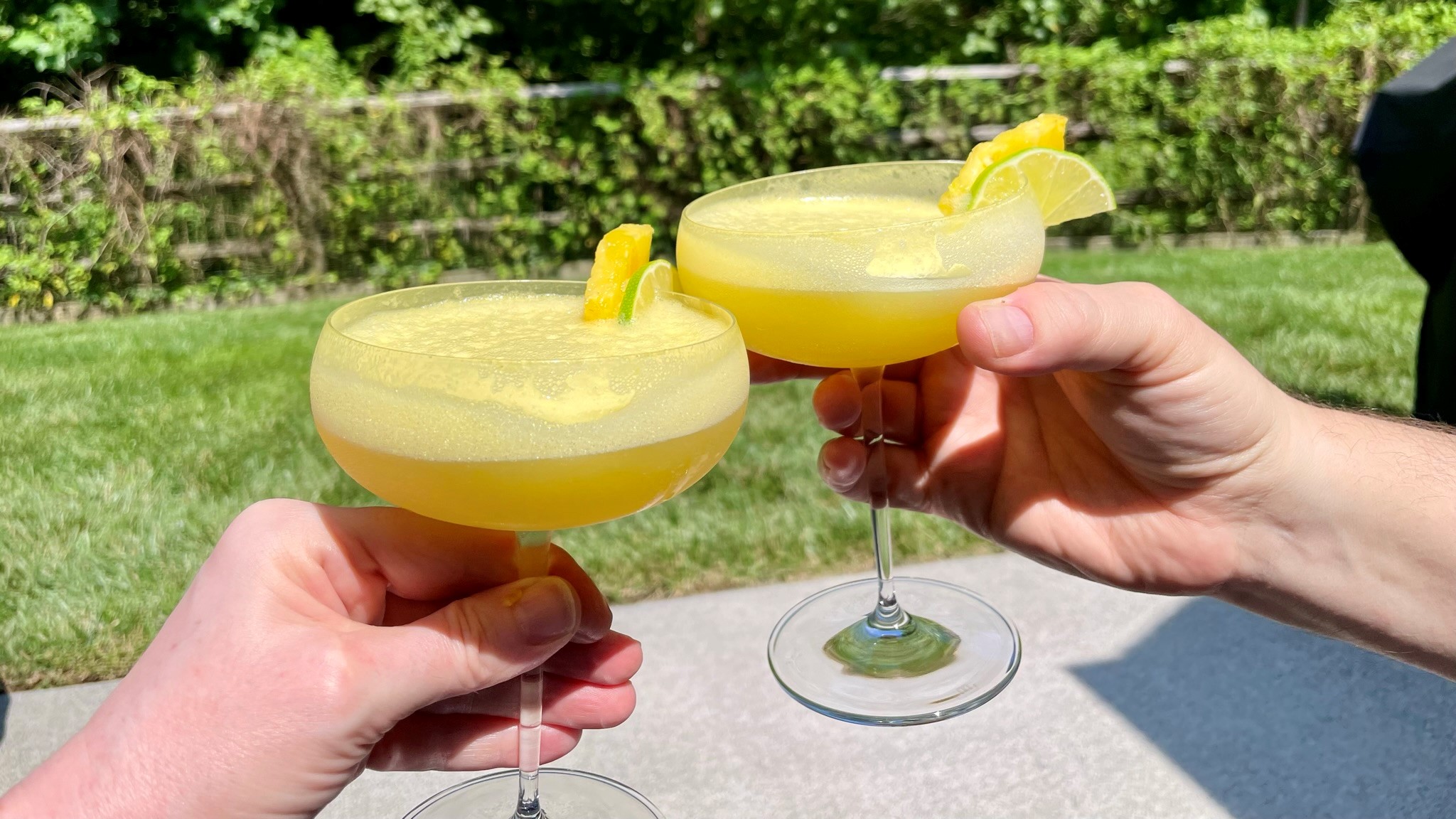
You can pour your spicy pineapple daiquiri over fresh ice or straight into a chilled coupe glass, as you wish. Doesn’t it look just like liquid sunshine?


Spicy Pineapple Daiquiri

  • Servings: 2
  • Difficulty: Average
  • Print

One of my favorite heat-sweet combinations is flinging a classic daiquiri into spicy-meets-tropical territory!


Ingredients

  • 4 oz. light or golden rum
  • 1/2 cup fresh pineapple chunks
  • Juice of one large lime
  • 1 oz. Serrano-infused simple syrup (see below)
  • 1 cup ice (for blending)
  • Lime and fresh pineapple for garnish

Directions

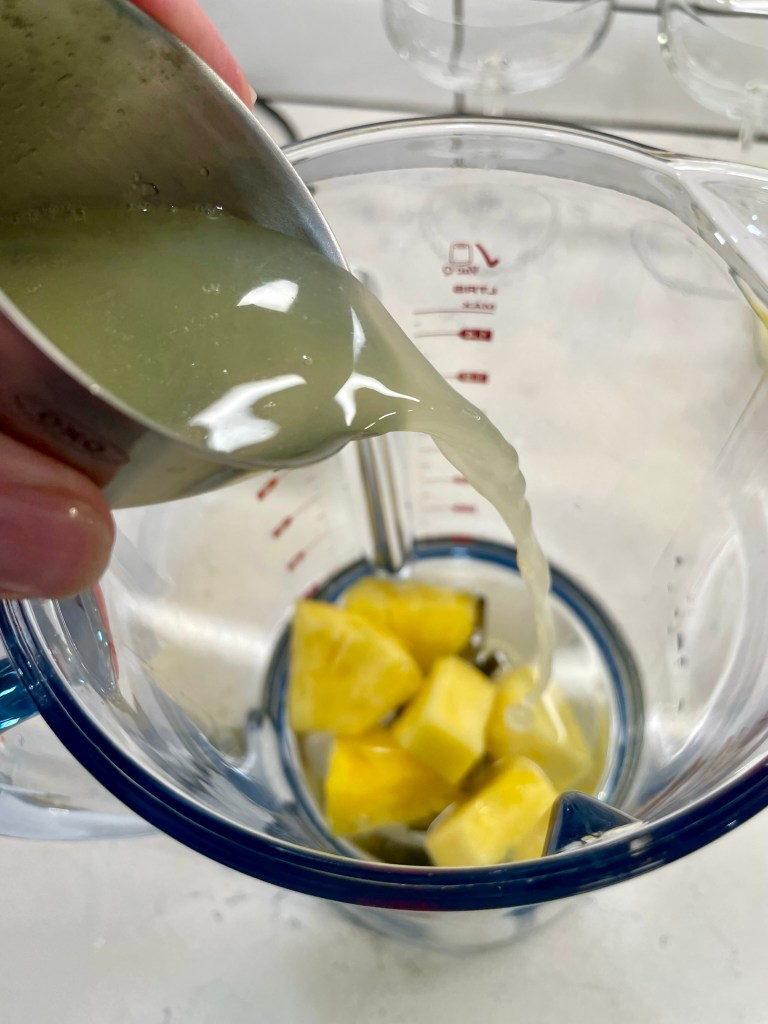
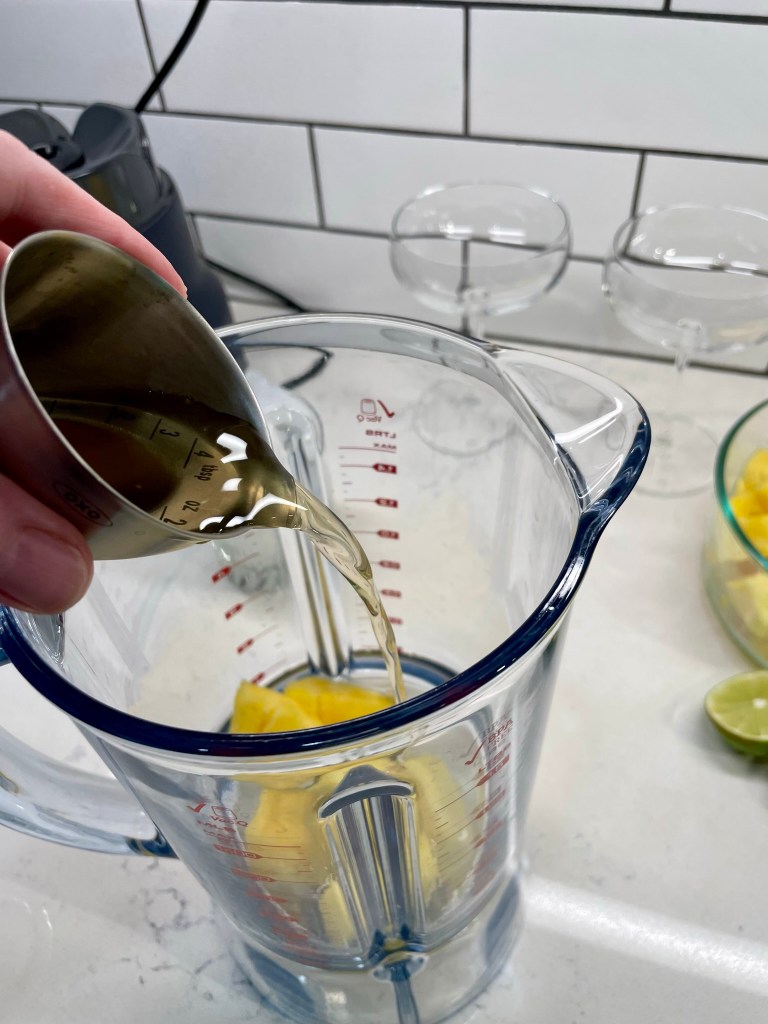
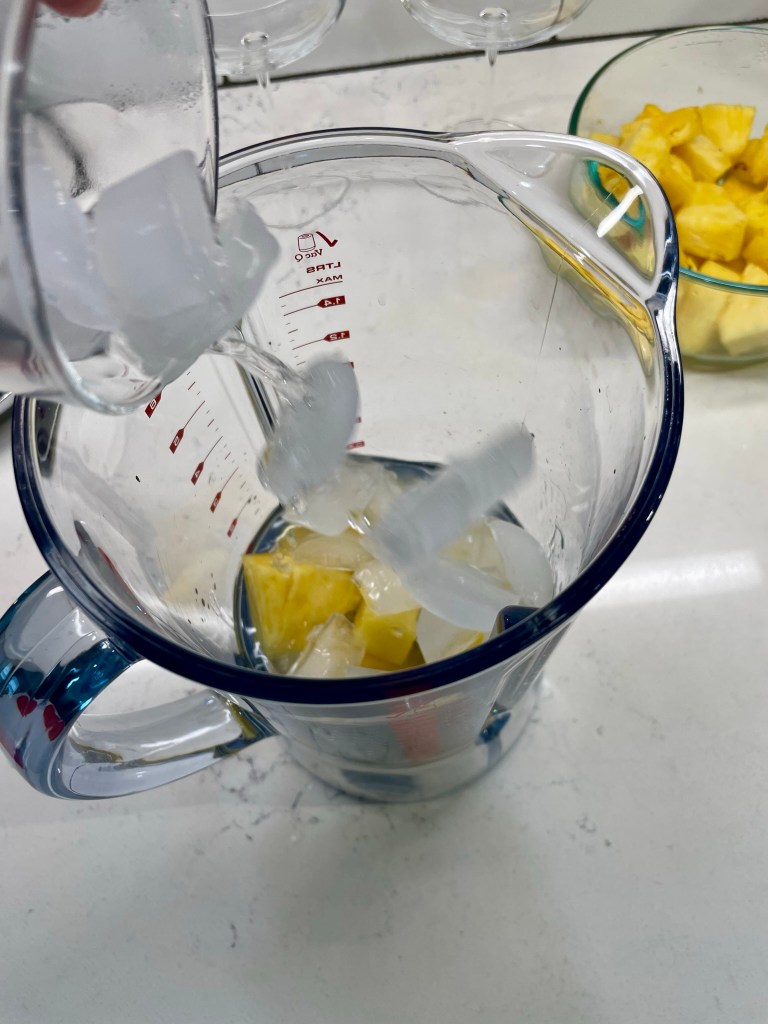
  1. Combine all ingredients except garnish in the pitcher of a blender and process until ice is finely blended and mixture is somewhat frothy. Divide between chilled cocktail glasses and garnish with thinly sliced lime and pineapple.
  2. Alternatively, you may add all ingredients to a cocktail shaker and shake until the outside of the container is frosty. Strain over fresh ice into a rocks glass and garnish as desired.

Serrano-infused Simple Syrup: Combine 1/2 cup each sugar and water in a small saucepan and bring to slight boil. Stir in a chopped Serrano chile pepper. Remove from heat and steep until cool. Strain out chile pieces and transfer syrup to a jar or bottle. Refrigerate up to three weeks.


Here’s some more fun pineapple recipes!


Creamsicle Ice Cream

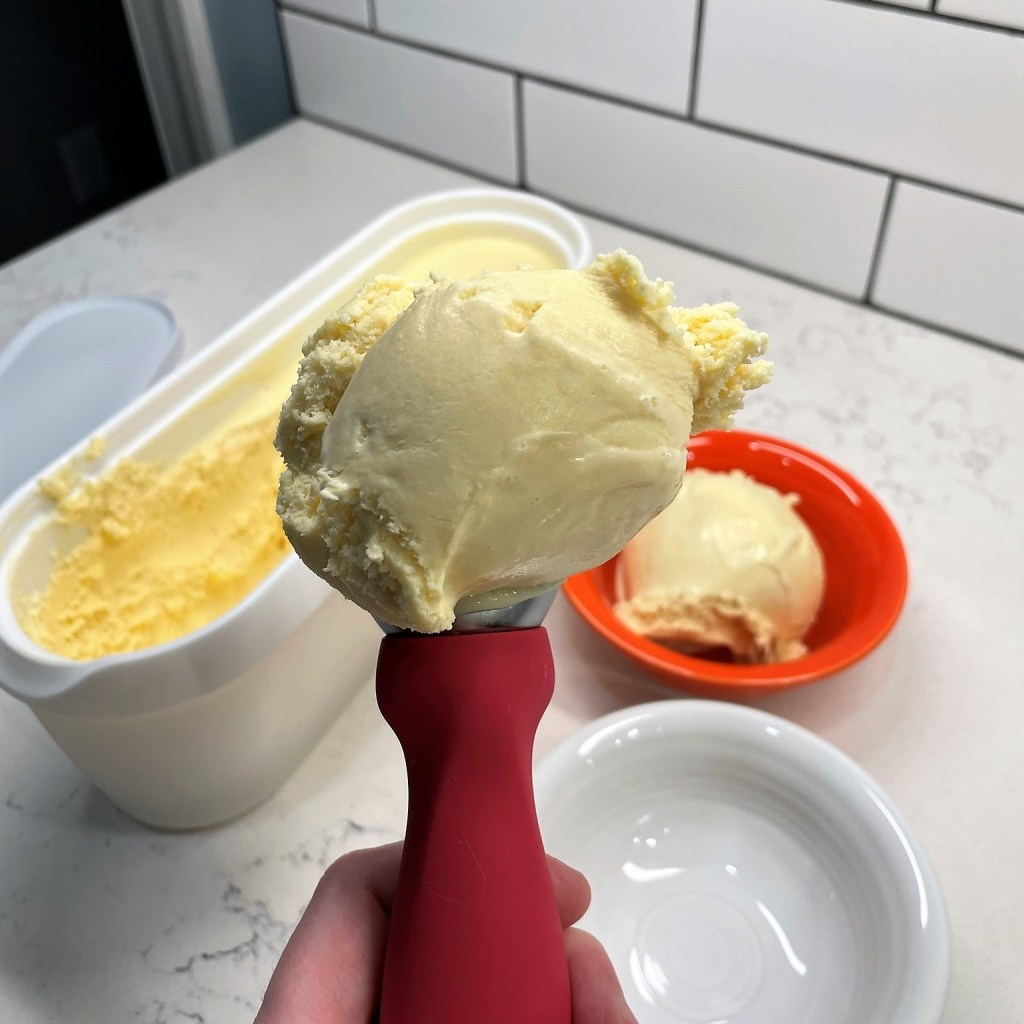
Do you remember your favorite frozen summertime treat? I had three, and they were pretty much neck and neck: an ice cream called “blue moon,” with an unidentified fruity flavor and bits of pineapple (one day I will figure out how to make it), the Rocket Pop in all its red, white and artificial blue glory, and of course, the Creamsicle. That combination of orange sherbet over vanilla ice cream on a stick was synonymous with summer in my youth. I loved it so much that I can’t resist sharing my scoopable version of a Creamsicle to kick off National Ice Cream Month.


I feel great about this ice cream for a few reasons. First, of course, is the nostalgia of it. The mingled flavors of vanilla and orange take me back to the summers of the 1970s, when life was so carefree. It conjures memories of splashing at the community pool with friends and walking barefoot in the freshly cut grass behind my grandmother’s house. I envision water balloon fights and the familiar sound of the ice cream truck coming down the street, drawing the kids like moths to a flame. God, I loved those days.

This is also exciting for me because my previous efforts at Creamsicle ice cream fell sorta flat, probably because I was still relying on my custard-based ice cream formula. Custard ice cream is wonderful, but it’s a lot of effort and sometimes the richness overpowers the flavors. The first time I used sweetened condensed milk for my ice cream— it was when I made S’mores Ice Cream, and I did it to keep the color nice and white— was a major “aha” moment for me. Homemade ice cream doesn’t have to be so fussy as standing over the stove tempering egg yolks and cream, crossing your fingers that you don’t scramble the eggs and have to start over. Then waiting for the mixture to cool overnight before you can churn it? It’s so extra.

Sweetened condensed milk provides an excellent, smooth texture in the base of an ice cream, it provides exactly the right level of sweetness, and it comes with a bonus advantage in that you can swap in the fat-free version with almost zero impact on the texture. Delicious ice cream and reduced guilt? Sign me up!

Who’s ready for some ice cream?


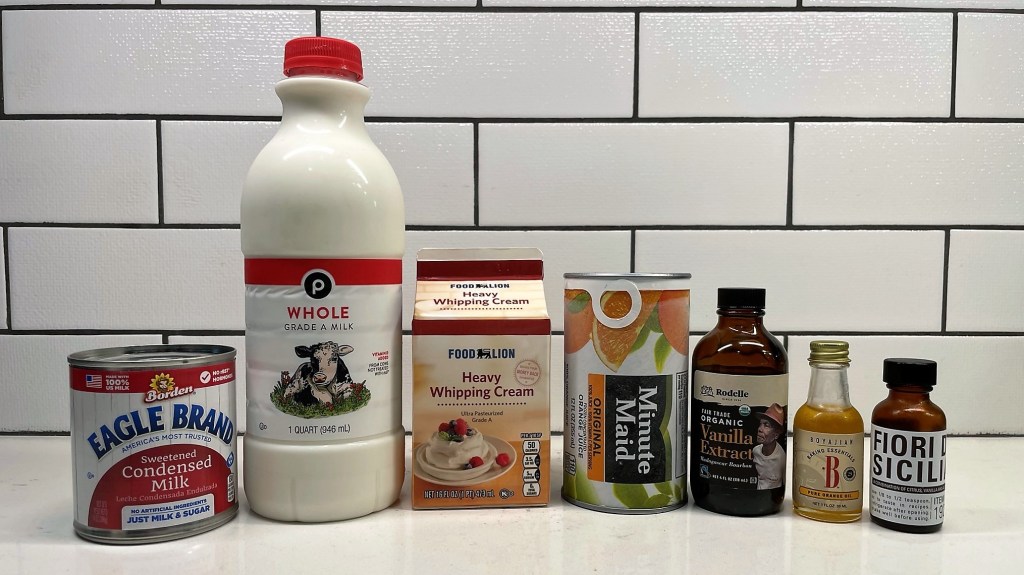
The base of this ice cream is so simple, with only four main ingredients— milk, cream, condensed milk and frozen orange juice from concentrate. The addition of vanilla extract alone would give the impression of a Creamsicle, but I’ve amped up the intensity with two secret weapons that I highly recommend.


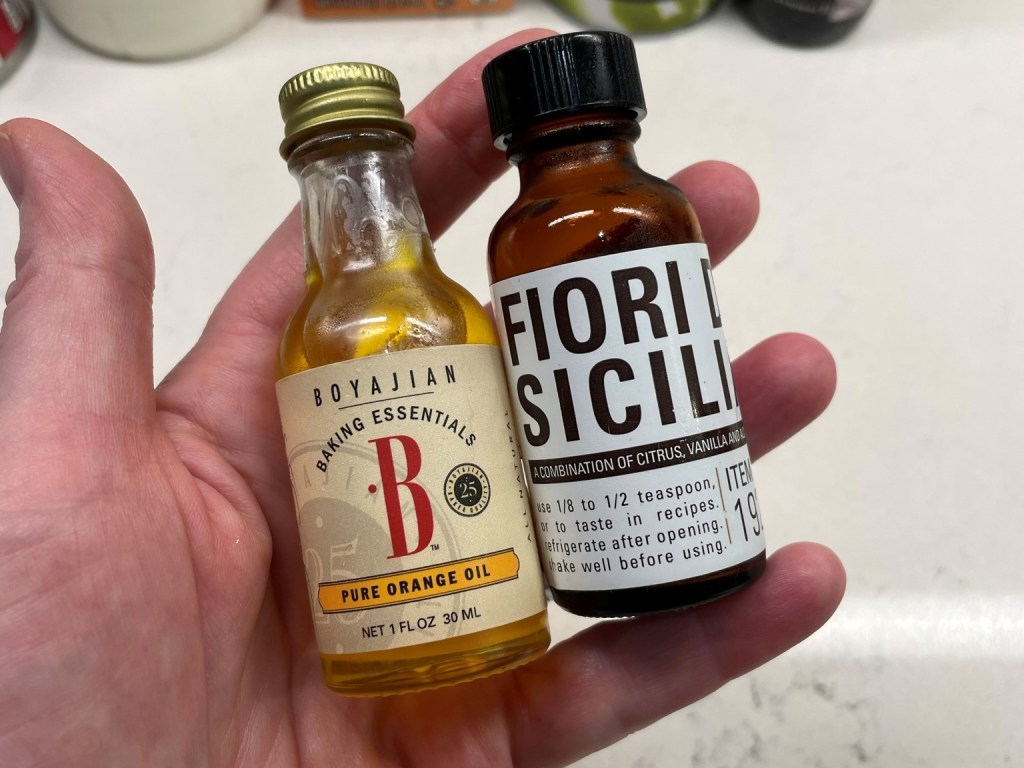
Orange oil is derived from real orange peel, and it adds a very concentrated orange flavor without adding more orange juice, which would make the ice cream too icy. Fiori di Sicilia is a citrusy-vanilla extract that is used for making panettone, and it is so potent that you only need a scant 1/4 teaspoon to get the job done in this ice cream. I purchased both of these specialty ingredients from King Arthur Baking Company, but you might also find them at a specialty store, such as Williams-Sonoma or Sur La Table, either in store or online.

Can you make the ice cream without these ingredients? Of course, but if you want more than a hint of Creamsicle in your ice cream, these will help you get there.

Here’s how it goes:

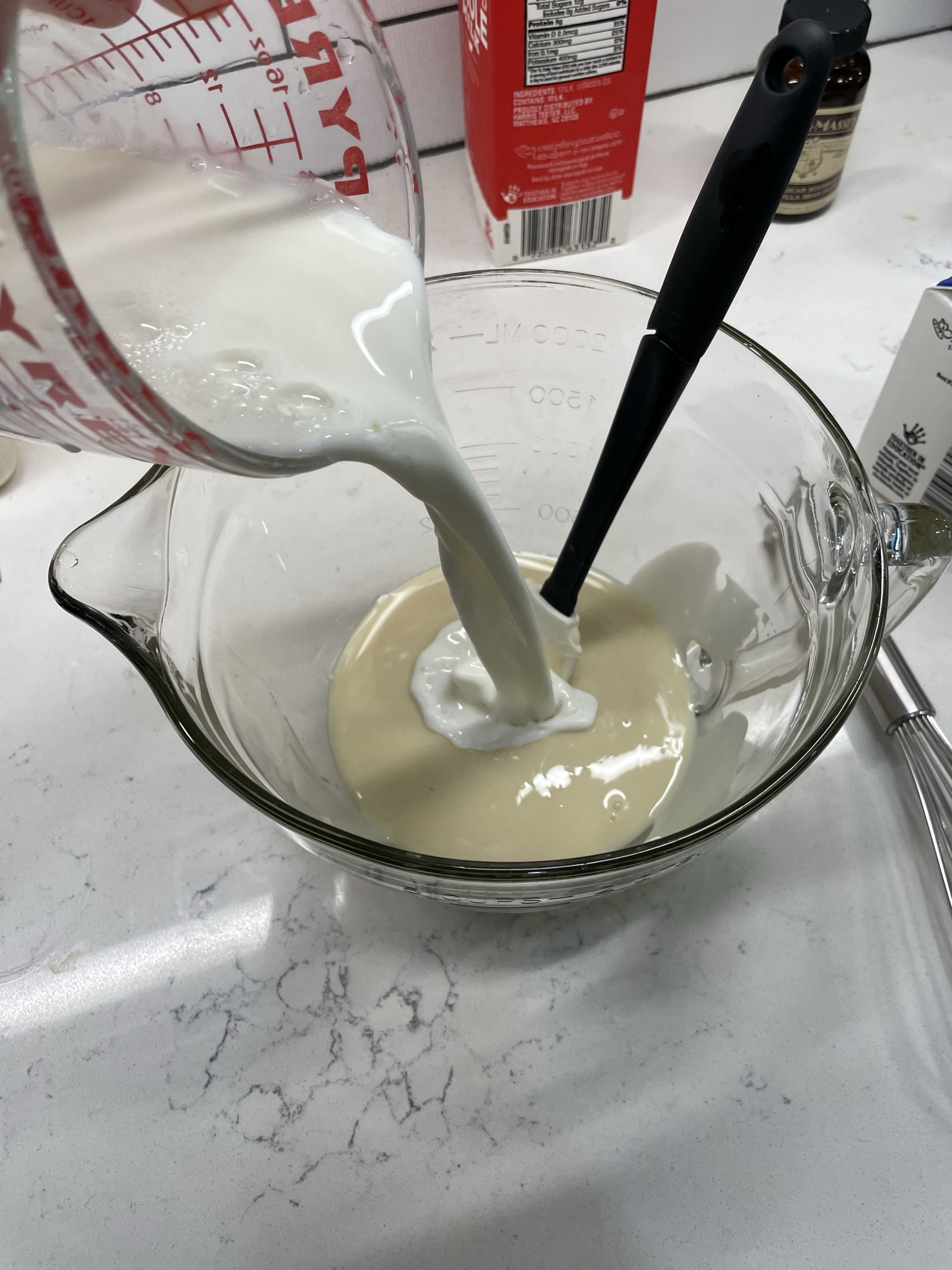
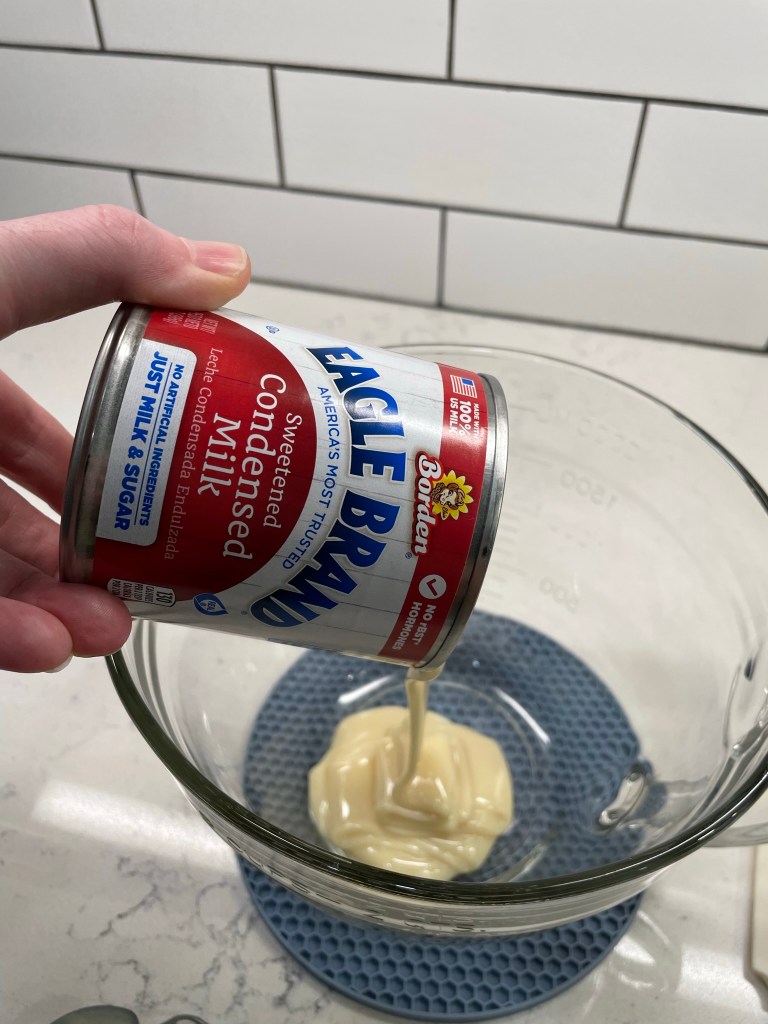
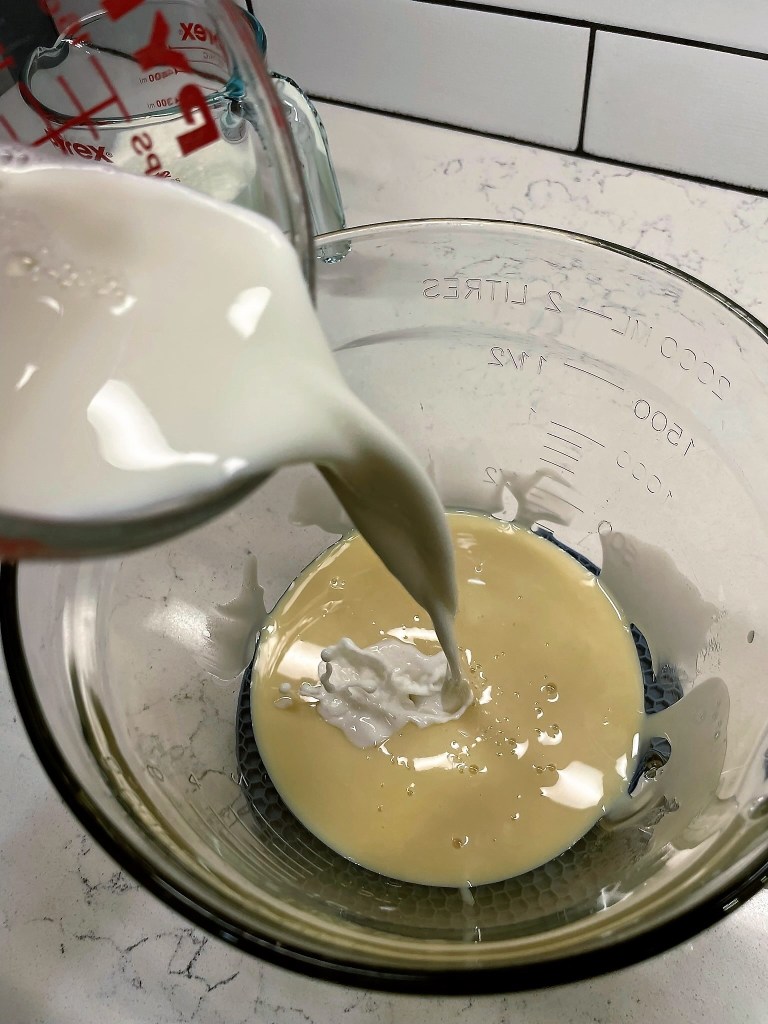
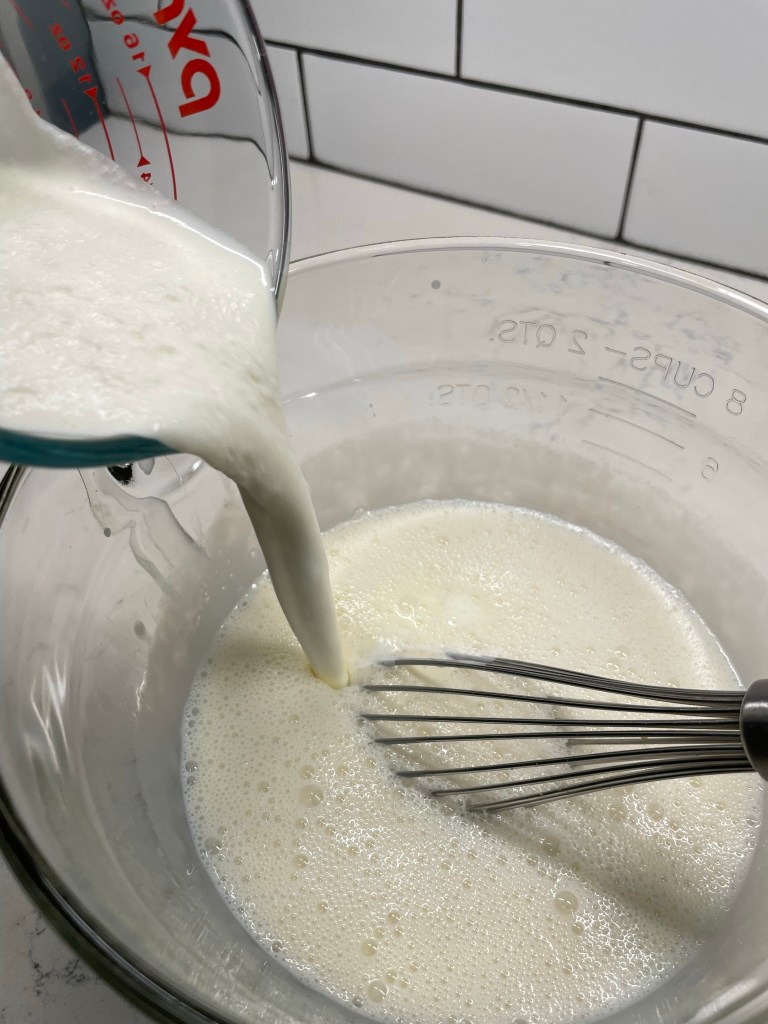
Feel free to swap in fat-free condensed milk here; on this day, I only had original in the cabinet. Whisk the whole milk into the condensed milk first, because their viscosities are very different and it requires some hefty whisking to combine them. Next, gently whisk in the heavy cream.


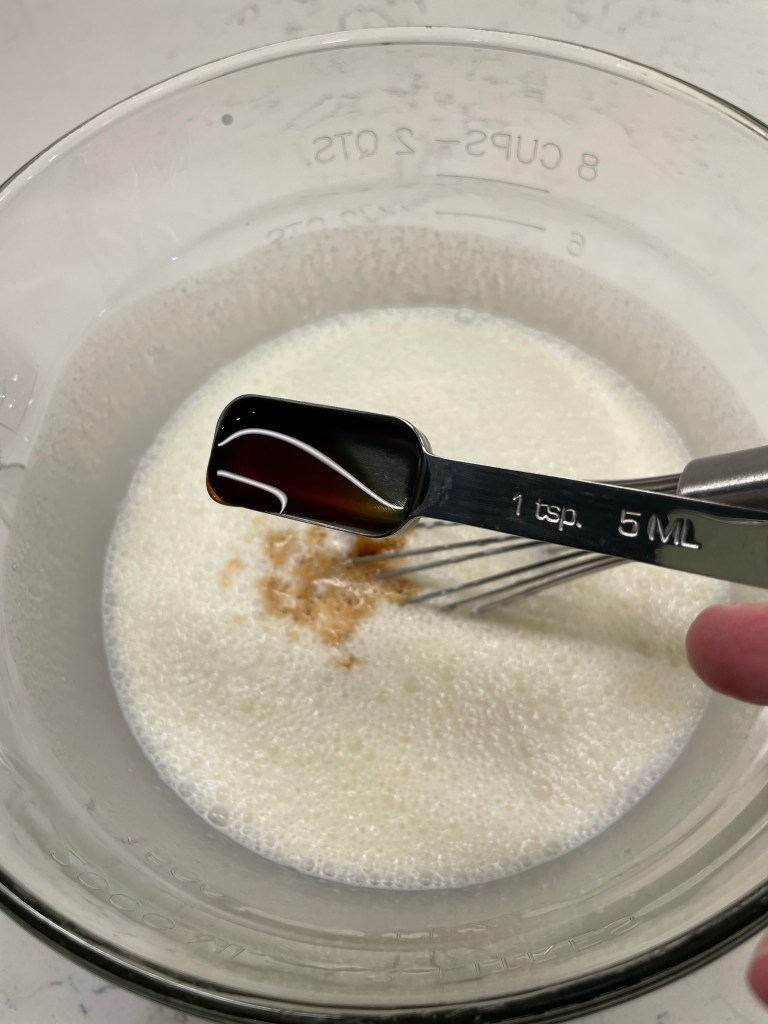
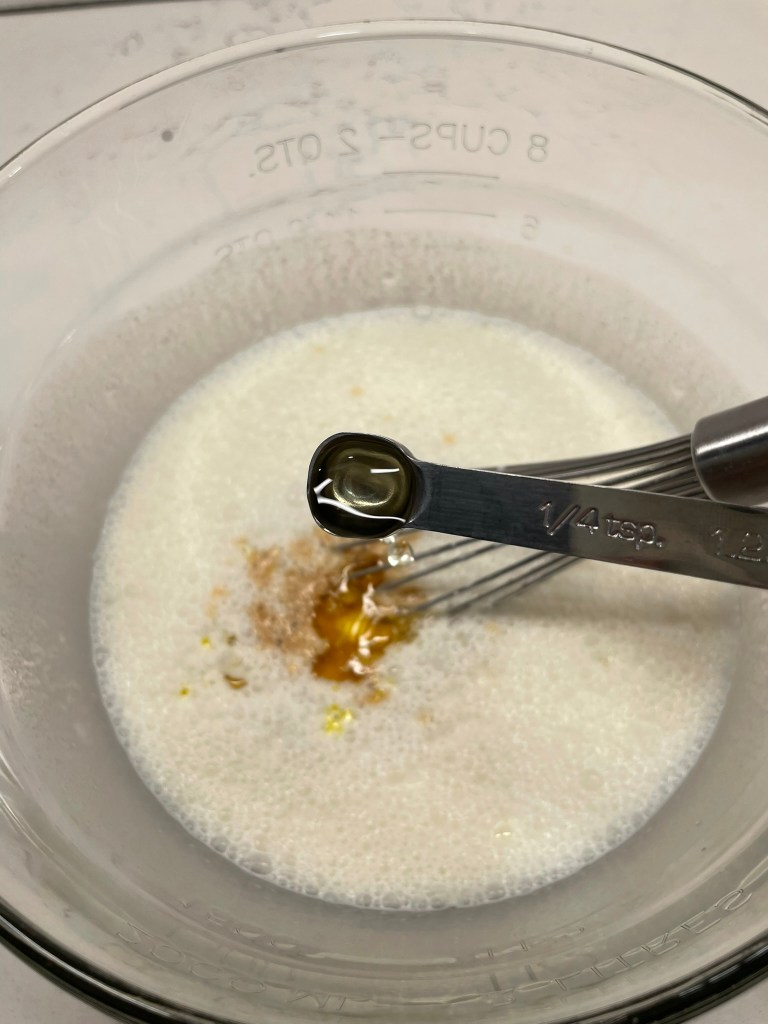
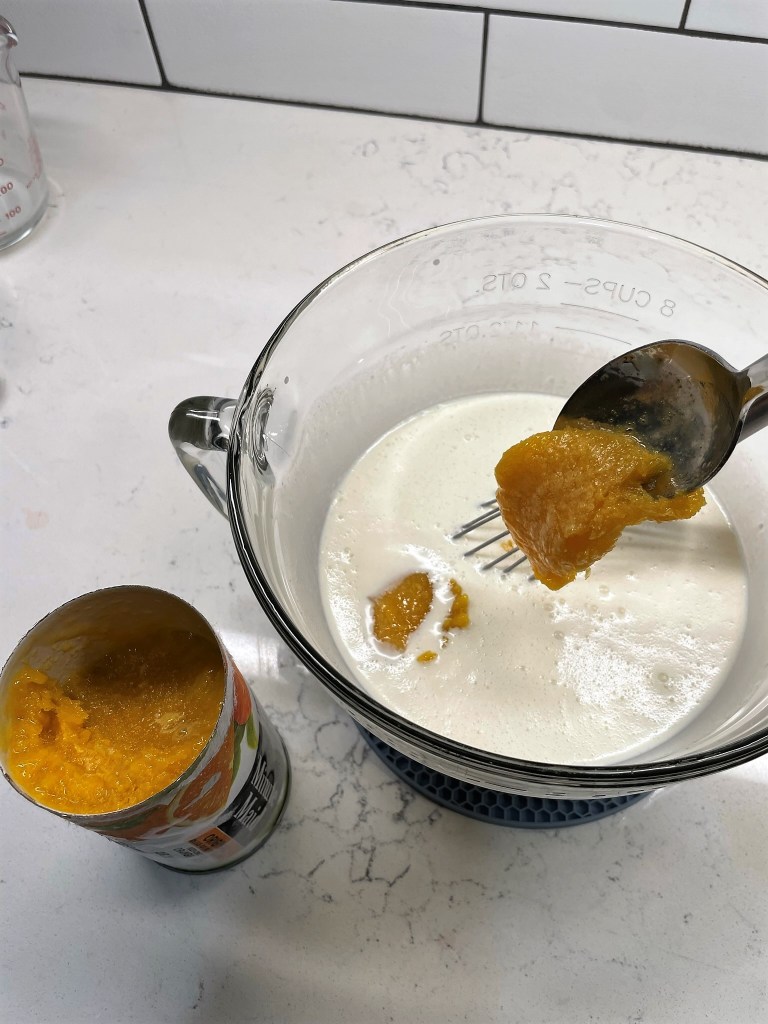
The flavoring agents are next: vanilla extract, orange oil and Fiori di Sicilia. Finally, half a can of orange juice concentrate, the kind your mom used to buy in the frozen section. Choose a reputable brand that lists only orange juice as an ingredient.


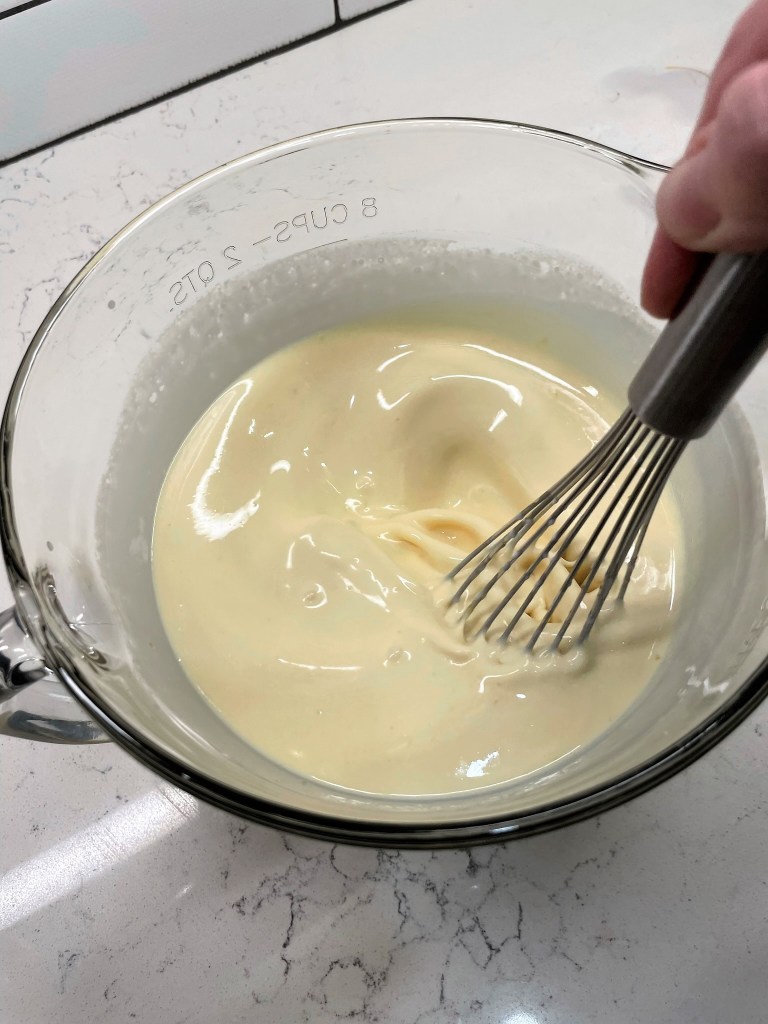
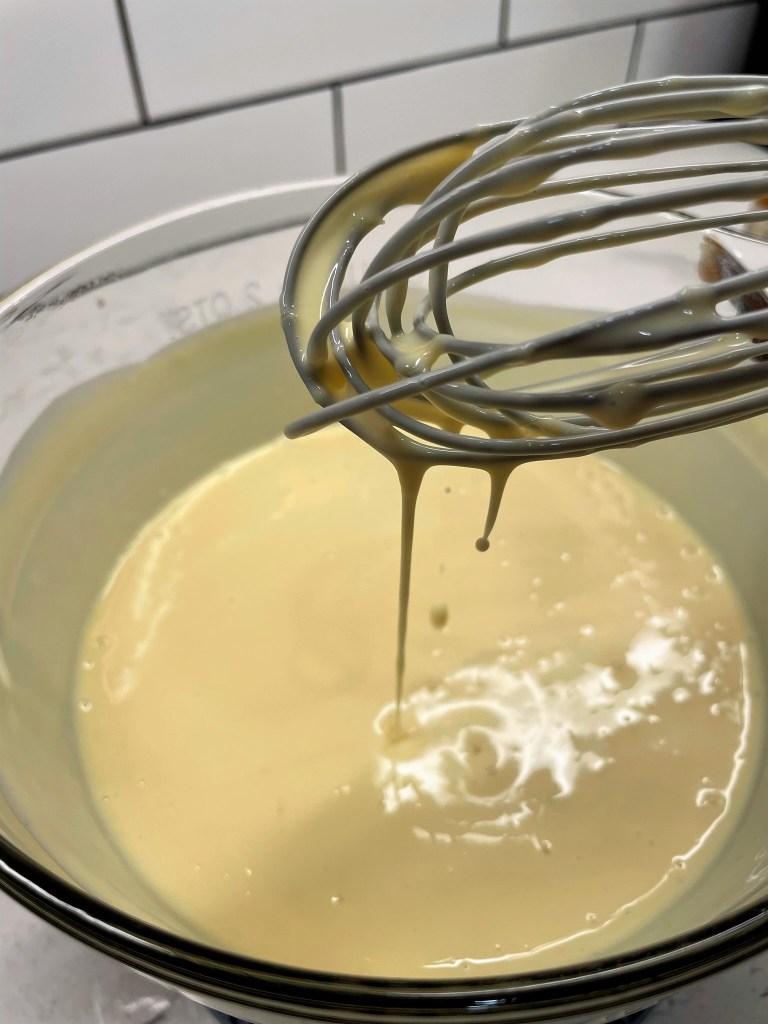
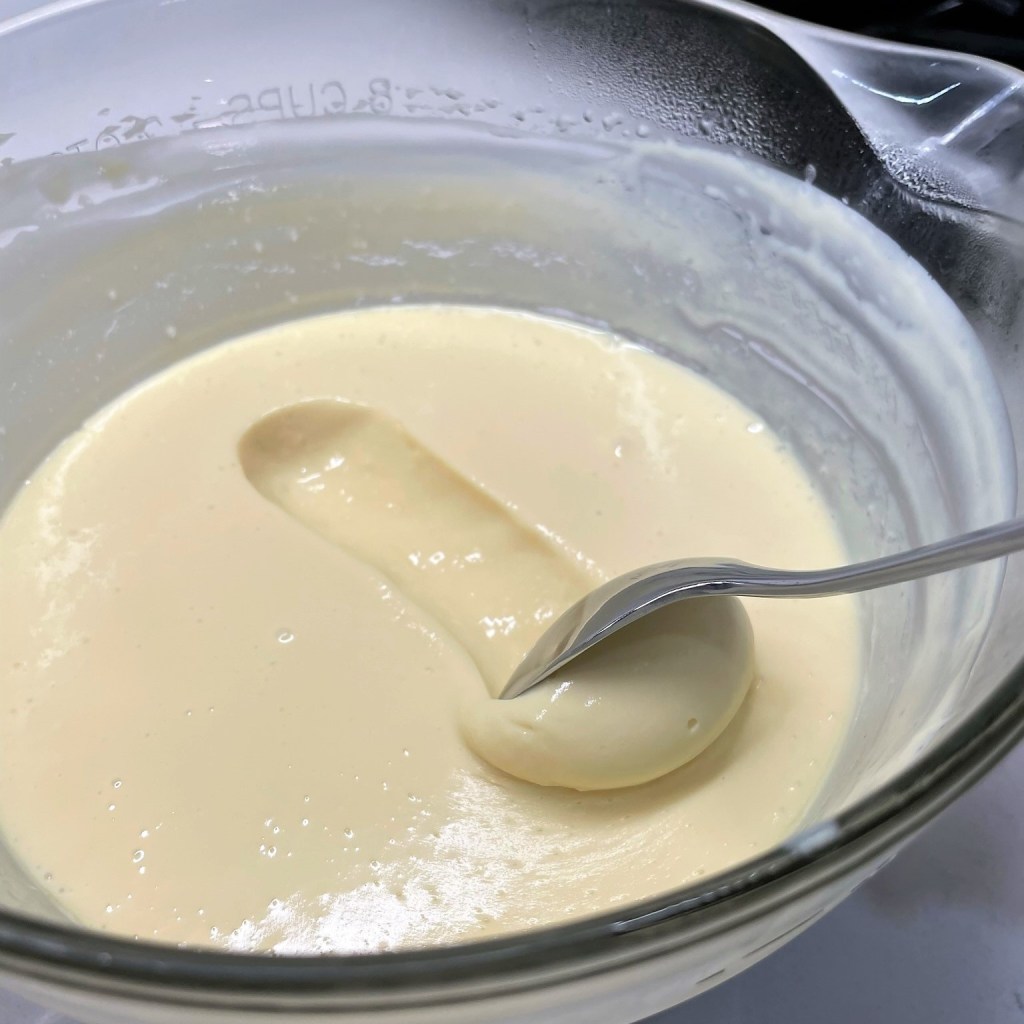
Whisk gently to incorporate the frozen orange juice, and then cover the bowl and refrigerate several hours or overnight. Now, something magical happens when you combine condensed milk and an acidic ingredient like citrus juice. OK, it isn’t magic, it’s science. This reaction happens with any kind of dairy milk, but the result with condensed milk is a nicer consistency. The acid changes the structure of the proteins in the milk, causing them to curdle or thicken. In the morning, you can expect it to look a little like pudding. Deliciously creamy, citrus-vanilla pudding.

Nobody would blame you if you eat a spoonful of it right on the spot.
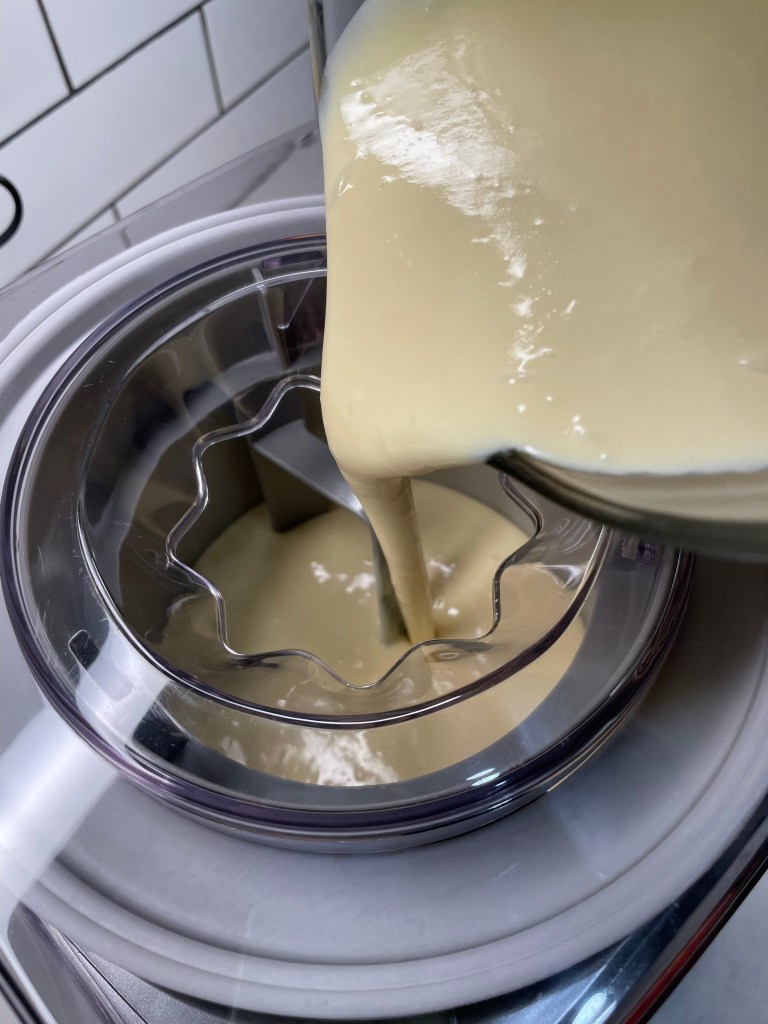
The thickness is not a problem, and a quick whisking will bring the ice cream base to a thick but pourable consistency. Freeze as usual in an ice cream machine and then transfer to an insulated container to ripen it in the coldest spot of the freezer. Overnight is best, but if you can’t resist, you’ll still enjoy this Creamsicle ice cream in soft-serve form.


Creamsicle Ice Cream

  • Servings: About 8
  • Difficulty: Average
  • Print

Orange and vanilla are a superb combination! With this recipe, I wanted to recreate the flavor of Creamsicles, which I loved so much in my childhood. Mission accomplished.


Ingredients

  • 14 ounce can sweetened condensed milk (regular or fat-free)
  • 1 cup whole milk
  • 1 cup heavy cream
  • 2 teaspoons real vanilla extract
  • 1/2 teaspoon orange oil (optional, but recommended)
  • 1/4 teaspoon Fiori di Sicilia (optional, but recommended)
  • Approximately 6 ounces frozen orange juice concentrate

Directions

  1. In a large bowl or pitcher, combine condensed milk and whole milk and whisk to combine. Gently whisk in heavy cream. Stir in vanilla extract, orange oil and Fiori di Sicilia.
  2. Add spoonfuls of frozen orange juice concentrate, gently whisking to incorporate each spoonful before adding more. Cover bowl with a lid or plastic wrap and refrigerate several hours to fully chill the mixture. The ice cream base will thicken significantly because of a chemical reaction between the dairy and citrus. Simply whisk to loosen it when you’re ready to freeze.
  3. Freeze ice cream base, following manufacturer’s instructions for your particular machine. Transfer churned ice cream to an insulated container and freeze overnight before serving.

This ice cream is ready to scoop and serve straight from the freezer. As with any homemade ice cream, it is best enjoyed within about a week.


Strawberry Daiquiri Cake

Here I go, answering my own question of “what other cocktails could be turned into a cake?” I asked this just a few weeks ago, when I presented the tiki cocktail skillet cake that put a fun, boozy spin on a pineapple upside-down cake. I started making a list of other drinks that could work, including some suggested by followers in the comments section.

Somehow, this one was not on the tip of my tongue when I first asked the question. It came about when I found beautifully ripe, organic strawberries on a recent shopping visit. I told Les I would make strawberry shortcake for Father’s Day, but he challenged me to come up with something more imaginative that didn’t involve sponge cake or biscuits (neither are his favorites). What about a strawberry cake, I asked? And he said, “that would be better, and do you think you could make it a little boozy?” 

C’mon, could I make it a little boozy?! I mean, does he even know me?


My first step was to find a recipe that would accommodate a ton of fresh strawberries, plus booze. Even a novice baker like me knows that too much liquid will wreck a cake, so that was a major hurdle. The internet is full of strawberry cake recipes, and most of them are dressed-up versions of a boxed cake mix, which didn’t fit my goal. I don’t mean to be snobbish, and if you’re cool with a box mix, I’m not judging. But I’m super sensitive to artificial flavorings, colors, thickeners and sweeteners, so desserts tend to be a little more complicated for me.

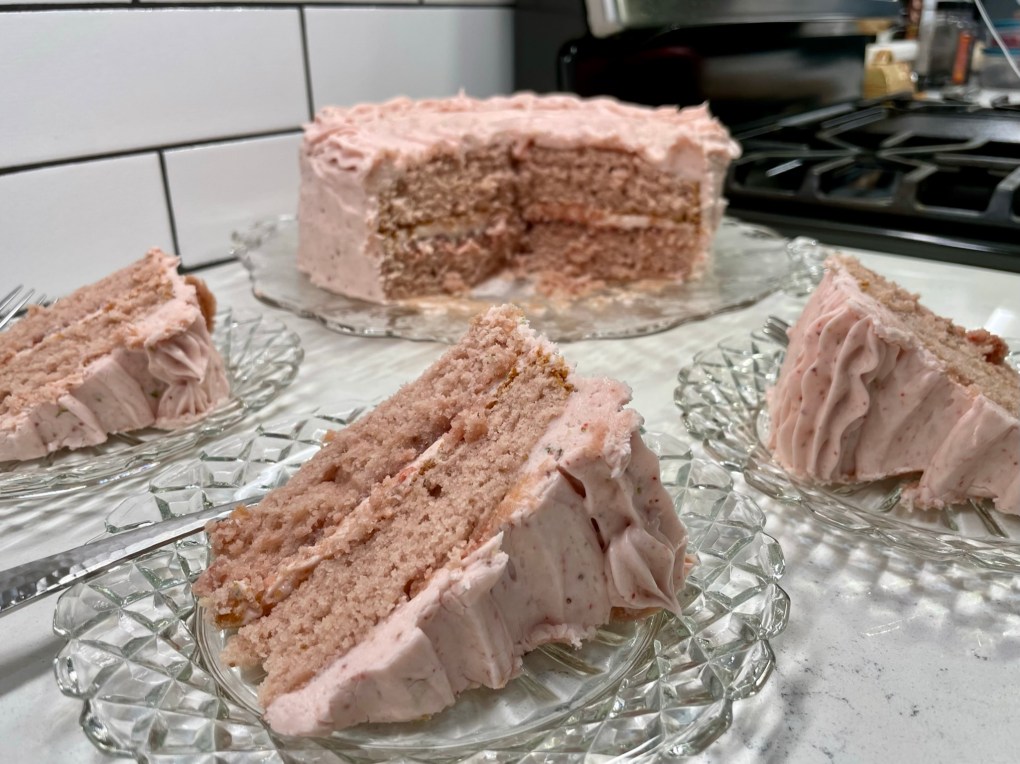
Hello, Gorgeous!

Besides, my goal was to take advantage of these beautiful fresh berries that are at their peak, so I searched until I found a scratch recipe that satisfied both my palate and my baking comfort level. Several recipes in my search results leveraged a technique called “reverse creaming,” which I’ve never heard of, let alone tried. Too much experimentation at once gets me into trouble, so I passed on those. Finally, I found this scratch strawberry cake recipe on Sally’s Baking Addiction blog that would be a good starting point, and I made only a few adjustments to booze up the ingredients, and one to make the process more familiar to me.

Get ready for oodles of photos on this one; there were a lot of steps for this cake, and I wanted to be detailed, for my future self as much as any other reason. If it’s all too much for you, skip ahead to the end, where I’ve included a click-to-print recipe card. You know, in the event you find gorgeous strawberries at your market, too. 🙂

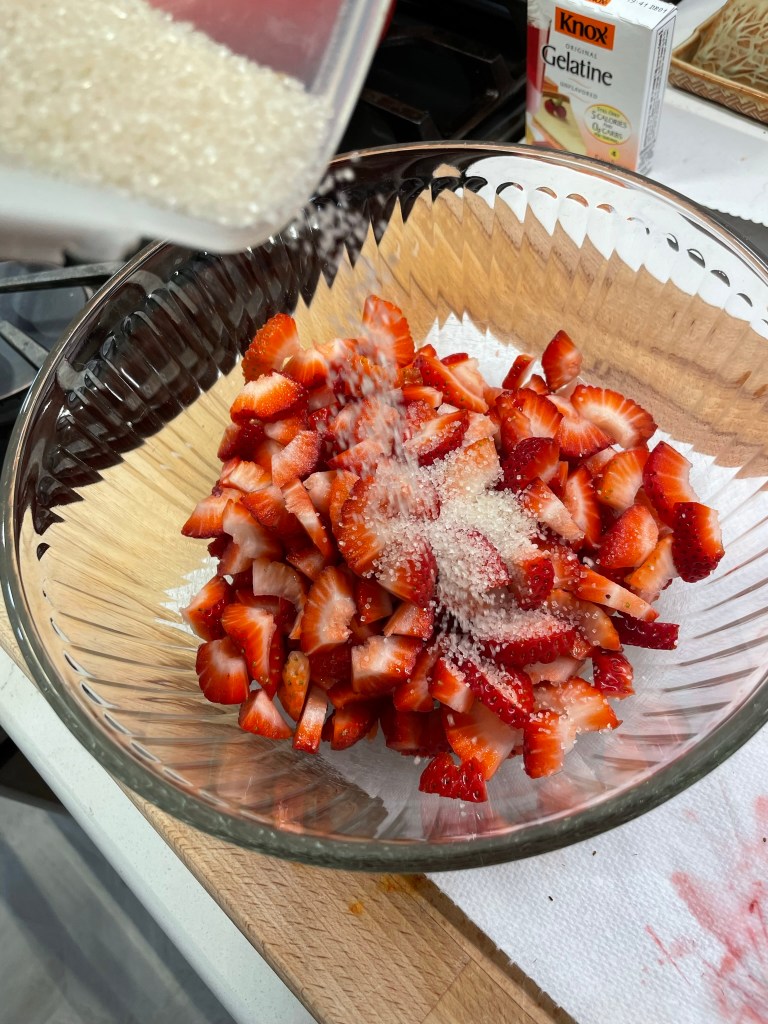
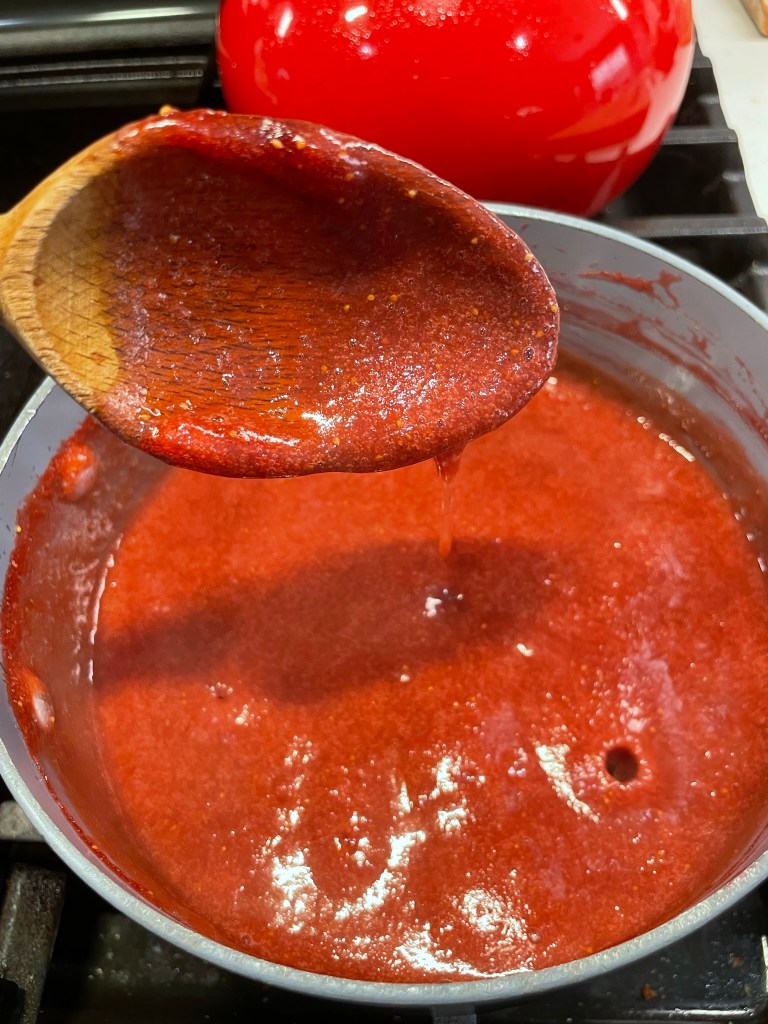
I got a little excited about the berries, and muscle memory took over when I sliced them up. Without thinking, I dumped in a bunch of sugar to macerate them before I even found the recipe I wanted to use. That turned out to be a problem because Sally’s recipe specifically said “don’t” add sugar to the berries before reducing. Oops. There was obviously no undo button for that, and I had to do some fancy math to make up for the sugar I had already used. This also meant that I had to watch the sweetened puree carefully to keep it from burning as I reduced it. If this all sounds complicated, well, what can I say? Nobody has ever accused me of doing things the easy way! It worked out just fine; next time I would just puree the strawberries naked and follow the recipe for the full amount of sugar. Don’t worry, that’s how I wrote the recipe.


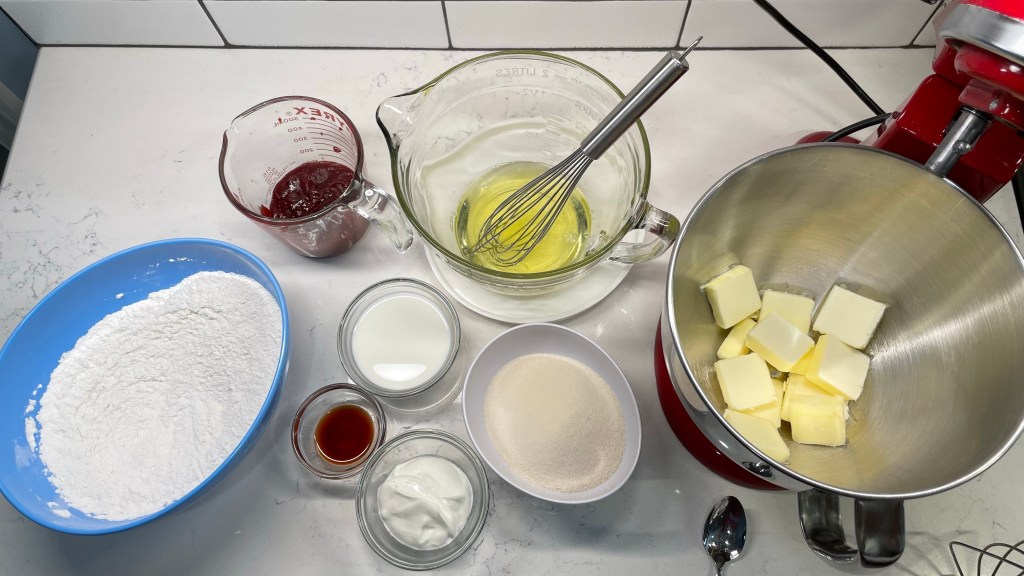
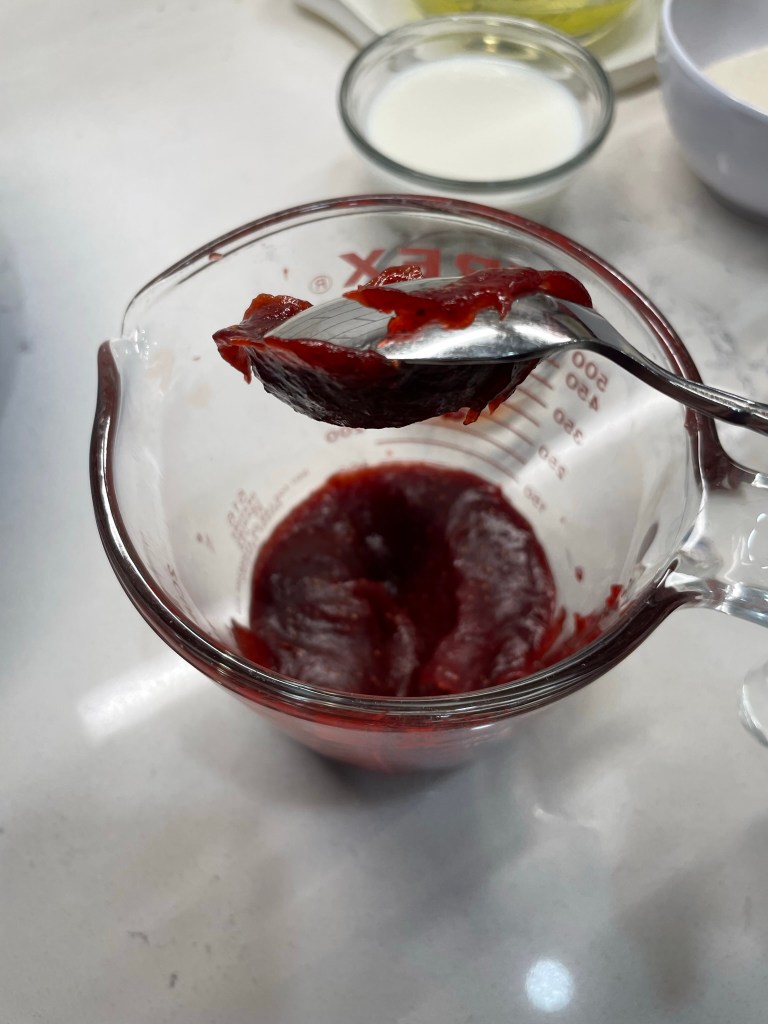
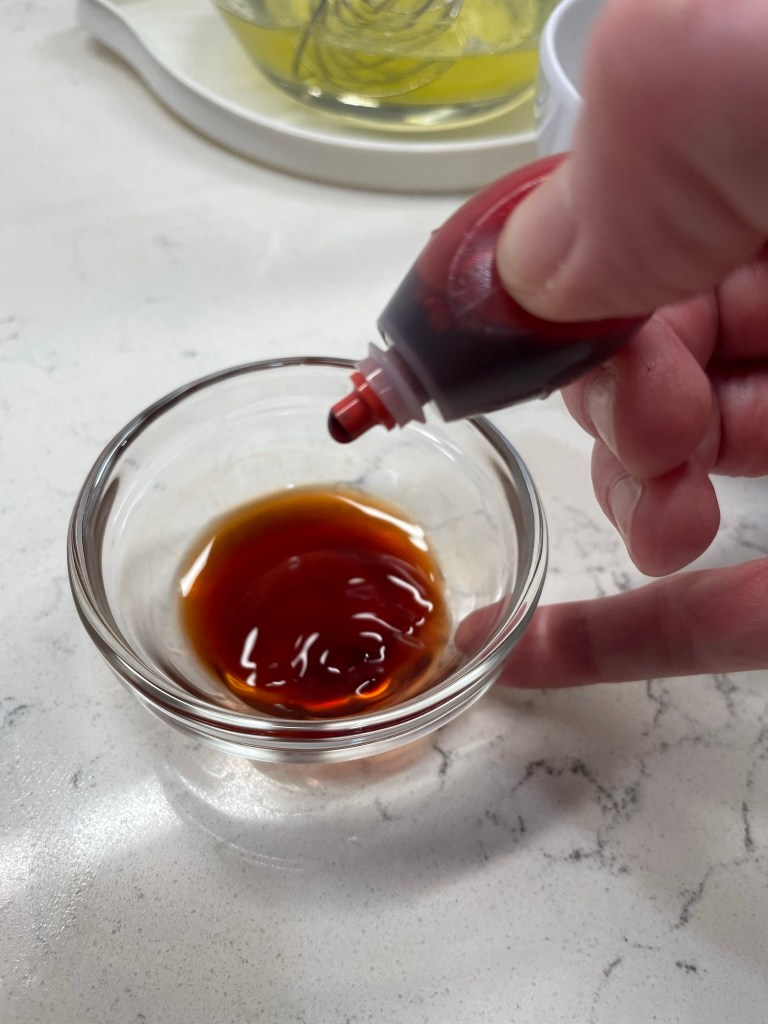
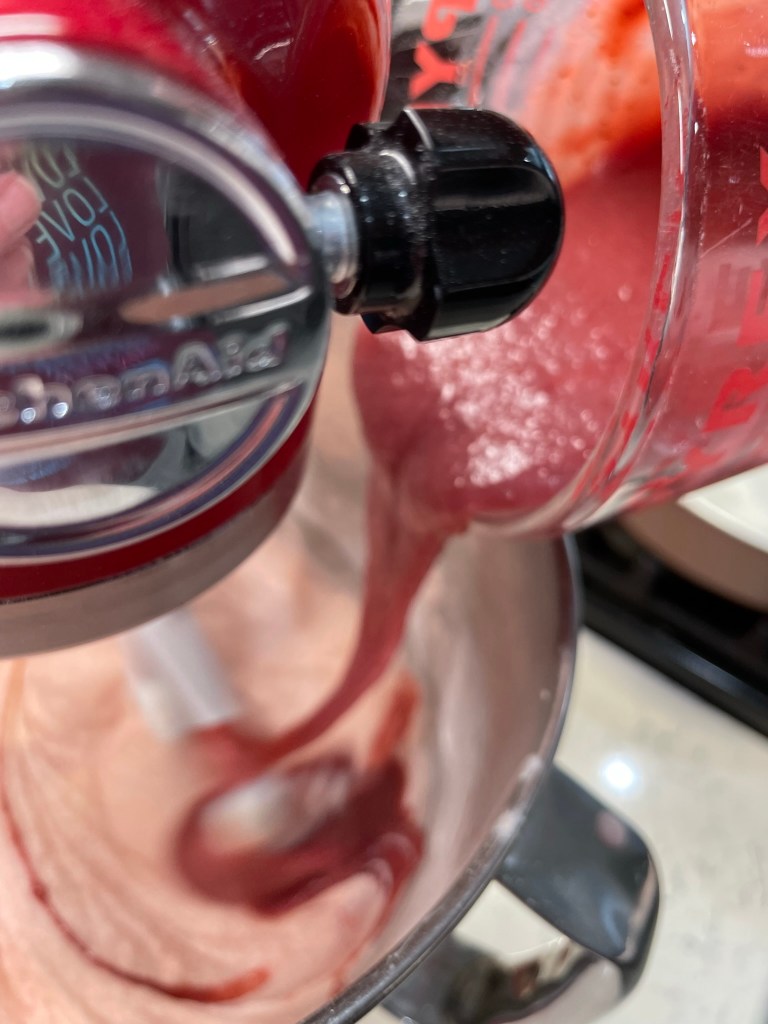
The puree needed time to cool, so I used that down time to get my other ingredients lined up and organized. This really helped me when I made my tiki skillet cake, so I’m trying to make it a habit. It still felt like too many components, so I combined a few things that made sense to me. That puree was thick as tomato paste, so I mixed the milk into it to make it pourable. I didn’t want to forget to add a few drops of natural red food coloring, so I added that to the extracts. Finally, I prepped my 9-inch cake pans and preheated the oven to 350 F.


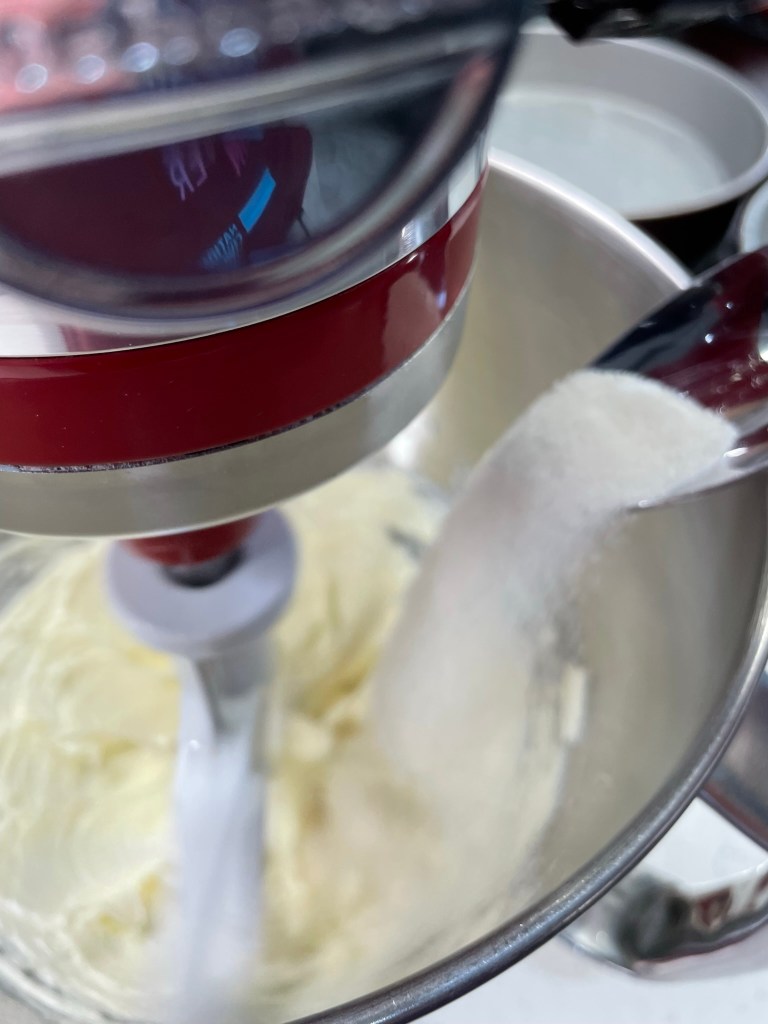
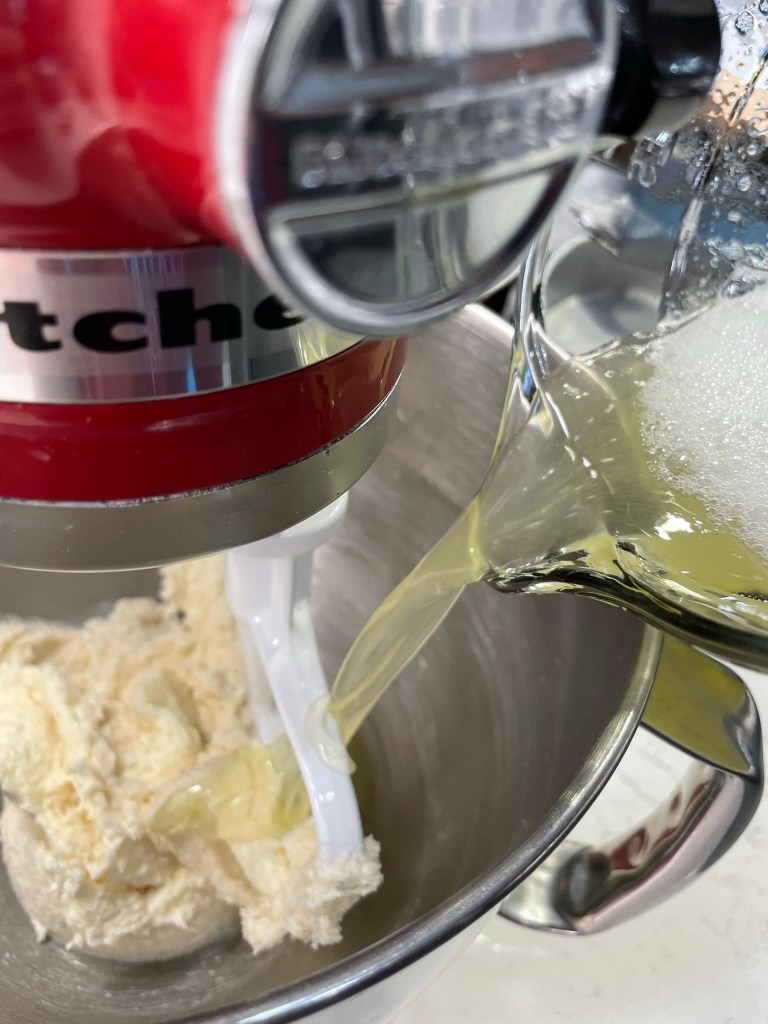
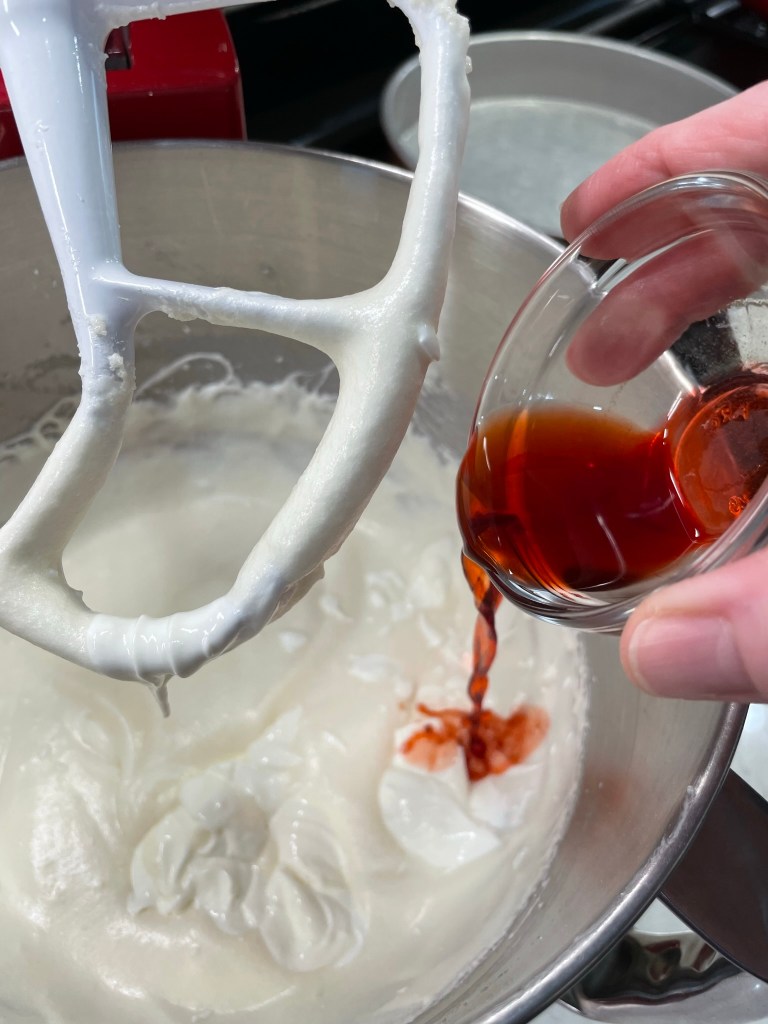
When the butter was softened enough to blend, I started by creaming it with sugar, then whipped in the egg whites, sour cream and extracts. So far, so good!

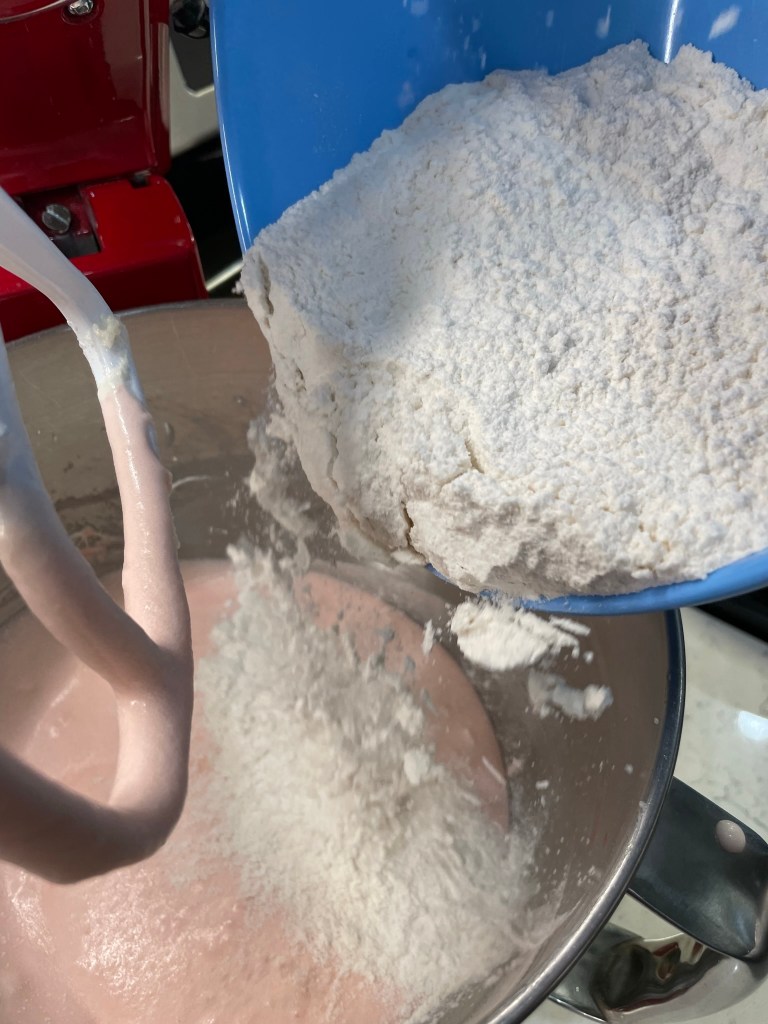
My next adjustment was in technique. The inspiration recipe suggested adding whole amounts of some ingredients all at once, rather than alternating dry and wet additions to the batter. Perhaps this works well for a more skilled sweets baker, but I didn’t want to take any chances with unincorporated ingredients, especially when I was aiming to please my husband on Father’s Day. I did this the way my grandma would have suggested, and poured the batter into my prepped pans, one of which was fitted with a cake strip. These things are soaked in water then wrapped around the cake pan, and the intent is to help the cake bake evenly without too much “dome.” I only used it on one layer, as I didn’t mind the top layer being rounded a bit. As it turned out, neither layer had a dome.


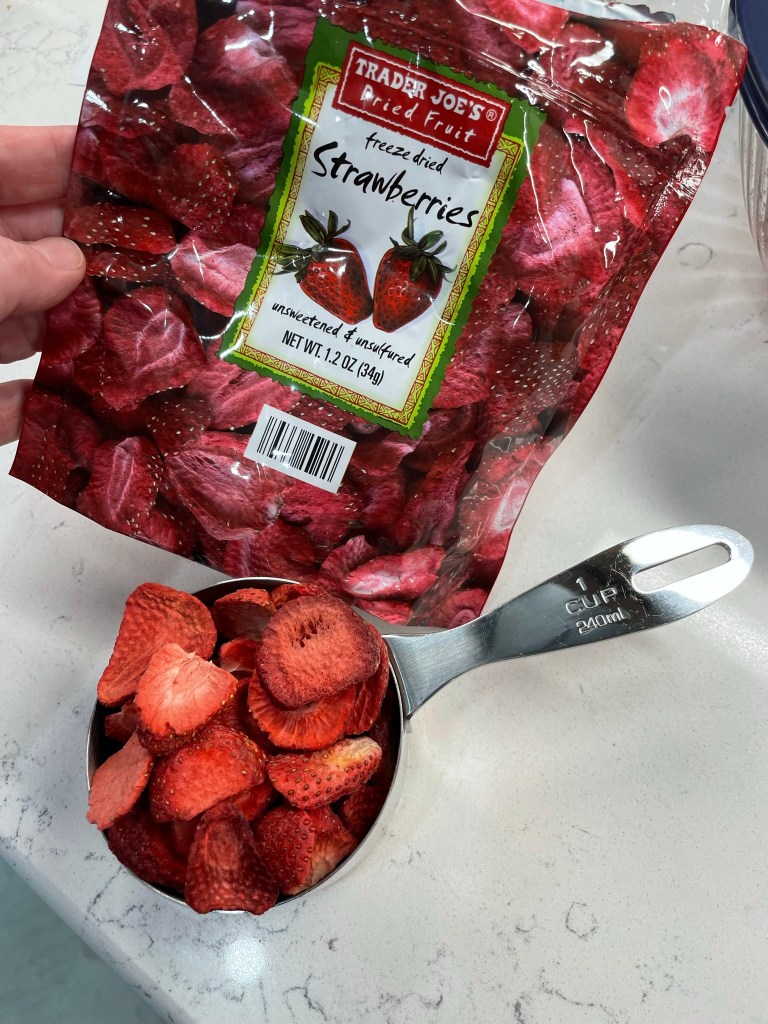
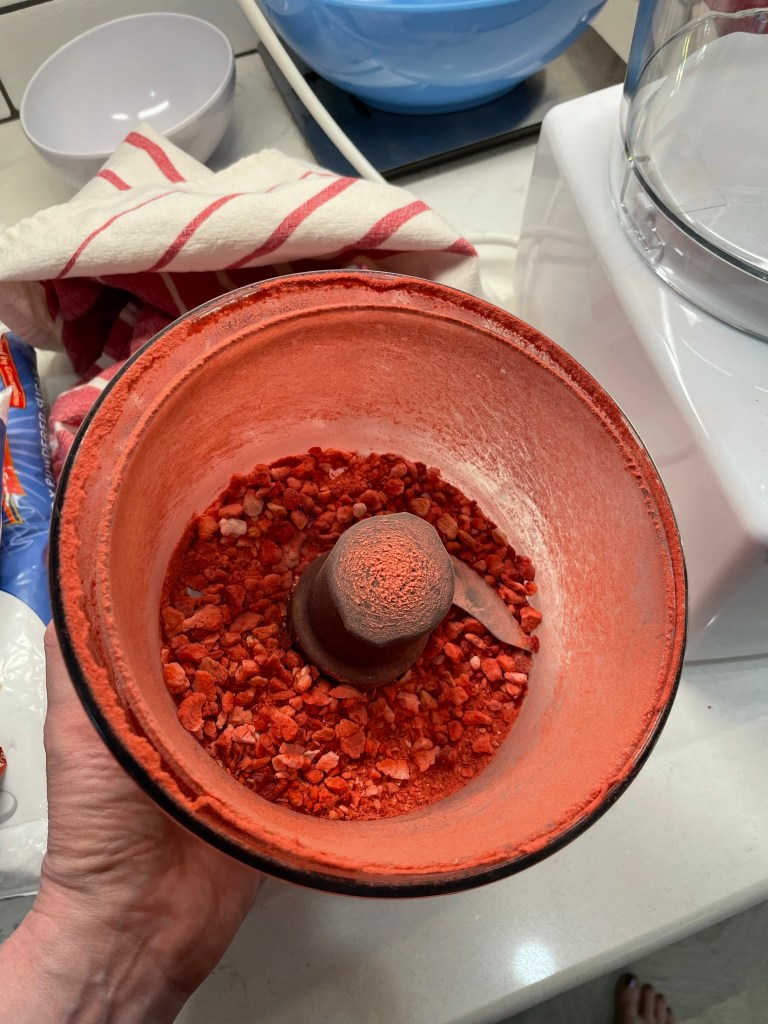
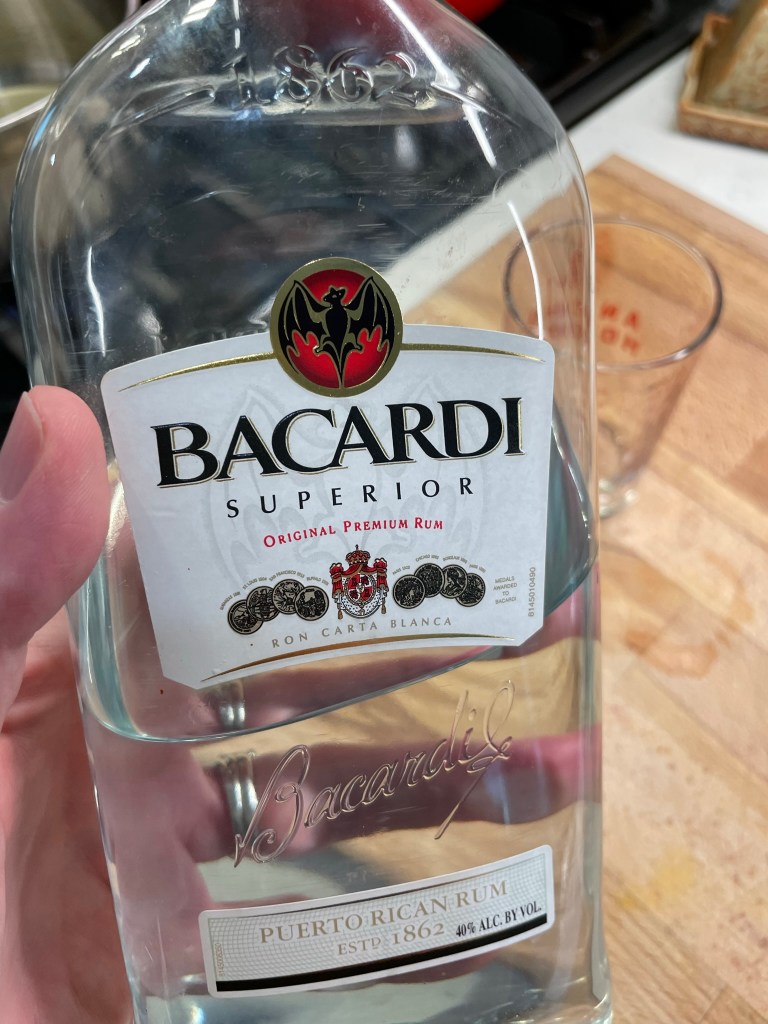
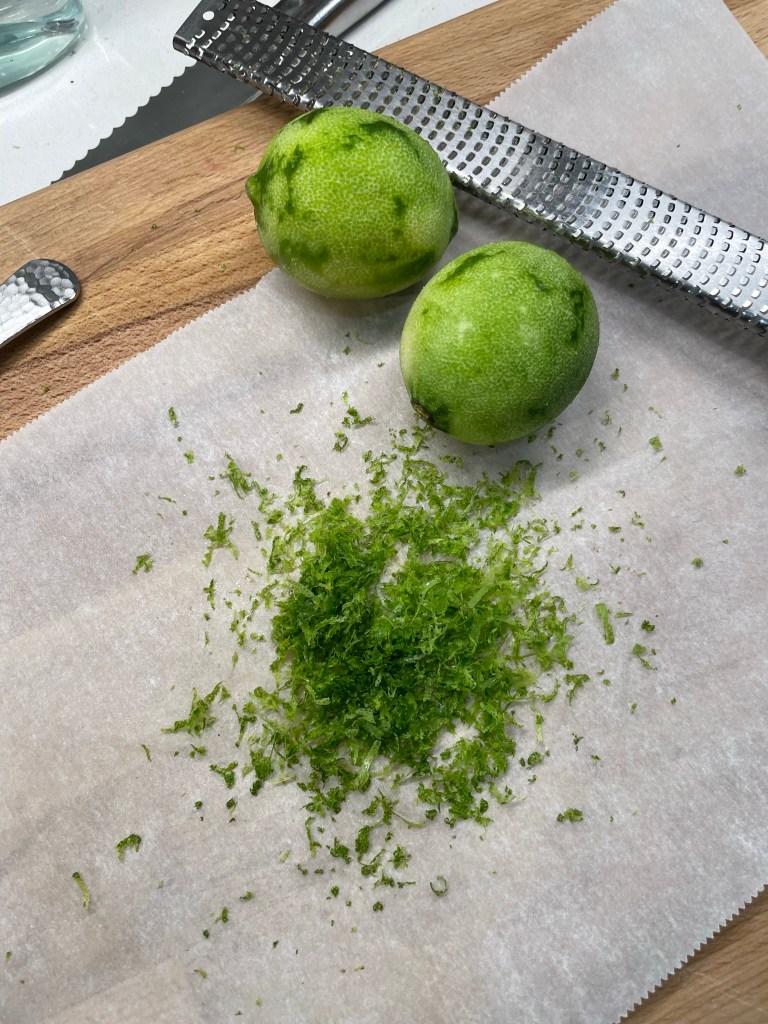
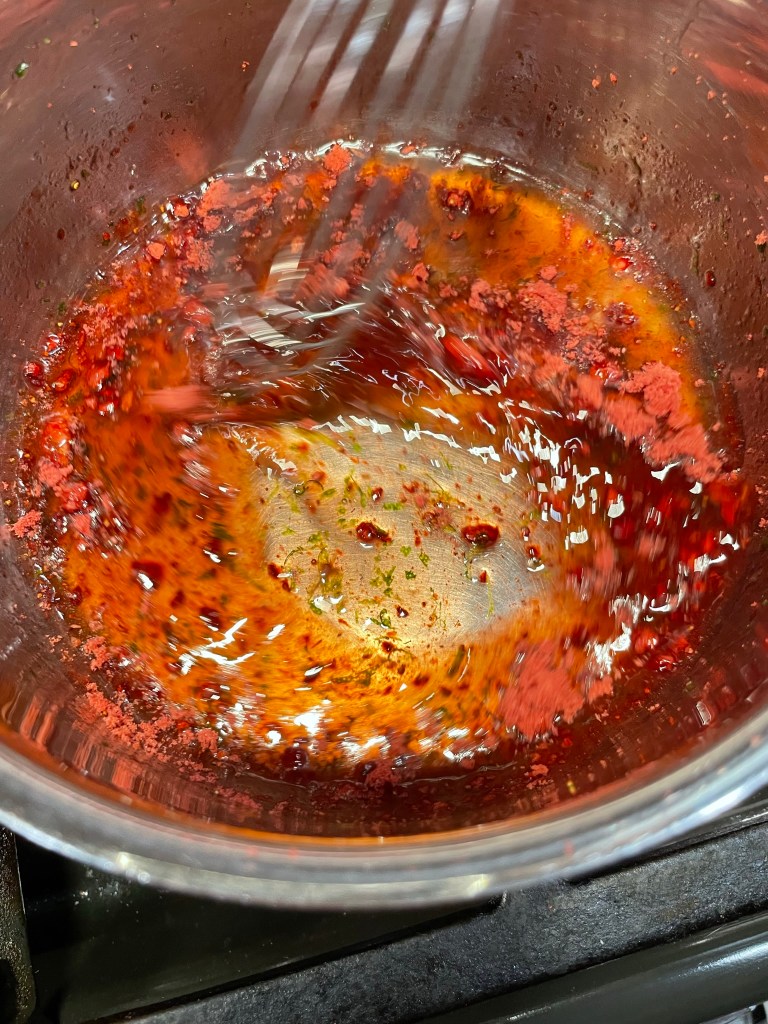
To achieve the “daiquiri” effect, I had swapped out some of the vanilla in favor of rum extract, and I cooked up a boozy strawberry daiquiri syrup for soaking the baked cake layers before icing. That alone was so good, I’ll have to think up another reason to make it again— and soon! The syrup was flavored with Bacardi white rum, fresh lime zest, and bits of freeze-dried strawberries, which I had processed into powder in the food processor. I’m pretty sure I’ll still be finding strawberry powder in random parts of the kitchen this time next strawberry season. Who has a better suggestion for turning that stuff into powder?


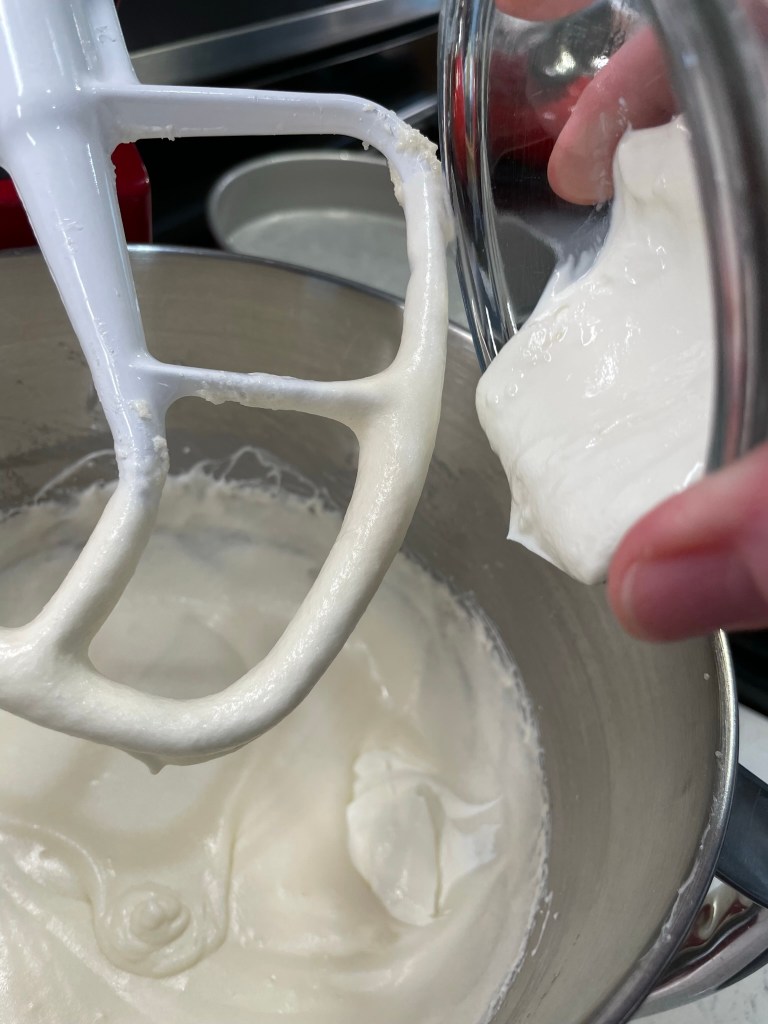
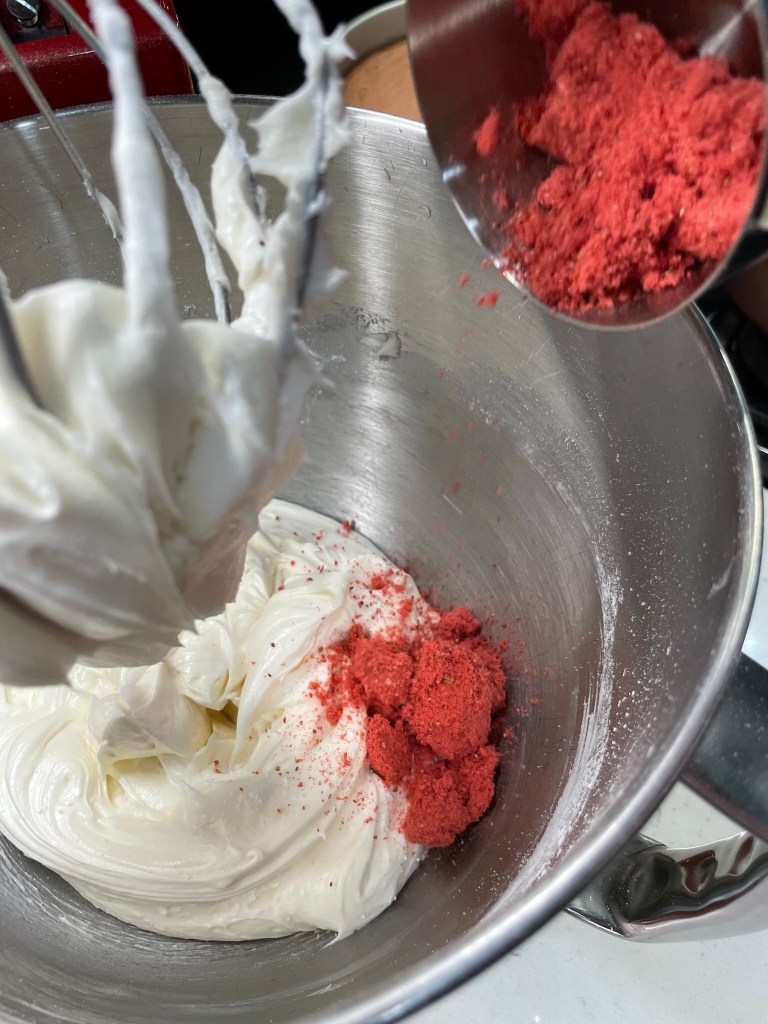
Almost finished! The cream cheese frosting got its pretty pink color from the freeze-dried strawberry powder, which put a ton of fresh berry flavor into play, without messing up the texture with too much moisture. I used an extra cup of powdered sugar from Sally’s recipe, because I wanted it to be sturdier. More lime zest and another splash of rum, and this frosting was good to go. And when I say, “good,” I mean really gooood!


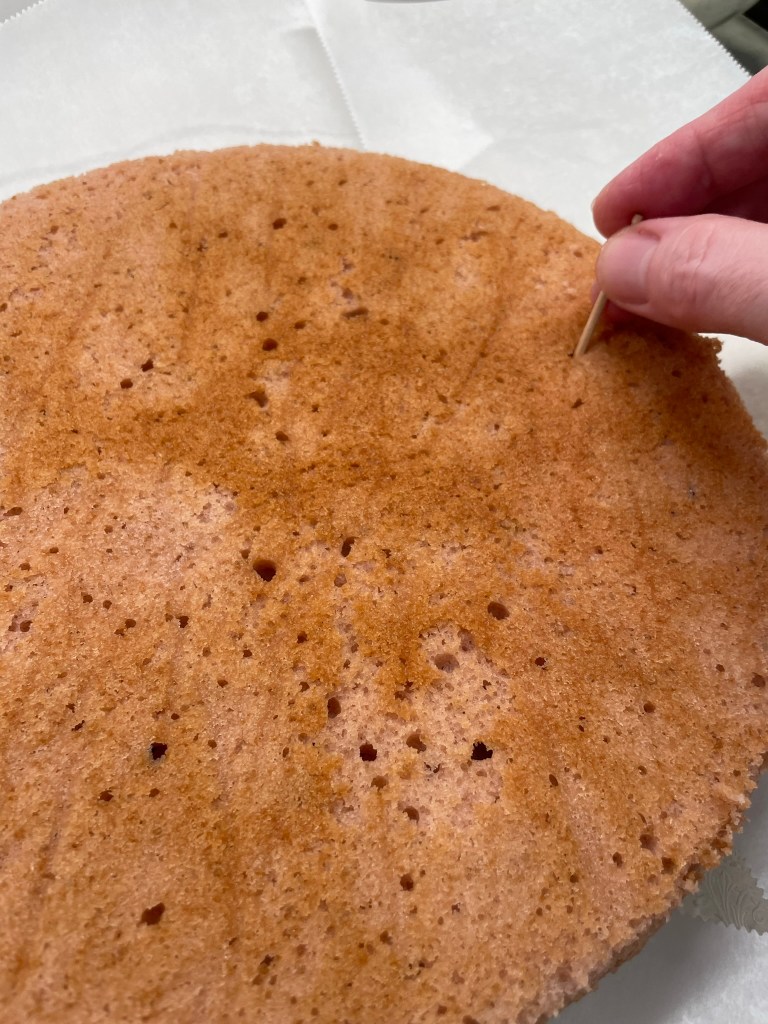
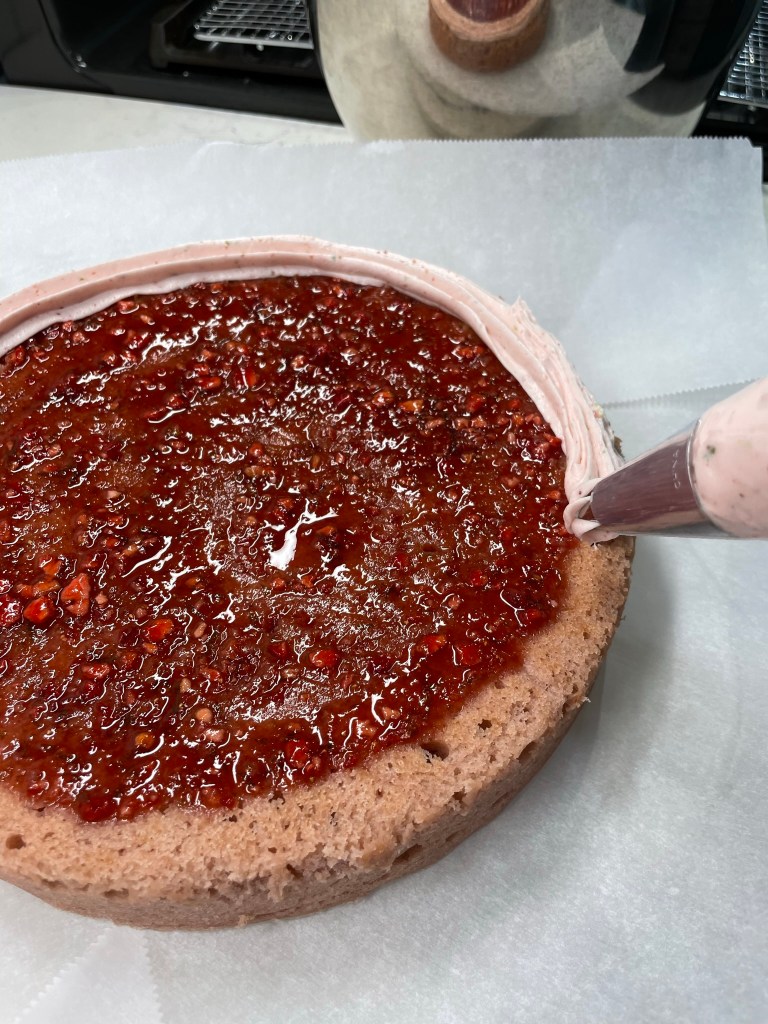
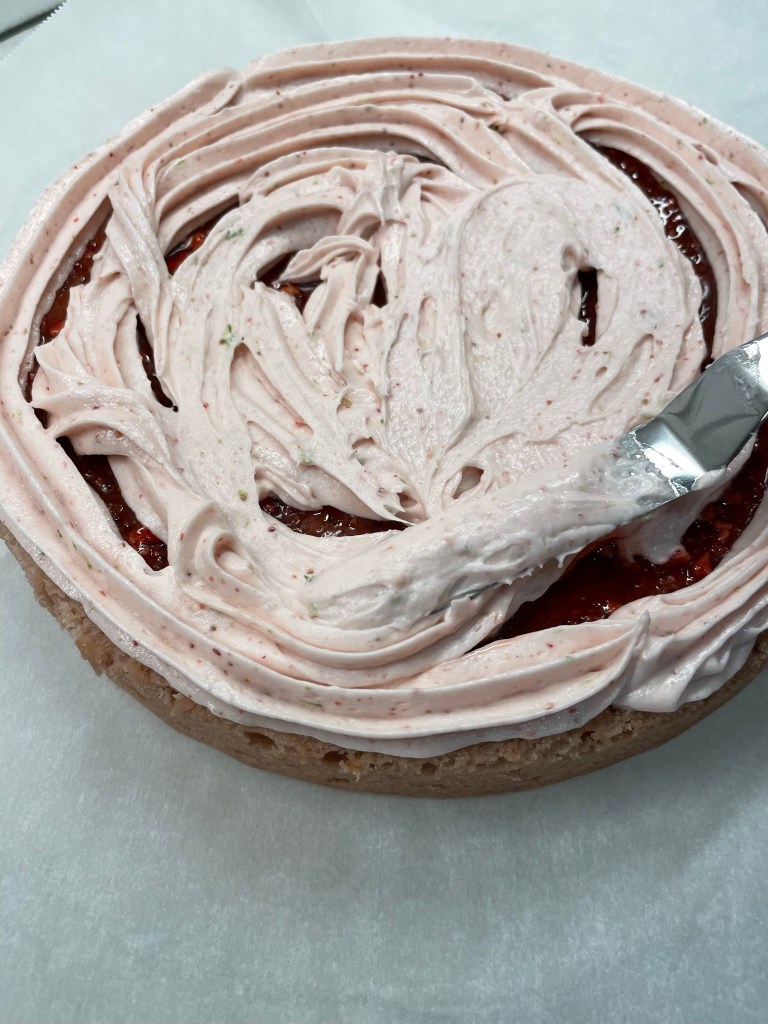
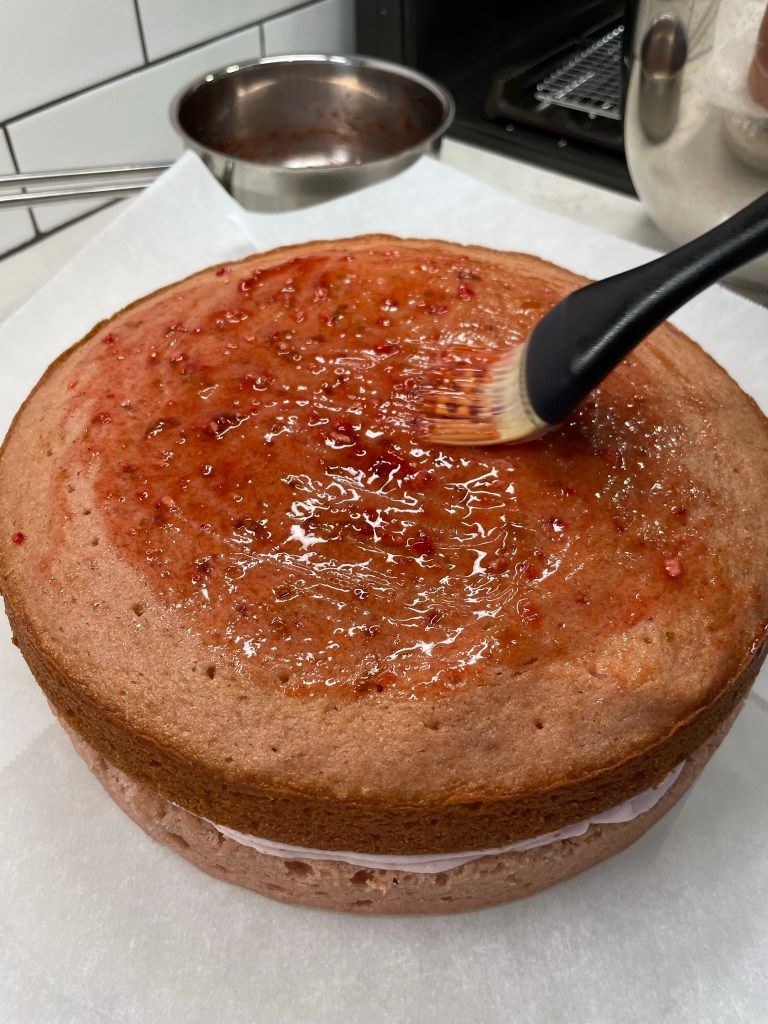
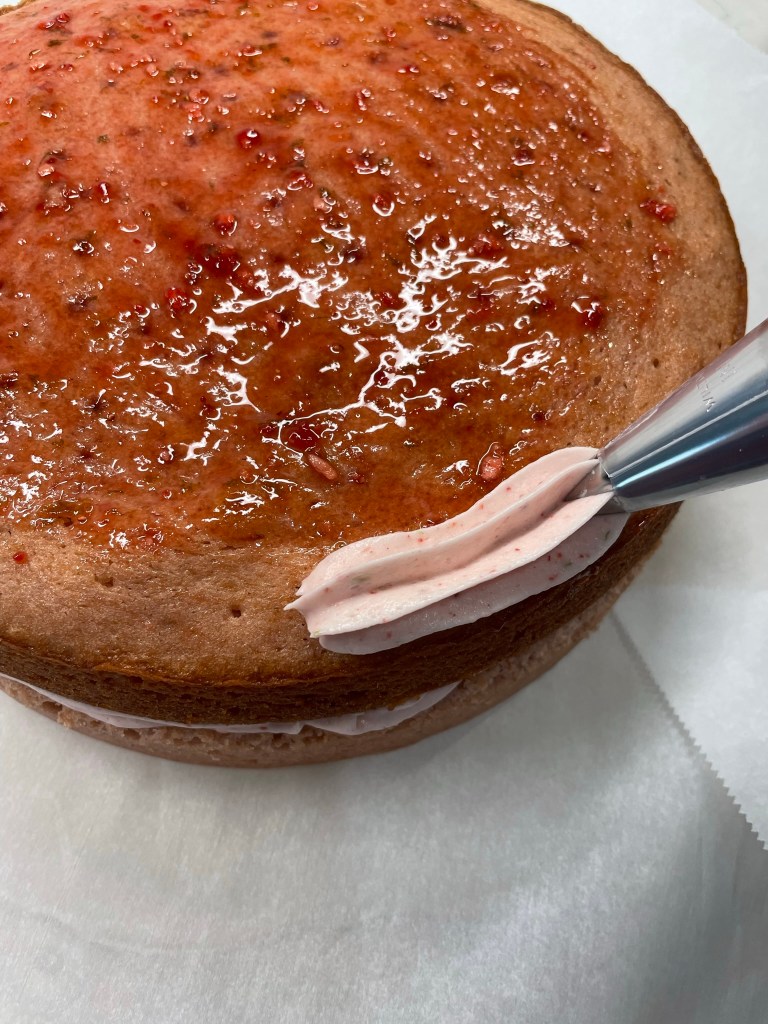
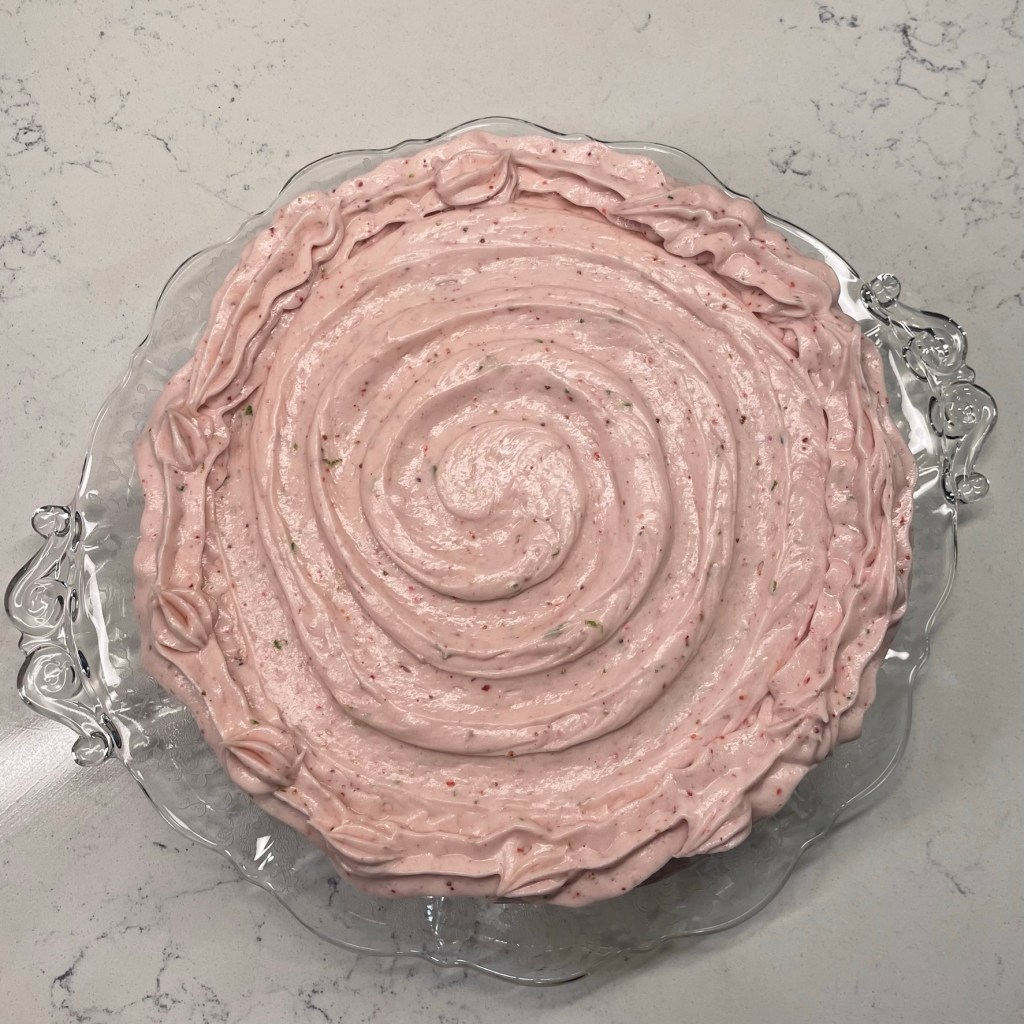
Putting the cake together was the easy part! I spooned most of that boozy daiquiri syrup over the first layer, which I poked all over with a toothpick first. A little edge of frosting kept it from soaking down the sides, and then I topped it with the second layer and frosted it up all over. 


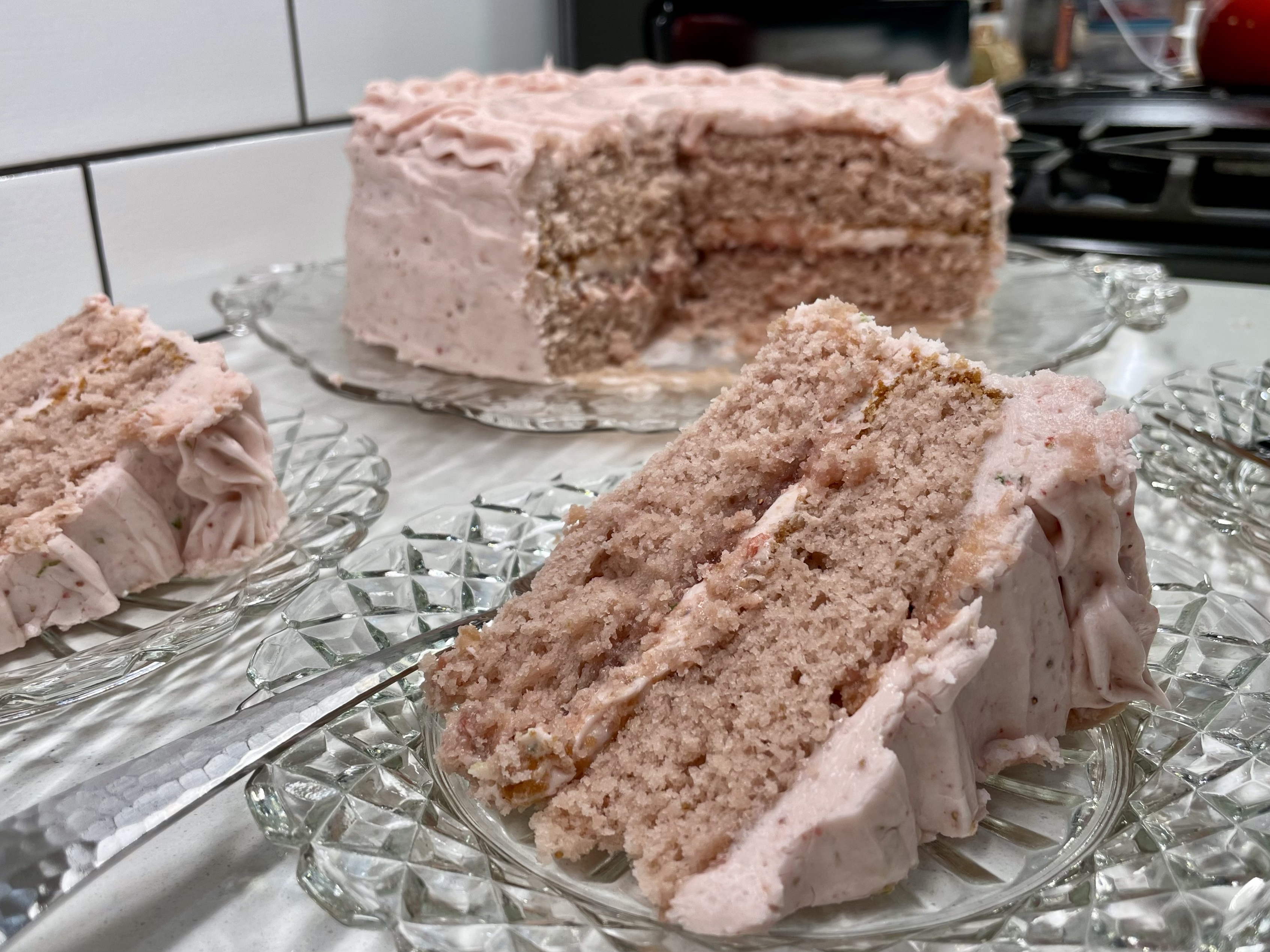
The resulting cake was beautiful and very tasty. Would I change anything next time? Not really, except for skipping the macerating of berries, which I wasn’t supposed to do in the first place. It wouldn’t be terrible to double the daiquiri syrup, and maybe it would soak in deeper if I applied it when the cake layers were still warm. I might put a little extra gel coloring into the batter to achieve more of a pink look. And I’d probably save a few of the prettiest fresh berries to garnish the cake at serving time.


But even without all of that, this was a big time winner. Les loved his Father’s Day cake, and I’m conquering my fear of baking, one recipe at a time. 🍓😉

Strawberry Daiquiri Cake

  • Servings: 10 to 12 slices
  • Difficulty: Intermediate
  • Print

This pretty cake is packed with fresh strawberry flavor, and I found a way to put a fun cocktail spin on it, too!


For the cake batter, plan ahead for the time needed to puree and cook the strawberries, as the reduction needs to be cooled to room temperature, along with the butter, egg whites and sour cream. For best results, measure out and line up all your ingredients before beginning this recipe. The ingredients and directions are split up into three components: the batter, the daiquiri syrup and the frosting.

Ingredients

  • 1 pound fresh ripe strawberries, rinsed and hulled (these will be pureed and cooked)
  • 2 1/2 cups cake flour (see notes)
  • 2 tsp. baking powder
  • 1/2 tsp. baking soda
  • 1 tsp. fine salt
  • 3/4 cup (1 1/2 sticks) unsalted butter, room temperature
  • 1 3/4 cups cane sugar
  • 5 large egg whites, room temperature
  • 1/3 cup sour cream, room temperature (full fat for best results)
  • 1 tsp. real vanilla extract
  • 1 tsp. rum extract
  • 4 drops red food color (optional, for extra pink color)
  • 1/2 whole milk, room temperature

Directions

  1. Puree the strawberries in a blender or food processor until smooth. Cook the resulting puree over medium low heat for about half an hour, until the berries have reduced down to about 1/2 cup volume. The mixture should be almost as thick and sticky as tomato paste. Set this aside to cool.
  2. Preheat oven to 350 F, with oven rack in center position. Prepare two 9-inch cake pans by buttering the sides and bottom. Lay parchment rounds over the bottom and butter that as well for easy removal of the cake layers.
  3. Combine flour, baking powder, baking soda and salt in a medium bowl.
  4. Beat butter in stand mixer with paddle blade. Add sugar gradually, beating until light and fluffy. Whisk egg whites until frothy; pour into mixer bowl and beat with paddle until evenly combined, about two minutes. Add sour cream, vanilla and rum extracts and food color (if using); beat until smooth.
  5. Whisk the cooled strawberry puree into the milk to create a thick liquid. Add dry and wet ingredients to the batter, alternating so that you begin with flour, then strawberry-milk, flour, milk, flour. After each addition, beat on low speed only until addition is incorporated. Scrape down the sides of the bowl a couple of times during these additions.
  6. Divide batter between prepared cake pans. Bake 25 minutes, using the toothpick test to check for doneness. Allow cake layers to cool in the pans, set on a cooling rack for even air flow underneath. When cakes are cooled, invert onto cooling racks.

The daiquiri syrup is next, and this can be made ahead and brought to room temperature before soaking baked cake layers. The syrup uses some of the freeze-dried strawberries that are also used in the frosting. Process those into a powder during this stage, and reserve most of the powder for the frosting.

Ingredients

  • 1/4 cup cane sugar
  • 2 Tbsp. water
  • 1/4 cup white rum (I used Bacardi brand)
  • zest of one organic lime
  • 1 Tbsp. powdered, freeze-dried strawberries plus small bits (see frosting ingredients below)

Directions

  1. Add the freeze-dried strawberries to a blender or the small bowl of a food processor. Pulse about 20 times to transform the berries into a powder. Sift the berry powder through a wire strainer, and measure out a tablespoon or so to be used in the simple syrup, along with some of the larger bits caught in the mesh strainer.
  2. Make the daiquiri syrup by heating sugar, water and rum over medium heat until slightly bubbly. Add about a tablespoon of the strawberry powder, and a spoonful of the small bits, which will rehydrate in syrup. Stir in lime zest and set aside to cool. If you’d like, you can make this ahead and keep it in the fridge, but bring it to room temp when you’re ready to assemble the cake.

For the frosting, I like salted butter because it emphasizes the bright flavors of strawberry, rum and lime. If you prefer unsalted butter, it’s an even swap.

Ingredients

  • 1 heaping cup freeze-dried strawberries (look for them at Trader Joe’s, Whole Foods or online)
  • 8 ounces full-fat cream cheese, room temperature
  • 1 stick salted butter, room temperature
  • 4 cups confectioner’s sugar
  • 1 Tbsp. white rum
  • zest of one organic lime

Directions

  1. Make the frosting; cream together the cream cheese and butter on high speed, using the stand mixer with whisk attachment. Stop mixer and add confectioner’s sugar, one cup at a time. Whisk until smooth and scrape down sides as needed. Beat in rum, then add powdered strawberry dust and lime zest. Beat until fluffy. If the frosting seems a little soft, cover the bowl and refrigerate a half hour or so, then whip at high speed for a fluffy texture.
  2. Smear a little bit of frosting onto serving platter, then position first cake layer upside-down on the dab of frosting to prevent it sliding around on the platter. Use a toothpick to poke small holes all over the first cake layer. This will help the daiquiri syrup soak into the bottom layer of the cake.
  3. Fill a piping bag with frosting, and lay a thick line around the outer edge of the first layer. Spoon most of the daiquiri syrup evenly over the cake layer, spreading it up to the edge of the frosting line to encourage it into the toothpick holes. When the syrup appears mostly soaked into the cake, pipe frosting all over the top and use an offset spatula to gently smooth it over the syrup. It doesn’t have to be perfect.
  4. Position the second layer of cake over the first. Use the toothpick to poke holes over this layer and gently brush the remaining daiquiri syrup over the top, stopping about one inch from the edges. This layer should have only a slight coating of the syrup; otherwise, the frosting might not stay put. Pipe a line of frosting around the edge of the top layer, then frost the sides and top of the cake.
  5. Cover and refrigerate the cake a couple of hours before serving for best results.


Tiki Cocktail Skillet Cake

On a recent grocery run, I was stopped in my tracks in the produce section by a stunning display of fresh pineapple. Their luscious fragrance caught me first, and those golden beauties were staring me in the face, just begging to go home with me. All the way home, I imagined whipping up some fun tiki drinks, one of my hubby’s favorites. I also considered making a classic pineapple upside-down cake, though I don’t have a great track record with dessert baking. It isn’t for lack of trying; rather, it’s a matter of getting into my own head in a way that messes me up. Still, I’d try it. And then, as I was putting away groceries, a crazy thought hit me.

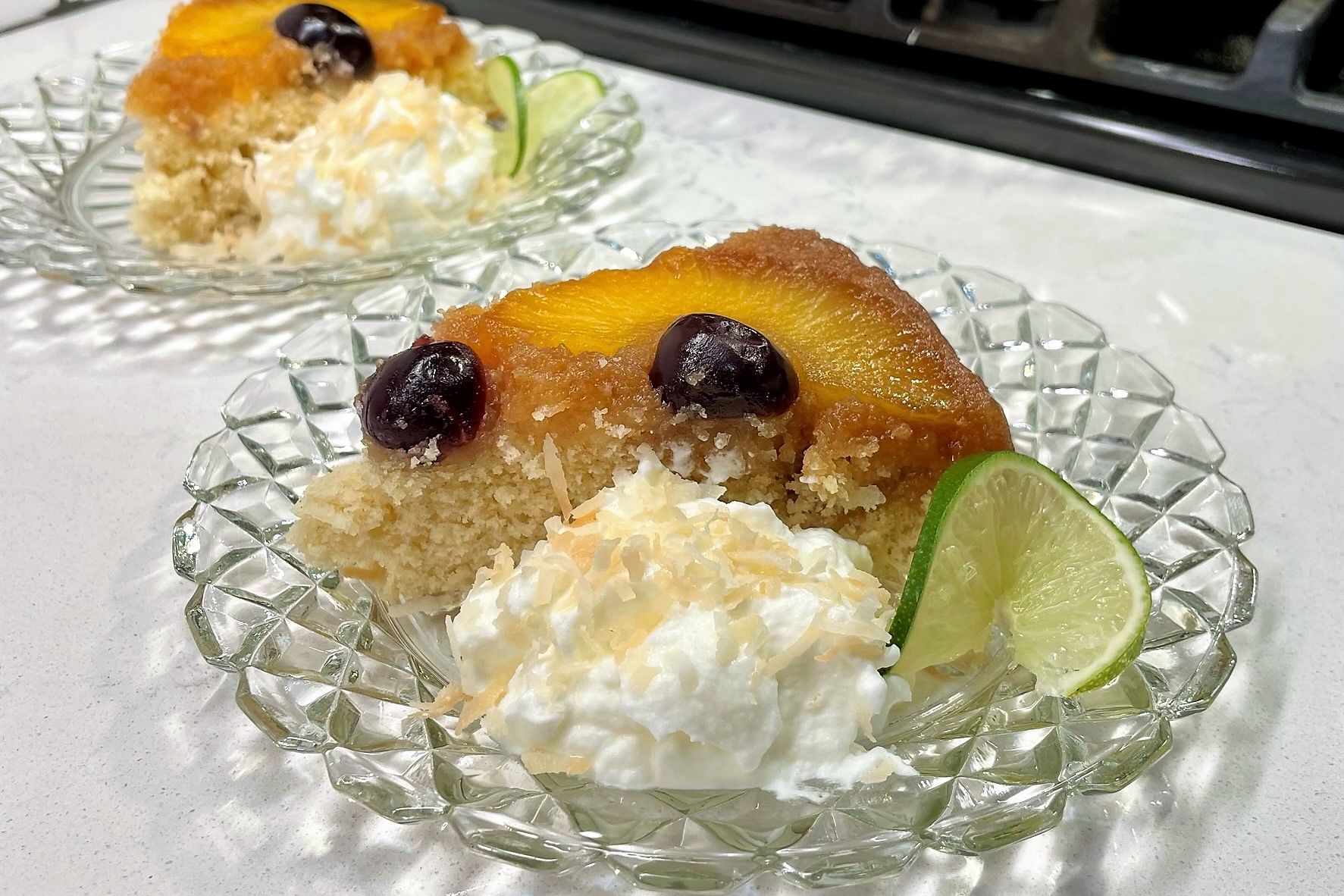
Could it be a terrible idea to combine the two? Throw a little Comfort du Jour curveball on a pineapple upside-down cake by applying all the tropical flavors of a tiki drink? The magical combination of rum, pineapple, coconut and lime is the flavor equivalent to summer sunshine, and once the idea hit me to include them in a cake— with my good cocktail cherries, of course— well, there was no turning back!

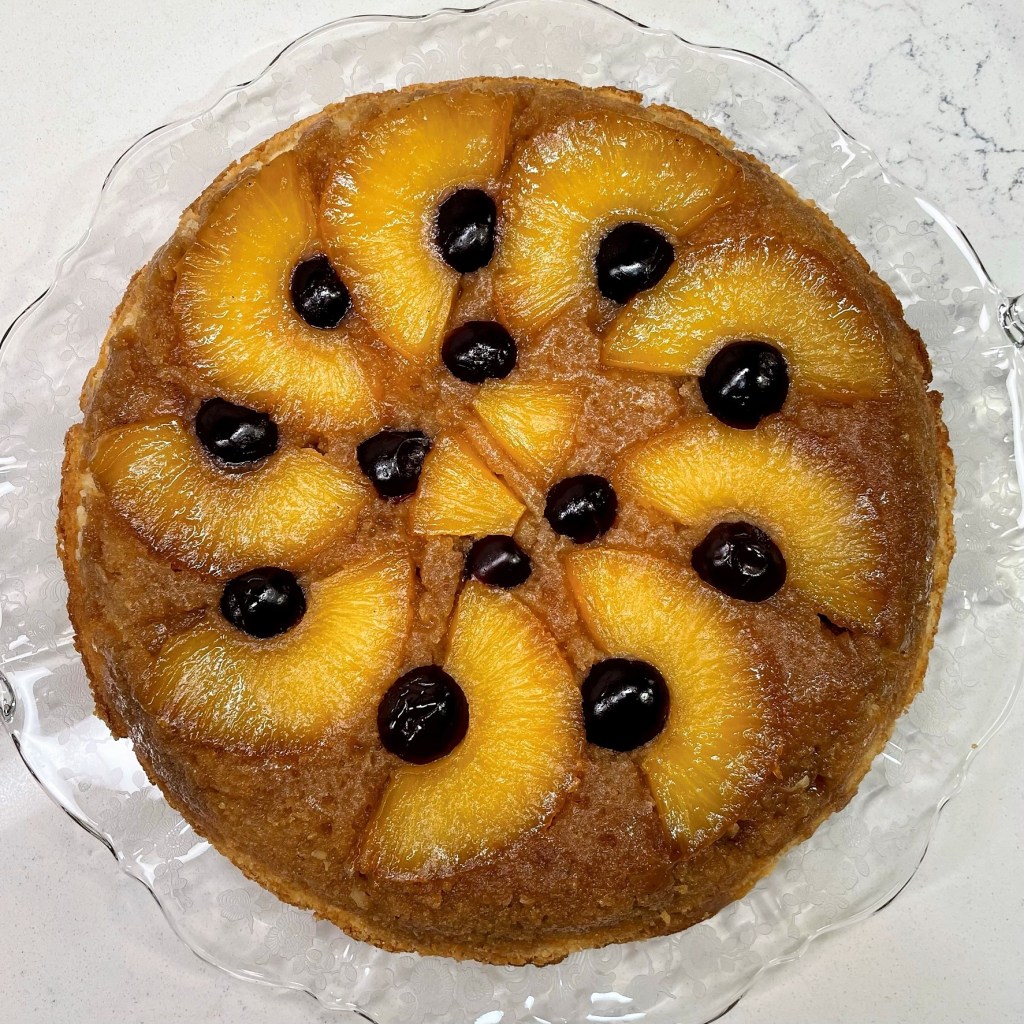
It was every bit as delicious as it looked!

As I gathered up my ingredients to get started, I realized all at once the source of my frustrations with baking sweet treats. It’s me. Yep, it’s my own fault I’m a lousy sweets baker.

But this recipe proved I can break free of that negative self-talk. I just needed to be diligent.

My muse is frequently five or more steps ahead of my mind and my hands, and the exuberance that kicks in when I start making on-the-fly adjustments to a perfectly good recipe is exactly what gets me into trouble. I confuse myself with too many ideas for substitutions, throwing off the ratios that are so necessary for good baking results. It makes me crazy after hours spent in the kitchen on a recipe that seemed so promising at the start.

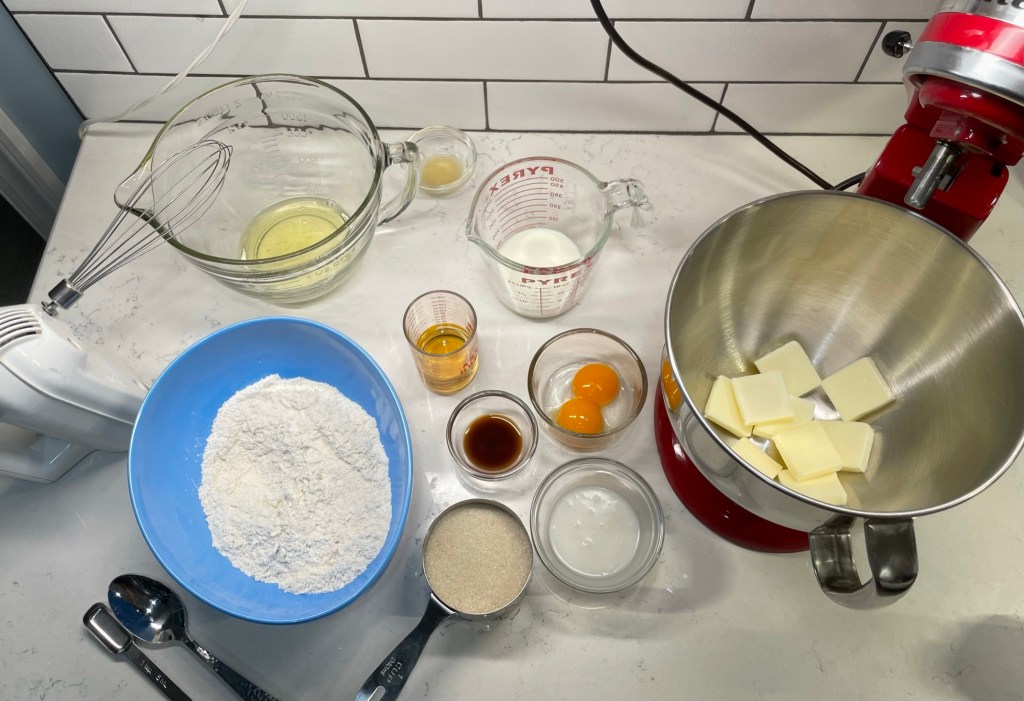
When I have a crappy result, I inevitably swear off baking— and I am using the word swear quite intentionally. Then, when my persistent muse comes around again, I repeat the whole scenario, sometimes verbatim. But for this cake, I pledged to slow down, chart my substitution ideas more thoughtfully, read the recipe (twice), and truly organize my ingredients into pre-measured amounts (not just put their pantry containers on the counter) to reduce the chances of disaster. And what do you know?— it worked!


My baseline recipe was a skillet version of pineapple upside-down cake that I found on the King Arthur Baking website, my go-to for all things baking. I imagined the wonderful flavors of a tiki cocktail and started rounding up my substitutions.

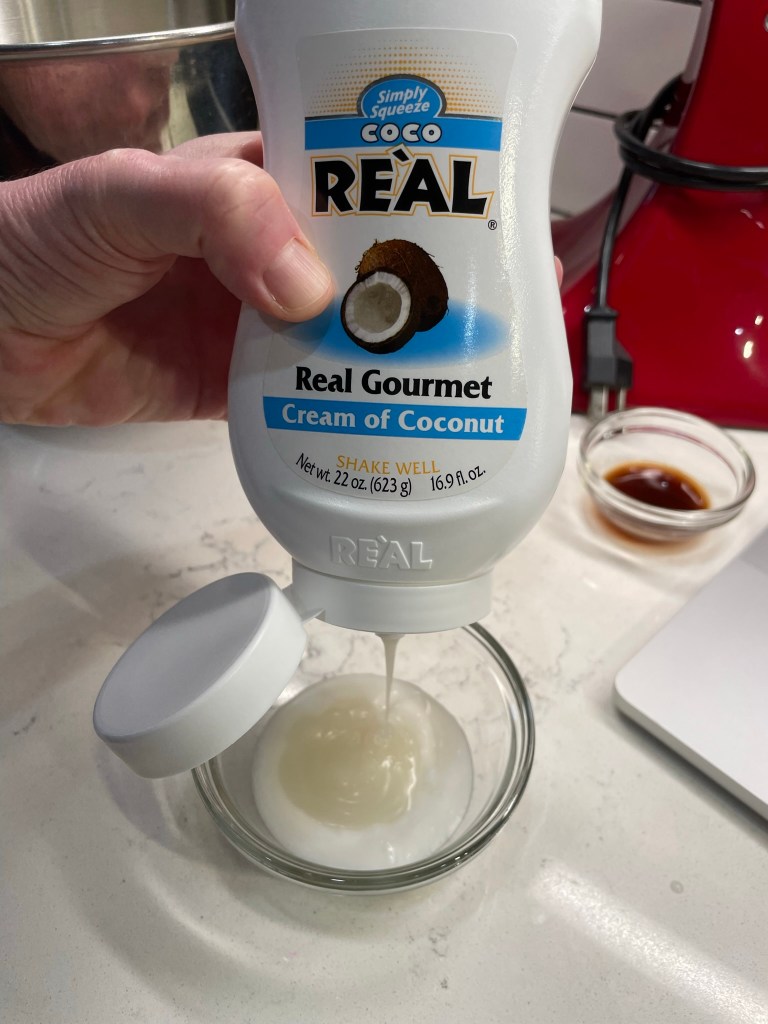
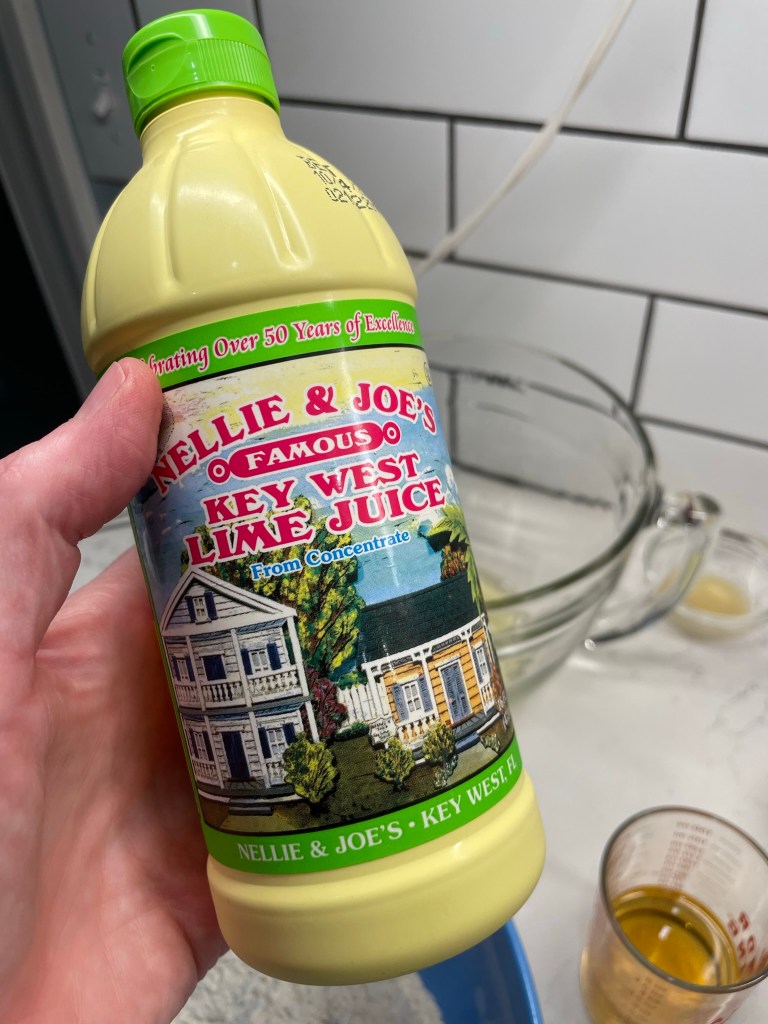
I wanted rum in the brown sugar topping, and in the cake batter itself. Sweetened flaked coconut would be great in the batter, but that wouldn’t be enough flavor so I’d swap out some of the sugar in favor of this sweet cream of coconut— the same stuff I use in a real tiki cocktail. Key lime juice would spike it with a touch of citrus, but just a touch. Almond extract would play the role of orgeat, the nutty-sweet syrup ingredient that is so distinctively tiki-ish. Our bourbon-drenched cocktail cherries felt more appropriate than the artificially colored bright red maraschinos, and it would be another touch of boozy, grownup candy goodness. And then, of course, my lovely fresh pineapple would be the centerpiece.


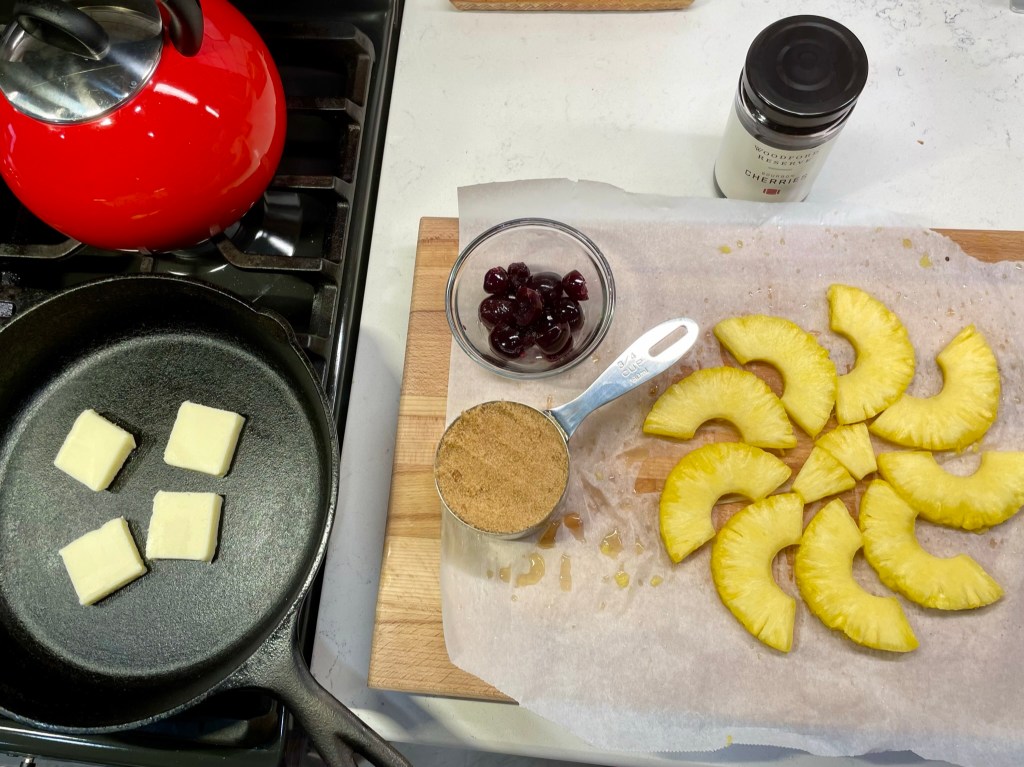
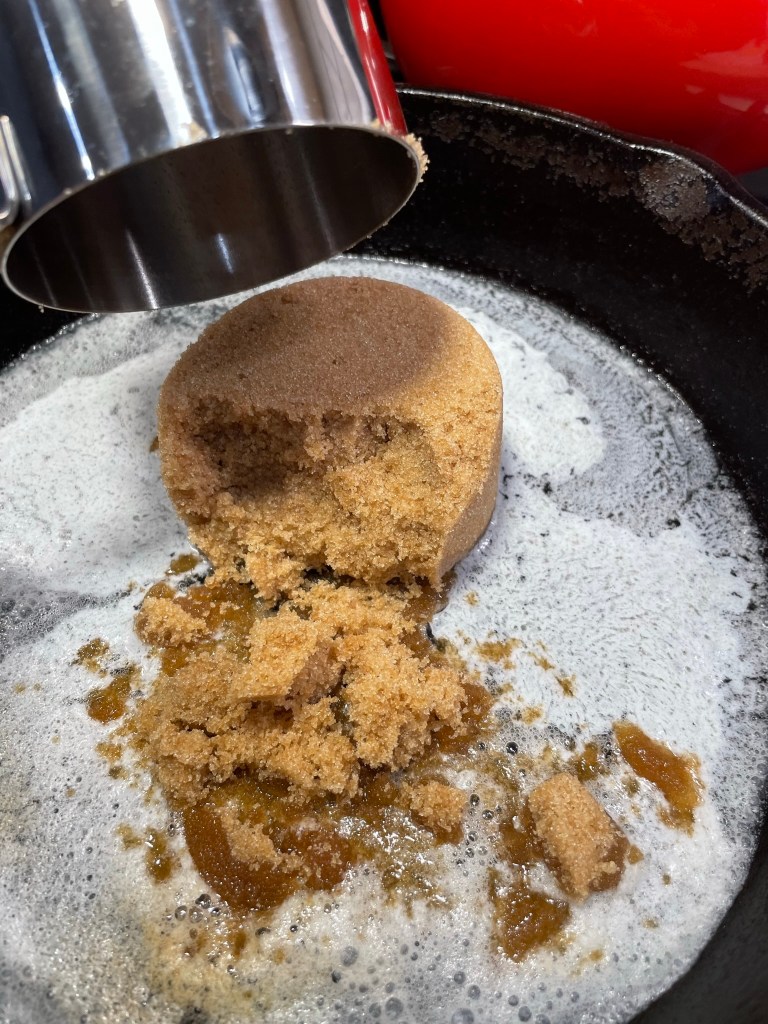
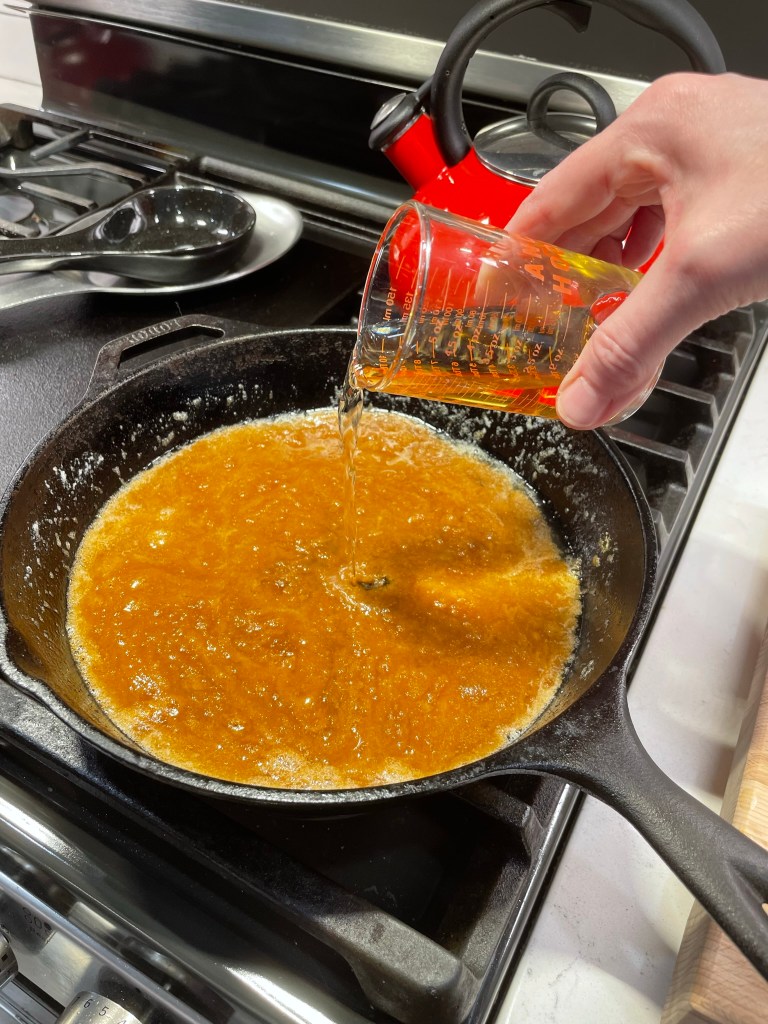
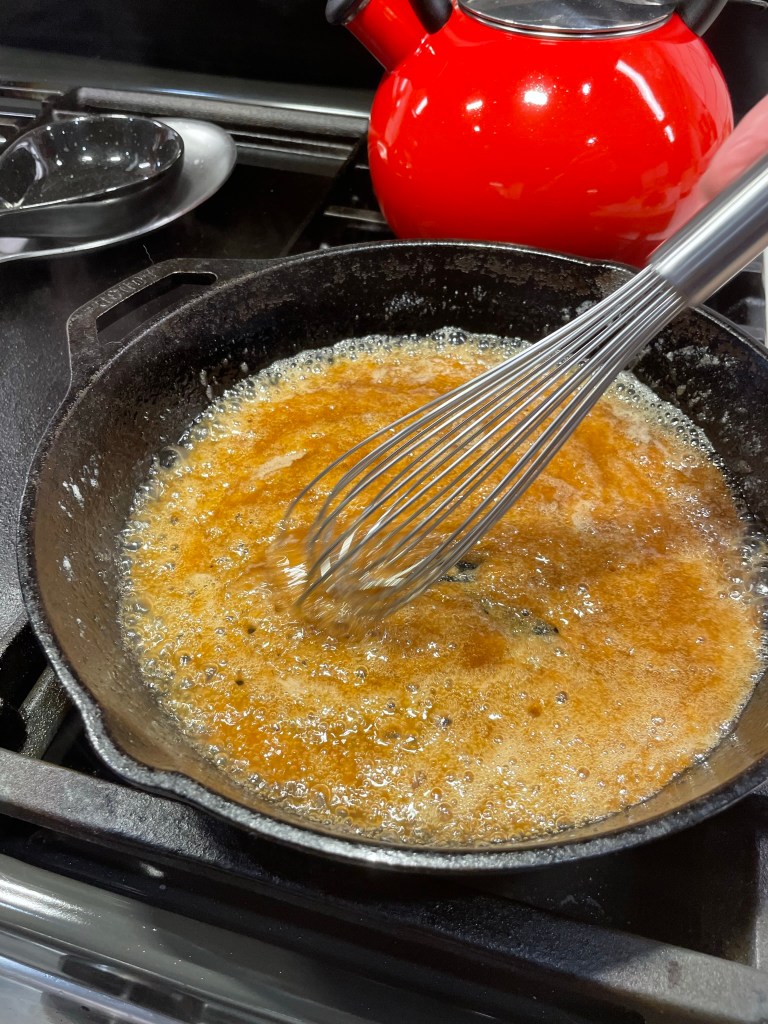
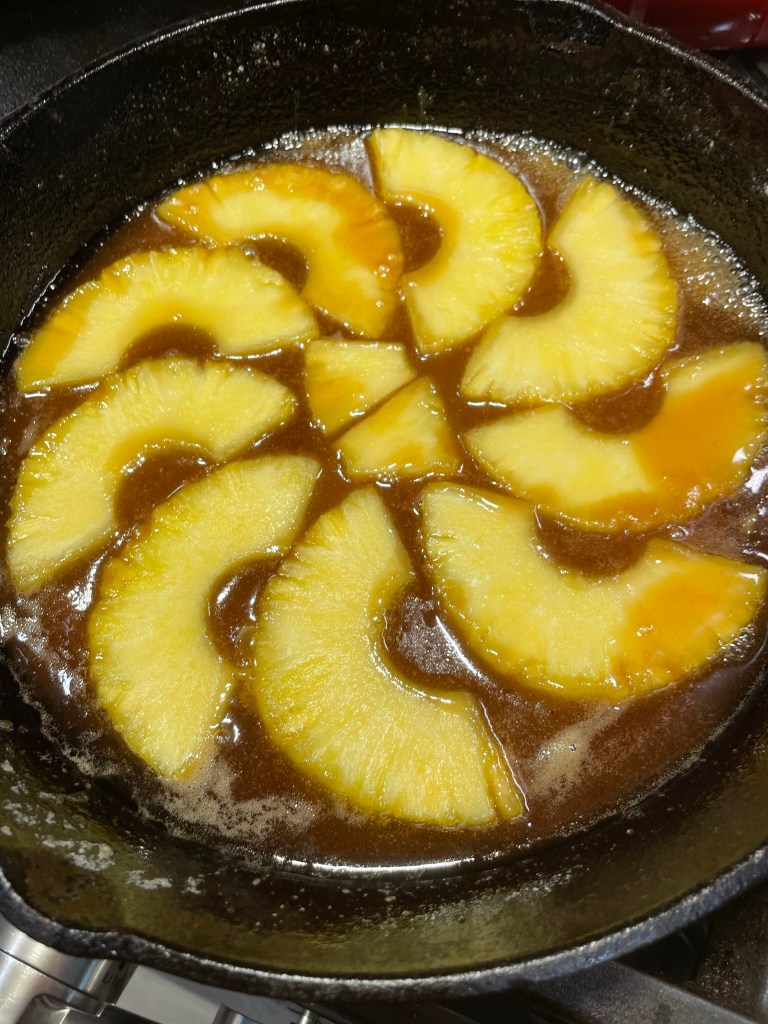
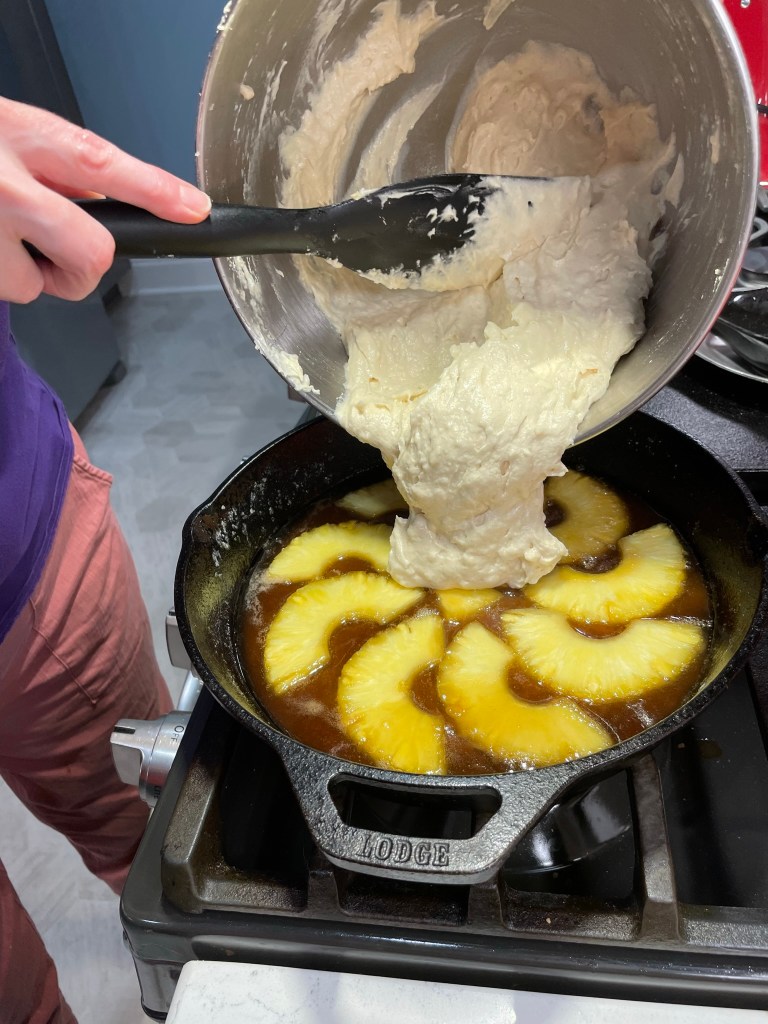
With my ingredients measured and in order, following the recipe roadmap was a cinch. The topping was easy, just melting together brown sugar and butter, and then boosting it with a shot of Jamaican rum. I let it get nice and bubbly, then turned off the heat and arranged the pineapple slices. The cherry halves would come later.


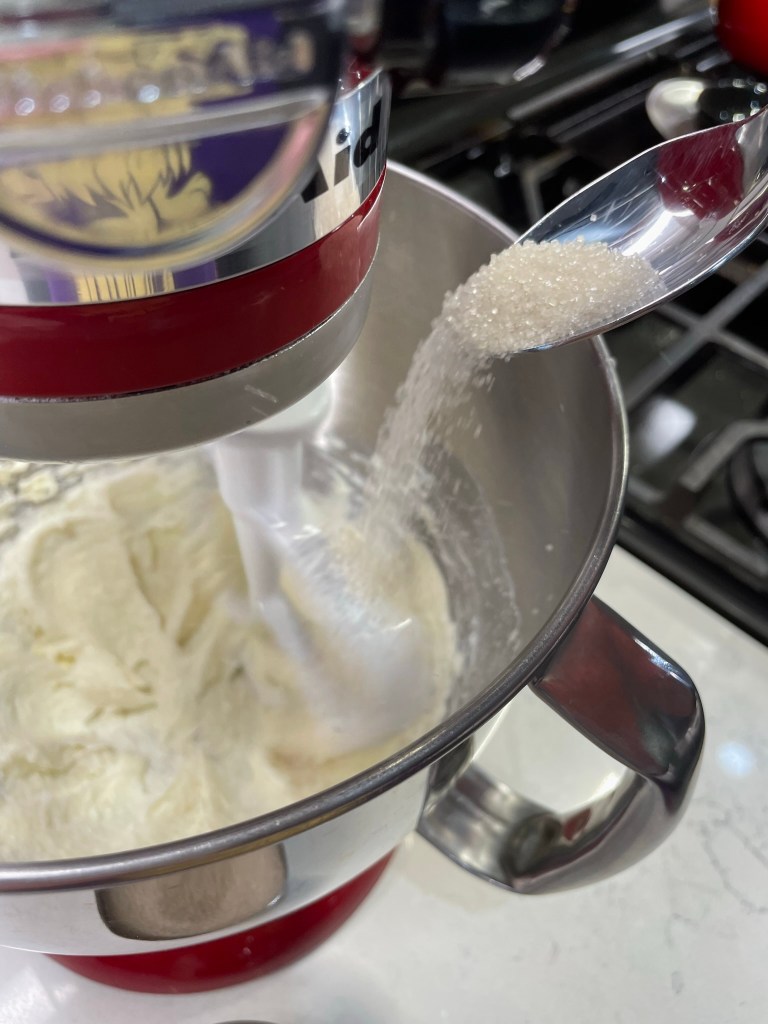
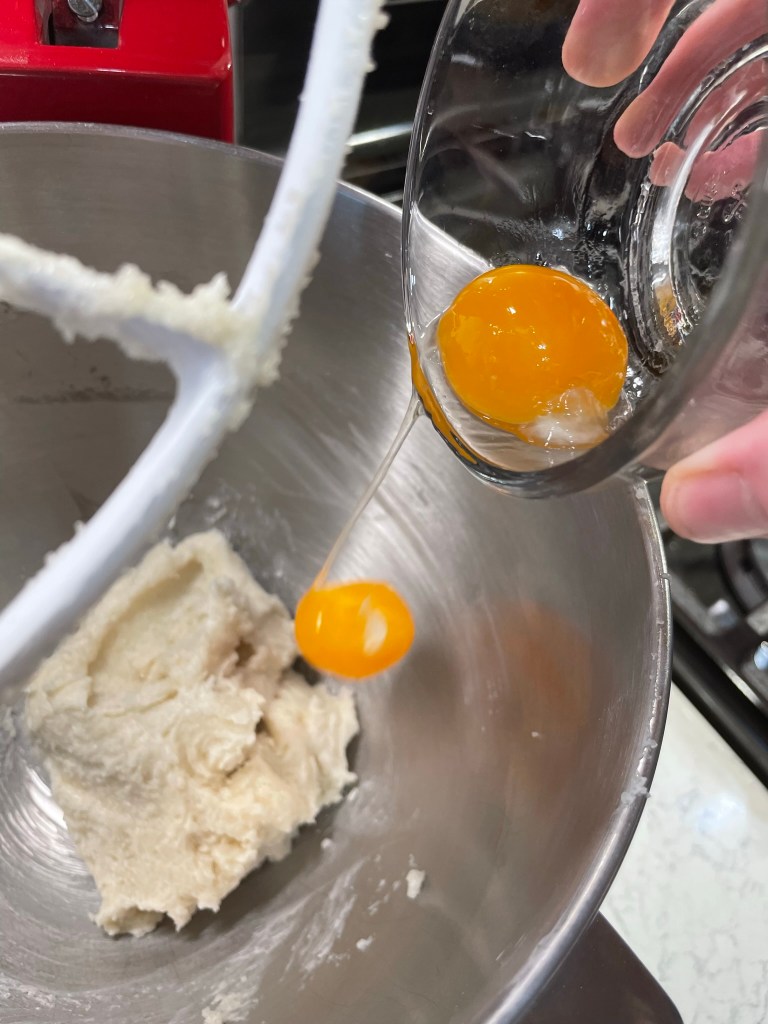
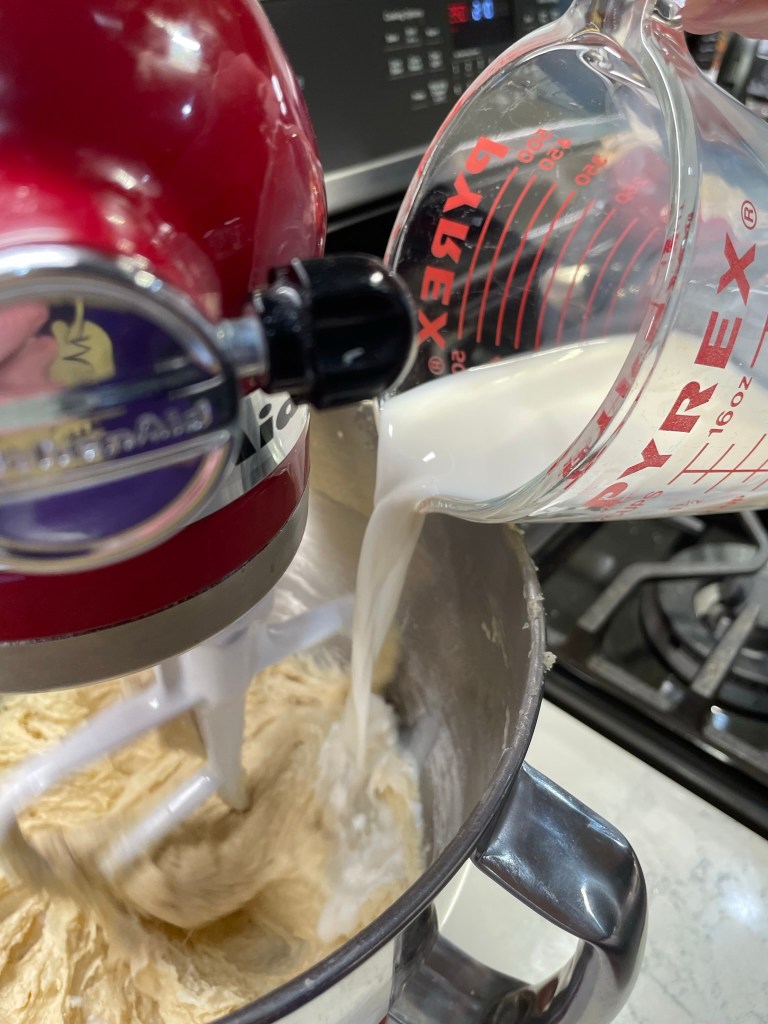
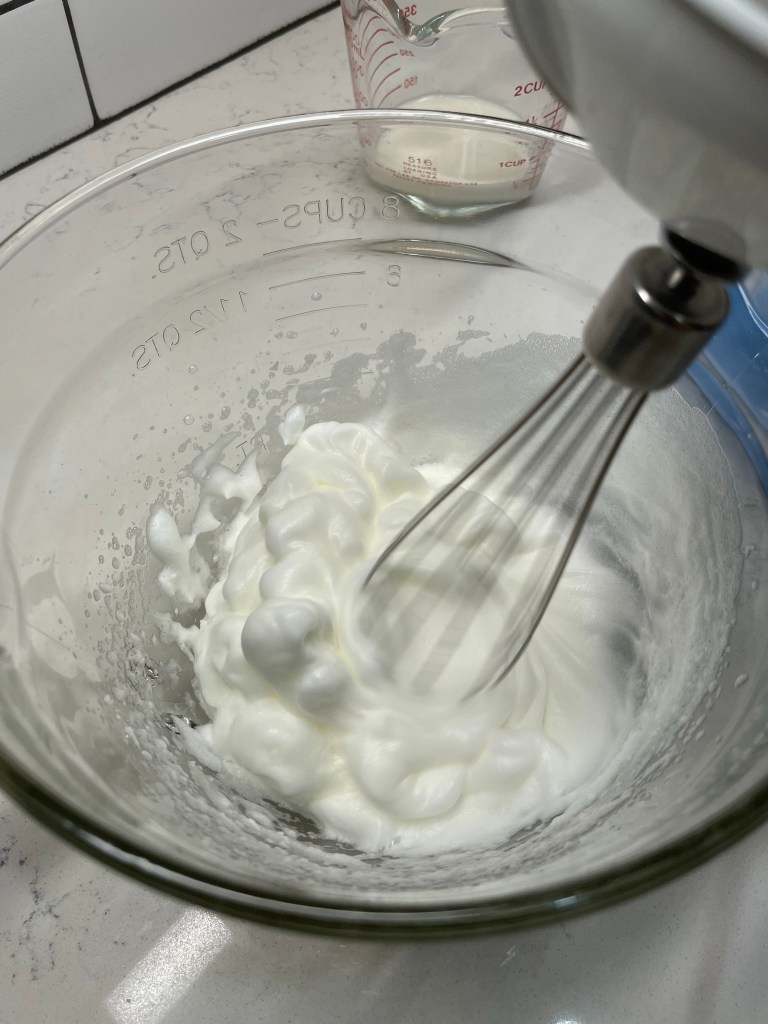
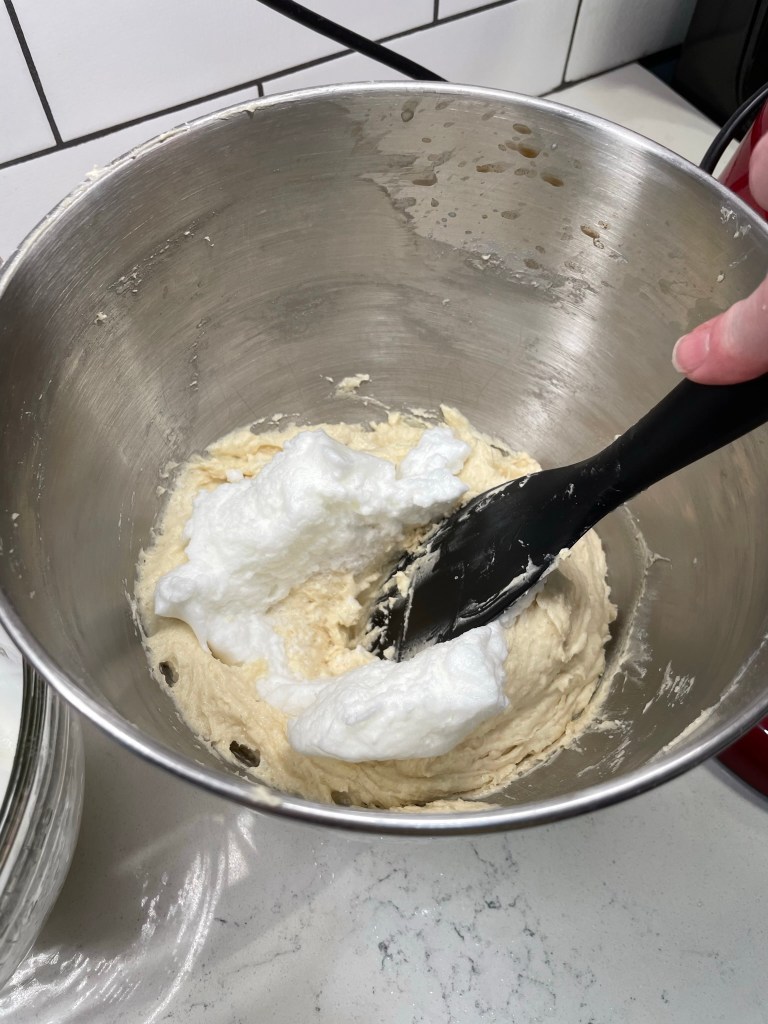
I creamed together the butter and cream of coconut, then gradually beat in the sugar. Next came the egg yolks, the flavorings and the flour-milk-flour-milk-flour additions. Alternating those ensures more even blending without overmixing. The egg whites, which were whipped separately, were folded in at the end and I spooned the batter over the brown sugar butter mixture that held the pineapple slices in the skillet.


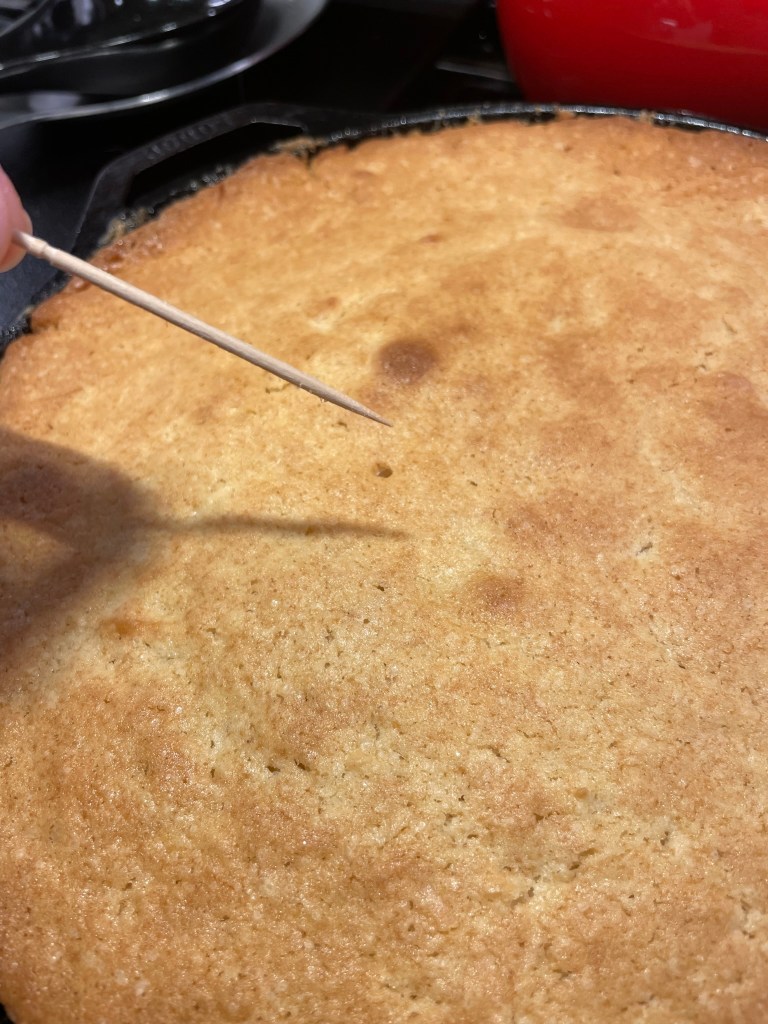
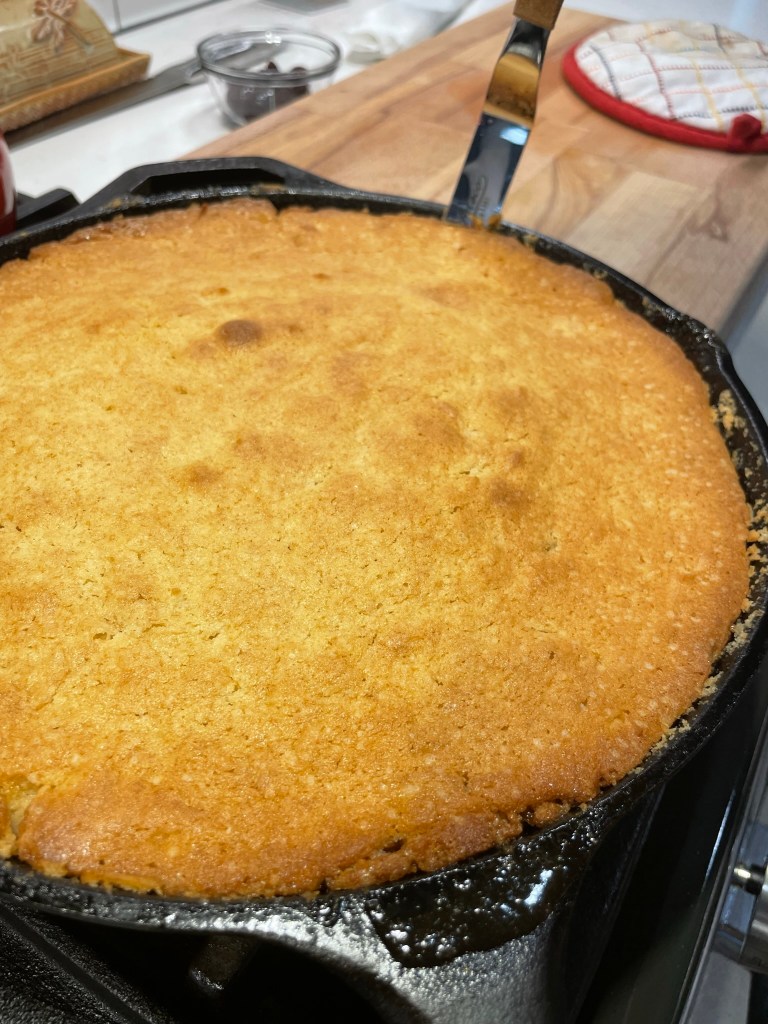
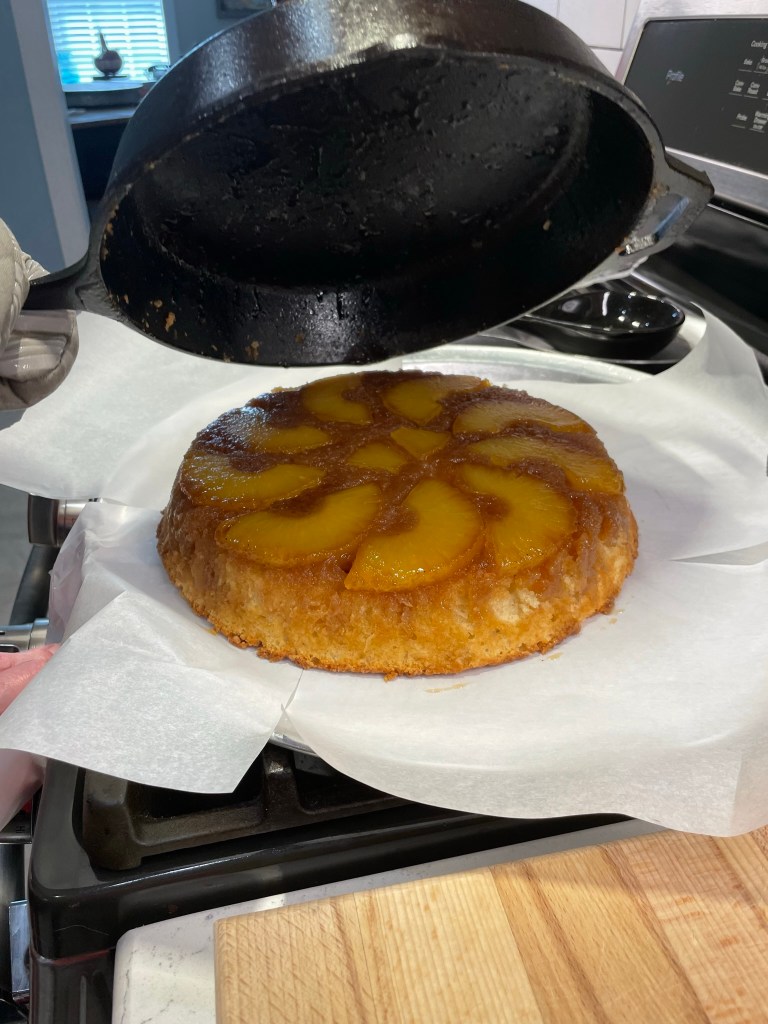
The baking time was true to the recipe (my toothpick said so), and I inverted the cake onto a serving platter to cool. There’s a sweet spot in timing the inversion from a hot skillet; too soon and the cake may fall apart, too long and the toppings will stick and you’ll be patching them into place. Aim for 15 to 20 minutes for best results, then immediately press the cocktail cherry halves into place while the topping is still warm and gooey. Cool it completely before serving. Waiting to enjoy it was the hard part!


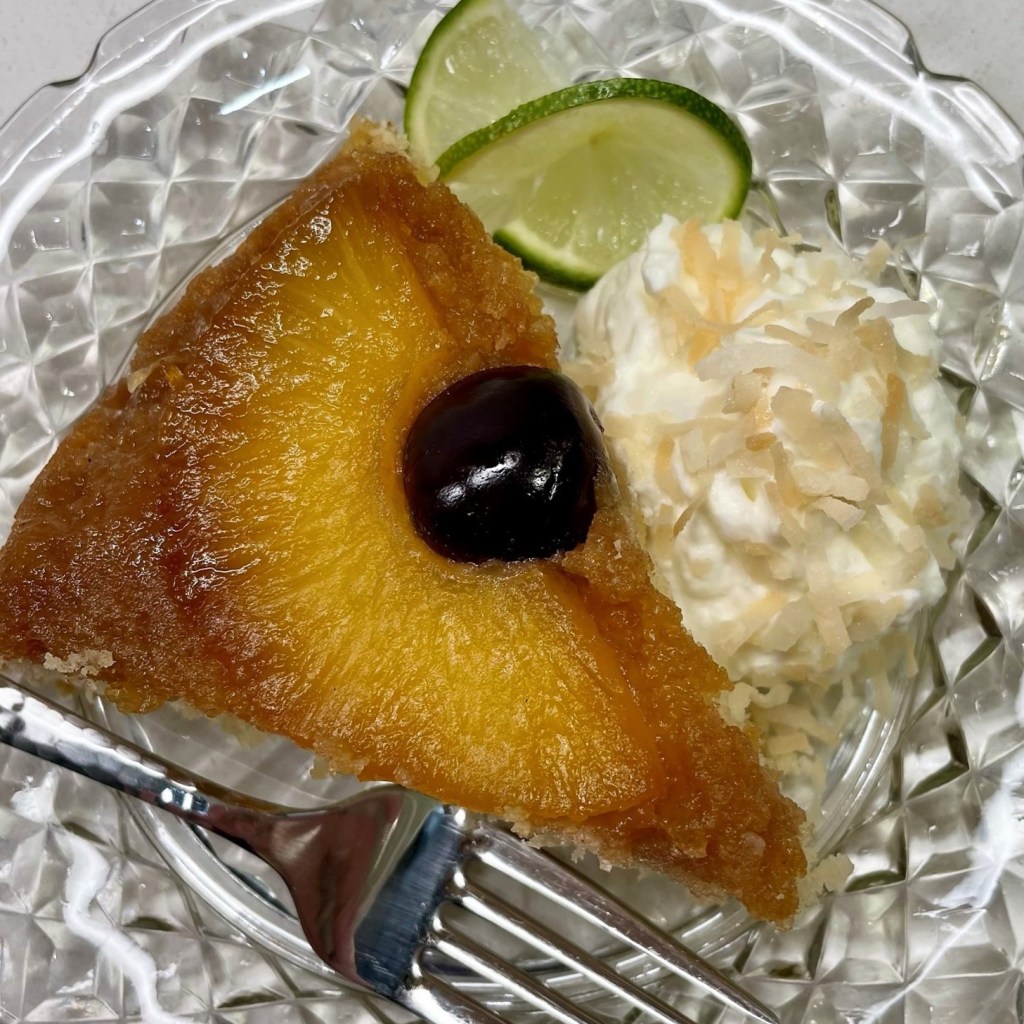
I served my tiki cocktail cake with a dollop of sweetened whipped cream, spiked with more booze of course, as well as a lime twist and a sprinkling of toasted coconut.

Having my cake and drinking it, too!

So was it worth the trouble? Mostly, yes. The cake was really delicious— definitely boozy, as intended— and the coconut and pineapple were solid co-stars. It had the perfect hint of almond, but the key lime was barely detectable, and next time I would probably just grate a little lime zest over the cake at serving time. The boozy cherries, as much as I love them, got lost a little bit with all the tropical flavors swirling around them, but they were still a nice little nod to a traditional upside-down cake.

The biggest victory for me was seeing the success that resulted from my planning and, for once, I didn’t swear off baking when this was finished. To the contrary, I’m already imagining my next cocktail-to-cake creation. Any suggestions? 😄


Tiki Cocktail Skillet Cake

  • Servings: 8
  • Difficulty: Average
  • Print

A few thoughtful ingredient swaps turned a classic cake into tropical tiki territory. You might say that I'm having my cake and drinking it, too!


Ingredients

  • 1/2 stick (4 Tbsp.) salted butter, softened
  • 3/4 cup light brown sugar
  • 2 Tbsp. rum (I used Jamaican dark rum)
  • Fresh or canned pineapple rings, drained
  • 1 cup all-purpose flour
  • 2/3 cup whole wheat pastry flour (or additional all-purpose)
  • 1/4 cup sweetened flaked coconut
  • 2 tsp. baking powder
  • 3/4 tsp. fine salt
  • 1 stick (8 Tbsp.) unsalted butter, room temp
  • 1/4 cup cream of coconut
  • 3/4 cup cane sugar
  • 2 large eggs, separated
  • 1/2 cup, minus 2 Tbsp. milk (see recipe notes)
  • 2 Tbsp. rum (Jamaican again)
  • 1 1/2 tsp. vanilla extract
  • 3/4 tsp. almond extract
  • 1 tsp. key lime juice
  • Cocktail cherries, halved (use as many as you have pineapple rings)

Having all my ingredients measured and lined up before beginning made all the difference in the world for my successful outcome. Separate the eggs while they are cold, but let them come to room temperature before you start the recipe.

Directions

  1. Preheat oven to 350 F, with rack in center position.
  2. In a medium bowl, whisk together flours, coconut, baking powder and salt. Set bowl aside.
  3. Cut unsalted butter into chunks to quicken softening. Separate the eggs, keeping the whites in a large bowl to be whipped. This will be added to the batter just before baking. Combine milk and 2 Tbsp rum in a measuring glass and set aside.
  4. While all the ingredients are coming to room temperature, prepare the pineapple topping. Melt salted butter in a cast-iron skillet over medium heat. Add brown sugar and whisk until combined and just beginning to bubble. Turn off heat and stir in 2 Tbsp of the rum. Give the skillet a few gentle shakes to settle the mixture evenly in the skillet. Arrange the pineapple slices as desired.
  5. Cream butter and cream of coconut together in the bowl of a stand mixer, stopping occasionally to scrape down the sides. When mixture is lighter and somewhat fluffy, gradually add sugar, beating and scraping down sides as needed.
  6. Use an electric hand mixer to whip the egg whites until light and airy but not broken. Set aside.
  7. Add one egg at a time to the batter, beating until well combined after each. Beat in vanilla, almond and lime juice.
  8. Alternate addition of the flour mixture and milk as follows: 1/3 flour mixture stirred in until smooth. Next, 1/2 milk mixture. Then 1/3 flour mixture, remaining milk, remaining flour mixture. Scrape down sides and blend as evenly as possible without overworking the batter.
  9. Give the egg whites a quick whisk again, then gently fold them into the batter, taking care to mix only until the whites are not distinguishable in the batter. Gently spoon the batter over top of the pineapple topping. Use a spatula to smooth out the top.
  10. Bake for 35 to 40 minutes, until a toothpick inserted in the center comes out clean. Cool for about 15 minutes.
  11. Run a knife or offset spatula around edges of the skillet to loosen the outer edge of the cake. Invert onto a plate or serving platter. Immediately place the cocktail cherries into the topping, pressing gently to set them into caramelized sugar.
  12. Cool cake completely. Cut into wedges and serve with a dollop of whipped cream, spiked with cointreau or coconut rum. Sprinkled with toasted coconut.


Copper Pennies

As much as I love experimenting in the kitchen, there are times that I crave a classic. These copper pennies were a dish that I learned to make during my short stint at A Pinch of Thyme, an upscale catering business in Greensboro, North Carolina, during the 1990s. I suppose if they were to have given me a title, I might have been a “food prep specialist” or some such thing, but I basically just did a whole lot of chopping of fresh vegetables for crudité, salads and other recipes.

One of the most important lessons I learned in the “Pinch kitchen,” as we called it, was that simple dishes tend to be everyone’s favorites. You didn’t have to make grand gestures to impress people with food—it just had to hit their palates with balance and sometimes a bit of nostalgia. No wonder these copper pennies were popular with our clients for catered lunches—they cover both!

Copper pennies started appearing on American tables in the 1940s or so (the history on this is tough to track down), and most vintage cookbooks I’ve seen call for Campbell’s condensed tomato soup in the marinade. That’s the nostalgia part, I suppose, but we were having none of that in the Pinch kitchen. Our clients expected the food to be prepared from scratch, and that’s how I’ve made them here as well. In the spirit of full disclosure, the recipe I’m sharing today did not come from Pinch, but from a Junior League cookbook that was gifted to me many years earlier.

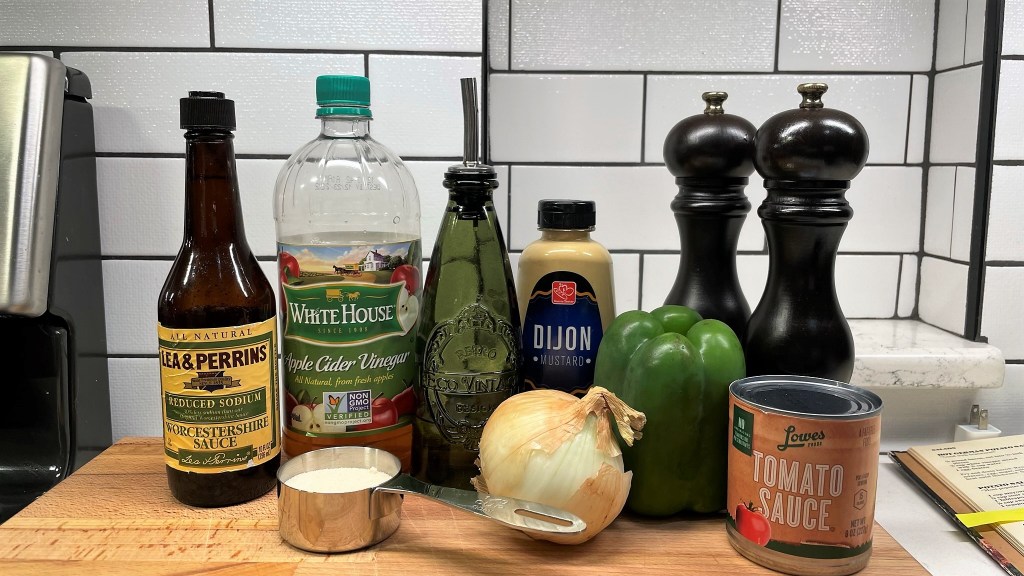
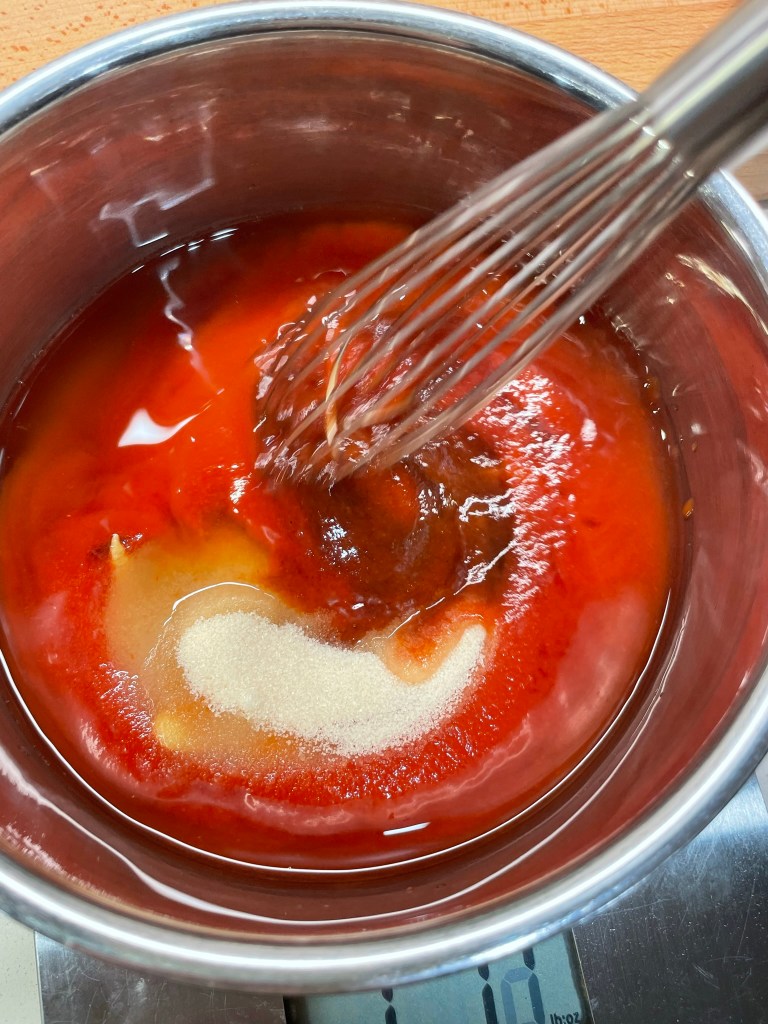
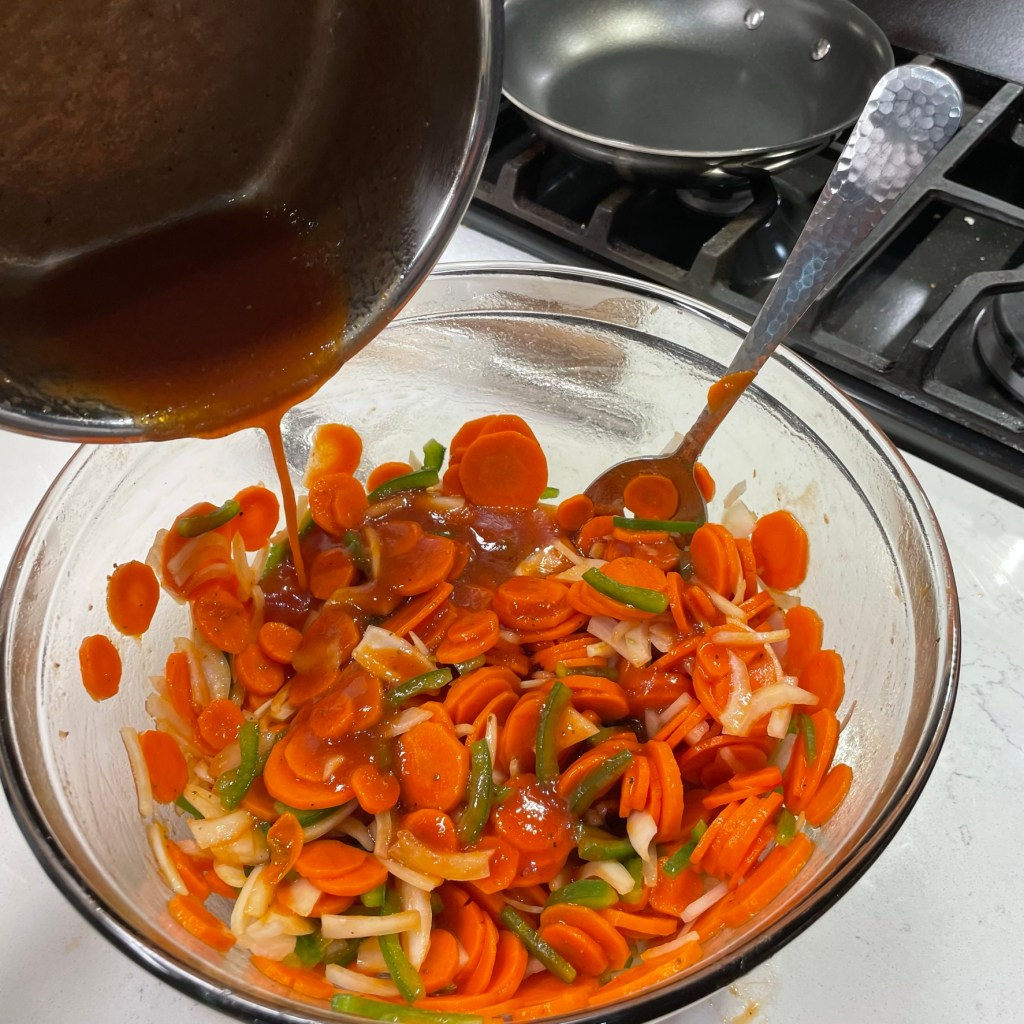
When I ran across the recipe, my mouth instantly began to water, as I recalled the tasty and vibrant copper pennies I had made so many years ago. The recipe builds on a small can of tomato sauce, and I tweaked it a bit for my own taste, cooking the marinade to deepen its flavor as well as cook off the tinny taste from the can. Here’s a glimpse of the rest of the ingredients. See? simple.


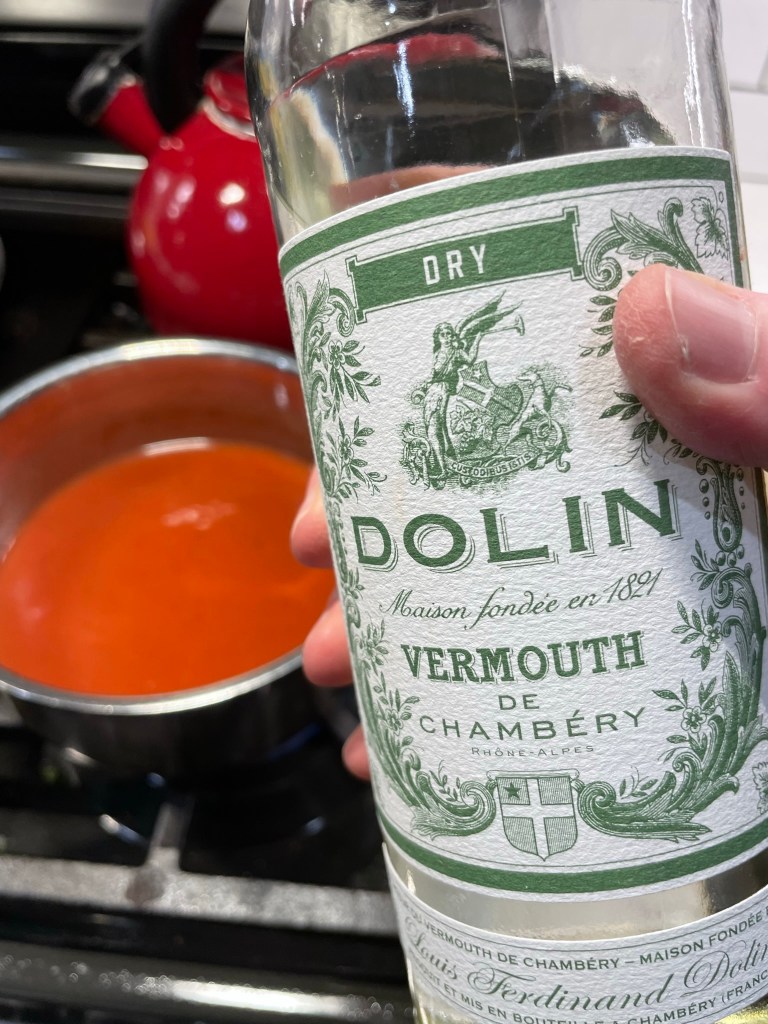
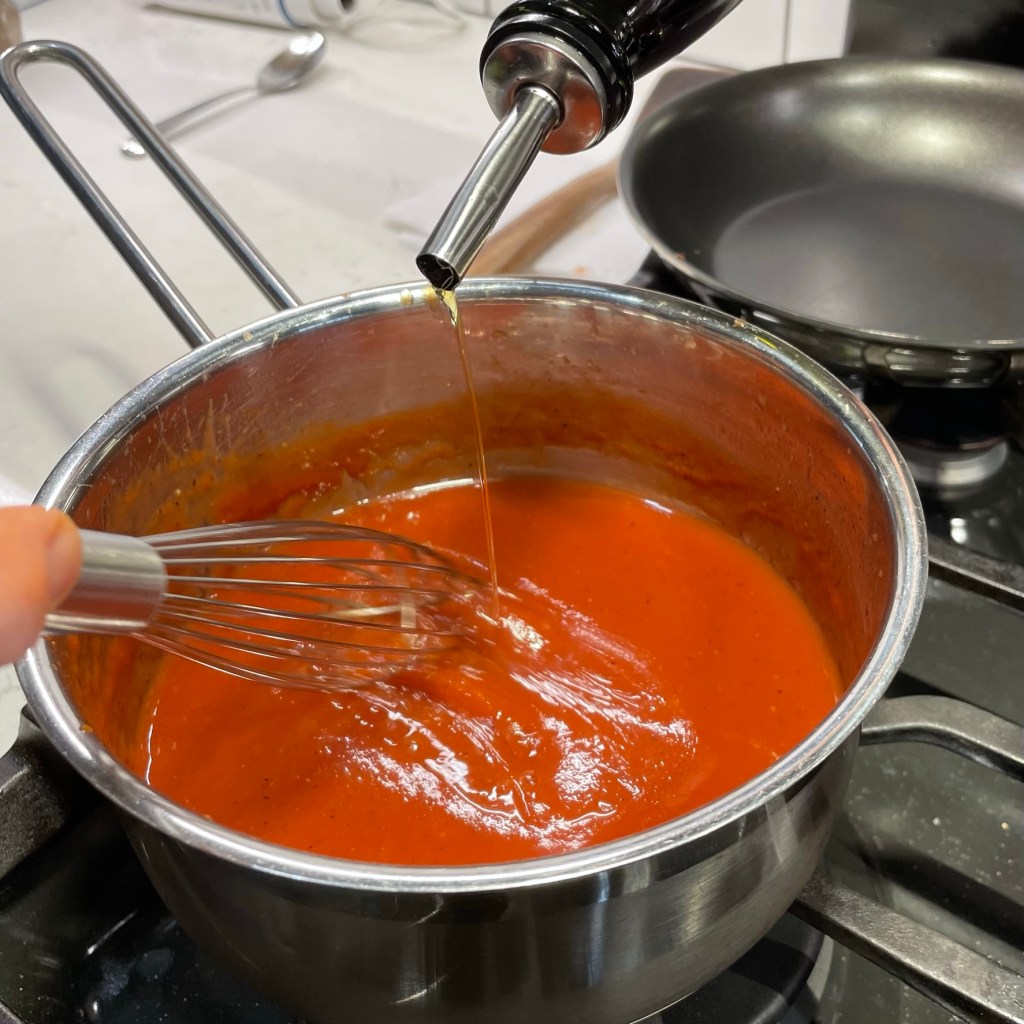
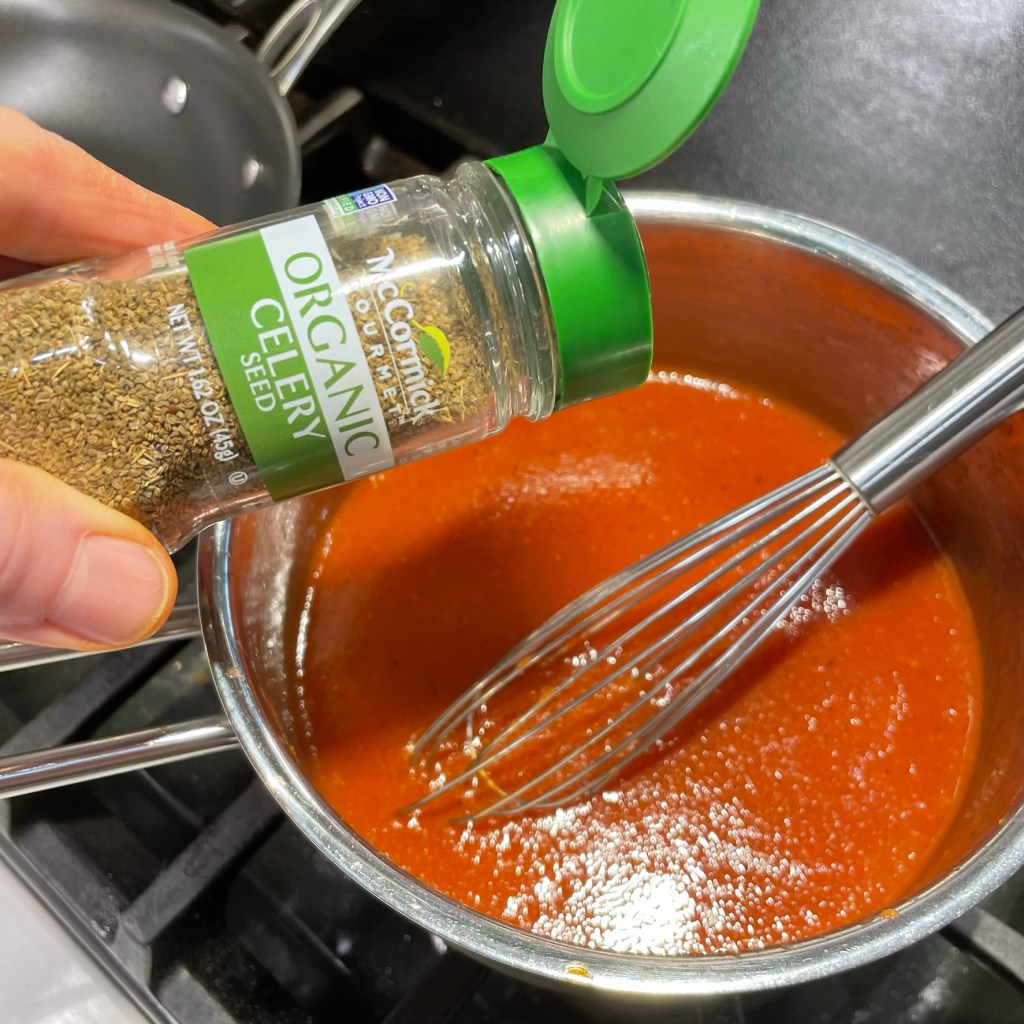
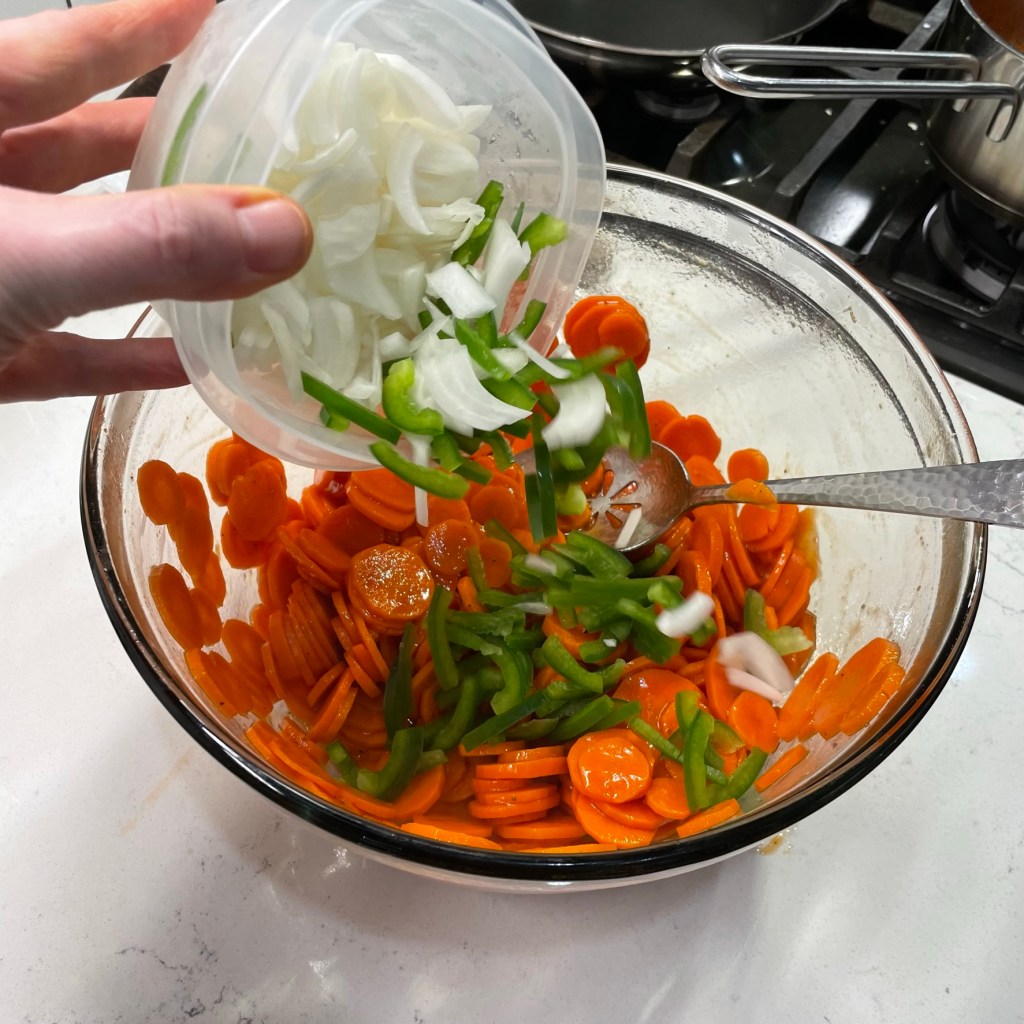
The onions and green bell pepper are standard, and I backed off the sugar in the Junior League recipe and added a splash of dry vermouth to elevate the marinade flavors. Dry white wine would be a perfect substitute, but I never have a bottle of that open and, after reaching for vermouth in its place one day, I found the complexity so appealing that I never looked back. If you’re a fellow martini lover, with a bottle of dry vermouth in the fridge, give it a try in a few recipes and let me know what you think about it in place of wine. I whisked in olive oil when the marinade was nearly finished, and sprinkled in celery seed for an herbal note.


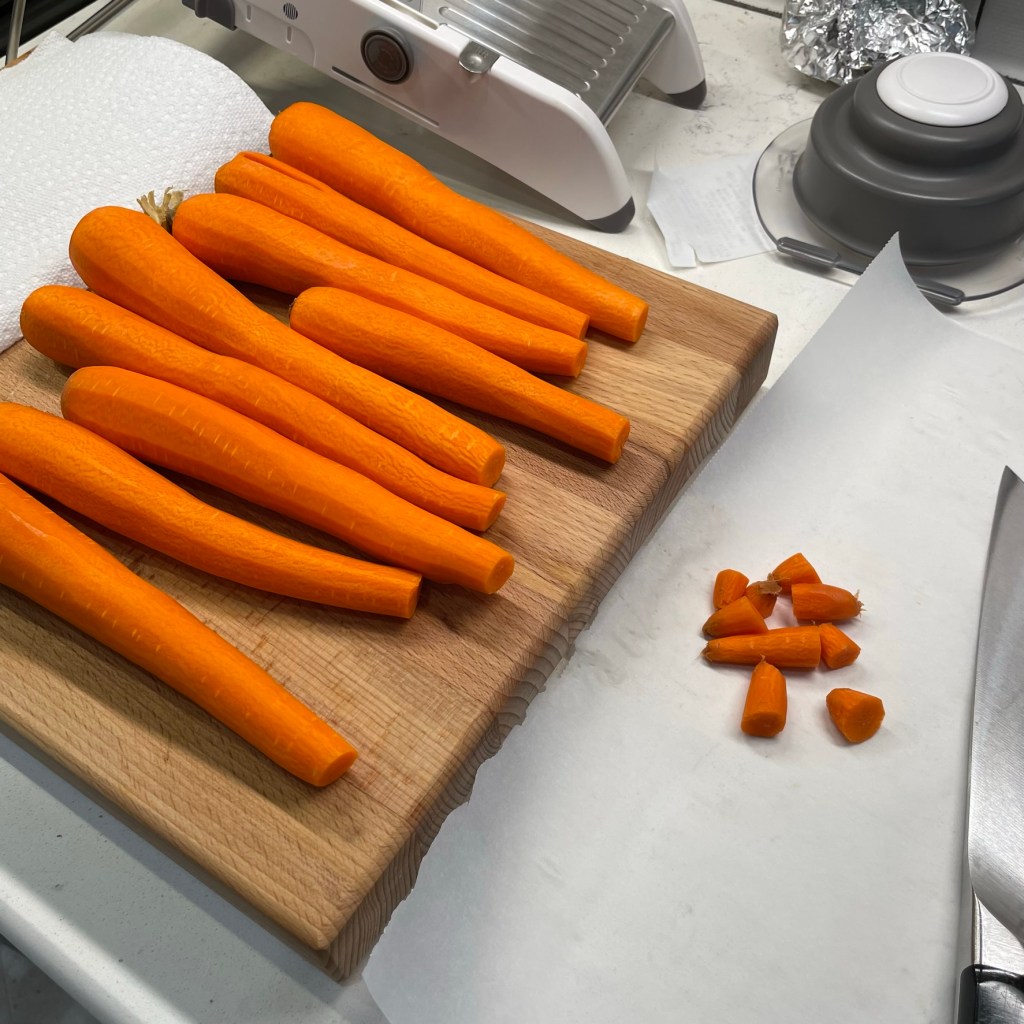
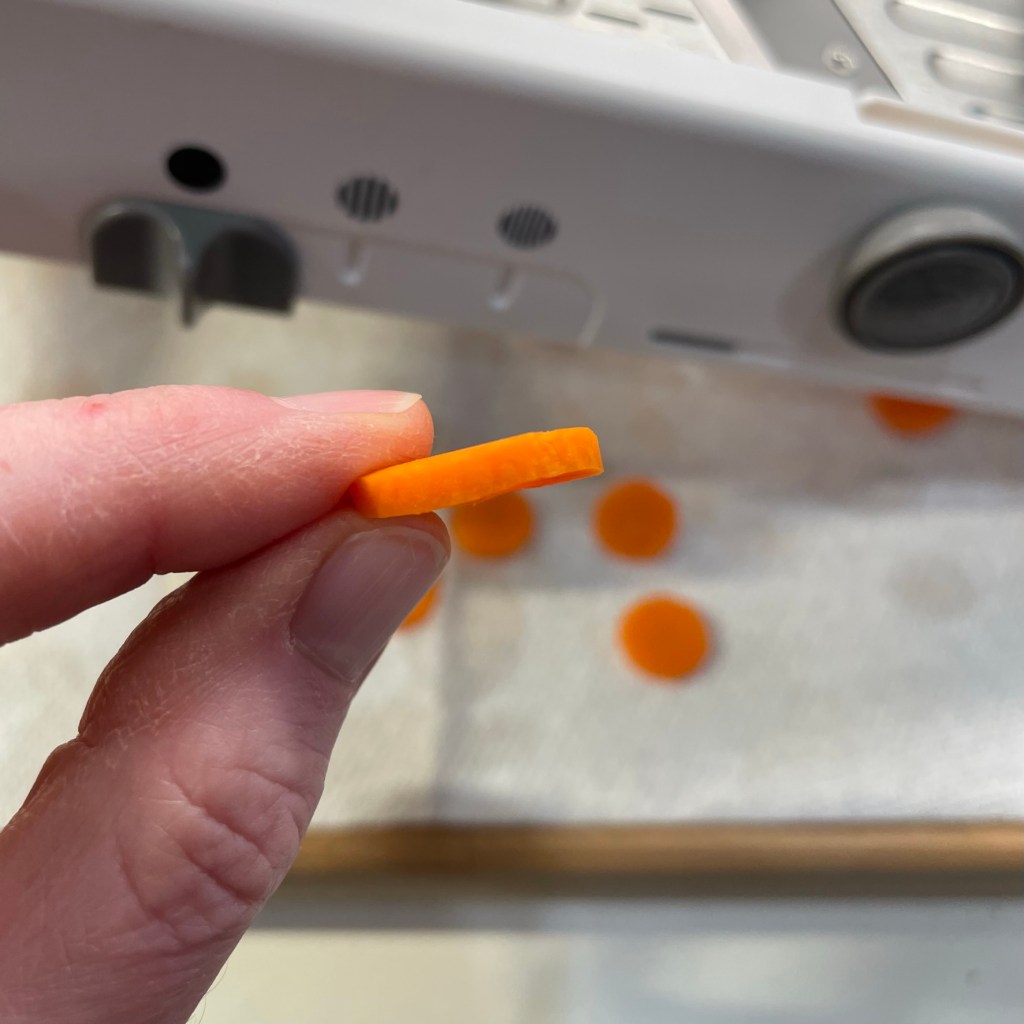
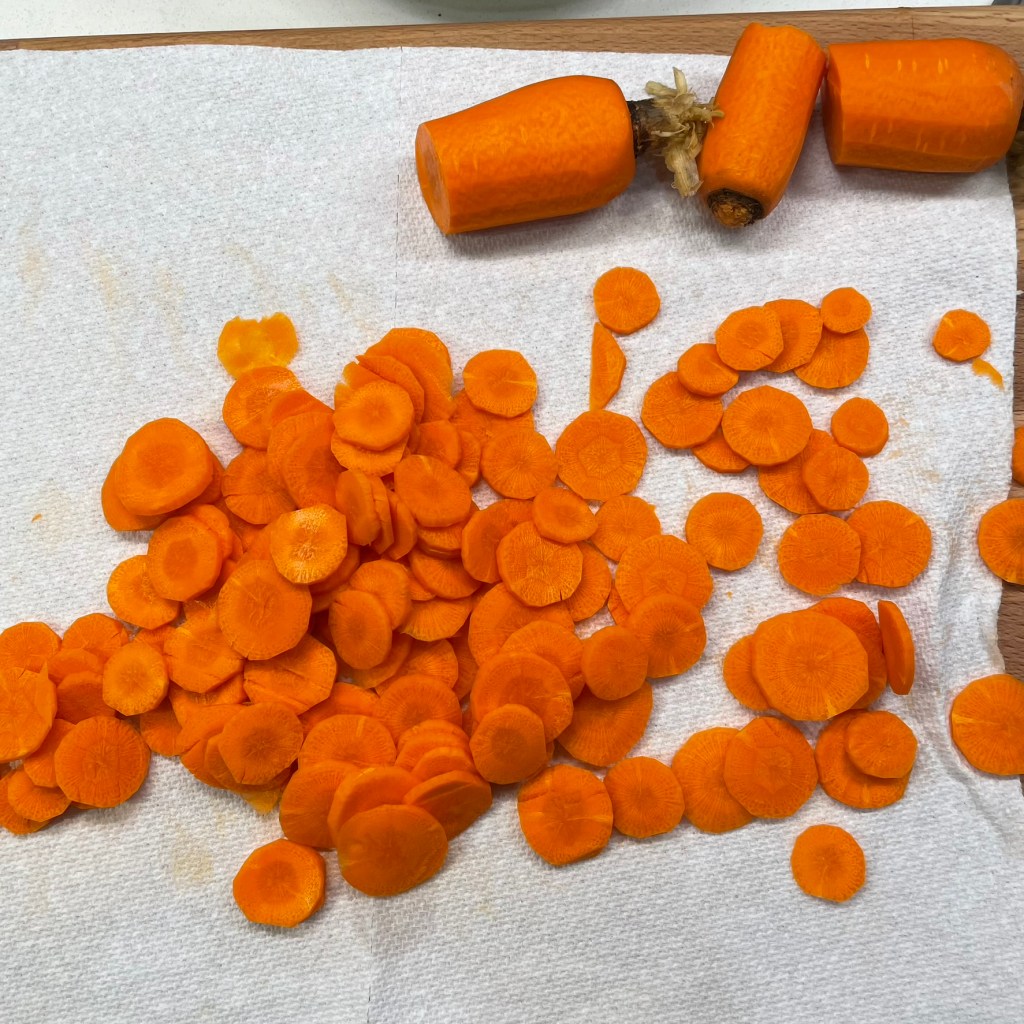
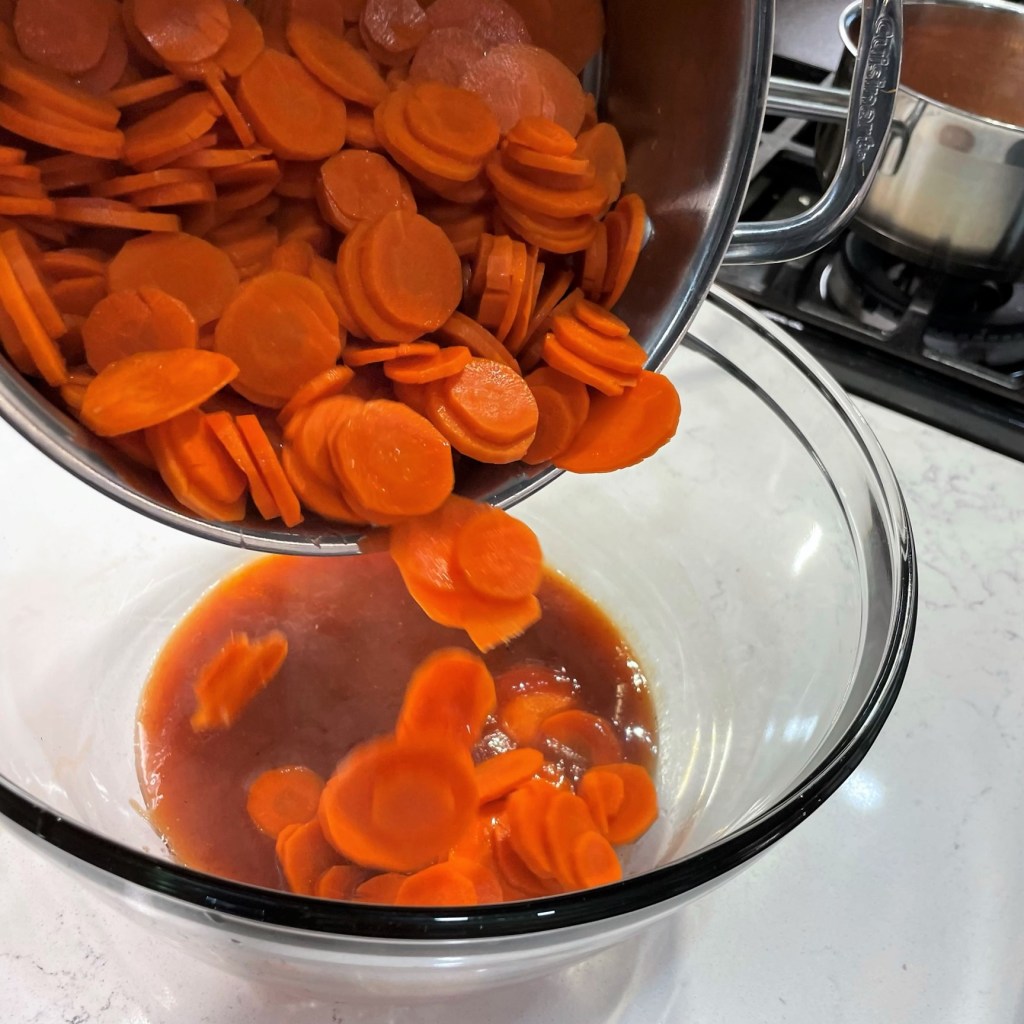
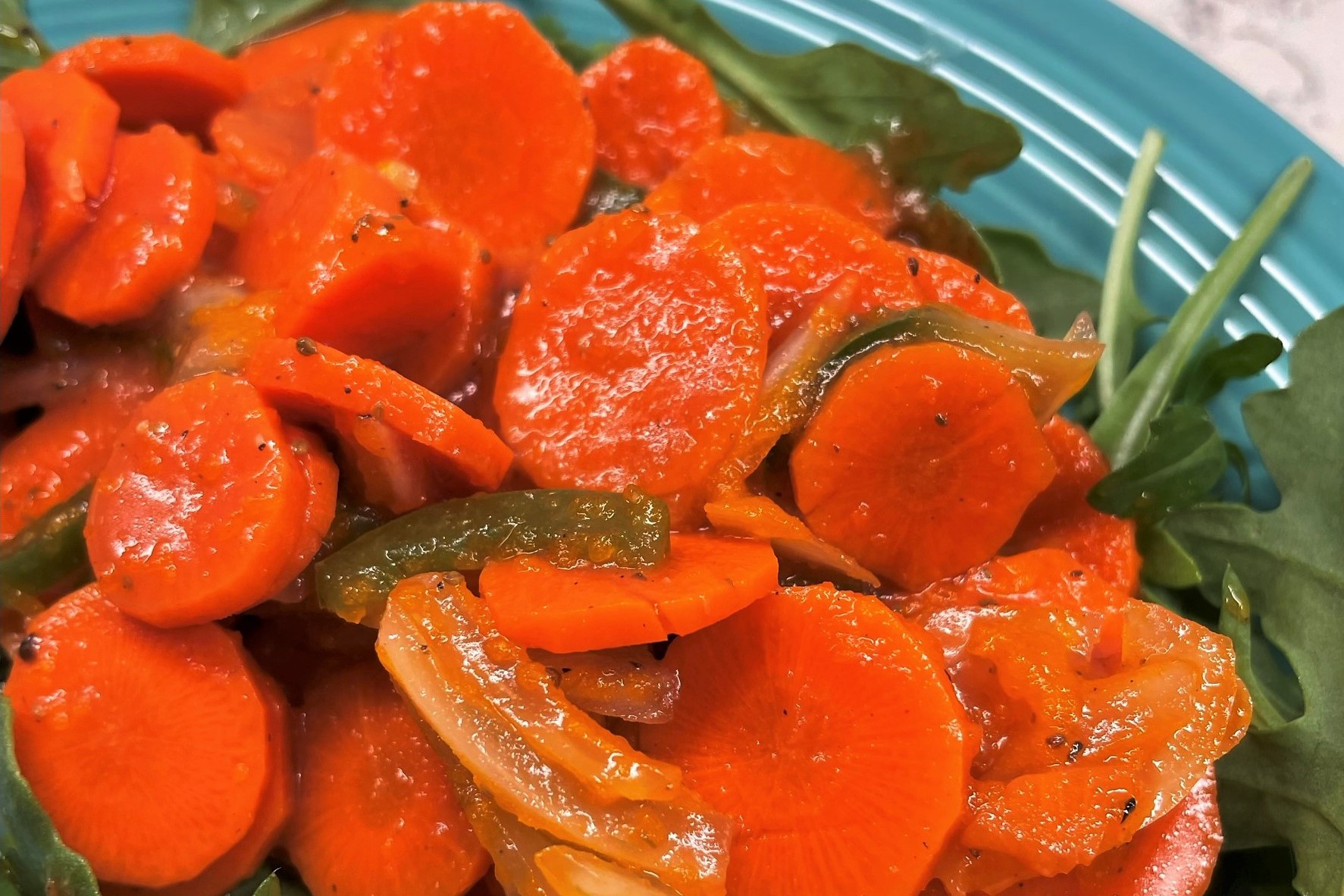
While the sauce simmered, I got to work slicing my carrots, and I purposely selected larger, fatter carrots for this recipe. My mandoline came in handy for this, as I was able to get perfectly round, even slices, but you must be careful using a mandoline. You see the large carrot “heels” I had leftover after slicing? That was because I stopped when my hands were getting too close to the blade. If you have never used a mandoline before, may I suggest you circle back to my post from two years ago, A Quick Flick of the Wrist, to see firsthand how dangerous it can be to ignore the safety features of this versatile kitchen gadget. If you’re more comfortable slicing by hand, that’s fine, too.


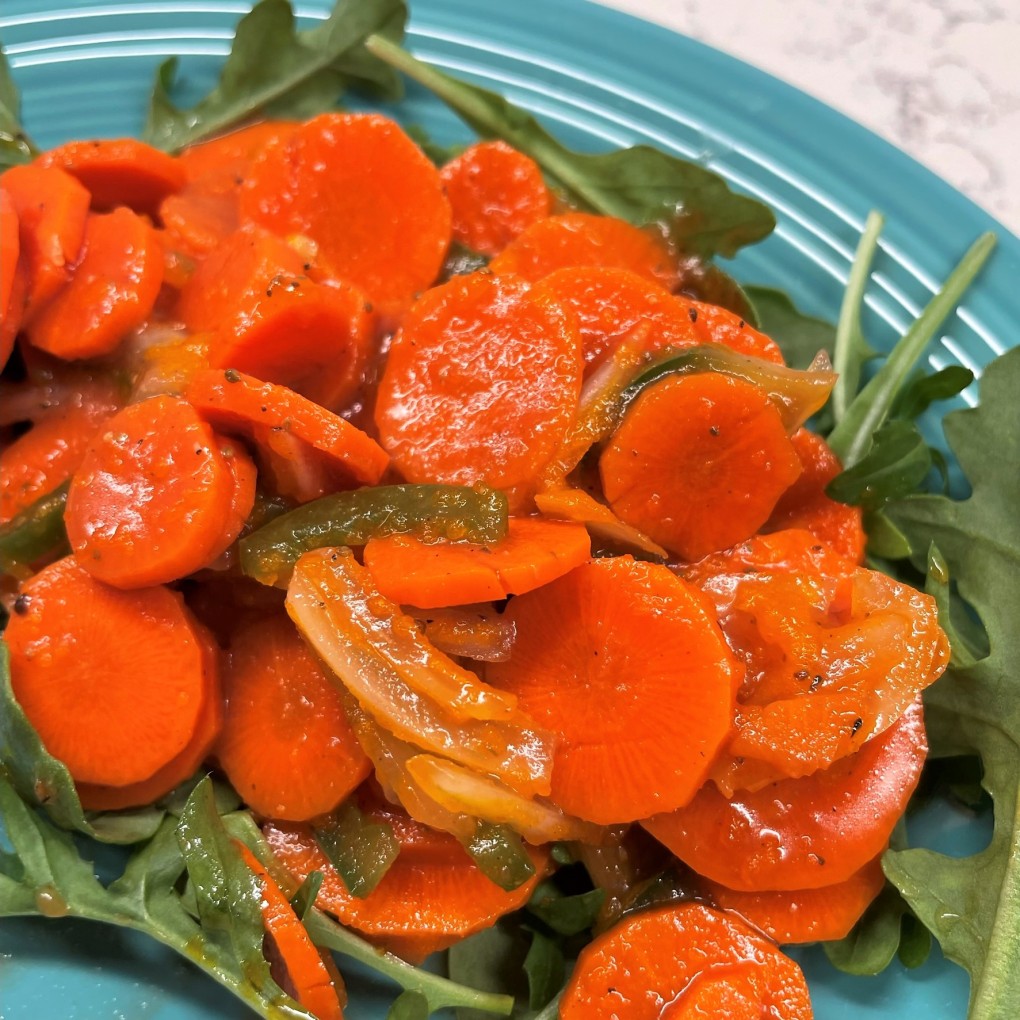
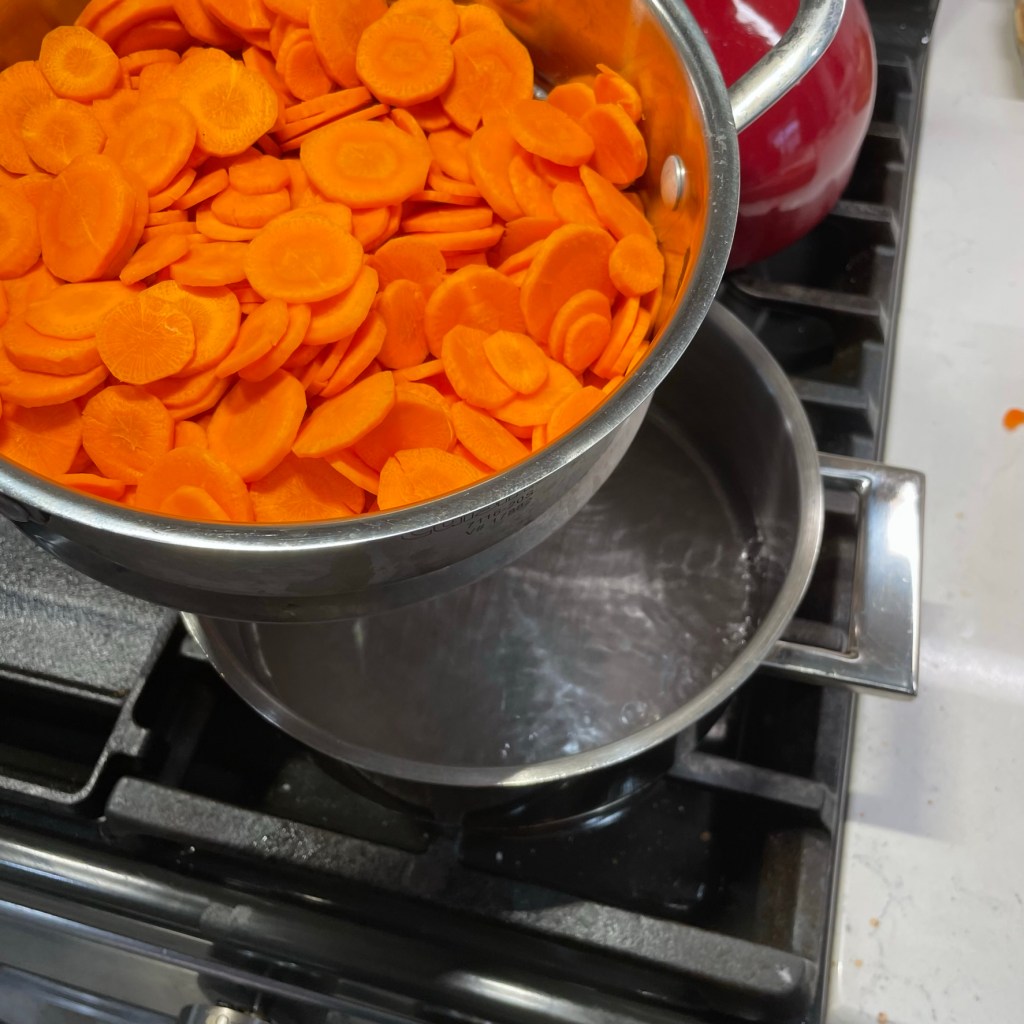
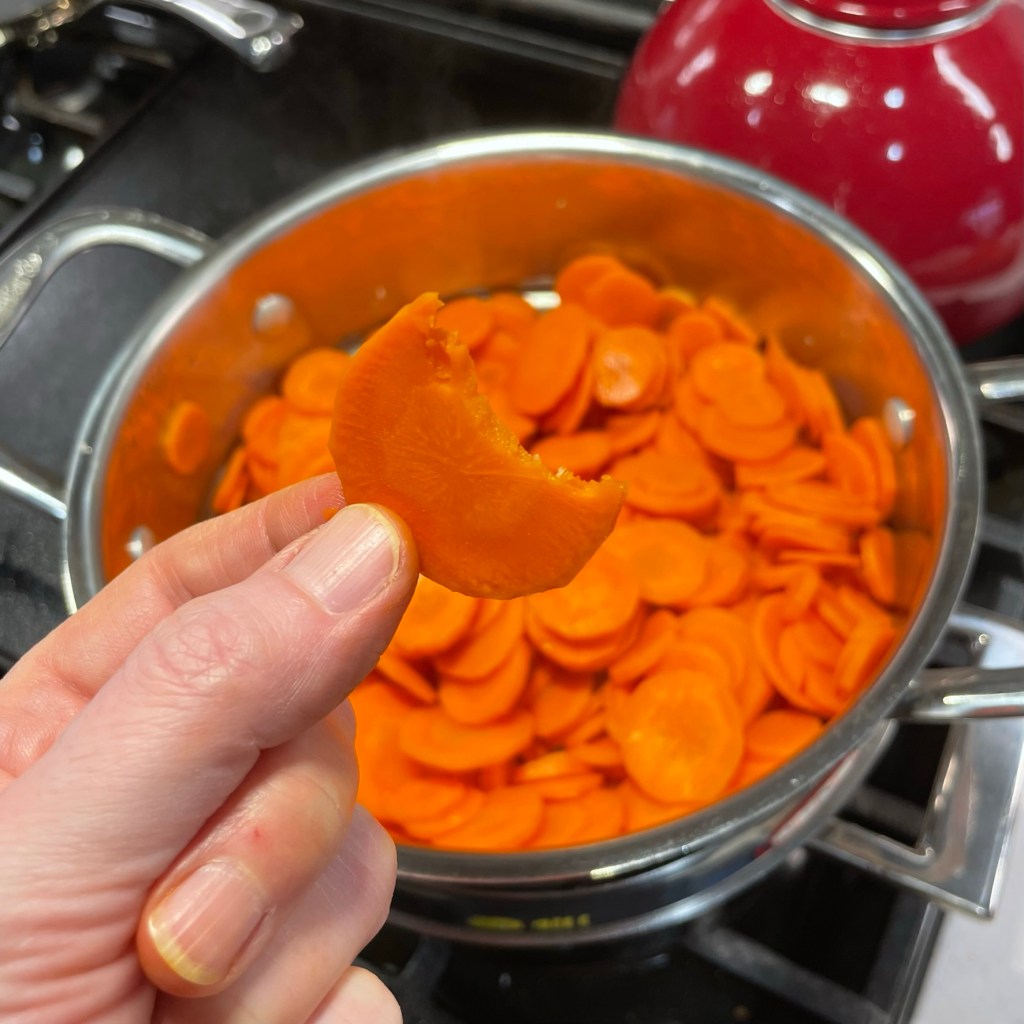
The only thing left to do was steam the carrots, which I did for 8 or 9 minutes, until a carrot slice tested to al dente firmness. I transferred them directly into the tangy tomato marinade, along with the onions and peppers, then tossed it all together before cooling it down in the fridge. 


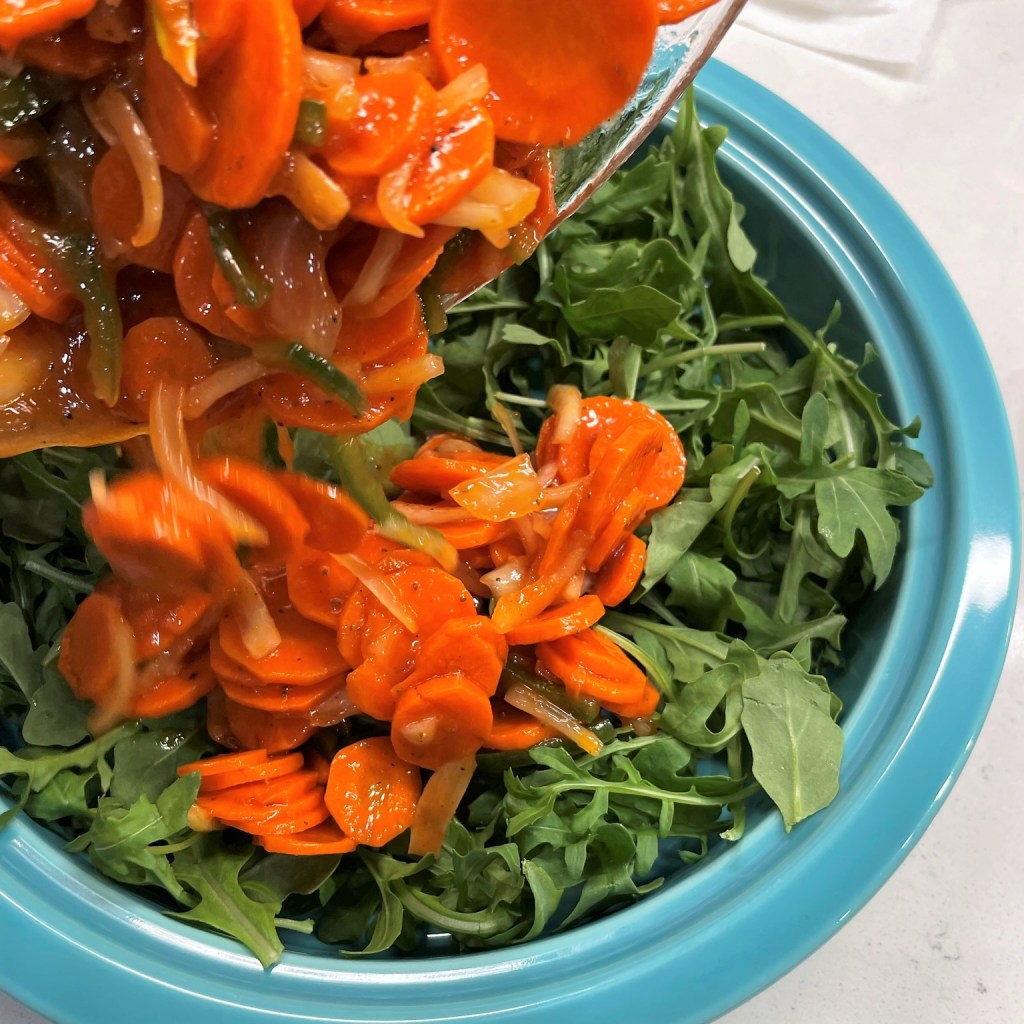
This is a great option for make-ahead side, when you want a chilled salad that isn’t carb-heavy the way pasta or potato salad might be. You can serve it as is, or dress it up a bit by serving it over a bed of greens. One of the tricks I learned in catering is that serving a marinated salad over greens allows for the excess liquid to run underneath, keeping the main part of the dish nice and crisp.


Copper Pennies

  • Servings: 8 to 10
  • Difficulty: Average
  • Print

Tender-crisp steamed carrots and a tangy tomato marinade make this vintage recipe a keeper! It's perfect to make ahead for any kind of summer gathering.


Ingredients

  • 2 pounds fresh carrots, peeled and sliced into 1/4-inch rounds
  • 8 oz. can tomato sauce
  • 1 medium sweet onion, sliced thin from top to bottom
  • 1/2 medium green bell pepper, cut into thin strips and then cut into 1-inch pieces
  • Kosher salt and black pepper
  • 1/3 cup cane sugar
  • 1/4 cup apple cider vinegar
  • 1 tsp. worcestershire sauce
  • 1 tsp. prepared Dijon mustard
  • 2 Tbsp. dry white wine (or vermouth)
  • 3 Tbsp. extra virgin olive oil
  • 1 tsp. celery seed
  • A few handfuls washed baby greens, for serving

Directions

  1. Combine tomato sauce, vinegar, Dijon, sugar and worcestershire a medium saucepan over medium heat. Cook until sugar is dissolved.
  2. Add white wine (or vermouth) and cook until mixture begins to thicken slightly. Stir in celery seeds and adjust salt and pepper to taste. Remove from heat and allow sauce to cool to room temperature.
  3. Prepare to steam carrots by placing a steamer basket or pot over a pot with approximately one inch of water. Heat until water maintains a consistent gentle boil. Add carrots to basket and steam for 8 or 9 minutes, until tender-crisp. No stirring is necessary during steaming.
  4. Transfer carrots directly into cooled tomato sauce. Add onions and bell peppers and toss gently to combine. Cool and then refrigerate overnight to meld the flavors. Serve copper pennies over a bed of baby greens, if desired.


Turkey & Black Bean Stacked Tostadas

South-of-the-border flavors have been a mainstay in my diet since I was in the first grade. I spent a few of my formative years in southern Colorado with my mother, so cooking and eating Mexican food feels like a homecoming for me. The foods of that region had so much flavor and complexity, and the fact that the earliest Mexican foods I ate were homemade means the bar is set pretty high for me.

With Cinco de Mayo coming up this week, I wanted to share a fun meal that is as versatile as it is delicious. Though most of the Mexican food my mom made at home was some version of ground beef tacos, she occasionally dabbled into more involved recipes, and at some point when I visited her as an adult, she made something she called “stacked tostadas.” I loved them! With crunchy tortilla shells, warm ground meat and melty shredded cheese, they satisfied all my texture cravings, and the authentic flavors took me back to my younger years.


This recipe is not quite the same as what my mom made, and I doubt she even worked from a recipe but from whatever she had on hand at the time. A few of the ingredients are necessary, including the corn tortillas and cheese, but the other fillings are subjective. The thing that really makes this dish is the red sauce— it’s bold and flavorful, but not tomato-based. Rather, it is built on ground chile peppers.

For as long as I can remember, one of the staple seasonings in my mother’s arsenal was a pure chile powder that came in a generic looking cellophane packet with a white label and red lettering. It was made by a local, southern Colorado company, which had a whole line of other products as well, but I most remember the“chile molido puro.” Unlike most commerical brands of “chili powder,” which usually include various other seasonings, additives and a ton of salt, this stuff was just pure ground chiles—the exact literal translation of chile molido puro.

I have not seen those cellophane packets in many years (I’m sure they’re only distributed regionally), and until a few days ago, I couldn’t even remember what the brand was called, but it’s amazing what one can find on the internet with only a few keywords in a search bar. Here’s one of the images the web found for me when I asked for “chile seasonings Colorado company:”

This is the REAL deal!

Just seeing the package made my heart giddy! It’s funny that whatever made you fall in love with a particular food becomes the standard, and I guess that’s what comfort food is all about! If you want to try something fun and new for Cinco de Mayo, give this recipe a try, either as I made it with ground turkey, or by substituting whatever sounds delicious to you.

Olé!

I haven’t been able to get my hands on a package of the Fernandez seasoning just yet, so I’ve substituted ground ancho chile powder for my enchilada sauce. Always read the labels to see whether your seasoning includes other ingredients, and if you find that you have one labeled “chili powder,” with cumin, oregano and garlic, that will cover most of the flavors you need. If it also contains salt, adjust your salt and pepper accordingly.

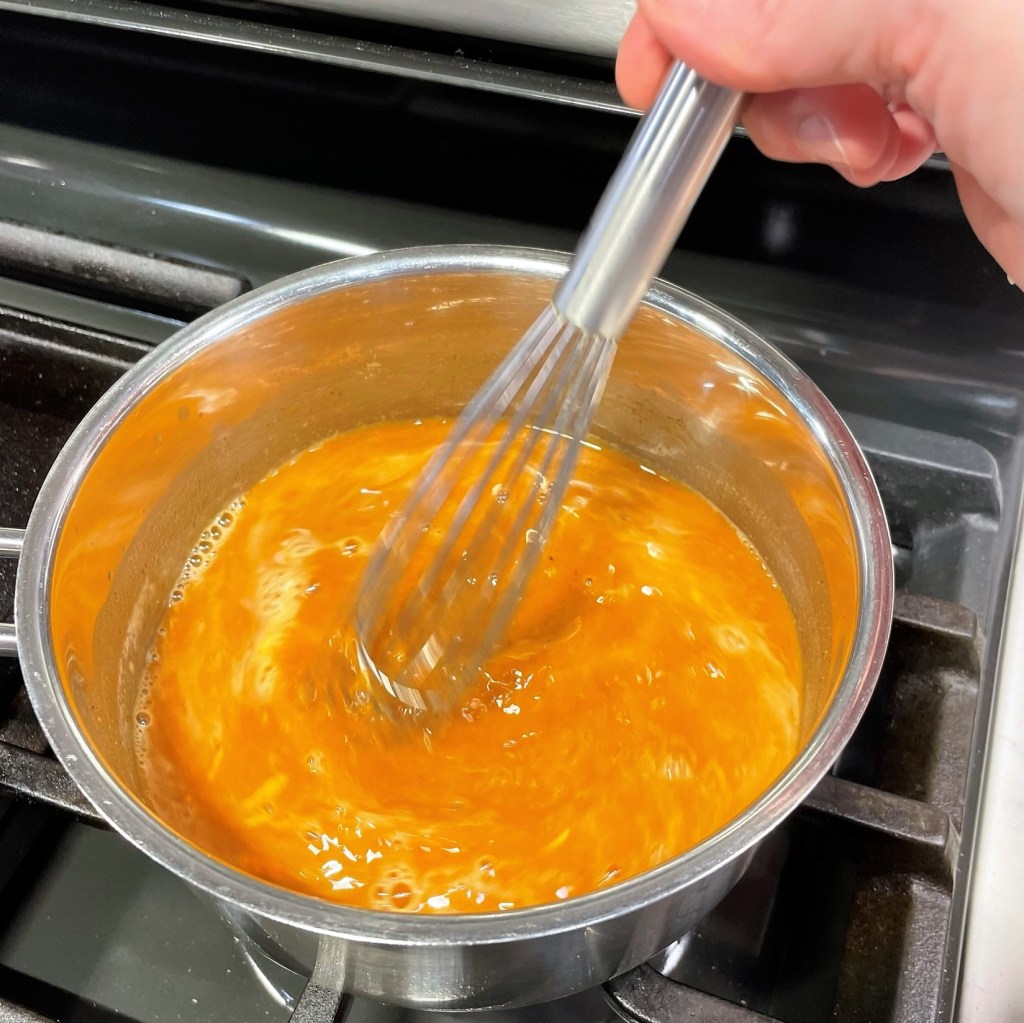
My recipe for the sauce is very similar to what’s offered on the back of the Fernandez label, which recommends making a basic oil and flour paste, with garlic and seasonings for flavor and water to thicken (though I used a low-sodium veggie broth). If you find the flavors of your sauce too intense, you can tame it by adding a few tablespoons or up to a small can of tomato sauce. We crave intensity at our house, so I went the other direction and added a spoonful of pureed chipotle with adobo. We had some in the fridge because my hubby had just made a batch of his awesome smoky guacamole, which was perfect on top of these tostada stacks.


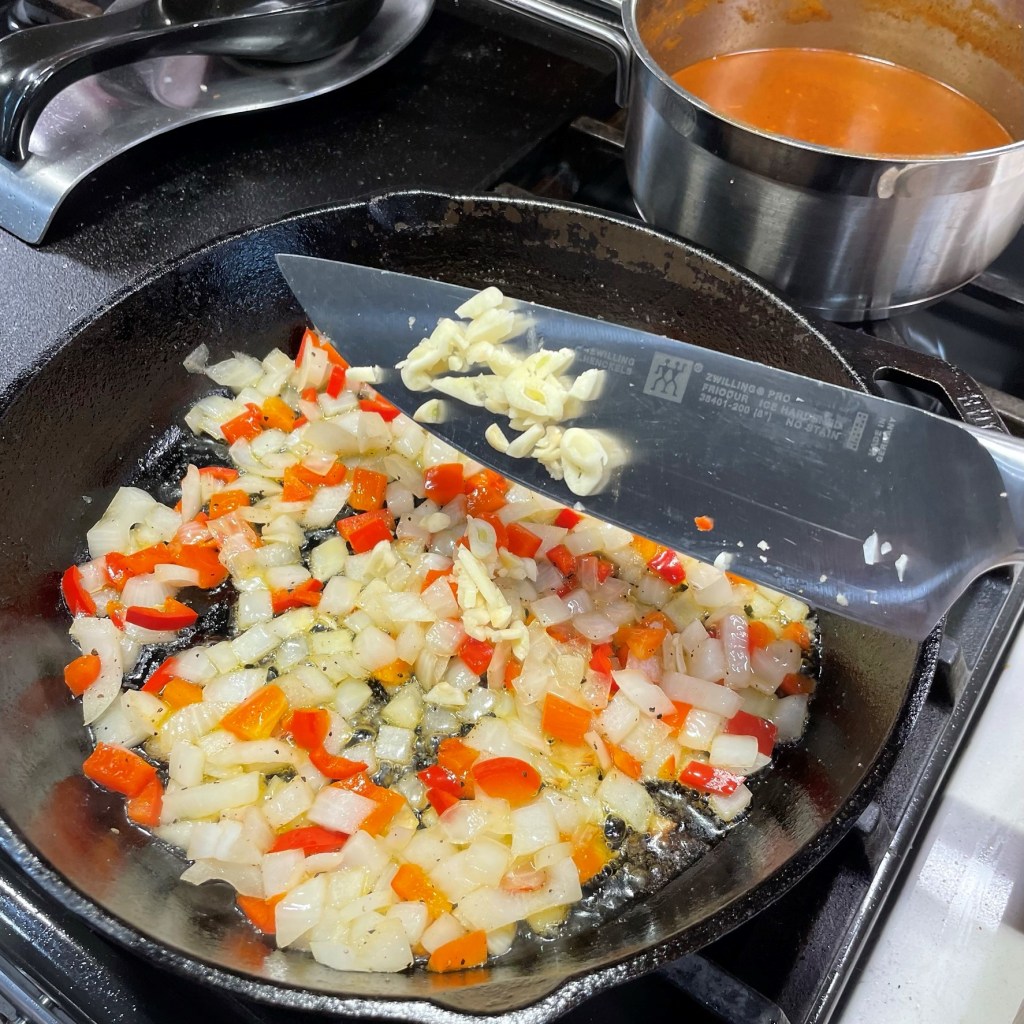
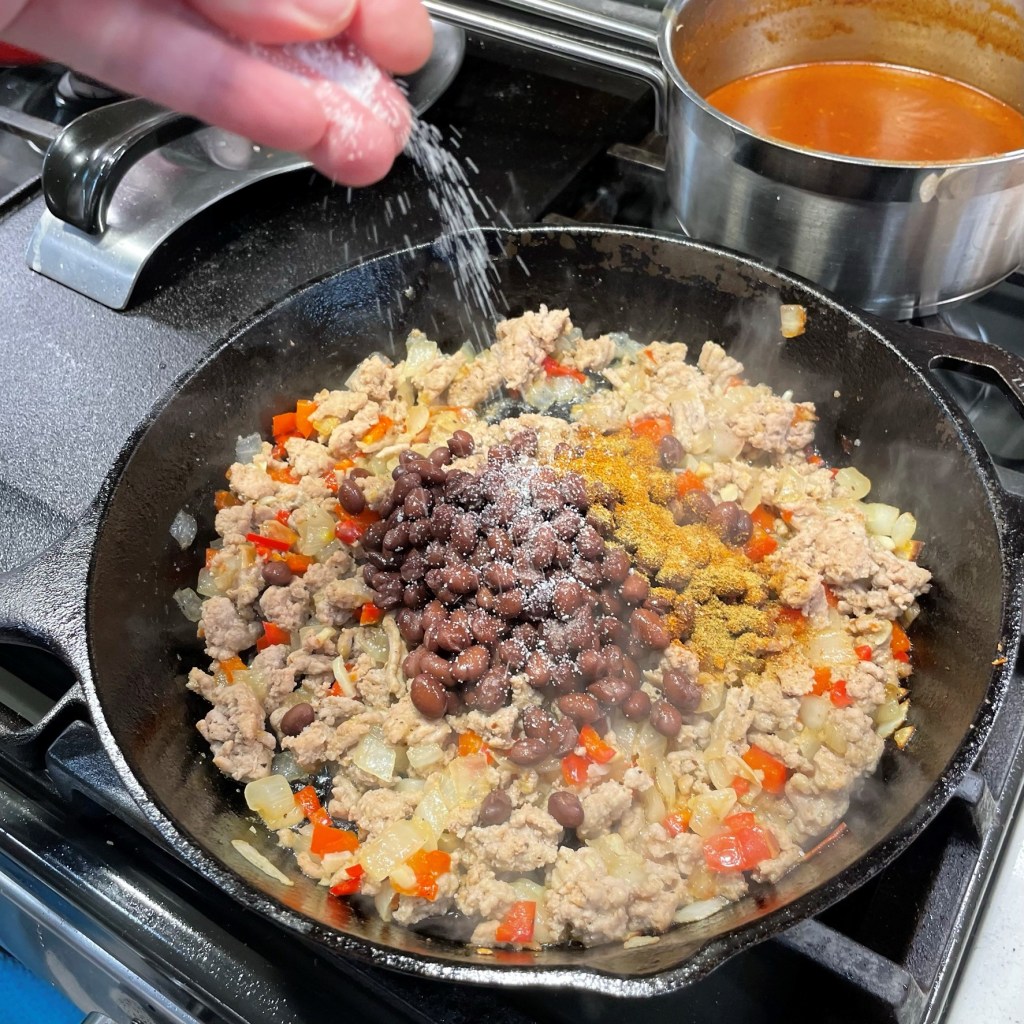
For the filling, I cooked up some ground turkey with onions and red bell peppers, a few shakes of my favorite Mexican spices and some black beans. Want more heat? Swap the red bell pepper for diced jalapeños. My mom always used ground beef, but turkey lightened this up a bit without sacrificing flavor. Ground chicken would also work, or you could skip the meat altogether in favor of additional beans or perhaps roasted sweet potatoes for body and texture. For a little pop of sweetness, I also added a little fire-roasted sweet corn, which we almost always have in the freezer.


Use whatever kind of Mexican melting cheese you like— cheddar, Monterey Jack or pepper jack work nicely, or Colby is good if you want really mild flavor. For best results, buy a block of cheese and shred it yourself. The stuff in the bag is coated with cellulose powder to keep the cheese from sticking, and the melting quality suffers. I promise, it’s worth the extra effort.

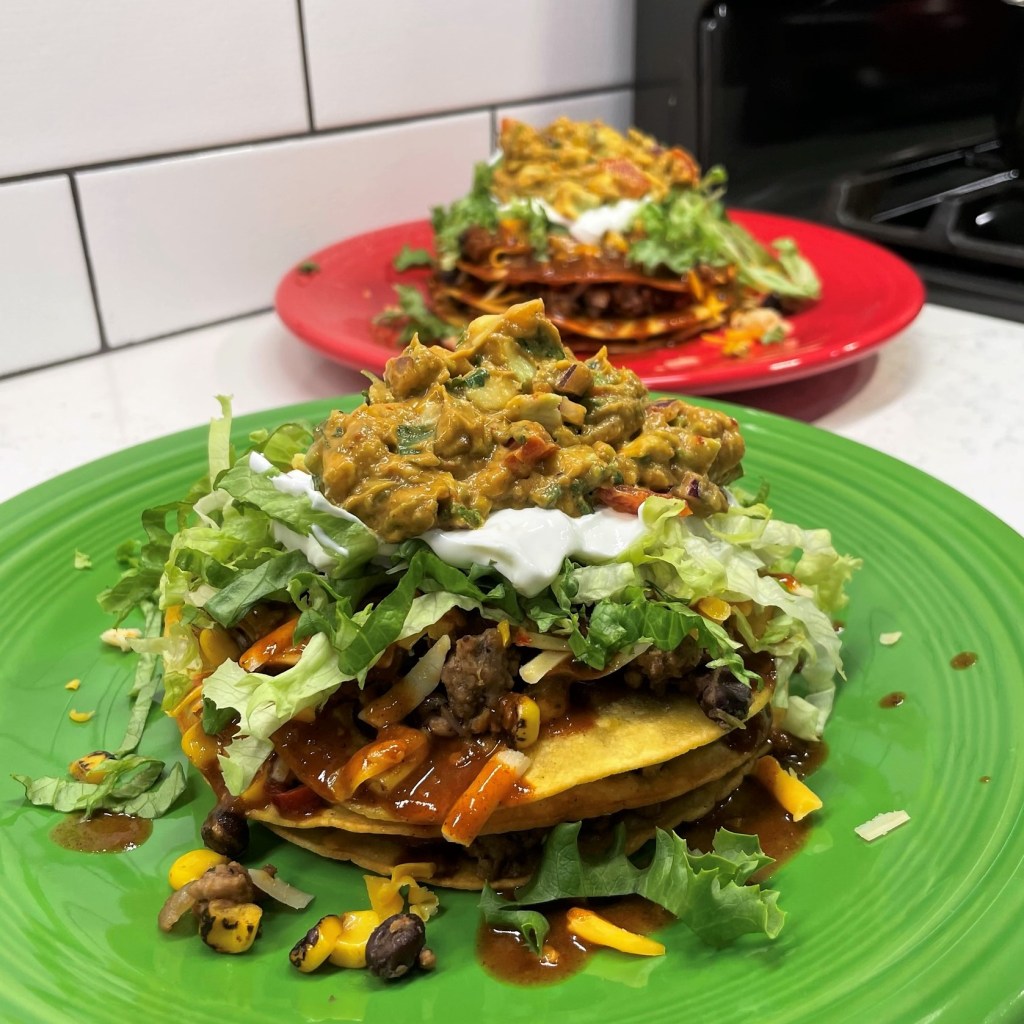
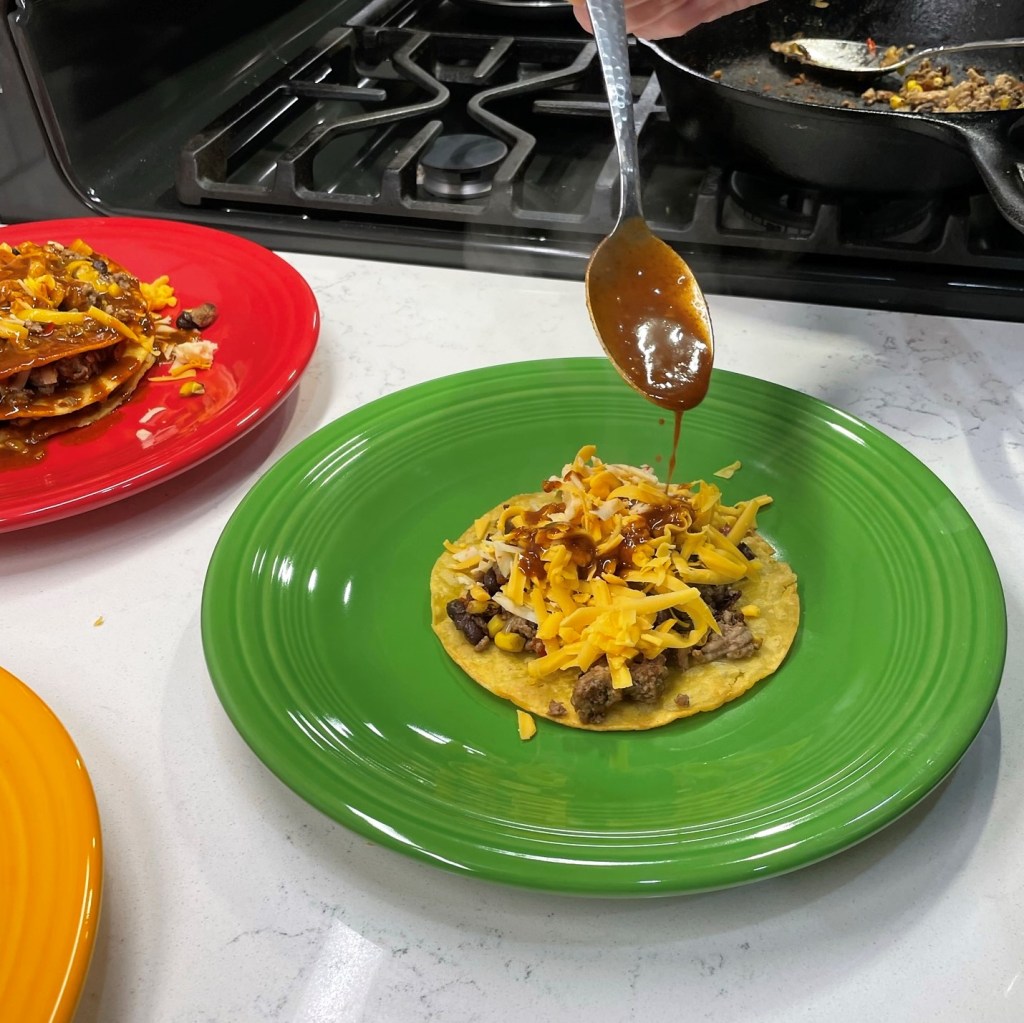
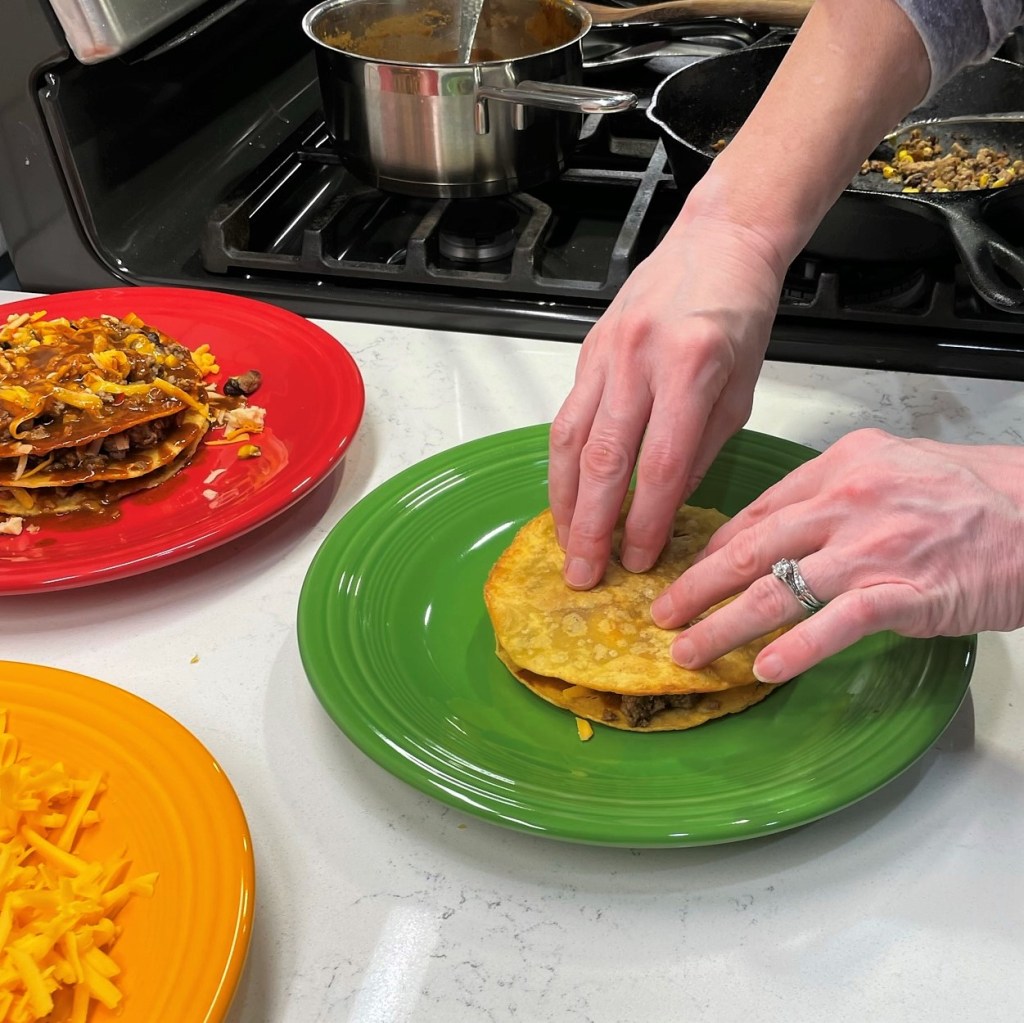
Store bought corn tortillas are fine for this, but if you want to go all out for Cinco de Mayo, consider making a batch of easy handmade corn tortillas. Give them a brief dip in hot oil to make them nice and crispy, then start layering! Filling mixture goes on first, then cheese and sauce. Second verse, same as the first.


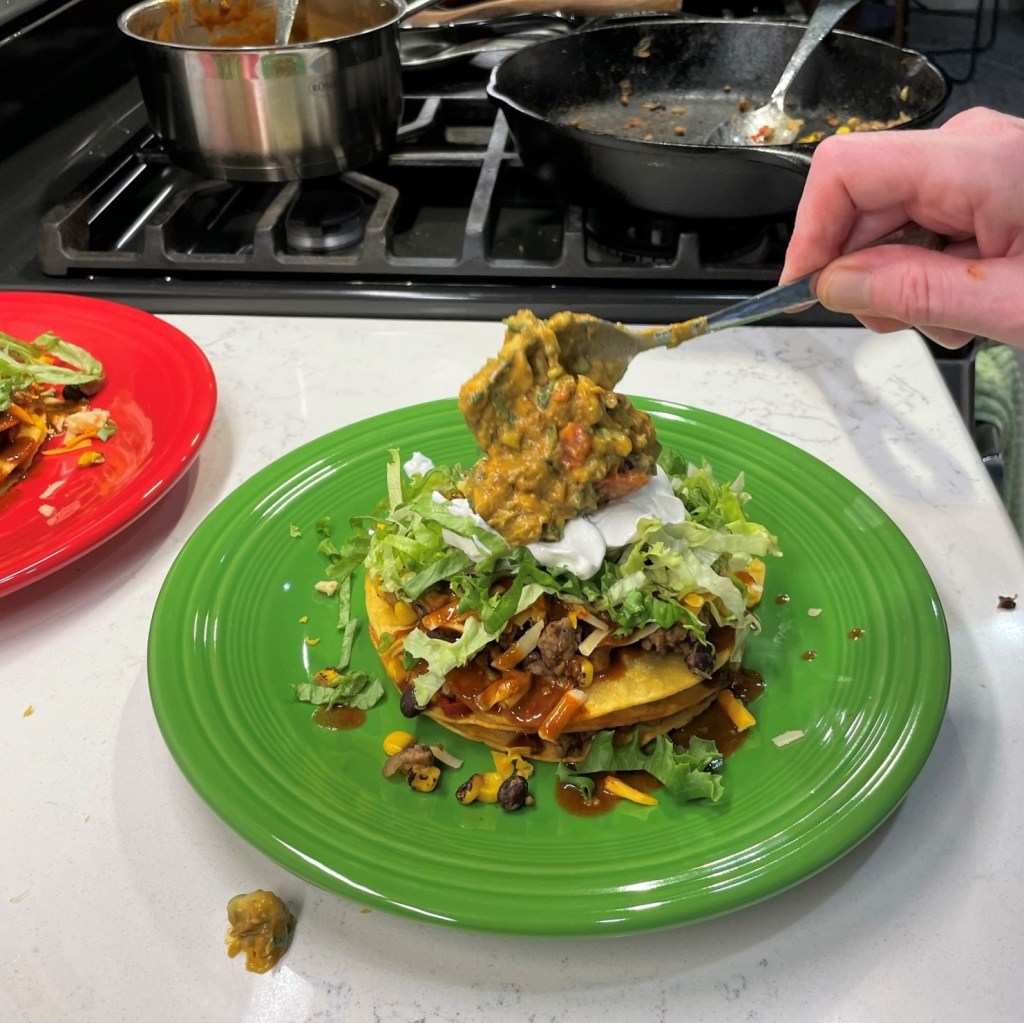
After a third layer, finish the enchilada stack with a handful of shredded lettuce, a dollop of sour cream and fresh guacamole. And though tostadas are typically a handheld item, the stacked and sauced method here requires that you use a fork.


Turkey & Black Bean Stacked Tostadas

  • Servings: 4
  • Difficulty: Average
  • Print

Cinco de Mayo is a great excuse for me to celebrate the flavors that I've loved since early childhood.


It’s best to prepare the chile sauce first, or perhaps even a day ahead so the flavors can mingle overnight in the fridge. The sauce can be rewarmed while you make the turkey-black bean filling.

Ingredients

  • 1 clove fresh garlic, minced
  • 3 Tbsp. olive oil
  • 3 Tbsp. all-purpose flour
  • 2 Tbsp. pure ground chile powder
  • 1/2 tsp. salt
  • 1/2 tsp. ground cumin
  • A pinch of oregano (preferably Mexican)
  • 2 cups low-sodium vegetable (or chicken) broth
  • 1 Tbsp. pureed chipotle with adobo (optional; substitute tomato sauce for milder flavor)

Directions

  1. Heat a small saucepan over medium heat. Swirl in olive oil and saute garlic briefly, just until it begins to bubble.
  2. Add flour and whisk to combine. Let this cook until bubbly, then add seasonings and broth.
  3. Whisk constantly until mixture begins to thicken.
  4. Stir in chipotle with adobo (or tomato sauce) and reduce heat to a simmer while you prepare the tostada filling.

Any other ground meat may be substituted for the ground turkey. If you prefer to keep the tostada stacks meatless, swap the ground turkey for refried beans. Swap other ingredients as desired, but aim to incorporate flavors and textures that will complement each other, such as roasted sweet potatoes and sauteed mushrooms.

Ingredients

  • 1 Tbsp. olive oil
  • 1 medium sweet or yellow onion, chopped
  • 1/2 red bell pepper, chopped
  • 2 cloves fresh garlic, minced
  • 1 pound lean ground turkey
  • 1/2 tsp. Ground Chile powder
  • 1/2 tsp. Ground cumin
  • Salt and pepper to taste
  • 1 can black beans, drained and rinsed
  • 1/2 cup fire-roasted sweet corn (frozen is fine)
  • 12 regular size corn tortillas
  • Vegetable oil for frying (peanut or canola oil are good)
  • Shredded lettuce, sour cream and guacamole for topping

Directions

  1. Heat a large skillet over medium heat. Add olive oil, then sauté onions and bell peppers until softened. Add garlic and cook until fragrant.
  2. Push the vegetables to the outer edges of the pan and add turkey, half at a time, to the center of the pan. Cook until browned and then add remaining turkey to finish cooking.
  3. Add seasonings, black beans and corn. Stir and cook until heated through. 
  4. Reduce heat to keep mixture warm while you prepare the tortillas.
  5. Place a second skillet over medium heat, and add oil to about 1/2-inch depth. 
  6. Fry tortillas, one at a time, until crispy (about 2 minutes) and blot on paper towels.
  7. Create stacks, beginning with a tortilla base, topped with turkey-black bean mixture, cheese and sauce. Follow with two more layers.
  8. Top finished stack with a handful of shredded lettuce, sour cream and guacamole.


Benedictine Spread

How do you know when a dish is a winner? Is it compliments received or perhaps a request for the recipe? Maybe it’s no words at all as the eaters enjoy each bite in blissful silence. It could be any of the above, but in my experience, an empty plate tells no lies!

When Kentucky Derby rolled around last year, my husband and I were invited to join some friends for an afternoon of snacking, sipping and generally feeling fancy with gussied-up hats and minty bourbon cocktails. I offered to bring an appetizer and though it isn’t really my style to share a straight-up classic, I decided on Benedictine, a cream cheese-based spread developed by an early-20th century Louisville caterer.

As Wikipedia tells it, Jennie Carter Benedict served this concoction to her catering clients and later to guests in her tea room, though at that time it was more of a silky dip than a spread, made with the juices of cucumber and onions and sometimes a few drops of green food coloring for effect. The combination of cream cheese and cucumber is cool and refreshing and makes Benedictine a delectable filling in pretty cucumber sandwiches. Its popularity continues all these years later, with a few modernizations. There will be plenty of it served up at Kentucky Derby gatherings alongside mint juleps and hot brown sandwiches, and probably even at Churchill Downs itself when the riders take their positions on the first Saturday of May.

Benedictine is made with very simple ingredients, requires no cooking, and can be made a day ahead and stored in the fridge until post time. And, as I mentioned, the empty plate I brought home after last year’s Run for the Roses was proof that this appetizer was a clear winner.


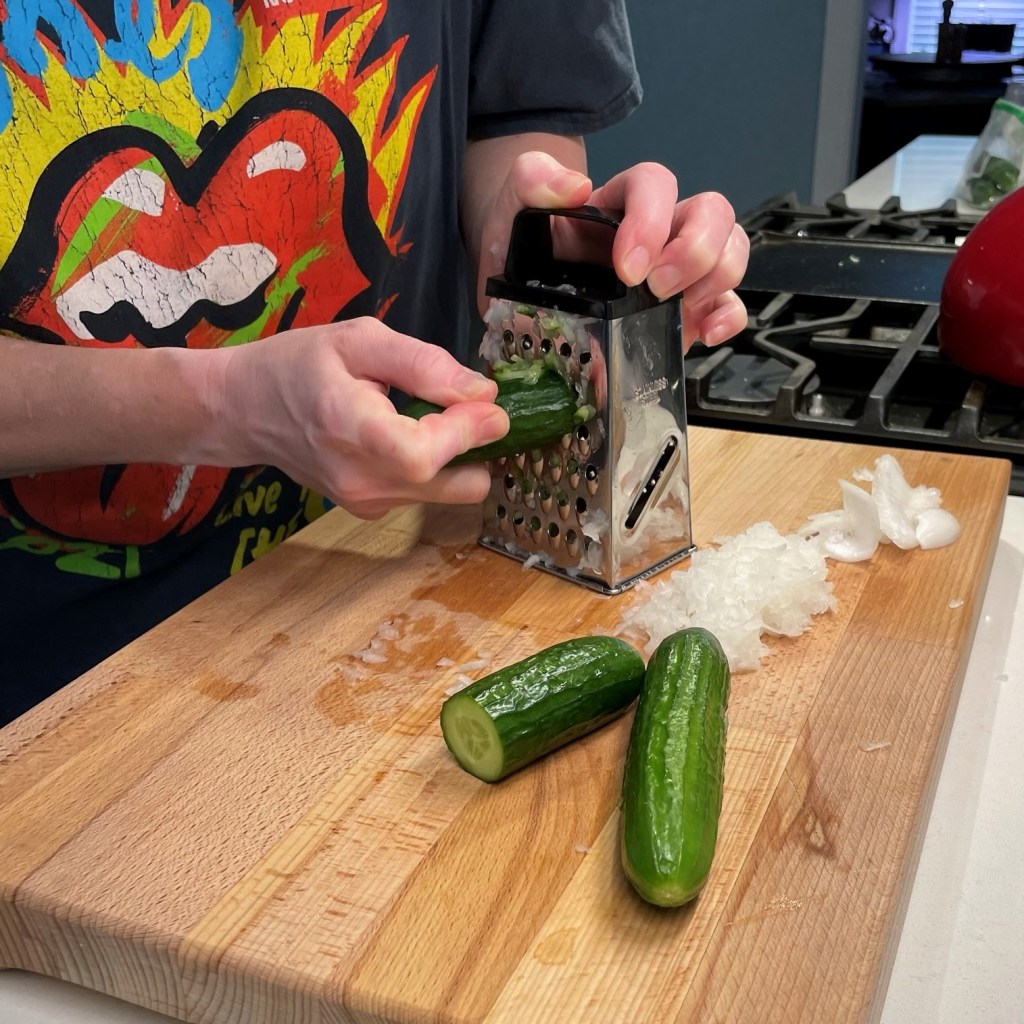
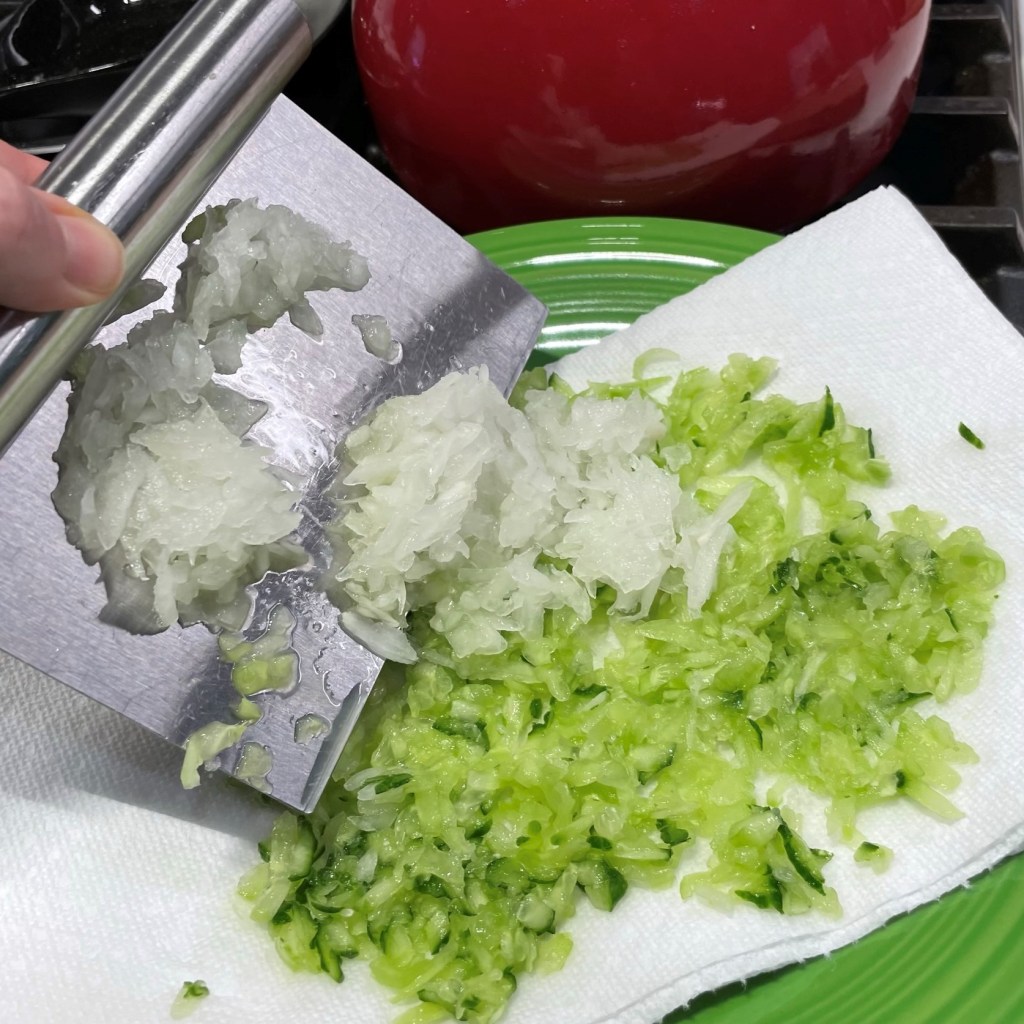
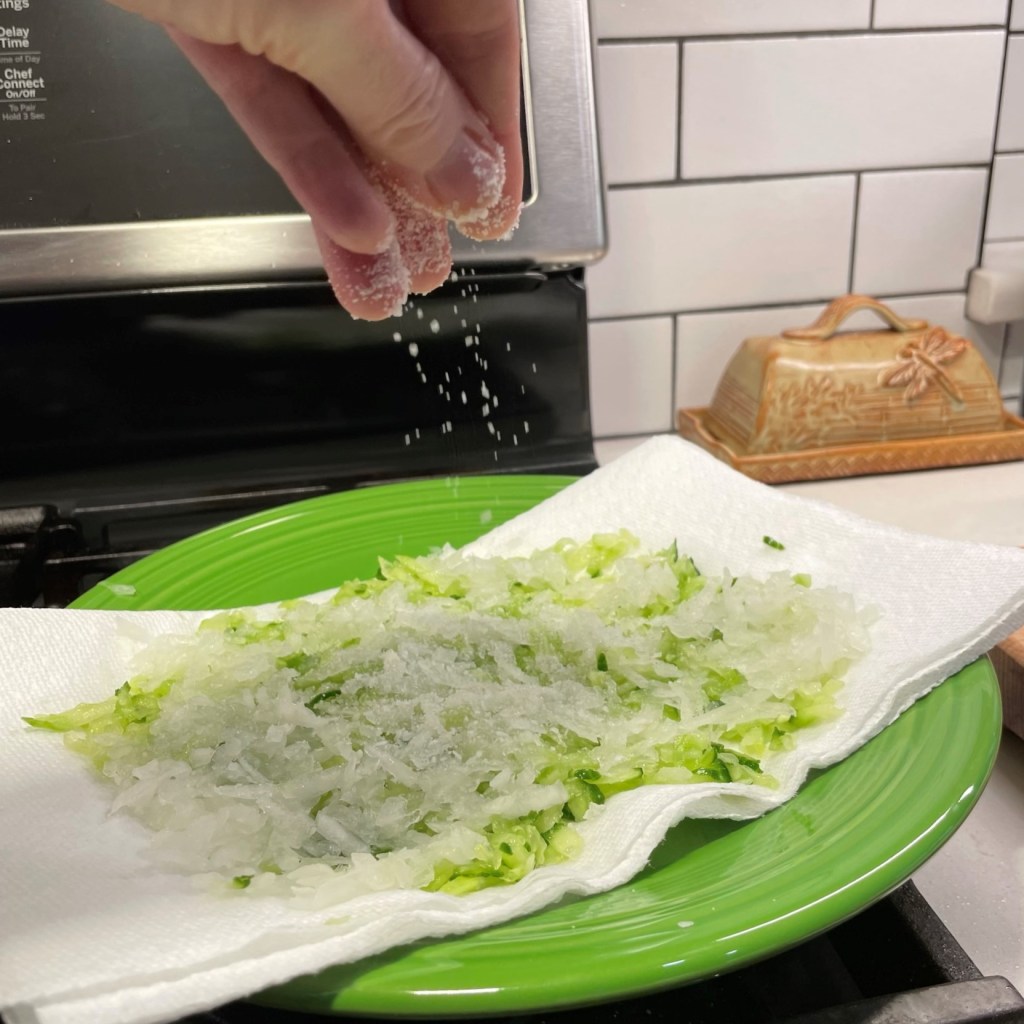
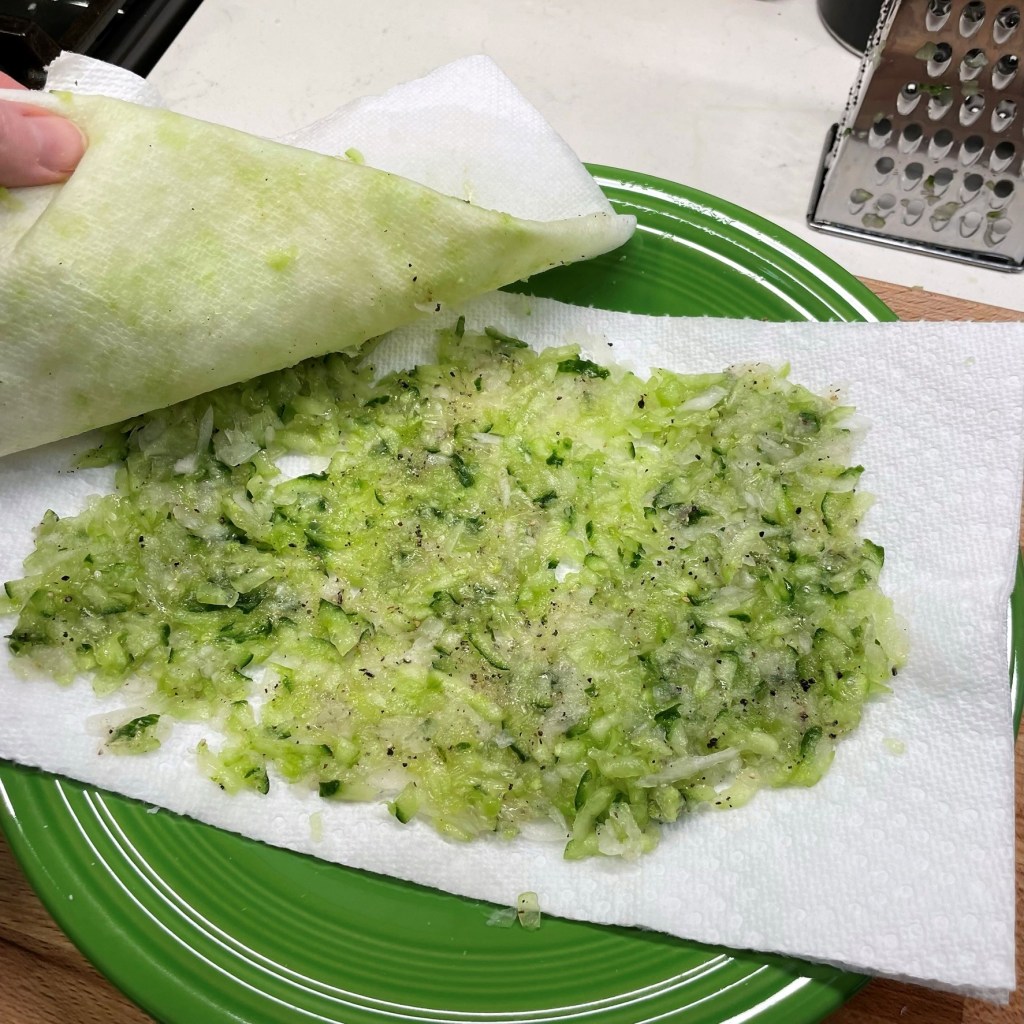
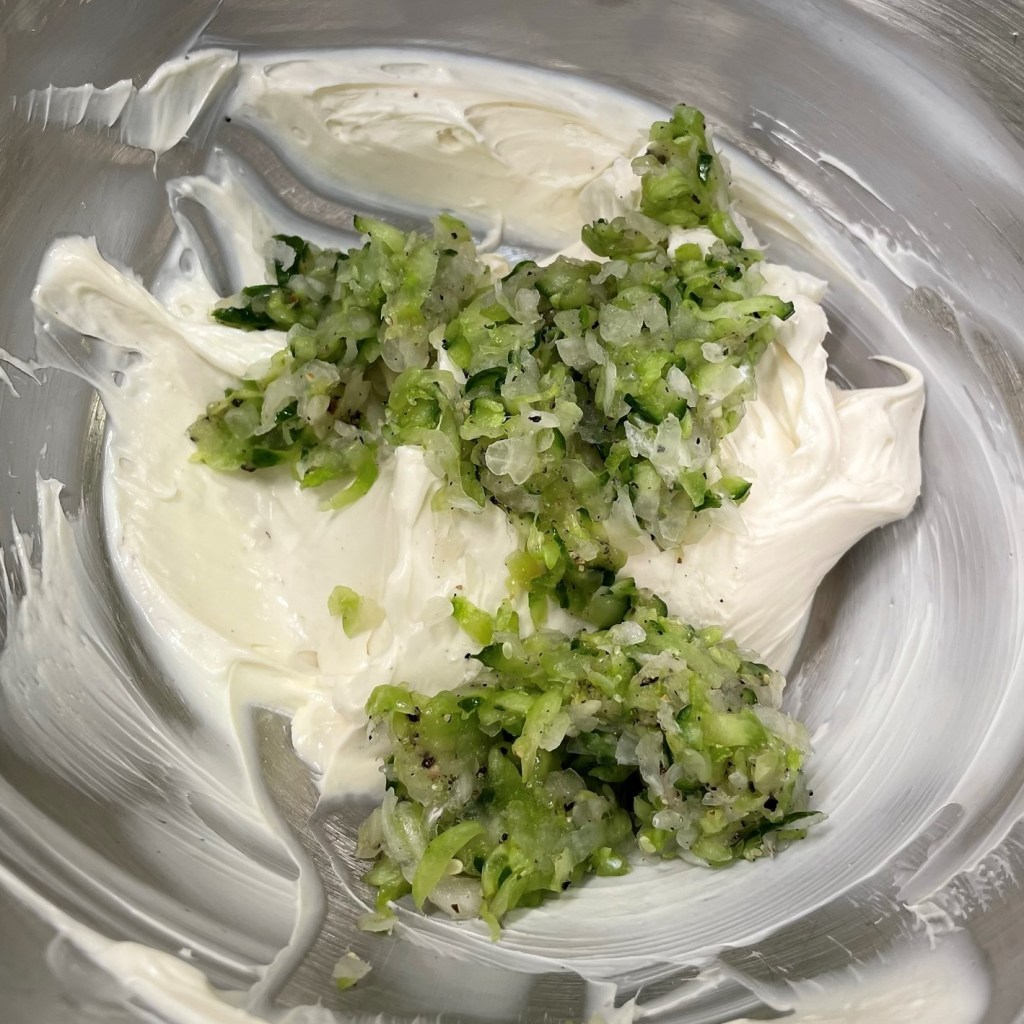
This recipe for Benedictine is inspired by the original, but follows my own general formula for a cream cheese-based dip. As with my tzatziki dip, I salted and drained the grated cucumbers to ensure the shreds would not turn the spread soupy. I did the same with the onions, swapping new paper towels over the mixture until they no longer felt soaked. I did this part of the recipe first, and let the cukes rest in the fridge for a couple of hours before proceeding. I used Persian cucumbers because they have fewer seeds and the skin is tender enough for some of it to be included.


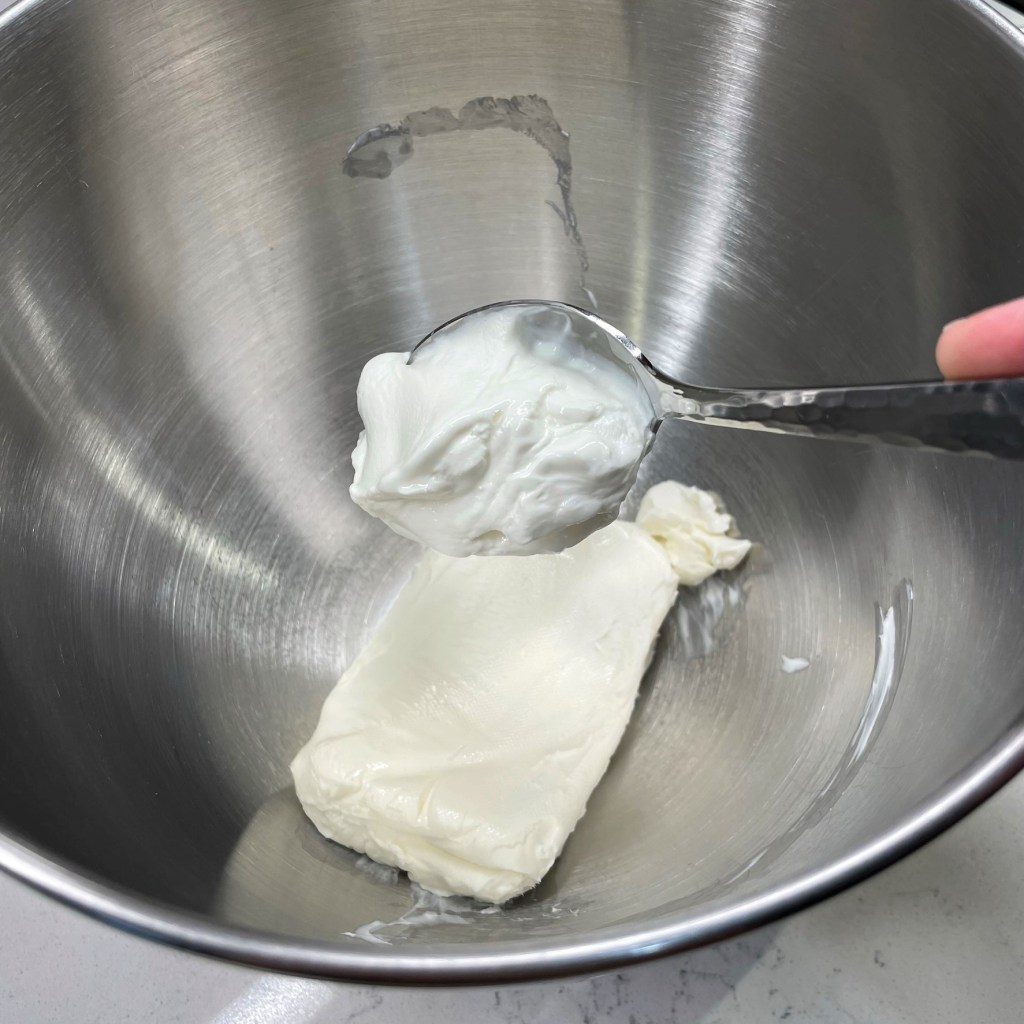
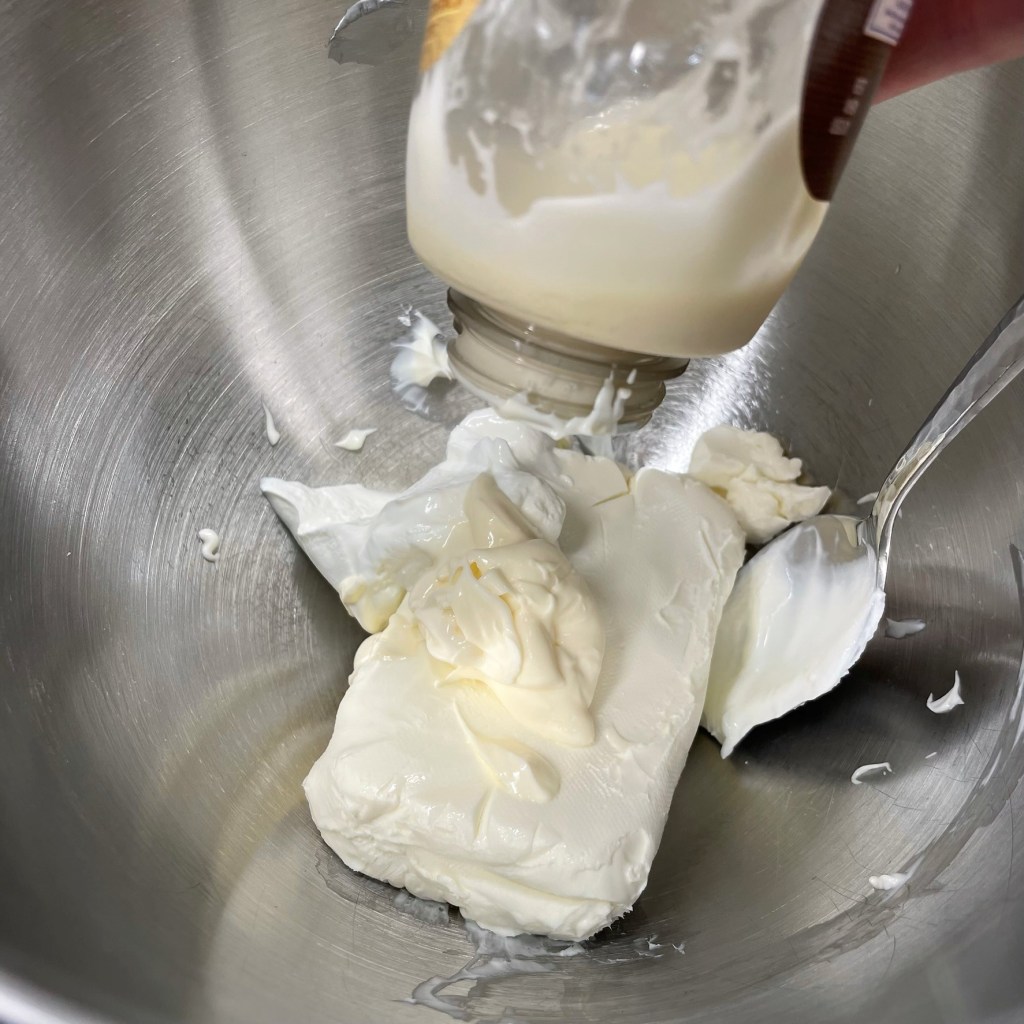
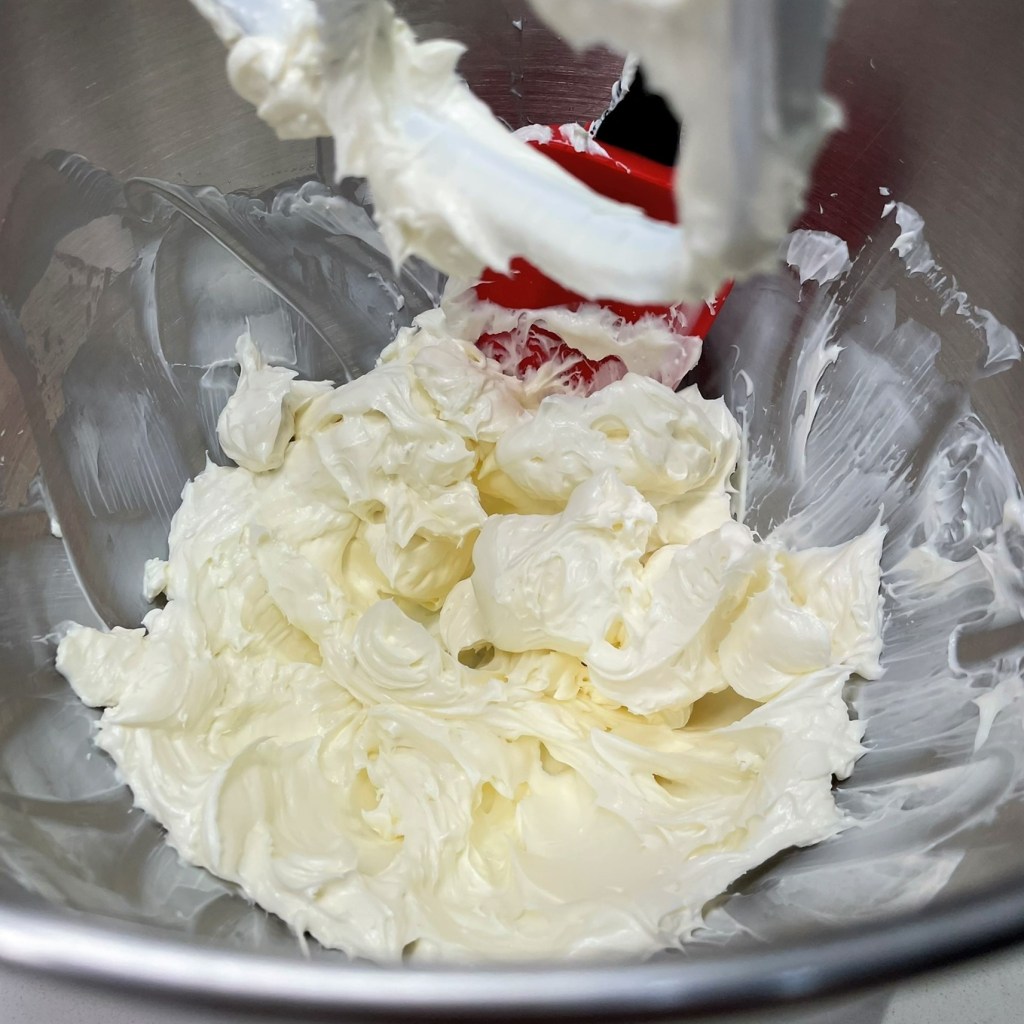
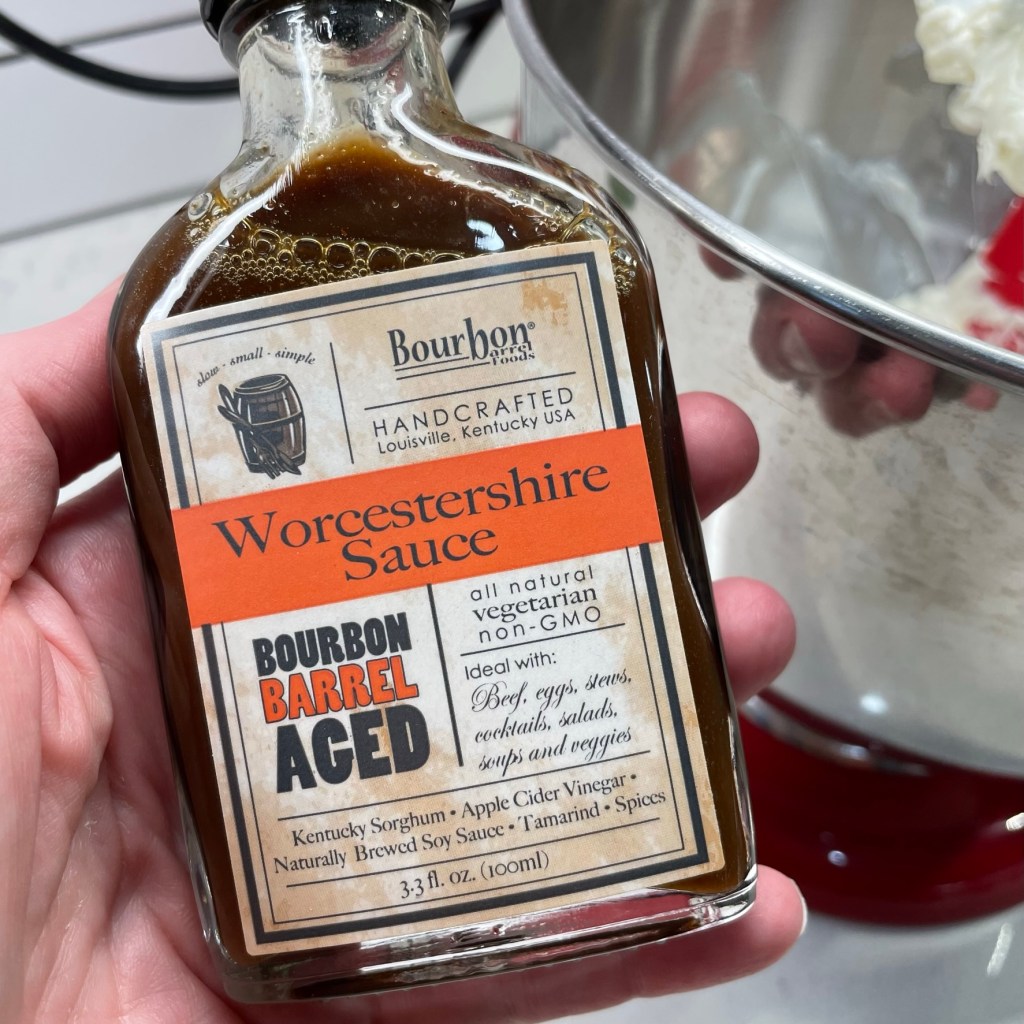
The creamy base was a blend of light cream cheese, sour cream and a bit of mayonnaise. Rather than drops of hot sauce (mentioned in the Wikipedia article), I gave my Benedictine a little zing from a bourbon barrel-rested Worcestershire sauce made in Louisville—that seemed apropos for a Derby Day recipe and it was a pleasant, savory complement to the freshness of the cucumbers. This sauce also happens to be vegetarian, as it omits the usual anchovies.


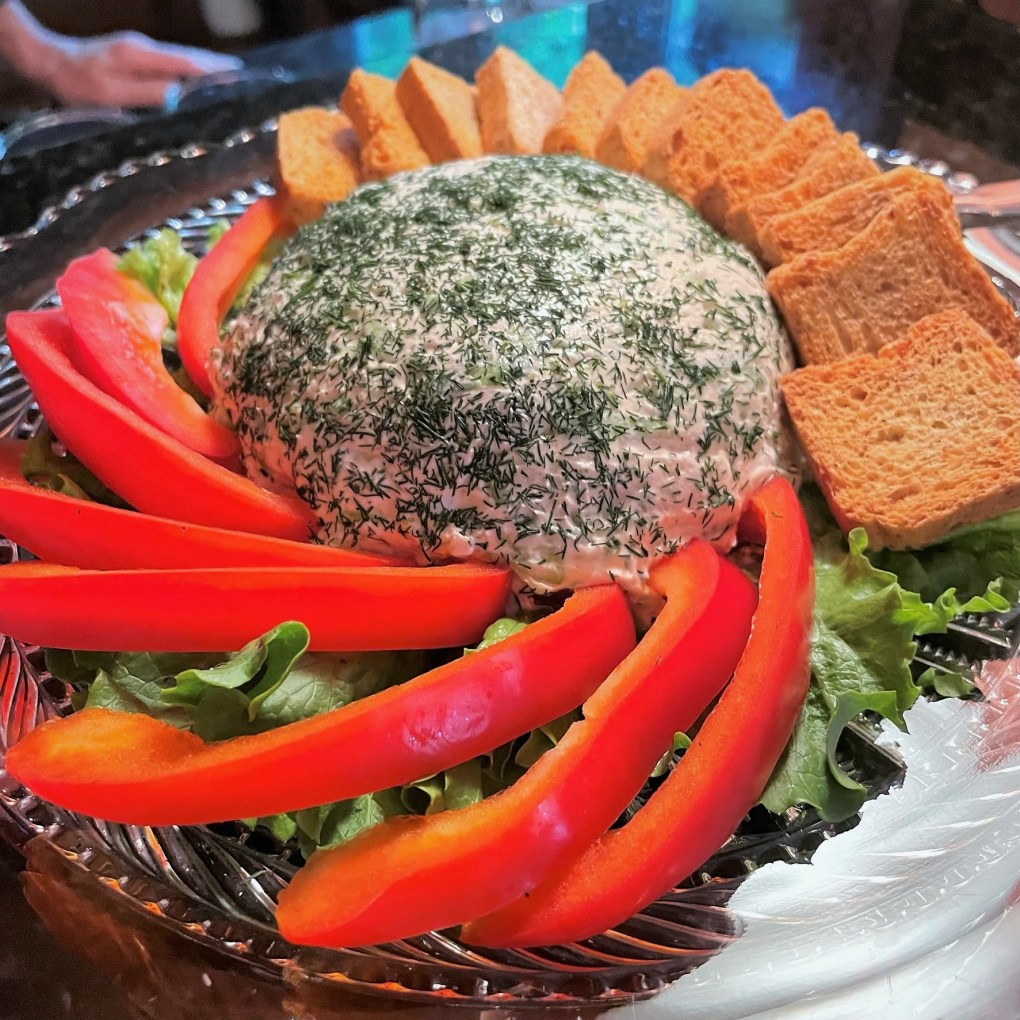
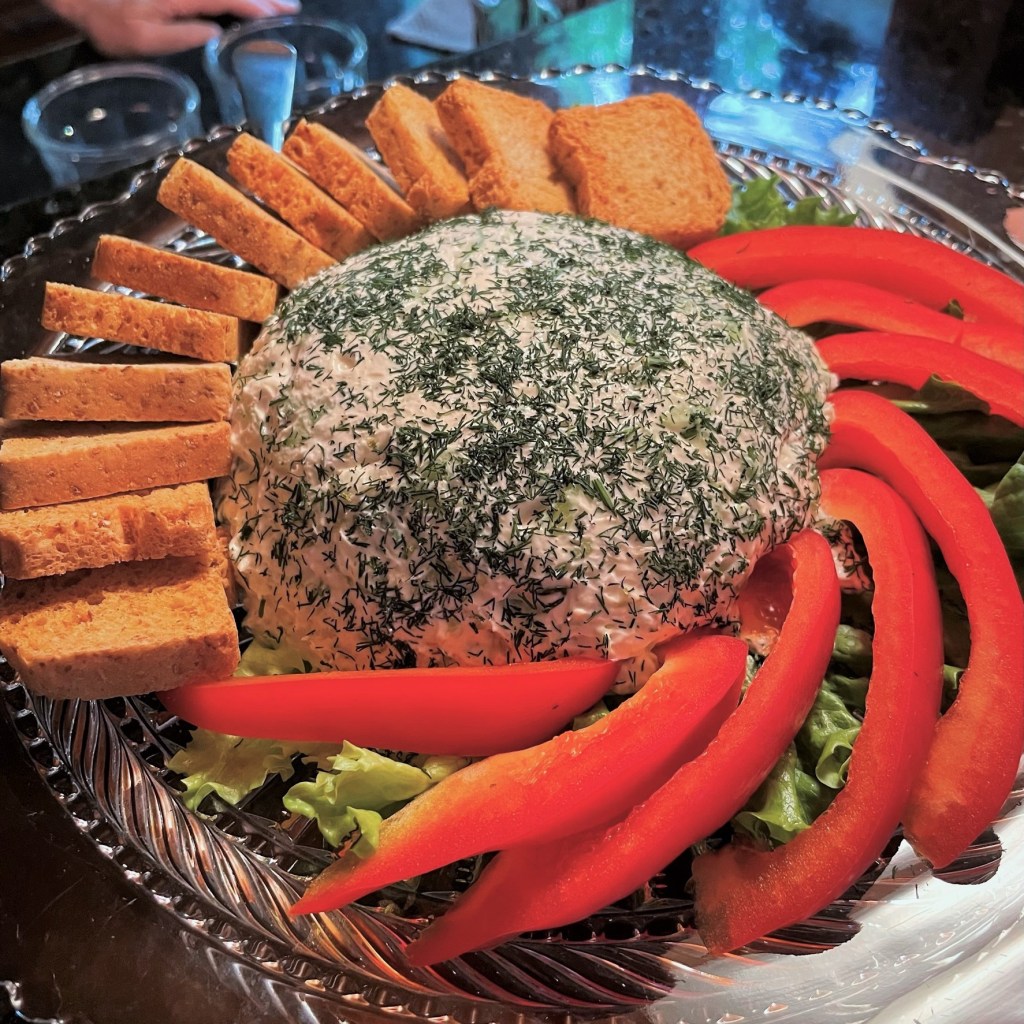
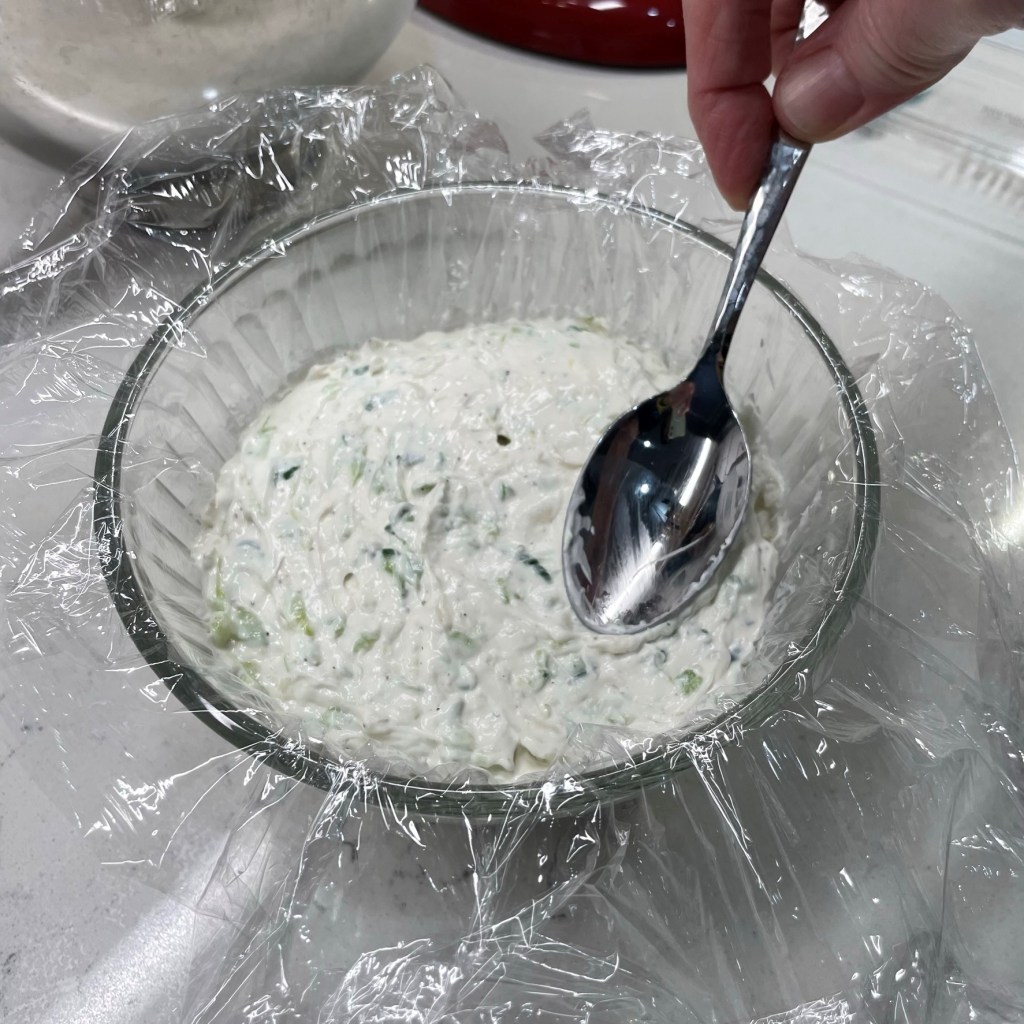
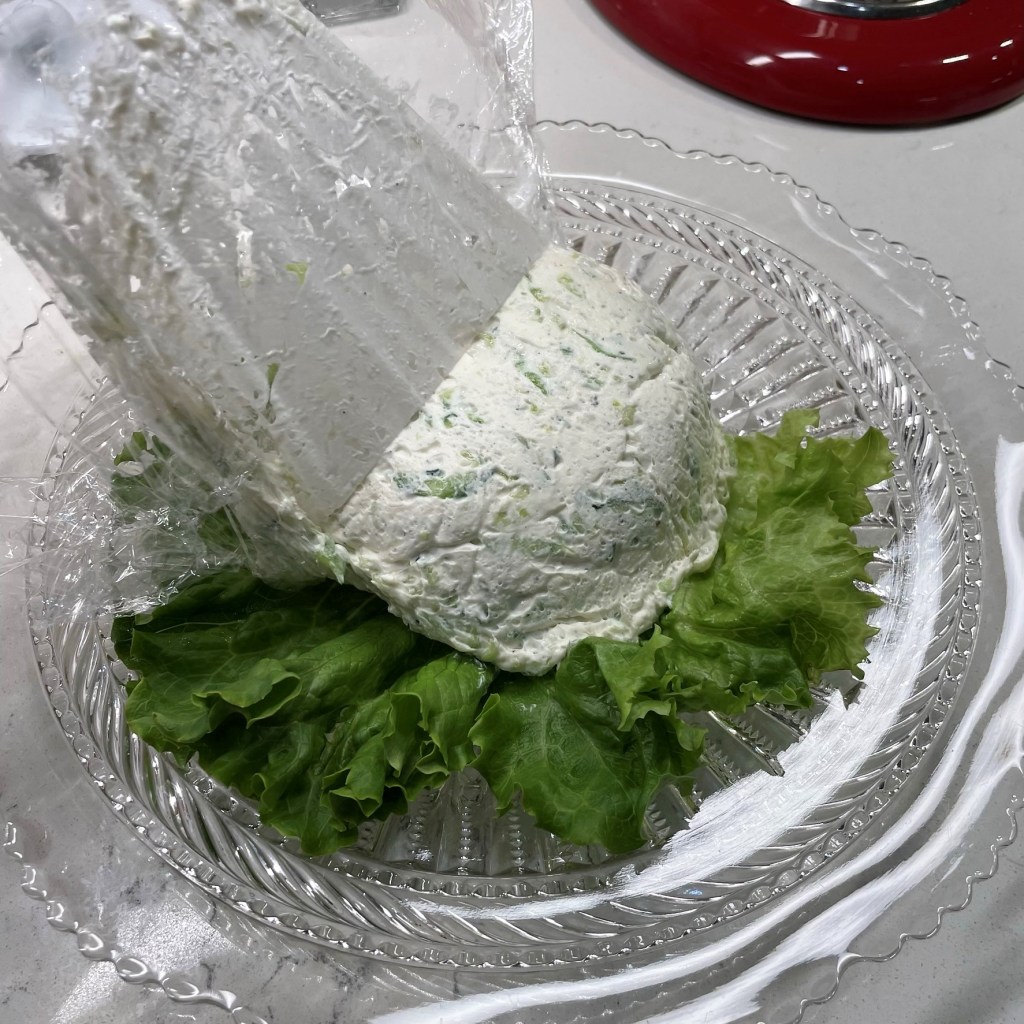
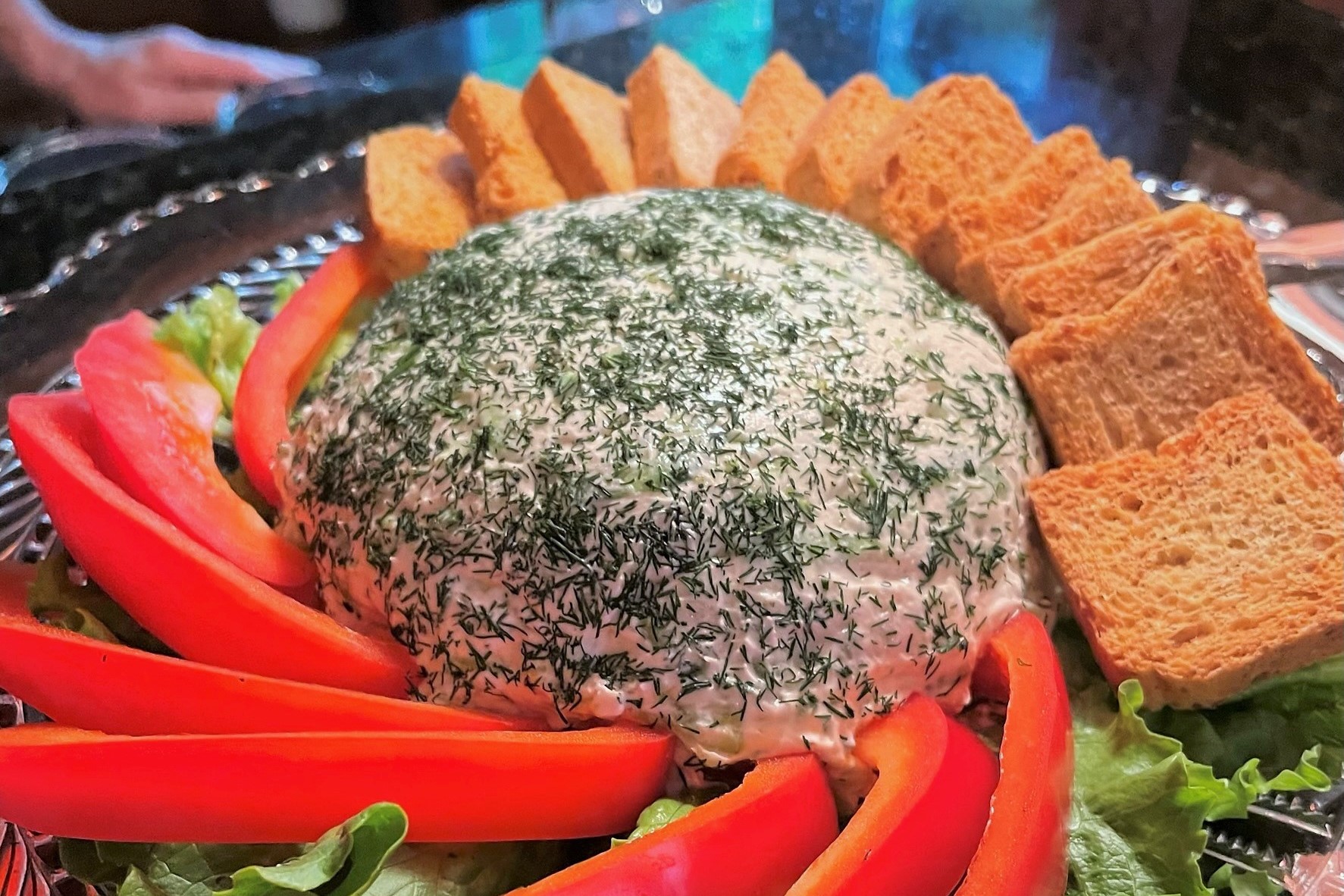
If I were in a hurry or making cucumber sandwiches, this would have been ready as soon as the drained cucumber and onion shreds were mixed in, but I wanted to serve my Benedictine on a platter with fresh veggies for dipping and some toasted mini brioche squares, so I pressed it into a bowl lined with plastic wrap and gave it some fridge time to set up for prettier presentation.


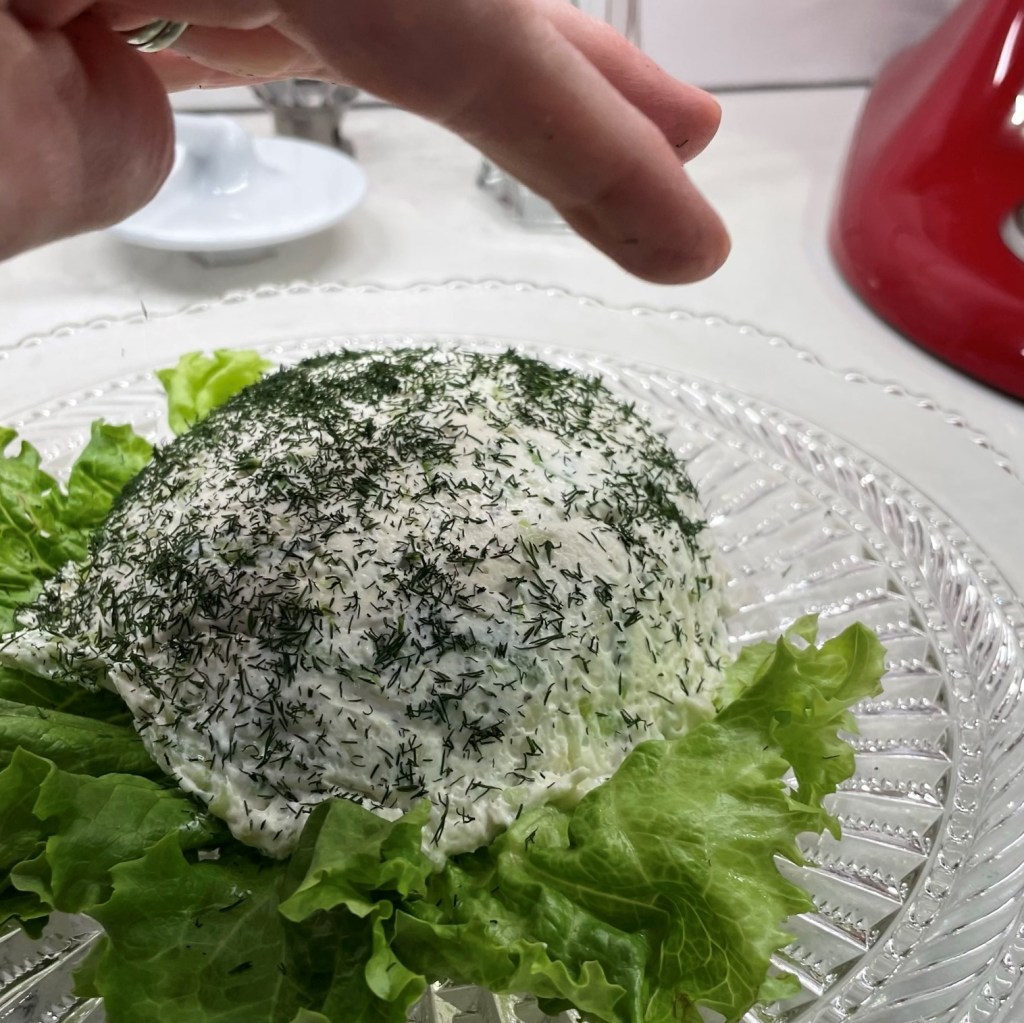
When I inverted it onto a lettuce-lined platter a few hours later, it occurred to me that fresh herbs would finish it nicely. Unfortunately, all I had in the fridge that day was cilantro (not the best match here), and it was too late for a last-minute dash to the store, so I had to concede to using dried dill leaves. The flavor was still very good, but fresh dill would take the win—by a nose. 😉


Benedictine Spread

  • Servings: 6 to 8 as an appetizer
  • Difficulty: Average
  • Print

DESCRIPTION


Ingredients

  • 2 Persian cucumbers*, cleaned and partially peeled (a little of the tender peel is fine and adds lovely color)
  • 1/2 medium sweet onion
  • 1/2 tsp. kosher salt and black pepper to taste
  • 8 oz. brick light cream cheese (or full-fat)
  • 1/4 cup stirred sour cream (or plain Greek yogurt)
  • 1/4 cup mayonnaise
  • 1 tsp. Worcestershire sauce (mine was aged in a bourbon barrel, available in specialty stores or online at https://bourbonbarrelfoods.com/product/bourbon-barrel-worcestershire-sauce/)
  • 2 Tbsp. fresh dill leaves, chopped

Persian cucumbers are usually about five inches length and they have fewer seeds and more tender skin than typical “slicing” cucumbers. Consider peeling and seeding other types of cucumber. This recipe requires about 1 cup of grated cucumber. I peeled one of my Persians, and kept the other intact.

Directions

  1. Use a box grater to shred the cucumbers and onion. Place shreds in a bowl or plate, lined with layers of paper towels. Sprinkle with salt and pepper, and then wrap in the paper towels; refrigerate a couple of hours to draw out as much excess moisture as possible.
  2. By hand or with a stand mixer, combine cream cheese, sour cream and mayonnaise until smooth and fluffy. Stir in Worcestershire. Cover and refrigerate until ready to combine with cucumber mixture.
  3. Use clean paper towels to blot away any lingering excess moisture from cucumber-onion shreds. Blend evenly into cream cheese mixture.
  4. Transfer Benedictine spread to a small bowl lined with plastic wrap. Press and smooth the mixture so that it assumes the shape of the bowl with no air bubbles. Cover and refrigerate a couple of hours to firm up.
  5. Invert Benedictine onto a lettuce leaf-lined serving plate. Remove plastic and sprinkle with fresh herbs. Serve with fresh vegetables, crackers, crostini or toasted brioche squares.