During the holiday season, right smack between Thanksgiving and Christmas, I shared my recipe for Smoked Maple Bourbon Crème Brûlée. That dessert was divine, with all the silky creaminess you’d expect and a generous splash of smoked maple bourbon, a Knob Creek product that my husband and I had recently discovered. The culinary possibilities of this bourbon seem limitless, as we have enjoyed it now in cocktails, dessert and these meatballs, which were inspired by a comment made by a friend on that crème brûlée post.
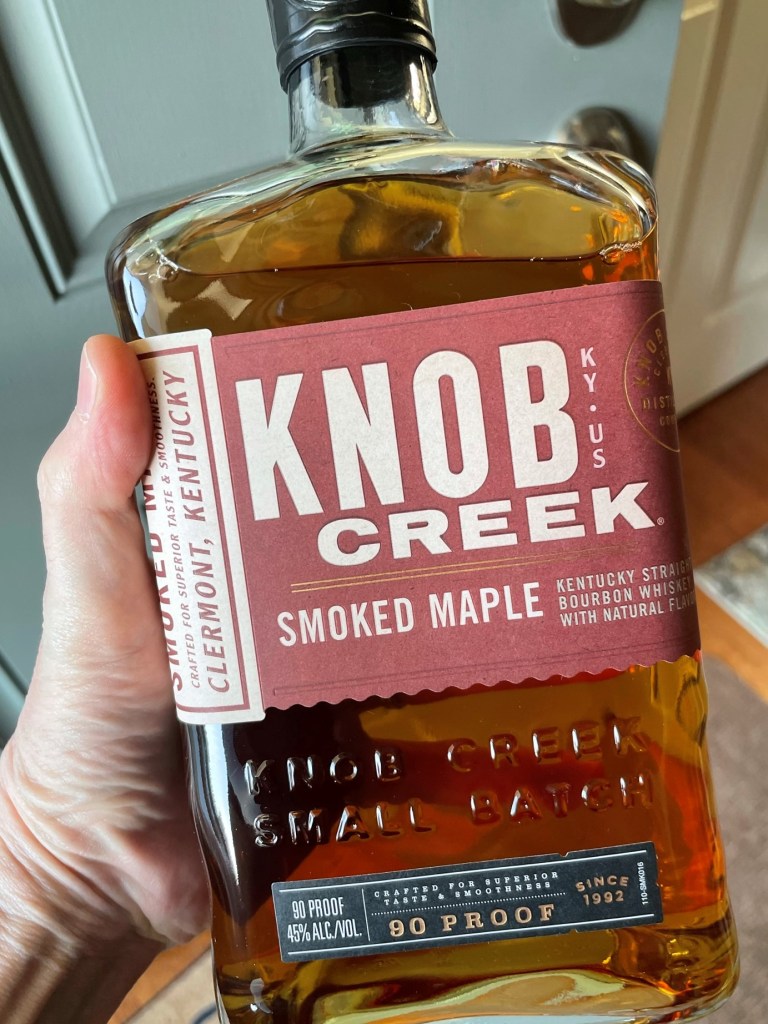
We have been so inspired by this smoked maple-flavored bourbon.
My friend and blog buddy, Michelle, cannot tolerate alcohol in drinks but she enjoys the flavors of booze in food (including the Tequila & Lime Chicken Tacos she inspired me to make last summer). Michelle commented that the maple-bourbon combination in my dessert reminded her of a signature appetizer made by an old friend. Can’t we all relate to that—a dish so good that we can still taste it in our minds, even years later? That simple comment about her friend’s “maple mustard mystery” meatballs got my own creative juices going. I was bored with ground beef (and it isn’t always easy to find fresh grass-fed in the store), so I turned to ground pork instead and modified a recipe I already had for Marsala-braised pork meatballs. I had been thinking about making those, but maple and bourbon sounded much more interesting.
Maple is one of the most versatile sweeteners I know—it is not a flat kind of sweet, as sugar is, but complex, with a warmth and depth that you can’t get from brown sugar or even honey. Maple plays nicely with tangy, spicy and smoky as well as it does with creamy and buttery. If you have only enjoyed maple with weekend pancakes, this recipe may help you break out of a flavor rut. The maple and mustard was a terrific combination for early December, which is when I made the meatballs. Yes, we are hanging in there with dry January, so I suppose you could say I am enjoying bourbon vicariously through myself from last month.
For this meatball recipe, I paired a spicy maple syrup with Dijon mustard, a bit of tomato paste, onion juice and some of the smoky maple bourbon we had bought for the Smoked Maple Cranhattansat Thanksgiving. I resisted the urge to add cream to this sauce, because cream tends to soften other flavors and I really wanted the maple and mustard to enjoy the spotlight.
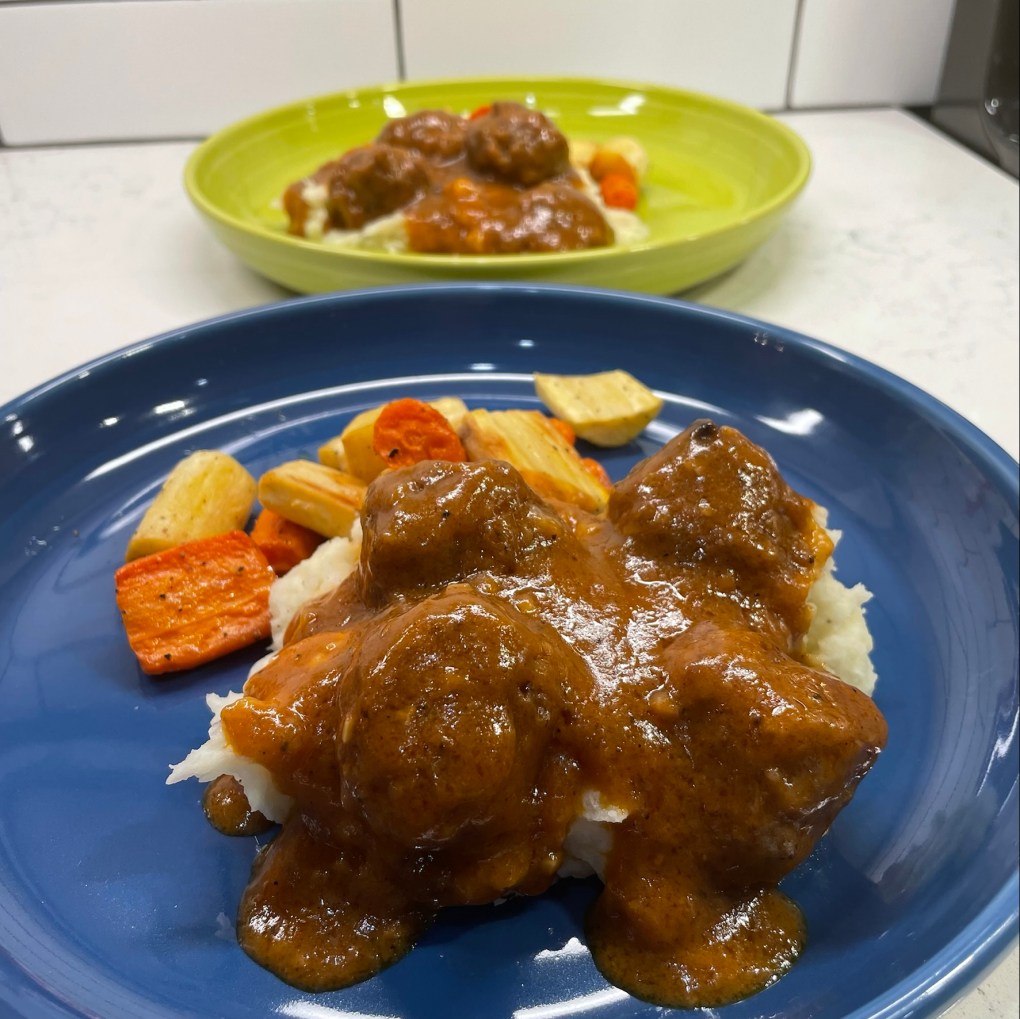
Mission accomplished—they were delicious! I served them over a bed of simple mashed potatoes and with a side of roasted root vegetables, but I couldn’t help thinking they would also be delicious on toothpicks as an appetizer, as my friend remembered them. Super Bowl, maybe?
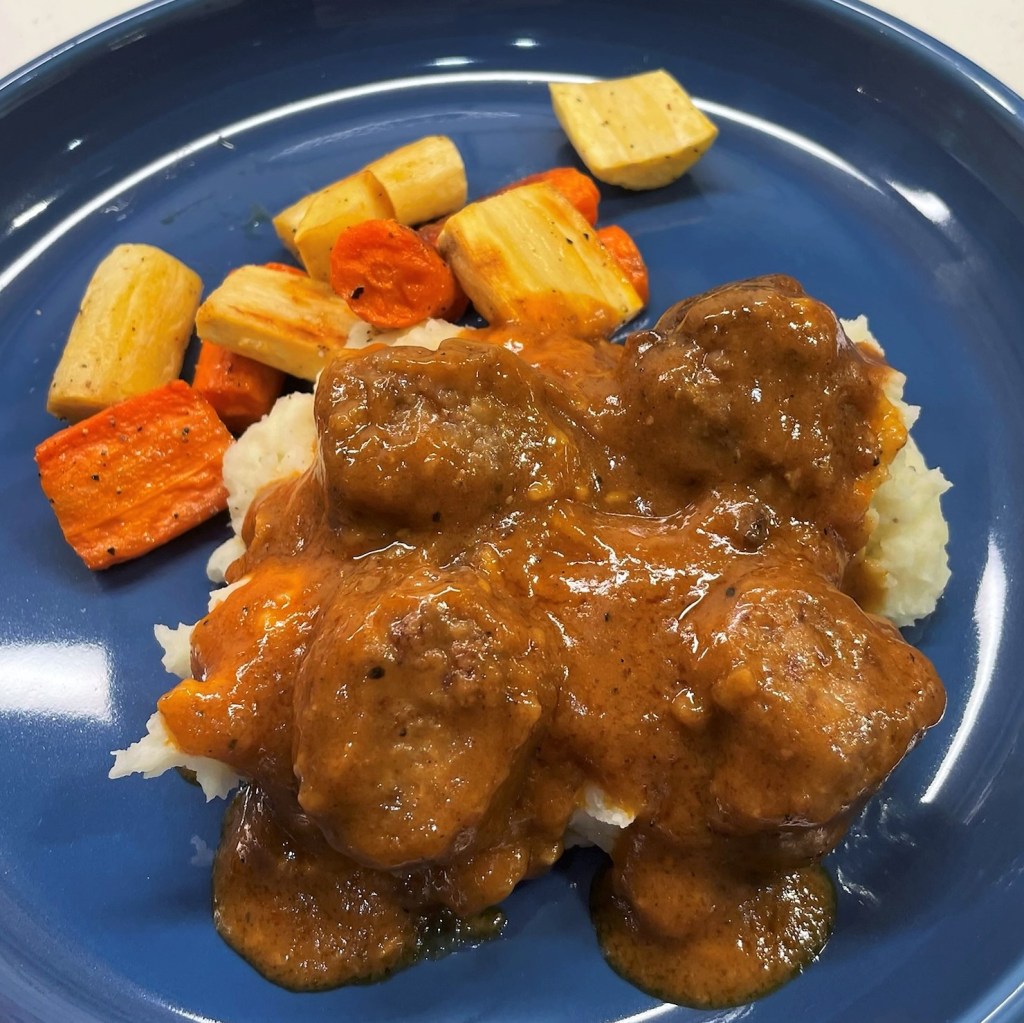
Ingredients
1 large, sweet or yellow onion* (see notes)
1 lb. fresh ground pork
1/3 lb. bulk breakfast sausage
1/3 cup panko breadcrumbs
1/4 cup milk
2 Tbsp. all-purpose flour
2 Tbsp. Dijon mustard
1 Tbsp. tomato paste
2 tsp. Worcestershire sauce
2 Tbsp. real maple syrup*
2 cloves garlic, finely minced
Up to 1/2 cup low-sodium vegetable broth
2 Tbsp. smoked maple bourbon*
*Notes
When I made these meatballs, I had reserved onion juice from the Classic Crispy Latkes I had made for the first night of Hanukkah. You will only use half of the large onion in this recipe, but you need the juice of the whole onion to flavor the simmering sauce.
I used a habanero-infused maple syrup for this recipe because my husband and I enjoy spicy foods. Any maple syrup would be delicious—but choose real maple for the best flavor. If the idea of spicy flavor appeals to you, try using regular maple syrup and add about a teaspoon of cayenne or sriracha sauce for similar results.
The smoked maple bourbon is a Knob Creek product. It’s completely optional in this recipe. If you avoid alcohol, simply omit this and add an extra splash of vegetable broth.
Instructions
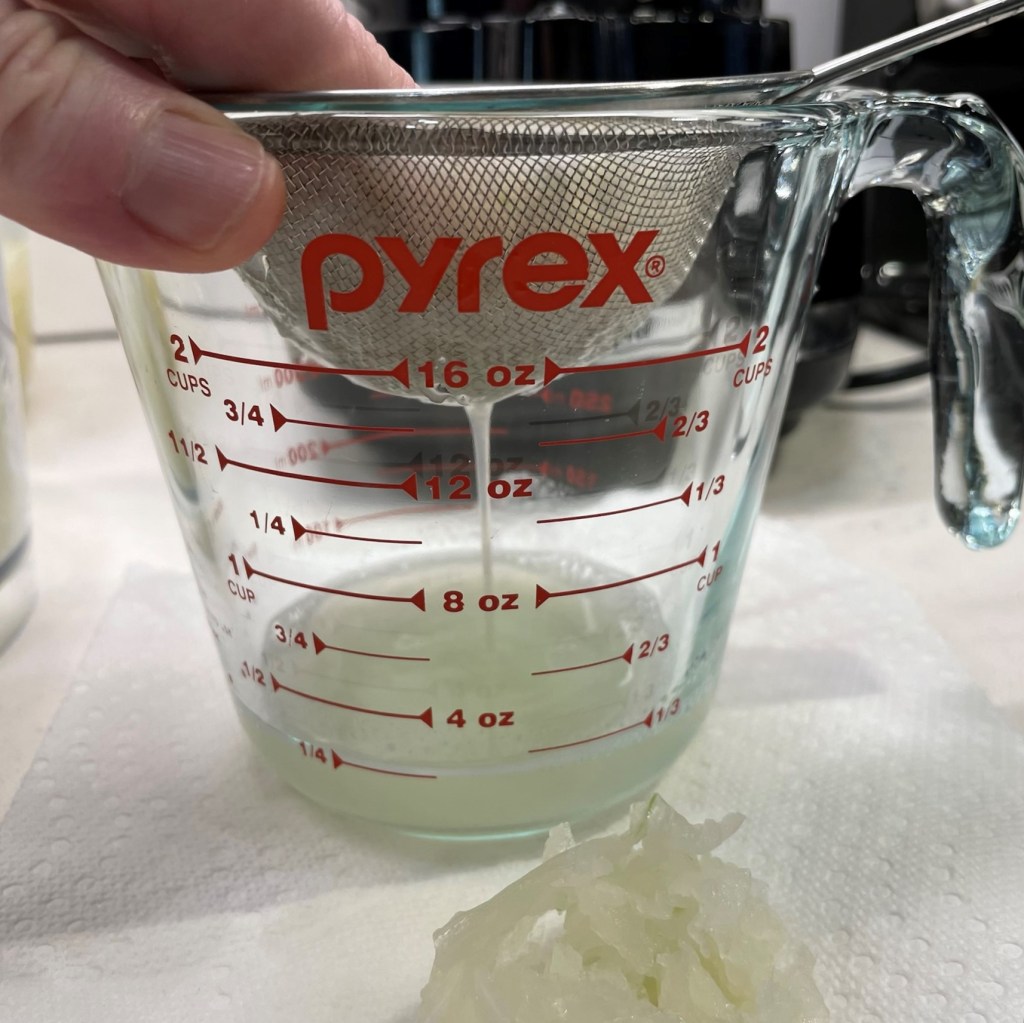
Shred a large onion and press it through a mesh strainer to separate (and reserve) the juice.
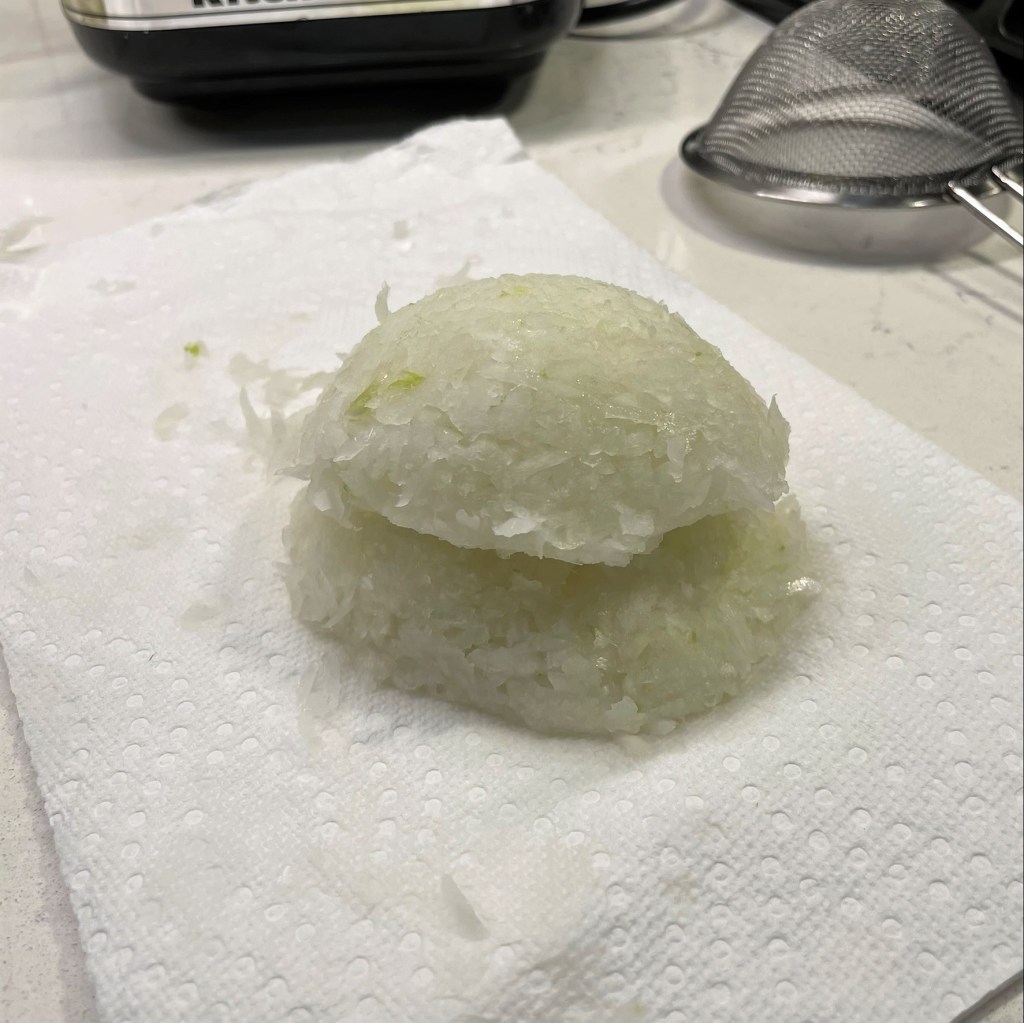
Set aside half of the onion for another use. You will only use half of it in these meatballs, but you will use all of the juice in the sauce.
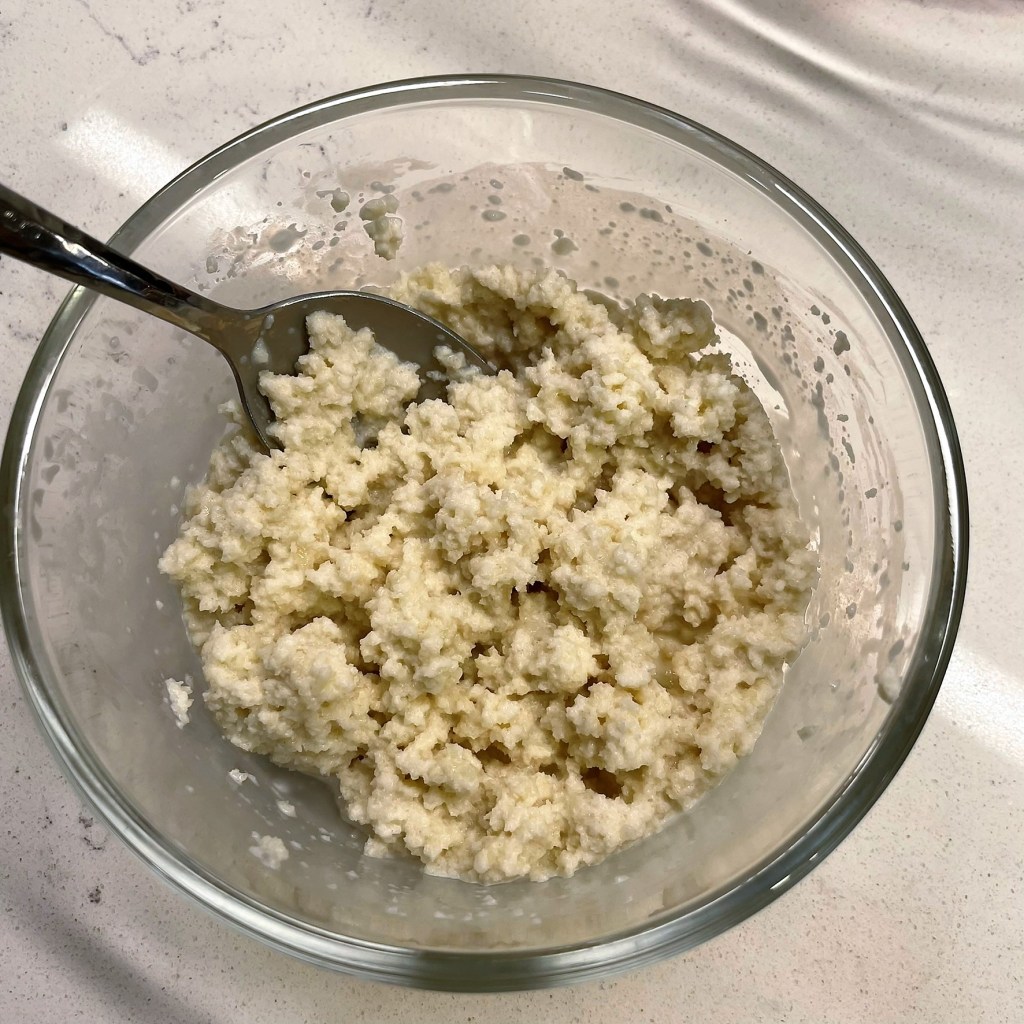
Combine the panko crumbs with just enough milk to cover them, and give the mixture a few minutes to soak.
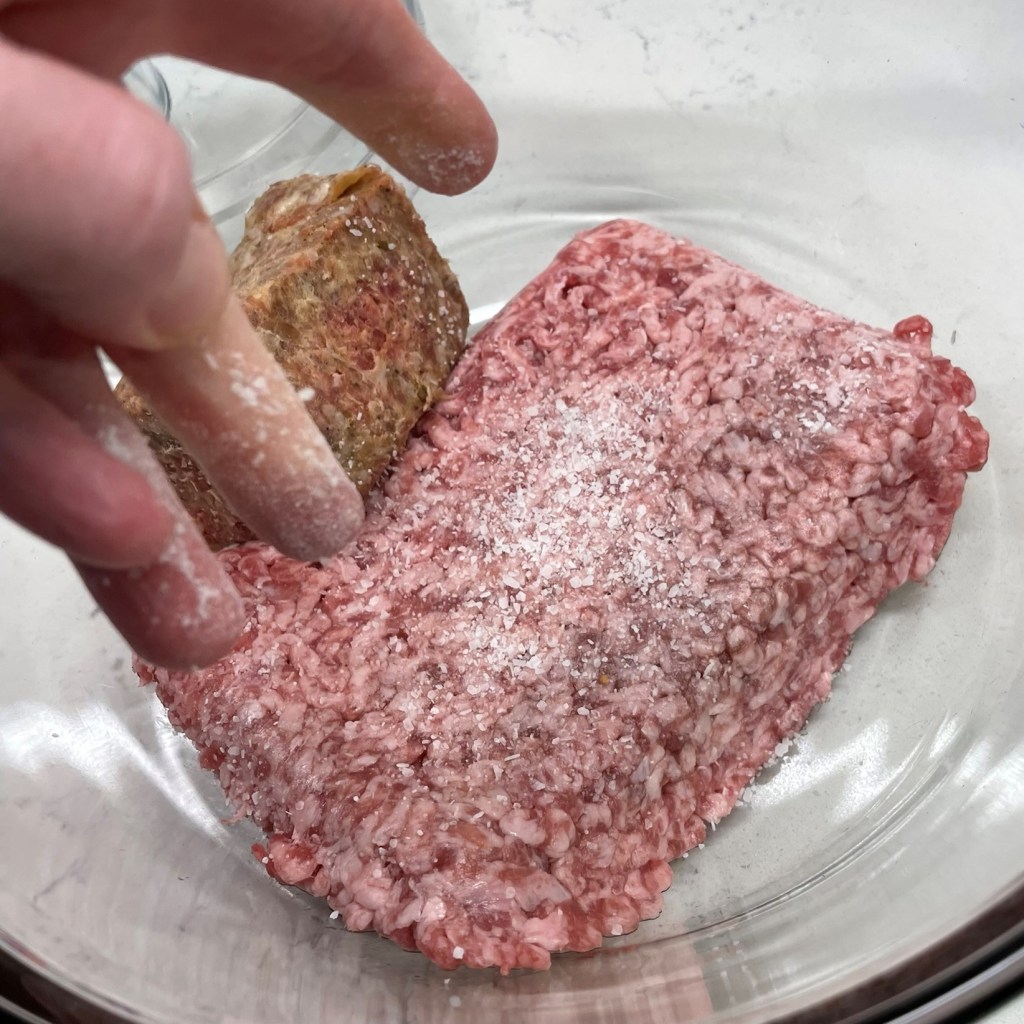
Season the meats with salt and pepper before adding the panade.
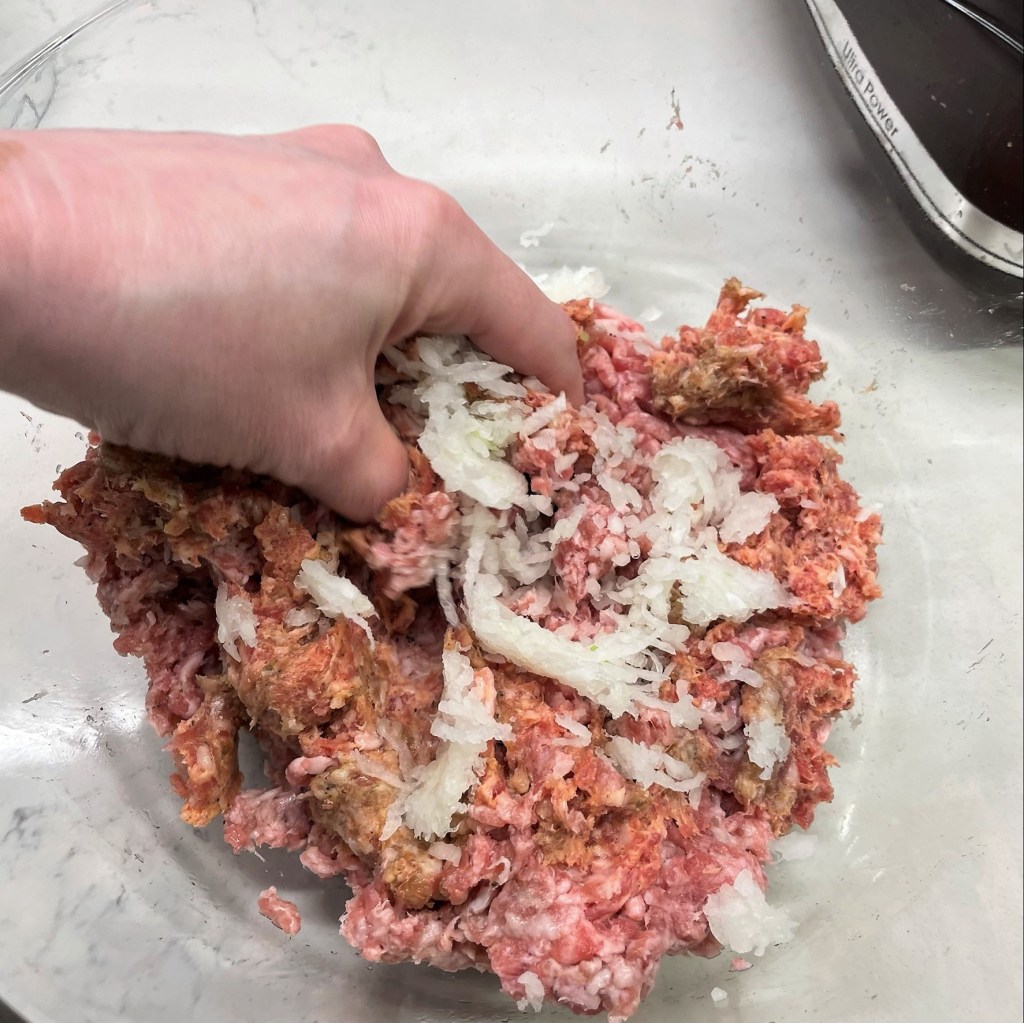
The shredded onions went into the meatball mixture, but the onion juice was reserved for the sauce.
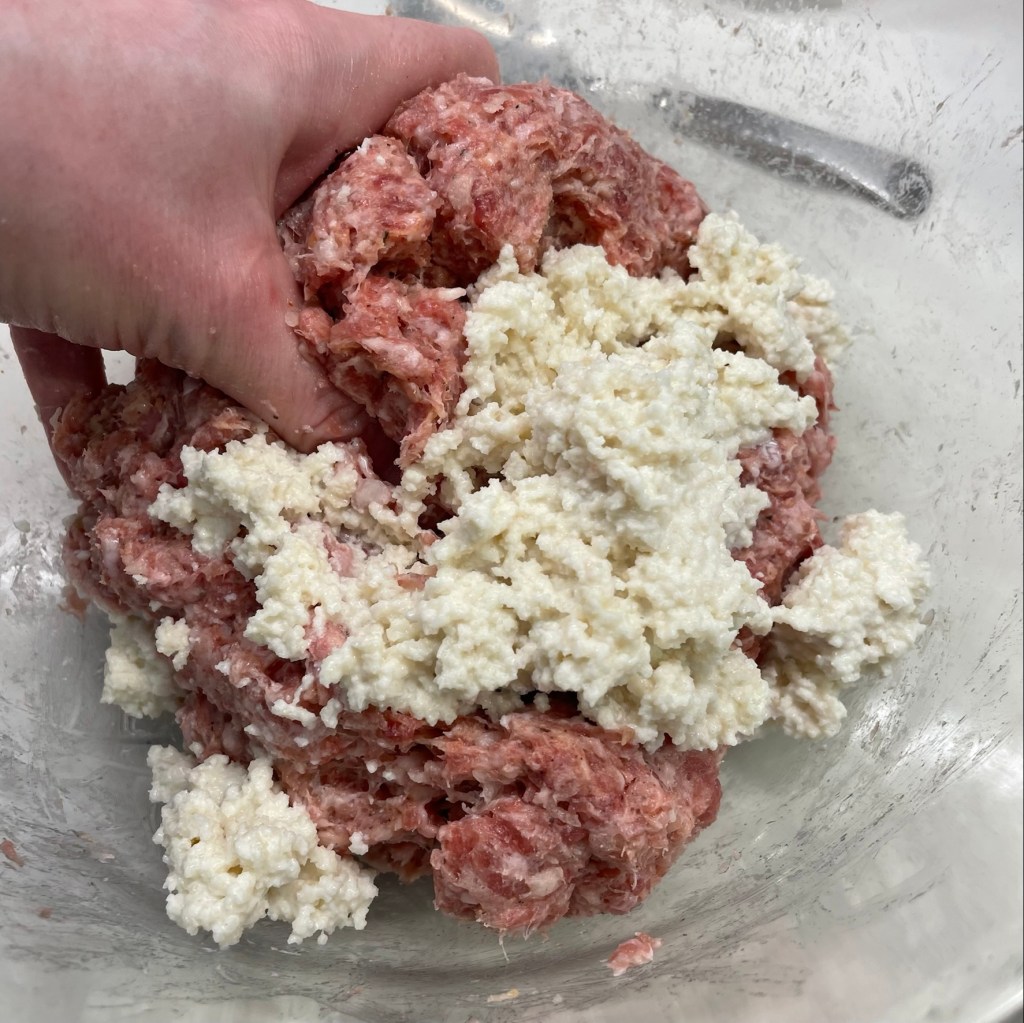
Mix the panade into the meat mixture and knead gently to blend.
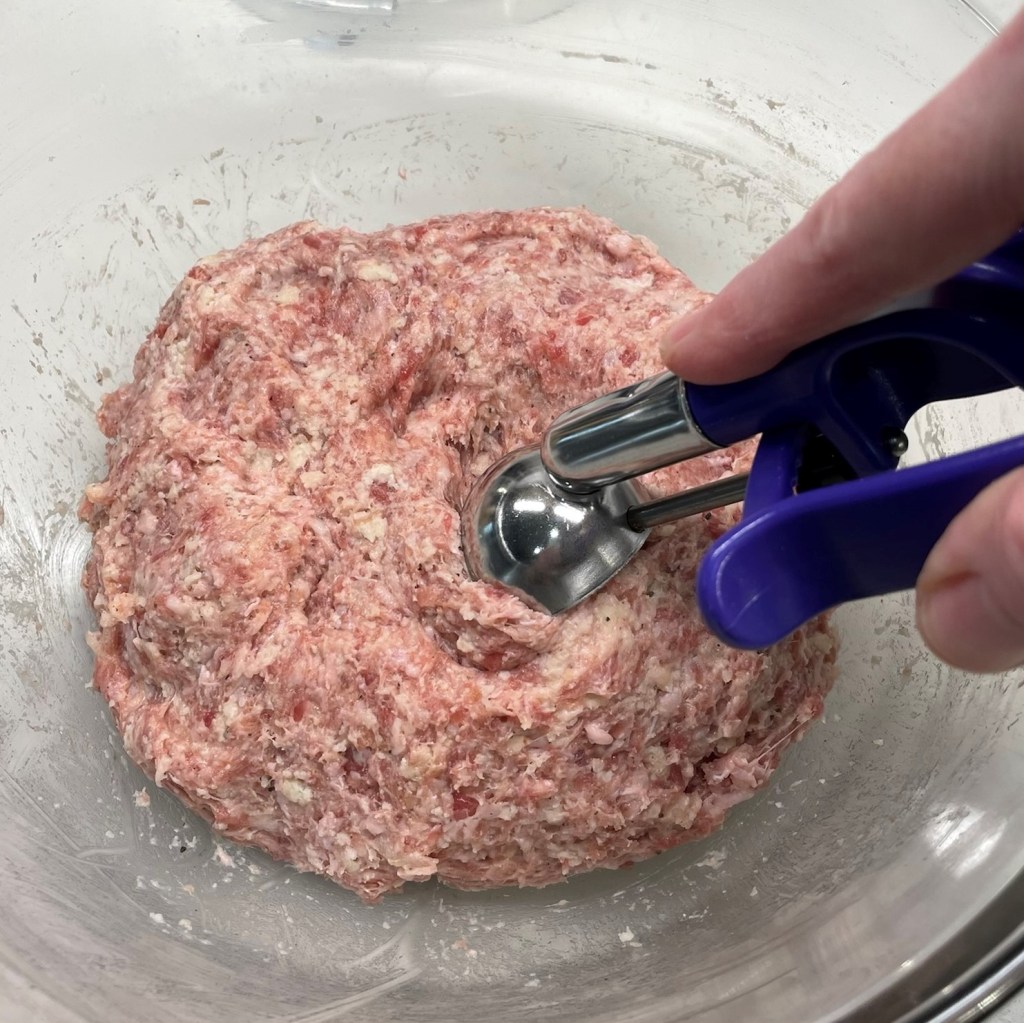
I used a cookie scoop to measure out my meatballs.
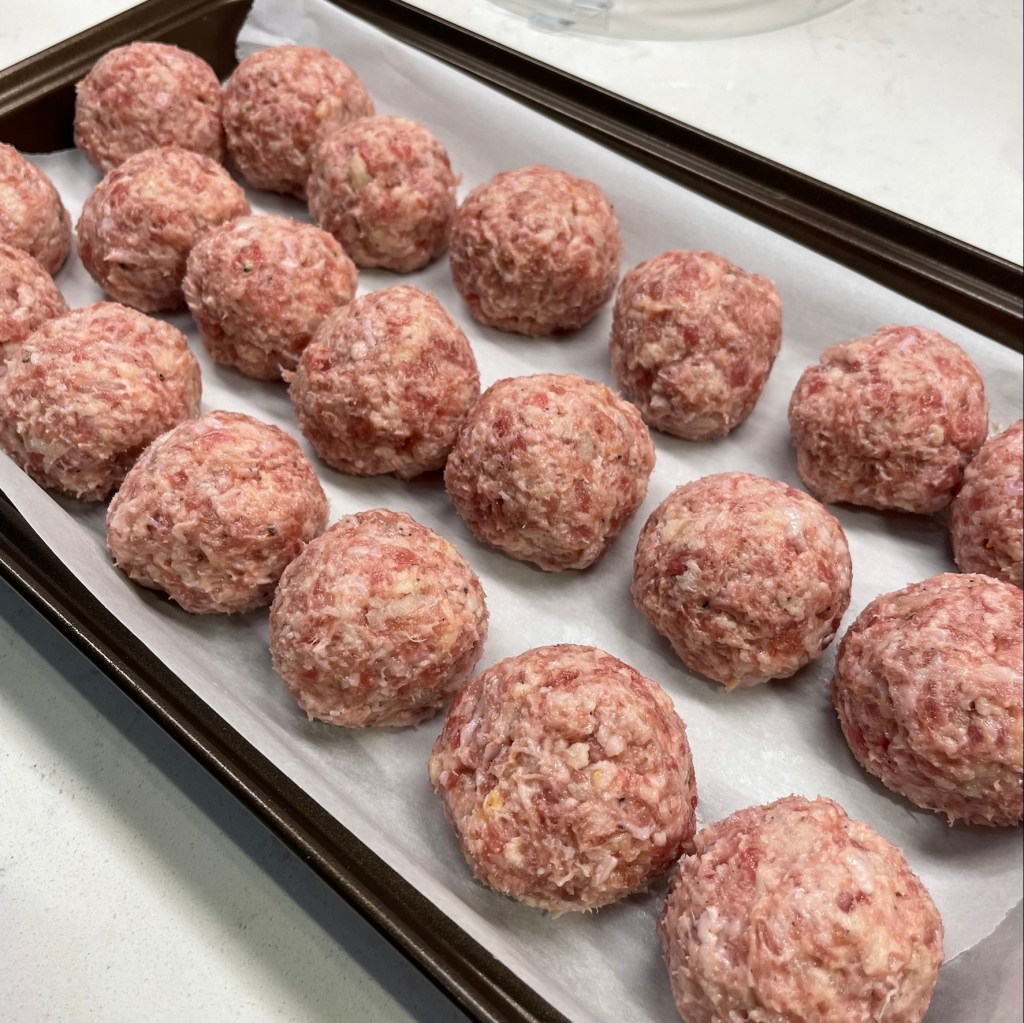
Shape them to about the size of a ping pong ball and let them chill in the fridge for about 20 minutes to firm up.
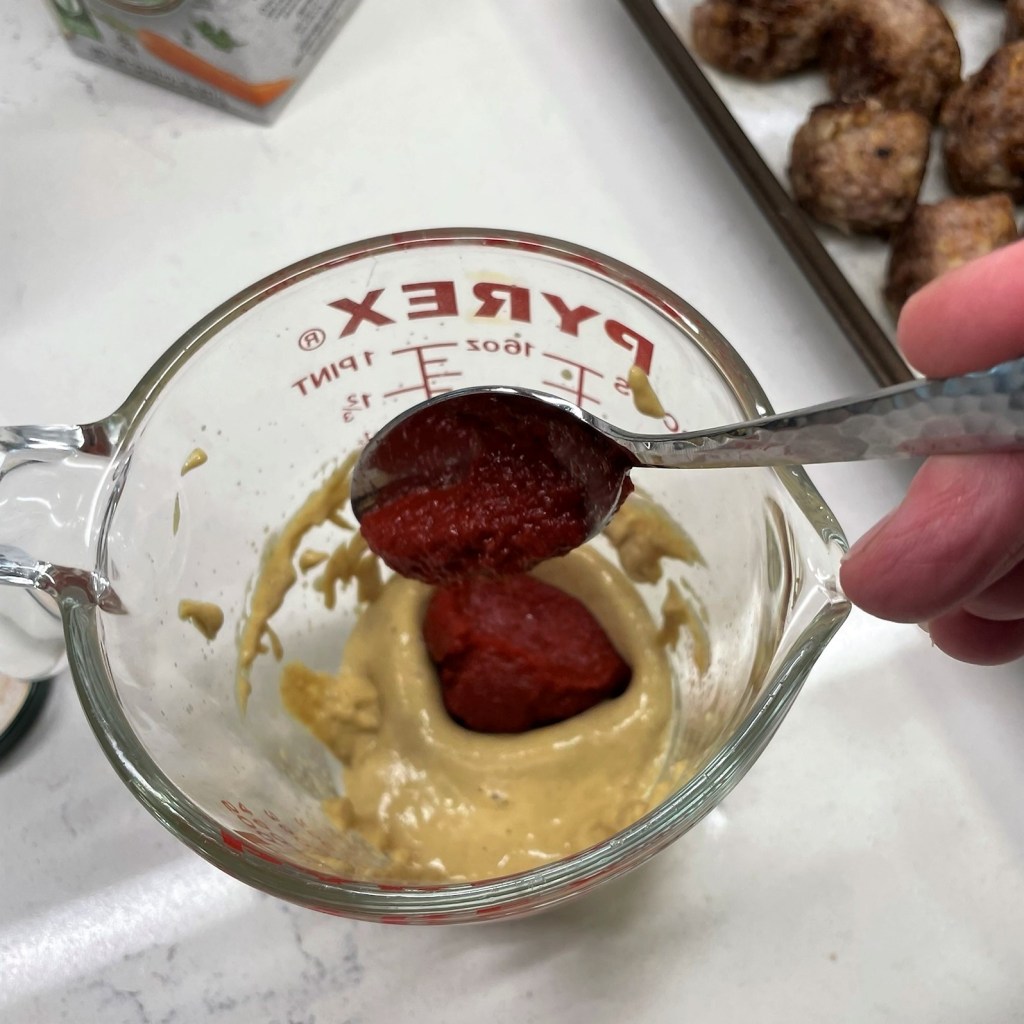
Tomato paste will add some acidity to the dijon mustard.
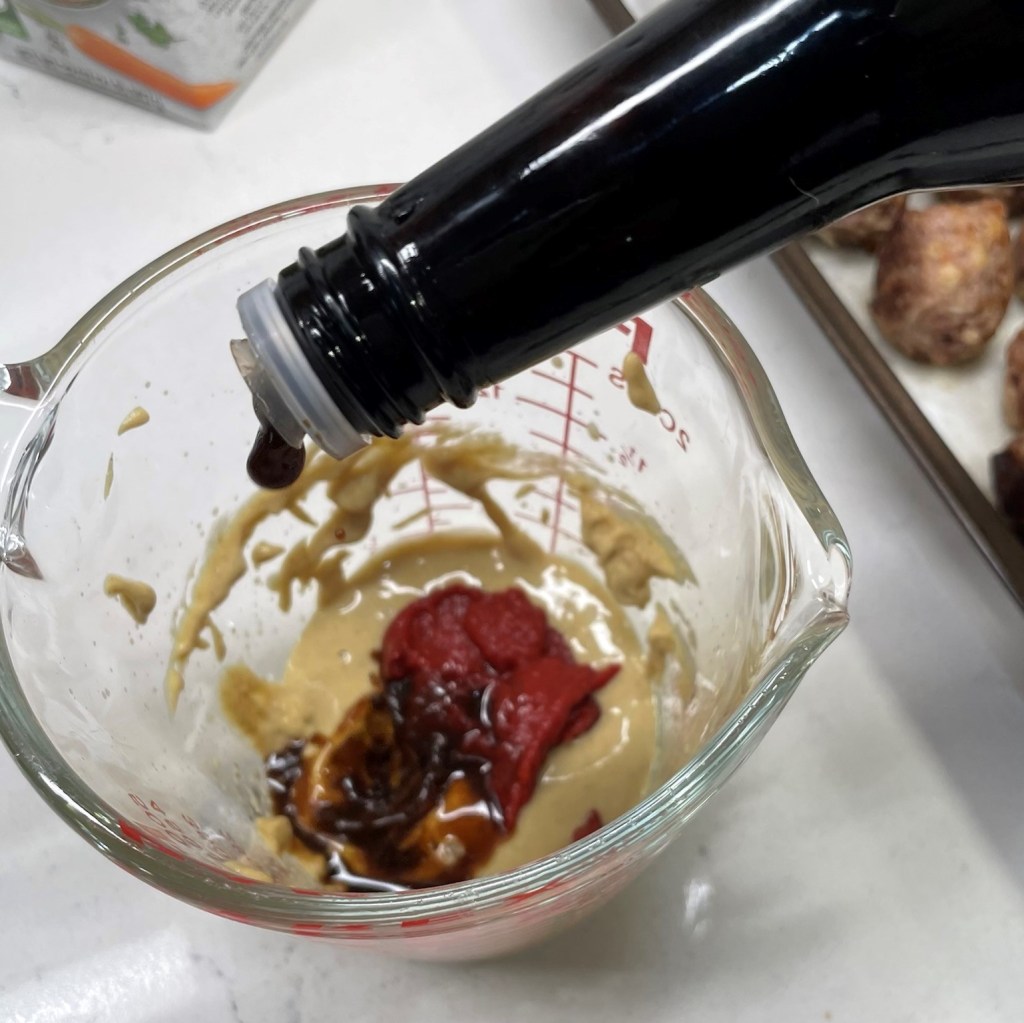
Worcestershire adds flavor and depth.
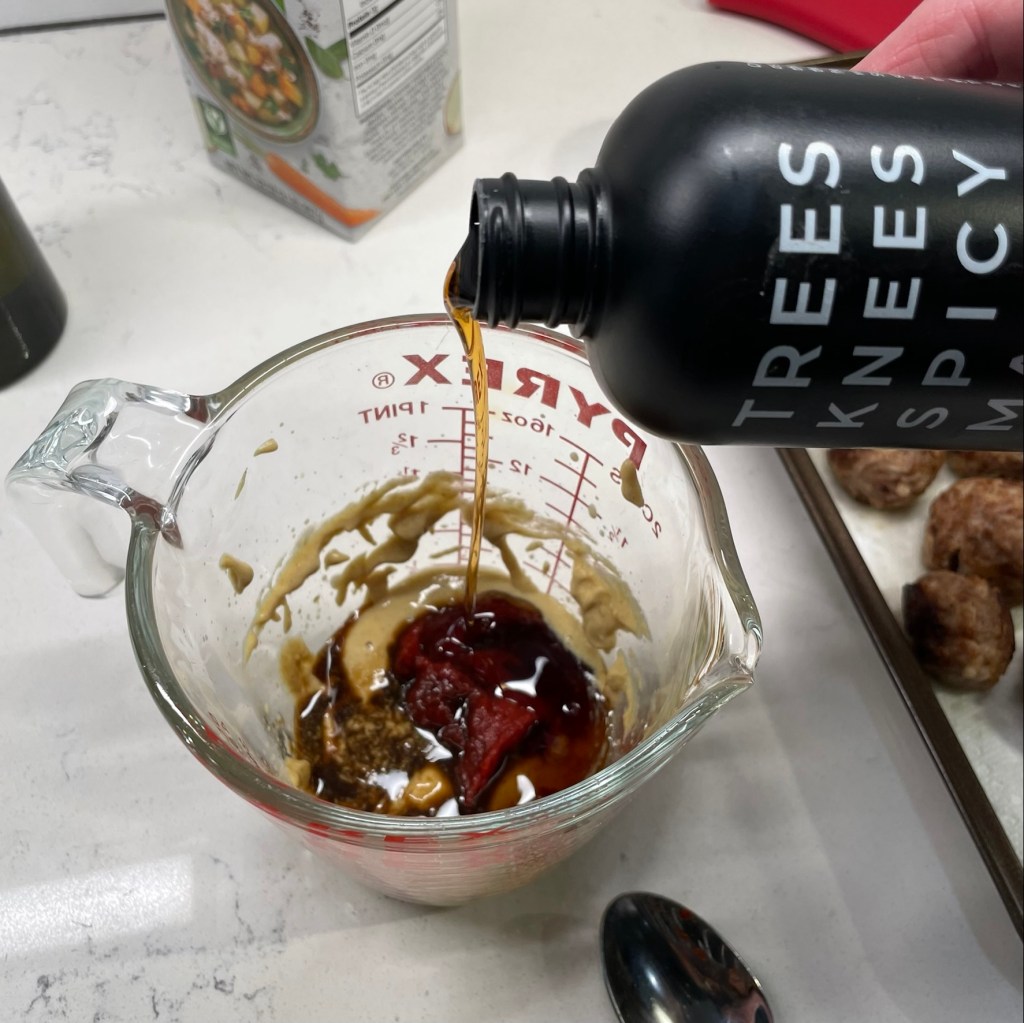
The maple syrup lends a warm sweetness (and in my case, with the spicy maple, heat).
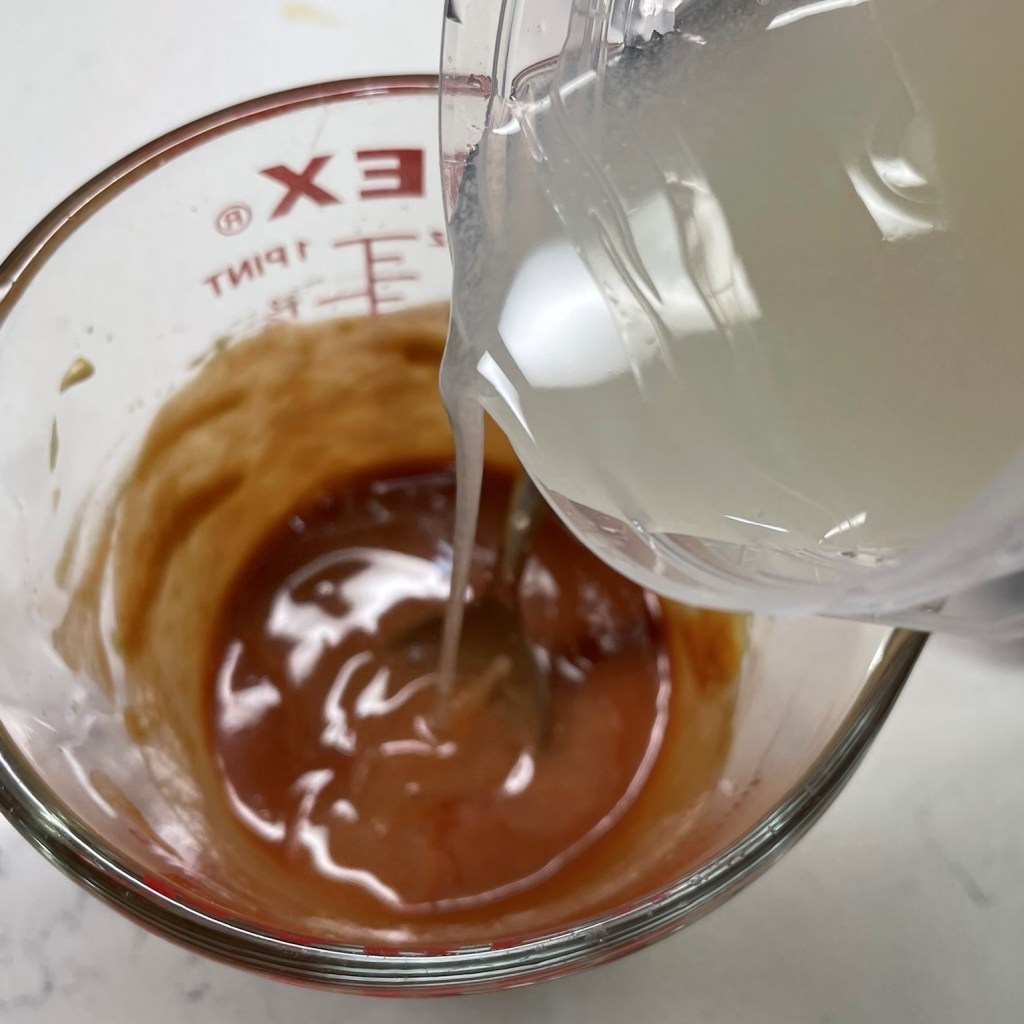
Add onion juice to the sauce blend to boost the aromatic flavors.
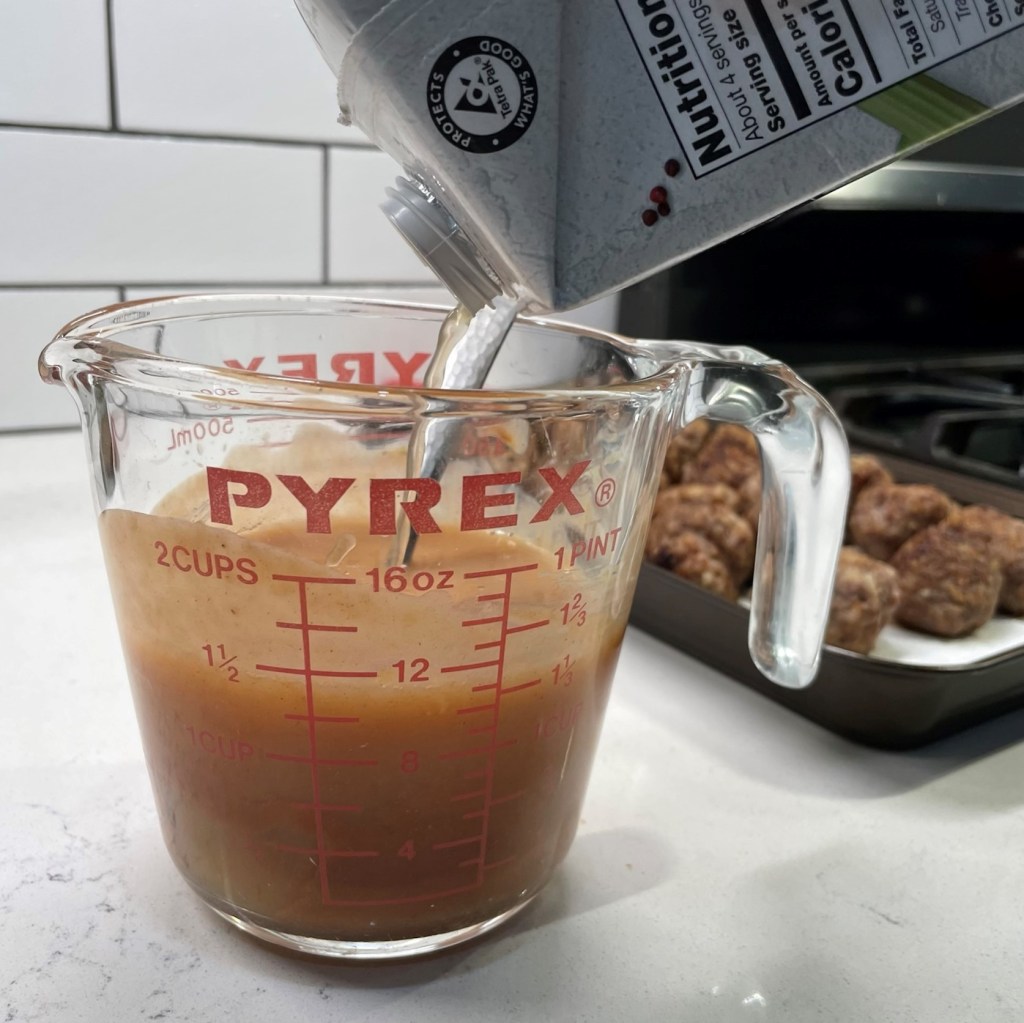
Stir in enough vegetable broth to total 1 1/2 cups.
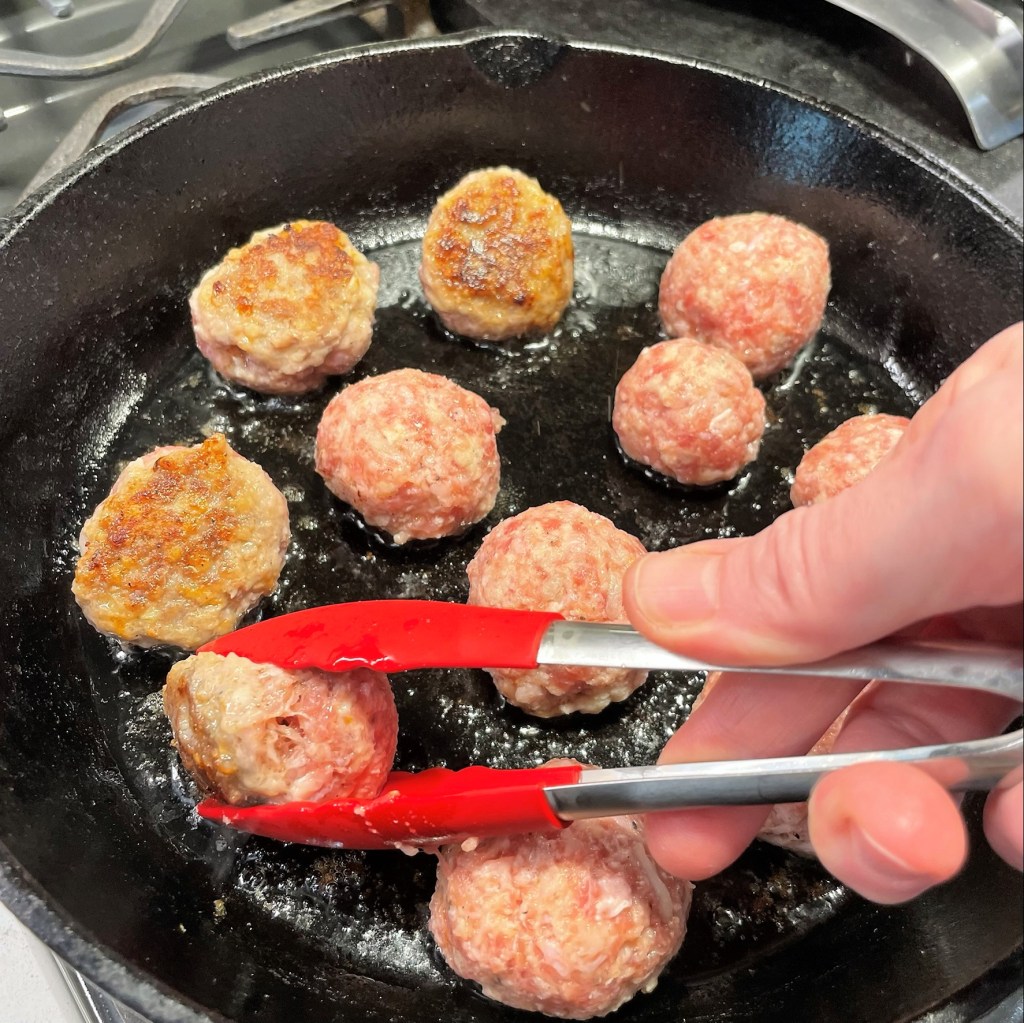
Brown the meatballs in an oiled skillet, but do not cook all the way through.
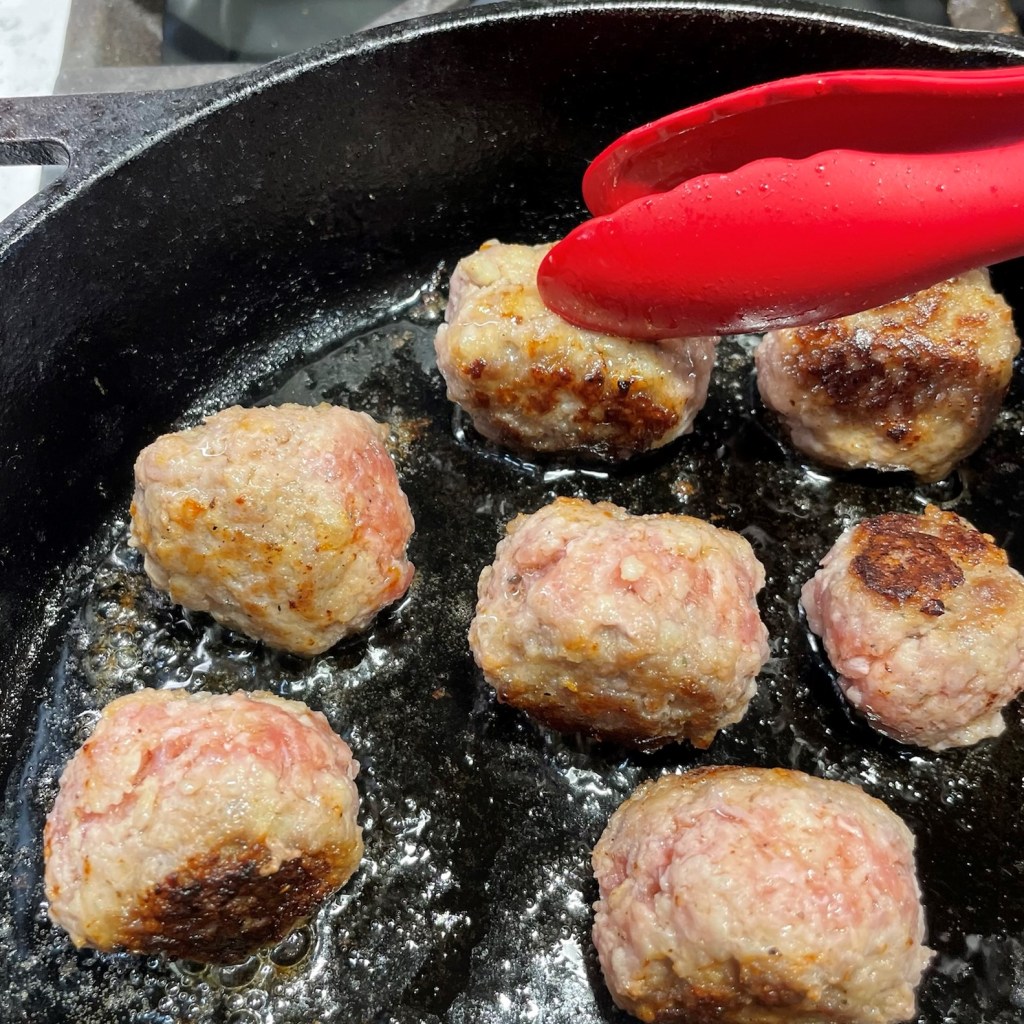
Turn them gently to brown every side. I used a small set of tongs to move them more easily.
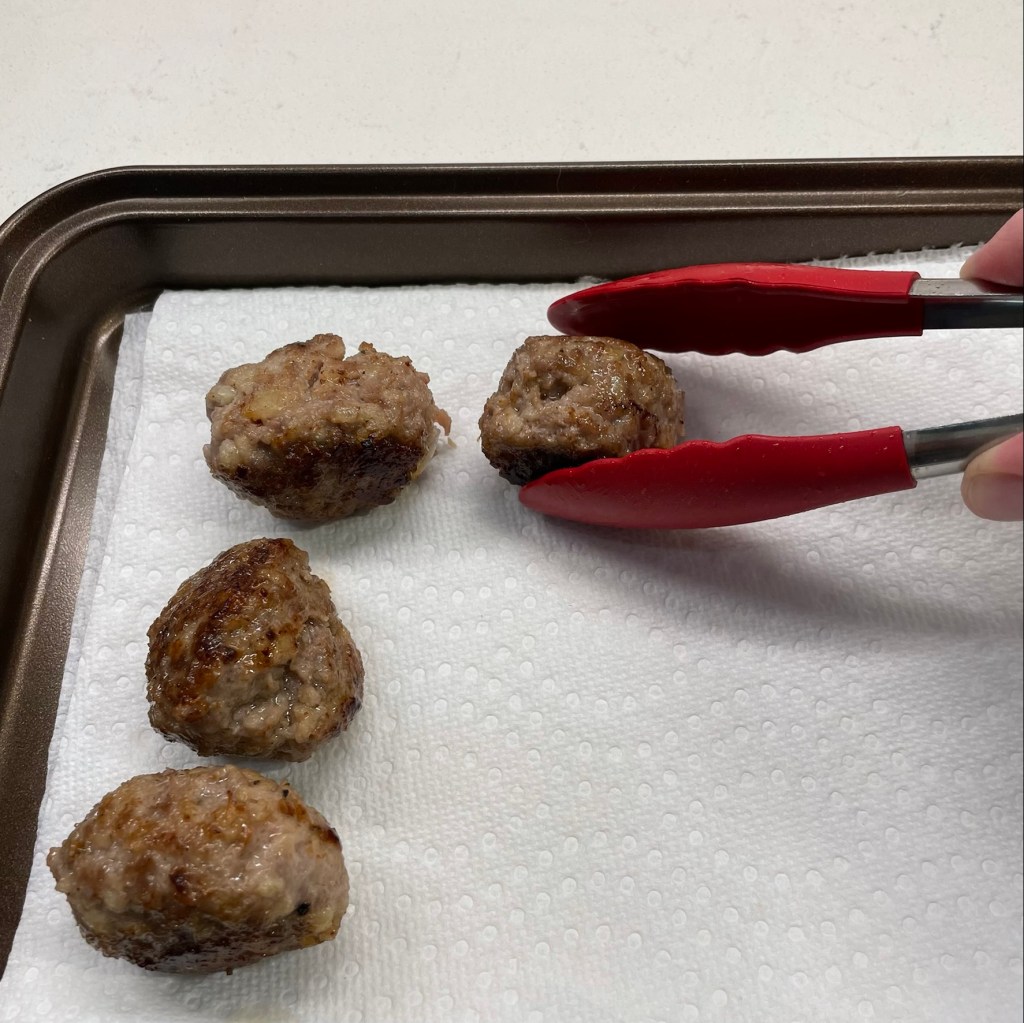
Drain the browned meatballs on layered paper towels.
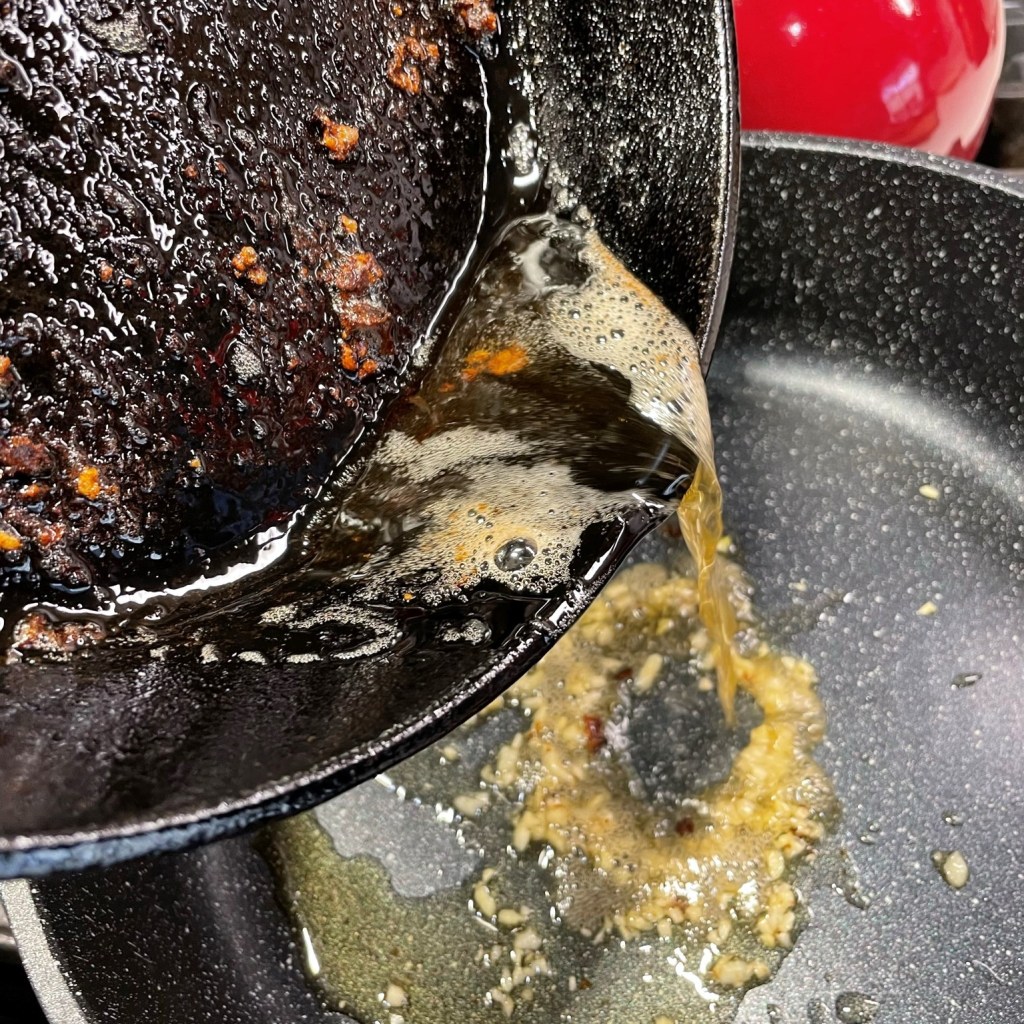
Drain about 2 tablespoons of the grease into a sauce pot to build the sauce. We will come back to the browned bits in the skillet!
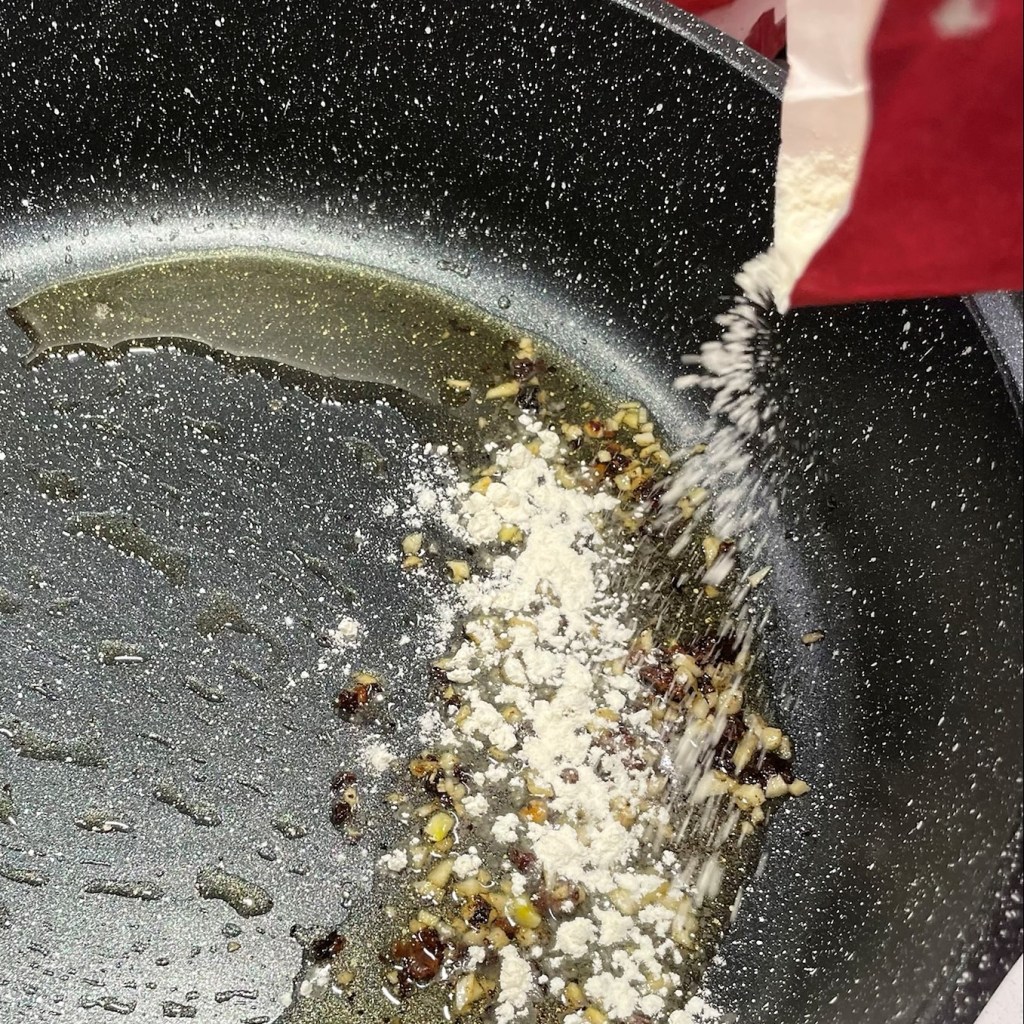
Sprinkle 2 tablespoons all-purpose flour into the pot and whisk to create a roux.
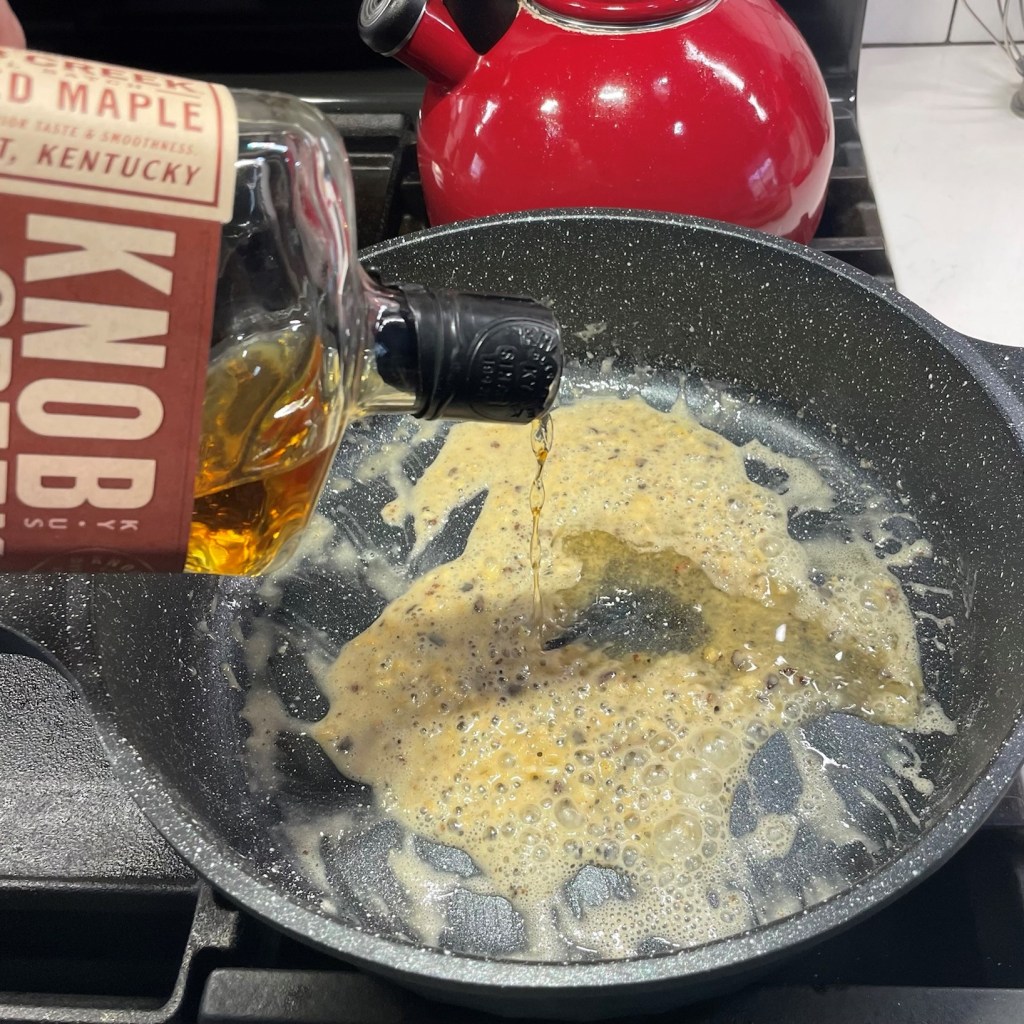
Pour a splash of bourbon into the roux. I also poured a splash into the skillet to pick up all those browned bits. I forgot to snap a picture of that!
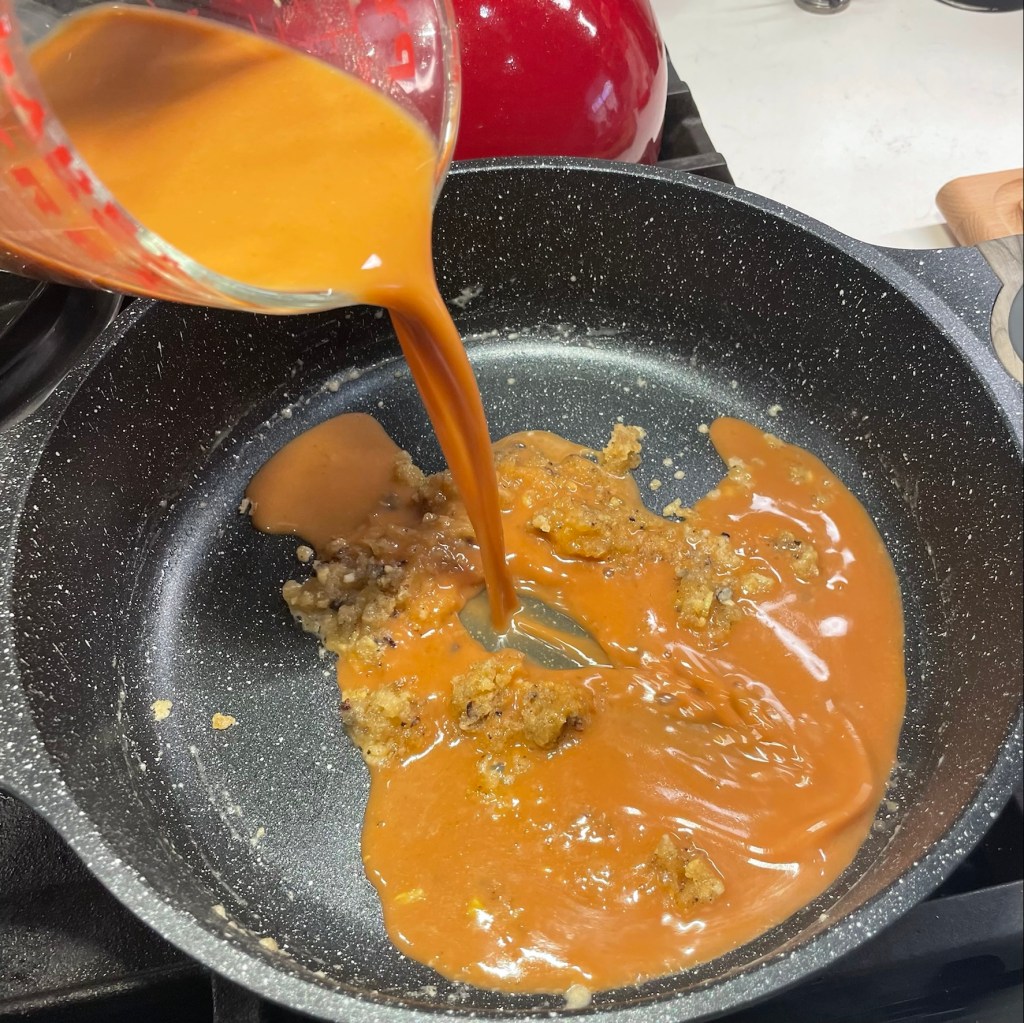
Pour all of the maple mustard sauce into the pan and whisk gently until the roux thickens it.
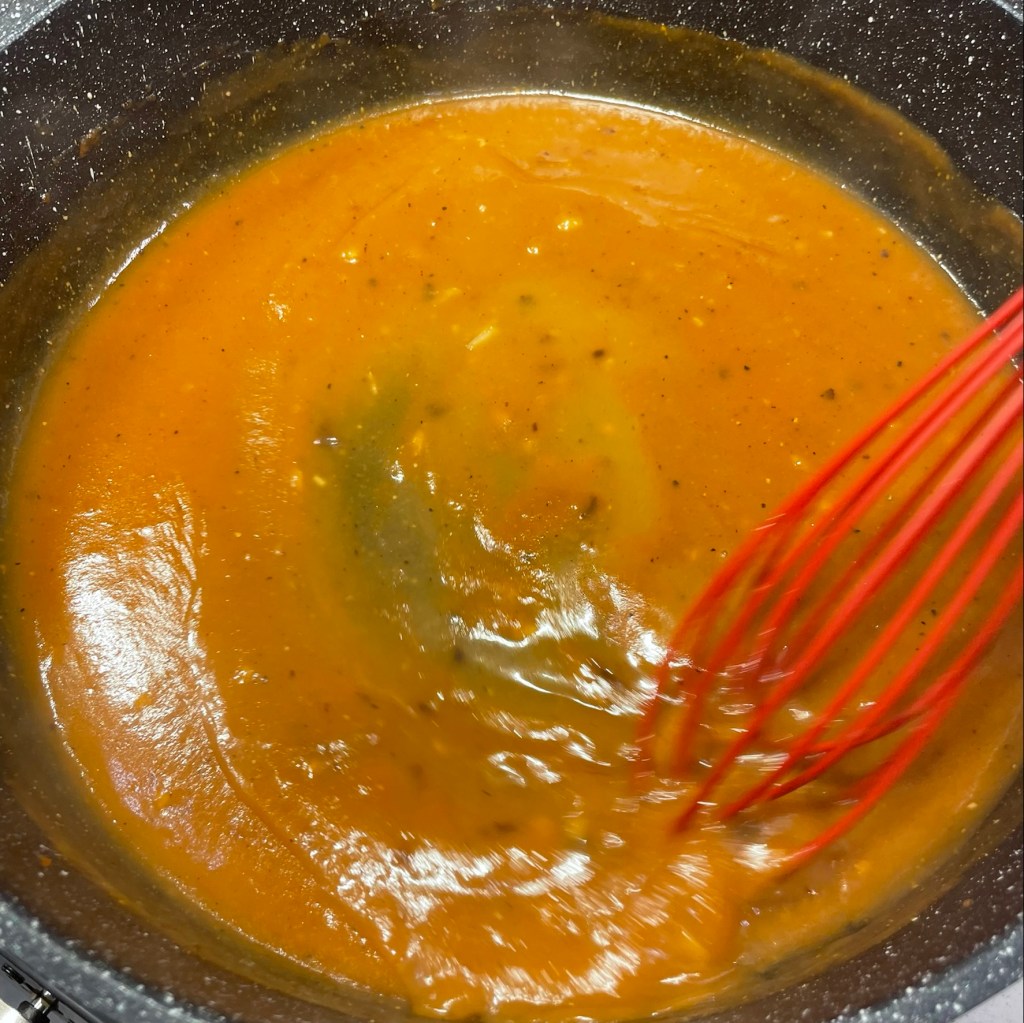
Whisk until blended. The roux will thicken the sauce.
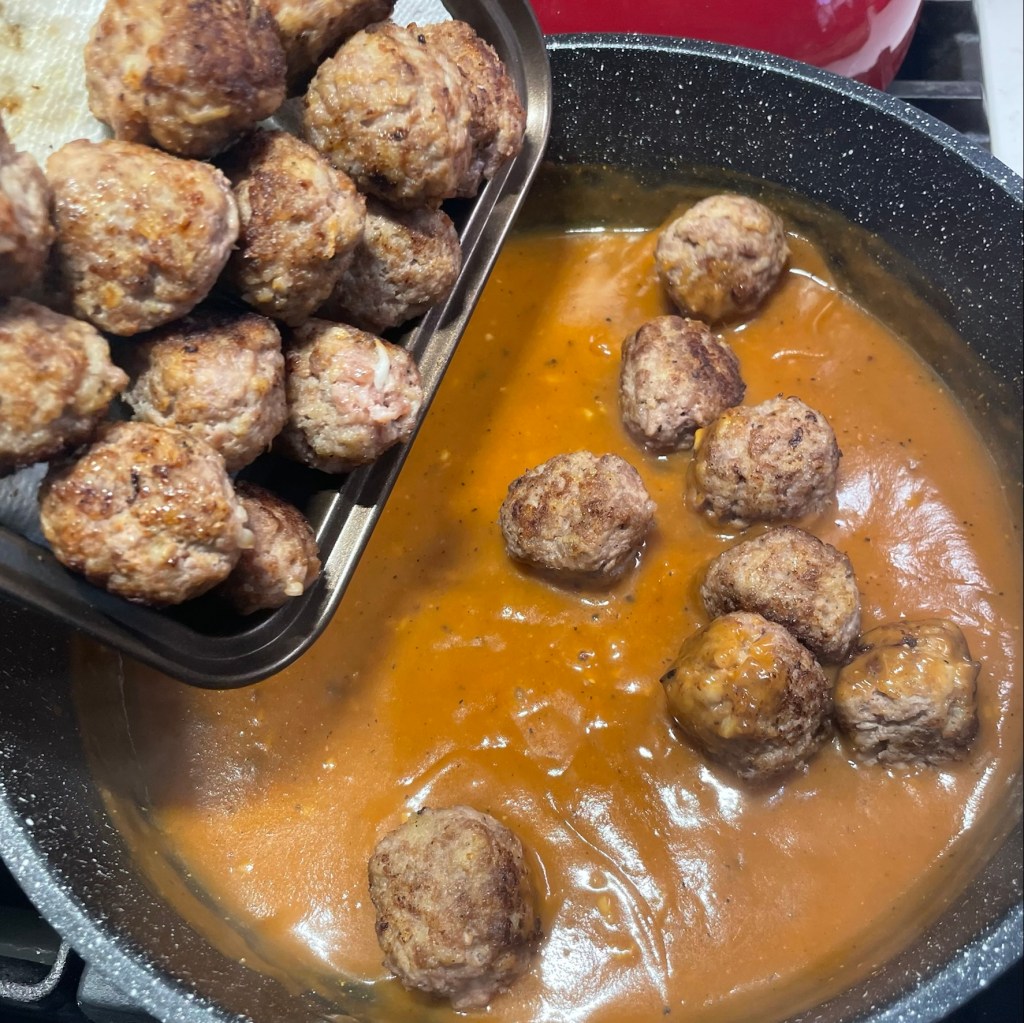
Add the browned meatballs to the sauce and turn to coat them.
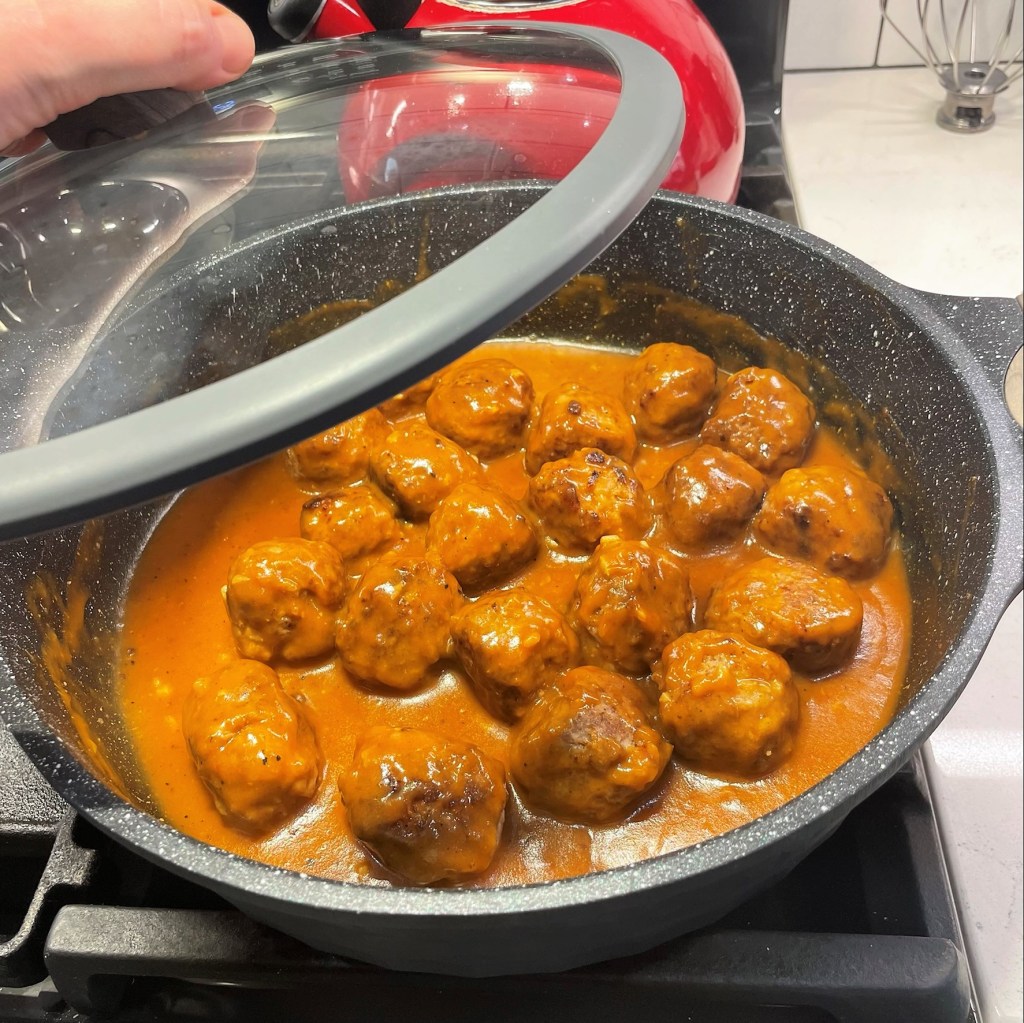
Reduce the heat to a simmer and cover the pot, checking them only occasionally, like kids in a slumber party.
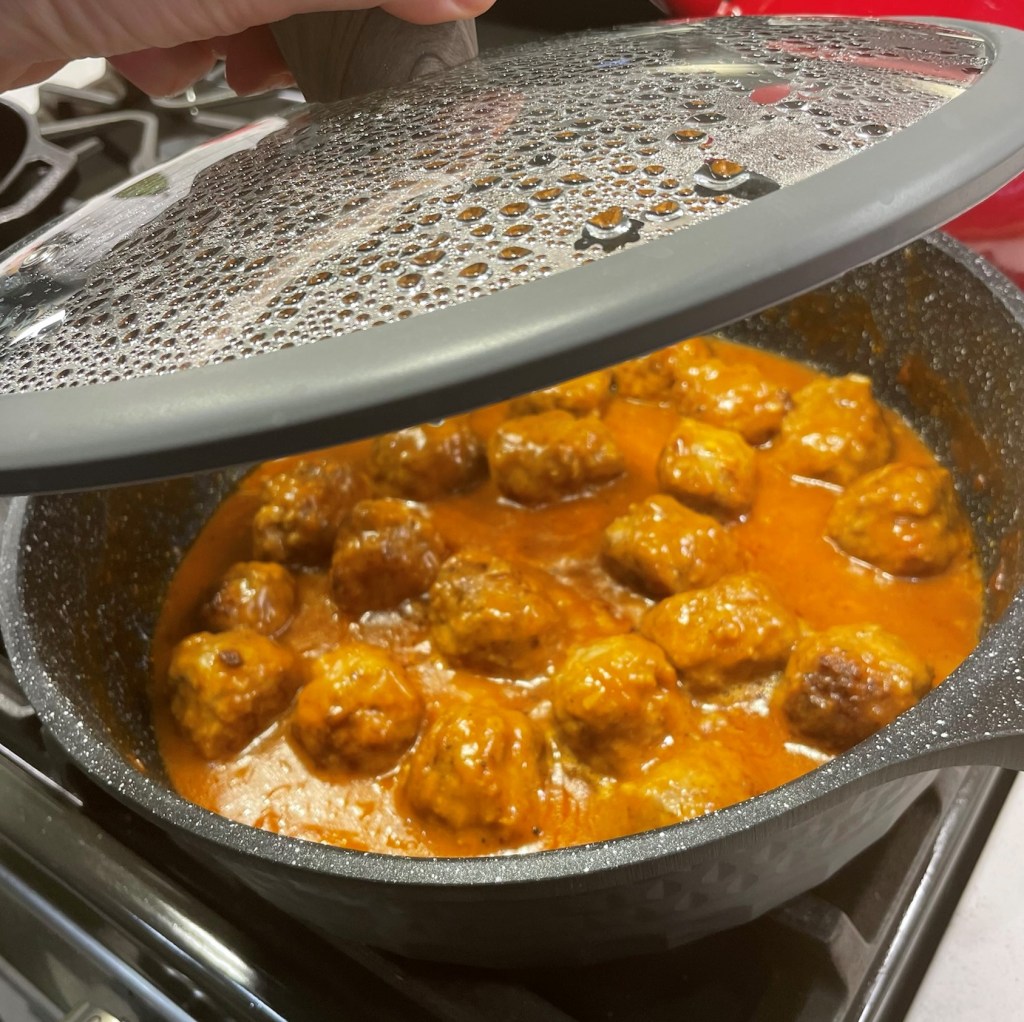
You guys okay in there? Need anything? Cover and simmer for about an hour.
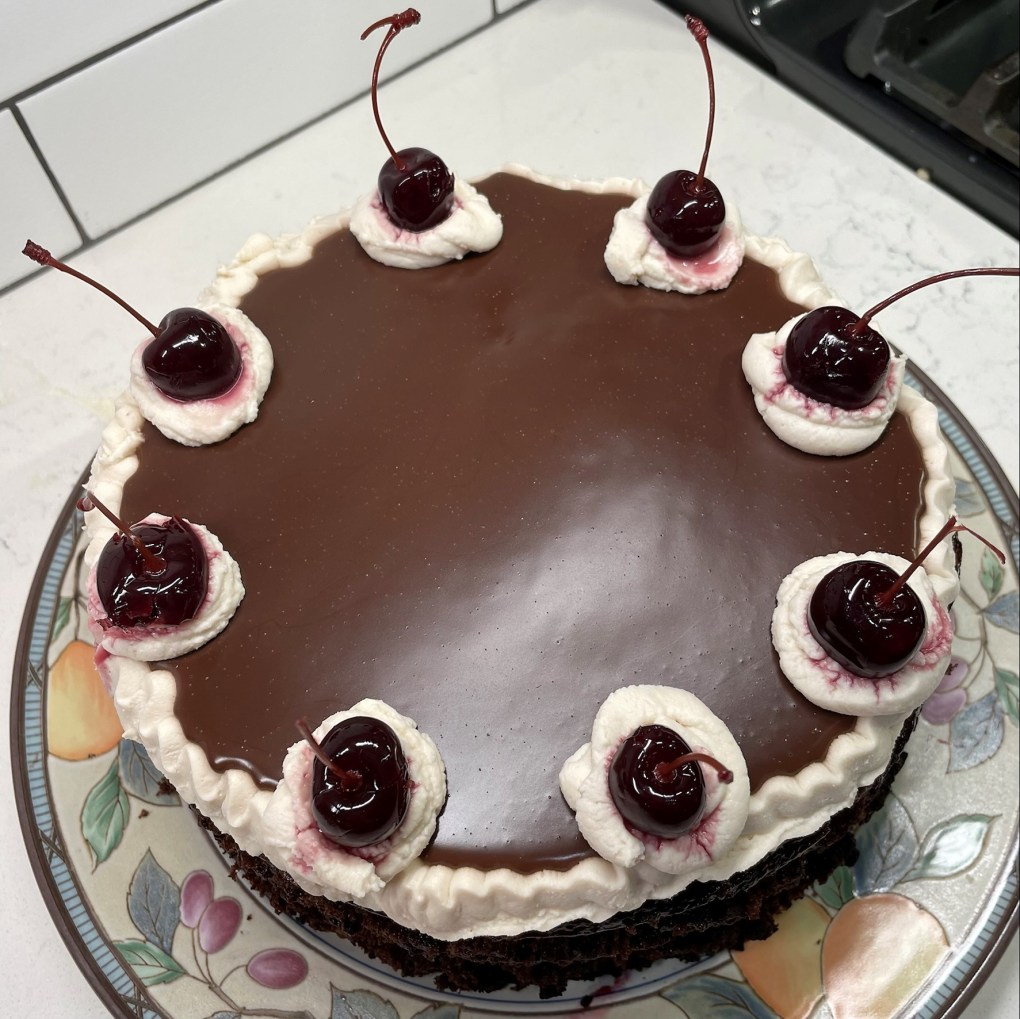
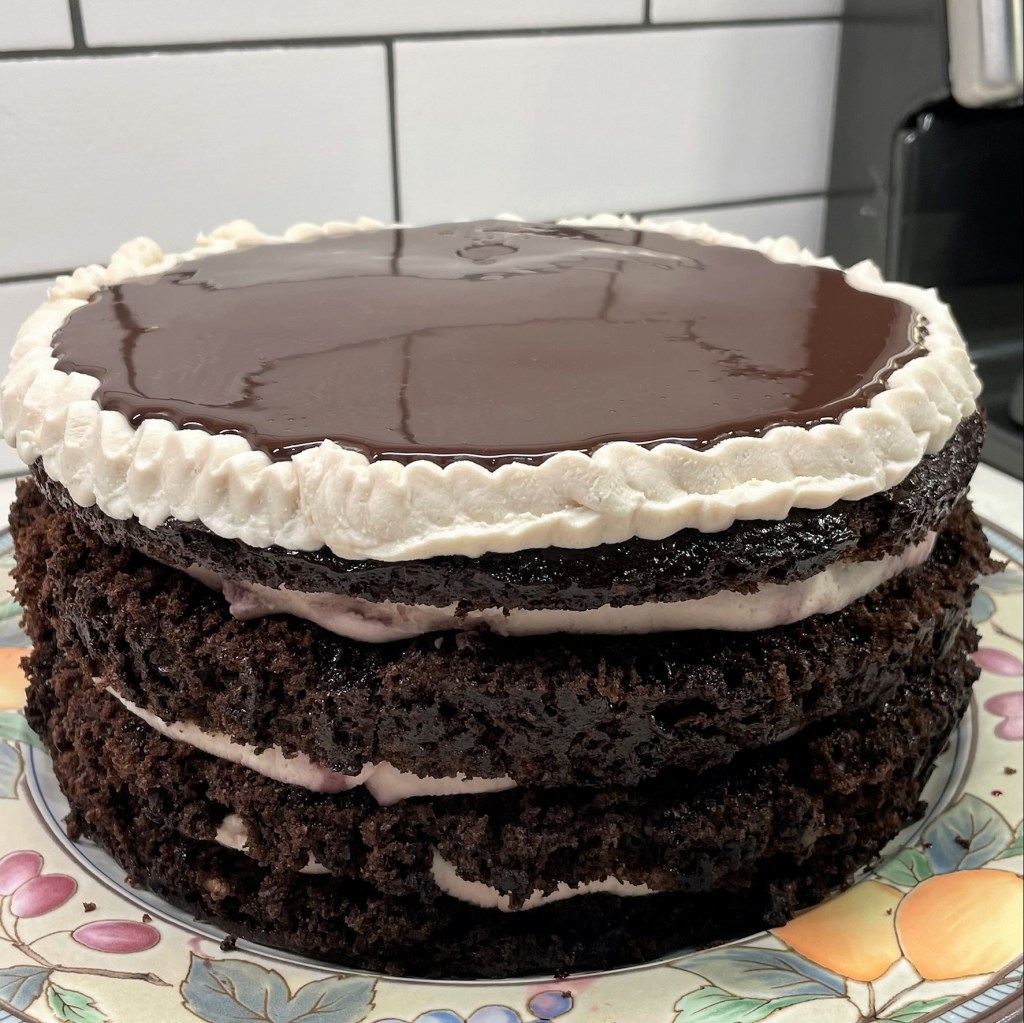
Before we get into it, I’d like to issue my own disclaimer about the inauthenticity of this recipe as a “Black Forest” cake. Any purist would quickly point out that a true, German Schwarzwälder Kirschtorte would be more of a spongy chocolate cake, soaked with kirsch (a clear cherry liqueur) and decorated with whipped cream, sour cherries and shavings of chocolate. But when is the last time you remember me sticking to tradition?
My version of this cake is a departure in almost every category, save for the chocolate and cherry flavors. Cake baking is not in my wheelhouse, so I went for a recipe that I knew I could count on—a sourdough chocolate cake from King Arthur Baking that has served me well before—and I adjusted the fillings to match it. My whipped cream filling is enhanced with mascarpone, making it more substantial to support the sturdy cake. The cake itself is not super sweet, so the cherries had to be. And kirsch liqueur (or any cherry liqueur, for that matter) is nowhere to be found in our liquor stores, so I reached straight for what’s plentiful at our house—bourbon, and that was a very good call.
The cake is not difficult to make, but it is fussy enough that it deserves a special occasion. I was going to save this until the week of Valentine’s Day, but my husband heard on his favorite sports talk show this morning that today is National Chocolate Cake Day, so, heck yeah! We might as well get a jump start on swooning over it. 😉
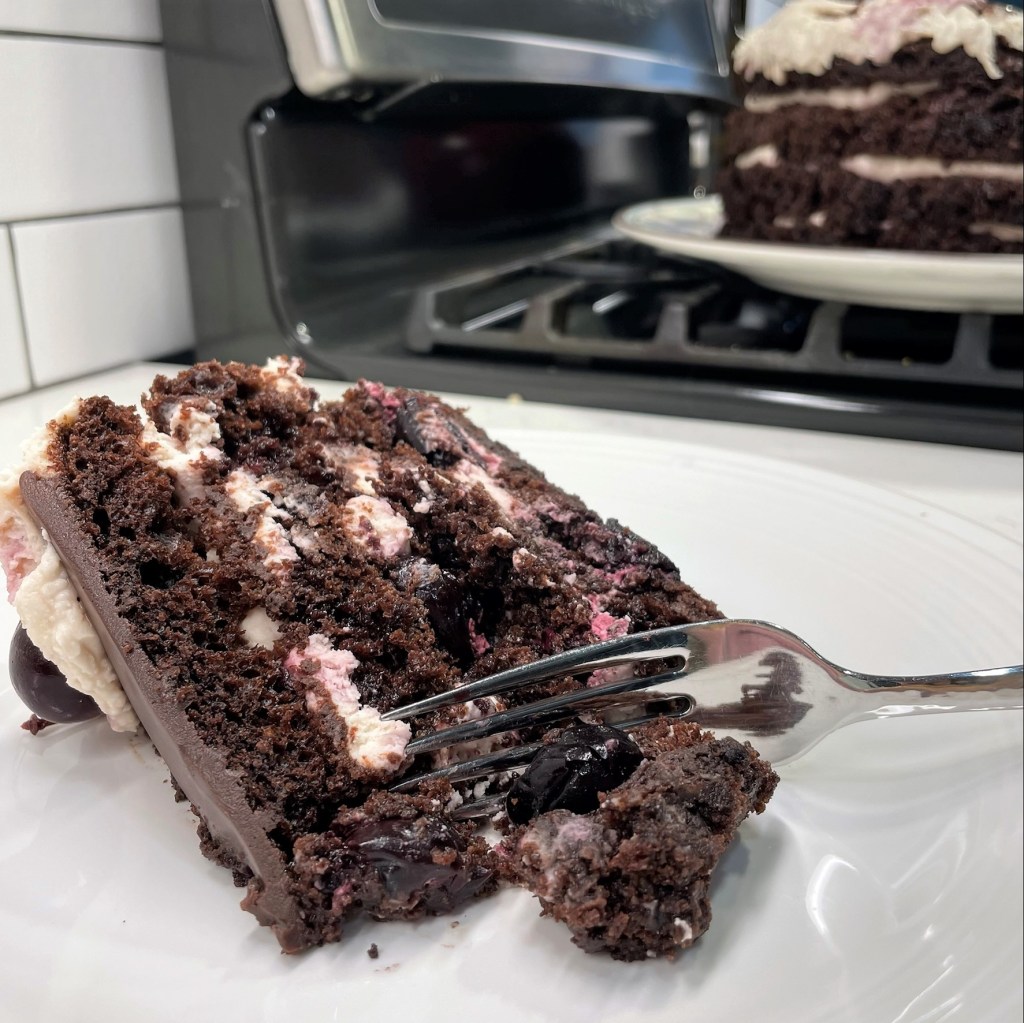
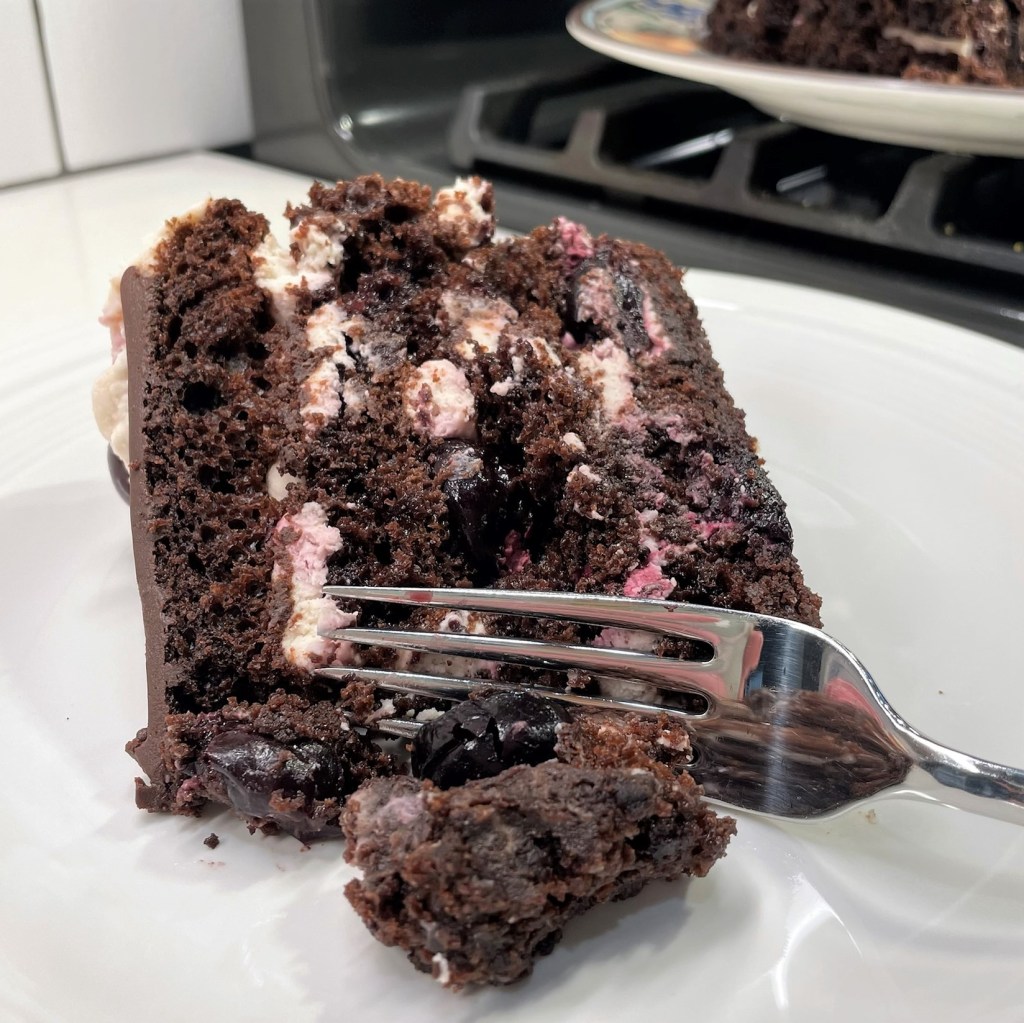
Every slice has a great balance of cherry and chocolate. Who cares if it isn’t a true Black Forest cake? 🙂
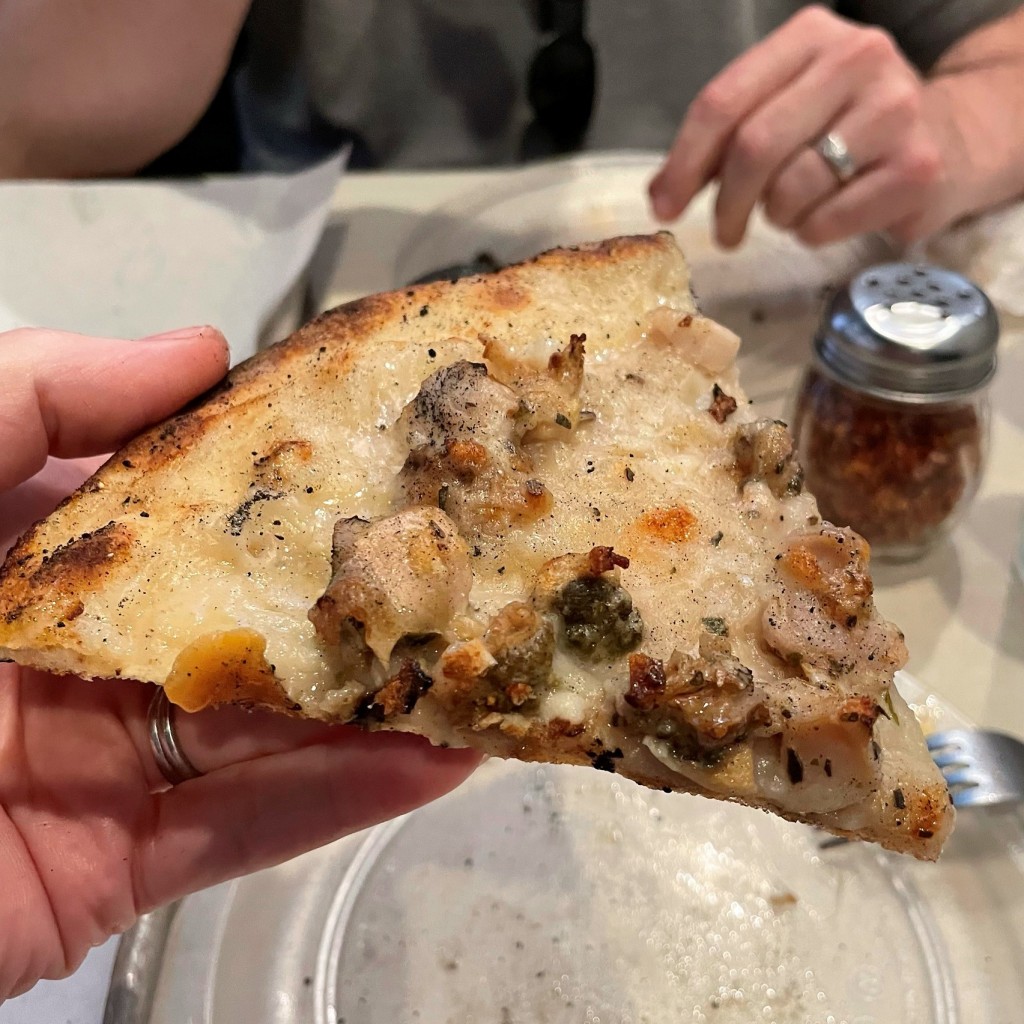
We splurged on this decadent, multi-layer dessert to finish our New Year’s Eve meal of White Clam Pizzaand our newest addition, the Oysters Rockefeller Pizza, and the cake was delicious for the occasion (and, remarkably, just as good later as leftovers straight from the fridge).
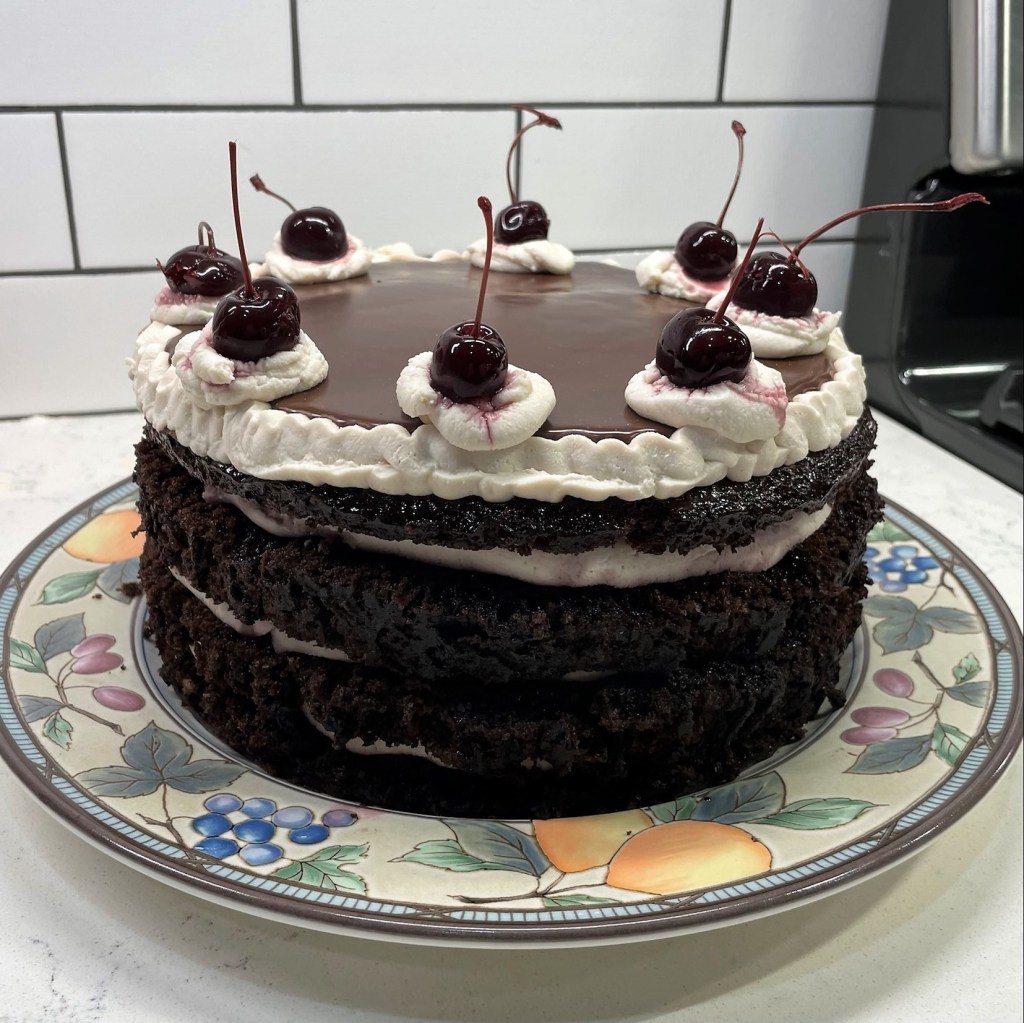
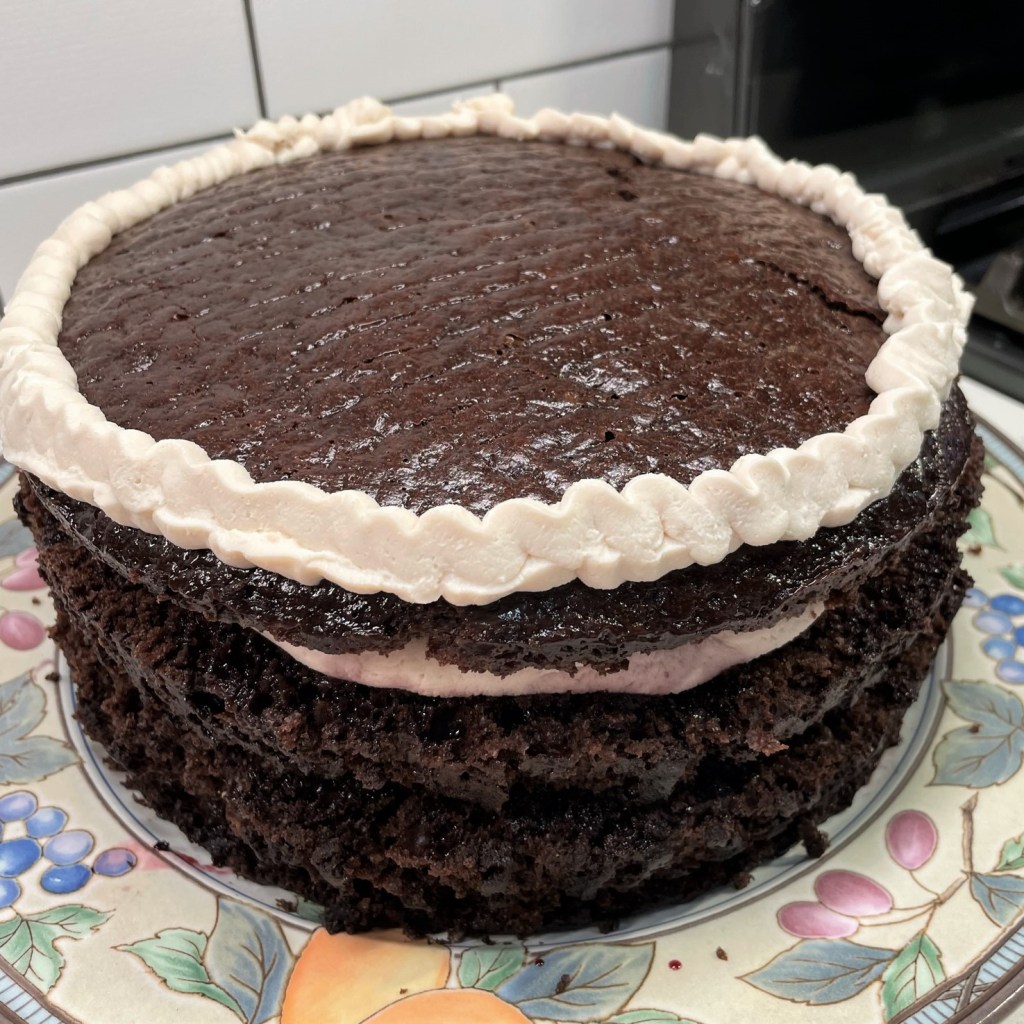
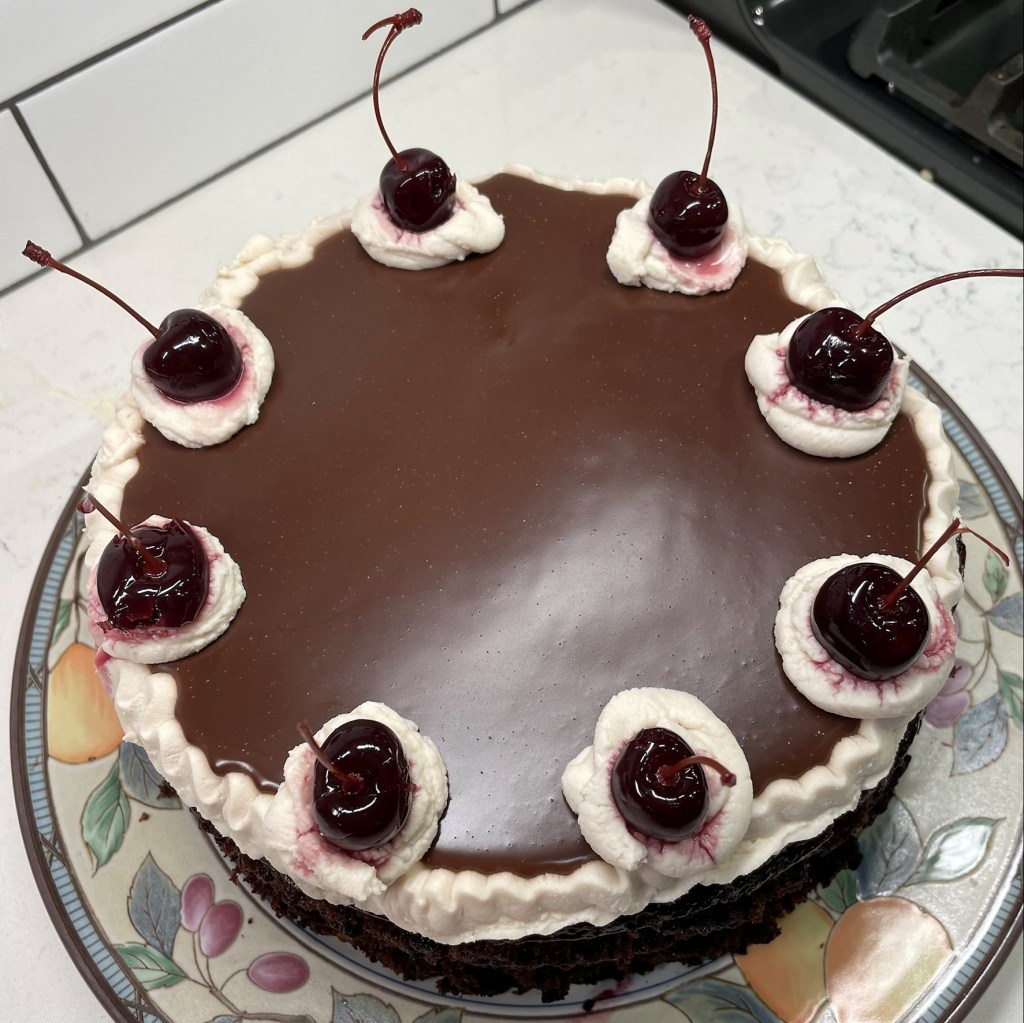
Frosting a cake requires patience that I do not have (especially at the holidays), so I went for a more rustic appearance, which also afforded us a glimpse of the yumminess that was to come, in the form of mascarpone cream and cherries hanging out the sides. There was no whipped cream wrapped around the outside of my cake and no shavings of chocolate, as one would find on a true Black Forest Cake. But it was delicious, with a capital D.
My layers were a little uneven, but the flavors were phenomenal.
So, is it authentic Black Forest Cake? No, but “Sourdough Dark Chocolate Cake with Bourbon-Soaked Cherry and Mascarpone Filling with Ganache Topping” is a mouthful. Plus, it didn’t fit in the title box. 😉
8 bourbon cherries or morello cherries, with stems (for decorating cake top)
Instructions
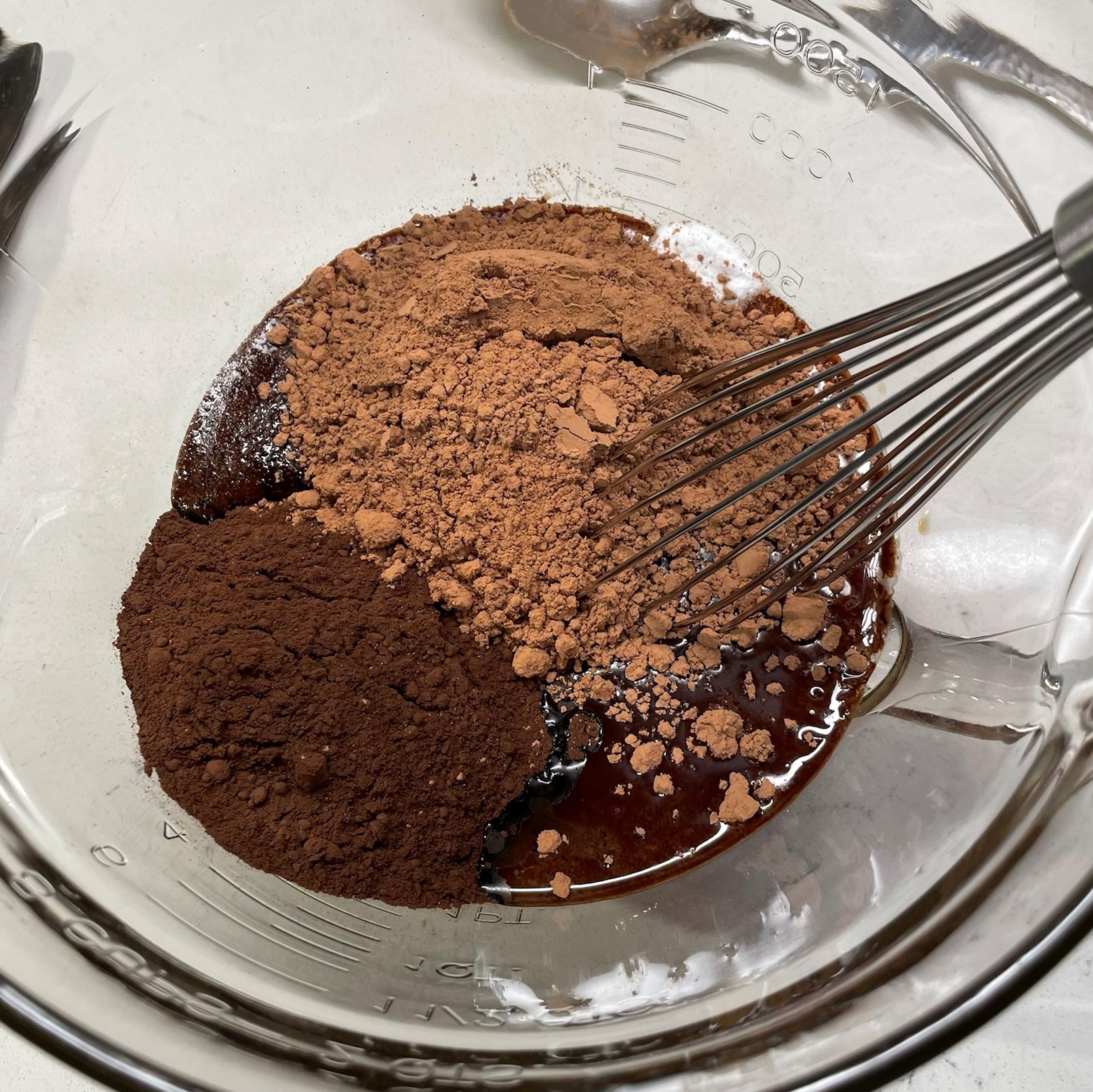
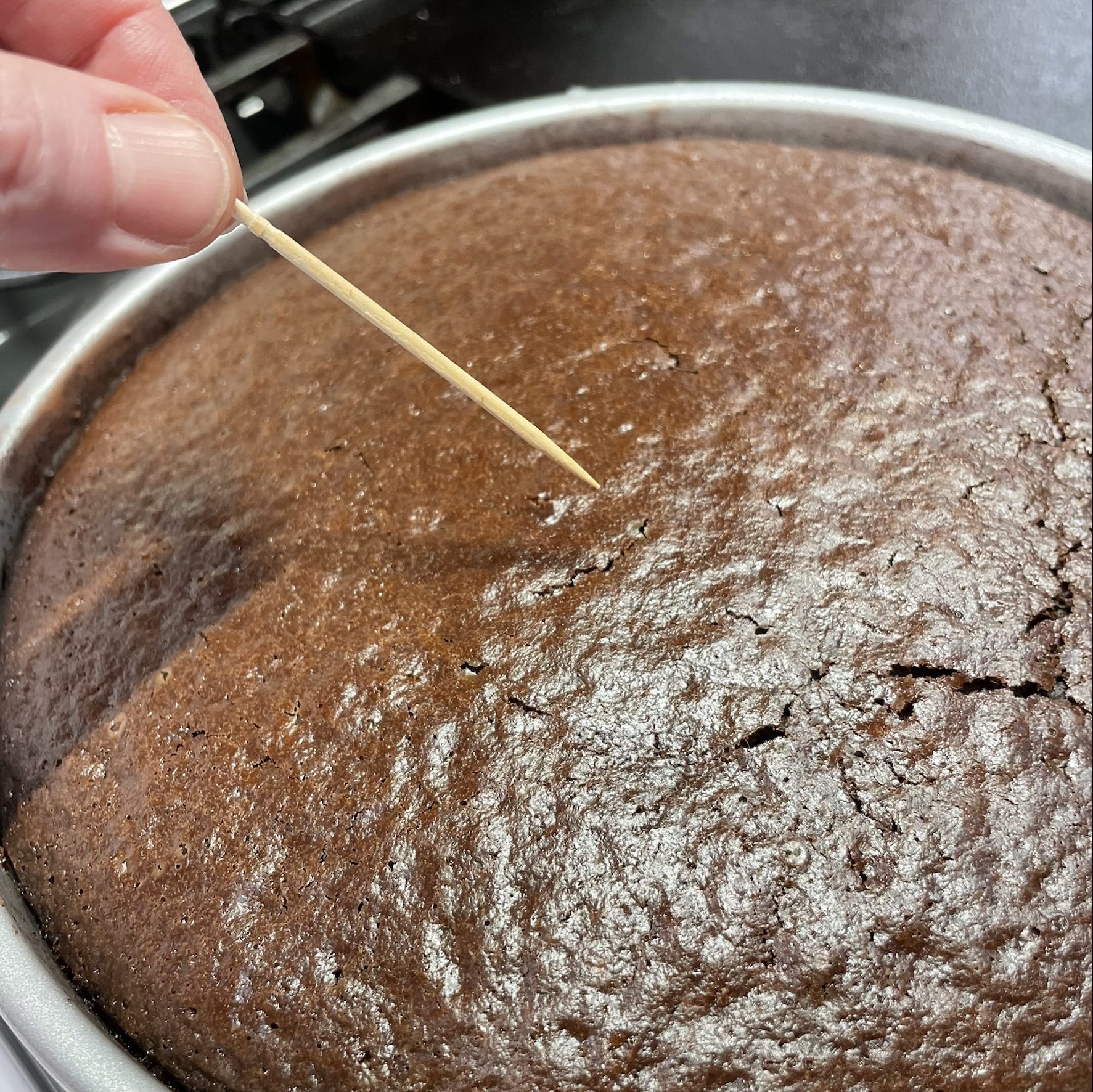
Bake the cake as instructed on King Arthur website. I followed the instructions with one ingredient adjustment; I replaced half of the natural cocoa with KA’s Double Dark Dutch Cocoa. I am crazy about the deep, dark color and chocolate flavor! Also, I baked it in two buttered and cocoa-dusted 9-inch layer pans rather than the 9 x 13 that was suggested, and the cake was done in 30 minutes. Cool the cake layers completely before removing them from the pans.
Not riding the sourdough train? No problem; use any other dark chocolate cake recipe you like, provided the layers are sturdy.
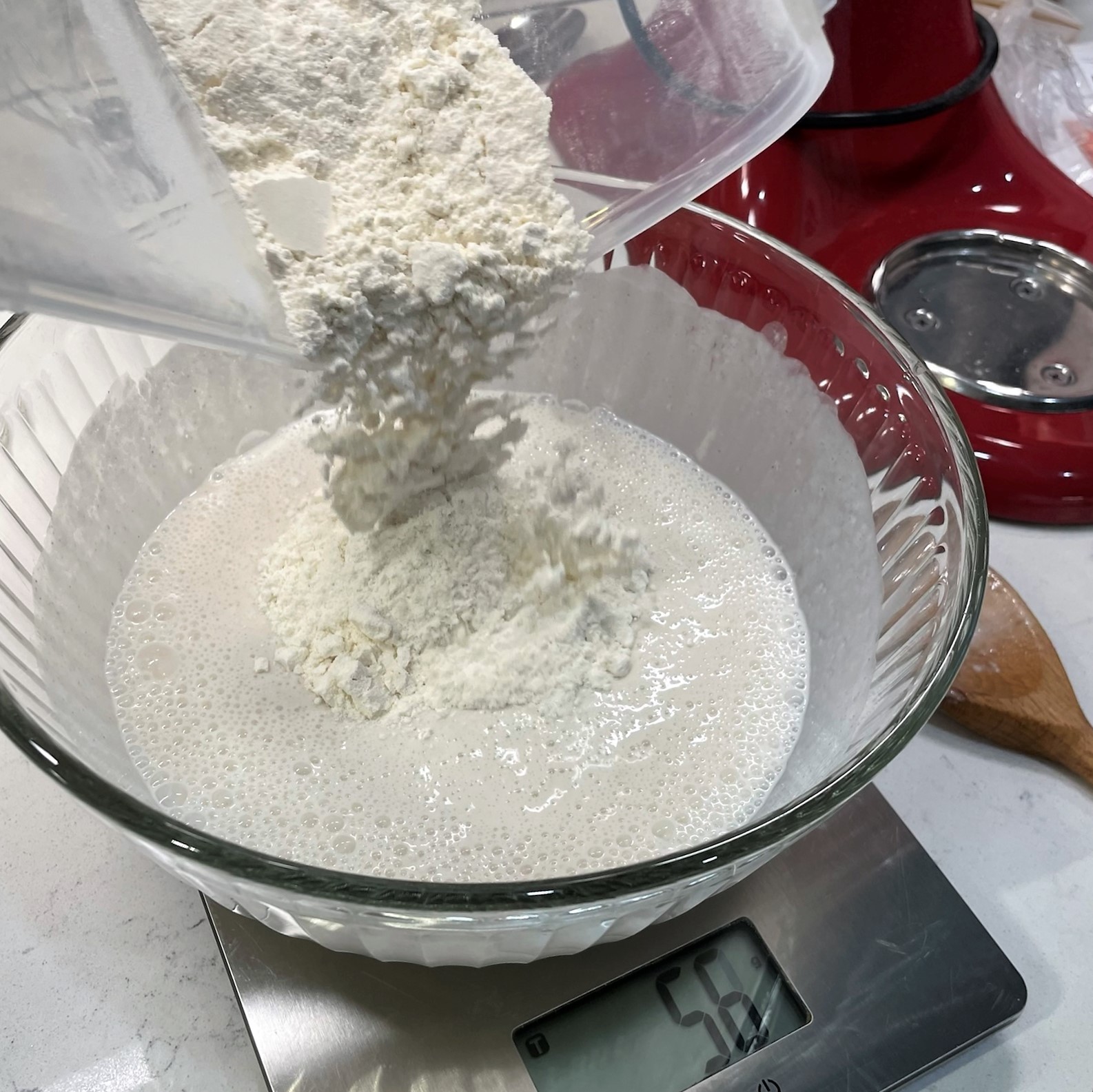
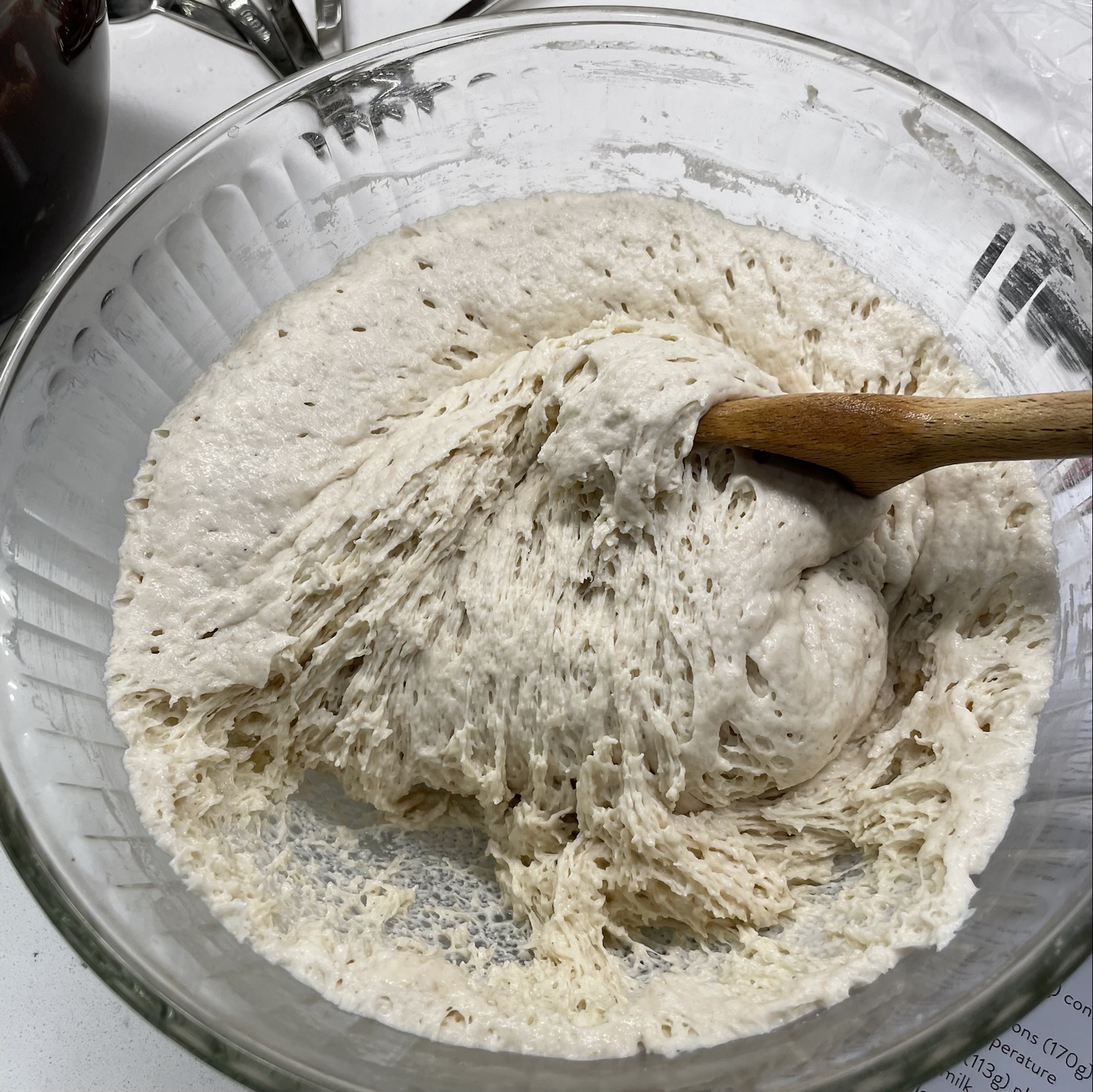
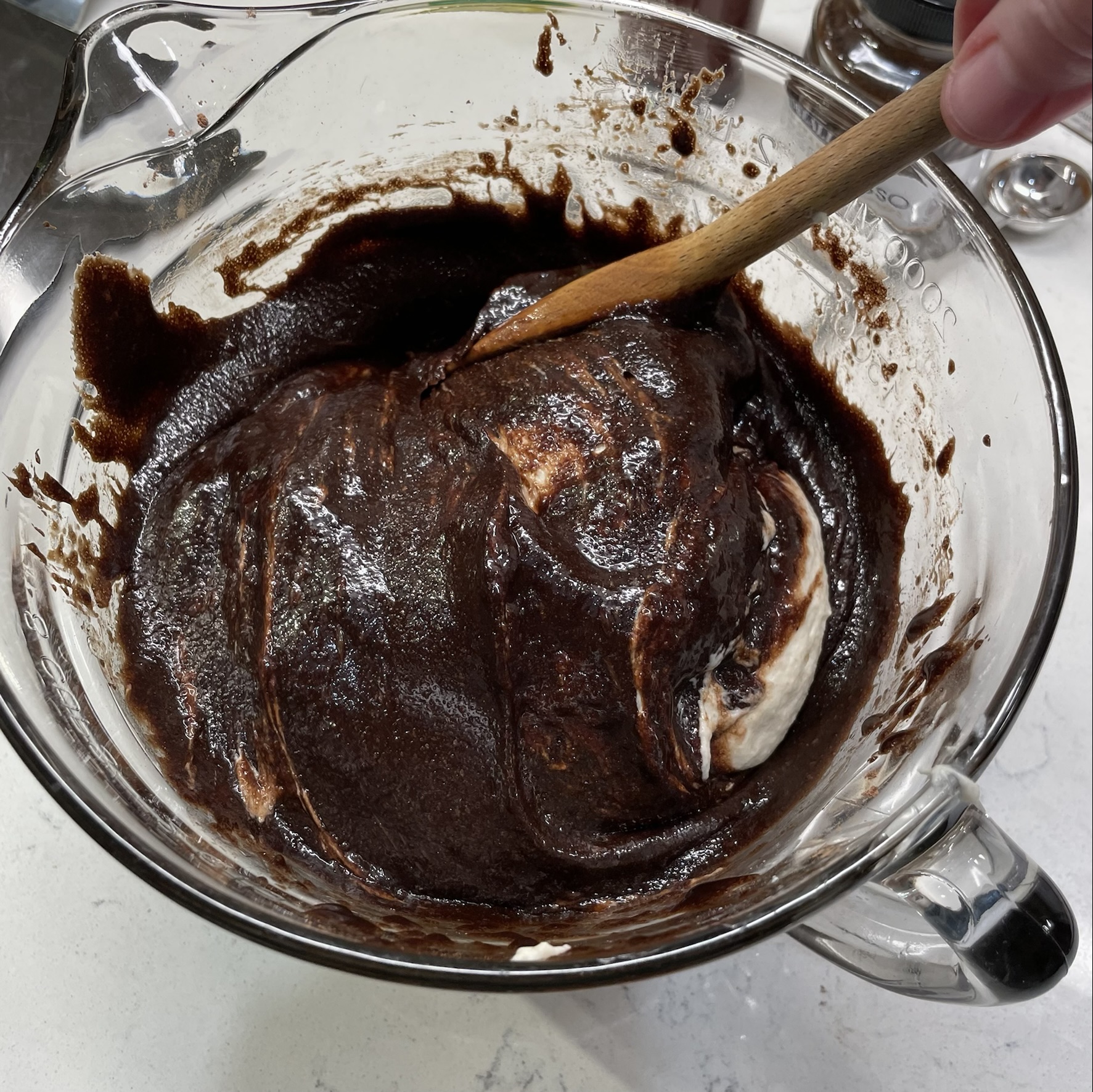
First, you build an overnight starter.By morning, the starter is very spongy.I used half natural cocoa, and half Double Dutch Dark cocoa. Love that color!It seems impossible, but it works!My Gram taught me to dust the cake pans with cocoa when making a chocolate cake, so that’s what I do.I baked the cake in layers rather than in a 9 x 13, as suggested on the King Arthur site. The pick comes out clean after 30 minutes.
For the cherry syrup, mascarpone filling and shiny ganache topping, I’ll provide a visual walkthrough, and you can scroll to the bottom of the post for a printable recipe if you want to give it a go in your kitchen. Happy Chocolate Cake Day! 🙂
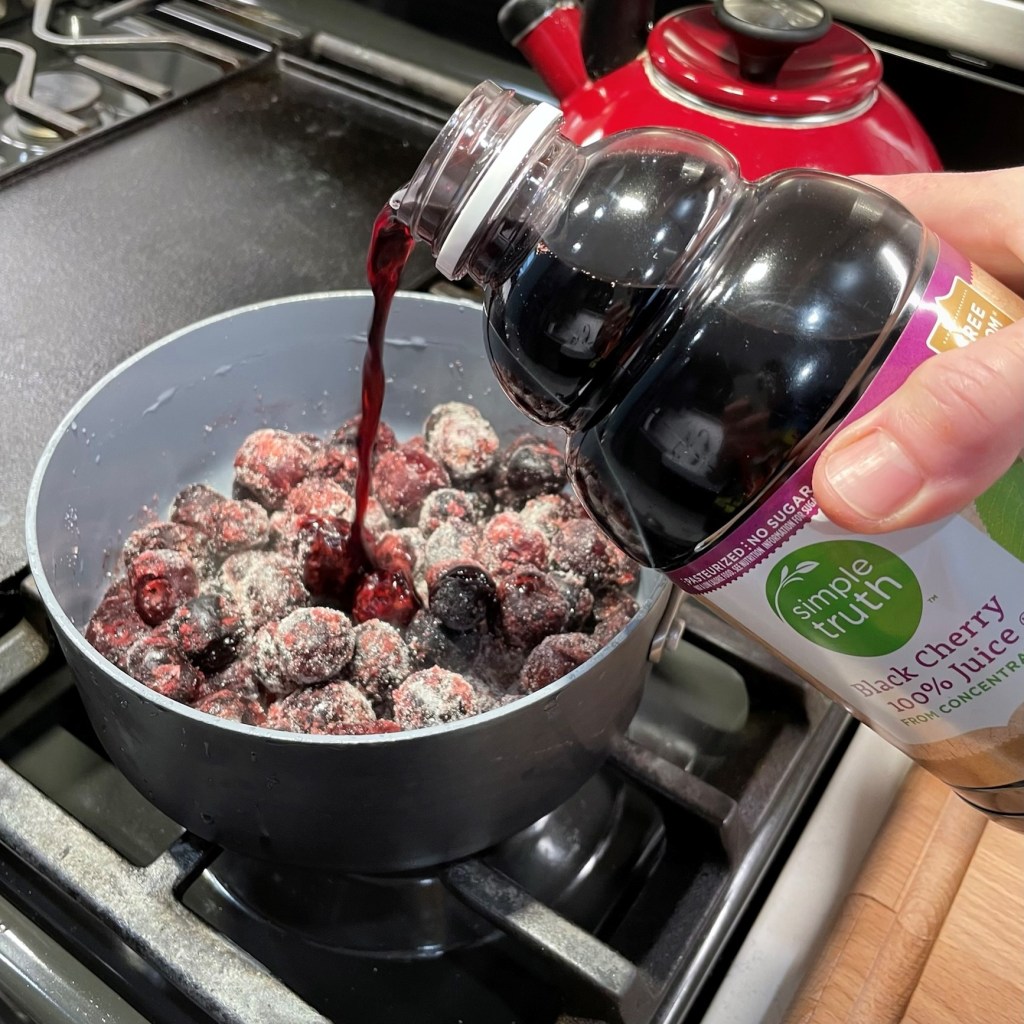
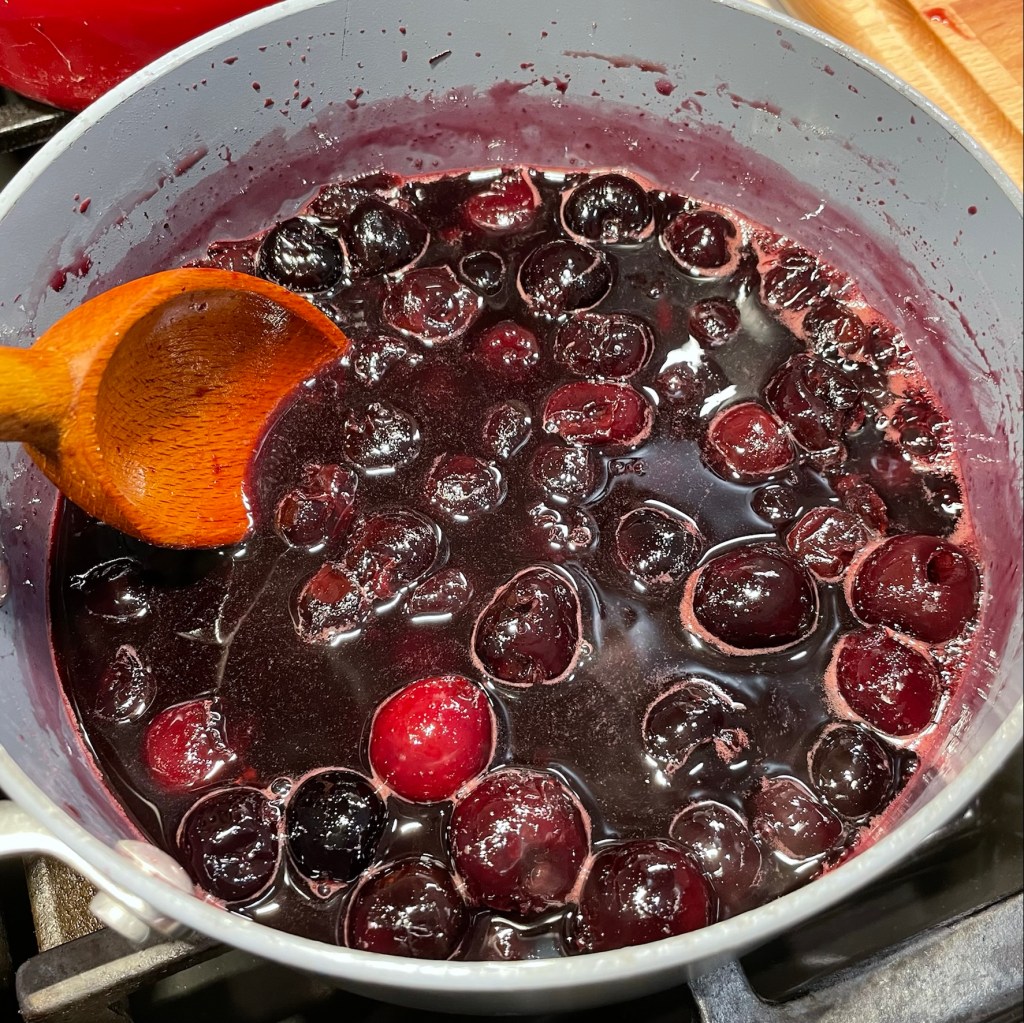
Combine the frozen cherries and sugar in a saucepan.
Add the unsweetened black cherry juice and bring to a slight boil.
When the syrup has simmered a few minutes, drain the cherries into a bowl and return the syrup to the pan.
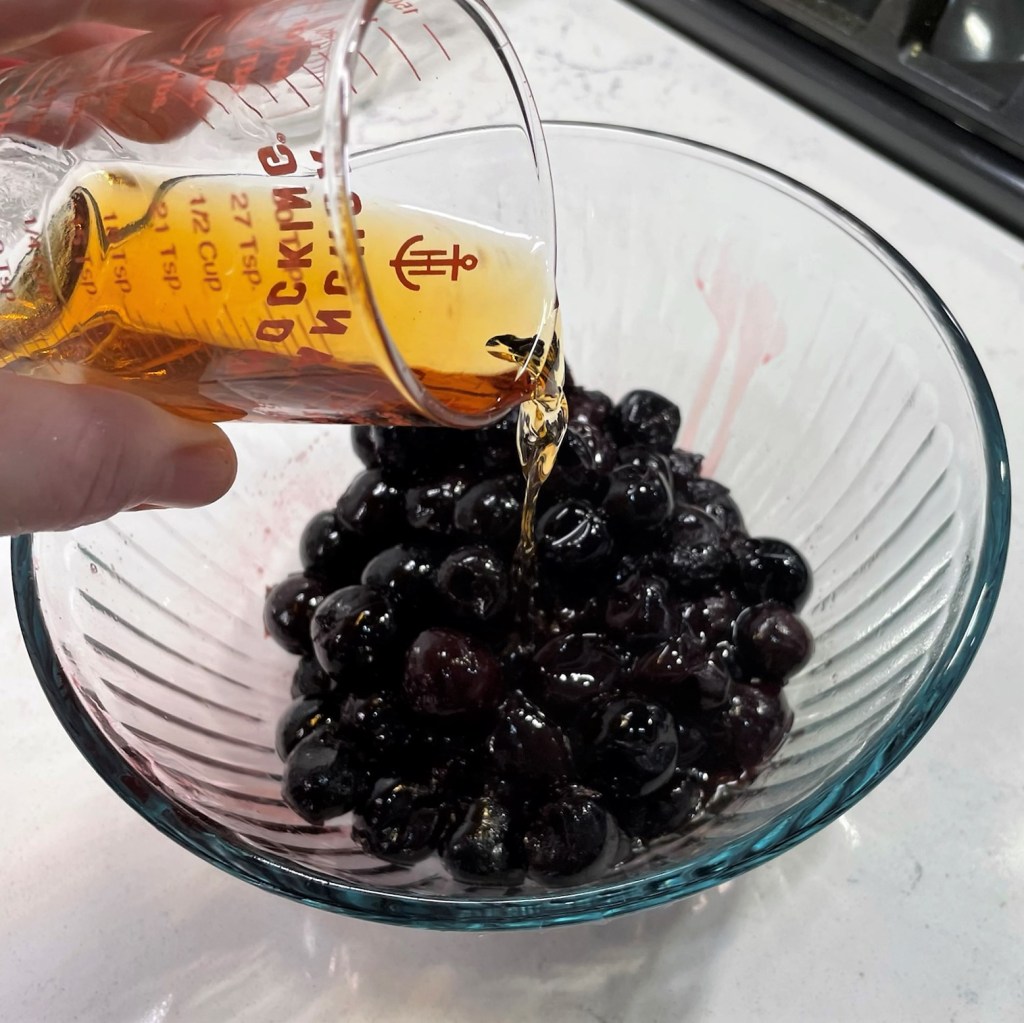
Pour bourbon over the strained cherries and steep until they are cooled.
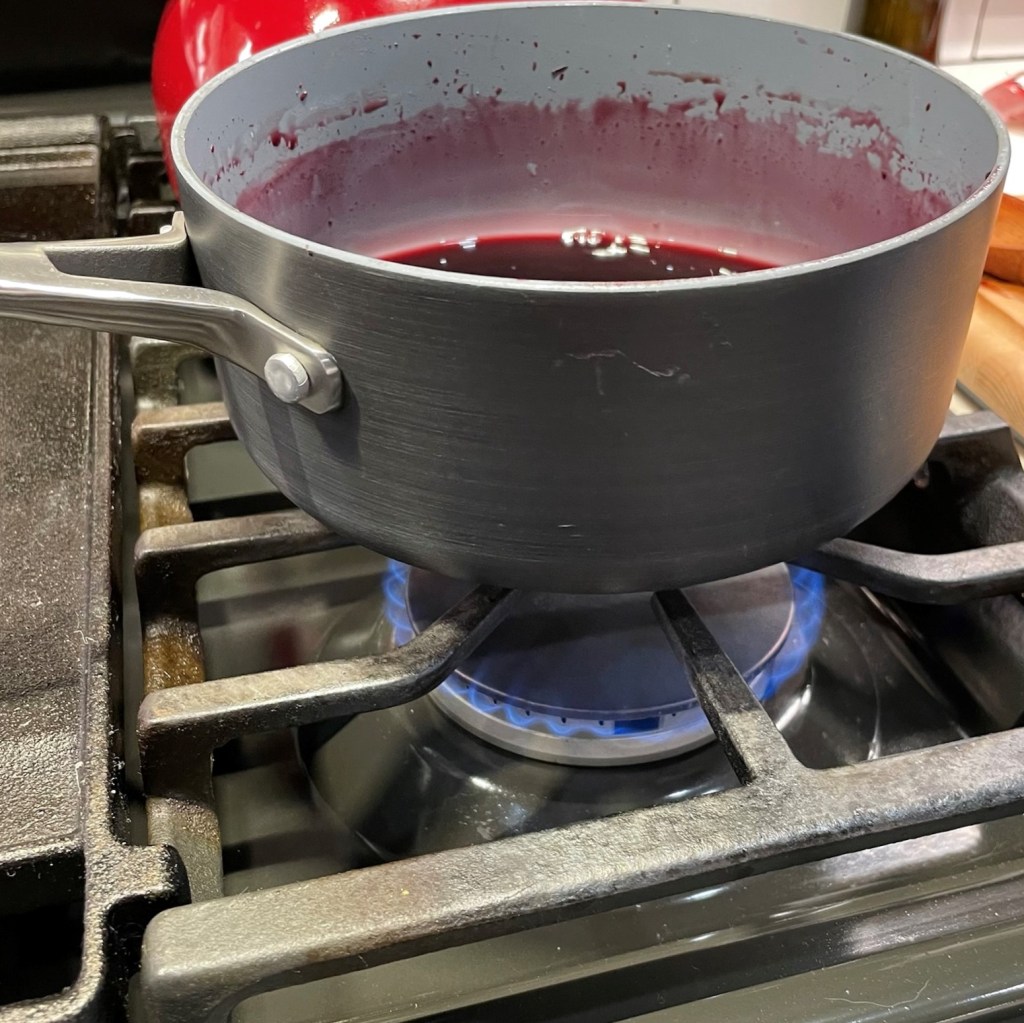
Simmer the syrup over medium heat until reduced to 2/3 cup.
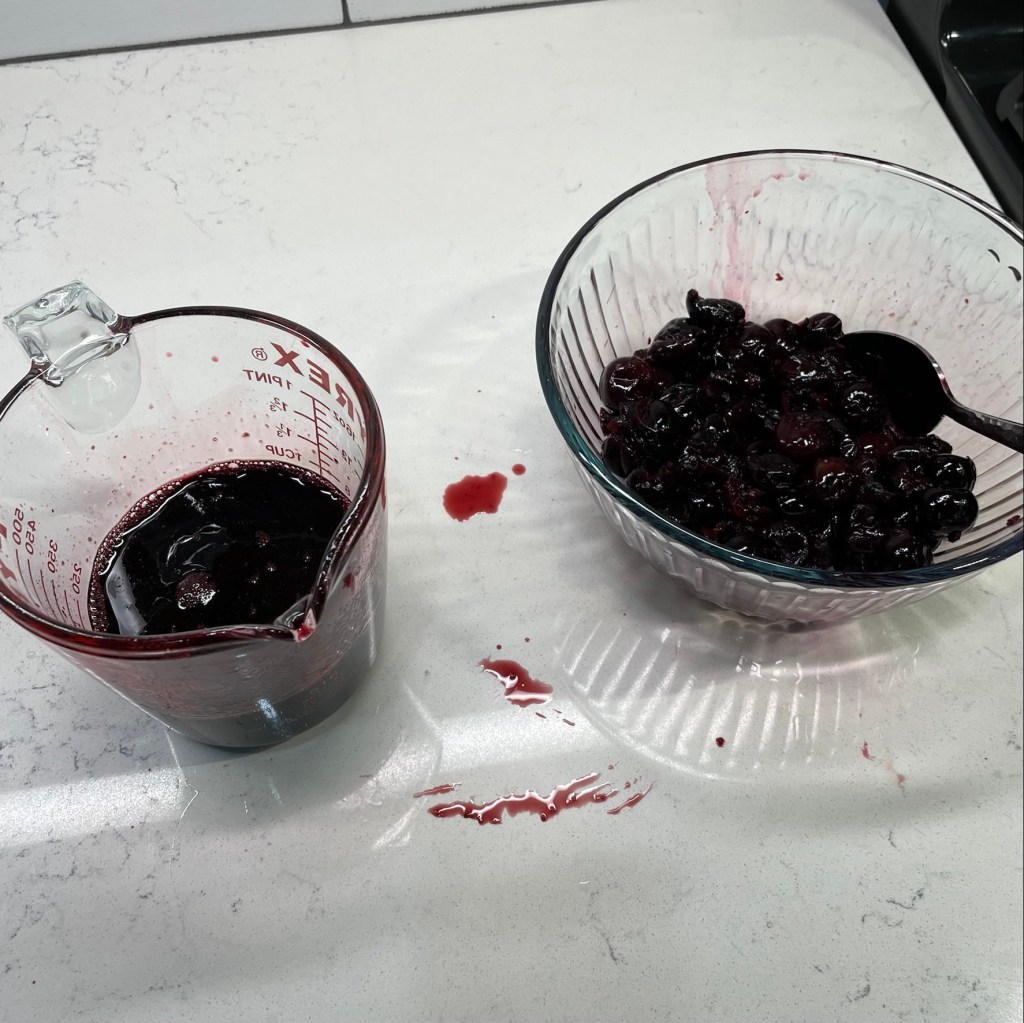
Drain the cherries again and add the bourbon syrup to the other syrup.
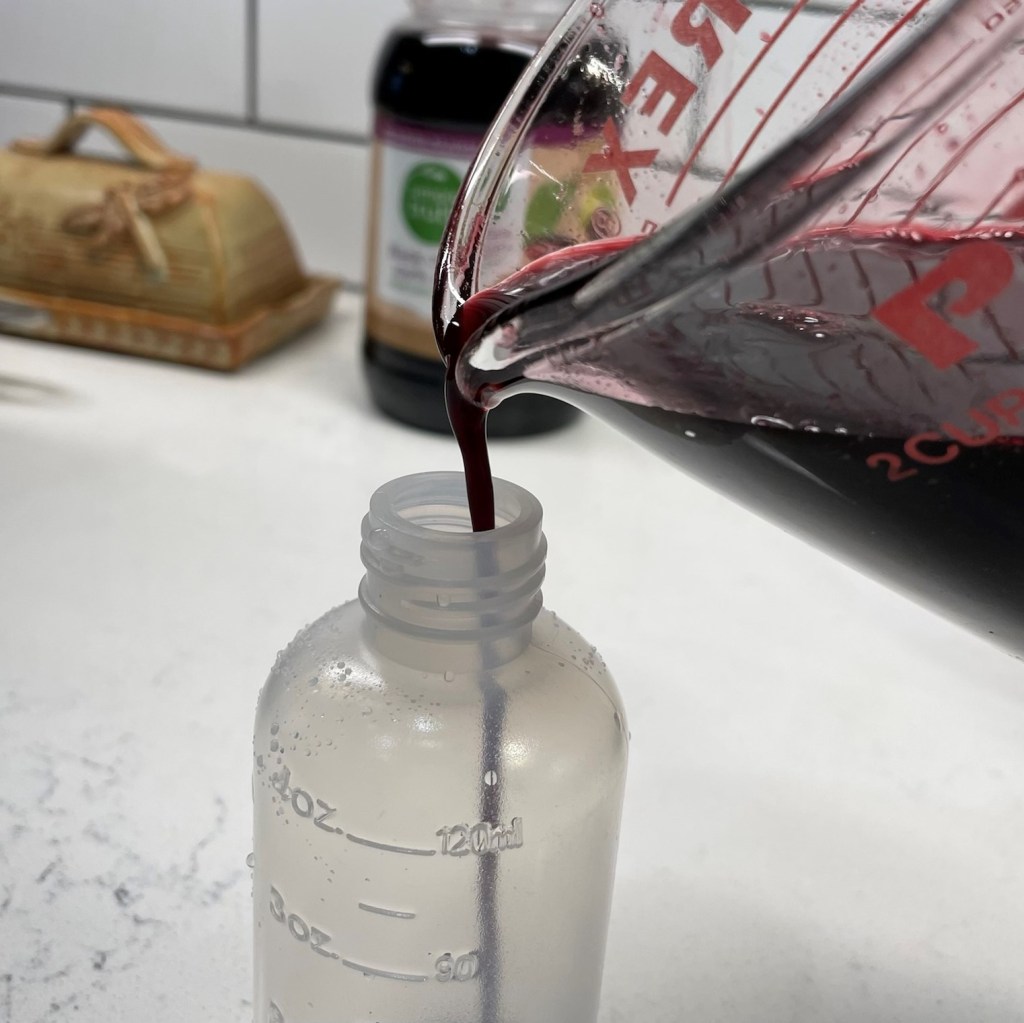
Transfer the syrup into a squeeze bottle if you have one; I found it an easy way to distribute the syrup over the cake layers.
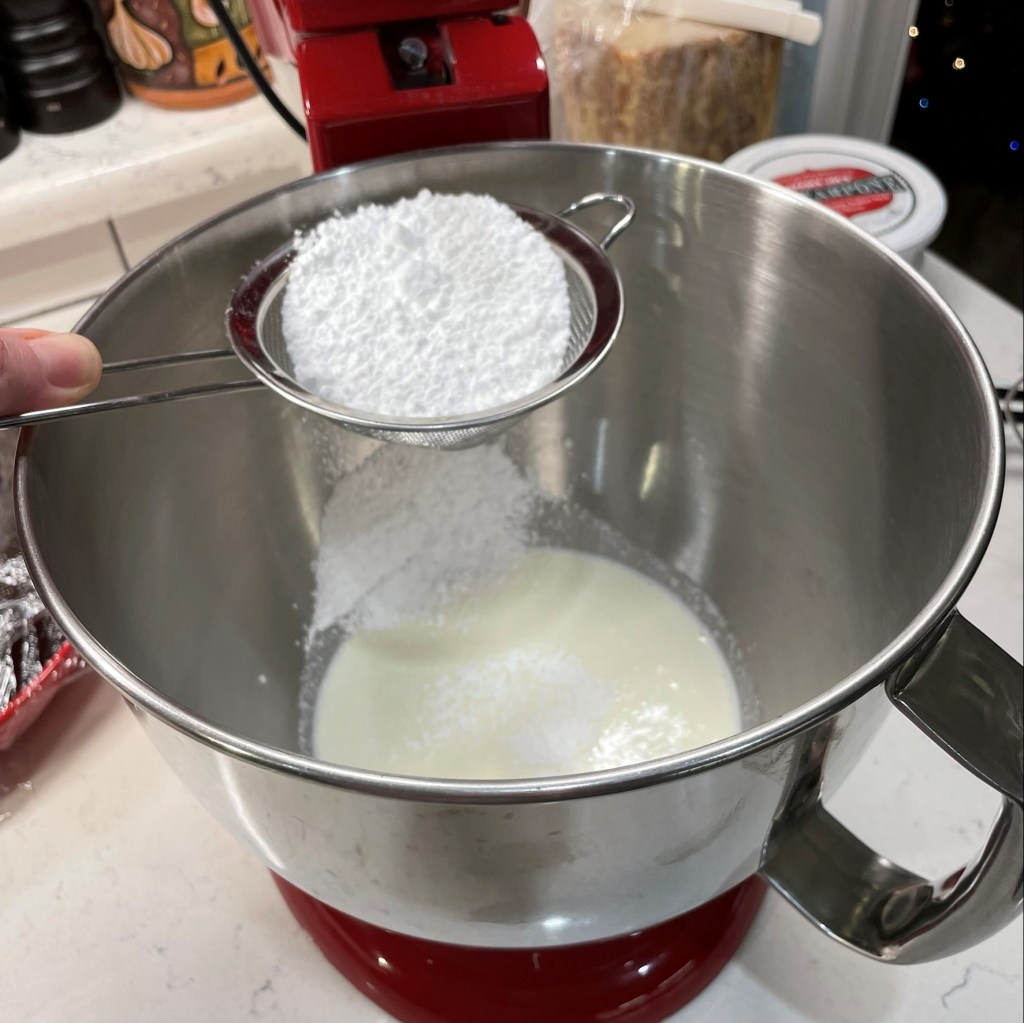
Sift powdered sugar into the heavy cream.
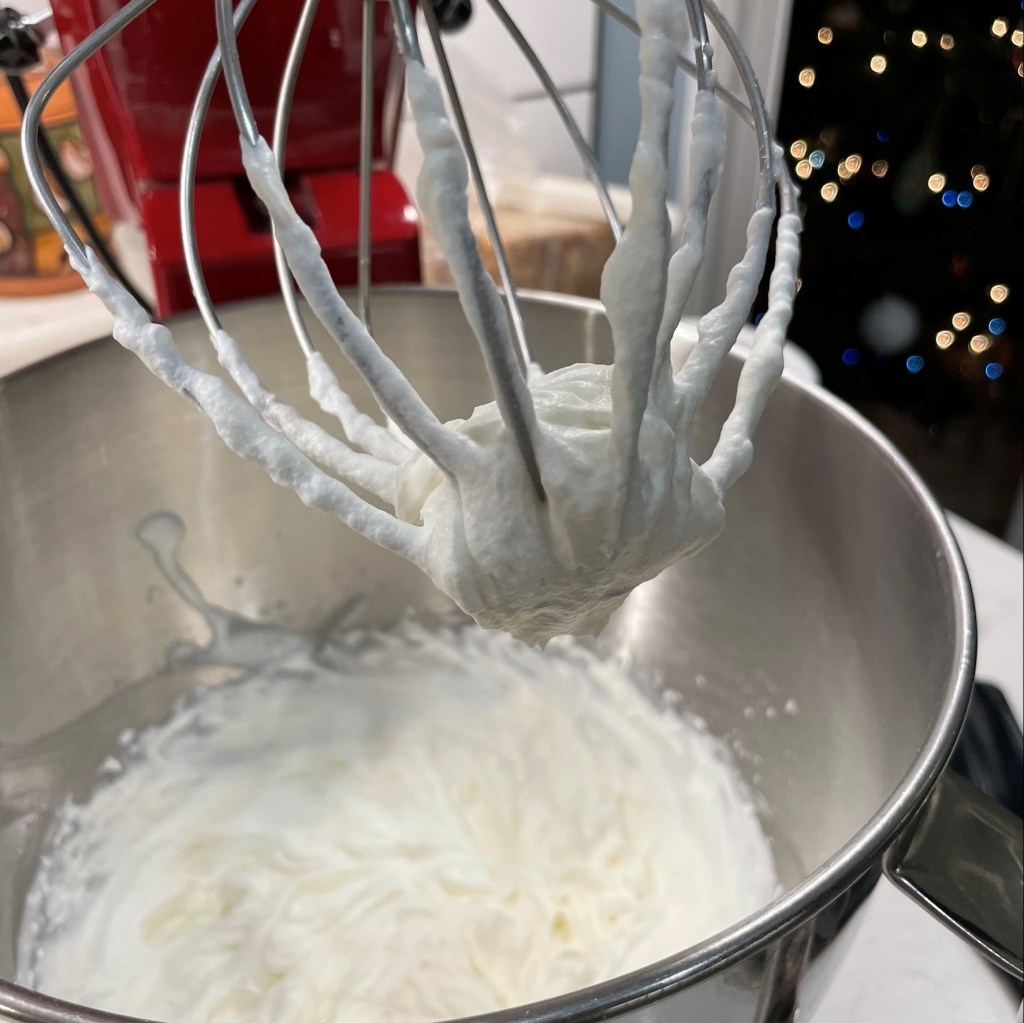
Whip the sweetened cream until soft and lightly fluffy.
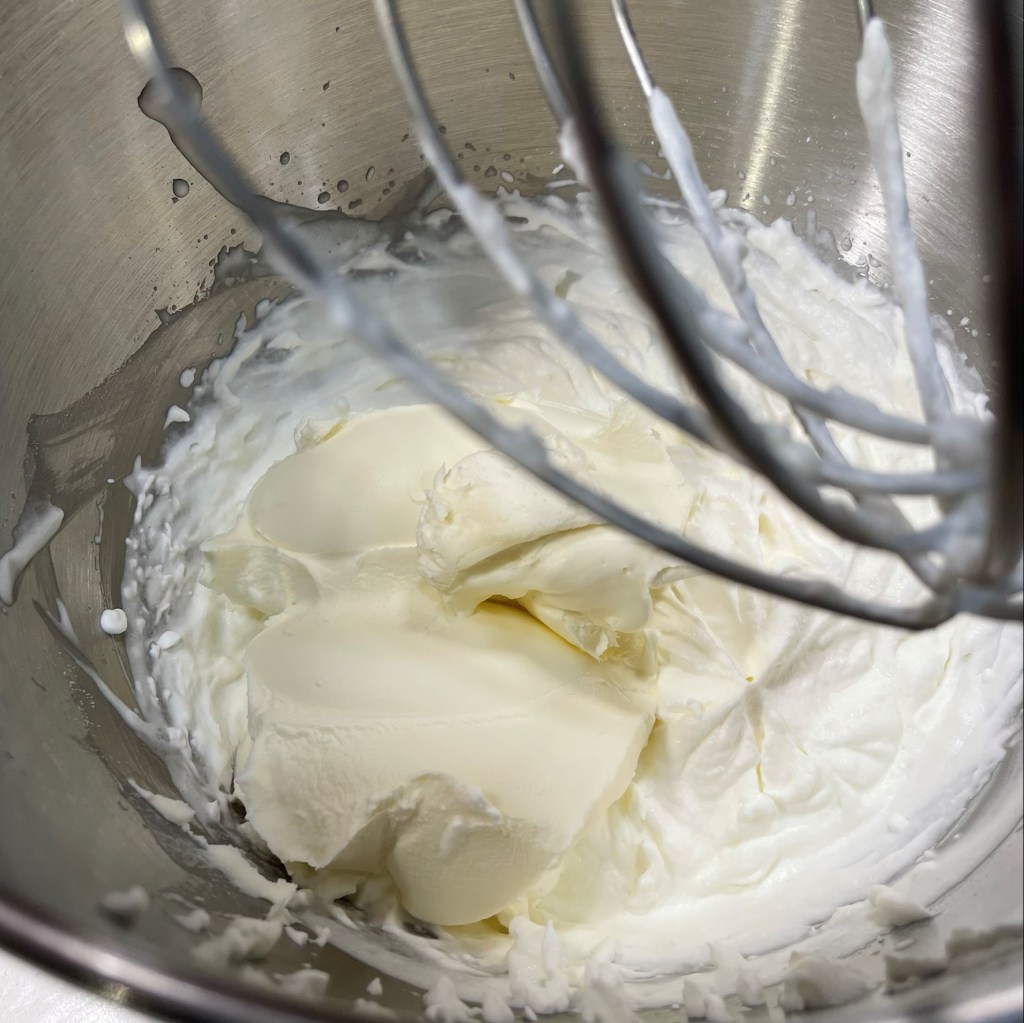
Add the mascarpone and whip on low speed until until combined.
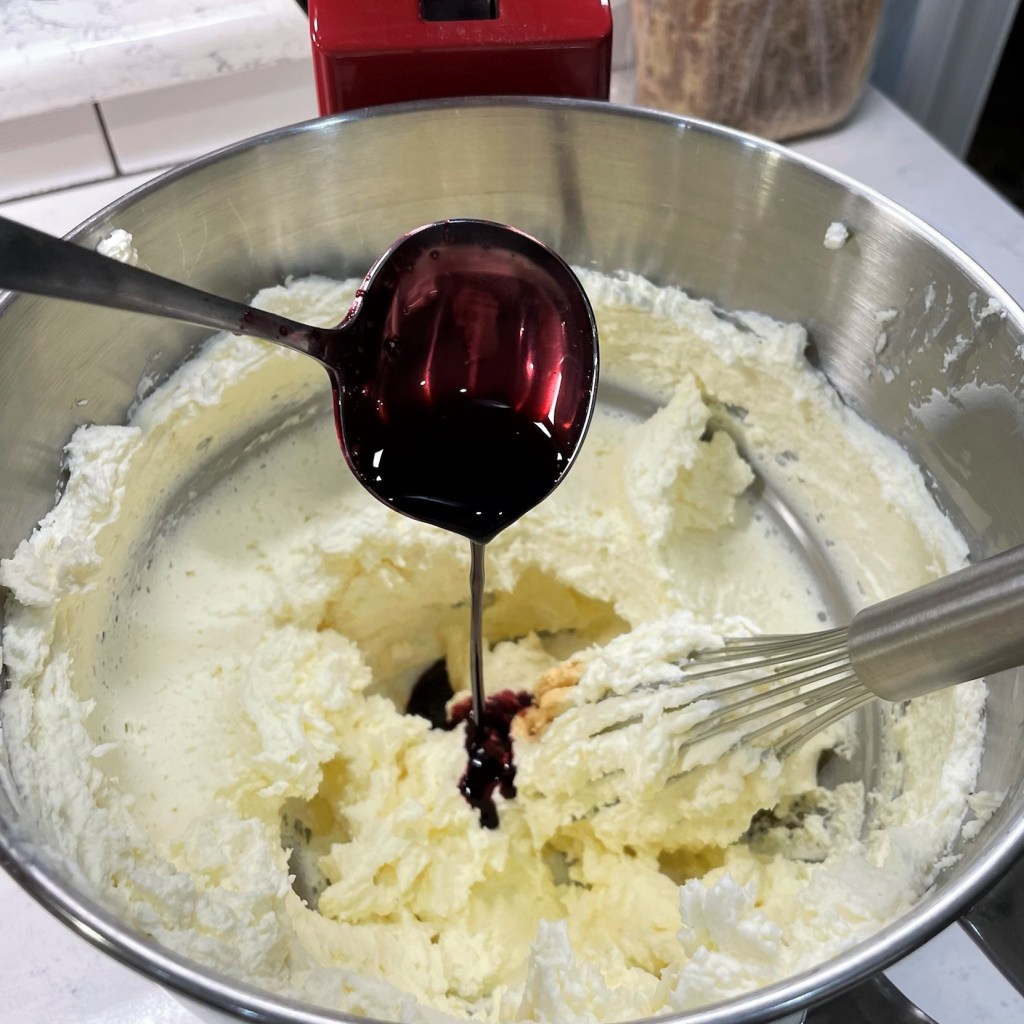
Drizzle 2 tablespoons of the syrup into the mascarpone and fold until blended.
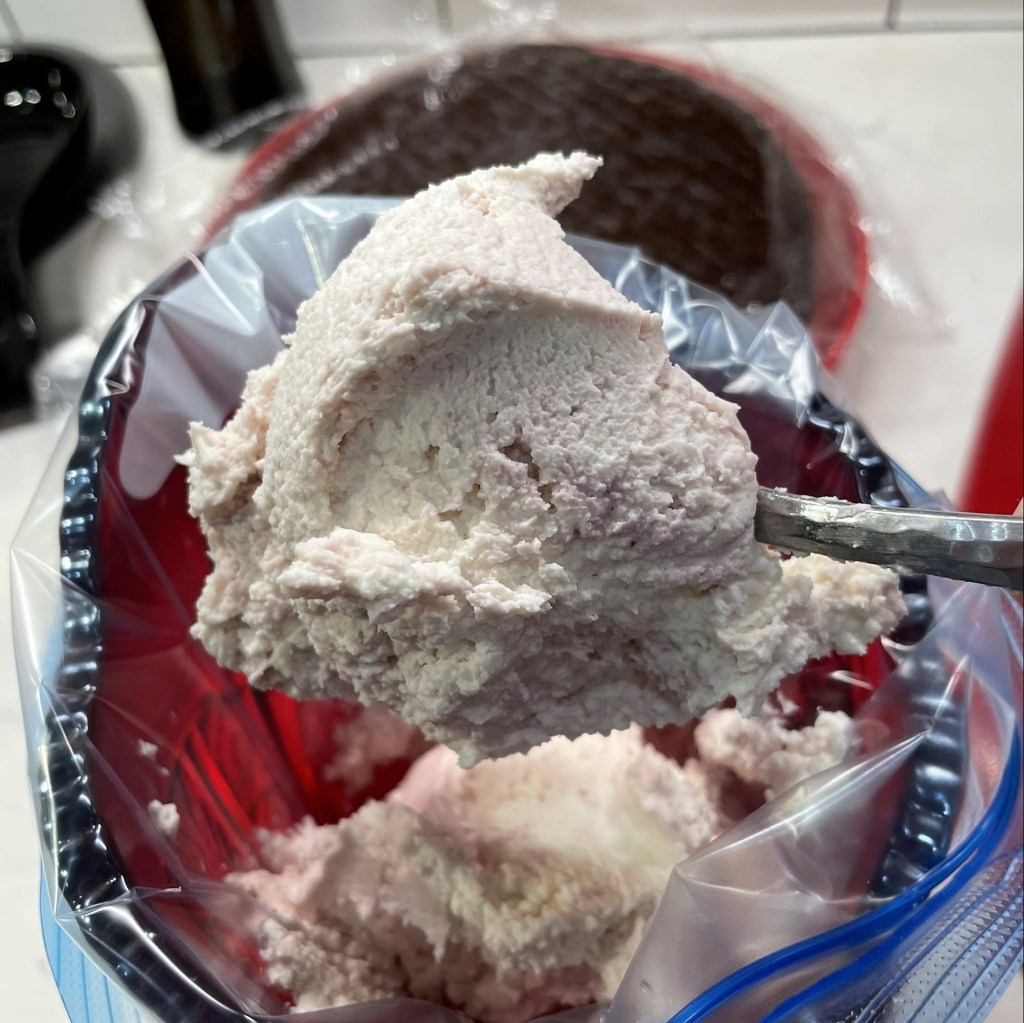
Transfer the mascarpone cream to a large zip-top bag and put it in the refrigerator.
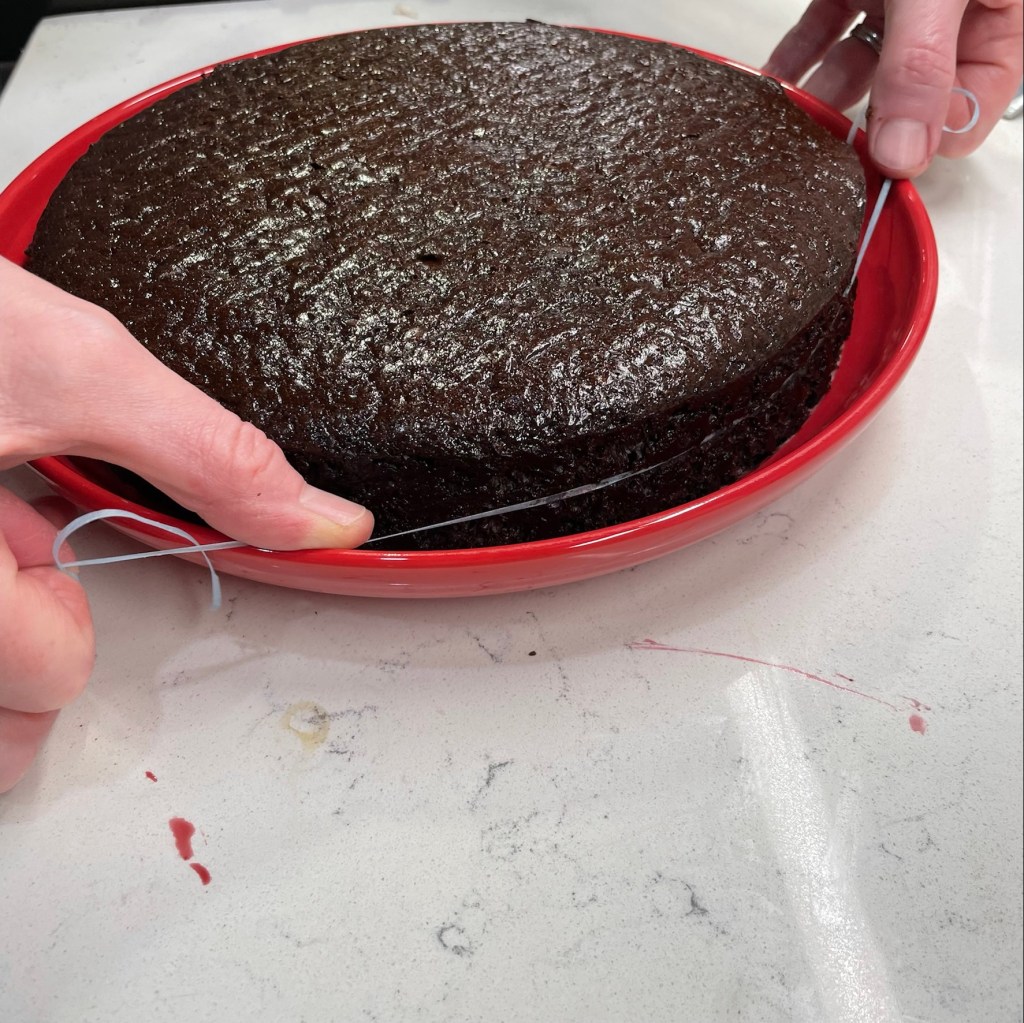
To slice the cake layers, I used a long piece of unflavored dental floss.
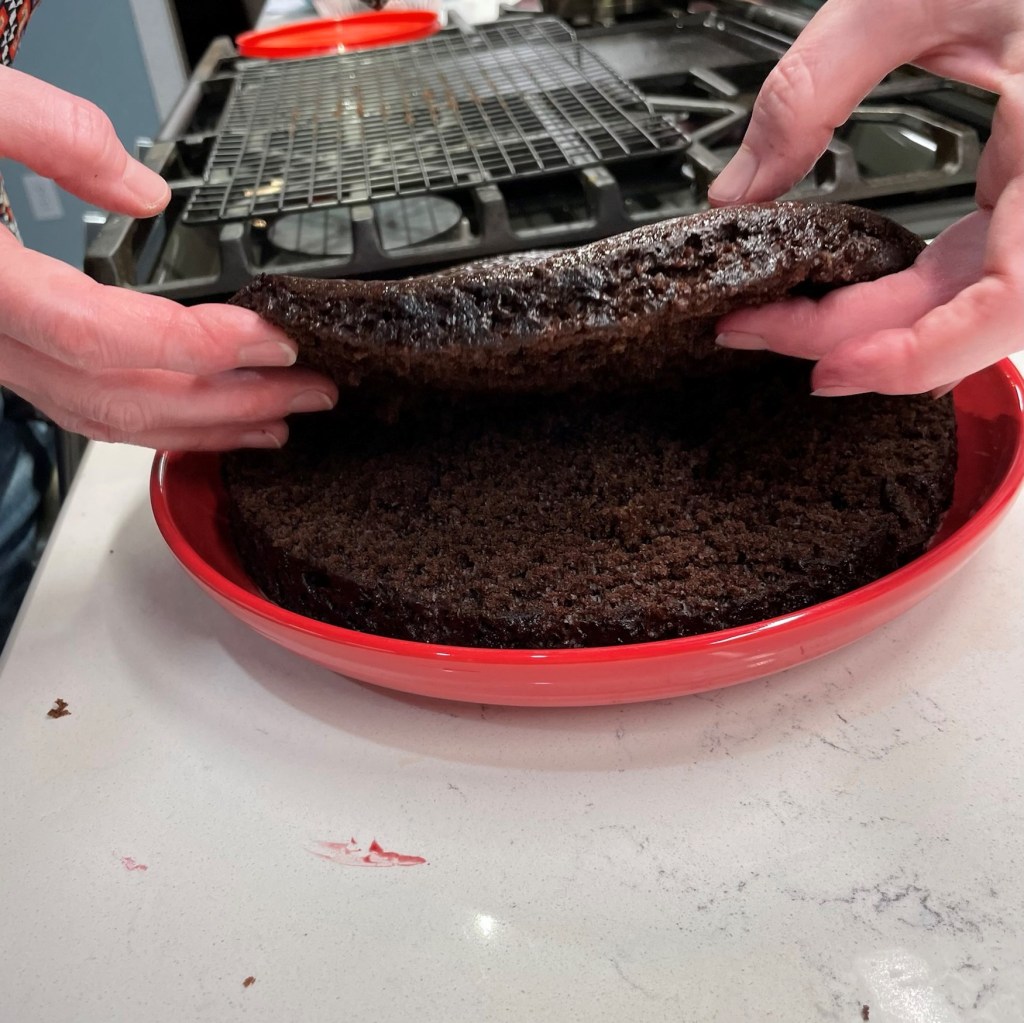
The layers may not be totally perfect, but that’s OK.
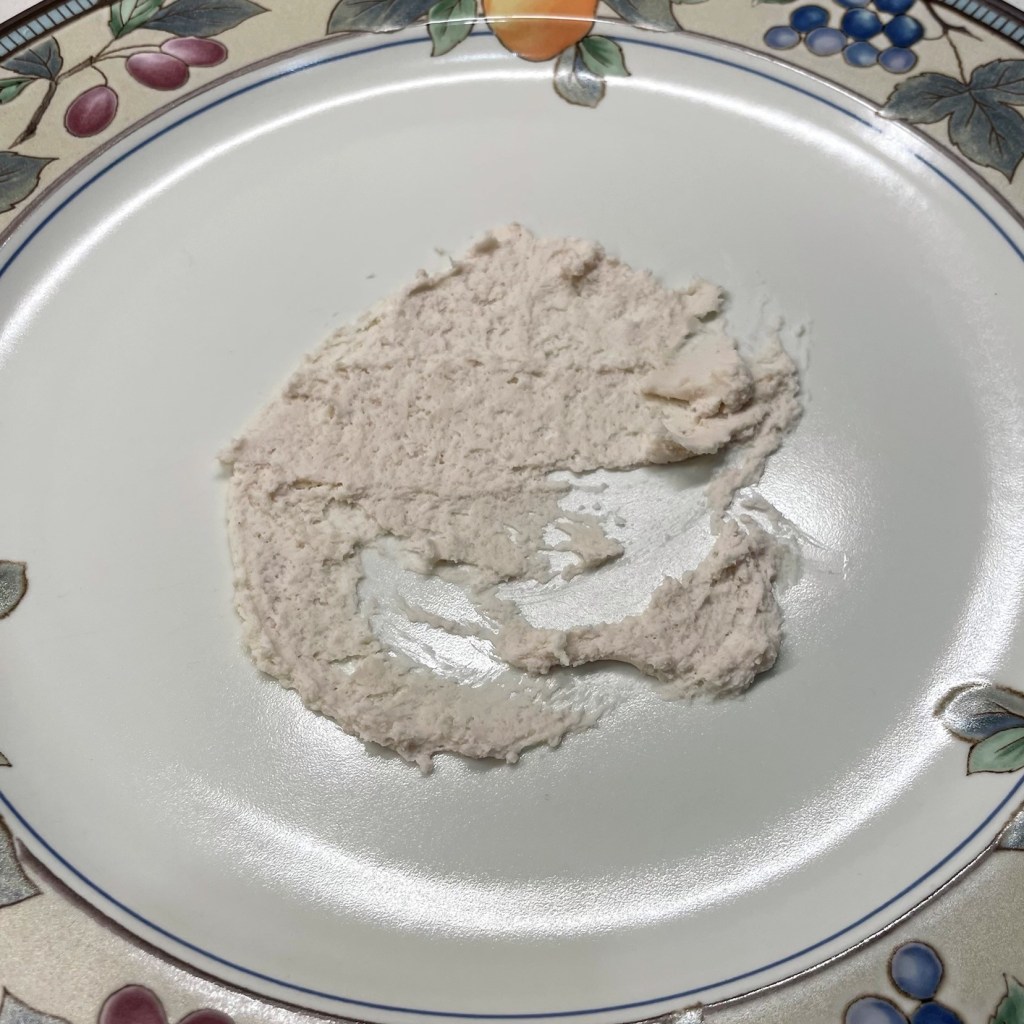
When you’re ready to assemble the cake, smear a small amount of mascarpone cream onto the cake platter to stabilize the first layer.
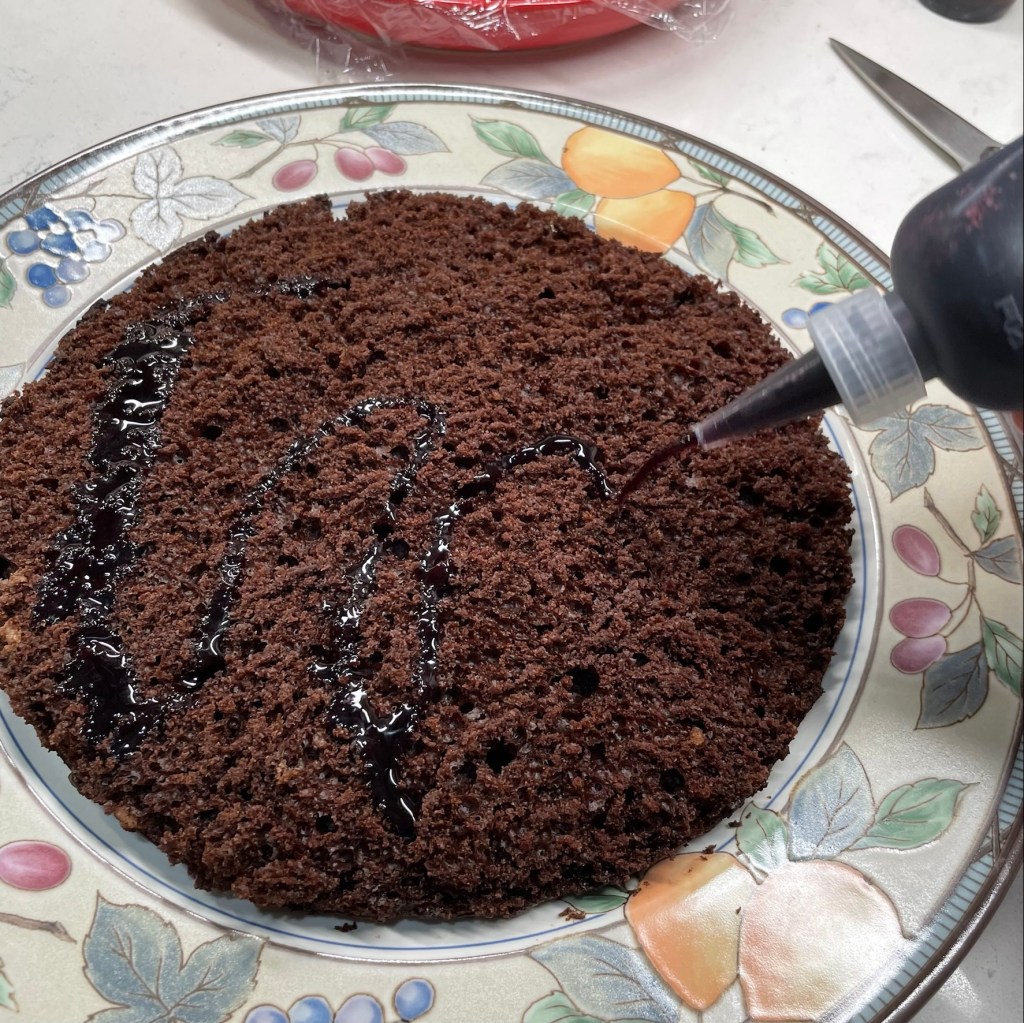
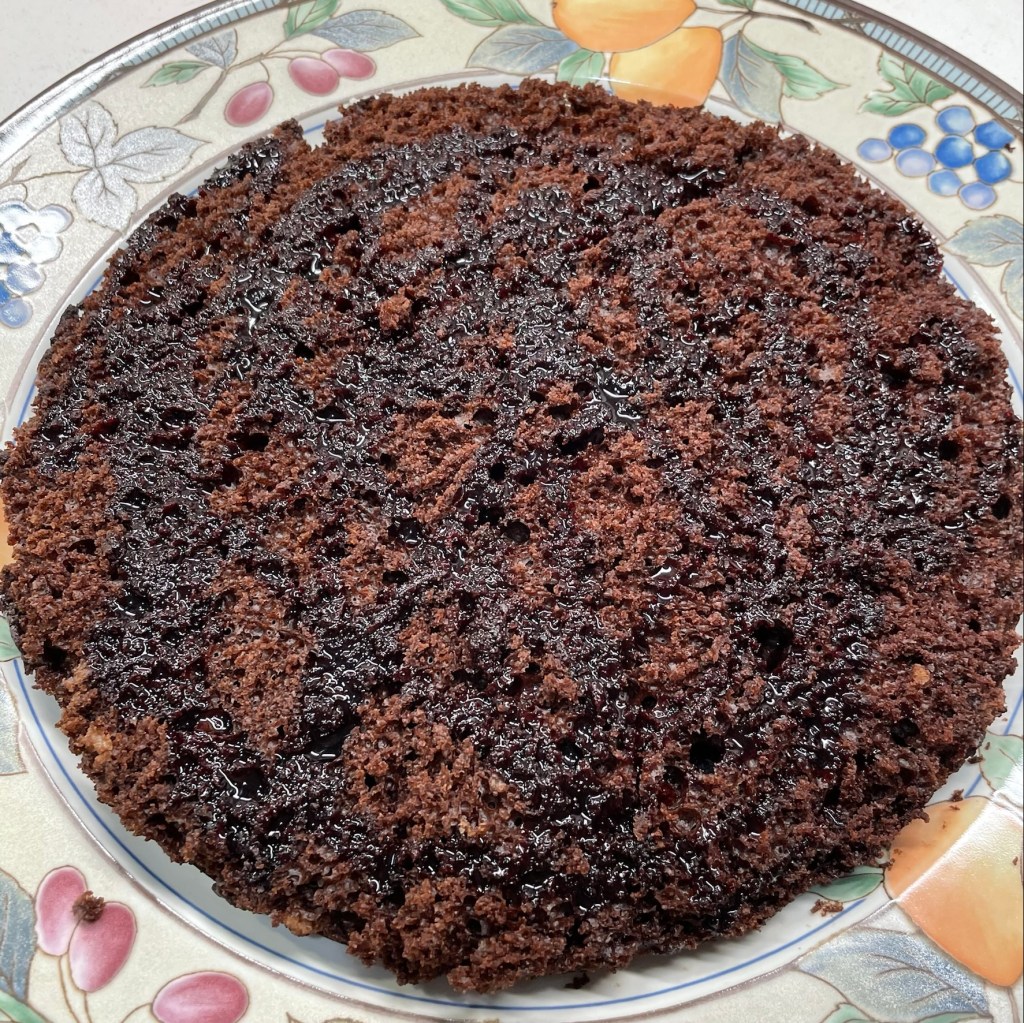
Drizzle about 1/3 of the cherry syrup over the cut side of the cake layer.
The syrup will soak into the cake, drenching every bite with the bourbon-cherry flavors.
Snip the corner of the mascarpone cream bag and pipe about 1/4 of it onto the soaked cake layer. Spread gently to get more coverage, or just fill in with a few dots of additional cream.
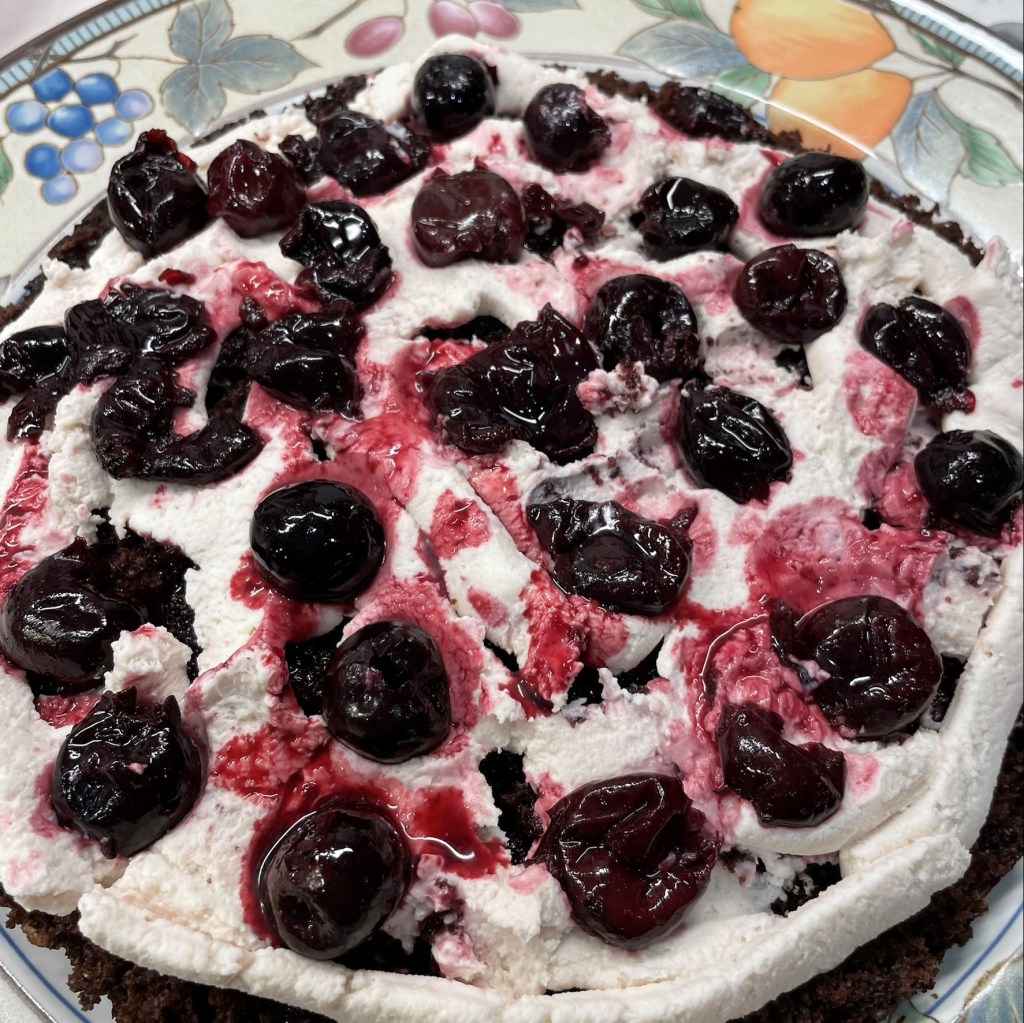
Arrange 1/3 of the drunken cherries onto the mascarpone cream. Repeat with the next two layers, saving a rounded piece for the top.
Pipe some of the remaining mascarpone cream around the top edge of the final layer. Refrigerate the cake while you make the ganache.
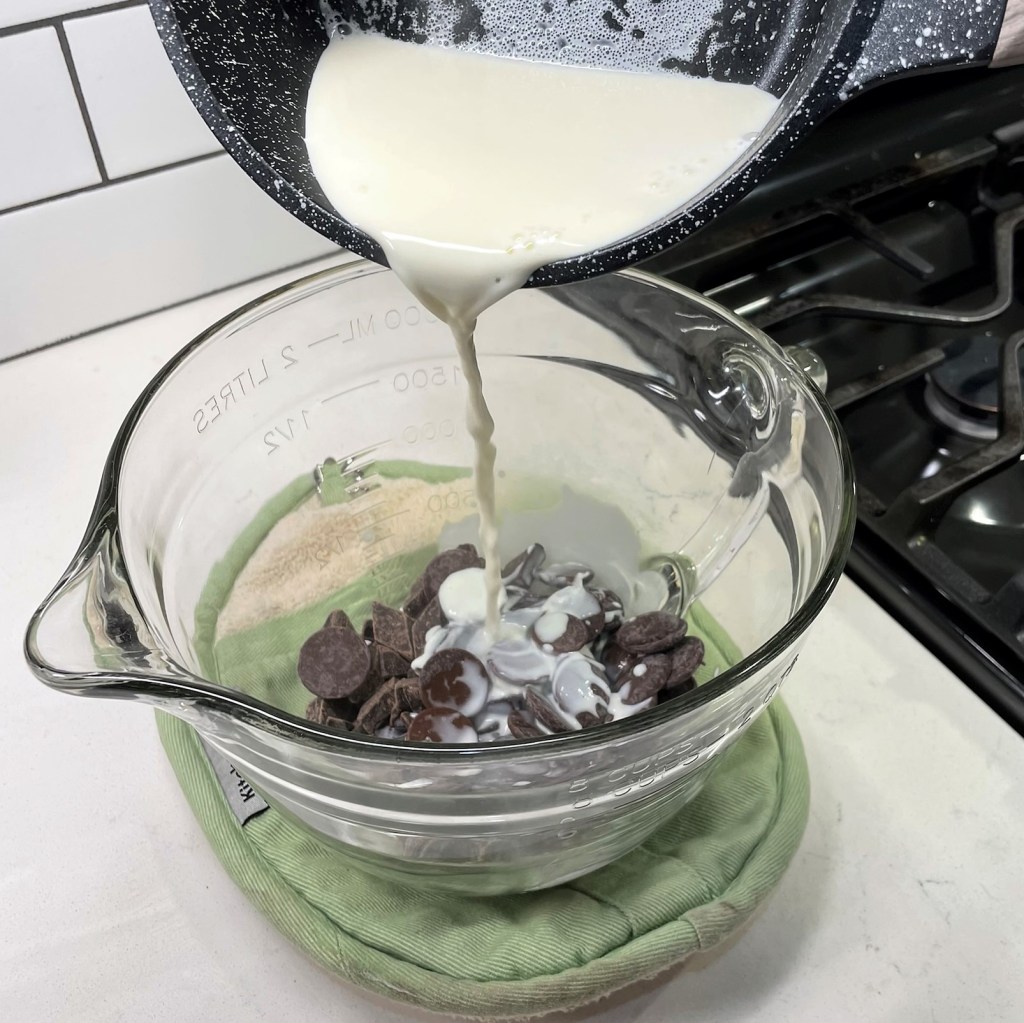
To make the ganache, heat heavy cream over medium-low heat until steaming. Pour over chocolate and leave it alone for 10 minutes.
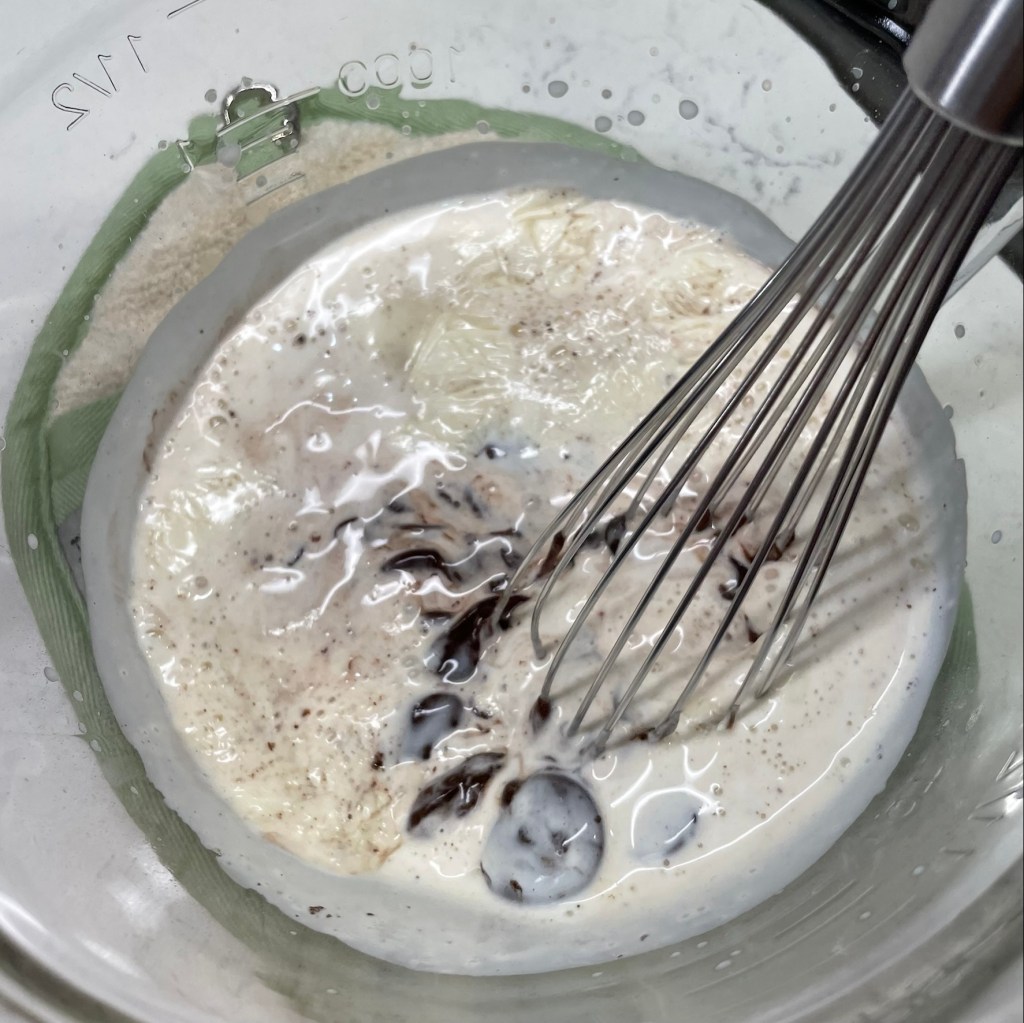
After 10 minutes, blend with a whisk, stirring mainly in the center of the bowl.
At first, it will seem like it isn’t working, but stay with it.
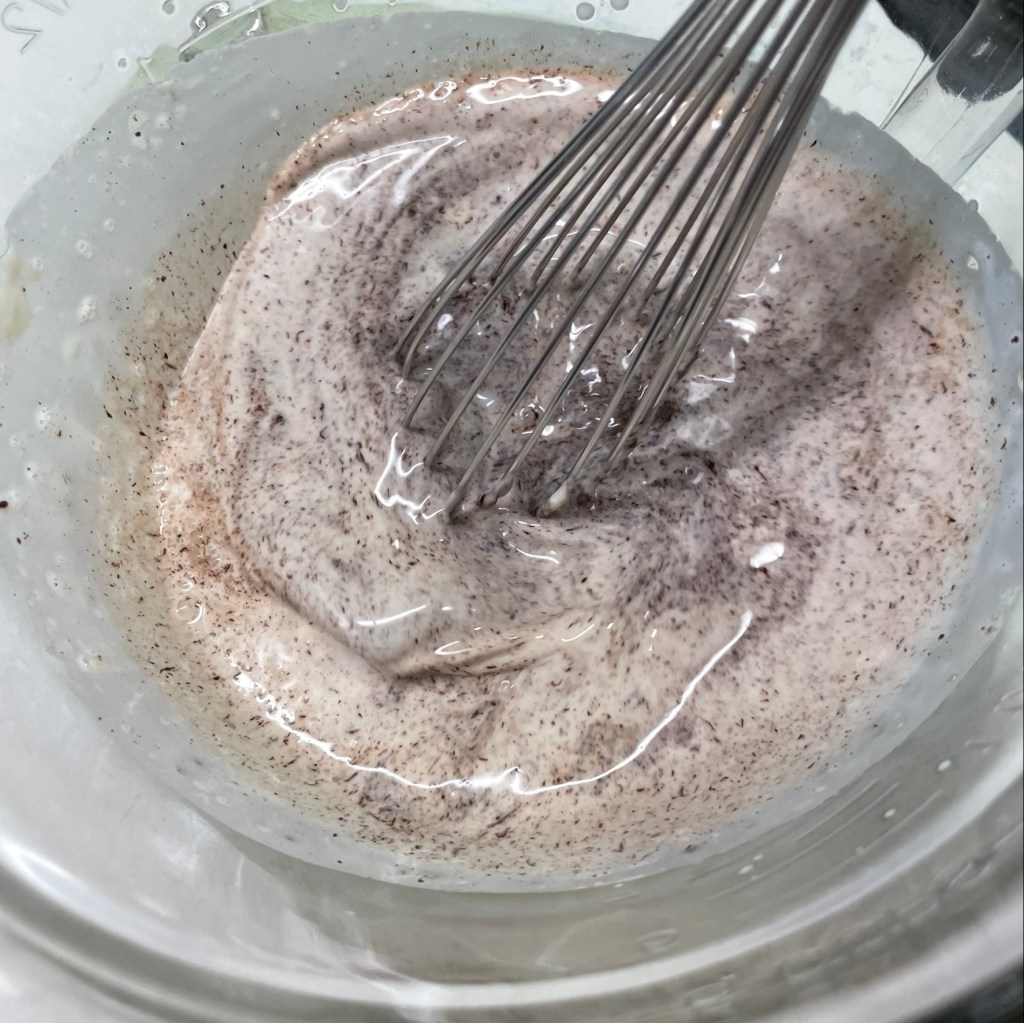
Aha! Continue to whisk until the entire mixture is smooth and chocolatey.
This is what my ganache looked like after only one minute of whisking.
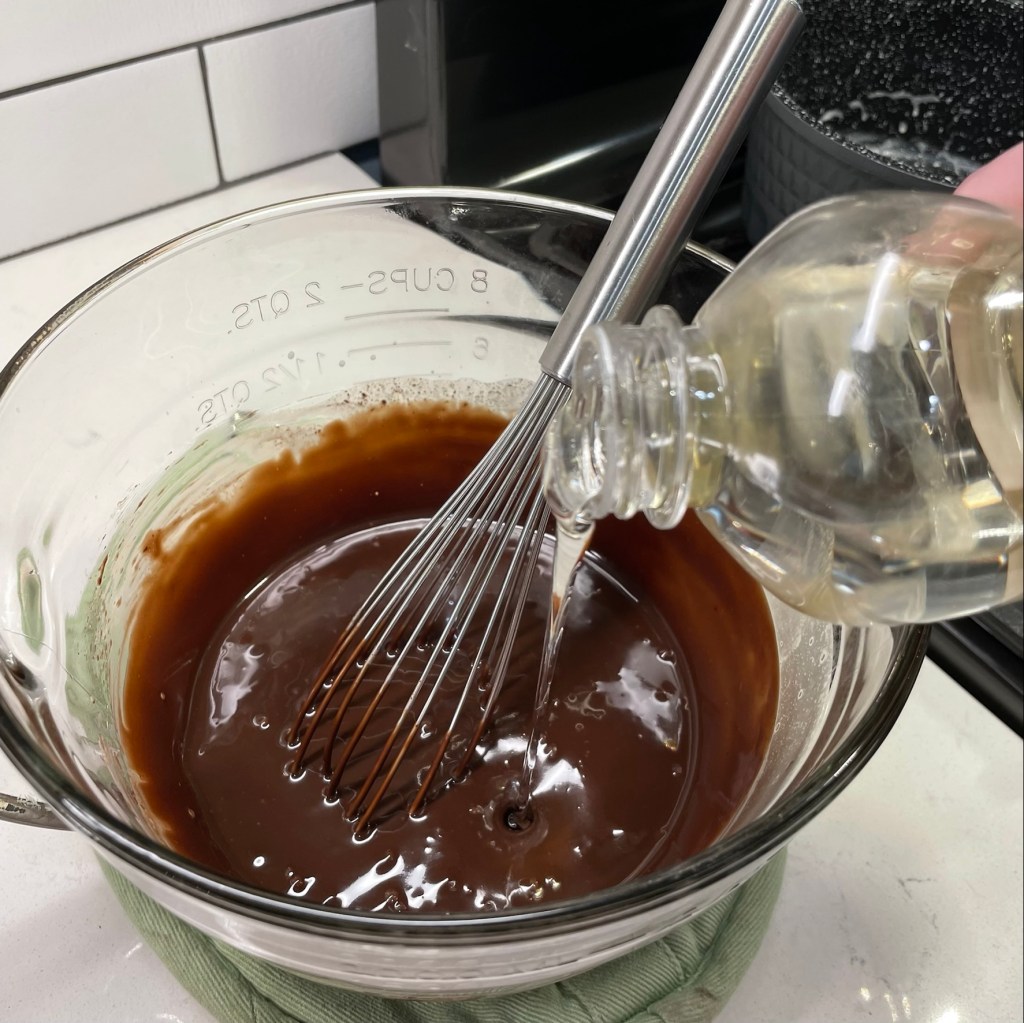
Stir in a small amount of corn syrup for a glossy shine and to keep the sugars from crystallizing.
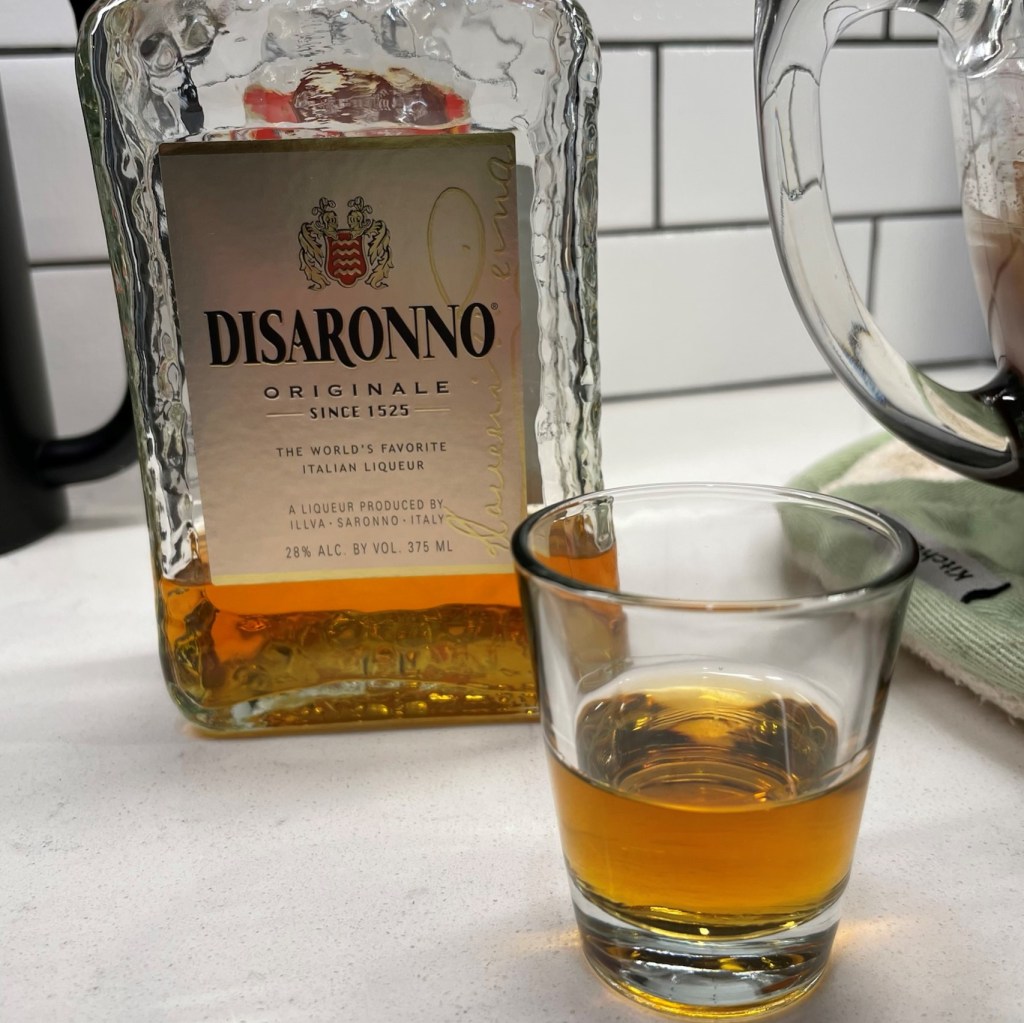
Just for fun, I whisked in a half shot of amaretto. We like it in bourbon-cherry cocktails, and it worked here as well.
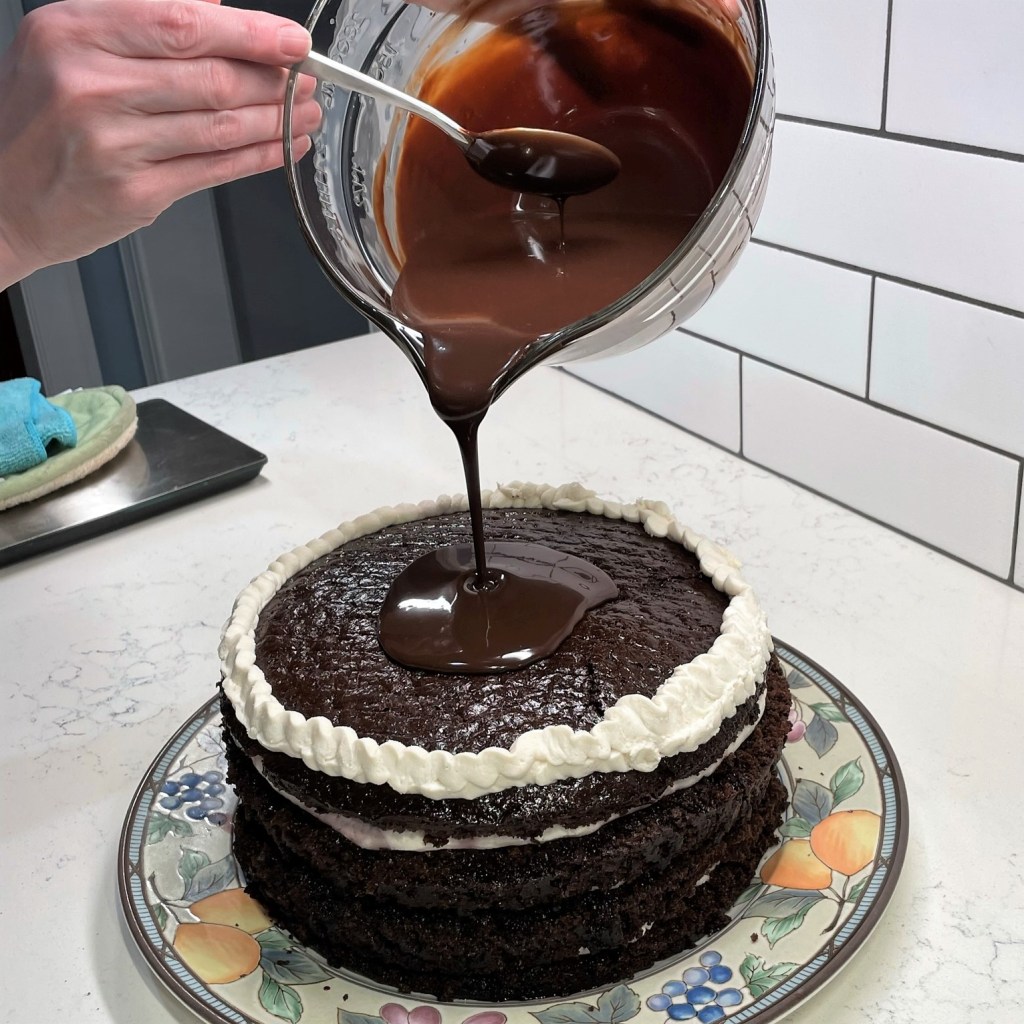
Slowly pour the cooled ganache onto the cake. The ganache will run off the center of the cake, but the mascarpone will keep it from running off. Keep pouring.
I poured the ganache right to the top of the edge. When the ganache has set, cover and refrigerate the cake until ready to serve.
Just before serving, pipe on the last bit of mascarpone cream, making little cushions for the bourbon cherries. Serve immediately.
The cake keeps very well in the fridge, and we decided the flavors were even better after a day or two!
The new year is off to a slow start for me and Comfort du Jour, but it isn’t for lack of trying. I have begun at least five times to write an introduction to our beautiful new kitchen, and here’s the thing—I just have too many favorite features to put it into words!
If I could invite you all over for dinner (or breakfast, brunch, lunch, coffee, cocktails), which would be my preference, we could demonstrate all the cool things we like about our new space and you could touch the textured backsplash tile and try out the features of the faucet and we would have a grand time. Until that is an option, and without trying to use so many words to explain what I want you to see, I am going to do the big reveal mainly in pictures. There are a ton of them ahead, and I would like to recommend that a computer, or at least a tablet, is a better way to view this post than a smartphone. You will see the detail better and the captions will not cover the photos. If you typically visit my site on the WordPress Reader, I recommend that you use this link to visit my actual page for a better experience as well. The slideshows do not translate as well in the reader.
Dear friends, you were terrific about supporting my husband, Les, and me as we stumbled through those awkward weeks of renovation, and we thank you for your comments, suggestions and “been there, done that” empathy. As we all know (or at least as the Bible teaches), God created the world in six days, but you can count on a minimum of six to eight weeks for a new kitchen. It was quite a ride, and well worth it in the end.
Here we go!
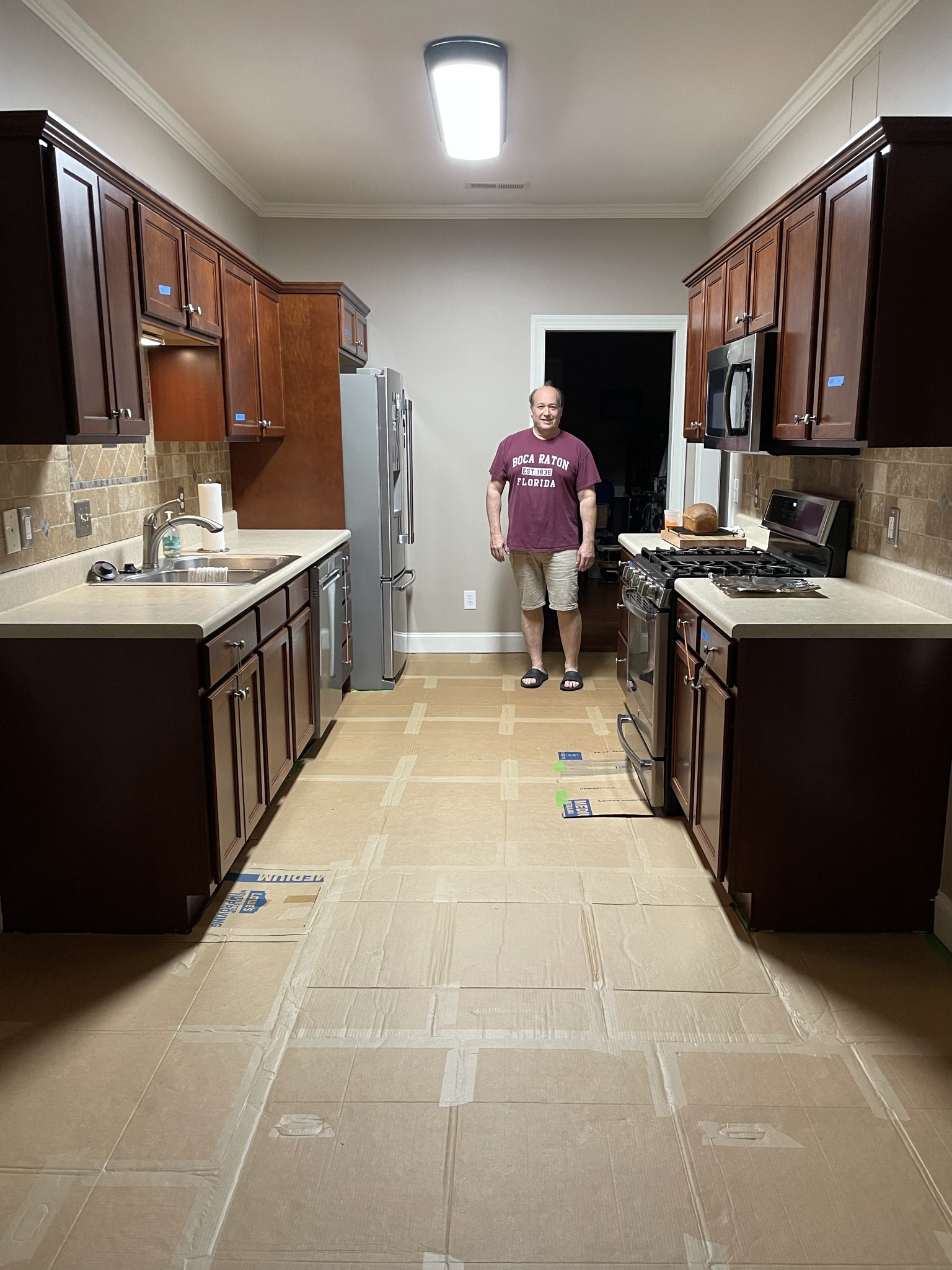
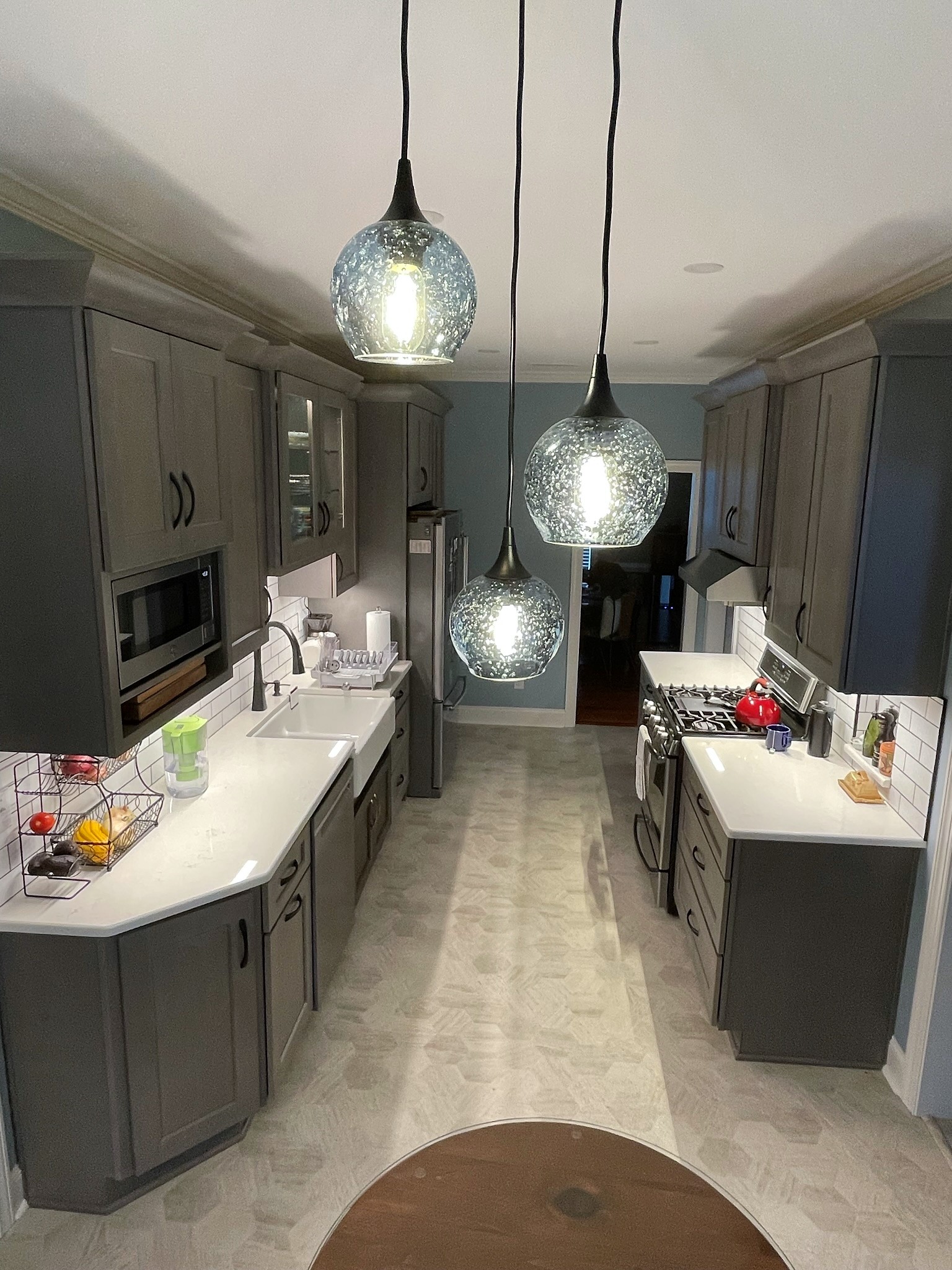
When we sat down with Matt (our general contractor) back in June 2021, Les and I discussed with him three primary trouble spots in our tired old kitchen: not enough counter space, poor traffic flow and lousy lighting. We asked for storage solutions, reworking of some of the existing layout, premium materials, under-cabinet lighting and a few fun bells and whistles, and I am pleased to report that we got everything we asked for and more!
Sometimes when I walk into the kitchen, I still can’t believe it’s ours!
Let’s begin with the layout, which mainly affected the sink and fridge side of the kitchen. You would think, with a 22-foot length, space would not be an issue. But things were not arranged well in the original design.
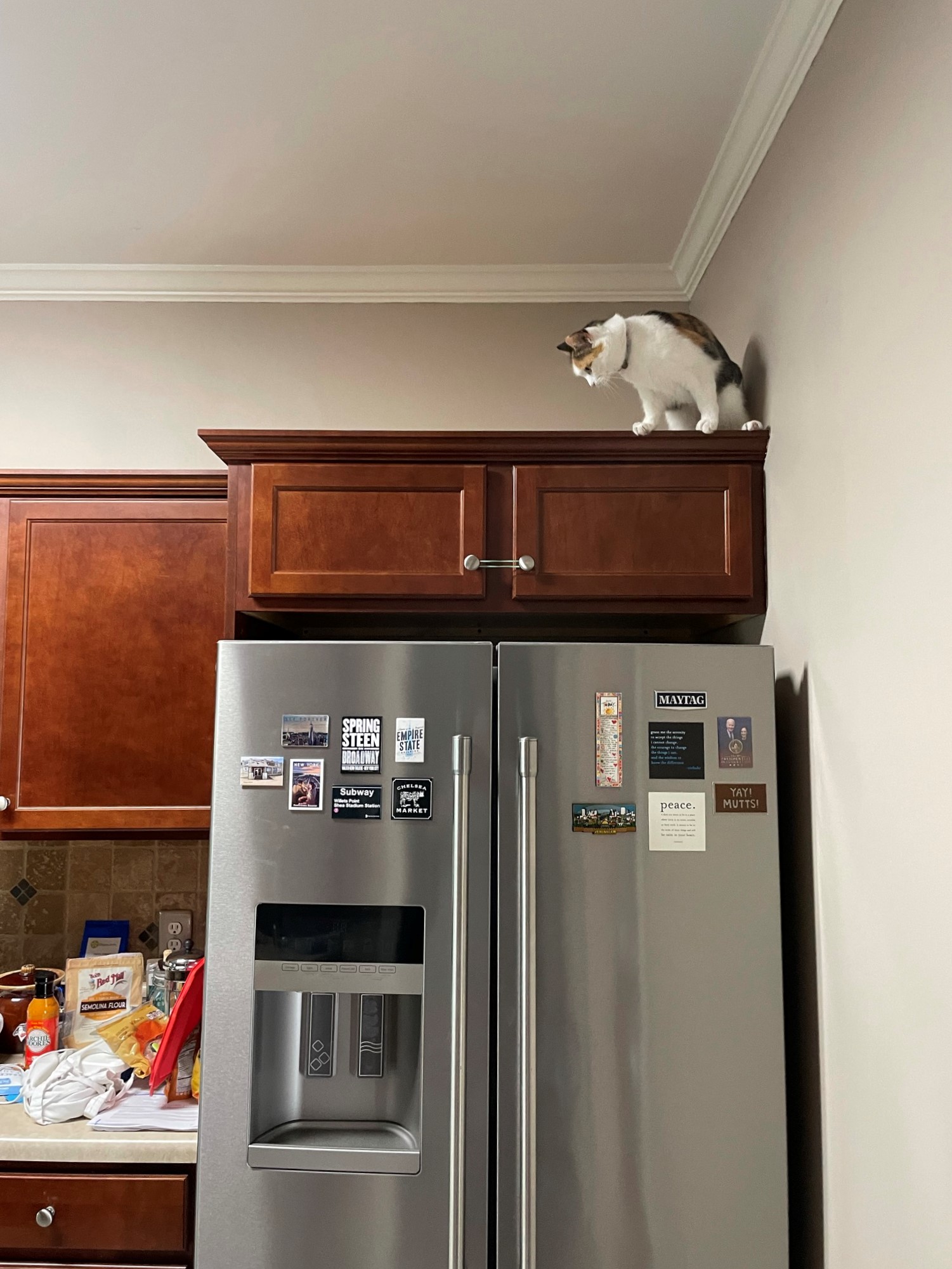
Even Taz could see that having the fridge right next to the wall wasn’t a good plan. The right door did not open all the way.
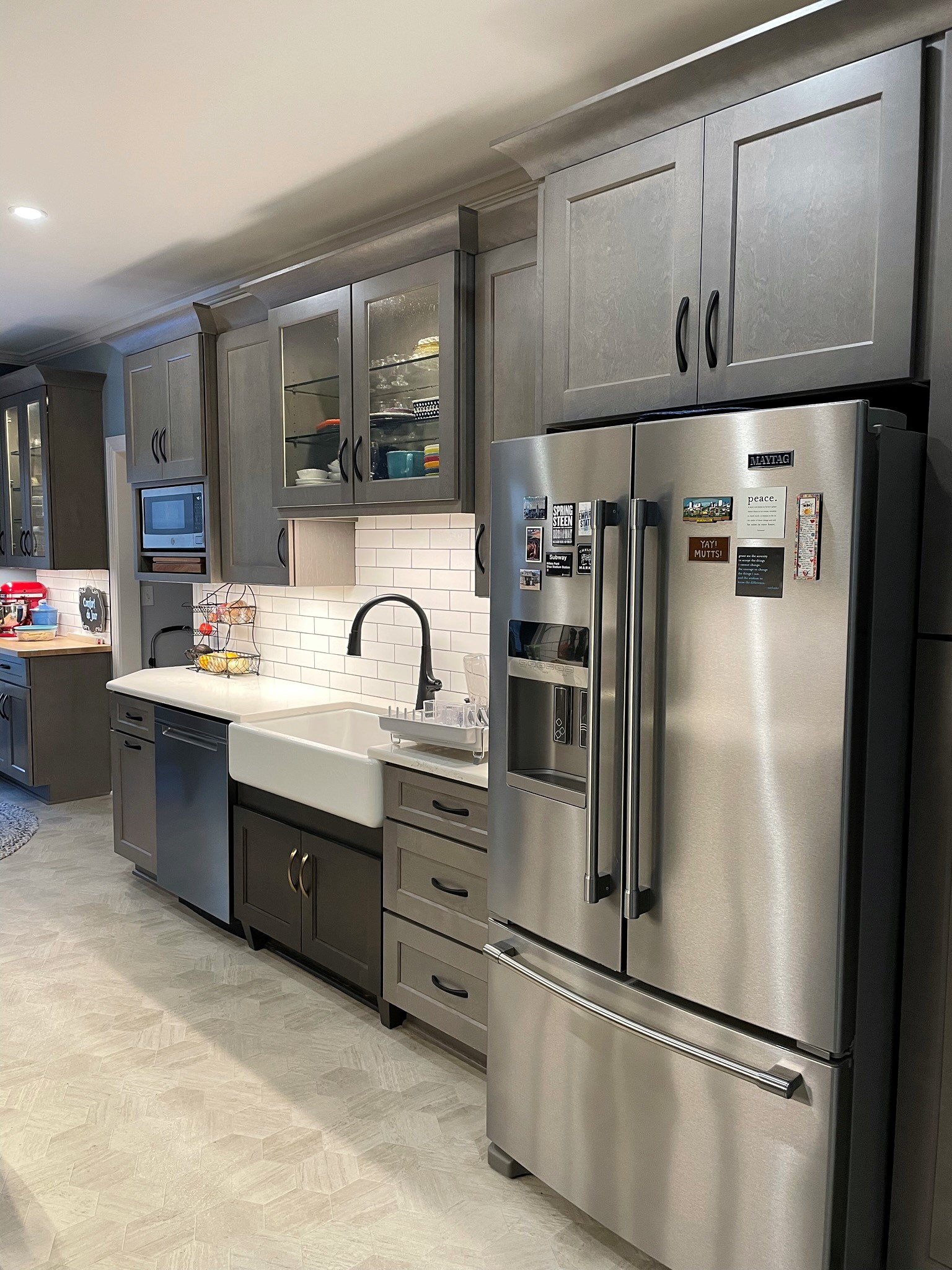
My new, full-depth pantry cabinet provides a ton of space for all of our pantry items, and I also have full access to open both sides of the fridge!
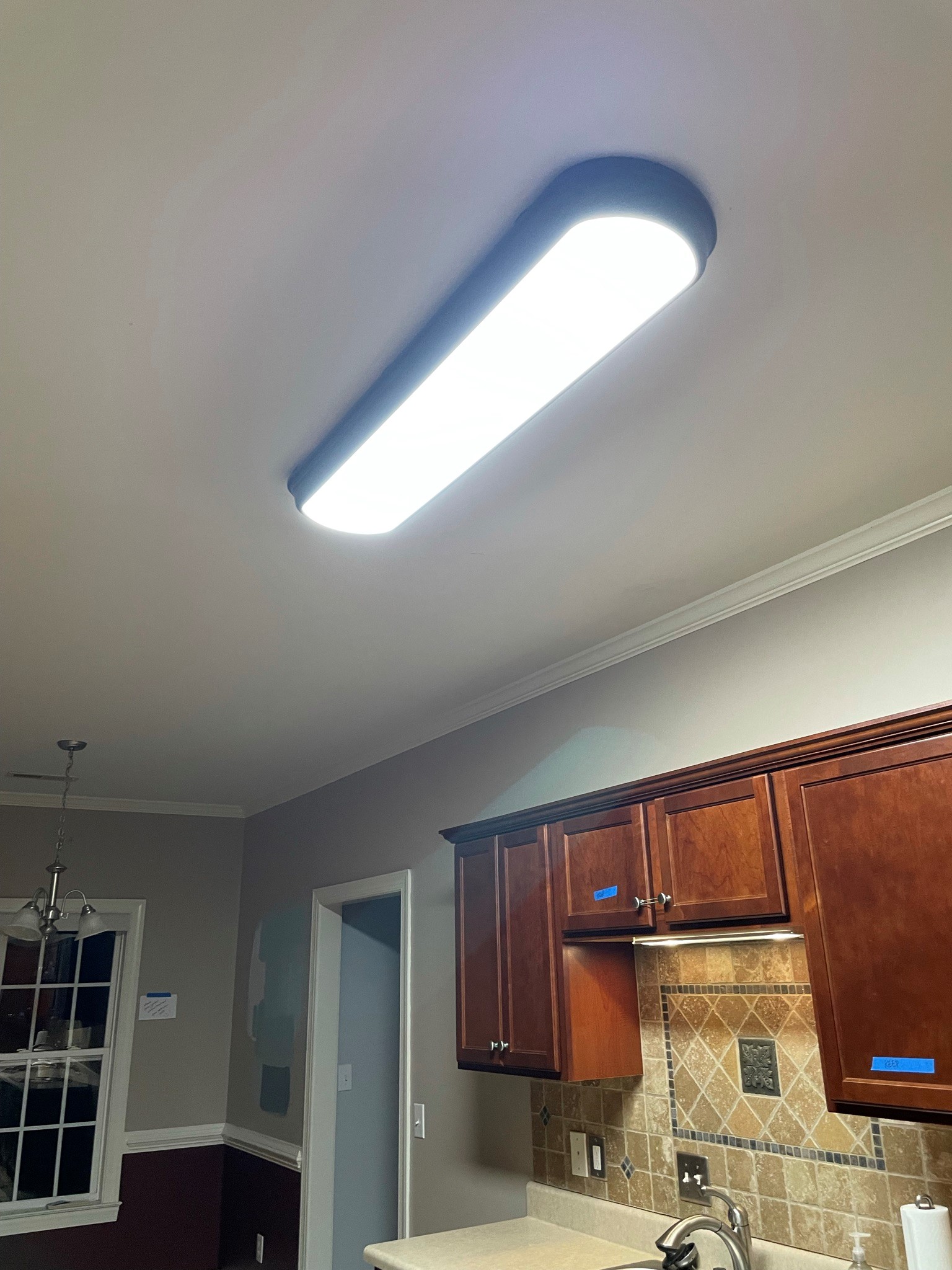
This thing was like a streetlamp; too bright and not bright enough at exactly the same time; no matter where I stood, I was in my own shadow.
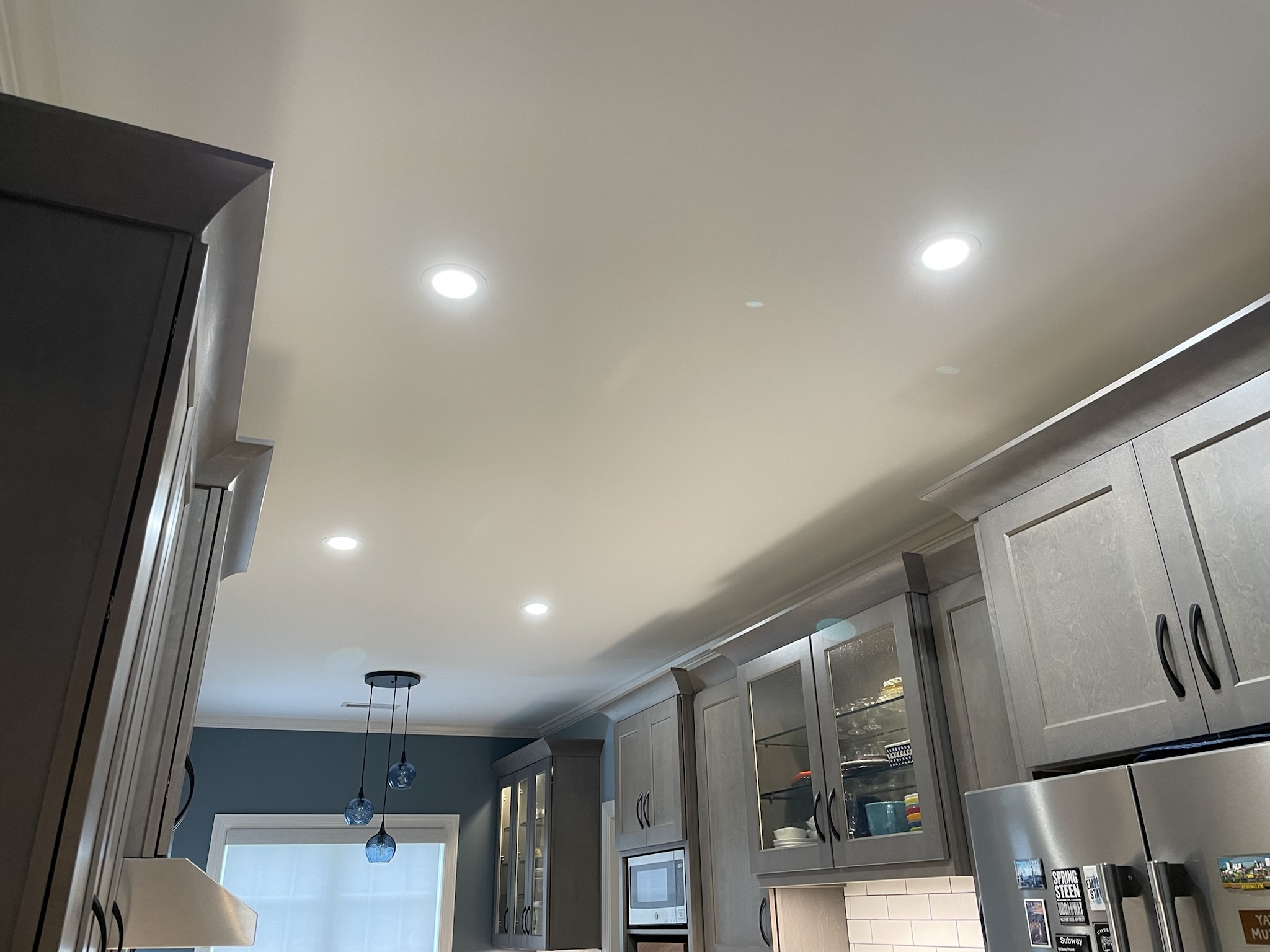
Our new, energy-efficient wafer lights put a spotlight on every workstation, and they don’t distract from the beauty of the kitchen.
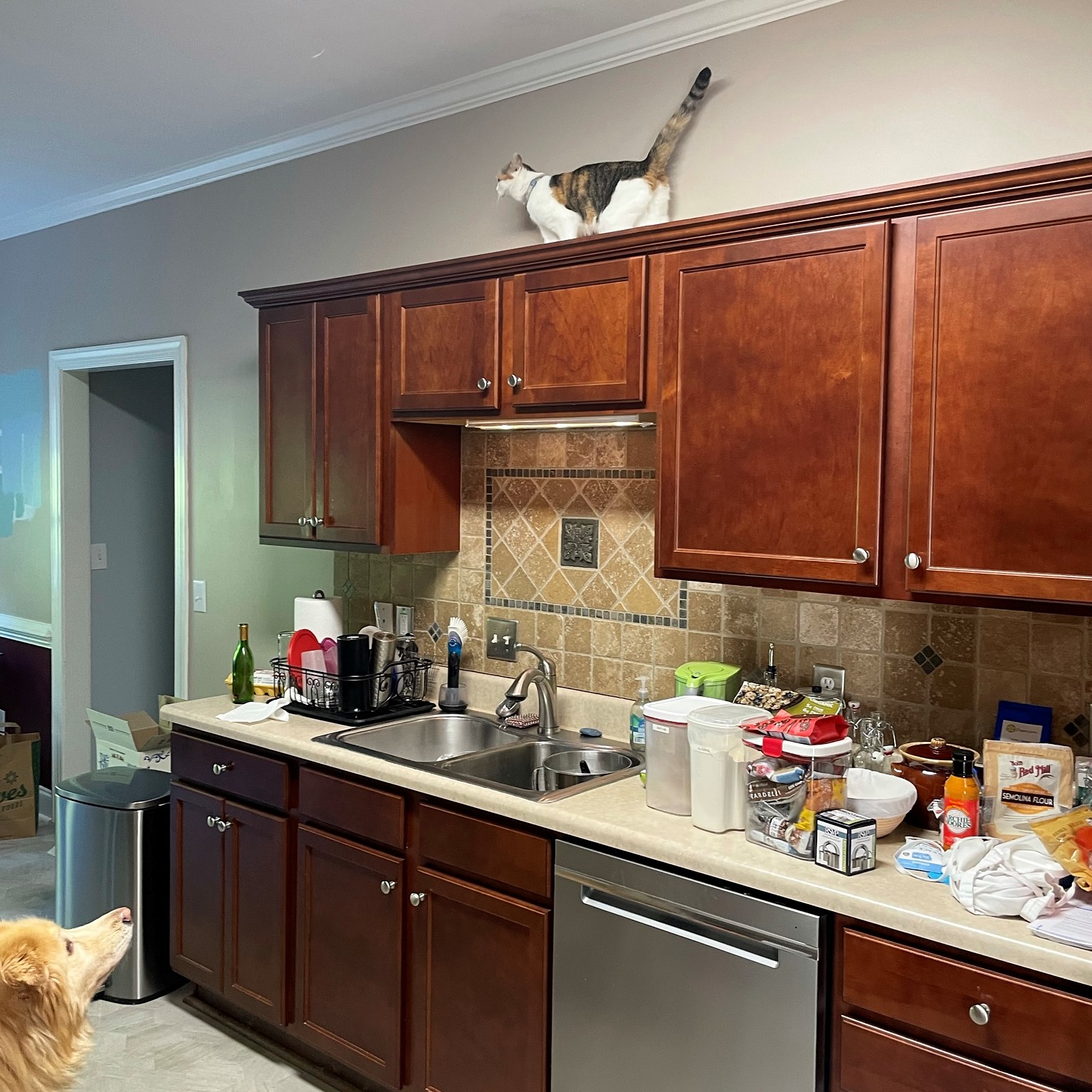
That’s a lot of wasted space above our wall cabinets, though Taz enjoyed the view! This massive clutter fest occurred during the load out of the old kitchen.
It’s a bit difficult to get this whole side into one picture! And Taz has not ventured to the top of these tall cabinets.
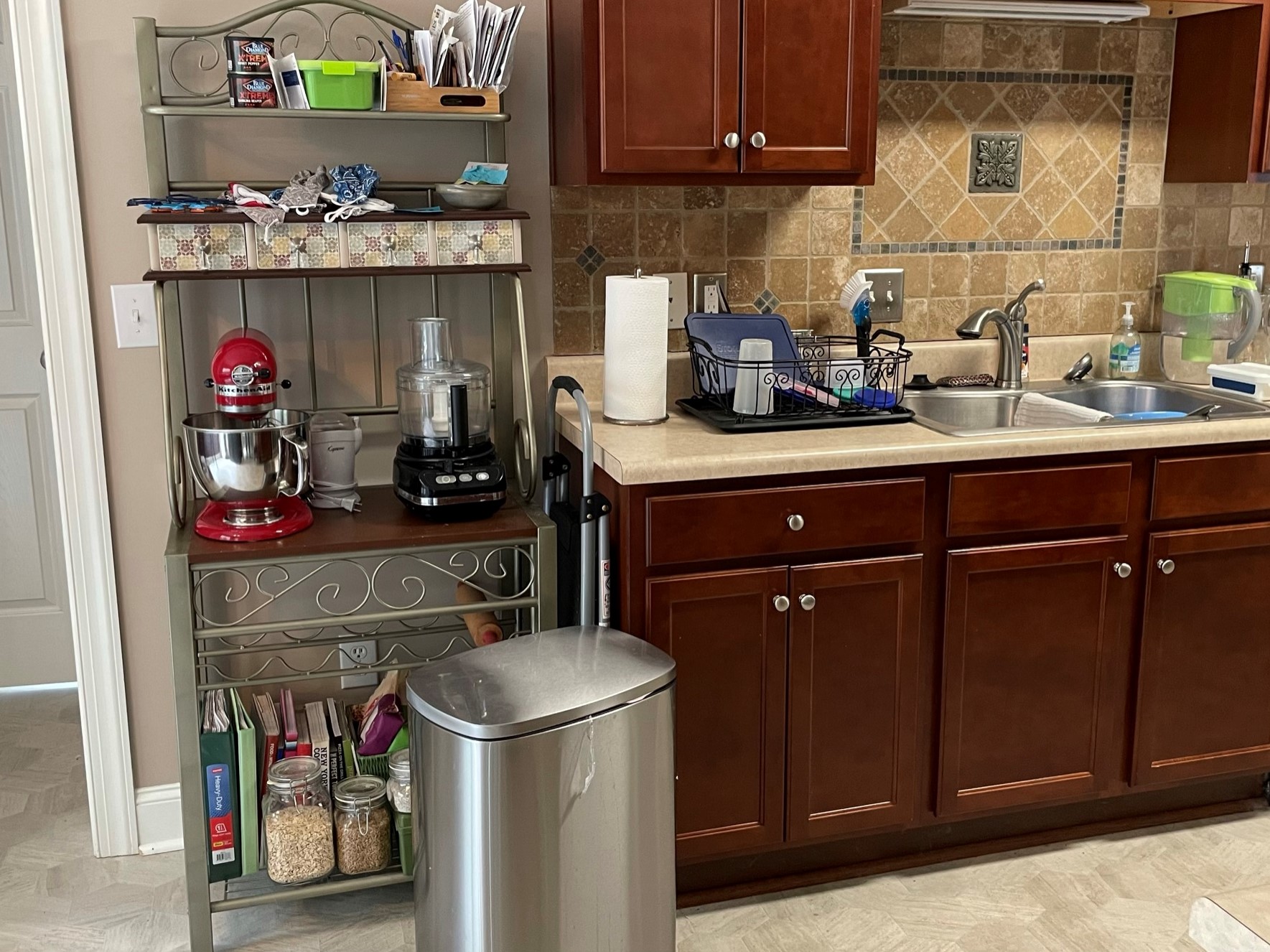
I don’t even know what was hanging out of the trash can that day, but this whole scene is a hot mess.
Now this area is a workspace for Les when we are cooking together. The full cabinet is an integrated trash and recycling station. Our dog, Nilla, loves the corner cabinet because her treats are in there. 🙂
I am pleased to report that this baker’s rack has been passed down to Les’s daughter, who just bought her first home last summer!
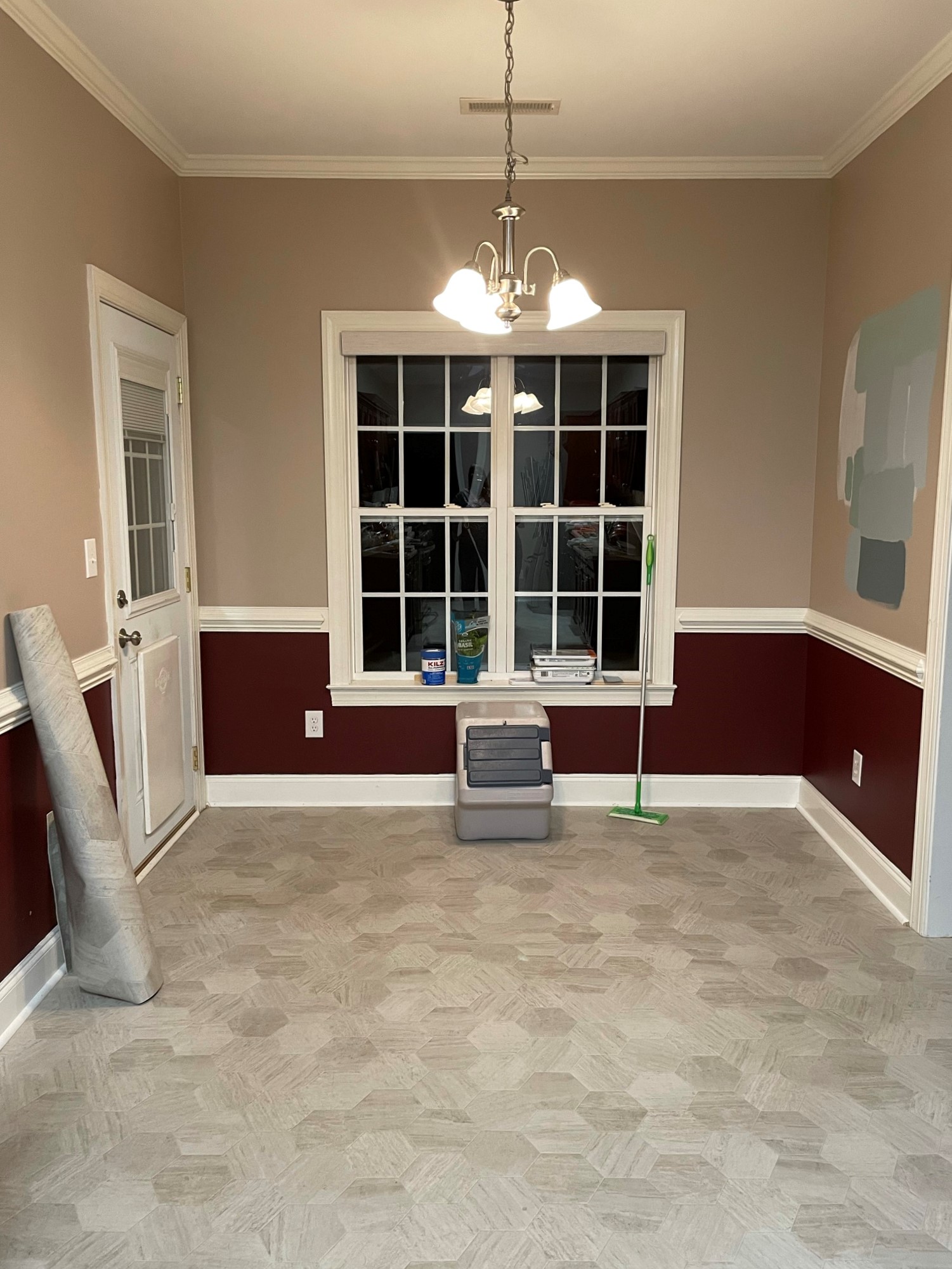
Our boring, hard-to-use dinette area was desperate for a fresh look.
Now, Les can enjoy a cocktail and scroll ESPN on his laptop while I’m working in the kitchen, and he eats breakfast here every morning.
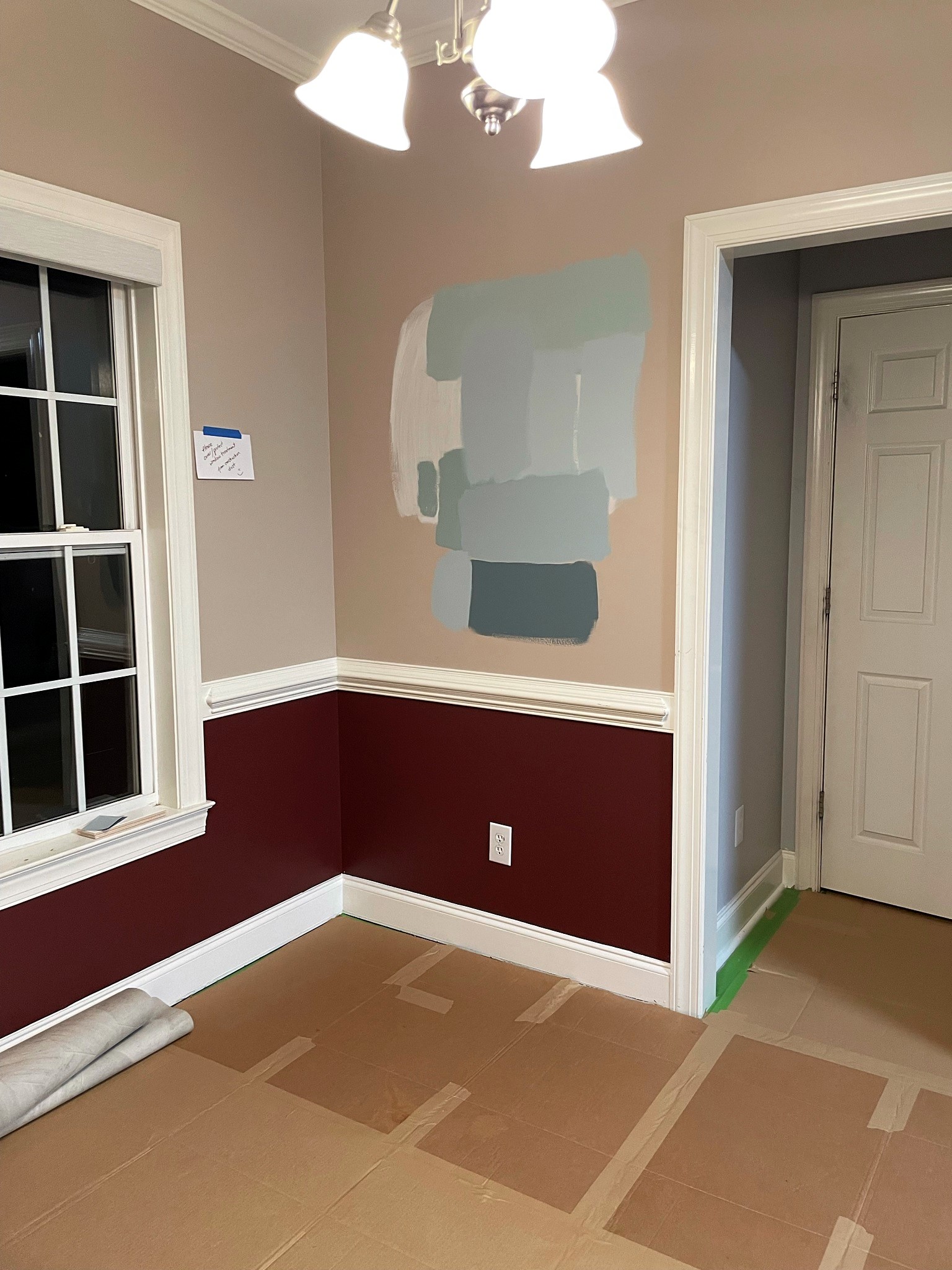
This corner in the dinette was wasted space, but we had big plans for it. We used that wall to test our paint colors.
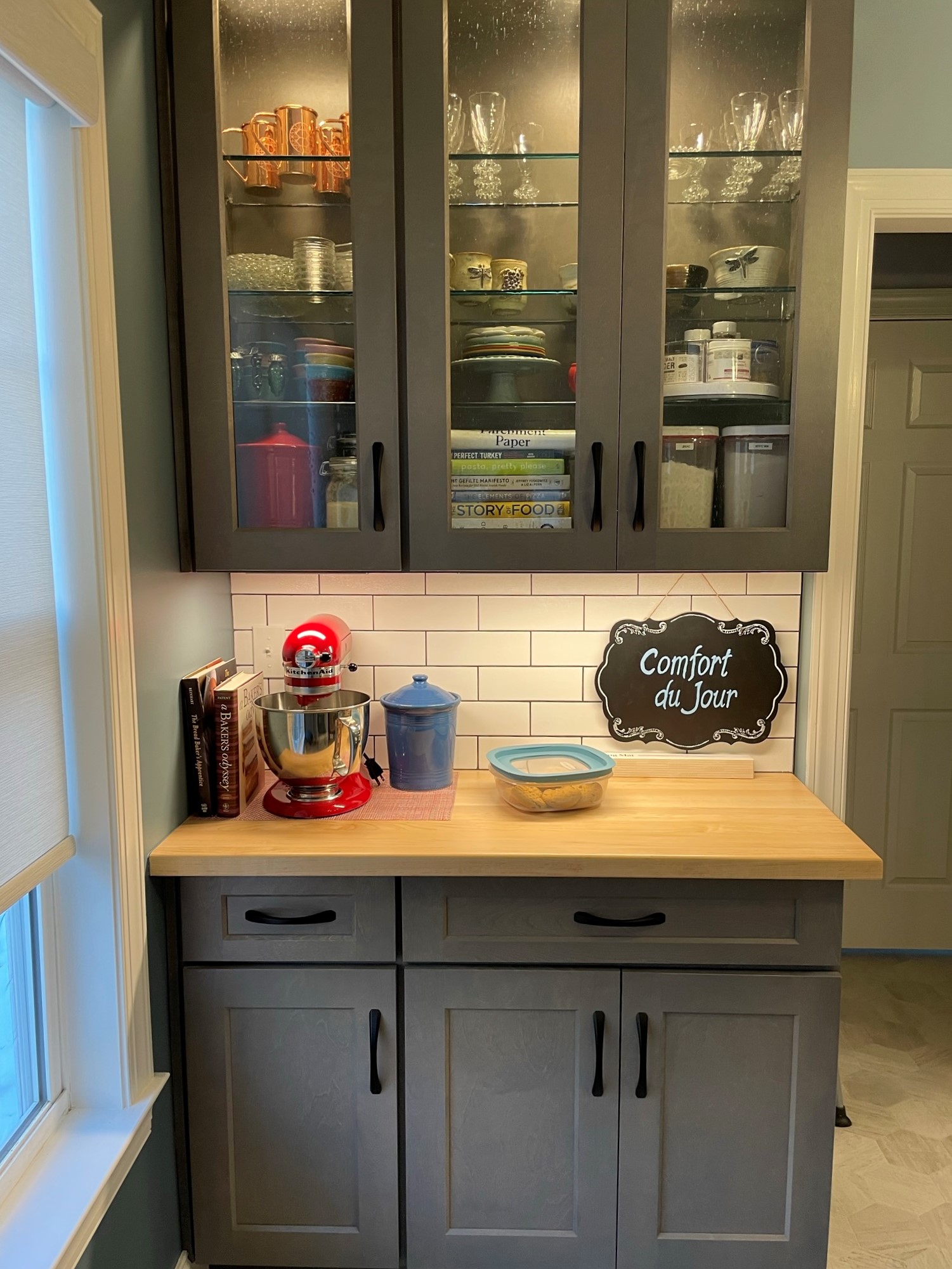
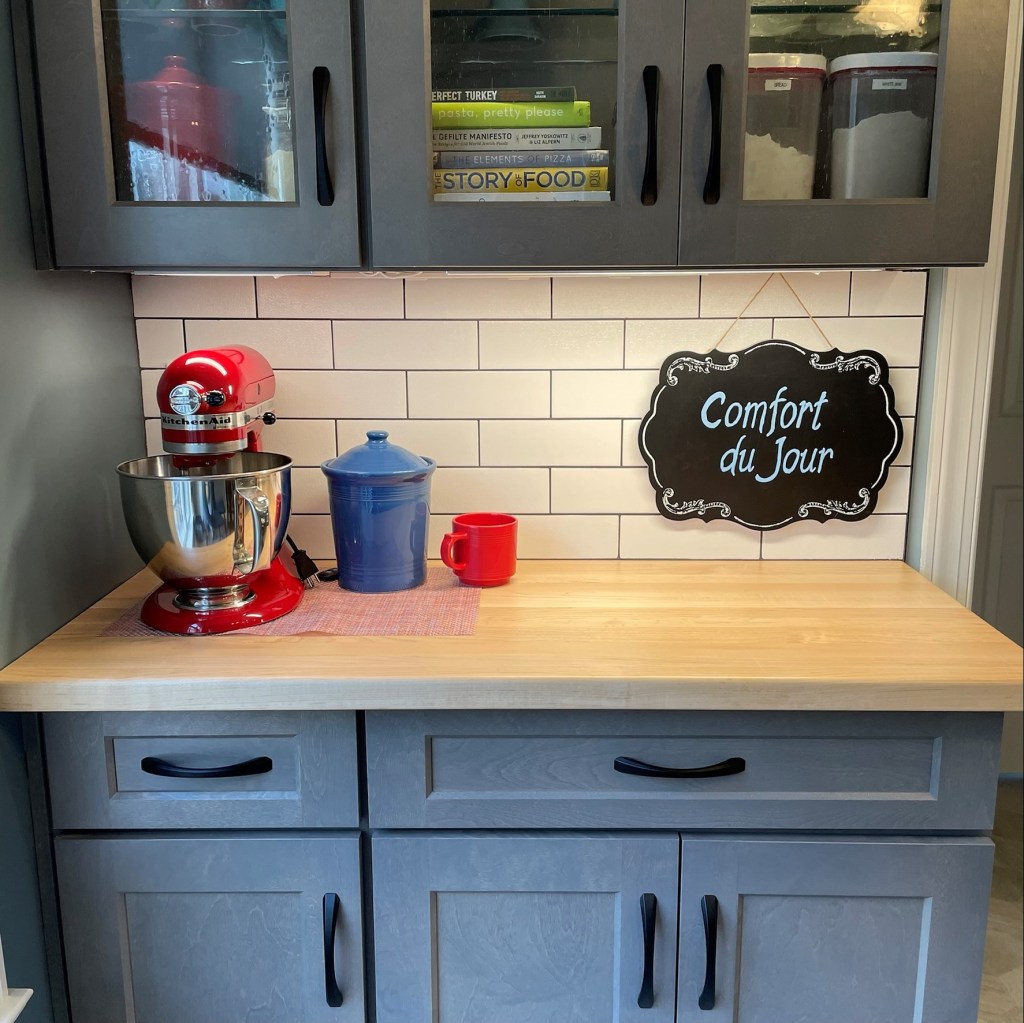
The spot is now home to my baking station. The seeded glass doors help me to proudly display some of my grandmother’s vintage dishes and my own handmade pottery pieces.
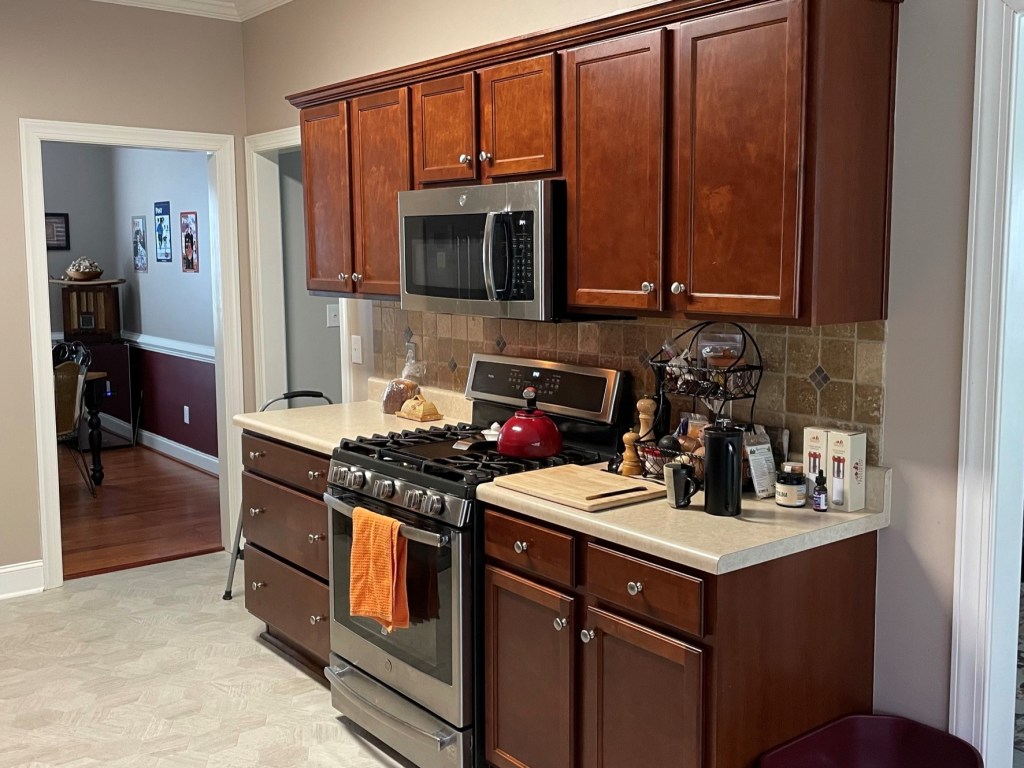
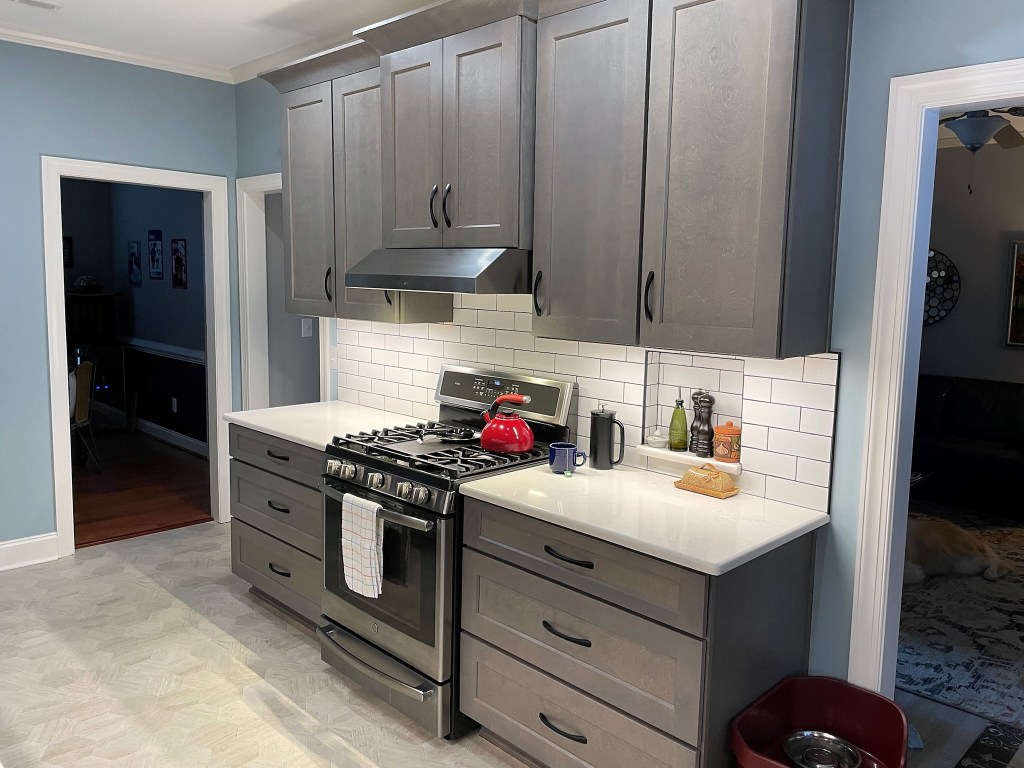
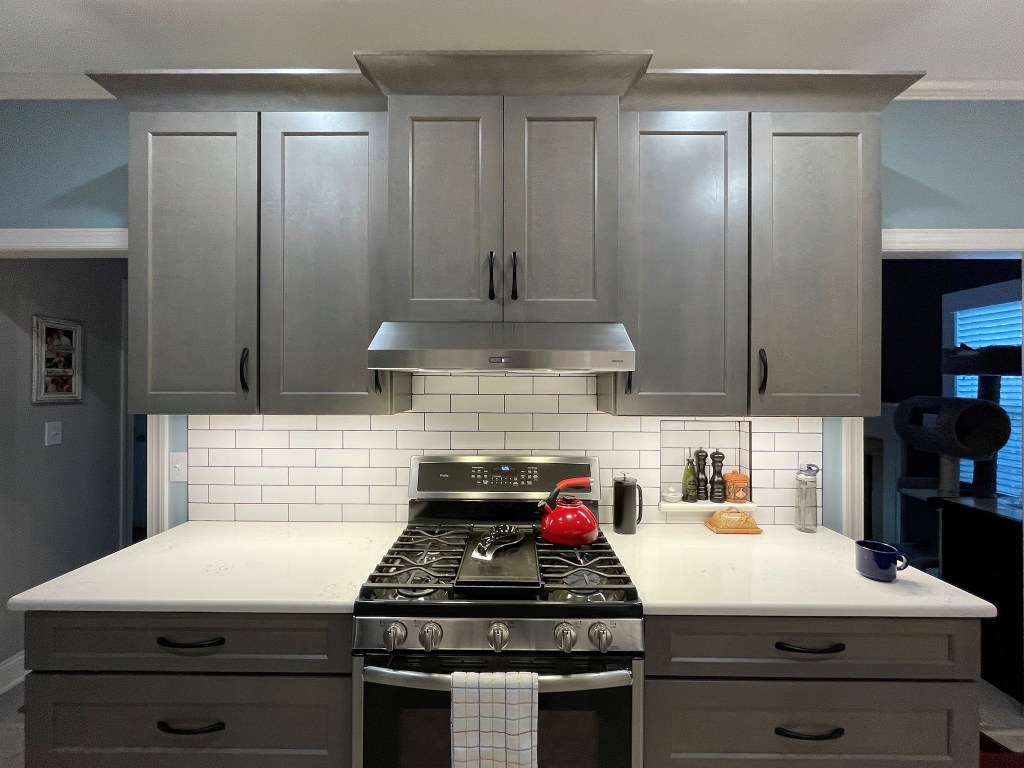
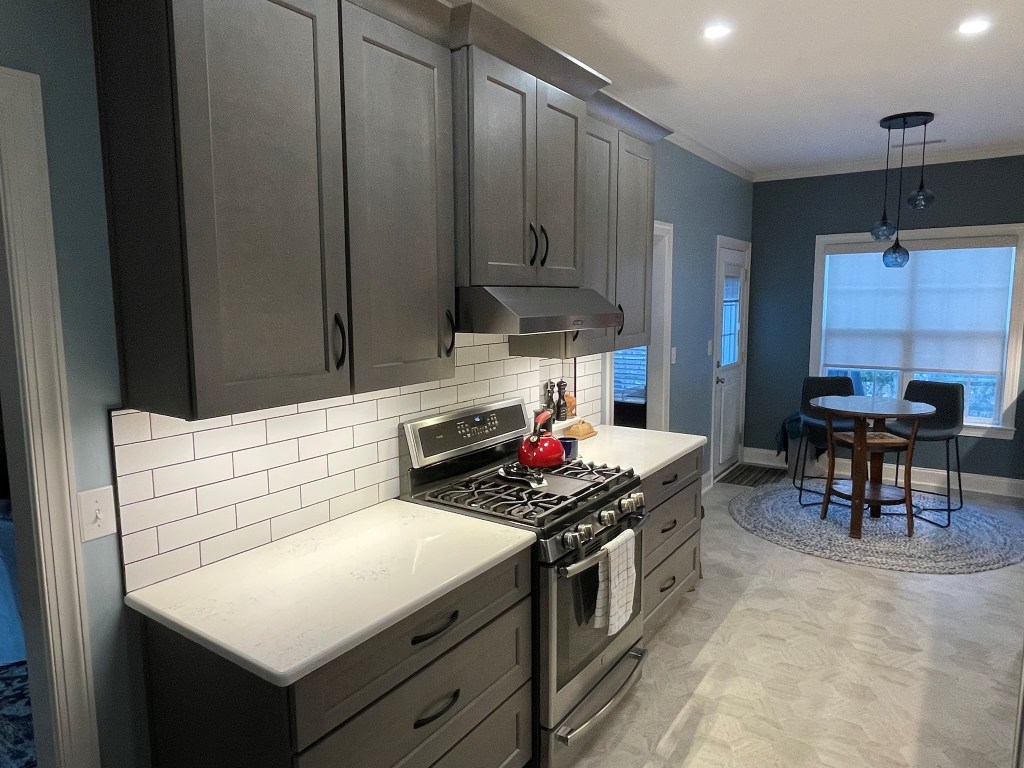
The changes to the stove side of the kitchen are less dramatic, but still noticeably improved. We went for symmetry on this side, swapping out a standard base cabinet for drawers to match the other side, and each side was increased by 3 inches. You’d be amazed at the difference that made in the big picture.
Clutter, clutter everywhere.
Everything about the room is brighter!
The old cabinets opened against the stove, blocking my view of what was inside.
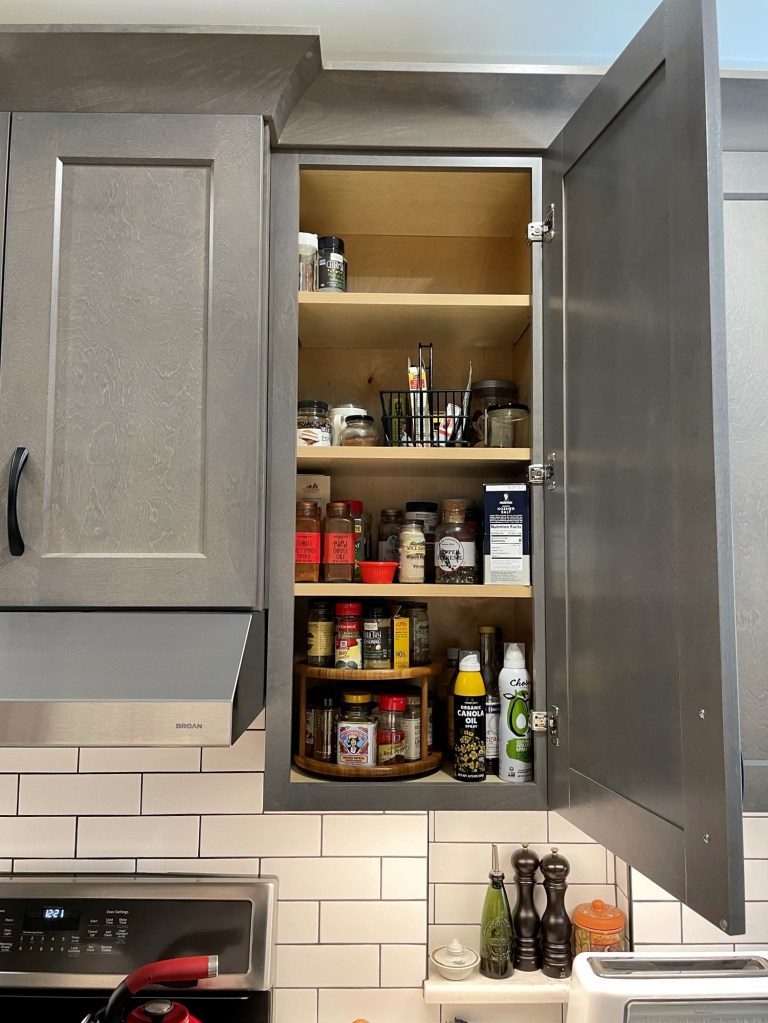
The cabinets nearest the stove are now hinged to open away from the stove, making it easier for me to grab what I need as I’m cooking. We even have some empty shelves!
Our previous setup had two smaller drawers on the right side of the stove. Look at the space lost between them.
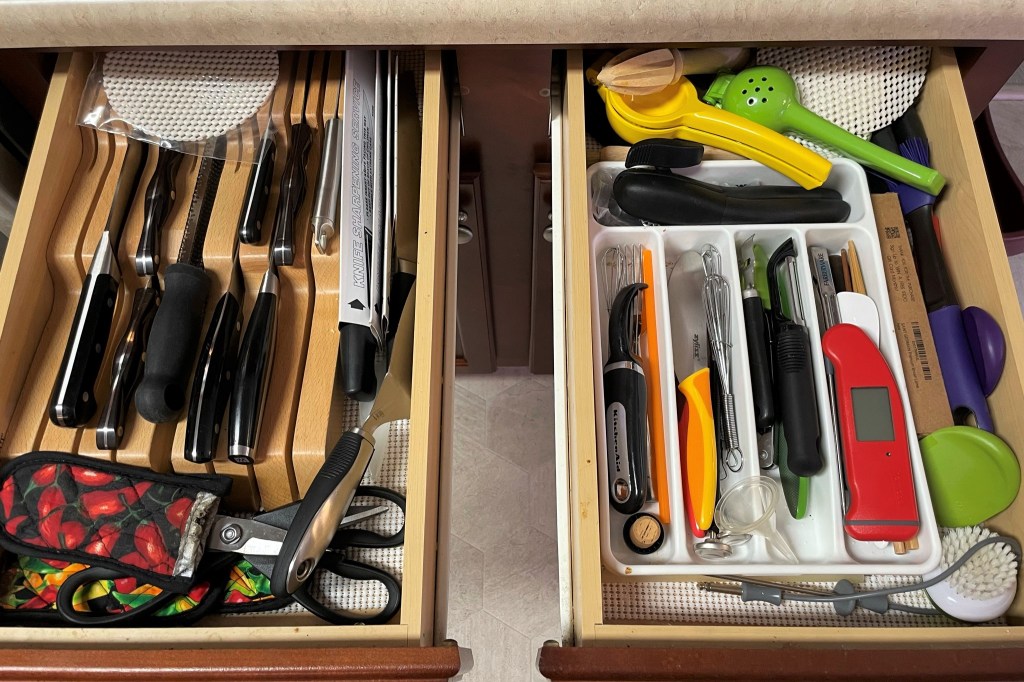
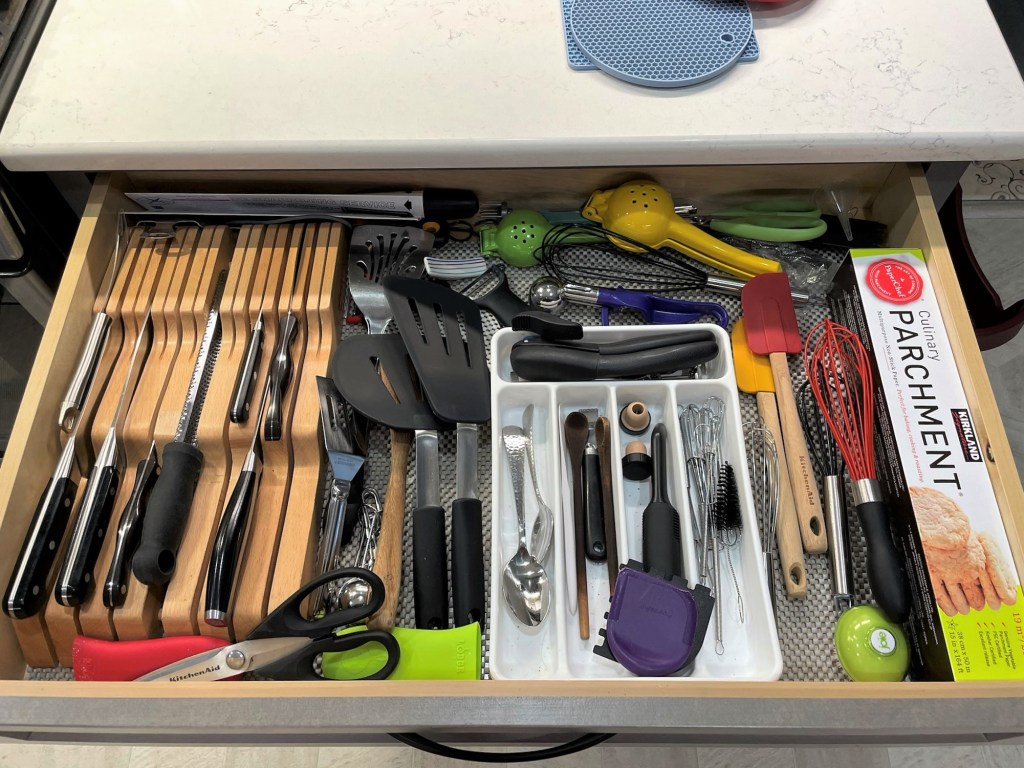
It’s astonishing how many of my essential tools are all in this one drawer. And all the drawers have “soft-close” glides, so there is no slamming.
We gained space vertically with the 42″ wall cabinets, and horizontally by replacing the 33″ bases with 36″. Every little bit helps!
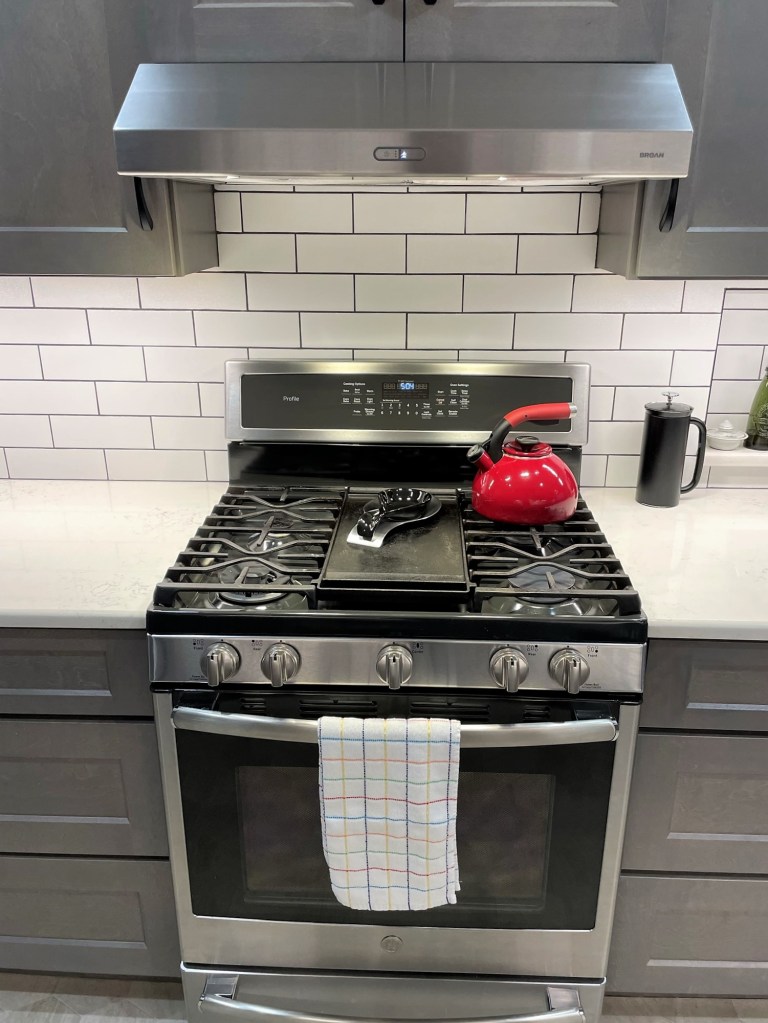
The brighter space even makes the gas range look new, but it is actually 2 1/2 years old! I love not having a microwave looming over it, and the hood offers great lighting.
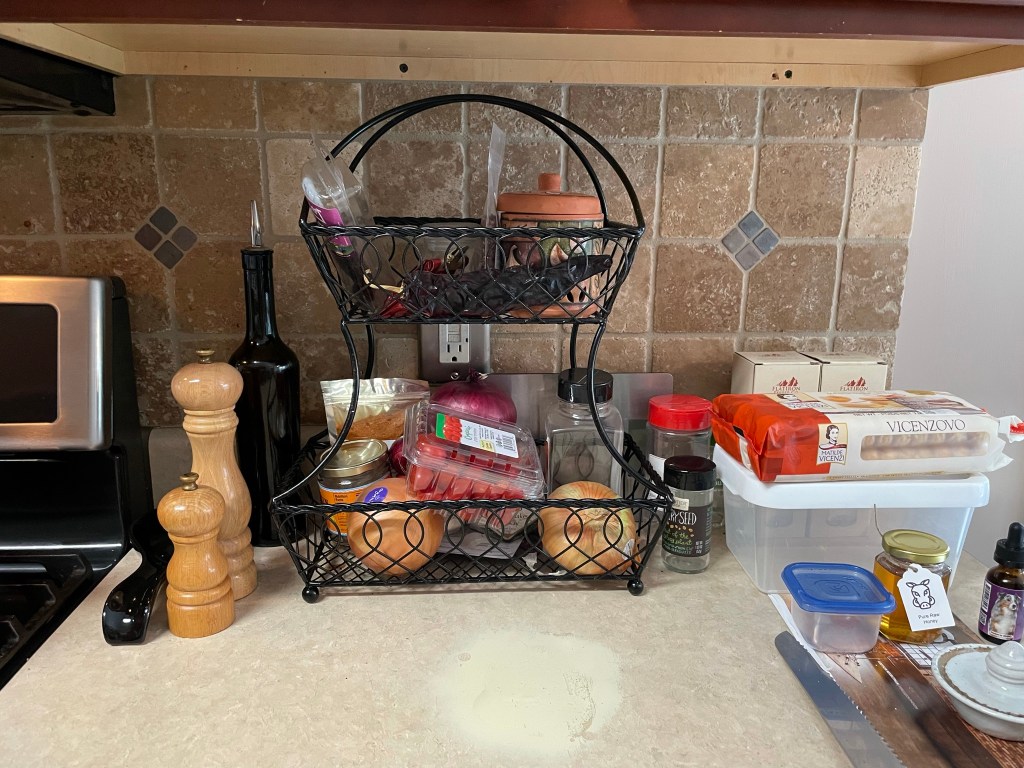
All this clutter was in the exact spot where I needed space for food prep at the stove. The patch on the counter was an accidental burn mark, and we concealed it with a cutting board.
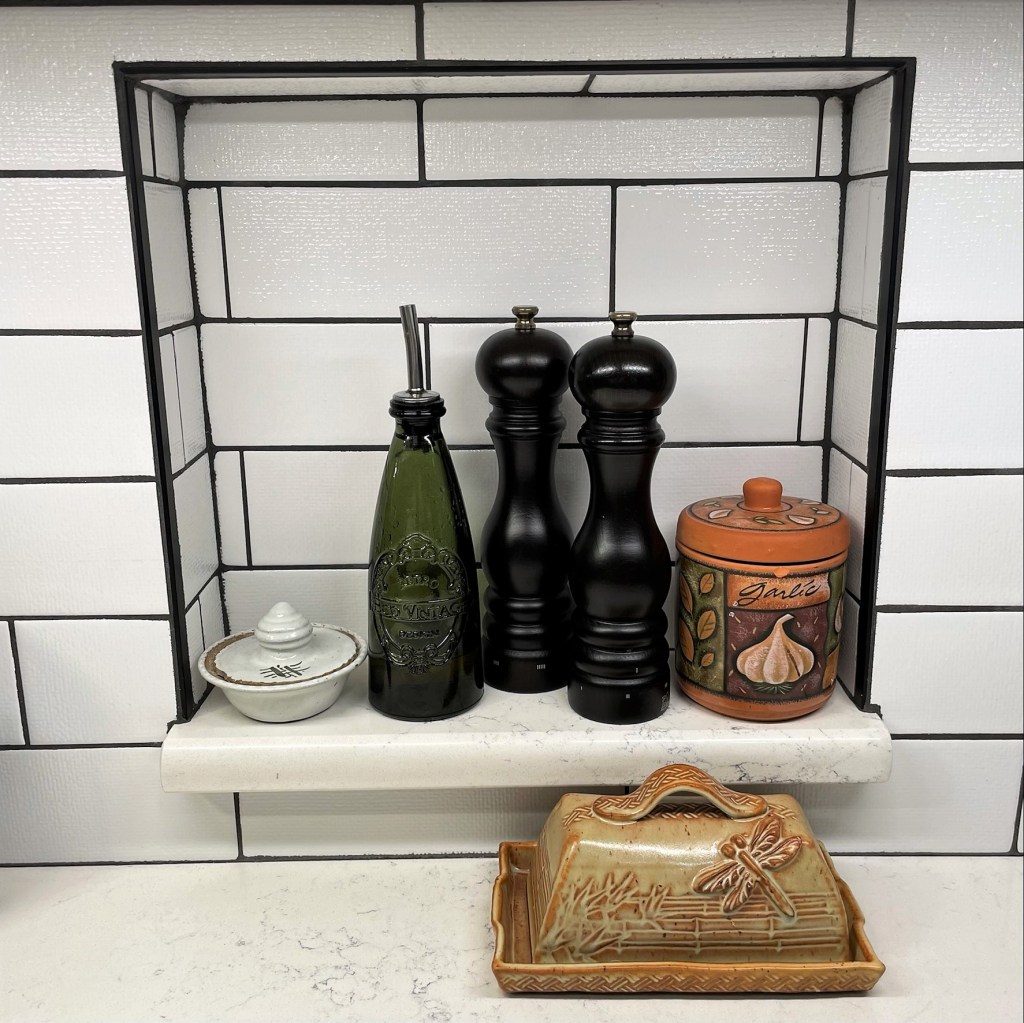
The wall niche in that spot by the stove was one of our best decisions. It keeps my most-reached for items handy without cluttering the countertop. The tile guy did an amazing job with this!
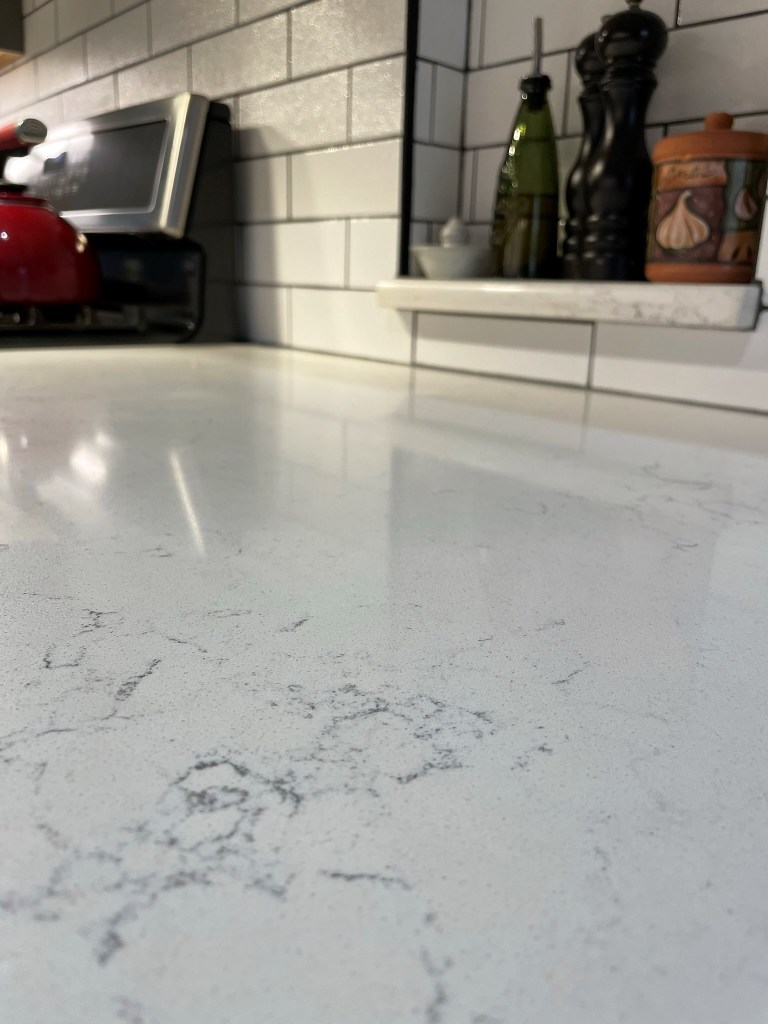
And the quartz countertop is impervious to heat, stains, cuts or any other kind of damage. It doesn’t need to be sealed, and it’s beautiful!
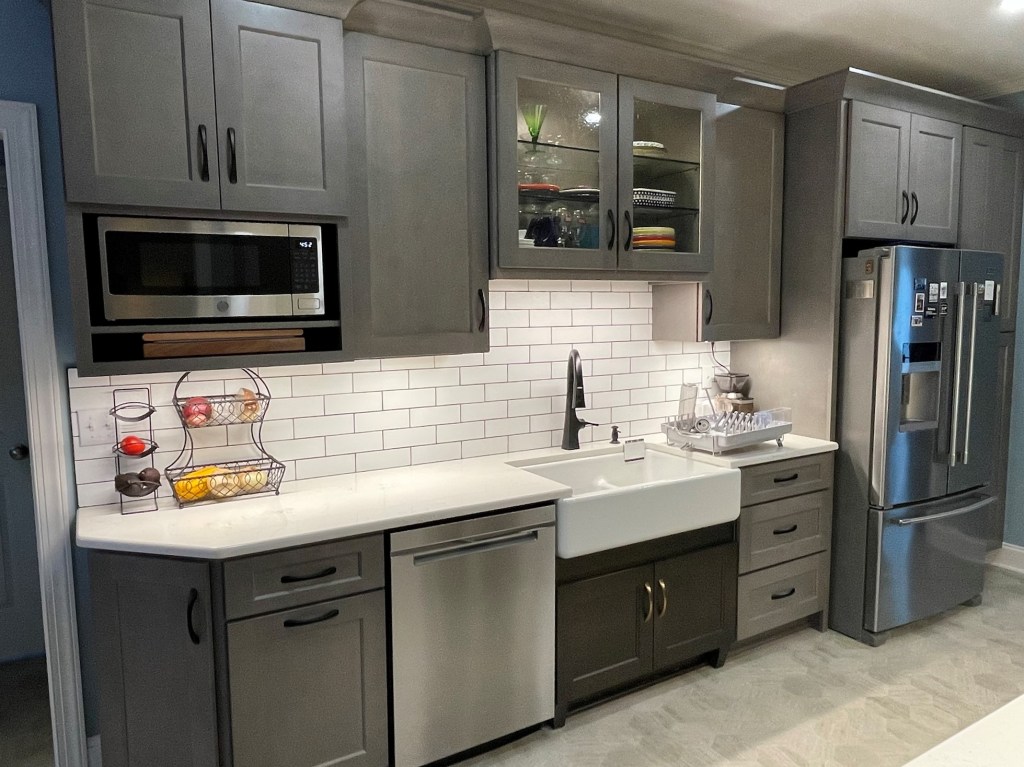
We worked with a designer to select our cabinets, countertop and hardware, and we were intentional to choose as many American-made products as possible. Our cabinets were made in Minnesota byLegend Cabinetry, and we liked the sleek, Shaker-style doors with light gray stain over birch hardwood. The color is warm, but fresh, and the movement of the grain is evident underneath.
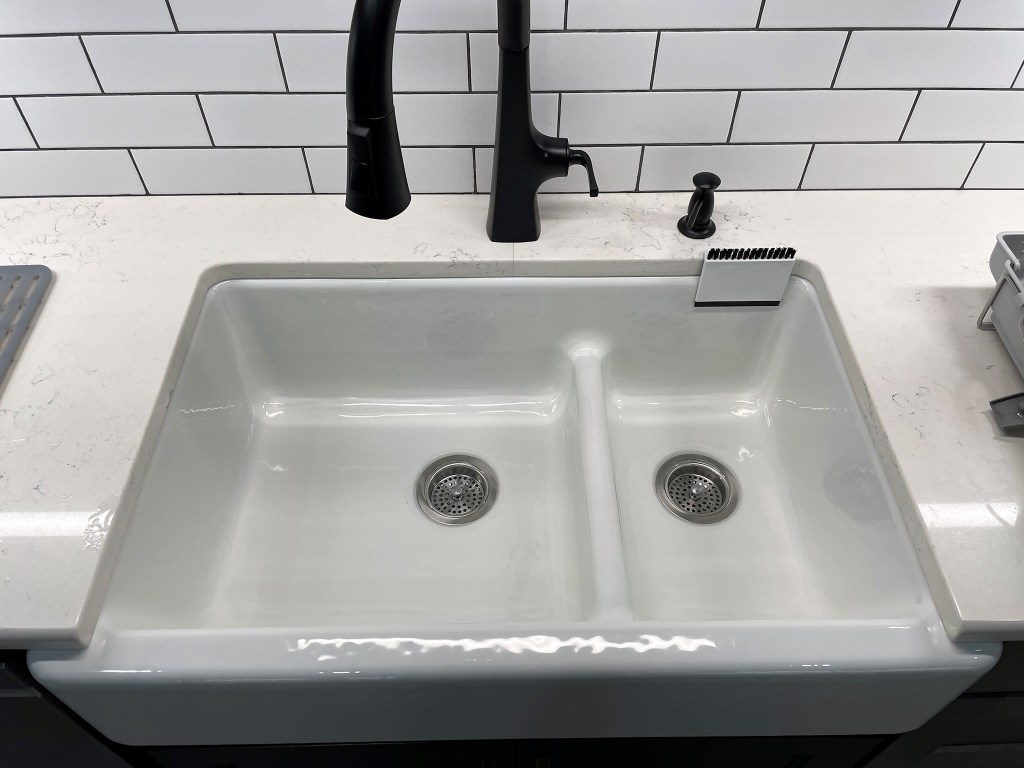
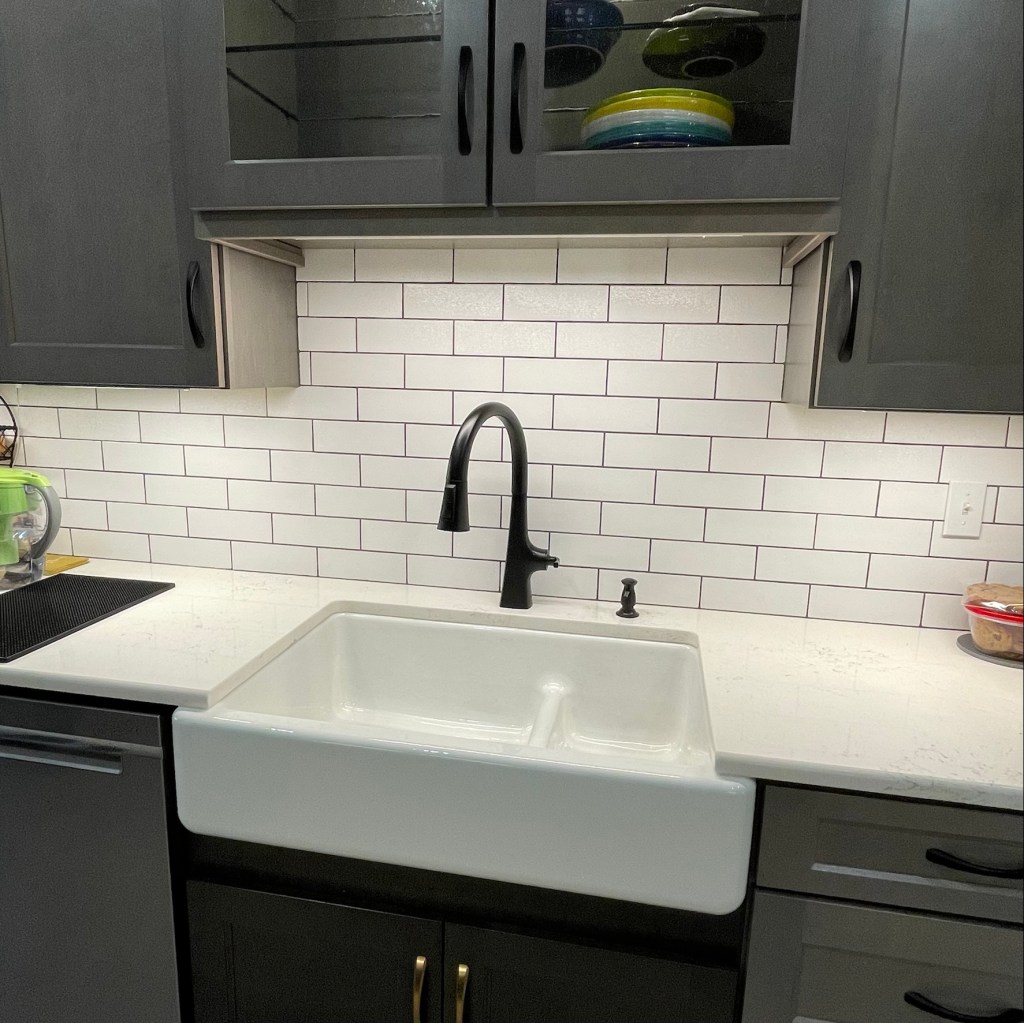
We invested in a few splurges, including the Kohler sink, which I call the “Queen of the Kitchen.” We paired it with a Kohler faucet, primarily because both are made in the U.S. and also for the special features it offered.
The sink is called “Smart Divide,” and the larger sink is plenty big even for washing our turkey roasting pan!
The high neck of the Kohler faucet allows us to move more freely at the sink, and it’s touchless! When my hands are sticky with bread dough, I only need to wave my hand under the neck to turn the water on and off.
We love the spray options on the Kohler faucet, including “berry soft,” which is a gentle spray, and “sweep,” a high-pressure spray that blasts like a blade for clearing dirty plates.
The apron front, cast-iron sink has been on my “dream kitchen” list for years and I love it. This kind of sink may not be for you, especially if you stand taller than me. It is deep to begin with; being mounted underneath a slab of stone makes it seem even deeper. Even I, at 5-foot-5, find myself stooping at times to clean the dishes. I don’t mind it, but it is something to keep in mind if you are considering a remodel.
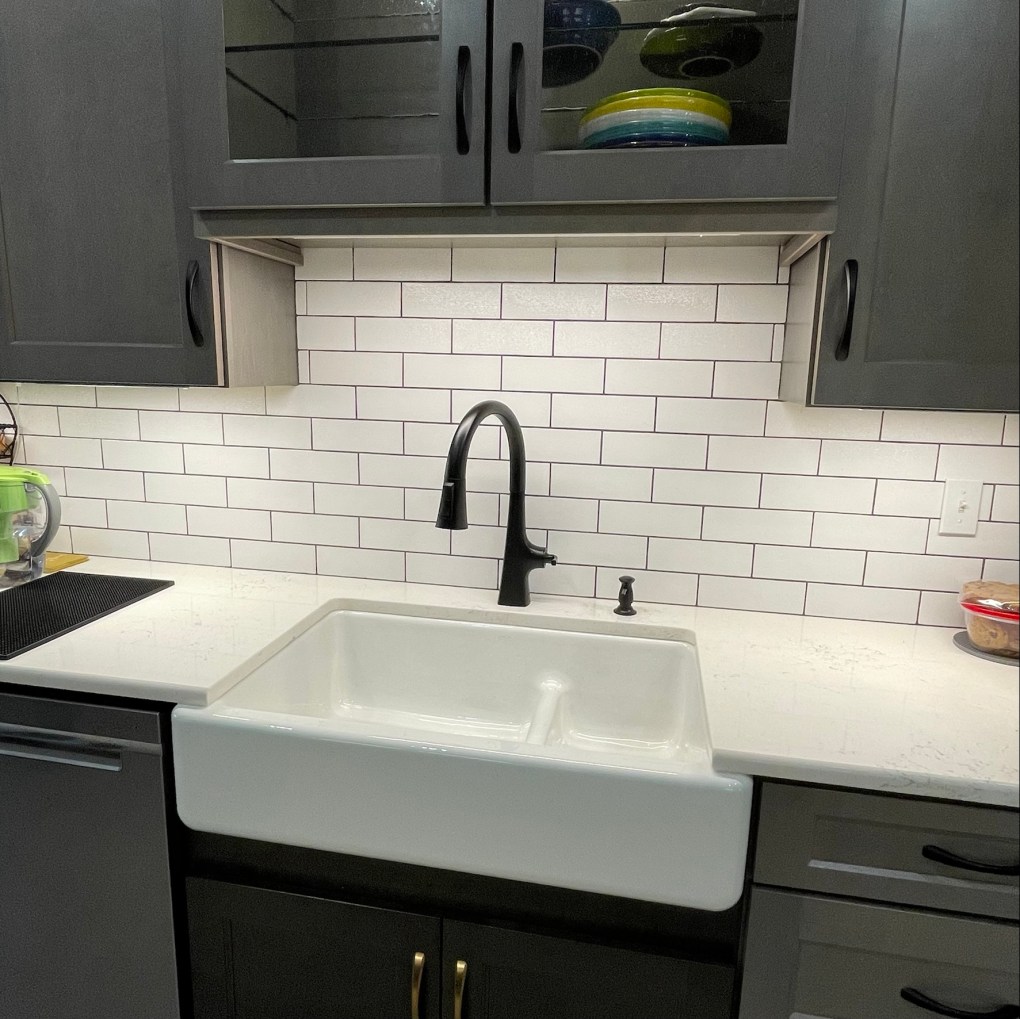
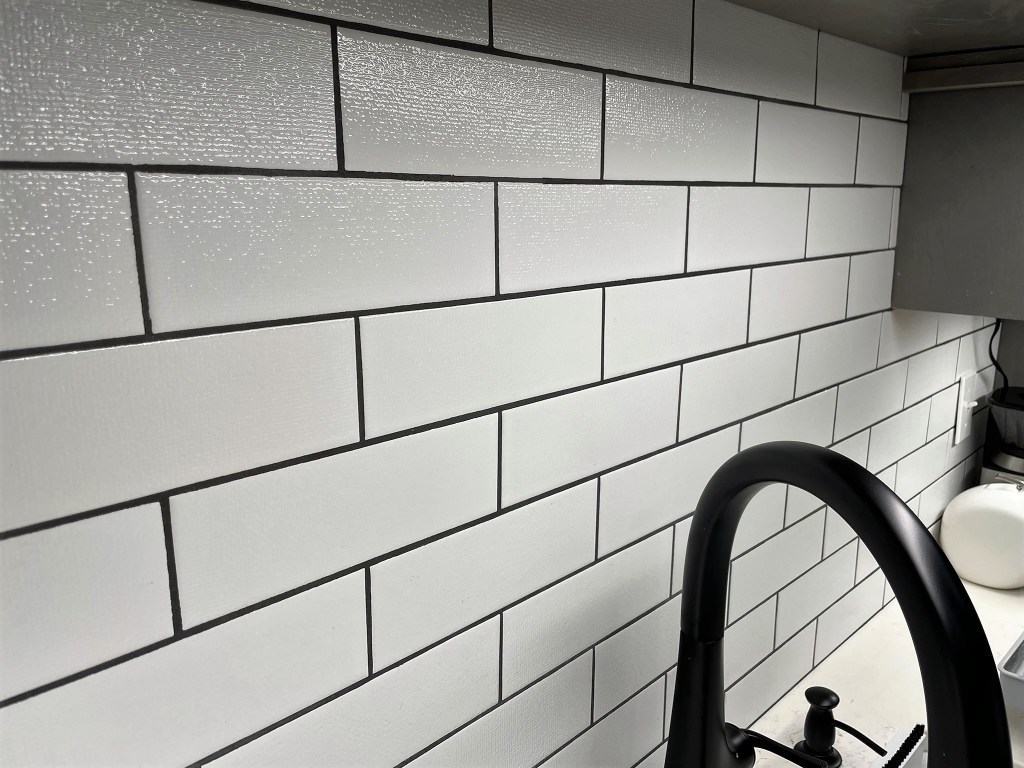
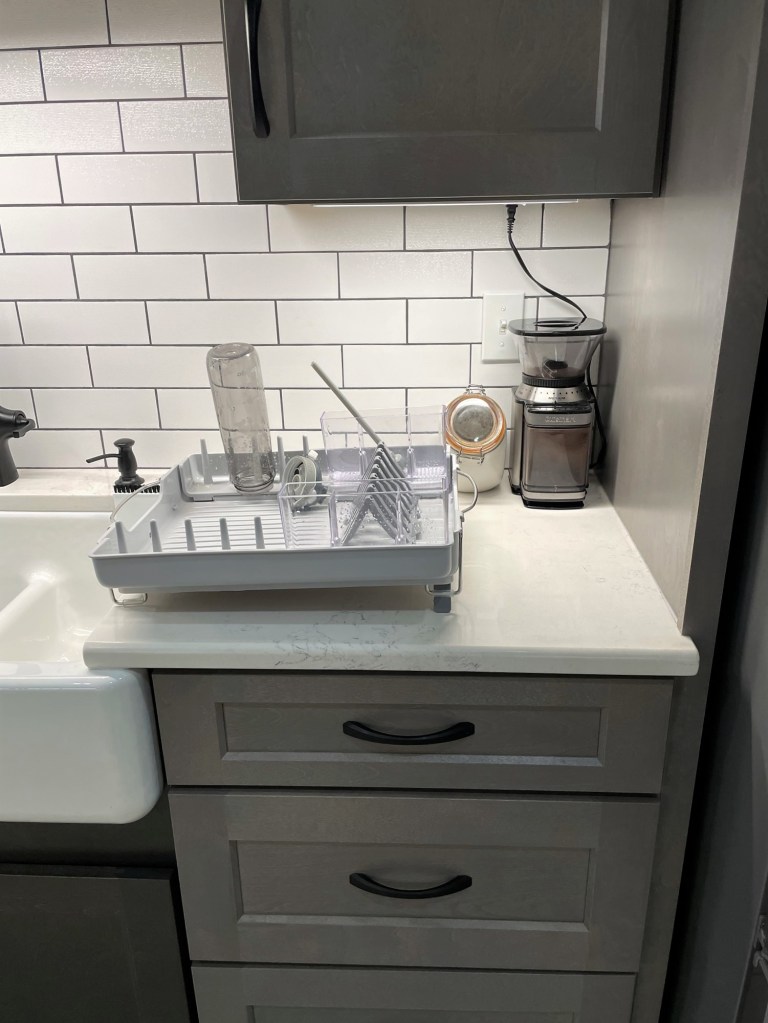
I am completely in love with this backsplash! The burlap texture on the white subway tiles is classic with a twist.
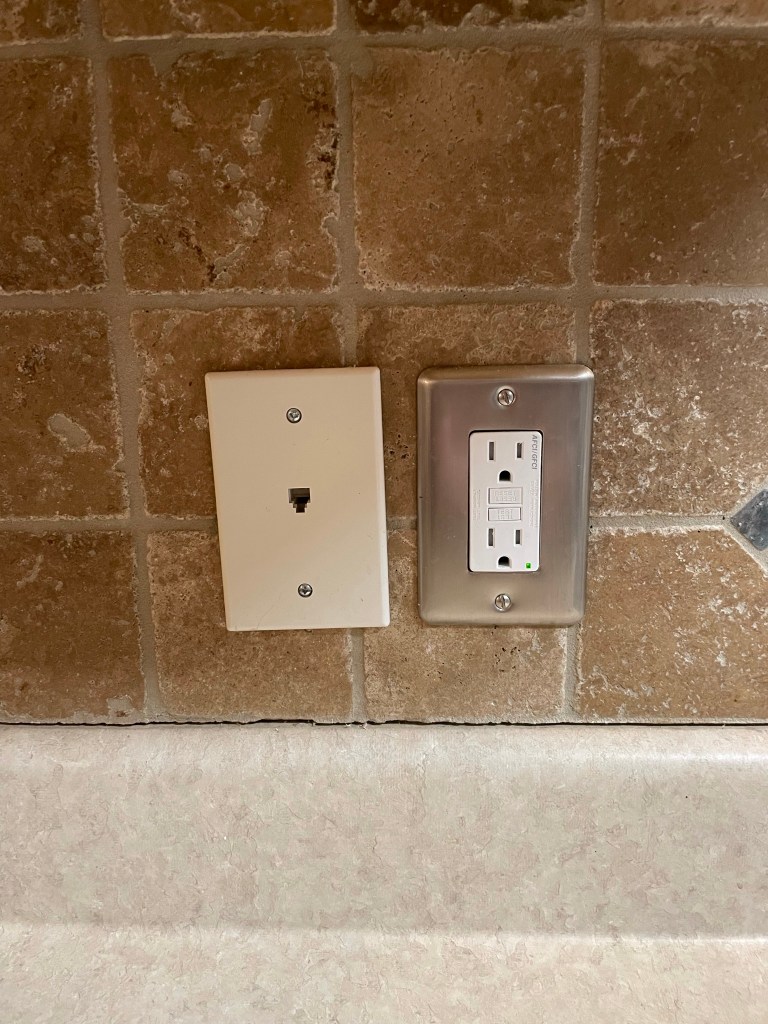
Notice what you don’t see? There are no outlets on the backsplash because we opted for strips along the underside of the cabinet.
I don’t have words to properly describe how much I hated seeing outlets everywhere on the backsplash. And the house has not had a landline phone for almost a decade.
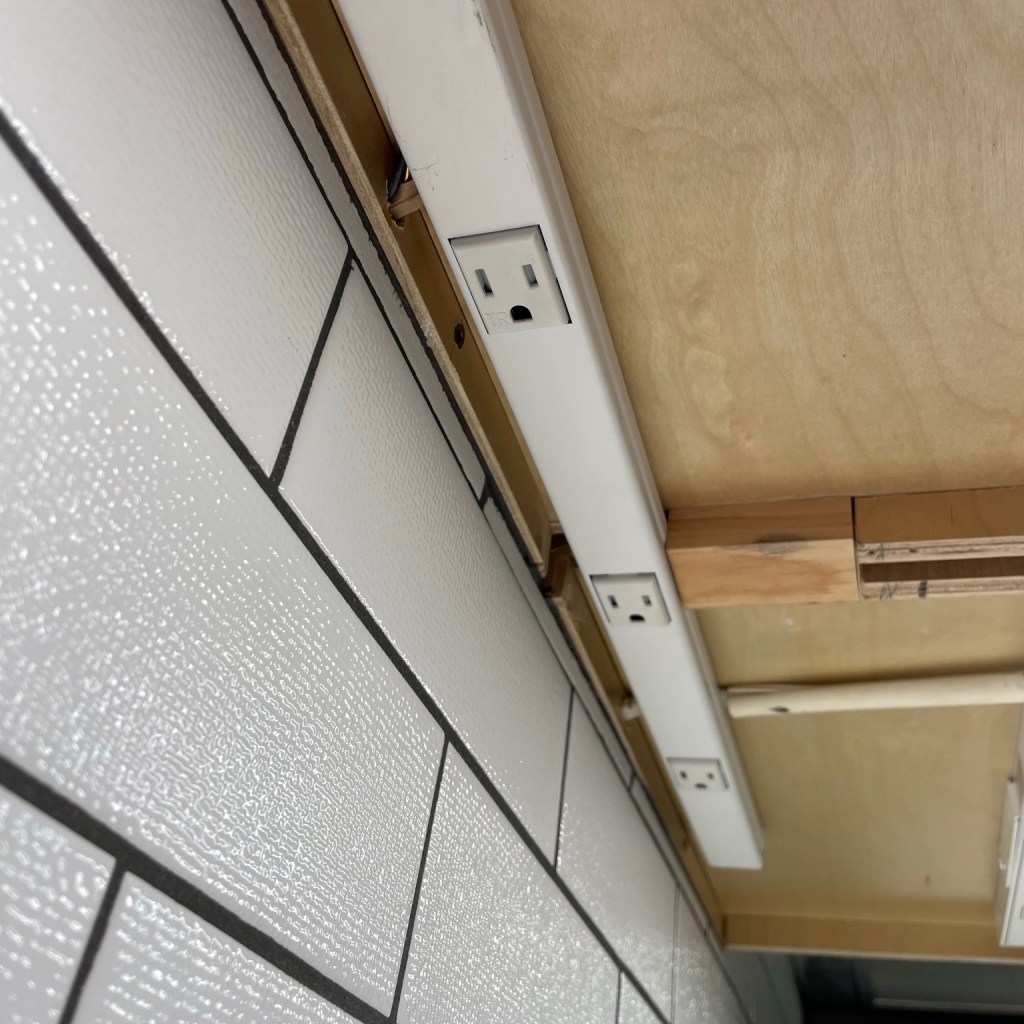
The hidden plugmolds provide all the power we need, without cluttering up the backsplash.
My trusty coffee grinder is the only appliance that lives on the counter. In hindsight, I would have agreed to a single wall outlet here, with a GFCI that could have served the entire wall.
When I first spotted the plugmolds (on Pinterest, of course), I got so excited! Part of my frustration with outlets on the backsplash has been pure vanity; I didn’t like them photo-bombing my food photos for Comfort du Jour, and I cursed them every time I tried to get a good image. But my blog is not for profit, so that was not the only justification for our splurge on this unusual item. We need all the counter space we have, and our appliances do not live there permanently (well, except for my coffee grinder, which uses a very small footprint in one corner). The plugmolds keep cords and charger cables up and out of the way when we use our small appliances, and there is nothing to obstruct the view of our gorgeous subway tile when we don’t. We like the clean look very much, but if you prefer always having appliances within easy reach, or always plugged in, this may not be for you.
Also, the plugmolds do not afford the convenience of a ground fault interrupter, so all the kitchen outlets must be on a breaker box circuit. If we get crazy and trip a breaker, we will need to trudge to the garage to reset it. So far, so good, as that hasn’t happened. Had this been explained to us on the front end, I would have agreed to one GFCI outlet in the kitchen, right there in the space where my coffee grinder lives.
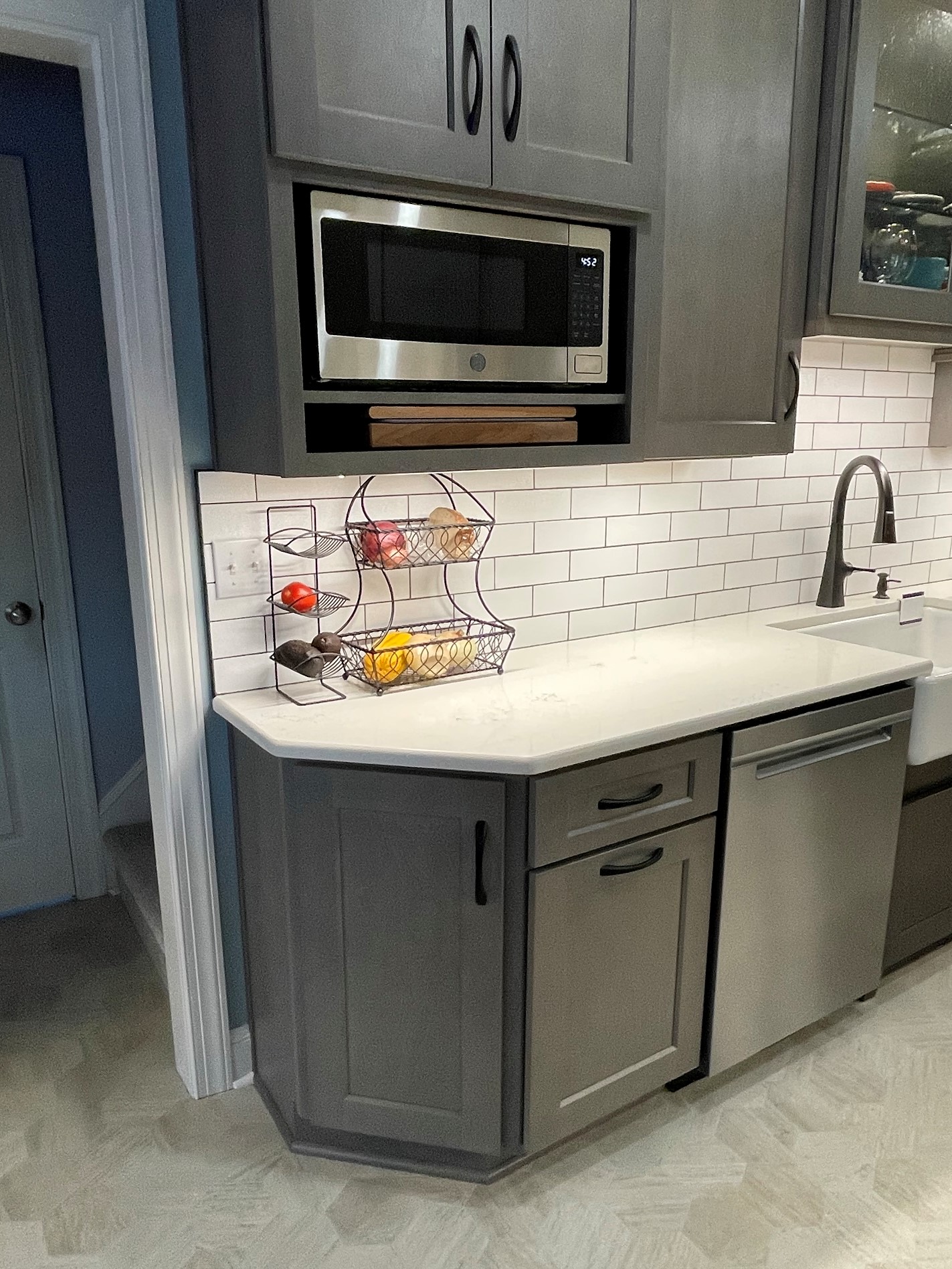
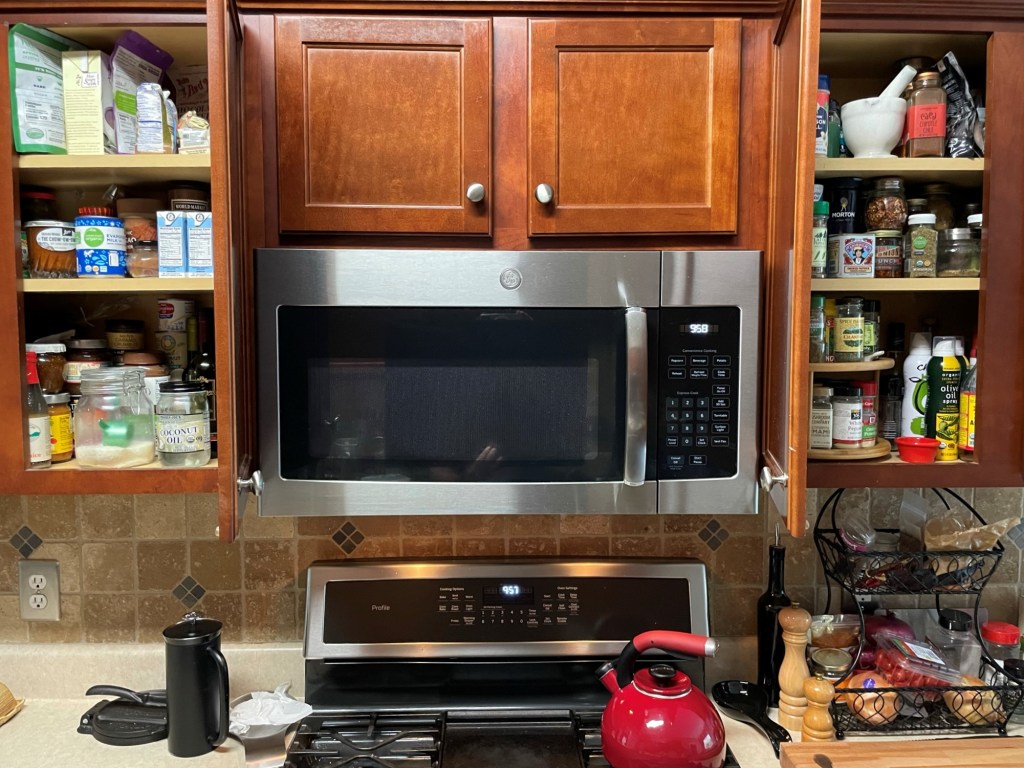
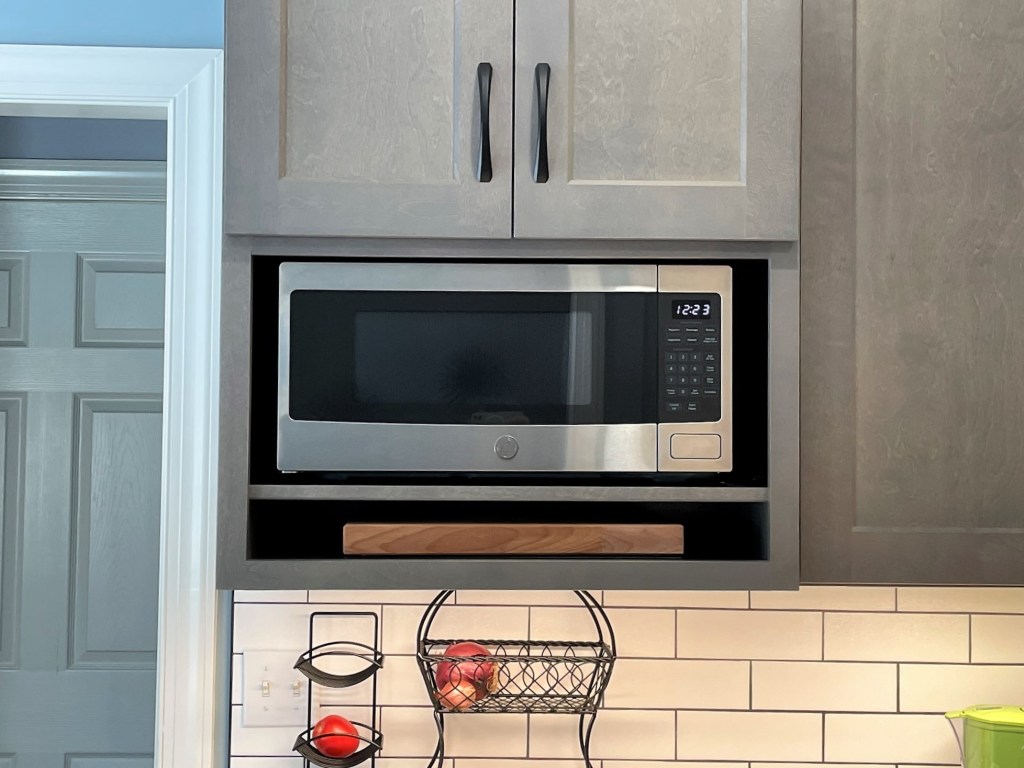
This arrangement gives the impression of a built-in microwave, but with more flexibility.
The microwave cabinet was under discussion from selection of our materials all the way to installation. We wanted to move the microwave from its previous position above the range, where it not only obstructed my view of the back burners but created havoc when Les and I worked in the kitchen at the same time. He could not warm leftovers or give our breakfast bacon a quick zap to rewarm it without bumping into me as I finished an omelet.
Many people choose to place a built-in microwave above a wall-mounted oven, but that was not an option for our kitchen footprint. Our house is on a slab and we were not interested in the enormous expense of moving walls or plumbing to make room for wall ovens. And for sure, we did not want to lose counter space to a microwave. We chose the GE Spacemaker microwave, which is low-profile and only 12 inches deep, but housing it remained a challenge.
Our cabinet designer, Molly, presented the terrific option that we chose—she ordered from the cabinet manufacturer a 24-inch depth microwave cabinet (the same kind that would be used for a standard built-in), and her cabinet technicians modified the cabinet to a 15-inch depth and added a secure shelf for our microwave, leaving space below for storage of our cutting boards! There is plenty of space around the microwave for ventilation (this was confirmed by the microwave manufacturer as well), and if we should ditch the microwave in the future, the shelf will be perfect for displaying our favorite cookbooks.
All my favorite baking tools live in this butcher block-topped station. Is this the sweetest little setup? ❤
The butcher block countertop makes my baking station feel special—even the lighting seems warmer reflected off the wood tones—and I love the surface for bread dough and pasta dough. The water-based finish is every bit as smooth as our lovely quartz countertops and does not require any special maintenance. We ordered the block with a greater overhang than what is standard, and that gives me plenty of space to attach my pasta machine to the counter—something I could not easily do on our other counters.
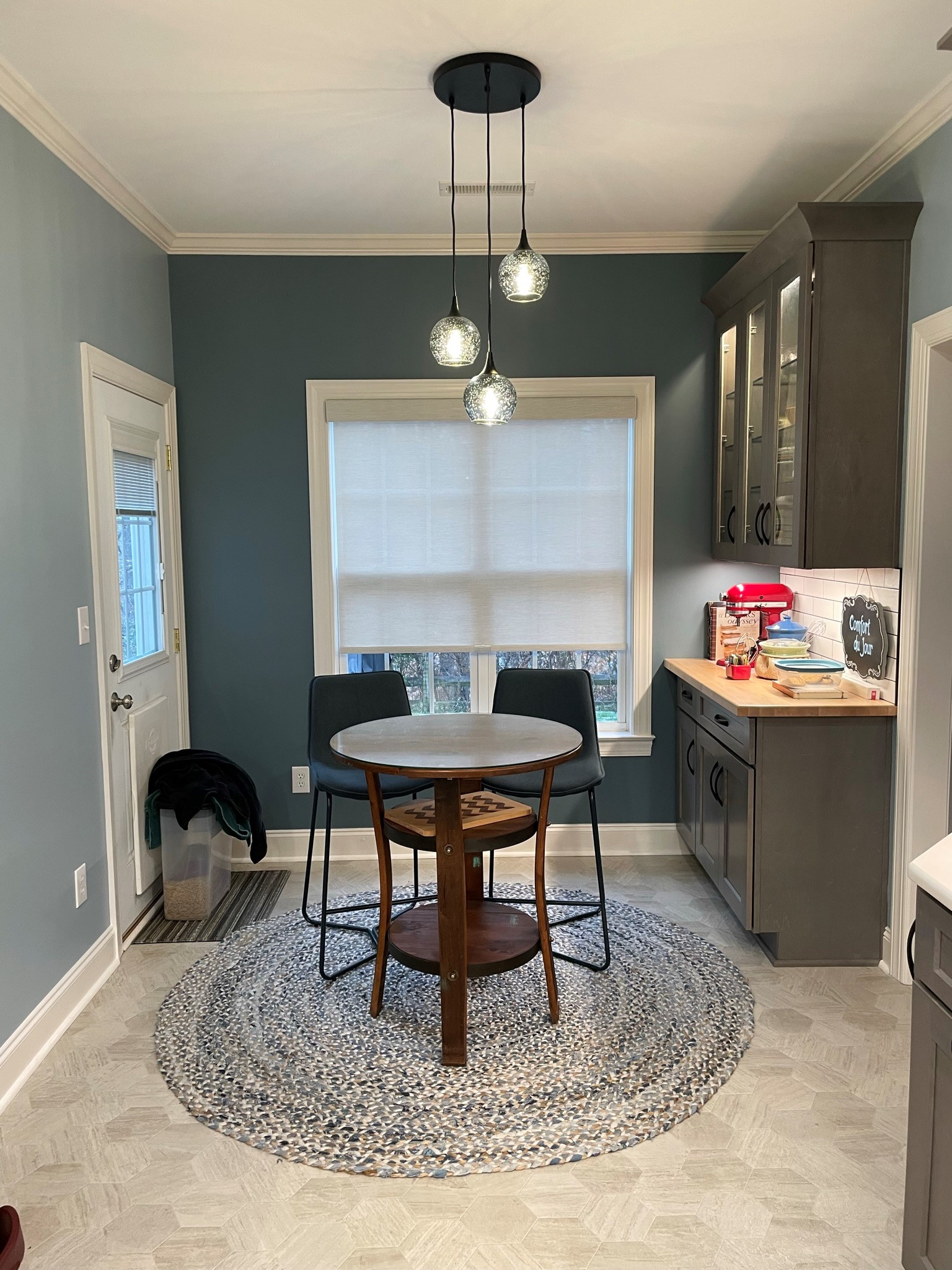
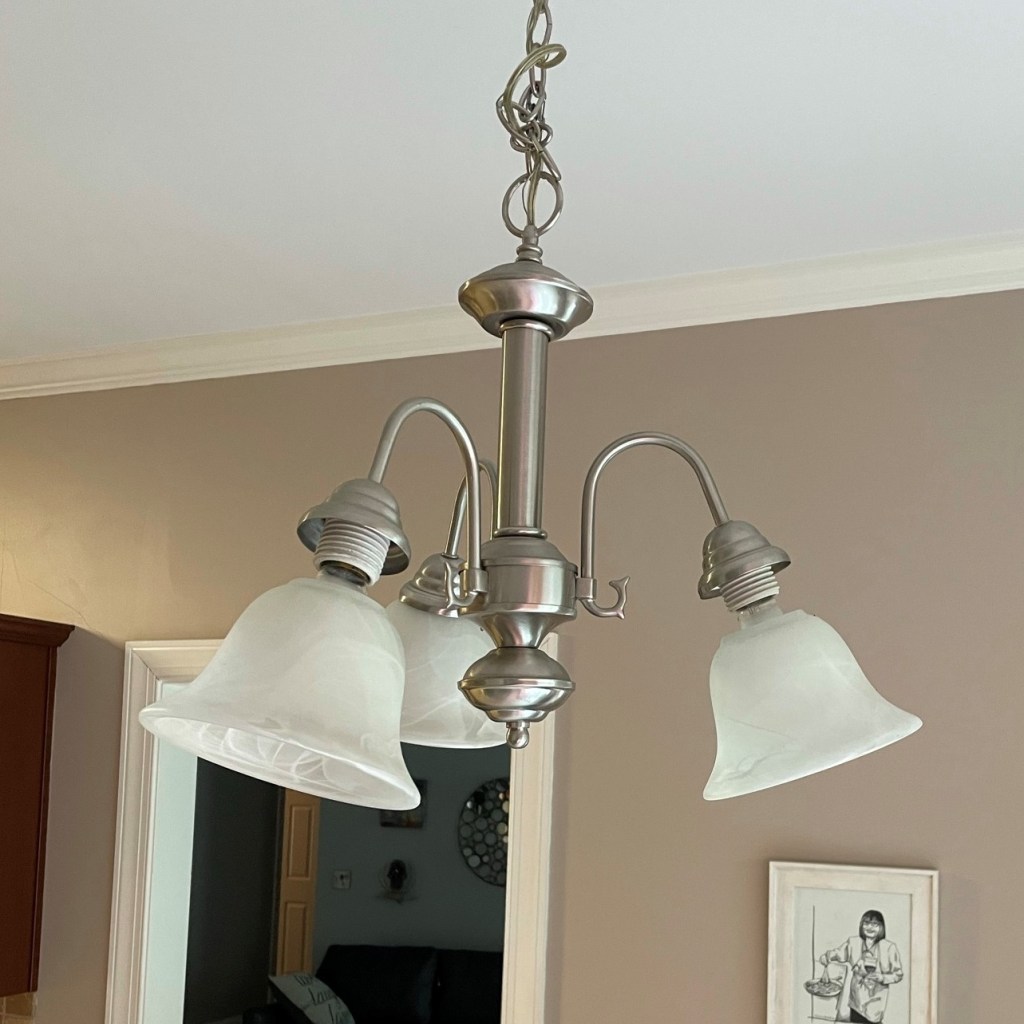
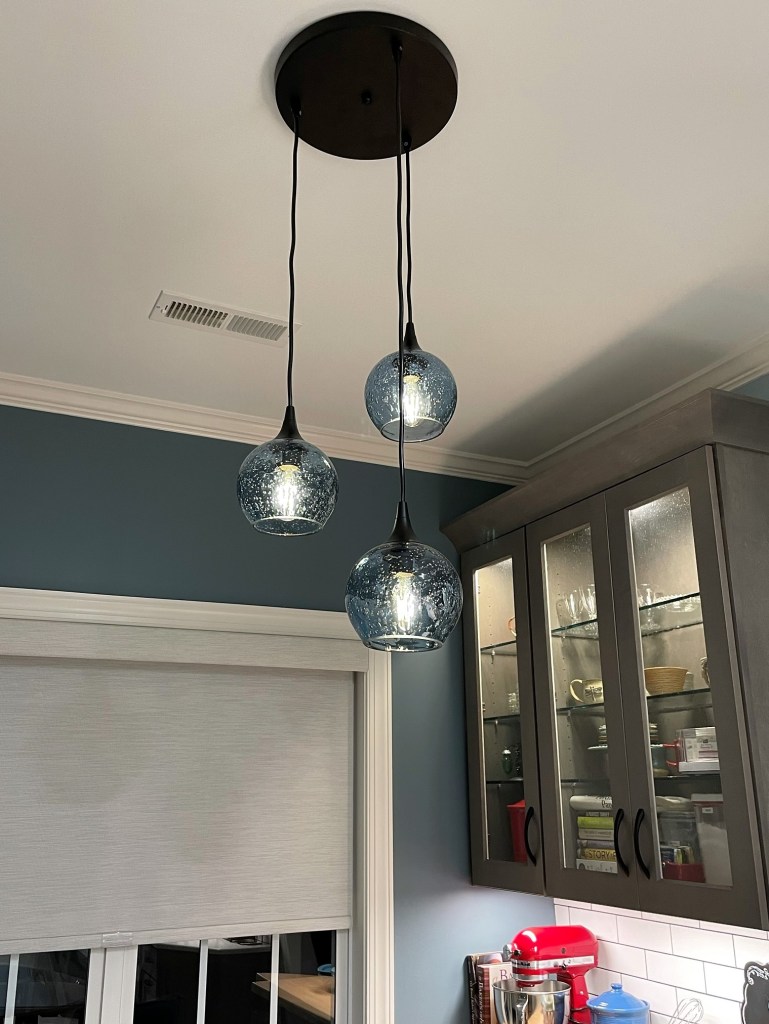
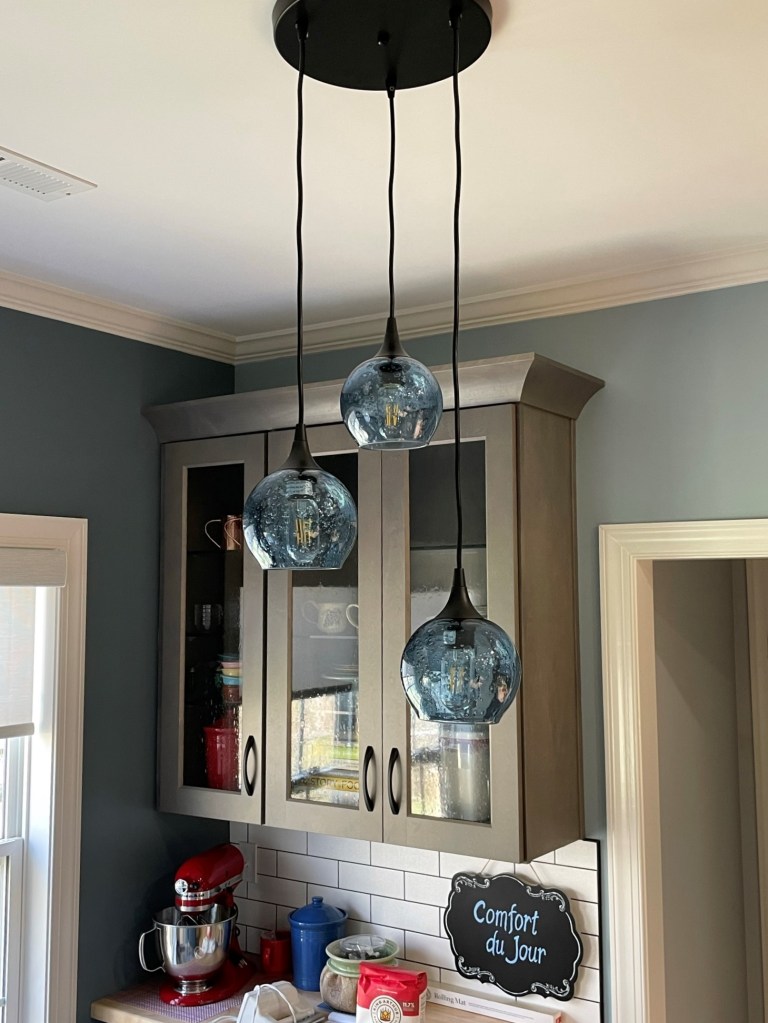
Finally, the special little touches that give our kitchen pizzazz. We wanted the former dinette area to feel cozy and inviting, so we did not choose to have bright wafer lights in this part of the ceiling; rather, we changed out the frazzled old fixture with a beautiful piece that was handmade from recycled glass, by Bicycle Glass, a company dedicated to sustainability, and you know how much I like that.
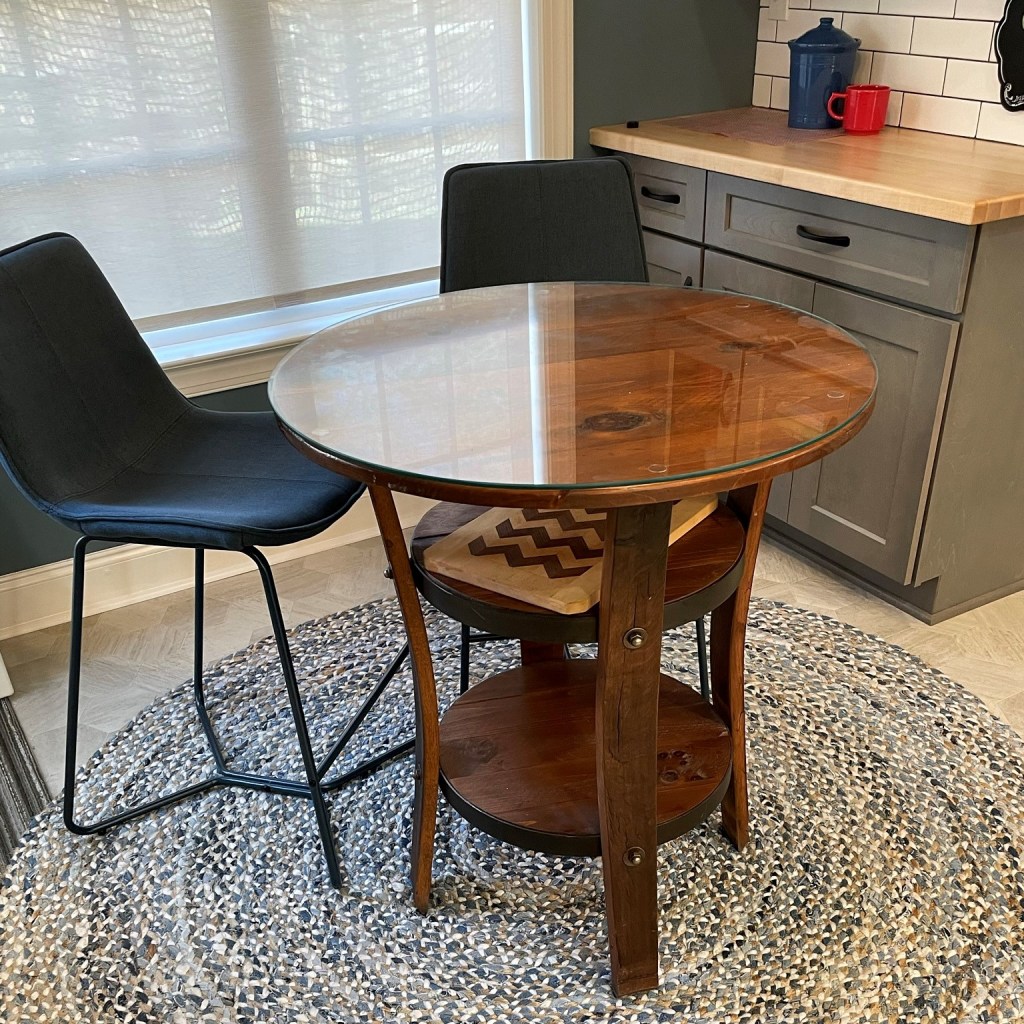
We also added a uniquely handcrafted table that was made locally, and we now refer to this region of the kitchen as “the bistro.” 🙂
I couldn’t wait to get rid of this junky, old, builder-basic chandelier that was literally falling apart.
I found this light fixture online by sheer luck, and it’s perfect! The seeded glass shades were custom made by craftsmen in Minnesota. The matte black finish of the canopy matches the other hardware in the kitchen.
We love this so much, we ordered a similar chandelier for the dining room, which is next on our update list!
We scoured the internet for a bistro-size table for our dinette area, but came up empty-handed. We stumbled on this one by accident when we visited the tasting room of a local winery. The base is made from an old wine barrel! Les found the blue fabric stools on Wayfair, and the braided rug has a vintage look and makes the space feel cozy.
The end of our remodel means the beginning of a new chapter of food adventures. We have already enjoyed our first holiday season in the new space, and many more fun meals will be served up soon, so stay tuned!
Much of the Southeast U.S. has been under a winter storm warning since we went to bed last night, and as I have watched tentatively out the window today, half expecting the power to go out from wind-toppled trees that have been coated with sleet and ice, I wrestled with my desire to be at the stove and the oven. There’s something very cozy about simmering a stew or pulling a loaf of bread from the oven on a blustery day, and this is definitely one.
It’s pretty on paper, I guess.
The day was beautiful at first, with mainly fluffy snow falling at a steady pace. We knew it would morph into a nasty mix, though, so we bundled up and headed out early for a walk around the neighborhood with our dog, Nilla, who absolutely loves cold and snow. It was beginning to sleet when we got back to the house.
This is Nilla’s favorite kind of day!
After much consideration, I finally gave in to the temptation to bake. It feels risky for many reasons. Our gas range is technically dual-fuel, with a natural gas cooktop but an electric-powered oven, so I had to choose something that could be done quickly (or at least put aside to bake later, should the power go out). Also, I come from a long line of highly accomplished cookie bakers, and that’s a lot to live up to, given that I hardly ever venture into treat baking. On top of that, my dear husband has made a reputation for himself with his own cookie baking, so I’m living on the edge in several ways today.
When Les makes cookies, they are almost always a version of chocolate chip; sometimes they have chips and chunks, with big, chewy bits of dried cherries or cranberries. Sometimes he adds cocoa powder to the dough itself, making them chocolate on chocolate with more chocolate. No wonder he is so popular, right? But he seldom strays from the chocolate chip category, and I wanted something different today.
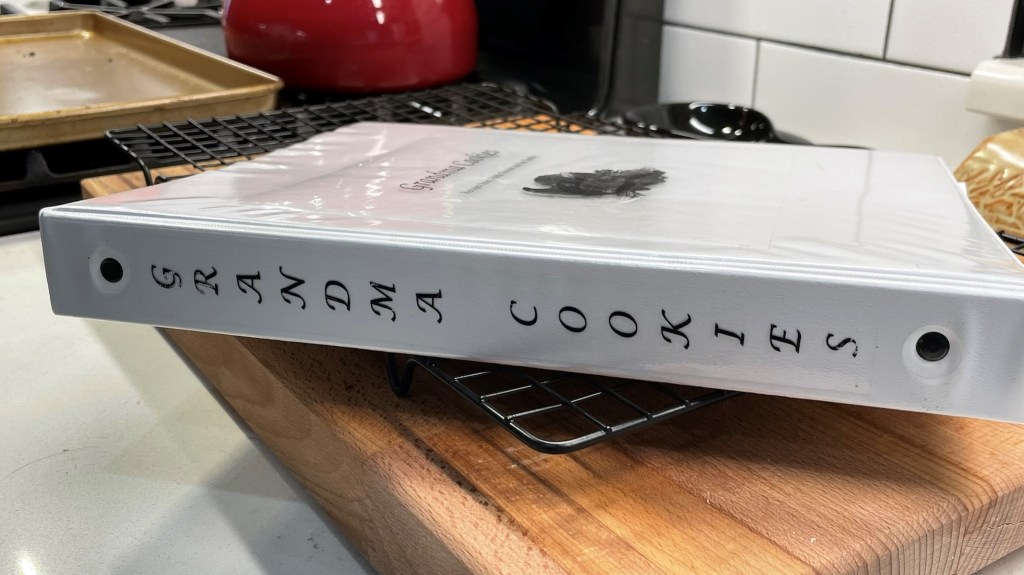
Several members of my mother’s side of the family have contributed to this collection, but it is mostly sweet treat recipes of my great aunt.
Without my own arsenal of go-to cookie recipes, I reached for a family cookbook—this homemade, 3-ring binder notebook, chock-full of recipes submitted by various members of my maternal family, and especially my great-aunt Adele. She was my Gram’s sister, and she was a master cookie baker if there ever was one. She was so known for her baked goods that her grandchildren called her “Grandma Cookies,” and I have my own memories of the treats she joyfully baked and shared with everyone. At Christmastime, you could count on receiving a box of various homemade cookies—and it didn’t matter if you lived across the street or on the other side of the country. She saved up cracker boxes and tea bag boxes and coffee tins and filled them up with her goodies so you could always have a taste of home.
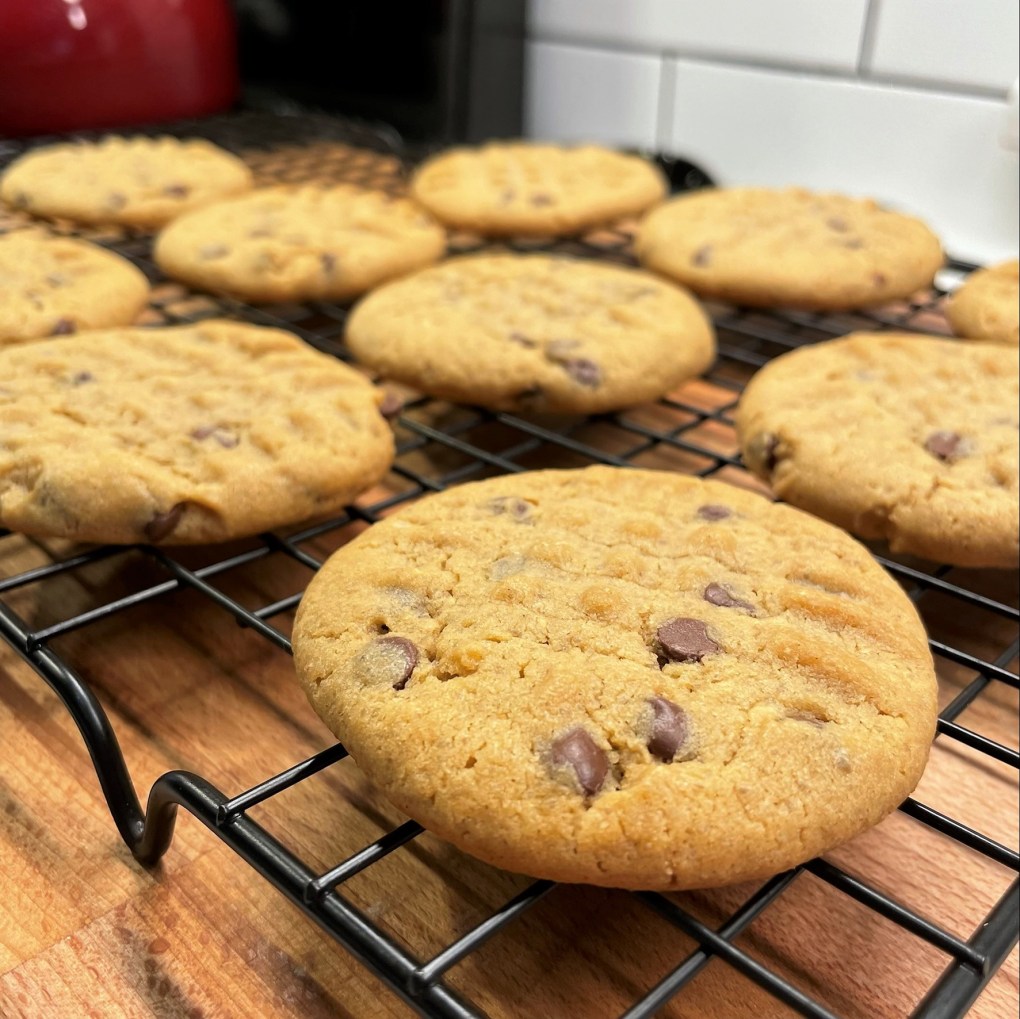
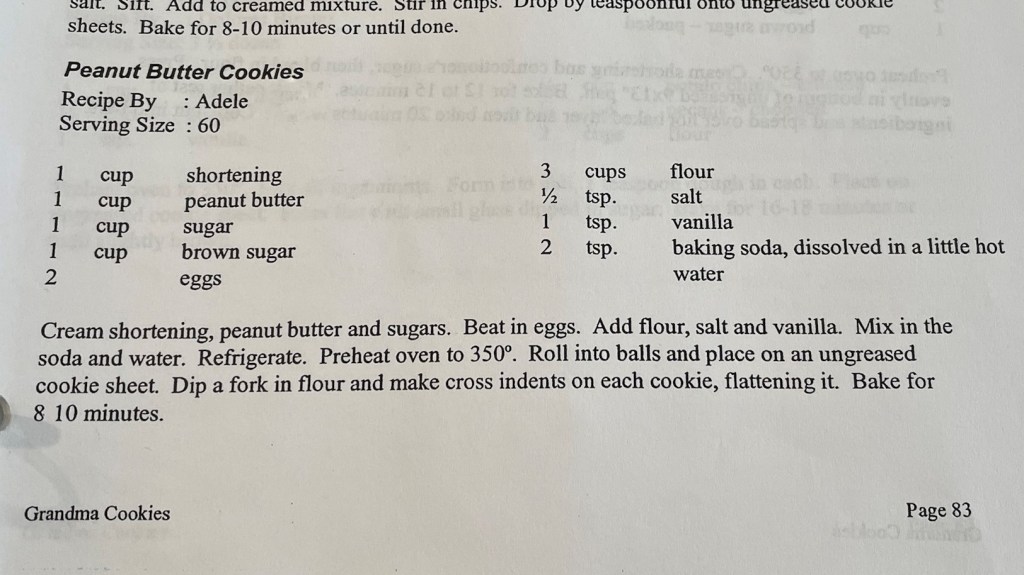
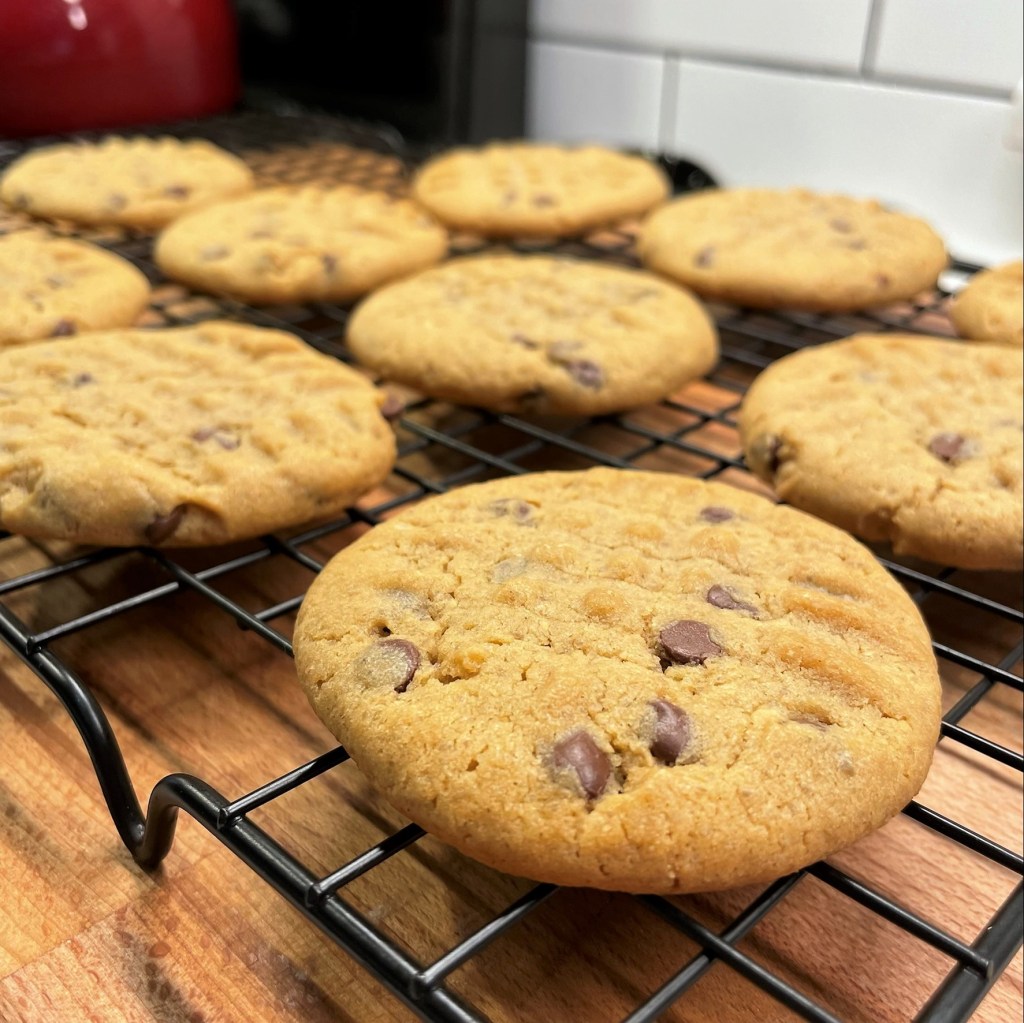
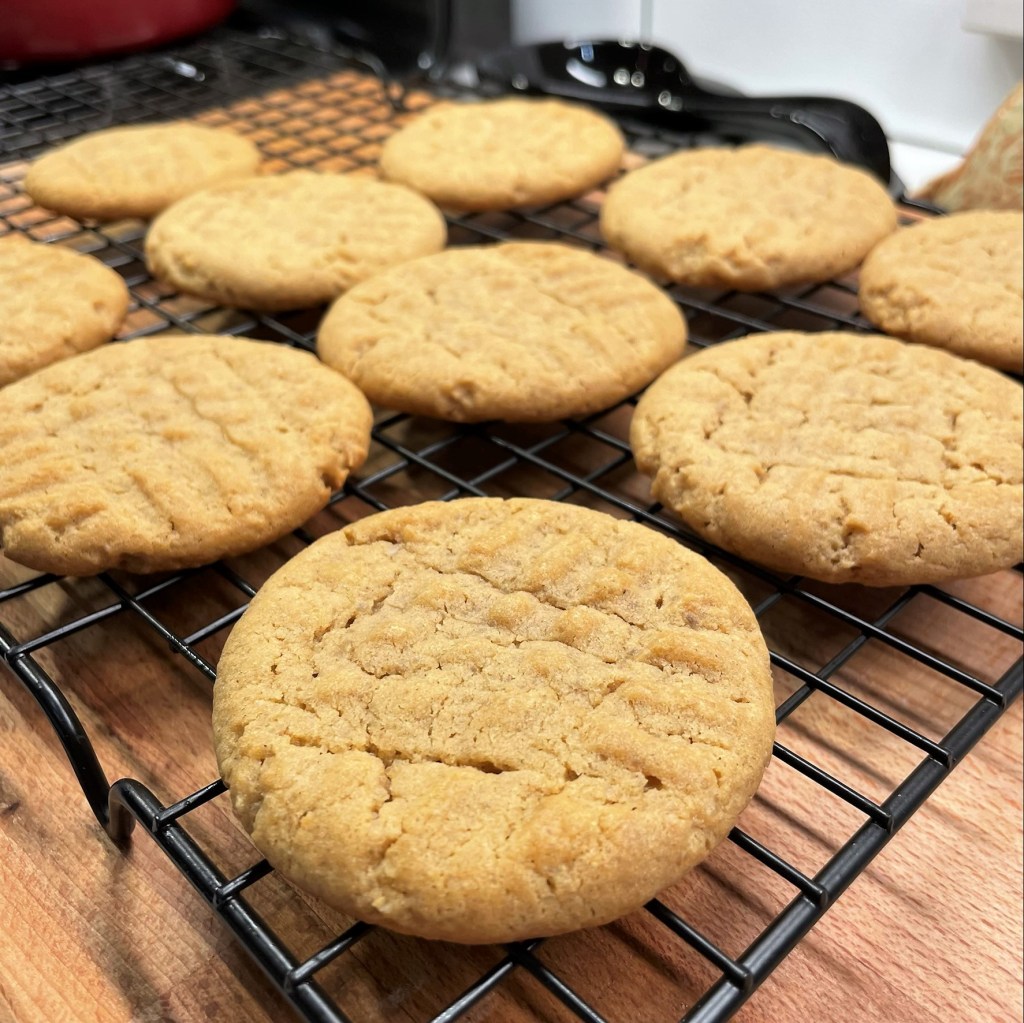
I’ll never live up to that standard, but I did a decent job with her peanut butter cookie recipe, with a few adjustments of course. First, I made a half batch, because we don’t need 60 cookies when we are stuck in the house. I never use only white flour in any recipe, so I subbed in an amount of whole wheat pastry flour which is nice and soft for tender baked goods. I don’t use shortening either, but real butter worked great. And, because my hubby is so fond of chocolate chips, I divided the dough in half and added mini chocolate chips to one portion of it for his taste, and the cookies turned out great both ways.
Some of the instructions in Aunt Adele’s recipe were a bit vague for this cookie novice but, thankfully, my Aunt Joy offered her experience to help me fill in the blanks.
My great aunt’s original recipe. I halved it and took a few liberties with the ingredients list.
Ingredients
1 stick salted butter, slightly softened* (see notes)
1/2 cup peanut butter
1 cup light brown sugar, packed*
1 large egg
1/2 tsp. real vanilla extract
1 tsp. baking soda, dissolved in a small amount of hot water*
1 cup all-purpose flour
1/2 cup whole wheat pastry flour
1/2 tsp. kosher salt (or 1/4 tsp. regular salt)*
1/4 to 1/2 cup mini chocolate chips (optional)*
*Notes
Butter should not be so cold that it’s hard, but not room temperature either. When you cream it with the sugar, you want it to be smooth and just slightly firm. I was impatient so I took a shortcut with my straight-from-the-fridge stick of butter.
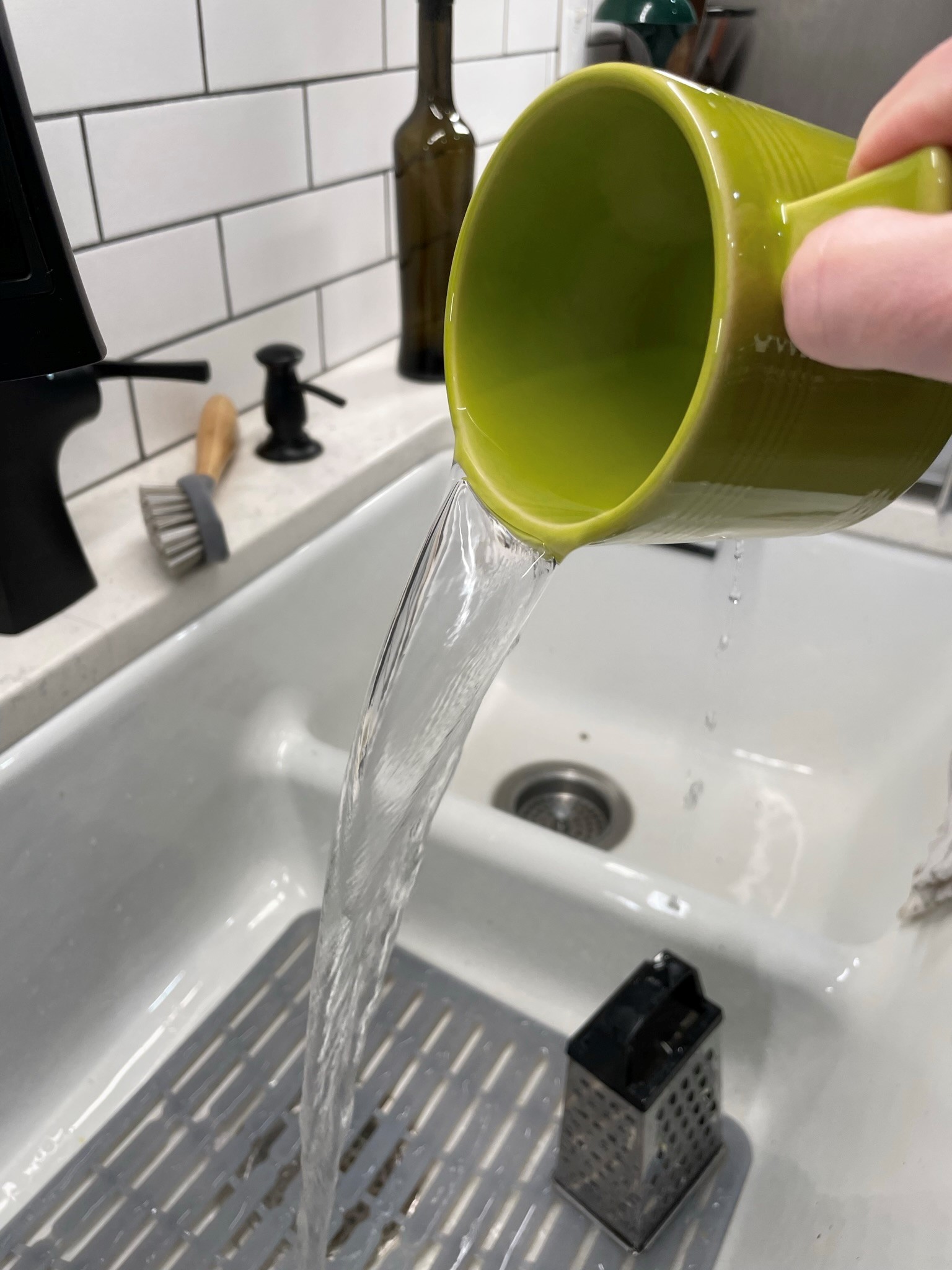
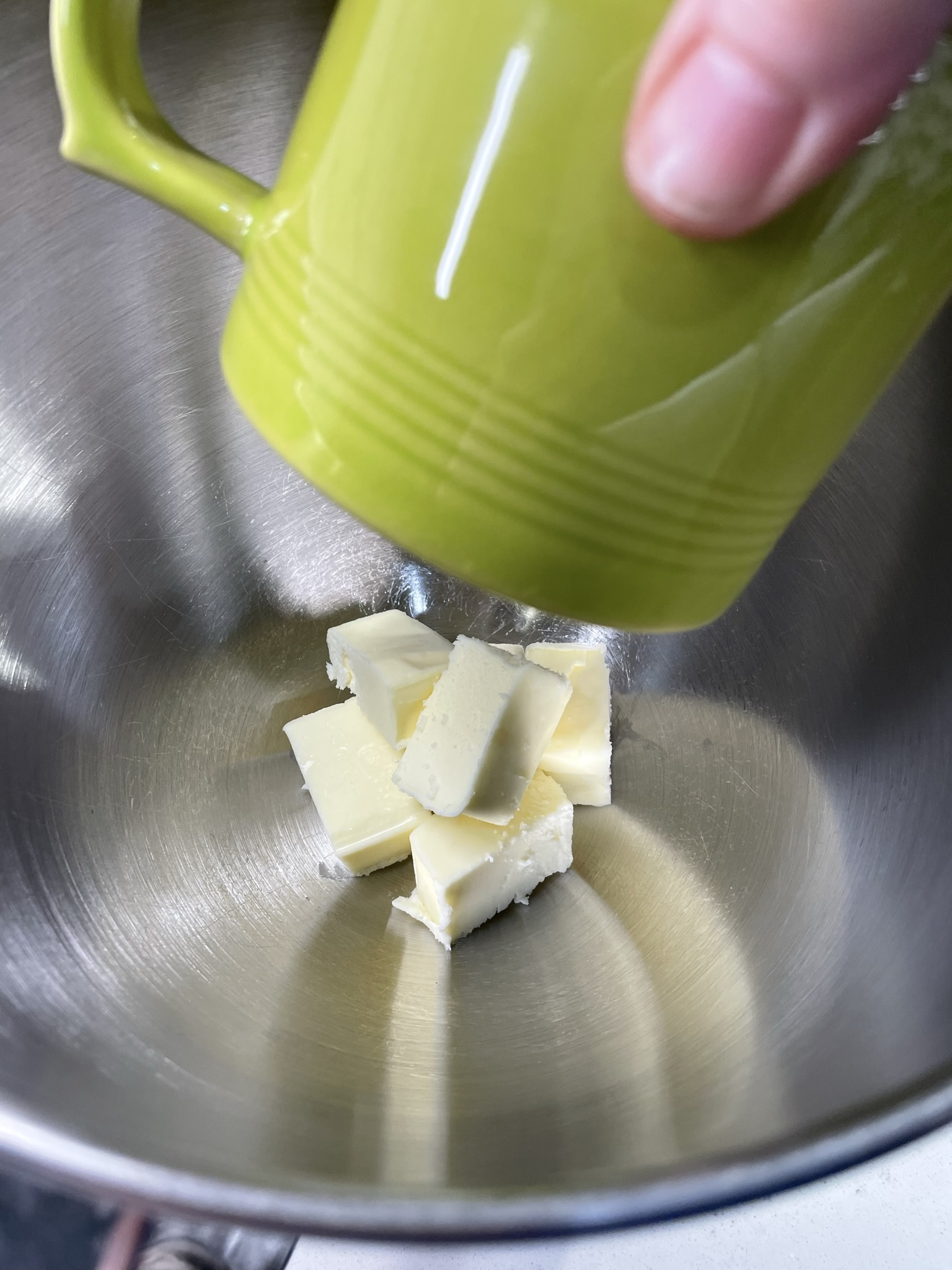
I filled a large mug with boiling water for a few minutes, then emptied it.The cold butter was cut into pieces, and I placed the hot mug over it for about ten minutes.Soft, but not melted. Easy and done!
My great-aunt’s original recipe suggested equal parts sugar and brown sugar, but I like a soft cookie, so I used all brown sugar. When you measure brown sugar, be sure to pack it snugly into the measuring cup. When you turn it over into your bowl, it should mostly hold its shape.
I have long wondered why some cookie recipes call for dissolving the baking soda in hot water. Given that it appears on many of the recipes my grandmother and her family have shared, I even considered that perhaps it was something they all learned from my great grandmother or something. But a quick bit of research (thank you, internet) turned up the real reason—dissolving the soda helps ensure that it can be evenly dispersed throughout the dough. If I were to mix it in with the dry ingredients, it would be prone to clumping. Now we know!
I cook and bake mostly with kosher salt, which has larger crystals than table salt. Those crystals take up more space in the measuring spoon, but some of that space is just air, so I use a little extra. My conversion is probably not exact, but I generally like to add a bit of extra salt to a baked good anyway to enhance the other flavors.
I used mini chocolate chips in half the cookie dough, and kept the rest as simple peanut butter dough. If you want chocolate chips in all the cookies, use 1/2 cup rather than 1/4 cup, as I did for my half-batch.
Instructions
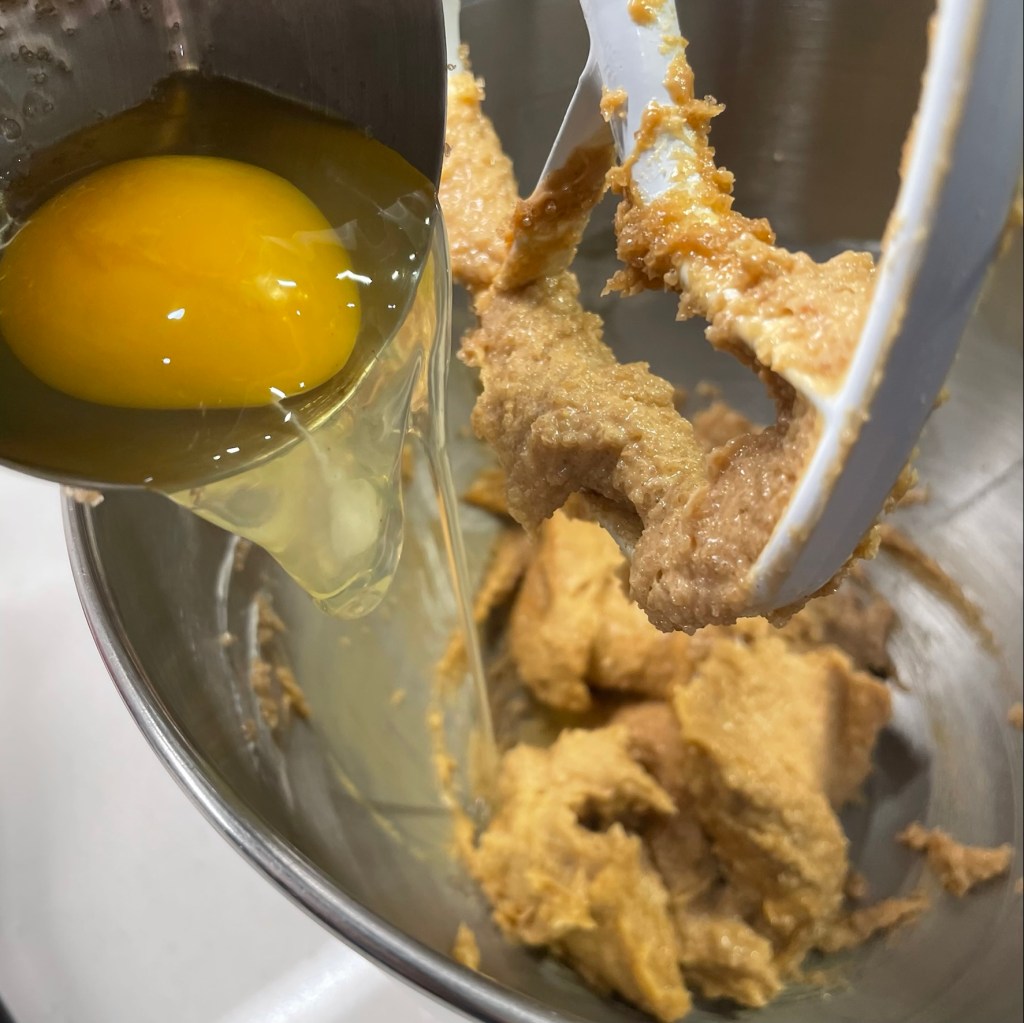
You know this goes; cream the butter and sugar together with the peanut butter, then beat in an egg and stir in the vanilla.
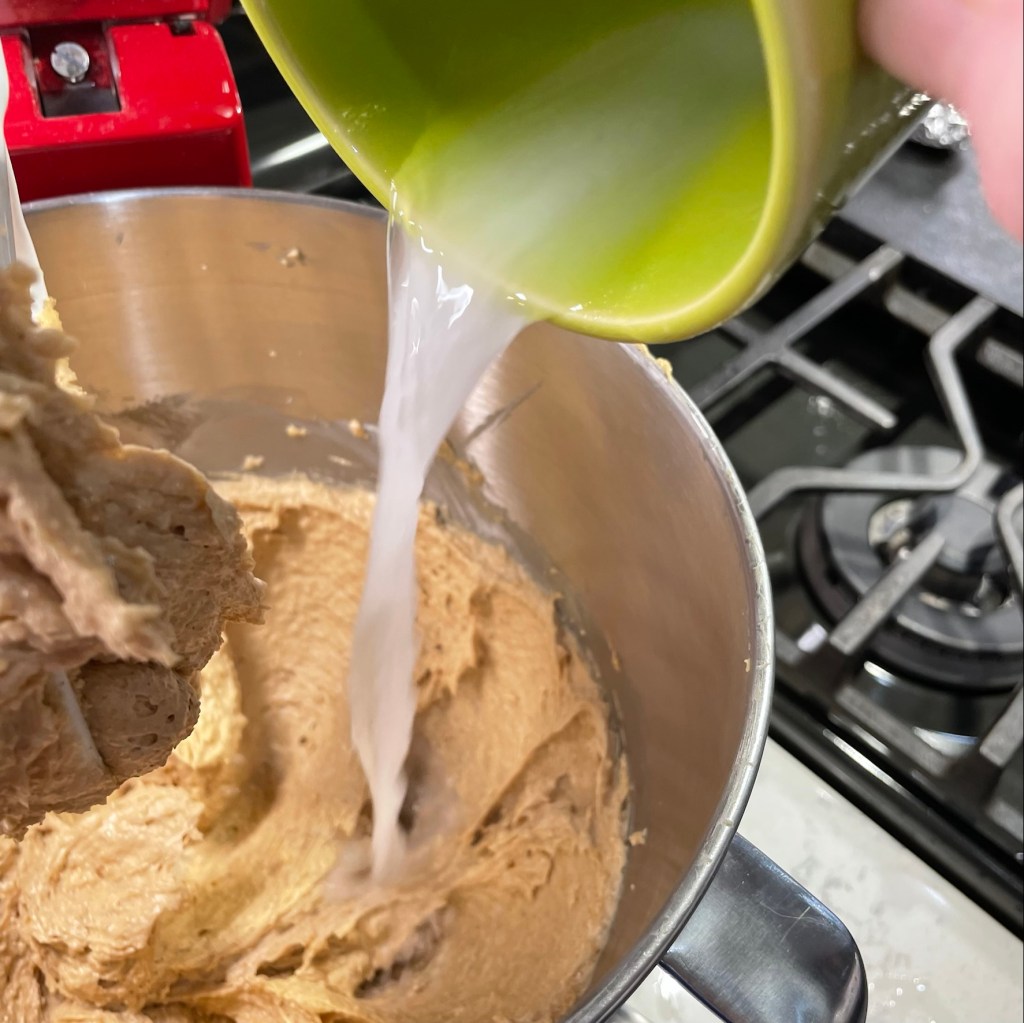
Here goes the dissolved soda, and I beat it long enough to mix it with the dough.
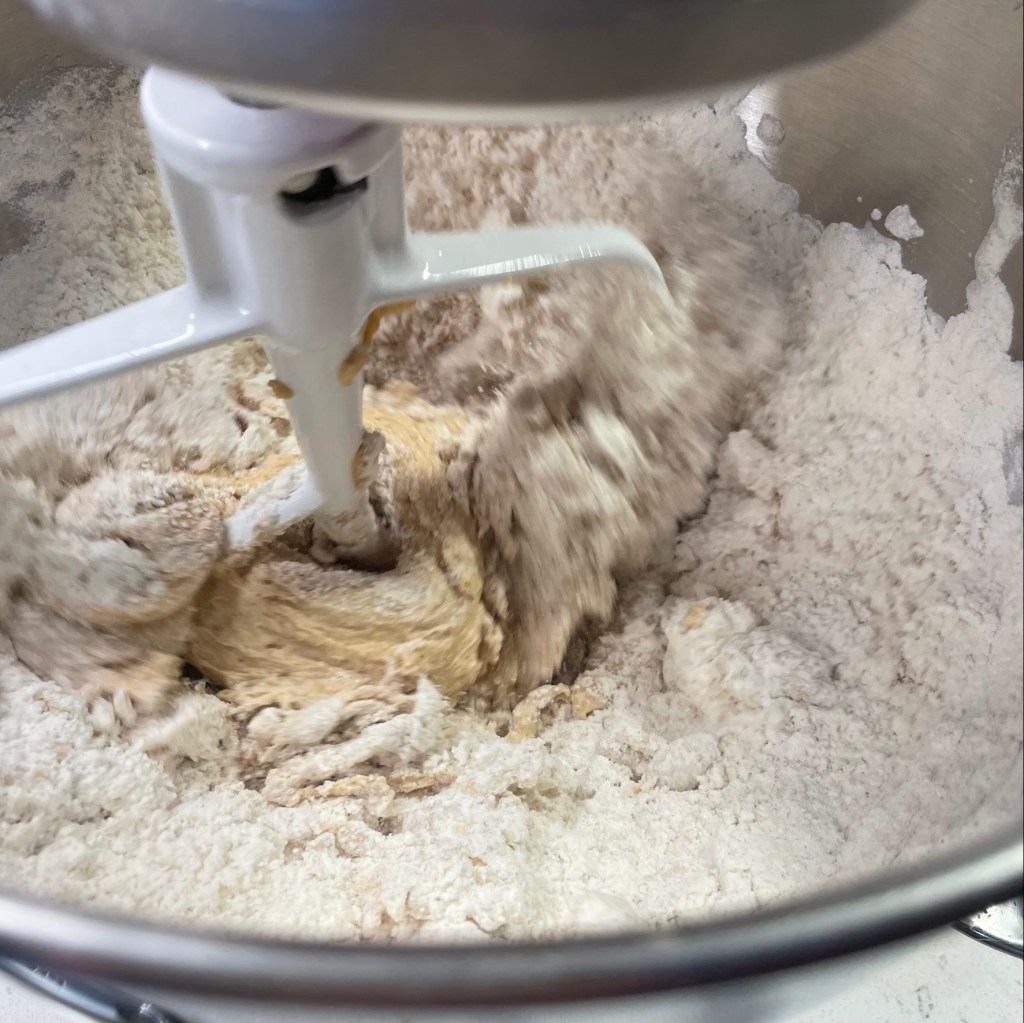
Beat in the flour and salt just until incorporated, and scrape down the sides to be sure all is mixed well.
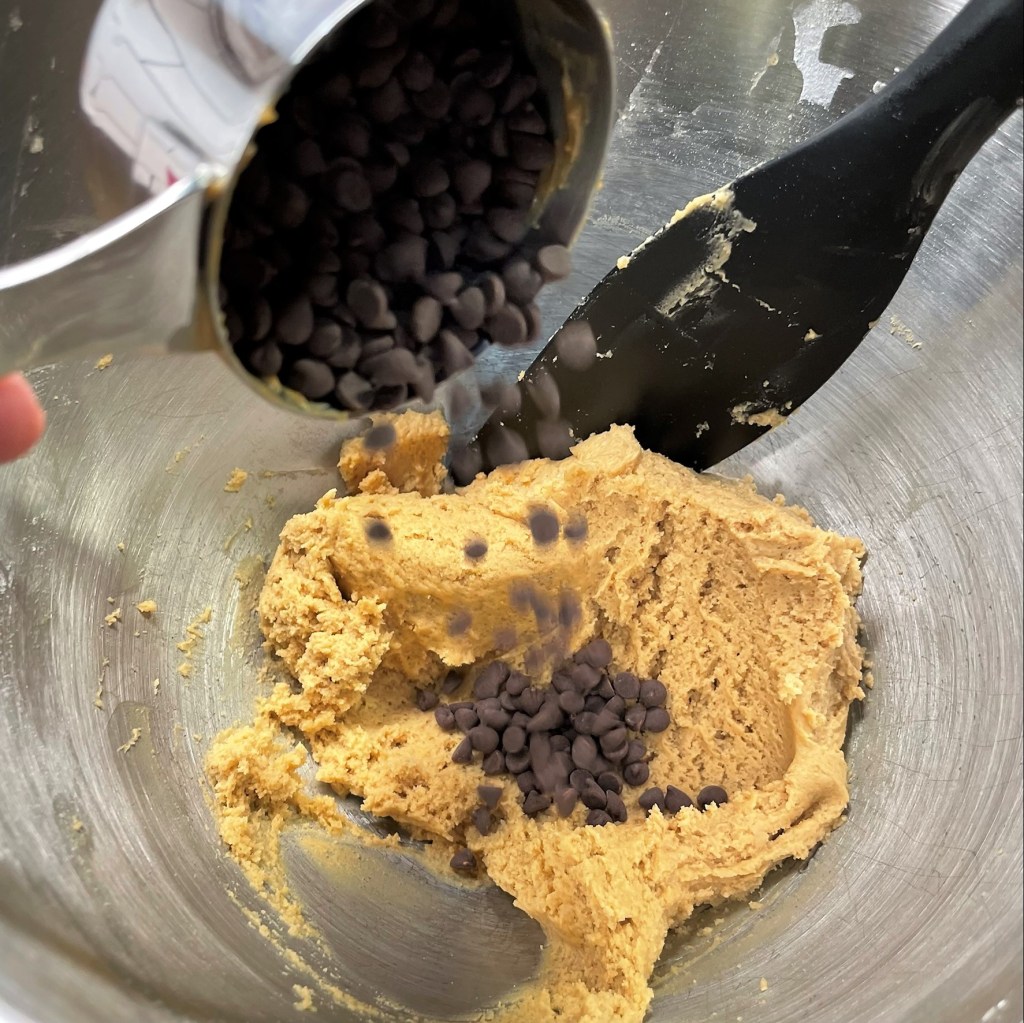
I divided the dough in half and folded the mini chips into one portion of the dough.
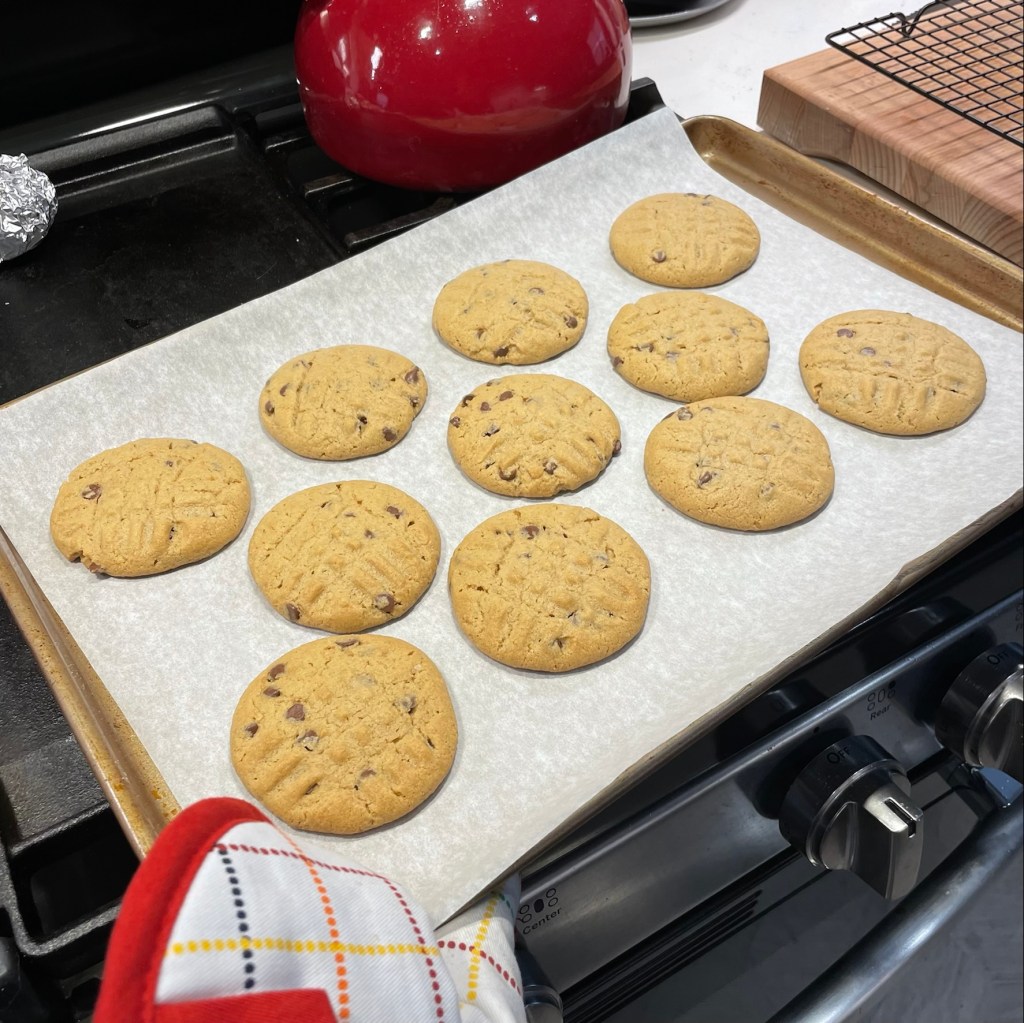
Chill the dough for an hour, then shape into balls. These are getting the usual criss-cross shape, with a floured fork.
Bake the cookies at 350° F for about 10 minutes.
They softened and flattened, but did not spread much, which is good.
The chocolate chip peanut butter cookies turned out delicious.
And so did the plain ones!
Cream together the butter, peanut butter and sugar until evenly combined and somewhat fluffy.
Add egg and beat until blended. Stir in vanilla, then stir in dissolved baking soda.
Add flour, beating only until incorporated. Stop the mixer and scrape down the sides, then mix again only long enough to blend in loose flour.
If using the mini chocolate chips, fold them into the dough. Cover the bowl and refrigerate for about one hour before baking.
Preheat oven to 350° F, with oven rack in the center position, or two racks roughly positioned near the center of the oven.
Roll cookie dough into balls about 1 1/4” diameter. Place them on a parchment lined cookie sheet. Flatten in a criss-cross pattern, using a fork dipped in flour to prevent sticking.
Bake 9-11 minutes, depending on your oven. The cookies will be very puffy, and slightly dry at the edges when finished. Cool on the sheet about two minutes, then transfer to a cooling rack.
My husband and I are 16 days into our alcohol-free pledge to start the new year. For the most part, I have not minded this experiment of Dry January. The break from alcohol has already had some positive effects on my body; most noticeably, I feel more hydrated in ways that I did not expect. My skin and hair are not as parched, despite the recent cold snap that has kept us indoors with the heat running constantly. I have found more focus and energy for tasks that need to be done around the house, so that’s a good thing. And I am astonished at how much more sleep I am getting, and that alone makes it worth the sacrifice. Still, I have caught myself counting the days, making it unlikely that this would become a permanent lifestyle change.
When my husband and I made the decision to give our bodies a break from alcohol, we guessed correctly that the biggest challenge to our lifestyle would come on Friday nights. Our ritual, since the beginning of the pandemic, has been to finish the work week with (usually bourbon) cocktails, homemade pizza and, whenever it was scheduled, Quarantunes, the Facebook Live concert featuring our pals Glenn and Oria Alexander.
Ahead of the first dry weekend, I threw all my creative effort into an attempt at zero-proof cocktails. In my mixology experimenting over the past couple of years, I have already learned how valuable infused simple syrups can be for delivering extra flavors into a drink, so that is where I started my chemistry challenge.
For Les, I whipped up a smoky, spicy cherry simple syrup—featuring smoked black peppercorn, pink peppercorn, unsweetened black cherry juice and real vanilla paste—to mimic the essence of an Old Fashioned. For myself, I made another simple syrup—steeped with white peppercorns and coriander seed—and it had a nice balance of bite and spice that I thought could be a reasonable stand-in for tequila in either a paloma- or margarita-style drink. I liked this one so much that I named it “white-hot syrup,” and I expect that I will use it in real cocktails at some point in the future.
When Friday night arrived, I pulled out all my usual tools for cocktail setup—my mixing glass, shaker, citrus juicer, bitters, rocks glasses and giant ice cubes. Only it wasn’t as easy as mixing up real drinks, which I have had plenty of practice doing. I was a novice again, and I measured, squeezed, stirred, tasted, adjusted, stirred again, tasted again and finally ended up with a couple of drinks that were enjoyable.
I have no idea how much of what went into these drinks!
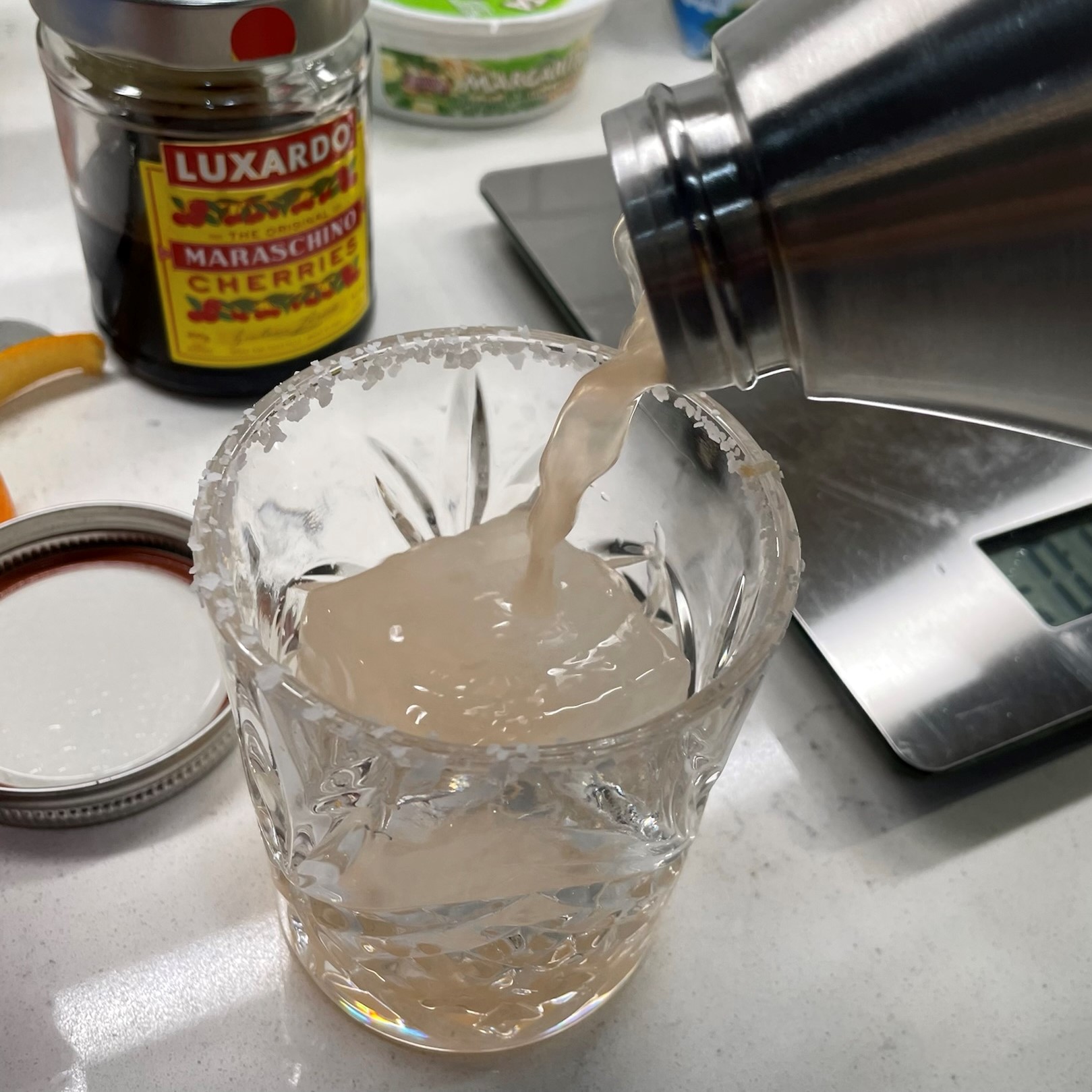
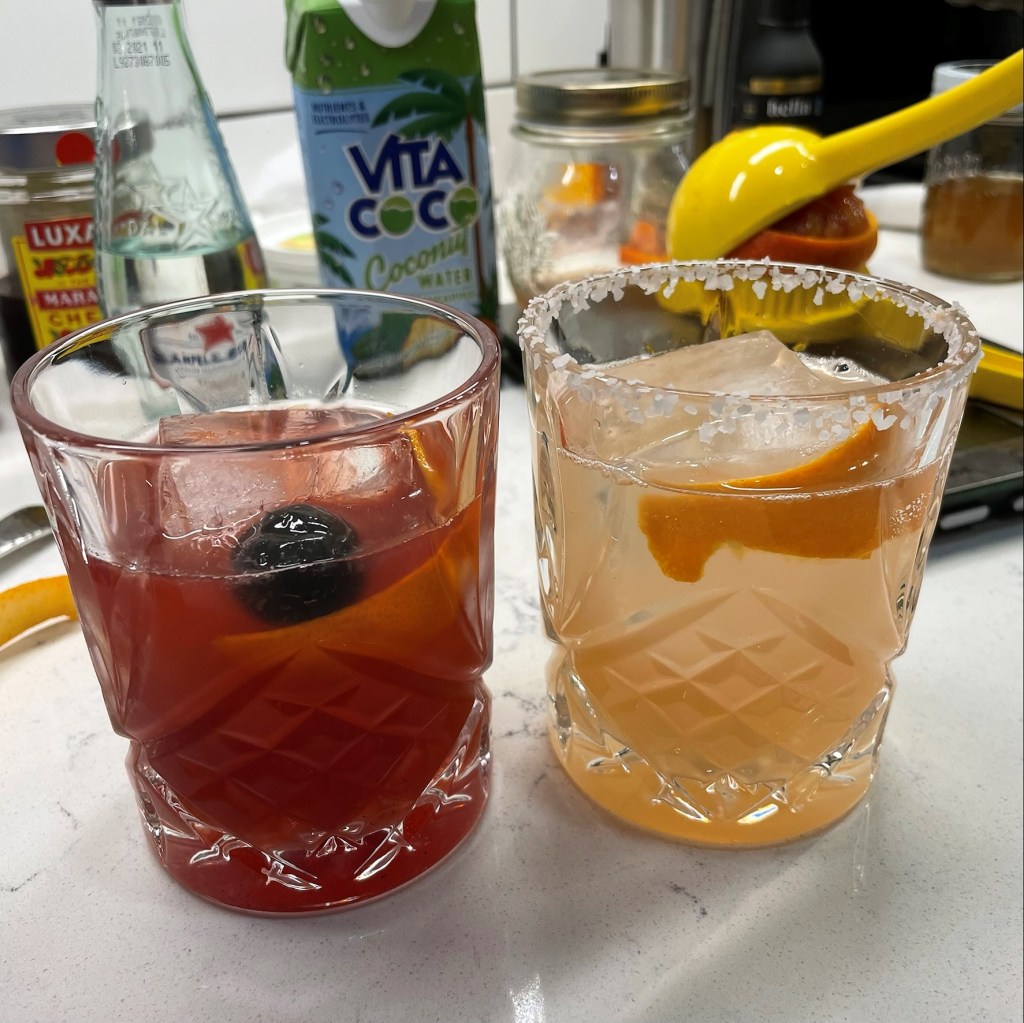
Les’s drink had the smoky black cherry syrup, mixed with freshly squeezed blood orange juice, a couple shakes of orange bitters and a slight splash of oak wood tonic (an interesting find that I’ll describe in a moment), and I even garnished it with a ribbon of blood orange peel and a Luxardo cherry. For my own drink, I blended the white-hot syrup in a shaker with fresh lemon, lime and orange, plus coconut water. I strained it into a salt-rimmed rocks glass, tossed in an orange peel and it called it a “mock-arita.”
Finally, our faux cocktails!
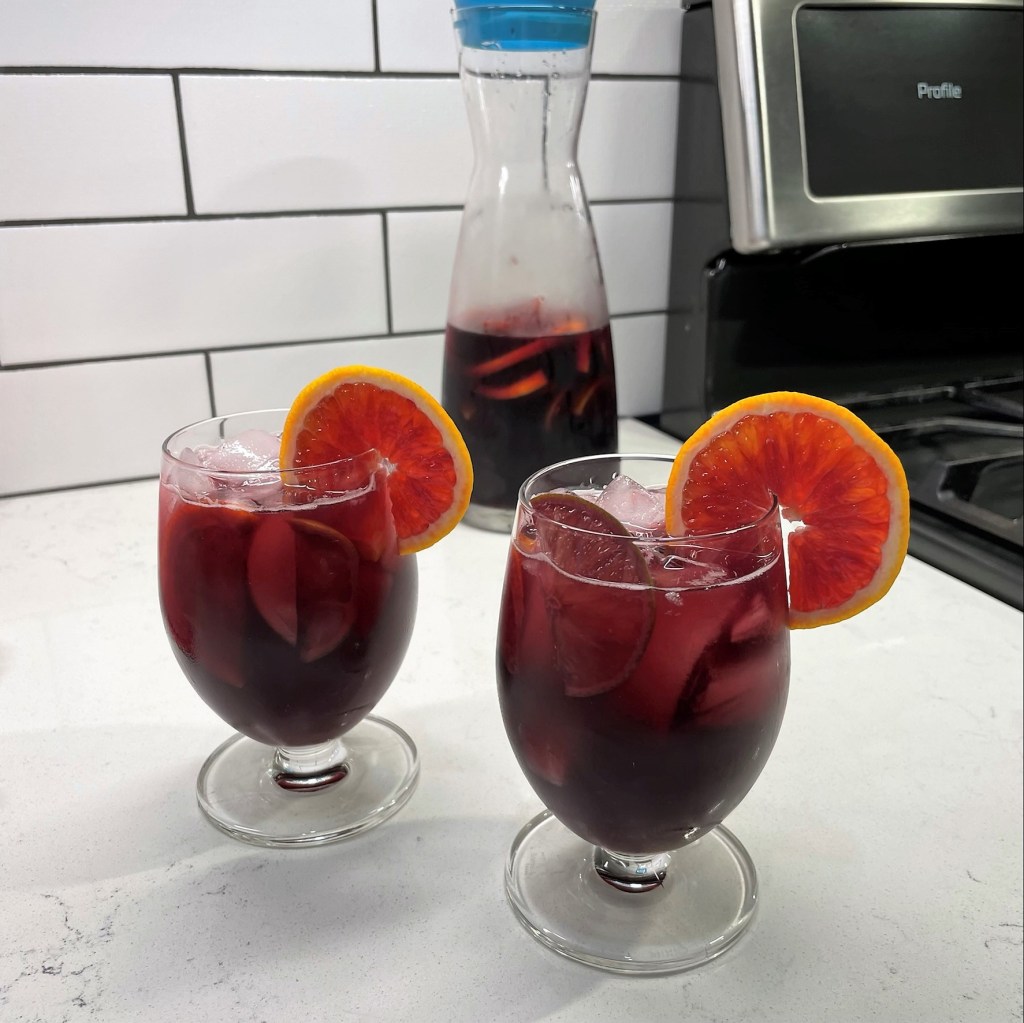
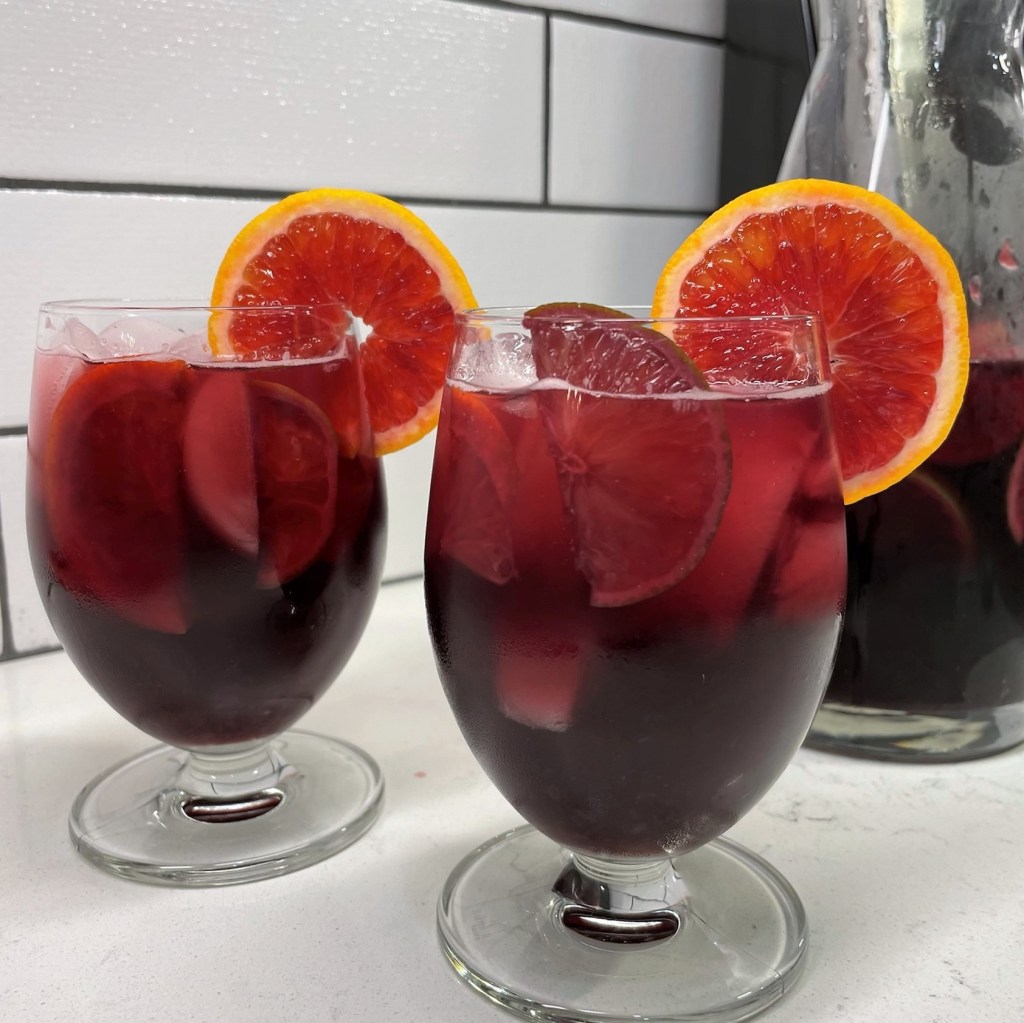
They turned out beautiful, but I spent so much time in the kitchen fiddling with these faux drinks that I missed 35 minutes of Quarantunes, which was the whole purpose of Friday night “cocktails.” And then, cleanup, which was sticky and ridiculous. This past Friday night, I decided on a better, simpler alternative—a zero-proof sangria! I appreciated that I could make it (and adjust to taste) ahead of time so that enjoying it on Friday night was only a matter of pouring it over ice and dressing it up with fresh fruit. No muss, no fuss. More time for pizza and Quarantunes. Perfect!
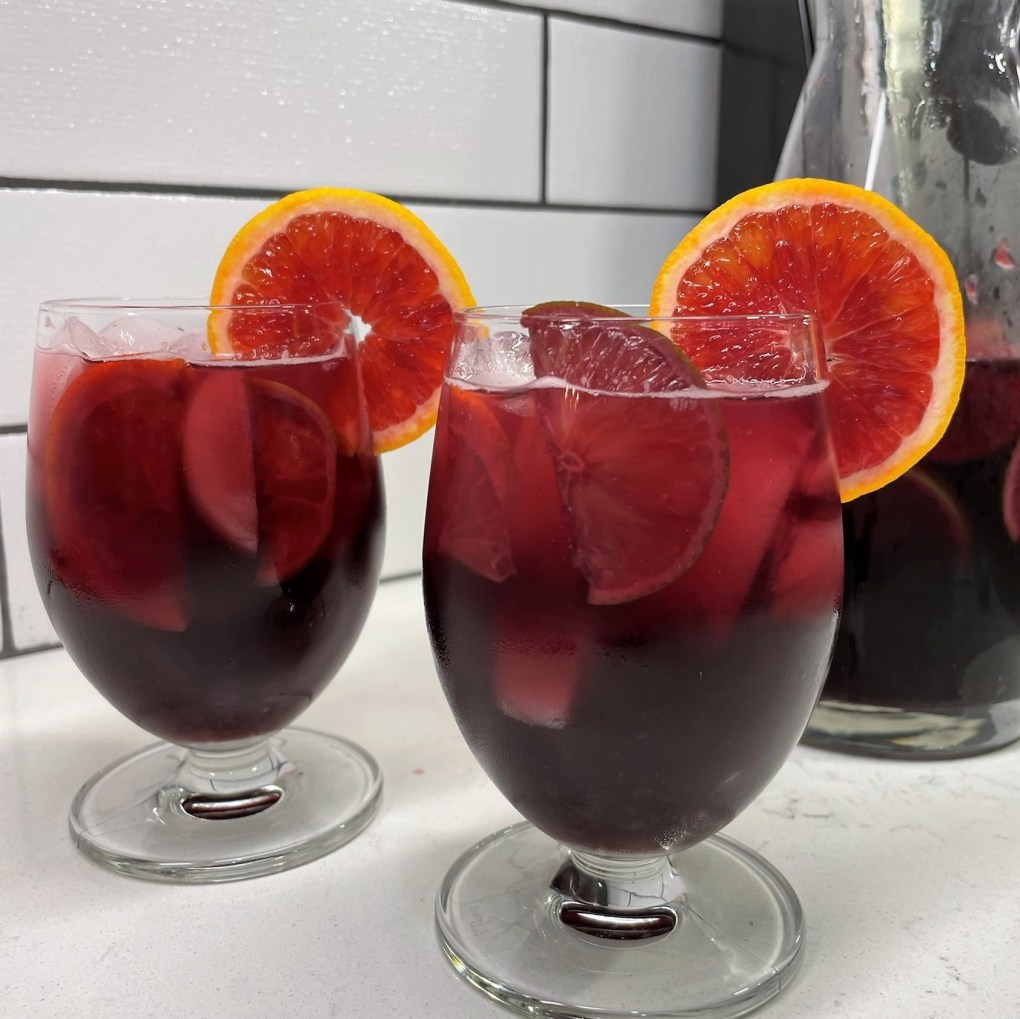
These were fruity, spicy and delicious. Exactly what we needed for Friday night, and no hangover or sluggish feeling on Saturday morning! 🙂
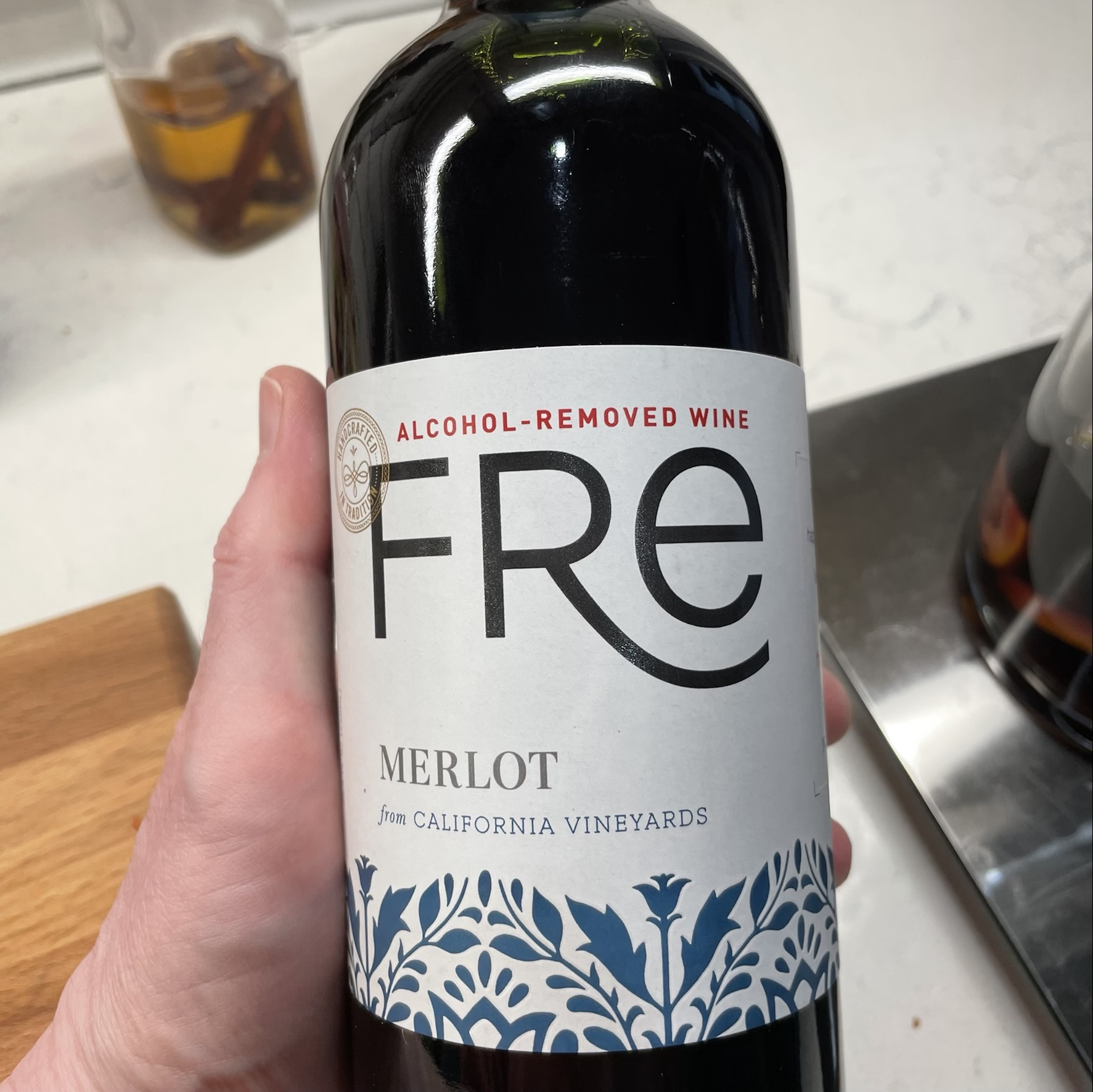
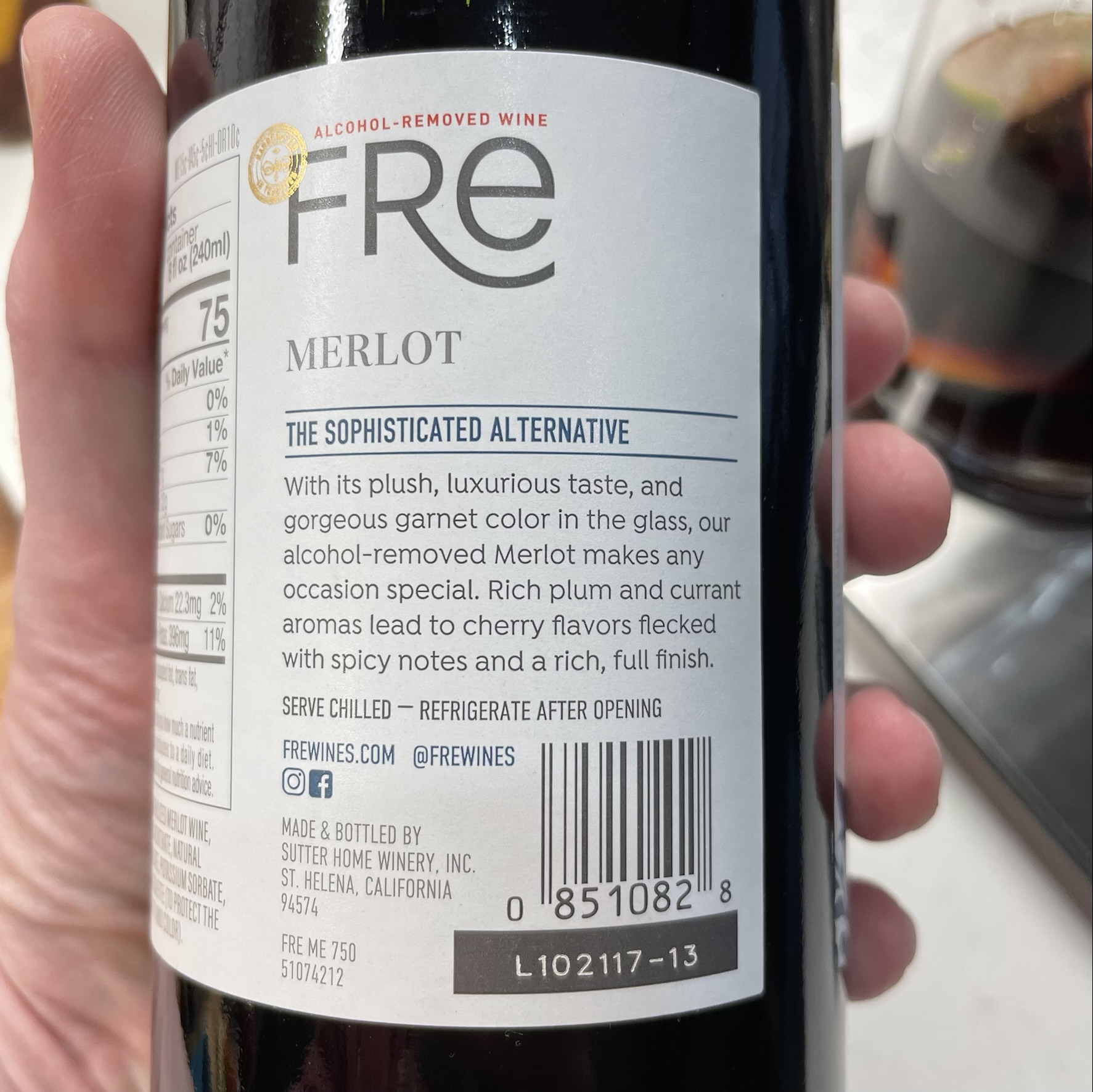
The base of my zero-proof sangria was a “de-alcoholized” Merlot wine. I have seen no-alcohol “wines” before, but for the most part, they were just unfermented, unsweetened grape juice. In other words, flat and mostly flavorless. But a de-alcoholized wine has gone through the process of fermentation, and then has the alcohol removed, either by vacuum distillation or reverse osmosis, just before bottling. It is a fascinating concept, and one that is gaining traction with a significant audience of adults who aim to reduce their booze consumption, whether short-term or for good.
It tastes like Merlot, but not really.
So how does this de-alcoholized wine taste? I’ll be honest—it’s different. I do taste the Merlot in this bottle, but it is missing the complexity and (obviously) the bite of real wine. I chose this for its base flavor but also its lack of sweetness, as I planned to jazz up our sangria with a few sweet ingredients. If I had used any regular grape juice, the sangria would have been cloyingly sweet, not to mention that it would have smacked of Welch’s grape jelly flavor.
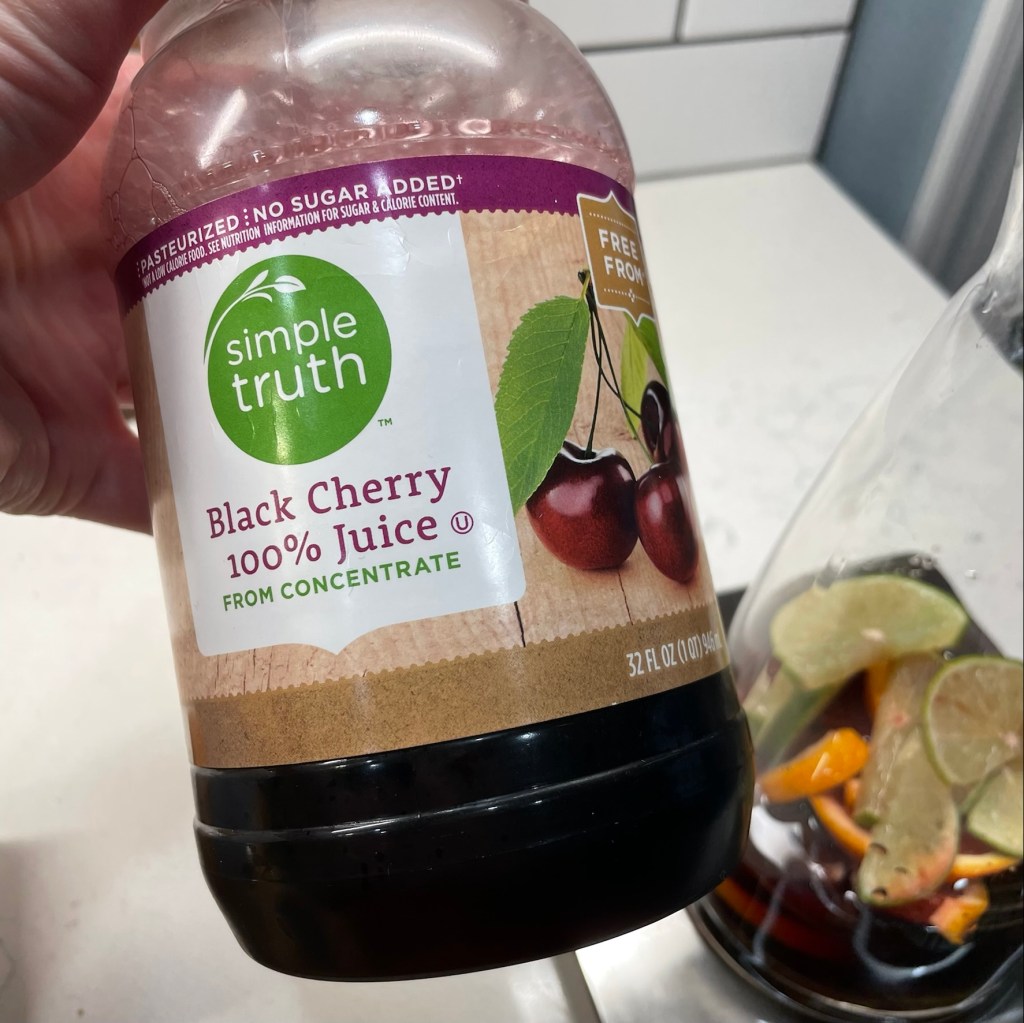
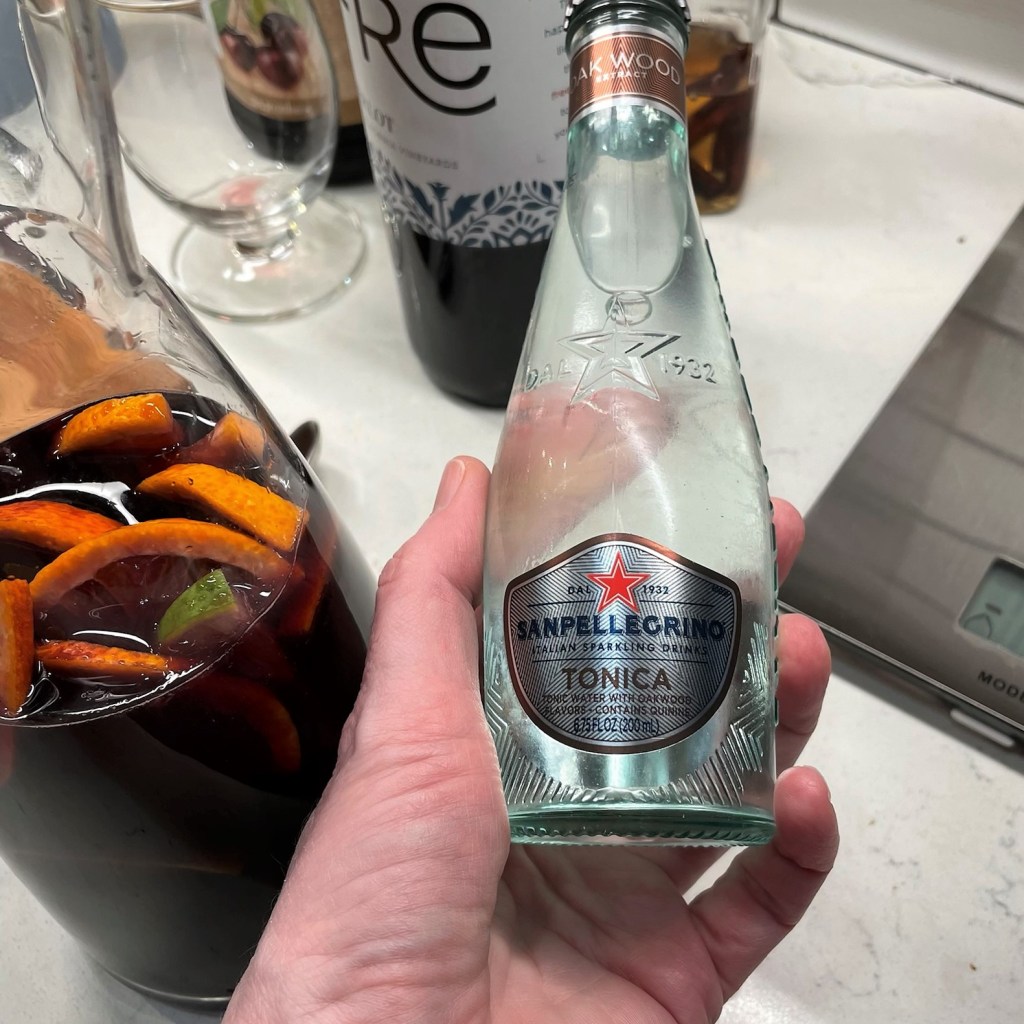
I enhanced the dry “wine” with some of the smoky black cherry simple syrup that I had made the first weekend (recipe is included below), plus cinnamon syrup (also below), fresh citrus, unsweetened black cherry juice, ginger-berry kombucha and (again) the oak wood tonic. This tonic, on its own, has a sharp and bitter flavor with distinctive woodsy flavor. It’s an acquired taste, and one that I’m not sure I’ll ever appreciate on its own. But blended with the other ingredients, it brings a just-right, edgy bite to make my zero-proof sangria feel more “Friday night worthy.”
Cheers!
I would absolutely make this again, for myself or for guests who prefer to abstain from alcohol. There are still plenty of ingredients in my pantry and spice cabinet to experiment with in these remaining days of Dry January, and I’m sure if I keep at it, I’ll discover the perfect formula for amazing zero-proof cocktails. Of course by then, it will be February. 😊
Ingredients for Zero-Proof Sangria
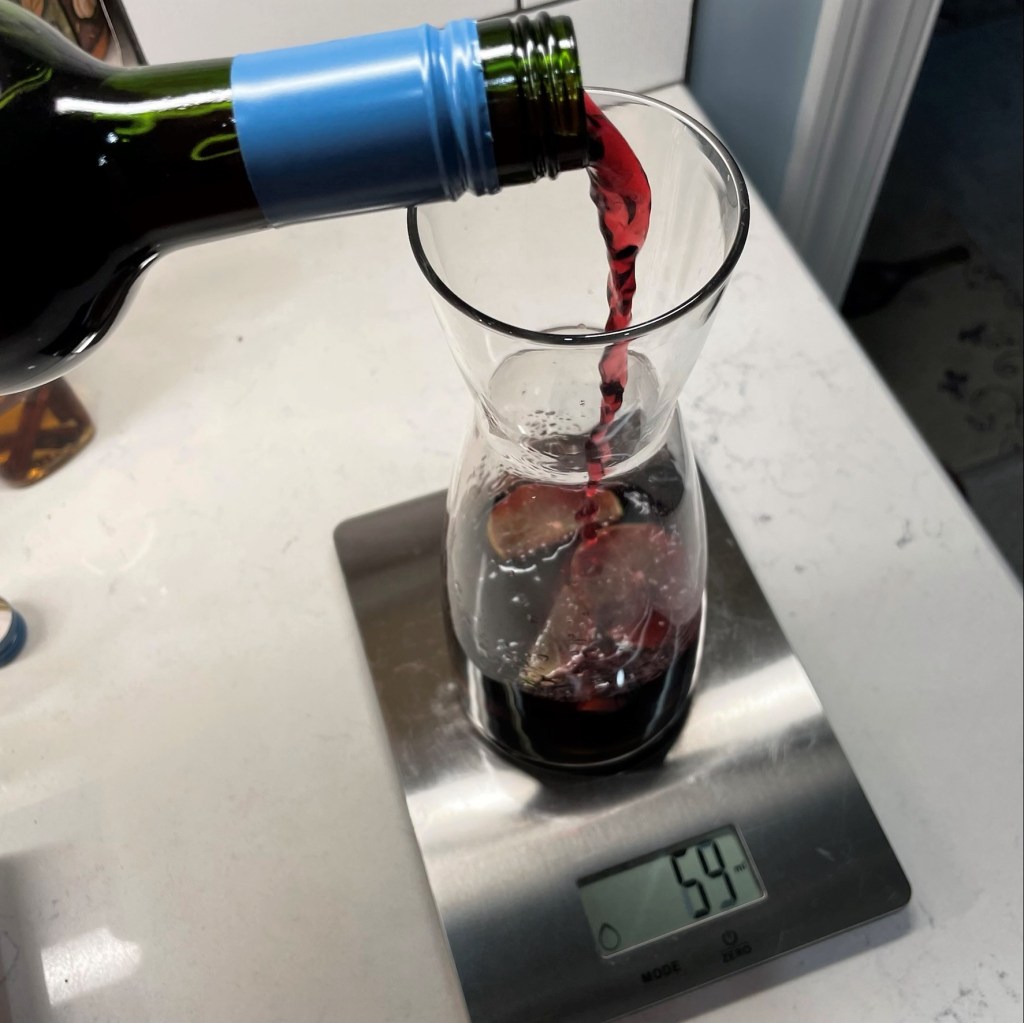
1/2 bottle de-alcoholized Merlot wine (Pinot Noir variety would also be good)
1 large blood orange, washed and sliced thin
1 good-size lime, washed and sliced thin
3 oz. smoky-spicy black cherry syrup (recipe follows)
1 oz. cinnamon syrup (recipe follows)
4 oz. unsweetened black cherry juice
2 oz. tonic water (San Pellegrino Oak Wood Tonica, if you can find it)
For each serving:
1 oz. berry flavored kombucha (adds a “fermented” flavor)
1 oz. strong ginger beer (adds bite and effervescence)
Fresh slice of citrus to garnish
Instructions
Citrus fruit is a must in sangria, and the overnight (or longer) chilling makes it even better.
My smoky-spicy cherry syrup will be a flavor boost for my zero-proof sangria.
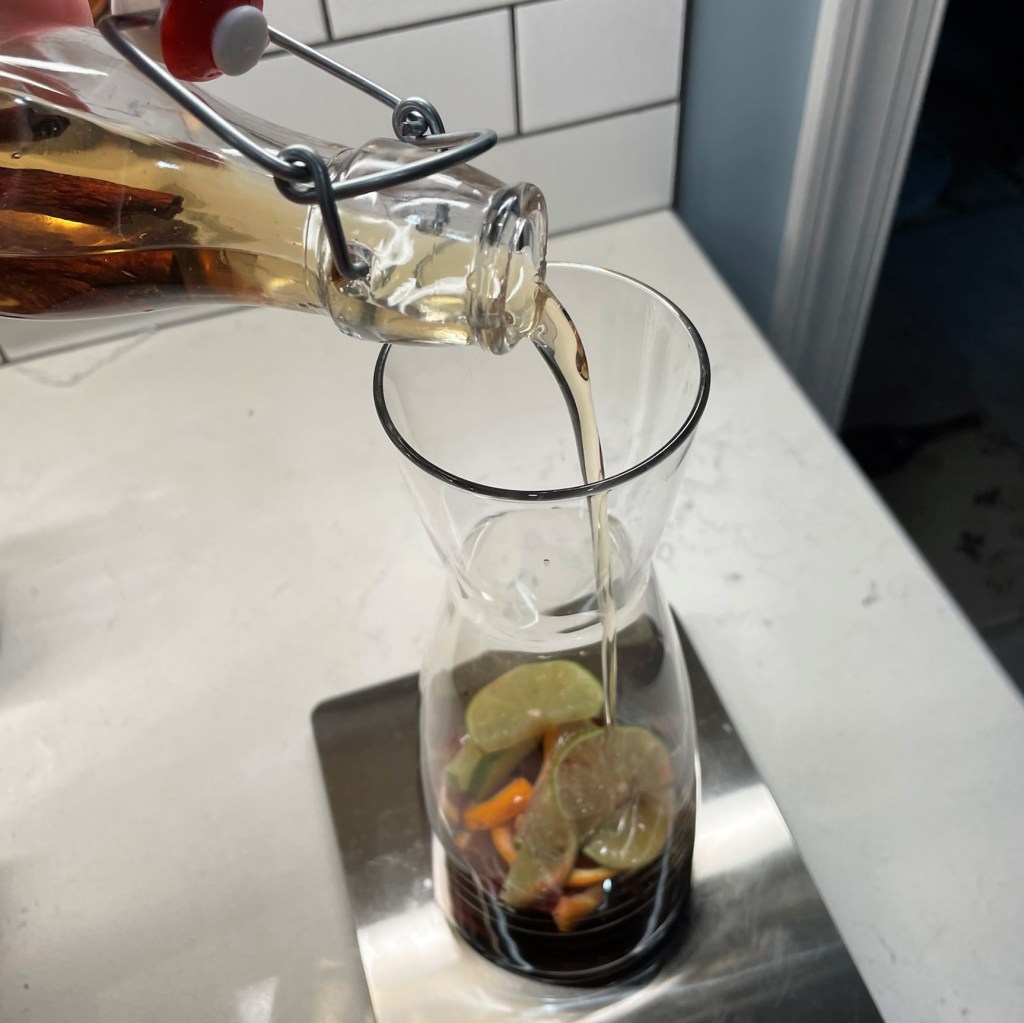
Cinnamon syrup adds warmth and more depth of flavor.
Unless you want your sangria to be very sweet (I didn’t), choose an unsweetened fruit juice. I went with cherry to complement the merlot grapes in the de-alcoholized wine.
My recipe is designed for half a bottle of the no-alcohol wine, mainly for the size of my carafe.
This oak wood tonica was a secret weapon to balance the flavor of my “sangria,” and 1/4 cup was just right. I think a bitter lemon tonic would also have been very good.
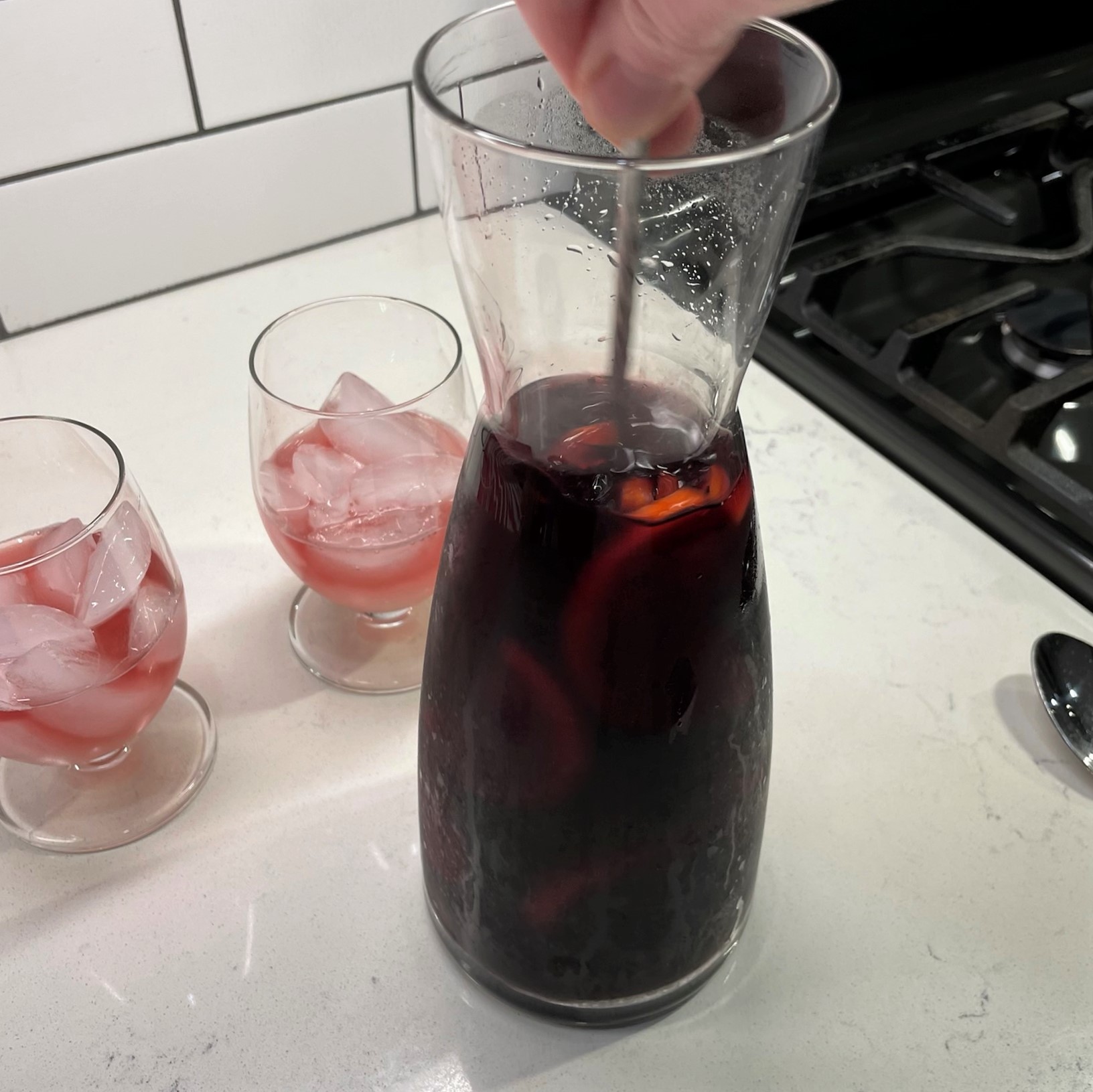
Stir it really well, to blend the syrup into the wine. Chill several hours, or preferably overnight, before serving.
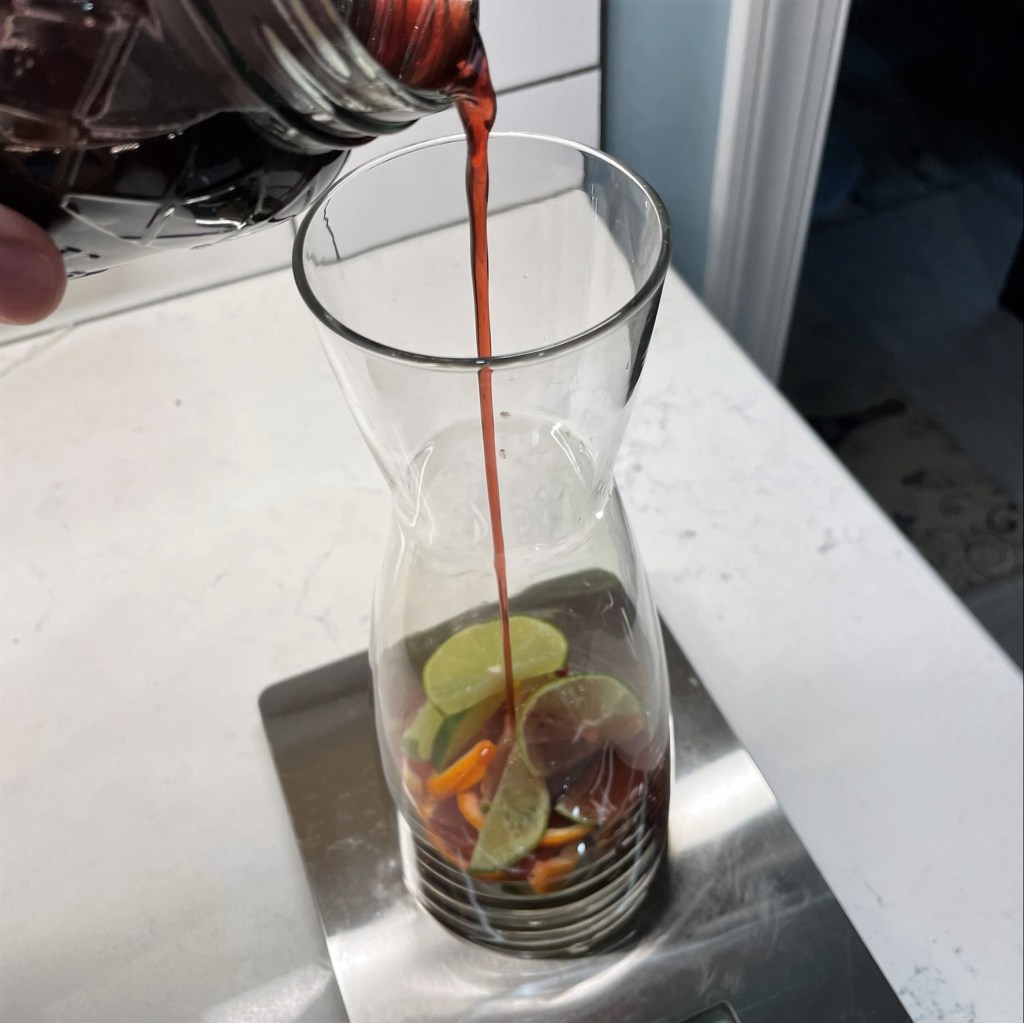
Load the citrus slices into a 1-liter carafe or pitcher. Add the simple syrups, black cherry juice, de-alcoholized wine and tonic. Stir to blend. Refrigerate until ready to serve.
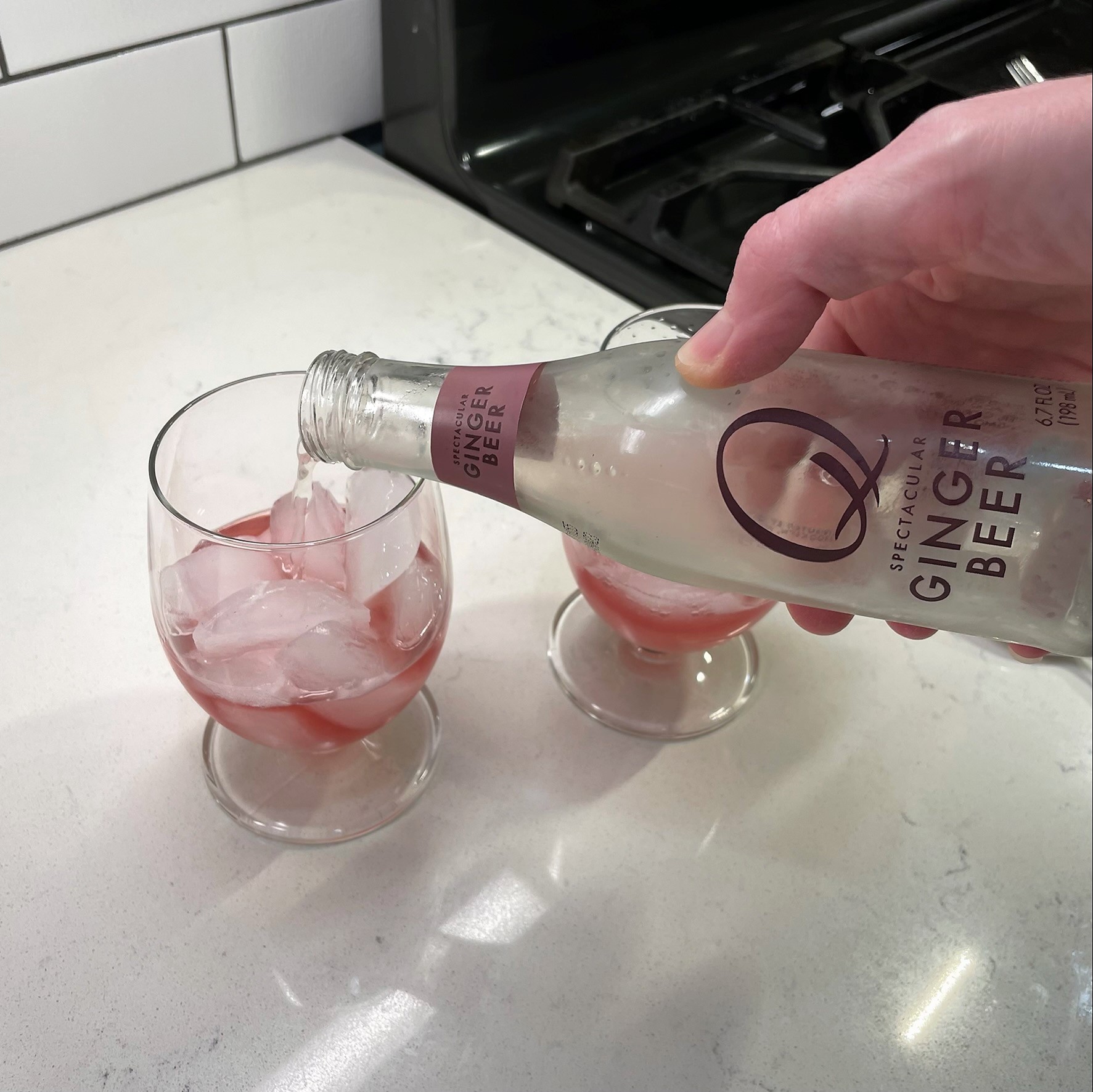
A splash of gingerberry kombucha in our glasses added a fizzy, fermented flavor.I had just a splash of ginger beer leftover from something else, so I poured that into our glasses, too.I gave the sangria a good stir to remix any of the syrup ingredients that may have settled overnight.
At serving time, fill 10 oz. glasses about 2/3 with ice. Pour kombucha and ginger beer over ice. Give the sangria a good stir to blend ingredients that may have settled. Pour over the ice to the top of each glass. Garnish with fresh citrus.
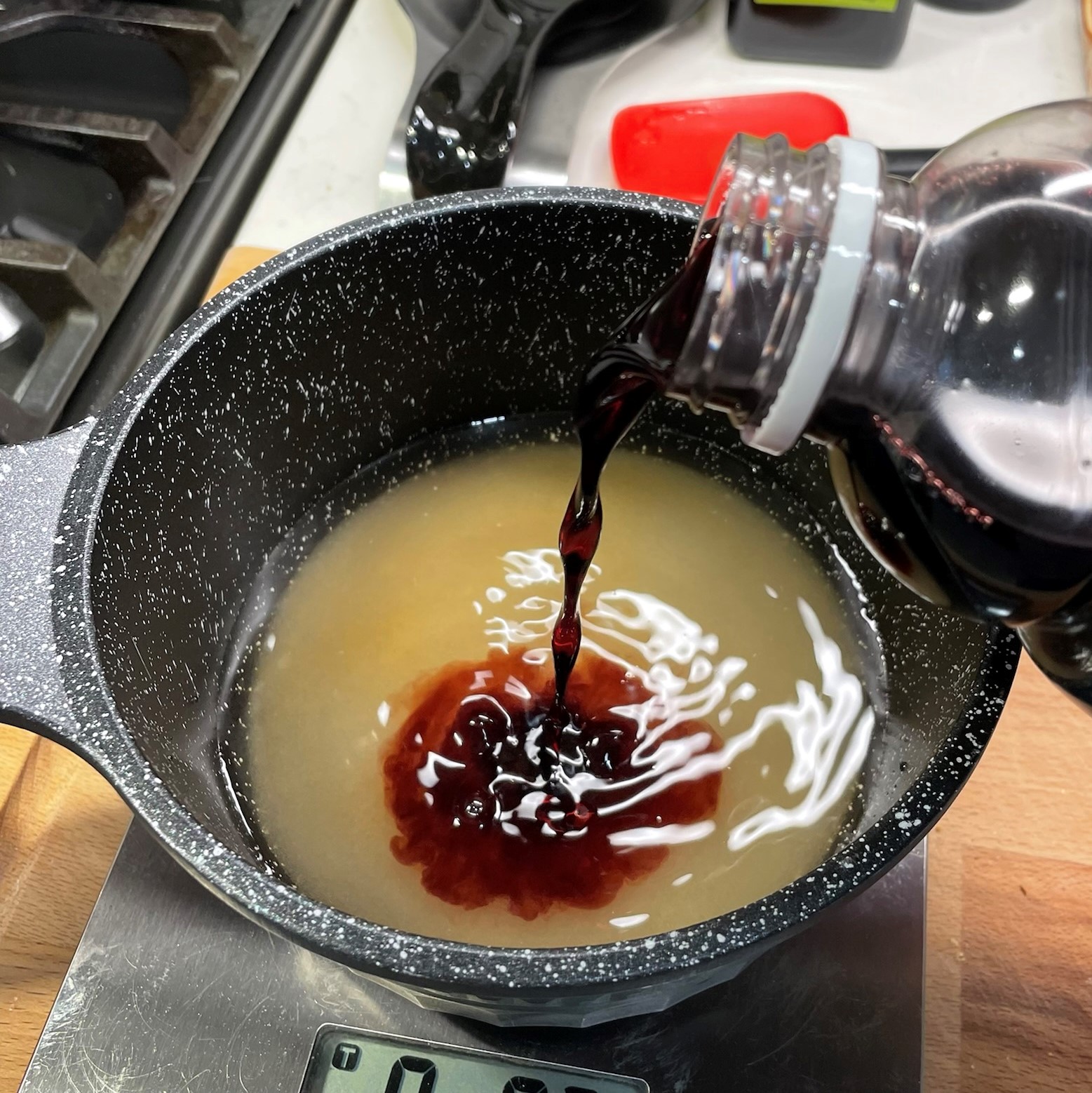
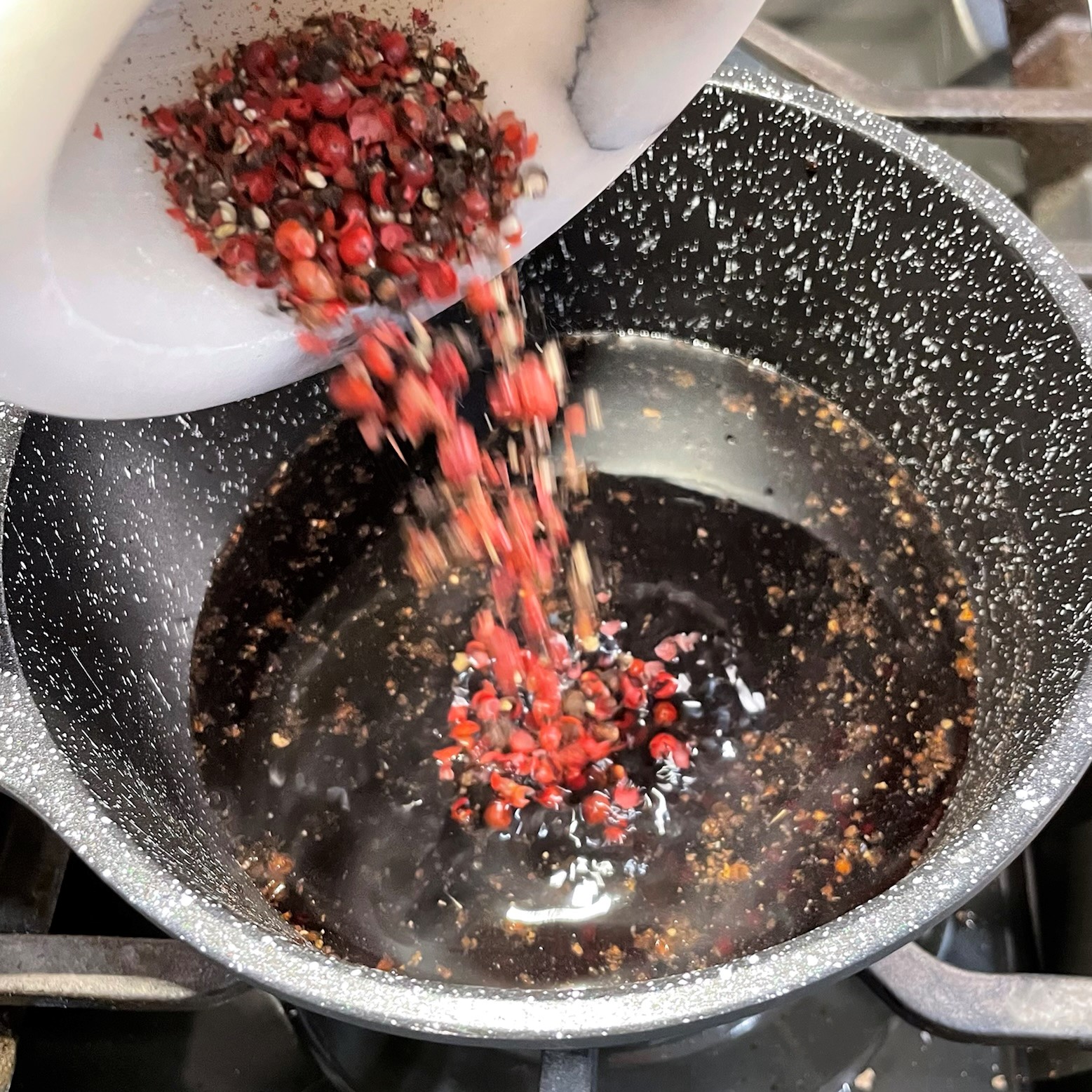
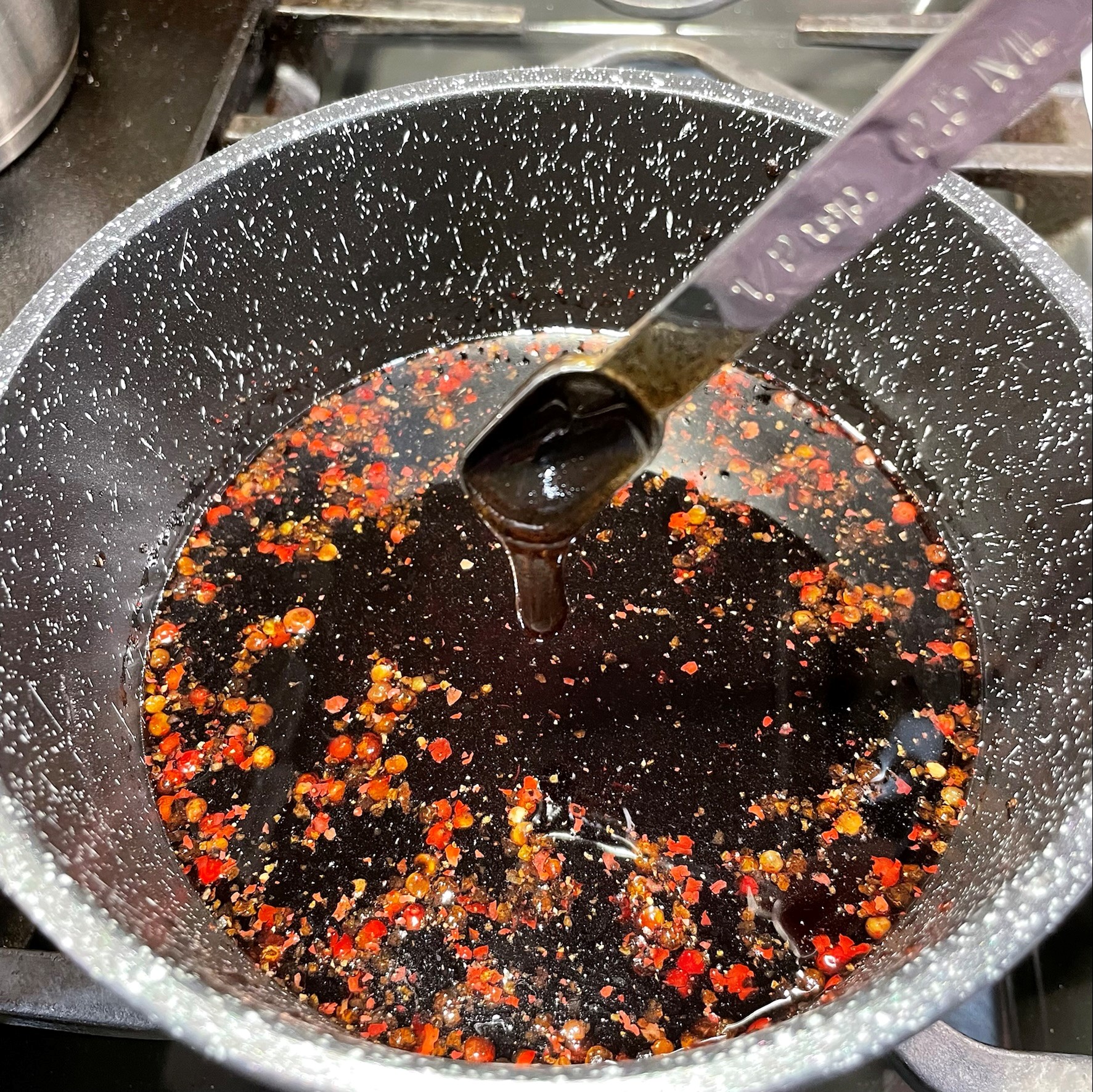
Combine 1/2 cup water and 1/2 cup unsweetened black cherry juice in a saucepan. Add 3/4 cup organic cane sugar. Heat over medium heat, stirring frequently, to dissolve sugar. Use a mortar and pestle or spice grinder to lightly crush 2 tsp. smoked black peppercorns and 1 tsp. pink peppercorns. Add to the syrup and stir to blend. When syrup reaches a slight boil, remove from heat. Add 1/2 tsp. real vanilla paste. Cool completely and strain into a canning jar. Refrigerate until ready to use.
The simple syrup is sweet enough to make up for the unsweetened black cherry juice.
I used a blend of pink peppercorns and smoked black peppercorns to give some zip to my cherry simple syrup.
A little vanilla paste to mimic the warmth of bourbon for my faux cocktails.
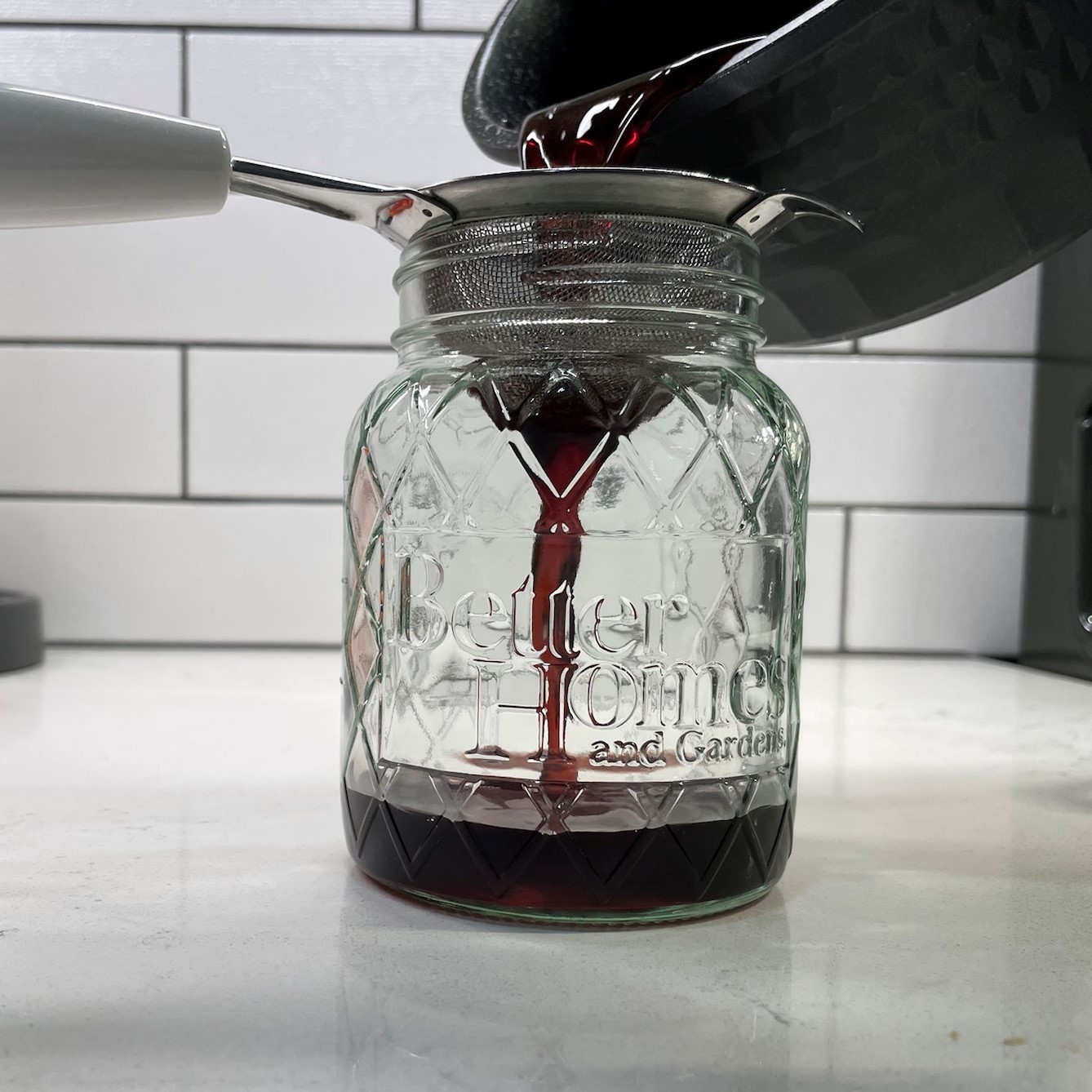
When the syrup is completely cool, strain it through a mesh strainer into a jar. Keep it in the fridge up to two weeks.
Cinnamon Syrup
Combine 1/2 cup water and 1/2 cup organic cane sugar in a saucepan. Add 3 pieces of cinnamon stick (each about 3” long) and bring syrup to a slight simmer. Continue to steep the cinnamon in the syrup until it is completely cool. Strain into a jar or bottle and refrigerate until ready to use.
Anybody who doesn’t get excited about pizza has, well, never had a good one. That’s my philosophy, and it’s one of the many reasons my husband, Les, and I are so darn compatible. Our tenacity in searching out the best foods is another. It is not possible for me to pass on reading an article about food—whether it relates to a trend, a signature dish or a hot new restaurant. Les is the same. So when we found ourselves at Modern Apizza in New Haven, Connecticut, near the end of our summer vacation, it was pretty much heaven for both of us.
You have to say it like the locals do… it’s Modern “Ah-Beetz!”
Our visit was not by chance; it was intended to be a highlight from the very start of our vacation planning, and we worked other aspects of our trip around it. That’s how seriously we take our pizza. And we had a big inside connection that won me a behind-the-scenes tour of the place, through the kitchen and prep spaces, and all the way down to the basement where they make more sauce and dough than I have ever imagined.
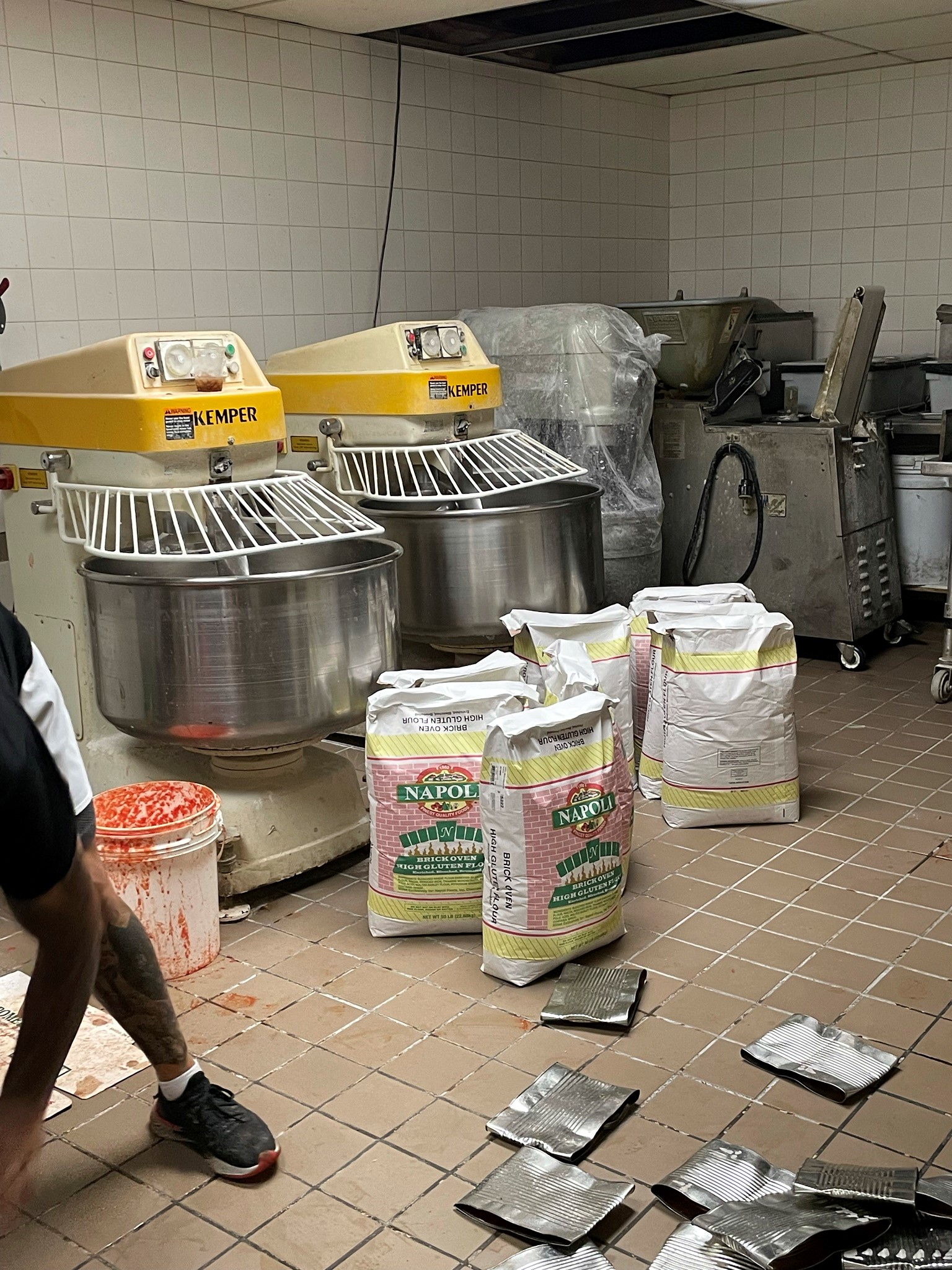
All these buckets of sauce are made for just one day’s pizzas.Those mixers are a wee bit bigger than my KitchenAid, yes? That’s 400 pounds of high-gluten flour, for ONE day’s pizzas!
How did I have such an opportunity, you might wonder, to be invited into the heart of this business that is 650 miles from my home? Easy. Les knows the owners! During what seems like a lifetime ago, when he lived in the New Haven area, Les owned a home two doors down from Bill and Mary Pustari, who bought Modern Apizza in 1988 and continued the long tradition of excellence there that had begun in 1934. After a few years owning the place, they expanded the dining room and added a second, oil-fired brick oven to their kitchen to keep pace with the popularity of their amazing pizzas.
When Les reached out to his old friends to inform them of our plans to visit New Haven, they were gracious to offer me a tour of the restaurant, to witness the magic up close and personal. For me, it was as exciting as many of the backstage events I had experienced during my radio years and one of the biggest highlights of our entire trip, and I’m excited to share my experience, and the pizza it inspired me to make at home. But first—lunch!
Oh, YUM!
Our server, Arianna (who also happens to be a daughter of the owners), didn’t hesitate when we asked which pizza is most popular with their customers.
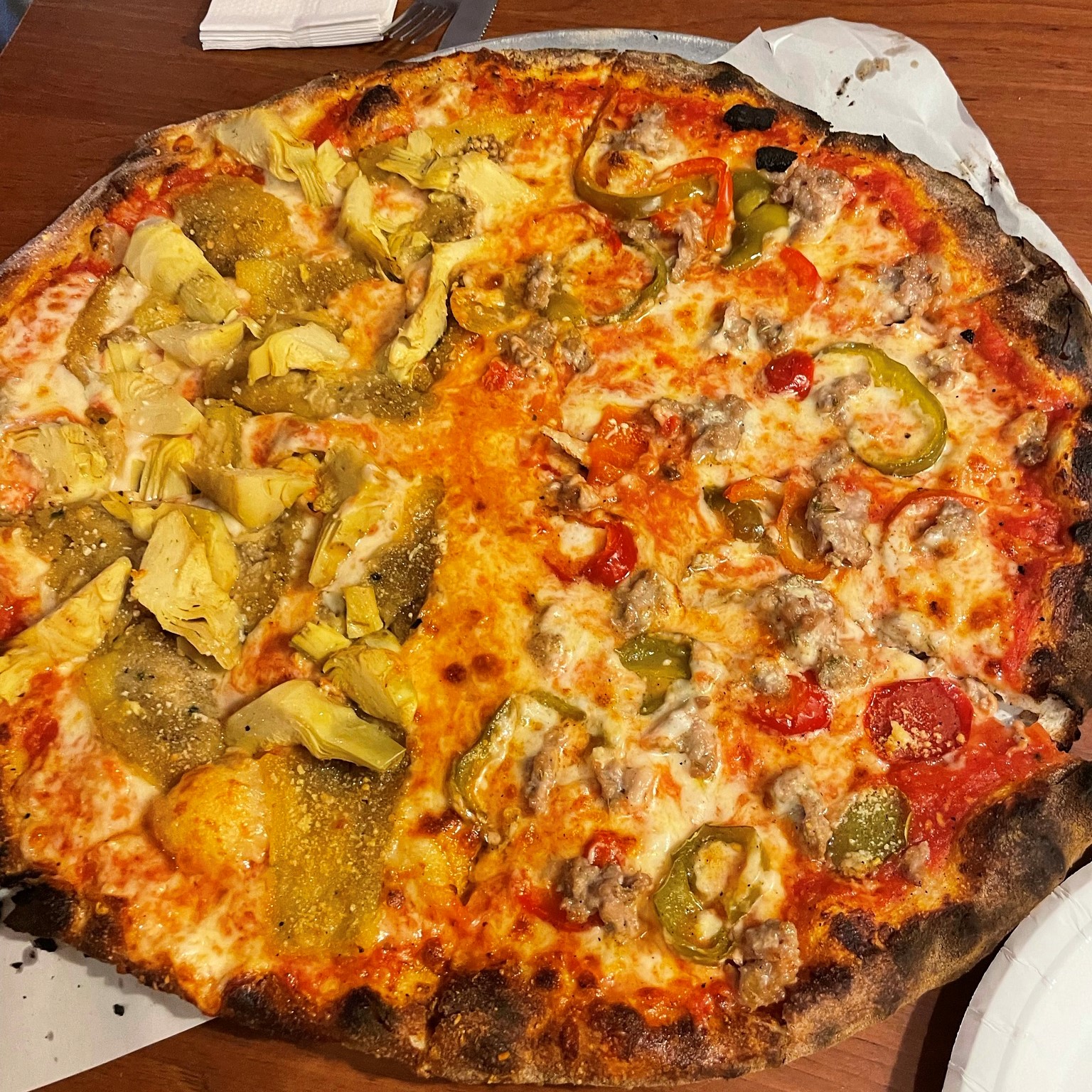
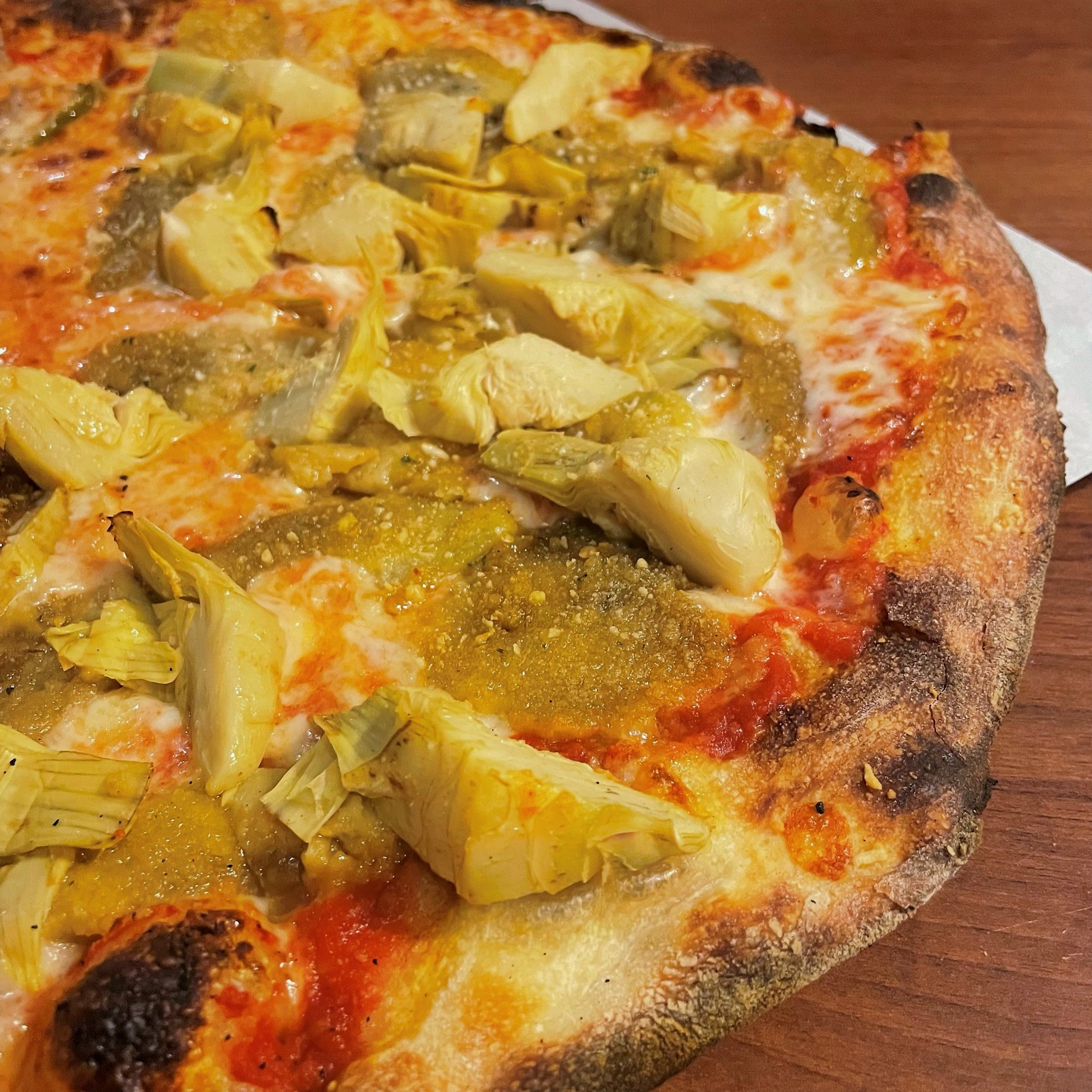
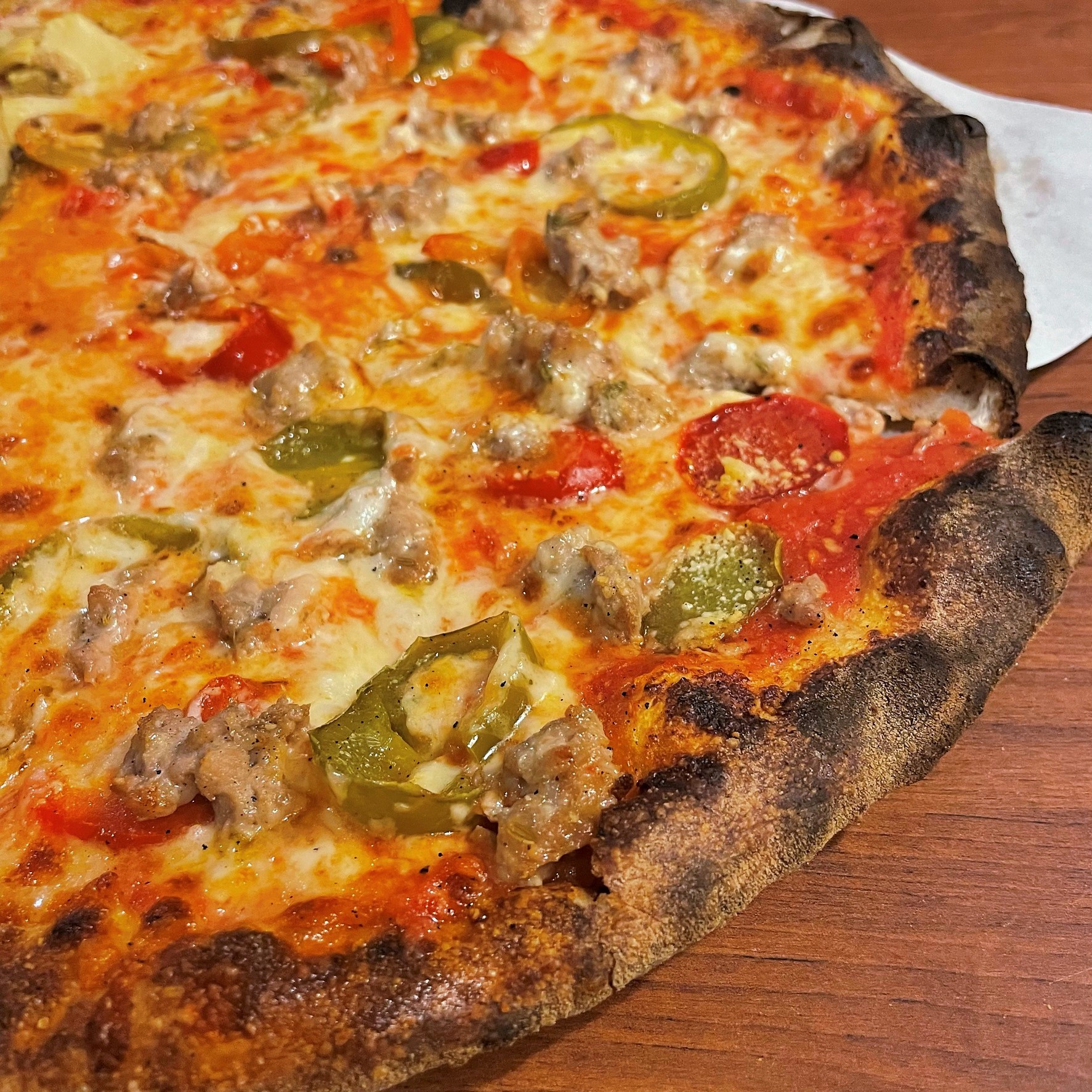
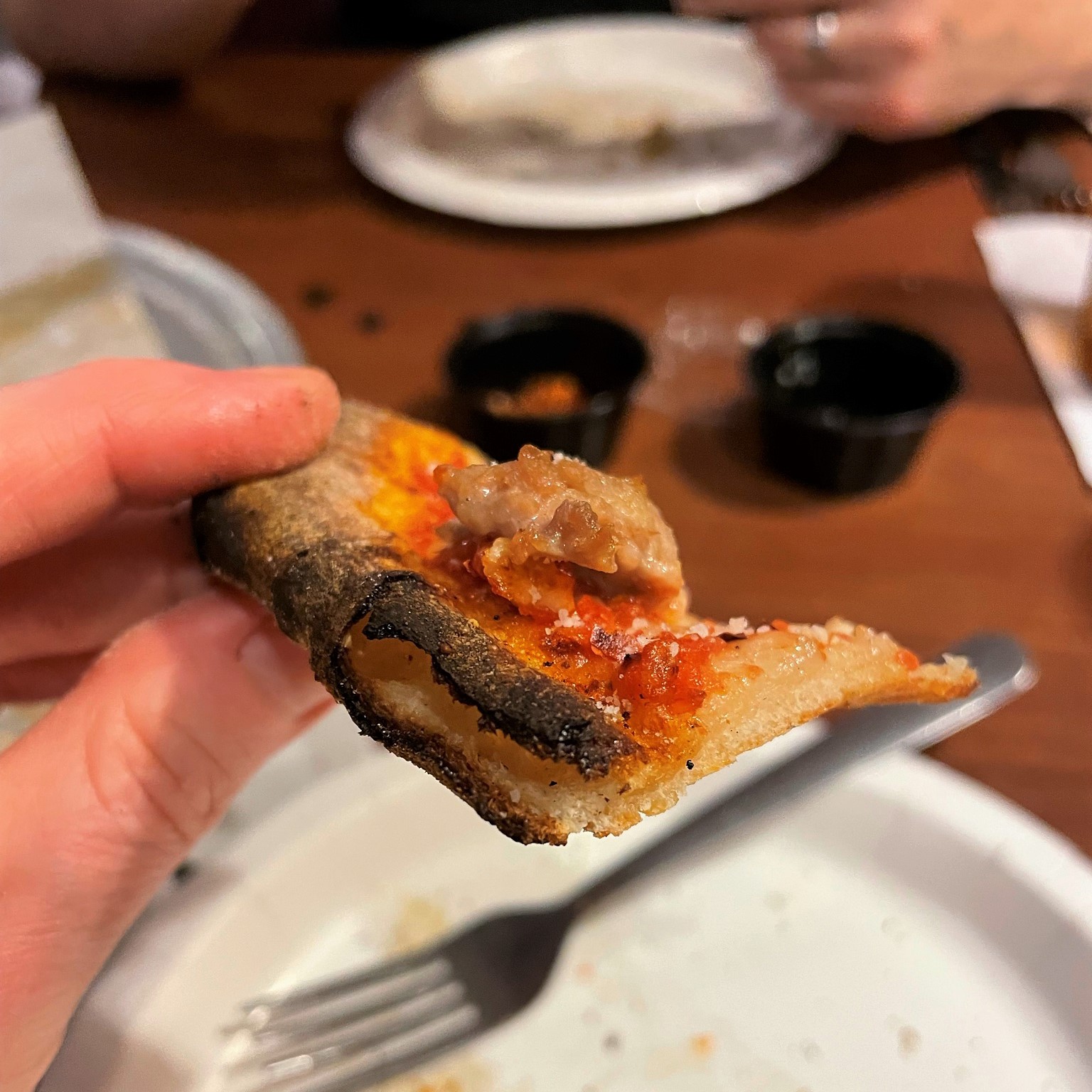
“Hands down, the Italian Bomb,” she said. Well, sure, the one with sausage, bacon, pepperoni, mushroom, onions, peppers and fresh garlic, of course! That sounded like a lot to chew on for lunch, and we decided on a half-and-half pizza (kind of amazing they are willing to do that), with artichoke hearts and eggplant on one side, and Italian sausage with hot cherry peppers on the other. Both combinations were delicious, but what I could not get over was the complex flavor and chewy-but-crisp texture of the crust, and I was about to come face-to-face with the signature ingredient that gives Modern Apizza a culinary edge over its competitors.
Veggie heaven, with artichoke hearts and eggplants.Italian sausage and hot pepper “apizza.”This looks and feels exactly like the crust I’ve been working to achieve at home!
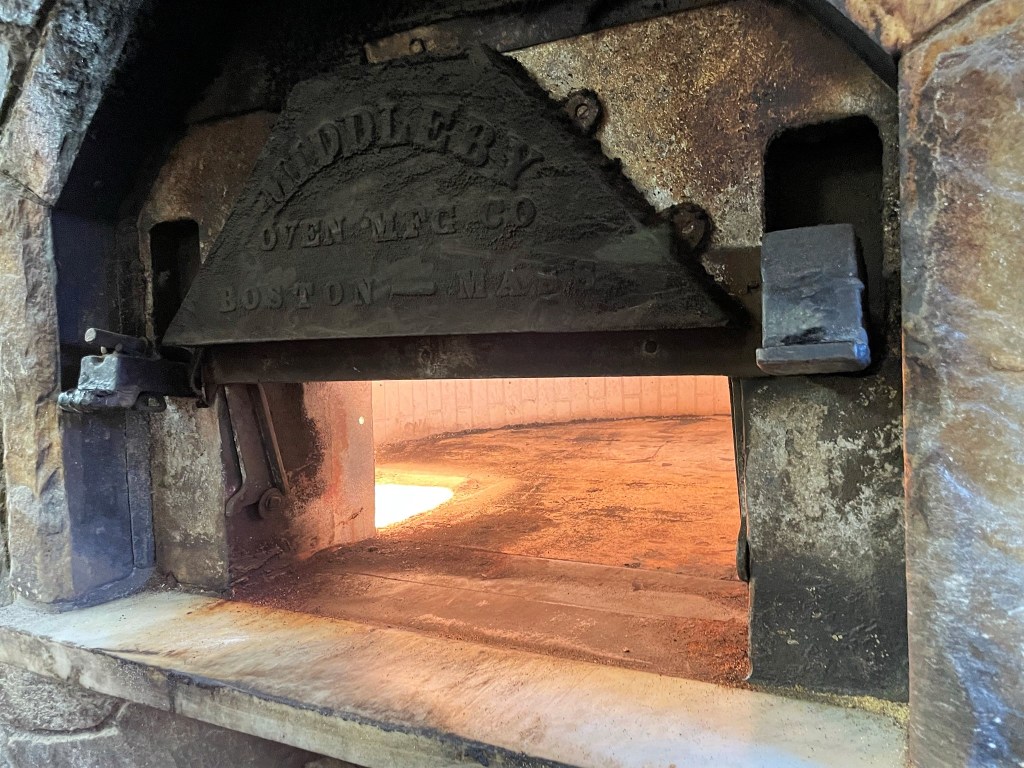
When it was time for my “backstage” tour, Bill took me first through the kitchen, and then to the original oven, which they still fire up when business is booming. An oil-fired oven is an incredible sight, and when Bill informed me that the coolest spot in the oven is 700° F, I couldn’t resist asking what the hottest temperature in the oven was. Care to guess?
Modern Apizza’s original brick oven, still in action after all these years.
“The temperature of fire,” Bill answered. Wow!
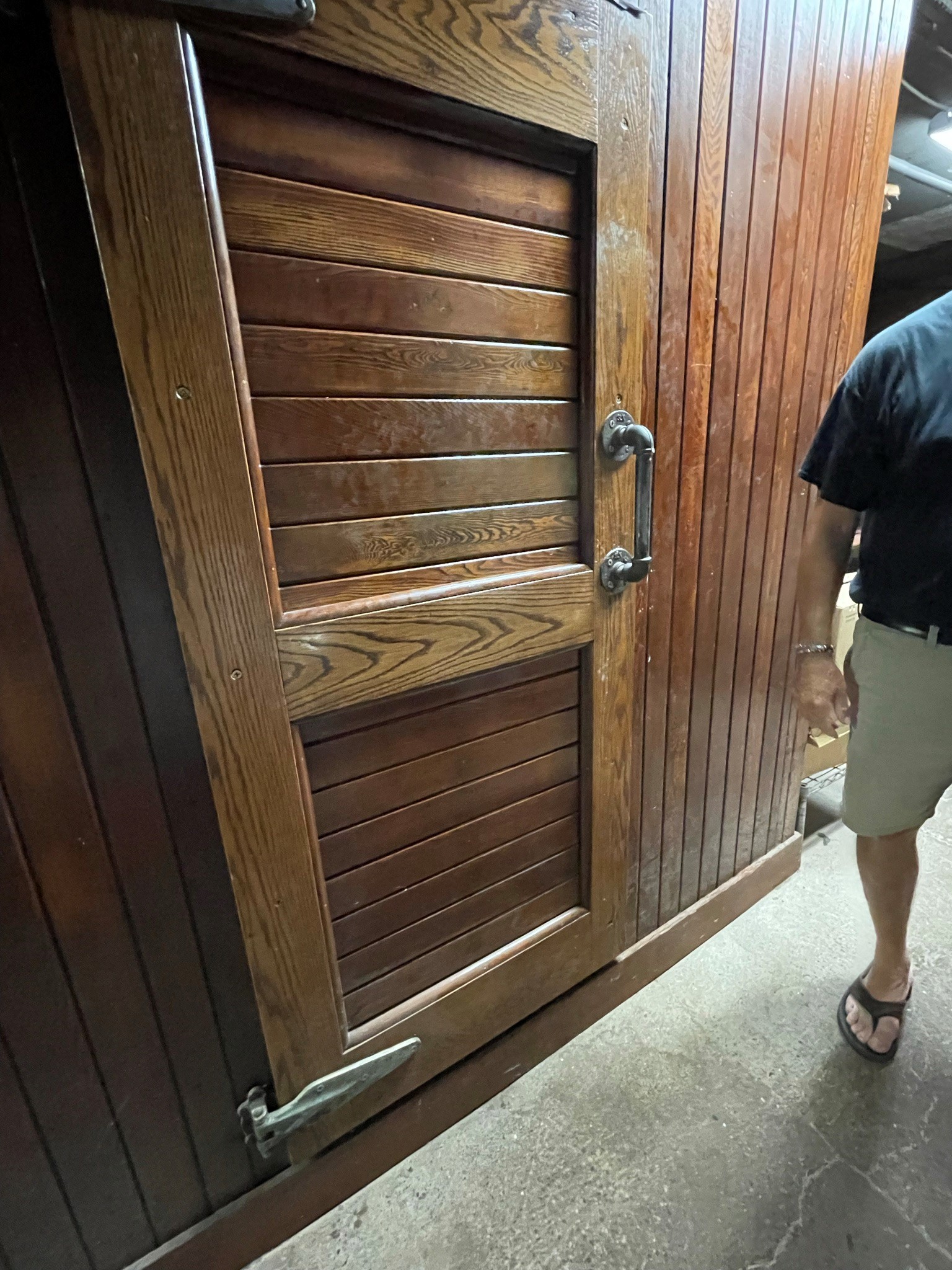
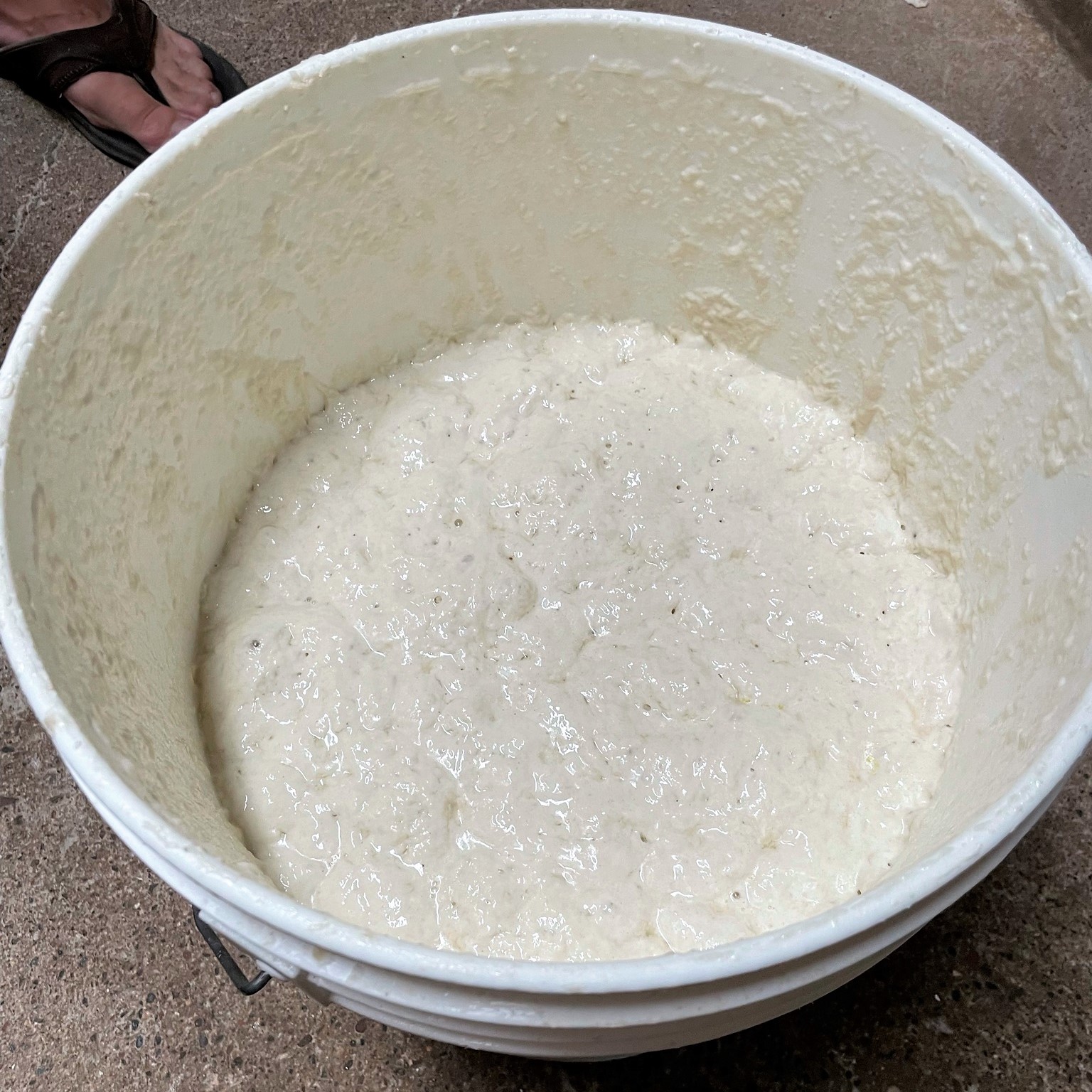
From there, Bill led me downstairs to the basement of the restaurant and to a very special, very old refrigerator that is home to a very old resident—and the secret to their flavorful dough—a sourdough starter!
Behind this antique refrigerator door lies the secret to Modern Apizza’s great flavor.Hello, Gorgeous!!! 🙂
They call this glorious culture “The Bitch.”
Despite her unbecoming name, The Bitch is a beloved member of the family at Modern Apizza. They feed her every day, and if there is ever a weather emergency or power outage, she goes home with someone for safekeeping. Bill told me that several years ago, he wanted to take Modern’s pizzas to a new level, so he got a bit of a 100-year-old starter from a local French bakery, and that ushered in a whole new chapter in Modern’s history. This revelation thrilled my sourdough-loving heart to pieces and connected the dots on why our lunch pizza reminded me of home.
I got more confirmation about my pizza-at-home techniques when we went back upstairs to the kitchen, where William (also a Pustari) and George worked in harmony with Jesse, the oven guy, preparing pizzas to order for their customers, at an astonishing rate of two pizzas per minute. Honestly, I wanted to throw on an apron and jump in on the action!
They have this down to a science!
From the shaping of the dough, the order of topping ingredients, the high-heat baking and the natural leavening of the pizza dough itself, I left Modern Apizza feeling that I was doing something right—or, really, doing a lot of things right, at home. All my research, trial and error had put me on the right pizza path, and that is a very good feeling. Before I share my home pizza that was inspired by this visit, can you stand just a little more bragging on Modern Apizza?
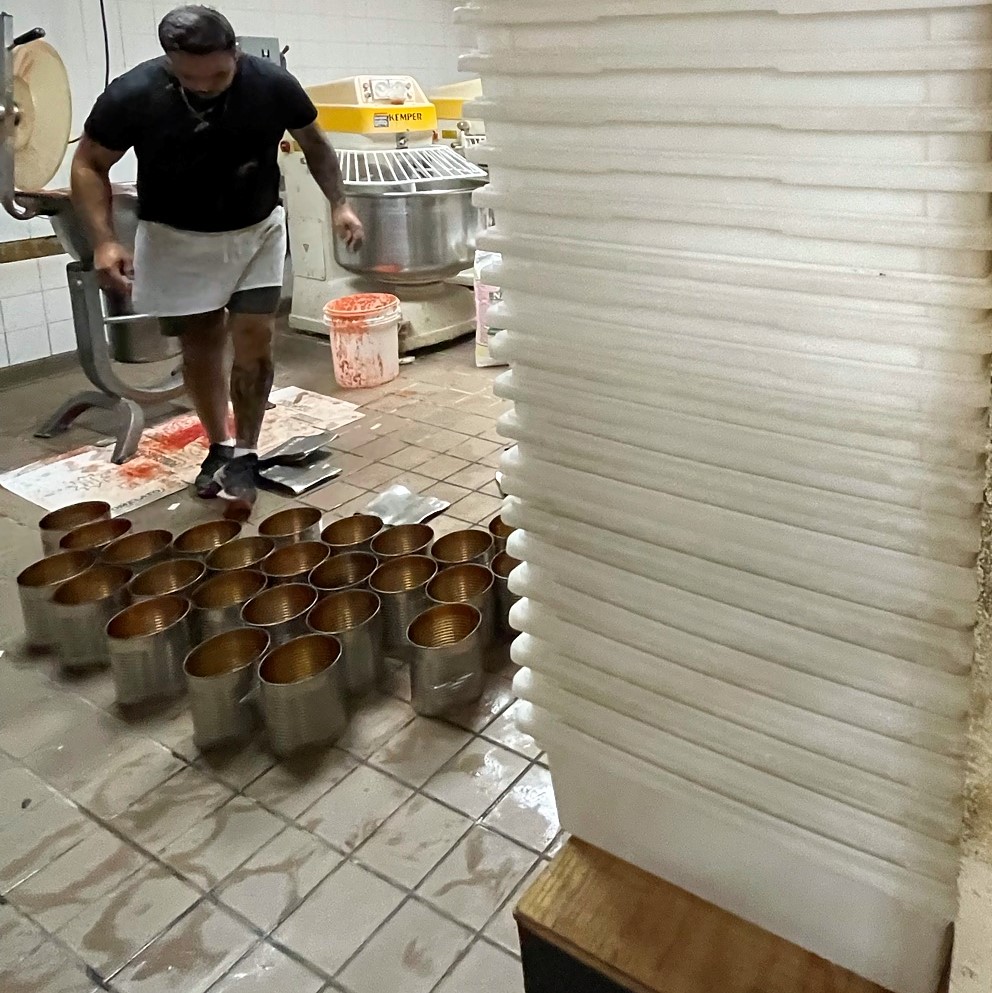
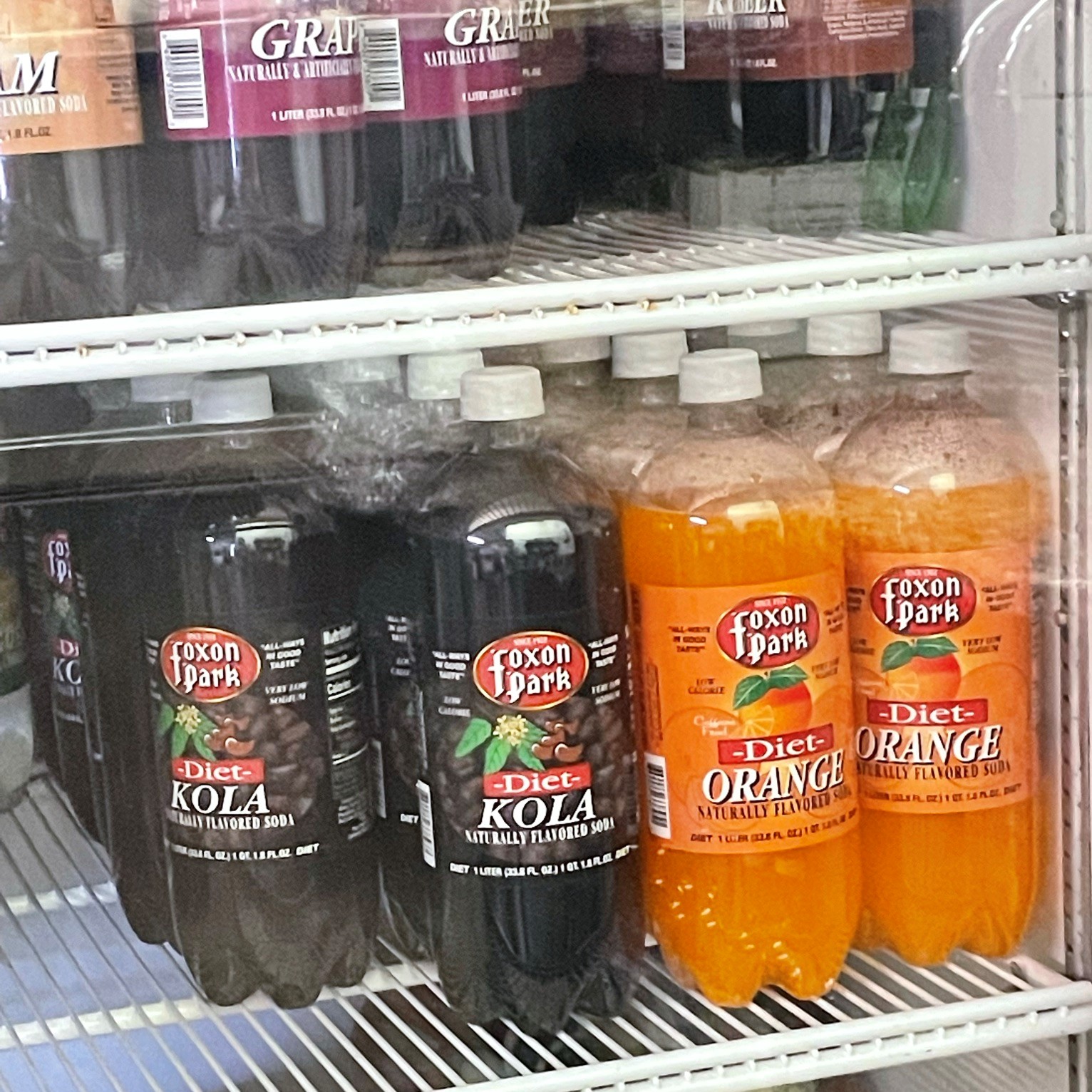
Yes, it takes time to crush and recycle all the cans. But, as Bill Pustari told me, it’s the right thing to do.As do the other amazing pizzerias in New Haven, Modern Apizza serves up local soft drinks from Foxon Park.Fresh from the local farm!
Despite the extra time it takes his prep crew, Bill is committed to doing right by his community. All those cans for the tomato sauce get recycled. He purchases sausage from a local butcher, serves local Foxon Park soft drinks, and Modern’s mozzarella comes from Liuzzi’s, the same Italian market Les and I had visited earlier in the week. Just before he arrived at the restaurant, Bill had met with a farmer to purchase local tomatoes to be used on the fresh tomato pizza which is, of course, a New Haven classic. All these neighbors supporting each other and finding great success—kinda makes me want to live in New Haven!
Sourdough was the key to the great flavor we experienced at Modern Apizza, and it’s my go-to pizza dough at home. My favorite recipe is linked in the ingredients list, and I recommend using a pizza steel and the hottest temperature your home oven can handle. My dough ferments in the refrigerator, but I bring it to almost-room temperature when I’m ready to shape and bake it.
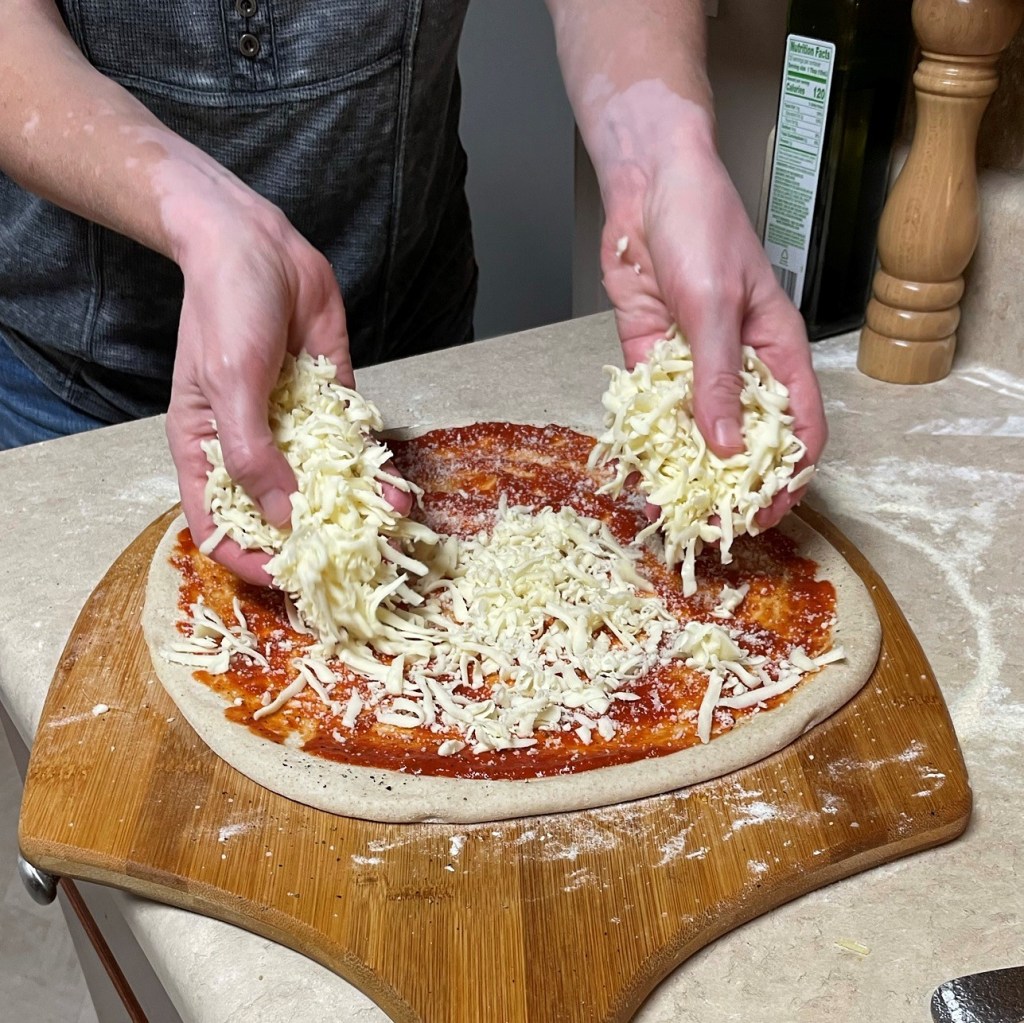
Use firm, whole milk mozzarella for best results—and yes, you absolutely should shred it yourself rather than using pre-shredded, pre-bagged cheese. Pre-bagged cheese may be convenient but it is coated with a powdery substance that prevents clumping in the bag, which unfortunately for use on pizzas also prevents even melting. So please shred your own; it’s worth it.
Instructions
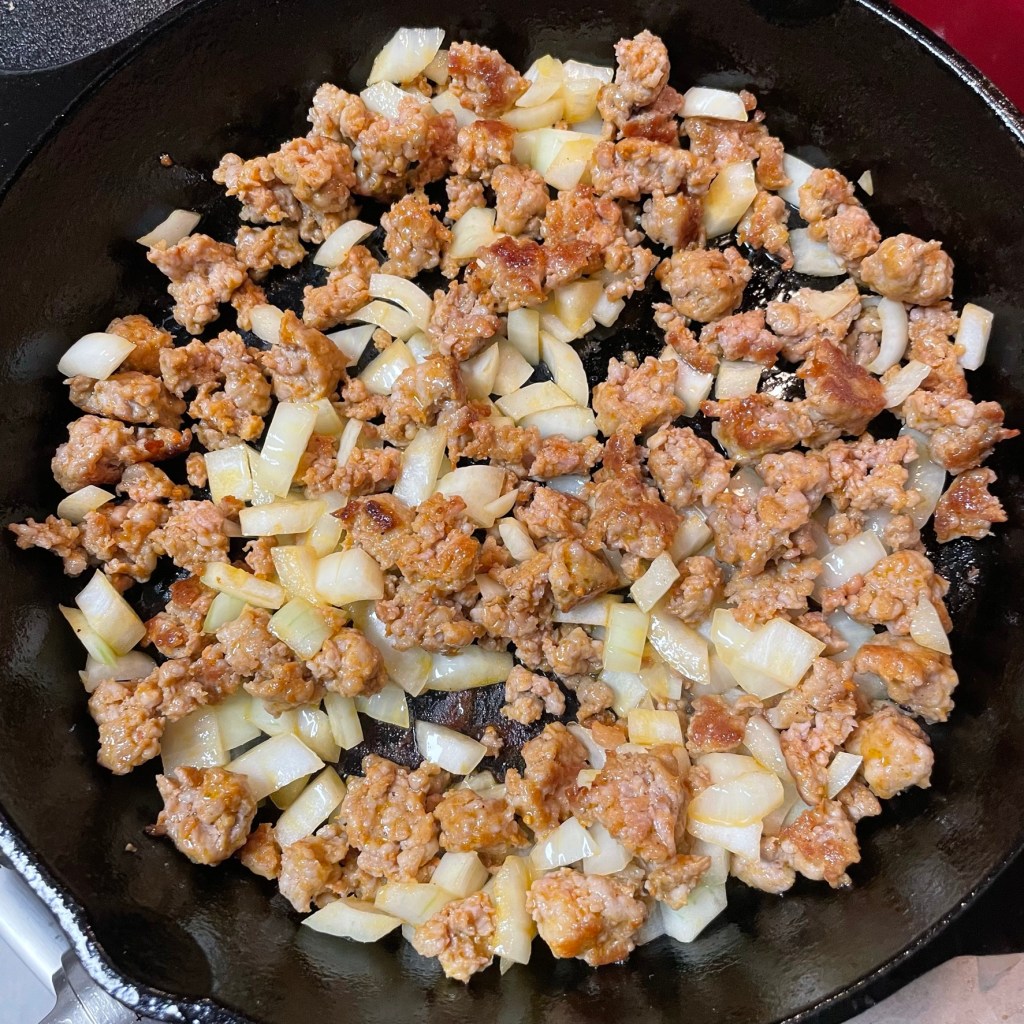
Crumble the Italian sausage and cook in cast iron just until it starts to brown. Add the onions and cook a minute or two more.
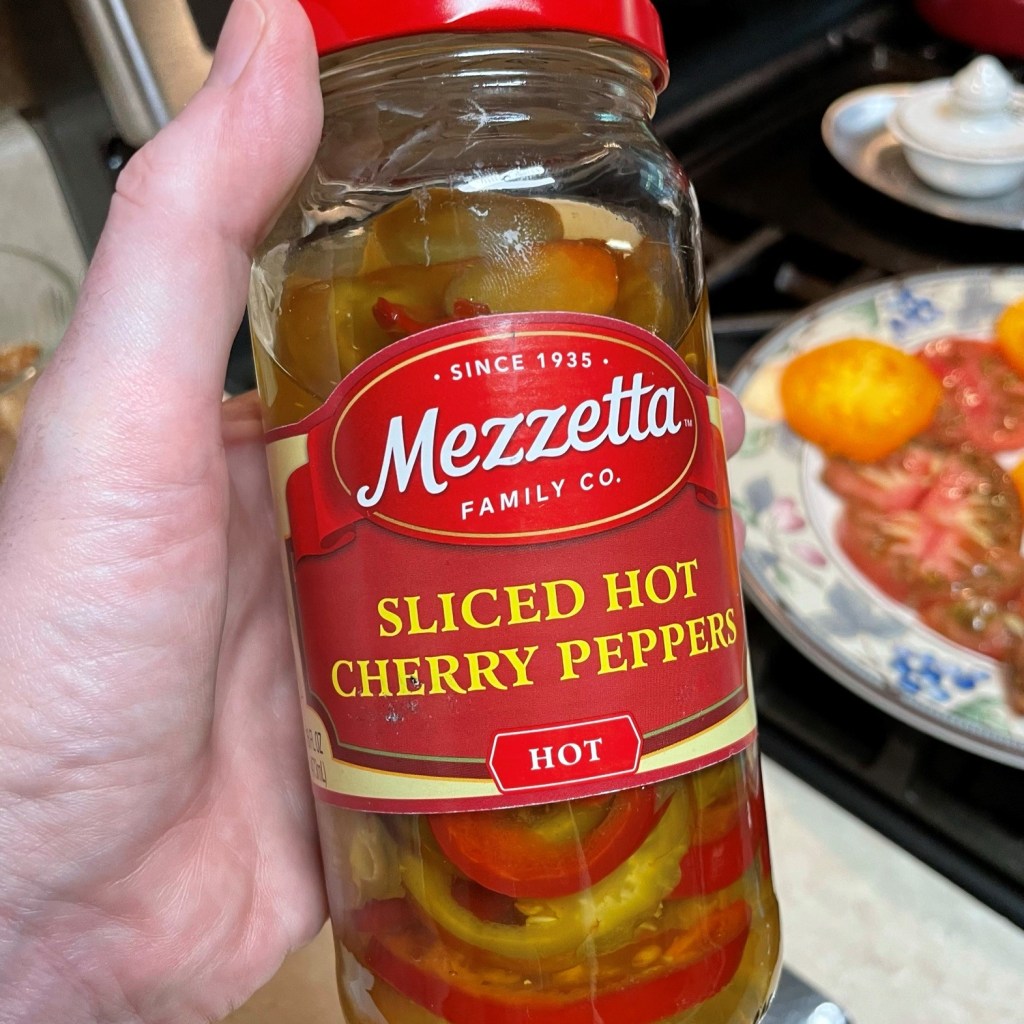
Hot or mild, your choice! Drain them and pat dry with paper towels. Chop into smaller bits if desired.
Swirl your sauce onto the shaped pizza dough, then scatter a generous amount of freshly shredded mozzarella over the whole thing.
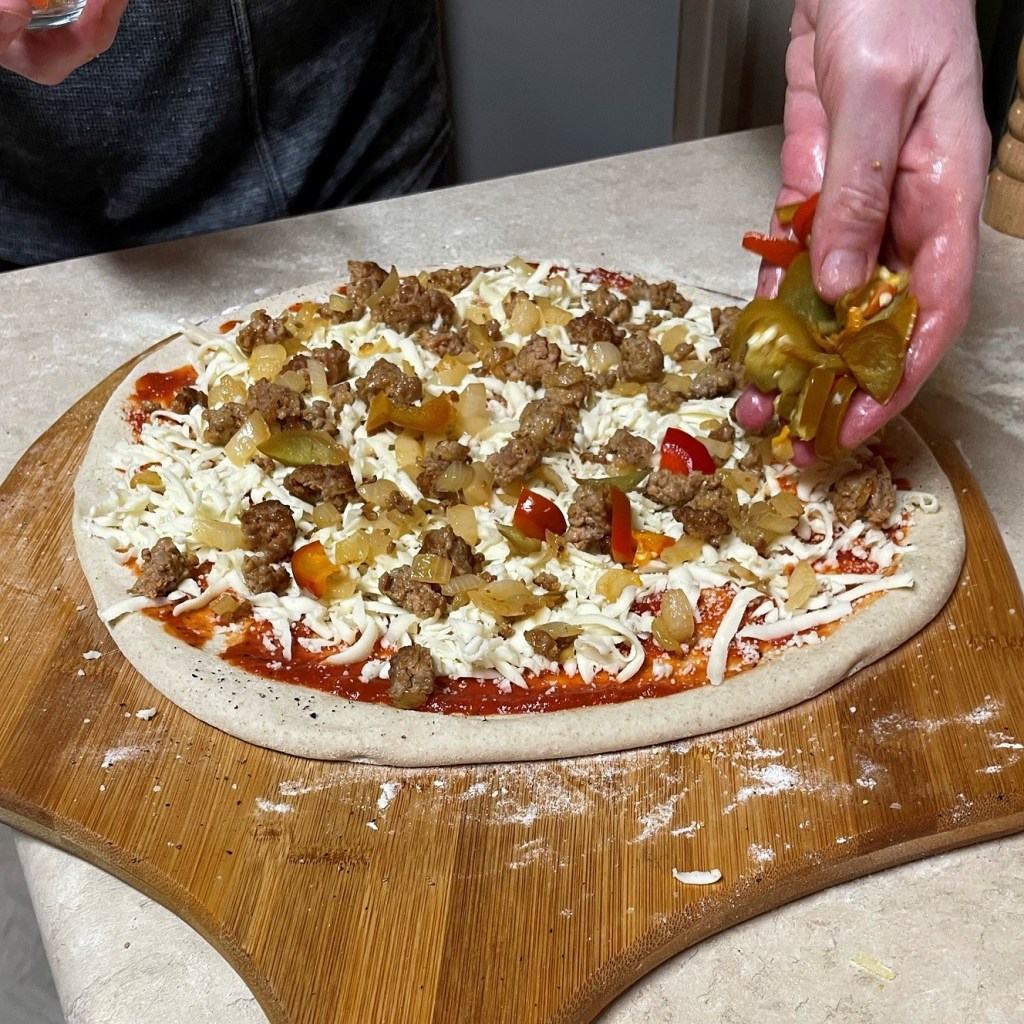
Arrange the sausage and cherry peppers all over the pizza.
This is a new thing for me, thanks to my experience at Modern Apizza. Drizzle a bit of extra virgin olive oil over the pie before you slide it into the oven.
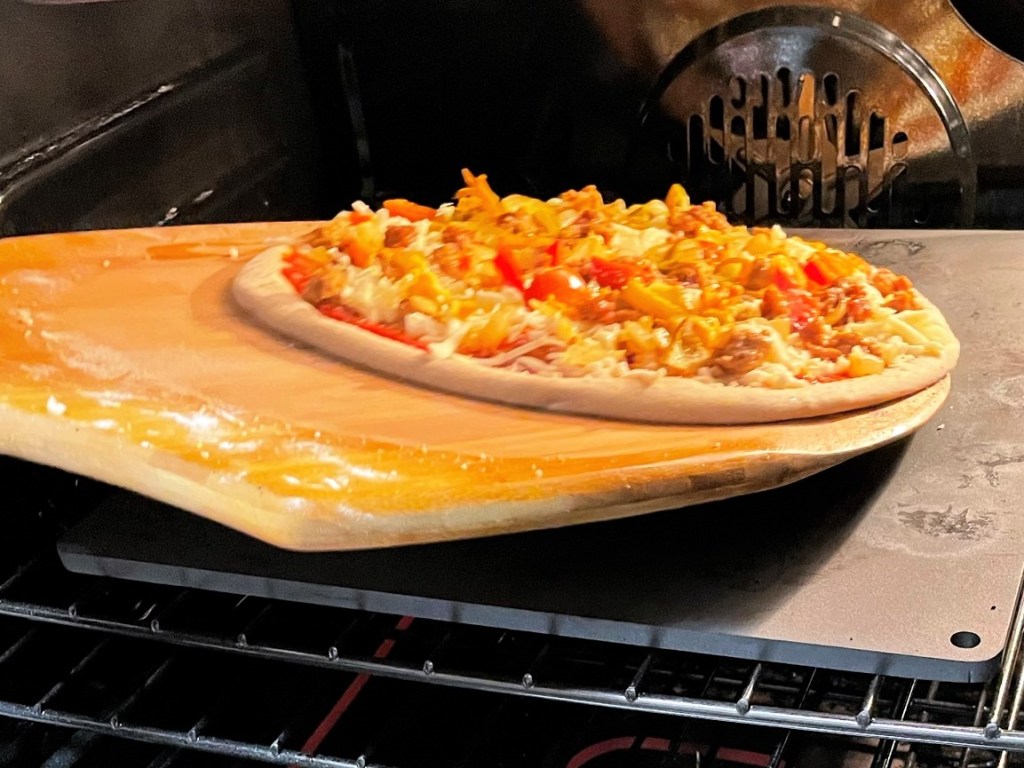
The hot pizza steel gives us a bit of brick-oven style baking at home. Our pizzas take about 6 minutes.
Loving it! 🙂
Preheat the oven to 550°F, with the oven rack positioned about 8 inches below the top element and a pizza steel in place for a solid hour at temperature.
Heat a cast-iron skillet over medium heat. Crumble up the Italian sausage and brown it until some of the edges are just developing a crust. You want it to hang onto its moisture for the most part, as it will cook again in the oven. Add the onions to the skillet and cook until they are softened. Transfer the meat and onions to a bowl and cool completely.
Drain the cherry peppers and pat them dry on layers of paper towel. Chop them into bite-sized pieces.
When the oven is ready, shape the dough into a 14” round and transfer to a flour- and cornmeal-dusted pizza peel, which will make it easy to slide the pizza into the hot oven.
Swirl pizza sauce over the dough, then scatter parm-romano and mozzarella evenly. Arrange the cooked sausage and onions over the pizza, and follow that with the cherry peppers.
Drizzle olive oil lightly over the toppings and quickly transfer the pizza to the hot oven for about 6 minutes, or until the cheese is hot and bubbly and the edges of the crust are browned and blistered.
Right here in the middle of gray, dull, Dry January, I think we could all enjoy a warm-weather trip down memory lane, and a taste of sweet summer tomatoes like the ones on this pizza. I’ve been waiting many months to share this story with you, and because this month is such a drag, I’m actually thankful that it took me so long to get to it. Life has been busy since we wrapped up our kitchen remodel, but now that the holidays are behind us, I’ve been looking at these pictures again and remembering the sweet time my husband, Les, and I had on our vacation through New York, New Jersey and Connecticut.
Our road trip presented a unique opportunity for me to do one of my favorite things—research of famous local foods—and this time, I was studying different but not necessarily opposed pizza styles. And after my extensive research (which was essentially just eating a lot of pizza), I have a confession. More of an announcement, really. For all the times I have claimed victory in the challenge to make homemade pizza that rivals my husband’s memory of his beloved N.Y.-style pizza, I stand corrected. My pizza at home does not at all rival the pizza of New York. It rivals a completely different style of pizza.
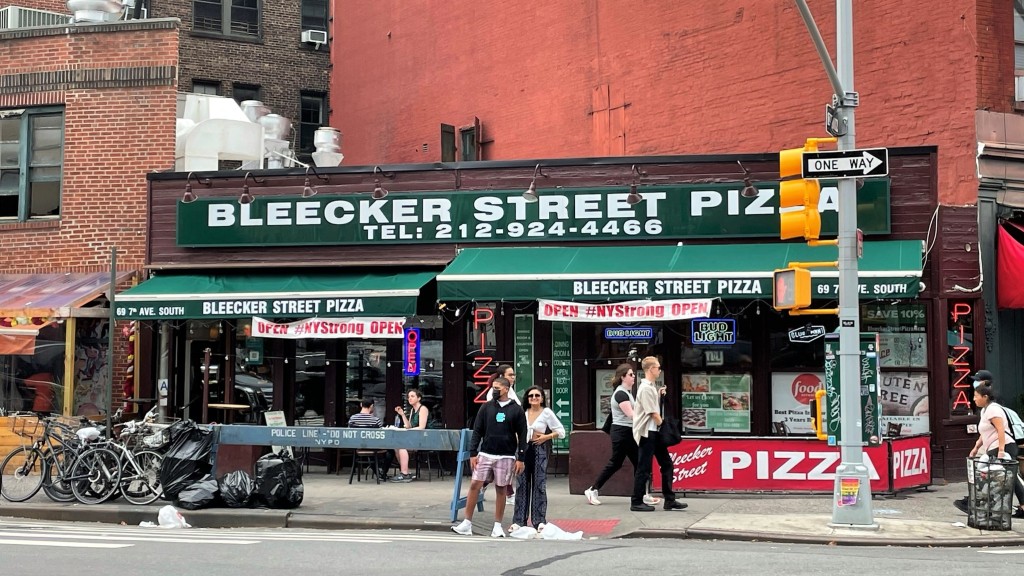
New York pizza is, of course, known for its gigantic slices and an ultra-thin and crispy crust that is easy to fold for eating on the run as you dash off to catch the subway or, if you’re lucky, a Broadway show. We had a taste of this N.Y. pie on our day trip into the city last August, as we stopped at one of the more acclaimed pizzerias, Bleecker Street Pizza. A friend of ours who is a native New Yorker (like my hubby) swears it is the best, so we put it on our “must do” list.
Legendary pizza slices, served up daily!
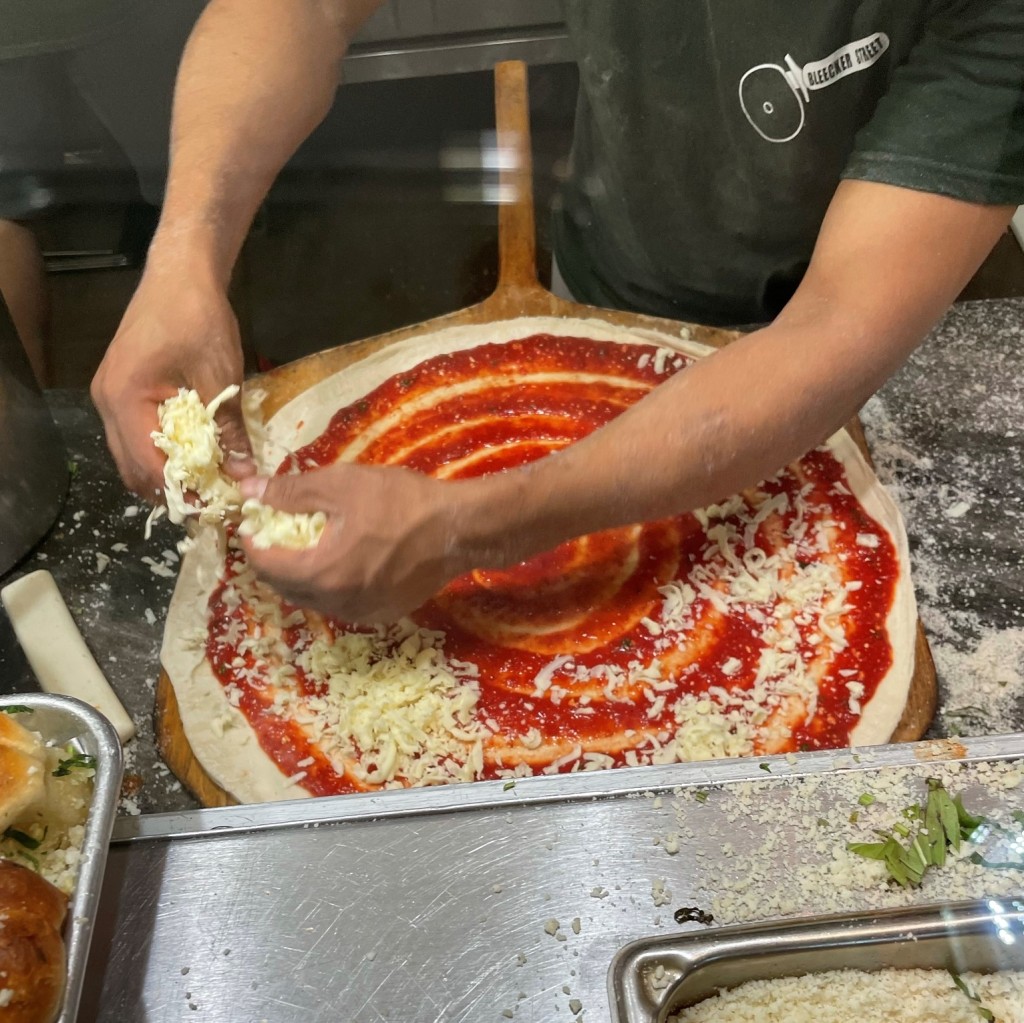
Big-time bragging rights!That swirl of tomato sauce! And ALL THAT CHEESE.Les still enjoys a classic N.Y. slice!This was definitely worth the trip!
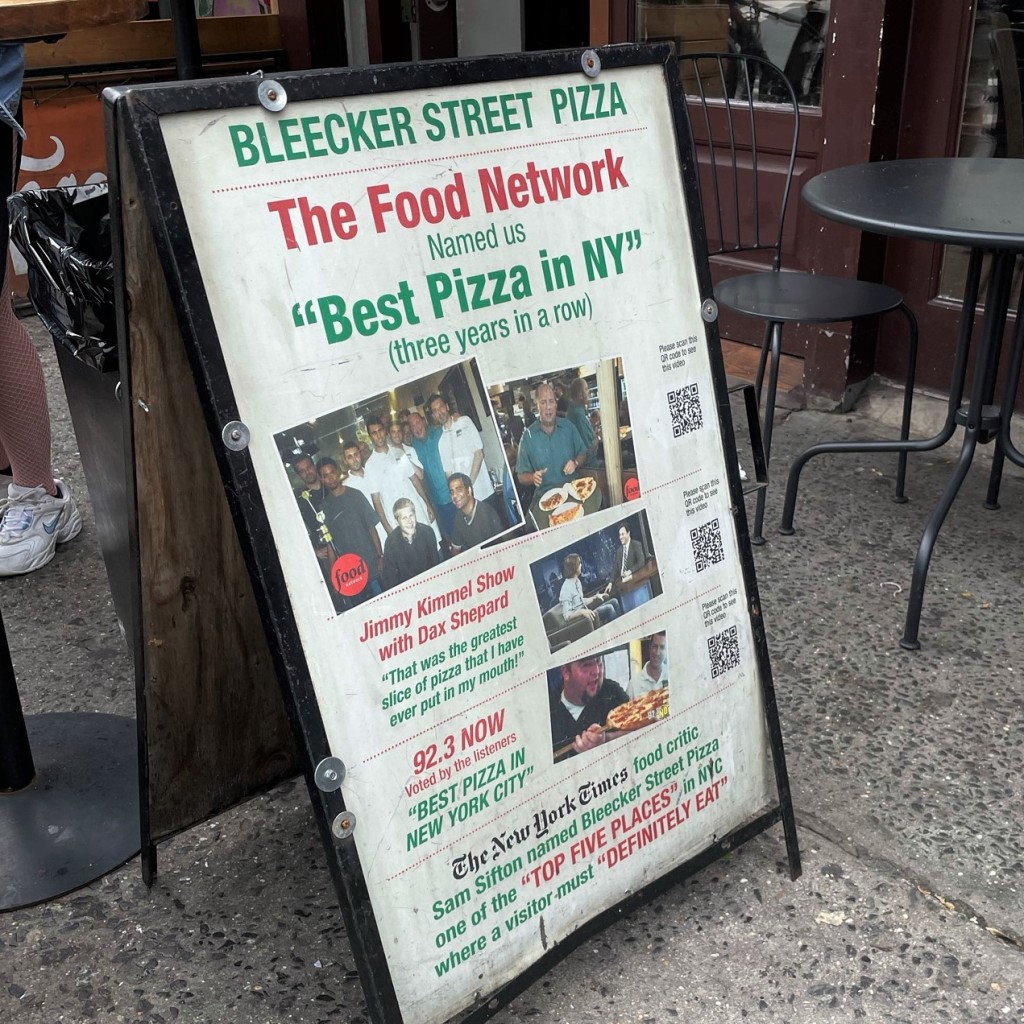
Notice their media props outside? Those are well-deserved, and the pies looked great, with the seasoned tomato sauce swirled out onto the dough (as I’m still learning to do at home, with hubby’s coaching) and, of course, all that cheese. It was good, but the crust didn’t feel or taste like the one I have developed at home—the crust that Les says is “just right.”
I can’t say for sure, but I suspect the Bleecker Street dough was dusted with rice flour. This is a simple trick that puts a crackling-crisp texture on the bottom crust and it’s good for reheating the slices, as they do to order, but it does not add flavor. Our research into pizza excellence would continue the next day, because we had plans to visit another legendary pizza town—New Haven, Connecticut. And that’s where I had my epiphany.
Greetings from New Haven, home of a whole different kind of pizza.
Les spent 19 years in the New Haven area, and I have heard plenty from him about various food joints he loved there, and especially about the white clam pizza, which we have worked to perfect over the past few years and now serve at home every New Year’s Eve. A random internet search for this unusual seafood pizza will lead you directly to New Haven, and particularly to Frank Pepe Pizzeria, which has been making white clam pizza since 1925. My mouth was watering from the time we arrived just before noon, and for the entire 30-minute wait, as there was a line of hungry pizza lovers wrapped all the way around the restaurant. We had waited so long for me to have a taste of real Frank Pepe’s pizza, we ordered three of them!
The roasted red pepper and pepperoni pizza (say that three times fast)! 🙂White clam pizza and fresh tomato pizza at Frank Pepe’s.
The crust on the first pizza—roasted red pepper with pepperoni—seemed instantly familiar, with more of the character I had been making at home, and Les agreed it was superior to the pie we had enjoyed the day before on Bleecker St. And there was something different about the flavor of the dough as well, something more complex, and we supposed it had to do with the higher heat ovens than what is used in the N.Y. pizzerias.
Frank Pepe’s uses an enormous coal-fired oven with a brick floor, and the pizzaolo has a pizza peel with a handle that is about 7 feet long—giving him access to load and spin the pizzas in the oven, but at a safe distance from the intense heat.
The coal-fired oven at Frank Pepe’s must be enormous inside, because they are churning out pizzas every few seconds.
My interest was piqued when the other two pizzas arrived at our table. First, there was a fresh tomato pizza, which is a limited-season thing and quite a big deal in New Haven, and it was very fresh and bright, exactly like summer. Finally, the legendary white clam pizza, and I was certain it would be pure nirvana for my taste buds.
Look at the huge chunks of fresh tomato! The white clam pizza is said to have originated at Frank Pepe’s, and they do load it up with clams!
Sometimes your imagination (or even your memory) of something can outrank the real thing and maybe that’s what happened, but it wasn’t until I finally dared to lean across the table and whisper the words, “I think ours at home is better,” and Les instantly agreed, that the reason occurred to me. As quickly as they were churning out specialty pizzas at Frank Pepe Pizzeria, there is no way they can manage using freshly shucked clams, as we do at home every New Year’s Eve. Nope, these clams had to be from a can. Still, the crust was very good and more like the one that Les has encouraged me to emulate. What I didn’t like was the dusty black char that was prevalent across the bottom of the pizzas, and even a bit on top of my white clam slice—it was the stuff we avoid at home by scraping off the hot steel before sliding another pizza into the oven. But I get it, they are slammed busy with a line out the door even as we left. Overall, it was still a great experience, and we boxed up our leftover slices to continue our journey through New Haven.
We had one more pizza joint to experience and it turned out to be the best of the bunch, not only for the pizza but for the overall experience. So much so, in fact, that it deserves its own post—tomorrow!
Until then, please enjoy this recipe—my own—for fresh tomato pizza, which I created at home the first weekend after we returned from our trip!
We don’t have a huge, coal-fired oven, but we are still getting it done at home!
My version used farmers’ market, late-season heirloom tomatoes and some fresh basil I plucked from a plant that was growing on my kitchen counter. It was post-Labor Day, but we were technically still in the final days of summer, and this pizza captured all the beautiful freshness of that.
The base, of course, is what I have long called My Real N.Y. Pizza Dough, but obviously I will have to update that because my careful, ahem, “research” proved my dough more closely resembles what the locals in New Haven call “apizza.”
Ingredients
2 heirloom tomatoes, cut in 1/4’’ slices
Kosher salt and freshly ground black pepper
1 ball of pizza dough at close to room temperature
About 3/4 cup freshly shredded whole milk mozzarella
A handful of fresh basil leaves
Extra virgin olive oil
*Notes
As always, the oven should be as hot as a home oven goes—550°F. and heated for an hour with a heavy pizza steel for the best-ever, crispy texture. If you do not have a steel, use a pizza stone and preheat to the hottest temperature possible for your particular stone. This combination of steel or stone and very high heat will emulate the brick oven baking that makes this style of pizza so special.
Instructions
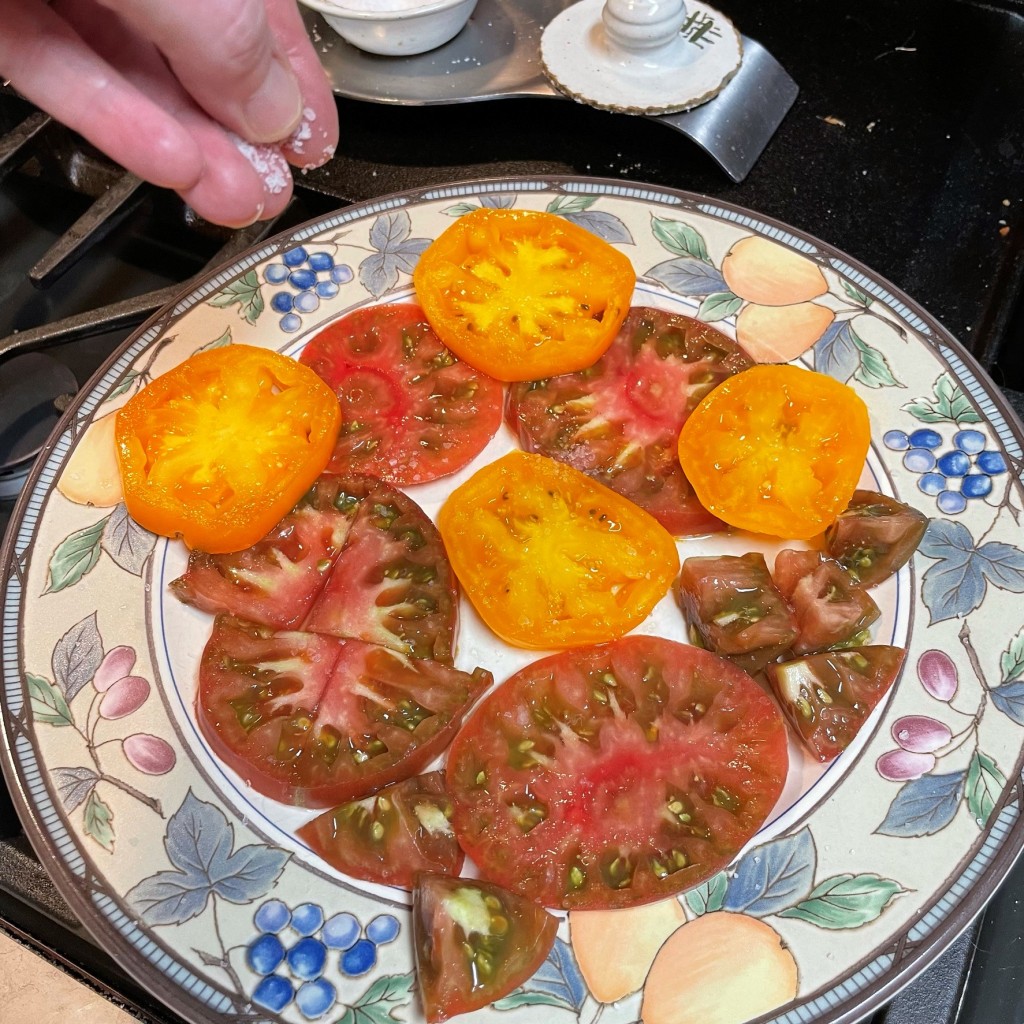
Slice your fresh tomatoes and sprinkle them with salt. This will season them, and also draw out excess moisture.
After several minutes, drain the tomatoes on layers of paper towel.
Guess what I did with the tomato juices on the plate? 😉
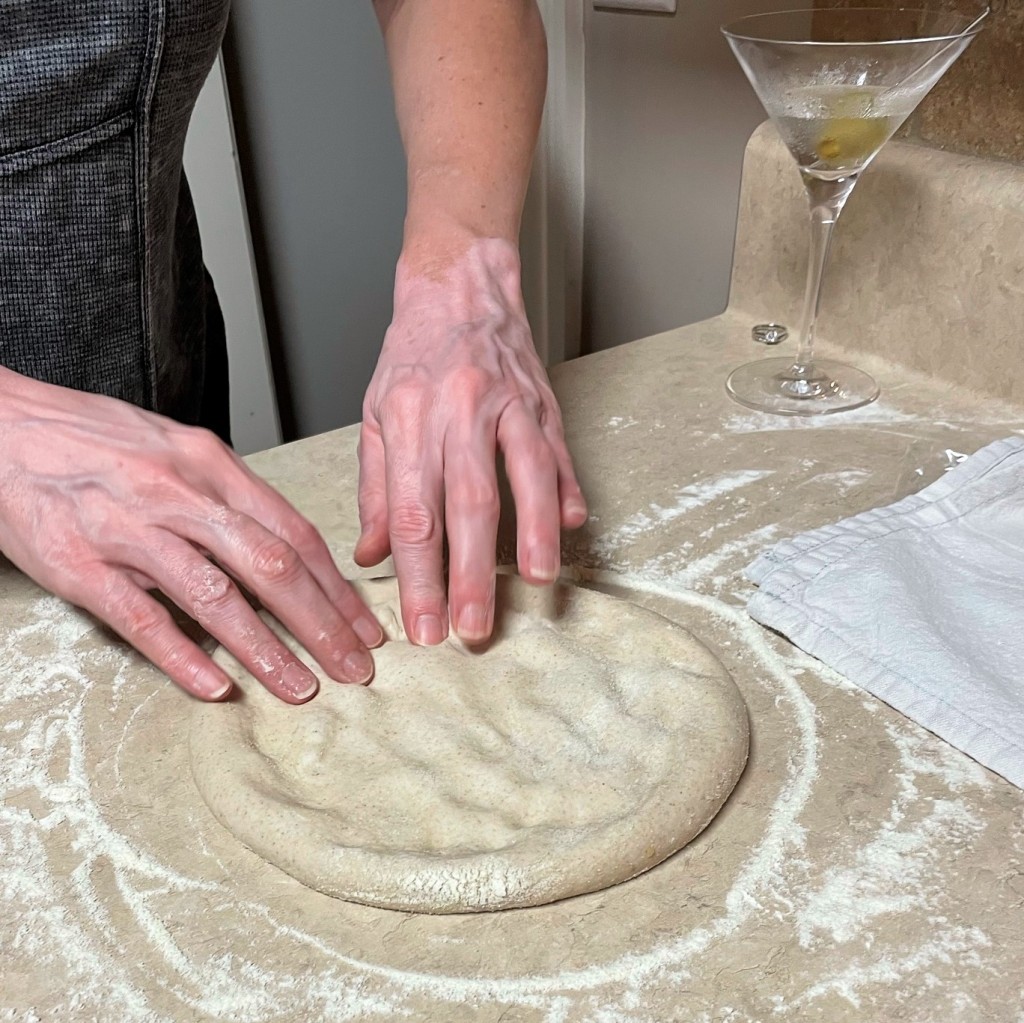
Shape the pizza dough into a 14″ round. Use the link to my pizza dough recipe if you’d like to see my shaping technique. Season it with salt and pepper and transfer to a prepared pizza peel.
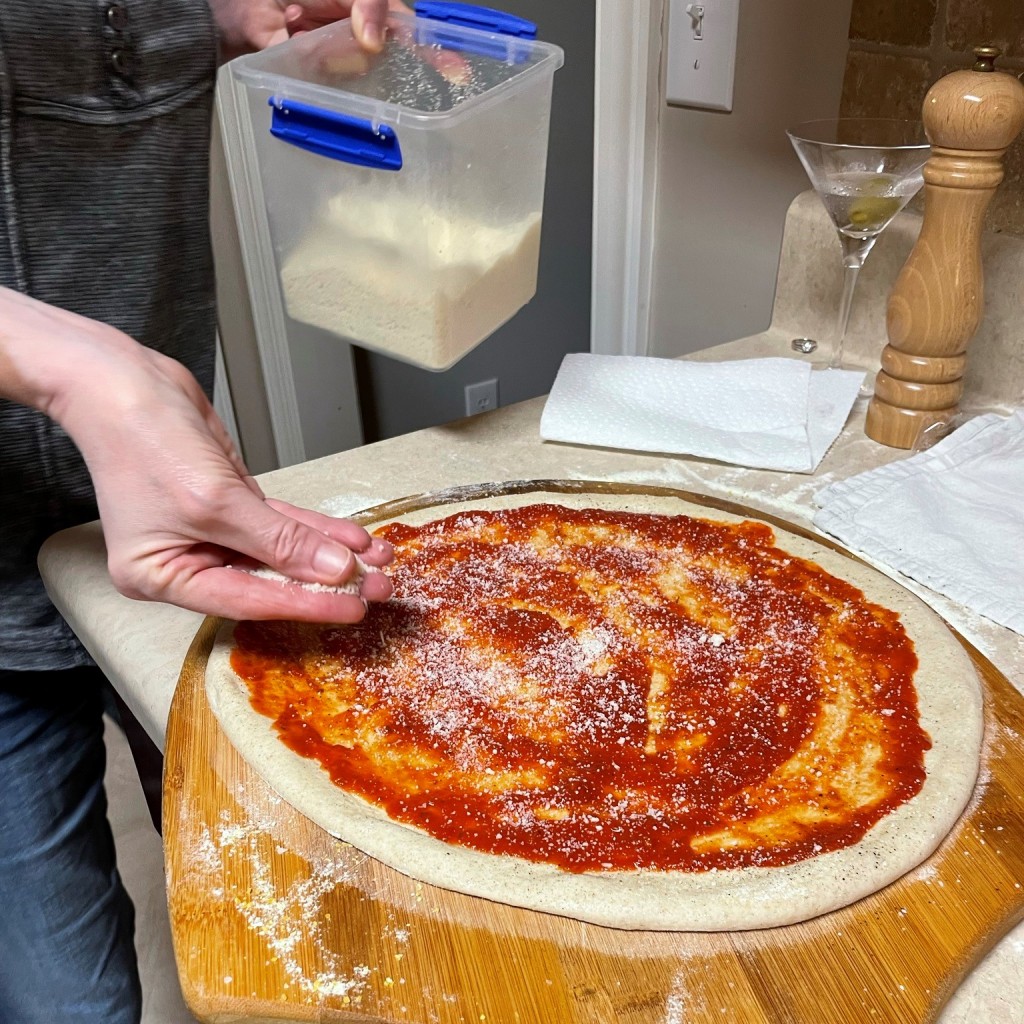
My swirl of sauce is not quite as perfect as that of the experts at Bleecker St. or Frank Pepe, but I’m working on it! Sprinkle on some parm-romano before the other toppings.
Freshly grated, whole milk mozzarella is what I use on most of my pizzas.
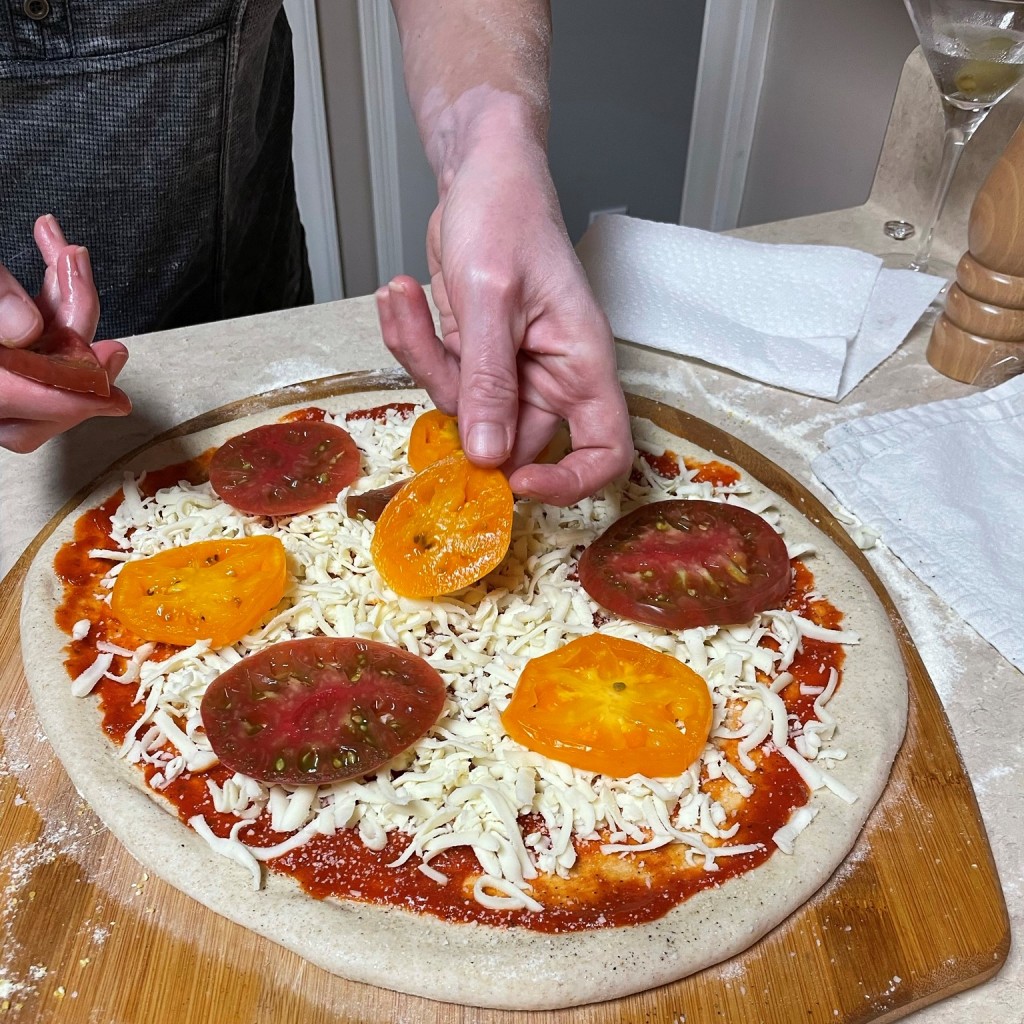
Look at these gorgeous fresh tomatoes! I’m already craving this for next summer.
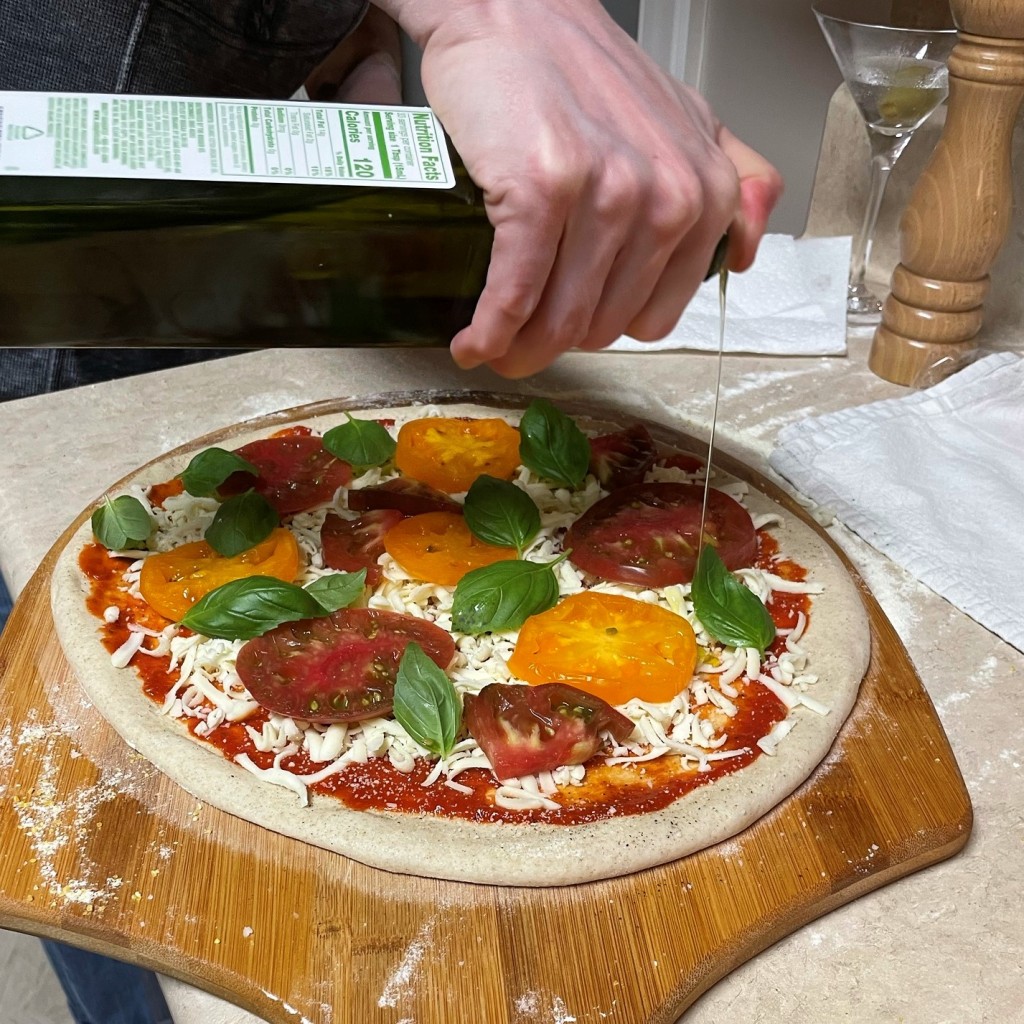
A few fresh basil leaves and a quick drizzle of extra virgin olive oil, and this pie is ready for the oven.
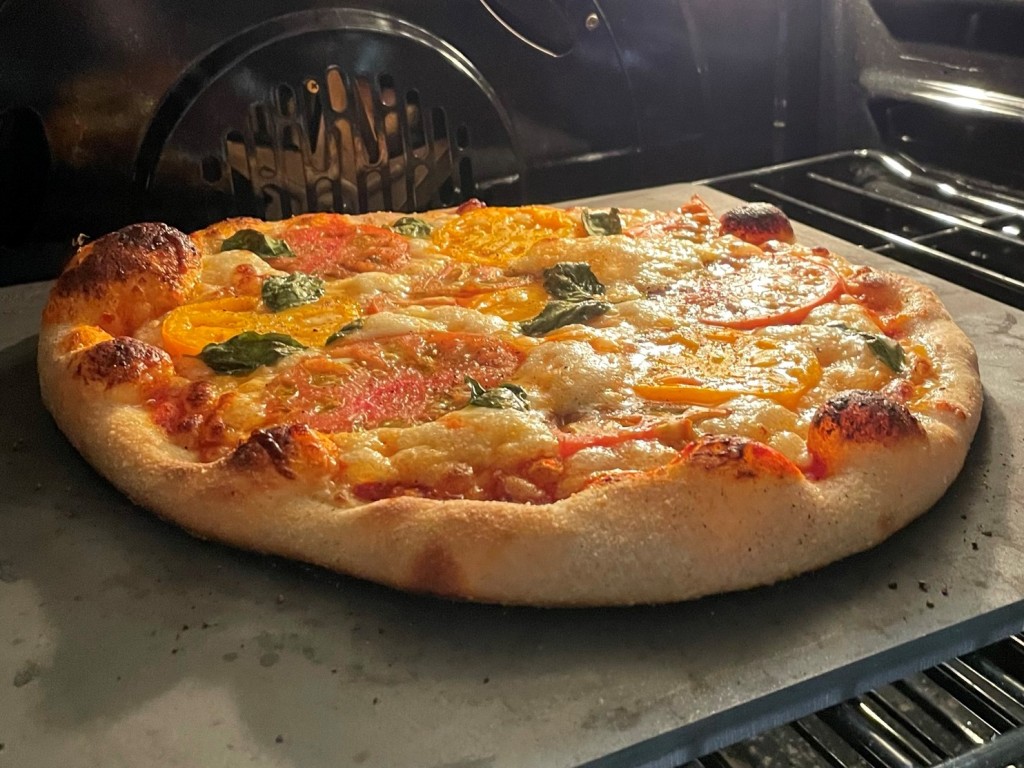
Yeah, baby!!! At 550° F, this is done in about 6 minutes.
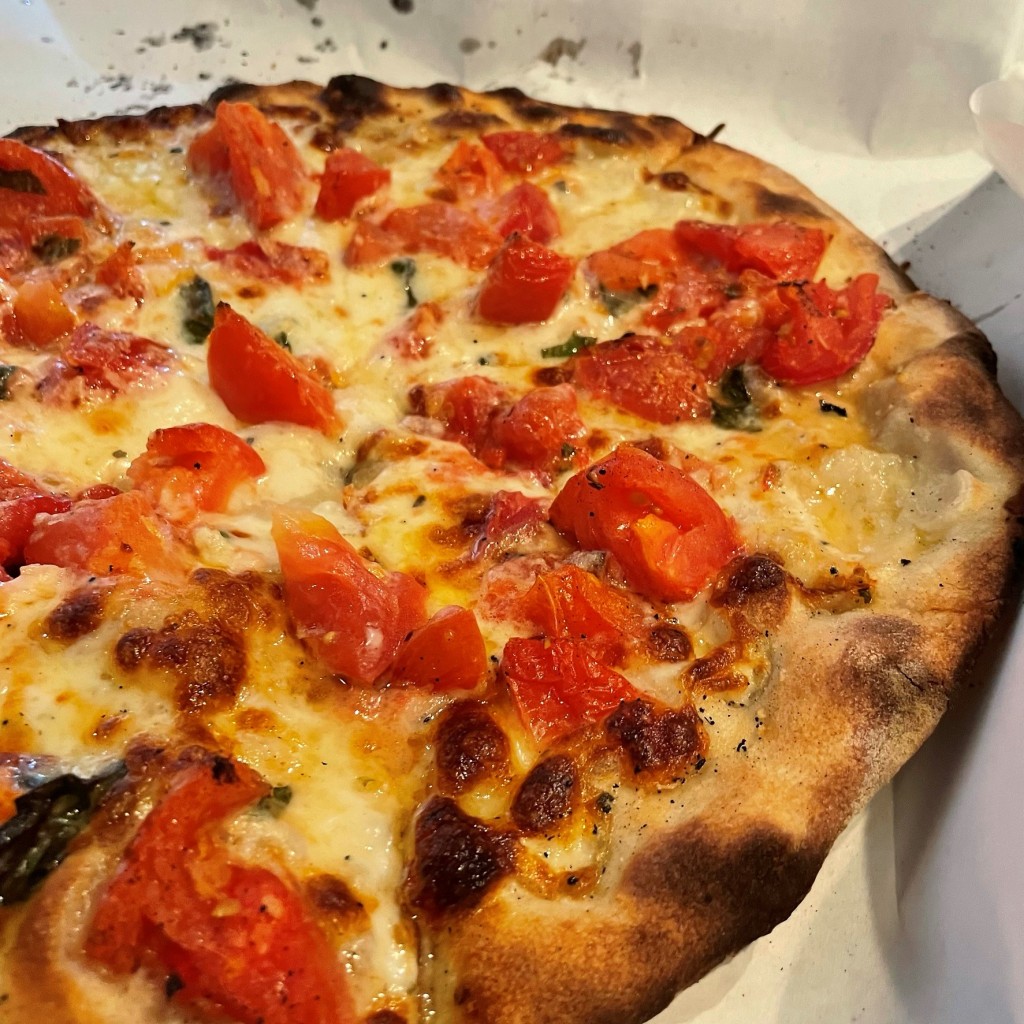
My crust more closely resembles the New Haven-style pizzas, especially with the blistered edges from the high heat of our pizza steel. These flavors were simple but amazing!
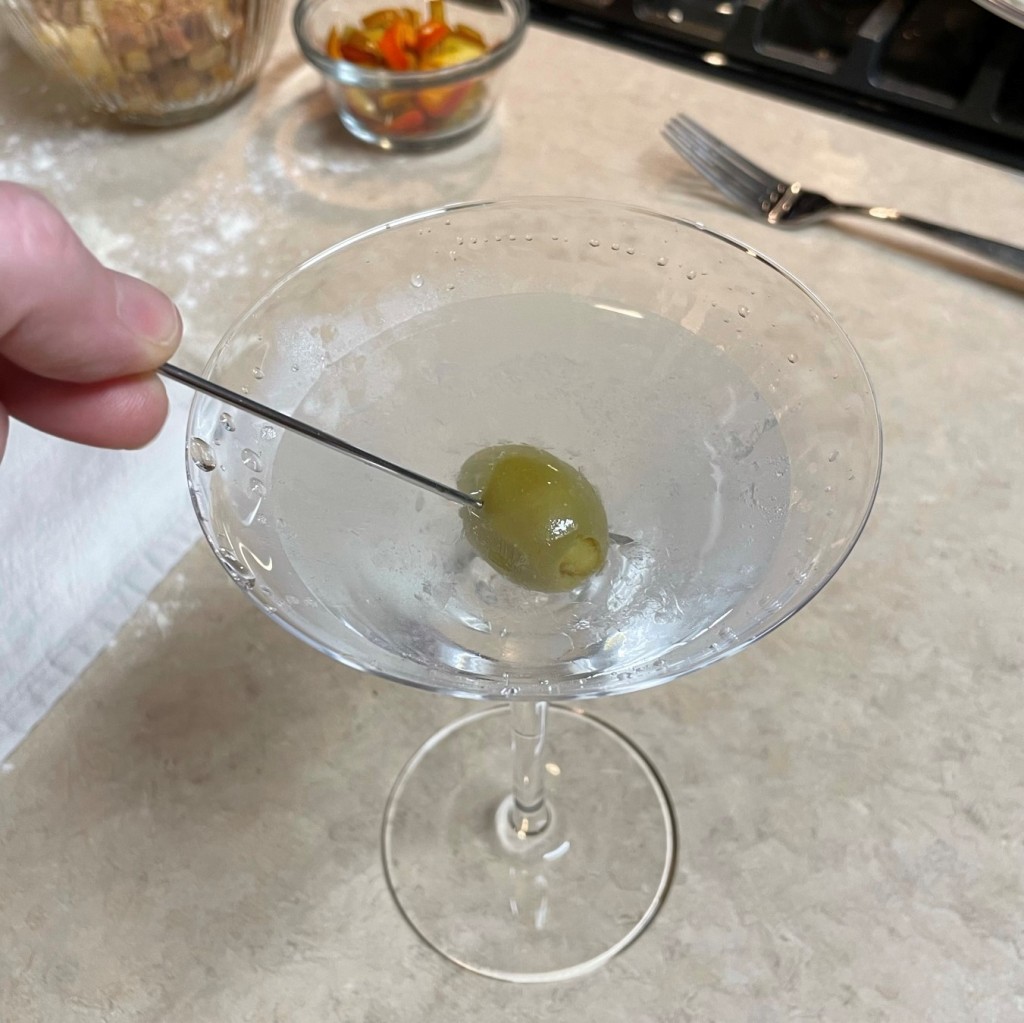
Spread the tomato slices out onto a large plate and sprinkle kosher salt over them. Be generous with the salt, as it will draw out excess moisture, concentrating the flavor of the tomatoes. Let this rest 20 minutes while you enjoy a cocktail (or whatever you do before dinner). Transfer the tomatoes to layered paper towels and pat dry. I actually poured the salted tomato juice from the plate right into my martini for a savory twist. When Dry January is over, I may do that again! 😉
Shape the dough into a 14” round and place it on a flour and cornmeal-dusted peel. Swirl on sauce, then sprinkle parm-romano evenly, not minding if some of it lands on the dough edges. Scatter the mozzarella on top, give it a few quick twists of freshly cracked black pepper, and arrange the drained tomato slices and basil leaves. Lightly drizzle the top of the pizza with olive oil and dash it off into the screaming-hot oven for about six minutes.
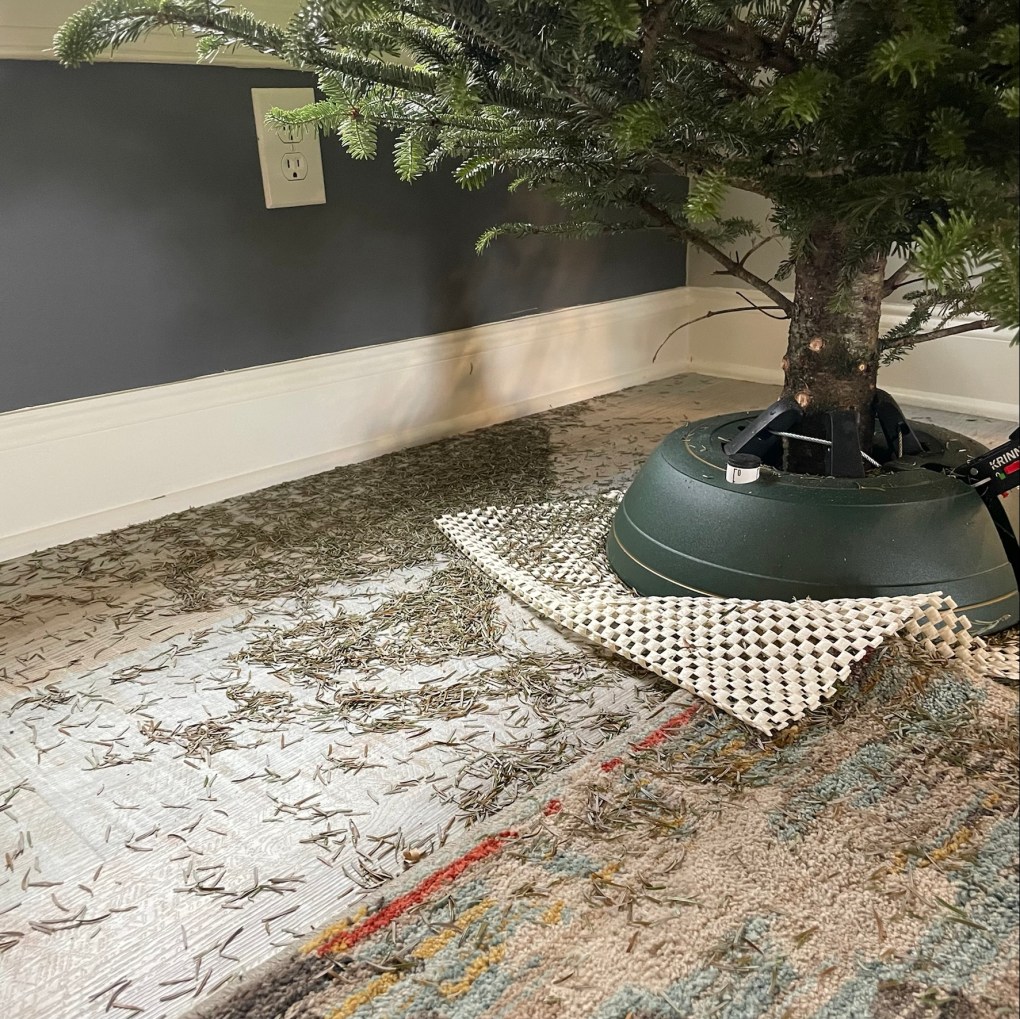
In my radio days, I had a co-worker who proclaimed that every month had a color. March was green, July was red, October was orange and January was (as if we couldn’t guess) gray. It couldn’t be truer, right? The twinkly lights are all packed away, the parties are over (or in the case of the past two years, they never even got started), the festive music is no longer playing 24/7 on the iHeartRadio station and it’s back to work as usual. One of my least favorite things about the holiday season ending is taking down the Christmas tree. This year, our tree made it clear that it, too, was “over it,” and it did so by drying up and dropping all its needles into the corner of our living room. Dry and gray.
The month is already off to such a gloomy start that I have procrastinated more than usual on writing up something for Comfort du Jour, though I have been busy in the kitchen. I have made soup and baked bread and used up leftovers. Most of our meals have been from the archives, so there isn’t much new to share. More gray.
As if the month of January is not already dismal enough, I made a reluctant decision to participate in the no-alcohol-for-a-month event known as Dry January. The concept has plenty of appeal, with the lure of better sleep, reduced inflammation, higher productivity, likely weight loss and improved overall health. All of those things sound great, but in January? What in the world was I thinking?
Could it have been the complete absence of having anything to wear when we rang in the new year last week? It’s true that none of the cute things in my closet even come close to fitting me because of the weight I’ve gained in the past two years. Leave it to me to choose an international lockdown as the time to both begin a food blog and go through menopause. So, yeah, that was part of it. And it didn’t help that in the middle of December, I got reckless and went shopping for a new bra (because none of those fit me anymore either) and found myself stunned and disgusted by the semi-naked figure gawking back at me from the full-length mirror in the try-on room. I knew the calories from all of my food and drink experiments would add up, but when did Mrs. Doubtfire’s costume team take over my body?
I would say that this Dry January commitment was a spontaneous opt-in, a last-minute positive peer pressure kind of thing, but that wouldn’t be true. I have considered it in previous recent years; I have friends who have done it and found it cleansing and rejuvenating after an indulgent holiday season—but I always made excuses about doing it myself, from a desire to use up the lingering champagne from New Year’s or to keep mid-month brunch plans with a girlfriend or just to give myself a distraction from the boredom and low-grade depression that always hits me after Christmas. I even considered it last year, for about five seconds, but no way was I going sober for a month under the grim circumstances of COVID without vaccines. This afternoon, when we reach the one-year anniversary of the insurrection, I will probably be rethinking this whole thing again. Would Democracy be safer if I have a cocktail in my hand?
But this year, my decision was intentional, and though I am reluctant, I am curious to see what I may learn about myself this time. A good number of years ago, I entered a voluntary period of total sobriety for about eight weeks—long enough to drop 16 pounds without even trying, and long enough to find the courage to confront inexcusable abuse from my childhood. I was only 27 then, and it was an important emotional exercise for me at that time. Perhaps I am overdue for a personal revelation, or maybe I am finally finding the maturity to realize that my body needs a break from all this “moderation.”
Either way, I won’t be doing it alone. It is estimated that 1 in 7 people participate in Dry January, and when I casually mentioned it last week to my supportive husband, he instantly said, “Yeah, I’ll do that with you, Babe.” Thank goodness only one of us overthinks everything.
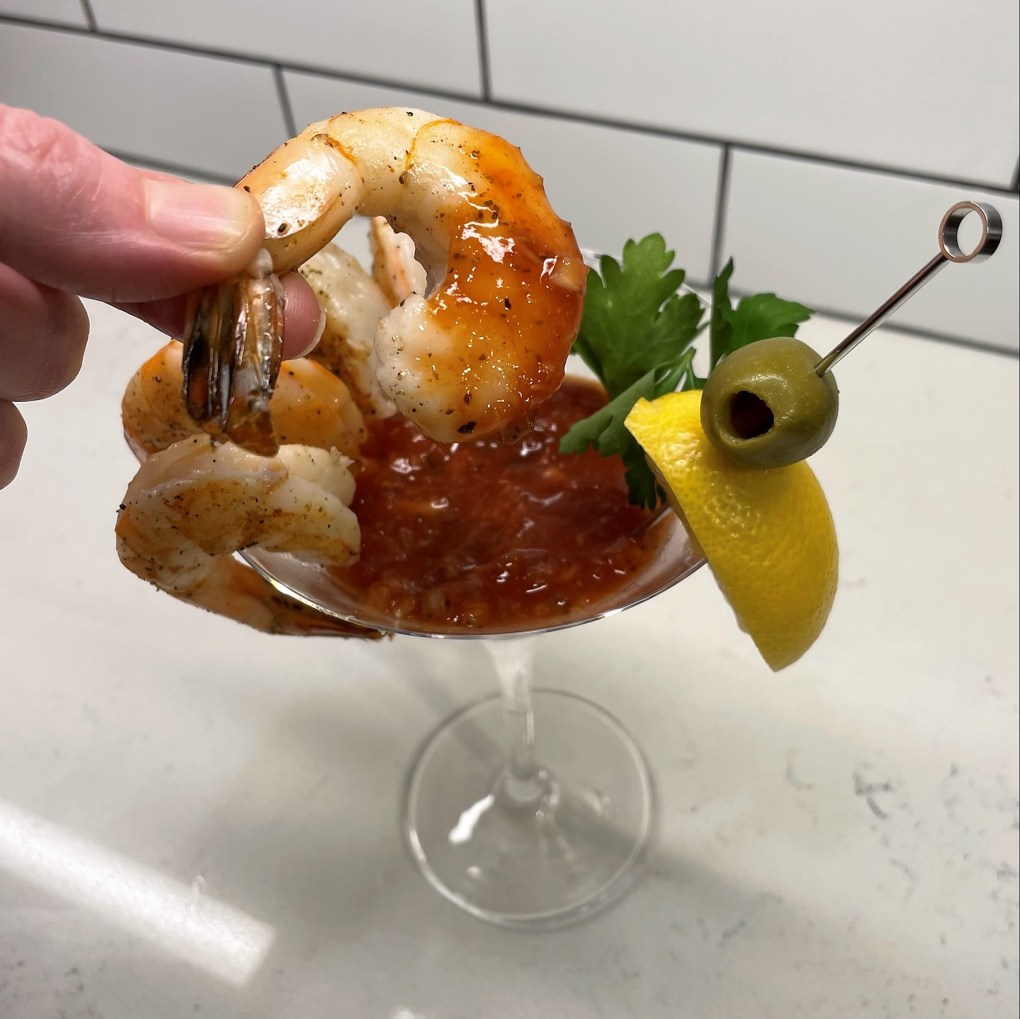
If you are a child of the ‘70s, as I am, you have seen your fair share of shrimp cocktails. It is a classic, but I am waking it up with a fun flavor twist in the cocktail sauce. You’ll find the flavors familiar—from a brunch standard, the bloody Mary—and it’s bringing a zesty jolt of flavor to the chilled freshness of sweet juicy shrimp, which never goes out of style.
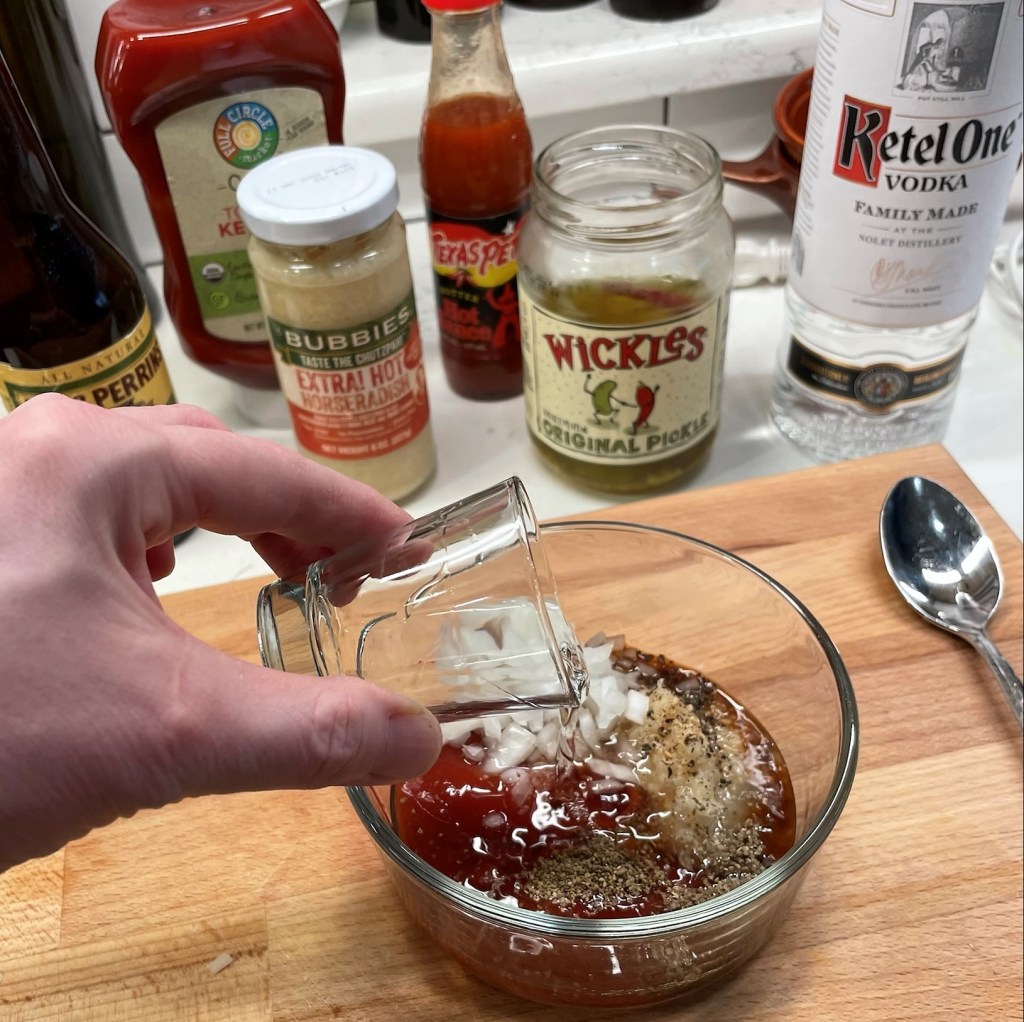
If you’re entertaining for New Year’s, this is an easy way to elevate a classic and please any palate. Begin with your favorite ketchup and dress it up with the ingredients you’d enjoy in a bloody Mary; think crunchy pickles, zippy horseradish, herbaceous celery seed, a shake or two of hot sauce or Worcestershire (or both) and, yes, a shot of vodka.
We like our flavors hot at our house, so I used a “hotter” variety of Texas Pete hot sauce, plus spicy Wickles brand pickles and “extra hot” horseradish. But if you prefer milder flavors, adjust accordingly. You could swap any flavors to suit your fancy. Pretty much anything that would work in a bloody Mary will work here. Same with your garnish.
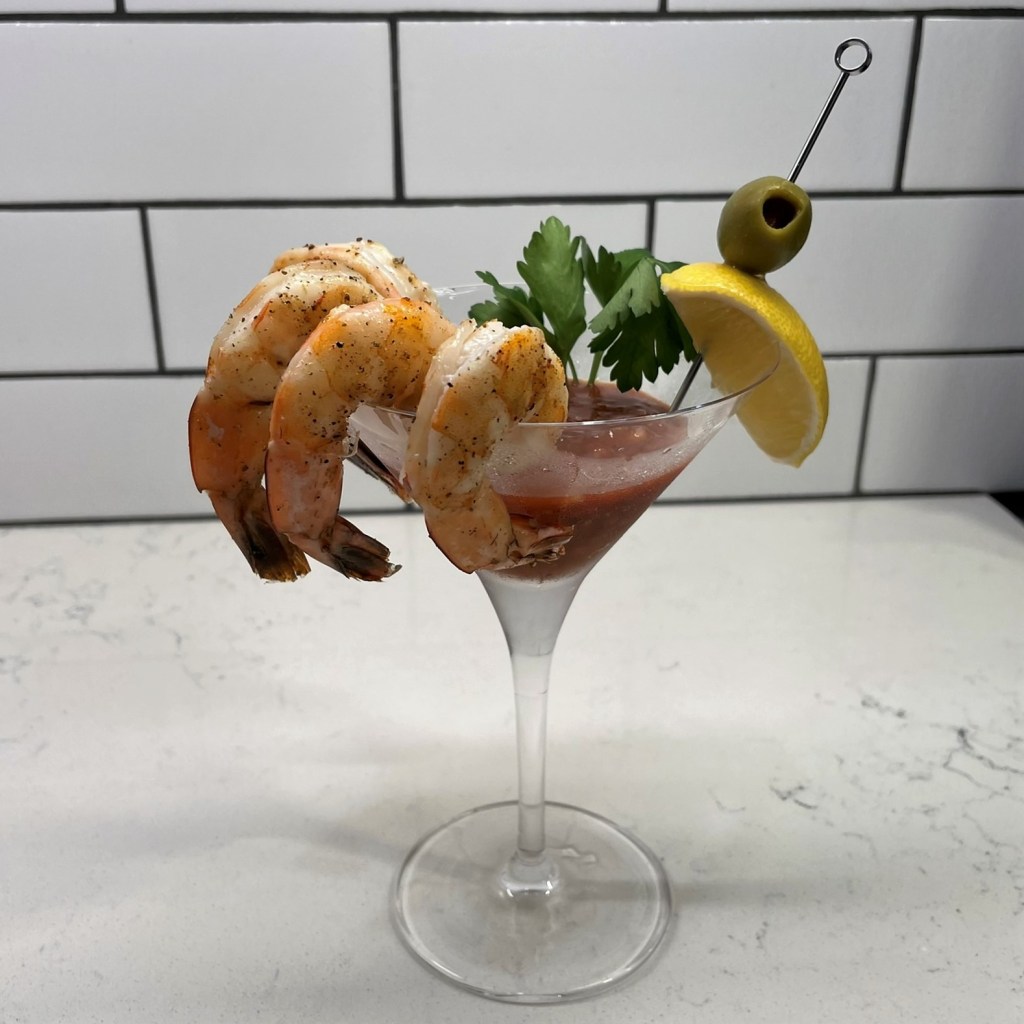
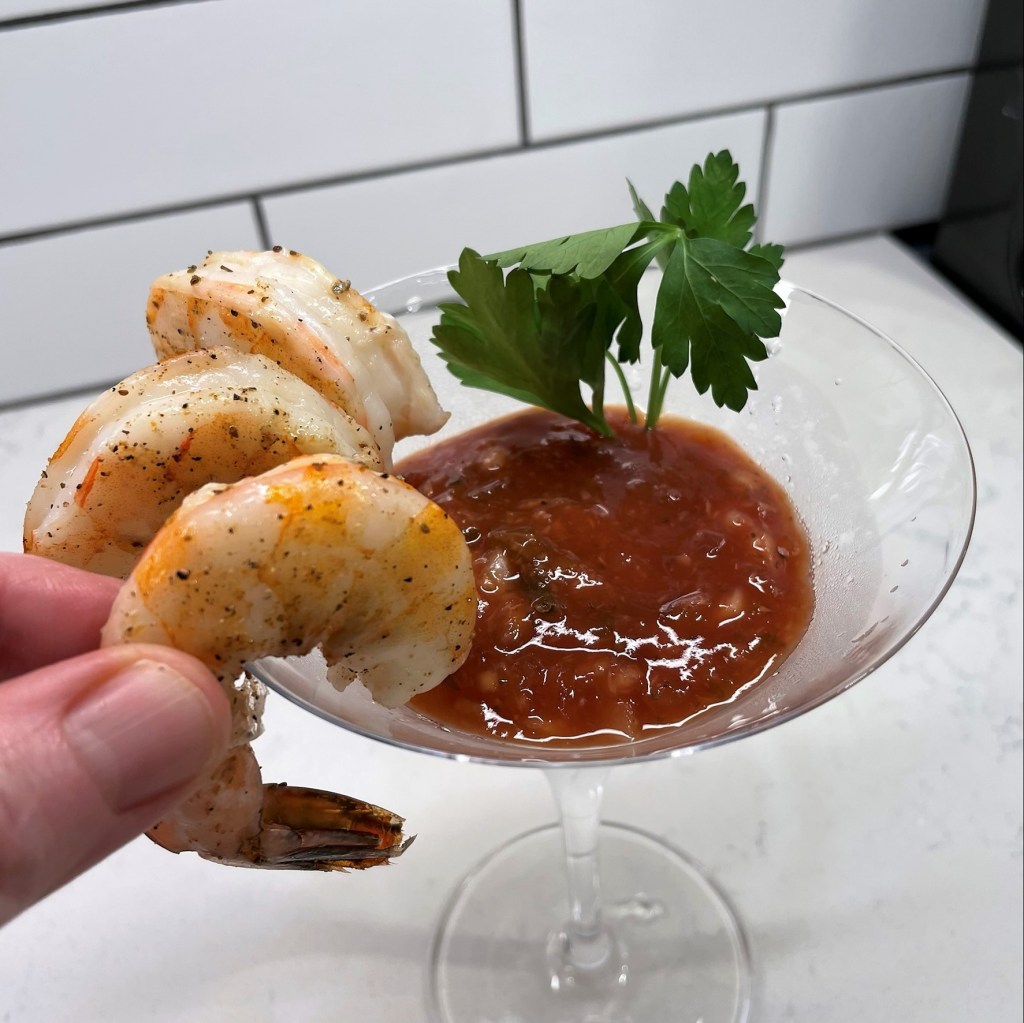
For the shrimp, do what’s best or easy for you, whether purchasing already cooked, steaming them or perhaps trying the roasting method I’ll demonstrate below. Whichever method you choose, be sure the shrimp have plenty of time to chill. Serve them in individual cocktail glasses for an impressive presentation and garnish as you would a bloody Mary!
Ingredients (serves 6)
18 jumbo shrimp* (see notes)
6 Tbsp. ketchup
2 Tbsp. finely minced onion or shallot
2 Tbsp. finely minced sweet, spicy or dill pickle
1 Tbsp. prepared horseradish
2 tsp. Worcestershire sauce
1 tsp. cayenne hot sauce, such as Texas Pete or Tabasco
1/2 tsp. celery seed
Splash or two of pickle juice
1 shot good quality vodka
*Notes
Take time to notice where your shrimp has been sourced, as some farming methods are bad for the environment and the seafood processing standards in some parts of the world are rife with human rights violations. Whenever possible, choose domestic (U.S. produced) shrimp that is either wild caught or sustainably farmed. Clean, peel and devein the shrimp, but keep the tails on for best presentation.
I used 16-20 count shrimp, which means there are 16-20 per pound. If you are serving the cocktail as an appetizer, three shrimp per person is a good starting point.
As a side note, it occurs to me that this zesty cocktail sauce would also be terrific with raw or steamed oysters.
Instructions
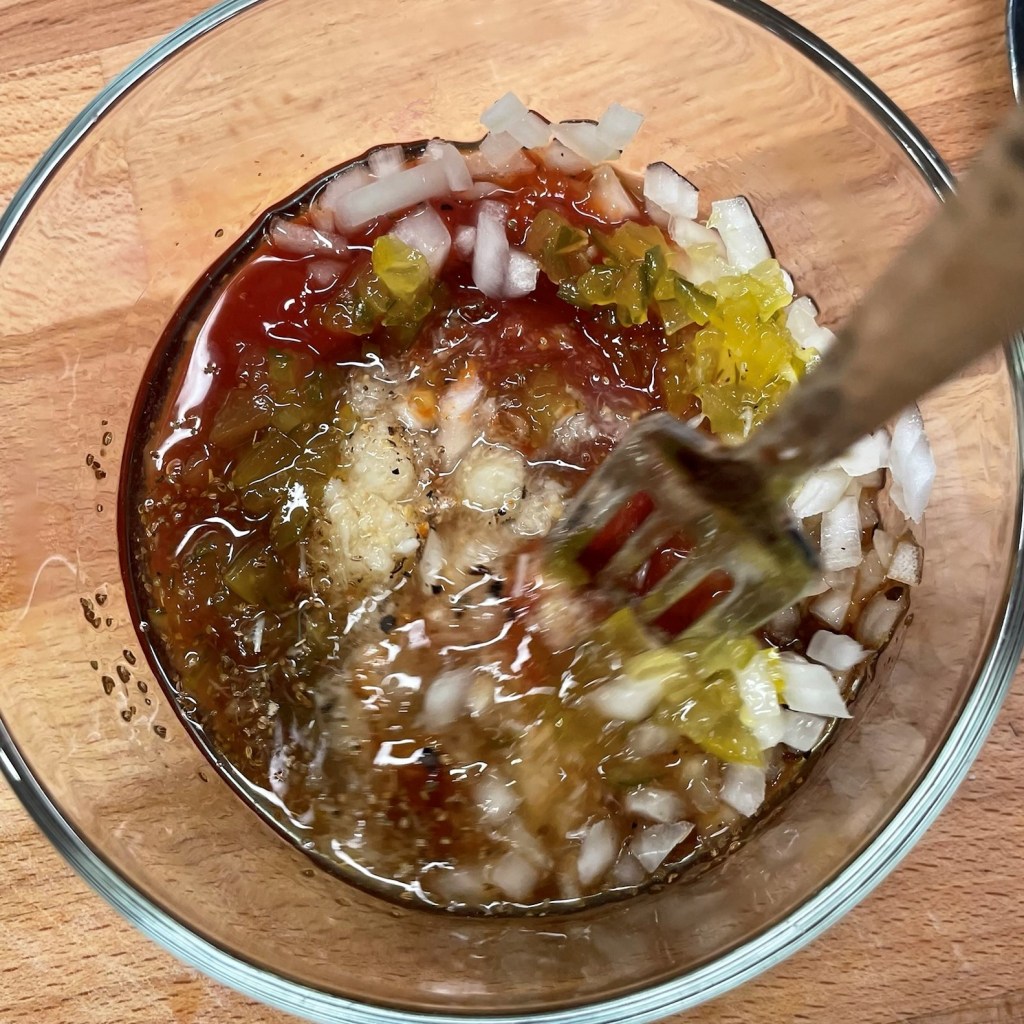
Combine your sauce ingredients in a bowl and add a shot of vodka.
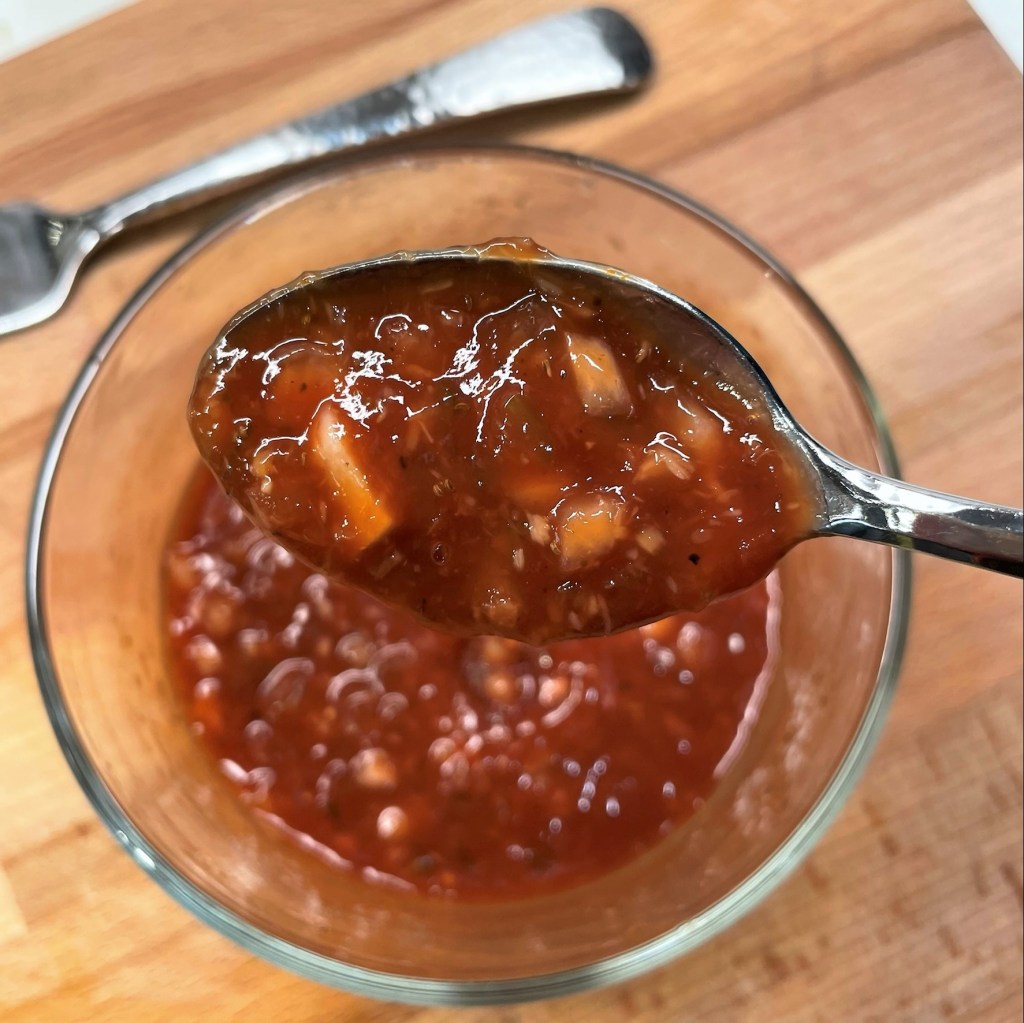
Give it a good stir, and adjust the flavors to taste.
I love to see the chunks of onion and pickle, but if you prefer a smoother sauce, you can pulse the ingredients in a food processor.
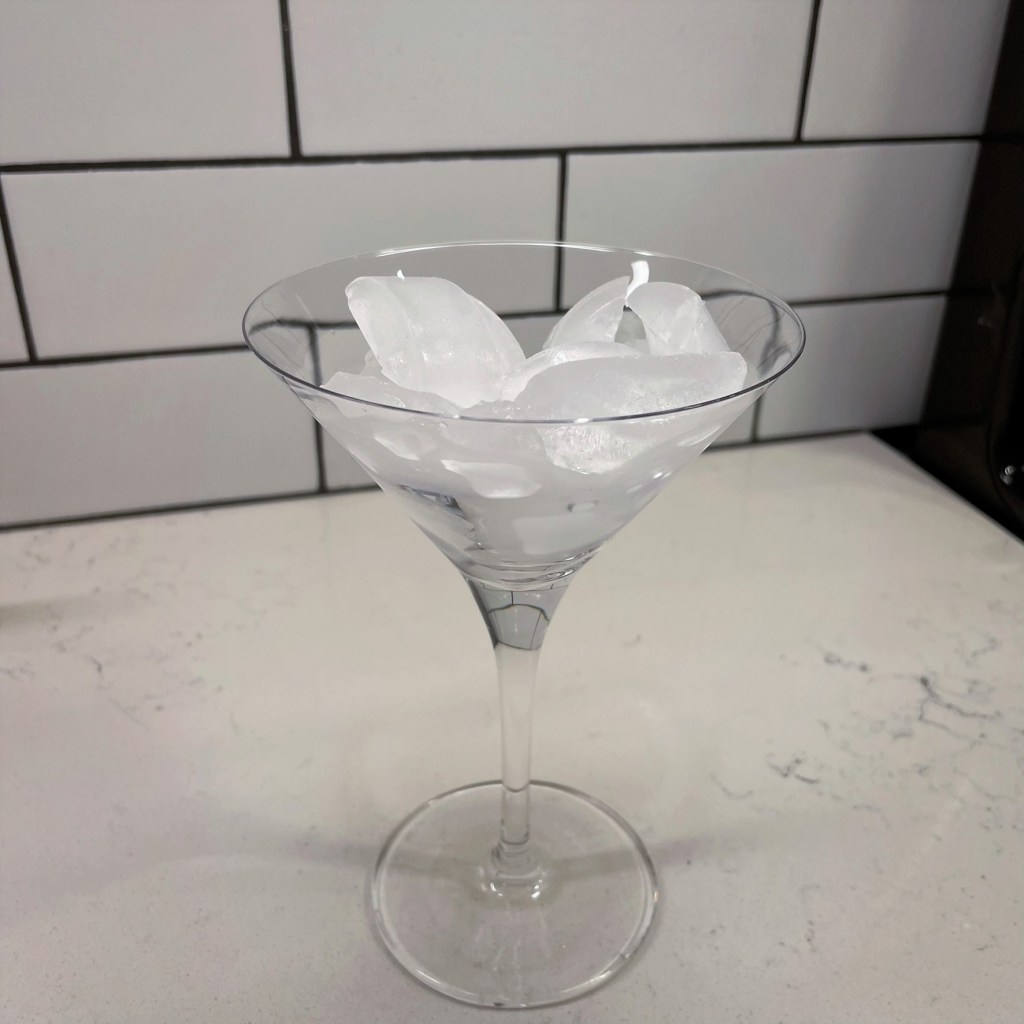
Chill your cocktail glasses by adding ice or ice water to them.
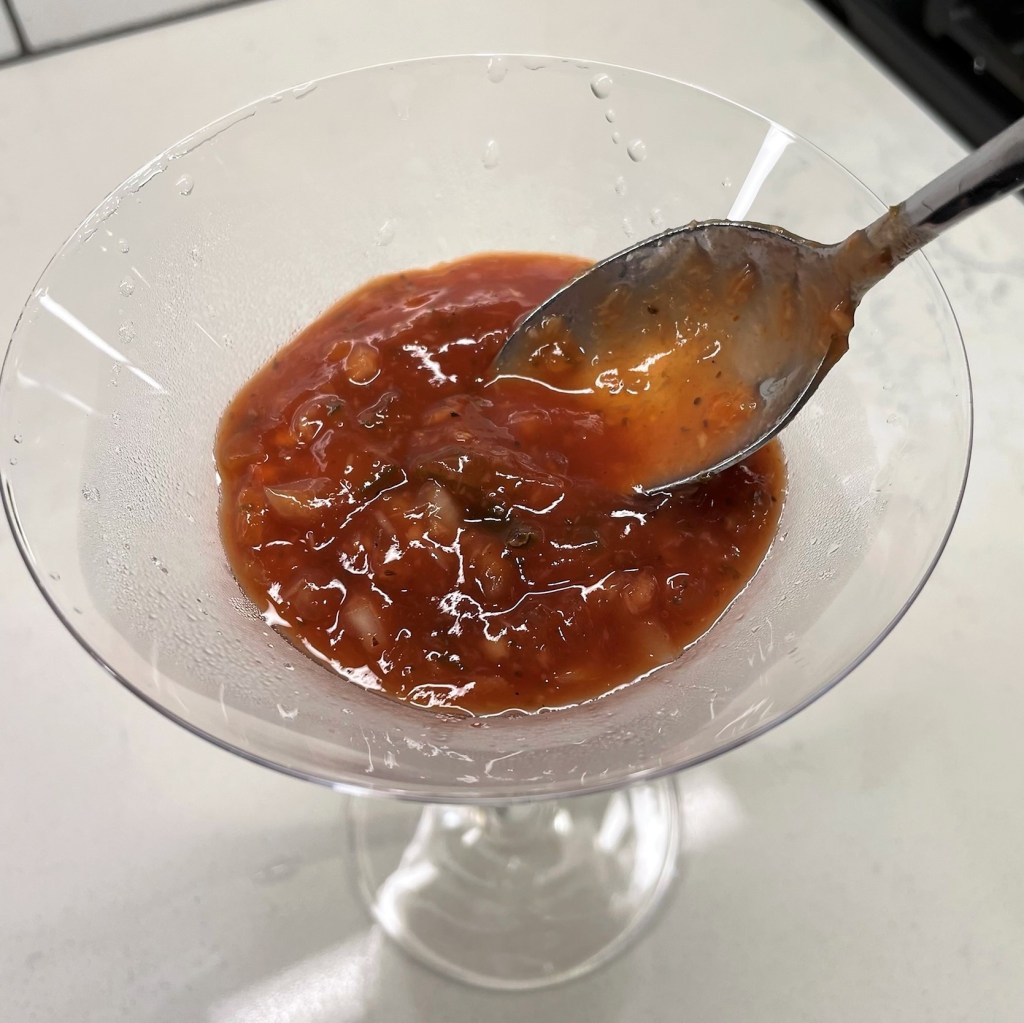
When shrimp are chilled, empty ice from the serving glasses and spoon the cocktail sauce into the glasses.
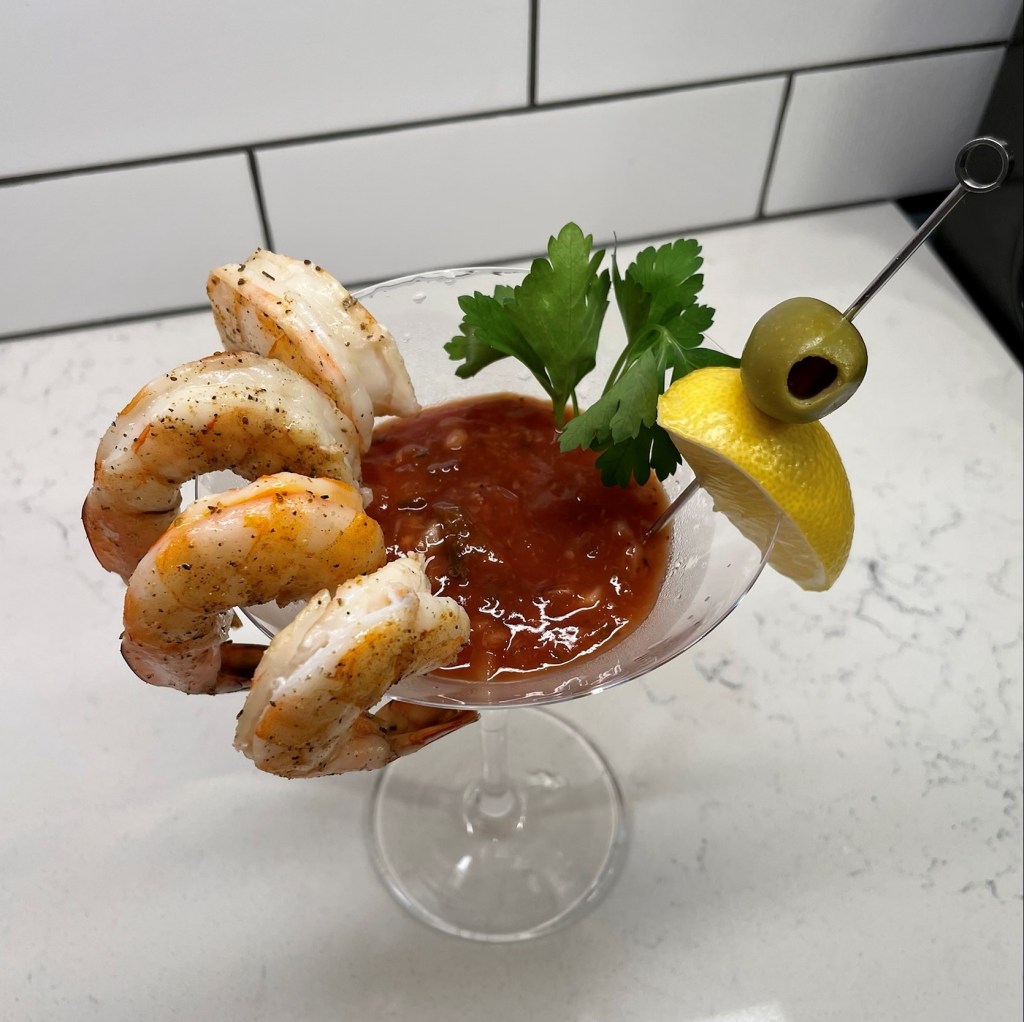
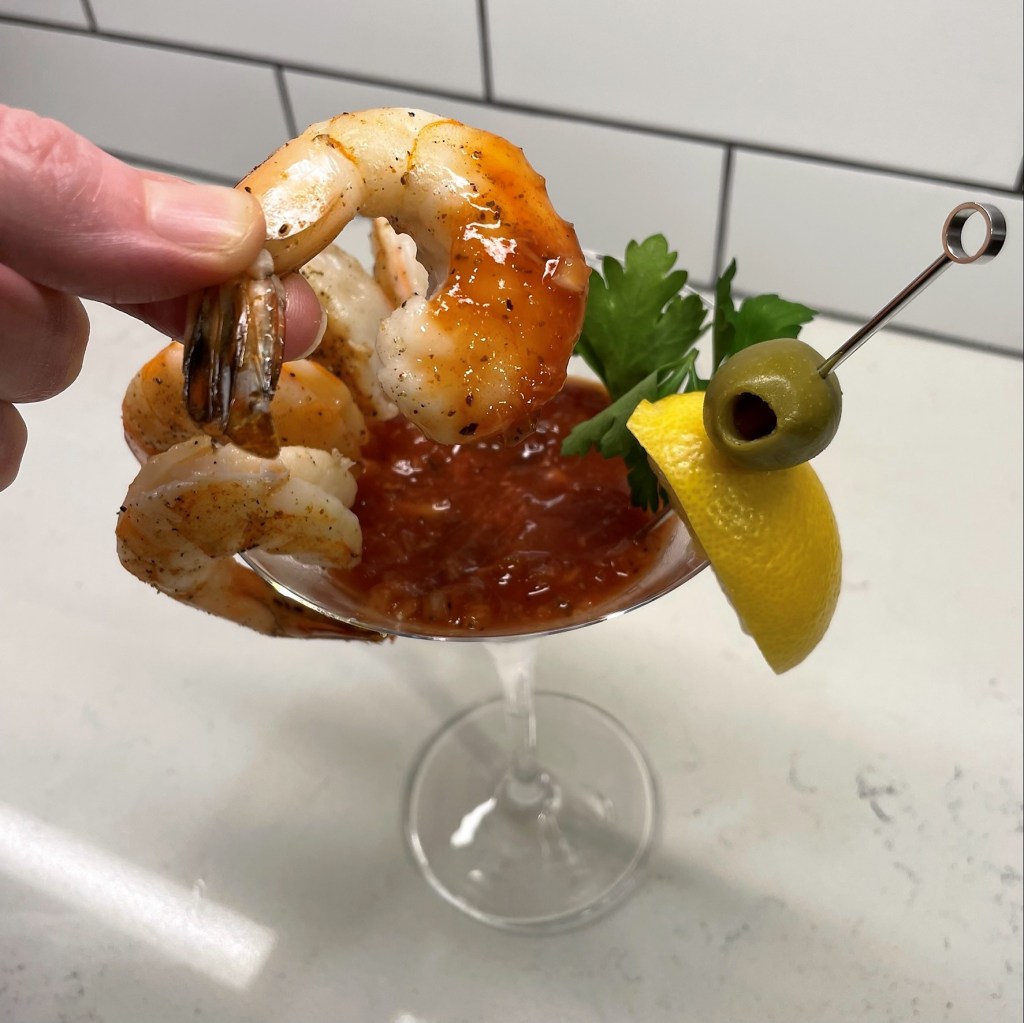
Arrange the chilled shrimp along the edge of the glass. When using jumbo shrimp, 3 is good for an appetizer serving.
OK, I splurged and went for four! Garnish as you would a bloody mary. I used a lemon wedge and a pimento-stuffed olive. But, as with a bloody Mary, anything goes!
Cook the shrimp, using your preferred method. Chill it thoroughly in the refrigerator before serving.
Stir all sauce ingredients together in a bowl and chill until ready to serve. For presentation, spoon about 2 tablespoons of sauce into a shallow cocktail glass and hang the chilled shrimp on the edge of the glass. Garnish with a wedge of fresh lemon and a cocktail olive, onion, pepperoncini, etc.
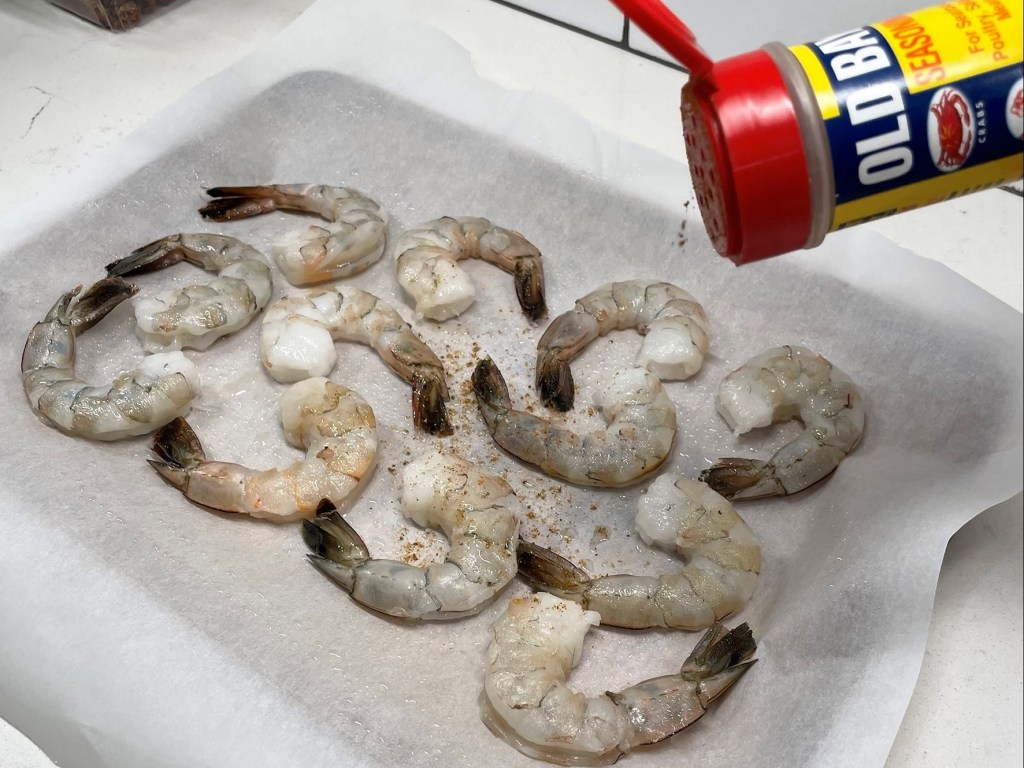
The roasting method may seem fussy, but it is actually easier than boiling or steaming, because it doesn’t move so quickly. It’s so frustrating to accidentally overcook something as delicate and expensive as shrimp.
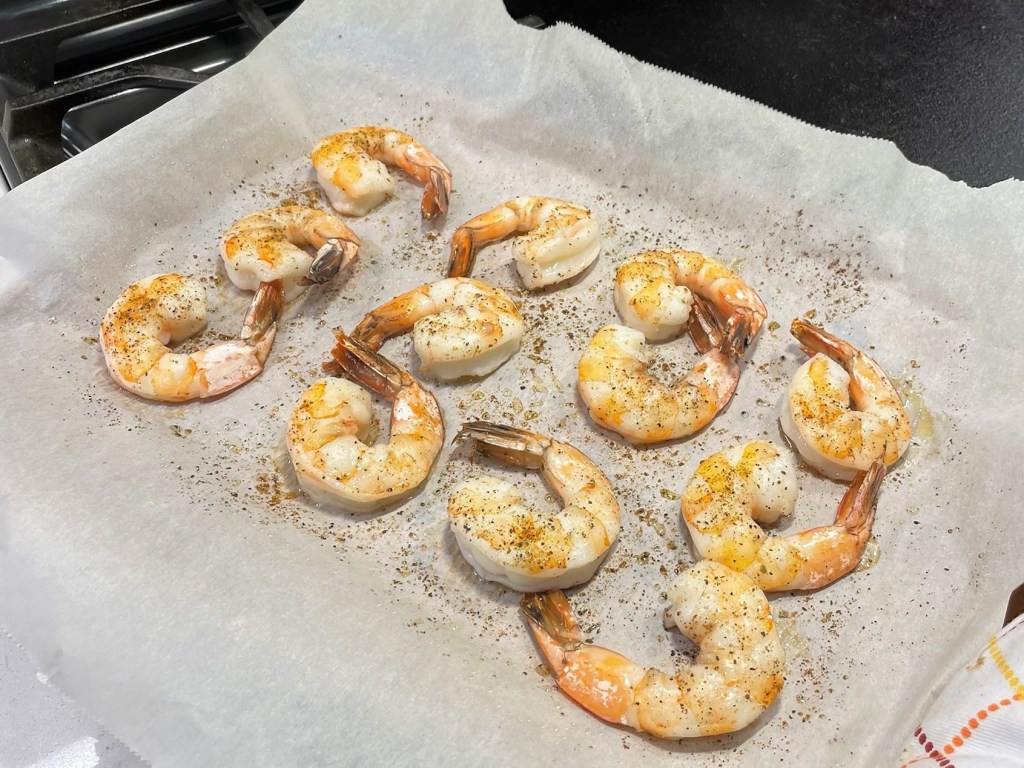
Peel and de-vein shrimp, then toss or spray with olive oil and season lightly with old bay or just salt and pepper. Roast the shrimp at 400 F for 7 minutes, then transfer to a bowl and immediately place them in the freezer to chill them down.
Preheat the oven to 400° F, with oven rack in center position. Peel and de-vein shrimp and arrange them on a parchment-lined baking sheet. Give them a quick spray of olive oil (or toss them lightly in olive oil) and sprinkle both sides lightly with Old Bay seasoning or (more simply) salt and pepper.
Roast for 7 minutes, until shrimp are just opaque. Immediately transfer shrimp to a bowl and chill them down quickly in the freezer for several minutes or plunge the bowl into a larger bowl filled with ice. The goal is to bring down the temperature quickly so that the shrimp don’t overcook to become tough.
“Trust me, you have to order the spinach Maria as your side,” was the instruction given to me, in no uncertain terms, by at least six of my now-husband’s family members, who had gathered from every corner of the world for his mom’s 90th birthday celebration in Boca Raton, Fla. On our second or third day of this visit, which I should mention was my first introduction to Les’s family, about 16 of us were seated at a very long table at the Ke’e Grill, an upscale Boca restaurant that specializes in exquisite seafood dishes. I watched and listened as the server moved along the table, taking order after order for spinach Maria. It didn’t seem to matter whether the desired entrée was lobster tail, shrimp or salmon—even steaks, chops or chicken—literally everyone at our table ordered the spinach Maria, and it appeared true for the tables around us as well.
What was this mystical side dish, I wondered, that was so delectable that it united all the personalities present at this table and beyond? Creamy, crumb-topped heaven in a ramekin, that’s what.
“Maria! I’ve just met a spinach named Maria!”
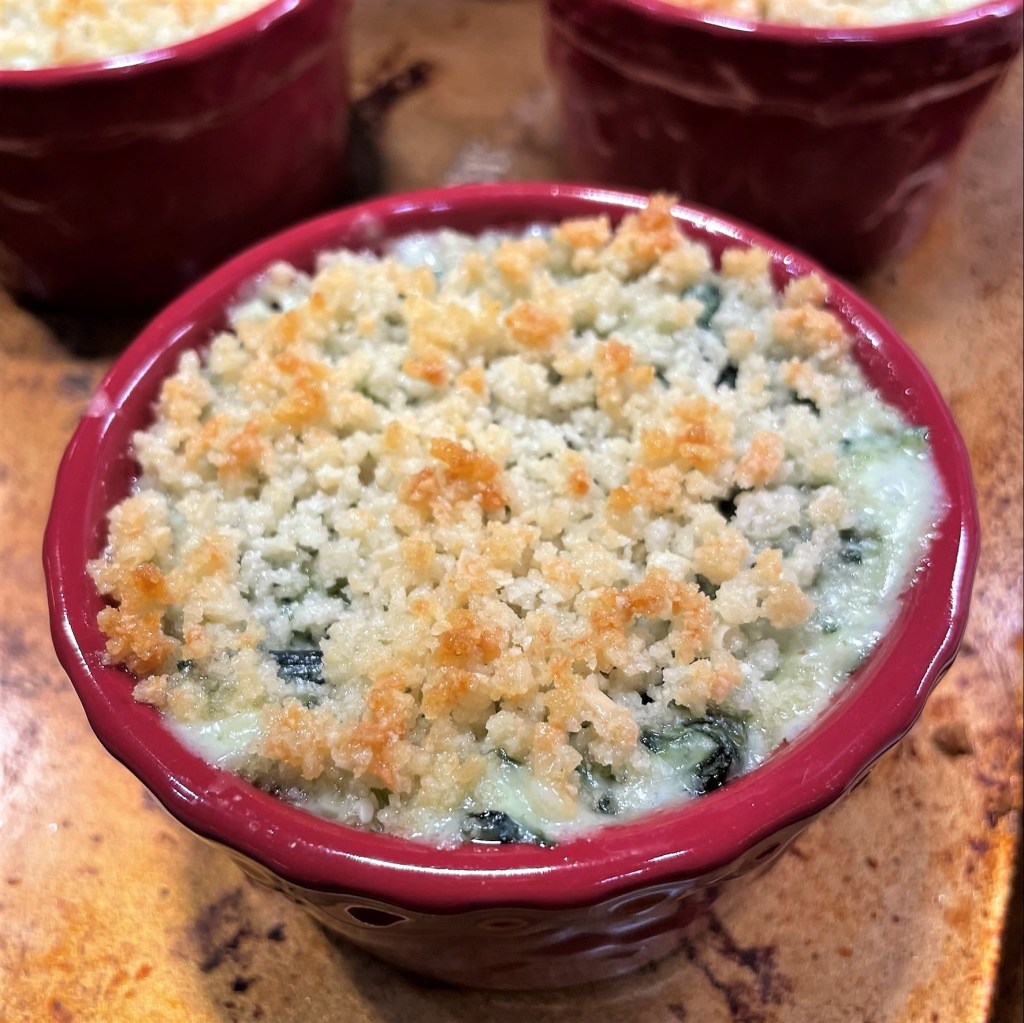
This was no ordinary creamed spinach, and on subsequent visits to Boca, I requested return trips to Ke’e Grill so that I could experience the flavors enough to deconstruct it in my mind and then recreate it at home. I have made it three times in recent history, and after a few tweaks here and there, I’m finally confident to share my version of this memorable side dish. The base of the sauce is a bechamel, but only barely thickened because the cream and cheese are weighty themselves, and the spinach adds quite a bit of body. The buttered panko crumb topping is a delightful textural contrast to the richness that bubbles underneath.
It is relatively easy to make, but it takes a bit of time, and the Ke’e Grill menu even reminds guests to be patient for spinach Maria, as it is made to order and baked to bubbly, crispy perfection just before serving. If you wish to make it ahead, perhaps for an elegant New Year’s Eve dinner, prepare the filling and portion it into ramekins, then refrigerate up to 24 hours. Bring the ramekins to near-room temperature before topping and baking.
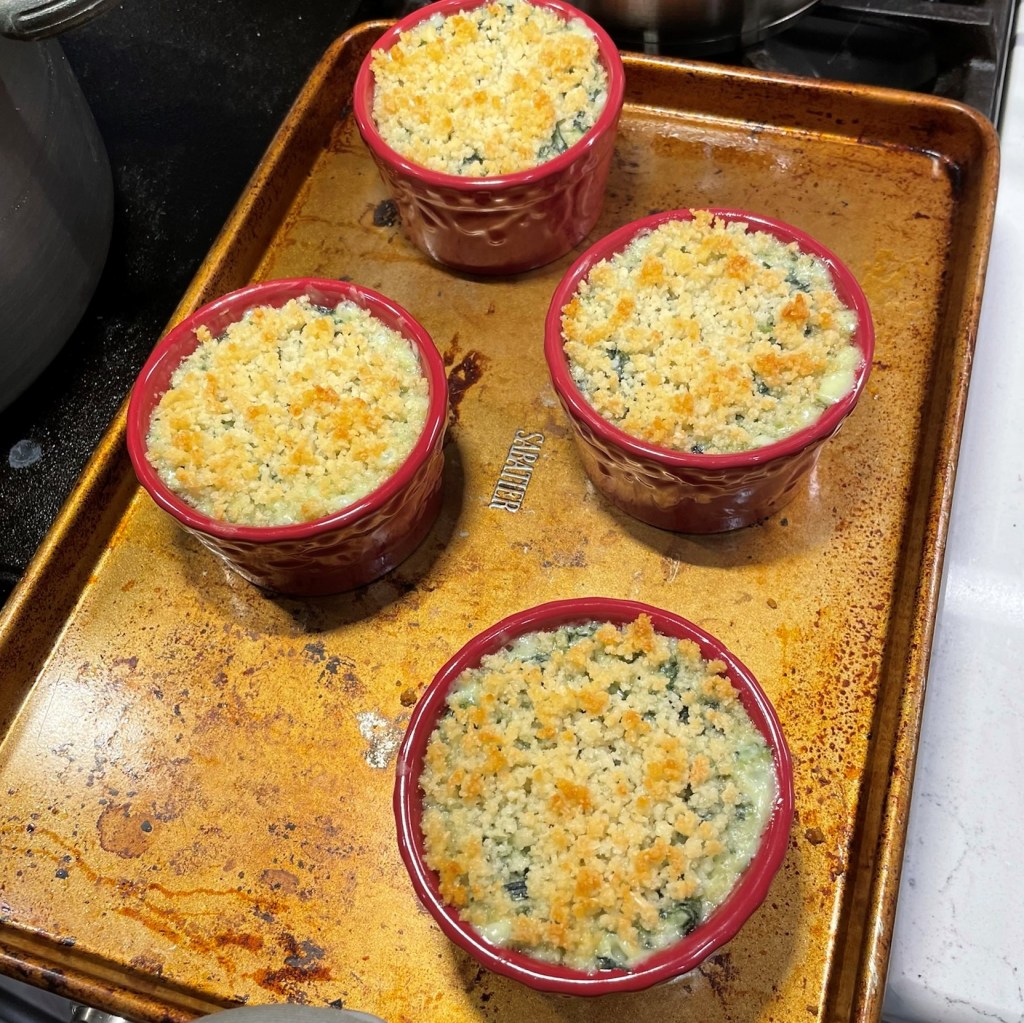
Hot and bubbly from the oven, and a great crispy texture in the crumbs on top.
Ingredients (for 6 servings)
1 lb. frozen chopped spinach, thawed and squeezed very dry
6 Tbsp. unsalted butter
3 Tbsp. all-purpose flour (a 1:1 gluten-free alternative would be fine)
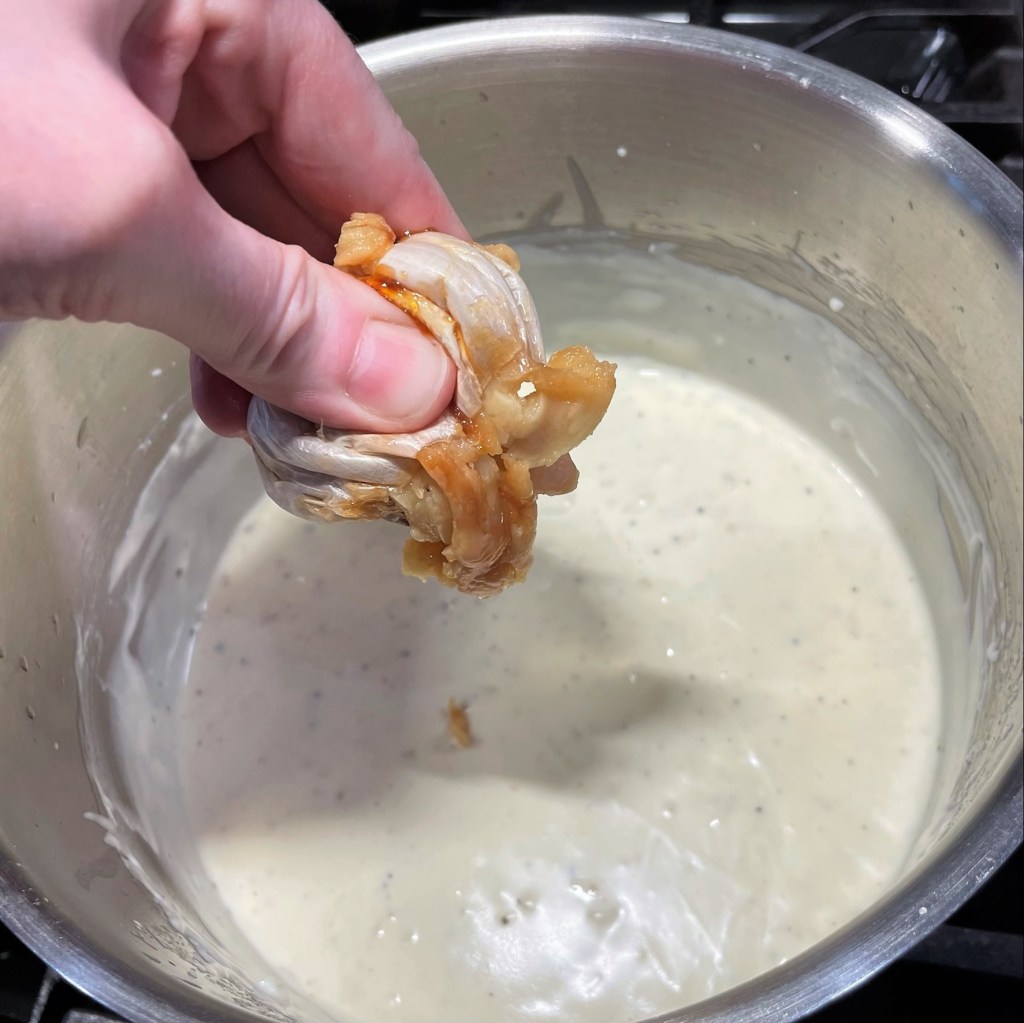
It is important that you use roasted garlic, and not fresh, which would be much too sharp for spinach Maria. If you have never made your own roasted garlic, you can follow the recipe link for easy instructions, and you’ll want to make that ahead so it is ready for your spinach Maria.
We keep a large container of freshly grated parmesan and romano cheese blend on hand all the time, and you can follow that recipe link as well if you’d like to give it a try. Or simply use a good quality parmesan from the supermarket deli (please, for the love of good food, not the stuff in the shiny green can).
Instructions
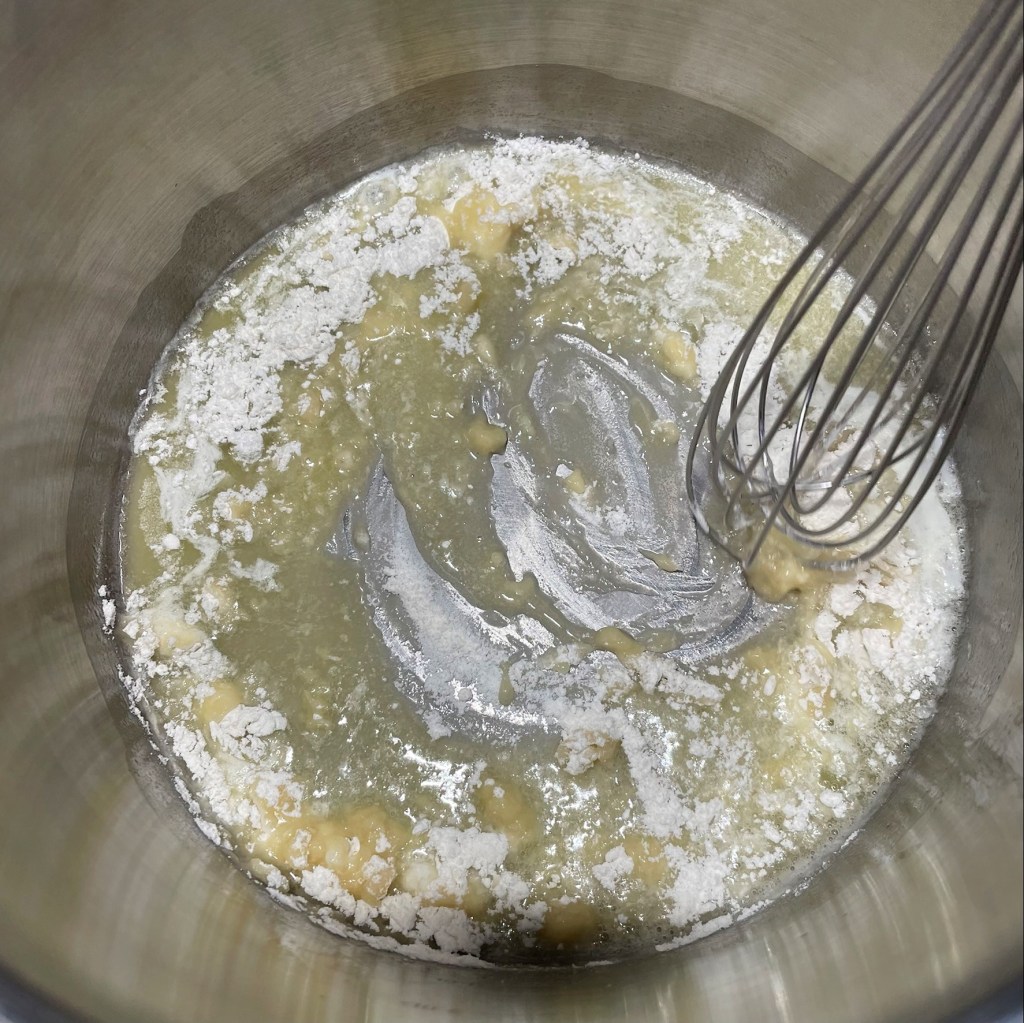
Spinach Maria begins with a simple roux, but half the usual flour.
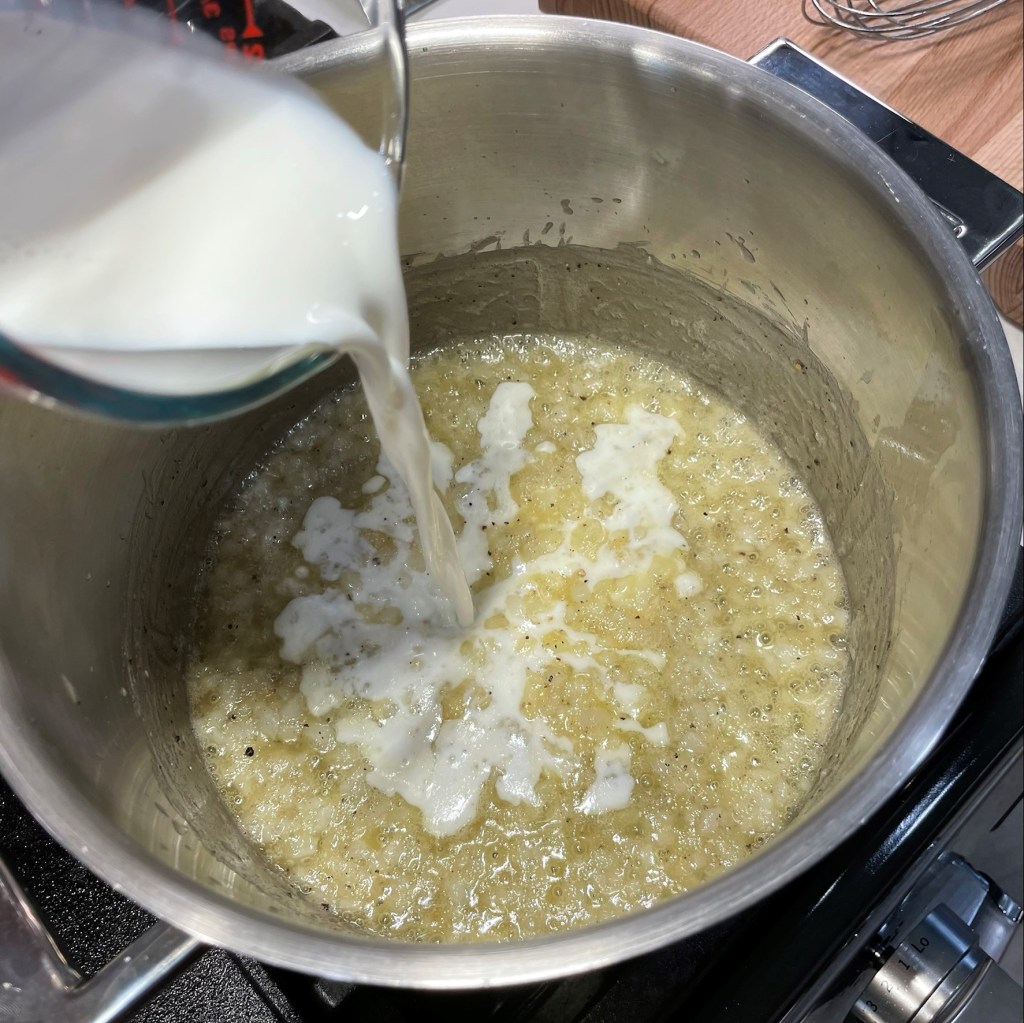
Simmer the roux a few minutes with minced shallots, then whisk in the milk and cream.
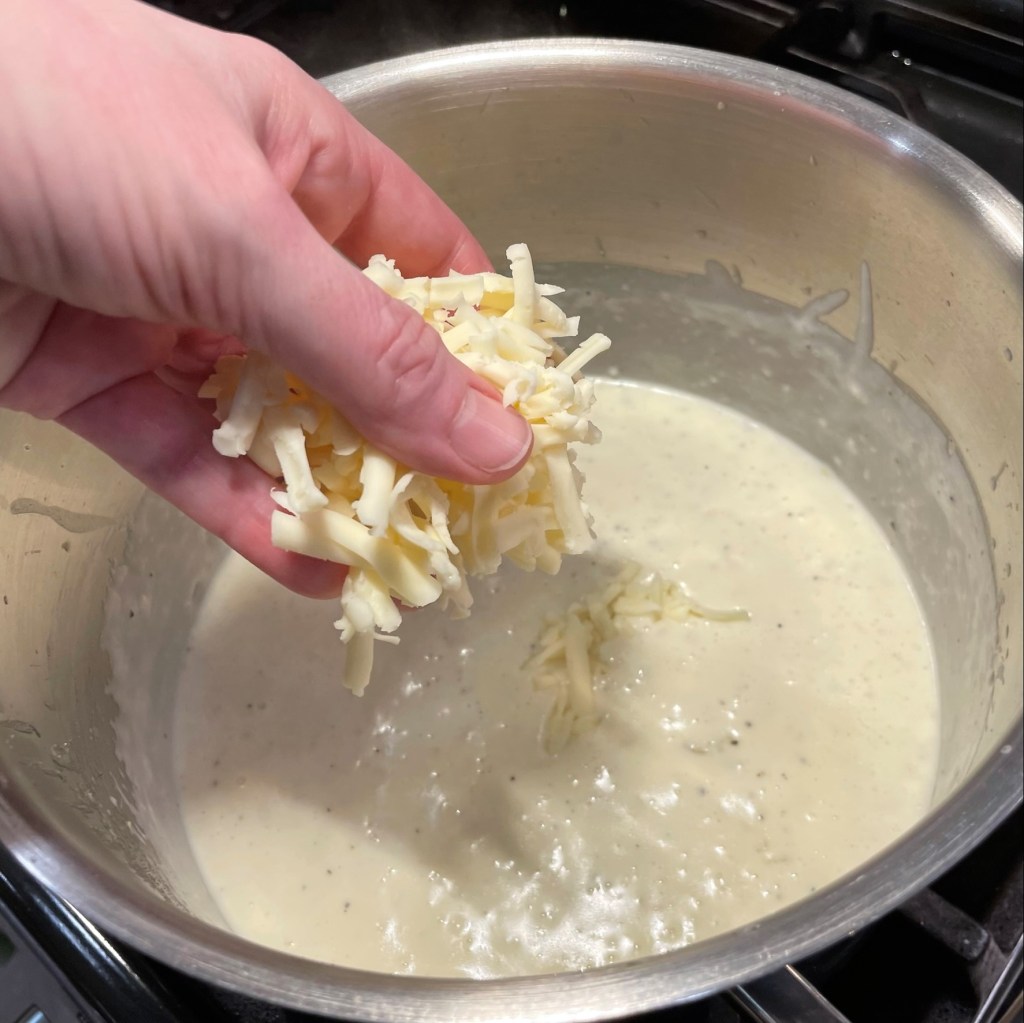
Blend in both kinds of cheese, and stir in cayenne and dry mustard.
A whole bulb of roasted garlic lends a lot of depth to the sauce.
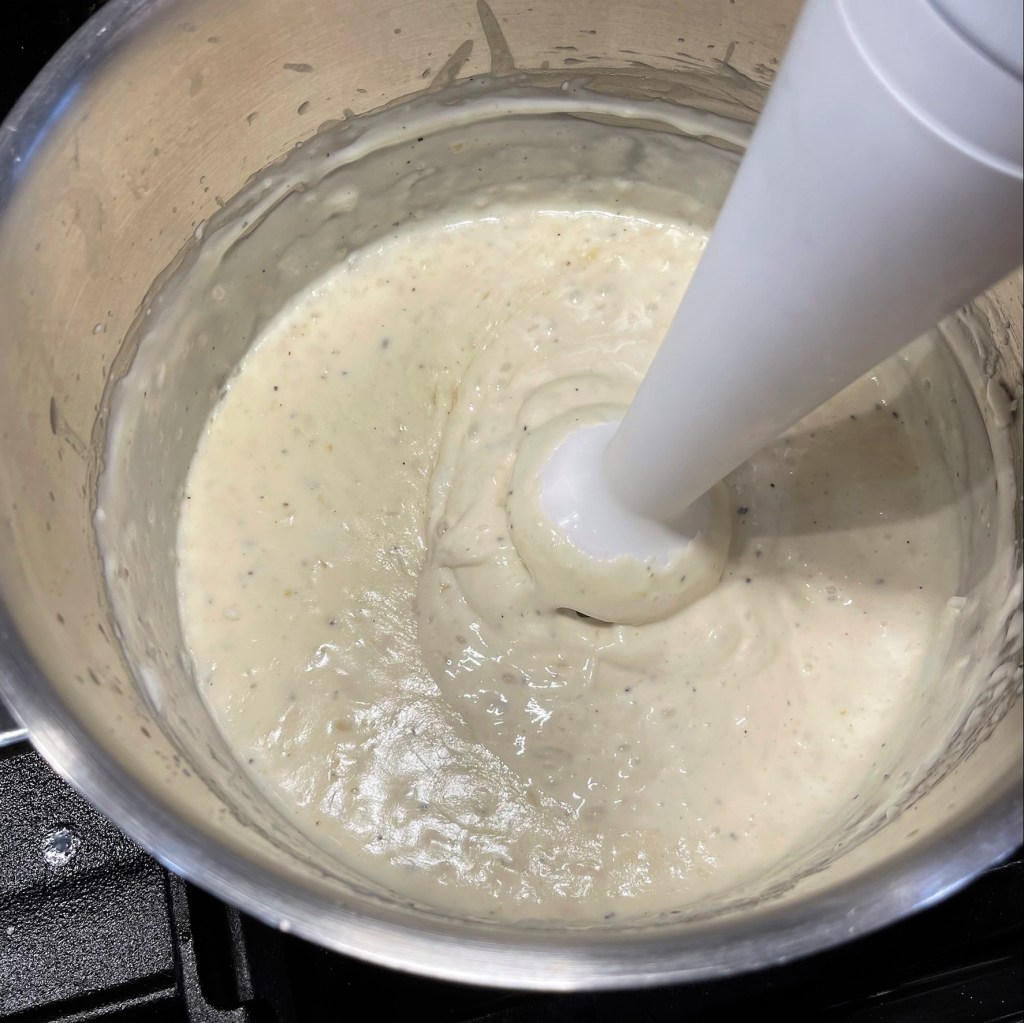
If you have an immersion blender, take it for a 60-second spin through the finished sauce to make it ethereally creamy.
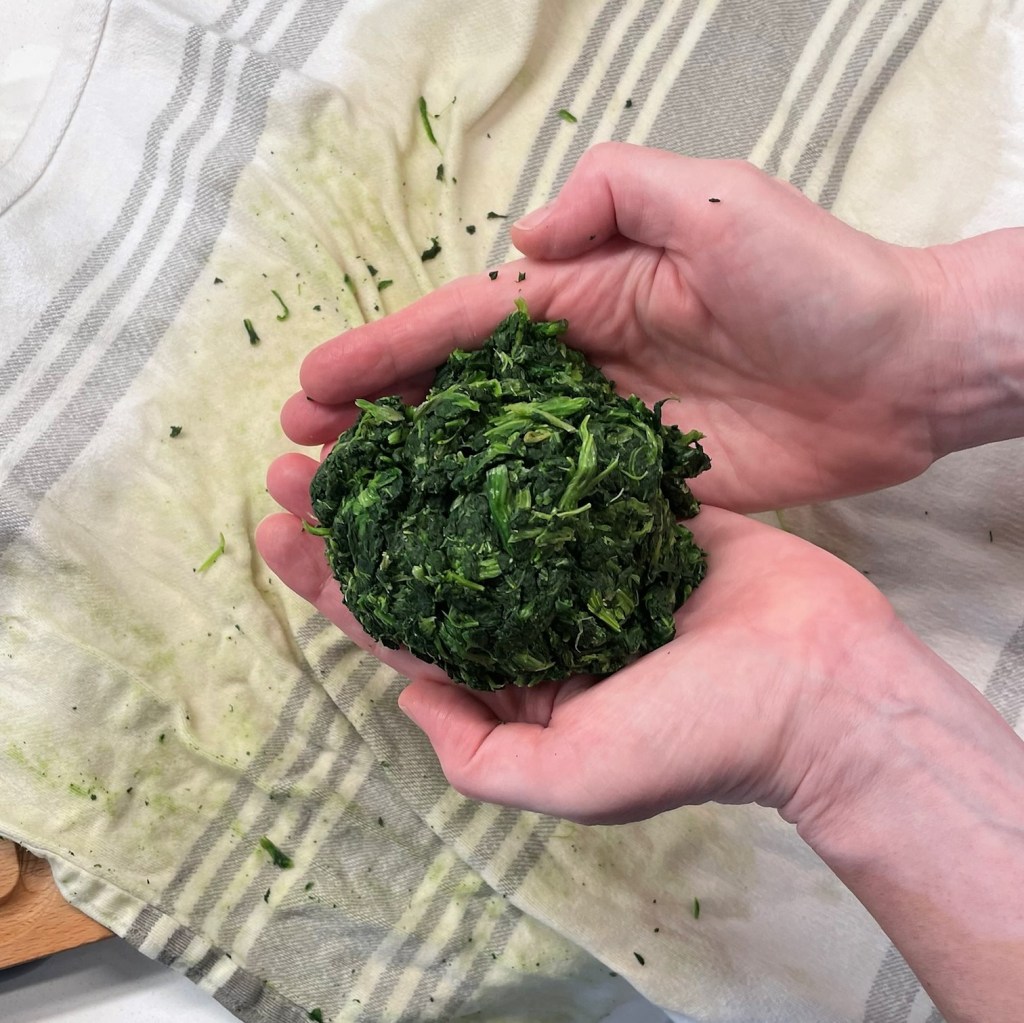
The spinach should be squeezed as dry as possible. Compacted like this, it measures about a heaping cup.
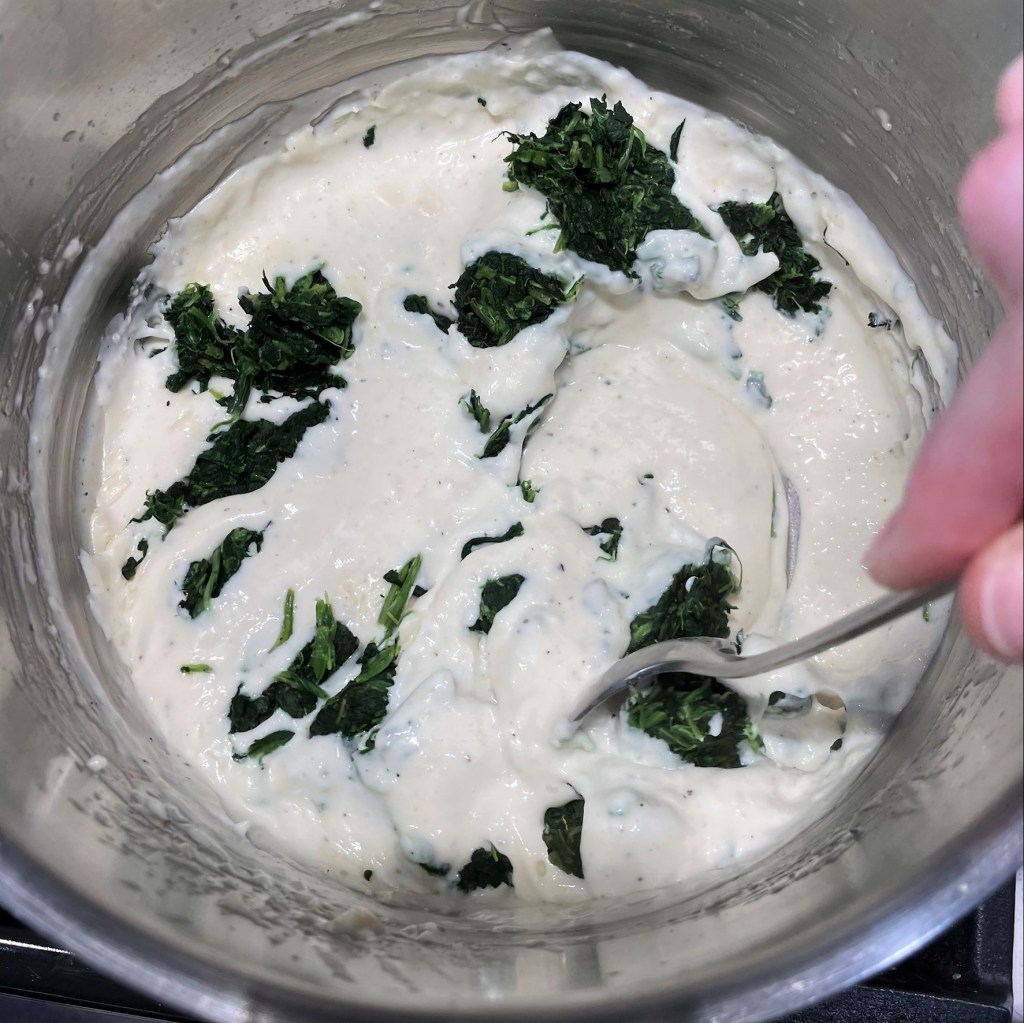
At first, it will seem there isn’t enough spinach, but trust the process and keep stirring.
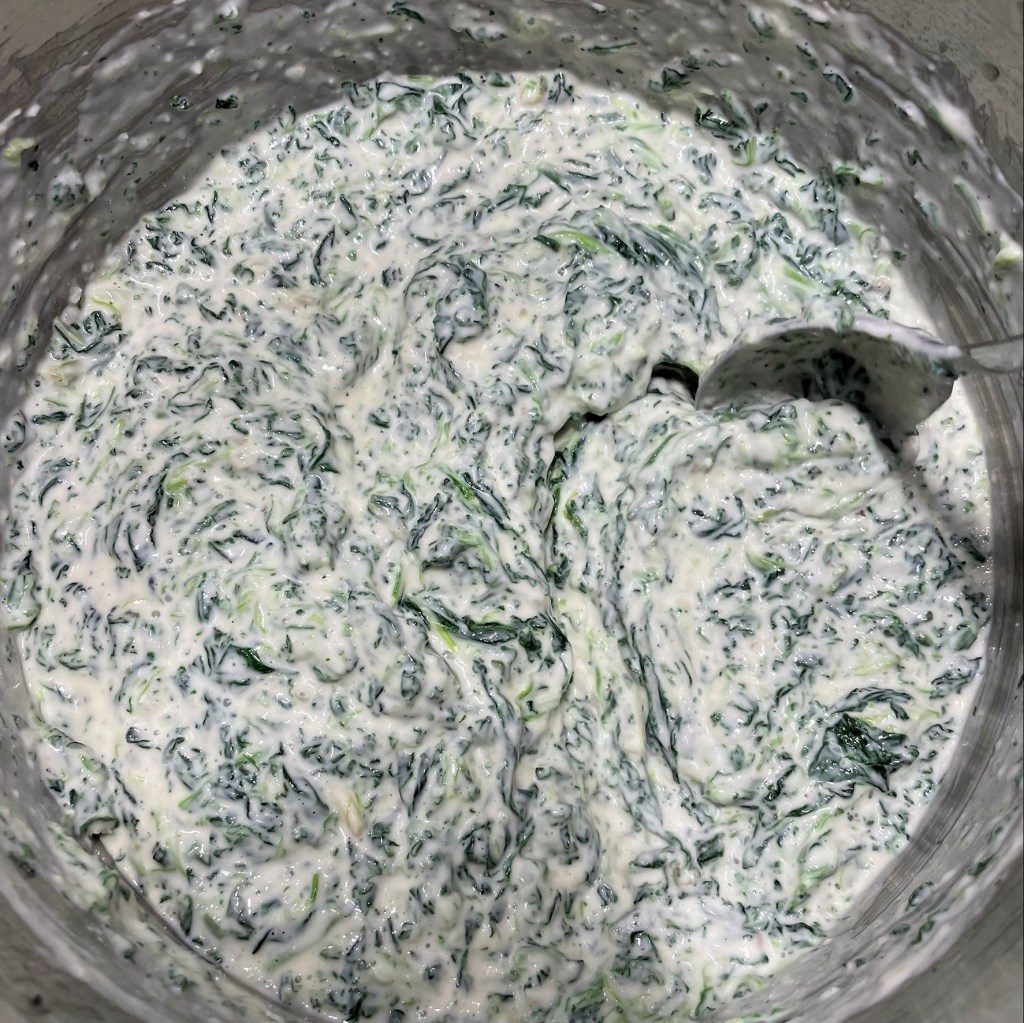
Eventually, the compacted spinach will break apart into individual shreds and it will be perfect.
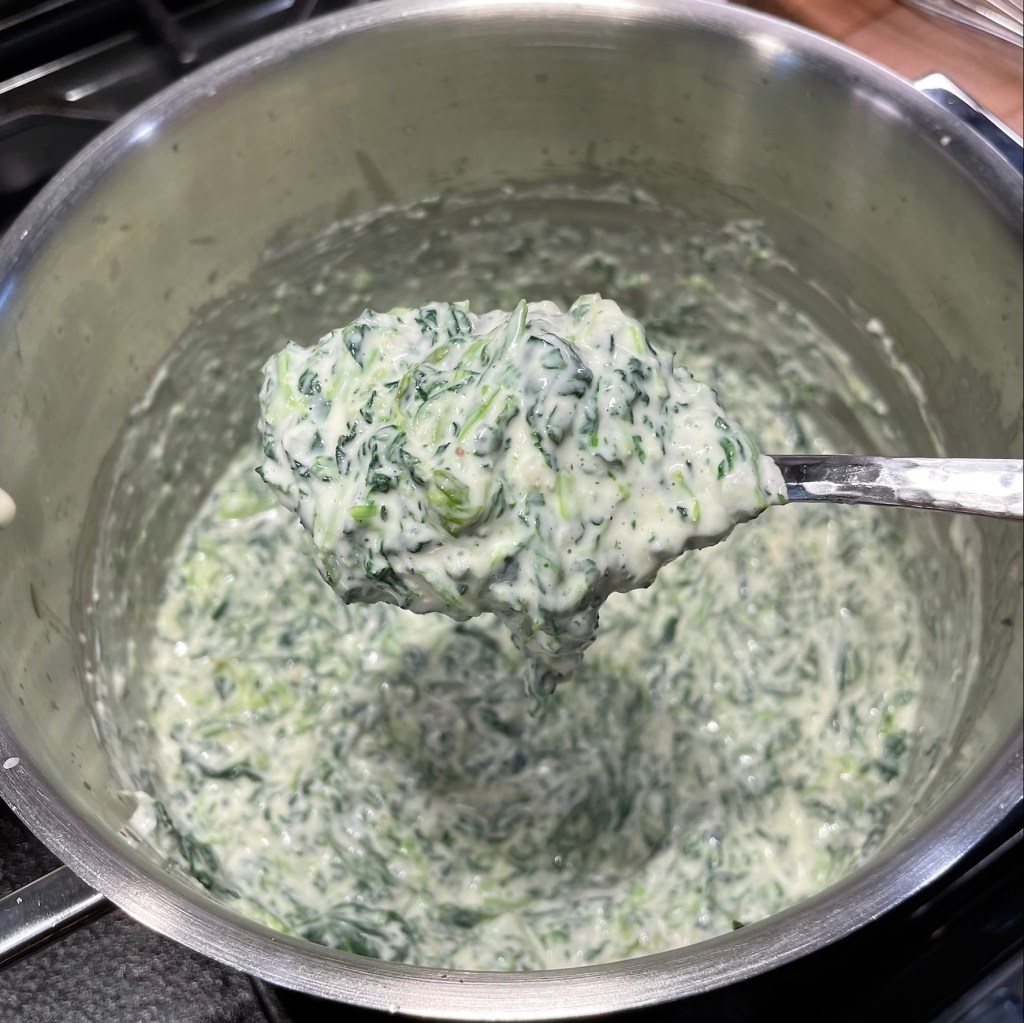
I love how the spinach gives off its green color to the cream sauce. Divide the mixture into 6 ramekins.
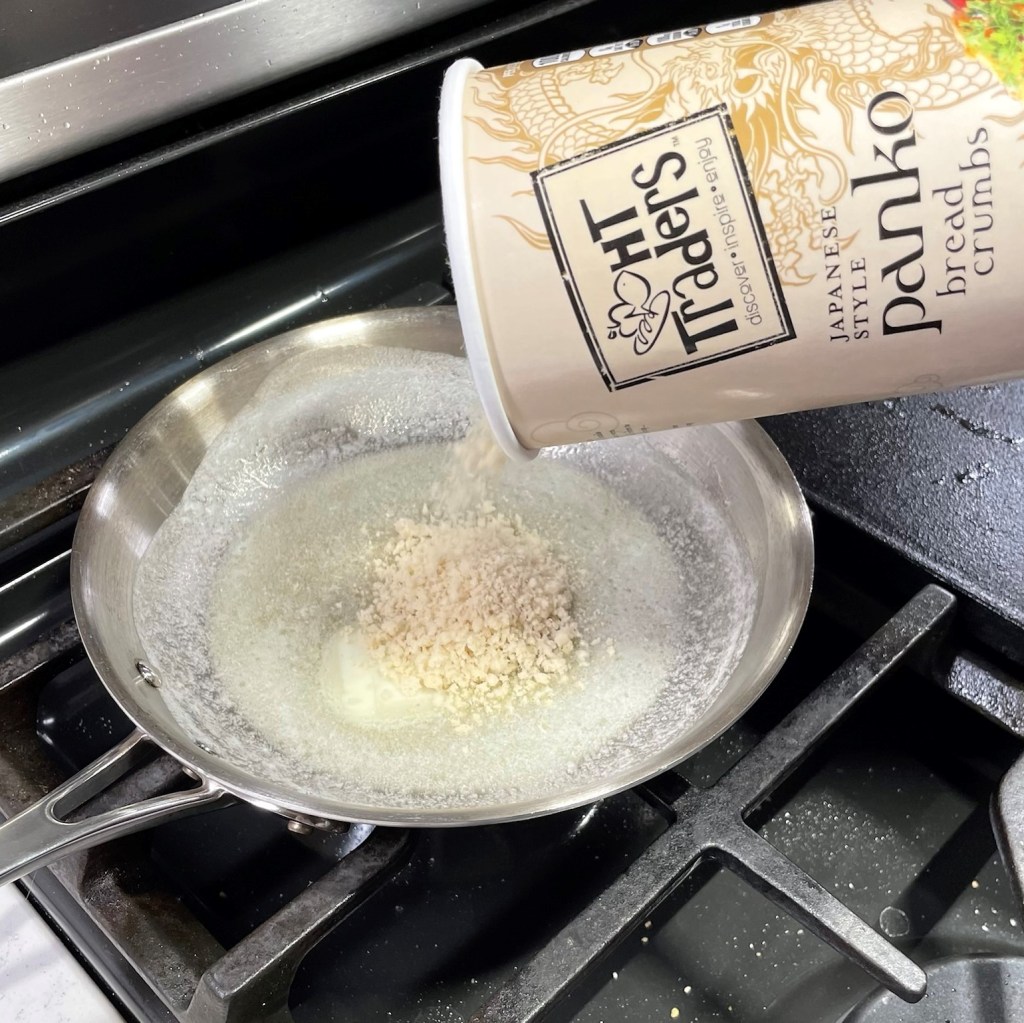
Melt butter to moisten the panko crumbs for the topping. Regular bread crumbs would be fine, too.
Sprinkle a little parm-romano or parmesan into the crumbs.
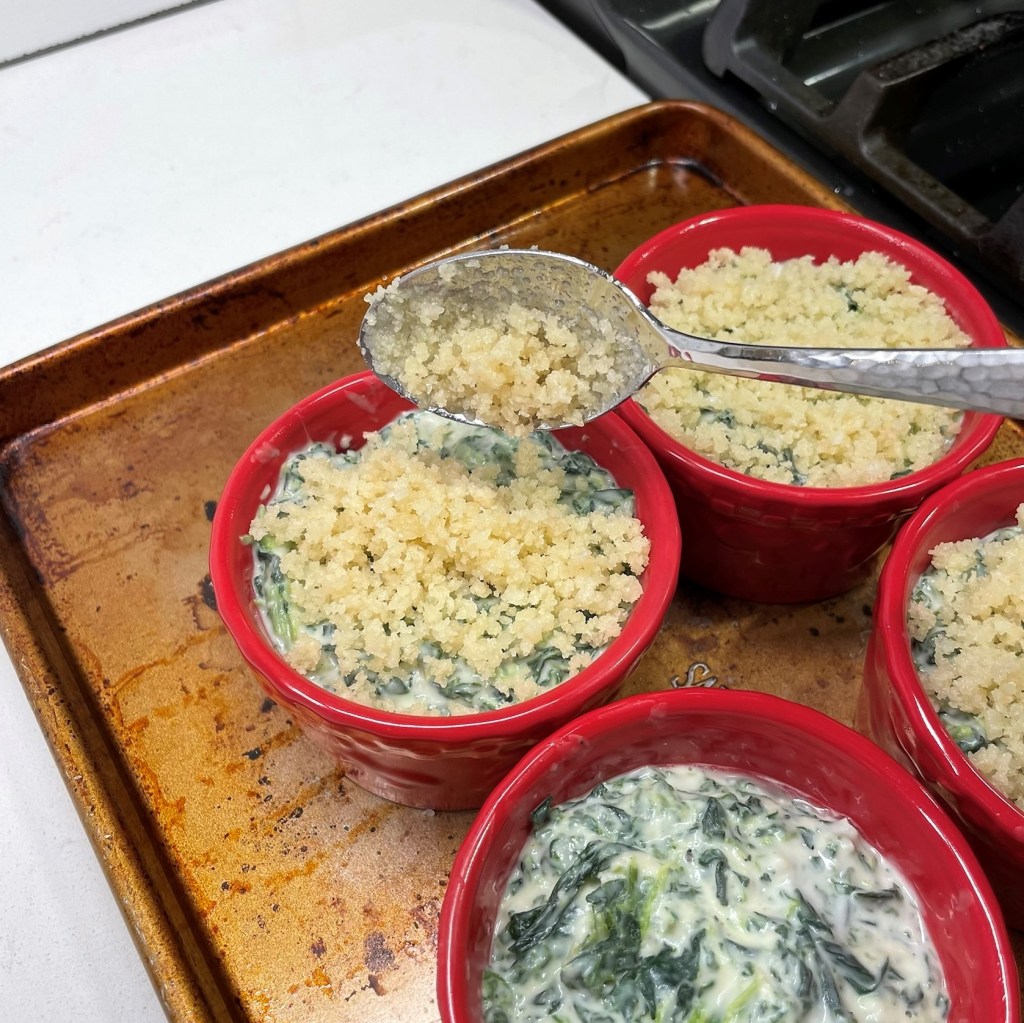
Divide the crumb topping among the ramekins just before baking. If you do this too early, the crumbs will not crisp as well in the oven.
Hot and bubbly from the oven, and a great crispy texture in the crumbs on top.
Prepare the spinach by thawing, rinsing and draining. It must be squeezed very dry for this recipe, and I recommend spreading it out onto a clean, unscented kitchen towel and rolling and twisting to extract all the excess moisture.
In a medium, heavy-bottomed sauce pot, melt the unsalted butter. Stir in the flour and minced shallots. Season with salt and pepper and cook over medium-low heat a few minutes, until the mixture is bubbly and has a slight nutty fragrance.
Add the milk all at once and whisk until smooth and thickened. Stir in the heavy cream until blended. Add the fontina and gruyere cheeses and stir until melted through. Stir in cayenne and dry mustard. Squeeze the roasted garlic directly into the sauce and whisk to break up the pieces.
Optional: At this point, the cream-cheese sauce will appear chunky, with visible bits of softened onion and roasted garlic. If you have an immersion blender, I highly recommend using it to cream up the sauce further; 60 seconds should do it. This step is optional, but it amplifies the creamy texture of any bechamel-based sauce, so I do it even for simple mac and cheese recipes.
Break up the packed dry spinach into the sauce and stir to blend it. It may seem that there is not enough spinach to match the sauce, but as you stir and blend, the bits will separate and disperse more evenly. Give the mixture a taste and adjust seasonings (salt, pepper, cayenne) to your liking.
Divide the spinach Maria mixture evenly into six 1/2-cup ramekins and place them on a small baking sheet. If you are preparing it ahead, cover them with plastic wrap and refrigerate up to one day. Bring them to near-room temperature before baking.
In a small saucepan or skillet, melt salted butter and toss the panko crumbs in it until moistened. Stir in parm-romano blend just until evenly mixed. Divide the topping among the ramekins. Bake on the cookie sheet at 350° F for about 25 minutes, until the crumb topping is crispy and golden, and the spinach Maria is bubbly at the edges. Serve immediately.